HOA Karen Bragged About Towing My “Ugly Jeep”—She Didn’t Know It Was an Undercover Police Task-Force Vehicle
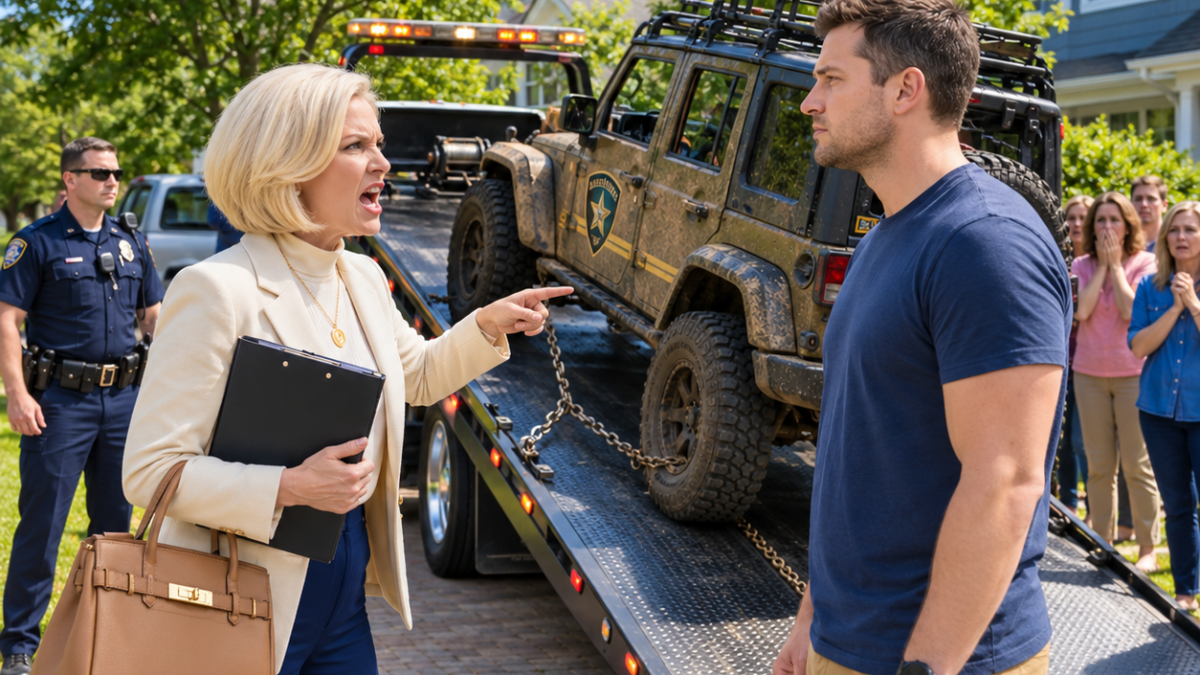
HOA Karen Bragged About Towing My “Ugly Jeep”—She Didn’t Know It Was an Undercover Police Task-Force Vehicle.
Diane Prescott stood in my empty driveway with a $14,000 handbag on her arm, posed beside the tow truck, and posted forty-three likes’ worth of congratulations after removing the muddy Jeep she had spent three months calling an embarrassment to the neighborhood.
What she did not know was that the battered 2005 Wrangler was registered through a law-enforcement shell company, wired with concealed surveillance equipment and encrypted radios, and assigned to the narcotics task force I had spent eleven months helping investigate a fentanyl network moving pills across central North Carolina.
By the time she learned why federal agents were standing inside her HOA clubhouse, the Jeep was almost the least of her problems—because the tow she bragged about exposed something far uglier than mud on a fender: years of inflated contracts, payments to relatives, false complaints, and an HOA president who had finally mistaken control for authority one time too many.
“You have twenty-four hours to remove that eyesore from my street.”
Diane Prescott said it while standing in my driveway.
That detail mattered.
Not the sidewalk.
Not the street.
My driveway.
Fourteen Magnolia Court.
Property line clearly marked.
Mortgage in my name.
County tax bill in my mailbox.
And yet she stood three feet from the front bumper of my Jeep with a clipboard tucked beneath one arm and looked at the vehicle the way a restaurant manager might look at a dead rat on the floor.
I was still wearing the jeans and faded gray T-shirt I had slept in.
It was 7:11 on a Saturday morning.
I had gotten home from work at 2:38.
Diane had apparently decided six hours of sleep was too generous.
I looked at the Jeep.
Then at her.
“Ma’am, it’s in my driveway.”
“I’m aware.”
“Then I’m confused about the phrase your street.”
Her eyes narrowed.
She was fifty-four.
Silver-blond bob cut so precisely that every strand seemed to understand HOA regulations.
Cream blazer.
Pearl earrings.
Gold watch.
A handbag that looked expensive enough to need its own insurance policy.
The kind of woman who could make “good morning” sound like documentation of misconduct.
She tapped the clipboard with one manicured finger.
“The board has received repeated complaints.”
“From who?”
“That information is confidential.”
“So you?”
“I said the board.”
“Which you run.”
Diane inhaled slowly.
I had known her less than three months and already recognized the inhale.
It meant:
I am about to explain something obvious to someone I consider beneath explanation.
“Mr. Callaway, Brierwood Station has standards.”
“I read the covenants.”
“Then you know visible vehicles must remain consistent with the appearance of the community.”
“That isn’t what the covenant says.”
She blinked.
PART2:
“It says vehicles must be operable, properly registered, and parked on approved surfaces.”
“Your Jeep is unsightly.”
“That word isn’t in there.”
“It doesn’t need to be.”
“Usually words need to be in rules before rules can use them.”
Her mouth tightened.
“You think this is funny.”
“No.”
I genuinely didn’t.
Mostly because I was tired.
Also because the Jeep behind her was not an ordinary vehicle, and every minute she spent photographing it made me more uncomfortable.
The Wrangler was a 2005 Unlimited.
Olive drab.
Paint faded.
Dented rear quarter panel.
Steel brush guard.
Roof rack.
No matching set of tires.
Mud dried along both fenders.
PART3:
If you saw it outside a rural gas station, you would assume its owner hunted deer, repaired his own plumbing, and had opinions about winches.
That was deliberate.
I had spent eighteen months helping use that vehicle as part of a joint narcotics operation.
My name is Jake Callaway.
Thirty-six at the time.
Four years Marine Corps.
Criminal justice degree on the GI Bill.
Six years patrol and investigations with a county sheriff’s office.
Then recruitment into the Tri-County Metro Narcotics Task Force.
The task force combined local deputies and detectives, state investigators, and federal partners who worked larger trafficking cases across multiple jurisdictions.
Our office had no impressive sign.
That was also deliberate.
We operated from an unremarkable suite in a commercial strip where nobody paid attention to who came and went.
The Jeep belonged to the task force through a government-controlled cover entity.
Its registration did not point back to my home agency.
The vehicle carried no visible police equipment.
No light bar.
No spotlight.
No cage.
But behind the ordinary exterior was equipment Diane could not see.
Concealed cameras.
Secure communications.
A hardwired tracking system.
A lockable compartment for operational equipment and sealed materials when authorized.
Nothing about it was designed to impress anybody.
It was designed to disappear.
That made Diane’s obsession with it particularly ironic.
She was angry because the Jeep looked exactly the way we needed it to look.
Cheap.
Dirty.
Forgettable.
She pointed at the right front tire.
“And now they don’t even match.”
“They’re both round.”
Diane looked offended.
“Your neighbor at twelve Magnolia drives an Audi.”
“Congratulations to him.”
“The previous owner of your house drove a BMW.”
“He left it?”
“No.”
“Then I’m not sure how that helps me.”
Her voice cooled.
“I’m trying to help you fit into this neighborhood.”
I leaned against the garage door.
“I bought a house.”
“Not a membership in a car dealership.”
She looked at the Jeep again.
“I’m giving you twenty-four hours.”
“For what?”
“Remove it.”
“No.”
Her expression changed.
It was not anger at first.
It was disbelief.
People like Diane do not necessarily begin as bullies.
Sometimes they simply live so long in systems where everyone decides arguing with them is exhausting that resistance begins feeling abnormal.
I had just become abnormal.
“You won’t remove it?”
“No.”
“Then I will.”
I stood straight.
“Diane.”
She turned.
“You should be careful with that sentence.”
For the first time, she seemed to notice something in my voice.
Not a threat.
I never threatened her.
I did not want attention.
I wanted the exact opposite.
“Is that supposed to intimidate me?”
“No.”
“It’s advice.”
She smiled.
“Mr. Callaway, you are not the first homeowner who thought the rules didn’t apply to him.”
“And you’re not the first person who mistook a contract for a badge.”
Her face went still.
I regretted the sentence immediately.
Not because it was wrong.
Because it made her curious.
“What exactly do you do?”
“Consulting.”
It was the cover I used with neighbors.
Broad enough to explain odd hours.
Boring enough to end most conversations.
“What kind?”
“Compliance.”
That almost made me laugh later.
At the time, Diane nodded as if she had confirmed her suspicion that I did something unimpressive.
“Well, perhaps your professional experience will help you understand consequences.”
She walked toward the street.
Then turned.
“One more thing.”
“Yes?”
“This neighborhood isn’t for everyone.”
Her eyes moved to my Jeep.
“If maintaining basic standards is difficult for you, maybe this street isn’t the right fit.”
I watched her leave.
Then went inside.
Made coffee.
Stood at the kitchen window.
The Jeep sat in the driveway exactly where I had left it.
Four days after I moved into Brierwood Station, Diane had shown up with a bottle of wine and a welcome packet.
At first I thought she was just overinvested.
She wore a cream tweed jacket and carried a folder embossed with the Brierwood Station crest in gold.
Whoever designed the crest had combined oak leaves, a shield, and a ribbon containing the words:
COMMUNITY. PRIDE. EXCELLENCE.
The development had been built in 2016.
Nothing about it was old enough to require heraldry.
Diane handed me the wine.
“Welcome to Brierwood Station.”
Then she stepped sideways and looked past me.
“Is that your vehicle?”
“Yes.”
She stared at the Jeep.
“It’s very…”
I waited.
“Outdoorsy.”
“That’s one word.”
“Most residents park recreational vehicles in their garages.”
“It’s not recreational.”
“What is it?”
“Transportation.”
She did not laugh.
“Just something to consider.”
That should have been the end.
Instead, three weeks later, I came home from a surveillance shift and found the first notice under my windshield wiper.
UNSIGHTLY VEHICLE VISIBLE FROM STREET.
Corrective action:
Store in enclosed garage or remove from property.
Fine after fourteen days:
$75.
Diane had written beneath the printed text:
Just a friendly reminder! Let’s keep Brierwood beautiful.
I put the notice in the glove box.
Then forgot about it.
Not because I believed she had authority.
Because my actual work had become difficult.
Operation Corridor had started as a series of overdose clusters in three counties.
Pressed pills.
Counterfeit prescription markings.
Fentanyl.
Young buyers who believed they were buying something else.
By the time I joined the investigation, the network had moved far beyond street-level dealing.
Storage units.
Rental houses.
Cash couriers.
Regional suppliers.
Encrypted messaging.
Vehicles changed often.
Phones changed faster.
The Jeep spent nights parked outside warehouses, gravel roads, rural houses, and truck stops.
Mud accumulated.
Dents happened.
Nobody cared.
Except Diane.
Notice two arrived twelve days after notice one.
This one included photographs.
She had measured how far the Jeep sat from the garage door.
Seventeen inches.
She described “visible soil accumulation.”
Soil accumulation.
That phrase went onto a legal-looking HOA form about a Jeep that had spent the previous night beside a soybean field while I monitored a suspected stash location.
Notice three objected to the brush guard.
Notice four included twelve color photographs.
Front.
Rear.
Both sides.
Tires.
Roof rack.
Dent.
One photograph zoomed in on a faded Carolina Mudders sticker left by whoever had used the vehicle before our unit acquired it.
Diane circled it in red.
UNAUTHORIZED EXTERIOR DECAL.
I brought the packet to work.
Agent Luis Rivera flipped through it during lunch.
He stopped on photograph nine.
“Whoever took this has commitment.”
“HOA president.”
“Does she sleep?”
“Apparently not.”
He turned the page.
“She photographed your tread.”
“Yeah.”
“This woman could process scenes.”
“Don’t recruit her.”
Luis looked at me.
“Seriously, what are you going to do?”
“Nothing.”
“She keeps escalating.”
“She gets bored eventually.”
Luis stared for a second.
Then laughed.
“You’ve spent your adult life studying criminal behavior and that’s your assessment?”
“HOA behavior is outside my training.”
He handed the packet back.
“Godspeed.”
My next-door neighbor Marcus Hayes became my unofficial intelligence source.
Marcus was sixty-one.
Retired Army.
Twenty-two years.
He maintained his lawn like a military installation and had built his own steel flag bracket because the hardware-store version “looked weak.”
He noticed everything.
One evening he knocked.
“Your lady friend was here again.”
“Please never call her that.”
“Seven fifteen this morning.”
“What did she do?”
“Walked past.”
“Photographed the Jeep.”
“Wrote something.”
“Walked back.”
“Exercise?”
“If she’s exercising, I’m nineteen.”
Marcus leaned against my porch column.
“You know she hates that thing.”
“I’ve gathered.”
“She’s talking about it at board meetings.”
“What’s she saying?”
“That it lowers property values.”
I looked at my house.
“Did Zillow call?”
Marcus smiled.
“She showed a picture of the previous owner’s BMW and then one of your Jeep.”
“No.”
“Yes.”
“Before and after.”
I laughed.
“You’re kidding.”
“She put a red arrow at the dent.”
“What did you do?”
“Asked why we were spending forty minutes discussing one man’s vehicle.”
“Her answer?”
“She said it was about standards.”
“Everything is about standards with Diane.”
Marcus scratched his jaw.
“I voted no.”
“On what?”
“New vehicle appearance reviews.”
My smile disappeared.
“She passed that?”
“Four to one.”
“What does it authorize?”
“Fines.”
“Anything else?”
“She wanted mandatory removal after repeated failures.”
“Wanted?”
“Our bylaws don’t give the board that power without more process.”
“Good.”
Marcus watched me.
“You sound like you know something about it.”
“Compliance.”
“Right.”
He never believed the consulting story.
But he respected boundaries.
That was one of the reasons I liked him.
I paid $225 in accumulated fines the next week.
That surprises people.
Why pay if I believed the rules were being misapplied?
Because I was eleven months into an undercover-support investigation and did not want to generate a public fight connected to the address where the task-force vehicle slept.
Sometimes being right is less important than being quiet.
I paid.
Diane interpreted it as surrender.
That was where both of us made a mistake.
Mine was believing payment would calm her.
Hers was believing payment proved she owned the situation.
In June, the certified letter arrived.
Seventy-two hours to remove the Jeep.
Failure to comply would result in “enforcement action including vehicle removal at the owner’s expense.”
I read it after three in the morning while sitting in the Jeep.
I had just finished listening to hours of recorded calls tied to the Corridor investigation.
I remember looking from that letter to the dashboard and thinking:
She cannot possibly be serious.
The Jeep sat on private residential property.
Whatever authority the HOA had to fine me under the recorded covenants did not automatically turn Diane into a repossession agent.
I should have called our task-force commander.
Lieutenant Patricia Harmon.
I should have called counsel.
I should have moved the vehicle temporarily to a secure facility and ended the risk.
Instead, I put the letter with the rest.
That was my mistake.
Not Diane’s.
Mine.
People in law enforcement talk a lot about complacency in others.
We are not immune.
Because something seems absurd does not mean someone will not do it.
Thursday, June 27, proved that.
I was sixty miles away.
Four fifteen in the morning.
Unmarked van.
Walmart parking lot.
Four investigators.
Body armor on the floor.
Bad coffee.
Live surveillance feeds.
We were waiting for a shipment associated with one of Operation Corridor’s primary distribution groups.
Back at Brierwood Station, a white flatbed entered Magnolia Court at 7:15.
Marcus saw it.
He was on his porch.
The tow truck backed into my driveway.
WILKS TOWING & RECOVERY.
Gary Wilks owned it.
Gary was Diane’s brother-in-law.
That mattered later.
At the time, Marcus only knew something was wrong.
He walked over.
The driver was already preparing the Jeep.
Diane arrived on foot.
Marcus later described her outfit in more detail than any civilian witness I had ever interviewed.
White pants.
Blue blouse.
Pearls.
Expensive handbag.
Clipboard.
“Diane.”
She turned.
“What are you doing?”
“Enforcement.”
“You cannot tow Jake’s Jeep from his driveway.”
“The deadline expired.”
“He isn’t home.”
“That is not my problem.”
Marcus looked at the driver.
“You talked to the owner?”
The driver glanced at Diane.
She answered.
“The board authorized removal.”
Marcus said:
“Then show me the court order.”
Diane smiled.
“Marcus, this is an HOA matter.”
“Not when you take property.”
“You spent twenty years in the Army.”
“Surely you understand rules.”
Marcus told me later that was the moment he nearly lost his temper.
He didn’t.
He said:
“I understand authority.”
“You should learn the difference.”
Diane turned to the driver.
“Load it.”
The Jeep went onto the flatbed.
The task-force tracking beacon continued transmitting.
At our operations center, its movement looked routine at first.
The vehicle had moved plenty over the previous months.
No alarm went out just because GPS coordinates changed.
At 7:31, Diane posted photographs to the Brierwood Station Facebook group.
One showed the Jeep on the tow truck.
One showed my empty driveway.
One showed Diane standing beside the flatbed smiling.
Caption:
Great news, neighbors!
The eyesore on Magnolia Court is officially gone.
After months of warnings and zero cooperation, the board took action this morning.
This is what community standards look like in practice.
Forty-three likes.
Comments:
Finally.
Thank you, Diane!
Best HOA president ever.
About time.
Marcus wrote:
This was someone’s property removed from his own driveway while he wasn’t home.
Diane replied:
Compliance isn’t optional, Marcus. Have a great day. ☀️
At 4:32 that afternoon, the shipment we had been waiting for moved.
The next several hours belonged to work.
Search warrants.
Arrests.
Vehicles stopped.
Residences secured.
Phones seized.
People yelling.
People pretending not to know one another.
I did not check my personal phone until after seven.
Fourteen missed calls.
Nine Marcus.
Two from our analyst.
One from Harmon.
Two unknown.
I called Marcus.
He answered immediately.
“Jake.”
“What happened?”
“That woman had your Jeep towed.”
Everything inside me went quiet.
“Where?”
“Wilks Towing.”
“Route 64.”
“I tried.”
“I know.”
“She stood there smiling.”
“Marcus.”
“Yeah?”
“Did anyone enter the vehicle?”
“I don’t know.”
I ended the call.
Then called our operations center.
David Park answered.
“I was about to call again.”
“Where’s the Jeep?”
“Stationary at Wilks Towing since eight-oh-two.”
“Any access alerts?”
Pause.
That pause changed everything.
“Yes.”
“What?”
“Rear equipment compartment recorded a tamper event at thirteen twenty-two.”
I closed my eyes.
“Breach?”
“No.”
“Seal?”
“Held.”
“Lock?”
“Held.”
“What kind of force?”
“Enough to trigger the sensor.”
“Likely tool contact.”
“Nothing opened.”
The vehicle contained task-force equipment and sealed operational materials.
Not a truck full of narcotics.
We did not store major evidence that way outside controlled facilities.
But unauthorized access to the compartment still mattered.
The compartment contained recorded-media backups from authorized surveillance, equipment logs, and sealed material that had to remain documented and secure.
If somebody opened it, we would have a chain-of-custody problem.
Potential disclosure problem.
Operational-security problem.
Maybe worse.
I called Lieutenant Harmon.
She listened.
No interruption.
Then:
“Do not go to the tow yard yourself.”
“I know.”
“Jake.”
“Yes, ma’am.”
“I mean it.”
“I know.”
“We recover it properly.”
“Yes.”
“Notify counsel.”
“Yes.”
“And do not contact your HOA president tonight.”
That one took effort.
“Yes.”
When I came home, my driveway was empty.
The oil stain where the Jeep usually sat looked ridiculous.
Small.
Ordinary.
Marcus walked over carrying two bottles of water.
“I’m sorry.”
“You didn’t do anything.”
“I could’ve called police.”
“You had no idea what that Jeep was.”
Marcus handed me water.
“I knew there was more to it.”
“How?”
“No man with your schedule does consulting unless he’s the world’s worst consultant.”
I laughed once.
He looked at the empty driveway.
“What is that thing?”
I thought.
Then gave him the only answer I could.
“Government vehicle.”
Marcus stopped.
His head turned slowly.
“Oh.”
“Yeah.”
“How bad?”
“Potentially annoying.”
“That means bad.”
“Could.”
He stared toward Diane’s house at the far end of street.
Then:
“I served twenty-two years.”
“I know.”
“I’ve met real authority.”
“Okay.”
“Real authority does not need a clipboard that big.”
Despite everything, I laughed.
The recovery order was signed the next morning.
Agents Rivera and Cole went to Wilks Towing with the required paperwork.
I stayed away.
Gary Wilks came out of the office wiping his hands on a shop rag.
He saw badges.
Looked toward the Jeep.
Then apparently said:
“Oh, hell.”
Rivera identified the vehicle as government property assigned to a multi-agency task force.
Gary sat on a bucket.
For ten seconds.
Then:
“My sister-in-law told me it was abandoned.”
“It was parked in a driveway.”
“She said the HOA had authority.”
“Did you verify that?”
Gary looked down.
“No.”
“Did you contact the registered owner?”
“No.”
“Why?”
Gary answered:
“She told me not to.”
That sentence mattered more than almost anything else.
Because mistakes are one thing.
Avoiding verification is another.
Gary surrendered his texts voluntarily after speaking with counsel.
Diane:
Thursday morning.
Early.
Get it done before he’s around.
Gary:
You sure?
This guy has been paying fines.
Could cause trouble.
Diane:
He won’t.
He’s nobody.
Board authorized it.
Do not call him.
Gary:
Why not?
Diane:
Because he’ll argue.
Just tow it.
An employee at Wilks later admitted he had tried to open the reinforced rear compartment while inventorying the vehicle.
He thought it might contain tools.
He used a pry bar.
Stopped when it would not open.
The timestamp matched the tamper sensor.
Nothing was breached.
Nothing was missing.
All sealed materials were accounted for.
Every device functioned.
The Jeep came back.
When Rivera drove it into our secure lot, the old Wrangler looked no different.
Same mud.
Same dent.
Same mismatched tires.
But now the HOA dispute had become official enough that I could no longer keep my work entirely separate from my address.
Gary cooperated.
That mattered.
He had made a serious mistake.
But he did not lie once he understood it.
He turned over texts.
Records.
Tow authorization.
He admitted he should have called.
Our attorneys and the appropriate agencies handled the legal implications of the tow.
I was not the charging authority.
I did not get to personally decide somebody should go to prison because I was angry.
That is another thing viral stories often get wrong.
Police officers do not get to choose consequences for people who annoy them.
Evidence goes where evidence goes.
What interested our investigators almost immediately was the paperwork Diane had given Gary.
A letter on Brierwood Station letterhead.
Signed by Diane.
It claimed the board had authorized removal from private property under HOA enforcement authority.
No attorney signature.
No court order.
No documented consent by the registered owner.
No statutory authority identified.
Just confidence.
That might have remained a narrow HOA case.
Then Gary mentioned the contracts.
“What contracts?”
Rivera asked.
Gary said Diane had sent him snow-removal work.
Dumpster work.
Towing.
He assumed the board had approved all of it.
Maybe they had.
Maybe they hadn’t.
That question moved outside my case.
Around the same time, I reviewed the financial documents residents could access under the association’s governing rules.
Not secretly.
Public-to-members records.
Numbers bothered me.
Landscaping costs.
High.
Administrative consulting.
Monthly.
Vendor names repeating.
One:
Prescott Professional Services LLC.
Another:
Heritage Green Landscapes.
Marcus knew the name.
“That’s her nephew.”
“Who?”
“Tyler Prescott.”
“Landscaping?”
“He started the company a few years ago.”
The HOA paid Heritage Green far more than comparable community landscaping contracts Marcus found through neighbors in nearby developments.
That alone does not prove theft.
Maybe they did more work.
Maybe premium service.
Maybe irrigation repair included.
Again:
Do not outrun evidence.
But questions multiplied.
A special assessment for a security-system upgrade showed an unusually large total.
The installation looked modest.
The vendor address led to a mailbox service.
The name did not appear in ordinary contractor searches.
I sent what I had through proper channels.
That distinction matters.
I did not use police databases because I was angry at an HOA president.
I did not turn an undercover drug investigation into a personal revenge machine.
That would have made me exactly the kind of person Diane believed authority allowed you to become.
Instead, the board received formal requests.
Records were preserved.
Outside financial review followed.
I stayed out of parts involving my own dispute whenever possible.
Meanwhile Diane had no idea the situation had changed.
That was the strangest part.
She believed she had won.
Five days after the tow, she held what she called an emergency standards review.
Marcus attended.
She projected a slide:
RESULTS.
Under it:
Vehicle violation at 14 Magnolia Court — RESOLVED.
She used the before-and-after photos.
Muddy Jeep.
Empty driveway.
Then proposed more power for herself.
Annual vehicle appearance approval.
Expedited enforcement.
Authority for the HOA president to initiate towing under defined conditions.
Higher dues to fund a “community excellence coordinator.”
Marcus raised his hand.
“Did Jake consent?”
Diane’s smile tightened.
“He chose noncompliance.”
“That isn’t what I asked.”
“The board acted within its authority.”
“Did you get a court order?”
“Not required.”
“Who told you that?”
“I have consulted professionals.”
“Which professionals?”
“That is privileged board information.”
There was no privilege.
There were no professionals.
But Diane had spent years discovering that if she said things confidently enough, most people became embarrassed to ask twice.
Marcus asked twice.
“Which lawyer?”
Diane moved on.
Then she filed a police complaint against me.
Irregular hours.
Suspicious behavior.
Potential narcotics activity.
She had lived three doors away from an actual narcotics detective for months and concluded the detective was a drug dealer.
I admit I appreciated the symmetry.
The report went through ordinary channels.
Eventually it reached someone who recognized my name.
He called.
“Jake?”
“Yes?”
“I have an HOA president claiming your behavior suggests narcotics trafficking.”
I rubbed my forehead.
“Technically she has identified narcotics activity.”
He laughed.
“What do you want me to do?”
“Handle it normally.”
“You want a patrol response?”
“If procedure calls for one.”
“Seriously?”
“Yes.”
Because the rule matters more when it is inconvenient.
A patrol supervisor contacted Diane.
Asked what she had actually observed.
Vehicle.
Hours.
Visitors.
No drugs.
No transactions.
No threats.
No probable criminal conduct.
The complaint was closed.
Her report became another example of how she used institutions as extensions of her annoyance.
Still not a crime by itself.
People are allowed to be wrong.
Patterns become important when they connect to other evidence.
The financial review did.
The first outside accountant found invoices paid to Prescott Professional Services.
Diane controlled the entity.
She had been receiving a monthly “administrative consulting fee” on top of serving as elected president.
Some board members knew she received reimbursement.
Several did not understand it was recurring compensation.
Minutes authorizing the arrangement were incomplete.
Then Heritage Green.
Owned by Diane’s nephew.
Pricing significantly above competitors.
Bids appeared in files, but two competing companies denied submitting the proposals attributed to them.
That changed things.
Then the security vendor.
One large invoice.
The company existed on paper.
Banking records eventually showed transfers that investigators traced through accounts connected to someone close to Diane.
At that point, the ugly Jeep was no longer the center.
It had been the loose thread.
Pulling it revealed the stitching.
Our task force continued working Operation Corridor.
That mattered to me more.
The Jeep returned to service.
We replaced one compromised-looking exterior panel and tested equipment.
Then I was given another vehicle temporarily because the Wrangler’s public exposure inside the subdivision made it less useful.
Diane had accidentally done what defense attorneys and traffickers had failed to do.
Draw attention to it.
That irritated me more than the tow.
Eleven months of boring discipline.
Ruined because she wanted curb appeal.
The major Corridor takedown produced more than twenty arrests across multiple jurisdictions.
Tens of thousands of counterfeit fentanyl-laced pills were seized during the broader operation, along with cash, firearms, and records connecting several layers of distribution.
I did not personally seize all of it.
I did not personally save a city.
No detective does.
Investigations like that are hundreds of people doing small parts correctly.
Analysts.
Patrol officers.
Agents.
Prosecutors.
Lab staff.
Judges reviewing applications.
People checking serial numbers.
People labeling evidence bags.
The Jeep had been one tool.
Useful.
Replaceable.
That distinction became important when Brierwood Station eventually learned the truth.
The board scheduled its July meeting for seven.
Largest turnout in years.
Eighty-plus residents.
Diane sent an email:
BRIERWOOD STATION 2025 — RAISING THE STANDARD.
Marcus forwarded it to me.
Attached agenda.
Community appearance initiatives.
Financial updates.
Vehicle standards.
Then a line:
Case study: successful resolution of chronic noncompliance at 14 Magnolia Court.
I read that three times.
The lawyers and investigators working the HOA financial matter had reached a point where some information could be disclosed to the board.
Lieutenant Harmon agreed to attend with me because the task-force vehicle issue needed formal notice and documentation.
The DEA partners did not need to turn the meeting into theater.
Neither did we.
But two investigators involved in the vehicle recovery were present.
A financial investigator attended separately concerning the HOA records.
At 7:02, Diane stood at the podium.
Black blazer.
White blouse.
Pearls.
Laser pointer.
The Jeep appeared on the screen.
Before.
After.
She circled the empty driveway.
“This is what results look like.”
The room murmured.
Diane continued.
“Some people believed the board lacked the will to enforce our standards.”
She looked toward Marcus.
“But leadership means making difficult decisions.”
The clubhouse doors opened.
I walked in.
Not dramatically.
No slow-motion law-enforcement parade.
Dark slacks.
Collared shirt.
Badge visible because there was no longer a reason to hide who I was from the HOA board.
Harmon came beside me.
The room quieted.
Diane stopped talking.
Her eyes went first to me.
Then the badge.
Then Harmon.
Then the investigators.
“Mr. Callaway.”
I walked toward the front.
“This is a scheduled board meeting.”
“Yes.”
“You’ll have to wait for homeowner comment.”
Harmon said:
“Ms. Prescott, we need a few minutes before you continue with this agenda item.”
Diane looked irritated.
“Who are you?”
“Lieutenant Patricia Harmon.”
She identified the task force.
Something changed around the room.
A whisper.
Marcus leaned back.
Smiled.
Diane looked at me.
I said:
“My name is Detective Jake Callaway.”
Nobody laughed.
The laser pointer in Diane’s hand stopped moving.
“I work with the Tri-County Metro Narcotics Task Force.”
Silence.
“The Jeep shown on your screen was assigned to the task force.”
Her face did not collapse like in movies.
It tightened.
People experiencing fear often become more controlled before they break.
I continued.
“It was registered through a cover entity because it was used for surveillance work.”
“It contained concealed communications and monitoring equipment.”
“The vehicle also contained a secured compartment for authorized operational materials.”
“When it was removed from my private driveway without consent, task-force personnel had to recover it and document an attempted access to that compartment at the tow facility.”
Somebody behind me whispered:
“Holy…”
I kept my voice level.
“The compartment was not breached.”
“No case evidence was lost.”
“No one in this room needs to worry that a narcotics case collapsed because of what happened.”
That was important.
I did not want eighty neighbors thinking Diane had almost released a cartel because of curb appeal.
Reality was serious enough.
Diane found her voice.
“This sounds like retaliation.”
“No.”
“You’ve been fined for months.”
“I paid the fines.”
“Then you acknowledge violations.”
“I acknowledged that avoiding an HOA dispute was more useful to me than fighting over $225.”
Her jaw tightened.
Harmon stepped in.
“The question tonight is not whether Detective Callaway liked your vehicle standards.”
“The question is whether the association had lawful authority to order that removal and whether representations made to the towing company were accurate.”
Diane looked toward her board.
Three people looked down.
One woman whispered:
“I thought we only authorized additional fines.”
Diane turned sharply.
“We discussed removal.”
“Discussed isn’t authorized.”
Another board member spoke.
“I never voted to tow from private driveways.”
Marcus said:
“You voted for appearance enforcement.”
Diane snapped:
“Marcus, this is not your meeting.”
He looked around.
“Pretty sure it belongs to all of us.”
Scattered nervous laughter.
Then the financial investigator placed a folder on the board table.
Diane saw it.
I watched the moment she realized there was a second problem.
The investigator introduced herself.
Explained that, during review triggered by the towing dispute and related vendor documentation, questions had arisen regarding HOA expenditures.
No accusations were announced as convictions.
No dramatic:
You stole exactly sixty-two thousand dollars and you’re going to prison.
That comes later, if evidence supports it.
Instead:
Payments to a consulting entity controlled by the president.
Landscaping contracts involving a family member.
Questions regarding competing bids.
A security vendor whose documentation required verification.
Board records that did not clearly show authorization for several payments.
Diane interrupted.
“All of those expenses were approved.”
The treasurer spoke.
“No.”
Every head turned.
Her name was Sandra Kimble.
She had served two years.
Quiet.
Rarely disagreed publicly.
Sandra opened her own folder.
“I thought the monthly transfers were management expenses to the association’s administrator.”
Diane stared.
“They are administrative expenses.”
“To your company.”
“I disclosed my company.”
“Not to me.”
“You signed the budget.”
“The budget said administrative support.”
The room changed.
This was no longer about the detective.
Good.
That was exactly what it needed to become.
Diane’s voice rose.
“This is an ambush.”
Harmon said:
“No one is arresting you at this podium.”
Diane looked almost offended by that.
The lieutenant continued.
“You are being informed of matters under review.”
“If investigators need an interview, your counsel can arrange it.”
Counsel.
That word finally reached her.
Diane picked up her phone.
“I want my attorney.”
“That is your right.”
No one tried to stop her.
The meeting paused.
People whispered.
Marcus came to stand beside me.
“I told you that Jeep was weird.”
“That’s your takeaway?”
“It had three different tires.”
“Two.”
“Whatever.”
Then he looked toward Diane.
“Is she going to jail?”
“I don’t know.”
“You’re a cop.”
“Exactly why I don’t know.”
He nodded.
“That’s disappointingly responsible.”
Ten minutes later, Diane returned to the podium.
She had spoken to counsel.
Her face had changed.
Less anger.
More calculation.
“I will be stepping away from chairing tonight’s meeting pending clarification of several matters.”
A board member said:
“I move to suspend the president’s administrative authority until outside review is complete.”
Another seconded.
Diane looked toward her allies.
One would not meet her eyes.
The vote passed.
Not because a detective had delivered a humiliating speech.
Because board members finally had reason to understand that trusting Diane without verification had put all of them at risk.
She collected her laptop.
Then stopped.
The screen behind her still showed the photograph.
My Jeep on the flatbed.
Diane smiling beside it.
A document of her own making.
She closed the laptop.
The image disappeared.
The room applauded.
I did not.
Neither did Harmon.
Marcus did.
Enthusiastically.
Outside, he asked:
“You didn’t enjoy that?”
“No.”
“You are a terrible liar.”
“I enjoyed twelve percent.”
“What was the twelve?”
“When Sandra said no.”
He laughed.
The next several months were less entertaining.
Audits are not cinematic.
Neither are subpoenas.
Bank records.
Vendor files.
Interview summaries.
Competing bids.
Checks.
Transfers.
Emails.
Meeting minutes.
The final picture was not as simple as neighborhood gossip wanted.
Diane had not stolen every dollar people accused her of stealing.
Some expenditures were legitimate.
Some expensive contracts were merely bad decisions.
Bad governance is not always criminal governance.
But enough was unsupported.
Her own consulting company had received payments without the level of board authorization residents believed existed.
Her nephew’s landscaping company benefited from a conflicted process.
Investigators found fabricated comparison documentation associated with contract renewals.
The security project included overbilling tied to a vendor relationship that could not be explained honestly.
That was enough for real consequences.
Diane’s attorney negotiated.
Some allegations became civil restitution.
Some became criminal counts.
She ultimately admitted misconduct involving misuse of association funds and false reporting connected to the Jeep dispute.
The exact result was less theatrical than the neighborhood rumors.
Probationary supervision.
Restitution.
Community service.
Removal from HOA leadership.
Restrictions tied to future association financial authority.
The association separately recovered money.
Diane sold expensive personal property to cover part of what she owed.
People found that funny.
I didn’t.
A handbag is not justice.
A corrected ledger is.
Gary Wilks avoided the worst consequences because he cooperated immediately and because the evidence supported a man who had relied recklessly on his sister-in-law rather than someone deliberately trying to interfere with a narcotics operation.
He paid.
Changed towing policy.
Required documented owner consent or clear legal authority for private-property removals.
The nineteen-year-old employee who touched the secured compartment was not treated like some sophisticated evidence saboteur.
He had been told to inventory a vehicle.
Saw a locked metal compartment.
Made a stupid decision with a pry bar.
Stopped.
Told the truth.
Accountability should match conduct.
That sounds obvious until people are angry.
Brierwood Station replaced the board.
Marcus ran for president only because everyone else kept asking.
His campaign speech lasted twenty-one seconds.
“I don’t want the job.”
People laughed.
He continued:
“I think that’s probably a qualification.”
More laughter.
“If you have a problem with your neighbor, talk to them before you create a committee.”
He won.
His first board meeting eliminated the vehicle appearance review program.
The association hired independent counsel to review enforcement procedures.
No vehicle removal from private property without clear legal authority.
Conflict-of-interest disclosures.
Competitive bids.
Quarterly financial reporting.
Independent annual review.
Dues dropped the following year because the association stopped paying for several unnecessary programs.
Marcus banned gold embossing on official correspondence.
Not formally.
He simply refused to authorize it.
I asked:
“What did gold stationery ever do to you?”
“Trauma response.”
The Jeep came back to my driveway.
For a while, every neighbor stared at it.
That was unfortunate.
An undercover vehicle that becomes neighborhood folklore is not particularly undercover.
Once Operation Corridor ended and the Jeep was no longer useful for the same work, the task force reassigned it to less sensitive duties.
Eventually it was retired from that role.
I had mixed feelings about that.
Not sentimental exactly.
Vehicles are tools.
But anyone who works around a particular piece of equipment long enough develops a relationship with its noises.
I knew that Wrangler.
The slight vibration above fifty-five.
The sticky passenger window.
The way the rear hatch needed an extra shove.
One Saturday after the operation closed, I washed it in the driveway.
First time in months.
Marcus walked over carrying two beers.
“Careful.”
“What?”
“You remove too much mud, somebody might approve it.”
I sprayed him with the hose.
He swore.
Then handed me a beer anyway.
We sat on the driveway.
The Jeep looked almost worse clean.
Faded paint became more obvious.
Dent sharper.
Scratches everywhere.
Marcus tapped one fender.
“So how much did this ugly thing actually do?”
“What do you mean?”
“In the case.”
I looked at it.
“Less than people think.”
He frowned.
“It was a vehicle.”
“Cameras helped.”
“Radios helped.”
“Surveillance teams used it.”
“But cases aren’t built by magic Jeeps.”
“They’re built by people doing paperwork nobody makes movies about.”
Marcus nodded.
“Still.”
“Still what?”
“She called it an eyesore.”
“It is an eyesore.”
He looked offended.
“I’m trying to be sentimental.”
“Sorry.”
He drank.
Then:
“Prettiest ugly Jeep in North Carolina.”
“That doesn’t make sense.”
“Neither does an HOA having a crest.”
Fair.
One afternoon, months after Diane’s removal, I saw her at a grocery store.
I almost did not recognize her.
Not because she had transformed physically.
Because she was pushing a cart.
Nobody was waiting for her decision.
Nobody carried a clipboard.
Nobody called her president.
She saw me near produce.
Stopped.
I expected her to turn around.
Instead:
“Detective Callaway.”
“Jake is fine.”
She looked uncomfortable with that.
Maybe ordinary names make ordinary people of us.
“I owe you an apology.”
I waited.
“What I did with the vehicle was wrong.”
“Yes.”
She looked down.
“I convinced myself the neighborhood gave me authority.”
“The neighborhood gave you a job.”
“I know that now.”
“Do you?”
Her eyes came up.
“I thought if people kept electing me, it meant they approved of everything.”
“Some probably did.”
“That’s the worst part.”
I had not expected that.
She continued.
“People thanked me for fines.”
“For enforcing things.”
“For making people comply.”
“And whenever somebody complained, there were five people telling me I was doing a great job.”
“So I started thinking disagreement meant the other person was the problem.”
I said:
“That is a dangerous place for anyone with authority.”
“Yes.”
She swallowed.
“I’m sorry.”
Not:
I’m sorry you were offended.
Not:
I’m sorry things got out of hand.
Just:
I’m sorry.
I nodded.
“I accept that you mean it.”
She seemed surprised by the phrasing.
“You don’t forgive me?”
“I didn’t say that.”
She looked away.
Fair enough.
Forgiveness is not an administrative box.
I was no longer angry in a way that needed her suffering.
That did not mean what happened became small.
She had taken government property off private land based on authority she did not have.
She had filed accusations because my habits offended her sense of order.
She had managed association money as though trust and entitlement were the same thing.
Consequences were appropriate.
Endless humiliation was not necessary.
Before she walked away, Diane said:
“I really did hate that Jeep.”
I laughed.
“That part I believe.”
“It was ugly.”
“It was supposed to be.”
“I know that now.”
“Good.”
She almost smiled.
Then:
“I suppose that was the point.”
Exactly.
Diane Prescott had spent years judging surfaces.
Grass height.
Paint.
Cars.
Trash cans.
Clothes.
Lawns.
The visual integrity of the streetscape.
She believed appearances told you whether something belonged.
The Jeep violated her worldview because it looked worthless beside expensive houses.
But what looked like an old Wrangler was communications equipment, cameras, secure storage, and thousands of hours of investigation disguised as faded paint.
What looked like a quiet homeowner in dirty jeans was a detective trying very hard not to attract attention.
What looked like decisive HOA leadership was authority stretched past its legal boundaries.
And what looked like a beautiful, perfectly managed neighborhood had financial records nobody had bothered to examine closely enough.
Appearances did matter.
They were simply terrible evidence.
I kept living at Fourteen Magnolia Court.
That surprises people too.
“Why didn’t you move?”
Because Diane did not own the neighborhood.
That was the whole lesson.
Marcus was next door.
Sandra apologized.
Families still walked in evenings.
Kids rode bicycles through the cul-de-sac.
People borrowed tools.
Neighbors brought food when Marcus had knee surgery.
Brierwood Station had never been Diane.
It was sixty-something households that had gradually allowed one personality to become larger than the institution.
Once she was gone, the place became boring.
Boring was wonderful.
Marcus’s board meetings lasted under an hour.
No PowerPoints about curb appeal.
No gold stationery.
No “excellence coordinator.”
One meeting consisted mostly of arguing about whether the pool gate needed a new hinge.
That was what HOA governance should have looked like all along.
Unexciting.
Practical.
Limited.
A year later, a new family moved into the house across from me.
Young couple.
Two children.
The husband drove an old Tacoma with primer on one door.
I saw Marcus look at it the first morning.
He walked over.
The new guy seemed nervous.
Probably expecting a warning.
Marcus said:
“Nice truck.”
The man laughed.
“It looks terrible.”
“Runs?”
“Perfect.”
“Then welcome to Brierwood.”
He walked away.
I called:
“Marcus.”
He turned.
“Visual integrity?”
He gave me one finger.
The new neighbor looked confused.
“Long story.”
Some stories become neighborhood mythology.
Mine did.
People exaggerated.
According to one version, Diane had unknowingly towed a Jeep full of seized fentanyl.
False.
Another said DEA agents arrested her during the board meeting.
False.
Another claimed the Jeep was wired with enough cameras to see inside every house.
Definitely false.
A teenager told Marcus the Jeep had been used to infiltrate a cartel compound.
Marcus asked if the kid thought Johnston County had cartel compounds.
The boy said:
“Probably.”
Rumors improve themselves.
The truth was simpler.
A vehicle used by a joint narcotics task force was parked in a detective’s private driveway.
An HOA president had spent months trying to make him remove it because she hated its appearance.
He avoided the fight longer than he should have because his work required discretion.
She mistook that discretion for weakness.
Then she ordered a tow she lacked authority to order.
That decision brought legal scrutiny.
The scrutiny exposed other problems.
The problems were investigated.
The consequences followed the evidence.
No movie ending.
No one lost everything in ten minutes.
No judge announced poetic revenge.
Institutions worked slowly.
Imperfectly.
But they worked.
The tow company changed procedures.
The HOA changed procedures.
Residents learned to read budgets.
The board learned that bylaws are limitations as much as powers.
I learned something too.
Silence is useful.
But silence has limits.
I had ignored Diane because attention posed an operational risk.
That was legitimate.
Then I kept ignoring her after the tow threat became concrete because the situation seemed too ridiculous to become real.
That was not strategy.
That was complacency.
Had I notified task-force leadership earlier, the Jeep could have been relocated.
We could have documented the HOA threat before anyone touched the vehicle.
Gary would not have been dragged into it.
His nineteen-year-old employee would never have put a pry bar near secured equipment.
There is a version of the story where I am perfectly calm, perfectly strategic, ten moves ahead of Diane the entire time.
It is a better viral story.
It is also a lie.
I was tired.
I underestimated her.
I avoided paperwork.
I assumed common sense would stop somebody before they crossed an obvious line.
It didn’t.
The reason the ending worked was not because I was secretly smarter than everyone.
It worked because once the line was crossed, professionals followed the evidence carefully.
Harmon.
Rivera.
Counsel.
Financial investigators.
Board members who finally asked questions.
Residents who admitted they had rubber-stamped too much.
Even Gary, who cooperated instead of inventing a story.
That is less glamorous than revenge.
It is also how accountability survives scrutiny.
Operation Corridor officially closed later that year.
The primary defendants were prosecuted based on a large collection of evidence gathered across months.
Surveillance.
Search warrants.
Phone records.
Financial evidence.
Physical seizures.
Witnesses.
Lab analysis.
The Wrangler’s role was one small piece.
A good piece.
Useful.
But one piece.
On the final day, I cleaned out the Jeep.
Old coffee cups.
A flashlight that did not belong to me.
Three protein-bar wrappers.
Mud.
A folded map.
One of Diane’s violation notices remained in the glove box.
Violation 2024-037.
UNSIGHTLY VEHICLE VISIBLE FROM STREET.
At the bottom:
Let’s keep Brierwood beautiful!
Little heart.
I took it into the office.
Rivera saw.
“You keeping that?”
“I think so.”
“Why?”
“Training material.”
“For what?”
“Threat assessment.”
He laughed.
Then:
“You know what’s funny?”
“What?”
“She documented that Jeep better than we did.”
I looked at the twelve glossy photographs.
He was not wrong.
“Maybe we should hire her.”
“No.”
“Probation might object.”
“Also me.”
I framed the first notice.
It hangs in my garage now.
Not because I enjoy humiliating Diane.
Because it reminds me of something I tell younger detectives.
Never decide someone is harmless merely because their motive seems stupid.
People cause enormous damage for stupid reasons all the time.
Pride.
Jealousy.
Embarrassment.
Control.
Aesthetics.
The belief that everyone should obey because everyone usually does.
At the bottom of the frame, Marcus eventually added a handwritten label:
THE $75 PARKING NOTICE THAT COST AN HOA PRESIDENT HER JOB.
I crossed out parking.
Wrote:
DRIVEWAY.
Accuracy matters.
The last time the old Jeep sat at Fourteen Magnolia Court, the task force was preparing to retire it from sensitive work.
I drove it home for one weekend after getting permission.
Marcus came outside.
“Thought that thing was gone.”
“Almost.”
“Where’s it going?”
“Different assignment.”
He rested a hand on the hood.
“Can I ask one question?”
“Sure.”
“Was it ever actually cleaned before you moved here?”
“No.”
“I knew it.”
He walked around.
Faded olive paint.
Scratches.
Dent.
Roof rack.
Brush guard.
Then:
“You going to miss it?”
“A little.”
“You should buy one.”
“I do not want another Jeep.”
“Why?”
“Because my next HOA president might have standards.”
Marcus laughed loud enough for Sandra across the street to hear.
I opened the driver’s door.
Then looked down Magnolia Court.
Trim lawns.
Similar houses.
Crepe myrtles.
Kids’ bicycles.
Marcus’s flag.
The driveway where a tow truck had once backed in because one woman believed nobody would challenge her.
I had originally moved there because I wanted ordinary.
That is still what I wanted.
Not admiration.
Not neighbors who knew what I did for work.
Not a house where everybody treated an old Jeep like a war memorial.
Ordinary meant people leaving each other enough room to be different without turning difference into violation.
That was what Brierwood finally became.
I started the Jeep.
The engine settled into the rough idle I knew by heart.
Marcus tapped the hood.
“Prettiest ugly Jeep in North Carolina.”
“Still makes no sense.”
“It doesn’t have to.”
I backed out.
No clipboard appeared.
No photographs.
No violation notice.
Just a neighbor raising his beer.
A scratched green Jeep rolling down a quiet suburban street.
And the strange knowledge that the vehicle Diane Prescott had wanted removed because she thought it made the neighborhood look bad had spent years doing work designed to keep neighborhoods like hers safer.
She had judged the mud.
The dent.
The mismatched tires.
She never once asked what the vehicle was doing there.
That was her real mistake.
Not failing to recognize a police vehicle.
She was never supposed to recognize it.
Her mistake was believing that anything she considered ugly must also be worthless.
That a dirty vehicle meant a careless owner.
That odd hours meant a suspicious man.
That silence meant weakness.
That expensive things meant respectable things.
That a clipboard meant authority.
That repeated applause meant she could not be wrong.
She spent years looking at surfaces until eventually a surface lied to her.
The Jeep looked like junk.
It wasn’t.
My quiet looked like surrender.
It wasn’t.
Her HOA presidency looked like power.
It wasn’t the kind she thought.
And when all of those assumptions finally collided, no dramatic revenge was necessary.
The facts did enough.
That is why the old violation notice still hangs in my garage.
Above the mud stain from a Jeep that is long gone.
Whenever I see it, I remember a woman standing in my driveway and saying:
“Maybe this street isn’t for you.”
She was wrong.
The street was fine.
It was never the Jeep that did not belong there.
It was the idea that one person’s taste gave them the right to decide who did.

