HOA Karen Booted My $40,000 Tractor Inside My Own Barn—She Had No Idea the Only Roads to Her 34-Home Neighborhood Crossed My Land Under One Very Specific Condition.
HOA Karen Booted My $40,000 Tractor Inside My Own Barn—She Had No Idea the Only Roads to Her 34-Home Neighborhood Crossed My Land Under One Very Specific Condition.
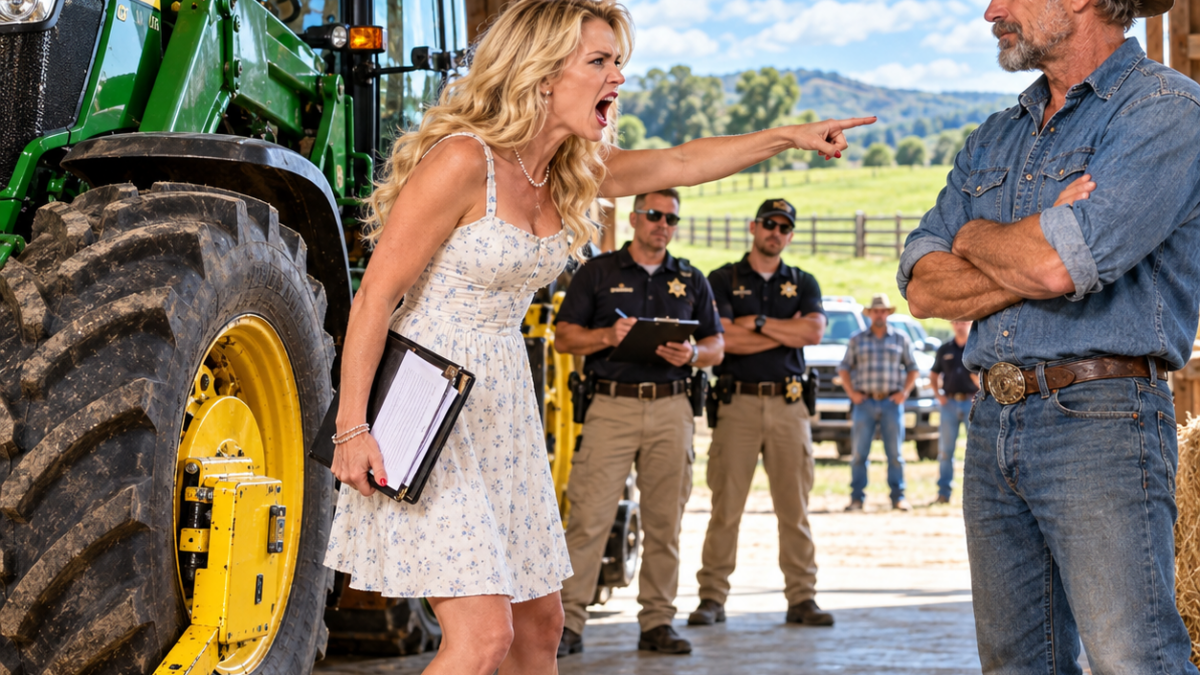
The HOA president walked into my barn before sunrise, ordered a private “compliance officer” to clamp a yellow boot onto my $40,000 John Deere, and told me farmers like me eventually learned to obey people like her.
What Shelby Whitford didn’t know was that every car entering her thirty-four-home subdivision crossed my family’s land under two conditional road easements my father had written himself—and one sentence in those documents gave me the right to revoke both roads if anyone using them interfered with our agricultural operations.
Thirty days later, after Shelby refused to apologize because she “didn’t apologize to farmers,” I filed the revocation papers, and the same woman who had tried to immobilize my tractor suddenly had to explain to thirty-four furious families why her ego had created a $2.1 million road problem.
My name is Cole Harden.
I live on two hundred forty acres outside Bastrop, Texas, where the eastern edge of the Hill Country starts flattening into Blackland Prairie and summer heat settles over the clay like something with weight.
My grandfather Vernon Harden bought the first section of our place in 1961.
Cattle pasture.
Coastal Bermuda.
Two creeks that stayed dry until they didn’t.
Live oaks older than every fence on the property.
Granddad didn’t have much when he started.
A used truck.
A two-room house.
Three cows.
A note at the bank.
What he did have was patience.
My father, Earl, used to say Vernon could look at a field everybody else saw as useless and somehow see five years ahead.
Where water would move.
Where fence should go.
Where shade mattered.
Where a road shouldn’t be.
Dad inherited that habit.
He became a licensed land surveyor.
That mattered later.
A lot.
Dad was the kind of surveyor who kept three sharpened pencils in his shirt pocket, carried a steel tape even after GPS equipment became standard, and could tell when a fence was six inches wrong from fifty yards away.
He farmed because he loved it.
He surveyed because accuracy paid the taxes.
He taught me two things before I turned twelve.
First:
Never ride the clutch on a tractor.
Second:
Never trust somebody else’s description of your property line when the deed is sitting ten feet away.
At sixteen, I thought both were boring.
PART2:
At forty-two, I considered them scripture.
I went to trade school instead of college.
Agricultural equipment repair.
Diesel.
Hydraulics.
Electrical systems.
For fifteen years I fixed combines, balers, tractors, skid steers, and whatever else ranchers broke during weather that made normal people stay indoors.
Then Dad died.
Seven years before the tractor incident.
Stroke.
Fast.
Too fast.
I came home.
My wife Maggie came with me.
So did our son Jackson.
Maggie taught third grade at Bastrop Elementary.
Five foot three.
Brown hair usually pinned up with whatever writing instrument happened to be nearest.
Quiet voice.
Absolutely no fear of grown men behaving stupidly.
I once watched a six-foot-two contractor apologize to her for swearing in front of a classroom doorway.
She hadn’t asked.
She had just looked at him.
Jackson was nine when we moved back.
Sixteen by the time Shelby Whitford decided she had jurisdiction over our barn.
He was already taller than Maggie.
Almost my height.
Could back a hay trailer through a narrow gate better than half the men I paid during cutting season.
Could also consume an entire gallon of milk without remembering where the empty jug belonged.
Nobody is perfect.
Our barn sits roughly three hundred feet from the county road.
Dad built the original pole structure with Vernon in 1963.
It had been expanded twice.
Metal roof.
Concrete work bay on one side.
Dirt floor in the equipment section.
Parts shelves.
MIG welder.
Hydraulic press.
Tool cabinets.
Nothing decorative.
Everything used.
Inside I kept a John Deere 612M.
About forty thousand dollars of machinery I depended on for mowing, raking, hauling, feeding, and half a dozen other jobs a suburban board president wouldn’t know existed.
That barn mattered.
The tractor mattered.
The farm mattered.
None of it belonged to an HOA.
That should have been the end of the story.
It wasn’t.
Ridgewood Crossing sat on the eastern side of our property.
Thirty-four homes.
Brick and stone.
Curving streets.
Decorative lamps.
Entrance monument with gold lettering:
RIDGEWOOD CROSSING
A PREMIER LIVING EXPERIENCE
Granddad would’ve laughed at that sign.
The land Ridgewood sat on once belonged to Harold Tate.
He sold a hundred ten acres to Ridgewood Development LLC in 2004.
The developer immediately discovered a problem.
Access.
Ridgewood was boxed in by Tanner’s Branch on one side and a limestone bluff on another.
The direct route to FM 812 crossed our property.
Without our land, the developer would have needed a bridge, a significant bluff cut, drainage work, and more than a mile of engineered roadway.
Back then they estimated somewhere around $1.4 million.
Today?
More.
So they came to Dad.
Earl Harden did not hate development.
That point matters.
He understood thirty-four families would eventually live there.
Go to work.
Send kids to school.
Call ambulances.
Order groceries.
He wasn’t interested in using land ownership as a weapon.
So he agreed.
Two road easements.
Ridgewood Drive along the northern boundary.
Tanner’s Lane closer to the creek.
Private access.
Recorded with the county.
Passenger vehicles.
Emergency services.
Utilities.
Specific restrictions on oversized commercial traffic and construction staging.
And buried on page three of both documents was the sentence Shelby should have read before she ever learned my name.
Dad showed it to me once.
I was seventeen.
We were replacing a fence post near Ridgewood Drive.
Cars passed behind us.
He leaned against the post driver.
“Cole.”
“Yeah?”
“As long as they leave the farm alone, they can drive through.”
“Okay.”
“If they don’t?”
I shrugged.
“They still have a road.”
“No.”
He pointed toward the pavement.
“They have permission.”
I remember looking at him.
“Same thing.”
Dad shook his head.
“No.”
Then he said:
“Permission has conditions.”
Years later, I would find the exact language again.
The easement remained valid only so long as the holder, its successors, assigns, and beneficiaries did not interfere with, restrict, impede, or obstruct agricultural activity on the Harden property.
If interference occurred and remained uncured thirty days after written notice, my father or his heirs could initiate revocation with an additional ninety-day notice.
Dad underlined that paragraph in red.
Then wrote one word beside it.
REMEMBER.
For eighteen years, nobody needed to remember.
Ridgewood drove through.
We farmed.
They waved.
We waved.
Sometimes a kid’s soccer ball landed over our fence.
Sometimes our dog Hank escaped and wandered into Ridgewood.
Normal neighbor problems.
Then Shelby Whitford moved in.
She was twenty-nine.
Blonde.
Perfectly styled.
Chanel cardigans.
Luxury handbags.
Heels on roads where heels had no business existing.
She was one of those people who could look overdressed at a funeral.
Her husband Craig sold medical devices across several states and traveled most of the week.
Shelby had time.
Money.
And apparently a deep emotional need to regulate things.
She bought the largest house in Ridgewood.
Five bedrooms.
Three-car garage.
Pool.
View toward our pasture.
Three months after moving in, she ran for HOA president.
The previous president was a retired postal worker named Gil Odom.
Gil’s philosophy toward governance was simple:
“If it isn’t burning, leaking, or blocking an ambulance, leave people alone.”
Shelby arrived at the election with a forty-seven-page Community Excellence Initiative tied with a gold ribbon.
Gil read the cover.
Closed it.
Then told everybody:
“I am too old to fight this woman.”
He resigned.
Shelby won.
Within six months she transformed thirty-four homes into something resembling a miniature municipal government run out of a leather tote bag.
She inspected lawn height.
Tracked trash-can visibility.
Sent formal notices about basketball hoops.
Created a forty-one-page color guide.
Not a joke.
Approved exterior shades included:
Sandstone Mist.
Prairie Taupe.
Heather Gray.
Dove Whisper.
Dove Whisper became Maggie’s favorite phrase for months.
Any time I wore an old shirt:
“Very Dove Whisper.”
Any time Jackson forgot deodorant:
“You’re giving more Barn Storm than Dove Whisper.”
The woman weaponized paint chips and accidentally improved our family vocabulary.
For a while, Shelby stayed inside Ridgewood.
Then she noticed my barn.
The first letter arrived in March.
Cream envelope.
Embossed oak-tree logo.
RIDGEWOOD CROSSING COMMUNITY EXCELLENCE BOARD.
Not HOA.
Apparently “Homeowners Association” wasn’t grand enough.
The letter demanded that I mitigate the visual impact of my agricultural structure.
Requirements:
Paint barn in approved Ridgewood palette.
Construct six-foot privacy fencing around visible agricultural equipment.
Replace metal roof with architectural shingles.
Submit compliance timeline within fourteen days.
I read it once.
Then handed it to Maggie.
She read slower.
Looked at me.
“Dove Whisper.”
“Apparently.”
“If you paint that barn Dove Whisper, I am taking Jackson, the dog, and half the cattle.”
“You don’t even like the cattle.”
“I like them more than that color.”
I didn’t respond to Shelby.
Our property wasn’t inside the subdivision.
Their restrictions did not bind us.
Week later:
Second letter.
Then third.
Fourth added odor.
Fifth added agricultural noise.
Sixth accused us of maintaining “combustible storage.”
Hay.
She meant hay.
Shelby filed seven county complaints in five weeks.
Dennis Maldonado from county code enforcement came out.
Mid-fifties.
Grew up ranching near Lockhart.
He walked everything.
Barn.
Fuel storage.
Hay.
Drainage.
Livestock.
“Mr. Harden.”
“Yeah?”
“Everything’s fine.”
“Good.”
He checked his clipboard.
“Unsafe combustible storage?”
“Hay.”
“I figured.”
“How many complaints?”
He hesitated.
“Seven.”
“All her?”
“Same reporting source.”
Dennis closed the clipboard.
“Off the record?”
“Sure.”
“People like this rarely stop when the facts tell them no.”
“What stops them?”
“Consequences.”
That sentence became prophetic.
Shelby switched strategy.
She gathered signatures.
Petition.
Twenty-eight of thirty-four homeowners.
She told residents our farm lowered their property values by fifty thousand dollars per house.
She handed out graphs.
The graphs came from a study involving industrial feedlots in another state.
Thousands of cattle.
Waste lagoons.
Semi traffic.
We had forty Angus cows and one border collie with anxiety.
Details.
At a county commissioners meeting Shelby gave an eleven-minute presentation about incompatible land uses.
Animated PowerPoint.
Charts.
Property values.
Agricultural externalities.
She used “externalities” four times.
I sat in the back.
Work boots.
Flannel.
Hay dust.
When asked to respond, I stood.
“My family has farmed the property since 1961.”
Pause.
“My operation complies with county and state agricultural rules.”
Pause.
“The Texas Right to Farm protections exist in part to prevent longstanding agricultural operations from being treated as new nuisances when residential development arrives later.”
Pause.
“And Mrs. Whitford lives in a subdivision that reaches the highway by driving across my property every day.”
That last sentence got attention.
Commissioners denied the petition.
Unanimous.
Commissioner Louise Peña looked at Shelby.
“Ma’am, you moved next to a farm.”
Shelby’s jaw tightened.
Peña continued.
“The farm was there first.”
Somebody laughed.
Not loudly.
Enough.
Shelby left.
That night, I told Maggie:
“I think we’re done.”
She was grading spelling tests.
Didn’t look up.
“No.”
“Why?”
“She got laughed at in a courthouse.”
“So?”
Maggie finally looked at me.
“That woman wore a blazer that probably cost more than our washing machine and got publicly told the farmer was right.”
She tapped a red pen against the table.
“She isn’t done.”
“You sure?”
“She’s loading.”
My wife should’ve been a prosecutor.
Three weeks later:
Barn.
Saturday morning.
5:45.
Jackson at a friend’s.
Maggie at a teacher workshop.
I had forty acres to cut before the temperature hit triple digits.
I walked toward the barn.
Heard a woman’s voice.
“Lock it down.”
I stopped.
“I want that piece of garbage immobilized before he gets back.”
I walked inside.
Shelby stood beside my tractor.
White Zimmermann sundress.
Designer heels.
Phone raised.
Filming.
A man in gray uniform knelt at the rear wheel.
CAPITAL CITY COMPLIANCE SERVICES.
He was tightening a bright yellow wheel boot around the John Deere.
Inside.
My barn.
I stood quietly for three seconds.
Not shock.
Assessment.
Mechanics do that.
Before touching something wrong, understand exactly how wrong it is.
“What are you doing?”
Shelby turned.
No surprise.
“Mr. Harden.”
“This is my barn.”
“This equipment has been identified as unauthorized heavy machinery visible from the Ridgewood corridor.”
I stared.
She continued like the sentence made sense.
“The board has ordered temporary immobilization pending compliance review.”
The compliance guy stopped tightening.
I looked at him.
“Did she tell you this was HOA property?”
His eyes went to Shelby.
She answered.
“The work order is authorized.”
“By who?”
“The Community Excellence Board.”
“That is you.”
“I chair the board.”
“My property is not in your subdivision.”
She smiled.
“The community’s well-being doesn’t end at an arbitrary line on a map.”
I almost admired the sentence.
“Property lines are literally the opposite of arbitrary.”
She looked around.
Workbench.
Parts wall.
Welder.
Old baler.
Tools.
Her face showed disgust.
“Honey, this barn is a dump.”
The boot man stared at the floor.
Shelby pointed toward the tractor.
“That machine is an eyesore.”
Then toward me.
“And frankly, you’re the smell this neighborhood is trying to get rid of.”
There are insults that hurt because they’re accurate.
That wasn’t one.
It clarified.
I said:
“Leave.”
She smiled.
“I don’t take requests from farmers.”
Her voice softened.
“I give orders.”
I looked at the boot.
Ratchet pulled tight.
Too tight.
Pressure against the wheel assembly.
Potential axle seal damage.
Brake damage.
Spindle stress.
Thousands.
I pulled out my phone.
Photographed everything.
Shelby.
Worker.
Boot.
Tool marks.
Tractor.
Barn door.
Compliance truck.
Plate.
Fourteen photos.
Then video.
Shelby laughed.
“You’re documenting?”
“Yes.”
“How adorable.”
The worker stood.
“Ma’am, maybe we should—”
“Finish.”
He didn’t.
Good instinct.
I looked at Shelby.
“You just made the worst decision you’ve made since moving here.”
She laughed.
“I’ve dealt with farmers before.”
“So?”
“You huff.”
“You puff.”
“You threaten lawyers.”
“Then six months later you sell.”
She adjusted one shoulder strap.
“Three families have already learned that.”
“What?”
“People resist change.”
Her smile returned.
“We curate outcomes.”
“How many farms?”
“Three properties.”
“You pressured three families into selling?”
She shrugged.
“They made the rational decision.”
I stared.
There it was.
Not neighborhood standards.
A worldview.
Farmers as temporary.
Subdivision as inevitable.
People like us just hadn’t accepted the future.
I turned around.
Walked home.
Didn’t touch the boot.
Didn’t physically remove Shelby.
Didn’t call her names.
I opened Dad’s filing cabinet.
Bottom drawer.
RIDGEWOOD — EASEMENTS — CONDITIONAL.
Four documents.
Two easements.
Developer acknowledgment letter.
Recorded plat.
I read page three.
The red underline.
REMEMBER.
Interfere with.
Restrict.
Impede.
Obstruct.
Agricultural operations.
Maintenance, repair, and operation of agricultural equipment explicitly listed.
The woman had walked inside my barn and immobilized agricultural equipment.
She hadn’t merely violated the spirit.
She had stepped directly into Dad’s sentence.
I called Maggie.
“Can you come home early?”
“What happened?”
“She booted the tractor.”
Silence.
Then:
“Inside the barn?”
“Yes.”
Another silence.
“I’m leaving.”
Pause.
“And Cole?”
“Yeah?”
“If she’s still there, get a picture of those heels on the barn floor.”
“Already did.”
“Good.”
I called Naen Garza.
Land-use attorney.
Austin.
Dennis Maldonado had quietly given me her name after Shelby’s county complaints.
“She’s the lawyer other lawyers call when an HOA forgets where its map ends.”
That was Dennis’s description.
Naen’s office overlooked Congress Avenue.
Exposed brick.
Tall windows.
No decorative crest.
Good start.
I brought the easements.
Letters.
County complaints.
Petition.
Barn photos.
Video.
Fourteen-month timeline.
Naen read silently.
Then:
“Your father wrote these?”
“Yes.”
“Surveyor?”
“Yes.”
“He should’ve been an attorney.”
“He disliked attorneys.”
“Most intelligent people do until they need one.”
She tapped the clause.
“Conditional easement.”
“Recorded.”
“Yes.”
“Developer acknowledged conditions.”
She held up the third document.
“Yes.”
“Plat references instrument.”
She checked.
“Yes.”
“Strong.”
“What can we do?”
“First, cure notice.”
“What does that mean?”
“You provide written notice that conditions were violated and give the required thirty days to correct.”
“Correct what?”
“Everything.”
She started listing.
Remove boot.
Pay tractor damage.
Cease claims of jurisdiction over your property.
Stop complaints intended to impede lawful agriculture.
Withdraw nuisance actions.
Acknowledge boundary.
Then:
“If they don’t cure?”
“Ninety-day revocation notice.”
“What happens if I revoke?”
Naen turned to her computer.
Pulled maps.
Made calls.
Civil engineer.
Road contractor.
County records.
Twenty minutes later she rotated the screen.
Alternative access.
Bridge over Tanner’s Branch.
Bluff cut.
New roadway.
Drainage.
Engineering.
Utility adjustments.
Estimate:
$2.1 million.
I leaned back.
“Thirty-four houses.”
“Yes.”
“That’s…”
“About sixty-two thousand dollars each if allocated evenly.”
I stared at the map.
I didn’t feel powerful.
I felt nauseous.
“Those families didn’t boot the tractor.”
“Correct.”
“Some signed the petition.”
“Yes.”
“Still.”
Naen leaned forward.
“You don’t have to revoke.”
“What do I do?”
“You enforce the cure.”
“How?”
“Give them the opportunity to fix the violation their leadership created.”
“And Shelby?”
“We sue her separately.”
“For?”
“Trespass.”
“Interference with business.”
“Damage to personal property.”
“Potential conversion/trespass-to-chattels theories depending on facts.”
“Whatever else evidence supports.”
“What about the tractor?”
I had Ray Cantu inspect it.
Friend.
Mechanic.
He confirmed the boot damaged a hydraulic seal and stressed the axle assembly.
Repairs:
$3,812.
Ray wrote a sworn statement.
Photos.
Parts.
Labor.
Cause.
Naen drafted the cure notice.
Certified to every homeowner.
Not because I wanted to scare them.
Because they were beneficiaries of the easement.
They needed the truth.
NOTICE OF EASEMENT CONDITION VIOLATION.
Then the conduct.
Then cure requirements.
Then the revocation clause.
No insults.
No dramatic language.
Just Dad’s words.
Thirty days.
Shelby called the evening notices arrived.
8:42.
“Mr. Harden.”
“Shelby.”
“I received your little threat.”
“Recorded notice.”
“You cannot close our roads.”
“I can enforce the conditions.”
“People rely on those roads.”
“That is why your HOA should stop interfering with the farm.”
“You are holding thirty-four families hostage.”
“No.”
“I am giving thirty-four families thirty days to correct what your board did.”
“You think a twenty-year-old document lets you cut off an established community?”
“Yes.”
She hung up.
Next morning, Ridgewood residents received her email.
URGENT: FARMER THREATENS TO CLOSE OUR ROADS.
Farmer.
Not Cole.
Not neighbor.
Not road grantor.
Farmer.
She called the roads public.
They weren’t.
She claimed the easement was irrevocable.
It wasn’t.
She claimed I was retaliating because the county rejected my “unsafe farming practices.”
Backward.
Her complaints had been rejected.
Homeowners panicked.
I got calls.
The first was Patricia Hall.
Nurse.
Single mother.
Lived on Tanner’s Lane.
“Mr. Harden?”
“Yes.”
“Are you closing the road?”
“Not today.”
“What does that mean?”
“Did you receive my notice?”
“Yes.”
“Read page two.”
“I did.”
“My father granted the easement with a condition.”
“Yes.”
“The HOA interfered with my agricultural equipment.”
“Shelby says the tractor was violating county rules.”
“It wasn’t.”
“She says—”
“I have photographs of her inside my barn.”
Silence.
Then:
“Inside?”
“Yes.”
“Your barn?”
“Yes.”
“She didn’t tell us that.”
“I figured.”
Patricia’s voice changed.
“What do you want?”
“Leave the farm alone.”
“That’s it?”
“And repair the damage.”
“How much?”
“$3,812.”
Another silence.
“That is not sixty-two thousand dollars per homeowner.”
“No.”
“Then why is Shelby telling us we need a special assessment?”
“I can’t answer that.”
That call was the beginning.
Dan Weber called.
Retired civil engineer.
“Can I see the easement?”
“Yes.”
He came to my porch.
Read.
Five minutes.
Then:
“Oh, hell.”
“What?”
“This is clean.”
“My dad wrote it.”
“He knew exactly what he was doing.”
“Yes.”
Dan pointed to the revocation clause.
“Shelby knew about this?”
“I don’t know.”
“She should’ve.”
“Agreed.”
“Why didn’t you revoke earlier?”
“Because nobody interfered with the farm like this before.”
He nodded.
Then looked toward Ridgewood Drive.
“My wife and I use that road every day.”
“I know.”
“What would it take to cure?”
I told him.
Payment.
No future jurisdiction claims.
Written acknowledgment.
Remove boot.
Publicly correct the misinformation.
Dan nodded.
“Reasonable.”
I noticed what he did not say.
He didn’t call it revenge.
Shelby’s lawyer filed for a temporary restraining order.
Emergency hearing.
Judge Carmen Reyes.
Her attorney argued reliance.
Public interest.
Implied dedication.
Equitable doctrines.
Two decades of use.
Community hardship.
Naen answered with four pages from 2003.
She read Dad’s condition slowly.
Then showed the plat.
Developer acknowledgment.
My timeline.
County inspection closures.
Boot photos.
Ray’s sworn statement.
Video.
Shelby’s own voice:
“Get that thing locked down tight.”
Judge Reyes looked over her glasses.
“These are private easements?”
“Yes, Your Honor.”
“Recorded as conditional?”
“Yes.”
“Referenced on the subdivision plat?”
“Yes.”
Shelby’s attorney tried:
“However, the community’s reliance—”
Judge Reyes raised a hand.
“Reliance does not erase recorded language.”
She looked at the photographs.
“Your client entered property outside the HOA boundary and caused agricultural equipment to be immobilized?”
The attorney whispered with Shelby.
“Temporarily.”
Judge:
“That wasn’t my question.”
He cleared his throat.
“Yes.”
Naen said nothing.
Didn’t need to.
Judge Reyes denied the restraining request.
Then said the sentence Ridgewood residents repeated for months:
“The remedy here is to cure the interference, not to ask this court to pretend the condition does not exist.”
Shelby stood.
Grabbed her handbag.
Walked out without looking at anyone.
Maggie waited in the parking lot.
I told her.
She smiled.
“That may be the first time Shelby has heard no from someone she can’t fine.”
I laughed.
But the cure clock was still running.
Three days before deadline, Shelby came to the farm.
Sunday evening.
I was replacing an HVAC filter.
She parked near the house.
Mercedes.
No heels.
White sneakers.
Brand new.
Maggie noticed from the kitchen window.
“Humility shoes.”
“What?”
“She bought humility shoes.”
I stepped outside.
Shelby approached.
“Can we talk?”
“Talk.”
She looked around.
No portfolio.
No clipboard.
“Things got out of hand.”
“Yes.”
“The board was concerned about property values.”
“Okay.”
“I may have been more aggressive than necessary.”
“You entered my barn.”
“That was a mistake.”
“You booted my tractor.”
“I said that was a mistake.”
“Cost me $3,812.”
“I can reimburse that.”
Good.
I said:
“Three things.”
She crossed her arms.
“First, full payment.”
“Fine.”
“Second, permanent written acknowledgment that my farm is outside HOA jurisdiction.”
She hesitated.
“Board vote.”
“Then get one.”
“And third?”
“Public apology.”
Shelby’s face changed immediately.
“No.”
“Then we don’t have a cure.”
“Cole.”
“No.”
“I have spent eighteen months establishing credibility in Ridgewood.”
“You spent eighteen months harassing my farm.”
“I enforced standards.”
“Standards that did not apply here.”
“A public apology would undermine the board.”
“You already undermined it.”
She stepped closer.
“You’re willing to create a two-million-dollar road crisis over an apology?”
“No.”
I pointed toward the barn.
“You created the crisis when you put that boot on my tractor.”
She shook her head.
“You know what I mean.”
“I do.”
She looked toward Ridgewood.
“I can pay the damages.”
“Good.”
“I can sign a jurisdiction agreement.”
“Good.”
“I will not humiliate myself in front of people who elected me.”
“That is exactly why the apology matters.”
Her face hardened.
Then came the sentence.
Quiet.
Cold.
Almost casual.
“I don’t apologize to farmers.”
I stared.
Not because I was shocked.
Because it explained every letter.
Every complaint.
Every condescending smile.
This was never about land use.
She needed me beneath her.
She could write a check.
She could sign a document.
But speaking three words to someone she considered lower?
Impossible.
I straightened.
“Then we’re done.”
“Cole.”
“Deadline is Wednesday.”
“You cannot be serious.”
“Ninety-day notice begins after that.”
She looked genuinely frightened for the first time.
“Thirty-four families.”
“Tell them why.”
“You’ll ruin people.”
“No.”
I held her gaze.
“You put thirty-four families behind your ego.”
She turned.
Walked toward the Mercedes.
Then stopped.
“You’re going to destroy a neighborhood because I won’t grovel.”
“No, ma’am.”
I looked toward the barn.
“You threatened the neighborhood over a tractor boot.”
Pause.
“I’m holding the receipt.”
She drove away.
Maggie stepped onto the porch.
“She said she doesn’t apologize to farmers.”
“Yes.”
Maggie pulled out her phone.
“What are you doing?”
“Math.”
She opened calculator.
“2.1 million divided by 34.”
“Don’t.”
“$61,764.71.”
“Maggie.”
“She could have said sorry for free.”
I went inside.
Called Naen.
“She refused.”
“Payment?”
“Yes.”
“Agreement?”
Maybe.”
“Apology?”
“Absolutely not.”
Naen sighed.
“People like that would rather lose money than lose rank.”
“File it.”
“You sure?”
I looked toward Dad’s filing cabinet.
“File it.”
Notice of intent to revoke.
Recorded Thursday.
Then Ridgewood exploded.
Someone forwarded the engineering estimate.
Then the easement.
Then my barn video.
Within hours, residents understood three facts:
Their roads were private conditional easements.
Shelby had triggered the condition.
Alternative access could cost roughly $2.1 million.
Shelby responded with an emergency special-assessment proposal.
Sixty-two thousand dollars per household.
She held a board meeting.
Dan Weber told me later the room went silent when the number appeared on screen.
Then Patricia Hall stood.
“Why are we paying sixty-two thousand dollars?”
Shelby said:
“Mr. Harden is weaponizing an outdated technicality.”
Patricia:
“Did you go inside his barn?”
Silence.
“Did you?”
“Yes, but—”
“Did you boot his tractor?”
“The board—”
“Did the board vote?”
Silence.
Dan stood.
“We didn’t.”
Another resident:
“You told us the roads were public.”
Another:
“You said the farmer had no legal authority.”
Another:
“Did you ever read the easement?”
Shelby had charts.
She had reasons.
She had explanations.
What she did not have was credibility.
Assessment vote:
29 against.
5 for.
Emergency community meeting scheduled Saturday.
Dan invited me.
“The neighborhood needs to hear it from you.”
“I don’t belong to the HOA.”
“I know.”
“Then why should I attend?”
“Because for eighteen months, Shelby has told us who you are.”
He paused.
“Maybe we should meet you.”
Maggie said I should go.
Jackson insisted.
“She called you smell.”
“I know.”
“She put a boot on Grandpa’s tractor.”
“My tractor.”
“Grandpa picked it.”
“Fine.”
“Make her pay.”
“I’m not going there for revenge.”
Jackson smiled.
“Sure.”
Saturday.
Community clubhouse.
All thirty-four households represented.
Spouses.
Two attorneys.
Kids outside.
Air-conditioning cold enough to store beef.
Shelby sat at the head table.
Navy blazer.
Pearls.
Leather folder.
Her usual armor.
But the room didn’t lean toward her anymore.
You can feel when authority has separated from position.
She still occupied the chair.
Nobody was following it.
Shelby read a prepared statement.
Six minutes.
Called the conflict unfortunate.
Called the easement ambiguous.
Called my conduct disproportionate.
Never said:
Barn.
Boot.
Trespass.
Damage.
Farmer.
Dan stood.
“I’d like Mr. Harden to speak.”
I walked to the front.
No suit.
Clean jeans.
Button-down.
Folder.
USB.
Thirty-four families looked at me.
Some I’d waved to for years.
Some I had never met.
“My name is Cole Harden.”
I paused.
“My grandfather bought the farm next door in 1961.”
“My father farmed it.”
“I farm it now.”
“My wife teaches some of your children.”
Maggie sat near the back.
“Jackson goes to school with some of yours.”
I looked around.
“In 2003, Ridgewood’s developer had a road problem.”
I unfolded the plat.
“Without access across our land, building your neighborhood was financially difficult.”
Then Dad’s easement.
“My father allowed two roads.”
I looked toward Dan.
“He did not sell the land.”
“Did not dedicate the road publicly.”
“He granted conditional access.”
Then I read the clause.
Slowly.
Every word.
INTERFERE.
RESTRICT.
IMPEDE.
OBSTRUCT.
AGRICULTURAL OPERATIONS.
EQUIPMENT.
STRUCTURES.
Thirty days.
Ninety days.
Revocation.
I laid down the letters Shelby had sent.
One.
Two.
Three.
All six.
Then seven county complaints.
The nuisance petition.
The PowerPoint.
Then the photos.
Barn.
John Deere.
Yellow boot.
Shelby standing beside it.
Then video.
Her voice filled the clubhouse.
“Lock it down.”
“Get that thing immobilized before he gets back.”
Then:
“I don’t take requests from farmers.”
The room changed.
A few people turned toward Shelby.
She stared at the table.
I continued.
“The boot caused $3,812 in documented damage.”
Ray’s affidavit.
“Here is the estimate for alternative access.”
$2.1 million.
Bridge.
Bluff cut.
Roadway.
Drainage.
Engineering.
“That’s the problem.”
Patricia Hall stood.
“No.”
She looked at Shelby.
“That isn’t the problem.”
Shelby raised her head.
Patricia continued.
“You’re the problem.”
Nobody spoke.
Then Dan Weber.
“We never voted on the barn action.”
Another resident:
“We never authorized county complaints.”
Another:
“You told us he was violating our HOA rules.”
Another:
“He isn’t in our HOA.”
Shelby finally spoke.
“I acted to protect property values.”
Bill Parish, retired contractor, stood in back.
“I signed your petition.”
Shelby looked toward him.
“You told me his cattle lowered my home value by fifty thousand dollars.”
“Yes.”
“My house doesn’t even face his pasture.”
Laughter.
Angry laughter.
Bill shook his head.
“You handed me a lemon bar and a graph and lied to my face.”
That line became famous in Ridgewood.
Shelby tried to restore order.
“We need to focus on solutions.”
Dan answered:
“Good.”
Motion.
Remove Shelby Whitford as HOA president.
Vote:
31 to 3.
She stared straight ahead.
Second motion:
Authorize full cure of easement violation.
Payment of tractor repairs.
Recorded agreement acknowledging Harden property is outside HOA jurisdiction.
Formal retraction of false HOA claims.
Public apology.
Vote:
34 to 0.
Unanimous.
Even Shelby’s remaining allies voted yes.
Third motion:
Censure prior unauthorized enforcement actions.
29 to 5.
Shelby sat motionless.
Her leather folder closed.
Hands flat on table.
Perfect nails.
Pearls catching recessed light.
The woman who had spent eighteen months controlling every room had become the quietest person in one.
I felt no urge to humiliate her.
That surprised me.
I thought I would.
Instead I felt tired.
Dan approached.
“Will you withdraw revocation if we cure?”
“Yes.”
Shelby’s head moved.
First time she’d looked at me all evening.
Dan asked:
“Fully?”
“Yes.”
“Both roads remain?”
“Yes.”
“Same access?”
“Yes.”
I looked at him.
“This was never about taking your roads.”
Patricia asked:
“Then why file revocation?”
“Because asking nicely didn’t stop her.”
Silence.
Then someone said:
“Fair.”
The apology came two weeks later.
Regular HOA meeting.
Maggie insisted we attend.
“I want to hear it.”
“You’re enjoying this.”
“No.”
“Yes.”
“Maybe.”
Shelby sat at a small table.
No gavel.
Dan had the gavel now.
He never used it.
Good sign.
When her name was called, Shelby stood with a note card.
“I apologize to Mr. Cole Harden and his family for entering private property without permission, interfering with agricultural equipment, and asserting HOA authority where none existed.”
Her voice flat.
Jaw tight.
She continued.
“I further apologize to Ridgewood Crossing residents for failing to review the conditions governing our road easements before taking actions that placed community access at risk.”
Pause.
“I will not engage in further conduct affecting the Harden agricultural operation.”
Then, after visible effort:
“I was wrong.”
Four words.
Those cost her more than $3,812.
Maggie leaned toward me.
Whispered:
“Dove Whisper.”
I almost laughed.
Tractor repair check arrived next week.
Cleared.
Naen drafted a permanent recorded agreement.
Seven pages.
Harden farm outside HOA jurisdiction.
No enforcement letters.
No HOA entry.
No equipment restrictions.
No agricultural nuisance complaints filed by association without documented legal basis.
Road access preserved.
Annual contribution to maintenance:
$4,800.
Seventeen years overdue, frankly.
Dan signed at our kitchen table.
Brought pecan pie.
“Cole.”
“Yeah?”
“I’m sorry.”
“You don’t need to apologize.”
“I signed one of Shelby’s petitions.”
“Okay.”
“I believed her.”
“That happens.”
“I should’ve checked.”
I looked toward Ridgewood Drive.
“People drive over an easement long enough, they forget it’s an easement.”
Dan nodded.
“They start thinking it’s theirs.”
“Exactly.”
Shelby listed her house three weeks later.
$585,000.
Sold for less.
Listing called Ridgewood:
A peaceful nature-adjacent community.
Maggie laughed for ten minutes.
“Nature-adjacent.”
“Apparently.”
“That nature is forty Angus cows and Hank eating garbage.”
“Premium nature.”
New owners were a young couple.
Two kids.
Golden retriever.
Minivan.
The wife met Maggie by the mailbox.
“We heard you’re the farm family.”
Maggie smiled.
“That’s us.”
“My kids have never seen a real tractor.”
“Bring them Saturday.”
And that was how Saturday barn tours started.
Jackson became tour guide.
Showed kids the tractor.
Baler.
Cattle.
Welder from a safe distance.
Hank the border collie.
Six laying hens behind the house.
One little boy asked:
“Is this what a farm smells like?”
Jackson said:
“Yep.”
Kid thought.
“Smells better than candles.”
Maggie had to walk away laughing.
Something changed between our farm and Ridgewood after that.
Not because everyone suddenly loved agriculture.
They didn’t.
One resident still complained when cattle bawled during weaning.
Difference?
He called me.
“Cole, how long does this usually last?”
“Few days.”
“Okay.”
That was it.
No certified letter.
No fake board.
No six-page notice.
Just neighbors talking.
Turns out civilization survives direct communication.
The revoked-road crisis disappeared once cure was complete.
Naen filed withdrawal before revocation became effective.
The easements stayed.
No bridge.
No $62,000 assessments.
Families kept their normal access.
Some people later accused me of bluffing.
I wasn’t.
Had Ridgewood refused to cure, I would have followed Dad’s documents.
That’s what conditions mean.
But I was glad I didn’t have to.
I never wanted thirty-four families driving over a new bridge because Shelby hated my barn.
I wanted the original deal restored.
Leave us alone.
Use the road.
Be neighbors.
Simple.
The lawsuit against Shelby settled separately.
Terms mostly private.
Tractor damage.
Attorney’s fees.
Other costs.
Enough that she learned trespassing inside a barn is more expensive than certified stationery.
Capital City Compliance Services also settled its part.
The worker who installed the boot, a guy named Marcus, called me months later.
“Mr. Harden?”
“Yeah.”
“This is Marcus Vega.”
I recognized the voice.
“Boot man.”
He groaned.
“Yeah.”
“What can I do for you?”
“I wanted to apologize.”
“For following a work order?”
“For not checking authority.”
I stayed quiet.
He continued.
“She told us Ridgewood owned the agricultural corridor.”
“It didn’t.”
“I know now.”
“Why’d you stop tightening?”
Marcus laughed nervously.
“Because you looked at the boot like a mechanic.”
“I am a mechanic.”
“That would’ve been useful information.”
“It was my tractor.”
“Fair.”
He said Capital City changed its procedures.
No immobilization on private property without title or government documentation.
Good.
A mistake that improves a system isn’t wasted completely.
Maggie eventually framed Shelby’s quote.
Not in the barn.
I refused.
Too much.
So she made a small sign in the mudroom.
I DON’T APOLOGIZE TO FARMERS.
Below it, in smaller letters:
—FORMER HOA PRESIDENT
Jackson loved it.
I tolerated it for six months.
Then took it down.
“Why?”
He asked.
“Because I don’t want her living in our house.”
That sentence surprised even me.
For eighteen months, Shelby had occupied mental space.
Letters.
Calls.
Inspections.
Hearings.
Barn.
Court.
Easement.
Meetings.
I was done giving her walls too.
We put Dad’s easement clause there instead.
One framed page.
Red underline.
REMEMBER.
Better.
Years passed.
Jackson finished high school.
Studied agricultural systems at Texas State.
Came home weekends.
Argued about machinery.
He thought our tractor needed GPS guidance.
I told him I had eyes.
He told me eyes don’t generate yield maps.
Disrespectful generation.
Maggie became assistant principal.
Absolutely terrifying development.
Shelby moved to Dallas, according to somebody.
Craig stayed in medical sales.
No idea whether they stayed married.
Not my business.
Ridgewood elected Dan Weber president.
His first board meeting lasted forty-five minutes.
No PowerPoint.
No linen paper.
No color psychology.
Gil Odom, the former president, attended.
At the end, he told Dan:
“If nothing is burning, leaking, or blocking an ambulance, adjourn.”
Wise governance returned.
One summer, Tanner’s Branch flooded.
Bad storm.
Water over part of the easement.
Ridgewood residents got nervous.
I opened a temporary farm route so they could exit through our north gate.
No charge.
No legal agreement first.
Emergency.
Dan called.
“Cole, you don’t have to do this.”
“I know.”
“Our old president would’ve charged you.”
“That sounds like her problem.”
“You sure?”
“Families need out.”
The temporary route stayed open two days.
When water receded, Ridgewood residents helped clean debris off the easement.
Teenagers hauled branches.
Adults shoveled mud.
Patricia Hall brought sandwiches.
That’s what the road should have represented all along.
Not leverage.
Connection.
Dad gave them access because he believed neighbors could share infrastructure without sharing ownership.
Shelby mistook sharing for weakness.
Then mistook patience for surrender.
Those mistakes cost her.
The strangest part?
My barn eventually got repainted.
Not Dove Whisper.
Metal red.
Jackson and I did it one October.
Maggie stood outside.
Hands on hips.
“Looks good.”
I said:
“You sure?”
“Needs architectural shingles.”
I threw a rag at her.
We kept the metal roof.
Of course.
One afternoon, years later, a little Ridgewood kid named Tyler came on a barn tour.
He pointed to the John Deere.
“Is that the tractor?”
“What tractor?”
“The one Mrs. Whitford put jail on.”
I laughed.
“Boot.”
“Yeah.”
“This one.”
He walked around the rear wheel.
“Why?”
“She thought she was allowed.”
“Was she?”
“No.”
“Then why’d she do it?”
That question.
Simple.
I thought.
“Sometimes people confuse having a title with having power everywhere.”
Tyler frowned.
“What?”
“Sometimes adults get bossy.”
“Oh.”
He understood that.
“Did you beat her?”
“No.”
“What happened?”
“Everybody read the paperwork.”
He looked disappointed.
Kids want battles.
Bulldozers.
Chases.
Water cannons.
Paperwork is terrible cinema.
But paperwork saved the farm more effectively than yelling ever could.
I walked Tyler toward the easement road.
Cars passed.
“That road is yours?”
“The land under it is.”
“So you can close it?”
“Only under the conditions my dad wrote.”
“Why don’t you?”
“Because nobody’s bothering the farm.”
He nodded.
“That’s fair.”
Exactly.
Dad never designed the clause to trap anybody.
It was defensive.
A boundary inside cooperation.
You can use this.
But don’t use your access to hurt what made access possible.
That’s not revenge.
That’s balance.
After Dad died, I found dozens of little notes in his files.
Measurements.
Questions.
Reminders.
Most meaningless to anyone else.
One was clipped behind the Ridgewood easement folder.
I didn’t notice it until years after the dispute.
Yellow paper.
His handwriting.
Roads create habits.
Habits create assumptions.
Assumptions become claims.
Put conditions in writing while everybody is still friendly.
I sat at the desk and laughed.
Dad had predicted the entire psychology of the problem in four lines.
Nobody at Ridgewood woke up intending to steal road rights.
They drove.
Year after year.
Kids grew.
Houses sold.
Owners changed.
Eventually the roads felt like neighborhood streets.
The fact that they crossed someone else’s farm became invisible.
Shelby simply took that invisibility one step further.
If the roads felt like hers, maybe the view did too.
If the view felt like hers, maybe the barn became her problem.
If the barn became her problem, maybe the tractor became her jurisdiction.
Power expanded until a yellow boot inside my own barn finally made the underlying agreement visible again.
That’s why records matter.
Not because everybody is evil.
Because memory is convenient.
Documents are less flexible.
One year on the anniversary of the boot incident, Maggie brought me something.
Small yellow toy wheel clamp.
Plastic.
She found it online.
I stared.
“Why?”
“For the Christmas tree.”
“No.”
“Yes.”
“No.”
Jackson walked in.
Saw it.
“Absolutely yes.”
I lost.
Every December a tiny yellow boot hangs from our Christmas tree beside ornaments Jackson made in kindergarten.
Marriage is compromise.
The first year it went up, Maggie attached a tag.
$2.1 MILLION ORNAMENT.
I threatened divorce.
She reminded me who owns the dog.
I stayed.
The farm changed.
All farms do.
We reduced cattle.
Expanded hay.
Added rotational grazing improvements.
Solar pump at a stock tank.
New equipment shed.
Jackson eventually came back full-time.
Not because I asked.
I didn’t.
I wanted him to choose.
That’s another lesson ownership disputes teach you.
Something forced isn’t worth inheriting.
He told me:
“I want to keep it going.”
I said:
“Then read everything.”
He rolled his eyes.
“I know.”
“No.”
I opened Dad’s filing cabinet.
“You think you know.”
I handed him the easement folder.
He read.
Slow.
Then got to the red underline.
“Grandpa was scary.”
“Yes.”
“He really could’ve revoked both roads?”
“Yes.”
“You really would have?”
“If they refused to cure.”
Jackson nodded.
Then:
“Sixty-two grand a house.”
“Approximately.”
He whistled.
“Shelby was insane.”
“Don’t diagnose people.”
“She was financially adventurous.”
“Better.”
He kept reading.
Then asked:
“Why’d Grandpa agree to the roads at all?”
“Because families needed access.”
“He could’ve charged more.”
“Yes.”
“Why didn’t he?”
“Dad didn’t think every opportunity needed to become maximum profit.”
Jackson thought about that.
“He’d be bad at venture capital.”
“Terrible.”
We laughed.
That is what I want Jackson to inherit.
Not only land.
Judgment.
Boundaries.
Proportion.
Knowing when leverage protects something and when leverage becomes cruelty.
People love the version of my story where I “erased two million dollars of roads off the HOA map.”
Truth is more complicated.
I initiated the process that could have revoked the easements.
That possibility forced thirty-four households to finally look at the recorded conditions.
Then they cured the violation.
The roads stayed.
Which is better.
If I had actually forced every family to build another route after they voted Shelby out and corrected the conduct, I would’ve become what I claimed to oppose.
Punishment after correction isn’t boundary enforcement.
It’s revenge.
And revenge is expensive even when you win.
Shelby lost because she couldn’t understand that distinction.
To her, every relationship had hierarchy.
Win.
Lose.
Above.
Below.
HOA president.
Farmer.
She said she didn’t apologize to farmers because apology required equal human status.
That sentence told me more than every legal filing.
Her problem wasn’t rules.
It was rank.
Thirty-four families eventually saw it too.
Once they did, her authority evaporated faster than anything I could have done from outside.
That’s the part people overlook.
I didn’t remove Shelby.
Her neighbors did.
I gave them information.
They made their own decision.
The same people she controlled with certified letters raised their hands and told her no.
Thirty-one to three.
Then thirty-four to zero on the cure.
That was healthier than me “defeating” her.
A community corrected itself.
Dan served three years as president.
Then Patricia Hall took over.
First single mother to lead the Ridgewood board.
She killed half Shelby’s unnecessary rules.
Color manual?
Gone.
Basketball hoop ban?
Gone.
Trash-bin nine-minute enforcement?
Gone.
She kept the rules that mattered.
Road safety.
Drainage.
Common maintenance.
Insurance.
“Turns out we only needed twelve pages,” she told Maggie.
Maggie replied:
“Dove Whisper took at least fourteen.”
Patricia laughed.
The neighborhood improved.
Home values did not collapse because basketball hoops appeared.
Civilization survived blue doors.
Kids played outside more.
One family painted their front door bright yellow.
I drove past just to admire it.
That yellow was louder than the tractor boot.
Better use of the color.
The annual road-maintenance payment eventually increased with actual costs.
Fairly.
Written.
Transparent.
If heavy work damaged the easement, we documented it.
If farm equipment needed crossing priority, Ridgewood yielded.
That clause was added voluntarily.
Dan suggested it.
Good neighbors do not need to pretend interests never conflict.
They need procedures for when they do.
One morning, twenty-five years after Dad wrote the original easements, Jackson and I resurfaced a section of Ridgewood Drive.
He was running the skid steer.
I stood at the edge checking grade.
A Ridgewood resident slowed.
Rolled down the window.
“Morning, Mr. Harden.”
“Morning.”
“Thanks for fixing the road.”
I looked at Jackson.
“Thank him.”
She waved.
Drove on.
Jackson grinned.
“Your road.”
“Our land.”
“Their access.”
“Correct.”
“You really love technical distinctions.”
“Technical distinctions bought your college textbooks.”
He laughed.
Then pushed gravel.
The barn remains.
Red now.
Metal roof.
John Deere replaced eventually.
Not because of Shelby.
Hours.
Age.
Work.
I kept the damaged axle seal.
Small rubber-and-metal piece.
Ray handed it to me after the repair.
“You want this?”
“No.”
Then I took it.
It sits in Dad’s old file cabinet.
Beside the easement folder.
Why?
Not revenge.
Reminder.
Tiny pieces matter.
A seal.
A sentence.
A signature.
A condition.
A photograph.
People imagine land disputes are about huge things.
Acres.
Millions.
Roads.
Sometimes the entire outcome turns on a paragraph everyone forgot to read.
Shelby saw a barn she disliked.
She thought my refusal was ignorance.
She mistook farming clothes for weakness.
She saw an old structure and assumed nobody sophisticated stood behind it.
She never imagined the farmer she mocked was the son of a licensed surveyor who had drafted her neighborhood’s access rights before she was old enough to run an HOA.
She saw a yellow boot.
I saw page three.
That was the difference.
Maggie once asked me, years later:
“What would’ve happened if your dad hadn’t put in that clause?”
I thought.
“We would’ve sued over trespass.”
“Would we win?”
“Probably.”
“Would Shelby stop?”
I looked toward Ridgewood.
“Maybe.”
“But no two-million-dollar road issue.”
“No.”
She smiled.
“Your dad really did leave a loaded document in a filing cabinet.”
“Yes.”
“Very dramatic for a surveyor.”
“He would’ve hated that description.”
“That’s why I like it.”
Dad didn’t write the clause because he predicted Shelby.
He wrote it because he understood systems.
Roads affect farms.
Homes change hands.
People forget original agreements.
Conditional rights need remedies.
Boring.
Responsible.
Powerful.
That’s the thing I wish more people understood about protecting property.
The dramatic moment isn’t usually where you win.
The dramatic moment is where the other person reveals what they’ve done.
You win months or years earlier when somebody measured correctly.
Recorded the document.
Maintained the file.
Paid taxes.
Kept receipts.
Understood the easement.
Dad won part of my fight in 2003.
I just had to open the drawer.
One evening, long after Shelby left, I sat on the porch with Maggie.
Jackson and a couple Ridgewood kids were near the barn.
Hank’s replacement, another border collie named June, chased something she had no chance of catching.
Cars moved along Ridgewood Drive.
Normal.
Maggie watched one pass.
“Funny.”
“What?”
“They’re still using the road.”
“That’s the idea.”
“After all that.”
“After all that.”
She drank tea.
“You could’ve shut it.”
“I could’ve tried.”
“You didn’t.”
“No.”
“Why?”
I looked at her.
“Because Dad gave it for families.”
She nodded.
“Not Shelby.”
“Right.”
There it was.
Simple.
Shelby was temporary.
Families remained.
Road remained.
Farm remained.
Permission remained because respect returned.
That is the ending I prefer.
Not a subdivision stranded behind a creek.
Not homeowners bankrupted.
Not me standing at a locked gate enjoying somebody else’s misery.
A better ending:
Everybody knows the road crosses Harden land.
Everybody knows the easement has conditions.
Everybody knows the farm is not part of Ridgewood.
Nobody boots tractors.
And nobody paints my barn Dove Whisper.
That’s peace.
The Ridgewood entrance sign still says:
A PREMIER LIVING EXPERIENCE.
Every time I pass it, I think:
You’re welcome for the road.
Then I keep driving.
Some mornings I take the tractor past the subdivision entrance before sunrise.
Newer tractor now.
Bigger.
Cleaner.
Jackson says more efficient.
People wave.
Nobody complains about the agricultural visual impact.
Nobody files odor reports.
Nobody sends a letter about the roof.
The farm smells like hay, diesel, soil, cattle, rain when we’re lucky, and dust when we’re not.
Exactly what it should smell like.
Dad used to say fences make good neighbors only if both sides know whose fence it is.
Roads work the same way.
So do easements.
So does authority.
Shelby Whitford walked into my barn believing the letters HOA PRESIDENT gave her power over anything her residents could see.
She clamped a yellow boot onto forty thousand dollars of equipment and told me people like me always sold eventually.
She was wrong.
I didn’t sell.
I didn’t lose the barn.
I didn’t repaint it.
I didn’t move the tractor.
I didn’t give up the farm.
And I never had to physically block Ridgewood’s road to make my point.
I only had to remind thirty-four families of something my father understood twenty years before any of us needed it.
They did not own the road.
They had permission to use it.
And permission survives only as long as the people benefiting from it remember that the land underneath still belongs to someone else.
Shelby forgot.
Dad’s paperwork didn’t.

