HOA Karen Blocked My Private Gate With Her Tesla 50 Times Despite Every Warning—Then a Fully Loaded Logging Truck Came Down the Road at 6:07 A.M.
PART3:
“My deed covers the road. I pay to maintain it.”
“We’ll sort that out.”
“Move the car and sort it out afterward.”
“I’m already late.”
“So am I.”
She looked at me for several seconds.
Then she put her sunglasses back on.
“I’ll move it when I’m finished.”
She walked away.
Just like that.
I stood beside her Tesla wondering if the entire conversation had actually happened.
Most conflicts begin with uncertainty.
Maybe she did not understand.
Maybe she had been told something wrong.
Maybe somebody from the HOA had given her bad information.
Those explanations disappeared when I called the towing company.
The dispatcher listened.
Then said, “If she’s claiming association property and she’s a resident, we need proof before we get involved.”
“It’s my road.”
“I believe you.”
“So tow it.”
“I need documentation.”
By the time Karen came back, nearly an hour had passed.
She was flushed from yoga but completely unbothered.
“I left a note on your windshield,” I said.
“I saw it.”
“And?”
“I threw it away.”
She opened the driver’s door.
“You shouldn’t hoard public access, Marcus.”
“It’s not public.”
“That’s not very neighborly.”
Then she drove away.
I thought that would be the end of it.
The next morning, a paper was folded beneath my gate latch.
Whispering Pines HOA letterhead.
Gold logo.
Formal language.
Violation notice.
According to the document, my gate violated community accessibility requirements.
Fine.
Two hundred fifty dollars.
I laughed.
Actually laughed.
My property was outside the association.
The HOA could fine me for violating their rules about as effectively as Canada could issue me a speeding ticket in Oregon.
But the notice bothered me anyway.
Because it meant Karen knew exactly what she was doing.
She was building a story.
Her story said the road belonged to the community.
Reality said otherwise.
Karen seemed to believe repetition could eventually replace reality.
By the end of that week, she had parked at my gate twice more.
Each time, I asked her to move.
Each time, she resisted.
Once she was “running into town.”
Another time she had what she called a wellness luncheon.
Every time, her answer was some variation of the same thing.
“I’m HOA vice president.”
As though those words transformed my deed.
The second time she said it, I asked, “Does that badge come with eminent domain powers?”
She stared at me.
“Excuse me?”
“I’m wondering when the HOA got authority over private property outside its boundaries.”
“You’re being hostile.”
“I’m asking you to move your car.”
“That tone is exactly the problem.”
I started taking photographs.
Nothing dramatic.
Just documentation.
Date.
Time.
Location.
Position of the Tesla.
I emailed the HOA board.
Two days later, they responded.
After review, they had determined Mrs. Patterson’s parking fell within reasonable community activity.
I read the email twice.
Reasonable community activity.
On my private road.
Blocking my only gate.
That was when I understood this was becoming something bigger than bad parking.
Karen wanted control.
Not access.
Control.
She wanted me to acknowledge that her authority continued beyond the edge of the HOA.
I installed two additional signs.
Large.
Reflective.
Impossible to miss.
PRIVATE PROPERTY.
NO PARKING.
The next morning, one had been spray-painted.
Bright pink.
HOA ACCESS ONLY.
I stood in front of it holding my coffee.
The paint had run downward in thick lines.
Karen’s favorite shoes were neon pink.
I had no proof.
So I did not accuse her.
I photographed it.
Logged the date.
Replaced the sign.
Logging teaches patience.
You cannot rush a dangerous tree.
You study lean.
Wind.
Weight.
Escape path.
You cut carefully.
Then gravity finishes the job.
I decided to treat Karen exactly the same way.
No shouting.
No threats.
No grabbing keys from her hand.
No touching the Tesla.
Document.
Wait.
That became harder when she started blocking my employees.
One Saturday morning, my radio cracked.
“Marcus?”
It was one of my drivers.
“Go ahead.”
“We can’t get through.”
I already knew what he was going to say.
“White Tesla?”
“Yep.”
I drove down.
Karen was standing beside the car.
Phone raised.
Recording.
“Move the Tesla.”
She smiled into her camera.
“Smile, Marcus. You’re on HOA video.”
“This isn’t funny.”
“You’re harassing me.”
“I’m asking you to move a car that’s blocking my business.”
“I’ll be reporting your conduct.”
“Good.”
She looked surprised.
“Good?”
“Make sure the report includes the delivery you’re stopping.”
“What delivery?”
“The one that just cost me thirty-five hundred dollars.”
For approximately two seconds, her smile disappeared.
Then it came back.
“Maybe you should be more neighborly.”
That sentence showed me what this had become.
This was not misunderstanding.
Karen knew she was costing me money.
She enjoyed it.
People like that do not merely want to win.
They want you to know they are making you lose.
I called my friend Tom that night.
Tom and I had known each other since high school.
He became an attorney.
I became the man who called him whenever somebody decided paperwork could substitute for common sense.
I explained everything.
He listened without interrupting.
Then said, “Classic.”
“What?”
“Person gets a small title and suddenly thinks she governs Wyoming.”
“I’m not in Wyoming.”
“You know what I mean.”
“What do I do?”
“Document.”
“I already am.”
“Document more.”
“What about the fake fine?”
“If the HOA is asserting authority over property outside its jurisdiction, that can become a serious problem for them.”
“Can I tear the notice up?”
“You can frame it if you want.”
“What about her car?”
“Don’t touch it.”
That answer irritated me.
“For how long?”
“Until we have enough evidence that nobody can pretend this was one argument over one parking incident.”
“How much is enough?”
“When Karen stops helping you build the case.”
That sounded ridiculous.
It turned out to be excellent advice.
Month two was worse.
Karen started parking closer.
Sometimes half a foot into the entrance.
Then directly across it.
She would smile and say, “Relax, Marcus. We’re neighbors.”
One afternoon, I stood beside her Tesla while she scrolled through her phone.
“Karen.”
Nothing.
“Karen.”
“What?”
“You are trespassing every time you park here.”
“The HOA disagrees.”
“The sheriff’s office confirmed this road is private.”
She looked up.
“The sheriff doesn’t understand community easements.”
“There is no community easement.”
“You’re not an attorney.”
“Neither are you.”
She smiled.
“Doug understands these things.”
“Doug is an accountant.”
That one landed.
Her face hardened.
“You’ve been investigating my husband?”
“No. He told someone what he does.”
She twirled her keys.
“The HOA has jurisdiction.”
“You cannot invent jurisdiction because you want a parking space.”
She laughed.
“Watch me.”
I remember those words perfectly.
Watch me.
Two weeks later, one of the largest deliveries of my year was scheduled.
Kiln-dried Douglas fir.
A furniture manufacturer in Portland.
My truck was loaded.
Everything ready.
At 7:30 in the morning, my driver called.
“Marcus.”
I closed my eyes.
“She there?”
“Dead center.”
I drove to the gate.
The Tesla sat exactly where he said.
Clean.
White.
Perfect.
Blocking the entrance.
I called Karen.
Voicemail.
I called again.
Voicemail.
Then the HOA office.
“Mrs. Patterson is currently unavailable.”
“She is blocking a commercial shipment.”
“We can forward your message.”
“She’s fifty yards away.”
Silence.
“Sir, we can only forward the message.”
Hours passed.
My truck sat loaded.
Driver waiting.
Customer waiting.
Every minute cost money.
Tom replied to my message immediately.
KEEP DOCUMENTING.
DO NOT TOUCH THE VEHICLE.
So I waited.
Almost noon.
Karen finally appeared carrying a smoothie.
She looked at the loaded truck.
Then at me.
“Hey, neighbor.”
“You cost me another thirty-five hundred dollars.”
Her face showed no concern.
“Maybe you should plan better.”
That was the moment something changed inside me.
Not rage.
Clarity.
Karen believed there could never be consequences because everyone around her was too cautious to create them.
She understood bureaucracy better than confrontation.
So she used bureaucracy.
I decided to learn it better than she did.
That night, I created a folder on my computer.
HOA NONSENSE.
Inside went everything.
Photographs.
Emails.
Screenshots.
Letters.
Dates.
Times.
Video.
By the end of several weeks, I had documented more than fifty incidents.
Then the title company contacted me.
Outstanding HOA dues.
I thought it was a mistake.
It was not.
Karen had filed paperwork asserting a lien against my property.
Nine hundred dollars.
Supposed unpaid dues for maintenance of shared access.
I called Tom.
He went quiet when I explained.
“Send it.”
I emailed the scan.
Three minutes later, my phone rang.
“Marcus.”
“Yes.”
“This is different.”
“I figured.”
“She signed this?”
“Yes.”
“As vice president?”
“Yes.”
“And she listed your parcel?”
“Yes.”
“The parcel outside Whispering Pines?”
“Yes.”
Tom exhaled slowly.
“We’re filing with the county.”
“For fraud?”
“At minimum, we’re creating a formal record disputing this immediately.”
He sent a cease and desist through his firm.
Professional.
Specific.
No insults.
No dramatic language.
A week later, Karen taped another violation notice to my mailbox.
Unauthorized commercial activity.
Disturbing community peace.
I read it standing beside the road.
My logging company was licensed.
Insured.
Operating lawfully.
My yard was not even inside the HOA.
None of it mattered to Karen.
She was not trying to prove anything.
She was trying to make resistance exhausting.
Then the rumors started.
At a gas station, I heard a woman say, “Isn’t that the guy with the illegal lumber operation?”
I turned.
She looked embarrassed.
Karen’s story was spreading.
Noise violations.
Environmental damage.
Illegal business.
Dangerous trucks.
I became a neighborhood villain without changing a single thing about the business I had operated for years.
One evening, I found Karen and another board member photographing my tires.
“What are you doing?”
Karen smiled.
“Collecting evidence.”
“Of what?”
“Environmental damage.”
I looked at the gravel.
“My truck tires are environmental damage?”
“We’re documenting everything.”
I almost yelled.
Then remembered Tom.
By the book.
So I smiled instead.
“Keep filming.”
Karen frowned.
“You’ll need the footage.”
That night, I reviewed everything.
The evidence had become absurd.
Fifty parking incidents.
False notices.
Emails.
A disputed lien.
Photographs.
Video.
Reports.
I called the sheriff again.
A deputy confirmed what I already knew.
Yes, the road was private.
Yes, repeated parking could constitute trespass.
But because ownership and HOA claims were being thrown around, immediate towing remained complicated without further legal process.
Karen understood delay.
Delay was her weapon.
She began using my gate as content.
TikTok-style videos.
Phone raised.
Talking about “entitled men.”
One video showed her standing in front of my gate.
“Some people think owning a truck gives them authority.”
Comments praised her.
Nobody watching knew the road behind her belonged to me.
That is the danger of thirty-second videos.
Context takes longer than outrage.
I stopped watching them.
Then my mailbox was smashed.
I found my cease and desist letter crumpled on top.
Red marker across it.
YOU DON’T OWN THIS ROAD.
I stared at the words.
Then called Tom.
“You said by the book.”
“Yes.”
“I’m ready for the next page.”
“What are you planning?”
“Something that ends the parking.”
He paused.
“Whatever it is, don’t improvise.”
“I won’t.”
“No revenge fantasy.”
“No.”
“No threats.”
“No.”
“Make sure every action has a legitimate business reason.”
“It will.”
That became our rule.
Legitimate business.
Documentation.
Notice.
Witnesses.
No surprises.
No ambush.
If Karen chose to ignore every warning after that, the choice would be hers.
Then she did something that removed the last piece of sympathy I had left.
My mother came to visit.
She was eighty.
Strong personality.
Weak knees.
She used a folding walker.
We had planned lunch.
Nothing special.
Diner.
Pie.
A walk around the property if her knees allowed it.
I told her I would meet her at the entrance so she could park close.
When we arrived, Karen’s Tesla was across the gate.
Again.
Rear bumper inches from the latch.
I called.
No answer.
I looked toward the clubhouse.
People were gathered near the community area.
My mother climbed slowly out of her car.
“Is this where I’m supposed to park?”
“No.”
I tried to sound relaxed.
“We’ll sort it out.”
She leaned on her walker.
“You’ve been telling me about this woman for months.”
“Mom.”
“What?”
“Stay in the car.”
“I’m not made of glass.”
“I know.”
“Then stop looking at me like I am.”
That was my mother.
I called the HOA.
They told me the road was under review.
Civil matter.
I called local law enforcement.
An officer came.
He looked at the photographs.
The deed information.
The car.
Then said what everyone kept saying.
Civil problem.
Tow could take hours.
Karen could not be found.
My mother waited.
One hour.
Then another.
Her knees became stiff.
She tried to joke.
Eventually she stopped joking.
That was worse.
By the time we finally worked around the situation and got her inside much later, she looked exhausted.
She sat at my kitchen table rubbing one knee.
“I’m sorry,” I said.
“For what?”
“This.”
“You didn’t park the car.”
“I should have fixed it months ago.”
She looked at me.
“Then fix it.”
Simple.
She was right.
That night, I called Tom after midnight.
“This is not about parking anymore.”
“I know.”
“She wants humiliation.”
Tom was quiet.
Then he said, “Then don’t give her revenge. Give her procedure.”
We created a checklist.
Certified legal notice.
Visible commercial warning signs.
County documentation.
Video.
Witnesses.
Business schedule.
Load manifest.
Specific date.
Specific time.
Final direct warning.
Everything had to be boringly clear.
The next morning, I gathered every document connected to my property.
Deed.
Surveys.
Tax maps.
Maintenance receipts.
Insurance.
Commercial permits.
Road records.
My road.
No ambiguity.
Tom drafted a formal notice to Karen.
Commercial logging traffic would use the private access road beginning Monday at 6:00 a.m.
Vehicles obstructing access after notice could face consequences connected to blocking legitimate commercial activity.
The language was clinical.
Not angry.
A courier delivered it.
Karen signed.
I kept the receipt.
Then signs went up.
Big signs.
Reflective.
COMMERCIAL LOGGING TRAFFIC.
PRIVATE ROAD.
NO PARKING.
ACTIVE HOURS.
They were placed where nobody approaching the gate could miss them.
Additional placards showed when notice had been posted.
The cameras came next.
Two additional high-resolution units.
One looking directly at the gate.
One covering the road approach.
Timestamped.
Automatic cloud upload.
No editing.
No gaps.
I notified the HOA board.
Copied relevant records.
Sent everything through channels Tom approved.
My crew received instructions.
Monday’s logging shipment was real.
Not staged.
A buyer expected the load.
The Kenworth had been inspected.
The load had a manifest.
Pete, one of my drivers, sat with me in the office.
“This isn’t a stunt,” I told him.
“I know.”
“If she moves the car, we stop.”
“Got it.”
“If anything looks unsafe, we stop.”
“Got it.”
“No improvisation.”
Pete nodded.
“You really think she’ll park there after all this?”
I looked toward the gate.
“Yes.”
He shook his head.
“Why?”
“Because moving would mean admitting the road isn’t hers.”
That was the whole thing.
Karen no longer cared about convenience.
The Tesla had become a flag.
Every time she parked there, she was planting it.
The day before operations, I left another voicemail.
“Karen, this is Marcus Turner. Commercial logging traffic begins Monday at 6:00 a.m. Do not park in front of the gate. Your vehicle may be damaged if you block active access. This is your final warning.”
Saved.
Timestamped.
Sunday night, I barely slept.
Not excitement.
Weight.
I knew whatever happened Monday would be recorded.
Lawyers might review it.
Insurance companies.
Police.
Maybe a judge.
I had no interest in looking reckless.
At 4:30 Monday morning, Tom texted.
YOU’VE DONE THE WORK. STICK TO THE PLAN.
I made coffee.
Checked cameras.
Green.
Recording.
5:12.
5:13.
5:14.
The certified receipt sat on the table.
I drove to the gate at 5:45.
The Tesla was there.
Of course.
White.
Centered.
Blocking access.
Not slightly.
Not accidentally.
Directly.
I sat in my pickup for several seconds.
Karen had received written notice.
Saw the signs.
Received voicemail.
Knew the operation date.
Knew the hour.
And still parked there.
I called her.
Straight to voicemail.
“Karen. This is Marcus. Commercial logging traffic begins at six. Move your vehicle immediately. Final warning.”
5:47.
I logged it.
A deputy had already been copied into the documentation chain and planned to observe.
A few minutes after six, the Kenworth approached.
Loaded.
Heavy.
Diesel engine echoing through the trees.
Pete came over the radio.
“We’re here.”
“Copy.”
I climbed into the cab with him briefly and reviewed the plan.
“Slow.”
“Slow.”
“If she appears?”
“Stop.”
“If the car moves?”
“Stop.”
“Cameras?”
“Running.”
“Manifest?”
“Glove compartment.”
I climbed back down.
The truck moved forward.
Gravel compressed beneath the tires.
Karen’s Tesla sat motionless.
Pete sounded the horn.
Once.
Waited.
Again.
Nothing.
Lights came on in nearby houses.
Curtains moved.
People were watching.
The truck advanced.
Slowly.
The remaining distance closed.
Ten feet.
Five.
Three.
I looked toward the clubhouse.
No Karen.
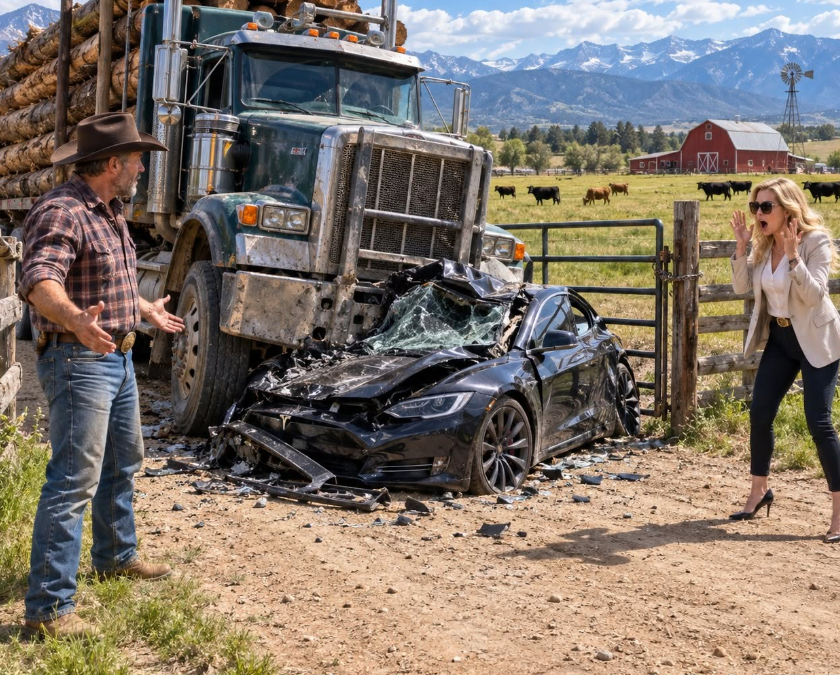
At 6:07, the front of the truck reached the Tesla.
Initial contact was almost quiet.
A soft compression.
Then weight took over.
The Tesla moved.
Its rear bodywork began to buckle.
Plastic cracked.
Metal distorted.
Glass broke.
The sound echoed across the entrance.
Not one clean crunch.
A sequence.
Pop.
Groan.
Snap.
The kind of mechanical surrender anybody who works around heavy equipment recognizes immediately.
Pete kept the movement controlled.
The Tesla’s rear suspension collapsed.
Its body shifted under pressure.
Then Karen appeared.
She came running from the direction of the clubhouse.
Hair loose.
Sunglasses crooked.
She screamed before she reached the car.
“STOP!”
Pete stopped.
Immediately.
Exactly as instructed.
Karen ran to the Tesla.
“Oh my God!”
People were coming outside now.
Phones raised.
“WHAT DID YOU DO?”
I stepped away from the truck.
“You were warned.”
“You destroyed my car!”
“You were warned.”
“You can’t do this!”
A deputy pulled in.
Karen ran toward him.
“Arrest him!”
The deputy raised a hand.
“Ma’am.”
“He intentionally crushed my Tesla!”
“Give me a minute.”
“He needs to be arrested right now!”
“Ma’am.”
She pointed at me.
“He planned this!”
I handed the deputy a folder.
That folder had become my shield.
Certified notice.
Delivery receipt.
Photographs of signs.
Property records.
Prior complaints.
Timeline.
Commercial manifest.
Videos.
The deputy reviewed the material.
Karen paced.
“This is insane.”
Nobody answered.
“You people are standing here acting like this is normal!”
The deputy looked toward the gate.
Then the Tesla.
Then my signs.
“Mrs. Patterson, did you receive this certified notice?”
She crossed her arms.
“I receive lots of mail.”
“That’s your signature?”
She looked.
“I don’t remember.”
“It appears to be.”
“That doesn’t give him permission to destroy my property.”
The deputy kept reading.
I showed him the 5:47 voicemail timestamp.
Then camera footage.
Karen parked.
Signs visible.
Truck arriving.
Horn.
Slow approach.
No person near the vehicle.
Karen arriving afterward.
The deputy did not give anybody a cinematic speech.
Real officers usually do not.
He documented.
Asked questions.
Photographed.
Karen kept demanding charges.
Then Doug arrived.
He was wearing pajama pants.
One shoe looked barely on his foot.
He approached the Tesla.
Stopped.
Looked at Karen.
“What happened?”
Karen pointed at me.
“He crushed it.”
Doug looked at the deputy.
Then the folder.
Then one of the signs.
Then Karen.
“You parked here?”
“He can’t do this.”
“That wasn’t my question.”
She stared at him.
“Doug.”
“You parked here after getting all those letters?”
“They don’t have authority.”
“Brenda.”
That was the first time I heard him call her Brenda.
“You didn’t read them, did you?”
“I read enough.”
Doug closed his eyes.
“No. You didn’t.”
Karen looked betrayed.
“You’re taking his side?”
“I’m taking the side of the paper you signed.”
Neighbors were filming everything.
That line would spread later.
So would another.
Karen told the deputy, “I’m HOA vice president. I represent this community.”
He looked at the road.
“Not on this road, you don’t.”
Silence.
Even I felt that one.
The HOA representative who arrived afterward looked like he wanted to disappear.
He read the certified notice.
Looked at the property map.
Then stared at the mangled Tesla.
Nobody from the board had much to say.
Karen called her insurance company from the shoulder.
She shouted.
Then shouted more.
Words like vandalism.
Intentional destruction.
Malicious.
Her husband walked away from her.
A local reporter eventually appeared.
I did not give a victory speech.
I said the same thing every time.
“This is private commercial access. She received repeated warnings. The vehicle was blocking scheduled business operations.”
Boring.
Factual.
Exactly how Tom wanted it.
The internet was less restrained.
By afternoon, video clips were everywhere locally.
One teenager posted footage with dramatic music.
Comments exploded.
Some called me a hero.
Others called me insane.
Some said Karen deserved it.
Others thought crushing a car went too far.
I ignored most of it.
Internet arguments were irrelevant.
Paper mattered.
The HOA board called an emergency meeting.
That part I expected.
What I did not expect was how fast the community turned on Karen once people started posting documentation.
My old violation notices appeared online.
The false fines.
Photographs of her Tesla blocking the gate.
Screenshots of her videos.
Neighbors began sharing their own experiences.
Administrative fees.
Selective enforcement.
Strange citations.
One resident claimed Karen had charged a fee that never appeared clearly in HOA records.
Another produced an aesthetic violation ticket that made no sense.
The board started investigating.
The parking dispute was only the visible part.
Karen’s use of authority went deeper.
There were questionable administrative charges.
Improper expenses.
HOA funds apparently connected to personal activities.
Including yoga costs.
Her little empire started collapsing under its own records.
Karen contacted an attorney.
Not Doug.
A real outside attorney.
From what I later learned, the lawyer reviewed the evidence and warned that litigation could expose her to counterclaims involving trespass, harassment, and the disputed property filings.
She did not file the dramatic lawsuit she had promised.
Her insurance claim became another battle.
An adjuster inspected the car.
Reviewed notices.
Reviewed the parking history.
Reviewed correspondence.
No instant celebration.
Insurance companies do not operate on poetic justice.
They operate on policy language.
But the documentation mattered.
A lot.
Meanwhile, the HOA removed Karen from authority.
At the public meeting, residents who once supported her started asking questions.
Why had the board claimed my road was shared?
Who authorized the notices?
How did the lien get filed?
Why were complaints against my business accepted without verifying HOA jurisdiction?
Why had the board protected repeated parking violations on property it did not own?
Nobody had good answers.
The president, Henry, eventually came to my property.
Mild man.
Accountant.
The kind of person who looked physically uncomfortable around conflict.
He stood on the gravel near my repaired gate.
“Marcus.”
“Henry.”
“I owe you an apology.”
“The board owes me several.”
He nodded.
“Yes.”
I appreciated that.
He did not argue.
“We let Karen overstep.”
“You did.”
“We should have checked the property records immediately.”
“Yes.”
“We should not have supported her parking.”
“No.”
He took a breath.
“We recognize your right to maintain access to your private property.”
That phrase had also appeared in an HOA email.
I printed the email later.
Not because I needed validation.
Because irony deserves documentation too.
Doug moved out soon afterward.
I do not know every detail of their marriage.
I did not ask.
Their problems were theirs.
But people saw boxes leaving the house.
A separation followed.
Karen’s house eventually went up for sale.
Her social media disappeared after the videos spread.
The same platforms she had used to portray me as an aggressive neighbor now contained endless clips of her Tesla folded at my gate.
I took no pleasure in that part.
The internet is merciless.
Sometimes disproportionately so.
I wanted Karen out of my road.
I did not need thousands of strangers insulting her.
But once something becomes public, nobody controls it.
The police eventually released a brief statement indicating no criminal charge would be pursued against me based on the evidence reviewed.
The remaining issues were civil.
That mattered more than online opinion.
Then Heritage Mutual contacted me.
Karen’s insurer wanted complete supporting documentation.
I smiled when I read the request.
Not because I knew the outcome.
Because for months people had treated my obsessive evidence collection like paranoia.
Now somebody wanted all of it.
I sent a USB drive.
Sixty-seven pages of photographs and documents.
Thirteen video clips.
Six witness statements.
Certified mail receipts.
Timeline.
Property documentation.
Commercial records.
Everything.
A week later, the letter arrived.
After review, the insurer said it found no liability on my part and closed the claim against me.
I read the paragraph twice.
Then put it on my bulletin board.
By then, peace was returning.
Not instantly.
Peace does not arrive like a verdict.
It seeps back.
You stop checking the gate camera every ten minutes.
You drive home without wondering whether the Tesla is there.
Your shoulders stop tightening when you turn toward your property.
I had not realized how much of my life Karen occupied until she no longer occupied any of it.
No fake notices.
No white Tesla.
No pink spray paint.
No HOA emails pretending private property was a shared space.
Just gravel.
Pines.
Diesel.
Work.
My mother came back around Thanksgiving.
I was nervous about that visit.
The last one had been ruined.
This time, the gate was clear.
I opened it.
She parked close to the house.
Got out with her walker.
Looked around.
“Well.”
“What?”
“The queen has abdicated.”
I laughed so hard I almost dropped the pie.
“You’ve been waiting to say that.”
“All week.”
She adjusted her scarf.
“Much better.”
“Road’s clear.”
“Imagine that.”
She looked at me.
“You stayed patient.”
“Mostly.”
“You did it the right way.”
That sentence meant more than anything strangers wrote online.
Because the months before the collision mattered more than the collision.
Warning.
Notice.
Documentation.
Restraint.
The source of my satisfaction was never smashed metal.
It was that Karen had spent months insisting she could ignore every boundary and eventually discovered that boundaries still existed.
The new HOA board adopted a different attitude afterward.
Henry visited again.
“We’re reviewing all boundary maps.”
“Good.”
“And every policy involving roads.”
“Better.”
He looked at my gate.
“I think people learned something.”
“Expensive lesson.”
He smiled slightly.
“Very.”
I replaced the damaged hardware.
Repainted the posts.
Cleaned the gravel.
Eventually, there was almost no physical sign anything had happened.
The Tesla was gone.
The tire marks faded.
The crowd stopped coming.
News crews moved on.
A young couple eventually bought Karen’s house.
First week, the husband walked over carrying beer.
“Marcus?”
“That’s me.”
“I heard there used to be some drama around here.”
I looked toward the old Patterson house.
“You could say that.”
“Anything we should know?”
“Yes.”
He waited.
I pointed toward the property line.
“Your side.”
Then mine.
“My side.”
He laughed.
“Sounds reasonable.”
“That’s all it ever was.”
We opened the beers.
No drama.
That was the best part.
Normality.
Sometimes people who saw the viral video emailed me.
They focused on the truck.
Of course they did.
Heavy machinery crushing a luxury car is visually dramatic.
But the truck was never the real weapon.
The paperwork was.
If I had lost my temper during the first month, Karen would have owned the story.
If I had smashed a window.
Threatened her.
Dragged her car.
Screamed into her phone camera.
She would have had exactly what she wanted.
Aggressive logger harasses HOA woman.
Instead, I gave her months to show people who she was.
She parked.
I photographed.
She fined.
I preserved.
She filed.
I challenged formally.
She lied.
Records contradicted her.
She escalated.
I stayed boring.
Boring won.
That is something people misunderstand about conflict.
Drama feels powerful.
Documentation feels weak.
Until the day someone has to prove what happened.
Then drama becomes noise.
Paper becomes structure.
My road never changed ownership.
Karen’s confidence did not alter the deed.
HOA votes did not move the parcel boundary.
Her title did not create an easement.
Fifty parking incidents did not convert trespass into public access.
Reality remained reality while she performed around it.
That was the foundation underneath everything.
I still own the same land.
Fifteen acres.
Pines.
Douglas fir.
House behind the gate.
Nothing glamorous.
The road still needs grading after heavy rain.
Branches still fall.
Diesel still gets into my clothes.
The logging business still has days where machines break and clients complain.
Those problems feel honest.
A broken hydraulic hose does not pretend you caused it because you were insufficiently neighborly.
It simply breaks.
You fix it.
Karen’s kind of conflict was harder because she made simple things morally confusing.
She blocked my road.
Then called me selfish.
She trespassed.
Then called me aggressive.
She cost my company money.
Then told me to plan better.
She filed against my property.
Then claimed she was protecting the community.
People like that depend on reversal.
If you accept their framing, you spend all your energy defending yourself instead of examining what they did.
It took me months to stop doing that.
The day my mother waited outside was the moment the framing finally disappeared.
There was no HOA theory.
No community access debate.
No social media performance.
Just an eighty-year-old woman with bad knees sitting in a car because somebody who had been warned repeatedly chose not to move.
That stripped the issue down to what it had always been.
Cruelty disguised as authority.
Karen would probably reject that description.
Maybe she genuinely believed she was defending shared access.
People are capable of believing astonishing things when those beliefs flatter them.
But intention only matters so far.
Actions create consequences.
She blocked.
Businesses lost money.
She filed false claims.
My title became complicated.
She spread rumors.
People avoided me.
She refused to move for my mother.
My mother suffered.
At some point, “I believed I had authority” stops being a meaningful excuse.
The documents existed.
The warnings existed.
She simply did not like them.
That was Karen’s central problem.
Evidence did not persuade her if evidence reduced her power.
The sheriff could confirm the road was private.
She said he did not understand HOA easements.
I could show the deed.
She claimed broader community rights.
Tom could send a cease and desist.
She taped another citation to my mailbox.
Every contradiction became another reason for her to push harder.
Then came Monday morning.
People ask whether I smiled when the Tesla folded.
I remember feeling something.
Not joy.
Not exactly.
Relief.
The conflict had reached a point where pretending had become impossible.
Nobody could call the gate blockage minor anymore.
Nobody could pretend the notices were theoretical.
Nobody could treat the road as community property without looking at the wreckage and asking why a private logging operation had been obstructed after explicit warnings.
The crushed car forced attention onto the facts Karen had spent months obscuring.
That is the strange thing about consequences.
They are often less important than what they reveal.
Before that morning, neighbors knew Karen’s version.
Afterward, they started asking for documents.
Once they did, her version deteriorated quickly.
The most satisfying moment was not the crash.
It was watching somebody at an HOA meeting read my certified letter aloud.
Because there it was.
Date.
Time.
Warning.
Signature.
No screaming could erase it.
Another resident pulled up the fake fine.
Another showed parking photographs.
Another asked why Karen’s yoga expense appeared where HOA spending should have been.
The whole system began auditing itself.
Karen had built power through fragmentation.
One person knew about parking.
Another knew about strange fees.
Another knew about selective enforcement.
Another had heard rumors.
Nobody compared notes.
Then they did.
Once information connected, power changed hands.
That lesson stayed with me.
Isolation protects abuse.
Comparison exposes patterns.
The same thing happened to me psychologically.
For months, Karen made me feel like I was fighting alone.
Then people came forward.
A neighbor named Lisa apologized.
“We didn’t know.”
“You could have asked.”
“I know.”
That was enough.
She did not need to grovel.
Most residents had not participated directly.
They had simply believed whoever held the title.
Vice president.
Official letterhead.
Gold logo.
It looked legitimate.
Authority often survives because it looks legitimate.
People assume somebody checked.
Nobody had.
That is why the property map mattered.
One boundary line defeated months of speeches.
My parcel ended here.
HOA jurisdiction ended there.
Done.
Karen’s title stopped at the property line whether she liked it or not.
Years in logging teach you respect for lines.
Cut lines.
Property lines.
Road limits.
Equipment zones.
You ignore physical boundaries long enough, something hurts you.
Society is not that different.
Rules work when everyone recognizes where their authority ends.
Karen’s authority had an edge.
She kept stepping across it.
I gave her warnings.
Then records.
Then lawyers.
Then signs.
Then more warnings.
She still crossed.
Eventually she encountered something heavier than confidence.
People loved calling it karma.
I understand why.
But karma makes it sound mystical.
Nothing mystical happened.
A person repeatedly blocked active private commercial access after receiving extensive notice.
A scheduled logging operation arrived.
The dramatic part was weight.
The important part was choice.
Karen had choices every step of the way.
Move the Tesla the first afternoon.
Check the deed.
Stop issuing fake fines.
Remove the lien.
Respect the cease and desist.
Move when my mother arrived.
Read the certified commercial notice.
Believe the signs.
Listen to the voicemail.
Move the car at 5:47.
Any one of those choices changes the ending.
She chose none.
That is why I never accepted her later claim that the collision came from nowhere.
Nothing about that morning came from nowhere.
It had months of warning behind it.
I remember standing beside the damaged car while Karen screamed that nobody had told her.
Doug held up the certified letter.
“You signed this.”
She looked at it.
“That’s not the point.”
That sentence might summarize her entire philosophy.
Evidence was never the point when evidence hurt her.
Authority was the point.
Being right was less important than being obeyed.
Once people stopped obeying, the entire persona collapsed.
Without the HOA title, Karen was just a person yelling beside a damaged car on somebody else’s land.
That was probably why the board removing her mattered so much.
She had built her identity around the office.
Vice president.
Community leader.
Standards.
Rules.
Once residents withdrew that authority, the performance had nowhere to stand.
The house went up for sale.
The social account disappeared.
Her husband left.
Again, those parts did not make me happy.
A marriage falling apart is not entertainment when you are close enough to see boxes being loaded.
But consequences spread.
Karen had fused her personal identity with community power so completely that losing one damaged everything else.
That is another warning.
Never make a small title the entire proof of who you are.
Eventually the title ends.
Then what?
For me, the answer was easy.
I was still Marcus.
Still had trucks.
Still had employees.
Still had customers.
Still had fifteen acres.
Still had an eighty-year-old mother who criticized my shirts.
My life existed outside the dispute.
That saved me.
Karen seemed to have nothing outside hers.
Peace returned slowly.
The first morning I drove through the gate without checking for a white Tesla, I did not notice until I reached the house.
I turned off the pickup.
Sat there.
Then realized.
I had not looked.
For months, scanning the entrance had become automatic.
White car?
Karen?
Camera?
Notice?
Nothing.
That absence felt enormous.
I started sleeping better.
My drivers stopped calling with parking emergencies.
Deliveries ran on schedule.
Customers stopped asking whether I had “that neighborhood problem” under control.
Revenue normalized.
My mother visited without waiting.
Life resumed.
One spring afternoon, I stood near the road watching the young couple who bought Karen’s house walk their dog.
They waved.
I waved back.
That was all.
No board title.
No conflict.
No history lesson.
Just neighbors.
I realized something then.
Karen had made neighborhood life look complicated.
It was not.
Respect the line.
Ask before using somebody’s property.
Move your car when you are blocking a gate.
Do not manufacture authority you do not have.
Do not use paperwork as a weapon.
Do not confuse cooperation with surrender.
Simple.
The new HOA understood that.
Henry and I developed what I considered the ideal relationship between an HOA president and a person who does not belong to his HOA.
Almost none.
He handled Whispering Pines.
I handled Turner Logging.
If an issue crossed the line, we talked.
No embossed threats.
No fake jurisdiction.
Just conversation.
That was progress.
People asked whether I regretted anything.
Yes.
I regretted not recognizing earlier how deliberate Karen’s behavior was.
The first few incidents, I kept assuming misunderstanding.
That delayed a stronger formal response.
I also regretted how long my mother sat waiting.
I regretted the business losses.
I regretted letting gossip bother me as much as it did.
But I did not regret documenting everything.
That folder became the difference between a dramatic story and a defensible record.
People remember the truck.
I remember the timestamps.
5:47.
Final voicemail.
6:03.
Truck arrives.
Horn.
Slow movement.
6:07.
Contact.
Those numbers mattered.
So did the weeks before.
Signed courier receipt.
Posted notices.
HOA emails.
Fifty incidents.
The dispute was not a spontaneous explosion.
It was a timeline.
That is why Tom kept saying, “The pattern matters more than the incident.”
He was right.
One blocked gate could be an accident.
Two could be stubbornness.
Fifty becomes a pattern.
One questionable notice could be clerical confusion.
Multiple notices plus a lien become something else.
One rumor could be gossip.
A coordinated campaign becomes harassment.
Patterns tell truth individual moments can hide.
Karen’s biggest mistake was consistency.
She behaved badly so reliably that eventually the documentation became overwhelming.
If she had been reasonable once in a while, she might have created ambiguity.
She never did.
She believed persistence proved authority.
Instead, persistence proved intent.
That is almost funny now.
At the time, it was exhausting.
Every new incident meant camera files.
Screenshots.
Notes.
Emails.
Tom probably has nightmares about my attachments.
But clean records meant Karen could not rewrite history later.
That mattered when she went on local television.
The reporter asked whether she had parked on private property despite receiving multiple warnings.
Karen froze.
Then said she did not want to discuss specifics.
The interview died right there.
Because specifics were the problem.
Generalities favored her.
Community.
Shared access.
Neighborhood safety.
Respect.
Specifics favored me.
Deed.
Date.
Signature.
Gate.
Vehicle.
Warning.
Once journalists started asking specific questions, her story had nowhere to go.
That is a broader lesson.
People who manipulate narratives love abstract language.
Fairness.
Safety.
Community.
Standards.
They become uncomfortable when you ask:
Which parcel?
Which rule?
Which date?
Which authority?
Which signature?
Show me.
Specificity is hostile to invented power.
Tom taught me that indirectly.
Whenever I called furious, he would ask boring questions.
“What date?”
“What exactly did she say?”
“Was it written?”
“Who witnessed it?”
“Do you have a copy?”
At first, those questions annoyed me.
I wanted him angry.
I wanted somebody to say Karen was outrageous.
Instead, he built the record.
That was far more useful.
Anger validates you.
Evidence protects you.
My mother understood that too in her own way.
After the case quieted, she asked to see the gate.
I showed her the repaired latch.
New paint.
Gravel.
She tapped the metal with one hand.
“Strong?”
“Strong.”
“Good.”
Then she looked toward Whispering Pines.
“You know what your father would have done?”
“What?”
“Towed her car the first day.”
I laughed.
“He probably would have.”
“And then spent six months in court.”
“Probably.”
She nodded.
“You’re smarter.”
That may be the nicest thing she has ever said to me.
I did not tell her how close I came to losing my temper several times.
The night my mailbox was smashed, I walked toward Karen’s house.
Got halfway.
Stopped.
Turned around.
If I had knocked on that door angry, anything could have happened.
She could have filmed me.
Provoked me.
Called police.
Changed the entire narrative.
Instead, I called Tom.
That choice probably saved me more than any sign did.
Restraint is frustrating because nobody sees it.
People see the moment you finally act.
They rarely see the hundred moments you chose not to.
That is why the viral clip felt incomplete.
It showed seconds.
Truck.
Tesla.
Karen screaming.
It did not show months of patience.
My mother waiting.
The fraudulent lien.
The calls.
The losses.
The warnings.
The careful preparation.
Without context, I could look like a madman.
With context, the story became what it was.
A long boundary dispute that escalated because one person refused every opportunity to stop.
The insurance company understood context.
The police understood context.
Eventually the HOA understood context.
That mattered more than strangers.
The Tesla itself became a strange symbol.
People joked about it.
One dealer supposedly advertised the damaged vehicle with a joke description after it was removed.
I laughed when someone sent me the screenshot.
But I did not keep it.
The car was never important.
It could have been a Honda.
A pickup.
A golf cart.
What mattered was what Karen used it to say.
My authority reaches here.
Every time she parked across my gate, that was the message.
The vehicle became territorial.
So when the Tesla finally left on a tow truck, I felt something close to relief.
Not because an expensive machine was damaged.
Because the symbol was gone.
No flag at the border.
No challenge.
Just road.
One afternoon, I repainted the gate posts.
Sun warm.
Pine smell everywhere.
I realized I had not heard Karen’s voice in weeks.
That might have been the real ending.
Silence.
Not the dramatic silence after metal crumpled.
Ordinary silence.
The kind where wind moves through trees and nobody is trying to prove anything.
That is peace.
People imagine peace as something grand.
Usually it is absence.
No blocked road.
No threatening letter.
No phone recording you.
No public argument.
Nothing happening.
After months of conflict, nothing becomes beautiful.
I became much less tolerant of unnecessary authority afterward.
Not hostile.
Just careful.
If someone says they have jurisdiction, I ask where it comes from.
If someone cites an easement, I want the recorded document.
If someone threatens fines, I want the rule.
Not because every authority figure is corrupt.
Most are not.
Because legitimate authority can answer legitimate questions.
Karen could not.
She compensated with confidence.
That worked until somebody stopped mistaking confidence for proof.
The Whispering Pines board changed too.
Residents began attending meetings.
Budgets received scrutiny.
Administrative charges became clearer.
People who once hated conflict started asking questions.
Maybe Karen accidentally improved the association.
Not through leadership.
Through example.
They saw what happens when oversight disappears.
Power concentrates.
Rules become personal.
Boundaries blur.
Then somebody gets hurt.
Nobody wanted another Karen.
The phrase actually became shorthand for a while.
“Check the parcel map. We don’t need another Karen situation.”
I hated hearing my conflict become a governance term.
But I understood.
Institutional memory is useful.
The board eventually wrote procedures requiring boundary verification before asserting authority near non-HOA property.
That should have existed already.
Now it did.
My property did not need the protection.
My deed was enough.
But maybe the policy would prevent somebody else from going through the same nonsense.
That was worth something.
Doug disappeared from the neighborhood before Karen sold.
I saw him once in town.
Hardware store.
He was buying paint.
I almost avoided him.
Then he noticed me.
“Marcus.”
“Doug.”
Awkward silence.
Finally he said, “I’m sorry.”
“For what?”
“All of it.”
“You didn’t park the car.”
“I should have stopped her.”
Maybe.
Maybe not.
Marriage is complicated.
“Take care of yourself, Doug.”
He nodded.
That was it.
No revenge.
No lecture.
I did not need him to confess.
I had enough paperwork already.
Karen never apologized.
Not to me.
Maybe she apologized privately to someone else.
I doubt it.
But it stopped mattering.
Apologies are valuable when you still need a relationship.
I did not.
I needed a clear gate.
I had one.
That was sufficient.
Months later, Heritage Mutual sent final closure paperwork.
Claim closed.
No further action required.
I pinned the letter beside a photograph of my first logging truck.
That old truck looked tiny compared with modern rigs.
Rust on the bumper.
Dent in the door.
I remember buying it used.
Every dollar mattered.
I built the business slowly.
Maybe that was another reason Karen’s behavior angered me.
My land and company were not decorations.
They represented decades.
Payments.
Risk.
Work.
Employees.
Customers.
Equipment.
She treated all of it like an inconvenience to her preferred version of the neighborhood.
People who have never built something sometimes underestimate how personal interference becomes.
A blocked gate was not merely a parking problem.
It stopped payroll-generating work.
Delayed deliveries.
Risked contracts.
Damaged reputation.
That is why “just wait for her to move” was not a harmless suggestion.
Waiting cost money.
Real money.
Karen knew.
She had watched drivers sitting there.
I told her the amount.
She still continued.
That took the issue out of accidental nuisance territory.
It became intentional pressure.
She thought money would force me to give in.
In the end, money helped expose her.
Lost delivery records.
Invoices.
Driver time.
Everything quantified the impact.
Again.
Paper.
The boring hero.
I still advise younger business owners about that.
Not the Tesla story.
Documentation.
I tell them if something threatens your operations, write it down before you get emotional.
Date.
Time.
Cost.
Witness.
Photograph.
Save the email.
Because memory sounds subjective after six months.
Records do not.
That lesson was expensive.
At least it became useful.
The young couple in Karen’s old house turned out to be easy neighbors.
Sometimes they buy firewood.
Once they accidentally parked a trailer near my road.
The husband called.
“Marcus, am I blocking you?”
“Two feet.”
“Give me five minutes.”
He moved it.
That was it.
No dispute.
No documents.
No sheriff.
No truck.
Five minutes.
Every time something that simple happens, I think about how unnecessary the entire Karen situation was.
Normal people solve normal problems through conversation.
Karen needed every interaction to confirm hierarchy.
That made resolution impossible because compromise felt like defeat to her.
The only acceptable outcome was obedience.
Eventually, reality refused.
Reality usually does.
You can ignore a deed.
It still exists.
You can ignore a warning.
The timestamp remains.
You can ignore a sign.
The camera sees you pass it.
You can ignore a loaded truck.
Physics is less negotiable.
That is why the opening sound remains clear in my memory.
Not because I enjoyed it.
Because it was final.
For months, every conversation had been reversible.
Karen could reinterpret.
Deny.
Argue.
Appeal.
Post online.
The sound of metal folding could not be argued into something else.
The conflict had become physical.
Visible.
Public.
Everybody finally had to deal with the truth beneath the performance.
Her vehicle was blocking the gate.
The truck needed through.
Months of avoidance reached one unavoidable point.
The aftermath proved something else.
Consequences do not automatically end bad behavior.
Karen still screamed.
Called insurers.
Called lawyers.
Tried media.
Tried HOA arguments.
For several days, she acted like enough outrage could reverse what happened.
But each institution asked for evidence.
That was the arena where she lost.
Her greatest strength had been social dominance.
Paper did not care.
The adjuster did not care how forcefully she spoke.
The attorney did not care how much she hated me.
The parcel map did not care she was vice president.
Once the dispute entered systems that demanded proof, her confidence became irrelevant.
That might be the deepest reason documentation worked.
It moved the conflict away from personality.
I am not charming.
Karen was better at public performance than me.
If the case depended on who told the more dramatic story, she might have won.
Instead, it depended on ownership and records.
Good.
Justice should not be a popularity contest.
What stayed with me afterward was not the damage.
It was the months before it.
That is what shaped the ending.
The gate is still there.
Repaired.
Stronger.
I eventually replaced the old sign.
The new one says:
PRIVATE ROAD.
NO PARKING.
Nothing clever.
For a while, I considered something sarcastic.
RESPECT GETS YOU FURTHER THAN ARROGANCE.
My mother liked that one.
I decided against it.
The gate does not need a joke.
It needs clarity.
A boundary should not require performance.
This is mine.
That is yours.
Respect both.
Done.
Sometimes, late in the afternoon, I stand near the entrance when a loaded truck comes through.
Diesel.
Gravel.
Pine dust.
Heavy tires.
The drivers wave.
I wave back.
Nobody blocks them.
That ordinary movement means more to me now.
Access used to be invisible.
You only notice infrastructure when someone takes it away.
Gate.
Road.
Driveway.
Rights.
All boring until blocked.
Karen taught me that.
Not intentionally.
But thoroughly.
She also taught me something about patience.
Patience does not mean endless tolerance.
That distinction matters.
For months, I confused the two.
I thought being reasonable meant waiting one more time.
Giving another warning.
Avoiding escalation.
Sometimes that is wise.
Sometimes delay rewards the person abusing your patience.
Real patience is strategic.
It gives you time to understand the problem.
Gather facts.
Choose the right response.
Then act when action is necessary.
Logging works the same way.
You do not stand forever beside a dangerous tree because patience is virtuous.
You assess.
Prepare.
Clear the area.
Then make the cut.
Karen mistook my preparation for weakness.
A lot of people do.
Quiet people are often assumed to be passive.
Businesses that follow procedure look slow.
Polite requests look negotiable.
Then suddenly the person who has been documenting everything acts with a complete record behind them.
That surprise is not because they changed.
It is because you misunderstood restraint.
My mother understood.
“You stayed patient,” she told me.
Not passive.
Patient.
There is a difference.
I still think about her sitting in that car.
That image probably prevented me from backing down later.
Not because I wanted revenge for my mother.
She would hate that framing.
Because it showed me the cost of allowing Karen to dictate access.
The cost had moved beyond my business.
It reached family.
That was my line.
Everyone has one.
Karen found mine.
Then ignored the warnings around it.
I do not know where Karen lives now.
I do not search.
No interest.
I hope wherever she went, she learned something.
Not for my sake.
For whoever shares a property line with her.
Maybe she became more reasonable.
People can change.
Maybe she tells a version where I am still the villain.
People can do that too.
It no longer matters.
My life is not dependent on being understood by Karen Patterson.
That freedom might be the best outcome of all.
During the conflict, I cared too much what she said.
Every rumor.
Every post.
Every whisper.
I wanted correction immediately.
Wanted neighbors to know.
Wanted strangers online to understand context.
Eventually I learned truth has its own pace.
Documents accumulated.
People compared stories.
Records surfaced.
The truth became harder to avoid.
I did not have to chase every lie.
That saved energy.
If I could talk to myself on the first Tuesday afternoon, standing beside that pristine Tesla, I would say:
Do not argue about personality.
Do not try to make her understand.
Photograph the car.
Check the deed.
Send written notice.
Save everything.
Then go home.
You cannot reason someone out of a boundary violation they are using as a power test.
You can only make the boundary undeniable.
That is what happened.
Slowly.
Painfully.
Expensively.
But eventually, undeniably.
The damaged Tesla became the image everyone remembered.
For me, the more important image came months later.
Thanksgiving.
My mother stepping out of her car beside my house.
No obstruction.
She looked at the open gate behind us.
Then at me.
“You finally fixed it.”
“Yeah.”
“How?”
“Paperwork.”
She laughed.
“I thought it was the truck.”
“No.”
“The truck helped.”
“Mom.”
She smiled.
Then walked inside.
That was the whole story in two sentences.
People thought the truck ended it.
The paperwork ended it.
The truck was only the moment everybody noticed.
The next spring, my company had one of its best quarters.
No lost deliveries from gate disputes.
No drivers sitting idle.
No frantic calls.
The furniture manufacturer that had been delayed during Karen’s worst period placed another order.
I personally supervised the load.
When the truck rolled out through the gate, I stood aside.
No Tesla.
No crowd.
No cameras except my standard security system.
The driver waved.
I watched until the trailer disappeared toward the highway.
Then I closed the gate.
Simple.
There are people who would call that boring.
They are right.
I had never been happier to be bored.
The forest around my house returned to being louder than the neighborhood.
Wind through cedar.
Chainsaw in the distance.
Birds.
Engines from the yard.
No shouting.
Whispering Pines finally lived up to its name again.
I do not frame the conflict as me defeating Karen.
She defeated herself.
Every opportunity to stop, she escalated.
Every document she could have checked, she ignored.
Every warning she could have respected, she mocked.
Every institution she tried to weaponize eventually examined the evidence.
That is not heroic.
It is procedural.
But procedures matter.
Especially when power becomes personal.
Today, when someone asks why I did not simply let her park there, I ask one question.
“Would you let somebody block the only entrance to your business whenever they wanted?”
Usually that ends it.
Because once you remove the luxury car and HOA drama, the issue becomes obvious.
Access.
Property.
Livelihood.
A boundary.
Karen treated my gate like a stage.
I needed it as a gate.
We were never arguing about the same thing.
That is why we could not compromise.
For her, parking there demonstrated status.
For me, leaving it clear allowed trucks to move.
One side was symbolic.
The other functional.
Function eventually won.
Weight helped.
But function won.
My crew still jokes about the morning.
Pete claims he aged five years in four minutes.
I tell him his hair was gray already.
He denies it.
One day he asked, “Would you do it again?”
I thought before answering.
“I’d rather never need to.”
“That wasn’t the question.”
“I know.”
He waited.
“If the same facts existed?”
“Yes.”
“If every warning had been given?”
“Yes.”
“If the route had to be used?”
“Yes.”
I looked at him.
“I’d still wish she moved the car.”
That is the answer.
The cleanest ending would have been nothing happening.
Karen reads the notice.
Moves the Tesla.
Truck passes.
Everybody goes to work.
No viral video.
No insurance dispute.
No damaged property.
No collapsed HOA career.
But Karen had fifty chances at the clean ending.
Maybe more.
She kept choosing the dramatic one.
Eventually she got it.
Drama is expensive.
Peace is cheaper.
The young couple who bought her house learned that immediately.
They do not have to like me.
We do not barbecue together every weekend.
We respect the line.
That is enough.
Good neighbors do not need intimacy.
They need boundaries and basic decency.
Karen wanted community without boundaries.
That is not community.
That is control.
I know that now.
The forest taught me before she did.
Trees grow beside one another for decades.
Roots spread.
Canopies overlap.
They share weather.
But every trunk still occupies its own ground.
There is room for proximity without ownership.
Karen never understood that.
I hope I always do.
When I lock the gate at night, I sometimes see scratches on one repaired section.
Remnants from the old hardware.
I could replace everything.
Make it perfect.
I leave them.
Not as a monument to revenge.
As a reminder.
Lines matter.
So does how you defend them.
I am proudest not of the truck.
Not of the viral video.
Not of the insurance letter.
I am proudest of all the mornings before it when I could have lost my temper and did not.
I am proud I called Tom instead of walking to Karen’s house furious.
I am proud the final record contained warnings instead of threats.
I am proud the facts were strong enough that I did not need to exaggerate them.
Karen gave me fifty incidents.
I documented fifty incidents.
That was enough.
The world contains plenty of loud people.
Documentation rarely shouts.
It waits.
Then someone asks what happened.
You open the folder.
That was my real answer to Karen.
Not the truck.
The folder.
Everything else followed.
The last official letter from Heritage Mutual is still pinned in my office.
No liability on my part.
Claim closed.
No further action.
Three dull sentences.
People expect the most satisfying thing from this story to be the sound of a luxury SUV folding beneath industrial weight.
It was not.
The most satisfying sound was my office printer when I made a copy of that final letter.
Paper sliding out.
Soft mechanical hum.
Done.
Because metal can be dramatic.
But closure is quiet.
And after months of Karen Patterson turning my private gate into the center of her little war, quiet was all I had wanted from the beginning.
Now, when I drive home, I turn from the highway onto my gravel road.
The pines close around me.
My gate comes into view.
Nothing sits in front of it.
No white Tesla.
No HOA officer.
No phone camera.
No fake notice.
Just my road.
My gate.
My land.
I unlock it.
Drive through.
Close it behind me.
Then I keep going.
That is how this story actually ends.
Not with crushed metal.
Not with Karen screaming.
Not with strangers cheering online.
It ends with a clear road, a closed gate, and the kind of silence you only understand after someone has tried to take it from you.

