HOA Karen Billed Me $47,000 to Upgrade My Private Bridge for Her Husband’s $18 Million Resort—So I Legally Demolished It and Left the Entire Project Without Road Access.*
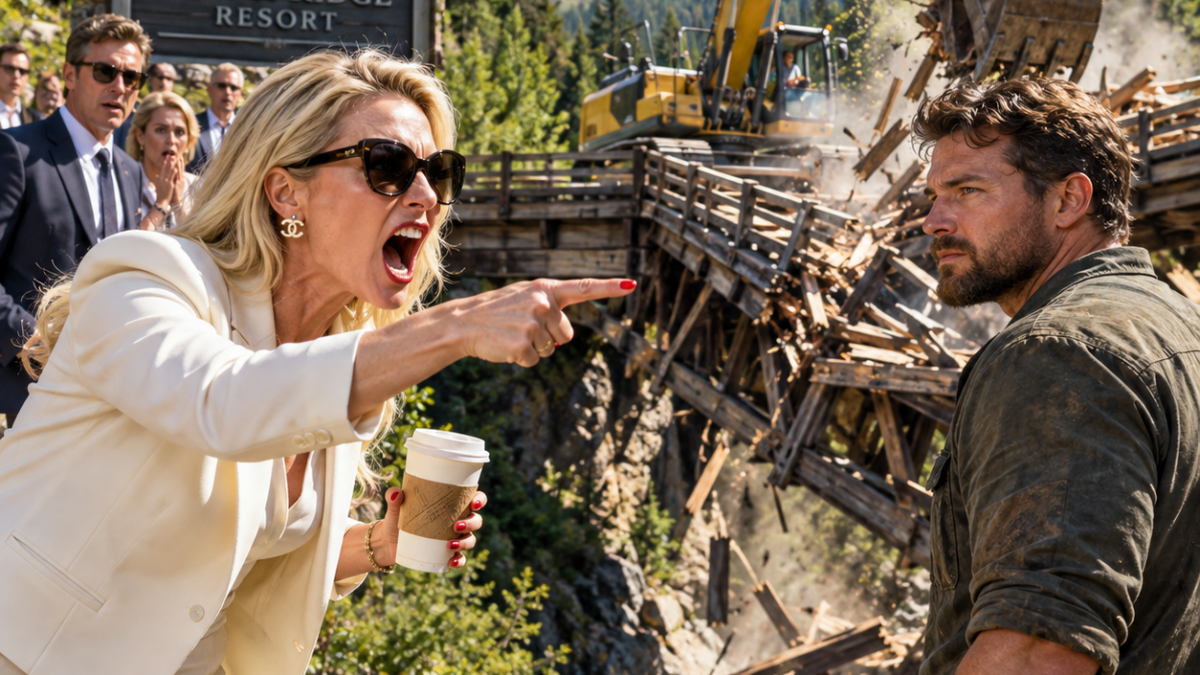
HOA Karen Billed Me $47,000 to Upgrade My Private Bridge for Her Husband’s $18 Million Resort—So I Legally Demolished It and Left the Entire Project Without Road Access.
Sloan Prescott stood on my father’s bridge in designer heels, handed me a $47,000 “assessment,” and told me I would pay to reinforce the private timber span so construction trucks could reach the $18 million luxury resort her husband planned to build across the canyon.
What she did not tell the forty-seven families applauding her “community safety campaign” was that she secretly owned twenty-two percent of that resort, that her husband’s trucks had already been crossing my fifteen-ton bridge without permission, and that their entire development had no legal vehicle access without the structure they were trying to bully me into surrendering.
So after their easement claim failed, after one of their company trucks was caught on camera vandalizing my property, and after the county confirmed the bridge was mine to remove, I waited until twelve hours before their final resort hearing and did the one thing Sloan never believed I would have the nerve to do—I legally took my father’s bridge apart.
My name is Cole Whitfield.
I never wanted to come back to Hemlock Canyon.
Not because I hated the place.
I loved it too much.
There is a difference.
My wife Sarah loved it too.
That was the problem.
The last time she stood beside me on the old bridge, she had one hand wrapped around a thermos of coffee and the other tucked into the back pocket of my jeans.
October.
Cold enough to see our breath.
The creek sixty feet below us flashed gold beneath the last evening light.
Fog had begun crawling up the canyon walls.
Sarah leaned over the timber railing and said:
“This place feels like a doorway.”
“To what?”
“I don’t know.”
“That’s vague.”
“You’re an engineer.”
“You hate vague.”
“I respect vagueness when properly documented.”
She laughed.
I remember that laugh more clearly than I remember what I said next.
Three years later, she was dead.
Logging truck.
Highway 20 outside Sedro-Woolley.
Red light.
Wet pavement.
The state trooper told me it happened quickly.
People say that as though speed softens grief.
It does not.
Fast only means there was no final conversation.
No warning.
No goodbye.
No last ordinary morning you knew was last.
One minute your wife is driving home.
PART2:
The next minute every plan you made together becomes a story only one person remembers.
Sarah was thirty-eight.
I was forty.
We had been married eleven years.
No children.
Not because we did not want them.
Life simply kept telling us:
Later.
Later.
Later.
Then later disappeared.
At the time, I had served twelve years with the Army Corps of Engineers.
Bridges.
Roads.
Temporary crossings.
Structural repair.
Afghanistan taught me that a bridge is never only a bridge.
It is movement.
Supply.
PART3:
Evacuation.
Access.
Control.
Sometimes survival.
In Helmand, I worked on temporary spans while mortar rounds landed close enough to make the river move.
In the Korengal, we designed pontoon crossings under conditions where the word “temporary” meant “until somebody blows it up again.”
In Kandahar, I supervised reconstruction of three permanent spans damaged by IEDs.
I knew load calculations.
Fatigue cycles.
Lateral force.
Bearing failure.
Scour.
Foundation movement.
I knew the particular dry cracking sound a timber truss makes when it begins telling you it has carried enough.
Most people hear wood.
Engineers hear information.
After Sarah died, I lasted another six months.
Then I filed for early separation.
Everybody assumed grief drove me home.
They were right.
But not in the way people imagined.
I did not come back because Hemlock Canyon comforted me.
I came back because it hurt honestly.
Tacoma was full of places pretending nothing had happened.
Our apartment.
The coffee shop Sarah liked.
The grocery store.
Her dry cleaner.
The intersection where she used to complain about people blocking the crosswalk.
Everywhere I turned, ordinary life continued with offensive confidence.
The canyon never pretended.
The bridge hurt.
The tree farm hurt.
My father’s workshop hurt.
But at least the pain matched the truth.
Sarah was gone.
Dad was gone.
And this place remembered both of them.
My father, Warren Whitfield, bought 240 acres along Hemlock Creek in 1971.
Douglas fir.
Western red cedar.
Hemlock.
Steep country.
Deep ravines.
Dark soil.
Rain that seemed less like weather and more like a permanent atmospheric arrangement.
He paid almost nothing by modern standards.
He also bought almost nothing except trees, rock, water, and inconvenience.
The property straddled Hemlock Canyon.
The western half had county road access.
The eastern half did not.
Between them sat a sixty-foot gorge carved by Hemlock Creek.
Dad spent seven years crossing the long way around whenever he needed equipment on the east side.
Then he got tired of asking geography for permission.
In 1978, he started building a bridge.
Ninety-foot timber span.
Heavy Douglas fir trusses.
Poured concrete abutments.
Fifteen-ton design capacity.
Single lane.
No decoration.
No lighting.
No decorative stone.
No little plaque saying WARREN’S BRIDGE.
Dad would have hated that.
He built it because the canyon was inconvenient and because Warren Whitfield believed inconvenience was mostly a planning problem.
It took him three summers.
He hauled some beams using logging equipment.
Others came up old trail sections because the road was too narrow for a conventional flatbed.
My mother said he lost eighteen pounds during the first summer and gained fifteen of them back eating her pies.
He finished in October.
Then drove his pickup across.
Mom said Dad sat on the east side for ten minutes before returning.
She asked why.
He said:
“I wanted to see whether it stayed up without me watching.”
That was his sense of humor.
The bridge became his proudest piece of work.
Not because it was beautiful.
It was not.
It was square.
Heavy.
Plain.
The structural equivalent of a man who shakes your hand once and means it.
Dad died in 2009.
Heart attack in the equipment barn.
Sixty-seven.
Tree farm came to me.
Bridge came to me.
For years, I mostly leased the timber operation to a local forester while serving.
Then Cedar Ridge Estates appeared.
The development went up in 2012 on three hundred acres east of the creek.
Former commercial timber ground.
Forty-seven houses.
Large lots.
Mountain views.
Polished wood façades.
People from Seattle, Bellevue, Tacoma.
Families who wanted rural scenery while remaining within reach of good coffee.
I do not mean that as criticism.
Most were decent people.
But Cedar Ridge had a problem.
Their county road ended at the canyon.
The developers had not built a crossing.
The nearest public route to Highway 20 required an eleven-mile detour.
My bridge connected directly to the western road.
I could have closed it.
I could have charged.
I did neither.
I opened the gate.
Neighbors crossed.
Morning commuters.
School pickups.
Grocery runs.
Emergency vehicles when necessary.
Nobody signed a contract.
Nobody paid a toll.
Nobody demanded anything.
Dad had built the bridge to connect two halves of his land.
I let it connect people too.
That felt right.
For fourteen years, there was never a serious problem.
Then Sloan Prescott arrived.
The first time she called me “tree man,” I thought she was joking.
She was not.
Sloan was thirty-two.
Lifestyle influencer.
Three hundred forty thousand followers.
Her online life consisted of luxury travel, expensive brunches, carefully distressed motivational quotes, resort reviews, and photographs where every sunrise appeared contractually obligated to happen behind her shoulder.
She was beautiful.
There is no reason to pretend otherwise because she was unpleasant.
Tall.
Platinum-blonde.
Controlled.
Every part of her presentation looked professionally maintained.
Her clothes cost more than some of my equipment.
She drove a pearl-white Range Rover Velar with a vanity plate:
SLOAN P.
Her husband, Nolan Greer, was forty-one.
Developer.
Polished.
Expensive.
The kind of man who wore outdoor brands without ever getting dirt on them.
Together they looked like a magazine advertisement for a life nobody actually lived.
They moved into Cedar Ridge three years before my return.
Sloan became HOA president almost immediately.
She ran unopposed.
That is how many petty empires begin.
Not through conquest.
Through everybody else deciding the meeting sounds boring.
Sloan’s campaign slogan was:
ELEVATING OUR COMMUNITY.
Her flyer had a QR code linking to Instagram.
People laughed.
Then voted for her because nobody wanted the job.
When I came home after Sarah died, Sloan had already spent three years converting an ordinary HOA into something resembling a personal brand.
Community newsletters had professional photography.
Board meetings included catering.
She added a Cedar Ridge logo redesign.
Created “visual identity standards.”
Started referring to residents as “stakeholders.”
There were more committees.
More rules.
More social-media posts.
More photographs of Sloan standing beside things other people maintained.
The first meeting I attended was supposed to be a courtesy.
I had reopened full-time forestry operations on my property and wanted neighbors to know when trucks might appear.
I wore Wrangler jeans.
Work boots.
Flannel.
Sloan saw me enter.
Her smile moved over me from head to toe.
“You must be the tree man.”
“Cole Whitfield.”
“I know.”
She shook my hand.
“We just love that you maintain the bridge for us.”
For us.
I noticed.
Did not react.
“It’s my bridge.”
“Of course.”
She smiled again.
“Community partnerships are so important.”
Three weeks later, the first official envelope arrived.
CEDAR RIDGE ESTATES HOMEOWNERS ASSOCIATION.
INFRASTRUCTURE UPGRADE ASSESSMENT.
Amount due:
$47,000.
Payable by:
Cole Whitfield.
Purpose:
Widening, structural reinforcement, re-decking, and modernization of “community bridge” to meet commercial vehicle standards.
I read it twice.
Then once more because I wondered whether grief had somehow damaged my ability to process absurdity.
The HOA was billing me forty-seven thousand dollars to upgrade my own bridge.
A bridge entirely on my property.
A bridge their residents crossed only because I allowed it.
I called Sloan.
She answered on the second ring.
“Cole.”
“You sent me an assessment.”
“Yes.”
“For my bridge.”
“For infrastructure serving Cedar Ridge.”
“I’m not in Cedar Ridge.”
“The bridge serves Cedar Ridge.”
“That doesn’t make me an HOA member.”
“You benefit from surrounding property values.”
“Not relevant.”
“Cole, we had an engineering review.”
“Who requested it?”
“The board.”
“For what?”
“Safety.”
“What commercial traffic are you planning?”
Silence.
Tiny.
Then:
“This is a broader community conversation.”
“Meaning?”
“You should attend Thursday.”
“Am I paying the $47,000?”
“Yes.”
“No.”
Sloan exhaled.
“Cole.”
“No.”
“Let’s not start with hostility.”
“You mailed me a bill for my property.”
“Then called it community infrastructure.”
“You started.”
She hung up first.
That same week, she posted photographs of my bridge.
Close-ups of old timber.
Hairline cracks.
Weathering.
Caption:
SERIOUS SAFETY CONCERNS WITH OUR COMMUNITY BRIDGE.
WHEN WILL THE RESPONSIBLE PARTY ACT?
The cracks were real.
That bothered me.
I inspected the bridge the next morning.
Two center beams showed fresh hairline fractures.
South abutment had stress marks.
Deck planking carried deep tire gouges.
Not passenger-car damage.
Heavy truck.
I measured the width.
Looked at tread spacing.
Kenworth T880 range.
Greer Construction owned several.
My stomach tightened.
I checked the old timber again.
Somebody had been running heavy equipment across a fifteen-ton bridge.
Without asking.
That afternoon I closed the gate temporarily and inspected everything.
No immediate collapse risk.
But continued heavy loading would accelerate fatigue.
I replaced two deck boards.
Added temporary monitoring gauges.
Then Nolan Greer arrived.
Black Mercedes G-Wagon.
Clean enough to perform surgery on.
Gray Patagonia vest.
Crisp shirt.
Leather portfolio.
“Cole.”
He shook my hand.
“Great to finally meet the man behind the bridge.”
Behind the bridge.
Like I was a caretaker.
He spread plans across the hood.
Cedar Ridge Resort.
$18 million.
Forty luxury cabins.
Spa.
Conference center.
Restaurant.
Hiking trails.
Infinity pool cantilevered toward the canyon.
Glass-front lodge.
The kind of resort marketed as “untouched wilderness” after millions of dollars had been spent touching everything.
The drawings were beautiful.
I hate admitting that.
Good architect.
Good renderings.
Then I saw the access plan.
Blue line.
County road.
My bridge.
Label:
EXISTING COMMUNITY ACCESS POINT — PRIMARY VEHICULAR INGRESS.
I stared.
“Nolan.”
“Yes?”
“This is my bridge.”
“I know.”
“You labeled it community access.”
“That’s how it functions.”
“No.”
“It functions as access because I allow it.”
He smiled.
“Semantics.”
“Property law isn’t semantics.”
“The resort needs reliable access.”
“Then build access.”
“This is access.”
“No.”
He tapped the bridge symbol.
“Current capacity is maybe fifteen tons?”
“Exactly fifteen.”
“We need forty.”
“For construction.”
“And guest service.”
“So build another bridge.”
Nolan’s smile softened into patience.
The kind adults use on children.
“That would be inefficient.”
“It would also be yours.”
“Think of the upgrade as an investment.”
“In what?”
“When the resort opens, your little tree farm could actually become quite valuable.”
Little tree farm.
Two hundred forty acres.
Three generations.
Managed timber.
Stream habitat.
Infrastructure.
He said it like a hobby involving birdhouses.
“I’m not upgrading the bridge.”
Nolan gathered the plans.
“We can make this easy.”
“Or complicated.”
“Either way, the resort is happening.”
That sentence stayed.
Not:
We hope.
Not:
We are applying.
The resort is happening.
Then:
“Sloan mentioned you’ve been ignoring the assessment.”
“Yes.”
“Forty-seven thousand is the friendly number.”
I looked at him.
“What is the unfriendly number?”
His smile returned.
“Let’s not find out.”
He drove away.
That night, I pulled Dad’s original survey.
No easement.
No right-of-way.
No recorded access agreement.
Bridge.
Both abutments.
Approach road.
Everything inside Whitfield property.
Then something on Nolan’s plans caught my eye.
Revision date.
Fourteen months earlier.
The resort had been designed before Sloan became HOA president.
I opened county corporation records.
Cedar Ridge Resort LLC.
Registered fourteen months before her election.
Nolan Greer:
78%.
Sloan E. Prescott:
22%.
Not Sloan Greer.
Her maiden name.
Separate EIN documentation.
Still legal.
Still revealing.
Twenty-two percent of an eighteen-million-dollar project.
On paper, almost four million dollars in project equity.
The HOA president billing me to improve my bridge for “community safety” secretly owned a large stake in the commercial development requiring the upgrade.
I sat at my kitchen table until two in the morning.
Pulled county plans.
Environmental filings.
Business records.
The resort had one vehicle access route.
Mine.
No backup.
No secondary crossing.
I called the county planning office the next morning.
Asked what another bridge would require.
The planner sighed.
“Hemlock Creek?”
“Yes.”
“Critical Chinook habitat.”
“Section 404 process.”
“Army Corps.”
“State review.”
“Fish and wildlife.”
“Environmental assessment.”
“How long?”
“Best case?”
“Eighteen months.”
“Cost?”
“Depends.”
“Give me a rough number.”
“For something carrying resort traffic?”
“Maybe 1.8 million.”
There it was.
Their strategy reduced to arithmetic.
Build their own legal bridge:
$1.8 million.
Pressure me to upgrade mine:
$47,000 from me, plus whatever they could make the HOA subsidize.
Morality had been optimized out of the spreadsheet.
A county bridge inspector named Phil Eckhart arrived Thursday.
Khaki pants.
Government Ford.
Clipboard.
He spent forty minutes inspecting the structure.
Tapping timbers.
Measuring.
Checking abutments.
I walked with him.
He knew his work.
Six days later:
Bridge structurally adequate for residential vehicular traffic up to fifteen-ton design limit.
Bridge inadequate for planned commercial traffic.
Upgrade recommended if commercial use intended.
If commercial use intended.
That phrase mattered.
I called Phil’s office.
“Who requested commercial evaluation?”
“Cedar Ridge Estates HOA.”
“Specific request?”
“Yes.”
“Commercial-grade analysis.”
Sloan had written the exam so the bridge would fail.
Not fail physically.
Fail her chosen standard.
She created a requirement based on a commercial use she had never disclosed while claiming she was protecting existing residents.
Then came the “community vision session.”
Of course she did not call it an emergency meeting.
There were sixty-two folding chairs.
Sparkling water.
Lemon slices.
Styled cheese.
Linen napkins.
Sloan arrived twelve minutes late in white Stella McCartney.
Not a wrinkle anywhere.
She had a twenty-two-slide presentation.
BRIDGE MODERNIZATION INITIATIVE.
Slide four:
3D rendering.
Steel reinforcement.
Wider deck.
Decorative railings.
LED lighting.
My father had built the bridge to move trucks between two halves of forest land.
Sloan wanted mood lighting.
Slide nine:
Total modernization cost.
$612,000.
Shared community investment.
I scanned the proposed funding structure.
HOA funds.
County infrastructure incentives.
Owner contribution.
My contribution:
Almost the entire initial engineering cost plus structural work attributed to “private deferred maintenance.”
Slide seventeen:
Property values.
Aesthetic improvement.
Resort connectivity disguised as “future economic integration.”
Then her closing line:
“This isn’t about one man’s bridge.”
“It’s about our community’s future.”
Applause.
Forty-six homeowners clapped.
I sat in the third row.
No shouting.
No confrontation.
I watched.
That matters.
Anger wants movement.
Training teaches you to wait until movement matters.
Afterward, a retired Boeing engineer named Hank Cowl stopped beside me.
Quiet guy.
Lived near the east entrance.
“Is it really your bridge?”
“Yes.”
“Legally?”
“Yes.”
“Does Sloan know?”
“Yes.”
He looked toward her.
“She didn’t mention that.”
“No.”
“Why?”
I met his eyes.
“I think you should ask her.”
That night I pulled every record I could find.
Then called Garrett Ellis.
Garrett and I served together in Afghanistan.
Combat engineer.
Rebuilt a forty-foot irrigation-canal crossing under small-arms fire.
Now practiced civil property law in Olympia.
Life has a sense of humor.
“I need a legal opinion.”
“Bad sentence.”
“Bridge demolition.”
Silence.
“Whose bridge?”
“Mine.”
“You want to demolish your bridge?”
“Yes.”
“Why?”
“HOA president is trying to make me upgrade it for her husband’s resort.”
“Of course she is.”
“She owns twenty-two percent.”
Pause.
Then Garrett laughed.
Slowly.
“Send me everything.”
Two days later:
“Clean.”
“What?”
“Legally clean.”
“Private structure.”
“Private land.”
“No easement.”
“No recorded right-of-way.”
“Residents cross by permission.”
“You can revoke permission.”
“What about prescriptive easement?”
“They’re dead on that.”
“Why?”
“In Washington, adverse use has to be hostile, not permissive.”
“You openly let them use it.”
“The generosity that exposed you also protects you.”
“Can I remove it?”
“With permits.”
“Environmental clearance.”
“Notice.”
“Yes.”
Something inside me settled.
Not relief.
Direction.
I drove to the county permits office.
Filed for voluntary removal of a private timber bridge.
The clerk adjusted her glasses.
“You want to remove a bridge?”
“Yes.”
“Yours?”
“Yes.”
She stamped the form.
“That’s a first this month.”
Environmental review required fisheries assessment.
I hired Laura Chase.
Biologist.
Chinook specialist.
She spent two days on Hemlock Creek.
Measured channel.
Reviewed the old abutments.
Mapped habitat.
Her conclusion surprised me.
Removal would likely improve the stream.
Dad’s abutments narrowed the natural channel.
At the time, that was standard.
Modern restoration practice favored opening it.
Remove structure.
Remove abutments.
Restore bank.
Sediment movement improves.
Potential salmon habitat benefit.
I sat at my kitchen table reading her report.
Sarah would have loved that.
She cared about salmon more than most people care about politics.
One problem solved.
But removing the bridge meant cutting off forty-seven families from the shortcut they had used for years.
That bothered me.
They had not all bullied me.
Most had done nothing wrong.
I thought about Dad.
Would he have removed it?
Probably not quickly.
Would he have allowed strangers to turn it into resort access?
Absolutely not.
So I gave notice.
Thirty days.
Forty-seven certified letters.
Each packet contained:
My deed.
Survey.
Proof the bridge was private.
Notice revoking permissive crossing.
Sloan Prescott’s disclosed corporate ownership.
Twenty-two percent.
Demolition date.
Alternative county route.
The letters landed like artillery.
Within forty-eight hours, emergency meeting.
No cheese board.
No headshot.
No branded slogan.
Plain email.
Tuesday.
9:00 p.m.
Standing room only.
Sloan wore black.
Furious but composed.
She held my letter.
“This man is threatening to destroy our only access road.”
Not true.
They had another road.
Longer.
“In retaliation.”
Not true.
“He is holding forty-seven families hostage because we asked him to maintain a bridge that serves everyone.”
Hank Cowl raised his hand.
“Sloan.”
She paused.
“Yes, Hank?”
“Do you own twenty-two percent of Cedar Ridge Resort LLC?”
Tiny flicker.
Then smile.
“My husband develops property.”
“That’s not the question.”
“I have a passive investment.”
“Twenty-two percent of an eighteen-million-dollar development isn’t passive.”
The room changed.
People began looking at one another.
Sloan recovered.
“The important issue is Cole Whitfield cutting off this community.”
Hank held up my letter.
“This says the resort’s entire vehicle access depends on his private bridge.”
“Is that true?”
Sloan’s voice sharpened.
“We are discussing community mobility, not my private finances.”
“Your private finances appear to depend on community mobility.”
Silence.
That was the first crack.
Next morning, Nolan’s lawyers filed for prescriptive easement.
Garrett called.
“They’re going to lose.”
“How fast?”
“Very.”
He was right.
The original 2012 Cedar Ridge covenants contained the sentence I did not even know existed.
Article 7, Section 3:
PRIVATE BRIDGE CROSSING HEMLOCK CREEK IS PROPERTY OF THE ADJACENT LANDOWNER AND IS USED BY CEDAR RIDGE ESTATES RESIDENTS BY EXPRESS PERMISSION.
Express permission.
Their founding documents killed their claim.
Nine days later, judge denied easement.
Fourth sentence of order:
“The movants’ own governing documents defeat the claim.”
Sloan did not post that.
She posted a video.
Golden-hour lighting.
Tears.
“One man is trying to destroy our community.”
Thousands of views.
Comments.
Stay strong.
We support you.
Bullies cannot win.
I watched twenty seconds.
Closed it.
Then somebody cut my fence.
Four posts.
Clean saw cuts.
Wire removed.
Next morning:
Irrigation lines slashed.
Eight feeder lines.
Two hundred young trees without water.
Twenty-six dead before I caught it.
Then EPA complaint.
Anonymous.
Alleged chlorpyrifos runoff.
I had not used synthetic pesticide on the farm in fourteen years.
Certified sustainable operation.
Inspector tested.
Water clean.
Soil clean.
Runoff clean.
Complaint baseless.
But it cost time.
Stress.
Reputation.
That was the point.
Paper can be weaponized even when it eventually proves nothing.
I installed four trail cameras.
Infrared.
Motion activated.
Three nights later, camera two captured a blue Ford F-250 at 1:47 a.m.
Man in hoodie.
Gloves.
Cut wire.
Sawed post.
Tailgate visible.
GREER CONSTRUCTION LLC.
I stared at the image.
Printed it.
Saved original.
Made backups.
Then drove to the sheriff.
Dale Combs.
Big man.
Reading glasses on chain.
Looked like a retired linebacker who had developed patience only because arresting every liar personally would be exhausting.
He studied the photos.
“That’s Nolan Greer’s company.”
“Yes.”
He looked at me.
“You’re not the first.”
“What?”
“Six families have complained about those two.”
My jaw tightened.
“About vandalism?”
“Pressure.”
“HOA enforcement.”
“Threats.”
“Code complaints.”
“Three sold below market.”
“One woman withdrew a complaint after Sloan told her it was ‘the graceful choice.’”
The graceful choice.
Cruelty packaged as etiquette.
Dale continued.
“Nolan also has open violations on the resort parcel.”
“Unauthorized clearing.”
“Riparian-buffer issues.”
“Stormwater.”
“County’s been slow.”
“Why?”
He did not answer.
He did not need to.
Connections.
Influence.
Bureaucracy.
Not necessarily corruption.
Sometimes just relationships and delay.
Then Dale asked:
“What are you going to do?”
“Demolish the bridge.”
“Legally?”
“Every nail.”
He nodded.
“The planning board reviews Nolan’s final resort application next Thursday.”
Interesting.
Very.
The demolition contractor arrived before dawn that same Thursday.
Four men.
Crane truck.
Saw equipment.
Cable rigging.
Excavator.
I had spent the previous evening on the bridge alone.
Ran my hand along the railing Dad sanded by hand.
The timber had worn smooth.
Rain.
Wind.
Hands.
Forty-eight years.
I remembered being six years old, following Dad across after a storm.
Remembered Mom yelling when I climbed the railing.
Remembered Sarah at dusk.
“This place feels like a doorway.”
I stood in the center span and cried.
Not dramatically.
Just quietly.
Removing the bridge felt like killing something that had survived everybody who built it.
Foreman, Luis Ortega, had told me:
“Good bones.”
“Shame.”
“Yes.”
I said.
“It is.”
Some decisions can be right and still hurt.
That morning, at 6:00, the work began.
We did not blow it up.
No cinematic explosion.
No reckless collapse into salmon water.
Controlled dismantling.
Decking first.
Railings.
Secondary members.
Truss sections supported before removal.
Timber lifted clear.
Abutment demolition under environmental controls.
Debris contained.
Creek protected.
I watched every piece come apart.
Around nine, Luis handed me a section of railing.
“You keeping this?”
I looked at it.
“Yes.”
One piece.
That was enough.
By noon, the span was gone.
Hemlock Canyon open between the two banks.
For the first time since 1978, my property was divided by the creek exactly as nature built it.
The planning-board meeting began that evening.
Room 204.
Skagit County Administration Building.
Beige carpet.
Fluorescent lights.
Eighty chairs.
All occupied.
Reporters.
Residents.
Contractors.
Board members.
Sloan sat front row in red Valentino.
Nolan in charcoal.
They looked ready for approval.
Nolan’s presentation ran twenty minutes.
Tourism revenue.
Jobs.
Tax base.
Hospitality investment.
Beautiful renderings.
Then slide fourteen.
ACCESS PLAN.
There was Dad’s bridge.
Existing community access point.
Primary vehicle ingress.
A bridge that had not existed for twelve hours.
Board chair Patricia Webb asked for public comment.
Three people spoke in favor.
Then I stood.
The room shifted.
Sloan saw me.
Her eyes narrowed.
I walked forward carrying four documents.
“My name is Cole Whitfield.”
“I own two hundred forty acres along Hemlock Creek.”
“And I am the owner of the bridge referenced in slide fourteen.”
I placed document one on the table.
“My deed.”
“Bridge and abutments entirely on Whitfield property.”
Document two.
“Cedar Ridge Resort LLC filings.”
“Twenty-two percent ownership by Sloan Prescott, current Cedar Ridge HOA president.”
“An ownership interest never disclosed to the homeowners while she pushed multiple bridge assessments and upgrade resolutions.”
Sloan’s face tightened.
Document three.
“Cedar Ridge governing covenants.”
“Article Seven, Section Three.”
“Residents use the private bridge by express permission.”
Document four.
“Trail-camera images showing a Greer Construction vehicle at my property during overnight vandalism.”
The room went silent.
Then I placed the permit on top.
“At six o’clock this morning, I exercised my legal right as the owner of that private structure.”
“The bridge has been removed.”
For one second, nobody moved.
Sloan stood.
“You can’t—”
She stopped.
Then tried again.
“You cannot destroy the access for forty-seven families.”
“The bridge served those families because I allowed it.”
“You are retaliating.”
“No.”
“I followed county law.”
“Environmental review.”
“Permit.”
“Notice.”
Nolan stood too.
His face had lost all polish.
“You can’t just—”
“I did.”
I slid the signed demolition permit toward Patricia Webb.
She read it.
Then looked at Nolan.
“Mr. Greer.”
“Yes.”
“Your access plan relies on infrastructure that no longer exists.”
He swallowed.
“We have alternatives.”
“Where?”
“We are evaluating—”
“Your submitted plan shows none.”
He glanced toward Sloan.
She looked at him.
For the first time, they seemed like two separate people rather than one strategy.
Patricia continued.
“Is there a legally secured alternate vehicle route to the proposed resort?”
Silence.
“No.”
she said.
“Correct?”
Nolan’s voice became quiet.
“Not currently.”
Board recessed.
Twenty minutes later:
Application tabled pending access and conflict-of-interest review.
Two weeks later:
Denied.
Formal reason:
Unresolved lawful access.
Material disclosure deficiencies.
Infrastructure uncertainty.
Unofficial reason:
Nobody wanted their name attached to the mess.
The fallout happened fast after that.
Investors panicked.
Nolan had pre-sold resort interests and reservation packages worth approximately $3.2 million.
Contracts included access guarantees.
No bridge meant no guaranteed access.
Alternate route required new crossing.
New crossing required federal and state environmental review.
Estimated:
Eighteen months.
$1.8 million minimum.
Lawsuits came.
Seven within sixty days.
The $18 million resort became an $18 million problem.
Sloan faced a recall election.
Forty-four to two.
She and Nolan were the two.
No PowerPoint.
No catered cheese.
Eleven minutes.
Gone.
Then came investigation into her undisclosed financial interest.
She had voted six times on matters directly affecting bridge upgrades and access.
Never disclosed twenty-two-percent ownership.
Never recused.
The local newspaper ran the story.
HOA PRESIDENT HELD SECRET STAKE IN HUSBAND’S RESORT PROJECT.
Her follower count collapsed.
Three hundred forty thousand to sixty-eight thousand within weeks.
Her last major public post showed a candle and tea.
Caption:
SOMETIMES THE BRAVEST THING YOU CAN DO IS STEP BACK.
Even accountability became content.
Jenny—no, Sarah—would have laughed at that.
I still almost thought of telling her.
That was one of grief’s cruel reflexes.
Something happens.
Your mind reaches for the person who should hear it.
Then remembers.
Nolan eventually put the resort land up for sale.
No buyer.
Beautiful property.
Landlocked for practical commercial purposes.
You could stand on the ridge and see everything.
You just could not drive a hotel full of guests there.
The vandalism case also moved.
The trail-camera evidence connected a Greer Construction employee to the fence damage.
Civil settlement followed.
Six figures.
Unauthorized bridge-use claims.
Property damage.
Business losses.
Nolan’s attorney wanted confidentiality.
I refused terms that would prevent me from discussing public facts.
We settled without silence.
I used a large portion of the money to create the Warren Whitfield Conservation Fund.
Dad would have hated the name.
He would have said:
“Who died and made me a foundation?”
I named it anyway.
The fund supports Hemlock Creek salmon habitat and outdoor education for local students.
Laura Chase helped design the first program.
Twelve kids came in September.
Middle school.
Rain jackets.
Too much energy.
We stood near the old crossing.
No bridge.
No abutments.
Creek already widening.
One student asked:
“Why did you remove it?”
I could have told the whole story.
Instead:
“It had stopped serving the purpose it was built for.”
She looked confused.
“So you destroyed it?”
“Removed it.”
“Same thing.”
“Fair.”
“Do you regret it?”
I looked down at Hemlock Creek.
Water moving across gravel where concrete once narrowed the channel.
“Yes.”
She seemed surprised.
“Then why do it?”
“Because regretting a necessary decision doesn’t make it unnecessary.”
She thought about that.
Then asked whether salmon missed bridges.
Laura saved me.
“No.”
she said.
“They’re doing fine.”
Cedar Ridge elected Tom Anderson president.
Retired Boeing engineer.
New Balance shoes.
Spreadsheet enthusiast.
No Instagram following.
His first meeting lasted forty-eight minutes.
Agenda:
Drainage.
Insurance.
Reserve fund.
County-road access.
He called me afterward.
“Cole.”
“President Anderson.”
“Don’t start.”
“What do you need?”
“To apologize.”
“You didn’t do anything.”
“I voted for two of Sloan’s bridge resolutions.”
“Did you know about the resort ownership?”
“No.”
“Did you know the bridge was private?”
“I should have.”
“That isn’t the same answer.”
“I know.”
He paused.
“We’re going to build proper access.”
“Good.”
“County route east side.”
“Longer.”
“Yes.”
“More expensive.”
“Yes.”
“Yours.”
“Yes.”
Fourteen months.
$400,000.
County improvements.
Road connection.
Cedar Ridge residents now drive twelve extra minutes to reach the highway.
Some complained.
Most accepted it.
A few apologized to me in person.
Carol Dixon caught me at the general store.
She had lived in Cedar Ridge since 2013.
“Cole.”
I turned.
She held bread.
Coffee.
Milk.
Normal life.
“I’m sorry.”
“For what?”
“I applauded Sloan’s presentation.”
“You didn’t know.”
“I should have asked.”
“Yes.”
She blinked.
I smiled.
“That’s the part worth keeping.”
Not guilt.
Questioning.
Another man told me I had punished forty-seven families.
I understood why he felt that way.
I told him:
“I gave free access for fourteen years.”
“I gave notice.”
“I followed the law.”
“The bridge was being repurposed without my consent for commercial development.”
He said:
“You could have upgraded it.”
“Yes.”
“You chose not to.”
“Yes.”
He shook his head.
We never agreed.
That was okay.
Being right about ownership did not require everybody to like the consequence.
That became important to me.
Stories get simplified.
Hero.
Villain.
Victory.
But real outcomes contain collateral discomfort.
I removed a bridge.
People lost a shortcut.
Emergency routing changed.
School commutes lengthened until the road project finished.
Children did not create Sloan’s scheme.
Retirees did not secretly own resort shares.
Their inconvenience was real.
I could acknowledge that without surrendering my property.
Both could be true.
That is adulthood more often than people admit.
Sloan and Nolan eventually moved.
Seattle, according to somebody.
I did not care enough to verify.
Her Range Rover disappeared.
The resort parcel remained unsold for years.
Then a conservation-oriented buyer purchased part of it.
Low-density use.
No hotel.
No spa.
No infinity pool.
Some trails.
Forest.
Not my victory.
Just another outcome.
Sheriff Dale Combs stopped by the farm one afternoon.
Coffee in hand.
“Quiet.”
he said.
“Finally.”
“You miss her?”
“Terribly.”
He smiled.
“How’s the fence?”
“Uncut.”
“Irrigation?”
“Unslashed.”
“EPA?”
“No complaints.”
“Boring.”
“Beautiful.”
He nodded.
Then looked toward the canyon.
“Bridge?”
“Still gone.”
“You ever wish you hadn’t?”
I took a while.
“Sometimes.”
“What do you miss?”
“My father.”
He looked at me.
“That wasn’t the question.”
“Yes, it was.”
The bridge had become a vessel for too much.
Dad.
Sarah.
Childhood.
Service.
Generosity.
Then exploitation.
Removing it felt like losing them again.
For the first year, I avoided the crossing.
Took other trails.
Then one November evening, I walked to the west rim.
Fog rising.
Creek below.
Same light Sarah loved.
No timbers.
No railing.
Open air.
I sat on a stump.
Cried.
Then laughed because I could almost hear Dad complaining about the demolition crew.
“They took three days?”
he would have said.
“I built the damn thing faster.”
No, Dad.
You did not.
But facts rarely improved his stories.
I kept one piece of railing in the equipment barn.
Three feet long.
Smooth where hands had touched it.
One winter, I sanded it lightly.
Not enough to erase wear.
Then mounted it on the wall.
No plaque.
No dates.
Just timber.
Garrett visited the following spring.
He stood beneath it.
“You know that looks like a shrine.”
“It’s a piece of wood.”
“You bolted it to a wall.”
“For storage.”
“Of course.”
We drank beer.
He told stories from Afghanistan.
I told one about Sarah nearly falling into Hemlock Creek while trying to photograph a kingfisher.
She had slipped.
Caught herself on a branch.
Then looked at me and said:
“If you laugh, I’m leaving you.”
I laughed.
She married me anyway.
For years I avoided those memories because they hurt.
Eventually I realized avoiding them did not make her less dead.
It only made our marriage smaller.
The bridge taught me something about grief I had failed to learn in Tacoma.
You can dismantle a structure without erasing what happened on it.
Memory is not lumber.
The Army Corps invited me to consult on a rural bridge project two years later.
Temporary assignment.
I accepted.
That surprised me.
Engineering had once felt tied to the life before Sarah.
Now it felt like mine again.
The first morning on site, a young lieutenant asked:
“You’re the guy who tore down his own bridge?”
“That reputation travels too far.”
“Why’d you do it?”
“Long story.”
“Was it unsafe?”
“For what it was designed to do?”
“No.”
“For what someone else wanted it to do?”
“Yes.”
He nodded.
“That sounds like engineering.”
It did.
Loads matter.
Design intent matters.
You cannot keep adding weight to a structure because everyone benefits from pretending capacity is unlimited.
That applies to timber.
Organizations.
People.
Generosity too.
For fourteen years, I let Cedar Ridge use the bridge freely.
The mistake was not generosity.
I still believe that.
The mistake was allowing generosity to remain undefined so long that other people began treating it as obligation.
There is a difference between:
You may use this.
And:
You are entitled to this.
Sloan erased that difference because her financial interest required it.
The HOA followed because nobody checked.
That part became as important as her misconduct.
Sloan did not become powerful because forty-seven homeowners were evil.
She became powerful because most of them had jobs.
Children.
Mortgages.
Dinner.
Lives.
They did not want to read bylaws.
Did not want to attend meetings.
Did not want to ask why a lifestyle influencer suddenly cared so much about bridge load ratings.
So they delegated attention.
Sloan filled the vacuum.
This is how small power becomes strange.
Everybody assumes somebody else is watching.
Nobody is.
Tom Anderson changed that.
Board packets became available online.
Conflict-of-interest disclosure mandatory.
Related-party transactions required independent review.
Any director with financial interest had to recuse.
Meeting minutes listed votes by name.
No more “community consensus” summaries.
Boring rules.
Important rules.
Hank Cowl joined the infrastructure committee.
At the first meeting, somebody joked:
“Think we need LED lights on anything?”
He answered:
“Only if the salmon request them.”
That joke survived for years.
Laura’s fisheries monitoring showed improvement.
Removing the old abutments restored channel width.
Sediment redistributed.
Deeper pools formed downstream.
Juvenile Chinook counts increased in the monitored reach.
I did not pretend Dad’s bridge had been an environmental disaster.
It was a product of its time.
Useful.
Necessary.
Built before modern habitat standards.
But once gone, the creek adapted.
Nature does that.
Without moral commentary.
Laura once told me:
“Rivers don’t care why humans remove things.”
“They just respond to what’s left.”
I thought about Sloan.
About Sarah.
About myself.
Maybe people are not so different.
We respond to what remains.
The Warren Whitfield Conservation Fund grew.
Small.
Never became one of those foundations with galas.
I refused.
No catered cheese.
No logo redesign.
Laura said I was traumatized by presentations.
She may have been right.
We funded school trips.
Stream restoration.
Native planting.
One year, we helped replace a failing culvert on another property.
Dad would have liked that.
Not because his name was attached.
Because water moved better afterward.
I often wondered whether removing his bridge betrayed him.
Then I found one of his old notebooks.
Dad kept construction notes in pencil.
Measurements.
Costs.
Weather.
At the back, decades later, he had written maintenance comments.
1999:
CENTER BEAMS SHOWING AGE.
2011:
Cole should replace whole thing eventually. Don’t get sentimental. Bridge is for crossing, not worship.
I stared at that line.
Dad had been dead two years before Cedar Ridge became a real issue.
He had already answered me.
Don’t get sentimental.
I laughed so hard I had to sit down.
Then cried.
Because sometimes dead fathers reach through old notebooks with exactly the sentence you need.
Bridge is for crossing, not worship.
Sloan wanted to treat the bridge as an asset she could commandeer.
I had started treating it as a relic I could never change.
Both mistakes turned a structure into something it was not.
Dad built it to serve a purpose.
When that purpose became corrupted and the structure became leverage against me, removing it was not betrayal.
It was stewardship.
That realization freed me.
Not completely.
Grief does not disappear because you understand it.
But it changed shape.
I started walking the canyon more.
One evening, I met a Cedar Ridge resident at the creek.
Hank.
Retired Boeing engineer.
He had come around the long trail.
We stood near the old crossing.
“You know.”
he said.
“I voted for Sloan.”
“I know.”
“You keep track?”
“No.”
“You told me at the general store once.”
“Oh.”
He laughed.
“I thought she’d be efficient.”
“She was.”
“That’s not praise.”
“No.”
He looked at the water.
“My wife said I should have run for president.”
“Why didn’t you?”
“I thought the meetings would be boring.”
We both laughed.
Then he said:
“That’s how she got us.”
“Yes.”
“I feel stupid.”
“Don’t.”
“I’m an engineer.”
“I review failure modes for a living.”
“Yet I never asked why somebody with a financial interest was writing infrastructure requirements.”
“You didn’t know the interest.”
“I didn’t look.”
“That’s different.”
“Not enough.”
I understood.
Responsibility can exist without self-hatred.
Hank joined the board afterward.
That was better than guilt.
Nolan’s Greer Construction suffered after the resort collapse.
Not because I destroyed it.
Public records, lawsuits, code violations, financing issues.
Banks dislike uncertainty.
Investors dislike headlines.
Clients dislike contractors whose company vehicles appear in vandalism evidence.
He sold part of the business.
Settled claims.
Moved projects south.
No prison.
No cinematic bankruptcy where somebody carries a cardboard box out of a skyscraper.
Real consequences are usually slower.
Credit.
Contracts.
Reputation.
Legal fees.
People stop returning calls.
Sloan attempted a comeback online.
For a while she posted wellness content.
Boundaries.
Healing.
Letting go of toxic environments.
I learned this because someone kept sending screenshots.
Eventually I asked them to stop.
I did not need Sloan narrating her personal-growth arc inside my phone.
That was another boundary.
She had occupied enough of my attention.
One winter morning, I received a handwritten letter.
No return address.
I recognized the name.
Sloan.
I almost threw it away unopened.
Then I read it.
Not an apology exactly.
She wrote that she understood now the board should have disclosed her investment.
Should have obtained independent legal review.
Should never have assumed continued bridge access.
She said she still believed removing the bridge had been extreme.
That made me laugh.
Of course she did.
Then one sentence:
I confused what I wanted with what I was entitled to.
I read that twice.
That was enough.
I did not write back.
Forgiveness does not always require correspondence.
I had stopped wanting anything from her.
That was freedom.
Sarah’s parents visited the farm every year.
Her mother, Helen, could not walk the steep trails easily anymore.
We sat on the porch.
She asked about the bridge less after a while.
One evening she said:
“Sarah would’ve been furious with Sloan.”
“Yes.”
“She would’ve enjoyed the meeting.”
“She would’ve worn muddy boots.”
“Intentionally.”
“Absolutely.”
Helen smiled.
Then:
“She would’ve hated that you tore the bridge down.”
I looked at her.
“You think?”
“For five minutes.”
“Then she would’ve asked what the salmon thought.”
We laughed.
That was exactly right.
Sarah contained contradictions.
All real people do.
She could love Dad’s bridge and still approve of removing it.
Love is not always preservation.
Sometimes love is knowing when something has finished being what it was.
The east and west halves of the property remain separated now.
I access the eastern timber ground using a longer forestry road connecting farther north.
Less convenient.
Costs more.
I could build another private bridge if I wanted.
Modern design.
Steel.
Better clear span.
Salmon-friendly.
I have not.
Maybe someday.
Maybe not.
The canyon no longer feels like a problem needing correction.
Dad solved it for his life.
I am allowed to solve mine differently.
Cedar Ridge’s public road works.
Twelve extra minutes.
No one has died from inconvenience.
Emergency services adjusted.
School bus routes changed.
The development survived.
Property values did not collapse.
Sloan had repeatedly warned residents that losing the bridge would destroy the community.
It did not.
Communities are stronger than the leaders who claim only they can save them.
That may be the best thing Cedar Ridge learned.
A decade after Dad’s death, I held a small memorial at the conservation fund.
Nothing formal.
A few friends.
Garrett.
Laura.
Hank.
Tom Anderson.
Sarah’s parents.
Sheriff Dale.
Luis, the demolition foreman.
We installed a simple cedar sign near the canyon trail.
WARREN WHITFIELD CONSERVATION AREA.
No speech planned.
Of course people made me give one.
I stood beside the sign feeling ridiculous.
Then looked at the creek.
“At some point my father decided nature had spent ten thousand years making this canyon inconvenient.”
“So he spent three summers disagreeing.”
People laughed.
“He built a bridge.”
“It served his land for decades.”
“It served neighbors.”
“It served my family.”
“Then it became something he never intended.”
I paused.
“I used to think honoring people meant keeping everything they touched exactly as they left it.”
“I don’t anymore.”
“Dad built because the land needed something.”
“When the land needed something different, we changed it.”
“That isn’t forgetting.”
“It’s continuing the work.”
That was all.
Later, Laura told me it was almost sentimental.
I told her to leave.
She stayed for dinner.
The piece of railing is still in my barn.
Sometimes visiting students ask what it is.
I tell them.
One boy asked:
“Why didn’t you just sell them the bridge?”
Good question.
“Because a bridge isn’t a toaster.”
“What?”
“You can’t sell the middle and pretend the land around it doesn’t matter.”
He considered.
“Could you have charged tolls?”
“Yes.”
“Why didn’t you?”
“Because then I’d have to run a toll bridge.”
He looked disappointed.
Children love monetization when adults do not.
Another asked:
“Was Sloan evil?”
I hate that question.
“No.”
He looked surprised.
“She did bad things.”
“She abused power.”
“She hid a financial conflict.”
“She helped create pressure that hurt people.”
“That doesn’t require me to believe she woke up every morning planning to be evil.”
“What’s the difference?”
“Evil makes stories simple.”
“Real people make them useful.”
He did not fully understand.
That was fine.
Neither did I at his age.
The useful lesson is not:
Watch out for women in expensive shoes.
It is not:
Never trust an HOA.
It is not:
Destroy the bridge before somebody else can use it.
The lesson is:
Know what is yours.
Know what is theirs.
Know what you are giving voluntarily.
Write things down.
Disclose conflicts.
Read bylaws.
Ask who profits.
And when generosity becomes entitlement, correct the misunderstanding before it hardens.
I waited too long.
Fourteen years of open access created expectations.
Legally, permission protected me.
Socially, it blurred the line.
People began saying:
Our bridge.
Community bridge.
Access road.
It was understandable.
Humans rename repeated favors as normal.
Normal becomes expected.
Expected becomes deserved.
Deserved becomes right.
That process does not require bad intentions.
Only time.
Then somebody like Sloan arrives and weaponizes the confusion.
If I could speak to Dad now, I would ask:
“Should I have written an agreement?”
He would say:
“Obviously.”
Then I would remind him he never did either.
He would change the subject.
That is fatherhood.
Years after the resort fight, Tom Anderson called me.
“We have a new resident asking whether we can reopen bridge discussions.”
“There is no bridge.”
“A new one.”
“Why?”
“Shortcut.”
I laughed.
“What did you tell them?”
“That we have a public road.”
“Good.”
“I thought you’d appreciate that.”
“I do.”
Then he asked:
“Would you ever build another?”
“Maybe.”
“For community access?”
“No.”
“For forestry?”
“Maybe.”
“Would residents ever be allowed to use it?”
I thought.
Possibly.
With a written agreement.
Clear terms.
Revocable access.
Load limits.
Insurance.
Maintenance.
All the boring things Dad skipped because neighborly trust seemed enough.
“Maybe.”
Tom laughed.
“You haven’t learned anything.”
“I learned paperwork.”
“That is something.”
Sarah would have mocked both of us.
I still talk to her sometimes.
Not because I believe she answers.
Because love leaves habits behind.
I sit near the canyon at dusk.
Tell her about work.
Tell her about students.
Tell her when salmon counts improve.
Once I told her about Sloan’s letter.
“I confused what I wanted with what I was entitled to.”
I said the sentence aloud.
Then:
“Not bad.”
Wind moved through cedar.
No answer.
I did not need one.
The quiet no longer hurts the way it did.
That took years.
Retirement from the Army had not made me useless.
Losing Sarah had not made the future betrayal.
Removing Dad’s bridge had not erased Dad.
Those were beliefs grief handed me.
Time revised them.
I eventually returned to engineering work part-time.
Mostly rural infrastructure.
Smaller projects.
Bridges.
Culverts.
Forest roads.
I like structures again.
The first bridge I designed after Hemlock was a thirty-eight-foot steel span for a county trail crossing.
Simple.
Clear span.
No in-stream supports.
The day construction finished, the project manager asked whether I wanted to drive the first truck across.
I almost said no.
Then I remembered Dad.
So I drove.
Stopped on the far side.
Sat for ten minutes.
Just to see whether it stayed up without me watching.
Some traditions deserve preserving.
Others deserve demolition.
Wisdom is learning which is which.
Sloan wanted my bridge because it made her project possible.
Dad built it because his land needed connection.
I removed it because keeping it would have converted generosity into surrender.
All three statements can be true without contradiction.
That is why, when people retell the story, I correct one thing.
They say:
“You destroyed a perfectly good bridge to ruin an eighteen-million-dollar resort.”
No.
I removed my private bridge after the resort owners tried to compel commercial access through it, concealed a multimillion-dollar conflict of interest, and used my generosity as though it were ownership.
The resort ruined itself by depending on infrastructure it never secured.
That distinction matters.
Good development begins with rights you actually possess.
Bad development begins by assuming someone else will eventually become too tired to say no.
Nolan built an entire financial model on that assumption.
He looked at my quietness.
My grief.
My father’s old timber bridge.
My willingness to let neighbors cross.
He saw weakness.
Sloan saw the same thing.
Maybe I helped them see it.
I did not attend every HOA meeting.
Did not shout online.
Did not threaten lawsuits immediately.
I listened.
Measured.
Pulled records.
Waited.
People often mistake a quiet response for no response.
Engineers know better.
Structures carry invisible loads long before anything moves.
By the time Sloan understood I had made a decision, the permit had been issued.
The environmental review was done.
The demolition crew was booked.
The legal argument was finished.
The bridge was gone.
Her panic at the planning hearing was not really about timber.
It was the moment she realized the world had continued making decisions while she was performing control.
She had spent years believing the HOA gavel changed property rights.
It did not.
She believed followers changed facts.
They did not.
She believed an expensive project created entitlement to access.
It did not.
She believed the bridge’s usefulness to forty-seven families made it community property.
It did not.
Use is not ownership.
Need is not ownership.
Want is not ownership.
Familiarity is not ownership.
And generosity does not become permanent servitude simply because enough people have grown accustomed to it.
That is the line I wish somebody had explained before everything became ugly.
Maybe Sloan would not have listened.
Maybe Nolan would have found another pressure point.
Maybe the resort would still have failed.
I do not know.
What I know is this.
Dad’s bridge is gone.
His work is not.
You can see it in the stand of Douglas fir he planted on the north slope.
In the drainage ditches he cut.
In the old workshop.
In me.
Sarah is gone.
Her life is not.
You can see it in how I think about rivers.
In the way I still take photographs of fog because she loved it.
In the conservation fund.
In the part of me that remembers laughter before grief.
A structure can disappear without everything attached to it disappearing too.
That was the hardest lesson.
The canyon looks different now.
More open.
Hemlock Creek wider at the old crossing.
Salmon use deeper pools where channel constriction once accelerated flow.
Vegetation has reclaimed the banks.
If you did not know a bridge stood there for almost half a century, you might not guess.
Nature is not sentimental.
It accepts removal faster than people do.
One afternoon, I stood with Laura while juvenile Chinook moved through the reach.
She pointed.
“There.”
Silver flashes beneath water.
I watched.
“Dad would’ve liked that.”
“The salmon?”
“He liked anything that proved him wrong slowly.”
Laura laughed.
“What was he wrong about?”
“That the abutments weren’t affecting the channel.”
“Would he admit it?”
“Never.”
“Then how do you know he’d like it?”
“Because he’d quietly change the next bridge.”
That was Dad.
Stubborn about being wrong.
Flexible about doing better.
I hope I inherited the second part too.
The resort land eventually sold.
Not for what Nolan expected.
A conservation timber investor bought most of it.
Low-intensity recreation.
Selective forestry.
No luxury cabins.
No infinity pool.
No valet stand.
Hemlock Canyon remained mostly itself.
Not because I “won.”
Land does not care about narrative.
It simply avoided one future and entered another.
The Cedar Ridge public road now carries every resident legally.
No favors.
No uncertainty.
They maintain it.
They pay for it.
They own their access.
That is healthier.
Sometimes dependence feels neighborly until conflict exposes how vulnerable it is.
Good fences make good neighbors.
So do roads nobody else can revoke.
Tom Anderson once told me:
“The worst thing Sloan did may have been convincing all of us your gift was infrastructure.”
I thought about that.
“No.”
“What was worse?”
“Convincing you that questioning her was disloyal to the community.”
He nodded.
Power often protects itself that way.
Not by saying:
Do not ask.
By saying:
Asking hurts everybody.
Sloan wrapped self-interest inside community language.
Our future.
Our bridge.
Our safety.
Our values.
Every “our” widened her authority.
Meanwhile, the financial upside remained hers.
That is why Hank’s question mattered.
Do you own twenty-two percent?
Simple.
Specific.
No rhetoric.
Power dislikes specific questions.
Who owns it?
Who pays?
Who benefits?
Who voted?
What easement?
Which permit?
Where is it written?
Those questions are boring enough to be dangerous.
I teach them now whenever I speak to community groups.
Occasionally a county asks me to talk about private access and infrastructure agreements.
My opening slide is always a photograph of Dad’s bridge.
Then:
DON’T BUILD AN $18 MILLION RESORT ON SOMEBODY ELSE’S FAVOR.
People laugh.
Then I explain.
Written access.
Capacity.
Maintenance.
Insurance.
Commercial conversion.
Conflict disclosure.
Engineering limits.
Everything that would have prevented our fight.
No heroes necessary.
Just agreements.
That is a less viral lesson.
It is also the useful one.
The piece of Dad’s railing still hangs in my barn.
One winter morning, I noticed a small crack.
Drying.
Age.
For a second, instinctively, I reached for wood glue.
Then stopped.
Let it crack.
Not everything needs to be preserved from time.
Some things are allowed to age.
Sarah taught me that through absence.
Dad through timber.
The bridge through removal.
I ran my hand along the wood.
Same smooth section Sarah once leaned against.
I could almost see her thermos.
Fog.
Golden creek.
“This place feels like a doorway.”
I understand now.
A bridge is always a doorway.
Between sides.
Before and after.
What you inherit and what you choose.
The bridge carried me from one life into another.
Then eventually, it had to stop carrying anything.
And that is okay.
Sloan once told me:
“This isn’t about one man’s bridge.”
She was right.
Just not in the way she thought.
It was about what happens when a favor becomes an expectation.
When expectation becomes entitlement.
When entitlement becomes policy.
When policy quietly begins serving the private financial interest of the person holding the gavel.
It was about how communities surrender power because meetings are inconvenient.
How official language can make absurd demands look legitimate.
How generosity needs boundaries.
How grief can make a person quiet without making him weak.
How ownership carries the right to say no.
And how sometimes the only way to protect what something meant is to refuse to let other people turn it into something it was never built to become.
My father built that bridge to connect two halves of his tree farm.
For fourteen years, I let neighbors use it because that was the decent thing to do.
Sloan Prescott tried to convert it into the front door of a luxury resort she secretly owned a piece of.
Nolan Greer built an eighteen-million-dollar development plan on the assumption that a line drawn through my property on a rendering was the same as permission.
It was not.
They demanded I strengthen the bridge.
Widen it.
Steel-reinforce it.
Light it.
Modernize it.
Pay for it.
Hand over control.
I could have fought for years over tolls.
Easements.
Liability.
Commercial access.
Maintenance.
I chose another legal answer.
I removed the structure.
Not out of rage.
Not secretly.
Not dangerously.
With permits.
Environmental review.
Notice.
Engineers.
A professional crew.
And yes, grief.
A lot of grief.
The morning the last section lifted away from Hemlock Canyon, I did not feel triumphant.
I felt like I was watching my father leave again.
Then the creek moved beneath the empty space.
Same direction it always had.
And I realized something.
The bridge was not my father.
It was something my father built.
The distinction saved me.
Twelve hours later, Sloan stood at a county hearing and discovered that her husband’s resort had no road.
People remember her face.
The panic.
The red suit.
The moment the board chair asked for alternate access and Nolan had none.
I remember something else.
I remember walking back to my truck afterward.
Rain beginning.
Pine smell.
Dark canyon outside town.
No cheering.
No cameras.
No bridge waiting at home.
I stood beside the truck and breathed.
For the first time since Sarah died, I felt as though I had made a decision entirely for the life I still had instead of the life I had lost.
That mattered more than destroying a resort plan.
Years have passed now.
Hemlock Creek is healthier.
Cedar Ridge has its own road.
The conservation fund sends kids into the canyon every fall.
The tree farm still operates.
I still miss Sarah.
I still miss Dad.
And when fog lifts from the creek, there are mornings when I can see the empty span between the ridges and feel the shape of the old bridge as clearly as though the timbers were still there.
But I no longer wish it back.
Because Dad built it for a reason.
And when that reason ended, I finally understood what he had been trying to teach me my whole life.
Building something does not mean surrendering the right to change it.
Sharing something does not mean giving it away.
And when somebody mistakes your kindness for permanent ownership, sometimes the strongest boundary you can draw is not a fence, a lawsuit, or another argument.
Sometimes you simply take your bridge home.
Even if taking it home means taking it apart.

