HOA Chained Shut My 112-Year-Old Farm Gate—Then My Federal Escort Plowed Straight Through It.
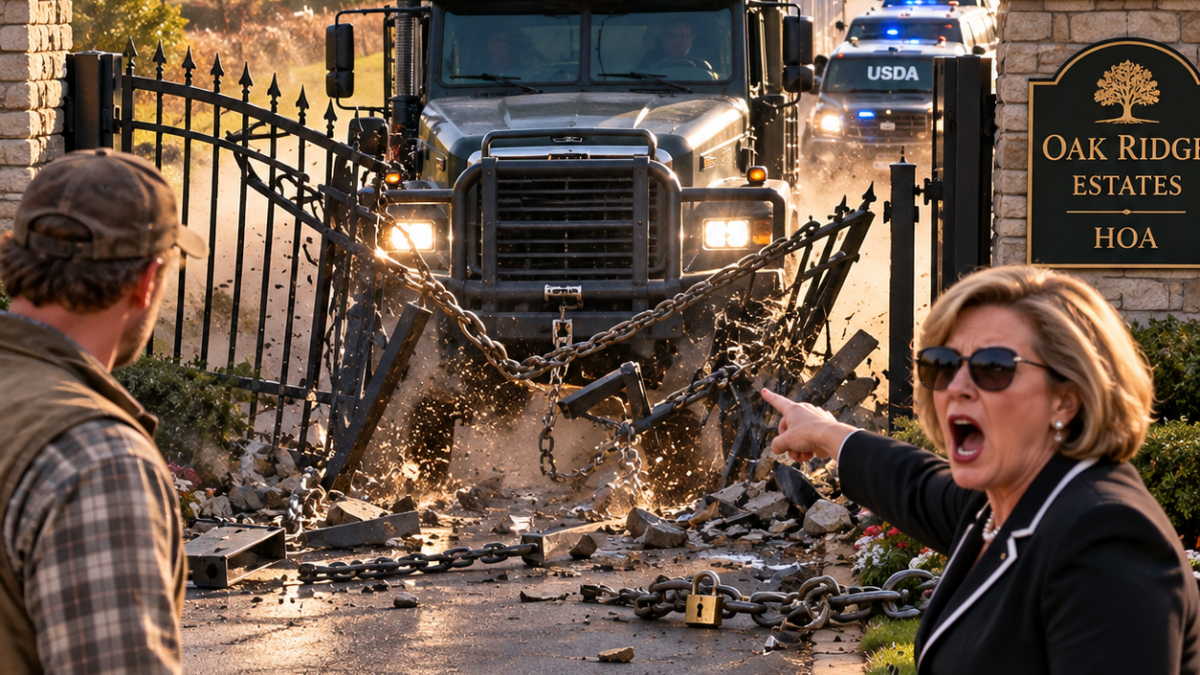
PART2:
Old Mill Road had been gravel for as long as I could remember, and I will admit that not having dust coat my truck every August was nice.
The problem was that Oak Ridge Estates didn’t just move next to us.
It behaved as though we had accidentally remained inside property that belonged to it.
Our farm sat at the dead end of Old Mill Road.
The road crossed land Meridian had purchased before reaching ours, but our deed contained an unrestricted agricultural easement dating back more than a century.
That right-of-way was not vague.
It was not implied.
It was written into multiple deeds, county maps, title records, and every closing document Meridian’s lawyers had examined before building a single house.
Farm traffic had unrestricted access.
Livestock trailers.
Harvest equipment.
Fuel trucks.
Feed deliveries.
Anyone legally doing business with the Hayes Farm.
Meridian knew this.
PART3:
For the first two years, we had disagreements, but the company understood contracts.
When homeowners complained that my combine was ugly, Meridian told them agriculture predated the subdivision.
When somebody objected to a manure spreader using Old Mill Road, Meridian politely reminded residents that the smell of farming was not a covenant violation.
One executive even called me personally after a family blocked my tractor with two SUVs during harvest.
He apologized.
They moved the cars.
Life continued.
Then Meridian finished construction and transferred control to the residents.
That was when I met Patricia Simmons.
Patricia was sixty-one years old, recently retired from corporate litigation, and possessed the dangerous combination of money, free time, and absolute confidence that every disagreement was simply a courtroom waiting for her to win it.
She wore her blond-gray hair in a lacquered bob that never seemed to move.
Her clothes always looked pressed.
Even at seven in the morning.
She drove a white electric golf cart through the neighborhood like General Patton inspecting a front line.
Within three months of becoming HOA president, she had reorganized every committee, doubled the architectural review board’s meeting schedule, and issued more violation notices than the previous board had sent in two years.
At first, none of that was my concern.
I wasn’t a member.
Then the letters began.
The first came on thick cream paper.
Gold Oak Ridge crest at the top.
OFFICIAL COMMUNITY COMPLIANCE NOTICE.
I remember laughing before I even finished it.
The letter claimed that agricultural equipment leaving my property was transferring “excessive soil debris” onto Oak Ridge roadways in violation of community standards.
I called the HOA office.
A volunteer answered.
“This is Wyatt Hayes from Hayes Farm.”
“Yes, Mr. Hayes.”
“I received a violation notice.”
“Yes.”
“Why?”
She sounded confused.
“Because of the mud.”
“No. Why did I receive a violation notice from your HOA?”
There was a pause.
“Because your vehicles use the road.”
“I don’t belong to your HOA.”
Another pause.
“I’ll have Mrs. Simmons call you.”
Patricia called twenty minutes later.
“Wyatt.”
Not Mr. Hayes.
Wyatt.
Like we had known each other for decades.
“I understand you have concerns.”
“I have one concern. Stop sending me HOA violations.”
She laughed.
Not loudly.
That controlled professional laugh attorneys use when they want you to know you’re being unreasonable.
“You may not technically be an association member, but you enjoy the benefit of our infrastructure.”
I looked out my kitchen window at a field my grandfather had planted before Patricia was born.
“I enjoyed the road before your houses existed.”
“It was not maintained to current standards.”
“My easement doesn’t require me to admire your landscaping.”
“You do understand residents pay substantial dues to maintain Old Mill Road.”
“I understand my deed gives me unrestricted access.”
“Nothing is unrestricted, Wyatt.”
There it was.
The first little warning.
Nothing is unrestricted.
I said, “My lawyer disagrees.”
She replied, “Then perhaps your lawyer should read more carefully.”
I hung up.
A week later, we received the first invoice.
$500.
ROAD MAINTENANCE CONTRIBUTION.
I returned it with one handwritten sentence.
NOT A MEMBER.
The next month another arrived.
$750.
Then $1,000.
Late fees.
Administrative charges.
Special landscape assessments.
A bizarre $350 “commercial vehicle impact fee.”
By Christmas, the HOA claimed I owed $4,875.
I hired a local property attorney named Rachel Kim.
Rachel was forty-two, small enough that people underestimated her, and had the terrifying habit of becoming quieter when angry.
She reviewed my deed.
Reviewed the HOA documents.
Reviewed county plat maps.
Then looked at me across her desk.
“You owe them zero.”
“That’s what I thought.”
“Not approximately zero.”
She tapped the papers.
“Zero.”
“So send Patricia a letter.”
Rachel smiled.
“Oh, I’m going to.”
She sent a six-page letter.
Patricia responded with twelve pages.
Rachel sent four.
Patricia sent eighteen.
For months, they conducted what I started calling the Paper War.
Meanwhile the HOA escalated in other ways.
Noise complaints.
Roosters.
Tractors before seven.
Harvest equipment after sunset.
One neighbor called the sheriff because my cows were “vocalizing excessively.”
Deputy Mike Carter drove out.
He leaned against my fence.
A cow mooed.
Mike looked at me.
“Think you can get her to keep it down?”
“I’ll issue a formal warning.”
“Appreciate it.”
He left laughing.
Patricia didn’t.
She began photographing my vehicles.
Her vice president, Greg Higgins, became her unofficial field officer.
Greg was fifty-something, middle management at an insurance company, always wore aviator sunglasses, and carried a clipboard as though civilization depended on his documentation.
He would park his golf cart near our boundary and photograph tractors.
Photograph tire tracks.
Photograph my cattle fence.
Once he photographed a ragweed plant growing on county right-of-way for twenty minutes.
I walked over.
“Greg.”
“Wyatt.”
“What are you doing?”
“Documenting.”
“What?”
“Violations.”
I looked at the weed.
“That plant isn’t on your property.”
“It impacts visual continuity.”
I stared at him.
“You need a hobby.”
“This is my responsibility.”
“That is a weed.”
He photographed me.
I waved.
By summer, Patricia’s invoices claimed I owed more than $11,000.
She sent a certified letter threatening “access restrictions.”
Rachel laughed when she read it.
“She cannot restrict the easement.”
“She thinks she can.”
“She’d need a court order.”
“She thinks she is a court order.”
Rachel stopped laughing.
“Keep every letter.”
I did.
What Patricia did not know was that the farm she wanted to squeeze was no longer operating the way it had ten years earlier.
Traditional soybeans had nearly ruined me.
Margins got thinner.
Equipment costs climbed.
Fertilizer prices jumped.
Two bad seasons left me carrying more debt than I slept comfortably with.
I had come within months of selling thirty acres.
Instead, through a state agricultural extension contact, I applied for a federal research partnership.
At first I expected nothing.
Then inspectors came.
Then agronomists.
Then paperwork thick enough to support a truck.
The project involved a drought-resistant soybean line being tested as part of a broader agricultural resilience program.
Nothing science-fiction.
Nothing secret in the Hollywood sense.
But highly controlled.
The seed stock had strict chain-of-custody requirements.
Fields had controlled access.
Federal research funds had improved irrigation and monitoring systems.
Harvest material had to be transported under scheduled supervision to a regional research facility.
For the first time in years, the farm had financial breathing room.
I told almost nobody.
Not because men in black suits threatened me.
Because contract confidentiality existed, and because I had learned that the less Patricia Simmons knew about my business, the happier I was.
Then October came.
Harvest week.
The transport plan had been coordinated for months.
At exactly 8:00 a.m. Tuesday, a federal agricultural convoy would arrive.
Two sealed climate-controlled haulers.
Inspection staff.
Security vehicles.
Chain-of-custody officers.
They would load the research seed, verify weights, seal the trailers, and move out before noon.
Timing mattered because samples had to reach the receiving facility inside a controlled window.
Monday night, I checked everything twice.
Equipment fueled.
Access clear.
Gate unlocked except for the standard cattle latch.
Documents ready.
At 5:30 Tuesday morning, I made coffee.
At 5:52, I climbed into my truck.
At 6:03, my headlights hit something that had not existed the night before.
I slammed the brakes.
Across Old Mill Road stood an eight-foot wrought-iron gate.
Not my gate.
Not a farm gate.
An ornamental monstrosity.
Black iron.
Brick posts.
Decorative spear points.
Drilled directly across the road where our easement entered the farm.
A forged-steel chain wrapped through the center.
Industrial padlock.
And hanging from the bars was an HOA notice.
I got out slowly.
Read it once.
Then again.
NOTICE OF ACCESS SUSPENSION
Outstanding Community Assessments: $18,450
Road privileges suspended pending full payment.
Authorized by:
Patricia Simmons
President, Oak Ridge Estates HOA
For perhaps ten seconds I felt nothing.
Then every muscle in my body tightened.
Eighteen thousand four hundred fifty dollars.
She had built a gate across a legal easement to collect fake debt.
And in less than two hours, federal transport vehicles were scheduled to arrive.
I called Rachel first.
She answered sleepily.
“Wyatt?”
“She did it.”
“Who did what?”
“Patricia gated the road.”
Silence.
“Say that again.”
“Eight-foot iron gate. Chain. Lock. Across the easement.”
Rachel became awake instantly.
“Do not cut anything.”
“I have bolt cutters.”
“Do not touch that lock.”
“I’ve got a convoy coming.”
“What convoy?”
I had never explained the full federal contract.
“USDA.”
Another silence.
“What exactly are you doing out there?”
“Research seed program.”
“Federal?”
“Yes.”
“Today?”
“Eight.”
Rachel said one word.
“Oh.”
“That’s what I said.”
“No, Wyatt. You said USDA like you were expecting a fertilizer inspector.”
“Two transport rigs. Security.”
Rachel exhaled.
“Call your federal contact.”
“I was going to.”
“And record everything.”
“Already am.”
“Do not threaten Patricia.”
“Rachel.”
“I’m serious.”
“I know.”
“Do not touch the gate.”
“I heard you.”
“Call me when they arrive.”
I called Special Agent Thomas Croft.
Technically he was an investigator assigned to the Department of Agriculture’s oversight branch, coordinating security and contract compliance.
Croft was fifty.
Former military police.
Spoke in complete sentences even when ordering lunch.
He answered on the second ring.
“Croft.”
“It’s Hayes.”
“Morning. We’re on schedule. ETA one hour forty-seven.”
“I’ve got a problem.”
“What kind?”
“The HOA built a gate across my access.”
There was silence.
“What do you mean, built?”
“Wrought iron. Posts. Chain. Industrial lock.”
“Temporary?”
“Looks permanent.”
“On the easement?”
“Yes.”
“Why?”
“They claim I owe eighteen thousand dollars.”
Another silence.
This one felt colder.
Croft said:
“Do not touch it.”
“My lawyer said the same.”
“Good lawyer.”
“The haulers can’t get through.”
“They need twelve-foot clearance?”
“More like ten. Gate blocks everything.”
“Is there another legal route?”
“No.”
“Field access?”
“Too soft. And private property on the south side.”
Croft’s tone changed.
“Photograph the notice.”
I did.
Sent it.
He called back two minutes later.
“Mr. Hayes.”
“Yes.”
“Remain on your side.”
“Okay.”
“Do not open the gate yourself.”
“I couldn’t without cutting it.”
“Do not cut it.”
“Understood.”
“Do not engage physically with HOA personnel.”
“I wasn’t planning to.”
“Good.”
I waited.
“What happens at eight?”
“We arrive.”
“And then?”
“We resolve federal access.”
The line disconnected.
That was Croft.
At 6:45, I called my father.
Dad was seventy-four and technically retired, which meant he still appeared at the farm six days a week and complained about how I did everything.
He answered:
“What broke?”
“How do you know something broke?”
“You don’t call before seven unless something broke.”
“Patricia built a gate.”
“What gate?”
“Across Old Mill.”
Dad was silent.
Then:
“I’ll get the loader.”
“No.”
“Why?”
“Federal convoy coming.”
Another pause.
“What have you gotten yourself into?”
“Long story.”
“I’m coming.”
“No.”
“I said I’m coming.”
He hung up.
At 7:12, Dad arrived from the north pasture in his old Ford pickup using our internal farm track.
He got out.
Looked at the wrought iron.
Walked to the notice.
Read it.
Then looked at me.
“That woman spent actual money doing this?”
“Apparently.”
“She could’ve bought a nice tractor.”
“Different priorities.”
Dad tugged the chain.
“Good chain.”
“Don’t.”
“What?”
“Federal guy said don’t touch it.”
Dad smiled.
“Federal guy?”
“Don’t start.”
At 7:28, we heard the golf cart.
Patricia arrived wearing beige slacks, matching jacket, loafers that had no business being near a farm, and sunglasses.
Greg sat beside her.
They parked on the subdivision side.
Patricia stepped out carrying coffee.
Then she looked at Dad.
“Good morning, Mr. Hayes.”
Dad nodded.
“Patricia.”
She smiled.
“I see you’ve discovered the new access control.”
Dad looked at me.
“Access control.”
“I heard.”
Patricia took a slow sip.
“You were warned repeatedly.”
I stepped toward the gate.
“Take off the lock.”
“No.”
“Patricia.”
“No.”
“You are blocking a deeded agricultural easement.”
“You continue to use association-maintained infrastructure without contributing.”
“I am not an association member.”
“That argument has become tiresome.”
Greg opened his clipboard.
“You currently owe eighteen thousand four hundred fifty dollars.”
Dad whistled.
“That’s a nice round scam.”
Greg stiffened.
“Sir, your son has received itemized statements.”
Dad smiled.
“My son’s received toilet paper with better legal value.”
Patricia’s face tightened.
“Mr. Hayes, I understand why Wyatt’s behavior may be embarrassing—”
Dad laughed.
That made her furious.
I stepped in.
“Patricia, federal transport vehicles are arriving at eight.”
She smiled.
“Of course they are.”
“I’m warning you once.”
“Another bluff?”
“It isn’t.”
Greg snorted.
“What are you transporting? Corn?”
“Doesn’t matter.”
“It matters if you’re using our road commercially.”
I pointed toward the chain.
“Remove it.”
Patricia set her coffee on the golf cart.
“I spent thirty years practicing law.”
“Then you should know better.”
Her smile vanished.
“I know exactly what I’m doing.”
“No, you really don’t.”
She stepped closer.
“This community will no longer be intimidated by agricultural entitlement.”
Dad whispered:
“Agricultural entitlement.”
I ignored him.
“Vehicles belonging to the federal government will be here in thirty minutes.”
Patricia crossed her arms.
“And?”
“And they have legal access.”
“Not without a warrant.”
I almost smiled.
“You think a USDA transport crew needs a warrant to enter a contracted farm site?”
“I think anyone entering Oak Ridge infrastructure is subject to community control.”
“Old Mill Road is subject to my recorded easement.”
“Which does not exempt you from reasonable expenses.”
“Rachel Kim sent you the deed.”
“Your attorney has an interpretation.”
I laughed.
“It’s written in plain English.”
“Courts decide plain English every day.”
Dad looked at me.
“She practiced too long.”
Patricia heard him.
“I am trying to resolve this professionally.”
Dad looked at the eight-foot barricade.
“Ma’am, you bolted a prison gate across a farm road at two in the morning.”
“It was installed by licensed contractors.”
“That makes it classier.”
Greg stepped forward.
“Pay the assessment and we unlock the gate.”
I stared at him.
“So that’s it?”
“Correct.”
“Eighteen thousand?”
“Yes.”
“You block my legal access until I pay money I dispute?”
Patricia smiled.
“Now you’re understanding.”
I took my phone from my pocket.
Held it up.
“Say that again.”
Her face changed.
Not enough.
“You are recording us?”
“Public roadway.”
Patricia looked toward Greg.
Then back at me.
“I said your access privileges are suspended pending satisfaction of lawful assessments.”
Better wording.
Still terrible.
Dad smiled.
“She remembered she’s a lawyer.”
At 7:42, Patricia removed a folding lawn chair from the golf cart.
I stared.
“You brought a chair?”
She unfolded it.
Sat in the middle of Old Mill Road.
Crossed one leg over the other.
“I want to be here when your supposed federal convoy arrives.”
Dad walked back toward my truck.
“Coffee?”
“Please.”
We stood on our side.
Patricia sat on hers.
Greg paced.
At 7:53, birds lifted out of the Bradford pear trees.
Then I felt vibration through the soles of my boots.
Dad looked toward the curve.
“That them?”
“Yes.”
The first black Chevrolet Tahoe appeared.
Dark windows.
Small emergency lights flashing behind the grille.
A second followed.
Then the first transport rig.
White.
Unmarked except for federal fleet numbers.
Then another rig.
Another SUV behind them.
The entire convoy rounded into Oak Ridge Estates.
People began coming out of houses.
Patricia stood.
Her chair tipped over behind her.
Greg stopped pacing.
He removed his sunglasses.
I had never seen his eyes before.
They looked terrified.
The lead Tahoe slowed twenty feet from the gate.
Then stopped.
Doors opened.
Croft stepped out wearing a dark tactical vest with federal identification.
Two additional officers exited behind him.
No weapons pointed.
No shouting.
Just the kind of controlled movement that made it obvious these men did not care who the HOA president was.
Patricia took two steps forward.
“This is private property.”
Croft did not answer her.
He walked to the gate.
Read the notice.
Photographed it.
Examined the posts.
Then looked through the bars at me.
“Mr. Hayes?”
“Morning.”
“This installed last night?”
“Wasn’t here at six yesterday evening.”
“Who authorized it?”
I pointed.
Patricia squared her shoulders.
“I did.”
Croft turned.
“Name?”
“Patricia Simmons. President of Oak Ridge Estates Homeowners Association.”
“Are you responsible for the chain and lock?”
“Yes.”
“Why?”
“Mr. Hayes is delinquent on community assessments.”
Croft looked at me.
“Are you an HOA member?”
“No.”
Patricia interrupted.
“He benefits from our roads.”
Croft’s eyes returned to her.
“Ma’am, I didn’t ask you.”
Her mouth opened.
Closed.
Croft continued.
“Do you have a court order authorizing obstruction of the recorded easement?”
Patricia’s posture changed slightly.
“This is private infrastructure.”
“That wasn’t my question.”
“We have association authority.”
“Court order?”
“No.”
Croft nodded.
“Unlock it.”
Patricia almost laughed.
“No.”
Greg looked at her.
Croft said:
“Ma’am, I am directing you to remove this obstruction.”
“You don’t have jurisdiction over HOA property.”
“I have jurisdiction over the federal operation you are interfering with.”
“This is a civil dispute.”
“Not anymore.”
Patricia’s face tightened.
“I demand to see a warrant.”
Croft remained calm.
“We are not searching your home.”
“You are attempting to destroy private property.”
“We are attempting to access a federally contracted agricultural site by its established legal route.”
“You cannot simply—”
Croft raised one hand.
She stopped.
“Listen carefully.”
His voice was quiet.
Everybody around us heard anyway.
“You erected a barricade across an active recorded easement.”
He pointed toward the transport trucks.
“You are now preventing federally contracted agricultural material from being moved according to schedule.”
Then the notice.
“You are conditioning access on payment of disputed money from an individual who is not a member of your association.”
He looked directly at her.
“That creates several legal problems for you.”
Patricia lifted her chin.
“I know the law.”
Croft nodded.
“Then this should be easy.”
He pointed to the lock.
“Open it.”
She did not move.
Greg whispered:
“Patricia.”
She snapped:
“Be quiet.”
Croft looked toward one of his officers.
“Document refusal.”
The officer began writing.
Patricia said:
“If you touch that gate, the HOA will sue the federal government.”
Croft’s expression did not change.
“Understood.”
“You’ll be personally named.”
“Understood.”
“I will file an injunction before lunch.”
“Understood.”
Her voice rose.
“You think your badge intimidates me?”
“No.”
That answer seemed to bother her more than anything.
Croft looked at the convoy.
Then toward me.
“Mr. Hayes, stand clear.”
My pulse jumped.
Dad muttered:
“Here we go.”
Patricia stepped in front of the gate.
“You will not damage this property.”
Croft said:
“Ma’am, move to the shoulder.”
“No.”
“Move.”
“No.”
One of the other federal officers approached.
“Mrs. Simmons.”
Patricia backed against the gate.
“You put your hands on me and I’ll have every one of you prosecuted.”
Croft looked at her for a long second.
Then said:
“Sir.”
The second agent stepped beside Patricia.
“Ma’am, I am going to guide you away from the roadway.”
“Don’t touch me.”
“You need to move.”
She planted her feet.
The officer took her gently but firmly by the upper arm and moved her toward the grass.
Patricia screamed.
“Assault!”
No one assaulted her.
She was simply no longer standing in front of several tons of federal SUV.
Croft looked toward the driver.
One hand motion.
Forward.
The Tahoe rolled.
Slow at first.
Its reinforced push bumper touched the iron bars.
Metal creaked.
Patricia shouted:
“Stop!”
The Tahoe accelerated.
Not fast.
It didn’t need to.
The left gatepost cracked.
One anchor tore from the pavement.
The chain held.
The hinges did not.
The entire eight-foot structure folded sideways with a sound like a dumpster being dropped from a roof.
Brick fragments scattered.
Iron twisted.
The gate collapsed beneath the bumper.
The Tahoe drove through.
Then stopped on my side.
Silence.
Absolute silence.
Dad looked at me.
“Well.”
Greg’s mouth hung open.
Phones were raised across the neighborhood.
Patricia stood on the grass staring at what used to be her gate.
The first transport truck moved forward.
Its tires rolled over broken iron.
Then the second.
SUV after SUV passed.
One by one.
Into the Hayes Farm.
Patricia finally found her voice.
“You destroyed private property!”
Croft looked at her.
“You were offered the opportunity to remove it.”
“You’ll pay for this.”
“Document whatever claim you believe you have.”
“I am calling the police.”
“Please do.”
She did.
Twenty minutes later, Sheriff David Miller arrived.
David had known my father forty years.
He had also dealt with Patricia enough times to recognize the situation before he finished getting out of his cruiser.
She rushed toward him.
“Sheriff, thank God.”
He looked at the demolished gate.
Then at the federal vehicles.
Then at me.
“What happened?”
Patricia answered:
“They attacked us.”
David looked at her.
“With a gate?”
“They destroyed HOA property and assaulted me.”
The federal officer who had moved her stepped forward.
“Body camera footage is available.”
Patricia ignored him.
“Arrest Wyatt.”
David rubbed his face.
“For what?”
“Conspiracy. Trespass. Property destruction.”
“Wyatt drove through that?”
“No. They did.”
She pointed toward Croft.
David looked at Croft’s credentials.
Then at Patricia.
“Why did they do that?”
She pointed toward me.
“He owes the association eighteen thousand dollars.”
David closed his eyes briefly.
“Patricia.”
“It is a lawful debt.”
“Is Wyatt in your HOA?”
“He uses our road.”
“Patricia.”
“Our attorneys—”
“Do you have a court order?”
Her jaw tightened.
“Not yet.”
David looked at the destroyed gate.
“You blocked his easement?”
“It is not that simple.”
“It looks pretty simple.”
“He has refused every reasonable accommodation.”
David turned toward me.
“You touch the gate?”
“No.”
“Damage it?”
“No.”
“Threaten anybody?”
“No.”
Patricia shouted:
“He threatened catastrophic consequences!”
I nodded.
“I did say consequences would be catastrophic.”
David stared at the wreckage.
“Accurate.”
Dad laughed.
Patricia spun toward him.
“You think this is funny?”
Dad’s expression changed.
“No.”
He stepped closer.
“I think what’s funny is that you moved into a neighborhood built around a farm, then spent two years acting offended that the farm still exists.”
Patricia’s face flushed.
“This has nothing to do with farming.”
Dad pointed toward the federal haulers.
“Looks like it does.”
Croft approached David.
They spoke quietly.
Documents.
Easement.
Transport authorization.
Patricia’s refusal.
Notice demanding money.
David listened.
Then turned back to her.
“I’m not arresting anybody.”
She stared.
“You have a duty.”
“I have a duty not to invent crimes because you’re angry.”
“Property was destroyed.”
“You built property across somebody else’s recorded access route without judicial authorization.”
“Our road—”
“Stop saying that like it erases the easement.”
She looked around.
Neighbors were filming.
Her humiliation became visible.
Not sadness.
Rage.
She hated losing.
But she hated being seen losing more.
David returned to his cruiser.
Before leaving, he looked at me.
“Wyatt.”
“Yeah?”
“Please don’t build anything across anybody else’s road today.”
“I’ll try.”
He left.
For the next four hours, the federal operation ran almost perfectly.
Scientists collected samples.
Seed stock was loaded.
Weights verified.
Seals attached.
Paperwork signed.
I should have enjoyed watching Patricia disappear.
She didn’t.
She stayed near the wreckage until almost ten.
Talking on her phone.
Taking photographs.
Greg disappeared much earlier.
At noon, Croft handed me final documents.
“You’re clear.”
“Thank you.”
He looked toward the damaged entrance.
“Keep every communication from the HOA.”
“I already do.”
“And your lawyer should expect contact.”
“From you?”
“Maybe.”
I frowned.
“There’s more?”
Croft looked at the laminated payment notice.
“I don’t like improvised toll collection.”
Then he climbed into the Tahoe.
The convoy left.
I thought the worst was over.
Three days later, a process server arrived.
I was repairing a hydraulic line on the grain cart.
He handed me a thick stack.
“Hate to ruin your afternoon.”
I read the first page.
Patricia Simmons and Oak Ridge Estates HOA versus Wyatt Hayes, Hayes Farm LLC, and multiple federal defendants.
Damages claimed:
$2.5 million.
Trespass.
Destruction of association property.
Business losses.
Emotional distress.
Unpaid road assessments.
Intentional interference with contract.
I called Rachel.
She read for fifteen minutes.
Then started laughing.
“This isn’t funny.”
“Yes, it is.”
“Two and a half million.”
“Wyatt.”
“What?”
“They sued the federal government.”
“So?”
“So they also put their fake eighteen-thousand-dollar debt directly into the complaint.”
I didn’t understand why she was so pleased.
Rachel did.
“They are claiming that debt is legitimate and central to damages.”
“Okay.”
“Which means they just invited discovery into how the HOA calculated it.”
I sat down.
“And?”
“And if federal counsel decides the access demand looked coercive, they’re going to want the financial records.”
My stomach tightened.
Rachel continued:
“Patricia just placed the entire HOA bookkeeping system under a microscope.”
“Maybe everything is clean.”
Rachel became quiet.
“Maybe.”
It wasn’t.
The first crack came from Greg.
He contacted Rachel privately.
Asked whether cooperation could protect him.
She told him she represented me, not him.
Then she called me.
“Something is wrong.”
“What?”
“Greg is scared.”
“He should be.”
“No.”
She sounded serious.
“Not lawsuit scared.”
“What kind?”
“Prison scared.”
Two weeks later, federal subpoenas arrived at the HOA office.
Bank records.
Vendor contracts.
Board minutes.
Invoices.
Emails.
Electronic backups.
Assessment calculations.
Patricia responded with outrage.
She held an emergency neighborhood meeting and told residents the government was “weaponizing bureaucracy against private property.”
People applauded.
Some.
But others asked questions.
Why had HOA legal expenses jumped sixty percent?
Why did road maintenance cost more than neighboring subdivisions with twice the mileage?
Why was a landscaping company nobody recognized receiving hundreds of thousands of dollars?
Why had dues increased three times in two years?
Patricia told everyone the questions were distractions.
That was mistake number one.
Her bigger mistake was assuming auditors cared about speeches.
Three weeks after the lawsuit, a white federal van arrived at the clubhouse.
No lights.
No tactical gear.
Just six people with laptops, file boxes, and authorization paperwork.
Agent Sarah Jenkins led them.
She was an accountant by training.
Maybe five-foot-four.
Gray suit.
No visible weapon.
She scared Patricia more than Croft ever had.
Because Jenkins understood money.
Four days later, Greg Higgins disappeared from the clubhouse.
Not literally.
He stopped answering calls.
His golf cart remained in his garage.
His wife told neighbors he was “dealing with stress.”
The fifth day, one of my neighbors from Oak Ridge named Tom Reynolds drove onto the farm.
Tom was a decent man.
Retired firefighter.
Never joined Patricia’s crusade.
He parked near the barn.
“Can we talk?”
“Sure.”
He looked embarrassed.
“We owe you an apology.”
“For what?”
“The neighborhood.”
“You aren’t the neighborhood.”
“I voted for Patricia.”
I leaned against the fence.
“That is unfortunate.”
He laughed weakly.
“She told us you were trying to take control of the road.”
“I want to drive to my house.”
“I know that now.”
He looked toward Oak Ridge.
“People are saying money is missing.”
“How much?”
“Nobody knows.”
“Then don’t repeat numbers.”
He nodded.
“Fair.”
He hesitated.
“Town hall Tuesday.”
“I wasn’t invited.”
“You are now.”
“Patricia won’t like that.”
“That is increasingly the point.”
Rachel advised me not to go.
Then changed her mind after learning federal investigators would attend.
“Sit in back.”
“I can do that.”
“Say nothing.”
“That is harder.”
“Wyatt.”
“I know.”
Tuesday night, more than two hundred residents packed the clubhouse.
I sat near the rear beside Dad.
Patricia stood at the podium.
Same polished hair.
Same controlled voice.
Different eyes.
She looked tired.
Greg sat at the board table.
No sunglasses indoors.
Hands shaking.
Patricia tapped the microphone.
“Neighbors, please.”
The room quieted gradually.
“What our community is experiencing is an unprecedented campaign of federal intimidation.”
Someone shouted:
“Where’s the money?”
Applause.
Patricia lifted one hand.
“The rumors of financial misconduct are false.”
Another voice:
“Then show us the books.”
“We are cooperating fully with the audit.”
A woman near the front said:
“You refused to give the treasurer records.”
Patricia’s face tightened.
“That is an internal governance matter.”
Then the doors opened.
Croft entered.
Jenkins beside him.
Two federal officers followed.
Nobody spoke.
Patricia froze.
Jenkins carried a thick binder.
Croft said:
“Mrs. Simmons. Mr. Higgins.”
Greg immediately stood.
“I didn’t create the accounts.”
Every head turned toward him.
Patricia snapped:
“Sit down.”
“I signed what she gave me.”
“Greg.”
“I didn’t know where it went.”
The room exploded.
People shouted.
Patricia slammed the microphone.
“Enough!”
Jenkins stepped forward.
“Mr. Higgins, do not discuss evidence publicly.”
That shut him up.
Barely.
Patricia looked at Jenkins.
“You have no right to interrupt a private association meeting.”
Jenkins opened the binder.
“Mrs. Simmons, because your association filed a lawsuit claiming financial injury from federal action, your financial records became directly relevant to that litigation.”
Patricia’s face went pale.
Jenkins continued.
“Our review identified substantial irregularities.”
Nobody moved.
“Over a twenty-six-month period, Oak Ridge Estates paid approximately four hundred twelve thousand dollars to a vendor called Dalton Landscape Solutions.”
Murmurs.
Patricia said:
“Legitimate contractor.”
Jenkins looked at her.
“Dalton Landscape Solutions owns no registered commercial landscaping vehicles.”
Silence.
“No maintenance equipment.”
Silence.
“No office at its listed address.”
The man beside me whispered:
“Oh, no.”
Jenkins turned a page.
“The registered manager is Richard Dalton.”
She looked toward Greg.
“Brother-in-law of Vice President Gregory Higgins.”
Chaos.
Greg stood.
“I didn’t know about the offshore account.”
Every sound stopped for half a second.
Then the clubhouse erupted.
Patricia stared at him.
If hatred could kill, Greg would have died before hitting the floor.
Jenkins said:
“Thank you, Mr. Higgins.”
Greg realized what he had done.
Too late.
An older homeowner screamed:
“Offshore account?”
Another:
“How much?”
Jenkins raised her voice.
“We traced substantial portions of vendor payments through intermediary accounts.”
A woman began crying.
“My dues doubled.”
Another man shouted:
“You told us reserves were empty.”
Patricia grabbed the microphone.
“This is being misrepresented.”
Croft stepped onto the stage.
“Patricia Simmons.”
She turned.
“Do not.”
He continued.
“You are being placed under arrest.”
The room became silent in a way I had never experienced.
Even Dad stopped breathing loudly.
Patricia gripped the podium.
“For what?”
“Conspiracy to commit wire fraud, extortion-related offenses, falsification of association records, and obstruction of a federal agricultural transport.”
She laughed once.
A broken sound.
“You cannot arrest me in my own community.”
Croft’s expression did not change.
“Yes, ma’am.”
“I am an attorney.”
“Yes.”
“I want counsel.”
“You will have that right.”
She looked at the residents.
At hundreds of phones pointed toward her.
Then at me.
That was when she saw me.
All the way in back.
Her face changed.
“You.”
Croft moved closer.
Patricia pointed.
“This is because of him.”
I said nothing.
Rachel would have been proud.
“You did this.”
Still nothing.
She screamed:
“You destroyed this community!”
Tom Reynolds stood.
“No.”
His voice carried from the middle of the room.
“You did.”
Patricia looked around.
Not one person defended her.
Greg was handcuffed first.
Then Patricia.
They walked her down the center aisle.
The same woman who had spent years issuing violation letters over garbage cans and fence colors passed residents who had just learned their dues had helped finance fraud.
Nobody applauded.
That surprised me.
They were too angry.
She passed my row.
Stopped.
Croft touched her arm.
“Keep moving.”
Patricia stared at me.
“I’ll take your farm before this is over.”
Dad leaned toward me.
“She still has confidence.”
I whispered:
“It’s impressive.”
Croft heard.
Almost smiled.
The federal criminal case took months.
The HOA civil lawsuit collapsed almost immediately.
Their attorneys withdrew parts of it after discovery.
The association entered emergency receivership.
Accounts were frozen.
A court-appointed administrator took control.
Investigators found that Patricia and Greg had created a network of inflated vendor contracts and fabricated expenses.
Some money went through Dalton’s company.
Some through consulting entities connected to Patricia.
The fake assessments sent to my farm had not been random harassment.
They needed cash.
The HOA’s reserve fund was missing hundreds of thousands.
An annual financial review was approaching.
Patricia had needed money in fast.
I was the perfect target.
Not a member.
Property valuable.
Long-standing easement she thought could be exploited.
She believed enough pressure might make me pay.
Or sell.
Developers had already offered millions for portions of Hayes Farm.
If I sold, Oak Ridge property values would rise.
Patricia convinced herself everybody would win.
Everybody except me.
Rachel put it best.
“She thought your existence was negotiable.”
The final restitution hearing took place almost a year after the gate incident.
Patricia had accepted a plea deal on several federal counts.
Greg cooperated extensively and received a lighter sentence.
Residents recovered only part of the missing money.
The rest had been spent.
Legal fees.
Travel.
Personal expenses.
Transfers difficult to unwind.
The HOA as they knew it effectively collapsed.
A judge approved restructuring under county oversight.
The private road arrangement became impossible to maintain because the association could no longer meet infrastructure obligations.
After negotiations, Old Mill Road was dedicated to the county.
Public roadway.
That mattered more to me than any settlement.
Nobody would ever gate my easement again.
The association’s remaining assets were liquidated.
The fancy brick guardhouse was sold.
The office furniture.
Maintenance equipment.
Two golf carts.
I attended the auction.
Dad insisted.
Patricia’s white golf cart came up for sale.
Dad raised his bidder card.
I grabbed his wrist.
“No.”
“Why?”
“You do not need her golf cart.”
“I absolutely do.”
“What for?”
“Checking fences.”
“You have an ATV.”
“Golf cart’s quieter.”
“Dad.”
He bid anyway.
Another man bid.
Dad bid again.
He won.
I stared at him.
“You paid three thousand dollars for Patricia’s golf cart.”
Dad smiled.
“Worth every penny.”
He drove it onto the farm the next day.
The gold Oak Ridge logo still on the side.
I made him remove it.
He refused for six months.
The settlement included compensation to Hayes Farm for business obstruction, legal costs, and documented losses connected to the gate incident.
Not millions.
Enough.
I used part of it for drainage improvements.
Part for a new storage building.
Then the county asked whether I wanted them to restore the entrance where Patricia’s decorative gate had been ripped out.
“Yes.”
“What kind of access gate?”
“A farm gate.”
The crew chief laughed.
“Fancy?”
“No.”
“Black iron?”
“Absolutely not.”
They installed twelve feet of galvanized steel.
Heavy agricultural tube frame.
Reinforced posts.
Functional.
Ugly.
Perfect.
Dad looked at it.
“Needs paint.”
“What color?”
“Green.”
“Why?”
“Tractor green.”
We painted it.
A small county easement sign went beside it.
PUBLIC ROAD ACCESS
HAYES FARM
NO TRESPASSING BEYOND FARM GATE
The first morning after installation, I stood there with coffee.
Oak Ridge residents drove past.
Some waved.
Some didn’t.
Nobody photographed my weeds.
Greg eventually moved away after serving his sentence and completing restitution obligations.
I heard his wife divorced him.
I never confirmed it.
Patricia lost her law license after the criminal case.
She served federal time.
People occasionally asked whether I felt sorry for her.
The answer isn’t simple.
I don’t enjoy imagining anybody in prison.
I don’t celebrate families being destroyed.
I don’t think every enemy needs to suffer forever.
But sympathy does not erase accountability.
Patricia had multiple chances.
Rachel’s letters.
Sheriff Miller’s warnings.
My warnings.
Croft’s warning standing six feet from the lock.
Every time she could have stepped back.
She chose forward.
That wasn’t bad luck.
That was character.
Oak Ridge changed after her.
The receiver appointed an interim board.
Then residents rewrote the bylaws.
Limits on president authority.
Independent annual audits.
Open financial records.
Requirements for competitive bids.
No enforcement action against non-members without legal review.
Tom Reynolds became board president.
He hated the job.
Which was probably why he was good at it.
One afternoon he came onto the farm.
No clipboard.
No camera.
Just two beers.
We sat on the tailgate.
He looked toward the houses.
“People still blame the HOA.”
“For what?”
“Everything.”
“That seems unfair.”
He laughed.
“You’re defending HOAs now?”
“No.”
I took a drink.
“I’m saying organizations don’t steal money. People do.”
Tom nodded.
“We need some rules.”
“I figured.”
“Pool doesn’t clean itself.”
“True.”
“Road used to need maintenance.”
“Not anymore.”
“Thank God.”
He smiled.
“Turns out the problem wasn’t having an association.”
“No.”
“It was giving Patricia a kingdom.”
That was exactly it.
Power rarely announces itself as power.
It calls itself procedure.
Policy.
Standards.
Assessments.
Authority.
Patricia never said:
I want to control you.
She said:
Community standards require compliance.
She never said:
Pay me money you don’t owe.
She said:
Outstanding assessments must be satisfied.
She never said:
I am blocking your legal property access because you refuse to obey me.
She said:
Road privileges are suspended.
Language can make almost anything look respectable.
Until a federal Tahoe drives through it.
That image became famous locally.
Someone’s doorbell camera captured the exact moment the gate folded.
The clip spread online.
People sent it to me for months.
HEADLINE:
FEDERAL SUV CRUSHES HOA GATE BLOCKING FARM.
The internet loved it.
Of course it did.
People love a clean moment.
Arrogant person.
Big machine.
Crash.
Justice.
But the gate was not the important part.
It was dramatic.
Satisfying.
Loud.
The real destruction happened quietly later.
A subpoena.
A spreadsheet.
A vendor address that didn’t exist.
A payment that should not have been made.
An account linked to a relative.
Auditors asking boring questions nobody could bluff away.
Patricia thought authority looked like a locked gate.
Jenkins knew authority looked like a bank statement.
I think about that every time someone asks for my favorite moment.
Most expect me to say the Tahoe.
Dad says the Tahoe.
Without hesitation.
He has described it at least two hundred times.
“You should’ve seen those hinges.”
“I was there.”
“Whole thing folded.”
“I remember.”
“Best federal tax dollars I’ve ever watched.”
“Dad.”
“What?”
My favorite moment came months later.
After the indictments.
After the audits.
After Old Mill became public.
I was fixing fence near the entrance when a minivan stopped.
A woman got out.
I recognized her from Oak Ridge.
Her name was Sarah Mitchell.
We had never really spoken.
Her daughter, maybe eight, stayed in the van.
Sarah walked over.
“I wanted to apologize.”
“You didn’t build the gate.”
“No.”
She looked down.
“But I believed Patricia.”
I leaned against a post.
“What did she tell you?”
“That you were trying to destroy our roads.”
I laughed.
“I drive on them.”
“I know.”
“She said farm traffic was costing each household thousands.”
“Wasn’t.”
“I know now.”
She looked toward my fields.
“We moved here because we liked that it felt rural.”
“That happens a lot.”
“I guess we wanted rural without farming.”
I smiled.
“That happens more.”
She laughed.
Then became serious.
“I signed the petition supporting the gate.”
I hadn’t known there was one.
“Okay.”
“I shouldn’t have.”
“No.”
“I’m sorry.”
I looked at her.
She expected anger.
Maybe she deserved some.
But Patricia’s greatest talent had been convincing people that fear was information.
Mud would destroy property values.
Tractors would make homes impossible to sell.
Farm smells were threats.
My easement was unfair.
My land was wasted development opportunity.
Some believed because it benefited them.
Others because they trusted the wrong person.
I said:
“Thank you.”
Sarah looked surprised.
“That’s it?”
“What do you want me to do?”
“I don’t know.”
“Could make you weed the soybean field.”
She laughed.
“Apology withdrawn.”
We became friendly.
Her daughter later joined 4-H.
Two years after Patricia’s arrest, Sarah asked if her daughter could raise a market lamb on part of the farm because their HOA rules still prohibited livestock.
I said yes.
The irony pleased me.
Oak Ridge kids started visiting for agricultural education days.
At first a few.
Then dozens.
We showed them irrigation systems.
Soil testing.
Seed research.
Tractors.
Chickens.
Cattle.
One boy asked:
“Is this the farm where the government destroyed the gate?”
His mother looked mortified.
I said:
“Yes.”
He stared.
“Cool.”
Dad appeared behind me.
“You want to see the video?”
“Dad.”
“What?”
The boy nodded vigorously.
Dad had it saved on his phone.
Of course.
The federal research contract continued.
The drought-resistant line performed well.
Eventually the program expanded to another grower.
I was proud of that.
Not because it made the farm famous.
It didn’t.
Because Hayes Farm had almost disappeared.
There had been nights I sat at the kitchen table wondering whether holding onto family land was courage or stupidity.
Sentiment doesn’t pay taxes.
History doesn’t repair combines.
Tradition doesn’t refinance loans.
The federal contract gave us time.
Then Patricia almost took that time away because she saw the farm as a problem to be solved.
Instead, the mess she created helped secure our access permanently.
That’s the part that still feels unreal.
The gate she built to force me out became the reason the road could never be privately controlled again.
Her lawsuit triggered the discovery that destroyed her own operation.
Her demand for money exposed where everybody else’s money had gone.
Every escalation narrowed her own exit.
Rachel once said:
“Some people lose cases because the facts are against them. Patricia lost because she kept manufacturing more facts.”
Accurate.
Five years after the gate incident, my father died.
Heart attack.
Quick.
He was seventy-nine.
The morning after the funeral, I went to the equipment barn.
Patricia’s old golf cart was parked in the corner.
Dad had eventually removed the HOA logo.
In its place he’d painted:
HAYES FARM ENFORCEMENT
I sat inside it for almost an hour.
Grief does strange things.
I remembered him pulling rocks from fields with me.
Teaching me to weld.
Telling me never to buy cheap fence staples.
Laughing when Patricia said “agricultural entitlement.”
Standing beside me while the federal convoy came down Old Mill Road.
A week later, I drove that ridiculous golf cart to the green gate.
I parked.
Looked down Old Mill Road.
Oak Ridge was quiet.
Trees older.
Bradford pears mostly gone because, predictably, half of them had split during storms.
The county had replaced several with native oaks.
That made me smile.
A black SUV approached.
For half a second, memory kicked.
Federal Tahoe.
Flashing lights.
Gate collapsing.
But it was just Tom Reynolds.
He pulled over.
“Wyatt.”
“Tom.”
“How are you?”
“Been better.”
“I heard about your dad.”
“Yeah.”
“He was a character.”
“That is polite.”
Tom smiled.
“He bid against me for that golf cart.”
I stared.
“You were the other bidder?”
“Yep.”
“Why?”
“I wanted to destroy it.”
I laughed harder than I had since Dad died.
He pointed.
“Your father cost me twenty-eight hundred dollars.”
“He would’ve loved knowing that.”
We stood near the gate.
Tom looked at the road.
“You know Patricia gets released next year.”
I hadn’t known.
“Okay.”
“You worried?”
“No.”
“Really?”
I looked around.
County road.
Public records.
New HOA board.
Audited finances.
Farm contract.
Federal easement protections documented so thoroughly nobody would ever misunderstand them again.
“No.”
That was the truth.
Patricia had been powerful because people believed she was.
Because rules were unclear.
Because neighbors stayed quiet.
Because nobody checked the books.
Because small abuses looked too petty to fight.
That ecosystem no longer existed.
A dictator is much less impressive when everyone learns they can say no.
Patricia never returned to Oak Ridge.
At least not permanently.
I heard she sold her house through an attorney.
Somebody else bought it.
Young family.
Two kids.
Nice enough.
They planted tomatoes.
Their son eventually joined the same 4-H program.
Life has a sense of humor.
The Hayes Farm is 117 years old now.
Still 110 acres.
I never sold to the developers.
We’ve diversified.
Soybeans.
Research plots.
Hay.
Small cattle herd.
School programs.
I lease ten acres to a young farmer growing specialty vegetables.
That part would make my grandfather suspicious.
He believed kale was decorative.
Old Mill Road is busier.
That’s reality.
But it is public.
Nobody can charge me $500 because my tractor drops dirt.
Nobody can suspend my access.
Nobody can install an ornamental gate because a board voted after dinner.
My green farm gate remains.
Every morning I open it.
Every night I close it.
It is not decorative.
There is mud on it.
Scratches.
One hinge squeaks in winter.
Dad would have fixed it.
I keep meaning to.
Sometimes an Oak Ridge resident walks past and waves.
I wave back.
That may be the part people online find disappointing.
They expect me to hate the whole neighborhood forever.
I don’t.
Why would I?
Most residents were victims too.
Patricia stole from them.
Manipulated them.
Raised their dues.
Drained reserves.
Used their fear to build her authority.
They lost money.
Trust.
Community.
Some almost lost homes because assessments climbed beyond what retirees could afford.
Justice is not pretending everybody on the other side is the enemy.
It’s identifying who actually did what.
Patricia committed fraud.
Greg helped.
Others ignored warning signs.
Some supported harassment.
Some objected quietly.
Some never knew.
People are complicated.
Property disputes aren’t movies.
Even if occasionally an SUV drives through an iron gate like one.
I still have the original laminated notice.
The one that said:
ACCESS SUSPENDED.
$18,450 DUE.
Patricia’s signature at the bottom.
Rachel wanted it for the case.
After everything ended, she mailed it back.
I framed it.
Not inside the house.
That felt obsessive.
It hangs in the farm office.
Beneath it is a photograph Dad printed from the video.
The Tahoe halfway through the gate.
Iron bending.
Brick exploding outward.
Dad wrote in marker:
PAYMENT DECLINED.
I thought about removing it after he died.
I didn’t.
Visitors laugh.
Then sometimes they ask what really happened.
I tell them.
Not the short version.
Not simply:
HOA Karen locked my farm gate and the government smashed it.
The real version matters more.
A homeowners association president decided legal rights belonged to whoever sounded most confident.
She created fake financial obligations.
She weaponized paperwork.
She convinced neighbors that harassment was community protection.
She counted on me being too poor, tired, or intimidated to fight.
Then one morning she placed eight feet of iron between a farmer and a federal operation.
And for the first time, she confronted an institution she could not bully with letterhead.
The gate came down in seconds.
Her power took longer.
But it came down for the same reason.
It had been built where it never legally belonged.
That is what I learned.
Property rights matter.
Contracts matter.
Oversight matters.
Records matter.
And arrogance becomes especially dangerous when nobody forces it to encounter consequences.
Patricia thought consequences meant a fine she issued.
A lien she threatened.
A gate she locked.
She never considered consequences could travel the other direction.
At 7:30 that Tuesday morning, she had sat in a folding chair drinking coffee, convinced I had twenty minutes left before humiliation.
At eight, federal vehicles arrived.
By eight-oh-five, her gate was scrap metal.
Three weeks later, auditors entered her clubhouse.
A few months later, federal prosecutors entered the picture.
A year later, Old Mill Road no longer belonged to her HOA.
And years later, the farm she intended to isolate was still standing.
That’s the detail I care about.
Not Patricia.
Not the lawsuit.
Not even the gate.
The farm.
My great-grandfather woke before sunrise on this land.
My grandfather nearly lost it during the Depression.
Dad refinanced once without telling my mother until after the papers were signed, which nearly resulted in his early death for reasons unrelated to banking.
I spent years trying to keep it alive.
And one morning, standing at the entrance while a convoy disappeared down a road that had finally become public forever, I understood something my father had been trying to teach me since I was a kid.
Owning land does not mean controlling everything around it.
You cannot control weather.
Markets.
Neighbors.
Governments.
Disease.
Interest rates.
Or whether a retired attorney with too much free time decides your tractor is destroying civilization.
What you can control is whether you know your ground.
Literally and otherwise.
Know the deed.
Know the boundary.
Know what you owe.
Know what you don’t.
Keep records.
Keep your temper.
And when someone tells you their authority is absolute, check the paperwork.
Sometimes you’ll discover they have none.
And sometimes, if you are very lucky, the people arriving to clarify that fact show up in three black Tahoes with reinforced bumpers.
I was at the gate last October when the newest federal transport arrived.
The program is different now.
Smaller convoy.
No drama.
One SUV.
One hauler.
Agent Croft had retired.
His replacement was a young woman named Special Agent Maya Benton.
She stepped out.
Looked at the green gate.
Then at the road.
“You’re Mr. Hayes?”
“Wyatt.”
She shook my hand.
“I’ve heard about this site.”
“That worries me.”
She smiled.
“Agent Croft trained me.”
“That worries me more.”
She glanced at the green gate.
“Is that the replacement?”
“Yes.”
“County installed?”
“Partly funded by restitution.”
She laughed.
“So the HOA bought you a gate.”
“In a roundabout way.”
She looked toward Old Mill Road.
“Where was the old barricade?”
I pointed.
“Right there.”
She stared.
“You’re telling me somebody installed an eight-foot gate across a federal access route hours before transport?”
“Yes.”
“Why?”
“She thought I owed eighteen thousand dollars.”
“Did you?”
“No.”
Benton shook her head.
“People are incredible.”
“That is one word.”
The hauler moved onto the farm.
No obstruction.
No shouting.
No lawn chair.
Just tires on gravel.
Exactly how it should have been the first time.
Before leaving that afternoon, Benton stood beside the gate.
“You know Croft still tells that story.”
“I know.”
“He says you were remarkably calm.”
I laughed.
“He wasn’t inside my head.”
She smiled.
“Apparently Mrs. Simmons wasn’t calm.”
“No.”
“Do you remember what you thought when the Tahoe hit the gate?”
I considered giving her something clever.
Something cinematic.
Truth was better.
“I thought Rachel was going to yell at me.”
“Your attorney?”
“Yes.”
“Why?”
“She told me not to touch the gate.”
“But you didn’t.”
“I know.”
“Then why would she yell?”
“Rachel enjoys preventive yelling.”
Benton laughed.
Then drove away.
That evening I locked my gate.
Sun dropping behind the western pasture.
Cattle moving slowly near the fence.
Wind through the oaks the developers had never managed to cut down.
I could hear distant lawn equipment from Oak Ridge.
Nothing hostile.
Just people living their lives.
I touched the steel latch.
Twelve feet wide.
Green paint chipped near the hinge.
No decorative spear points.
No gold crest.
Just a gate.
Mine.
Behind me, 110 acres.
Ahead of me, a public county road.
Simple.
Legal.
Quiet.
I looked toward the spot where Patricia once sat with her coffee.
Sometimes I wonder what she thought would happen.
Maybe she genuinely believed I would write the check.
Maybe she imagined the trucks turning around.
Maybe she believed federal agents would see her letterhead and decide the HOA president obviously outranked recorded law.
Maybe after thirty years of winning arguments, she had lost the ability to tell the difference between being confident and being correct.
That’s dangerous.
Especially when people around you stop saying no.
Greg never said no until agents were already in the clubhouse.
The board rarely challenged her.
Homeowners complained privately.
Contractors accepted checks.
Nobody pulled the emergency brake.
So Patricia kept accelerating.
Violation letters.
Fines.
Threats.
Fake invoices.
Financial manipulation.
Finally a gate.
Then she hit something that didn’t move.
People like to say the federal convoy destroyed her.
It didn’t.
Patricia destroyed Patricia.
The convoy simply arrived on schedule.
I slid the latch into place.
The metal made a heavy click.
For one strange second, I remembered the sound of her chain around the old barricade.
Same basic idea.
Metal closing access.
But context is everything.
Her lock had tried to keep me from my own rights.
Mine protected my farm after the road remained open to everyone legally entitled to use it.
Authority and abuse can look almost identical from a distance.
The difference is legitimacy.
The difference is limits.
The difference is whether the person holding the key accepts that the law applies to them too.
Patricia never did.
Not until steel bent.
Not until books opened.
Not until handcuffs clicked.
By then, it was too late.
I climbed into my truck.
Started the engine.
Before driving back toward the farmhouse, I looked once more across Oak Ridge Estates.
Somewhere beyond the trees sat the empty patch where the old guardhouse used to be.
The monument sign remained.
Oak Ridge Estates.
Smaller now.
No gold lights.
No security gate.
Just a neighborhood sign beside a county road.
Exactly what it should have been.
A place where people lived.
Not a kingdom.
I smiled.
Then I drove home across the land my family had owned for more than a century.
The land Patricia believed she could isolate with a chain.
The land her fabricated invoices were supposed to weaken.
The land a federal convoy crossed the morning her authority finally met something stronger than arrogance.
My father used to say you could learn everything important about a person by watching what they did when a gate was closed in front of them.
Some turned around.
Some asked permission.
Some looked for another road.
Some broke the law trying to force others to obey.
And once in a very great while, the person who closed the gate discovered that the vehicles coming toward it had no intention of stopping.
Patricia Simmons learned that lesson at 8:03 on a Tuesday morning.
The wrought iron lasted less than ten seconds.
The lie behind it lasted a few months longer.
The Hayes Farm is still here.

