HOA Bulldozed a 320-Foot “Emergency Road” Across My Land—Then the Fire Marshal Found Their Route Led to a 6-Ton Bridge Fire Trucks Couldn’t Use.
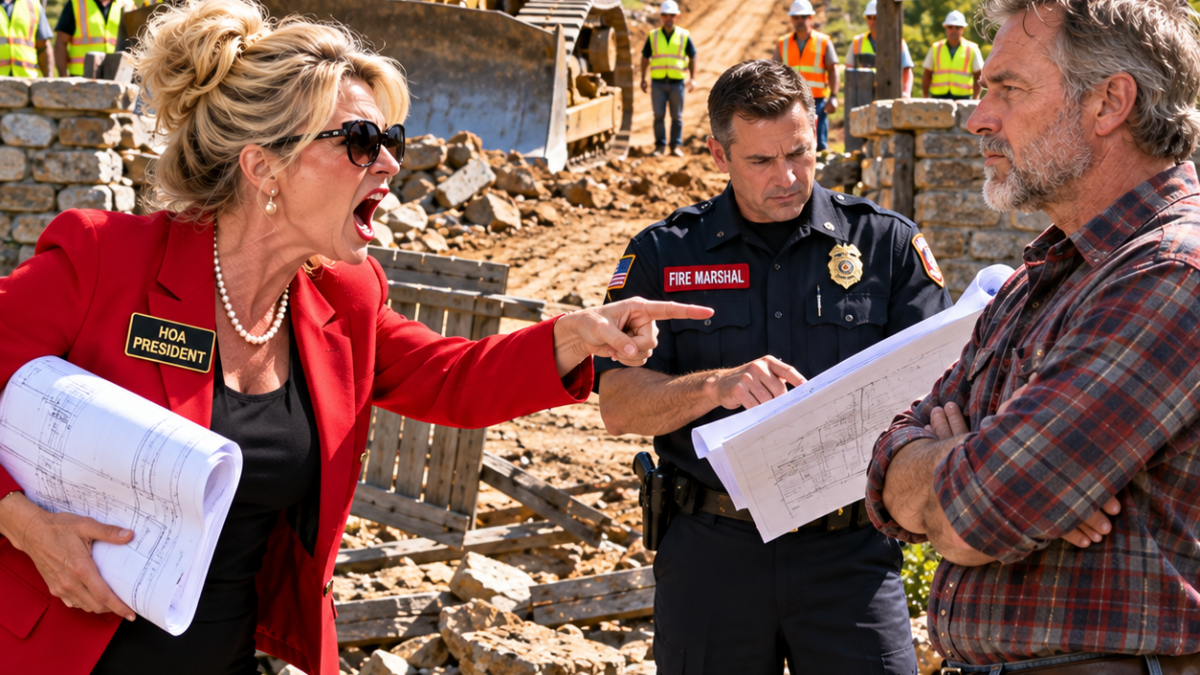
PART2:
By the time I inherited the property, that wall had become one of the few structures on the land older than my cabinet shop.
No mortar.
Dry stacked.
Broad faces outward.
Weight leaning gently into the hill.
It had survived floods.
Two tornado warnings.
Ice storms.
Teenage me backing a pickup into one section in 1986.
And forty-five years of Tennessee weather.
It did not survive Timber Ridge’s bulldozer.
Several stones lay under the machine tracks.
One had a dark scrape through its face where the blade hit.
I aimed the camera at the operator.
“You Daniel Mercer?”
“I am.”
He was maybe forty-five.
Broad shoulders.
Orange vest.
Mud already on his jeans.
“Who authorized you to enter my property?”
He pointed uphill.
A white pickup sat at the cul-de-sac.
Beside it stood a woman in a scarlet jacket.
She started walking toward us.
I knew her before she reached the broken wall.
Celeste Ward.
President of the Timber Ridge Estates Homeowners Association.
Fifty-one.
Always polished.
Always composed.
Always spoke with the controlled patience of someone who believed disagreement was simply a delay in other people’s understanding.
“Mr. Mercer.”
“Celeste.”
“Please stay clear of the equipment.”
I looked at the machine sitting on my land.
“That’s your opening sentence?”
“This is a permitted emergency-access improvement.”
“On whose property?”
“The recorded access corridor.”
“No.”
Her expression barely moved.
“Our engineer and counsel reviewed it.”
“Show me the recorded vehicle easement.”
She held up a rolled drawing.
“The corridor has existed since 1989.”
“In 1989 Timber Ridge didn’t exist.”
“The underlying rights did.”
I turned back to the operator.
“What company?”
“Carter Siteworks.”
“Your name?”
“Mason Reed.”
“Mason, did anyone give your company written authorization from the owner of this parcel?”
Celeste answered for him.
“Your office received the easement exhibit.”
I looked at Mason.
“That wasn’t my question.”
His expression changed.
Not dramatically.
Just enough.
Contractors recognize certain words.
Owner.
Authorization.
Insurance.
Property line.
He climbed down.
Pulled his phone.
“I’m calling my project manager.”
Celeste stepped toward him.
“You have a mobilization deadline.”
Mason looked at her.
“My company also has insurance.”
He glanced at the broken wall.
“Those two things are having a conversation right now.”
That was the first sensible thing anybody besides me said that morning.
While Mason called, I photographed everything.
Bulldozer.
Machine number.
White pickup.
Construction sign.
Gate.
Cut chain.
Broken stones.
Fresh gravel.
Orange flags.
Track marks.
Then I walked twenty feet uphill and photographed where the new road crossed into Timber Ridge.
The cul-de-sac ended before my boundary.
It had always ended there.
Between pavement and my wall had been grass and trees.
Now there was gravel.
Mason ended his call.
“We’re pausing.”
Celeste turned sharply.
“Based on what?”
“Ownership confirmation.”
“The association already confirmed ownership rights.”
“My office wants title documentation.”
“You have an approved exhibit.”
“An exhibit isn’t a deed.”
Celeste stared at him.
Then at me.
“You are obstructing an emergency route serving one hundred twelve homes.”
I pointed toward the ditch.
“You sent a bulldozer through my father’s wall before breakfast.”
She said nothing.
“Do not lecture me about obstruction.”
Her jaw tightened.
“Our attorney will contact you.”
“Good.”
She turned and walked uphill.
Mason moved the bulldozer backward.
Slowly.
Carefully.
When the tracks crossed what remained of the wall, another stone shifted.
I heard it fall.
That sound bothered me more than the machine.
My foreman, Eli Grant, arrived at seven.
Twenty-eight.
Six years with me.
One of the best cabinetmakers I had ever trained.
He parked beside my shop, walked toward the north field, and stopped.
“You sell them a road?”
“Apparently.”
He studied the destroyed wall.
“How much?”
“I forgot to negotiate.”
He looked at the sign.
“Emergency access?”
“So they say.”
“Through the shop drive?”
“Yes.”
He pointed downhill.
“And the bridge?”
“Exactly.”
That was the first moment the bridge entered the problem.
My workshop lane crossed Laurel Branch on a timber bridge Dad and I built twenty-three years earlier.
Pressure-treated beams.
Concrete abutments.
Heavy decking.
Good bridge.
I inspected it every spring.
Replaced boards.
Watched rot.
Kept drainage clear.
A metal plate bolted to the near post read:
MAX GROSS VEHICLE WEIGHT — 6 TONS.
Enough for my pickup.
Cargo vans.
Small delivery trucks.
Not a loaded fire engine.
Not even close.
But I still didn’t know exactly what Timber Ridge was claiming.
Maybe “emergency access” meant residents evacuating in passenger vehicles.
Maybe they had some alternate connection.
Maybe the route on their plan did not rely on my bridge.
I would learn otherwise.
First I had to keep my business running.
Our white-oak delivery was scheduled for nine.
A tractor-trailer normally came in from Old Mill Road, swung across the shop apron, then backed toward the lumber bay.
The bulldozer had cut through the edge of that turning area and left a twelve-inch ridge of loose stone.
A loaded trailer could not safely pivot around it.
So while Celeste was presumably calling lawyers, Eli and I spent two hours with my tractor moving gravel someone else had placed on my land.
I photographed before.
During.
After.
Logged our hours.
By 9:20, we had enough room.
The truck arrived twenty minutes later.
Rear wheels missed the disturbed edge by maybe six inches.
Driver leaned out.
“What happened?”
“Neighborhood improvement.”
He looked uphill.
“Looks expensive.”
He had no idea.
At 10:32, an email arrived from Timber Ridge’s management company.
Subject:
EMERGENCY ACCESS INTERFERENCE.
The letter said Timber Ridge had begun authorized work within a recorded access and utility corridor.
It demanded that I:
Refrain from entering the construction area.
Remove no stakes.
Remove no signs.
Provide uninterrupted contractor access.
And avoid delays that could expose me to substantial costs connected with the new Timber Ridge clubhouse.
Attached was a one-page exhibit.
A red line ran from Timber Ridge’s cul-de-sac across my property toward Old Mill Road.
Next to it:
EXISTING ACCESS CORRIDOR.
No recording number.
No deed book.
No page.
No surveyor seal.
No owner signature.
But beneath the red line was a faded label someone apparently missed while preparing the exhibit.
APPALACHIAN ELECTRIC COMPANY
10′ UTILITY EASEMENT
I knew that easement.
My father granted it in 1989.
One overhead line entered our northern edge, ran along boundary for roughly two hundred feet, then turned back toward what would later become Timber Ridge.
The electric company had access to maintain poles.
Trim vegetation.
Replace equipment.
That was all.
The easement belonged to Appalachian Electric and its successors.
It did not grant Timber Ridge any rights.
It did not reach Old Mill Road.
It did not authorize vehicles generally.
And it was ten feet wide.
The road outside my window was eighteen.
I replied with five questions.
Who owns the claimed access rights?
What recording number identifies a vehicle easement?
Who authorized entry onto Parcel 14-22?
What permit identifies my private bridge as emergency apparatus access?
Who authorized removal of my gate and stone wall?
I received an automated acknowledgment.
Nothing else.
At noon, I drove to the county register of deeds.
I have learned that angry people often want to call police first.
Sometimes appropriate.
But property disputes become much simpler when you know exactly what paper says before everybody begins shouting legal conclusions.
I ordered certified copies.
My deed.
Dad’s 1979 purchase.
Every recorded easement touching the parcel.
Final subdivision plat for Timber Ridge.
The clerk found them within an hour.
No vehicle easement.
No HOA corridor.
No public road.
1989 utility easement exactly as I remembered.
Grant:
Appalachian Electric Company and successors.
Purpose:
Construction, inspection, maintenance, repair, replacement of electrical lines and related equipment.
Nothing about Timber Ridge.
Nothing about residents.
Nothing about emergency vehicles.
The subdivision plat was even clearer.
Timber Ridge western cul-de-sac ended twenty-two feet before the first stone of Dad’s wall.
Heavy termination line.
Subdivision boundary.
My parcel beyond.
Somebody had not merely misunderstood the width of an easement.
Somebody had taken an electric-company strip and redrawn its purpose.
But I still needed the county permit file.
Why?
Because Celeste kept saying “approved.”
Approved by whom?
For what?
Based on what representation?
I submitted a public-records request for the clubhouse development.
Site plans.
Fire-access review.
Permit comments.
Revisions.
Correspondence.
Then I called Nora Ellis.
Property attorney in Knoxville.
She had represented a supplier of mine during a warehouse-access dispute.
Smart.
Calm.
Not theatrical.
She drove out that afternoon.
Before she looked at deeds, she walked straight to wall.
Took photographs.
Measured disturbed area.
Looked at cut lock.
Then at fresh road.
“Why photographs first?”
I asked.
“Fresh damage tells story faster than old paper.”
She held up deed copy.
“This tells us whether they had right to cause it.”
We sat in my shop office.
She read easement.
Subdivision plat.
HOA exhibit.
Then looked at me.
“They don’t have what they say they have.”
“That was my reading.”
“Do not block utility access.”
“I haven’t.”
“Do not destroy their signs or stakes.”
“Fine.”
“Do not threaten anyone.”
“I haven’t.”
“Do not start moving gravel beyond what’s necessary for business access.”
“Okay.”
“And don’t communicate directly except factual responses.”
“That one I’ll enjoy less.”
She smiled.
“I know.”
That afternoon, Nora sent preservation notice to:
Timber Ridge HOA.
Management company.
Carter Siteworks.
She stated:
Property rights disputed.
No permission granted.
No further entry authorized.
Preserve plans, emails, work orders, photographs, survey files, GPS equipment logs, and communications regarding proposed road.
No threats.
No grand lawsuit language.
Just:
Stop.
Preserve.
Carter Siteworks removed the bulldozer entirely before sunset.
Timber Ridge left its emergency-access sign.
The next morning, I found three orange cones across my shop driveway.
Each had laminated card:
FIRE LANE — NO PARKING.
Eli picked one up.
“Can they declare your driveway a fire lane?”
“They can print card.”
He laughed.
I moved cones onto disturbed road.
Photographed them.
Added time to log.
By then residents had started using cut.
Not cars.
People.
Two dog walkers.
Teenager on mountain bike.
Older couple looking around.
They had been told community now had emergency route.
I couldn’t blame them.
So I installed temporary farm fence across opening, carefully leaving existing ten-foot utility access reachable from its proper gate.
Sign:
PRIVATE PROPERTY
VEHICLE EASEMENT DISPUTED
UTILITY ACCESS UNCHANGED
Celeste arrived forty minutes later.
Scarlet jacket.
Black binder.
“Remove that fence.”
“Show me the vehicle easement.”
“The county fire-access approval is part of the development plan.”
“Show me.”
“You requested it.”
“So you don’t have it with you.”
Her jaw tightened.
Then she changed arguments.
“Mr. Mercer, we’re trying to protect lives.”
That was harder to dismiss.
Timber Ridge had one paved entrance.
A narrow switchback from State Route 28.
Trees.
Steep slopes.
Wildfire risk.
Storm debris.
I had personally helped clear fallen trees from that road twice.
Emergency planning was not ridiculous.
I told her that.
“You want a real emergency route? Fine. Show me one.”
She gestured at bulldozed strip.
“This is one.”
“No. This is eighteen feet of gravel across land you don’t own leading to a bridge you never inspected.”
“The bridge is adequate for passenger evacuation.”
“Your email says apparatus access.”
A pause.
Half second.
“Emergency access includes multiple uses.”
That answer stayed with me.
She was avoiding whether fire engines could actually use it.
Before leaving, she placed an envelope on fence post.
Offer.
$40,000.
Permanent non-exclusive emergency-access easement.
HOA maintains road.
I release claims related to:
Wall.
Gate.
Business interruption.
Construction entry.
Offer expires in seventy-two hours.
At first glance, forty thousand sounded respectable.
Then I read easement.
Residents.
Guests.
Contractors.
Emergency vehicles.
Maintenance vehicles.
Future community services approved by board.
Twenty-four-hour access.
No meaningful use limitation.
And I would remain responsible for maintaining bridge unless HOA elected to make repairs.
That wasn’t emergency easement.
It was second subdivision entrance.
With an emergency sticker.
I emailed Nora.
Three minutes later phone rang.
“Do not sign that.”
“I wasn’t.”
“Good. I prefer clients who save me dramatic speech.”
That evening, Timber Ridge emailed all 112 households.
A neighboring commercial operator had obstructed the community’s approved emergency evacuation route immediately before fall fire season.
Legal action might be required.
Safety of Timber Ridge families depended on access.
No mention that road crossed private land.
No mention they had just offered forty thousand dollars to purchase rights they claimed already existed.
No mention bulldozer arrived before showing owner a single deed.
The next afternoon, my largest client called.
She ran a high-end design firm.
Our $38,000 cabinet package was part of a twelve-room renovation.
“Daniel, is Tuesday installation in jeopardy?”
“No.”
“Someone from Timber Ridge contacted our office.”
I gripped phone.
“Said access to your shop may be closed by court action.”
“No court order exists.”
“So delivery is happening?”
“Yes.”
I said it confidently.
Then looked through office window at damaged turning apron.
This was where Celeste found vulnerability.
Not my emotions.
My business.
Custom cabinetry runs on timing.
Cabinet delivery lands before countertop templates.
Before flooring completion.
Before painters finish.
One missed date cascades.
My client did not care who owned an easement.
She cared whether finished white oak showed up Tuesday.
Eli and I changed plan.
Rented two smaller box trucks.
Split load.
Two trips.
Extra labor.
Extra rental.
But delivery would happen.
I documented cost.
That afternoon, Leah Brooks arrived.
Licensed surveyor.
Robotic total station.
Two tripods.
No interest in anybody’s politics.
She found my recorded pins.
One buried beneath fresh gravel.
One by old white oak.
Tied them into control.
Measured cul-de-sac.
Utility easement.
Bulldozed road.
Result was simple.
Road entered my parcel through destroyed wall.
Ran 320 feet across north field.
Stayed between seventeen and twenty-one feet inside boundary before joining workshop lane.
The utility easement did not follow road.
It hugged boundary.
At least half of graded road sat entirely outside even the ten-foot strip.
Leah drove temporary stakes.
Blue ribbon.
Actual property line suddenly became visible.
Celeste’s red line and earth stopped agreeing.
The county released permit records the next morning.
Four fire-access revisions.
Revision one:
Secondary route through vacant eastern parcel.
Revision two:
Same route improved.
County comments:
Retaining walls.
Turning radius.
Drainage.
Apparatus load.
Then revision three.
Eastern route vanished.
New red line crossed my property.
Label:
EXISTING SECONDARY EMERGENCY APPARATUS ACCESS TO OLD MILL ROAD.
That word.
Existing.
Behind plan was engineering resubmittal letter.
Eastern route estimate:
$418,000.
Not including land acquisition.
Two retaining walls.
Wider culvert.
Nearly six hundred feet of pavement.
At least five months added construction time.
Western route across my property:
$87,000 construction allowance.
Beside acquisition line someone had typed:
EXISTING.
There it was.
Money.
Schedule.
Timber Ridge’s construction loan commitment expired in nineteen days unless permit conditions were completed and foundation contract authorized.
Their legitimate second route threatened:
$400,000 additional cost.
Five-month delay.
Possibly financing.
My driveway turned problem into $87,000.
If, and only if, land cost zero.
Permit file included certification page signed by Celeste.
Association possessed or would possess all property rights needed before construction.
Important distinction.
County had not declared Timber Ridge owned my land.
Applicant told county rights existed or would be secured.
Then fire marshal comment:
VERIFY BRIDGE CAPACITY AND ALL-WEATHER SURFACE PRIOR TO FINAL APPROVAL.
No bridge report.
None.
I walked to Laurel Branch.
Took photographs of six-ton plate.
Beams.
Deck.
Abutments.
Approach angles.
A modern fire engine might weigh twenty tons or more depending equipment and water.
Some much more.
My bridge wasn’t designed for that.
I checked trail camera overlooking north field.
Two weeks before bulldozer:
Carter Siteworks crew measuring opening.
Celeste beside Mason with plan.
Mason walked down workshop lane.
Seven minutes later returned.
Pointed downhill toward bridge.
No audio.
But they had seen route.
Nora sent images and permit comment to Carter Siteworks.
Asked if bridge evaluated.
Mason called me.
“Our scope ended at tie-in.”
“Did you inspect bridge?”
“No.”
“Did you mention it?”
“Yes.”
“To whom?”
“Celeste and project manager.”
“What did you say?”
“Route beyond our limit needed structural verification.”
“What did they say?”
“Association engineer handling it.”
“Written?”
Pause.
“There’s preconstruction clarification.”
Carter insurer provided it.
Two items required before mobilization:
- Owner authorization for offsite work.
- Structural approval for existing bridge.
Celeste’s email response:
Access has been cleared by association.
Bridge documentation to follow under separate cover.
Proceed to maintain schedule.
Bridge documentation never followed.
That email mattered.
Not only “proceed.”
The words:
under separate cover.
She knew bridge proof was outstanding.
She chose schedule over proof.
Nora sent packet to county.
No accusation of fraud.
No demand for arrest.
Facts:
Property rights disputed.
Road deviates from utility easement.
Only bridge connecting proposed route to Old Mill Road posted at six tons.
County assigned Fire Marshal Tom Alvarez.
Monday morning.
White county SUV.
Late forties.
Work boots.
No tie.
He spent first ten minutes at bridge.
Didn’t ask Celeste anything.
Walked deck.
Looked under beams.
Photographed six-ton plate.
Measured width.
Checked approach.
Then everyone gathered.
Celeste.
Property manager.
Civil engineer Brent Cole.
Nora.
Leah.
Me.
Tom pointed uphill.
“That’s secondary route?”
Brent answered:
“Route shown on latest exhibit.”
“What is bridge’s evaluated apparatus capacity?”
Brent shifted.
“We are still confirming existing structure.”
Tom looked at six-ton plate.
“My review comment requesting confirmation went out six weeks ago.”
Celeste stepped in.
“Bridge isn’t essential to resident evacuation.”
Tom opened permit set on hood.
“This plan is not resident-only evacuation.”
He pointed.
“It says secondary emergency apparatus access.”
“They’re related.”
“Not interchangeable for review.”
Celeste changed direction.
“Route can be upgraded.”
“Fine.”
Nora spoke.
“On property they own?”
Celeste looked toward blue survey ribbons.
“The association has recorded corridor.”
Leah handed Tom reduced survey.
“The only recorded corridor I found is ten-foot electrical easement held by utility.”
Tom looked.
“Road?”
“Eighteen feet.”
“Location?”
“Mostly outside strip.”
Tom turned to Brent.
“Your firm verified title?”
Brent cleared throat.
“We relied on client’s access certification.”
Tom turned to Celeste.
“Recording reference?”
She opened binder.
Three pages.
Four.
Stopped.
Closed.
“Our attorney is compiling chain.”
Tom nodded.
“Until chain is produced, route cannot be credited toward required access.”
Celeste’s control finally slipped.
“Construction is financed.”
Tom looked at her.
“That is not an apparatus-capacity calculation.”
Nobody spoke.
He photographed:
Bridge plate.
Wall destruction.
Cul-de-sac termination.
Survey stakes.
Then walked full 320 feet with measuring wheel.
At top, found third failure.
Curve.
Road had been centered too tightly.
County design fire engine could not turn without sweeping another twelve feet into my field.
Permit plan showed wider turning bulb.
On paper only.
To build it:
Remove two mature white oaks.
Destroy another wall section.
More land.
So route failed three independent ways.
No demonstrated vehicle right.
No approved bridge load.
Geometry inadequate.
Property problem.
Structural problem.
Engineering problem.
Tom issued field correction notice that afternoon.
Secondary access could not be accepted pending:
Proof of rights.
Structural capacity.
Compliant geometry.
Work stop on route.
Clubhouse permit reverted incomplete.
No arrests.
No sirens.
No accusation.
Just paper.
Celeste still had one move.
Public pressure.
Emergency HOA meeting.
Held in heated sales tent because clubhouse itself wasn’t built yet.
Residents filled chairs.
At entrance, polished rendering showed pool.
Event hall.
Stone fireplace.
Commercial kitchen.
Families drinking wine under lights.
Celeste framed dispute simply.
One landowner versus community safety.
She said:
Timber Ridge had one entrance.
HOA negotiated fairly.
Route historically existed.
I rejected compensation.
My obstruction threatened delays costing residents hundreds of thousands.
Then she invited me to speak.
That was a mistake.
I think she expected anger.
Anger would make me look unreasonable.
Instead, Nora and I brought four enlarged exhibits.
Subdivision plat.
Leah’s survey.
Six-ton bridge plate beside county plan saying emergency apparatus.
Carter clarification asking for owner permission and bridge approval before mobilization.
I stood.
Looked around at families.
Most had no reason to dislike me personally.
They had paid.
They wanted clubhouse.
They had been told I was blocking safety.
I said:
“Your board did not build a functioning fire road and later discover a paperwork problem.”
Room quiet.
“It built across land it did not control.”
I pointed to survey.
“Toward a bridge it had not evaluated.”
Bridge exhibit.
“On a curve its own fire engine cannot make.”
Geometry diagram.
A man second row raised hand.
“Were we told easement already existed?”
Board treasurer, Kevin Dorsey, sat near aisle.
He looked at Celeste.
Then answered:
“Budget packet described route as existing.”
Another resident:
“How much have we already paid?”
Kevin swallowed.
“Special assessment was fifty-two hundred per household.”
Murmurs.
112 homes.
More than half million dollars.
Some committed.
Some spent.
Celeste took microphone.
“This community voted for clubhouse.”
Kevin stood.
“Did board vote to enter Mercer property before easement was signed?”
Silence.
Celeste answered:
“Emergency-access decisions fall within president’s delegated authority.”
Nora asked from side:
“Then why does your easement offer require Mr. Mercer to release claims for work already performed?”
Celeste looked at her.
“That offer was good-faith effort to resolve uncertainty.”
Nora nodded.
“Your construction email did not call it uncertain.”
That landed.
Because Celeste had written:
Access cleared.
Not:
Access disputed.
Not:
Acquisition pending.
Cleared.
Kevin asked management company:
“Do we have title opinion naming HOA holder of vehicle easement?”
Property manager hesitated.
“No completed title report was obtained before mobilization.”
That changed room.
They were no longer angry at man blocking fire road.
They were looking at board that had committed assessments and financing based on road it did not own.
Meeting ended without vote to sue me.
Next morning, construction lender suspended first clubhouse draw.
Access condition unresolved.
Carter Siteworks issued formal extra-cost notice.
Would not return without written entry rights.
Insurer opened claim for:
Wall.
Gate.
Driveway damage.
Survey expense.
Business interruption.
Celeste’s seventy-two-hour $40,000 offer expired.
Nobody mentioned it again.
Then economics changed.
Timber Ridge considered three options.
Buy vacant eastern land.
Build original route.
Retaining walls.
Culvert.
Pavement.
More than $400,000 plus acquisition.
Or redesign clubhouse smaller so project-specific access requirement changed.
Or abandon clubhouse and refund uncommitted assessment.
Suddenly full clubhouse no longer looked cheap.
It had only been cheap because my land had been valued at zero.
Board eventually chose smaller pavilion near main entrance.
Fewer seats.
No commercial kitchen.
No second pool.
Simpler parking.
Existing approved road supported it.
County approved new plan.
My property disappeared from project.
That was all I wanted.
Financial consequences remained.
Insurer paid verified restoration.
Wall.
Gate.
Shop apron.
Topsoil.
Delivery rental.
Extra labor.
Survey.
Carter removed every yard of gravel placed south of boundary.
Appalachian Electric inspected its ten-foot easement.
Confirmed normal maintenance access unaffected.
Leah set permanent stone-faced monuments.
Nora recorded survey affidavit and restoration agreement.
Not because I expected same board to try again.
Because boards change.
Files disappear.
People retire.
Memory gets convenient.
Paper lasts.
Cabinet delivery happened Tuesday.
Two rented trucks.
Eli drove one.
I drove other.
We arrived forty minutes early.
Installed white oak over two days.
Client walked room by room.
Ran hand across grain.
Checked alignment.
Never mentioned Timber Ridge.
That mattered more than defeating Celeste.
My business survived because we kept building cabinets while paper handled argument.
That winter HOA held election.
Celeste did not run for president.
She sent me a letter.
Her intent had only been protecting residents.
A more cooperative property owner could have prevented cost.
I did not answer.
Public safety was never problem.
Using safety as a word strong enough to erase:
Ownership.
Engineering.
Consent.
That was problem.
In March, my daughter Hannah came home.
Twenty-four.
Landscape architecture firm in Chattanooga.
She grew up in shop.
Used to sit on steps drawing houses while Dad sorted stone.
We rebuilt wall.
Insurance would have paid mason.
I declined labor portion.
Some things I wanted done ourselves.
Hannah.
Eli.
Me.
Dry stacked.
Like Dad.
Broad faces outward.
Weight into hill.
Some stones had fresh bulldozer scars.
We used them anyway.
Hannah lifted long sandstone.
“This one was beside old gate.”
“How do you know?”
She turned it.
Shallow chisel mark.
“Granddad marked it because you kept putting it wrong.”
I remembered.
I was eleven.
Dad had marked one edge after I rotated same stone three times.
We set it at base of replacement gate.
New gate heavier.
Steel.
Simple.
Beside it, small plaque.
Boundary survey recording reference.
Not decorative.
Not threat.
For next contractor who receives colored line on exhibit and assumes someone checked it.
Grass eventually covered cut.
White oaks remained.
Workshop lane returned to normal.
From ridge, you can see Timber Ridge’s smaller pavilion through trees.
Families use it.
Children swim.
Fire department can reach it through approved main entrance.
No safety sacrificed.
That became important later.
Because Celeste had made argument that defending property meant choosing land over lives.
It was false choice.
A real emergency route must actually work.
A fire road built on a bridge too weak for fire apparatus is not safety.
It is drawing.
A road crossing land without legal access is not reliable emergency route.
It is lawsuit waiting for wildfire.
A curve truck cannot make is not access.
It is red line on plan.
Fire Marshal Tom understood something HOA leadership didn’t.
Emergency infrastructure has to function on worst day.
Not only look persuasive at meeting.
About six months later, I ran into Tom at building-supply store.
He recognized me.
“How’s field?”
“Growing grass.”
“Bridge?”
“Still six tons.”
“Good.”
I laughed.
“You sound disappointed.”
“No.”
He put lumber cart aside.
“You know what bothered me most?”
“What?”
“They called it emergency route.”
“Yes.”
“If I credit route, department planning may rely on it.”
I hadn’t thought beyond permit.
He continued.
“Imagine structure fire at clubhouse. Dispatch sees secondary access. Engine approaches Old Mill Road. Then bridge can’t carry it.”
He shook head.
“Paper mistakes become operational mistakes.”
That sentence stayed.
Celeste had treated fire designation as leverage.
Tom treated it as promise to people who might drive a twenty-ton vehicle into smoke.
Different levels of seriousness.
A year later, Timber Ridge had brush fire.
Small.
Lightning.
Near eastern ridge.
Fire crews entered through main access.
No problem.
Residents later posted grateful messages.
Nobody mentioned my field.
Exactly how it should be.
Public safety worked without taking my land.
Kevin Dorsey became board president after Celeste.
He came by one Saturday.
No lawyer.
No binder.
Jeans.
He stopped outside gate.
“Can I come in?”
That question alone improved relationship.
“Yes.”
We sat shop.
He looked at cabinets.
“You build all this?”
“Eli and I.”
He ran hand over walnut sample.
“I owe you an apology.”
“You personally?”
“I was treasurer.”
“Did you know easement didn’t exist?”
“No.”
“Then you owe homeowners more than me.”
He nodded.
“We relied on Celeste and engineer.”
“You’re board.”
“I know.”
He looked toward window.
“I signed budget.”
That was honest.
“What are you doing differently?”
“Independent title review for offsite work.”
“Good.”
“Board vote required before any land agreement.”
“Good.”
“Fire-plan changes reviewed directly with county.”
“Good.”
He smiled faintly.
“You make this sound like confession.”
“I spend days fitting boxes into walls. I like measurements.”
Kevin laughed.
Then asked something surprising.
“If we ever needed emergency evacuation only—not apparatus—would you consider license?”
I thought.
Temporary emergency use?
Different.
“During actual declared emergency?”
“Yes.”
“Residents evacuating?”
“Yes.”
“No construction?”
“No.”
“No permanent second entrance?”
“No.”
“Maybe.”
He nodded.
“Not asking now.”
“Good.”
That conversation proved entire conflict could have been avoided with one honest question.
Can we?
Instead Celeste began with:
We already can.
Those are different worlds.
Dad understood.
He had helped Timber Ridge residents for years.
When ice storm blocked main entrance, he once opened our farm track so two families could walk out.
When a tree fell, he took chainsaw.
When kid got ATV stuck near boundary, Dad pulled him out.
He never charged.
Kindness existed.
But Celeste tried turning possible emergency cooperation into permanent development entitlement.
That destroys generosity.
If someone can transform temporary help into recorded right, sensible landowners stop helping.
Clear boundaries protect neighborliness.
That took me years to understand.
For a while, I hated looking at bulldozer scars on stones.
Then Hannah said:
“Leave them.”
“Why?”
“So you remember.”
I said:
“I don’t need help.”
She smiled.
“Granddad marked rocks for you.”
Fair.
We left scars outward on three stones.
Not revenge monument.
History.
One morning, a delivery driver stopped.
Read survey plaque.
“What happened here?”
“HOA tried to build a road.”
He looked at wall.
“Through that?”
“Yes.”
“Why?”
“Cheaper.”
He laughed as if I made joke.
I didn’t.
That was entire cause.
The legitimate route cost $418,000 plus land.
Mine was estimated $87,000 if land acquisition could be treated as nonexistent.
That is how many “technical misunderstandings” begin.
Somebody has a budget.
Correct answer costs too much.
Wrong answer is cheaper.
Then wrong answer gets renamed.
Existing corridor.
Historic access.
Emergency route.
Technical clarification.
Once language changes, people stop asking what actually happened.
Celeste may have believed association eventually could establish rights.
Maybe counsel told her utility easement created argument.
Maybe she thought eminent domain or necessity theories might apply.
I never saw legal opinion proving that.
What mattered was she mobilized first and planned to sort rights later.
That was backwards.
With construction, backwards becomes expensive fast.
A bulldozer can create more legal exposure in ten minutes than a lawyer can untangle in ten weeks.
Mason Reed understood that faster than Celeste.
I respected him for stopping.
Some residents blamed Carter Siteworks initially.
I didn’t.
They should have verified better.
Absolutely.
Their own clarification shows they had concern.
But when operator was confronted, company paused.
Then preserved.
Then cooperated.
Then removed gravel.
People deserve credit for stopping when they realize risk.
Celeste did opposite.
Every new warning produced new justification.
First:
Recorded corridor.
Then:
County approved.
Then:
Emergency safety.
Then:
Historic rights.
Then:
Fair compensation.
Then:
Stubborn commercial operator.
Then:
Community already paid.
Each argument arrived after previous weakened.
That is a sign.
When reason for action keeps changing, action probably came first.
Reason second.
Nora taught me that.
She said once:
“People with clear rights usually repeat same basis.”
People improvising authority shift.
I used that lesson later in business contracts.
Whenever customer gives three different explanations for why payment isn’t due, I stop discussing explanations and read agreement.
Same principle.
Two years later, one of Timber Ridge’s new board members called.
They were updating emergency preparedness.
Wanted contact information for neighboring landowners.
Asked if temporary evacuation through my lower lane could be included as contingency only with owner authorization during actual event.
I said yes.
We wrote simple memorandum.
No easement.
No construction.
No public access.
If primary entrance physically blocked during declared emergency, HOA or emergency services could contact me and I would make lower route available to passenger evacuation if conditions safe.
Bridge six-ton limit remains.
Fire apparatus does not use.
No permanent right.
Nora reviewed.
Signed.
That was cooperation.
Ironically, Timber Ridge ended up with safer emergency plan after losing fake fire road.
Because actual plan distinguished:
Evacuation.
Apparatus.
Capacity.
Permission.
Conditions.
Reality.
Celeste’s route blurred them.
Fire Marshal forced separation.
Maybe that is best consequence.
Not that she lost presidency.
That system became more honest.
I saw Celeste once after election.
Home improvement store.
She was looking at paint.
She recognized me.
“Daniel.”
“Celeste.”
Awkward.
She said:
“I heard you signed emergency agreement with new board.”
“Conditional evacuation memorandum.”
Something flickered.
“So you were willing to cooperate.”
“Yes.”
She stared.
“Then why not before?”
“Because you bulldozed first.”
She looked down.
“We were under deadline.”
“I know.”
“The clubhouse financing—”
“I know.”
“People would’ve lost money.”
“They did anyway.”
She sighed.
“I thought county approval meant we were protected.”
“County approval relied on your certification.”
“We believed corridor existed.”
“You offered me forty thousand dollars after construction.”
“To avoid litigation.”
“To buy rights.”
She did not answer.
Then:
“You could have saved everyone money.”
I felt old anger stir.
But not enough.
“No.”
She looked at me.
“You could have saved everyone money by not sending a bulldozer through a wall until you owned a road.”
She turned back to paint samples.
Conversation over.
I don’t think she was evil.
That’s worth saying.
She wanted clubhouse.
Residents wanted clubhouse.
She probably believed it improved neighborhood.
She wanted second access because county required it.
Then legitimate solution became too expensive.
Deadline tightened.
Loan clock ran.
She began treating ownership as obstacle to be regularized after construction.
Maybe she believed once road existed I would sell.
Maybe she thought I would be intimidated by project size.
Maybe she assumed business owner would take $40,000 rather than fight HOA with 112 homes.
She miscalculated.
But bigger mistake wasn’t misjudging me.
It was misjudging fire marshal.
Engineering does not become more flexible because project is financed.
Bridge either carries design vehicle or it doesn’t.
Turning radius either meets standard or not.
Rights either documented or not.
Tom did not care how many households had paid assessments.
His question:
Can emergency apparatus rely on this route?
Answer:
No.
That was end.
There is something satisfying about technical reality entering political argument.
Everybody can debate fairness.
Intent.
Community benefit.
Cost.
But six-ton sign does not debate.
A twenty-ton engine is not becoming six tons because HOA has ribbon cutting.
Geometry does not care that board has loan.
Survey pin does not move because scarlet jacket says corridor.
Those physical facts saved us from endless argument.
Years passed.
My cabinet shop grew slightly.
Eli became partner.
Eventually bought minority share.
Hannah redesigned our display room.
She still teases me about stone with chisel mark.
Dad would have loved that.
I’m sixty now.
Well past now, depending when you hear this.
Still build some cabinets.
Less lifting.
More drawing.
Eli tells me my joints have become management issue.
I tell him his generation complains.
We both know he’s right.
The north field looks almost normal.
If you know where road ran, you can see slight difference in grass.
Soil compacted differently.
A few stones newer.
Blue survey ribbons long gone.
Permanent monuments remain.
Timber Ridge pavilion is visible between trees.
Smaller.
Families use picnic tables.
Kids splash in pool.
No commercial kitchen.
No giant event hall.
Nobody died because project became modest.
That may be part Celeste never accepted.
Scaling back felt like failure because she had sold residents grand version.
But smaller building they legally could access was better than bigger building dependent on illegal road.
A plan is not good because it is ambitious.
It is good because it can actually be built.
One autumn morning, fire truck came down Old Mill Road for unrelated barn call.
It passed my driveway.
I thought about Timber Ridge plan.
Imagine that truck turning onto my shop lane.
Approaching Laurel Branch.
Seeing six-ton plate.
Stopping.
Smoke on ridge.
People waiting.
That is why Tom was so firm.
Emergency infrastructure isn’t place to “fix paperwork later.”
If plan says fire engine can use road, somebody may bet life on it.
Celeste called her road public safety.
But public safety was exactly why it failed.
The more serious the use, the less room for assumptions.
Dad once told me wall had two jobs.
“Keep cows in and fools out.”
We didn’t have cows by then.
I asked which job mattered.
He said:
“Depends on day.”
The day bulldozer came, it failed second one temporarily.
We rebuilt.
The replacement gate usually stays open during work hours.
Not because I’m trying to fortify kingdom.
UPS comes.
Clients visit.
Neighbors sometimes stop.
Timber Ridge residents have walked down to buy cutting boards at Christmas.
No issue.
I don’t hate them.
They were misled too.
One resident, Mrs. Collins, brought pecan pie after election.
She said:
“I called you selfish at meeting.”
“I remember.”
She looked horrified.
“You heard?”
“You were four rows back.”
“I’m sorry.”
“Okay.”
“That’s all?”
“What should I do?”
“I don’t know.”
“Pie helps.”
She laughed.
We ate pie in shop.
That is how neighborhoods heal.
Not pretending nothing happened.
But allowing people to update opinions.
Kevin’s board did better.
Residents learned.
I calmed down.
Wall remained.
No need to carry conflict forever.
Nora once asked if I regretted not suing individually.
“No.”
“You had claims.”
“I know.”
“You could have pursued punitive theories.”
“I know.”
“Why not?”
“Insurer fixed damage. Business recovered. Road removed.”
She nodded.
“Good answer.”
I didn’t want lawsuit to become second business.
Victory is not always extracting maximum pain.
Sometimes it is restoring what matters and going back to work.
Celeste lost presidency.
That was residents’ decision.
I didn’t need more.
Her final letter blamed me partially.
I kept it.
Not to reread.
File.
Because documents.
Eli calls me paranoid.
I call him young.
We still keep the original emergency-access sign in shop loft.
He wanted to throw it away.
I said no.
“Why?”
“History.”
“It’s plastic.”
“So are half museums.”
Hannah wants to hang it next to photo of restored wall.
Maybe someday.
I’m not there yet.
There was nothing heroic about what I did.
I documented.
Called surveyor.
Called lawyer.
Pulled deeds.
Kept business moving.
Asked people to prove what they claimed.
Most property disputes become emotional because land is personal.
Mine was.
Dad’s wall made it personal immediately.
But emotion wasn’t what stopped road.
Paper and engineering did.
That is lesson.
When somebody invokes authority:
Ask for source.
When they say approved:
Ask what approval covers.
When they say easement:
Ask who owns it.
When they say emergency:
Ask what vehicle.
When they show map:
Ask for deed.
When construction arrives before answers:
Document everything.
And if the entire plan depends on a bridge, check bridge.
Especially if there is a six-ton sign bolted to it.
Sometimes I wonder what would have happened if I got there at seven instead of 6:14.
Mason might have finished more road.
Maybe second wall section gone.
Maybe white oaks cut.
Maybe road tied into driveway.
Once completed, pressure would increase.
Residents might begin driving it.
Clubhouse permit might advance before dispute surfaced.
Bank might release draw.
Then Timber Ridge would argue reliance.
Money spent.
Safety needs.
Status quo.
Still wouldn’t create ownership automatically.
But conflict would get harder.
Timing saved a lot.
So did Mason stopping.
People ask what I would have done if operator refused.
Called sheriff.
Probably.
Nora later said that would have been reasonable once clear trespass.
But I’m glad it didn’t happen.
No arrest.
No shouting match.
No one standing in front of moving machine.
The camera and question:
Do you have owner authorization?
was enough to make insured contractor pause.
Sometimes you don’t need force.
Just put uncertainty where certainty used to be.
Celeste’s whole plan required contractors to believe access settled.
The second Mason realized owner standing there saying no, risk changed.
He didn’t need know who was right.
He needed know insurer would care.
That is adult reality.
Years later, I showed young apprentice in shop the trail-camera footage.
He asked:
“Why didn’t contractor check deed?”
“Because client told him.”
“That’s dumb.”
“People trust upstream paperwork.”
“Would you?”
“Now?”
“No.”
He laughed.
Then I pointed to survey plaque by gate.
“That’s why.”
Institutional memory often begins with somebody’s expensive mistake.
Timber Ridge now has checklist.
Offsite property rights attached.
Title confirmation.
Fire review.
Board authorization.
Contractor acknowledgment.
Probably feels bureaucratic.
Good.
Bureaucracy is annoying until it stops bulldozer.
My father would have hated paperwork.
He also would have hated missing wall.
I think he’d accept trade.
One spring, Hannah came back.
We walked north field.
She ran hand over restored stones.
“You ever think selling easement?”
“No.”
“What if they offered a lot?”
“No.”
“What if million?”
I looked at her.
“Ask me again at two.”
She laughed.
Truthfully, permanent second subdivision entrance would change property.
Traffic.
Liability.
Shop access.
Privacy.
Future use.
Maybe no amount practical.
But emergency cooperation?
Yes.
Because emergencies are temporary.
Ownership permanent.
Celeste intentionally blurred those.
New agreement does not.
That distinction is everything.
People tell HOA stories like boards are monsters and owners are heroes.
Usually too simple.
HOAs solve real problems.
Road maintenance.
Drainage.
Shared amenities.
Safety.
Some boards work well.
Some leaders even care deeply.
The danger appears when collective benefit becomes excuse for taking shortcuts with individual rights.
“We need it” does not equal “we own it.”
“We voted” does not bind person outside association.
“We spent money” does not validate unauthorized entry.
“We call it emergency” does not transform utility easement.
Those are boundaries governance must respect.
Timber Ridge eventually did.
And because it did, I became more willing to cooperate, not less.
That is irony.
Respect creates access.
Entitlement closes gates.
The replacement gate is heavier.
But most days it’s open.
Residents wave.
I wave.
Their pavilion events end by ten.
Occasionally music carries over ridge.
Not enough to bother me.
When storms hit, Kevin texts:
“Road okay if needed?”
I answer.
Actual emergencies, I don’t charge.
I don’t ask for sticker.
I don’t care HOA politics.
If families need out and route safe, gate opens.
That is what neighbor means.
But nobody gets to pave first and ask later.
The fire marshal’s correction notice hangs in my filing cabinet.
One line stands out:
SECONDARY ACCESS CANNOT BE CREDITED UNTIL PROPERTY RIGHTS, STRUCTURAL CAPACITY, AND COMPLIANT GEOMETRY ARE VERIFIED.
Three things.
Right.
Strength.
Fit.
Timber Ridge had verified none.
Yet bulldozer came.
That is why story still bothers me.
Not personal insult.
Process failure.
Somebody made a decision with enough certainty to destroy physical property before confirming three basic facts.
Did they own route?
Could bridge carry vehicle?
Could vehicle make turn?
No.
No.
No.
Everything else was confidence.
Confidence is useful.
Until it outruns evidence.
Celeste had red line.
Fire marshal had measuring wheel.
Red line lost.
A few months after pavilion opened, Kevin invited me to community safety meeting.
I almost declined.
Then went.
Tom Alvarez presented wildfire evacuation.
He put map on screen.
Primary route.
Shelter areas.
Temporary pedestrian options.
Mutual-aid routes.
My property appeared as:
PRIVATE CONTINGENCY EVACUATION — OWNER AUTHORIZATION REQUIRED — PASSENGER VEHICLES ONLY — BRIDGE LIMIT 6 TONS.
Perfect.
No invented right.
No pretending.
No drama.
Tom said:
“Emergency plans are strongest when every assumption is explicit.”
I looked at Celeste’s old seat.
Empty.
That was lesson.
When meeting ended, resident stopped me.
“Are you Daniel?”
“Yes.”
“I thought you were guy who blocked fire road.”
“I know.”
“I was wrong.”
“Okay.”
He frowned.
“That easy?”
“Usually.”
He laughed.
Maybe I’m getting old.
I no longer need everybody who was wrong to suffer for proper duration.
I need them to stop repeating mistake.
Timber Ridge did.
Mostly.
Boat-trailer guy from another story would probably still find way.
But different neighborhood.
Different headache.
Today, if you stand where bulldozer entered field, you see wall.
Gate.
Grass.
Two white oaks.
No road.
You can barely tell eighty-seven-thousand-dollar shortcut ever existed.
That is satisfying.
The field went back to being field.
Cabinet trucks turn normally.
Bridge carries vehicles it was designed to carry.
Appalachian Electric still has its ten feet.
Timber Ridge has its pavilion.
Fire crews have honest access plan.
Nobody lost safety.
Nobody lost home.
The only thing lost permanently was idea that enough urgency could turn permission into ownership.
That needed to disappear.
Dad’s wall stands again.
Three stones still bear bulldozer scratches.
I run my hand over them sometimes.
Not because I enjoy remembering fight.
Because they remind me how quickly confident mistake becomes physical.
A red line on plan.
A typed word existing.
An email saying proceed.
Then twelve tons of steel through forty-five years of stone.
Paper matters before machine starts.
Once machine starts, paper becomes expensive.
Celeste learned that.
Residents learned.
Contractor learned.
I learned too.
Next time someone tells me a corridor exists, I ask for recording number before coffee.
And if someone says a fire engine can use road?
I ask what bridge weighs.
Because emergency access is supposed to be the route everybody can trust when everything else fails.
Timber Ridge’s first “fire road” was built on private land, a six-ton bridge, an impossible turn, and permission no one had.
The fire marshal did not destroy their plan.
He simply checked whether it existed anywhere outside the paper.
It didn’t.

