His Owner Locked Him in a Bathroom and Starved Him for a Year—When Animal Control Finally Opened the Door, the 4-Pound Cat Was Still Sitting in the Bathtub Waiting.
PART3:
Then he said, “You need to come.”
“What room?”
“Bathroom.”
“Can you close the door and keep the animal contained?”
“The door is already closed.”
Something about the way he said it made me sit straighter.
“Is it locked?”
“Yes.”
“From inside?”
“No.”
I paused.
“From outside?”
“Yes.”
I grabbed my field kit.
Camera.
Gloves.
Microchip scanner.
Evidence tags.
Towels.
Catch pole I hoped I would not need.
I called my supervisor to log the response and drove twelve miles west.
Miller Creek Road ran between old cattle fields and a line of small rental houses built in the late seventies.
The property was pale yellow.
Single story.
Vinyl siding.
Sagging gutter.
Two trash bags sat beside the porch.
Harold Price met me outside.
Sixty-something.
Work boots.
Carhartt jacket.
Face gray with anger.
“You Cole?”
“Yes.”
“Thank God.”
“What did you find?”
He shook his head.
“Just come.”
The house smelled stale.
Old cigarette smoke.
Trash.
Closed rooms.
Nothing unusual for an eviction.
The living room was mostly empty.
Mattress gone.
Television gone.
A broken lamp near one wall.
Kitchen cabinets open.
Refrigerator unplugged.
Then Harold led me down a narrow hallway.
The bathroom was at the end.
I saw the lock immediately.
A cheap sliding barrel bolt.
Hardware-store kind.
Four screws in the doorframe.
Mounted on the outside.
I stopped.
“When was this installed?”
Harold looked at it.
“Wasn’t there when he moved in.”
“You’re sure?”
“I own the place.”
“How long did he live here?”
“Thirteen months.”
My stomach tightened.
“Did you know he had a cat?”
“I knew he had one when he applied.”
“Have you been inside since?”
“He stopped letting me in.”
“For how long?”
“Months.”
“Routine inspections?”
“He’d cancel. Say he had COVID. Then the flu. Then family problems.”
“Any complaints?”
“About smell.”
“From neighbors?”
He nodded.
“I thought litter boxes.”
I looked at the bolt.
Then photographed it.
Wide shot.
Close-up.
Screws.
Frame.
Door.
I photographed before touching anything.
Habit.
Evidence before emotion.
“What was the tenant’s name?”
“Derek Shaw.”
“Where is he now?”
“No idea.”
“Did deputies see this yesterday?”
“Bathroom was closed. He said plumbing was broken and he’d handle it before leaving.”
I stared at him.
“He told them not to open it?”
“I guess.”
Harold swallowed.
“I didn’t open it yesterday.”
“That isn’t on you.”
He looked like he didn’t believe me.
Neither did I, completely.
Not because he should have known.
Because hindsight makes everybody guilty.
I put on gloves.
The bolt slid harder than I expected.
Paint had built around the metal.
It had been used enough to polish the inner surface.
That detail stayed with me.
This was not something installed once and forgotten.
Somebody had been opening and locking it.
Opening.
Locking.
Opening.
Locking.
I lifted my camera.
Hit record.
Then slid the bolt back.
The smell came first.
Not ordinary litter-box smell.
Ammonia.
Feces.
Urine.
Rot.
Mold.
A sour animal smell that usually means infection, starvation, or both.
Harold gagged behind me.
I pushed the door.
It opened four inches.
Stopped.
Something scraped along the floor.
I looked down.
The bottom edge of the door was shredded.
Not damaged.
Excavated.
Grooves ran through the cheap flooring.
The vinyl had been clawed completely away in sections, exposing plywood beneath.
Wood fibers curled upward.
The bottom of the door itself had deep vertical scratches.
Hundreds.
Maybe thousands.
I opened it farther.
The shower curtain hung in ribbons.
The plastic toilet seat had teeth marks around one edge.
The rubber caulk beside the tub had been chewed away.
A cardboard toilet-paper tube lay shredded near the wall.
Then I saw the bathtub.
And the cat.
Orange tabby.
Male.
Sitting upright.
Perfectly still.
Looking at me.
I had seen emaciated cats before.
This was different.
There was so little body left that for one second my brain registered skeleton before cat.
His ribs were visible from across the room.
Not “I could see the outline.”
I could count them.
Every one.
His spine rose like a ridge beneath his coat.
Hip bones formed sharp angles.
His face had collapsed inward until his eyes looked enormous.
His skull seemed too large.
His coat was patchy.
Dry.
Thinning along the shoulders and sides.
There were bald areas from malnutrition or overgrooming.
Maybe both.
His head turned slightly.
No meow.
No hiss.
He just looked at me.
I have no idea how long I stood there.
Probably seconds.
It felt longer.
Behind me Harold whispered, “Jesus Christ.”
I raised one hand.
“Stay back.”
My voice did not sound like mine.
I crouched slowly.
The cat watched.
“Hey, buddy.”
Nothing.
“It’s okay.”
That phrase again.
The lie humans use when things are clearly not okay.
His eyes moved to my hand.
I expected fear.
Maybe aggression.
A trapped animal with a year’s worth of reasons to hate hands.
I extended two fingers.
He did not move.
I came closer.
Still nothing.
I touched the top of his head.
His skin felt thin.
Hot and cold at the same time.
He blinked.
Slowly.
One eye.
Then the other.
That broke me more than aggression could have.
Not forgiveness.
Not gratitude.
Just a tired cat responding to touch.
I looked away.
Professional face.
Come on.
You know how to do this.
Document.
Observe.
Act.
I photographed his body before moving him.
Front.
Side.
Room.
Toilet.
Floor.
Door scratches.
No food bowl.
No water bowl.
There was an empty plastic takeout container beneath the sink.
Dry.
Dusty.
Could have been anything.
The toilet lid was up.
The bowl contained cloudy water.
Hair floated along the rim.
I photographed that too.
Harold said, “Was he drinking from there?”
I did not answer immediately.
Then I said, “Probably.”
The word tasted bad.
The cat tried to stand.
His front legs shook.
His hips rose halfway.
Then collapsed.
I moved immediately.
“Easy.”
He stayed upright with his front half.
I slid a towel beneath his chest.
Then lifted.
I expected more weight.
My muscles prepared for a normal adult male cat.
Instead he came up almost like an empty jacket.
I froze.
“Oh, man.”
His body was warm beneath the towel.
But there was nothing between my hands and bone.
Every rib.
Every vertebra.
Pelvis.
Shoulders.
He weighed less than some newborn puppies I’d handled.
Harold said, “How is he alive?”
“I don’t know.”
That was not technically true.
I had ideas.
Water.
Occasional calories.
A body slowly consuming itself.
But emotionally?
I did not know.
The cat rested against my forearm.
No struggle.
No purr.
His eyes remained open.
I carried him out of the bathroom.
Then something happened.
As we passed the doorway, his head turned back.
Toward the room.
Just once.
Maybe sound.
Maybe smell.
Maybe nothing.
I hated that gesture anyway.
I walked outside.
Cold air hit us.
The cat shivered.
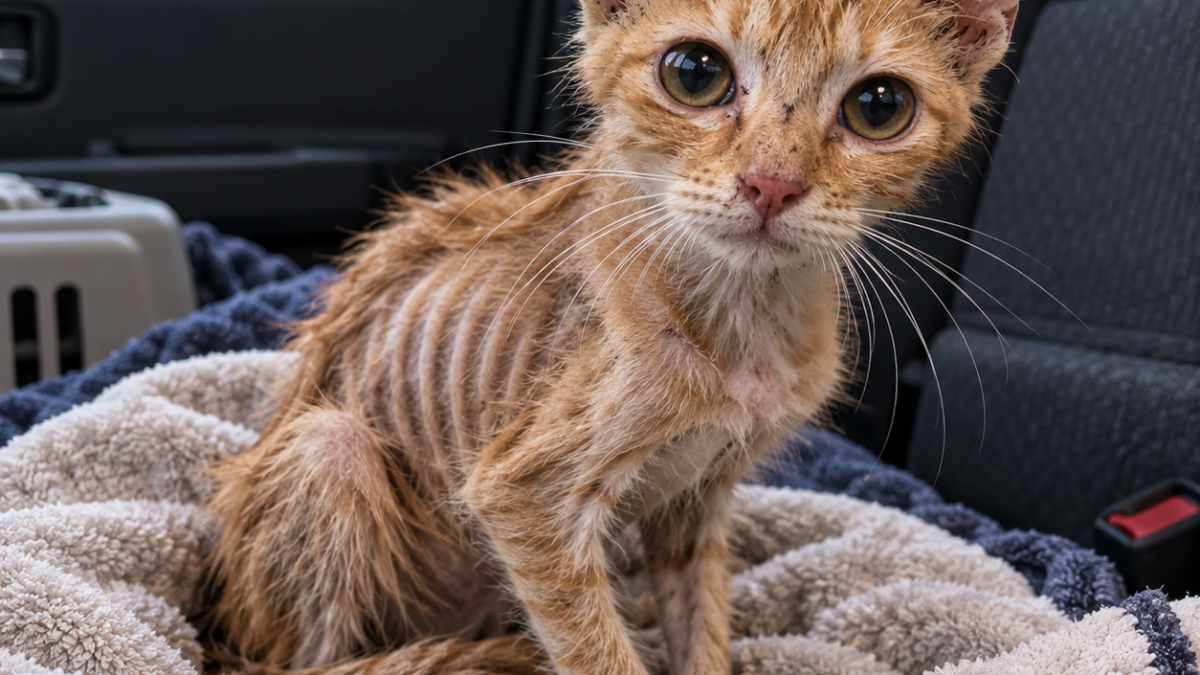
I wrapped another towel around him and placed him on the passenger seat of my county vehicle because I wanted a clean photograph before transport.
Evidence photo.
That was the reason.
At least officially.
He sat there in the towel.
Somehow still sitting.
Not lying.
His shoulders narrow.
Head too big.
Ribs visible beneath orange fur.
I took the picture.
Then lowered the camera.
His eyes met mine.
There should have been anger there.
That is what people later said when they saw the photograph.
He should hate humans.
He should be terrified.
But animals do not read our moral scripts.
His eyes looked tired.
That is all.
Tired.
I sat beside him for several seconds.
“You’re done in there.”
He blinked.
“You hear me?”
Nothing.
“You’re never going back in that room.”
I do not usually make promises on scenes.
That morning I did.
I drove to Oakridge Veterinary Hospital.
Called ahead.
“Severe starvation case.”
“How severe?”
“Four-pound adult male.”
Pause.
“What should he weigh?”
“Probably twelve to fourteen.”
Longer pause.
“Bring him through side intake.”
Dr. Maria Kent met us.
She had been Oakridge’s medical director for nearly fifteen years.
She also had the bedside manner of someone who believed comforting people wasted time that could be used helping animals.
I liked her.
She pulled back the towel.
Then stopped.
“What the hell.”
That from Maria meant something.
“We need a legal weight.”
Technician placed him carefully on the scale.
3.97 pounds.
I wrote it down.
Three pounds, fifteen and a half ounces.
Later, veterinary records from two years earlier showed 13.9 pounds.
Almost ten pounds lost.
Seventy percent of his former body weight.
Maria listened to his heart.
“Bradycardic.”
“Bad?”
“Starvation response.”
Temperature.
Low.
Blood pressure.
Low.
Gums.
Pale.
Muscle condition.
Catastrophic.
Dehydration.
Severe.
Bloodwork.
Liver changes.
Kidney stress.
Electrolyte abnormalities.
Anemia.
The list grew.
I stood in the corner documenting.
At some point Maria looked at me.
“How long?”
“Possible confinement up to a year.”
She stared.
“A year?”
“Door locked from outside.”
“Water?”
“Toilet.”
Her jaw tightened.
“Food?”
“None in room.”
“Then someone was feeding intermittently.”
“Probably.”
“Otherwise he would have died long ago.”
That statement bothered me.
Just enough.
That phrase.
Just enough.
Enough calories not to die.
Not enough to live.
There is cruelty in abundance.
And there is cruelty measured by teaspoon.
Maria said, “Do you have a name?”
I checked the old paperwork Harold had found near the kitchen.
Tenant veterinary receipt.
Cat name:
Sunny.
Of course.
Orange cat.
Sunny.
I hated how normal it sounded.
“Sunny.”
Maria touched his shoulder.
His head lifted.
His eyes opened wider.
“That got his attention.”
“He knows it.”
Probably.
After a year.
Still.
Maria looked at me.
“You know we can’t just feed him.”
“I know.”
“Refeeding syndrome risk is significant.”
“Explain it for my report.”
She did.
After prolonged starvation, the body adapts to extremely low energy intake.
Suddenly introducing large calories can shift insulin and electrolytes rapidly.
Phosphorus.
Potassium.
Magnesium.
Fluid balance.
Heart.
Neurological function.
Organs can fail.
The thing every decent person wants to do when seeing a starving animal—
Feed him everything.
Could kill him.
So Sunny received almost insultingly small meals.
Measured portions.
Hours apart.
Tiny amounts of easily digestible food.
Fluids adjusted carefully.
Electrolytes monitored.
Warmth.
Antibiotics only if indicated.
Parasite treatment timed around stability.
Every intervention had to respect how fragile survival had become.
I watched a technician put one teaspoon of food onto a dish.
Sunny smelled it.
Then ate.
Fast.
Too fast.
She removed the plate after seconds.
He looked at her.
That look.
I’ll never forget it.
He did not understand why food had been taken away.
His eyes followed the plate.
He licked the metal surface.
Then the floor where one drop had fallen.
The technician turned away.
I saw her crying.
“I hate this,” she whispered.
Maria said, “Slow keeps him alive.”
“I know.”
“Then hate it later.”
That was Maria.
I left at noon to continue the investigation.
I did not want to.
Sunny watched me from the heated kennel.
At the door, I looked back.
His eyes were open.
Facing the exit.
I told myself that meant nothing.
Then returned to Miller Creek Road.
The bathroom was worse after you knew.
The scratches became a timeline.
The floor near the door had the deepest damage.
Plywood gouged.
Claw marks blackened with dirt.
At the lowest corner of the door, the wood was splintered from repeated attempts.
The toilet seat had shallow bite grooves.
Why chew plastic?
Hunger.
Boredom.
Stress.
Attempted escape.
We would never know.
The shower curtain had claw marks high enough to show Sunny had once been strong enough to climb.
At the bottom, newer damage stayed close to the floor.
As he lost muscle, his world got lower.
That realization hit me in the chest.
I photographed every inch.
Then found something behind the toilet.
Three dry kernels of cat food.
Old.
One lodged beneath the base.
Another near the wall.
One partly crushed.
I bagged them.
Harold watched.
“So he fed him sometimes.”
“Maybe.”
“Why?”
That was not an evidence question.
I answered anyway.
“Enough to keep him from dying.”
Harold’s face twisted.
“That’s worse.”
I understood what he meant.
The bathroom had no window large enough for escape.
Small frosted pane above the tub.
No screen damage.
Door was the only exit.
And somebody had added a lock specifically designed to make sure it stayed shut.
Intent matters in cruelty investigations.
So do patterns.
Neglect can be chaos.
Poverty.
Mental illness.
Ignorance.
Overwhelm.
A bolt on the outside of a bathroom door is different.
Somebody made a decision.
Bought hardware.
Measured.
Screwed it into place.
Closed the cat inside.
Slid the bolt.
I interviewed neighbors.
Mrs. Green across the road said she had heard scratching.
“When?”
“Sometimes at night.”
“How long?”
“Months.”
“Did you know it was an animal?”
“No.”
“What did you think?”
“Pipes?”
Another neighbor remembered a cat crying during summer.
“Did you report it?”
“No.”
“I thought maybe outdoor cat.”
Again.
Hindsight.
The cruelest word in investigations.
Should have.
Could have.
Didn’t know.
I learned not to weaponize hindsight against ordinary people.
It solves nothing.
The person who knew exactly what was behind that door was Derek Shaw.
He had been removed from the property the day before.
Sheriff’s office located him that evening at his brother’s apartment.
I attended the interview with a deputy.
Derek was thirty-four.
Thin.
Work boots.
Hoodie.
He did not look like a monster.
That matters too.
I wish cruelty always arrived with warning labels.
He looked annoyed.
Not frightened.
“It’s about the cat?”
I kept my professional face.
“What cat?”
He rolled his eyes.
“Sunny.”
“How long have you owned Sunny?”
“Years.”
“How many?”
“Six maybe.”
“When did you begin keeping him in the bathroom?”
“He stayed in there because he’d piss everywhere.”
“Did you lock the door?”
“Yes.”
“When did you install the outside bolt?”
“I don’t remember.”
“Landlord says it wasn’t present thirteen months ago.”
“Then after.”
“Why?”
“He’d get out.”
“How?”
“He’d push the door.”
“So you installed a lock.”
“Yeah.”
“Was he allowed out?”
“Sometimes.”
“How often?”
Derek shrugged.
“That isn’t a time measurement.”
“I don’t know.”
“Daily?”
“No.”
“Weekly?”
“Maybe.”
“Food?”
“I fed him.”
“How often?”
“When I remembered.”
My pen stopped.
Not my face.
My pen.
“When you remembered?”
“Yeah.”
“How often did you remember?”
“I don’t know.”
“Once a day?”
“No.”
“Every two days?”
“Maybe.”
“Every week?”
He got irritated.
“I said I don’t know.”
“Water?”
“Toilet.”
“You intentionally left the toilet open?”
“He drank.”
“Was there a water bowl?”
“He knocked it over.”
“So you stopped providing one?”
“There was water in the toilet.”
I felt the professional face slipping.
I looked down.
Wrote.
Water source: toilet bowl.
“Why didn’t you surrender him?”
Derek laughed.
“To who?”
“Animal shelter.”
“They charge.”
“Our county shelter does not charge for owner surrender in hardship cases.”
He looked away.
“Didn’t know.”
“Rescue.”
“No one wants old cats.”
“He was seven.”
“Whatever.”
“Friend?”
“No.”
“Post online?”
“Didn’t care that much.”
There it was.
Plain.
Not rage.
Not apology.
Didn’t care that much.
I had expected some explanation.
Breakup.
Depression.
Job loss.
Something people could debate.
Instead:
He peed outside the box.
He annoyed me.
I forgot food.
There was toilet water.
Didn’t care that much.
I asked, “What did Sunny weigh when you put him in the bathroom?”
“How should I know?”
“Fourteen pounds two years ago.”
“Was fat.”
“He weighs four pounds now.”
Derek stared.
For the first time, something changed.
Not remorse.
Surprise.
“Four?”
“Yes.”
“He’s alive?”
I looked directly at him.
That was when I lost my face.
“Yes.”
My voice became harder.
“He’s alive.”
The deputy beside me shifted.
I continued.
“He sat in that bathtub after twelve months behind the lock you installed.”
Derek said nothing.
“He clawed through the flooring.”
Silence.
“He chewed the toilet seat.”
“Okay.”
“He lost almost ten pounds.”
“I said okay.”
“He drank toilet water.”
“I know.”
That answer did it.
I know.
I stood.
The deputy said, “Cole.”
I walked outside.
Cold air hit me.
I put both hands on the hood of my county truck and breathed.
Eight years.
Thousands of calls.
Professional face.
Gone.
The deputy came out ten minutes later.
“You good?”
“No.”
“Need me to finish?”
“Yes.”
He nodded.
No judgment.
That’s another thing good officers learn.
Everyone gets one case that reaches through the armor.
Sometimes more.
Sunny was mine.
The district attorney’s office received the file.
Photographs.
Veterinary report.
Historical medical records.
The lock.
Scene video.
Statements.
Derek’s admission.
Food absence.
Toilet-water evidence.
Weight change.
The case became criminal.
I cannot tell you every detail of the legal process.
Some records were sealed.
Some proceedings took months.
Charges were filed.
That’s enough.
Justice did not happen quickly.
Recovery did not either.
For the first seventy-two hours, Sunny ate every few hours.
Tiny meals.
Each one weighed.
His blood phosphorus dropped.
Supplemented.
Potassium monitored.
Heart checked.
Temperature stabilized.
He developed diarrhea.
Then nausea.
Then refused one meal.
I panicked.
Maria did not.
“Expected.”
“He needs calories.”
“He needs a functioning body more.”
“He was eating yesterday.”
“Recovery is not a staircase.”
“What?”
“You expect every day to go up.”
She drew a line in the air.
“It doesn’t.”
She made a wave with her hand.
“Up. Down. Up. Down.”
“He can still die?”
“Yes.”
I hated her for answering honestly.
Then respected her for it.
On day four, Sunny purred.
The technician called me.
“I thought you’d want to know.”
I drove over after shift.
He was lying beneath a blanket.
Still skeletal.
But when I scratched under his chin, a tiny vibration started.
Barely there.
I smiled.
“About time.”
He looked at me.
Slow blink.
Sunny stayed hospitalized nine days.
At discharge he weighed 4.4 pounds.
Gain of less than half a pound.
It felt enormous.
His foster placement was with a veterinary technician named Hannah Cole.
Thirty-one.
Two cats of her own.
No children.
Experience with starvation cases.
She had fostered a dog who arrived at one-third of normal weight.
Hannah met Sunny in a quiet room.
She did not reach for him.
Sat on the floor.
Put down a small plate.
Sunny ate.
Then looked toward the door.
Hannah noticed.
“What?”
I said, “He does that.”
“Looks at doors?”
“Yeah.”
“Why?”
I thought about the bathtub.
“I think he’s used to waiting for them to open.”
Hannah’s face changed.
She stood.
Walked to the foster room door.
Removed the latch hook she had installed to keep her cats out.
“What are you doing?”
“Changing the setup.”
“He needs confinement initially.”
“I know.”
She replaced it with a baby gate system and a door that stayed visibly open while still separating the room when necessary.
Sunny could see the hallway.
No closed door.
It seemed like a small thing.
Maybe meaningless.
It wasn’t to me.
The first night, Hannah texted:
He won’t sleep in the bed.
Where?
Bathtub.
My chest hurt.
Her guest bathroom connected to the foster room.
Sunny had found the tub.
Curled in one corner.
Not because he loved bathtubs.
Maybe because one year had taught him that was where surviving happened.
Hannah did not force him out.
She placed a folded blanket inside.
Food outside.
Water outside.
Litter outside.
The next night, he slept there again.
Week one.
Bathtub.
Week two.
Still.
Then, one afternoon, Hannah sent a picture.
Sunny asleep on a rug in the hallway.
Not the bathroom.
The hallway.
Caption:
HE CAME OUT BY HIMSELF.
I saved the photograph.
The next week:
Couch.
Then:
Window.
Then:
Hannah’s bed.
Each photograph felt like territory reclaimed.
His eating changed too.
At first, he inhaled meals.
Not ate.
Inhaled.
He would finish and immediately search.
Counter.
Floor.
Garbage.
Sink.
Cabinet.
One night Hannah found him chewing a cardboard cereal box.
Empty.
Another time he tore open a sealed bag of flour.
Not because flour tastes good.
Because the bag smelled like food.
Hunger had rewritten his behavior.
Hannah called Maria.
“How do I teach him food isn’t disappearing?”
“You don’t.”
“What?”
“Not quickly.”
“So just keep schedule?”
“Exactly.”
Same times.
Same amount.
Reliable.
No gaps.
A body learns abundance biologically before the mind believes it emotionally.
Sunny started sitting by the feeding mat thirty minutes early.
Then twenty.
Then ten.
Months later, he stopped waiting there between meals.
Routine did what reassurance couldn’t.
Week three:
5.1 pounds.
Week five:
5.8.
Week eight:
6.7.
He gained muscle slowly.
His coat stopped falling out.
New fur grew.
Orange became orange again instead of dusty brown.
His face filled.
Eyes looked proportional.
At eight pounds, people started calling him beautiful.
That irritated me.
He had been valuable at four.
Beauty should not be the reward for surviving.
Hannah understood.
She never posted before-and-after pictures without context.
When the rescue shared an update, she wrote:
Sunny’s recovery is not a transformation from “worthless” to “worthy.” He mattered on the bathroom floor too.
I liked that.
The internet preferred:
LOOK AT THIS MIRACLE CAT!
We compromise with humanity.
Three months after rescue, Sunny did something I did not expect.
Hannah had guests.
One man wore work boots similar to Derek’s.
Sunny saw him.
Ran.
Not behind furniture.
To the bathroom.
Jumped into the tub.
Hannah found him pressed flat against the porcelain.
Shaking.
No aggression.
No sound.
Just gone.
She called me.
“I thought he was better.”
“He is.”
“This feels like back to zero.”
“No.”
“How do you know?”
“Because trauma isn’t amnesia.”
Silence.
I had learned that from a behavior specialist we used on another case.
I continued.
“He’s not failing because something scared him.”
“What do I do?”
“Let him decide when to come out.”
It took two hours.
The guest left.
Hannah sat in the hallway.
Didn’t call him.
Didn’t reach.
Eventually Sunny appeared.
One paw.
Then head.
Then body.
He crossed the hallway.
Sat beside her.
She sent me another picture.
No caption.
Didn’t need one.
The criminal hearing happened in spring.
I testified.
Professional face back.
Mostly.
The prosecutor displayed the photograph from my vehicle.
Sunny at four pounds.
Wrapped in a towel.
The defense attorney asked whether I could prove Sunny had been inside that bathroom continuously for twelve months.
“No.”
“So you cannot say he never left?”
“Correct.”
“Could the defendant have allowed him out?”
“Yes.”
“Could the cat’s weight loss have occurred from disease?”
“Veterinary experts found no underlying disease sufficient to explain the starvation.”
“But you’re not a veterinarian.”
“No.”
“Could food have been provided?”
“Occasionally, yes.”
“So there was food.”
I looked at the attorney.
“There was enough intermittent caloric intake for him not to die.”
He paused.
“That wasn’t my question.”
“It is the accurate answer.”
The judge looked at me.
“Answer only what you’re asked, Officer.”
“Yes, Your Honor.”
My supervisor later told me I had come very close to sounding sarcastic.
I disagreed.
I had sounded exactly sarcastic enough.
Derek took a plea agreement months later.
The details mattered legally.
Less emotionally.
Animal possession restrictions.
Probation.
Fines and restitution.
A cruelty conviction remained on record.
People online wanted prison.
Some thought the sentence too lenient.
Others thought too harsh.
My job was not deciding punishment.
My job was documenting what happened.
I learned to let that boundary protect me.
Mostly.
Sunny did not know any of it.
While lawyers argued, he discovered a heated window perch.
Much better use of time.
At six months, he weighed 9.6 pounds.
At nine:
11.2.
Maria wanted him around twelve.
His frame was larger than we first realized because starvation had distorted everything.
By one year, Sunny weighed 12.8 pounds.
Healthy.
Muscular enough.
Thick orange coat.
A little saggy skin around his abdomen where his body had changed.
He still had strange habits.
He checked empty bowls even after eating.
He licked condensation from sinks despite having three water fountains.
Open toilet lids fascinated him.
Hannah began keeping them closed.
Not because he needed toilet water.
Because she never wanted him to need it again.
Most importantly:
Sunny hated closed bathroom doors.
Any bathroom.
If Hannah entered and shut one, he scratched.
Not frantic.
But immediate.
So she stopped closing bathroom doors when home alone.
Privacy became a luxury.
She joked about it.
I didn’t.
The scratches on that original bathroom door were still in evidence storage.
I had photographed them hundreds of times.
Sometimes at night, I saw them anyway.
Parallel gouges.
Wood fibers.
A cat slowly losing strength but continuing to try.
That was the image I could not shake.
Then Hannah called.
“We have a problem.”
My stomach tightened.
“What?”
“Adoption application.”
“For Sunny?”
“Yes.”
“That isn’t a problem.”
“It is for me.”
I smiled.
“Hannah.”
“Don’t.”
“You’re attached.”
“I am professionally committed.”
“You sleep with him.”
“For monitoring.”
“He weighs thirteen pounds.”
“Could decline anytime.”
“Maria discharged him from nutritional monitoring six weeks ago.”
“She’s reckless.”
“You work with her.”
“Unfortunately.”
I laughed.
Hannah did not.
“You think I should adopt him.”
“I think you already did emotionally.”
Silence.
Then:
“What if he needs somebody better?”
There it was.
The question foster parents ask when they already love an animal enough to be afraid love isn’t qualification.
“You kept him alive through refeeding.”
“Maria did.”
“You stayed.”
“That’s not expertise.”
“Sometimes it is.”
She exhaled.
“He sleeps on my chest.”
“I know.”
“How?”
“You send pictures at two in the morning.”
“Right.”
She adopted Sunny that week.
Officially.
I attended.
Not required.
Wanted to.
Hannah filled out the paperwork.
Under distinguishing marks she wrote:
Orange tabby. White chin. One damaged canine.
Then paused.
Added:
Will follow you to open doors.
I looked at her.
“That’s not a mark.”
“It is emotionally.”
The rescue worker shrugged.
“Works for me.”
Sunny sat on the table.
Thirteen pounds.
I thought about four.
The same eyes.
Different face around them.
Afterward Hannah asked if I wanted to hold him.
I did.
My arms prepared differently this time.
Weight.
Real weight.
Warmth.
Muscle.
Fur.
He settled against me.
I could no longer feel every bone.
That made my throat close.
“Look at you.”
Sunny purred.
I scratched under his chin.
“You gave me a terrible year.”
Hannah said, “He had a worse one.”
Fair.
The property owner, Harold, eventually renovated the house.
I visited once to collect additional measurements for the prosecutor.
The bathroom had been gutted.
New flooring.
New door.
New toilet seat.
No bolt.
I stood there longer than necessary.
Harold came behind me.
“I couldn’t keep it.”
“What?”
“The door.”
“You weren’t supposed to. Evidence released it?”
“After they did.”
“What happened?”
“I burned it.”
I looked at him.
“The scratched one?”
“Yes.”
“Why?”
He looked embarrassed.
“My wife said donate it or dump it.”
“And?”
“I couldn’t imagine somebody hanging that door in another house.”
I understood.
“Did burning it help?”
“No.”
He smiled sadly.
“Thought it would.”
We stood in the clean bathroom.
It smelled like new paint.
Nothing remained of Sunny except memory.
Harold said, “I keep thinking I should’ve inspected sooner.”
I had heard versions of that for a year.
“You had a tenant who denied entry and gave excuses.”
“I own the property.”
“You’re not psychic.”
“I could’ve—”
“Harold.”
He stopped.
“Responsibility has an address.”
I pointed mentally toward Derek.
“Don’t move it because hindsight is uncomfortable.”
He nodded.
I wish I believed my own advice as easily as I gave it.
I still asked myself:
What if someone had called about scratching?
What if deputies opened the bathroom during eviction?
What if Harold entered three months earlier?
What if I had somehow known?
Rescue and enforcement are full of invisible animals.
Suffering behind walls.
Inside sheds.
Beneath porches.
In bedrooms.
In cages nobody sees.
You cannot save what you do not know exists.
That sentence is true.
It still feels inadequate.
Sunny began visiting our office occasionally.
Hannah worked near us, and she brought him for staff fundraisers.
He became enormous compared with the cat in the original photograph.
Not obese.
Just restored.
People who had never seen the bathroom case looked at him and said:
“He doesn’t look like he was ever starved.”
That sentence always bothered me.
As if successful healing should preserve visible evidence for our satisfaction.
Trauma does not owe spectators a scar.
Sunny had some.
Not visible.
One afternoon a volunteer accidentally shut the supply-room door with him inside.
Less than thirty seconds.
Sunny lost control.
Screaming.
Clawing.
Throwing his body at the door.
We opened it instantly.
He shot out.
Ran beneath a desk.
Would not emerge for an hour.
Everyone felt terrible.
Hannah did not blame the volunteer.
“It was an accident.”
Still, we changed office procedures when Sunny visited.
Doors checked before closing.
That was his scar.
Invisible until touched.
At age nine, he developed dental disease.
Needed two extractions.
Hannah panicked about fasting before anesthesia.
Not because Sunny couldn’t fast medically.
Because withholding breakfast made him frantic.
Maria modified the plan carefully.
Late-night meal.
Early morning procedure.
Minimal fasting within safe anesthetic guidelines.
Sunny still screamed at his empty bowl.
Hannah sat with him.
“This is temporary.”
He didn’t know that.
That is the problem with animals and necessary discomfort.
You know why.
They only know it is happening.
After surgery, when feeding time returned, Sunny ate slowly.
That was new.
For years he had inhaled food.
Now, at nine, he could leave food on a plate.
Come back later.
The first time Hannah saw him do it, she called me.
“He walked away.”
“From what?”
“Food.”
“Is he sick?”
“No.”
“Then?”
“He left half the bowl.”
Silence.
I understood.
“He knows it’ll still be there.”
Hannah started crying.
“Yeah.”
I cried too.
Ridiculous things become landmarks.
A starving cat walking away from half a meal because somewhere deep inside his nervous system, scarcity had finally loosened its grip.
That felt bigger than thirteen pounds on a scale.
A year later, our department used Sunny’s case in officer training.
Not the graphic photos first.
The room.
Bolt.
Door.
Toilet.
Scratches.
Then the cat.
I trained new animal-control officers on documentation.
I told them:
“Your first instinct will be to photograph the animal.”
“Do it.”
“But also photograph the environment.”
“Cruelty cases are stories built from physical facts.”
I showed the bolt.
“Somebody installed this.”
The floor.
“This is repeated behavior over time.”
The toilet.
“This was the accessible water source.”
No food bowl.
“This absence matters.”
Scratched door.
“This tells you the animal attempted escape.”
Then I showed Sunny’s photo from the vehicle.
Four pounds.
Eyes enormous.
Sitting upright.
The room always became silent.
One trainee asked, “How do you not lose it?”
I almost gave my old answer.
Professionalism.
Distance.
Focus on the job.
Instead I said:
“Sometimes you do.”
They looked surprised.
“You don’t do it in front of the suspect if you can help it.”
“You don’t contaminate the investigation with emotion.”
“But if you’re asking how to become a person who feels nothing?”
I shook my head.
“Don’t.”
That was what Sunny changed in me.
I had mistaken numbness for resilience.
They are not the same.
Resilience means feeling something and still doing the work correctly.
Numbness means eventually nothing gets through.
I did not want that anymore.
Sunny turned ten.
Then eleven.
His orange face whitened around the mouth.
He became more affectionate with age.
Slept against Hannah every night.
Still hated bathroom doors.
Still drank from the faucet even though he had perfectly good water.
Still inspected every grocery bag for food.
But no longer panicked if dinner was five minutes late.
Progress.
Derek’s animal-possession ban expired eventually under the terms of his sentence.
That bothered me.
I checked legally available records once.
No new animals registered.
No new complaints.
Then I stopped checking.
Sunny’s life did not need Derek remaining at the center forever.
That was another lesson.
Accountability matters.
But if the person who caused harm remains the main character years later, harm keeps receiving more space than healing.
Sunny deserved more story than that bathroom.
At twelve, he developed early kidney disease.
Manageable.
Prescription food.
Fluids eventually.
Regular labs.
Hannah called me after the diagnosis.
“I can’t lose him.”
“You will someday.”
“Helpful.”
“Sorry.”
“No, you’re right.”
She was quiet.
“I think part of me still believes surviving that bathroom bought him forever.”
I understood.
“Doesn’t work that way.”
“I know.”
“But it should.”
“Yes.”
He lived three more good years.
At fourteen, arthritis.
At fifteen, kidney disease advanced.
By then I had been in animal control over twenty years.
Hair grayer.
Knees worse.
Professional face softer.
Sunny’s case had become something new officers knew before meeting me.
“That bathroom cat.”
I hated that nickname.
He had spent one year in a bathroom.
He spent fourteen years elsewhere.
Why did the smallest portion of his life get the title?
So whenever someone said it, I corrected them.
“Sunny.”
Not bathroom cat.
Sunny.
At fifteen, he stopped eating one November morning.
Hannah knew immediately.
A lifetime of watching food made refusal impossible to ignore.
Maria had retired.
Her successor, Dr. Nguyen, ran bloodwork.
Kidneys.
Severe.
Treatment helped for two days.
Then not.
Hannah called.
“Can you come?”
I drove over.
Sunny lay on the same heated blanket he’d owned for years.
Old.
Thinner again.
Not four pounds.
Nothing like that.
Just elderly.
Tired.
I sat on the floor.
He looked at me.
Those eyes.
Smaller in his filled face now.
Cloudy with age.
I held out two fingers.
Like the first day.
He smelled them.
Then slowly pressed his forehead beneath my hand.
Hannah cried.
“I hate this.”
“I know.”
“He fought so hard.”
I looked at her.
“Don’t make him keep fighting because we’re impressed by it.”
She covered her mouth.
I had not meant it harshly.
But sometimes love turns survival into obligation.
Sunny had survived enough.
He did not owe us one more day to prove anything.
Dr. Nguyen came to the house.
Home euthanasia.
No carrier.
No clinic.
No closed doors.
Hannah left every door open.
Bedroom.
Bathroom.
Hallway.
Front door closed, of course.
But not locked in any way Sunny could see.
Maybe that was for us.
He lay on Hannah’s lap.
I sat beside them.
Before the first injection, Hannah offered him a teaspoon of tuna.
Sunny licked once.
Then turned away.
Years earlier, that would have terrified us.
Now it was permission.
Hannah whispered, “Okay.”
Sedative.
His body relaxed.
Purr.
Very soft.
I touched his shoulder.
“Hey, buddy.”
His eyes opened.
Slow blink.
Same thing from the bathtub.
My throat closed.
“You can stop waiting now.”
Hannah cried harder.
Final injection.
Breathing slowed.
Stopped.
Sunny died at fifteen.
Fourteen years after leaving the locked bathroom.
That ratio matters to me.
One year trapped.
Fourteen free.
One year drinking toilet water.
Fourteen years with fountains, bowls, faucets, and a woman who once drove back from work because she couldn’t remember whether she’d refreshed his water.
One year scratching one door.
Fourteen years walking through open ones.
One year wondering when food would come.
Years later, leaving half a meal because he finally trusted breakfast would happen tomorrow.
That is Sunny’s story.
Not starvation alone.
After he died, Hannah gave me something.
A framed copy of the photograph from my county vehicle.
I did not want it.
“I already have the file.”
“This isn’t evidence.”
She turned it around.
Beside the old photograph was another.
Sunny at thirteen.
Fat orange cheeks.
Green eyes.
Lying in sunlight.
One paw hanging over the edge of a couch.
Between the two pictures, a small brass plate read:
3.97 LBS WAS WHAT HE WEIGHED.
IT WAS NEVER WHAT HE WAS WORTH.
I stared.
Hannah said, “I thought your office should have it.”
It hangs there now.
New officers see it.
Members of the public see it.
Sometimes people ask about him.
I tell them.
Not every detail.
Enough.
The bathroom.
The bolt.
The year.
The weight.
The recovery.
Someone always says:
“How did he survive?”
I used to answer medically.
Toilet water.
Intermittent food.
Metabolic adaptation.
Luck.
All true.
Now I usually say:
“I don’t know.”
Because survival is more than continued heartbeats.
Sunny had spent a year with almost nothing.
No reliable food.
No companionship we know of.
No freedom.
No safe water bowl.
No control over the door.
And still, when I opened it, he was sitting upright.
Facing me.
Waiting.
That image used to make me unbearably sad.
Now it does something else too.
It reminds me that hope does not always look hopeful.
Sometimes hope is just posture.
A body too weak to stand.
Still sitting.
Eyes toward the only exit.
Not because the animal understands rescue is coming.
Not because he has faith in humanity.
We should not romanticize him that way.
Maybe Sunny simply heard footsteps.
Maybe he had heard footsteps thousands of times before.
Maybe every time Derek approached the door, food occasionally appeared.
Maybe his brain had learned:
Sound.
Door.
Possibility.
So he watched.
That explanation does not make the image smaller.
It makes it more painful.
For a year, footsteps meant maybe.
Maybe food.
Maybe escape.
Maybe attention.
Maybe nothing.
He kept looking anyway.
After Sunny died, I returned once to Miller Creek Road.
Different owner now.
Renovated years earlier.
I did not go inside.
I parked across the road.
No reason.
Just did.
A family lived there.
Two kids playing in the yard.
Dog behind a fence.
I watched for maybe five minutes.
Then felt stupid.
What was I expecting?
Ghosts?
Closure?
The house had none to give me.
The bathroom was gone.
The bolt burned.
Derek moved on.
Sunny died loved.
There was nothing left at the address.
That was good.
Some places should lose ownership of the stories that happened inside them.
I drove back to the office.
Looked at the two photographs.
Four pounds.
Thirteen pounds.
Bathtub eyes.
Sunlight eyes.
Same cat.
I thought about how easy it is to turn suffering into identity.
The starving cat.
The abuse case.
The bathroom cat.
Victim.
Survivor.
All labels.
Sunny was also:
The cat who slapped a Labrador through a baby gate.
The cat who learned to open Hannah’s kitchen cabinet.
The cat who screamed whenever someone ate rotisserie chicken.
The cat who slept on tax forms.
The cat who hated closed doors but loved empty cardboard boxes despite the obvious contradiction.
The cat who eventually learned food could remain unfinished.
The cat who grew old.
That last one may be my favorite.
He grew old.
Animals in cruelty photographs often feel frozen in the moment we meet them.
Thin forever.
Scared forever.
Wounded forever.
But successful rescue gives them ordinary time.
Enough time to become annoying.
Fat.
Sleepy.
Opinionated.
Arthritic.
Old.
That is the victory.
Not simply that Sunny survived a locked bathroom.
He lived long enough for that bathroom to become a small fraction of who he was.
I still investigate cruelty cases.
Fewer now.
I supervise more.
Train younger officers.
But every time somebody enters a home and finds an animal behind a closed door, I tell them:
Photograph first.
Document everything.
Check water.
Check food.
Check the floor.
Check the door.
Look for scratches.
Look for repair marks.
Ask who installed locks.
Pull prior veterinary history.
Weight records matter.
Timeline matters.
And after you’ve done all that—
look at the animal.
Not only as evidence.
As the reason evidence matters.
There is a difference.
Sunny taught me that too.
Our job is not proving humans did something bad.
Our job is protecting the living thing that endured it.
Sometimes prosecution succeeds.
Sometimes it disappoints you.
Sometimes laws are strong.
Sometimes embarrassingly weak.
But the animal cannot wait for court.
Food.
Water.
Medicine.
Warmth.
Safety.
Those happen first.
Justice begins before sentencing.
Sometimes justice is a teaspoon of food every four hours.
A heated blanket.
An open door.
A woman sitting quietly on the floor until a cat chooses the hallway.
A full bowl he eventually learns he does not have to finish.
People want justice to sound louder.
Sunny’s was mostly quiet.
At the end of his life, Hannah mailed me his collar.
I called immediately.
“You should keep this.”
“I kept his tag.”
“Why send me the collar?”
“Turn it over.”
A small metal plate was attached inside.
I’d never noticed it.
Hannah had engraved it years earlier.
IF FOUND, PLEASE BRING ME HOME.
I laughed.
Then cried.
“That’s cruel.”
“What?”
“You put that on the bathroom cat?”
“Don’t call him that.”
“Sorry.”
She was right.
I turned the collar over in my hand.
Home.
Sunny had one once.
Lost it while still physically inside it.
Then found another outside.
That is something people misunderstand.
A house is not a home because the animal is trapped inside.
Ownership paperwork does not create care.
A roof is not protection if the person beneath it controls food as punishment.
A closed bathroom was technically indoors.
It was still abandonment.
Maybe worse.
Because no one passing by could see him.
He was hidden inside a place everyone assumed meant shelter.
After Sunny, I stopped asking only whether animals had a house.
I asked:
Can they access water?
Can they access food?
Can they move?
Can they leave the space they’re confined in?
Does somebody notice if they stop eating?
Does somebody care?
Those are better questions.
Sunny weighed 3.97 pounds the day I opened that door.
People remember that number.
I do too.
But there are other numbers.
Thirteen pounds at healthy adult weight.
Fourteen years after rescue.
Hundreds of meals.
Thousands of nights outside the bathroom.
Countless open doors.
One woman who stayed.
One old animal-control officer who thought he had learned not to feel too much and discovered that was never the point.
Sometimes, when a case is especially bad, a new officer sits in my office afterward.
Hands shaking.
Angry.
Embarrassed by tears.
They say:
“I don’t know how you do this.”
I point at Sunny’s photographs.
Then I tell them the truth.
“You don’t learn how not to feel it.”
“You learn what to do with the feeling.”
Document.
Remove.
Treat.
Testify.
Follow up.
Improve the next case.
Feed the next animal.
Open the next door.
That is all.
The day we found Sunny, I believed the most powerful part of his story was that he had survived twelve months locked in a bathroom.
I don’t anymore.
The most powerful part came later.
Years later.
Hannah put down breakfast.
Sunny ate half.
Then sunlight moved across the carpet.
He looked at it.
Walked away from his bowl.
Curled into the warm patch.
And went to sleep.
Food still sitting behind him.
No panic.
No guarding.
No desperate licking.
No fear it would disappear.
He slept.
Think about that.
A cat who once chewed plastic and scratched plywood because hunger and confinement had reduced his entire world to survival eventually learned that an unfinished meal could remain behind him.
He trusted there would be another.
That is recovery.
Not weight alone.
Trust in tomorrow.
Sunny earned none of his suffering.
And he did not earn his rescue by being strong.
We need to stop telling stories that way.
Animals do not deserve help because they inspire us.
They deserve help because they are alive.
Sunny was worth saving when he was four pounds.
Worth feeding when he could not stand.
Worth protecting when his coat was falling out.
Worth prosecuting for even if he had died before we arrived.
His eventual happiness did not retroactively make the year acceptable.
His survival did not soften what happened.
It simply proved that cruelty did not get the final word.
I still remember sliding that cheap metal bolt.
The click.
The door moving.
The smell.
Then orange fur in the bathtub.
Sometimes I dream about it.
In the dream, I open the door and the room is empty.
I wake relieved.
Then sad.
Strange combination.
But the real memory always ends the same way.
Sunny looks at me.
I reach down.
He slow-blinks.
And I lift him.
He weighs almost nothing.
Yet somehow, that four-pound body carries more than I expect.
Evidence.
Failure.
A year nobody came.
And one stubborn little pulse that kept going long enough for somebody finally to open the door.
I used to think that meant Sunny never gave up.
Maybe.
But I don’t want to romanticize what he endured.
He should never have needed that strength.
No animal should.
So when people call him a fighter, I understand.
When they say he was brave, I understand.
But if Sunny could have chosen, I think he would have preferred something much simpler than bravery.
Breakfast.
Clean water.
A warm window.
A person who noticed him.
A door that opened.
He eventually got all of those things.
For fourteen years.
And whenever I think about the twelve months he spent waiting inside that bathroom, I remind myself of what came after.
He did not spend the rest of his life facing the door.
Eventually, he turned away from it.
Toward a hallway.
A couch.
A window.
A bowl he could leave half full.
Toward Hannah.
Toward sunlight.
Toward a life where footsteps no longer meant maybe.
They meant someone was coming home.
That is the picture I choose now.
Not the bathtub.
Not the four-pound body.
Sunny at thirteen pounds, stretched in a patch of afternoon sun, sleeping so deeply that one paw hung over the edge of the couch.
A bowl sat ten feet away.
Water beside it.
Every door in the hallway stood open.
And for the first time in a very long life, he was not waiting for anybody to let him out.
He was already free.

