His Mother Seated His Wife’s Small-Town Mom Beside the Kitchen at a 500-Guest Wedding — But They Didn’t Know One Name in Her Speech Would Turn the Entire Charleston Ballroom Against the Woman Who Thought Status Made Her Untouchable
PART3:
Owned three dresses she considered “nice.”
She gardened.
Volunteered at the library.
Delivered meals to people recovering from surgery.
Remembered birthdays.
Sent cards when somebody’s dog died.
She had an almost supernatural ability to stretch soup.
Growing up, I never knew whether an unexpected person sitting at our table was a friend, stranger, widower, student, or somebody whose electricity had been shut off.
Mom never explained.
She just added water.
That was her way.
She did not perform kindness.
She practiced it.
Patricia never understood people who did not perform.
The two women met before Miles and I married.
Dinner at Patricia’s home.
Charleston silver.
White linen.
Three forks.
Mom arrived carrying a homemade apple cake because where we came from, you didn’t walk into somebody’s house empty-handed.
Patricia looked at the cake like Mom had brought roadkill.
“Oh,” she said.
“How sweet.”
Mom smiled.
“I wasn’t sure what everyone liked.”
“We have dessert catered.”
“Of course.”
Mom left the cake on the counter.
Nobody served it.
That night after we got home, I found Mom in the guest room wrapping the cake back up.
She said:
“Your mother-in-law has beautiful dishes.”
That was Marian Lane.
Someone could stab her politely and she would compliment the knife.
I said:
“You can say she was rude.”
Mom looked at me.
“She loves her son.”
“That wasn’t what I said.”
She smiled.
“No.”
Then:
“Marriage will be easier if you don’t make a courtroom out of every dinner.”
At the time, I thought that was wisdom.
Years later, I understood it had limits.
Because there is a difference between refusing unnecessary conflict and training yourself to accept disrespect.
Patricia tested that difference constantly.
At Thanksgiving:
“Avery, darling, your cornbread is so rustic.”
At Christmas:
“Do people in Briar Ridge still exchange homemade gifts?”
At our anniversary dinner:
“I suppose public universities have improved dramatically since your generation.”
I was thirty.
Patricia said “your generation” like I had survived polio.
When Mom visited:
“Marian, you must find Charleston overwhelming after somewhere so quiet.”
Mom would smile.
“Not really.”
Or:
“Those pearls are lovely. Family?”
“Yes.”
“My husband gave them to me.”
“How sentimental.”
Everything became smaller when Patricia said it.
My hometown.
My education.
My food.
My mother.
My husband, Miles, saw it all.
At first he defended us sometimes.
“Mom, stop.”
Or:
“That was unnecessary.”
But Patricia had a skill.
She never admitted intent.
“Oh, Miles, I was complimenting her.”
“You’re too sensitive.”
“Avery knows I adore her.”
Then she would become wounded.
And Miles would spend the rest of the evening managing her feelings instead of mine.
Eventually he stopped correcting her.
That was easier.
For him.
Not for me.
I learned to watch his face whenever Patricia made a comment.
His jaw tightened.
Shoulders stiffened.
Eyes dropped.
He heard.
That became worse than if he hadn’t.
Two weeks before Natalie’s wedding, we sat around Patricia’s formal dining table finalizing seating.
The guest list looked like a census report for wealthy Charleston.
Patricia had printed it in twelve-point font and still needed fourteen pages.
She sat at the head of the table with a gold pen.
Natalie beside her.
My sister-in-law looked exhausted.
Not excited.
Exhausted.
She had spent eight months watching her own wedding become Patricia’s Olympics.
Miles sat beside me.
His father Charles near the opposite end.
Patricia tapped one page.
“The Winthrops must be moved closer to the head table.”
Natalie said:
“They’re already table six.”
“Table six is not table three.”
“Mom, they don’t care.”
Patricia stared at her daughter.
“People notice placement.”
Natalie sighed.
Patricia continued.
“Judge Holcomb should be near Graham Ellis.”
“Why?”
“They know each other socially.”
“Do they?”
“Of course.”
Patricia had no idea.
Then she reached the L section.
Her pen stopped.
Marian Lane.
Something in my chest tightened before she even spoke.
“Of course your mother should come, sweetheart.”
Sweetheart.
Dangerous word.
“She’s already coming.”
“I know.”
Patricia tapped her pen.
“Just make sure she understands the dress code.”
I stared.
“She has been to weddings.”
“This is different.”
“How?”
“Formal Charleston evening.”
I waited.
She continued.
“I simply don’t want her to feel uncomfortable.”
“She won’t.”
Patricia tilted her head.
“And perhaps mention the weather.”
“What about it?”
“She has that wool shawl she wears.”
My mother’s shawl.
Handmade by my grandmother.
“She should probably leave it at home.”
Miles looked down.
There.
That movement.
He had heard.
I said:
“Why?”
“Because the colors are a little…”
Patricia searched.
“Folk.”
Natalie suddenly became very interested in her phone.
Charles reached for wine.
Patricia smiled.
“And please make sure Marian doesn’t arrive smelling like wood smoke.”
I actually thought I misheard.
“What?”
“You know how mountain houses get in autumn.”
Miles said:
“Mom.”
One word.
Barely.
Patricia waved.
“Oh, stop. I’m trying to help.”
Then she looked back at me.
“There will be people attending who are used to a certain standard.”
That was when I stopped seeing the table.
I saw Mom.
Her little blue house.
The woodstove my father had installed.
The pearl earrings he gave her on their twentieth anniversary.
The library where she volunteered three days every week.
The way she saved tissue paper from gifts because throwing it away after one use felt wasteful.
I said:
“My mother does not need instructions on how to be presentable.”
Patricia smiled.
“Then there’s no issue.”
Miles said nothing.
Nothing.
Not:
Mom, enough.
Not:
Don’t speak about Marian that way.
Not:
You owe Avery an apology.
Nothing.
I turned to him.
He stared at the seating chart.
That hurt more than Patricia.
It always did.
In the car later, rain tapped the windshield.
Miles drove.
I waited until we reached the bridge.
“You heard her.”
“I know.”
“You didn’t say anything.”
He kept looking forward.
“I said Mom.”
I laughed once.
“You whispered one word.”
“Avery—”
“She said my mother might smell like wood smoke.”
“I know.”
“And you sat there.”
“What did you want me to do? Start a fight two weeks before Natalie’s wedding?”
“Yes.”
He looked over.
“What?”
“Yes.”
I surprised myself.
“If defending my mother starts a fight, then yes.”
“Avery, my sister is barely holding it together.”
“This isn’t about Natalie.”
“Everything is about Natalie right now.”
“No.”
I looked at him.
“Everything is about keeping your mother comfortable.”
He gripped the steering wheel.
“That’s not fair.”
“Isn’t it?”
“She’s difficult.”
“You think I don’t know that?”
“So why make it worse?”
There it was.
The family philosophy.
Why make it worse?
Translation:
Why make Patricia experience consequences for what she says?
I said:
“Because every time you stay quiet, you’re making it easier for her and harder for me.”
“That’s not what I’m doing.”
“It is what happens.”
He sighed.
“You know I love your mom.”
“Then act like someone who does.”
Silence.
I watched Charleston lights move across the water.
Miles finally said:
“I’ll talk to her.”
He didn’t.
I know because Patricia behaved exactly the same at rehearsal dinner.
Mom arrived Thursday afternoon.
Drove down from Briar Ridge in her twelve-year-old Subaru.
She refused to let me pay for a hotel.
“I have points.”
She did not have points.
She had found a modest inn fifteen minutes away because the wedding hotel cost more per night than she believed any room with one bed should cost.
I met her in the lobby.
She wore navy slacks.
Cream blouse.
Pearls.
Same pearls.
She hugged me.
“You look tired.”
“Hello to you too.”
“You’re beautiful.”
“Better.”
She had brought a garment bag.
“Dress?”
“Yes.”
“Can I see?”
“No.”
“Why?”
“You’ll fuss.”
“Correct.”
She smiled.
Mom looked good.
Happy.
Nervous maybe.
She adored Natalie.
Despite Patricia.
Mom had mailed Natalie a handwritten letter after the engagement with a recipe card from my grandmother tucked inside.
Natalie kept it.
Patricia probably would have had it engraved if she knew.
The rehearsal dinner was at a private club.
Patricia saw Mom enter.
Looked her up and down.
Then:
“Marian.”
Warm smile.
Air kisses without contact.
“How wonderful you could make the trip.”
Mom said:
“I wouldn’t miss Natalie’s wedding.”
Patricia looked at her blouse.
“Very practical.”
I almost choked on champagne.
Mom said:
“Thank you.”
Later, Patricia introduced Mom to another woman.
“This is Avery’s mother from a tiny town in North Carolina.”
Not Marian.
Not my mother-in-law.
Not a person.
A geographic novelty.
The woman smiled.
“Oh, I love Asheville.”
Mom said:
“We’re about an hour and a half from there.”
Patricia laughed.
“See? I never know where any of those little towns are.”
Mom only smiled.
I watched Miles.
Again.
Nothing.
That night I cried in our hotel bathroom.
Quietly.
I hated myself for crying.
Patricia had said worse.
Nothing dramatic happened.
But disrespect accumulates like water behind a wall.
Eventually the damage is not the individual drops.
It’s the pressure.
Miles knocked.
“Avery.”
I wiped my face.
Opened the door.
He looked guilty.
“I’m sorry.”
“For what?”
“You know.”
“No.”
I wanted him to say it.
He exhaled.
“My mom.”
“What about her?”
“She shouldn’t talk about Marian that way.”
“Correct.”
“I’ll handle it after the wedding.”
I laughed.
“After.”
“Avery.”
“Everything is after.”
“What does that mean?”
“After Thanksgiving.”
“After Christmas.”
“After your dad’s birthday.”
“After Natalie’s shower.”
“After the rehearsal dinner.”
“After the wedding.”
“When exactly do I get to matter more than your mother’s mood?”
He looked wounded.
That made me furious.
He said:
“You matter.”
“Then why am I always the one swallowing things?”
He didn’t answer.
The wedding day came.
October.
Perfect Charleston weather.
Warm afternoon.
Cool evening.
The ballroom was extraordinary.
I can admit that.
Tall glass walls.
Oak branches visible outside wrapped in white light.
Thousands of flowers.
Candles everywhere.
The string quartet played near the garden doors.
Five hundred place settings.
White linen.
Gold flatware.
Patricia moved through the room like a general inspecting troops.
She had a headset.
An actual headset.
I was helping Natalie upstairs when Mom arrived.
She called.
“I’m here.”
“What are you wearing?”
Mom laughed.
“You’ll see.”
Ten minutes later she came through the bridal-suite door.
And I stopped.
Her dress was dark blue.
Not flashy.
Floor-length.
Soft fabric.
Simple neckline.
It fit beautifully.
Her gray-brown hair was pinned back.
Pearls at her ears.
Dad’s pearls.
On one wrist, the thin gold bracelet I remembered from childhood.
She looked elegant.
Not Patricia elegant.
No attempt to announce anything.
Just Marian.
I hugged her.
“You look beautiful.”
“You’re crying.”
“No.”
“You are.”
“Shut up.”
She laughed.
Natalie turned from the mirror.
“Oh my God, Marian.”
Mom’s face changed.
“Too much?”
“No!”
Natalie hugged her.
“You look gorgeous.”
Mom smiled.
“So do you.”
Patricia entered.
Saw Mom.
Her eyes traveled from dress to shoes to pearls.
Pause.
Then:
“Well.”
I waited.
“You cleaned up beautifully.”
Natalie closed her eyes.
I said:
“Patricia.”
Mom touched my arm.
“It’s fine.”
It wasn’t.
But the ceremony was beginning.
So once again:
Later.
The ceremony itself was beautiful.
Natalie married Andrew Halpern.
Good man.
Kind.
Looked at her like she was the only person in Charleston.
I envied that briefly.
Then hated myself.
Afterward came photographs.
Cocktails.
Dinner.
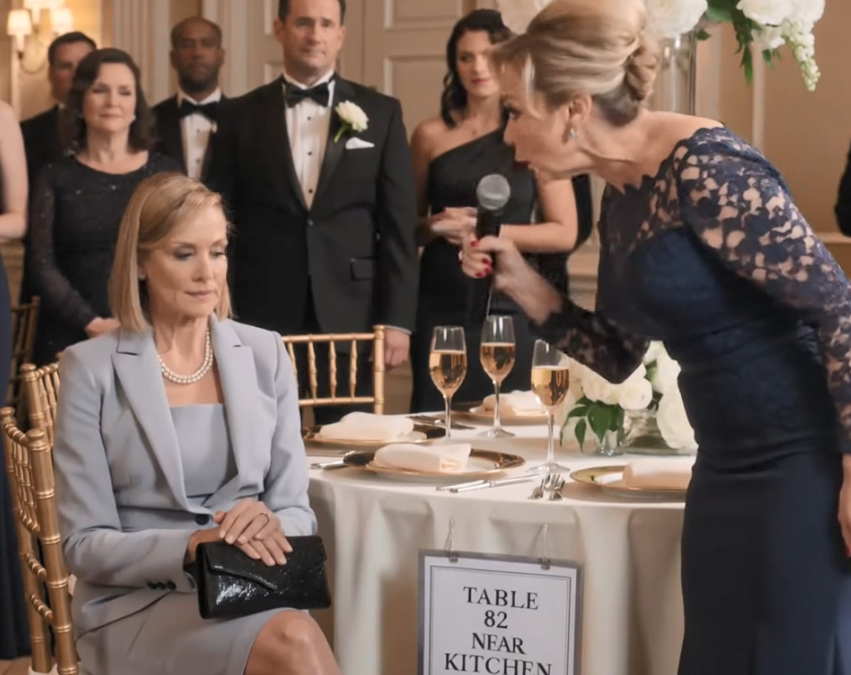
That was when I discovered table eighty-two.
Mom stood holding her place card.
I walked with her.
Tables near stage were one through twenty.
Middle room up through sixties.
Seventies near the rear.
Eighty-two was beside the service corridor.
Not metaphorically.
Literally six feet from swinging kitchen doors.
Waitstaff moved constantly.
Metal carts.
Trays.
Noise.
There were eight seats.
Mom.
An elderly cousin Patricia barely knew.
Two employees of a vendor.
Three people whose invitations had apparently been last-minute obligations.
One empty chair.
I stared at the card.
TABLE 82.
Mom said:
“This is fine.”
“No.”
“Avery.”
“No.”
I looked toward my table.
Table four.
Near family.
There should have been room for Mom closer.
We had discussed it.
Originally she was table twelve.
I knew that.
I had seen the draft.
I found Patricia near the champagne wall.
“Why did you move my mother?”
She blinked.
“What?”
“Table eighty-two.”
“Oh.”
Like she’d forgotten.
“We had last-minute seating adjustments.”
“She was table twelve.”
“The Beaumonts confirmed.”
“Then move someone else.”
Patricia lowered her voice.
“Avery, do not cause a scene.”
“Move my mother.”
“There are five hundred people here.”
“Exactly.”
“Seating is complicated.”
“You put her beside the kitchen.”
“She said she didn’t mind.”
“You asked her?”
Patricia paused.
Enough.
“No.”
She adjusted the front of her dress.
“Marian is very easygoing.”
My blood went cold.
“You use her kindness as permission.”
Patricia’s eyes narrowed.
“Excuse me?”
“You know she won’t complain.”
“Avery, your mother does not require proximity to the head table.”
“That isn’t the point.”
“What is?”
“You wanted her out of sight.”
Patricia looked offended.
“Don’t be absurd.”
Then she made the mistake.
She looked toward table eighty-two.
Toward Mom.
And said:
“Frankly, she will be more comfortable there.”
“Why?”
“She has more in common with those guests.”
I stared.
“You don’t know those guests.”
“Neither do you.”
“I know my mother.”
Patricia smiled tightly.
“Avery, not everyone needs to be placed among donors, elected officials, board chairs, and business leaders simply because they’re related to the bride’s sister-in-law.”
There it was.
Not even hidden anymore.
Status.
I said:
“My mother is family.”
“And she has a lovely table.”
Miles appeared.
Of course.
Always after.
“What’s happening?”
I turned.
“Your mother moved Mom from twelve to eighty-two.”
He looked toward the back.
Then Patricia.
“Mom.”
Again.
That one pathetic word.
Patricia said:
“Miles, please don’t get involved.”
He looked at me.
“Avery, it’s one dinner.”
Something inside me went still.
Not broke.
Still.
That’s different.
I said:
“Yes.”
He frowned.
“Yes?”
“It is one dinner.”
I stepped back.
“Enjoy it.”
Then I walked away.
Miles followed.
“Avery.”
I didn’t stop.
“Avery.”
He caught my arm gently.
I turned.
He let go immediately.
“Please.”
“What?”
“Don’t make this into something bigger.”
That sentence ended five years of confusion.
Because suddenly I understood.
He knew.
He had always known.
He simply believed my pain should stay smaller than his family’s inconvenience.
I looked at him.
“I’m not making it bigger.”
“It already is.”
His expression changed.
I walked to table eighty-two.
Mom looked up.
“There you are.”
I sat in the empty chair.
“That isn’t your seat.”
“It is now.”
“Avery.”
“I’m eating here.”
“You’re at the family table.”
“Apparently so are you.”
Mom sighed.
She knew.
“Don’t ruin Natalie’s night.”
“I won’t.”
I smiled.
“I’m improving mine.”
For twenty minutes, I stayed.
Mom talked to the elderly cousin.
Asked one of the vendor employees about her children.
Within ten minutes, table eighty-two was laughing harder than table four.
That was Mom too.
She could make leftovers feel intentional.
Halfway through appetizers, a man stopped beside us.
Seventies.
Silver hair.
Black tuxedo.
I recognized him vaguely from Charleston philanthropy pages.
Dr. Henry Barlow.
Former president of a major university.
He stared at Mom.
“Marian?”
Mom looked up.
“Henry.”
He smiled like he’d found someone.
“What on earth are you doing back here?”
I froze.
Mom stood.
They hugged.
Not polite handshake.
Hug.
Dr. Barlow said:
“I haven’t seen you since the literacy summit.”
“Three years.”
“You disappeared.”
“I went home.”
“You always go home.”
He laughed.
Then:
“How is the Briar Ridge program?”
“Still growing.”
“Of course it is.”
He noticed me.
Mom said:
“My daughter Avery.”
Dr. Barlow shook my hand.
“Your mother has caused me enormous professional embarrassment.”
I blinked.
Mom said:
“Henry.”
He laughed.
“She rejected every public recognition we tried to give her for ten years.”
I looked at Mom.
She gave me a warning expression.
Later.
Apparently my family had those too.
Henry continued:
“You know half the rural literacy network in the Carolinas exists because this woman refused to accept the word impossible.”
Mom said:
“That’s generous.”
“No.”
He pointed.
“Accurate.”
Then he looked at the table number.
Eighty-two.
His expression changed slightly.
“Interesting placement.”
Mom said:
“It’s a lovely wedding.”
He understood.
Older powerful people sometimes read rooms faster than young ones.
He said nothing else.
But he did not go back to his table immediately.
He pulled out the empty chair.
Sat.
For fifteen minutes.
That attracted attention.
Dr. Henry Barlow was supposed to be table five.
People noticed.
Patricia noticed.
I saw her looking.
Then another person came.
A woman named Dr. Elise Warren.
Chief executive of a regional hospital system.
She greeted Mom.
“Marian Lane.”
Same reaction.
Warm.
Respectful.
“Are you still refusing to let us name the scholarship after you?”
Mom laughed.
“Yes.”
Dr. Warren saw table eighty-two.
Paused.
Then sat for five minutes.
By the time entrees arrived, three people from the first ten tables had visited Mom.
Patricia started looking nervous.
Miles looked confused.
I was beyond confused.
I leaned toward Mom.
“Who are you?”
She laughed.
“Your mother.”
“Apparently that is incomplete.”
“We’ll talk later.”
“What literacy summit?”
“Avery.”
“What scholarship?”
“Eat your salmon.”
“You hate salmon.”
“Exactly.”
Then Graham Ellis took the stage.
Television host.
Polished.
Easy smile.
The kind of man who could make five hundred people stop talking without asking twice.
He welcomed everyone.
Introduced parents.
Told a story about Natalie and Andrew.
People laughed.
Champagne flowed.
Then Graham said:
“Before we move to the first dance, Natalie and Andrew asked me to recognize several people whose example of marriage, family, and service has influenced the people in this room.”
I glanced at Mom.
She was eating a dinner roll.
Graham mentioned grandparents.
Mentors.
Andrew’s late uncle.
Then:
“There is also someone here tonight I was not expecting to see.”
Mom stopped chewing.
I noticed.
Graham smiled.
“About fifteen years ago, before I ever had a television program, I was a reporter covering education in some of the poorest rural counties in North Carolina.”
My mother looked down.
I stared at her.
Graham continued.
“I visited a library in Briar Ridge that was operating out of a building with a leaking roof, six outdated computers, and a children’s program run mostly by volunteers.”
Table eighty-two went silent.
“The woman organizing it refused to be interviewed.”
People laughed.
Graham said:
“She told me the children were the story.”
Mom closed her eyes briefly.
“Oh no.”
I whispered:
“You know him.”
“Yes.”
Graham continued.
“That woman later helped create a scholarship network and rural-library foundation that has funded literacy programs, teacher grants, community health outreach, and college scholarships across three states.”
Now conversations stopped throughout the ballroom.
Patricia was watching.
Graham said:
“She and her late husband, Thomas Lane, gave away more than almost anyone knew because they made a deliberate decision not to put their name on buildings.”
There.
Thomas Lane.
Dad.
My chest tightened.
Graham’s voice softened.
“Thomas passed eleven years ago.”
Mom touched one pearl earring.
Dad’s pearl.
“And Marian kept going.”
Then he said her name.
“Marian Lane.”
Five hundred heads did not literally turn at once.
It felt like they did.
Dr. Barlow stood first.
Then Dr. Warren.
A university trustee.
Then another woman I later learned chaired a major charitable trust.
People around the room started looking.
Searching.
Graham shaded his eyes.
“Marian, where did they put you?”
Somebody near table twelve pointed toward the rear.
Then Graham saw table eighty-two.
Beside the kitchen doors.
His expression changed.
Only for a second.
Professional.
Then he smiled again.
“There you are.”
Every eye followed.
Toward us.
Toward my mother.
Toward table eighty-two.
Patricia stood frozen near the front.
Graham said:
“Mrs. Lane, would you mind standing?”
Mom whispered:
“I absolutely mind.”
I laughed through sudden tears.
“Stand up.”
“I hate you.”
“Stand.”
She did.
Slowly.
Dark blue dress.
Simple pearls.
No designer label anyone could recognize from fifty feet.
The ballroom rose.
Not everyone instantly.
One section.
Then another.
Applause.
Mom looked horrified.
I cried.
Completely.
No dignity.
Across the room, Patricia’s face had gone white.
Not because Mom was secretly rich.
That is important.
She wasn’t.
Dad had built a regional industrial-supply company with two partners when I was young.
It did well.
Better than I understood as a child.
When he sold his interest, he and Mom had more money than they needed.
They created the Lane Community Foundation.
Quietly.
Dad hated galas.
Mom hated plaques.
Most giving was done through foundations, partner organizations, or anonymous matching grants.
Our life did not change much.
Same house.
Same Subaru class of cars.
Same church.
Same library.
Dad used to say:
“If money makes you need witnesses, you’re spending it on yourself.”
I knew my parents donated.
I did not understand scale.
They had never told me.
I had moved away for college before the foundation expanded.
Mom never discussed numbers.
And after Dad died, she became even more private.
Graham continued:
“Marian, I know you’re going to be angry with me.”
Mom called:
“I am.”
The room laughed.
“But there are people here tonight whose institutions, employees, children, patients, and communities have benefited from work you helped make possible.”
Dr. Warren raised her glass.
Graham said:
“So forgive us for embarrassing you.”
Applause again.
Mom sat as quickly as possible.
I leaned close.
“You have explaining to do.”
“So do you.”
“What?”
“Why are you sitting back here?”
Fair.
Then something extraordinary happened.
People came.
Not all five hundred.
Enough.
A university dean.
Hospital administrator.
Judge.
A woman who ran a children’s nonprofit.
Two former scholarship recipients.
One man approached with tears already in his eyes.
He looked at Mom.
“You probably don’t remember me.”
Mom stood.
He said his name.
Her face changed immediately.
“Marcus.”
He laughed.
“You do.”
“Of course.”
He turned to me.
“Your mother paid my first semester deposit when my scholarship paperwork got delayed.”
Mom said:
“The foundation did.”
He shook his head.
“You drove the check to campus.”
I stared.
He continued:
“I was eighteen.”
“My mother had just died.”
“I was going to drop out before classes started.”
He looked at Mom.
“I run a law firm now.”
Mom smiled.
“I know.”
“You know?”
“You send Christmas cards.”
Of course.
The entire time, Patricia stayed near the head table.
No one confronted her.
That would have been easier.
Instead, powerful people simply kept walking past her table toward my mother.
Table eighty-two became the center of the room without moving an inch.
That’s the kind of reversal Patricia understood.
Not because it was morally better.
Because it spoke her language.
Status.
And the woman she had deliberately placed beside the kitchen suddenly had more gravitational pull than the people Patricia had spent months arranging.
Miles came toward us.
He looked stunned.
“Avery.”
I didn’t answer.
He looked at Mom.
“Marian, I had no idea.”
Mom smiled.
“About what?”
“The foundation.”
“Oh.”
She shrugged.
“It isn’t relevant to tonight.”
I looked at him.
That was when everything crystallized.
Patricia’s cruelty became visible to Miles only after discovering Mom had status.
That was almost worse.
He said:
“Why didn’t you ever tell us?”
Mom’s face became very still.
“Why would I need to?”
He opened his mouth.
Nothing.
Mom continued gently.
“Would it have changed how I should have been treated?”
There it was.
The question.
Miles looked at me.
I could see shame arriving.
Real shame.
Not embarrassment.
Not fear of public perception.
Understanding.
“No.”
Mom nodded.
“Then it shouldn’t matter.”
He sat in the empty chair.
For once, Miles Whitcomb had no defense.
The music started.
Natalie and Andrew danced.
I watched my sister-in-law.
She looked happy.
Finally.
That mattered.
This was her wedding.
I would not turn it into a battlefield.
Patricia eventually approached.
Not immediately.
That would have made her look too reactive.
She waited until after the first dance.
Then came toward table eighty-two with Charles beside her.
She smiled.
Different smile now.
Respectful.
Suddenly.
“Marian.”
Mom looked up.
“Patricia.”
“I had absolutely no idea about the foundation.”
Mom said:
“I know.”
The simplicity of it nearly killed me.
Patricia laughed weakly.
“You’re very modest.”
Mom looked at her.
“I’m private.”
“Yes.”
Patricia touched her necklace.
“I wish you’d told us.”
Mom’s expression stayed warm.
“Why?”
Patricia opened her mouth.
Closed it.
Then:
“Well, we would have wanted to recognize you properly.”
Mom glanced at the table number.
Then back.
“I was invited as Avery’s mother.”
“Yes.”
“That seemed like recognition enough.”
Patricia’s face tightened.
Mom was not attacking her.
That made it worse.
Patricia said:
“There was some confusion with seating.”
I almost laughed.
Mom said:
“Was there?”
“Yes.”
“Last-minute changes.”
“Of course.”
“I hope you haven’t been uncomfortable.”
Mom looked toward the kitchen doors as two servers pushed through carrying trays.
Then:
“The staff have been lovely.”
Charles coughed.
I looked down to keep from smiling.
Patricia tried again.
“We can move you closer to the family table.”
Mom shook her head.
“No, thank you.”
“Oh, but—”
“I like the people here.”
The vendor employee beside her smiled.
The elderly cousin lifted her champagne.
Patricia stood there.
Powerless.
Because moving Mom now would be transparent.
Leaving her exposed Patricia.
Either way, the room knew.
Mom had no interest in punishing her.
That may have been the hardest consequence of all.
Patricia left.
Miles remained.
He looked at me.
“We need to talk.”
“Not tonight.”
“Avery.”
“Natalie gets tonight.”
He nodded.
Finally, the right answer.
After cake, I found Natalie alone briefly near the garden doors.
She looked exhausted but happy.
She hugged me.
“I’m sorry.”
“For what?”
She looked toward table eighty-two.
“I didn’t know Mom moved Marian.”
“I believe you.”
“She changed seating yesterday.”
“That sounds like her.”
Natalie’s eyes filled.
“I should’ve checked.”
“No.”
I held her shoulders.
“You were getting married.”
“Tonight is not your responsibility to police.”
She nodded.
Then laughed.
“Marian has been more popular than I am.”
“She’s furious.”
“I can tell.”
We both laughed.
Then Natalie whispered:
“I’ve always hated the way Mom treats you.”
I looked at her.
She continued.
“I should’ve said more.”
“Join the club.”
We both glanced toward Miles.
He was standing alone.
That was new.
The wedding ended after midnight.
Mom rode back with me and Miles.
Silence in the car.
Patricia had arranged transportation for family, but I refused.
Mom sat in back.
Miles drove.
At a red light he said:
“Marian.”
“Yes?”
“I’m sorry.”
Mom looked toward him.
“For tonight?”
“For…”
He stopped.
Then:
“For a lot of things.”
I looked out the window.
Mom said:
“What things?”
Good.
Make him name them.
Miles swallowed.
“My mother’s comments.”
“My silence.”
“Letting Avery deal with it alone.”
“The seating.”
“I knew it was wrong when I saw where you were sitting.”
Mom asked:
“Why didn’t you fix it?”
Silence.
Miles said:
“I didn’t want to upset my mother at Natalie’s wedding.”
Mom nodded.
“Did you mind Avery being upset?”
He gripped the wheel.
“Yes.”
“But you accepted it.”
He closed his eyes briefly.
“Yes.”
Mom leaned back.
“That is something you need to work out with your wife.”
Not:
I forgive you.
Not:
It’s okay.
Because it wasn’t.
I loved her for that.
At the hotel, Mom hugged me.
Then whispered:
“Don’t make a permanent decision while you’re furious.”
“I’m not furious.”
She looked at me.
“That worries me more.”
She was right.
I was calm.
Miles and I went upstairs.
He closed the door.
I removed my earrings.
Shoes.
He stood behind me.
“I failed you.”
No excuse.
That was new.
I looked at him in the mirror.
“Yes.”
He flinched.
Good.
Not because I wanted pain.
Because truth should land somewhere.
He said:
“I kept thinking staying quiet was keeping the peace.”
“For who?”
“Myself.”
Honest.
He sat.
“My mother trained all of us that disagreement was disloyalty.”
“I know.”
“I thought if I didn’t participate, I wasn’t responsible.”
I turned.
“You were.”
“I know.”
“Tonight didn’t suddenly make her wrong.”
“I know.”
“My mother isn’t more worthy because people in that room know her name.”
“I know.”
He looked at me.
“That is actually the part making me feel sick.”
I waited.
He said:
“When Graham said Marian’s name, I felt proud.”
“And then?”
“Then I realized I should have been proud of her when she was just the woman who made apple cake.”
I cried.
Not because it fixed anything.
Because for the first time, he understood the actual wound.
He continued.
“I watched my mother disrespect someone for years.”
“I kept thinking it wasn’t serious enough to fight about.”
“I made you measure whether each insult was big enough.”
I sat across from him.
“Yes.”
“And that was wrong.”
“Yes.”
He nodded.
“What happens now?”
I didn’t answer quickly.
Finally:
“I don’t know.”
He looked terrified.
Good.
Marriage should not be maintained by certainty that the other person will tolerate anything.
I said:
“I love you.”
“I love you too.”
“That doesn’t make this small.”
“I know.”
“I need something to change.”
“What?”
“You stop asking me to absorb disrespect so you don’t have to confront it.”
He nodded.
“I can do that.”
“Don’t promise tonight.”
He looked confused.
“Why?”
“Because promises are easy when you’re scared.”
I stood.
“Show me.”
That was the beginning.
Not the ending.
The next morning, Patricia requested brunch.
Of course.
Miles said no.
I almost dropped my coffee.
His phone rang again.
He silenced it.
Then a text.
He read.
His face tightened.
“What?”
“Mom says last night was humiliating.”
I laughed.
“Her?”
“Yes.”
“Of course.”
He started typing.
Stopped.
Deleted.
Typed again.
Then showed me.
Mom, Marian’s background had nothing to do with what happened. You treated her disrespectfully before you knew people you value respected her. Avery and I will not discuss this as if your embarrassment is the problem. We need space.
I read it twice.
“Send.”
He did.
His hand shook slightly.
It sounds ridiculous.
Adult man sends boundary-setting text to mother.
But families can make simple things difficult enough that the first healthy sentence feels revolutionary.
Patricia called fourteen times that day.
Miles answered none.
By Monday, Charles called.
“Your mother is devastated.”
Miles said:
“She should apologize.”
I was in the kitchen and stopped moving.
Charles said something I couldn’t hear.
Miles answered:
“No, Dad.”
Long pause.
Then:
“No. Marian does not need to apologize for Graham recognizing her.”
Another pause.
“No.”
Then:
“I’m not doing this anymore.”
He hung up.
I stared at him.
“What?”
He shrugged.
“Apparently I’m doing things now.”
Not perfect.
But movement.
Mom went home to Briar Ridge.
Within twenty-four hours, she was back at the library.
I called.
“What are you doing?”
“Shelving.”
“You were applauded by five hundred people.”
“And?”
“You’re shelving mystery novels.”
“They’re overdue.”
There she was.
The wedding story spread because Charleston society is still a small town wearing expensive shoes.
People talked.
Not publicly at first.
Privately.
Who seated Marian Lane at eighty-two?
Was it true?
Did Patricia know who she was?
No.
Did that matter?
That question became uncomfortable.
Some people framed it as a fabulous reversal.
Rich woman insults secret philanthropist.
Wrong.
That version missed everything.
Mom hated it.
A local columnist called asking for comment.
She said:
“No.”
Graham Ellis called personally to apologize for putting her on the spot.
Mom said:
“You owe me lunch.”
He said:
“Done.”
They went to lunch.
Apparently he paid.
I asked Mom why she never told me how large the foundation had become.
She said:
“You knew.”
“I knew you donated.”
“You knew your father sold the company.”
“Yes.”
“What did you think we did with the money?”
“I thought you had it.”
She laughed.
“Avery, have you seen my car?”
Fair.
Then she told me the history.
Dad and two friends built Appalachian Industrial Supply in the eighties.
Sold most of it years later.
He and Mom kept enough to live comfortably.
Then started a charitable foundation.
At first:
Ten scholarships.
Library grants.
Teacher supplies.
Then partnerships.
Matching programs.
Rural health initiatives.
Broadband access for learning centers.
College retention grants.
Dad handled finances.
Mom handled people.
After he died, the endowment kept operating.
Professional staff managed investments.
Mom chaired the board for six more years, then stepped back.
She still reviewed scholarship programs.
Never took a salary.
Never wanted press.
“Why?”
I asked.
Mom looked surprised.
“Why what?”
“Why hide it?”
“I didn’t.”
“You didn’t tell anyone.”
“That isn’t hiding.”
She was right.
Patricia had never asked a meaningful question.
That became the irony.
For five years she had talked about Mom.
Where she came from.
What she wore.
What she lacked.
Never once:
Marian, what matters to you?
What work do you do?
What did your husband do?
What are you proud of?
She saw plainness and assumed emptiness.
That’s not Mom’s secrecy.
That’s Patricia’s incuriosity.
Three weeks after the wedding, Patricia wrote Mom a letter.
Handwritten.
Six pages.
Mom sent me a photograph of the envelope.
I called.
“Read it.”
“No.”
“What?”
“I haven’t opened it.”
“Mom.”
“I’m gardening.”
“You cannot tell me that and go garden.”
“I just did.”
She opened it that evening.
Called me afterward.
“What does it say?”
“She apologizes.”
“Actually?”
“Yes.”
“For what?”
Mom paused.
“For treating me like my worth depended on who knew my name.”
That surprised me.
“Wow.”
“She also spends three pages explaining her stress.”
There it was.
“Are you accepting?”
“I accept the apology.”
“Do you forgive her?”
Mom sighed.
“Avery, forgiveness is not the same as pretending I want lunch.”
I wrote that down mentally.
Patricia called me next.
I answered.
Not because I owed her.
Because I wanted to hear what she said without a room full of witnesses.
“Avery.”
“Patricia.”
“I owe you an apology.”
“Yes.”
That old reflex almost made me soften the answer.
I didn’t.
She inhaled.
“I was cruel about Marian.”
“Yes.”
“I was cruel about you.”
I stopped.
That was new.
She continued.
“I told myself I was protecting standards.”
“I was protecting my own insecurity.”
That sentence did not sound like Patricia.
Probably therapy.
Or Charles threatened divorce.
I didn’t care which.
She said:
“I have spent most of my life believing that if the right people approve of me, I am safe.”
I sat down.
“I treated people according to how useful their approval seemed.”
That was the most accurate thing she’d ever said.
I asked:
“Would you be calling if Graham had never recognized my mother?”
Silence.
Long.
Then:
“I don’t know.”
Good answer.
Painful.
Honest.
I said:
“That is the problem.”
“I know.”
“No.”
I looked out the window.
“You need to understand this.”
“My mother didn’t become worthy when wealthy people stood up.”
“I know.”
“She was worthy when she brought apple cake to your house.”
“I know.”
“She was worthy when you mocked her town.”
“I know.”
“She was worthy at table eighty-two before anyone moved toward her.”
Patricia cried.
Softly.
That didn’t erase anything.
I continued:
“And so was I.”
“I know.”
“No, Patricia.”
“I’m not sure you did.”
She was quiet.
Then:
“I didn’t.”
There.
It wasn’t satisfying like applause.
It was better.
True.
Miles changed more slowly.
He went to therapy.
Individual.
Then we went together.
At first he hated it.
He wanted techniques.
Our therapist wanted history.
Patricia dominated his childhood emotionally.
Not abuse in the dramatic sense.
Control.
Approval tied to compliance.
Silent treatment.
Public charm.
Private guilt.
Miles had learned early:
Don’t challenge Mom.
Wait until she calms down.
Protect the event.
Don’t embarrass the family.
Be reasonable.
Which really meant:
Someone else absorbs the impact.
Usually me.
Once he saw it, he started seeing it everywhere.
Christmas became the first test.
Patricia invited us.
Miles said:
“We’ll come if Marian is also treated as family.”
Patricia said:
“I have apologized.”
“I’m setting the expectation.”
She bristled.
He held the line.
Mom came.
She wore the same pearls.
Patricia did not comment on them.
Progress.
At dinner, a family friend asked Mom:
“Are these the famous pearls?”
Mom said:
“They cost forty-three dollars in 1989.”
Everybody laughed.
Patricia laughed too.
Maybe too hard.
But she laughed.
At dessert, Mom brought apple cake.
The same recipe.
Patricia served it.
Small thing.
I noticed.
The foundation became more visible after the wedding, not because Mom wanted fame, but because Graham’s speech made anonymity unrealistic in our circles.
She responded by doing something extremely Marian.
She stepped further back.
A younger director became public face.
Mom stayed in Briar Ridge.
She planted tomatoes.
Volunteered.
Checked grant proposals at her kitchen table.
Once I visited and found a folder labeled:
REGIONAL SCHOLARSHIP EXPANSION — $2.4M.
It was sitting beside grocery coupons.
I stared.
“Mom.”
“What?”
“This is two-point-four million dollars.”
“Yes.”
“Beside a coupon for sixty cents off yogurt.”
“Money is money.”
Impossible woman.
Years later, what I remember most about Natalie’s wedding is not the applause.
Not Patricia’s face.
Not Graham’s speech.
It’s Mom sitting at table eighty-two before anyone knew.
Kitchen doors banging behind her.
Server carrying trays past.
Simple pearls.
Talking to the vendor employee about her son’s college applications.
Treating an elderly cousin like she was the most important woman in the room.
Nothing about her changed after Graham said her name.
That’s the entire point.
Her posture didn’t straighten.
Her dress didn’t become more expensive.
The pearls didn’t become more beautiful.
Her voice didn’t become more intelligent.
She was the same woman before the room turned around.
The room changed.
That’s why I remember Patricia looking at her differently.
And why that new respect bothered me almost as much as the old contempt.
If learning Mom had influence made Patricia see humanity she couldn’t see before, then she had not yet learned the lesson.
Eventually, I think she did.
Or at least began.
She stopped introducing people by status first.
Not completely.
Patricia was still Patricia.
But I once heard her tell someone:
“This is Marian, Avery’s mother.”
Nothing else.
No foundation.
No Briar Ridge qualifier.
No explanation.
Just Marian.
Mom later said:
“That was nice.”
I knew what she meant.
Normal respect is beautiful after years without it.
Miles and I stayed married.
That surprises some people when I tell the story.
They expect the wedding to end our marriage.
It almost did.
But humiliation did something conversations had failed to do.
It forced Miles to see the structure.
Not simply that his mother was difficult.
That his silence had become participation.
He stopped confusing neutrality with innocence.
That saved us.
Not immediately.
Trust returns slowly.
I watched actions.
When Patricia criticized my job one Thanksgiving, Miles stopped her before I spoke.
When she joked about Briar Ridge at dinner, he said:
“Mom, don’t.”
Normal tone.
No shouting.
No apology afterward.
When she complained that I’d changed him, he answered:
“I hope so.”
That one made me love him a little harder.
Natalie also changed.
She and Andrew moved two hours away.
Not because of Patricia.
Mostly.
She created boundaries earlier than Miles did.
She once called me laughing.
“Mom asked for our future baby’s baptism date.”
“You’re not pregnant.”
“I know.”
“What did you say?”
“I said 2034.”
Good girl.
Graham Ellis remained friends with Mom.
Every year he moderates one fundraiser for the rural-literacy network.
Mom complains.
Then attends.
He introduces her simply:
“Marian.”
No biography.
The people who know, know.
The people who don’t?
Doesn’t matter.
That became Mom’s rule.
The Lane Foundation eventually funded renovation of the Briar Ridge library.
People suggested naming the building for Mom and Dad.
She refused.
They compromised.
One reading room contains a small plaque.
FOR THOMAS LANE, WHO BELIEVED EVERY CHILD DESERVES A DOORWAY INTO A LARGER WORLD.
Mom allowed Dad’s name.
Not hers.
I asked why.
She touched her pearls.
“He isn’t here to argue.”
Fair.
The blue house remains.
Mom could live anywhere.
She doesn’t.
Her neighbors still bring casseroles.
She still knows which kids need extra snacks.
The woodstove still smells like wood smoke in winter.
I love that smell now more than ever.
Patricia visited once.
Years after the wedding.
She and Mom somehow ended up having coffee in Briar Ridge.
I was there.
Patricia arrived in a Mercedes.
Mom had mud on her shoes.
They sat at the kitchen table.
I expected awkwardness.
Instead Patricia asked:
“Why did you never leave?”
Mom looked out toward the garden.
“Leave where?”
“This town.”
Mom thought.
“Why would I?”
“You could have lived anywhere.”
“I like here.”
Patricia looked genuinely confused.
Mom continued.
“People spend a lot of their lives earning enough money to live where they want.”
“I was already where I wanted.”
That sentence silenced Patricia for a long time.
Then Mom poured more coffee.
No triumph.
No lecture.
Just coffee.
That was Marian’s way.
I think Patricia learned more in that kitchen than she ever did in a ballroom.
Maybe because nobody was watching.
Sometimes I revisit the wedding photograph.
There is one wide shot from dinner.
Five hundred guests.
Flowers.
Lights.
Stage.
The front tables full of powerful people.
And way in the back, near the kitchen doors, table eighty-two.
You can barely make out Mom’s dark blue dress.
If you didn’t know the story, you would never notice her.
That’s what Patricia counted on.
She believed importance should always be visible.
Best table.
Largest house.
Famous name.
Expensive clothes.
She never understood how many truly powerful people move through the world quietly because they do not require strangers to recognize them.
My mother never needed the room to turn around.
She already knew who she was.
I did too.
The person who needed the lesson was me.
Because for five years, I had been waiting for someone else to validate that Patricia’s behavior was wrong.
Waiting for Miles.
Waiting for Charles.
Waiting for Natalie.
Waiting for some insult large enough that nobody could minimize it.
Then five hundred people turned toward my mother.
And I realized something embarrassing.
Their applause changed nothing.
If not one person had recognized Marian—
If Graham had never met her—
If Dad had never sold a company—
If the foundation had never existed—
If my mother had spent her entire life shelving library books, growing tomatoes, stretching soup, and wearing forty-three-dollar pearls—
Patricia still would have been wrong.
My mother still would have deserved table twelve.
Or table one hundred.
Because the table number was never the real issue.
Dignity does not depend on proximity to power.
That became the lesson I refused to forget.
And eventually, the lesson I taught my own daughter.
Yes.
Miles and I had a daughter.
Years later.
Her name is Margaret Marian Whitcomb.
Maggie.
She has her grandmother’s eyes.
And unfortunately my husband’s ability to lose shoes inside a closed house.
When she was six, she asked Mom about the pearl earrings.
“Are they expensive?”
Mom smiled.
“They are to me.”
“How much?”
“Your grandfather bought them when money was tight.”
“Why?”
“Anniversary.”
“Were you poor?”
Mom laughed.
“We were starting.”
Children understand that better.
Starting.
Not poor.
Not rich.
Living.
Maggie asked:
“Can I have them when you die?”
I nearly dropped my glass.
Mom laughed so hard she cried.
“Maybe.”
Then Maggie asked:
“Why does Grandma Patricia have so many necklaces?”
I said:
“Different people like different things.”
Mom looked at me.
Approved.
I do not want to raise another generation measuring women against each other.
Patricia is Maggie’s grandmother too.
She loves her.
And to Patricia’s credit, she is different with Maggie.
Maybe because she learned.
Maybe because grandchildren give people another chance.
She never comments on Maggie’s clothes.
Never ranks schools in front of her.
Never talks about “good families.”
Once Maggie wore rain boots to a fancy lunch.
I waited.
Patricia looked at the boots.
Then at me.
I saw the old instinct rise.
Then she smiled.
“Excellent choice.”
Progress can be funny.
Mom is older now.
Gray completely.
Still in Briar Ridge.
Still wearing those pearls.
The foundation has funded thousands of scholarships by now.
Mom would hate me writing that.
So let’s make something clear.
The impressive thing about Marian Lane was never the money.
Money amplified what she was already doing.
Before there was a foundation, she helped people.
Before Dad sold the company, she helped people.
Before powerful people learned her name, she helped people.
The foundation didn’t create her character.
Her character created the foundation.
Patricia had it backward.
She saw the external signs of importance and assumed they produced worth.
Mom understood that worth comes first.
Everything else is decoration.
Years after Natalie’s wedding, Graham asked Mom during a private interview for a literacy archive:
“What did you feel when the room stood?”
Her answer made me cry when I heard it later.
She said:
“Embarrassed.”
Graham laughed.
Then:
“Nothing else?”
Mom thought.
“I was proud of Avery.”
“Why?”
“Because she sat with me before anyone knew to stand.”
That’s it.
That’s the line that stayed.
I had forgotten that part.
I moved to table eighty-two before Graham said her name.
Before Dr. Barlow sat down.
Before powerful people came.
Before Patricia was embarrassed.
I sat because she was my mother.
That was enough.
Mom remembered.
And I realized maybe I had learned something before I knew I had.
Status did not save my mother from humiliation that night.
Recognition did not create her dignity.
The room merely discovered what Patricia had been too shallow to see.
A quiet woman from a mountain town.
A widow.
A mother.
A volunteer.
A philanthropist.
A friend.
A person who never needed a table near the stage to know she belonged.
Patricia spent months deciding where everyone should sit based on how much their presence could enhance the Whitcomb name.
Then Graham Ellis said one name into a microphone.
“Marian Lane.”
And suddenly every important person Patricia had spent the evening trying to impress turned away from her perfect head tables and looked toward the woman she had hidden beside the kitchen.
That was the moment Patricia thought she had been humiliated.
She hadn’t.
She had been revealed.
There is a difference.
And the person she revealed most clearly was not my mother.
It was herself.

