Her F-16 Was Sabotaged Before Takeoff—Then She Looked Up at the Control Tower and Recognized Who Was Watching
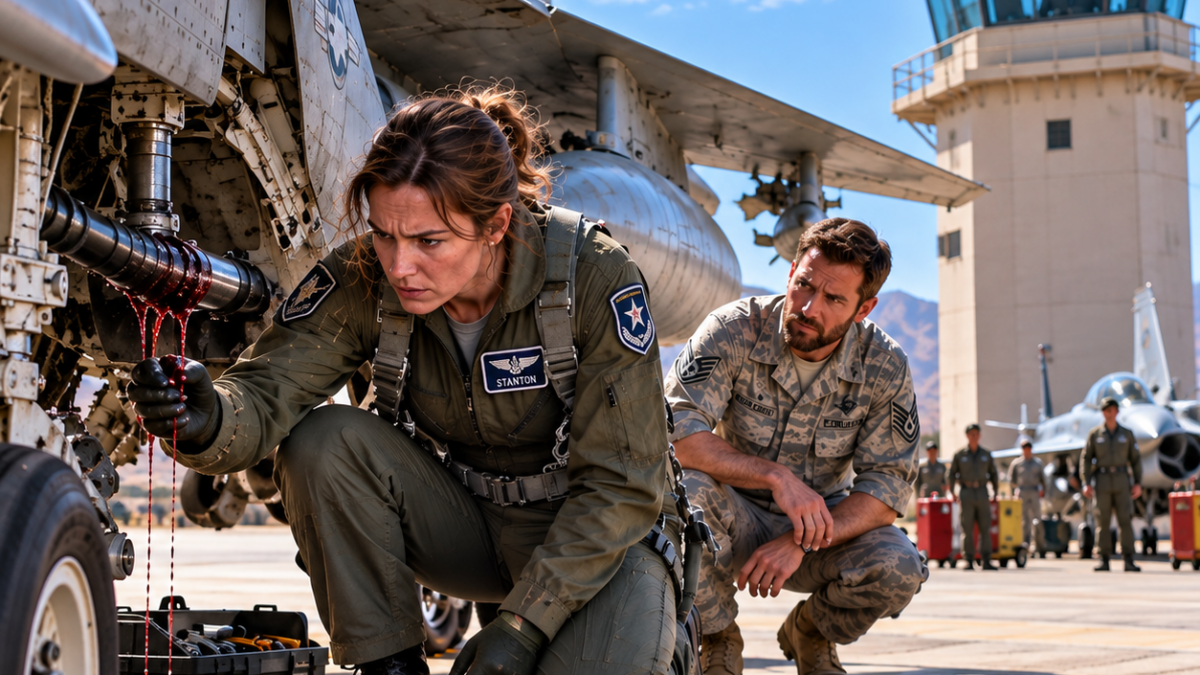
Her F-16 Was Sabotaged Before Takeoff—Then She Looked Up at the Control Tower and Recognized Who Was Watching.
The hydraulic line on my F-16 had not failed—it had been cut, carefully enough that the jet might survive every ground check and kill me only after I committed to takeoff.
I had spent three weeks quietly reporting missing aircraft parts and millions of dollars disappearing through procurement accounts, so when I looked toward the control tower and saw a colonel staring directly at my jet through binoculars, I understood something colder than fear: he wasn’t checking whether I was safe.
He was waiting for me to die.
My name is Captain Jessica Stanton.
By the morning somebody tried to kill me at Nellis Air Force Base, I had logged a little over two thousand hours in military aircraft.
Combat sorties.
Night operations.
Training missions.
Bad-weather recoveries.
Emergency landings.
The kind of hours pilots measure not because the number is impressive, but because every hour teaches your body one more way an aircraft can tell you something is wrong.
A vibration.
A smell.
A gauge half a needle-width from where it normally sits.
A sound buried beneath a hundred other sounds.
People think fighter pilots survive because we react quickly.
Sometimes.
But the best pilots I knew survived because they noticed early.
Before the warning light.
Before the alarm.
Before a small problem became a funeral with folded flags.
That morning in Nevada began like hundreds of others.
Heat already rising from the concrete.
The smell of jet fuel hanging in the air.
Ground crews moving between aircraft.
Engines whining in the distance.
A C-17 lumbering along a taxiway while maintenance vehicles crawled between hardened shelters.
Nellis never really became quiet.
Even when no fighter was launching, the base carried the hum of machinery preparing to.
I had a routine interception-training flight scheduled as part of a larger combat exercise.
Nothing unusual.
At least, nothing that should have been unusual.
But I had been living with a knot between my shoulders for almost three weeks.
Three weeks earlier, I had been assigned to assist with a safety review involving recurring component failures in our maintenance system.
On paper, it was boring.
Inventory.
Parts histories.
Procurement numbers.
Service-life records.
The kind of review most pilots dreaded because it meant more spreadsheets than flying.
I did not mind.
My father had been an aircraft mechanic before I ever touched a control stick.
He taught me early that airplanes did not care about rank or ego.
Metal failed according to physics.
PART2:
Not according to who signed the paperwork.
So I read everything.
And then I found the first discrepancy.
A high-stress component documented as meeting a military specification did not match the certified manufacturer record.
At first I assumed clerical error.
Then I found another.
And another.
Different aircraft.
Different dates.
Same problem.
Parts listed as one grade had apparently been replaced with cheaper equivalents.
Inspection numbers did not align.
Procurement costs were inflated.
Serial-number chains ended inside administrative accounts that should not have existed.
Money moved into what appeared to be auxiliary procurement channels.
Then disappeared.
I followed the paper farther than a pilot normally would.
Eventually the trail reached offices far above mine.
PART3:
That was when I stopped treating it as a maintenance issue.
I filed a confidential report through the Inspector General system.
Encrypted.
Documented.
No accusations beyond what the records showed.
No gossip.
No conversation with squadron friends.
I assumed the process would protect confidentiality.
That assumption lasted roughly forty-eight hours.
My schedule changed.
Twice.
Leave I had already been approved for disappeared from the system.
A training slot went to someone else without explanation.
Two officers who usually sat with me at lunch started choosing another table.
My friend Lieutenant Khloe Harrington was abruptly grounded after a medical review that made no sense.
Khloe had helped me notice several of the inventory discrepancies.
Nobody said the two events were connected.
Nobody had to.
Then came the looks.
People imagine military intimidation as shouting.
Threats.
Orders.
Sometimes it is much quieter.
A conversation stopping when you enter.
A supervisor who no longer closes the door when speaking to you.
A maintenance chief suddenly unwilling to answer an ordinary question without checking who else is listening.
A colonel who knows your name despite never having had reason to.
The walls had begun moving inward.
I knew it.
I just did not know how far they would go.
My aircraft that morning was tail number 419.
F-16.
Gray.
Lean.
Familiar enough that I could walk around one half asleep and still notice something out of place.
Master Sergeant Mike O’Connor met me near the nose gear.
Mike had twenty-three years of maintenance experience.
Hands scarred.
Fingernails permanently dark around the edges no matter how hard he scrubbed.
He spoke about aircraft the way some people spoke about children.
That one runs hot.
This one hates cold mornings.
That jet will lie to you about fuel quantity if you park her nose-down.
Pilots trusted him.
I trusted him more than most officers.
He handed me the maintenance clipboard.
“Morning, Captain.”
“Morning.”
“She’s clean.”
I took the board.
He looked tired.
More than tired.
Tense.
“You sleep?”
“Eventually.”
“That’s not an answer.”
“Then don’t ask questions you don’t want answered.”
Normally I would have smiled.
That morning, I watched his hands.
Slight tremor.
Barely visible.
“Everything good?”
His eyes met mine.
Then moved away.
“Yes, ma’am.”
Too formal.
Mike almost never called me ma’am unless somebody important was nearby.
I looked around.
Nothing obvious.
So I started my walk-around.
Nose.
Sensors.
Panels.
Intake.
Landing gear.
Control surfaces.
Access points.
You learn not to rush a preflight because everybody around you looks busy.
The aircraft does not care about your schedule.
I moved toward the rear.
Heat shimmered above the concrete.
Another aircraft taxied behind me and the noise became physical, vibrating through my ribs.
I crouched near the right side of the tail section.
At first everything looked normal.
Then my flashlight caught something wet.
Wrong color.
Wrong place.
I leaned closer.
Hydraulic fluid.
Fresh.
Not pooled beneath the aircraft.
A thin trace along a protected line inside the assembly.
I changed angle.
Looked deeper.
Then I saw the damage.
I stopped breathing.
The line had been deliberately compromised.
Not worn.
Not chafed.
Not cracked from age.
There was a clean man-made cut through the outer reinforcement.
Placed in a section difficult to see unless you knew exactly where to look.
Enough damage to weaken the line.
Not enough for it to rupture immediately while the aircraft sat idle.
I touched the wet surface with one gloved finger.
Looked at the stain.
Then at the rest of the system.
My first thought was mechanical.
My second was not.
Whoever had done this wanted the failure to happen under load.
Not on the ground.
Not during inspection.
Later.
When I was committed.
My body went cold despite the Nevada heat.
I had experienced fear in combat.
Incoming fire.
Missile warnings.
An engine problem over hostile terrain.
This was different.
Combat fear has direction.
There is an enemy.
A threat.
A mission.
This fear was inside the fence.
Somebody wearing the same uniform had looked at my aircraft and decided I should not return.
I stood slowly.
No sudden movement.
No shouting.
If the person responsible was nearby, I did not want them to know I had found it.
Mike was at the front of the aircraft.
I walked to him.
Held the clipboard between us.
“Keep looking at the paperwork.”
His eyes flicked toward me.
“What?”
“Don’t react.”
He froze.
“Jessica—”
“Right-side hydraulic system.”
His pen stopped.
“There’s deliberate damage.”
The color left his face.
“I signed her off three hours ago.”
“I know.”
“I checked that section.”
“I know.”
“I swear to God—”
“Mike.”
He looked at me.
“I know.”
His jaw clenched.
“Then it happened after sign-off.”
“Yes.”
“Somebody got onto my line.”
“Yes.”
He looked ready to turn.
I grabbed the edge of the clipboard.
“Don’t.”
His eyes stayed forward.
“We call Security Forces.”
“No.”
“OSI.”
“Not yet.”
“Captain, somebody tried to kill you.”
“I know.”
“Then what are we waiting for?”
I looked around the ramp.
Ground vehicles.
Crews.
Aircraft.
Hangars.
Nothing.
Then a thought came.
“If they did this expecting an accident, they’re watching.”
Mike’s expression changed.
“For what?”
“To see whether I launch.”
We both looked nowhere.
That was the trick.
Do not look obvious.
I shifted the clipboard.
“What has sight of this ramp?”
“Maintenance tower.”
“Operations building.”
He paused.
“Control tower.”
I glanced toward the tower.
Hundreds of feet away.
Tinted glass.
Perfect view of the runway system.
Perfect view of us.
Mike kept his voice low.
“You thinking what I’m thinking?”
“I hope not.”
He had binoculars in his vest for inspecting birds or debris around structures.
I said:
“Give me the glasses.”
“For what?”
“Point at the upper mast.”
He understood.
Mike made a show of looking upward.
“Captain, can you check that antenna? I thought I saw damage.”
I took the binoculars.
Raised them.
Aimed at the tower.
At first, reflection.
Tinted glass.
Shapes.
Controllers wearing headsets.
Consoles.
Then one person standing near the window.
Not seated.
No headset.
Blue uniform.
Silver eagles.
Binoculars raised.
Pointed directly toward my aircraft.
Colonel Richard Bradley.
Deputy base commander.
Procurement and logistics oversight.
His office had appeared repeatedly in the records I reported.
I adjusted focus.
His face became clear.
He was not scanning the runway.
Not watching multiple aircraft.
He was watching me.
My jet.
Waiting.
I lowered the binoculars half an inch.
My pulse thudded in my ears.
Mike whispered:
“Who?”
“Bradley.”
Silence.
“You sure?”
“He’s watching us through binoculars.”
Mike swore softly.
Colonel Bradley had a reputation.
Smart.
Ambitious.
Connected.
The kind of officer who spoke about careers the way businessmen spoke about assets.
Useful.
Transferable.
Disposable.
A month earlier, Khloe Harrington had asked questions about missing inventory.
Within days she was grounded on questionable medical grounds.
We had joked about it at first.
Then stopped joking.
Now Bradley was standing in the tower watching the aircraft someone had sabotaged.
A colonel did not crawl under an F-16 with cutting tools.
Somebody had done it for him.
That meant at least two people.
Possibly many more.
Mike whispered:
“We are way past local security.”
“Yes.”
“He can shut down the ramp.”
“Yes.”
“Control maintenance access.”
“Yes.”
“Move the aircraft.”
“Yes.”
“Then what?”
I looked back at 419.
The damaged line was evidence.
Right now, it was the best evidence I had.
If I walked away openly and accused Bradley, the aircraft could be towed into a closed hangar under some technical pretext.
The line replaced.
Maintenance history changed.
Photographs questioned.
People reassigned.
By dinner, there might be nothing left except my accusation against a colonel.
That would not be enough.
I needed evidence outside Bradley’s reach.
Witnesses.
Federal custody.
A record created in too many places to disappear.
I told Mike:
“Photograph it.”
“Already thinking that.”
“Macro shots.”
“Include surrounding identifiers.”
“Serial plates if you can.”
“Got it.”
“Upload them outside our local network.”
His eyes narrowed.
“To whom?”
“Special Agent Sarah Higgins.”
Mike looked at me.
“OSI?”
“Yes.”
Higgins had handled a previous procurement investigation and had a reputation for making senior officers nervous.
Good.
“Use the secure case channel connected to my IG complaint.”
Mike nodded.
“What about you?”
“I keep doing preflight.”
He stared.
“You are not flying that aircraft.”
“No.”
“But Bradley has to believe I might.”
That was the beginning of the most dangerous bluff of my career.
I climbed the ladder.
Not because I planned to take off.
Because Colonel Bradley needed to see me behaving like a pilot who had found nothing.
I settled into the cockpit.
Harness.
Helmet.
Communications.
Power.
Displays came alive.
Green light against my gloves.
Checklist muscle memory took over while another part of my brain planned for betrayal.
My wingman that day was Captain Ryan Gallagher.
Call sign Viper.
Combat veteran.
Too sarcastic to impress senior officers.
Exactly the person I wanted nearby.
I opened our secure tactical channel.
“Viper, Ghost.”
“Ghost, Viper. Loud and clear.”
His voice sounded normal.
Good.
“Listen carefully.”
Pause.
“Go.”
“Do not look at my aircraft.”
Silence.
“Understood.”
“I found deliberate sabotage in a flight-control hydraulic system.”
Another silence.
Shorter.
“Say again.”
“Confirmed sabotage.”
“Are you safe?”
“For now.”
“Who?”
“Bradley is in the control tower watching the jet.”
Ryan breathed once into the microphone.
“That’s a problem.”
“Yes.”
“What do you need?”
“Contact Agent Higgins through secure SATCOM.”
“Now?”
“Now.”
“Send her Mike’s photographs.”
“Already moving.”
I looked toward the tower through the canopy.
Could not see Bradley from there.
But I felt him.
Watching.
Waiting for me to taxi.
Ryan asked:
“What are you doing?”
“Making sure the evidence becomes impossible to hide.”
“How?”
“Public ground emergency.”
He paused.
“Explain.”
I gave him only what he needed to know.
I would not take off.
I would create a controlled abort on the ground if necessary, forcing emergency response crews onto the aircraft and freezing the scene in front of dozens of witnesses.
Nothing subtle.
Nothing Bradley could quietly tow away before OSI arrived.
Ryan hated the idea.
“I don’t like this.”
“Neither do I.”
“You don’t need to prove courage.”
“This isn’t courage.”
“What is it?”
“Chain of custody.”
He actually laughed once.
Nervously.
“Only you could make an aviation emergency sound like a legal filing.”
“I need Higgins.”
“You’ll have her.”
Mike finished photographing the damaged area and transmitted everything through the secure case channel.
I waited.
Every minute felt wrong.
Too long.
Too visible.
Then Mike gave me the smallest nod from the ground.
Sent.
I continued the appearance of a normal cockpit check.
In the tower, Bradley would see exactly what he wanted.
Captain Stanton preparing to fly.
I imagined him already writing the condolence statement.
Tragic mechanical failure.
Decorated officer.
Service to country.
Investigation ongoing.
My mother receiving folded fabric.
No.
Not today.
I radioed ground operations.
“Ghost Eleven requesting maintenance hold. Flight-control anomaly.”
I deliberately kept the language vague but transmitted it on a channel broad enough that multiple operations personnel heard it.
The response came:
“Ghost Eleven, hold position.”
Bradley would know I had noticed something.
Maybe not what.
The next minutes mattered.
I powered down before creating any additional risk.
Then I opened the canopy.
Climbed out.
Mike met me.
“You changed the plan.”
“Yes.”
“Thank God.”
“You sound relieved.”
“I’ve spent twenty-three years keeping pilots from doing stupid things.”
“I was going to do something professionally dramatic.”
“That is pilot language for stupid.”
Fair.
I jumped down.
Then the base crash alarm sounded.
Not because my jet was on fire.
Because Ryan had used the emergency maintenance channel to report suspected deliberate tampering on an armed military aircraft.
That language changes everything.
Fire crews rolled.
Security units rolled.
Maintenance leadership responded.
People started looking.
Once enough people looked, Bradley’s ability to make the aircraft disappear shrank.
The first security SUVs arrived fast.
Sergeant Brody Davis stepped out.
Davis was known as a hard man.
More importantly, he was known to be close to Bradley.
That worried me.
“Captain Stanton!”
He approached.
“Step away from the aircraft.”
I stayed where I was.
“This aircraft is evidence.”
“Colonel Bradley has ordered it secured in Hangar Four.”
There it was.
Hangar Four.
Closed.
Restricted.
Exactly what I had feared.
“No.”
Davis stared.
“What did you say?”
“I said no.”
“You are refusing a direct order?”
“I’m preserving evidence in a suspected sabotage case already reported to OSI.”
His jaw shifted.
“I haven’t received any OSI notification.”
“You will.”
“Until then, Colonel Bradley commands this installation.”
Mike stepped beside me.
“Sergeant, I personally photographed deliberate damage to that aircraft after certifying it clean three hours ago.”
Davis looked at him.
“Then maintenance made an error.”
“No.”
“Master Sergeant—”
“No.”
Mike almost never raised his voice.
That got attention.
“The line was cut after my sign-off.”
Davis looked around.
More people were gathering.
Fire crews.
Maintenance personnel.
Pilots.
Nobody spoke.
Davis tried again.
“Captain, move away.”
Then two dark government sedans crossed the ramp.
They did not move slowly.
Doors opened.
Federal badges.
OSI.
Special Agent Sarah Higgins walked toward us with a folder in one hand.
She was not physically imposing.
She did not need to be.
Some people carry authority without decoration.
“Sergeant Davis.”
He turned.
“Ma’am.”
“Stand your personnel down.”
“Colonel Bradley has ordered—”
“I am aware of Colonel Bradley.”
She held up paperwork.
“This aircraft is now under federal investigative hold.”
Davis hesitated.
Higgins continued:
“Nobody moves it.”
“Nobody enters it.”
“Nobody replaces a component.”
“Nobody alters a maintenance log.”
“Understood?”
“Yes, ma’am.”
“Good.”
Then she looked at me.
“You’re Captain Stanton?”
“Yes.”
“You made my morning complicated.”
“Sorry.”
“No, you’re not.”
“No.”
Higgins almost smiled.
Then turned toward one of her agents.
“Tower team?”
The agent touched his earpiece.
“Moving.”
I looked up.
Control tower.
For the first time, I wished I could see inside.
Higgins said:
“We already identified the airman who entered the restricted maintenance area after Sergeant O’Connor’s inspection.”
Mike stared.
“How?”
“Security footage.”
“Bradley has access to that system.”
“He does.”
She looked toward the tower.
“He doesn’t control all of it.”
Airman Tobias Larsen.
Young maintainer.
Financial problems.
Access credentials.
He had been captured entering a restricted area at a time he had no maintenance assignment.
OSI agents were already searching his locker and work area.
Within minutes, they recovered tools consistent with the damage pattern.
More importantly, Larsen broke quickly.
Fear does that.
So does discovering that the senior officer who promised to protect you is being questioned himself.
Higgins’ phone rang.
She listened.
Then looked at me.
“Bradley’s being escorted out of the tower.”
Mike exhaled.
Ryan, who had joined us by then, said:
“That’s it?”
Higgins looked at him.
“No.”
She turned to me.
“Not even close.”
Bradley had not acted alone.
That became clear within the first hour.
He was angry when brought in.
Not frightened.
That disturbed Higgins more than panic would have.
“He thinks somebody is going to get him out,” she told me later.
We were inside the provost marshal’s building.
Cold air-conditioning.
No windows.
A one-way observation panel looked into an interrogation room.
Colonel Bradley sat at the table.
Uniform still perfect except for his tie.
Back straight.
Hands folded.
He looked irritated.
Not defeated.
Higgins stood beside me.
“Larsen implicated him.”
“Financial trail?”
“Initial transfer records support payment through an intermediary.”
“Then why is he smiling?”
“Exactly.”
Bradley looked toward the glass.
He could not see us.
Still, I felt like he knew.
The maintenance discrepancies came back to me.
Cheap substitute materials.
Inflated procurement payments.
False inventory.
Millions missing.
Bradley was deputy commander.
Powerful.
But not powerful enough to move that amount of money through a major procurement system alone.
“He’s not the top.”
Higgins looked at me.
“No.”
“He moves things.”
“Exactly.”
“Somebody above him authorizes them.”
“That’s our concern.”
I thought of Khloe Harrington.
Grounded immediately after asking questions.
“Khloe.”
“What about her?”
“She found some of the same discrepancies.”
“I know.”
“Who ordered her medical review?”
Higgins did not answer.
She did not need to.
The door opened.
Three Air Force officers entered the observation area.
Two legal officers with them.
The man in front wore three stars.
Lieutenant General Robert Clayton.
Commander-level authority.
The kind of rank that changes a room before a word is spoken.
Higgins straightened.
“General.”
“Agent Higgins.”
His tone made her title sound temporary.
“This investigation is now compartmented.”
Higgins did not move.
“On whose authority?”
“Department-level.”
“I need documentation.”
“You’ll receive it.”
He looked at me.
“Captain Stanton, you should return to quarters pending further review.”
I almost laughed.
“Sir?”
“Your aircraft experienced a maintenance event.”
Higgins’ face changed.
“General—”
Clayton continued as if she had not spoken.
“A serious one.”
“However, because classified procurement programs may be implicated, unauthorized dissemination could compromise national security.”
There it was.
Classified.
The most useful word in the world if you need people to stop asking questions.
I said:
“Sir, that was sabotage.”
His eyes settled on me.
“That has not been established.”
“An airman confessed.”
“Confessions under stress are unreliable.”
“Tools were recovered.”
“Evidence can be misinterpreted.”
“Colonel Bradley was watching my aircraft from the tower.”
“Senior officers observe training operations.”
Every answer came too quickly.
Prepared.
Higgins stepped forward.
“General Clayton, I have an active attempted-murder investigation.”
Clayton’s face hardened.
“You have an internal military matter touching a special-access procurement program.”
“Federal criminal jurisdiction does not disappear because a procurement line is classified.”
“Neither does chain of command.”
I watched Bradley through the glass.
Then saw it.
A slight smile.
Barely there.
He knew Clayton was coming.
Not hoped.
Knew.
My stomach dropped.
General Clayton was not arriving to clean up Bradley’s mistake.
He was part of the structure Bradley believed would save him.
I thought back through the original procurement records.
Authorizations.
Program codes.
Signatures.
Some entries had been above Bradley.
At the time I assumed automatic approval chains.
Now I understood.
Bradley moved the parts.
Somebody else protected the money.
Clayton looked at Higgins.
“Release Colonel Bradley to my custody.”
“No.”
The room went still.
Higgins said it again.
“No.”
Clayton’s voice became quieter.
“Agent, I am giving you an opportunity not to damage your career.”
Higgins smiled slightly.
“General, people usually say that right before mine improves.”
I almost liked her.
Clayton turned toward me.
“Captain Stanton, your actions today may constitute destruction of government property, insubordination, and unauthorized disclosure of classified information.”
That was when I understood his plan.
Make me the problem.
Pilot under stress.
Overreacted.
Damaged aircraft.
Leaked restricted data.
Unstable whistleblower.
Bradley saved.
Program sealed.
Khloe discredited.
Story buried.
That might have worked.
If I had only sent evidence to OSI.
But after three weeks of feeling the walls close in, I had stopped trusting single channels.
I took an encrypted data pad from my flight suit pocket.
Clayton’s eyes followed it.
“Sir, the evidence is already outside your control.”
His expression changed.
Barely.
Enough.
“What does that mean?”
“When Mike transmitted the sabotage photographs, I had the case file mirrored to a secondary protected recipient.”
Clayton stared.
“Who?”
“Congressional oversight.”
Higgins turned to me sharply.
“You did what?”
“I assumed Bradley had senior protection.”
Clayton’s voice hardened.
“Captain, you had no authority to bypass command channels.”
“I used an authorized whistleblower-protection route connected to procurement oversight.”
That mattered.
I had not dumped classified files to the press.
I had not emailed random politicians.
Weeks earlier, after Khloe was grounded, I had consulted a military attorney quietly about protected disclosure procedures.
There are legal mechanisms for reporting suspected fraud and threats when normal command channels may be compromised.
I used one.
The evidence package included procurement discrepancies.
Original audit extracts.
Maintenance photographs.
My IG filing.
An encrypted statement.
And a request for preservation.
Clayton could argue classification.
He could not make every copy vanish.
His face finally lost confidence.
Not all of it.
But enough.
Higgins looked at me.
“Who received the preservation notice?”
I named the authorized oversight counsel.
Her eyes widened.
“That’s going to create noise.”
“That was the point.”
General Clayton stepped forward.
“You have no idea what you’ve done.”
I looked at him.
“That is what Colonel Bradley thought too.”
For the first time, he looked angry.
Not controlled.
Real anger.
“You are a captain.”
“Yes, sir.”
“You are speaking to a lieutenant general.”
“Yes, sir.”
“Then act like it.”
I thought about the cut line.
Bradley waiting with binoculars.
Mike’s shaking hands.
Khloe grounded.
The funeral my family almost attended.
Then I said:
“Rank does not turn sabotage into maintenance.”
Silence.
Higgins looked away for half a second.
I think she was hiding a smile.
Clayton did not take Bradley anywhere.
Not that day.
Higher legal authorities intervened.
The investigation expanded.
Slowly.
Messily.
Not in one dramatic set of handcuffs.
Real cases involving senior officials rarely collapse that neatly.
Records were frozen.
Procurement accounts flagged.
Several maintenance facilities received preservation orders.
OSI investigators and other federal agencies began tracing money.
Contractor offices were searched under warrants.
Some innocent officers got dragged through interviews simply because their names had appeared on paperwork.
That part bothered me.
Investigations do not move like movies.
They widen.
People get frightened.
Careers pause.
Lawyers arrive.
Facts take time.
Bradley eventually faced charges connected to conspiracy, obstruction, fraud, and the attempt on my life.
Larsen cooperated.
His testimony helped establish the chain below Bradley.
The financial investigation moved higher.
General Clayton was relieved pending investigation.
I cannot pretend every rumor about him proved true.
Some allegations fell away.
Others became formal charges.
The procurement scheme was more complicated than I had imagined.
Not a single secret account.
Multiple contractors.
Inflated invoices.
Substandard materials.
False certifications.
Shell companies.
Kickbacks.
The kind of corruption that survives precisely because no one person understands the entire machine.
Bradley understood enough.
Clayton understood more.
Other people understood pieces.
My original report had disturbed a system built on compartmentalization.
That was why they tried to stop me.
Not because I knew everything.
Because I had started connecting parts that were supposed to remain separate.
Khloe Harrington was reinstated.
Her medical grounding was reviewed and reversed.
The day she came back to the squadron, she walked into my office carrying two coffees.
Set one down.
“You almost got murdered.”
“Apparently.”
“I miss one month and you become interesting.”
“Your father knows about the oversight disclosure.”
Khloe stopped.
Then smiled.
“My father knows a lot of things now.”
Her father did, in fact, have connections to congressional defense oversight.
But I had been careful not to use family influence as a personal shortcut.
The evidence went through protected legal channels.
That mattered.
Khloe sat.
“You could’ve told me.”
“You were already being targeted.”
“Jessica.”
“What?”
“I would’ve helped.”
“I know.”
“That’s why you should’ve told me.”
I looked at her.
She was right.
Fear makes you protect people by isolating them.
Sometimes that only helps the people trying to isolate you.
I never forgot that.
Mike O’Connor received a commendation for his role in preserving evidence.
He hated the ceremony.
“Should’ve given me a week off.”
“You got a medal.”
“I have a drawer full.”
“Very patriotic.”
“I wanted fishing.”
He stayed on my crew another year before retirement.
At his retirement barbecue, somebody gave him a framed photograph of aircraft 419 after investigators released it.
He stared at it.
Then at me.
“You know what I see?”
“What?”
“A maintenance nightmare.”
I laughed.
He pointed at the frame.
“And a pilot who doesn’t know when to quit.”
“That too.”
“Seriously, Captain.”
He became quiet.
“You trusted me.”
“Yes.”
“Why?”
“Because you looked scared before I told you anything.”
He frowned.
“That doesn’t make sense.”
“It does to me.”
Mike had signed the jet clean.
Then somebody entered his world and violated it.
The tremor I noticed that morning had not been guilt.
It had been stress from the strange atmosphere around the squadron and pressure from leadership.
He had suspected something was wrong before he knew what.
Trust is not always certainty.
Sometimes it is recognizing which fear belongs to whom.
Ryan never let me forget the incident either.
Every time I conducted a preflight afterward:
“Hydraulics look good?”
“Yes.”
“Tower empty?”
“Shut up.”
“Anyone holding binoculars?”
“Ryan.”
“Just supporting situational awareness.”
He thought he was hilarious.
Unfortunately, so did most of the squadron.
Aircraft 419 did not return to service quickly.
Investigators held it.
Then maintenance stripped and rebuilt parts of the affected systems.
Evidence retention.
Inspections.
Structural checks.
Eventually it flew again.
I was offered the first test flight.
I declined.
Not because I was afraid.
Because Mike had retired and said if anybody touched “his” jet first, he wanted it to be a test pilot with fewer emotional issues.
Fair.
The first time I saw 419 airborne again, I stood near the hangar and watched.
Gear up.
Clean climb.
Turn west.
Perfect.
My chest tightened.
Not trauma exactly.
Something like gratitude.
Machines do not understand what happens around them.
419 had almost become my coffin.
Then became evidence.
Then became an airplane again.
There was something comforting about that.
The investigation took almost two years.
Trials took longer.
Some defendants pleaded.
Others fought.
Procurement reforms followed.
Additional inspections found more questionable components than anyone initially expected.
Most had not yet failed.
That matters.
People later talked about the money.
Millions lost.
Contracts canceled.
Careers destroyed.
But the thing I thought about was quieter.
How many pilots had flown aircraft containing parts that were not what the paperwork said they were?
How many maintenance crews had trusted false certifications?
How many families had unknowingly relied on people choosing profit over integrity?
Corruption in aviation is not only theft.
It transfers risk to strangers.
That is what made me angriest.
Bradley did eventually speak to me directly.
Months later.
Legal proceeding.
Hallway.
Two federal marshals nearby.
He looked older.
Not dramatically.
Just compressed.
People under investigation seem to shrink into their uniforms.
He stopped.
“Captain Stanton.”
I looked at him.
“Colonel.”
Technically he still held the rank then, pending final disposition.
He smiled slightly.
“You think you changed something?”
I almost walked away.
Instead I said:
“Yes.”
He laughed.
“One investigation?”
“No.”
“One report?”
“No.”
“What then?”
I looked directly at him.
“You made people start checking.”
His smile disappeared.
That was enough.
Systems built on dishonesty survive because people stop checking.
Serial numbers.
Invoices.
Signatures.
Access logs.
Authorization codes.
Material certifications.
People assume somebody else already verified them.
Bradley’s world depended on that assumption.
My father had taught me the opposite.
Trust the mechanic.
Then inspect the aircraft.
Respect the checklist.
Then look again.
Not because everybody is dishonest.
Because humans miss things.
And occasionally, humans hide them.
Years later, cadets and young pilots asked me what saved my life that morning.
They expected:
Training.
Instinct.
Combat experience.
Those helped.
But the simplest answer was:
I looked.
I did not skip the walk-around because the maintenance sheet was signed.
I did not let schedule pressure rush me.
I did not assume a small fluid trace was somebody else’s problem.
I looked.
Then looked closer.
That lesson is almost annoyingly ordinary.
People want heroism to be dramatic.
Most survival is boring before it becomes dramatic.
Use the checklist.
Ask why.
Document.
Do not ignore the thing that feels wrong just because everybody around you is acting normal.
And when the normal reporting chain begins behaving strangely, know what lawful alternative channels exist before you need them.
That last part matters.
I learned it late.
Afterward, I spent time working with safety and whistleblower training programs.
Not glamorous.
No afterburners.
No combat.
Conference rooms.
Slides.
Coffee.
Young officers checking phones under tables.
I told them a version of the story without classified details.
Then I asked:
“What is the most dangerous sentence in aviation?”
People guessed:
I’ve got this.
It’ll probably be fine.
We always do it this way.
Those were good answers.
Mine was:
“Somebody else already checked.”
Because responsibility disappears quickly when everybody believes verification belongs to somebody else.
Mike checked the aircraft.
Then I checked.
Both were necessary.
OSI checked my evidence.
Then external oversight preserved it.
Necessary.
The system eventually worked because enough independent people looked at the same truth.
Bradley’s plan required fewer eyes.
Secrecy prefers small rooms.
Accountability likes witnesses.
My mother still hates hearing the story.
She knows only the official version and what eventually became public.
That is more than enough.
The first time I went home after the investigation began, she opened the door.
Looked at me.
Then slapped my shoulder.
Hard.
“Ow.”
“That’s for almost dying.”
“I didn’t.”
“Do not argue grammar.”
Then she hugged me so tightly I could barely breathe.
My father stood behind her.
Retired mechanic.
Seventy-one.
He waited.
Then said:
“You did the walk-around.”
That was it.
I nodded.
“Yeah.”
He hugged me next.
Later, sitting at the kitchen table, he asked:
“Where was the damage?”
I told him generally.
Not operational detail.
He stared into his coffee.
Then said:
“Somebody knew what they were doing.”
“Yes.”
He looked at me.
“That’s worse.”
“Yes.”
Then:
“Did you know the crew chief?”
“Mike.”
“Good man?”
“Very.”
“Keep him.”
Dad spoke about mechanics as if they were dogs you could adopt.
I understood what he meant.
People asked whether I became paranoid after that.
For a while.
Yes.
I checked everything twice.
Then three times.
I hated seeing unfamiliar maintenance personnel near my assigned aircraft.
I looked at control towers more than necessary.
A reflection in tinted glass could spike my heart rate.
That was not heroic.
That was trauma.
I spoke with a flight psychologist.
Quietly at first.
Then openly.
Combat pilots can be absurd about mental health.
We will discuss fuel starvation calmly while pretending nightmares are a personal failure.
The psychologist asked:
“What do you think would happen if you stopped checking?”
“I’d miss something.”
“You checked before.”
“Yes.”
“And it saved you.”
“Yes.”
“So your brain learned checking equals survival.”
I stared.
“That sounds obvious.”
“It is.”
“Then why say it?”
“Because habits that save us once can hurt us when we cannot turn them off.”
That took time.
Eventually I returned to normal discipline instead of compulsive checking.
One walk-around.
Proper checklist.
Trust qualified people.
Verify what requires verification.
Then fly.
The first mission after I was fully cleared again was boring.
Perfectly boring.
Weather clear.
Aircraft normal.
No alarms.
No villains.
No investigators.
I loved every second.
At altitude, Nevada spread beneath me in brown ridges and dry basins.
The sky above was impossibly blue.
Ryan flew off my wing.
“Ghost.”
“Go.”
“Hydraulics?”
I sighed.
“Nominal.”
“Control tower?”
“Approximately thirty thousand feet below.”
“Still watching?”
“Ryan.”
“Just checking.”
I smiled inside my oxygen mask.
Then we turned toward the range.
That was the moment I knew I was back.
Not because I was fearless.
Because fear was no longer flying the aircraft.
Years later, Colonel Bradley was no longer Colonel Bradley.
His convictions and administrative actions ended his career.
General Clayton’s case became more complicated and drew national attention because of the level of procurement involved.
I won’t pretend every accusation led to conviction.
That is not how justice works.
Some charges require proof prosecutors cannot establish beyond a reasonable doubt.
Some financial cases turn on documents rather than dramatic testimony.
Some people lower in the scheme cooperate.
Some walk away with lesser consequences than the public wants.
But the procurement operation collapsed.
Contractors lost access.
Certification procedures changed.
Independent audits expanded.
Khloe returned to flying.
Mike went fishing.
Ryan remained annoying.
And I lived.
That last fact is the one I think about most.
I lived.
Someone had made an administrative decision that my death was acceptable collateral for protecting money.
I lived anyway.
Not because fate chose me.
Not because I was stronger than everybody else.
Because I saw a wet line where no wet line should have been.
That’s why I dislike stories that turn survival into destiny.
It was not destiny.
It was inspection.
Training.
A good crew chief.
A friend on secure communications.
An investigator who moved fast.
A network of people who refused to let evidence disappear.
Nobody saved me alone.
Certainly not me.
The control-tower image stayed with me for years.
Bradley behind tinted glass.
Binoculars raised.
Watching.
He thought distance protected him.
That’s what power often does.
It allows someone to hurt people without getting close enough to see the result.
He wanted to watch anyway.
That told me something about him I did not understand at first.
This was not simply risk management.
He wanted confirmation.
He wanted the satisfaction of knowing the problem had vanished.
Instead, I looked back.
That is the part people remember.
The pilot noticing the colonel.
But I remember what came after more.
Mike pretending to read a clipboard while transmitting evidence.
Ryan staying calm on the radio.
Higgins stepping onto the flight line.
Investigators placing evidence bags around a damaged aircraft.
Khloe walking back into the squadron.
My father’s hand on my shoulder.
Ordinary people doing their jobs correctly.
Corruption feels powerful because it is dramatic when discovered.
Integrity rarely looks dramatic.
It looks like someone refusing to alter a maintenance record.
A technician preserving an original photograph.
A clerk refusing to backdate paperwork.
An investigator saying no to a general.
A pilot completing a walk-around instead of assuming the sheet is right.
Small acts.
Stack enough of them and even senior people cannot move the truth easily.
I retired from active flying years later.
Not immediately.
I stayed.
That surprised some people.
They asked:
“How could you trust the Air Force after what happened?”
Because Bradley was not the Air Force.
Clayton was not the Air Force.
Larsen was not the Air Force.
Neither was I.
Institutions are people performing systems.
Some fail.
Some cheat.
Some protect each other.
Others expose the failure.
If every honest person leaves when corruption appears, corruption inherits the building.
So I stayed.
Not forever.
Long enough.
On my final flight, Ryan was there.
Different squadron by then, but he arranged to join the formation.
Mike came to base for the ceremony.
Higgins sent a short message:
TRY NOT TO START AN INVESTIGATION ON YOUR LAST DAY.
I framed it.
The flight itself was uneventful.
Exactly what I wanted.
After landing, I shut down.
Sat in the cockpit a moment.
Hands resting on my legs.
Quiet.
Then I looked toward the control tower.
Reflex.
For a second I saw another morning.
Binoculars.
Bradley.
The cut line.
Fear.
Then the image faded.
The tower was just a tower.
Controllers doing their jobs.
Sunlight on glass.
Nothing more.
I climbed down.
Mike waited at the bottom.
Older.
More gray.
Same hands.
He looked at me.
“Did you check the hydraulics?”
I laughed.
“Yes, Mike.”
“Good.”
He shook my hand.
Then pulled me into a hug.
That was retirement.
No speeches I remember.
No medal I cared about.
Just people.
Years afterward, when somebody asks what courage looked like that day, I correct them.
Courage was not climbing into the cockpit after finding sabotage.
In retrospect, even pretending I might fly carried unnecessary risk.
Courage was stopping.
Thinking.
Not letting anger choose the next move.
Not marching into the tower.
Not confronting Bradley alone.
Not turning suspicion into an accusation before evidence existed.
Gather.
Preserve.
Call people who have authority.
Create witnesses.
Stay alive long enough for truth to matter.
That was the lesson.
There is a strange belief, especially among military people, that courage means moving toward danger.
Sometimes.
Sometimes courage means refusing to move until you understand who benefits from your urgency.
Bradley expected me to follow routine.
Start.
Taxi.
Takeoff.
Die.
The most important thing I did was interrupt his timeline.
I did not give him the event he planned.
That applies far beyond airplanes.
People who manipulate systems often depend on your predictable reaction.
Panic.
Anger.
Silence.
Shame.
Obedience.
Sometimes the strongest response is simply:
No.
Not yet.
Show me.
Document it.
Put it in writing.
Who authorized this?
Who else knows?
Those questions have grounded more dangerous people than shouting ever will.
I keep one photograph from that morning.
Not the damaged line.
Not Bradley being escorted away.
Not the aircraft surrounded by investigators.
It is a picture Mike took before all of it.
Tail number 419 sitting in Nevada sunlight.
Canopy closed.
Ladder beside it.
Ordinary.
You cannot see what is wrong.
That is why I keep it.
Danger does not always look dangerous.
Corruption does not always look corrupt.
A uniform does not guarantee honor.
A signature does not guarantee truth.
And a quiet warning sign does not become unimportant because everybody else keeps walking past it.
The photo sits in my study.
Sometimes visitors ask about it.
I tell them:
“That airplane taught me to look twice.”
That’s enough.
Because in the end, the part of the story that mattered was not that somebody sabotaged my jet.
It was not even that I recognized the colonel watching from the control tower.
It was that the people behind the plot believed rank, classification, procedure, and fear would keep everybody else from looking too closely.
They were wrong.
Mike looked.
Ryan listened.
Higgins investigated.
Khloe kept asking questions.
Oversight counsel preserved records.
I completed the walk-around.
One set of eyes became many.
And once enough people were looking, the conspiracy stopped being powerful.
It became evidence.
That is what Bradley never understood.
He stood behind tinted glass believing he was watching my final minutes.
Instead, he was watching the exact moment his own cover began to disappear.
And the strangest part is that I never needed to climb that tower.
I never needed to threaten him.
Never needed to out-rank him.
I only needed to survive long enough for the truth to reach people he could not control.
That morning, I thought I was preparing for a routine flight.
Instead, I learned the most important rule of my career.
Before you trust the machine—
look.
Before you trust the paperwork—
look.
Before you trust the person telling you there is nothing to worry about—
look.
And if you ever find someone watching from the shadows, waiting for you to ignore what your instincts already know—
make sure someone else is looking too.

