He Drove Two Hours With an Injured Stray Cat in His Shirt—Then Paid $1,800 Without Asking Her Name
PART3:
Her spine appeared stable.
Then we took X-rays.
Both hind legs were fractured.
One fracture was relatively clean.
The other was worse.
But repairable.
When I came back into the room, the man was still standing exactly where I had left him.
His shirt was gone because the cat had it.
He crossed his arms over the white T-shirt he had been wearing underneath.
“What’s the situation?”
I pulled up the images.
“She was probably hit by a car.”
He looked at the screen.
“Can you fix it?”
“Yes.”
That word seemed to release something in him.
His shoulders dropped slightly.
I continued.
“But she needs surgery.”
“Okay.”
“Both legs.”
“Okay.”
“It’s going to be expensive.”
“How expensive?”
I gave him the most honest estimate I could.
“Probably around eighteen hundred dollars. Possibly a little more depending on what we find.”
I waited.
Usually that is where the conversation changes.
Even owners who adore their pets sometimes need a moment after hearing a number like that.
Questions begin.
Payment plans.
Alternatives.
Prognosis.
Quality of life.
Sometimes euthanasia.
There is no shame in any of those conversations.
Veterinary medicine is expensive.
Reality is real.
But this man did not hesitate.
Not even for a second.
“Do it.”
I thought I had misunderstood.
“You want us to proceed?”
“Yes.”
“With surgery?”
He looked confused by my confusion.
“Yes.”
I glanced toward the cat.
Then back at him.
“Is she yours?”
“No.”
That stopped me.
“You’re not the owner?”
“Never seen her before today.”
I stared at him.
“How long have you had her?”
He checked his watch.
“Maybe an hour and a half.”
I honestly did not know what to say.
So I asked the obvious question.
“What happened?”
He sat down for the first time.
“I was driving.”
“Where?”
He named a rural road almost two hours from our clinic.
That explained the mud on his truck.
“I saw something move near the shoulder.”
He paused.
“Thought it was trash at first.”
Then he looked toward the treatment area.
“But it moved again.”
He pulled over.
Traffic kept going.
He walked back.
There she was.
The cat had apparently dragged herself from the road into the grass using only her front legs.
Both rear legs useless behind her.
He said she tried to crawl away when he approached.
“I took my shirt off.”
“Why?”
“I didn’t know if she’d bite me.”
Fair.
“And I figured she was probably cold.”
He wrapped her in the flannel.
Lifted her.
Put her in the passenger seat.
Then started calling veterinary clinics.
The first was closed.
The second could not handle orthopedic surgery.
Another told him they were fully booked.
Eventually someone gave him our number.
He drove.
Nearly two hours.
With a cat he had found beside the highway wrapped in his shirt.
I asked:
“You’ve had cats before?”
“No.”
“Never?”
“Nope.”
“Dogs?”
“Always had dogs.”
“What kind?”
“Labs mostly.”
Of course.
He looked like a Labrador man.
I explained something he probably did not know.
“If you want, you can surrender her to us.”
He frowned.
“What does that mean?”
“We could contact rescue groups.”
“They may be able to raise funds or take financial responsibility.”
His expression changed immediately.
“No.”
“You wouldn’t be abandoning her.”
“I know.”
“We do this all the time.”
“I said I’ll pay.”
I tried again.
“It’s a lot of money for an animal that isn’t yours.”
He leaned forward.
“She got hit.”
“Yes.”
“She needs the surgery.”
“Yes.”
“Then do the surgery.”
There was no drama in his voice.
No performance.
Just logic.
I realized there was nothing left to discuss.
So we prepared her.
Before taking the cat into surgery, one of my technicians asked him if he wanted to give us his phone number so we could call him when we were finished.
He did.
Then she said:
“You’re welcome to go home. This will take a few hours.”
He looked at her.
“I’ll wait.”
“You don’t have to.”
“I know.”
“We’ll call you.”
“I know.”
“You drove almost two hours to get here.”
“I’ll wait.”
So he waited.
For nearly three hours.
Our waiting room has a television.
He did not watch it.
There were magazines.
He did not touch them.
He barely looked at his phone.
He sat in one chair with his elbows on his knees.
His flannel shirt was folded across his lap.
We had offered to wash it.
He said no.
There were still small dried stains on it from the cat.
Every twenty or thirty minutes, he would look toward the treatment-room doors.
Then look back down.
At one point, my assistant Megan went out to update him.
“She’s stable.”
He stood immediately.
“Is she hurting?”
That was his only question.
Megan told him:
“No. She’s under anesthesia now, and she had pain medication before we started.”
He nodded.
“Good.”
Then sat back down.
He did not ask how long.
He did not ask how much more it might cost.
He did not ask whether the surgery was still worth doing.
Just:
Is she hurting?
I’ve thought about that question several times since.
The operation took a little more than three hours.
Both fractures were repairable.
We stabilized the damaged bones with pins and appropriate fixation.
She would need strict rest.
Medication.
Follow-up imaging.
Probably six to eight weeks before we knew exactly how well she would recover.
But I was optimistic.
Young cats can be extraordinary healers.
When I finished, I washed my hands and went to find him.
He stood the moment I entered the waiting room.
“How is she?”
“The surgery went very well.”
His eyes closed for maybe one second.
Then opened.
“Both legs?”
“Both repaired.”
“She’ll walk?”
“I believe so.”
“Normally?”
“That’s the goal. She’ll need time and rehabilitation.”
He nodded.
“Good.”
That was it.
Good.
As if we had repaired a tractor he had brought in.
But his eyes told another story.
They were wet.
He just did not let the tears fall.
I sat across from him.
“There’s something we need to decide.”
“All right.”
“What happens when she goes home?”
He looked confused again.
“Home?”
“Yes.”
“We can keep her through initial recovery, but after that she needs somewhere safe.”
I explained the options.
A rescue.
Foster placement.
Adoption.
He listened.
Then said:
“She comes with me.”
I laughed because I genuinely thought he was joking.
He was not.
“You’re taking her?”
“Yes.”
“You told me you’ve never owned a cat.”
“I haven’t.”
“She’s going to need medication.”
“Okay.”
“Restricted movement.”
“Okay.”
“Probably a crate or small recovery area for several weeks.”
“Okay.”
“No jumping.”
“Okay.”
“Follow-up visits.”
“Okay.”
“You live almost two hours away.”
“I know where the road is.”
That made me laugh again.
Then I became serious.
“You understand you don’t have to do this.”
His face changed.
Not angry.
Almost puzzled.
“Why wouldn’t I?”
“Because she wasn’t your responsibility when you left home this morning.”
He was quiet.
Then he looked through the small window in the treatment-room door.
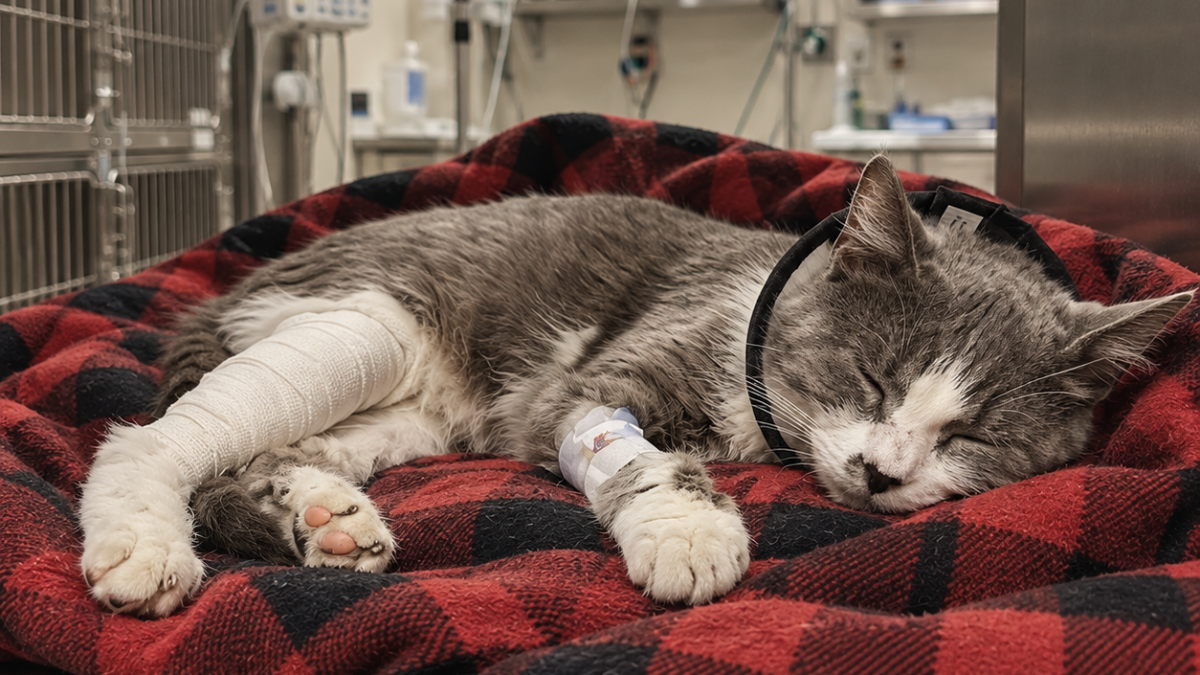
The cat was asleep on a warming pad.
His flannel shirt had been placed underneath her because she settled better when she could smell it.
He stared at her for several seconds.
Then said the sentence I cannot stop thinking about.
“I’m the one who saw her.”
I waited.
He continued.
“Everybody else drove by.”
He rubbed one rough hand over the other.
“I saw her.”
Then he looked directly at me.
“From that moment on, she was my responsibility.”
He shrugged slightly.
“That’s how it works.”
I wish I could tell you I had an equally meaningful response.
I didn’t.
I simply stared at him.
Fourteen years in veterinary medicine.
Thousands of cases.
And somehow this man who claimed not to know anything about cats had just summarized something I had spent my whole career trying to explain.
Responsibility often begins before ownership.
Before love.
Before history.
Sometimes it begins with noticing.
I went back to my office.
Took a yellow sticky note.
Wrote his words down.
I still have it.
He paid the full bill.
Approximately eighteen hundred dollars.
No fundraiser.
No argument.
No request for recognition.
We gave him a carrier.
A technician explained how to give the medication.
He listened with the seriousness of a man receiving military instructions.
“Morning and night?”
“Yes.”
“With food?”
“This one, yes.”
“What if she won’t eat?”
“Call us.”
“What kind of food?”
We gave him several options.
“What about litter?”
That required a longer discussion.
Remember, he had never owned a cat.
He knew almost nothing.
We showed him how to set up a recovery space.
Low-sided litter box.
No stairs.
No jumping.
Separate from dogs initially.
He took notes.
Actual notes.
At one point he asked:
“What if she hates me?”
Megan smiled.
“She probably won’t.”
“But what if?”
“Give her space.”
He nodded.
“I can do that.”
Before leaving, I brought him into the recovery room.
The cat was awake enough to lift her head.
He crouched beside the cage.
Did not reach inside.
“Hey.”
Her eyes opened halfway.
“You caused a lot of trouble today.”
Her nose moved.
He put one finger close to the door.
She sniffed it.
Then lowered her head onto the flannel shirt again.
He smiled.
First time all day.
It transformed him.
“What are you going to name her?”
I asked.
He frowned.
“I have to name her?”
“If you’re taking her home, eventually people will expect something besides ‘cat.’”
He thought.
Looked at her.
Then at the red flannel.
“Maybe Rosie.”
“Why Rosie?”
“The shirt’s red.”
“That is terrible naming logic.”
He shrugged.
“You asked.”
Rosie it was.
He placed the carrier carefully on the passenger seat.
Buckled it in.
I watched from the clinic window.
Before closing the truck door, he adjusted the blanket around her.
Then stood there for a few seconds.
One large hand resting on top of the carrier.
Finally he climbed in.
Two-hour drive home.
A cat he had met that afternoon beside him.
I thought that was the end of the story.
It wasn’t.
He called the next morning.
6:52 a.m.
Our clinic technically wasn’t open yet.
I was there.
“She’s not eating.”
“How long?”
“Since we got home.”
“Is she drinking?”
“A little.”
“Has she used the litter box?”
Pause.
“I think so.”
“What does that mean?”
“There is definitely something in it.”
I smiled.
“Good.”
We talked.
Post-anesthesia appetite can be slow.
Pain.
Stress.
New environment.
I gave him warning signs.
An hour later he sent a picture.
Rosie inside a large dog crate.
Soft bedding.
Low litter tray.
Food.
Water.
Everything exactly as instructed.
In the corner sat the red flannel shirt.
Rosie was sleeping on it.
The next message:
SHE ATE CHICKEN.
Then:
IS CHICKEN OK?
We answered.
A few days later:
SHE KEEPS PURRING. IS THAT GOOD?
Yes.
Usually.
Then:
SHE BIT ME.
I asked:
“Hard?”
He wrote:
NO. I THINK SHE WAS MAD ABOUT THE PILL.
Congratulations.
He was officially a cat owner.
At her first follow-up, he arrived twenty minutes early.
Rosie was in the carrier.
Flannel shirt inside.
He was wearing a different flannel.
Blue.
Apparently red now belonged to Rosie.
She looked brighter.
Eyes clearer.
Eating.
Pain controlled.
The surgical sites looked good.
When I opened the carrier, she did something interesting.
She looked around.
Then immediately looked for him.
He put his hand near her.
She pressed her cheek against one knuckle.
He froze.
“You see that?”
“Yes.”
“What does that mean?”
“She likes you.”
He looked almost offended by the possibility.
“She barely knows me.”
I smiled.
“So?”
That shut him up.
Over the next eight weeks, we saw them several times.
Rosie healed.
Slowly at first.
Then faster.
Her weight improved.
Her fur became cleaner.
Her personality emerged.
She was stubborn.
Very stubborn.
She hated medication.
Loved chicken.
Loved warm laundry.
Despised the vacuum cleaner.
And somehow became obsessed with sleeping inside the man’s work boots.
He told us:
“I bought her a forty-dollar bed.”
“Where does she sleep?”
“My boots.”
“Sounds right.”
His name, by the way, was Tom.
Thomas Mercer.
I had finally learned it sometime between surgery and the first recheck.
Tom worked construction.
Mostly heavy equipment and rural contracting.
He lived alone on five acres.
One old Labrador named Hank shared the house.
Tom had worried Hank might not accept Rosie.
The opposite happened.
At their four-week visit, he showed me a photograph.
Rosie inside her recovery pen.
Hank sleeping directly outside it.
Nose pressed against the bars.
“He won’t leave her.”
Tom said.
“And she?”
“Hits him through the bars.”
“Also normal.”
Tom shook his head.
“Cats are weird.”
“Correct.”
At six weeks, we took follow-up radiographs.
The fractures were healing well.
Tom stood beside me while I showed him.
“You see this?”
“Yes.”
“New bone formation.”
“So it’s working?”
“It’s working.”
He smiled.
“How much longer?”
“Two more weeks of restrictions, then gradual activity.”
Tom looked disappointed.
Not because recovery was slow.
Because he had become paranoid about Rosie damaging herself.
“I can keep her in longer.”
“No.”
“You sure?”
“She needs to start moving eventually.”
“What if she jumps?”
“She will.”
His face tightened.
“She is a cat, Tom.”
“That doesn’t sound medically reassuring.”
“It is medically realistic.”
At eight weeks, Rosie took several normal steps across an exam-room floor.
Then several more.
A slight stiffness remained.
But she was walking.
Tom was sitting on the floor.
He watched her cross toward him.
She climbed onto his leg.
Curled against his stomach.
And started purring.
Tom looked at me.
“She remembers?”
“Of course she remembers.”
He swallowed.
“I just stopped.”
“Yes.”
“That was it.”
“Yes.”
Outside that clinic room, people were answering phones.
Dogs were barking.
Printers running.
Normal day.
Inside, a man who had never owned a cat was sitting on the floor holding one whose life existed because he had refused to keep driving.
A few months later, Tom came by without an appointment.
Rosie was not with him.
That scared me for half a second.
“Everything okay?”
“Yeah.”
He handed me a folded piece of fabric.
Red flannel.
Washed.
Repaired.
The blood stains were mostly gone, although faint discoloration remained.
“I figured you might want this.”
“Why?”
“You took that picture after surgery.”
I remembered.
Rosie asleep.
Wrapped in his shirt.
He continued:
“My sister gave me three new shirts for Christmas because apparently everybody knows the story now.”
He looked embarrassed.
“Rosie has enough blankets.”
I held the shirt.
“Shouldn’t you keep it?”
He thought.
Then:
“No.”
“Why?”
He smiled.
“She doesn’t need it anymore.”
That sentence got me.
Because he was right.
The shirt had smelled like the man who stopped.
During the drive.
During surgery.
During recovery.
It had become safety before Rosie knew what safety was.
Now she had a house.
A dog.
A man.
A ridiculous cat bed she refused to use.
She did not need the emergency version of safety anymore.
She had the permanent one.
I kept the flannel for a while.
Eventually Tom changed his mind and took it home after I convinced him that sentimental veterinarians already have enough clutter.
Months passed.
Then one Saturday morning, a pickup rolled into the parking lot.
Not fast this time.
Tom came in carrying a cat carrier.
Rosie looked perfectly healthy.
“What happened?”
“Nothing.”
He opened the carrier.
She stepped out.
No limp.
No hesitation.
Beautiful gray-and-white coat.
Bright eyes.
She jumped directly onto the exam table.
I stared.
“She isn’t due for anything.”
“I know.”
“Then why are you here?”
Tom shrugged.
“I was in town.”
“You drove two hours.”
“I had materials to pick up.”
“Forty minutes away.”
He looked irritated that I knew geography.
“Close enough.”
Rosie walked across the table and rubbed against my hand.
Tom said:
“I thought you might want to see her.”
I did.
Very much.
He had one more surprise.
A photograph on his phone.
Tom sitting on his porch.
Hank lying beside him.
Rosie sitting on Tom’s shoulder like a parrot.
I laughed.
“Who taught her that?”
“Nobody.”
“You look unhappy.”
“She put her tail in my coffee.”
“That is unfortunate.”
“She owns the house now.”
“I warned you.”
“No, you didn’t.”
“I am a veterinarian. It’s implied.”
He put the phone away.
Then his face became more serious.
“Can I ask you something?”
“Sure.”
“Do you think somebody owned her before?”
“Probably possible.”
“She likes people too much.”
“Maybe.”
“I put notices up.”
I hadn’t known that.
Local groups.
Animal control.
Lost-pet pages.
For months.
No one claimed her.
Tom nodded slowly.
“Good.”
Then quickly:
“I mean—not good that somebody lost her.”
“I know.”
“I just…”
“You don’t want someone taking her.”
His ears turned slightly red.
“No.”
I smiled.
“She’s yours.”
He looked at Rosie.
Rosie looked at him.
Then jumped onto his chest without warning.
He caught her.
Barely.
“Unfortunately.”
I don’t usually write about patients.
There are ethical reasons.
Privacy.
Confidentiality.
And because every clinic sees hundreds of stories people might misunderstand if reduced to one emotional paragraph online.
Veterinary medicine is complicated.
Not everyone can pay eighteen hundred dollars.
Not everyone who cannot pay is cruel.
Not every injured stray can be saved.
Not every surgery succeeds.
I never want a story like Rosie’s to become a weapon against people facing impossible choices.
That is not why I’m telling it.
I’m telling it because of one sentence.
I’m the one who saw her.
From that moment on, she was my responsibility.
Tom did not mean every person has to spend thousands of dollars every time they encounter suffering.
That would be unrealistic.
I think he meant something simpler.
Once suffering becomes visible to us, we have to decide what kind of person we are going to be in relation to it.
Maybe you stop.
Maybe you call for help.
Maybe you move an animal out of traffic.
Maybe you knock on a neighbor’s door.
Maybe you contact a rescue.
Maybe all you can do is stay until someone better equipped arrives.
But seeing creates a moment of choice.
That day, dozens of cars may have passed Rosie.
I don’t know.
Maybe some drivers never saw her.
Maybe others saw movement in the grass and thought somebody else would stop.
That is one of humanity’s most dangerous assumptions.
Somebody else.
Somebody else will call.
Somebody else will help.
Somebody else knows what to do.
Somebody else has more time.
More money.
More courage.
Then sometimes one person says:
No.
This time, I’m somebody else.
Tom never described himself as kind.
Never called himself an animal rescuer.
Never acted heroic.
When a local reporter later contacted him after hearing about Rosie, he refused an interview.
They asked why he stopped.
He apparently said:
“Because she was in the road.”
They asked why he paid.
“Because she needed surgery.”
Why adopt her?
“She needed somewhere to go.”
Every answer sounded obvious to him.
Maybe that is the most remarkable part.
He did not believe he had done anything exceptional.
He had simply seen a living thing hurt.
Then behaved as if seeing it carried an obligation.
Last week, almost a year after Rosie’s accident, Tom sent me another photograph.
No message.
Just the picture.
Winter evening.
Fireplace.
Hank asleep on the rug.
Tom in his recliner.
Rosie stretched across his chest.
One of her back paws resting under his chin.
Her eyes closed.
His eyes closed too.
On the arm of the chair lay a red flannel shirt.
I stared at that photograph longer than I expected.
Then wrote:
HOW ARE THE LEGS?
Tom replied:
BETTER THAN MINE.
I laughed.
Then he sent another message.
SHE STILL HATES PILLS.
Some things survive orthopedic trauma unchanged.
Fourteen years as a veterinarian has taught me that animals arrive in our lives through all kinds of doors.
Breeders.
Shelters.
Rescues.
Friends.
Family.
Sometimes the side of a highway.
We like to believe we choose them.
Sometimes we do.
Other times, something happens in ninety seconds on an ordinary afternoon and the choice is made before we even understand it.
Tom did not wake up that morning wanting a cat.
Rosie did not know she needed a construction worker in a dusty pickup.
They met in the worst possible place.
One of them broken in the grass.
The other driving somewhere else.
Then he saw her.
And he stopped.
Maybe that is where love begins more often than we realize.
Not with certainty.
Not with history.
Not even with affection.
Sometimes it begins with responsibility.
You are here.
I see you.
So I am not going to pretend I didn’t.
Everything else can come later.
The name.
The home.
The ridiculous bed you refuse to sleep in.
The old Labrador waiting outside your recovery crate.
The warm chest you eventually choose as your favorite place to nap.
But first somebody has to stop the truck.
And yesterday, when I looked again at the note I had written after Rosie’s surgery, the words felt just as important as they did the first time Tom said them:
“I’m the one who saw her.”
“From that moment on, she was my responsibility.”
For him, that was enough.
For Rosie, it was everything.

