For 389 Days, Families Called Ripley’s Name and Walked Away When He Never Answered—Then a Retired Teacher Tapped the Floor Three Times and the Deaf Cat Came Running.
PART3:
Three former students surprised me.
One of them, Thomas, drove four hours with his wife and baby daughter.
He had been eight years old when I met him.
He was thirty-two now.
He hugged me and signed:
YOU LOOK OLD.
I signed back:
YOU WERE ALWAYS RUDE.
He laughed.
Everybody laughed.
Someone gave me a framed photograph of my final class.
Someone else gave me a mug that said:
RETIREMENT: NOW EVERY DAY IS SATURDAY.
I hated that mug immediately.
The first Monday after retirement, I woke at 5:37 without an alarm.
I lay in bed staring at the ceiling.
No reason to hurry.
No hallway duty.
No lesson plans.
No children.
I made coffee.
Read the newspaper.
Was finished by 7:12.
Then I sat at the kitchen table.
The whole day was still in front of me.
That should have felt like freedom.
It felt like being forgotten.
I had friends.
I had a sister in Michigan.
I had former coworkers.
There were books I wanted to read.
A garden I kept promising to fix.
A dining room closet that had not been properly organized since the Clinton administration.
But for thirty-four years, the structure of my life had come from other people needing me at specific times.
Remove that, and suddenly I was a woman standing in a very clean kitchen wondering why I had bought twelve bananas.
For the first few weeks, I stayed busy.
Too busy.
I alphabetized spices.
I painted the guest room.
I joined a morning walking group and quit after three outings because everyone walked too fast and talked too much about cholesterol.
I volunteered one afternoon at the public library.
I reorganized my garage.
I watched six episodes of a British crime show and realized afterward that I had no idea who had been murdered.
At night, the house bothered me most.
I had lived alone for years.
That was not new.
My husband, Frank, and I divorced amicably in our forties.
He remarried.
We remained friendly until he died of a heart attack seven years before my retirement.
So I was not afraid of solitude.
But work had always followed me home.
Student emails.
Reports.
Lesson plans.
Books.
Thoughts.
The emotional residue of other people’s children.
Retirement removed all of it at once.
By September, my house was so quiet that I began leaving the radio on in rooms I was not using.
That annoyed me because I knew better.
Noise is not the opposite of loneliness.
Connection is.
One Tuesday afternoon, I drove past Pine Creek Animal Shelter.
I had driven past it hundreds of times.
That day, for no particular reason I could explain, I turned around.
I told myself I was only looking.
Anyone who has ever entered an animal shelter knows this is the first lie.
A young woman with a dark ponytail greeted me at the front desk.
Her name tag said JENNA.
She looked about twenty-six.
Maybe twenty-eight.
At sixty-seven, everybody under thirty-five begins looking vaguely twelve.
“Can I help you?”
“I’m thinking about adopting.”
Her whole face changed.
Shelter workers have a particular kind of hope.
Careful hope.
They want every visitor to be the person who finally says yes.
“Cat or dog?”
“Cat.”
“Kittens?”
“No.”
That surprised her.
“Older.”
“How old?”
“Old enough to have opinions.”
She smiled.
“We have several experts in that category.”
“I’d like calm.”
“Independent is fine.”
“I don’t need cuddly.”
“What about medical needs?”
“Within reason.”
She studied me.
“You’ve had cats?”
“When I was younger.”
“My last one died twenty years ago.”
“Okay.”
She picked up a clipboard.
“Come with me.”
The cat room was warm.
Bright.
Clean.
Loud in the ordinary sense.
Meowing.
Metal dishes.
Doors opening.
Someone vacuuming down the hall.
Most cats reacted when we approached.
A black kitten climbed the bars.
A tabby meowed so loudly Jenna laughed.
One enormous orange cat rolled onto his back as if he had been waiting all day for an audience.
Then we reached the last enclosure.
A gray-and-white cat sat facing the wall.
Not hiding.
Not curled up.
Just sitting.
Still.
His shoulders were slightly hunched.
White chest.
Gray back.
A white streak between his eyes.
One broken whisker.
He had the serious expression of an old judge who had heard every excuse available and found all of them disappointing.
“That’s Ripley.”
Jenna said.
I looked at the card.
RIPLEY.
MALE.
APPROX. 8 YEARS.
NEUTERED.
CALM HOME PREFERRED.
DAY 389.
I pointed.
“What does that mean?”
Jenna sighed.
“How long he’s been available.”
“Three hundred eighty-nine days?”
“Yes.”
She looked embarrassed, though it was not her fault.
“Why?”
She called his name.
“Ripley.”
Nothing.
She tried again.
“Ripley.”
He remained facing the wall.
Jenna raised her voice.
“Ripley!”
No twitch.
No ear movement.
Nothing.
Then she clapped once.
Ripley did not react.
I looked at her.
“Has anybody checked his hearing?”
Her expression changed.
“Sort of.”
“Sort of is an interesting medical category.”
She gave me a tired smile.
“He was examined when he came in.”
“Healthy overall.”
“Vet noted he might have reduced hearing.”
“Might?”
“He reacts to some things.”
“Like what?”
“Doors closing sometimes.”
“People walking by.”
I looked through the glass.
“Those create vibration.”
Jenna went quiet.
She looked back at Ripley.
Then at me.
“Can I meet him?”
“Absolutely.”
She opened the outer door.
Then the enclosure.
I did not say his name.
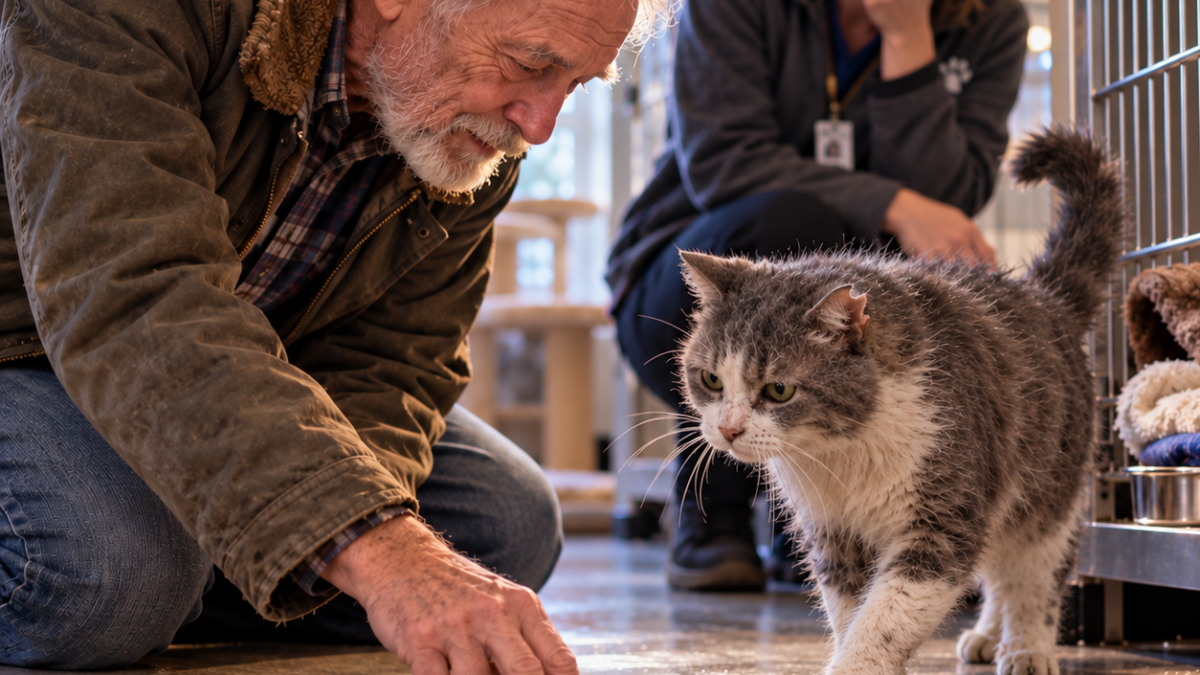
I knelt.
Placed two fingers against the hard floor.
Tap.
Tap.
Tap.
Ripley turned around immediately.
Jenna inhaled sharply.
So did I.
He looked directly at my hand.
Not my face.
My hand.
I tapped again.
Three times.
His body changed.
Shoulders lifted.
Eyes widened.
He walked toward me.
Slowly.
I kept one hand where he could see it.
I did not reach over his head.
You learn that early when working with children who do not hear you approach.
Surprise becomes fear faster when the warning never arrives.
Ripley sniffed my fingers.
Then pushed his forehead into my palm.
Behind me, Jenna whispered:
“Oh my God.”
I sat down.
Ripley climbed into my lap.
No hesitation.
He circled once.
Folded himself against my stomach.
And began purring.
I laughed.
Then, to my embarrassment, I cried.
Jenna turned away.
She wiped her own face.
“I’ve never seen him do that with someone this fast.”
I ran one finger down Ripley’s cheek.
He pushed harder.
“He’s not unfriendly.”
“No.”
Jenna whispered.
“He’s deaf.”
I watched Ripley’s ears.
They moved occasionally.
Toward motion.
Air.
Perhaps pressure.
But when Jenna called behind him, there was nothing.
“Probably profoundly deaf.”
I said.
“How did nobody know?”
Jenna looked ashamed.
“We suspected.”
“Suspected?”
“He had a note.”
“What note?”
“In his medical record.”
“Possible hearing impairment.”
I stared at her.
“What did his adoption profile say?”
She pointed at the card.
Calm home preferred.
Independent.
I read it again.
“Not deaf?”
“No.”
“Why not?”
“I don’t know.”
She swallowed.
“I’m not trying to make excuses.”
“Then don’t.”
The teacher in me had arrived.
Not angry yet.
Precise.
Jenna sat on the floor beside us.
“Most people come in.”
“They call him.”
“He doesn’t respond.”
“They call louder.”
“Sometimes they wave.”
“Sometimes they reach in.”
“From behind?”
“Yes.”
Ripley’s body tightened slightly when Jenna shifted.
I put my hand in his view.
He relaxed.
“What happens when they touch him?”
“He jumps.”
“Sometimes swats.”
“No claws, usually.”
“Then what do people say?”
Jenna looked at the floor.
“That he’s aloof.”
“Not affectionate.”
“Unpredictable.”
“One woman said she wanted a cat who actually liked people.”
I felt something painful move through my chest.
Not because I thought those people were monsters.
Most were probably kind.
They simply used the communication system they knew.
When it failed, they blamed the receiver.
I had seen that for thirty-four years.
A child did not answer from behind.
“Not paying attention.”
A child watched another child’s hands instead of the teacher’s face.
“Distracted.”
A child became frustrated in a noisy classroom.
“Behavior problem.”
A child missed instructions.
“Lazy.”
A child used language differently.
“Behind.”
The world has a terrible habit of defining people by how inconvenient their differences are to everyone else.
Ripley had lived inside that mistake for 389 days.
Jenna said:
“Would you like time to think?”
I looked down.
Ripley had fallen asleep in my lap.
“I think he’s already decided.”
She laughed through tears.
“Apparently.”
I adopted him that afternoon.
Before we left, I asked for every piece of medical paperwork the shelter had.
The examining veterinarian had written:
“Limited response to auditory stimuli; difficult to determine whether behavioral versus hearing deficit.”
That sentence bothered me.
Not because it was medically irresponsible.
A single shelter exam is not always enough.
But no one had followed it.
No repeat evaluation.
No specialized observation.
No adoption note.
Just a vague description that allowed 389 days of misunderstanding.
In the car, Ripley sat in his carrier facing me.
I tapped the plastic floor twice.
He looked up.
“Okay.”
I said aloud.
Then signed the word too.
HOME.
He did not know sign language.
Of course he did not.
But it felt right to start.
The first evening was chaos.
Not frightened chaos.
Ripley inspected my house like an insurance adjuster.
Kitchen.
Hallway.
Bathroom.
Closets.
Dining room.
Bedroom.
He ignored the cat bed I had bought on the way home.
Drank from the glass beside my sink.
Sat inside an empty grocery bag.
Then discovered the heating vent beneath my living room window.
Within an hour, he was asleep on top of it.
I stood over him.
No response.
I tapped the floor once.
His eyes opened.
That became our beginning.
One tap:
Look at me.
Two taps:
Come.
Three taps:
Come now.
Not because Ripley understood numbers.
Because he learned patterns.
I used a slow open hand when I was leaving the room.
A palm-down motion for stay.
I patted the couch when I wanted him beside me.
I flicked the hall light twice when I entered the house at night.
He learned that fastest.
The first time I came home after dark, he was sleeping in the living room.
I flicked the lights twice.
His head came up.
He saw me.
Then he ran.
Not walked.
Ran.
Across the rug.
Onto the couch.
Onto the arm.
Then put both front paws against my chest.
I nearly fell over.
“You ridiculous animal.”
I said.
He pressed his face beneath my chin.
Within two weeks, we had a language.
Not American Sign Language.
Not anything formal.
Ours.
Visual.
Tactile.
Vibration.
Routine.
People sometimes asked later:
“How did you teach a cat sign language?”
I didn’t.
I taught myself to stop expecting him to communicate like I did.
That is different.
At our first veterinary appointment, Dr. Patel confirmed what I already believed.
Severe bilateral hearing loss.
Probably profound.
She performed several observations.
No response to high-pitched sound outside his visual field.
No reaction to clapping behind him.
Strong response to floor vibration.
Visual awareness excellent.
Healthy eyes.
Healthy neurologically.
“Has he always been deaf?”
I asked.
“Impossible to know.”
“Could be congenital.”
“Could be progressive.”
“Age?”
“Possible.”
“Prior illness?”
“Possible.”
“Can anything be done?”
“For hearing?”
“No.”
I nodded.
“What does he need?”
Dr. Patel smiled.
“Mostly someone who understands he’s deaf.”
That sentence should not have felt revolutionary.
It did.
I called Jenna from the parking lot.
“It’s confirmed.”
She went quiet.
“Completely?”
“Close enough.”
“I’m so sorry.”
“For what?”
“That we missed it.”
“You didn’t create his deafness.”
“No.”
“But we let it become his personality.”
That sentence made me stop.
“That is exactly what happened.”
Jenna asked if I would email documentation.
The shelter updated Ripley’s file even though he was already adopted.
They added:
DEAF.
RESPONDS TO VISUAL AND FLOOR-VIBRATION CUES.
APPROACH FROM FRONT.
I told myself that was enough.
It wasn’t.
Not because I wanted revenge.
There was nobody obvious to punish.
But for days I could not stop thinking about those 389 days.
How many people had called him?
How many had decided he did not care?
How many times had he been startled by a hand arriving from nowhere?
I began writing observations.
Old habits die hard.
Date.
Behavior.
Cue.
Response.
Light flick.
Head lift.
Two floor taps.
Approaches within five seconds.
Hand in visual field.
Seeks touch.
Unexpected touch from rear.
Startle response.
I realized on day ten that I was making a progress chart for my cat.
I laughed so loudly Ripley slept through it.
Of course he did.
Retirement changed after that.
Mornings had shape again.
Not because Ripley required much.
He was a cat.
His primary occupational goal was preventing me from using any chair I wanted.
But he gave rhythm to the house.
At seven:
Breakfast.
At nine:
Window.
At eleven:
Move to the patch of sunlight beside the bookcase.
At two:
Sleep somewhere inconvenient.
At four:
Demand food two hours early.
At night, he slept beside my hip.
Not always touching.
Close enough.
I started talking to him anyway.
That surprised people.
“Why talk if he can’t hear?”
Because speech was part of how I thought.
Because he watched my face.
Because communication is not wasted just because every piece is not received.
I spoke.
I signed simple words.
I tapped.
I waved.
He blinked.
Pressed his head to me.
Turned away.
Ignored me for reasons unrelated to deafness.
He was still a cat.
That mattered.
Disability does not erase personality.
It explains some things.
Not everything.
Ripley could not hear.
Ripley was also stubborn.
These facts coexisted peacefully.
About a month after I adopted him, I was reading in the living room.
Ripley slept across the room.
I looked at him.
Thought about the shelter.
Three hundred eighty-nine days.
I set down the book.
Tapped the floor three times.
Tap.
Tap.
Tap.
His eyes opened.
His head lifted.
He saw me.
Then he ran.
Straight across the rug.
Onto the couch.
Into my lap.
He shoved his face beneath my hand.
And I began crying.
Hard.
The kind of crying that fogs your glasses.
I took them off.
Ripley stepped on them.
“Thank you.”
I said.
He sat down on my stomach.
I thought about retirement.
About waking with nowhere to be.
About the classroom door closing behind me.
About those first months when I felt as though the world had moved one step forward and forgotten to tell me.
Nobody had done anything wrong.
That was almost the hardest part.
The school still existed.
Teachers taught.
Children learned.
My replacement was excellent.
The system worked without me.
That is what healthy institutions are supposed to do.
But being unnecessary can feel very similar to being invisible if you are not careful.
Ripley did not need me to become useful again.
That would be unfair to both of us.
What he gave me was smaller and better.
A new way to participate.
A reason to notice.
A creature whose language rewarded patience.
Then Jenna called.
Her voice was strange.
“Margaret?”
“Yes?”
“Are you sitting down?”
“I’m sixty-seven.”
“I sit whenever possible.”
“I found something.”
“What?”
“Ripley’s original intake packet.”
I straightened.
“I thought you already had it.”
“We had the digital file.”
“This was paper.”
“Where?”
“Archive box.”
“Old surrender documents.”
“Somebody was reorganizing.”
“What did it say?”
She inhaled.
“Can you come in?”
That annoyed me.
“If this is about a cat, Jenna, I am not driving twenty minutes for suspense.”
“It says three taps.”
I stopped breathing.
“What?”
“The note.”
“His original note.”
“It says three taps.”
I was at the shelter eighteen minutes later.
Jenna met me in the lobby.
Her eyes were swollen.
She carried a yellowed sheet inside a plastic sleeve.
At the top:
RIPLEY — OWNER SURRENDER FOLLOWING OWNER DEATH.
The handwriting below belonged to someone older.
Uneven.
Blue ink.
I read.
Ripley cannot hear you.
He has been deaf for years.
Please come where he can see you before touching him.
He feels footsteps.
Tap the floor three times and he will come.
He sleeps on the left side of the bed.
He likes chicken but not fish.
He does not like being carried.
Please be patient.
He is a good boy.
My hands started shaking.
“Who wrote this?”
Jenna pointed to the signature.
MARY CALDWELL.
Emergency contact.
Daughter of deceased owner.
“Why wasn’t this in his file?”
Jenna’s mouth tightened.
“We’re reconstructing that.”
“What does that mean?”
“The shelter changed software around the time Ripley came in.”
“Paper intake documents were scanned.”
“Some weren’t attached correctly.”
“This page was scanned into a different animal’s archived record.”
I stared.
“You had this.”
“Yes.”
“For 389 days.”
“Yes.”
“You had the answer.”
“Yes.”
Jenna started crying.
I did not comfort her immediately.
Not because I was cruel.
Because anger deserves a moment before being converted into reassurance for the person who feels guilty.
“How many staff knew?”
“Not this page.”
“What about his hearing?”
“Some suspected.”
“Then why wasn’t he reassessed?”
“We were overwhelmed.”
She wiped her face.
“That’s not an excuse.”
“No.”
“We had staffing turnover.”
“Budget cuts.”
“Two outbreaks.”
“I know none of that changes what happened.”
“No.”
Jenna looked at the note.
“I called his name too.”
The confession came quietly.
“I stood there and called his name.”
“I thought maybe he was depressed.”
“Maybe shut down.”
“I told adopters he needed someone patient.”
“But I never told them he was deaf because I didn’t know for sure.”
I looked at her.
“You could have said we suspect hearing loss.”
“Yes.”
“I know.”
“Someone should have.”
“Yes.”
I read the note again.
Tap the floor three times and he will come.
The same cue I had used instinctively because floor vibration is one of the most obvious ways to get attention when hearing is absent.
Except Ripley had not simply noticed vibration.
He knew the pattern.
Three taps had meant something before me.
That was why he turned so quickly.
Why he came without hesitation.
I had thought I discovered him.
Really, I had accidentally spoken a language someone else had already taught him.
That realization made my anger collapse into grief.
“Who was his owner?”
Jenna opened another page.
“Samuel Caldwell.”
“Seventy-nine.”
“Died eighteen months before you adopted Ripley.”
“Family?”
“Daughter in Arizona.”
“She surrendered him after funeral.”
“Did she know he sat here this long?”
“We don’t know.”
“I want to know.”
Jenna hesitated.
“Privacy rules.”
“I’m not asking for her address.”
“Ask her whether she wants contact.”
Jenna nodded.
The shelter director, Mr. Hanson, asked to speak with me.
He was around fifty.
Tired face.
Polite.
He apologized.
Not the defensive kind.
No phrases like:
Mistakes were made.
Instead:
“We failed Ripley.”
That helped.
“How?”
“His paper intake was mishandled.”
“His hearing concern wasn’t followed.”
“His adoption profile described behavior without enough context.”
“People interpreted disability as temperament.”
I folded my hands.
“What are you doing?”
“Full file audit for long-term animals.”
“Any animal listed as unresponsive or difficult to engage gets medical review.”
“Staff training.”
“Adoption cards will include communication needs.”
“We’re building a checklist so surrender notes can’t disappear during software entry.”
I listened.
Then asked:
“Will you tell people what happened?”
Hanson hesitated.
“Publicly?”
“Yes.”
“We can.”
“Will you?”
He studied me.
“You think we should.”
“I taught for thirty-four years.”
“Do you know what one of the most dangerous sentences in education is?”
He waited.
“People might misunderstand.”
I leaned forward.
“They already misunderstood him.”
“For 389 days.”
“Silence did not protect him.”
Hanson nodded.
“We’ll tell the story.”
I had one condition.
“Do not turn him into inspiration.”
He looked confused.
“What do you mean?”
“No ‘brave deaf kitty overcame disability.’”
“No ‘special-needs angel.’”
“He didn’t overcome deafness.”
“He is deaf.”
“The problem was that people expected him to hear.”
Hanson nodded slowly.
“Fair.”
“And don’t make adopters feel guilty.”
“They weren’t given good information.”
“Most were responding to what they saw.”
“The lesson is not that they were bad people.”
“The lesson is that interpretation changes when communication changes.”
He smiled faintly.
“You really were a teacher.”
“Unfortunately, retirement did not cure it.”
The shelter posted Ripley’s story two days later.
A photograph of him sitting in my window.
Not sad.
Not dramatic.
Caption:
For 389 days, Ripley was described as aloof because he did not respond when people called him.
Ripley is deaf.
An intake note explaining his communication needs was misfiled during a records transition.
We failed to preserve that information.
We are changing our intake and medical-review procedures so other animals are not defined by behavior we have not taken time to understand.
The post spread farther than anyone expected.
Local news called.
I declined at first.
Then Jenna asked:
“Would you consider one interview?”
“Why?”
“Because people keep asking how deaf animals communicate.”
That interested me.
I agreed on condition the shelter appeared too.
The reporter came to my house.
Ripley slept through the equipment setup.
Naturally.
She asked me to demonstrate the floor taps.
I waited until Ripley faced away.
Tap.
Tap.
Tap.
He turned.
Walked toward me.
Then sat two feet away because television crews apparently did not deserve lap access.
The reporter laughed.
“Does he know sign language?”
“No.”
“What does he know?”
“He knows patterns.”
“Visual cues.”
“Vibration.”
“My body language.”
“Routine.”
“Can he understand your voice?”
“Not the sound.”
“But he understands me.”
She paused.
“What’s the difference?”
“Communication isn’t the same as hearing.”
That sentence became the headline.
The story reached some former students.
My phone started filling with messages.
Thomas:
OF COURSE YOU ADOPTED A DEAF CAT.
I wrote back:
HE ADOPTED ME. RUDE CHILD.
Another former student, Naomi, sent a photo from her office.
She was an audiologist now.
Her message said:
Remember when you told my third-grade teacher I wasn’t “ignoring directions,” I literally couldn’t hear them?
I remembered.
Very well.
Naomi had moderate hearing loss.
Her teacher kept speaking while facing the whiteboard.
Naomi missed instructions.
Grades dropped.
The teacher told her parents she lacked focus.
I attended one meeting and asked the teacher to explain the problem while facing away from us.
Then asked:
“Did you notice how much harder that was?”
She never forgot.
Neither did Naomi.
A week after Ripley’s story aired, the shelter called again.
This time, Jenna sounded excited.
“Three deaf cats were adopted.”
“What?”
“Not ours.”
“Two in other counties.”
“One at a rescue in Indiana.”
“People shared the story.”
I smiled.
“That’s good.”
“And a family came in specifically asking for our oldest cat.”
“How old?”
“Sixteen.”
“Did they call his name?”
Jenna laughed.
“He can hear.”
“That was not my question.”
“They sat down and waited.”
“Better.”
The shelter started monthly orientation sessions for people interested in older, shy, deaf, blind, or medically complicated animals.
They asked me to speak.
I said no.
Then I showed up anyway.
Retirement does strange things to a person.
The first session had eleven people.
Jenna stood beside me.
I held up a simple poster.
BEHAVIOR IS INFORMATION.
Not accusation.
Not moral judgment.
Information.
I talked about approaching deaf animals from the front.
Using lights.
Floor vibration.
Predictable routines.
Avoiding startling touch.
Never letting a deaf cat outdoors unsupervised.
Using visual markers.
But mostly, I talked about assumptions.
“If an animal doesn’t respond,” I said, “your first question shouldn’t be, ‘Why is he ignoring me?’”
“It should be, ‘What am I missing?’”
A woman in the back raised her hand.
“My grandson is autistic.”
The room changed.
I knew where she was going.
“He does things people call rude.”
“Sometimes he doesn’t answer.”
“Sometimes he walks away.”
“I know that’s different from deafness.”
“It is.”
I said.
“But the question can still be useful.”
“What am I missing?”
She nodded.
After the session, she adopted a twelve-year-old cat with diabetes.
His name was Marvin.
Marvin hated everyone for three days.
Then slept on her feet.
Meanwhile, I tried to locate Ripley’s first family.
The shelter contacted Mary Caldwell.
She responded.
She did not want her contact information shared at first.
Understandable.
But she sent a letter.
I opened it at my kitchen table while Ripley slept beside the radiator.
Dear Ms. Ellis,
I have cried several times since the shelter called.
Not because Ripley was adopted. I am grateful he found you.
I cried because I believed for more than a year that he had been living happily with another family.
When my father died, I was overwhelmed and living two states away. I could not take Ripley because my apartment did not allow animals, and my husband was undergoing treatment that required us to avoid pets temporarily.
The shelter told me they would find him a home.
I wrote everything I could think of on his intake forms because my father was terrified people would think Ripley was unfriendly.
Dad lost much of his hearing in his sixties.
He understood Ripley better than anyone.
He taught him to respond to vibrations.
Three taps meant “come to me.”
One long tap meant “look.”
Dad used to stomp lightly when he entered a room so Ripley wouldn’t be startled.
Please know that if I had known he stayed there 389 days, I would have found a way to come back for him.
I cannot change that now.
Thank you for learning how to speak to him.
At the bottom, she had written:
If you are comfortable, I would love to see a photograph of him sleeping somewhere he feels safe.
I looked across the room.
Ripley was upside down on my couch.
One paw over his face.
Completely shameless.
I took a picture.
Sent it through Jenna.
A week later, Mary asked whether we could speak by phone.
We did.
Her voice was older than I expected.
Maybe early sixties.
She told me about Samuel.
Her father.
Retired machinist.
Hard of hearing.
Widower.
Stubborn.
He found Ripley under his porch as a kitten.
Or Ripley found him.
Mary said the story changed depending on who told it.
Samuel refused to admit he owned a cat for nearly six months.
Meanwhile, he bought premium food, heated beds, and a scratching post taller than his television.
When Ripley’s hearing began fading, Samuel noticed because he understood the experience.
“He stopped coming when Dad opened cans.”
Mary said.
“But he came when Dad walked across the kitchen.”
“Vibration.”
“Yes.”
“My father said, ‘The cat isn’t ignoring me. The floor still works.’”
I laughed.
“That sounds like somebody I would’ve liked.”
“You would have.”
Then Mary told me the part that stayed.
“My father hated hearing aids.”
“Wouldn’t wear them half the time.”
“People shouted at him.”
“He hated that even more.”
“One day he told me, ‘Everybody thinks louder is the same as clearer.’”
I wrote the sentence down.
Louder is not the same as clearer.
Samuel and Ripley had lived inside the same misunderstanding.
When Samuel died, Ripley lost the one person who had already adjusted the world around him.
Then he landed in a place where everyone began using sound again.
No wonder he seemed withdrawn.
No wonder he sat facing walls sometimes.
Walls were predictable.
Walls did not surprise him from behind.
Mary and I stayed in touch.
Not constantly.
Birthday pictures.
Christmas.
Ripley sleeping.
Ripley sitting in boxes.
Ripley glaring at a cucumber.
She sent one photograph of Samuel.
He was sitting in a recliner with Ripley stretched across his chest.
Both looked annoyed by camera.
I framed it.
Placed it on a shelf.
Not because Samuel was part of my family.
Because he was part of Ripley’s.
Animals have histories before us.
We are not always their first love.
That does not make later love smaller.
About six months after adopting Ripley, I began volunteering at the shelter twice a week.
Not because they needed another critic.
Because criticism without participation gets boring.
I worked with long-stay cats.
Some were shy.
Some old.
Some medically complicated.
Some simply unlucky.
I taught volunteers to observe before labeling.
One cat named Pearl was described as “aggressive at cage door.”
I watched.
Her aggression happened whenever hands entered from above.
When approached from the side, she relaxed.
Old shoulder injury.
Reaching overhead hurt.
Profile changed.
She was adopted three weeks later.
A black cat named Chester hid whenever men approached.
No mystery diagnosis.
Just fear.
We stopped presenting him as “antisocial” and wrote:
Needs slow introductions; more comfortable with women initially.
A retired couple adopted him.
The husband sat on the floor for four days without touching him.
On day five, Chester slept against his leg.
These were small things.
Not miracles.
Better information.
That was all.
But better information changes outcomes.
So does humility.
Ripley changed too.
At home, he became more confident.
He stopped startling as easily.
He learned the light cue.
He learned that when I stomped twice near the doorway, I had entered the room.
He learned my morning routine so well that if I slept past seven, he sat on my chest.
Deaf does not mean incapable of making demands.
People sometimes asked whether I wanted a vibrating collar.
I did not.
He did not need one for our environment.
Other owners use them safely and effectively.
Our system worked.
The point was not one right method.
The point was communication tailored to the individual.
The teacher in me loved that.
Maybe too much.
I made a laminated cue chart.
Ripley tore one corner off.
Educational feedback.
One winter morning, I slipped on ice near the back steps.
Not badly.
I landed on my side.
The breath knocked out of me.
Ripley was sitting inside the glass door.
He saw me fall.
He paced.
I could not get up immediately.
My phone was inside.
I waved.
He could not help me, obviously.
He was a cat, not emergency medical personnel.
But he stayed at the door.
Watched.
When I finally stood, he ran toward the hallway.
By the time I came inside, he was waiting on the rug.
I sat.
He climbed into my lap.
Not because he knew I was injured.
Not because deaf cats have magic intuition.
Because something unusual had happened and I was sitting where I normally did not sit.
Animals are often wonderful enough without turning them supernatural.
I called my sister.
She scolded me.
Then sent me traction cleats.
A week later, Thomas visited with his daughter.
The baby from my retirement party was now almost two.
Ripley did not like toddlers.
We prepared.
Visual separation.
Safe room.
Elevated shelves.
No forced interaction.
Thomas’s daughter, Mia, saw Ripley through the baby gate and squealed.
Ripley saw her.
Walked away.
Thomas signed:
SMART CAT.
I signed:
SMARTEST PERSON IN HOUSE.
Thomas looked around.
YOU LIVE ALONE.
EXACTLY.
We laughed.
Then his expression changed.
He signed:
YOU MISS SCHOOL?
I hesitated.
YES.
DO YOU WANT TO GO BACK?
NO.
He waited.
I corrected myself.
NOT LIKE BEFORE.
THEN WHAT DO YOU MISS?
That was why good students become dangerous adults.
They ask better questions.
I thought.
PURPOSE.
Thomas nodded.
Then pointed at Ripley.
FOUND SOME.
I wanted to reject that.
Too sentimental.
Too neat.
But he was partly right.
Ripley had not given me a purpose in the heroic sense.
I did not wake every morning thinking:
Today I shall serve the deaf cat community.
I fed a cat.
Cleaned litter.
Volunteered.
Talked to people.
But those things reconnected parts of me I thought retirement had closed.
The skills had not disappeared because the job ended.
Experience is not a building you lock behind you.
I began giving occasional workshops.
Schools.
Rescues.
Senior centers.
One community college invited me to speak about communication access.
Ripley appeared in my opening slide.
His judge face.
Title:
CALLING LOUDER IS NOT A STRATEGY.
Students laughed.
Then I told them about him.
Then about children.
Then older adults.
Then anyone whose way of receiving information differs from the sender’s assumption.
We talked about captioning.
Visual alerts.
Facing people when speaking.
Checking comprehension without humiliation.
Not infantilizing adults with hearing loss.
Not assuming nonresponse equals defiance.
Ripley became an example.
Not a mascot.
There is a difference.
At the shelter, another mistake surfaced.
An elderly white cat named Daisy had been labeled “cage defensive.”
A new volunteer noticed Daisy reacted badly only when approached on her blind side.
Vet exam confirmed significant vision loss in one eye.
I stood beside Jenna when results came.
She stared at me.
“Please do not say it.”
“I’m not.”
“You’re thinking it.”
“I absolutely am.”
“What?”
“What are you missing?”
She groaned.
“I hate you.”
“No, you don’t.”
“No.”
“I really don’t.”
Jenna eventually became adoption coordinator.
She changed kennel cards.
Instead of personality labels alone, profiles included observed conditions.
Prefers approach from front.
May startle when sleeping.
Responds to hand target.
Needs quiet introduction.
Enjoys lap contact after settling.
Specific.
Useful.
Kind.
The shelter director began calling it the Ripley Protocol.
I objected.
“That sounds like a spy movie.”
“That is why we like it.”
“Call it communication-access review.”
“That sounds like paperwork.”
“It is paperwork.”
“Exactly why we’re not calling it that.”
Ripley Protocol stayed.
I pretended to hate it.
Two years passed.
Then three.
Ripley aged.
So did I.
He developed arthritis.
I bought stairs for the couch.
He ignored them.
Then used them at night when he thought I was not looking.
We had more veterinarian visits.
Kidneys stable.
Heart good.
Weight slightly high.
My fault, apparently.
“You’re overfeeding him.”
Dr. Patel said.
“He is emotionally persuasive.”
“He is twelve pounds.”
“That’s a form of persuasion.”
She was unmoved.
I reduced treats.
Ripley filed a complaint.
Mary Caldwell visited once.
She had moved closer after her husband died.
We arranged it carefully.
I worried Ripley would not remember her.
Then worried he would remember her too much.
Human beings are talented at inventing opposing fears.
Mary entered slowly.
I stomped lightly so Ripley knew someone had arrived.
He came into the hall.
Saw her.
Stopped.
Mary put one hand over her mouth.
“Hi, Rips.”
That had been Samuel’s nickname for him.
Ripley stared.
Then walked past her.
Mary laughed and cried at the same time.
“That seems right.”
She sat on the couch.
Did not reach.
After twenty minutes, Ripley approached.
Sniffed her shoe.
Then her hand.
He rubbed his cheek against one finger.
Mary began crying harder.
“He remembers something.”
I said.
“Maybe scent.”
“Maybe.”
She nodded.
“I don’t need to know exactly.”
That was wise.
We drank coffee.
She told me stories about Samuel.
How he used to tap a wooden cane on the floor.
How Ripley would come running from another room.
How Samuel sometimes pretended he could not find the cat when Ripley was sitting directly beside him.
Before Mary left, she handed me a small brass tag.
RIPLEY.
Samuel’s phone number on back.
“I found it in Dad’s desk.”
I held it.
“Do you want to keep this?”
“I kept his first collar.”
“You should have something too.”
I put the tag beside Samuel’s photograph.
Ripley never wore it.
He disliked collars.
Some traditions should remain symbolic.
Years went on.
Retirement became something other than absence.
I learned to leave days unplanned.
That had been hard.
I learned not every useful hour must produce something.
I learned sitting in sunlight with a cat can be enough.
I still volunteered.
Still taught occasional workshops.
But I stopped filling every empty square on the calendar.
Ripley taught me that too, though unintentionally.
Cats are experts in unapologetic idleness.
At seventy-one, I started gardening properly.
Ripley watched from screened porch.
He could not go outdoors freely.
Deaf cats are especially vulnerable to cars, predators, and anything approaching from outside their visual field.
So I built a small enclosed patio.
A “catio,” Jenna called it.
I hated the word.
Then used it constantly.
Ripley sat there for hours.
Watching birds he could not hear.
Some people found that sad.
I did not.
He watched movement.
Light.
Leaves.
Wings.
The world was not empty because one channel was missing.
That was another human assumption.
We think if someone cannot access the world the way we do, their version must be smaller.
Sometimes it is simply different.
At seventy-two, I developed cataracts.
For the first time in my life, visual communication became harder.
Small print blurred.
Night driving became unpleasant.
I hated it.
More than I expected.
Dr. Patel laughed when I complained during Ripley’s annual checkup.
“Now both of you have accessibility needs.”
“Do not become philosophical.”
“Too late.”
After surgery, I had to rest.
Ripley stayed near me.
Not protectively.
Mostly because I was warm and stationary.
But I appreciated it.
When I could not see him clearly across the room, I found myself tapping the floor.
Three times.
He came.
There was comfort in being able to call someone without sound.
That system belonged to us now.
Even though Samuel had built its first version.
One afternoon, Jenna called.
“Do you remember day 389?”
“Of course.”
“We have another long-stay cat.”
I sighed.
“What’s wrong with him?”
“Nothing.”
“That’s suspicious.”
“His name is Benny.”
“Twelve.”
“Black.”
“Missing half a tail.”
“People keep passing him.”
“Why?”
“He does not come to the front.”
I went in.
Benny sat in a box.
He could hear perfectly.
He simply disliked strangers.
I sat near his enclosure.
Waited.
Twenty minutes.
Nothing.
Thirty.
One eye appeared at box opening.
Jenna whispered:
“See?”
“I see an eye.”
“He’s curious.”
“He’s judgmental.”
“Ripley taught you well.”
I did not adopt Benny.
A woman named Celia did two weeks later.
She had recently lost her husband.
Jenna told her:
“Do not expect him to comfort you.”
Celia replied:
“I don’t need comfort.”
“I need another heartbeat in the house.”
That sentence stayed with me.
Six months later, Celia sent a picture.
Benny sleeping at her feet.
Not lap.
Feet.
Enough.
By then, Ripley was slowing.
He still came to three taps.
But not running.
Walking.
Then one year, limping slightly.
Arthritis.
Dr. Patel gave medication.
I added ramps.
He accepted one and rejected the other.
His standards remained mysterious.
He slept more.
Watched less.
Still greeted light flicks.
Still demanded breakfast.
Still pushed his forehead into my palm.
I had spent my career helping families understand that adaptation was not tragedy.
Then age demanded I practice what I taught.
You do not love an older animal by pretending he is young.
You love him by noticing who he is now.
Shorter jumps.
Warmer beds.
Slower approaches.
More time.
At seventy-four, my sister asked:
“What happens to Ripley if something happens to you?”
I hated the question because it was responsible.
“I have arrangements.”
“Real arrangements?”
“Yes.”
“Written?”
“Yes.”
“Good.”
I had learned from Samuel.
Ripley’s veterinary records.
Food.
Medication.
Cues.
Three taps.
Light signals.
Preferred sleeping spots.
Jenna agreed to take temporary custody if needed.
Thomas and his wife agreed to permanent placement if Ripley outlived me.
Their daughter was older then.
Calm.
Understood boundaries.
I wrote everything.
Not because I expected death.
Because loving something vulnerable requires imagining the future even when you prefer not to.
On Ripley’s tenth adoption anniversary, the shelter held a small event.
I told them absolutely no balloons.
Ripley hated movement overhead.
There was cake for humans.
Treats for cats.
A poster:
10 YEARS SINCE THREE TAPS CHANGED EVERYTHING.
I rolled my eyes.
Then cried.
Several families came with deaf animals.
A white cat named Luna.
A deaf Australian shepherd.
An older terrier with little hearing left.
People shared methods.
Hand signals.
Vibration collars.
Flashlights.
Floor taps.
One woman said:
“I thought my dog became stubborn when he got old.”
“Turns out he just stopped hearing me.”
I smiled.
“Very common.”
“I felt terrible.”
“Don’t waste too much time there.”
She looked at me.
“Why?”
“Guilt is only useful if it improves the next thing you do.”
That was a sentence I wished someone had told me at thirty.
At the event, Hanson showed me a binder.
Long-stay animal review.
Every thirty days.
Medical recheck triggers.
Sensory-screening prompts.
Behavior observation.
Communication notes.
“We’ve reduced average long-stay time.”
he said.
“Not because we’re pushing adoptions.”
“Because profiles are better.”
“People know what they’re getting.”
I touched the binder.
“This is good.”
“You know how painful it is to hear you praise paperwork?”
“Paperwork is civilization.”
“That explains teaching.”
A reporter came again.
Anniversary story.
She asked:
“Do you think Ripley forgave the shelter?”
I almost laughed.
“Forgiveness is a human story.”
“He doesn’t know who failed him.”
“He knows who feeds him at six.”
“Five forty-five.”
“Unfortunately.”
“What about you?”
“Do you forgive them?”
I thought.
“Yes.”
“That doesn’t mean what happened was acceptable.”
“Forgiveness and accountability are not opposites.”
The reporter asked:
“What do you think would have happened if you hadn’t come in that day?”
I looked at Ripley asleep in a carrier beside Jenna’s chair.
“I don’t know.”
“Someone else might have understood.”
“Someone might not.”
“Maybe he would have stayed another year.”
“Maybe longer.”
She asked the question everybody asks.
“Did you rescue him?”
“No.”
“Why not?”
“Because he was not broken.”
That became another headline.
I did not mind that one.
Ripley was sixteen when I knew we were approaching the end.
He stopped eating breakfast.
That was how I knew something was serious.
Ripley considered breakfast a constitutional right.
Dr. Patel ran bloodwork.
Kidney disease had progressed.
Weight loss.
Dehydration.
There were options.
Fluids.
Medication changes.
Diet.
We tried them.
He improved.
Then declined.
Improved again.
Then stopped jumping onto couch even with stairs.
I put cushions on floor.
Started reading down there with him.
One evening, Jenna visited.
Ripley had known her for years by then.
She sat beside him.
He sniffed her hand.
Accepted one forehead rub.
“Do you remember when I called his name?”
she asked.
“Yes.”
“I still think about it.”
“He doesn’t.”
“I know.”
She smiled sadly.
“I’m glad you were mean to me.”
“I wasn’t mean.”
“You were definitely a little mean.”
“Educationally firm.”
“That is teacher language for mean.”
We laughed.
Then she started crying.
“He changed the shelter.”
“Yes.”
“You changed it.”
“No.”
I looked at Ripley.
“The mistake changed it.”
“What?”
“If you make him into the reason, you miss the point.”
“What point?”
“Institutions should not need a perfect hero to improve.”
“They need people willing to admit what happened.”
Jenna wiped her eyes.
“You really cannot stop teaching.”
“Apparently not.”
The final decline came in January.
Snow outside.
Ripley stopped coming to three taps.
Not because he could not feel them.
He lifted his head.
Saw me.
But did not stand.
I knew.
There is a difference between not hearing a call and not having the strength to answer.
I sat beside him.
Put my hand in his view.
He pushed his forehead forward.
Barely.
That afternoon Dr. Patel came to my house.
I had asked if she would.
Ripley hated the clinic.
I wanted his last room to be one he knew.
Jenna came.
Mary joined by video call.
Thomas drove over.
Then I changed my mind about having people there.
Too many bodies.
Too much movement.
Ripley had always preferred small rooms.
So they said goodbye one at a time.
Mary cried through the phone.
“Tell him his first old man loved him.”
“I will.”
Thomas knelt.
Signed toward me:
GOOD CAT.
I signed back:
TERRIBLE CAT.
He smiled.
Jenna tapped the floor once.
Ripley looked at her.
She covered her mouth.
Then she left.
In the end, it was Dr. Patel and me.
Ripley lay on a blanket beside the couch.
I put my hand where he could see it.
Three taps.
Not because I needed him to come.
He could not.
Because it was our word.
Our oldest word.
Come to me.
His eyes opened.
He looked at my hand.
Then my face.
I slid onto the floor beside him.
“That’s enough.”
I whispered.
And signed nothing.
There was no sign I trusted for goodbye.
Dr. Patel explained each step.
I had taught families for years that information reduces fear.
That day, I understood how little information changes grief.
I knew exactly what would happen.
It still hurt.
I kept one hand beneath Ripley’s chin.
The other on his shoulder.
His body relaxed.
He breathed out.
Then no more.
The house became quiet again.
A kind of quiet I recognized.
But not the same.
After retirement, quiet had felt like absence of purpose.
After Ripley, quiet felt like the shape of someone missing.
Those are different pains.
I sat on the floor until my legs went numb.
Dr. Patel stayed.
Did not rush.
Before she left, she said:
“He had a good life.”
I nodded.
Then said:
“He had several.”
Samuel.
Shelter.
Me.
She smiled.
“Yes.”
“He did.”
For weeks, I still flicked the hallway light twice when I came home.
Habit.
The first time I caught myself, I stood inside the doorway and cried.
I kept tapping floors without meaning to.
One tap beside the kitchen.
Three near the couch.
My body remembered a conversation that no longer had another participant.
Mary sent me Samuel’s cane.
Not to keep forever.
She said:
“I thought you might want to see it.”
The rubber tip was worn.
I tapped it lightly on my kitchen floor.
Three times.
No cat came.
That hurt.
Then, strangely, it comforted me.
The cue had existed before me.
It would exist after Ripley.
Love is like that.
We mistake participation for ownership.
We think because we are the ones loving now, the whole story belongs to us.
It never does.
Ripley had belonged to no one completely.
Not Samuel.
Not Mary.
Not the shelter.
Not me.
He had simply moved through our lives and changed the shape of each.
The shelter planted a small plaque near the cat room.
I fought them about wording.
They wanted:
IN HONOR OF RIPLEY, WHO TAUGHT US TO LISTEN.
I said:
“That’s too sentimental.”
Hanson asked:
“What do you want?”
We argued for twenty minutes.
Final plaque:
BEFORE DECIDING SOMEONE IS NOT RESPONDING, ASK WHETHER YOU ARE COMMUNICATING IN A WAY THEY CAN RECEIVE.
RIPLEY, 2009–2025.
DAY 389 WAS NOT TOO LATE.
That I accepted.
The first anniversary after his death, I visited the shelter.
A gray kitten slept where Ripley’s old enclosure had been.
Not deaf.
Not him.
Jenna handed me coffee.
“You want to meet anyone?”
“No.”
“Sure?”
“No.”
Then from farther down the room came a soft thump.
A large white cat sat in a kennel.
One blue eye.
One green.
Card said:
MILO.
DEAF.
RESPONDS TO LIGHT CUE AND FLOOR VIBRATION.
NEEDS VISUAL APPROACH.
I smiled.
“Look at that.”
Jenna did too.
“Progress.”
A young couple entered.
They stopped at Milo’s enclosure.
The man called:
“Milo?”
Nothing.
Before I could say anything, his wife touched his arm.
She pointed to the card.
Then knelt.
Tapped the floor.
Milo turned.
Walked toward them.
The man’s face lit.
No one walked away.
That was the moment I understood Ripley’s story had finished.
Not when he came to me.
Not when the shelter found the lost note.
Not when the news covered him.
Not when procedures changed.
There.
A stranger reading before judging.
A person changing the way they communicated instead of deciding the animal had failed.
That was justice.
Quiet justice.
The best kind.
I still live in the same house.
I am seventy-five now.
Retirement no longer frightens me.
Some mornings nobody needs me.
I have learned that is not the same as having no value.
I volunteer Tuesdays.
Teach workshops occasionally.
Garden badly.
Read constantly.
Thomas visits when he is in town.
Jenna sends me photographs of difficult cats she thinks I will diagnose from my couch.
I refuse.
Then give opinions anyway.
Mary and I exchange Christmas cards.
Samuel’s photograph still sits on the shelf.
Beside it is Ripley.
His serious judge face.
One broken whisker.
Looking completely unimpressed with the world.
I sometimes think about the first day.
Jenna calling his name.
Louder.
Then louder.
Ripley facing the wall.
For 389 days, people had interpreted silence as rejection.
He did not hate them.
He did not dislike affection.
He was not emotionally unavailable.
He was not stubborn for failing to answer a sound he could not hear.
He was simply waiting for the world to reach him another way.
I understand that better now than I did even as a teacher.
Because communication is not proving how clearly you can send a message.
It is caring whether the other person can receive it.
That is true with children.
With older adults.
With animals.
With grief.
With love.
Maybe with almost everything.
Some nights, especially in winter, the house becomes very still.
The refrigerator hums.
Heat clicks on.
Cars move outside.
I sit on the couch with a book.
There is no cat on my lap.
Sometimes my fingers move toward the floor.
Old muscle memory.
Tap.
Tap.
Tap.
Nothing comes running.
And I miss him.
I miss the weight against my stomach.
The broken whisker.
The way he pushed his forehead into my palm.
The irritation on his face when breakfast was late.
The light flicking twice in the hallway.
The first time he understood home.
Or maybe the first time I did.
People still tell me:
“You rescued Ripley.”
I still disagree.
Ripley did not need rescuing from deafness.
Deafness was not his tragedy.
The tragedy was being surrounded by people who kept using a language he could not access and then deciding his silence described his heart.
What changed his life was not that I loved him more than everyone else.
I knew one small thing they did not.
When calling does not work, you do not always need to call louder.
Sometimes you kneel down.
You change the signal.
You make sure the other person can feel you there.
And you try again.
Three taps.
That was all.
Three taps told Ripley:
I see you.
I understand something about you.
You do not have to become different for me to reach you.
And years later, when I look back at the classroom I left, the shelter I walked into, the cat who turned around, and the quiet house that stopped feeling empty, I realize those three taps were saying something to me too.
You are still here.
You still know how to connect.
There are still lives you can touch.
You just have to be willing to listen differently.

