Five Minutes After Coming Home, a Scarred Shelter Cat Forced His Way Into a Bedroom That Had Been Locked for 11 Months—Then a Text Message Arrived.
PART3:
“Found outside an abandoned duplex on Miller Street. Neighbors said he’d been hanging around for months. He’s friendly in his own way, but not cute-friendly. More like… old-man-at-a-diner-friendly.”
That was the first time I smiled that day.
The volunteer smiled too, relieved to have made me human for a second.
“He doesn’t show well,” she said.
I looked at the cat’s broad back, the rough orange fur, the crooked ear. “Meaning he doesn’t perform.”
“Pretty much.”
“How long has he been here?”
“Four months.”
Something in her voice changed when she said it.
Four months.
Long enough for people to look past him hundreds of times.
Long enough for kittens to arrive and leave.
Long enough for his story to become old news even in a place built out of second chances.
“He’s not sick?”
“No. FIV negative. Vaccinated. He has some arthritis, old scars, a limp when it rains. He likes quiet people. Hates being picked up. Loves beds, apparently, though none of us has one to offer him here.”
I should have walked away.
I had enough emptiness at home without importing another life into it.
But the cat turned then.
Slowly.
He looked at me with that squinting yellow eye and one clearer amber one, and I felt the strangest sensation: not love, not pity, not even recognition.
I felt accused.
Like he knew I had been living with every door closed inside me and wanted to know how long I planned to keep pretending that was strength.
“I’m not really looking,” I told the volunteer.
She nodded with the patience of someone who had heard that sentence from many people right before they ruined their own plans.
“Of course.”
“I work full-time.”
“He sleeps most of the day.”
“I don’t know if I can afford surprise vet bills.”
“None of us can afford surprise anything anymore.”
That made me laugh again, and then I hated that too because laughing in that building felt like agreeing to something.
“I have a complicated house,” I said.
The volunteer glanced around, then back at me.
“He’s a complicated cat.”
Biscuit blinked.
Slowly.
Like he had signed the paperwork before I did.
I renamed him Hank in the parking lot.
He objected for the entire drive home.
Not loudly. He was not a dramatic cat. He made a low, rusty sound every few minutes from inside the carrier, less like a meow and more like an old door being opened in a haunted house.
“I know,” I told him at a red light. “I’m not thrilled either.”
He scraped one paw against the carrier.
“Don’t start.”
He stared through the metal door with the heavy disappointment of a creature who had already judged my driving and found it lacking.
By the time I pulled into my driveway, I was sweating through my blouse. Not because of him. Because of the house.
It looked the same as always from the street. Small beige ranch house. Two flowerpots I kept meaning to refill. Faded welcome mat. Mailbox slightly crooked because Kayla backed into it two years earlier and we both laughed until we cried.
Before everything got hard, we laughed a lot.
People forget that about families that break.
They imagine shouting from the beginning. They imagine cruelty announcing itself like thunder. But sometimes the house was full of pancakes on Sunday mornings and terrible singing in the kitchen. Sometimes Kayla sat on the counter eating cereal out of a mug while I packed lunches. Sometimes we watched crime shows together and shouted obvious clues at detectives who could not hear us.
The breaking came slowly.
Bill by bill.
Shift by shift.
Fear by fear.
I carried Hank inside and set the carrier in the living room.
The house was quiet in the way it had been since Kayla left. Not peaceful. Just untouched. Like every room was waiting for footsteps that had stopped coming.
“All right,” I told him. “Ground rules.”
He stared.
“You are not going on counters.”
He blinked.
“You are not scratching the couch.”
He scratched the inside of the carrier once, deliberately.
“You are not entering rooms with closed doors.”
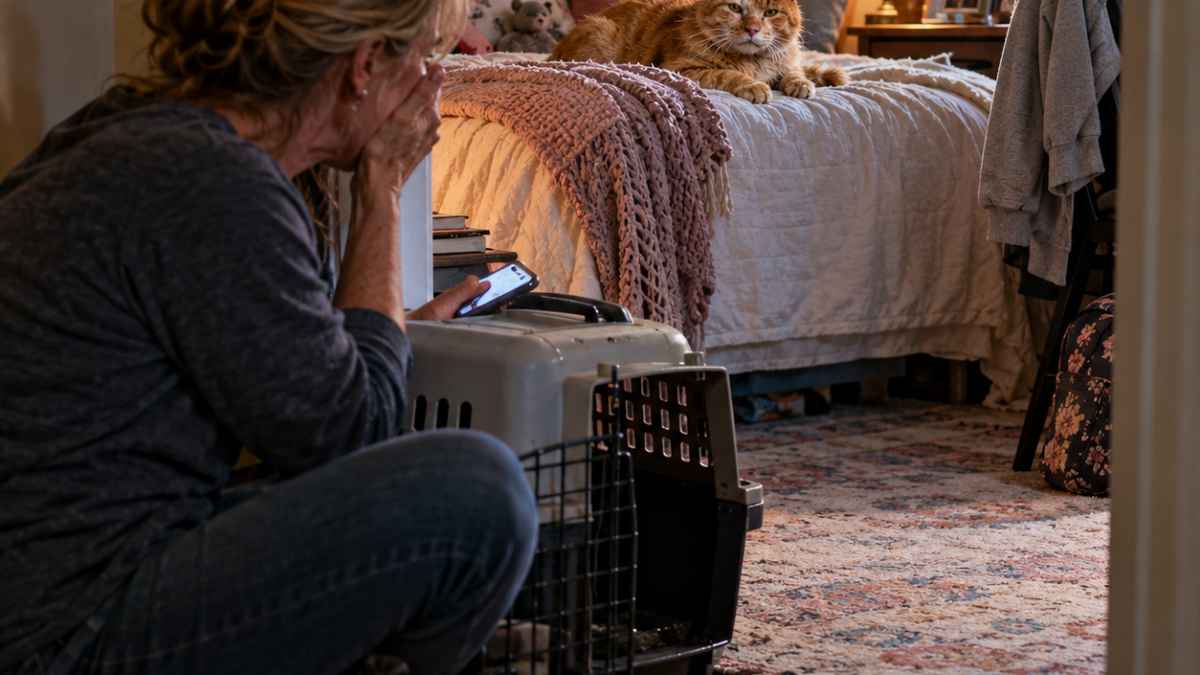
That was when he pushed the carrier door with his head, squeezed out before I had fully unlatched it, landed on the rug, shook one paw like the floor had personally offended him, and limped down the hall.
“Hank.”
He ignored me.
“Hank.”
Nothing.
It is humiliating how quickly a cat can establish that names are decorative.
He went directly to Kayla’s door.
I had not realized until that moment that the latch had never caught properly after the last fight. She slammed the door so hard that night the frame shifted. For eleven months, it had looked closed, but maybe it had only been waiting for one stubborn creature to test it.
Hank pressed his forehead to the edge.
The door opened three inches.
My entire body went cold.
“No,” I said.
He pushed again.
“Hank, no.”
He slipped inside.
I stood frozen in the hallway, one hand still gripping the empty carrier.
He jumped onto her bed.
Turned twice.
Lay down.
And claimed the center of the room I had been afraid to enter.
Then my phone buzzed.
The sound nearly made me drop the carrier.
I looked at the screen.
Kayla.
For several seconds, all I could do was stare at her name.
It had been three weeks since her last text.
That one had said: Did my W-2 come there?
Before that: Can you send me a pic of my insurance card?
Before that: Please don’t call Jessie’s mom looking for me. I’m fine.
Fine.
That ugly little family word.
I opened the new message.
Can I come by tonight and grab the rest of my stuff?
I sat down right there on the hallway floor.
The cat lifted his head and looked at me like, Well? You gonna keep hiding forever?
My daughter, Kayla, was nineteen when she left.
Too old to be treated like a child, too young to be carrying the kind of fear she had in her face all the time.
That is one of the things I understand better now.
Nineteen is not grown.
Not really.
At nineteen, the law says one thing and the heart says another. You can sign a lease, work late shifts, open a credit card, leave home, ruin your sleep, break your own heart, and still need someone to notice when your hands are shaking.
Kayla had been shaking for months before she left.
I told myself it was attitude.
Stress.
Poor sleep.
Too much phone.
Too many hours at the diner.
Too much time with Jessie, whose mother let young people treat her house like a bus station.
I told myself many things because the truth frightened me.
Kayla was drowning.
And I was standing on shore shouting instructions.
We had fought about college first.
She started community college the previous fall, part-time, because that was what we could afford. I had wanted more for her. That phrase—more for her—became my excuse for saying things in a way that hurt.
“You’re smarter than this.”
“You can’t just quit when it gets hard.”
“Do you want to spend your life waiting tables?”
“Your father would have wanted you to finish.”
That last one was the worst.
I knew it when I said it.
But fear makes thieves of us. It steals gentleness first.
Her father, Marcus, died when she was nine.
Heart defect nobody knew about. One minute he was fixing the garbage disposal while Kayla sat at the kitchen table drawing a horse with six legs, and the next, he was on the floor and I was screaming into a phone.
After he died, the whole world became math.
Mortgage.
Insurance.
Electricity.
School clothes.
Car repairs.
Dental bills.
How many hours I could work before Kayla started looking at me like I had moved out while still sleeping in the house.
I became practical because practical kept us fed.
I became strict because strict felt safer than chaos.
I became hard in all the places I was afraid to be soft.
And Kayla grew up inside the weather of my fear.
She was a good kid.
That is another thing people forget when they hear a daughter left home after a fight. They imagine rebellion. Drugs. Some dramatic disrespect. Kayla was not like that. She was tired. She was anxious. She cried in the shower because she thought I couldn’t hear the water change when her breathing broke.
She dropped two classes in March and did not tell me for three weeks.
When I found out, I reacted like the roof had caved in.
Maybe it had, in my mind.
I saw debt, lost scholarships, dead-end jobs, my daughter trapped in the same exhausted life I had been fighting to spare her from. I did not see a nineteen-year-old girl who had been working closing shifts, failing algebra, and sleeping four hours a night.
“You lied to me,” I said.
She stood in the kitchen, pale and still wearing her diner shirt.
“I didn’t lie. I just didn’t tell you yet.”
“That is lying.”
“I was going to fix it.”
“How? By pretending?”
Her face changed. “You think I’m stupid.”
“I did not say that.”
“You never have to.”
That should have stopped me.
It didn’t.
The months after that turned our house into a place where love came out sounding like accusation.
I asked if she had gone to class, and she heard, You’re failing again.
I asked if she had paid her car insurance, and she heard, You can’t handle your life.
I asked why she was home late, and she heard, You are becoming someone I don’t respect.
Sometimes she was wrong.
Sometimes she was not.
The last fight started with a stack of unpaid bills.
I found them in the drawer of her nightstand while looking for a library card she said she had left there. That is what I told myself, anyway. The truth is, I had been snooping for weeks in tiny, shameful ways. Looking for signs. Looking for proof of trouble. Looking for control.
The bills were from a clinic.
Three visits.
Two payment reminders.
One final notice.
My first feeling was not concern.
It was fear.
Then anger, which is fear that found a weapon.
Kayla came home at 10:40 that night, smelling like fryer oil and rain, hair pulled into a messy bun, shoulders sagging.
I was waiting in the living room with the envelopes on the coffee table.
Her face went still when she saw them.
“You went through my room?”
“You didn’t pay these.”
“You went through my room?”
“Kayla.”
“No.” Her voice rose. “Answer me.”
“I was looking for—”
“You went through my room.”
I should have apologized.
Right there.
I should have said, Yes. I was scared. I crossed a line. I’m sorry.
Instead, I pointed to the bills.
“What are these for?”
She stared at me.
“Anxiety meds,” she said.
The words hit the room and did not move.
I had known she was anxious.
Of course I had.
But knowing is different from seeing a bill with your daughter’s name on it and realizing she had gone somewhere alone to ask for help she did not believe she could ask from you.
“Why didn’t you tell me?”
She laughed.
Not because anything was funny.
Because the question was too large to answer safely.
“Seriously?”
“I’m your mother.”
“I know.”
“You should have told me.”
“You would have made it about school.”
“I would not have.”
“You would have made that face.”
“What face?”
“The one you’re making right now.”
I did not know what my face looked like.
Afraid, probably.
Disappointed, maybe.
Worst of all, guilty.
“You’re nineteen,” I said. “You can’t just hide medical bills.”
“I was handling it.”
“By not paying?”
“I didn’t have enough!”
“Because you cut your hours last month.”
“Because I couldn’t breathe, Mom!”
The words tore out of her.
Silence followed.
I remember the refrigerator clicking on. The rain tapping against the living room window. The way Kayla’s hands shook as she pushed hair out of her face.
“I couldn’t breathe,” she repeated, quieter. “I kept crying at work. I kept forgetting orders. I got dizzy in class. I thought maybe if I got help, I could fix it before you found out and looked at me like this.”
I stood there with those bills in my hand.
My daughter was telling me she had been drowning.
I asked about money.
“How much do you owe?”
Her face closed.
That fast.
That completely.
I watched the door inside her slam.
“You don’t love me,” she said.
“Don’t be dramatic.”
God forgive me.
That is what I said.
Don’t be dramatic.
Her face changed in a way I had never seen before.
It was not anger.
It was defeat.
“You don’t love me,” she said again, but softer now. “You love the version of me that makes you feel less scared.”
That one landed.
Because I knew exactly what she meant.
She grabbed her keys from the bowl near the door.
“Kayla, wait.”
“No.”
“It’s late.”
“I don’t care.”
“You are not driving upset.”
She turned around in the doorway.
“You don’t get to control how I leave too.”
Then she walked out.
I followed as far as the kitchen sink.
That is the detail I hate most.
I did not run after her.
I did not step onto the porch.
I stood at the kitchen sink with both hands gripping the counter, pretending I was too angry to cry while her car started in the driveway.
Tires on wet pavement.
Headlights sweeping across the curtains.
Then gone.
For eleven months, her room stayed shut.
At first, I told myself I was respecting her privacy.
Then I told myself she would come back soon and I wanted things unchanged.
Then I stopped giving the lie a name.
Some nights I stood outside her door and touched the knob.
Never turned it.
I texted practical things.
Mail.
Insurance.
Tax forms.
Her winter coat.
She answered with practical replies.
Thanks.
Okay.
I’ll grab it later.
She moved in with Jessie, then into a room above a garage rented by a woman from the diner. I hated that room without ever seeing it. I imagined bad wiring, thin walls, strange men coming and going, my daughter eating noodles out of Styrofoam cups.
I also imagined her happier there.
That was the thought I could not bear.
Now, on the hallway floor, Hank watching me from Kayla’s bed, her text open in my hand, I typed:
Yes. Come by whenever.
I stared at the message before sending it.
It sounded too casual.
Too cold.
Too small for eleven months.
I added:
I’ll be home.
Still not enough.
I added:
Drive safe.
Then I deleted that because it sounded like control.
I typed:
I’d like to see you.
Then deleted it because need felt dangerous.
Finally, I sent only:
Yes. Come by whenever.
Cowardice often looks like restraint from the outside.
I stood slowly.
My knees ached.
Hank stretched on Kayla’s comforter, extending his claws just enough to make me gasp.
“Don’t you dare.”
He yawned.
“I should throw you out.”
He rolled slightly onto one side, showing no fear of consequences.
I stepped into Kayla’s room for the first time in almost a year.
The air smelled faintly stale, with a trace of her old vanilla body spray still clinging somewhere beneath dust. The room looked both exactly as she left it and impossibly changed by her absence. Her faded blue hoodie hung over the chair. Makeup brushes stood in a chipped mug on the desk. A stack of textbooks leaned near the closet. The string lights above the window had one bulb out. On the dresser sat a framed photo from eighth grade: Kayla with braces, one arm around me, both of us laughing at something outside the frame.
I picked it up.
My hands shook.
In the picture, I looked younger. Not just in my face. In my whole body. Unafraid of what life would cost us. Kayla had cake frosting on her chin because the photo was taken at her thirteenth birthday. Marcus had already been gone four years, but we had still managed joy that day. A backyard party. Cheap balloons. A homemade cake that leaned slightly to one side. Kayla had blown out candles and wished for a dog. I gave her earrings instead because dogs cost money.
Now I stood in that same child’s abandoned room while a shelter cat cleaned one paw on her bed like he had been appointed executor of the estate.
“You don’t belong in here,” I told him.
Hank paused and looked at me.
Neither do you, his face seemed to say.
I sat on the edge of the bed.
The mattress dipped.
Hank did not move away.
That small mercy almost broke me.
At seven-thirty, I heard her car.
My whole body tightened.
Not metaphorically.
Every muscle seemed to brace at once, as if I were about to be struck.
I walked to the front door before she knocked, then forced myself to wait. Opening it too quickly would look desperate. Waiting too long would look cold. Motherhood, after a certain kind of rupture, becomes a series of calculations nobody teaches you.
She knocked.
Three soft taps.
I opened the door.
Kayla stood on the porch with an overnight bag slung over one shoulder.
For a moment, neither of us spoke.
She looked older.
Not in years.
Older in the tired way. The way people look when life has been teaching them things they did not ask to learn.
Her hair was shorter, cut just below her chin. She wore jeans, a gray sweatshirt, and black work shoes. There were faint shadows under her eyes. A small silver hoop pierced one nostril. I noticed it immediately and forced myself not to react.
“Hi, Mom.”
“Hi.”
That was it.
No hug.
No smile.
Just two people who had once shared cereal on the couch and now stood like strangers at the edge of a driveway conversation.
“Come in,” I said.
She stepped inside.
Her eyes moved around the living room quickly, cataloging changes and sameness. The same couch. Same lamp. Same stain on the rug from when she spilled nail polish at fifteen and cried because she thought I’d be furious. I had been furious. Then I saw her face and laughed. We covered it with a plant for two years.
Her gaze shifted down the hall.
She saw her bedroom door open.
Her body went still.
“You opened my room?”
“I didn’t.”
Her eyes flicked to me.
Then to the doorway.
Hank was still on her bed.
Still in the center.
Still acting like tenancy had been legally transferred.
Kayla’s face changed.
Not dramatically.
No crying. No gasp. Just a small softening around her mouth, and that bright look in her eyes that comes before tears when someone is trying hard not to let them fall.
“I got a cat,” I said, because apparently my mouth had chosen the stupidest possible explanation.
“I see that.”
“He opened it.”
“The cat opened my room.”
“Yes.”
She looked at him.
Hank looked back at her with the weary confidence of someone accustomed to emotional incompetence in humans.
For the first time that night, Kayla almost smiled.
Almost.
“That’s new.”
“I brought him home today.”
“Of course you did.”
“I didn’t plan it.”
“You never do when it counts.”
The words were not cruel.
But they were not nothing.
I accepted them.
“His name is Hank.”
“He looks like he sells fake IDs behind a bowling alley.”
A laugh startled out of me.
Kayla’s mouth twitched.
For half a second, there we were.
Then we remembered ourselves.
“I just need some clothes,” she said.
“Of course.”
We walked down the hall together.
Careful with each other.
That is the best way I can describe it. We moved like people carrying hot coffee in both hands. No sudden motions. No unnecessary contact. Every word chosen and still dangerous.
At the bedroom door, Kayla stopped.
I could feel her beside me, taking in the room.
The bed.
The hoodie.
The desk.
The life paused by anger.
“I didn’t think it would look the same,” she said.
“I didn’t change anything.”
“I know.”
That answer held more than I understood.
Hank stood, stretched luxuriously, jumped down, and disappeared under the bed.
“No,” I said. “Absolutely not.”
Kayla dropped her bag. “Is he supposed to be in here?”
“No.”
“Does he know that?”
“He knows nothing and respects less.”
She knelt and lifted the comforter.
I crouched beside her.
Suddenly we were both on the floor, peering into the darkness under the bed like fools.
Hank stared back with glowing eyes.
“Come here,” Kayla said softly.
He did not move.
“Wow,” she murmured. “He’s very committed to the bit.”
“He hates being picked up.”
“Smart.”
I glanced at her.
She kept looking under the bed.
A strand of hair fell across her cheek.
When she was little, I used to tuck her hair behind her ear when she concentrated. I almost did it then. My hand twitched before I stopped myself.
Mothers of estranged daughters learn to fear their own tenderness.
Kayla reached farther under the bed and froze.
“What?”
“There’s something in the drawer.”
My stomach dropped.
The bottom drawer of her nightstand sat half-open, probably pushed by Hank during his unlawful inspection. Kayla pulled it wider and reached inside.
She took out a stack of envelopes tied with a rubber band.
White envelopes.
Pink sticky notes.
Blue stationery from a box I bought at the dollar store because writing on plain paper made my apologies feel too naked.
She sat back on her heels.
“What are these?”
I did not answer.
She looked at the top envelope.
Kayla — October 14
Another.
Kayla — Thanksgiving
Another.
Kayla — I almost called tonight
Her face changed.
“They’re letters,” I said.
“I can see that.”
“I wrote them when I didn’t know what to say out loud.”
She held the stack like it might break.
“You never mailed them.”
“No.”
“Why?”
Because I was afraid.
Because I was proud.
Because apology in an envelope can be rejected.
Because it was easier to grieve you privately than risk hearing that you did not miss me.
Because I had spent your childhood teaching you to be brave while never learning how to do it myself.
“I don’t have a good answer,” I said.
That was the first honest thing I gave her that night.
She looked down at the envelopes.
“How many are there?”
“Thirty-seven.”
Her head lifted.
“What?”
“I counted once. Then felt pathetic and stopped writing for two weeks.”
She almost smiled again, but this time it broke before it formed.
“Can I read one?”
My chest tightened.
“Now?”
“Do you not want me to?”
“No, I do. I just…” I looked toward the hallway. “They’re not polished.”
“Good.”
She opened the envelope marked I almost called tonight.
I knew that one.
I had written it in December, after seeing a young woman at the grocery store wearing Kayla’s old high school sweatshirt. I followed her down two aisles before realizing she was a stranger. Then I went home and wrote four pages at the kitchen table.
Kayla unfolded the paper.
I watched her eyes move across the first lines.
My dear girl,
I almost called you tonight because I saw someone buy marshmallows and remembered how you used to eat all the mini ones out of the hot chocolate mix. I got mad every winter and bought more every winter. I don’t know what to do with all the small memories now. They don’t seem to understand that you moved out.
Kayla’s mouth tightened.
She kept reading.
I am trying to tell myself you are safer away from me right now. That is the only thought that lets me sleep. But I need you to know I am not angry in the way you probably think. I am scared. I have been scared since your father died. I think I mistook fear for love so many times that I taught you to hear them as the same thing.
Her hand went to her mouth.
I looked away because watching her read my shame felt both necessary and unbearable.
When she finished the first page, she lowered it.
“You knew?”
I swallowed.
“Not at first.”
“But when you wrote this.”
“Yes.”
“You knew what I meant.”
“Yes.”
She closed her eyes.
“Why didn’t you say it?”
“I didn’t know how to say it without asking you to comfort me.”
That made her look at me.
“And I had already asked too much of you.”
Silence.
From under the bed came the sound of Hank scratching at something, possibly my dignity.
Kayla sat back against the bed frame.
“I almost came home three times,” she said.
The room seemed to tilt.
“What?”
She shrugged, but her chin trembled.
“I’d drive here after work sometimes. Sit in the parking lot by the corner. Once I made it to the driveway.”
I remembered a night in January when I thought I heard a car slow outside.
“You did?”
“Yeah.” Her voice dropped. “Then I’d leave.”
“Why?”
“Because I was scared we’d just do the same thing again.”
That hurt because it was true.
“I was too,” I said.
She picked at the corner of the envelope.
“I wanted you to call.”
“I wanted you to answer.”
“I would have.”
“I didn’t know that.”
“I didn’t either.”
We sat there surrounded by the remains of a girlhood neither of us knew how to touch.
Then Kayla whispered, “I was so mad at you.”
“I know.”
“No, I mean…” She pressed both hands to her face for a second, then lowered them. “I wanted you to suffer. At first. I wanted you to stand in this house and feel what it was like without me because I felt like you only noticed me when I messed up.”
I nodded.
It was the kind of truth that deserved room.
“Then I felt guilty for wanting that. Then I was mad again because I was guilty.”
“That sounds exhausting.”
“It was.” She laughed once, bitter and small. “Everything was.”
I looked at my daughter’s hands.
Her nails were short. Cuticles rough. A small burn mark crossed one finger.
“You’re still at the diner?”
“Mostly. I picked up shifts at the pharmacy too.”
“The pharmacy?”
“Stocking. Not glamorous.”
“I wasn’t going to say—”
She looked at me.
I stopped.
“I was going to ask if you’re sleeping.”
Her face softened a fraction. “Some.”
“Eating?”
“Mom.”
“Sorry.”
“No, I…” She exhaled. “Some.”
That single word held months of cheap meals and skipped breakfasts.
I wanted to reach for her.
I did not.
“I’m sorry,” I said.
She stared at the envelope.
“I don’t mean generally,” I continued. “I mean specifically. I’m sorry I went through your room. I’m sorry I made your medical bills about my fear instead of your pain. I’m sorry I used your father’s memory like a weapon when I was scared. I’m sorry I made this house feel like a place where you had to prove you were okay before you could be loved.”
Tears slipped down her face.
She did not wipe them.
I kept going because stopping felt like cowardice now.
“I was scared all the time, Kayla. Scared of losing the house. Scared of failing you. Scared you’d end up exhausted like me. Scared if I loosened my grip even a little, the world would swallow you. But instead of telling you that, I handed the fear to you and called it guidance.”
She covered her mouth.
“I know I was trying,” I said. “But trying is not the same as not hurting you.”
That was when she broke.
Not loudly.
Kayla had never been a loud crier.
Her shoulders folded inward, and the tears came hard and silent at first, then with small gasping breaths like she was trying to apologize for needing air.
“I couldn’t breathe here,” she said.
“I know.”
“I loved you, but I couldn’t breathe.”
“I know.”
“No, I need you to know.”
“I do.”
“I kept thinking if I could just get better, you’d stop looking scared.”
That sentence went through me clean.
I moved then.
Slowly.
Not grabbing.
Not assuming.
I opened my arms the smallest amount.
Kayla looked at me like she did not know whether she wanted to enter them or run.
Then Hank crawled out from under the bed.
He did not come gracefully.
His back half emerged first, dust on his whiskers, one sock caught briefly around his hind leg before he kicked it loose with deep offense. He stepped between us, looked at Kayla, looked at me, and sat down directly between our knees.
Like a referee calling a truce.
Kayla stared at him.
Then she laughed.
It came out wet and broken and surprised.
I laughed too.
Then I cried.
Then she did.
There was nothing pretty about it.
No music.
No perfect words.
Just a middle-aged woman and her tired nineteen-year-old daughter sitting on the floor of a room neither had known how to enter, laughing and crying around an old orange cat who looked mildly annoyed that healing involved so much moisture.
Eventually Kayla leaned into me.
Not fully at first.
Just her shoulder against mine.
I held still, terrified that even my relief might become pressure.
Then she put her head on my shoulder.
I wrapped one arm around her.
She smelled like fryer oil, lavender shampoo, and rain.
My daughter.
My impossible, wounded, living daughter.
“I missed you,” I whispered.
She shook against me.
“I missed you too.”
Hank began washing his paw.
A creature of priorities.
That night, she did not move back in.
Life does not fix itself that fast.
People want reconciliation to behave like a slammed door reopening in a movie: one speech, one hug, one swelling moment where all the pain transforms into wisdom. Real repair is slower. Awkward. Repetitive. Full of opportunities to ruin it again.
Kayla stayed for coffee.
At ten at night.
Because neither of us knew what else to call sitting at the kitchen table with mugs between us, trying not to be strangers.
She told me about Jessie’s house.
About the room above the garage.
About the pharmacy job.
About how she had gone back to therapy twice, then stopped because the copay was too much.
I wrote that down.
She stiffened.
“I’m not making a list to control you,” I said quickly. “I’m making a list because I can help with copays.”
“I don’t want you paying for everything.”
“I don’t want you going without medical care because you’re trying to prove you don’t need me.”
She looked down.
“That sounded like pressure?”
“A little.”
“Okay.” I folded the paper and pushed it aside. “Then let me say it differently. If you want help with copays, I can help. No speech. No conditions. No comments about school.”
She looked at me for a long moment.
“Okay.”
That one word felt larger than forgiveness.
When she left after midnight, she paused at the door.
“I’ll come back this weekend.”
I nodded, trying to keep my face from becoming too much.
“I’d like that.”
She looked toward the hallway.
“Take care of Hank.”
“He seems to think he’s taking care of us.”
She smiled.
A real one.
Small, but real.
Then she stepped onto the porch.
“Mom?”
“Yes?”
“I don’t want my room packed up yet.”
My throat closed.
“Okay.”
“But I might take some stuff next time.”
“Okay.”
“And I don’t know if I’m coming back here. Like, to live.”
“I know.”
Her eyes searched my face, as if looking for the hook hidden in my answer.
I gave her none.
“I want you safe,” I said. “And I want you free. I’m trying to learn both can be true.”
She nodded.
Then she left.
Hank was on her bed again before she backed out of the driveway.
Like he knew some homes don’t need a miracle.
Just one stubborn creature brave enough to walk into the room everyone else is afraid to enter.
Kayla came back that weekend.
And the weekend after that.
At first, she came for things.
A sweater.
A box of books.
Her good boots.
The small desk fan.
Then she came because Hank had, according to her, “joint custody issues.”
She brought him treats.
He accepted them with suspicion and ate them behind the laundry basket.
She sat on her bed while he sat two feet away pretending not to care.
I made coffee.
We talked in short, careful sections.
Twenty minutes before the old patterns approached.
Then an hour.
Then one Sunday afternoon, three hours passed without either of us flinching.
We made rules.
Not formal ones.
Not written.
But spoken.
I would not ask about school unless she brought it up.
She would tell me if she was in trouble before the trouble became a locked drawer.
I would not use Marcus’s name to win arguments.
She would not disappear for weeks without at least texting that she was alive.
I would ask, “Do you want advice or listening?”
She would try to answer honestly.
We both failed.
Often.
Repair is not the absence of failure.
It is the decision to return after the failure and do the next conversation better.
Hank became the unofficial supervisor of this work.
If voices rose, he left the room with visible disgust.
If Kayla cried, he sat on her feet.
If I cried, he stared at me from across the room like he had not signed up for this but understood duty.
One evening, after Kayla snapped at me for asking about her rent and I snapped back that I was “just trying to help,” Hank jumped onto the kitchen table, knocked over a stack of mail, and sat on the unpaid electric bill.
Kayla stared.
I stared.
Then Kayla said, “He’s unionizing.”
I laughed so hard I had to sit down.
So did she.
Argument over.
Not solved.
Interrupted.
Sometimes interruption is grace.
In January, Kayla moved out of the garage room.
Not back home.
Into a small basement apartment with two other girls from work. I hated the place on sight. Low ceiling. Weird smell. One tiny window. A landlord named Gary who seemed overly proud of owning a clipboard.
I almost said no.
As if I had veto power.
Kayla watched my face.
I took a breath.
“Do you feel safe here?”
She looked surprised.
Then she nodded. “Yes.”
“Do you need help checking the lease?”
“Yes.”
“Okay.”
That was growth.
Not perfect.
But real.
We sat at a cracked kitchen counter in that basement apartment and read the lease together. I pointed out a clause about repairs. She pointed out that my purse was sitting in something sticky. We argued briefly about renter’s insurance, then I backed off and texted her a link instead of making a speech.
When I left, I cried in my car.
Not because she was leaving again.
Because this time, she was not escaping.
She was moving.
There is a difference.
Hank adjusted poorly to Kayla’s reduced visits.
He started sleeping in her room almost every night.
I stopped calling it Kayla’s room out loud, but in my mind, it remained hers. The bed stayed made. The hoodie remained on the chair until one afternoon she picked it up, smelled it, wrinkled her nose, and said, “Why does this smell like memory and dust?”
“Poetry has ruined you.”
“It smells like a ghost’s armpit.”
“Better.”
She took it home.
I cried after she left.
Hank watched from the bed.
“Don’t judge me,” I told him.
He blinked one slow, damning blink.
By spring, Kayla had started classes again.
One class.
Intro to psychology.
Online.
She told me in a text, not in person, which was probably easier for both of us.
Don’t make a big thing out of it.
I wrote back:
I am making a medium thing privately.
She replied:
That’s acceptable.
I made a large thing privately.
I took myself to the grocery store and bought a cake too big for one person. Then I ate one slice and sent the rest home with my neighbor because celebration, like grief, can become too heavy when held alone.
Kayla did well in the class.
Not perfectly.
She missed one assignment after a double shift and called me crying because she thought that meant she was “doing it again.”
I almost launched into solutions.
Email the professor.
Check the syllabus.
Make a plan.
Instead, I asked, “Advice or listening?”
There was a long pause.
“Listening.”
So I listened.
It was excruciating.
Do you know how hard it is to hear your child panic and not immediately begin constructing a ladder? It goes against every instinct. But sometimes a ladder thrown too fast feels like proof you think they cannot climb.
So I sat on the phone while she cried.
Hank sat beside me on the couch, his bad ear angled toward the sound of her voice.
When she finally quieted, she said, “Okay. I think I know what to do.”
“What?”
“I’m going to email the professor.”
I looked at Hank.
He looked at me.
We said nothing.
Progress sometimes looks like shutting up.
In June, Hank got sick.
It started with appetite.
It always starts with something small.
He left half his breakfast. Then all of it. He stopped jumping onto Kayla’s bed and slept under it instead. His limp worsened. He began drinking more water. I told myself it was the heat. Then age. Then stress. Then I stopped lying and took him to Dr. Nguyen.
Kidneys.
Early failure, she said.
Manageable for now, she said.
For now.
Veterinarians are kind people forced to use terrible phrases.
We started fluids twice a week. Special food. Medication.
Hank objected violently to all of it except the special food, which he liked for four days and then rejected as if betrayed by its continued existence.
Kayla came over to help with fluids.
The first time, we both ended up sweaty, scratched, and emotionally defeated while Hank hid under the dining table radiating triumph.
“This cat survived the streets,” Kayla said, pressing a cotton ball to a scratch on her wrist. “You think he fears medical advice?”
“We need a strategy.”
“We need armor.”
Eventually, we learned.
Warm the fluids.
Towel on the table.
Treats before and after.
No sudden movements.
Kayla held him. I managed the line.
Sometimes he tolerated it.
Sometimes he made it clear we were peasants.
But he felt better afterward.
That was what mattered.
That summer became a strange, tender season.
Kayla came every Tuesday and Friday for Hank’s fluids. Sometimes she brought laundry. Sometimes homework. Sometimes takeout. Sometimes nothing but her exhausted body and a willingness to sit on the couch beside me while Hank recovered his dignity.
We talked more honestly in those months than we ever had before.
Maybe because caring for a sick animal gives people something to do with their hands while truths enter the room.
She told me she had once slept in her car behind the diner because she was too tired to drive and too ashamed to call me.
I told her I had driven past the diner twice after she left but never stopped because I was afraid she would hate me for it.
She told me she thought I blamed her for making life harder after her dad died.
I told her the truth: that I had never blamed her, but I had often treated her needs like emergencies I resented because I was already drowning.
That was a hard sentence.
It deserved to be hard.
She told me she remembered the night Marcus died more than I realized.
“I remember you screaming,” she said quietly. “I remember hiding under the table. I remember thinking if I stayed quiet, maybe I wouldn’t make things worse.”
I had never known that.
Or maybe I had refused to know.
“I’m sorry,” I said.
“You didn’t kill him, Mom.”
“No. But I think after he died, I made you feel like your fear was one more bill I couldn’t pay.”
She cried then.
So did I.
Hank, who had just received fluids and should have been resting, limped between us and bit the corner of a napkin.
“Emotional support goblin,” Kayla whispered.
That became one of his names.
Hank accumulated names the way old cats accumulate grudges.
Hank.
Henry when he was dignified.
Goblin when he was not.
Mr. H when Kayla wanted him to sound like a retired math teacher.
Orange Management when he sat on important papers.
The Furry Landlord when he occupied Kayla’s bed.
But to me, privately, he became Door.
Because that was what he had been.
A door opener.
A room breaker.
A grief trespasser.
The one who entered the place I could not enter and showed us both there was still air inside.
In September, Kayla turned twenty-one.
We had dinner at my house.
Not a party.
Just dinner.
She brought a friend from work named Maya, who had a loud laugh and kind eyes. Eli drove in from Ohio with my granddaughter Rosie, who was now eight and immediately fell in love with Hank because children understand rude animals better than adults do.
Rosie followed him down the hall whispering, “Do you want to be my friend?”
Hank hid under Kayla’s bed.
Rosie lay on the floor and whispered, “That’s okay. I also need breaks from people.”
Kayla looked at me across the hallway.
I lifted one eyebrow.
She whispered, “Did an eight-year-old just out-therapy us?”
“Yes.”
The birthday dinner was imperfect.
The chicken was dry.
Maya spilled soda.
Eli told a story about Kayla at age five trying to mail herself to Disney World, and Kayla pretended to hate it while secretly smiling.
At one point, I looked around the table and felt a terrible, beautiful ache.
This was what I had nearly lost while trying so hard to prevent loss.
After cake, Kayla stood in the kitchen beside me, rinsing plates.
“You know,” she said, “I used to think if I came back, it meant I failed.”
I dried a fork slowly.
“And now?”
“Now I think maybe coming back is just… a thing people can do.”
I looked at her.
She kept her eyes on the sink.
“Not moving back,” she added quickly.
“I know.”
“But coming back. For dinner. For help. For cat medical crimes.”
“For coffee.”
“For coffee.”
I nodded.
“That would be nice.”
She bumped her shoulder gently against mine.
It was the first casual touch she had given me since leaving.
I turned away and pretended to search for a towel because sometimes dignity requires privacy.
Hank declined through the winter.
Not dramatically.
Not at first.
His good days stayed good enough to trick us. He would eat breakfast with enthusiasm, yell at birds through the window, and sleep on Kayla’s bed like a creature certain of his property rights. Then he would have a bad day. Hide. Refuse food. Stare at water as if drinking had become a complex philosophical problem.
Dr. Nguyen adjusted medication.
We monitored.
We hoped.
Hope, I learned, is not always bright.
Sometimes it is a tired little flame you keep cupping with both hands even when you know the wind is coming.
Kayla started coming more often.
She said it was for Hank.
Maybe it was.
Maybe not.
One night in February, snow falling thick outside, she stayed over because the roads were bad. She slept in her old room for the first time since leaving.
I expected the house to feel strange.
It felt right.
Not as if the past had returned.
As if the present had made room.
Around midnight, I heard her crying.
Softly.
I stood outside her door, caught between every version of myself.
The old me would have knocked and asked what was wrong with fear already in my voice.
The newer me almost walked away to give her privacy.
Then Hank made the decision for both of us.
He scratched once at her door from inside.
A raspy command.
I knocked lightly.
“Kayla?”
A pause.
“Yeah?”
“Can I come in?”
Another pause.
“Yeah.”
She was sitting on the bed with Hank beside her, one hand on his back. The room was different now. Some things gone. Some boxes packed. The fairy lights still there, though half no longer worked. The eighth-grade photo remained on the dresser.
“I’m sorry,” she said immediately.
“For crying in your own room?”
She gave a wet laugh.
“I was thinking about Dad.”
I sat carefully on the edge of the bed.
“What about him?”
“I’m forgetting his voice.”
The sentence stole the air from me.
She covered her face.
“I hate saying that.”
I reached for her hand, then stopped.
She took mine.
“I have videos,” I said.
She looked up.
“What?”
“Old ones. On a hard drive. I haven’t watched them in years.”
“Why didn’t you tell me?”
I looked at Hank.
He blinked like he had been waiting for this too.
“Because I thought if I opened that door, I’d fall through it.”
Kayla squeezed my hand.
“I think we’re good at doors.”
“Closing them?”
“Hiding behind them.”
I nodded.
“That too.”
The next day, we found the hard drive in a box in the hall closet labeled Christmas lights, because grief makes organization strange.
We spent the afternoon watching videos of Marcus.
Marcus flipping pancakes badly.
Marcus dancing with Kayla when she was seven.
Marcus singing the wrong words to a song in the car.
Marcus holding the camera too close to his face and saying, “Is this thing on?” like every father in America.
Kayla cried.
I cried.
Hank slept between us on the couch, unimpressed by human archives.
At one point, Marcus on the screen said, “Kayla, tell your mom she worries too much.”
Little Kayla shouted, “Mom worries too much!”
Adult Kayla looked at me.
I looked at her.
Then we both laughed until it hurt.
In March, Hank stopped eating.
Not the occasional refusal.
Not the old-cat negotiation.
Stopped.
Dr. Nguyen came to the house because by then we all understood car rides were cruelty unless necessary.
She examined him on Kayla’s bed.
The bed he had claimed on his first day.
The bed that had become the center of our strange little family repair.
Hank lay on the comforter with his torn ear flattened softly, scarred nose resting on one paw. Kayla sat on one side. I sat on the other. Dr. Nguyen moved gently, listening, touching, watching.
When she finished, she looked at us with that careful kindness that always means pain has become truth.
“I think we’re close,” she said.
Kayla inhaled sharply.
I nodded because my voice had left.
“Maybe days,” Dr. Nguyen continued. “Maybe less. He’s tired.”
Tired.
Such a small word for a body that had carried so much.
Kayla bent over Hank, pressing her forehead near his shoulder but not on him.
“You stupid old man,” she whispered.
His tail moved once.
That made us laugh and cry at the same time.
Dr. Nguyen left us with medication for comfort and instructions for what to watch.
As if we could watch anything else.
That night, Kayla did not go home.
She called Maya from the hallway.
“I’m staying at my mom’s,” she said.
My mom’s.
Not the house.
Not there.
My mom’s.
I stood in the kitchen and let that small phrase undo me privately.
Hank’s last day was gray and rainy.
Of course it was.
Some lives have a sense of narrative whether we ask for it or not.
He spent the morning on Kayla’s bed. Not under it. Not hidden. Right in the center, exactly where he had placed himself the first day, as if completing a circle only he understood.
Kayla sat beside him reading her psychology textbook aloud because she had an exam the next week.
“Classical conditioning,” she read, voice shaking. “Occurs when a neutral stimulus becomes associated with a meaningful stimulus—”
Hank opened one eye.
“I know,” she said. “It’s boring. I didn’t write it.”
I sat in the chair by the window with a cup of coffee gone cold.
The room smelled like rain, old blankets, and the faint medicinal scent of fluids and pills. The fairy lights above the desk glowed even though it was daytime because Kayla had plugged them in that morning without saying why.
At noon, Hank lifted his head.
Looked at Kayla.
Then at me.
Then, with great effort, he stood.
“Hank?” Kayla whispered.
He stepped carefully off the bed using the little stool we had placed there. Walked slowly across the room. Paused at the doorway.
We followed.
He limped down the hall to the front door.
At first, I panicked.
“No, buddy. You can’t go out.”
But he did not scratch.
He sat on the rug by the door and looked back at us.
Kayla covered her mouth.
“He wants the door open.”
It was raining lightly.
Not cold.
Spring rain.
I opened the front door but left the storm door closed.
Fresh air moved into the house.
Hank sat there, smelling rain.
The same hallway he had walked down on his first day.
The same door Kayla had walked out of eleven months before he arrived.
The same threshold where leaving and returning had rewritten us.
Kayla sat on the floor on one side of him.
I sat on the other.
For twenty minutes, we listened to rain.
No speeches.
No dramatic goodbye.
Just the three of us at the open door, breathing the wet air.
When Hank finally stood, he turned away from the door.
Back down the hall.
Back to Kayla’s room.
Back to the bed.
That was when I knew.
Dr. Nguyen came at four.
Kayla and I sat on the bed with Hank between us. I had one hand on his side. Kayla had one hand near his paw. The comforter beneath him was the same one he had claimed on his first day, though now it was covered in orange fur, medication stains, and the history of our return to each other.
Dr. Nguyen explained each step.
Sedation first.
Peace.
No pain.
Hank tolerated the first injection with more dignity than he had ever shown fluids. Slowly, his body relaxed. His head grew heavy against the blanket. His breathing eased.
Kayla sobbed silently.
I held her hand over Hank’s back.
“He brought you home,” I whispered.
She shook her head.
“He brought us both home.”
That was true.
So true it hurt.
I bent close to his scarred face.
“You nosy old landlord,” I whispered. “You walked into the one room I couldn’t enter and acted like you owned the place.”
His whiskers twitched.
“I guess you did.”
The final medicine was quiet.
Hank left like he had lived with us: stubbornly, inconveniently, and on his own terms.
On Kayla’s bed.
In the room he opened.
Between the two people he forced to stop hiding.
Afterward, the silence was unbearable.
Then Kayla crawled into my arms.
Not carefully.
Not halfway.
She broke against me, and I held her while Dr. Nguyen stepped into the hall and gave us the mercy of privacy.
“I don’t want him gone,” Kayla cried.
“I know.”
“It’s not fair.”
“No.”
“He just got us back.”
I closed my eyes.
There are no good answers to that.
Only the truth.
“Maybe that was his job.”
She cried harder.
I did too.
We buried Hank in the backyard beneath the dogwood tree Marcus had planted when Kayla was born.
I had once been afraid that tree would die. For years, it gave only a handful of flowers. Marcus used to say, “Give it time, Liv. Some things bloom late.”
That spring, it bloomed harder than it ever had.
Eli drove in for the burial. Rosie came too and brought a drawing of Hank wearing a crown. Maya came from Kayla’s apartment with flowers. Even Jessie came, standing awkwardly near the fence, older now too in the way young women get older when they’ve housed someone else’s grief.
Kayla placed Hank’s favorite toy—an ugly felt mouse he never played with but always slept near—into the small box beside him.
I placed one of the letters I had written and never mailed.
The one from December.
The one where I first admitted fear had been wearing love’s clothes.
Kayla saw me do it.
She did not stop me.
Afterward, she placed a small wooden marker in the ground. She had made it herself, burning the letters unevenly with a cheap craft kit.
HANK
HE OPENED THE DOOR.
Under that, in smaller letters:
RUDELY, BUT EFFECTIVELY.
I laughed through tears when I saw it.
So did everyone else.
It was perfect.
Kayla did not move back home.
That is important.
This is not that kind of story.
She kept her basement apartment for another year, then moved into a better place with actual windows. She finished one class, then two. Not quickly. Not perfectly. But honestly. She became a veterinary receptionist first, then went back for a certification program. She said animals made more sense than people.
I said that was why people needed her.
We kept working.
There were still hard conversations.
Still misunderstandings.
Still days when my fear came out sharp and she withdrew behind silence.
Still days when she heard criticism in questions I meant gently.
But now we had language for it.
Now one of us could say, “This is starting to feel like before.”
And the other could stop.
Not always immediately.
But sooner.
Every year, on the day Hank broke into her room, Kayla comes over for dinner.
We do not call it an anniversary because that sounds too polished.
We call it Trespassing Day.
The first year, she brought orange cupcakes.
The second year, she brought a shelter flyer and said, “Don’t panic, I’m not adopting. I’m just looking.”
She adopted a one-eyed black cat three weeks later.
His name is Milton.
He hates me, which Kayla says proves he has standards.
My house changed too.
Kayla’s room did not become a shrine again.
It became a room that could breathe.
Sometimes she slept there when she came over late. Sometimes Rosie used it when she visited. Sometimes I sat in it with coffee and read. The bedspread changed. The hoodie left. The fairy lights finally came down after half of them died.
But I kept the eighth-grade photo on the dresser.
Beside it sits a framed picture of Hank sprawled across Kayla’s comforter the day he arrived, looking like a furry squatter with no respect for emotional boundaries.
Under the photo, Kayla wrote on a slip of paper:
Some heroes do not knock.
Years later, when people ask how my daughter and I found our way back to each other, I tell them the truth.
A shelter cat broke into her room.
They laugh because it sounds ridiculous.
It was ridiculous.
Healing often is.
We expect healing to arrive with wisdom, maturity, prayer, therapy, or some grand emotional awakening. Sometimes it arrives with a scarred orange cat who ignores every closed door in the house and forces two stubborn women to kneel on the same floor looking under the same bed.
Hank did not fix us.
That would give him too much credit and us too little.
He did not erase the fight, the fear, the unpaid bills, the anxiety, the years after Marcus died, the words I should never have said, the nights Kayla sat in parking lots and drove away.
But he interrupted the silence.
He entered the room.
And sometimes that is where salvation begins.
Not with a miracle.
With an interruption.
With something alive walking straight into the place everyone else has declared too painful.
With a door that was never truly locked, only waiting for someone brave or rude enough to push.
I still miss him.
So does Kayla.
Some nights, when rain taps against the windows and the house smells like coffee and old wood, I imagine I hear the soft thump of him jumping onto her bed. I imagine that torn ear, that scarred nose, that unimpressed squint. I imagine him looking at me like, Well? Are you going to keep learning or not?
I am, Hank.
I am trying.
Kayla is thirty now.
She has laugh lines near her eyes and a steadier voice than she used to. She still works with animals. She still takes too much onto her heart. She still sometimes calls me from her car when life feels too big, and I still sometimes have to ask, “Advice or listening?” before I ruin everything with a plan.
Last month, she came over after a long shift at the clinic, kicked off her shoes by the door, and collapsed on the couch.
“Mom?”
“Yes?”
“I’m tired.”
The old me would have panicked.
Tired meant danger.
Tired meant dropping classes.
Tired meant bills hidden in drawers.
Tired meant losing control.
The new me set down my book.
“Do you want me to make coffee, dinner, or room?”
She turned her head toward me.
“Room.”
So I sat beside her.
No questions.
No fixing.
No fear dressed up as love.
After a while, she put her head on my shoulder.
Just like she had on the floor of her room years before.
And for a few minutes, we were quiet.
Not the old quiet.
Not the punishing quiet.
The good kind.
The kind that means no one is leaving just because nothing is being said.
Outside, rain began to fall.
Inside, Milton ignored me from the armchair.
The house was warm.
The door to Kayla’s old room stood open.
It stays open now.
Not because the pain is gone.
Because hiding from it nearly cost us everything.
And because once, five minutes after I brought home a shelter cat nobody else wanted, he walked straight into that pain, turned twice on my daughter’s bed, and lay down like he knew something we didn’t.
That grief is not a locked room.
That love is not control.
That coming back does not mean failing.
That some doors stay closed for years only because everyone on both sides is waiting for someone else to be brave first.
Hank was not polite.
He was not pretty.
He was not easy.
But he was brave in the way only old, scarred creatures can be brave.
He entered.
He stayed.
He made us follow.
And by the time he left us, my daughter and I had learned the lesson he had been teaching from the beginning:
A home does not heal because nobody leaves.
A home heals when someone finally opens the door and someone else finds the courage to come back through it.

