Five Military K9s Refused Every Vet, Handler, and Specialist at Walter Reed—Then a Quiet Nurse Walked In and All Five Dogs Stood Up for Her.
PART3:
I remember that sentence more clearly than half the things I learned in nursing school.
The handler tried again.
Louder command.
The shepherd flattened.
Dad eventually walked over.
Did not touch the dog.
Did not take the leash.
He simply crouched several feet from the grate.
Waited.
The dog watched him.
Then watched the handler.
Then stepped forward.
One paw.
Stopped.
Dad said nothing.
Another paw.
Eventually the dog crossed.
I asked later:
“What did you do?”
“Nothing.”
“That doesn’t make sense.”
“It will.”
It took me years.
Dad died when I was twenty-six.
Heart attack.
Sudden.
No long illness.
No chance to prepare.
He had just finished repairing a cabinet door.
Called me because he wanted to know whether I planned to come home for Thanksgiving.
I said yes.
We argued about whether he needed to buy a turkey early.
Then two days later I was standing in an emergency department wearing my hospital badge while another nurse told me my father was gone.
There are cruelties specific to working in medicine.
You know what the monitor means.
You know why the physician sits down before speaking.
You know what procedures have already failed by which equipment remains in the room.
Knowledge does not protect you.
It removes the brief mercy of confusion.
After Dad died, I stopped working with dogs.
Completely.
I kept nursing.
I could handle blood.
Grief.
Families.
Combat injuries.
I could tell a twenty-two-year-old Marine that he was going to need another surgery and sit there while he absorbed what that meant.
But dogs?
No.
The smell of training leather.
Metal kennels.
A shepherd’s ears rising when a familiar person entered.
Any of it could take me straight back to my father.
So I did what people in medicine are very good at doing.
I compartmentalized.
Work.
Sleep.
Work.
Coffee.
Books.
Occasionally dinner with friends who stopped asking whether I was dating because my answers were boring.
I became useful.
Quiet people often do.
Nobody looks too closely at the person refilling the supply cart.
That was exactly how I liked it.
The Monday everything changed began at 6:43 a.m.
I know because I bought coffee at the kiosk near the east entrance.
One black.
One with two creams for my coworker Jenna Ruiz, who forgot breakfast every Monday with such consistency that it had become tradition.
“I’m an adult,” she always said.
“Then act like one.”
“Coffee is breakfast.”
“No.”
“Milk.”
“No.”
That morning I carried both cups toward trauma.
The hospital felt different.
Not loud.
Military hospitals are rarely quiet even when nobody speaks.
Wheels.
Elevators.
Phones.
Ventilation.
Shoes.
But there was tension in the movement.
Military police at a corridor I normally used.
Two staff veterinarians moving quickly toward the working-dog wing.
Captain Eric Dawson standing outside an observation room.
I knew Eric.
Not well.
We had crossed paths years before at Fort Bragg when I was supporting a trauma stabilization program.
He was a young handler then.
Twenty-three.
Nervous.
His first working dog had swallowed half a rubber training toy.
I stayed in the veterinary clinic with him for four hours because he refused to leave.
He said:
“He’s my partner.”
I said:
“He ate a rubber ball.”
“He’s an idiot.”
“Still your partner.”
“Yes.”
The dog recovered.
Eric never forgot.
I almost walked past that morning.
Then I felt something.
Being raised around working dogs gives you strange instincts.
Silence can sound wrong.
I looked through the observation glass.
Five dogs.
They sat in different places around a large treatment room.
The oldest, a German Shepherd with silver around the muzzle, faced the main entrance.
Maverick.
Name printed on a service tag.
Near him sat a Belgian Malinois, lean, golden, ears shifting constantly.
Kodiak.
Another shepherd, Echo, kept his gaze toward the floor.
Scout, a younger Malinois, paced three steps forward and three back.
The smallest shepherd stayed near the wall.
Valor.
Five military working dogs.
No barking.
No pulling.
No aggression.
Just watching.
A veterinarian held a treat.
Nothing.
A handler gave a familiar command.
Nothing.
A behavior specialist sat quietly.
Nothing.
Then Maverick looked toward the glass.
At me.
I stopped.
He stood.
Dr. Hannah Foster, lead veterinarian, froze.
“Wait.”
Valor lifted his head.
Then stood.
Echo followed.
Scout stopped pacing.
Kodiak’s weight shifted backward, shoulders lowering for the first time.
I thought they had heard something behind me.
I looked.
Empty corridor.
When I turned back, all five were staring straight at me.
Eric Dawson smiled.
Not surprised.
That irritated me.
He knew something.
I gave the dogs a small smile.
Automatic.
Nothing more.
Maverick took one step toward the glass.
Hospital director Richard Coleman entered the observation area.
Sixty-two.
Silver hair.
Perfectly pressed shirt.
He had managed military medical facilities for nearly forty years and possessed the unique confidence of a man who had survived enough bureaucracy to believe paperwork was a form of combat.
He looked through the glass.
“What changed?”
Dr. Foster said:
“I don’t know.”
Eric looked at me.
I shook my head.
Do not.
His smile widened.
Coleman followed his gaze.
“Who is that?”
I kept walking.
I had patients.
Jenna needed coffee.
Five military dogs were not my responsibility.
Then Eric opened the hallway door.
“Olivia.”
I stopped.
Closed my eyes briefly.
Turned.
“Yes?”
“Can you come here?”
“No.”
Director Coleman raised one eyebrow.
Eric laughed.
“Please.”
“I work in trauma.”
“We know.”
“My shift starts in six minutes.”
“We need five.”
“Then find someone else.”
Eric looked through the glass.
Maverick remained standing.
Then back at me.
“They already did.”
I hated that.
Mostly because I understood.
I walked over.
Coleman studied my badge.
“Olivia Bennett?”
“Yes, sir.”
“Trauma nurse?”
“Yes.”
“You know these dogs?”
“No.”
“They know you?”
“No.”
“Then why did every one of them change behavior when you appeared?”
I glanced through the window.
“They didn’t.”
Dr. Foster said:
“They did.”
“Coincidence.”
“Maverick hadn’t moved in forty minutes.”
“Maybe his leg fell asleep.”
Eric almost laughed.
Coleman did not.
He asked:
“Do you have K9 experience?”
I looked at Eric.
He knew better.
Some histories belong to the person who lived them.
He said nothing.
Good.
“Some.”
“How much is some?”
“Enough to know five tired dogs don’t need twenty people staring at them through glass.”
Everyone became aware they were doing exactly that.
Coleman looked around.
Then:
“What do they need?”
I looked again.
Maverick facing the door.
Kodiak monitoring everyone.
Echo withdrawn.
Scout restless.
Valor trying to disappear.
Five dogs physically present in Maryland.
Five nervous systems somewhere else.
“What happened to their handlers?”
Eric answered.
“Three are still overseas.”
“Two?”
Silence.
That told me.
“Dead?”
One.
Another medically evacuated and not returning to duty.
I looked at Echo.
“Which?”
Eric’s voice softened.
“Echo lost his handler.”
Of course.
“And these five served together?”
“Yes.”
“How long?”
“Most of the last eighteen months.”
“What are you trying to do?”
“Initial exams.”
“Why?”
“Dehydration, weight loss, stress, refusal to eat. We need baseline work before transfer to rehabilitation.”
“They’re not refusing medicine.”
Dr. Foster nodded.
“I know.”
“They’re refusing people.”
Director Coleman crossed his arms.
“That distinction has been made.”
I looked at him.
“Then why are you still treating it like noncompliance?”
He wasn’t offended.
To his credit.
“What do you suggest?”
“Fewer people.”
“How many?”
“One veterinarian.”
“One tech.”
“One familiar handler if available.”
Eric raised a hand slightly.
“And?”
I looked at the dogs.
“Stop asking them to perform.”
Coleman frowned.
“We need examinations.”
“You need trust first.”
“How long?”
I shrugged.
“That question is part of the problem.”
People in hospitals hate that answer.
Medicine runs on clocks.
Medication at 0800.
Rounds at nine.
Surgery at eleven.
Animals do not care about schedules.
Neither does fear.
Dr. Foster opened the treatment-room door.
“Will you come in?”
I looked at my watch.
5:58.
Jenna appeared at the end of the hall looking for me.
She saw the scene.
Five dogs.
Director.
Veterinarians.
Then me.
She raised her coffee.
“I’ll cover report.”
Traitor.
I handed her my cup.
“You owe me.”
“Obviously.”
Then I entered.
The room smelled like disinfectant, dog fur, and transport crates.
The moment the door closed, every muscle in my body remembered childhood.
Dad.
Training field.
Leather leads.
Dogs breathing.
For one second, I almost left.
Then Maverick took a step toward me.
Slow.
Careful.
I stopped.
No command.
No name.
No crouching.
Nothing.
He studied me.
I let him.
People often rush trust because silence makes them uncomfortable.
Dogs don’t care whether you’re comfortable.
Maverick moved again.
Two feet.
Stopped.
I turned slightly sideways.
Less direct.
He came close enough to smell my scrub pants.
Then my hand.
I kept it at my side.
His nose touched my knuckles.
One breath.
Two.
I whispered:
“Morning.”
His ears moved.
“Long trip?”
Eric exhaled softly behind me.
Maverick looked toward him.
Then back at me.
I lowered myself into a crouch.
Not easy.
Military hospital floors are designed specifically to punish knees.
I kept one shoulder toward Maverick.
“I’m not going to ask you for anything.”
His gaze shifted.
The line hit me as much as him.
I repeated:
“Nothing.”
Then:
“You’ve done enough.”
Maverick lowered his head.
Not submission.
Release.
A tiny lowering of the neck.
Dr. Foster whispered:
“Oh my God.”
I wanted to tell her not to narrate.
Didn’t.
Maverick stepped forward.
Placed his head beneath my hand.
I touched the thick fur behind his ear.
His entire body softened.
Not collapsed.
Softened.
There is a difference.
Eric said quietly:
“There he is.”
Then Echo stood.
The grieving shepherd.
I could see his handler in everything he did not do.
No scanning.
No anticipation.
Dogs who lose people sometimes keep looking.
Others stop.
Echo had stopped.
He came behind Maverick.
Would not look directly at me.
I didn’t reach.
“Hi, Echo.”
His ear twitched.
“That’s all.”
Scout came next.
Young.
Conflicted.
Tail moved once and stopped like he had caught himself enjoying something.
Kodiak held out longest.
Good dog.
The hardest-working nervous system in the room.
Every door.
Every hand.
Every shift of weight.
He had probably spent months reading threats.
You cannot tell a dog like that to relax.
The word means nothing if the environment still feels like work.
I sat on the floor.
Maverick beside me.
Echo six feet away.
Scout behind Dr. Foster.
Valor still near the wall.
Kodiak watching.
I took a breath.
Then another.
Nobody spoke.
A full minute passed.
Kodiak walked over.
He did not seek affection.
He positioned himself between me and the hallway.
Of course.
“Fine.”
I looked at him.
“You can have security.”
He sat.
Last was Valor.
Three years old.
Smallest.
His dark eyes moved from dog to dog.
Maverick trusted.
Echo had approached.
Scout calmer.
Kodiak stationed.
Valor wanted consensus.
I knew dogs like that.
Young members of a stable team often borrow confidence from older dogs.
I did not call him.
Did not look directly.
Just said:
“No one’s asking you to be brave today.”
Valor’s ears came forward.
He moved.
Slowly.
Crossed the room.
Sat beside Maverick.
Director Coleman watched through the glass.
I later learned that was the moment he asked:
“Who is she?”
Eric said:
“The quiet nurse.”
Dr. Foster started Maverick’s exam.
She moved slowly.
Stethoscope.
Maverick looked at me.
I nodded once.
He allowed it.
Temperature.
Blood draw.
Joint assessment.
No restraint.
Then Kodiak.
Same pattern.
Echo.
Scout.
Valor.
Every time uncertainty rose, one of them looked toward me.
I did nothing dramatic.
No secret commands.
No magic.
I was predictable.
That was enough.
When Dr. Foster finished the fifth examination, she leaned against the counter.
“We’ve been trying since seven-thirty.”
“What time is it?”
“Ten forty-eight.”
My eyes widened.
“I missed half my shift.”
Eric smiled.
“You saved us four sedations.”
“I did not save anything.”
Director Coleman entered.
“I’m not sure the veterinary team agrees.”
I stood.
My legs had gone numb.
“I need to go.”
He looked at me.
“You’re Olivia Bennett.”
“We established that.”
Eric coughed to hide a laugh.
Coleman studied me.
“Who taught you?”
I froze slightly.
Dad.
Training field.
Metal grate.
Never confuse fear with disobedience.
“Someone patient.”
Then I left.
I thought that would be the end.
It wasn’t.
At lunch, I went outside beneath the oak tree behind the east wing.
Sandwich.
Book.
Twenty-eight minutes of silence.
I had read three pages when something pressed against my shoulder.
Maverick.
I nearly dropped the sandwich.
Behind him:
Kodiak.
Echo.
Scout.
Valor.
Three veterinary technicians jogged across the lawn.
“Olivia!”
I stared.
One tech bent over.
“We are so sorry.”
“How?”
“Maverick opened the interior latch.”
I looked at him.
He looked innocent.
“Of course he did.”
The dogs settled around me.
Not random.
Maverick left.
Echo near my shoes.
Scout stretched in the grass.
Kodiak facing outward.
Valor against my knee.
I looked at the technicians.
“You can go.”
“We can’t leave five military dogs with a trauma nurse.”
“Apparently you can.”
One laughed.
I gave Echo a corner of my sandwich.
Then reconsidered.
“No.”
He stared.
“Veterinary diet.”
His expression suggested deep betrayal.
Employees walking past slowed.
Phones came out.
I raised a hand.
“No photos.”
Most respected it.
One didn’t.
That photograph would later cause more attention than I wanted.
Five dogs.
Quiet nurse.
Oak tree.
Peace.
Director Coleman watched from his office.
Captain Dawson joined him.
I didn’t know their conversation until months later.
Coleman asked:
“Have they done that before?”
“With her?”
“Yes.”
Eric nodded.
“Different dogs.”
“What does that mean?”
“Olivia has been around working dogs most of her life.”
“She told me ‘some experience.’”
Eric smiled.
“That sounds like her.”
“Was she military K9 staff?”
“No.”
“Trainer?”
“No.”
“Then what?”
Eric looked toward the lawn.
“She was the nurse handlers asked for when they didn’t trust anybody else with their dogs.”
Coleman said:
“That isn’t an answer.”
“It is if you’ve worked around handlers.”
My history with military working dogs had not been official in the way people expected.
My father started it.
Then nursing created the rest.
During my first overseas military-hospital assignment, a wounded handler named Ben Alvarez arrived after an IED strike.
His dog Ranger had superficial injuries.
Ben had worse.
Multiple fractures.
Internal injuries.
Surgery.
Ranger refused separation.
Hospital policy said the dog belonged with the veterinary unit.
Ben became frantic.
Not angry.
Panicked.
“He won’t understand.”
I stayed beside him.
“Ranger is being treated.”
“No.”
“You need surgery.”
“He doesn’t know that.”
I understood.
Ben believed if Ranger disappeared while he was unconscious, the dog would think he’d abandoned him.
I called everyone I could.
Command.
Veterinary support.
Nursing supervisor.
Eventually we arranged five minutes.
Ranger was brought to the preoperative holding area.
Ben touched his head.
“Down.”
Ranger lay beside the stretcher.
Ben whispered:
“Wait for me.”
Then went to surgery.
Ranger waited.
Eight hours.
I visited him three times.
When Ben woke, his first word was not pain.
“Ranger?”
I said:
“Waiting.”
Ben cried.
That story traveled among handlers.
Not because I did anything heroic.
Because military systems are full of people who have heard “policy says no” when what they need is one person willing to ask why.
After that, handlers occasionally requested me.
Not as a trainer.
As translator between medical logic and the kind of partnership people underestimate if they’ve never trusted their life to an animal.
I helped reunite dogs with recovering handlers when safe.
Sat with dogs whose handlers were in surgery.
Helped veterinary teams recognize when agitation was separation rather than aggression.
Sometimes I did nothing more than sit.
My father would have understood.
I never put it on my résumé as anything special.
It was work.
Then came Sergeant Aaron Mills.
That was the photograph in my drawer.
Aaron was twenty-nine.
Army.
His dog, Rex, was a black-and-tan German Shepherd with a notch in one ear.
Aaron arrived in Germany after a blast.
Critical.
Rex had shrapnel in one shoulder.
I stayed with both.
Aaron lived three days.
On the third evening, command brought Rex to him.
Aaron could no longer speak.
His eyes opened.
Rex put his muzzle against Aaron’s hand.
Aaron died before midnight.
Afterward, Rex refused food.
Snapped at two technicians.
Pressed against the door anytime somebody walked past.
They called me.
I sat outside his kennel for six hours.
Nothing happened.
That is the truth.
No cinematic moment.
He did not crawl into my lap.
He did not suddenly eat.
He simply stopped pacing.
The next morning he drank.
Two days later he took food from his handler team’s sergeant.
Eventually he retired to Aaron’s parents.
His mother sent me photographs for years.
When Dad died shortly after, grief connected the two memories.
Human father.
Dog waiting outside a door.
Everything tangled.
I stopped volunteering around dogs.
Until Maverick looked through that glass.
Director Coleman began reading my personnel file.
That irritated me.
He called me to his office the following afternoon.
I remained standing.
“Sit.”
“I’m on shift.”
“Five minutes.”
“You said that yesterday.”
He almost smiled.
I sat.
He had my file open.
“Thirteen years.”
“Yes.”
“Landstuhl.”
“Yes.”
“Fort Bragg.”
“Yes.”
“Kuwait.”
“Yes.”
“Commendation for casualty stabilization.”
“I was part of a team.”
“Three letters from military working-dog unit commanders.”
I said nothing.
“One says you prevented the unnecessary behavioral euthanasia of a dog named Rex.”
“No.”
He looked up.
“No?”
“I sat outside a kennel.”
“For six hours.”
“Yes.”
“And coordinated his placement with the handler’s family.”
“Other people did most of that.”
Coleman closed the file.
“You seem determined to make yourself invisible.”
“I’m a nurse.”
“Nurses are rarely invisible.”
I stared.
He understood immediately that he had said something stupid.
“Poor choice of words.”
“Yes.”
“Why don’t people here know about this experience?”
“Because my patients don’t need a biography.”
“The dogs did.”
“They needed calm.”
“Provided by you.”
“Could’ve been someone else.”
“But it wasn’t.”
I stood.
“What do you want, sir?”
He leaned back.
“To understand what happened.”
“No mystery.”
“Five highly trained animals refused everyone in that wing.”
“They were exhausted.”
“They accepted you.”
“They made a choice.”
“Why?”
I thought about my father.
“Because I wasn’t trying to make them prove anything.”
He waited.
I explained.
“Everybody in that room had a goal.”
“Examine them.”
“Feed them.”
“Move them.”
“Evaluate them.”
“Completely reasonable goals.”
“But the dogs had spent months responding to goals.”
“Orders.”
“Missions.”
“Movement.”
“Alert.”
“Search.”
“Hold.”
“Release.”
“Transport.”
“Everything someone wanted from them mattered.”
“Then they got here and twenty strangers wanted more.”
“So you wanted nothing.”
“Yes.”
Coleman looked toward his window.
“That’s leadership?”
“No.”
“What is it?”
“Respect.”
He was quiet.
Then:
“I’ve spent forty years telling people leadership means taking responsibility.”
“It does.”
“But yesterday responsibility looked like leaving five animals alone long enough to choose.”
“Yes.”
He nodded.
“You’ve given me something unpleasant to think about.”
“Happy to help.”
I reached the door.
“Olivia.”
I turned.
“Thank you.”
I hated praise.
Not because I’m humble.
Humility is a flattering explanation.
Praise makes me uncomfortable because once people decide you’re unusually good at something, they begin expecting you to do it forever.
Dad used to call that the competence tax.
I said:
“They did the work.”
Then left.
The five dogs remained at Walter Reed for several weeks.
Their recovery was not magical.
That matters.
Online versions later made it sound as if I touched Maverick’s head and trauma evaporated.
No.
Maverick had arthritis and dehydration.
Kodiak had severe hypervigilance and recurring gastrointestinal problems associated with stress.
Echo was grieving.
Scout had lost eight pounds.
Valor showed separation distress whenever Maverick left the room.
They needed veterinary care.
Handlers.
Behavior specialists.
Sleep.
Food.
Time.
I was one piece.
Some mornings went backward.
Echo refused breakfast.
Kodiak barked at a maintenance cart and couldn’t settle for an hour.
Scout tore a blanket.
Valor vomited before an evaluation.
Maverick became restless whenever staff moved him away from the group.
Healing is ugly if you expect a montage.
What changed was that the veterinary staff stopped asking:
How do we make them cooperate?
They started asking:
What are they telling us?
That changed everything.
Dr. Foster began conducting exams in the group room instead of separating them unnecessarily.
Eric helped establish predictable routines.
Lights.
Meals.
Walks.
Same people.
Minimal rotations.
I visited when I could.
Not every hour.
Dependence would not help them.
Sometimes I walked past the observation window without entering.
Maverick watched.
I waved.
Kept walking.
The first time Dr. Foster completed Maverick’s blood draw without me present, she found me later.
“We did it.”
“Good.”
“He looked at the door twice.”
“But stayed.”
“Yes.”
“Better.”
She smiled.
“You really don’t want them attached to you.”
“I want them attached to safety.”
“What’s the difference?”
“Eventually I leave.”
Her smile faded.
She understood.
One dog worried me more than the others.
Echo.
His handler, Staff Sergeant Luis Ortega, had been killed six weeks before the dogs came home.
They had served together five years.
Echo had been present.
He saw the evacuation.
Then Luis never returned.
The military did what the military had to do.
Mission moved.
Personnel shifted.
Dog transferred.
But Echo’s world had one unanswered question.
Where?
One Thursday I found him lying near the treatment-room door.
Everyone else eating.
Echo ignored food.
I sat ten feet away.
Nothing.
Twenty minutes.
Nothing.
Then I placed Luis’s folded handler scarf near him.
Eric had obtained permission.
Echo lifted his head.
Sniffed.
Moved forward.
Pressed his nose into the cloth.
Then made a sound.
Quiet.
Small.
It broke something in me.
I had heard mothers make that sound in hospital corridors.
I stayed.
Echo eventually lay with the scarf between his paws.
Dr. Foster watched through the glass.
She cried.
I did not.
Not then.
I made it to a supply room first.
Closed the door.
Then cried so hard I had to sit on a box of IV tubing.
Jenna found me.
She didn’t ask.
Sat beside me.
Five minutes.
Then:
“Dog?”
“Yes.”
“Dad?”
“Yes.”
“Aaron?”
“Yes.”
She handed me a tissue.
“Everything?”
“Yes.”
“Okay.”
That is why nurses survive nursing.
Sometimes somebody knows not to fix you.
The next morning Echo ate.
Not much.
Enough.
The five dogs became known around the hospital.
Veterans in rehabilitation asked to see them.
We resisted at first.
They were not therapy animals.
They were patients.
Important distinction.
Then controlled hallway walks began.
One afternoon, I accompanied them through rehabilitation.
Maverick beside me.
Kodiak with Eric.
Echo with Dr. Foster.
Scout with a handler technician.
Valor near Maverick.
A Vietnam veteran in a wheelchair saw them.
Removed his cap.
Didn’t say anything.
Another veteran noticed.
Did the same.
Then another.
No announcement.
No command.
The hallway gradually became quiet.
Doctors stopped.
Nurses moved aside.
Service members watched five dogs walk past.
Maverick’s head came up.
Scout’s tail moved.
Valor stayed close.
Echo glanced at the older men.
Kodiak stopped scanning for a few seconds.
The Vietnam veteran whispered:
“Welcome home, boys.”
Echo looked at him.
Then walked closer.
The man held his hand low.
Waited.
Echo chose to touch it.
The veteran cried.
So did half the staff.
Not me.
I was busy pretending dust had entered both eyes indoors.
Afterward, Director Coleman stood near the elevator.
“I’ve run hospitals for forty years.”
I said:
“You mention that a lot.”
“I’ve never seen anything like this.”
“People understand service.”
“They were saluting dogs.”
“No.”
“What?”
“They were saluting themselves.”
He frowned.
I tried to explain.
“Those veterans saw something that came home changed.”
“Still useful.”
“Still worthy.”
“Still carrying things.”
“They recognized it.”
Coleman looked down the hallway.
“Does that include you?”
I hated him a little for asking.
“Yes.”
That afternoon he announced an all-staff meeting.
I tried to avoid it.
Jenna physically blocked the elevator.
“You’re attending.”
“I have charting.”
“Liar.”
“I always have charting.”
“Today you’re caught up.”
“That feels like a privacy violation.”
“Go.”
The auditorium filled.
Doctors.
Nurses.
Veterinarians.
Military handlers.
Techs.
Maintenance.
Administrative staff.
Mr. Lewis, the maintenance worker who had said the dogs were waiting for someone who understood silence, sat in the front row.
I sat in the back.
Naturally.
Coleman took the stage.
No slides.
Good.
“Yesterday morning,” he began, “I asked a question.”
People looked around.
“I asked who could reach five military working dogs that none of us could properly examine.”
Several heads turned toward me.
I looked at the floor.
“I expected a title.”
“Behavioral specialist.”
“Senior veterinarian.”
“Military trainer.”
“Instead, three people gave me the same answer.”
Pause.
“The quiet nurse.”
I wanted the chair to swallow me.
Coleman continued.
“I’ve spent much of my professional life believing institutions succeed because of protocols.”
“They do.”
“Protocols save lives.”
“Standards matter.”
“Expertise matters.”
Then:
“But institutions fail when expertise becomes so confident that it stops listening.”
Silence.
“Five dogs reminded us of that this week.”
“They had no interest in our titles.”
“They had no interest in our schedules.”
“They did not care who chaired the meeting.”
A few people laughed.
Coleman smiled.
“They cared who felt safe.”
Then he left the stage.
Started walking toward the back.
No.
Absolutely not.
People turned.
He stopped beside me.
“Olivia Bennett.”
I whispered:
“Please don’t.”
He heard.
Changed course.
No dramatic handshake.
No spotlight.
Instead he said quietly:
“Would you like to say anything?”
“No.”
The room laughed.
I sighed.
Stood.
Everyone went quiet.
I looked toward the side doors.
Captain Dawson waited there with the five dogs.
Maverick watching me.
Of course.
I said:
“I didn’t save them.”
Coleman nodded.
I continued.
“They were never asking to be saved.”
“They needed time.”
“Good medicine.”
“Experienced veterinary care.”
“Handlers who stayed patient.”
“Technicians who stopped taking refusal personally.”
“And each other.”
I looked at the dogs.
“They did most of the work.”
Then I sat.
Applause began.
I hated every second.
Later Mr. Lewis found me in the hallway.
“That wasn’t so bad.”
“It was terrible.”
He smiled.
“Your father would’ve liked it.”
I froze.
“How do you know about my father?”
“Eric talks.”
“Eric needs hobbies.”
Mr. Lewis chuckled.
Then said:
“I met David Bennett once.”
I stared.
“When?”
“Fort Belvoir.”
“Years ago.”
“He was helping a trainer.”
“I was maintenance.”
“Your father talked to everybody.”
That was true.
“He told me something.”
“What?”
“He said the people who understand dogs best are usually the people who don’t need to prove the dog obeys them.”
My throat tightened.
“That sounds like him.”
Lewis nodded.
“He’d be proud.”
I left before he could see my face.
A week later, something unexpected happened with Valor.
Maverick had to leave for imaging.
First real separation.
Valor panicked.
Pacing.
Whining.
Scratching at the door.
The dog who had barely made a sound since arrival suddenly looked like a puppy.
Dr. Foster called.
“Can you come?”
“I’ll try.”
When I arrived, Valor was exhausted.
Maverick was still in radiology.
I sat.
Valor came to me immediately.
Pressed against my legs.
I almost comforted him physically.
Then stopped.
That wasn’t the lesson.
He needed to learn absence did not equal loss.
So I stood.
Valor followed.
I walked him to the doorway.
Stopped.
Waited.
Maverick returned twenty minutes later.
Valor erupted.
Not aggression.
Joy.
Whole body moving.
Maverick sniffed him once with the tolerant exhaustion of an old sergeant dealing with an emotional private.
Everyone laughed.
Valor settled.
From then on, short separations were practiced.
Minutes.
Return.
Minutes.
Return.
His panic reduced.
Trust expanded from one dog to the pattern:
People leave.
Sometimes they come back.
That lesson wrecked me.
Because I had built my own life around the opposite assumption.
Dad left.
Aaron died.
Patients transferred.
Coworkers rotated.
Friends moved.
People leave.
So I kept relationships narrow.
Safe.
Temporary.
Dogs are rude teachers.
They teach the lesson you avoid.
Jenna noticed.
“You’re doing that thing.”
“What thing?”
“Thinking while pretending you’re not.”
“Very scientific.”
“You should date.”
“Conversation over.”
“See?”
“No.”
“You help a dog learn people come back but refuse dinner invitations because somebody might eventually leave.”
“That is a ridiculous comparison.”
“Is it?”
“Yes.”
“You want Thai food Friday?”
“No.”
“Coward.”
I went Friday.
Not a date.
Group dinner.
Six nurses.
I stayed two hours.
Tiny victory.
Nobody applauded.
Thank God.
The dogs were eventually cleared for the next stage.
A joint rehabilitation-and-retirement transition program.
No return to combat deployment.
Maverick and Kodiak would likely retire after evaluation.
Echo almost certainly would.
Scout might transition into less intensive work if appropriate.
Valor’s future remained uncertain.
I should have been relieved.
Instead I felt something heavy.
Their last morning at Walter Reed, transport vehicles waited outside.
Eric coordinated paperwork.
Dr. Foster checked medications.
Technicians packed food.
I stayed in trauma.
Deliberately.
Goodbyes had never been my strength.
Around 10:15 Jenna appeared.
“You have visitors.”
“If this is a trick—”
“Outside.”
I knew.
I walked to the loading area.
Maverick stood beside the rear transport.
He saw me.
Stopped.
Turned.
Then walked across the pavement.
Eric did not call him back.
Maverick came straight to me.
I crouched.
He put his head against my shoulder.
I buried one hand in his fur.
“Hey.”
Kodiak came.
Then Echo.
Scout.
Valor.
Five dogs around me.
Again.
The same loose circle from the oak tree.
Employees stopped.
No one took pictures this time.
Good.
I whispered to Maverick:
“You did good.”
To Kodiak:
“You can stop checking doors occasionally.”
He ignored advice.
To Echo:
“Keep eating.”
His ears moved.
To Scout:
“Try not to destroy anybody’s blankets.”
Tail wag.
Then Valor.
I touched his chest.
“You’re allowed to be young.”
He leaned into me.
Eric stood nearby.
“We’ll take care of them.”
I looked at him.
“I wasn’t talking to you.”
He laughed.
The dogs loaded.
Maverick nearest the rear window.
Convoy left.
I stood there until it disappeared.
Then went upstairs and worked twelve hours because apparently personal growth has limits.
Several months later, Director Coleman asked me to meet him in the lobby.
“No speeches.”
“No speeches.”
“No awards.”
“No awards.”
I went.
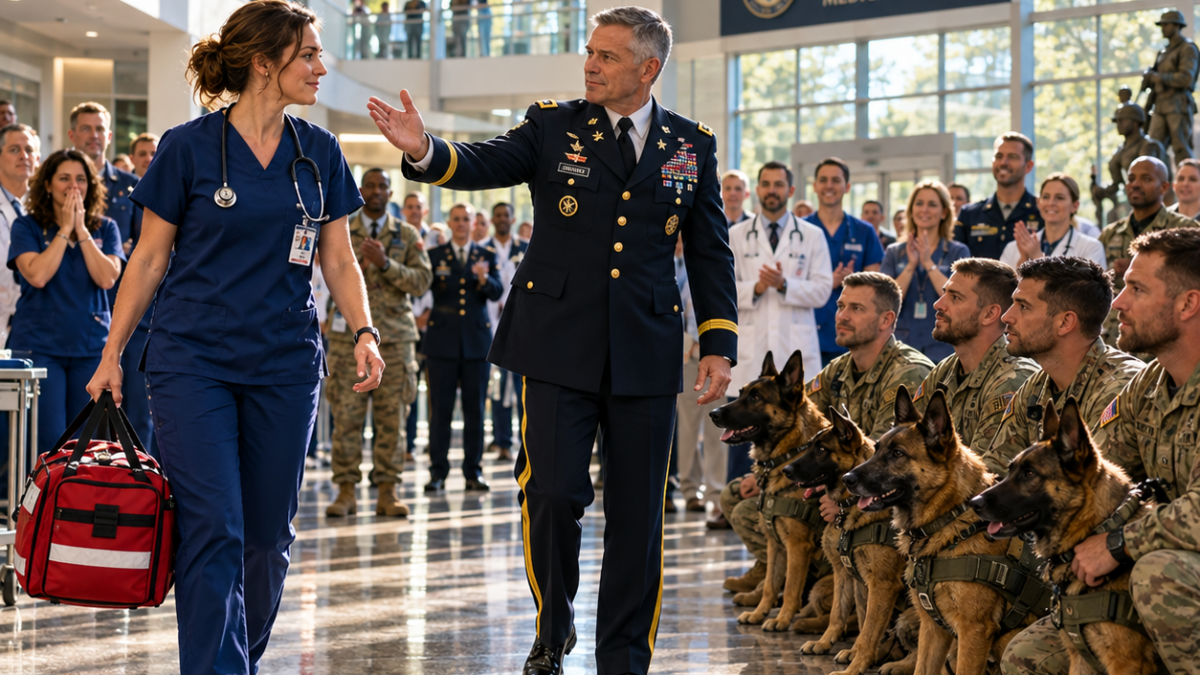
A bronze plaque had been mounted near the military working-dog corridor.
Simple.
KINDNESS EARNS A TRUST THAT AUTHORITY NEVER CAN.
Dedicated to caregivers whose quiet compassion changes lives, especially those who never seek recognition.
Below:
One photograph.
The oak tree.
Me sitting with five dogs.
I stared.
“Where did you get the photo?”
Coleman cleared his throat.
“Public affairs.”
“I said no photographs.”
“It was taken from inside.”
“I hate all of you.”
He smiled.
“We know.”
I looked closer.
Maverick beside my shoulder.
Echo at my feet.
Kodiak watching the parking lot.
Scout stretched in grass.
Valor against my knee.
For once, I didn’t hate the photograph.
Coleman said:
“I left your name off.”
“Thank you.”
“People ask who you are.”
“What do staff say?”
He smiled.
“The quiet nurse.”
I rolled my eyes.
“That’s terrible.”
“It appears permanent.”
He walked away.
I stayed.
Looked at the picture.
Then something behind me.
A woman had stopped.
Older.
Mid-sixties.
Holding flowers.
She looked at the plaque.
Then at me.
“Were those your dogs?”
“No.”
She smiled.
“They look like they were.”
I considered.
“No.”
Then:
“I think for a little while, we belonged to each other.”
She nodded as if that made sense.
Maybe it did.
Life moved on.
Maverick retired to Captain Dawson’s family.
Of course he did.
Eric’s wife sent me photographs of Maverick occupying an entire couch and refusing to move for anybody except their six-year-old daughter.
Kodiak went to a former handler in Virginia and eventually participated in a structured veteran-support program.
Not public therapy.
Small groups.
Predictable environments.
Echo retired to Luis Ortega’s parents.
That decision terrified me.
And healed something I did not know needed healing.
Luis’s mother called once.
“Olivia?”
“Yes?”
“He sleeps beside my son’s boots.”
I closed my eyes.
She continued.
“We kept them.”
“I figured.”
“He still looks at the front door sometimes.”
“What do you do?”
“Sit with him.”
Good.
Scout transitioned into a stateside training-support role for younger handlers.
Appropriate.
Energy with purpose.
Valor surprised everyone.
He matured.
Became steady.
Eventually retired early to a military family with two teenagers and another older shepherd.
Maverick had taught him how to belong to a pack.
The older dog in his new home continued the lesson.
I visited them over the years when life allowed.
Never all together again.
That’s the nature of temporary communities.
They exist.
They matter.
Then they change.
I finally turned over the photograph in my desk drawer.
Aaron Mills and Rex.
Taken outside the hospital in Germany before Aaron’s last deployment.
Aaron kneeling.
Rex beside him.
On the back, Aaron had written:
Thanks for understanding he isn’t equipment.
I had kept it facedown because grief felt easier when invisible.
One evening I placed it upright on my shelf.
Jenna noticed the next morning.
She did not ask.
Good friend.
Two years later, Walter Reed expanded a program supporting military working dogs and handlers navigating medical separation.
Director Coleman asked me to participate in program design.
“No.”
He waited.
“I hate committees.”
“We know.”
“Meetings.”
“We know.”
“PowerPoint.”
“We can negotiate.”
I joined.
Because of course I did.
The program was not built around me.
I insisted.
Veterinarians.
Handlers.
Behavior specialists.
Nurses.
Social workers.
Retired military working-dog experts.
The goal was simple:
Treat the team when possible, not merely the individuals.
Recognize that a hospitalized handler may be medically separated from a dog who cannot understand why.
Prepare transitions.
Reduce unnecessary stress.
Train staff to distinguish aggression from overload.
Create predictable reunification when safe.
None of that sounds dramatic.
It changed outcomes.
A young Marine named Caleb became one of the first cases.
His Malinois, Jax, had been separated during Caleb’s spinal surgery.
Jax stopped eating.
Under the new protocol, the dog was allowed controlled scent contact using Caleb’s shirt before physical reunion.
He ate that night.
Days later, Caleb saw him.
I stood outside the room.
Jax walked to the wheelchair.
Placed his head in Caleb’s lap.
Caleb sobbed.
One of the administrators beside me whispered:
“That program works.”
I said:
“The dog works.”
She looked confused.
I smiled.
Dad would’ve liked that.
Director Coleman retired eventually.
His farewell ceremony was exactly as long as he secretly wanted and publicly complained about.
At the reception, he found me near the coffee.
“Thirteen years?”
“Now sixteen.”
“You’re still quiet.”
“I’m speaking to you.”
“Progress.”
He handed me an envelope.
Inside was a copy of his first handwritten note from the day the dogs arrived.
Five MWDs refusing care.
Specialists unsuccessful.
Dawson recommends Nurse Bennett.
Why?
Below, written later:
Because she never tried to prove she was in charge.
I laughed.
“You kept this?”
“Best leadership lesson I got in forty years.”
“You’re dramatic.”
“Retirement allows it.”
He became serious.
“You changed this hospital.”
“No.”
He sighed.
“Still impossible.”
“Yes.”
“Then let me phrase it correctly.”
He raised his coffee.
“You helped us notice something we should’ve noticed earlier.”
That I accepted.
“Okay.”
“Okay?”
“Yes.”
“That’s the most praise you’ve ever accepted from me.”
“Don’t ruin it.”
He left smiling.
My life became less invisible after that.
Not dramatically.
I remained a nurse.
I eventually became clinical educator for trauma and military-animal integration support.
Terrible title.
Important work.
I trained nurses.
Not to handle dogs.
To understand partnerships.
Ask before separating.
Explain movements.
Respect handler anxiety.
Respect dogs’ cues.
Never assume calm means okay.
Never assume silence means consent.
Never confuse fear with disobedience.
Dad’s sentence became part of my lectures.
I always credited him.
David Bennett.
Civilian dog trainer.
My first teacher.
One year, a student nurse asked:
“What’s the most important command with a traumatized dog?”
I said:
“Usually none.”
She frowned.
“But how do you control the dog?”
“You don’t begin there.”
“Where do you begin?”
“Safety.”
“How do you establish that?”
“Consistency.”
She wrote it down.
I smiled.
Dad was still teaching.
Maverick died at fourteen.
Eric called me.
Old age.
Kidneys.
Quietly at home.
His daughter had grown from six to nine and slept beside him on the floor his last night.
Eric’s voice broke.
“He waited until she woke up.”
I closed my eyes.
“Sounds like him.”
“We’re burying him Saturday.”
“I’ll be there.”
The funeral was not military.
Eric wanted it simple.
Backyard.
Oak tree.
Family.
A few handlers.
Me.
Maverick’s collar placed beside the grave.
Eric’s daughter read a letter.
“You made Daddy less sad when he missed work.”
That line destroyed every adult present.
Afterward Eric handed me something.
Maverick’s old service tag.
“I think you should have it.”
“No.”
“He chose you.”
“He chose lots of people.”
“He chose you when he didn’t trust anybody.”
I looked at the tag.
Then his daughter.
She said:
“Take it.”
Children are very authoritative.
I did.
It hangs beside Dad’s photograph now.
Not as trophy.
Reminder.
Kodiak died two years later.
Echo before him.
Scout lived longest.
Valor became an old dog before I could believe enough time had passed.
Each loss reached me.
Not like Aaron.
Not like Dad.
Different.
Grief does not repeat exactly.
It teaches variations.
By the time Valor died, I was forty-four.
Hospital had changed.
New director.
New staff.
The plaque remained.
The photograph under the oak had faded slightly.
New nurses sometimes passed it without knowing me.
I loved that.
One afternoon I overheard a resident reading it.
“Who is the quiet nurse?”
The receptionist pointed across the lobby.
At someone else.
A young nurse named Sarah who had just spent forty minutes helping an elderly veteran understand his discharge medications.
“Probably her.”
I smiled.
Perfect.
The phrase had stopped belonging to me.
Maybe it never had.
Quiet kindness is not a person.
It’s a method.
A choice.
Seeing the thing everybody else is too hurried to see.
Years after the five dogs came through Walter Reed, I finally understood why that morning had affected Director Coleman so deeply.
It wasn’t because five dogs trusted me.
It was because they embarrassed our assumptions.
We had credentials.
Protocols.
Experience.
Authority.
Everything.
And those dogs reminded us that expertise without relationship can still fail.
Hospitals know how to do things to bodies.
Cut.
Repair.
Medicate.
Stabilize.
Measure.
Sometimes healing begins when you stop doing.
When the person—or animal—in front of you no longer has to perform recovery on your schedule.
I learned the same lesson personally.
For years after Dad died, I believed grief was something I should eventually finish.
People stopped asking after a while.
So I stopped mentioning him.
Aaron too.
Then five dogs arrived carrying their own unfinished losses.
Maverick taught me calm was not the same as absence of pain.
Kodiak taught me vigilance can become identity if you never feel safe enough to stop.
Echo taught me grief needs somewhere to go.
Scout taught me joy can look guilty when suffering has lasted too long.
Valor taught me that young things can learn fear from old things—and trust from them too.
I had thought I was helping dogs.
They were quietly naming parts of me.
That was the hidden history they revealed.
Not some classified military past.
Not medals.
Not secret rank.
Nothing so cinematic.
A childhood.
A father.
A dead handler.
Years of choosing useful silence because grief felt safer when nobody noticed it.
Director Coleman once asked me:
“Who saved the five dogs?”
The question still bothers me.
Nobody saved them.
Maverick was never broken.
Kodiak was not malfunctioning.
Echo was not defective because he missed Luis.
Scout did not need to be toughened.
Valor did not need to become brave on command.
They needed care.
Structure.
Time.
Each other.
And people willing to stop treating trust like another task on a medical checklist.
If I helped, it was because I knew something my father had tried to teach a ten-year-old girl beside a metal training grate.
Most people try to lead first.
The special ones become someone worth following.
Dad wasn’t talking only about dogs.
I know that now.
My apartment eventually became a house.
Small.
Bethesda outskirts.
Backyard.
Books everywhere.
Jenna claimed my living room looked like a library lost a custody battle.
I adopted a dog.
Years later.
Not a working dog.
Definitely not.
A mixed-breed senior named Lucy.
One eye.
Overweight.
Terrible hearing.
Zero interest in commands.
Perfect.
The first night I brought her home, she climbed onto my couch even though the rescue said she never climbed furniture.
She stared at me.
I said:
“No.”
She lay down.
“Absolutely not.”
She fell asleep.
I left her there.
Dad would’ve laughed.
One rainy evening I sat beside her and pulled the old facedown photograph from the drawer where it no longer belonged.
Aaron and Rex.
Maverick’s tag beside it.
Dad’s photograph above.
Lucy snored.
I realized something.
For a long time, I had believed caring deeply was what made loss unbearable.
The logical solution seemed obvious.
Care more carefully.
Quietly.
With limits.
Do not need too much.
Do not become indispensable.
Do not let anything become indispensable to you.
Working dogs know better.
They trust completely despite what trust can cost.
That is why losing a handler can break their world.
It is also why a new bond can build one.
The five dogs taught me trust after grief is not betrayal.
That was the lesson I had spent years avoiding.
The same one humans need.
You can love what came before and still step toward what comes next.
Echo loved Luis until the end.
Then learned to sleep at Luis’s parents’ home.
Maverick remembered service and learned a couch.
Kodiak remembered doors and eventually stopped watching every one.
Valor needed Maverick until he learned another pack.
Nothing was erased.
Life grew around it.
Maybe that’s healing.
Not removing scars.
Making enough room that scars are no longer the only thing in the room.
Sometimes new employees still find me at Walter Reed and ask about the plaque.
“Are you Olivia?”
Unfortunately.
“The quiet nurse?”
People really need to let that die.
They usually smile.
“Were the dogs really impossible?”
“No.”
“They wouldn’t let anyone near them.”
“That happened.”
“How did you get them to trust you?”
I give the same answer now.
“I didn’t.”
They look disappointed.
Everyone wants a technique.
A secret phrase.
A command.
A pressure point.
Something repeatable.
I tell them:
“I gave them a reason not to defend themselves.”
“How?”
“I waited.”
“That can’t be all.”
“No.”
“It never is.”
Then I explain.
Learn the history.
Reduce pressure.
Be consistent.
Let the dog choose where possible.
Use the people they trust.
Respect working-dog experience.
Treat medical needs.
Don’t romanticize trauma.
Don’t force affection.
Know when specialized behavioral care is required.
And never mistake patience for passivity.
Patience is work.
Sometimes the hardest work.
The last time I saw the original photograph under the oak tree, somebody had placed a small handwritten note beneath the plaque.
No signature.
It said:
My husband served 22 years and came home different.
Thank you for reminding me that quiet doesn’t mean gone.
I stood there a long time.
Then folded the note.
Placed it in my pocket.
That is the only thing from the plaque I ever took.
It’s in my desk now.
Beside the granola bar.
Some habits survive.
Every so often, usually very early, the working-dog wing is quiet.
Not hospital quiet.
Real quiet.
Before rounds.
Before phones.
Before footsteps multiply.
I walk past the old treatment room.
I can still see them.
Maverick standing first.
Valor following.
Echo lifting his head.
Scout stopping.
Kodiak finally lowering his shoulders.
Five dogs watching through glass.
Me holding two cups of coffee and wishing nobody had noticed.
If I could return to that moment, I don’t think I’d change anything.
Not even the attention.
Because what came afterward mattered.
The program.
Handlers reunited earlier.
Dogs evaluated more thoughtfully.
Nurses learning that partnership can be clinically relevant.
Staff asking different questions.
And one grieving woman finally turning a photograph face-up.
Director Coleman thought the quiet nurse saved five military K9s.
He was wrong.
Dr. Foster knew better by the end.
Eric always knew.
I think Maverick knew too.
Nobody saved anyone alone.
They trusted.
We listened.
They rested.
We learned.
And somewhere in the middle of all that, five dogs who had spent years protecting everyone around them finally discovered there was one room in one hospital where nobody expected them to guard the door.
For the first time in a very long while, they could simply lie down.
And so could I.

