Everyone Ignored the Homeless Hells Angel at Christmas—Until His True Identity Was Finally Revealed
PART3:
She first noticed Garrett three weeks before Christmas, when the first major freeze hit the city.
At first, she noticed only that he did not leave.
Most of the homeless people downtown moved around. They went to shelters when police pushed them. They gathered near heat vents, under bridges, beside church doors, inside public library bathrooms until security asked them to go. But Garrett stayed at the same wall, morning after morning, night after night, wrapped in filthy blankets beneath the abandoned bank’s narrow awning.
Other business owners complained.
They called the precinct.
They called city services.
They called him an eyesore, a liability, bad for foot traffic.
Joanne watched him from behind her diner window while pouring coffee for men in suits who did not tip enough and mothers with strollers who apologized for the mess before their toddlers even made one.
There was something about Garrett that bothered her.
Not bothered like fear.
Bothered like a question.
He never panhandled.
Never shouted.
Never stumbled drunk into the street.
Never harassed customers.
He sat with the stillness of a man guarding a door no one else could see.
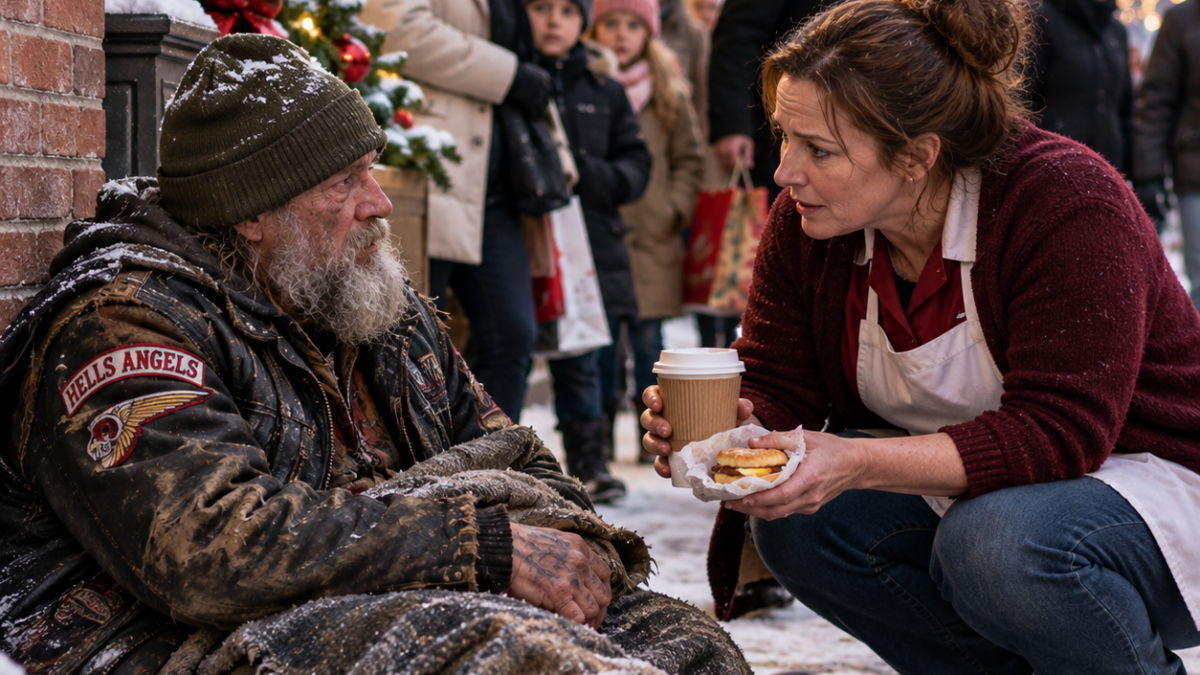
On December 22, before sunrise, Joanne filled a large Styrofoam cup with black coffee, wrapped a sausage-and-egg sandwich in wax paper, put both into a brown paper bag, and walked across the icy street.
The wind slapped her face hard enough to make her eyes water.
Garrett did not move as she approached.
“You’re going to freeze to death out here, mister,” Joanne said.
Her voice came out harsher than she meant.
Concern often wore a work apron in Joanne’s mouth.
She crouched and set the coffee and sandwich near his boots.
For a moment, nothing happened.
Then a large hand emerged from beneath the blankets. The fingers were cracked and red from cold. Old tattoo ink bled through grime along the knuckles, too faded and dirty for Joanne to read.
Garrett picked up the cup.
“Thank you, ma’am.”
His voice surprised her.
Deep.
Rough.
Like an engine turning over in winter.
It was not the voice of a man used to begging.
It was the voice of a man used to being heard.
Joanne hesitated.
“There’s a shelter down on West Twenty-Fifth. They’ve got heat. It’s supposed to drop below zero tonight.”
“I ain’t going to a shelter.”
He lifted his head then.
His eyes were pale blue.
Too clear.
Too steady.
Joanne felt something move through her that had nothing to do with the cold.
There was sorrow in those eyes, yes.
Heavy and old.
But beneath it sat something harder.
A dangerous stillness.
The look of a man who had seen the worst of the world.
Maybe had been part of it.
Before Joanne could press him, boots crunched behind her.
Officer Dempsey, the downtown beat cop, stopped near the curb with one hand resting on his utility belt. He was a thick man in his late forties with a red face, a tired marriage, and the permanent irritation of someone who believed the city would function better if everyone simply obeyed him faster.
“Joanne,” he said sharply, “I told you to stop feeding the strays.”
Joanne stood.
“He’s a man, Dempsey.”
“He’s loitering.”
“He’s sitting.”
“He’s bad for business.”
“I own the business across the street, and he’s never bothered me.”
Dempsey looked down at Garrett.
“You hear that, old man? You need to pack up this trash and move along. Downtown Business Association wants this block clear for the parade tomorrow.”
Garrett took a sip of coffee.
Ignored him.
Dempsey’s face flushed.
“Hey. I’m talking to you.”
Garrett held the cup with both hands.
“Move it,” Dempsey snapped. “Or I’m dragging you to county lockup until Christmas is over.”
Joanne stepped between them.
“Leave him alone.”
Dempsey gave her a hard look.
“You don’t know who you’re dealing with.”
That was the one true thing he said all morning.
Then he reached out and kicked the edge of Garrett’s boot.
Not hard enough to injure.
Hard enough to humiliate.
For half a second, the blankets shifted.
The slump disappeared.
Garrett’s shoulders rose, squared, and locked into place. His chin lifted slightly. His right hand, hidden beneath the blankets, curled into something that made the air around him change.
Joanne felt it.
Dempsey felt it too.
He had seen angry men before.
Drunk men.
Desperate men.
Men looking for a reason.
But what rose in Garrett Hayes was something older and colder than anger.
It was readiness.
Under the blankets, hidden from the city’s disgust, Garrett still wore a heavy black leather cut.
Faded.
Scarred.
Weathered.
On the back of that leather, beneath layers of rags and filthy wool, was a winged death head patch that had once made hardened men lower their eyes.
Garrett Hayes was not a nobody.
He had once been Iron Garrett.
Sergeant-at-arms for one of the most feared Hells Angels chapters in the Midwest.
A man who settled debts, protected the clubhouse, enforced rules written in blood and chrome, and walked into rooms where even violent men remembered they had families.
Dempsey did not know that.
Not yet.
But his body understood what his mind did not.
Garrett slowly looked at the boot that had touched him.
Then he looked up at Dempsey’s face.
He did not threaten.
Did not shout.
Did not move.
He simply stared.
Dempsey swallowed.
The badge, the gun, the radio, the uniform—none of it felt quite as heavy as it had a moment before.
“Just have your crap gone by noon,” he muttered.
Then he stepped back.
Joanne watched him walk away.
When she looked down again, Garrett was eating the sandwich.
Slowly.
Carefully.
As if nothing had happened.
But Joanne knew what she had seen.
A broken man had been sitting there.
For one second, something else had looked out through his eyes.
Something the cold had not killed.
Something maybe nothing could.
She did not yet know the history.
Almost nobody did anymore.
Twenty years earlier, Garrett Hayes had been a legend in places respectable people pretended not to know existed.
Iron Garrett.
Six foot three.
Broad as a loading dock door.
Hands like tools.
A laugh that shook bar walls.
A temper that had made foolish men very careful.
He lived by a code most people would not understand and many would not forgive.
Brotherhood.
Loyalty.
Debt.
Retaliation.
Silence.
He rode with the Hells Angels out of Cleveland, wore the patch with pride, and served as sergeant-at-arms with the kind of brutal efficiency that made him both feared and trusted. He knew how to end fights before they began. He knew how to make enemies disappear from the club’s doorstep. He knew how to stand between his brothers and the world with nothing but a stare and make the world reconsider.
But the club was not his only family.
There was Sarah.
His wife.
She had loved him before the beard went gray, before the scars stacked too high to count, before the world called him Iron and forgot the man underneath had once been gentle with her.
Sarah had dark hair, a sharp tongue, and no fear of Garrett whatsoever.
“You stomp around like thunder,” she used to tell him, “but you leave your socks on the bathroom floor like a child.”
He would growl, “Woman, I terrify grown men.”
“You terrify grown fools. Pick up your socks.”
And he would.
Then came their daughter, Chloe.
Small hands.
Dark curls.
A laugh that could break Garrett open.
He kept the club as far from his home as he could. That was the lie men in dangerous lives tell themselves. That darkness can be stored somewhere else. That violence obeys geography. That enemies respect property lines and bedtime stories.
They do not.
The life always bleeds through.
It happened on a rainy Tuesday fifteen years before the blizzard.
A rival crew wanted Garrett dead.
Not warned.
Not beaten.
Dead.
They did not find him.
They found Sarah’s car.
Brake lines cut.
Interstate 90.
Wet pavement.
A semi-truck with no time to stop.
Sarah died before help arrived.
Chloe was eight.
She survived, but survival is not the same as being spared. She spent months in intensive care, small body broken in more places than Garrett could look at without wanting to tear the world in half.
The club wanted war.
They came to Garrett with rage in their voices and murder in their eyes.
Garrett had enough rage to burn the city.
But when he stood beside Chloe’s hospital bed and looked at the tubes, the casts, the bruises, the empty place where Sarah should have been holding their daughter’s hand, something inside him did not ignite.
It died.
He blamed himself.
His life.
His choices.
His patch.
His enemies.
His pride.
They had killed Sarah and nearly taken Chloe because of him.
So Garrett made the only decision his grief could understand.
He signed custody of Chloe over to Sarah’s sister in Oregon.
He told himself distance was protection.
He told himself a father who brought danger to the door had forfeited the right to stand inside it.
Then he walked into the clubhouse, removed his colors, placed them on the long wooden table, and walked out.
Men do not just leave the Hells Angels.
Not like that.
But the president then, a man named Caleb Jensen, had loved Garrett like a brother. He saw the deadness in Garrett’s eyes and understood that dragging him back would only leave them with a body still breathing and a soul already gone.
So Caleb let him walk.
Garrett vanished.
He sold the house.
Gave away the money.
Burned the contacts.
Cut ties.
He did not go to Oregon.
He did not go to Sarah’s grave often enough to call it devotion.
He did not join another crew, another town, another life.
He stripped himself down to hunger, cold, concrete, and memory.
Every freezing night became punishment.
Every insult became deserved.
Every time someone looked through him, he thought, Good.
That is how ghosts should be treated.
By the afternoon of December 23, the weather had turned dangerous.
The news called it a historic lake-effect event.
Joanne called it hell with snow.
The wind screamed against Bradley’s Counter hard enough to rattle the old glass. Snow blew sideways through the streetlights. Visibility dropped block by block until downtown Cleveland looked like a city being erased.
Joanne planned to close early.
Then the lunch rush hit.
People came in half-frozen, stamping boots, shaking snow from coats, ordering soup, coffee, grilled cheese, anything hot. The diner filled with steam, wet wool, and noise.
Through the fogged front window, Joanne could still see Garrett across the street, half-buried beneath drifting snow.
“Stubborn old fool,” she muttered.
At 1:30 p.m., the bell above the diner door jingled violently.
Three young men shoved inside.
They carried cold with them.
Not just weather.
Trouble.
The leader was a tall, wiry kid named Wayne. Early twenties. Sharp face. Puffy coat. Smile like a broken bottle. He and his two friends had been circling small businesses for months, demanding “holiday protection money” from anyone too tired, too afraid, or too alone to refuse.
Wayne walked to the counter and knocked a sugar dispenser onto the floor.
Glass shattered.
“Oops,” he said.
Joanne straightened behind the counter.
“Get out.”
Wayne grinned.
“Joanne, Joanne. That any way to talk to customers?”
“You’re not a customer.”
“We’re here for our Christmas bonus.”
One of his friends grabbed a handful of napkins and tossed them onto the wet floor.
Wayne leaned forward.
“Storm’s coming. Windows break in storms. Fires start. Bad things happen when business owners don’t show respect.”
Joanne’s stomach tightened.
But she refused to show it.
“I told you last month. I’m not paying you a dime.”
Wayne’s smile faded.
The diner went quiet.
There were five customers left. A delivery driver. Two college students. A father with a teenage daughter. An older man reading a newspaper he had not turned in ten minutes.
Nobody moved.
Wayne reached across the counter, grabbed Joanne by the collar of her apron, and yanked her forward.
“You’re going to open that register,” he said softly, “or we’re going to start smashing this dump apart. Then maybe we start with you.”
Joanne’s heart hammered.
She could smell cigarettes on his coat.
Then the bell above the door jingled again.
A blast of wind and snow tore into the diner.
Everyone turned.
Garrett stood in the doorway.
Snow caked his beard and hat. Water dripped from the edges of his blankets. He looked enormous and ruined, like something dragged out of a frozen lake.
Wayne released Joanne’s apron and laughed.
“What the hell is this? You letting trash inside now?”
Garrett did not answer.
Wayne turned fully.
“Grandpa, get out before you catch a beating.”
Garrett reached up with one scarred hand and removed his wet green beanie.
His gray hair was matted to his head.
Then he stepped inside.
The slump was gone.
The beggar was gone.
Standing in the doorway was a man built by thirty years of fights, labor, prison yards, long highways, and violence survived at close range.
Garrett walked forward.
Slow.
Heavy.
Wayne pulled a switchblade from his pocket.
The blade snapped open with a sharp click.
A college student gasped.
Joanne whispered, “Garrett.”
He did not look at her.
His pale blue eyes fixed on Wayne.
“You want to bleed, old man?” Wayne said, thrusting the knife forward.
Garrett’s left hand moved.
Fast.
Too fast for his age.
Too fast for what he looked like.
He caught Wayne’s wrist in a grip like a bench vise. Wayne’s eyes went wide. The knife clattered to the floor. Garrett twisted just enough to make the boy’s knees buckle.
Then Garrett leaned close.
His voice was low.
“You came into her place.”
Wayne tried to pull free.
Couldn’t.
“You put hands on her.”
The two friends froze.
Garrett’s eyes moved to them.
“Pick up your trash.”
Neither moved.
Garrett’s grip tightened.
Wayne cried out.
“I said,” Garrett growled, “pick it up.”
They scrambled.
One grabbed the broken sugar dispenser. The other snatched up napkins, slipping on the wet floor, hands shaking.
Garrett released Wayne.
The kid stumbled backward, clutching his wrist.
“You’re crazy,” Wayne gasped.
Garrett bent and picked up the switchblade.
He folded it shut with one hand.
Then he dropped it into the trash can.
“No,” he said. “I’m tired.”
Wayne looked at him.
For the first time, really looked.
Something in Garrett’s face made the kid back toward the door.
“You don’t come back,” Garrett said.
Wayne nodded too quickly.
The three of them fled into the storm.
Silence fell over the diner.
Garrett stood there for a moment, chest rising and falling beneath his layers.
Then his shoulders lowered.
The old man returned by inches.
He looked at Joanne.
“Sorry about the floor, ma’am.”
Then he turned and walked back outside.
Into the snow.
Back to the brick wall.
He had protected her.
But he still did not believe he deserved warmth.
By Christmas Eve evening, Cleveland had become a disaster zone.
Two feet of snow in less than twelve hours.
Wind chills below zero.
Public transit shut down.
Airports closed.
Roads declared unsafe.
The city told everyone to stay home.
People never do.
Joanne closed the diner early, but she could not leave. Her old sedan was buried under a drift behind the building, and the roads were impassable. She sat in the darkened diner with one emergency lantern glowing on the counter, watching the storm turn the street outside into a white, violent blur.
Across the street, under the abandoned bank awning, Garrett was barely visible.
A dark mound beneath snow.
At 9:45 p.m., disaster struck.
A silver minivan came down Prospect too fast.
Not recklessly.
Desperately.
The driver was a father trying to get home before the storm got worse. Beside him was fear. In the back seat was his eight-year-old son.
At the intersection, the van hit black ice hidden under fresh snow.
It spun once.
Twice.
Then slammed passenger side first into a reinforced steel traffic pole.
The sound was horrible.
Metal folding.
Glass exploding.
A scream cut through the storm.
The minivan flipped onto its side and slid across the intersection until it crashed into the concrete barrier in front of the abandoned bank building.
Joanne screamed and ran to the window.
The vehicle was crushed.
Smoking.
Gasoline leaked from beneath it, spreading across the snow in dark, shining lines.
Under the crumpled hood, a small electrical fire flickered.
Joanne grabbed her coat and ran outside.
The wind nearly knocked her down.
“Help!” she screamed into the empty street. “Somebody help!”
The mound of snow under the bank awning erupted.
Garrett burst upward, blankets falling away from him like an animal shedding a trap.
He took one look at the wreck.
The leaking gas.
The smoke.
The fire.
The screaming.
And fifteen years vanished.
Not the grief.
The paralysis.
The punishment.
The idea that he was only a ghost.
He moved.
Garrett sprinted through the snow toward the van.
His boots tore through drifts. His coat flapped open. His breath came hard, but his body remembered urgency better than it remembered comfort.
Joanne reached the wreck seconds behind him.
Inside the overturned van, the father hung sideways from his seat belt, blood running down his forehead.
“My son!” he screamed. “My boy is trapped!”
Garrett climbed onto the side of the van and looked through the shattered rear window.
A boy, no older than eight, was pinned near the crushed passenger side, trapped under twisted metal and the collapsed frame of the door. He was crying, coughing, terrified.
The fire under the hood flared.
Garrett looked at the gasoline.
They had less than two minutes.
“Hold on, son,” Garrett roared. “I’m coming.”
The rear passenger door was crushed inward.
Joanne grabbed the handle and pulled.
Nothing.
“It’s stuck!” she yelled. “We need firefighters!”
“Ain’t got time.”
Garrett stripped off his outer coat.
Then the thick wool sweater.
Underneath was a torn thermal shirt and, beneath that, heavy black leather.
He wedged both hands into the narrow gap between the crushed door and frame.
Jagged metal sliced into his fingers.
He did not stop.
“Move back,” he told Joanne.
“Garrett—”
“Move!”
She moved.
Garrett planted his boots wide in the snow, bent his knees, and pulled.
At first, nothing happened.
The metal groaned.
The fire grew.
The boy screamed.
Garrett’s face twisted, not only with effort but with memory.
A rainy highway.
A car he had not reached in time.
Sarah.
Chloe.
The smell of gasoline.
The helplessness that had frozen him for fifteen years.
Not again.
Not a child.
Not tonight.
Garrett roared.
The sound tore through the storm.
His hands bled against the jagged steel. His shoulders bunched. The veins in his neck stood out like ropes. He pulled as if he were not pulling metal but dragging his own soul back from the wreckage of every night he had slept on concrete believing he was beyond use.
The latch snapped.
The door ripped open.
Garrett plunged into the smoke-filled cabin.
He reached the boy, tore the jammed seat belt loose, and pulled him free from the twisted metal. The child clung to him, sobbing.
Garrett passed him to Joanne.
“Get him away from the gas!”
Joanne wrapped the boy in her coat and dragged him toward the diner.
Garrett turned back.
The father was still trapped, disoriented, coughing hard.
Garrett climbed through the shattered window, unlatched the seat belt, caught the man as he fell, and hauled him out with brutal efficiency. He half-carried, half-dragged him twenty yards through the snow.
They had barely reached Joanne and the boy when the flames touched fuel.
The minivan exploded.
The fireball lit the entire intersection orange.
Heat slammed into Garrett’s back.
Windows blew out.
Snow flashed gold.
Then sirens wailed in the distance.
Two fire trucks and an ambulance forced their way down Prospect through the blizzard. Behind them came a local news van that had been stranded nearby while covering the storm. The cameraman jumped out before the van fully stopped, instinctively filming the wreck, the fire, the rescued boy, the father, Joanne, and the massive homeless man sitting in the snow with blood pouring from both hands.
A paramedic named Thomas Miller rushed to Garrett.
“Sir! Are you hurt?”
Garrett sat breathing hard, eyes fixed on the burning van.
“Boy okay?”
“He’s alive,” Thomas said. “You got him out.”
Garrett closed his eyes for half a second.
Thomas moved closer with trauma shears.
“Your shirt’s shredded. I need to check you for burns and lacerations.”
Garrett did not resist.
He seemed suddenly too tired to argue.
Thomas cut away the ruined thermal shirt.
Then froze.
The news camera light caught Garrett’s back.
The black leather cut, preserved beneath years of filth and layers, shone in the firelight.
Top rocker.
HELLS ANGELS.
Winged death head.
Bottom rocker.
CLEVELAND.
And over the left breast, half hidden by smoke, blood, and melted snow, was a smaller patch that made Thomas take one step back.
SERGEANT AT ARMS.
1%.
FILTHY FEW.
Thomas looked from the patches to Garrett’s scarred face.
“Who are you?” he whispered.
Garrett did not answer.
He looked into the camera.
For one second, the ghost was gone.
The entire city was about to learn who had been freezing on its sidewalk.
The footage aired at eleven.
By midnight, it was everywhere.
The homeless man ripping open a crushed minivan with his bare hands.
The burning wreck.
The child being carried through snow.
The torn shirt.
The Hells Angels death head.
The Filthy Few patch.
In her expensive house in Shaker Heights, Brenda Walsh sat on her sofa with a glass of wine halfway to her mouth.
When the anchor replayed the footage, her face drained of color.
The man she had called a piece of trash in front of her children was not harmless scenery.
He was a sleeping dragon she had mocked because he was cold.
At Cleveland General Hospital, chaos moved around Garrett Hayes like weather around a mountain.
He refused a stretcher and walked through the emergency entrance on his own feet despite frostbite, second-degree burns on his forearms, and hand wounds deep enough that one nurse whispered, “How is he still standing?”
Police were nervous.
Hospital security was terrified.
Officer Dempsey, assigned to stand outside Garrett’s room, looked as if he might pass out.
He had seen the news.
He knew what those patches meant now.
He knew he had kicked the boot of a man half the city’s criminals once crossed streets to avoid.
Inside room 312, Garrett sat on the edge of the bed while a doctor wrapped his hands. His beard had been washed, but it remained wild. His hair was wet and gray. His leather cut rested on a chair beside him, dark, scarred, and heavy with history.
He looked at it once.
Then away.
Across town, in a fortified garage in the Flats, Caleb Jensen watched the same news broadcast above the bar.
The current president of the Cleveland chapter stood so fast his chair crashed backward onto the concrete.
The clubhouse fell silent.
Pool balls stopped clacking.
A mechanic lowered his wrench.
Someone whispered, “No way.”
Caleb’s red beard moved as his jaw clenched.
“I’ll be damned,” he said. “That’s Iron Garrett.”
For fifteen years, they had believed Garrett dead, buried, exiled, or drunk somewhere beyond reach. No one knew their legendary sergeant-at-arms had been sleeping on concrete in their own city, punishing himself for a tragedy no punishment could undo.
Caleb turned to the room.
“Our brother has been freezing in the street. The cops have him at Cleveland General.”
A biker named Travis looked toward the storm outside.
“Boss, travel ban’s still on. Bikes won’t make it through that snow.”
“Then fire up the flatbeds,” Caleb snapped. “Chains on the F-250s. Cuts on. Nobody leaves a brother behind.”
Twenty minutes later, five heavy pickup trucks rolled out of the garage, engines growling through the blizzard, winged death head decals half-covered in snow.
At the hospital, Joanne sat in a plastic waiting-room chair, hands wrapped around terrible vending-machine coffee. She had refused to leave until she knew Garrett would live.
Then the emergency room doors slid open.
Wind and snow blew inside.
So did twelve men in leather cuts.
The room went quiet.
Nurses backed away from the desk.
Security guards froze.
Caleb Jensen walked to triage, boots leaving puddles across the floor.
“Garrett Hayes,” he said. “Room.”
The nurse stared.
Joanne stood slowly.
Caleb looked at her.
“You Joanne?”
She blinked.
“Yes.”
“Heard you fed him.”
“I brought coffee.”
Caleb’s face softened almost invisibly.
“That matters.”
Then he turned and walked toward the elevators.
Officer Dempsey nearly jumped out of his skin when the bikers rounded the third-floor hallway.
“You can’t be up here,” he stammered. “Restricted floor.”
Caleb did not stop.
Dempsey raised one hand.
Caleb walked through it, shoulder-checking the officer into the wall hard enough to make the badge rattle on his chest.
“Stand down,” Caleb said. “We’re here for family.”
Dempsey did not draw his weapon.
Some instincts arrive late.
But at least they arrive.
Caleb opened the door to room 312.
Garrett looked up.
For a moment, no one spoke.
The room filled with men who understood violence, loyalty, regret, and silence in ways no doctor could chart.
Caleb stepped forward.
“Fifteen years, Iron.”
Garrett looked down at his bandaged hands.
“Don’t call me that.”
“Fifteen years,” Caleb repeated, voice rougher now. “You let us think you were dead.”
“I was.”
“No. You were punishing yourself.”
Garrett’s jaw tightened.
“I didn’t deserve a roof.”
Caleb stared at him.
“My wife died because of the life we lived,” Garrett said. “My little girl almost died. I couldn’t pull Sarah out. I couldn’t—”
His voice failed.
Caleb put one heavy hand on Garrett’s shoulder.
“You pulled that boy out tonight.”
Garrett closed his eyes.
“You ripped steel open with your bare hands,” Caleb said. “You saved a father. You saved a kid. You think Sarah wanted you freezing under an awning for fifteen years? You think Chloe wanted that?”
Garrett flinched at his daughter’s name.
Caleb’s voice softened.
“Your debt is paid, brother. It’s been paid longer than you know.”
Before Garrett could answer, a soft knock came from the doorway.
The bikers parted.
Gregory Bennett stood there with a bandage around his forehead and one arm in a sling. Beside him, holding his good hand, was eight-year-old Leo.
The boy looked at the bikers.
He should have been scared.
He was not.
He looked only at Garrett.
Gregory stepped into the room.
“They told me you were homeless,” he said, voice trembling. “They told me you were just some guy off the street.”
Garrett looked down.
Gregory took another step.
“The gas was leaking. The fire was right there. You didn’t even hesitate.”
Garrett swallowed.
“I couldn’t let him burn.”
Gregory’s eyes filled.
“My wife died of cancer six months ago. Leo is all I have left in this world. If you hadn’t pulled us out, my family would be erased.”
Leo stepped forward.
He reached into his jacket pocket and pulled out a candy cane.
Slightly crushed.
Sticky at one end.
He held it out.
“Thank you for saving my dad, mister.”
Garrett looked at the candy cane.
Then at the boy.
The man who had survived biker wars, prison riots, winters on concrete, and fifteen years of self-hatred broke in the quietest way.
A single tear cut through the gray of his beard.
He reached out with bandaged fingers and took the candy cane like it was something sacred.
“You’re welcome, Leo.”
His voice was thick.
Almost unrecognizable.
For fifteen years, Garrett had lived inside the moment he failed to save Sarah.
That night, he could not undo the past.
But he saved a father.
He saved a son.
He preserved a family standing on the edge of being destroyed.
The ghost that had followed him through every frozen night finally loosened its grip.
Caleb turned to the club.
“We’re taking him home.”
This time, Garrett did not resist.
When Garrett Hayes walked out of Cleveland General the next morning, he was flanked by Hells Angels on both sides.
Reporters shouted questions.
Cameras flashed.
Nobody stepped too close.
Garrett did not return to the street.
But he did not return to the old life either.
Caleb understood.
The club understood.
Iron Garrett, sergeant-at-arms, belonged to the past.
Garrett Hayes, the man still breathing, needed something else.
They set him up in a small apartment above the garage.
Warm room.
Real bed.
Thick curtains.
Hot shower.
Locked door.
No one called it charity.
They called it brotherhood.
That made it easier for him to accept.
At first, he slept on the floor.
Old habits.
Punishment habits.
Caleb came in one morning, saw the untouched bed, and said nothing. He walked out and returned with an old dog bed from the garage office, threw it on the floor, and said, “Fine. But at least be dramatic with support.”
Garrett almost smiled.
Almost.
A week later, Joanne received a delivery at the diner.
A new front window.
Paid in full.
Installed before noon.
No note.
She knew anyway.
A month after Christmas, the snow had finally melted from the sidewalks of Fourth Street.
Joanne was wiping down the counter after lunch when the bell above the door jingled.
Garrett walked in.
Clean-shaven.
Gray hair trimmed short.
Heavy flannel shirt.
Thick leather jacket.
Still huge.
Still dangerous in the way mountains are dangerous.
But calmer.
He did not sit in the back.
He took the counter stool nearest the window.
The one facing the abandoned bank across the street.
Joanne poured coffee before he asked.
“Black?”
“Please, Joanne.”
She set the cup down.
He wrapped both hands around it.
For a moment, they both looked across the street at the wall where he had nearly disappeared.
“Looks empty over there,” Joanne said.
Garrett nodded.
“Good.”
“Staying warm?”
“Trying.”
“That’s not an answer.”
He looked at her.
“Learning.”
She smiled.
“That’ll do.”
Outside, shoppers moved along the sidewalk.
People glanced through the diner window now.
Some recognized him.
Some whispered.
Some looked away quickly.
Garrett did not care.
Wayne and his friends never returned.
Officer Dempsey requested a different route.
Brenda Walsh sent a donation to a homeless outreach program without including her name, though whether from guilt or fear, only she knew.
Gregory Bennett and Leo came by the diner every Sunday morning for pancakes.
Leo always brought Garrett a candy cane, even in March, because children understand symbols better than adults.
Garrett kept the first one in a drawer beside his bed.
Not because it saved him.
But because it reminded him he had saved someone.
Caleb visited the diner sometimes, taking up too much space in a booth and pretending he liked Joanne’s pie more than he did.
The first time Chloe called, Garrett almost did not answer.
Caleb stood in the doorway of the apartment holding out the phone.
“Oregon number,” he said.
Garrett stared at it.
His hand shook.
Caleb’s voice softened.
“She saw the news.”
Garrett took the phone.
For a long time, he said nothing.
Then he whispered, “Chloe?”
On the other end, his daughter cried.
So did he.
That is another story.
A longer one.
A harder one.
Healing does not arrive all at once just because a man pulls a child from fire.
It comes in pieces.
A phone call.
A warm room.
A diner window.
A cup of coffee.
A child’s candy cane.
A daughter’s voice.
A leather cut no longer hidden under rags.
Some nights, Garrett still woke smelling gasoline.
Some mornings, he still walked past the abandoned bank and felt the pull of the concrete like an old addiction.
But he did not sit down.
He crossed the street instead.
He went into Bradley’s Counter.
He took the stool by the window.
And he watched Fourth Street.
Not as a ghost.
Not as a beggar.
Not as Iron Garrett hunting enemies.
As a guardian.
The city never fully understood him.
Cities rarely understand the people they step over.
They knew only the headline version.
Homeless man revealed as Hells Angel legend.
Biker saves family from burning van.
Christmas miracle in Cleveland blizzard.
But Joanne knew better.
So did Leo.
So did Caleb.
So, slowly, did Garrett.
He was not just the worst thing he had done.
He was not only the life that led enemies to Sarah.
He was not only the husband who failed to save her.
He was not only the father who ran from his daughter because grief convinced him distance was love.
He was not only the homeless man people insulted outside Christmas shops.
He was also the man who heard a woman scream in a blizzard and ran toward fire.
He was the man who ripped open steel with bleeding hands.
He was the man who saved a boy.
He was the man who finally let someone bring him home.
That Christmas, everyone had ignored the old man under the blankets.
They had called him trash.
A vagrant.
A problem.
An eyesore ruining the holiday spirit.
But under the rags was a man carrying fifteen years of grief, a leather cut stitched with a dangerous past, and a strength the cold had never managed to kill.
Sometimes heroes do not look clean.
Sometimes redemption does not arrive in church bells and perfect snow.
Sometimes it crawls out from under a bank awning at minus twelve degrees, bleeding from both hands, wrapped in leather and regret, and does the one thing it failed to do years ago.
It saves the family in the fire.
And sometimes, when the whole city finally sees the truth, the most dangerous man on the street is not the one people should have feared.
He is the one they should have fed.
The one they should have seen.
The one they should never have left freezing alone at Christmas.

