Dozens of Drivers Passed a Navy SEAL and His Dying K9 on a 104° Texas Highway—Then a 72-Year-Old Carpenter Saw the Trident Tattoo and Hit the Brakes.
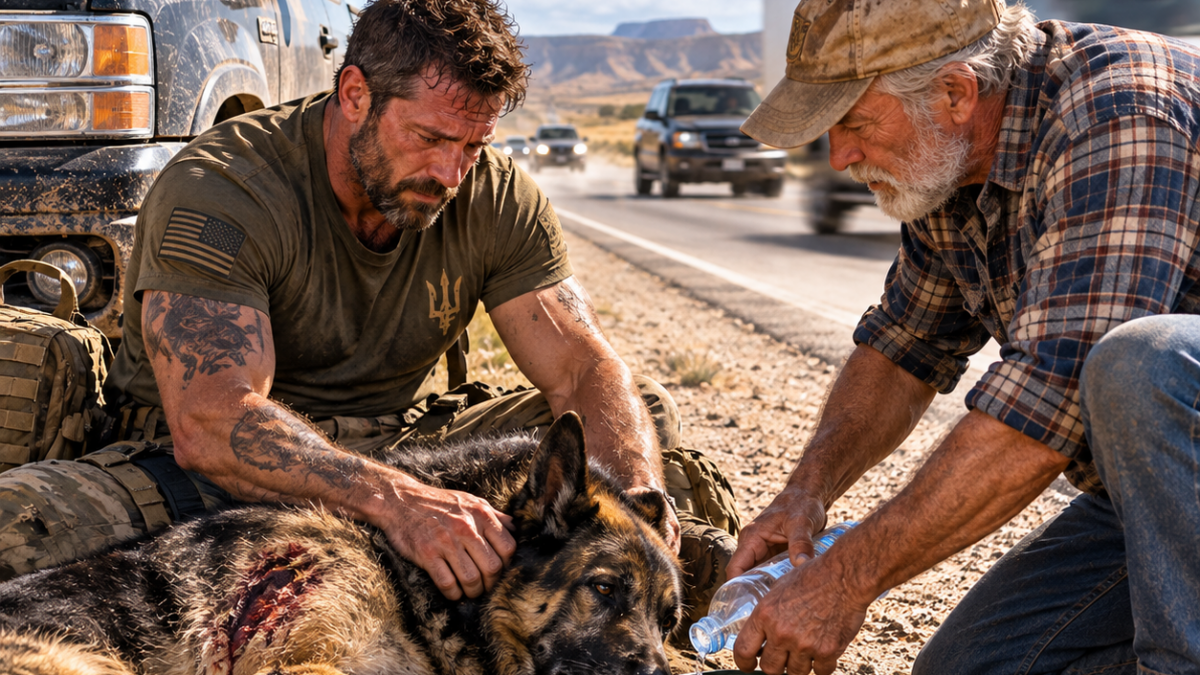
Dozens of Drivers Passed a Navy SEAL and His Dying K9 on a 104° Texas Highway—Then a 72-Year-Old Carpenter Saw the Trident Tattoo and Hit the Brakes.
Dozens of drivers looked straight at me standing beside a dead pickup on a 104-degree Texas highway with my dying German Shepherd in my arms, then locked their doors and accelerated because the scar across my face made me look more dangerous than desperate.
What none of them knew was that Ranger had spent years beside me in Naval Special Warfare, had stopped me from stepping onto a buried explosive in Afghanistan, and had once stood over my bleeding body until a rescue team reached us.
Then a seventy-two-year-old carpenter in a rusted blue Ford hit the brakes, looked at Ranger once, and said, “Put your boy in my truck”—without knowing that before the day was over, he would destroy his own vehicle, reopen the deepest wound of his life, and become the reason my best friend made it home alive.
My name is Caleb Hayes.
For twenty years, I’d been trained to solve problems.
That’s what men in my old line of work did.
You could call it courage if you wanted.
You could call it discipline.
Most of the time it was simpler.
Something went wrong.
You assessed.
Adapted.
Moved.
Door wouldn’t open?
Find another entry.
Vehicle disabled?
Move on foot.
Radio dead?
Establish alternate communication.
Teammate injured?
Stop bleeding.
Mission compromised?
Change the plan.
Panic was a luxury.
You learned to put it somewhere else until there was time to feel it.
That system worked in Afghanistan.
Iraq.
Training exercises.
Helicopters.
Compounds.
Mountain roads.
It worked with bullets in the air and men screaming into radios.
But there are moments when every piece of training you have becomes useless.
Mine happened beside Interstate 40 while my dog was dying at my feet.
PART2:
Ranger was ninety pounds of black German Shepherd, though age had started dusting silver around his muzzle.
He was eleven.
Old for a dog who had spent much of his life doing work that wore bodies down faster than calendars did.
He had arthritis in his back legs.
One chipped canine.
A scar beneath his right shoulder.
Another along his ribs.
He snored loudly enough to shake hotel-room walls.
He hated baths.
Loved steak.
Could open lever-style door handles.
And if I disappeared into another room without telling him, he would eventually find me and stare until I acknowledged the offense.
People called him my dog.
Technically, by then, he was.
For most of our lives together, that description had felt too small.
Ranger had been my partner.
My warning system.
My tracker.
My shield.
My excuse to keep breathing on days I wasn’t sure I wanted to.
I first met him at a military working-dog facility when he was barely two.
He wasn’t the biggest shepherd there.
Wasn’t the fastest.
PART3:
He was the one watching everything.
Handlers.
Doors.
Other dogs.
Vehicles outside the fence.
He didn’t waste movement.
I liked that.
The trainer told me:
“He’s intense.”
“So am I.”
“He’ll challenge you.”
“Good.”
“He has opinions.”
“That may be a problem.”
The trainer smiled.
“Only if yours are wrong.”
Ranger and I disliked each other for about four days.
Then something clicked.
By the end of the first month, I could feel when he caught scent before his body changed.
By the end of the first deployment, I trusted his nose more than technology.
By the end of the second, there were people alive because Ranger had stopped when everyone else would have kept walking.
Kandahar.
Dry road.
Village compound.
Nothing visibly wrong.
Ranger froze.
Not dramatic.
One paw suspended.
Head low.
I stopped the line.
We found the pressure plate.
The man behind me would have stepped on it.
Maybe I would’ve.
I never knew.
Ranger didn’t expect congratulations.
He wanted his reward ball.
That was the thing about him.
Humans attach meaning after survival.
Dogs just do their job.
Fallujah was different.
That memory came back every time I saw the scar near his shoulder.
I took a round high through the thigh in an alley.
My leg collapsed before I understood I’d been hit.
The team pushed forward.
I ended up partially exposed near a broken doorway.
Ranger came back to me.
Nobody commanded him.
He planted himself between me and the opening.
Teeth out.
Body rigid.
I remember blood soaking my pants.
Remember trying to push him away because I knew if somebody came around that corner, Ranger would take the first hit.
He wouldn’t move.
Extraction reached us.
The medic later said:
“Your dog nearly bit me.”
“He has standards.”
I was joking.
Mostly.
There were other missions.
Other things I won’t describe.
Enough to say Ranger earned retirement long before either of us received it.
I left the Navy with scars I could point to and others I couldn’t.
One piece of RPG fragmentation had opened the left side of my face during my final deployment.
Surgeons repaired what they could.
The scar started near my cheekbone, crossed my jaw, and disappeared beneath my shirt collar.
Children stared.
Adults tried not to.
It didn’t bother me at first.
In the Teams, everybody had scars.
They were information.
Outside, I learned scars could become identity before I said a word.
People saw:
Dangerous.
Angry.
Unstable.
Hard.
They weren’t always wrong.
But they were never seeing the whole man.
After twenty-two years, I retired.
That’s the word they use.
Retired.
As if a switch gets flipped.
As if on Friday you know exactly who you are and on Monday you wake up belonging to yourself again.
I struggled.
I had a house.
Savings.
Medical coverage.
Friends who would answer at three in the morning.
None of that solved the silence.
No briefing.
No team room.
No next operation.
No one needed me to know where the exits were.
I wandered the house at night.
Checked windows.
Sat facing doors in restaurants.
Got irritated by grocery-store crowds because nobody moved with purpose.
Ranger adjusted better.
At least I thought he did.
He slept.
Ate.
Followed me.
Started discovering normal things.
Sprinklers.
Mail carriers.
Squirrels.
The deep moral offense of vacuum cleaners.
He had spent years working because I asked him to.
Now his job became keeping me from disappearing into myself.
He excelled.
When I stopped sleeping, Ranger slept across the bedroom doorway.
When I spent too long sitting alone in the garage, he’d bring his ball.
When I skipped meals, he’d sit near the kitchen and stare.
If I ignored him, he’d bark once.
Just once.
Judgment.
My sister once said:
“That dog is running your recovery plan.”
She wasn’t wrong.
Three years after retirement, Ranger and I were driving west through the Texas Panhandle.
I was headed toward New Mexico to help an old teammate rebuild a workshop.
No schedule.
No rush.
My truck was a charcoal-gray 2012 Silverado with too many miles and a radiator I’d been promising myself I’d replace.
That promise almost killed Ranger.
It was July.
Brutal heat.
The dashboard read 104 degrees.
Air outside shimmered.
Interstate stretched empty between long waves of scrub and dust.
Around noon I felt vibration through the steering wheel.
Then temperature needle climbed.
I eased onto the shoulder.
Steam erupted from beneath the hood.
“Perfect.”
Ranger looked at me from passenger seat.
“You’re supposed to warn me about these things.”
Tail hit seat once.
I popped hood.
Coolant everywhere.
Radiator had failed hard.
Not fixable roadside.
My phone showed no service.
That irritated me.
Didn’t frighten me.
Truck problem.
Simple.
Wait.
Flag somebody.
Get a tow.
Ranger jumped out before I could stop him.
“Stay close.”
He moved toward scrub to relieve himself.
I leaned over engine.
Then heard it.
Dry.
Mechanical.
Fast.
Rattle.
Every person raised around desert country knows that sound.
I turned.
“Ranger!”
Too late.
Snake struck.
Greenish-gray body.
Fast recoil.
Ranger yelped and spun.
I was there in seconds.
Snake coiled again.
I stomped.
Hard.
Once.
Twice.
It stopped moving.
Then I saw the bite.
High shoulder.
Two punctures.
Blood.
Ranger tried to stand normally.
Failed.
My stomach dropped.
“Mojave.”
I knew enough.
I didn’t know enough.
That is a terrible middle ground.
Mojave rattlesnake venom can hit neurologically.
Breathing.
Muscles.
Circulation.
I had treated snakebite risks in training.
But Ranger was a dog.
Different dosing.
Different physiology.
Different clock.
I needed a veterinarian.
Fast.
No signal.
Disabled vehicle.
Desert.
That was when the first car appeared.
Silver Mercedes.
I moved toward road.
Raised both arms.
Driver saw me.
I could see his face.
Middle-aged man.
Polo shirt.
Sunglasses.
I pointed at Ranger.
Then truck.
Universal distress.
Slow down.
Please.
Instead he moved into the other lane.
Accelerated.
Dust hit me.
I watched taillights shrink.
“Okay.”
Second vehicle.
SUV.
Same.
Third.
Pickup.
Driver looked straight at me.
Kept going.
I checked Ranger.
Swelling already forming.
“Easy.”
I poured water into my palm.
He lapped weakly.
I could feel tremor beginning under his jaw.
Twenty years earlier, I might have shouted.
Cursed.
Thrown something.
That day I just felt time.
Every passing vehicle became a minute.
Every minute became less Ranger.
An RV approached.
Family.
I stepped farther toward white line.
Waved.
Pointed.
A little girl inside saw the dog.
Pressed her hands to window.
The father saw me.
His face changed.
He shook his head violently and accelerated.
Wind from RV threw gravel.
Ranger flinched.
I knelt.
Put my hand across him.
“It’s okay.”
It wasn’t.
Four more cars.
Delivery truck.
Nobody stopped.
At some point I understood why.
I looked frightening.
Six-three.
Two hundred twenty pounds.
Tattooed arms.
Tactical pants.
Scarred face.
Roadside.
No cell service.
Large black dog.
The same appearance that had made sense in places built around violence now looked like violence to strangers.
I couldn’t blame every driver completely.
People have families.
Safety matters.
But understanding didn’t make Ranger breathe any easier.
His panting changed.
Shallower.
Gums paling.
I knelt in dirt and pressed my forehead into his neck.
“Stay with me.”
My voice broke.
I had begged very few times in my life.
I had asked God for men to survive.
Asked medics to work faster.
Asked helicopters to arrive.
I had never begged for myself.
I begged for Ranger.
“Come on, buddy.”
His ear moved.
“You brought me home.”
I swallowed.
“I’m getting you home.”
There are promises you make because you know you can keep them.
Others because the person—or animal—hearing them needs something more than truth.
“I promise.”
Ranger whined.
The sound almost broke me.
Then I saw the old Ford.
Pale blue.
1988 maybe.
Rust.
Dents.
Tools in bed.
It approached slower than the others.
I stood.
Raised arm.
The truck passed one car.
Then brake lights came on.
Hard.
It pulled onto shoulder.
For a second I couldn’t move.
Someone had stopped.
Driver window rolled down by hand.
Old man.
White hair.
Weathered face.
Plaid shirt.
“Sir.”
I ran toward him.
“My dog was bitten by a Mojave green.”
His eyes moved past me to Ranger.
“He’s military K9.”
I don’t know why I added that.
Maybe because I had just watched half a dozen people decide Ranger wasn’t worth stopping for.
“He’s crashing. I need Amarillo.”
The old man didn’t ask whether I had money.
Didn’t ask whether Ranger might bite.
Didn’t ask why I looked like I’d recently escaped a bad decision.
He opened passenger door.
“Grab him.”
“What?”
“Put your boy in here.”
He swept blueprints and coffee cups from seat.
“AC works.”
I stared at him.
“Sir—”
“Hurry.”
That word snapped me back.
I ran.
Lifted Ranger.
Ninety pounds felt weightless.
Carried him to Ford.
Old man said:
“Lay him across you.”
I climbed in.
Ranger across lap.
Cab smelled like sawdust, old vinyl, coffee, machine oil.
Driver threw truck into gear.
Tires spit gravel.
We moved.
“My name’s Walter Higgins.”
“Caleb Hayes.”
“Dog?”
“Ranger.”
Walter nodded once.
“Good name.”
“Thank you.”
He accelerated.
I kept fingers against Ranger’s pulse.
Fast.
Weak.
Walter glanced at my arm.
Gold trident tattoo.
Didn’t mention it.
Then:
“Where were you?”
“What?”
“You and dog.”
“Military?”
“Yes.”
“Several places.”
“Afghanistan.”
“Iraq.”
“More.”
Walter nodded like that was enough.
“My boy was Marine.”
I looked over.
“Was?”
“First Battalion, Eighth Marines.”
Pause.
“He didn’t come home.”
Walter’s voice didn’t change.
That told me pain was old, not gone.
“I’m sorry.”
“Twenty years.”
“Doesn’t matter.”
He glanced at Ranger.
“Tommy wrote about the dogs.”
“Yeah?”
“Said he’d trust the dogs before half his lieutenant’s maps.”
I almost smiled.
“Smart Marine.”
“He was.”
Walter shifted gear.
“What did Ranger do?”
“Everything.”
Walter waited.
I looked down at dog.
“In Kandahar he stopped me from stepping on a device.”
“Fallujah he covered me after I got shot.”
“He’s found explosives.”
“People.”
“Weapons.”
Walter nodded.
“So he’s brought you home.”
“Yes.”
“Then we’re bringing him.”
That sentence settled something inside me.
We drove about ten miles before brake lights appeared.
First a few.
Then dozens.
Then traffic stopped.
Black smoke rose ahead.
I leaned forward.
“No.”
Walter rolled window down.
Flagged car crawling opposite direction.
“What happened?”
Driver yelled:
“Semi rolled!”
“Fire!”
“Both lanes closed!”
“Troopers say hours!”
Hours.
I looked at Ranger.
His chest barely moving.
“I’ll run.”
Walter turned.
“What?”
“I’ll carry him.”
“To Amarillo?”
“Yes.”
“Twenty miles.”
“I’ll do it.”
“Not in this heat.”
“I’ve run farther carrying heavier.”
“Maybe when you were thirty.”
My jaw tightened.
Walter said:
“You stroke out, dog still dies.”
He was right.
I hated him briefly for being right.
He stared through windshield.
Then right.
Fence.
Open country.
Canyon.
“There’s another way.”
I looked.
“Old ranch road.”
“Used to frame houses out there.”
“Cuts through Diablo Canyon.”
“How far?”
“Saves us around wreck.”
“Truck handle it?”
Walter looked at his Ford.
“No.”
I stared.
Then he grinned slightly.
“Truck doesn’t get a vote.”
He jerked wheel.
We left pavement.
Ford dropped down embankment.
Fence ahead.
“Walter—”
“Hold him.”
We hit old fence.
Posts snapped.
Metal screamed along body.
Truck slammed onto dirt.
Ranger groaned.
I wrapped both arms tighter.
“You okay?”
Not Walter.
Ranger.
Always Ranger.
Walter fought steering wheel through rocks.
Dust came through vents.
Tools hammered bed.
Suspension bottomed out.
I looked at this seventy-two-year-old carpenter driving a thirty-year-old truck into a canyon for two strangers and thought:
This man is insane.
Then I realized he had probably thought same thing about me five minutes earlier.
Trail barely existed.
Rock.
Dry creek beds.
Mesquite scraping doors.
Heat.
Walter drove from memory.
“You sure about this road?”
“No.”
“Good.”
“You military boys like confidence too much.”
“We like competent confidence.”
“Then you’re in wrong truck.”
I laughed.
First time since bite.
Ranger made small sound.
I leaned down.
“Stay awake.”
Walter barked:
“Talk to him.”
“I am.”
“Louder.”
“Why?”
“So he knows quitting ain’t option.”
I looked at Walter.
He shrugged.
“Carpenter medicine.”
I pressed my face near Ranger’s muzzle.
“You hear him?”
Ranger’s eyes opened halfway.
“You’re not dying in this truck.”
No movement.
“You still owe me for eating that steak in Phoenix.”
Ear twitched.
Walter glanced.
“He steal food?”
“He stole a ribeye off my plate.”
“Good dog.”
“Traitor.”
Ranger exhaled.
Then Ford dropped into sand.
Hard.
Rear wheels spun.
Truck stopped.
Walter hit gas.
Nothing.
Again.
Sand sprayed.
We sank.
“Damn.”
I carefully placed Ranger on seat.
“Stay with him.”
“Where are you going?”
“Solving problem.”
I got out.
Heat hit like furnace.
Truck bed.
Tools.
Sawhorses.
Canvas tarps.
I grabbed two heavy wooden horses.
Walter yelled from window:
“What are you doing?”
“Traction.”
I shoved wood beneath rear tires.
Sand burned forearms.
Canvas on top.
“Feather throttle.”
“You push?”
“Yes.”
“Truck weighs six thousand pounds.”
“Then help me lie to physics.”
Walter grinned.
“Go!”
Engine roared.
I pushed.
Boots sank.
Tires spun.
Caught canvas.
Ford lurched.
Again.
Then climbed out.
I ran after it.
Walter barely stopped.
I climbed in.
“How’s he?”
Walter’s face answered.
Worse.
We drove.
Five minutes.
Ten.
Then dashboard temperature needle rose.
“Walter.”
“I see.”
Smoke.
Hiss.
Engine coughed.
White steam covered windshield.
Truck rolled to stop.
Walter turned key.
Nothing.
Again.
Dead.
For several seconds, neither of us spoke.
I looked through clearing steam.
Paved county road maybe few hundred yards ahead.
Buildings far distance.
Phone suddenly showed one weak bar.
Walter checked map.
“Clinic’s two miles.”
“Name?”
“Panhandle Emergency Veterinary.”
“Call.”
“What are you doing?”
I lifted Ranger.
“He can’t wait.”
“Caleb.”
“Call ahead.”
“Two miles.”
“I know.”
“Ninety-pound dog.”
“I know.”
“One hundred four degrees.”
“I know.”
“You’ll die.”
“Then call an ambulance after you call the vet.”
Walter grabbed my arm.
“Son.”
I looked at him.
His eyes were wet.
“Don’t make me watch another one of you die.”
That sentence stopped me.
Not Ranger.
Me.
For one second I saw Tommy Higgins.
A son I’d never met.
A twenty-something Marine frozen in his father’s memory.
Walter had already lost someone in desert.
He had stopped because he recognized that shape of grief.
I put my hand over his.
“I’ll make it.”
“You don’t know that.”
“No.”
“But he doesn’t have another option.”
Walter released.
“Go.”
I stepped into heat.
Ranger limp against my chest.
First half mile felt possible.
I had carried men heavier.
Rucked farther.
Run hotter.
But I wasn’t thirty anymore.
And fear consumes oxygen.
I jogged.
Boots pounding asphalt.
Ranger’s body bouncing gently with stride.
I kept him tight.
“Stay with me.”
His pulse against forearm.
Faint.
Cars passed.
Now people slowed.
Maybe sight of scarred man running with dog looked strange enough to notice.
Still nobody stopped.
I stopped caring.
Half mile.
Sweat blinded.
One mile.
Arms burning.
Back tightening.
Old thigh wound started pulling.
I shifted Ranger.
Couldn’t risk dropping.
“You carried me.”
Breath ragged.
“My turn.”
I remembered Fallujah.
His body over mine.
Teeth.
Blood.
Remembered Kandahar.
That frozen paw.
Tripwire.
Remembered retirement night.
Ranger asleep in my kitchen for first time as civilian dog.
Remembered mornings when I couldn’t get out of bed and his nose shoved under my hand.
Mile and a quarter.
Vision narrowed.
Heat pushed down.
I stumbled.
Knee hit gravel.
I rotated midfall.
Kept Ranger off ground.
Pain shot through leg.
Got back up.
“You’re okay.”
I didn’t know whether talking to Ranger or myself.
“Get up.”
Step.
“Move.”
Step.
“Do not quit.”
Old BUD/S voice.
Step.
Men shouting on beach.
Step.
Cold water.
Step.
Ranger’s heartbeat.
Step.
At mile and a half, I heard siren behind me.
I didn’t turn.
Then state trooper passed.
Walter in passenger seat.
They slowed beside me.
Trooper yelled:
“Get in!”
“No time.”
“We can drive you!”
I stopped.
That option had somehow not entered my heat-addled brain.
Trooper opened rear door.
I climbed.
Walter grabbed Ranger’s back end carefully.
We got him inside.
Sirens.
Acceleration.
Clinic.
Three minutes maybe.
Felt like three years.
Automatic doors.
I carried Ranger inside.
Receptionist looked up.
Fear flashed across her face at sight of me.
Before she could say anything, doors to treatment opened.
Veterinarian and techs with gurney.
“We’re ready.”
Walter had called.
I laid Ranger down.
Tech:
“Severe envenomation.”
Another:
“Gums cyanotic.”
Oxygen.
IV.
Commands.
“Antivenom.”
“Pressure.”
“Move.”
Gurney disappeared.
Weight left my arms.
So did strength.
I dropped to knees.
Then floor.
Hands shaking.
Body finally allowed panic because task was out of reach.
I had done everything.
That is a terrible sentence.
Because once you’ve done everything, there’s nothing left to trade.
Walter came in with trooper.
He lowered himself onto floor beside me.
Seventy-two-year-old knees protesting.
Didn’t say:
He’ll be fine.
Didn’t say:
Everything happens for reason.
Didn’t say:
God has plan.
Thank God.
He simply sat.
Hand on my shoulder.
I stared at treatment doors.
“Your truck.”
“What?”
“I destroyed your truck.”
Walter shrugged.
“It was old.”
“You drove it off road.”
“It always wanted adventure.”
“Fence.”
“Wasn’t mine.”
I almost laughed.
Couldn’t.
“Why’d you stop?”
Walter looked at floor.
“My son.”
“I know he was Marine.”
“No.”
He breathed.
“When Tommy came home first deployment, he looked different.”
“Quiet.”
“Wouldn’t sit with back to door.”
“Carried himself like you.”
“He went back.”
“Didn’t come home second time.”
Walter rubbed calloused hands.
“For years I kept thinking maybe someone saw him when he needed help and didn’t stop.”
I turned.
“He died overseas.”
“I know.”
“Not road.”
“I know.”
He looked at me.
“Grief isn’t logical.”
No.
It isn’t.
He continued.
“When I saw you standing there, everybody else saw scar.”
“I saw my boy.”
That did it.
I cried.
Not elegantly.
Not silently.
My body folded.
Twenty-two years of control, gone.
Walter stayed.
Didn’t look embarrassed for me.
That’s one of the greatest gifts a man can give another.
Not requiring him to recover quickly.
Time disappeared.
Clock.
Air conditioning.
Muffled phones.
Then treatment doors opened.
Dr. Arthur Pendleton.
Older man.
Blood on gloves.
Sweat at collar.
I stood too fast.
Knees nearly failed.
Walter caught elbow.
Doctor said:
“Caleb?”
“Yes.”
“Ranger went into cardiac arrest.”
Everything inside me stopped.
“How long?”
“About thirty seconds.”
I couldn’t breathe.
Doctor continued.
“We got him back.”
I stared.
“The antivenom is working.”
I heard words individually.
Couldn’t assemble them.
“Respiratory function is improving.”
“His blood pressure is stabilizing.”
“Next several hours matter.”
“But right now…”
Dr. Pendleton smiled faintly.
“…he’s alive.”
My legs went.
Walter grabbed me.
I hugged him.
Hard.
Probably hurt him.
He laughed and cried against my shoulder.
“Easy, sailor.”
“Sorry.”
“Old ribs.”
“Sorry.”
I couldn’t stop laughing.
Ranger survived.
Not immediately.
Not cleanly.
He spent three nights at clinic.
More antivenom.
Fluids.
Monitoring.
Tissue damage around bite.
Kidney values watched.
Respiratory status.
First night I sat beside kennel.
Ranger barely conscious.
I put hand through opening.
His nose moved.
Touched palm.
That was enough.
Walter stayed in Amarillo.
His Ford had to be towed.
Repair shop said engine was finished.
Head gasket plus heat damage.
More money than truck was worth.
He shrugged.
Insurance didn’t cover driving through cattle fence and Diablo Canyon.
Apparently policies have standards.
I offered to buy him truck.
“No.”
“Walter.”
“No.”
“You lost it because of me.”
“Truck died doing something useful.”
“That doesn’t pay for replacement.”
“Neither do your guilt speeches.”
I had money.
More than Walter.
I found that offensive in moment.
He refused every direct offer.
So I called his daughter.
He had one.
Sarah.
Nurse in Lubbock.
I explained.
She laughed.
“He won’t take money.”
“I’ve noticed.”
“You’ll have to out-stubborn him.”
“I was a SEAL.”
“My father raised a Marine.”
Fair.
We developed plan.
Walter volunteered at VA hospital and built wheelchair ramps for veterans.
His old truck was core of that work.
Without it, he couldn’t haul lumber.
So I didn’t buy Walter a truck.
I donated one to his volunteer carpentry program.
Used F-250.
Work rack.
Toolbox.
Program assigned it to Walter.
He called me immediately.
“You son of a bitch.”
“Government-ish bureaucracy.”
“You bought that truck.”
“The nonprofit accepted a donation.”
“You know exactly what you did.”
“Yes.”
Silence.
Then:
“It’s too nice.”
“Scratch it.”
He hung up.
Next week he sent photo.
Truck covered in lumber dust.
Caption:
FIXED.
Ranger came home.
For first week, barely moved.
I slept beside him on floor.
Every few hours I’d wake and place hand against ribs.
Breathing.
Still breathing.
He got annoyed.
Good sign.
Walter visited.
Ranger lifted head.
Tail thumped.
Walter knelt.
“Hey, Marine.”
“He’s Navy.”
Walter scratched ears.
“My son said all dogs are Marines.”
“Your son was wrong.”
“Dead Marines remain hard to argue with.”
I let it go.
Something had formed between us during that drive.
Not friendship exactly at first.
Brotherhood is overused.
Recognition maybe.
Two men carrying different versions of same grief.
Walter lost son.
I had spent years losing pieces of myself.
Ranger connected us.
When I finally visited Walter’s home, I saw Tommy everywhere.
Photo in Marine dress blues.
High-school baseball.
Child holding fishing pole.
A folded flag.
Shadow box.
Walter didn’t hide any of it.
“That him?”
“Yes.”
I looked at Marine photo.
“Good-looking kid.”
“Got that from mother.”
“Smart?”
“Also mother.”
“Then what’d you contribute?”
“Excellent truck judgment.”
I laughed.
He told me about Tommy.
Not death first.
Life.
Bad spelling.
Loved jalapeños.
Couldn’t sing.
Joined Marines against Walter’s advice.
Called every Sunday when deployed if phones available.
Last call had been ordinary.
That’s the cruelty.
We expect last conversations to know they’re last.
Most don’t.
Tommy complained about heat.
Asked about an old dog.
Said he’d call again.
Then Fallujah.
Walter received officers at door.
“I hated the dogs for years,” he admitted.
“What?”
“Not literally.”
He looked at Ranger sleeping nearby.
“Tommy talked about working dogs all the time.”
“After he died, anything he loved hurt.”
“Then I started volunteering.”
“Why?”
“Because sitting home hating things was killing me.”
That was when he began building ramps for disabled veterans.
Decks.
Handrails.
Door widening.
Simple things.
Physical work that returned independence.
“You save everybody with lumber?” I asked.
“Cheaper than therapy.”
“Is it working?”
“No.”
We laughed.
After Ranger recovered, I started helping.
One ramp.
Then another.
My old skill set translated surprisingly well.
Measure.
Plan.
Carry.
Solve.
Walter knew carpentry.
I knew logistics.
We argued constantly.
He called me sailor.
I called him old man.
He insisted level was more accurate than my eye.
He was right.
I denied it.
The story of highway spread because state trooper told someone.
Then clinic posted anonymous thank-you to “a citizen who stopped.”
Somebody identified Walter.
Local station interviewed him.
He hated it.
Reporter asked:
“Do you consider yourself a hero?”
Walter stared at her.
“I stopped a truck.”
“You drove through a fence and canyon.”
“Poor judgment isn’t heroism.”
“Your actions saved Ranger.”
“The dog needed a ride.”
Reporter smiled.
“Why did everyone else pass?”
Walter looked at camera.
“Ask them.”
Then:
“I wasn’t braver.”
“I just knew what I was looking at.”
That line spread.
People asked what he meant.
He explained.
“I saw military boots.”
“Tattoo.”
“Posture.”
“But mostly I saw a man looking at an animal the way I once looked at my son in a hospital.”
“Fear is easy to recognize if you’ve carried enough of it.”
Drivers who passed became villain characters online.
I didn’t like that.
I never knew their stories.
Maybe children in car.
Maybe prior trauma.
Maybe no idea Ranger was dying.
It’s easy to judge a two-second decision from couch.
The lesson wasn’t that every driver was evil.
It was that Walter made a different choice.
Compassion often requires uncertainty.
He stopped without guarantee I was safe.
He assessed.
Kept distance.
Rolled window.
Asked enough.
Then acted.
You can be cautious and still human.
I eventually replaced Silverado radiator.
Then sold truck.
Couldn’t trust it.
Bought newer one.
Walter called:
“Fancy.”
“Functional.”
“Has heated seats.”
“Function.”
“You’ve gone soft.”
“Says man driving donated F-250.”
He had no comeback.
Ranger slowed after snakebite.
Not immediately.
But year later, age caught him.
Hip problems.
Longer naps.
I stopped traveling far.
Didn’t care.
He had gone everywhere I asked for most of his life.
Now we stayed.
Walter’s house became one of our places.
Ranger knew which cabinet contained treats.
Walter pretended not to spoil him.
Liar.
On Tommy’s death anniversary, Walter usually worked alone.
One year I found him rebuilding steps at widow’s home.
“Go home,” I said.
“No.”
“You’ve been here eleven hours.”
“Need rail.”
“Tomorrow.”
He shook head.
I understood.
Work was how he survived certain dates.
So I stayed.
We finished rail after dark.
Sat on tailgate.
Walter said:
“Tommy would’ve liked you.”
“Why?”
“Both stubborn.”
“That’s not compliment.”
“Wasn’t meant as one.”
Then he looked at Ranger.
“He would’ve loved him.”
I handed Walter beer.
“To Tommy.”
He lifted it.
“To Ranger.”
“Ranger’s alive.”
“All the more reason.”
Three years after highway, Ranger developed cancer.
Hemangiosarcoma.
Silent.
Aggressive.
Vet showed scans.
Weeks maybe.
Months if lucky.
I sat in parking lot afterward.
Ranger in passenger seat.
Same position he’d occupied thousands of miles.
Walter called.
I didn’t answer.
Hannah—my sister—called.
Didn’t answer.
Old teammate.
Didn’t answer.
Then Walter drove up.
No idea how he found me.
Probably clinic.
He parked.
Got out.
Opened passenger-side rear door.
Sat sideways.
“What?”
“Cancer.”
He nodded.
“Bad?”
“Yes.”
“How long?”
“Not enough.”
Walter looked at Ranger.
Then me.
“Never is.”
That was all.
We did not chase impossible treatment.
Pain control.
Good days.
Steak.
Sun.
Short walks.
Walter built a low ramp so Ranger could climb into truck without jumping.
Overengineered.
Could’ve held horse.
“It’s ridiculous.”
“Shut up.”
Ranger loved it.
Final day came quietly.
Ranger stopped eating.
Wouldn’t stand long.
Looked tired in a way I’d never seen.
I knew.
I wanted one more day.
That’s selfishness love creates.
Vet came to house.
Walter came too.
I sat on floor.
Ranger’s head in lap.
Walter stayed against wall.
No speeches.
I touched scar near shoulder.
Then his ears.
“You brought me home.”
My voice failed.
“Every time.”
Ranger looked at me.
Maybe because sound.
Maybe because he knew.
“I got you home too.”
The veterinarian gave medication.
His breathing slowed.
I kept my forehead against his.
“Good boy.”
Then no breath.
The room became impossible.
I don’t remember how long I sat.
Walter eventually lowered himself beside me.
Put arm across shoulders.
He had sat beside me on clinic floor years earlier.
Now again.
Some people show up once.
Others become the person you expect when the room goes dark.
We buried Ranger on Walter’s property under cottonwood.
I kept collar.
Service tags.
His reward ball.
Walter made marker.
Plain cedar.
RANGER
MILITARY WORKING DOG
PARTNER
HE BROUGHT HIS MAN HOME.
I saw it.
Shook head.
“No.”
Walter frowned.
“What?”
“Missing part.”
I took pencil.
Added beneath:
AND A CARPENTER BROUGHT HIM HOME.
Walter stared.
“That’s stupid.”
“It’s true.”
“You’re ruining clean design.”
“Old man.”
He left it.
Years passed.
I stayed involved with veteran home-repair program.
Eventually ran logistics.
Then expanded it.
We called project HOMEFRONT HANDS.
Walter hated name.
Said it sounded like hardware store.
We kept it.
Veterans needing ramps.
Roof repair.
Wheelchair access.
Door widening.
Fence repair for Gold Star families.
Anything manageable.
Walter became legend among volunteers.
At seventy-seven, still showed up early.
At eighty, finally stopped climbing ladders after Sarah threatened legal action.
He responded:
“You can’t sue your father.”
She said:
“Watch me.”
He stayed on ground.
Mostly.
The donated F-250 accumulated dents.
Walter adored every one.
People sometimes recognized us from old news story.
The Navy SEAL and carpenter.
I disliked label.
Walter despised it.
“We’re carpenters now,” he’d say.
“You’re carpenter.”
“You carry lumber.”
“That’s labor.”
“Exactly.”
One summer afternoon, a young veteran named Marcus joined our crew.
Marine.
Twenty-six.
Prosthetic below knee.
Angry.
Wouldn’t ask for help.
Reminded me of myself enough to irritate me.
We were building ramp at his own house.
He kept trying to lift boards alone.
I said:
“Ask.”
“I’ve got it.”
“You don’t.”
“I said—”
Walter, eighty-two by then, interrupted:
“Son.”
Marcus looked.
Walter pointed at me.
“See scarface?”
Marcus stared.
“Yes.”
“He once tried to run two miles in 104-degree heat carrying a ninety-pound dog because he was too stupid to wait thirty seconds for a police cruiser.”
“That is inaccurate.”
Walter ignored.
“Point is, strong men can still be idiots about help.”
Marcus laughed.
First time all day.
Then handed me one end of board.
That’s how stories become useful.
Not when strangers admire them.
When somebody hears one and chooses differently.
Walter died at eighty-four.
Sleep.
His daughter called me before sunrise.
I drove there.
Sat at kitchen table.
Same house.
Same tools.
His glasses beside crossword puzzle.
Coffee mug in sink.
Death can make ordinary objects obscene.
Sarah handed me envelope.
“Dad left this.”
Inside:
Truck title.
F-250.
I laughed and cried.
There was a note.
Caleb,
Program technically owns truck, so don’t get excited.
Tools are yours.
Keep building.
And for God’s sake, replace the circular saw blade before somebody loses a finger.
—Walter
Below:
Tommy would’ve liked you.
I folded note.
Sarah asked:
“What will you do with his tools?”
“Use them.”
She nodded.
“Good.”
We held memorial at VA center.
Marines came.
Veterans.
Families whose homes he’d repaired.
Hundreds.
Someone asked me to speak.
I didn’t want to.
Did anyway.
I told them about highway.
Not dramatic canyon part.
The first moment.
Rust-blue truck slowing.
Everything began with brake lights.
One person decided to stop.
I said:
“People keep telling me Walter saved Ranger because he recognized I was military.”
I looked at crowd.
“Maybe that helped.”
“But Walter didn’t know my name.”
“Didn’t know Ranger’s record.”
“Didn’t know whether I deserved anything.”
“He stopped because suffering was visible enough.”
Pause.
“That is the standard he left me.”
Not medals.
Not service.
Not status.
Visible need.
Do what you safely can.
That’s all.
After memorial, I drove to Ranger’s grave.
Walter buried nearby by family, not far away.
Tommy’s photograph mounted inside workshop.
Three generations of loss in one piece of land.
I sat between markers.
Thought about that highway.
All those cars.
For years I had been angry at them.
Eventually anger faded.
What stayed was Walter.
The man who stopped.
That’s a better way to remember a hard day.
Not by counting the people who didn’t help.
By remembering the one who did.
I teach that now.
At veteran transition workshops.
You cannot control who passes.
You cannot force people to recognize your story.
You cannot expect strangers to see beneath scars, clothing, fear, or first impressions.
But sometimes someone will.
And sometimes you get to be that someone.
Years after Walter died, HOMEFRONT HANDS rebuilt a porch for an elderly woman whose husband had served in Korea.
One volunteer was seventeen.
High-school kid.
He asked why our program logo included a little outline of a dog.
I told him.
Not all details.
Enough.
He said:
“So Walter was hero.”
I thought.
“No.”
Kid looked confused.
“He did heroic thing?”
“Yes.”
“So hero.”
“Maybe.”
I picked up level.
“But if you turn people into heroes, you start thinking ordinary people can’t do what they did.”
Kid waited.
“Walter was ordinary.”
“Carpenter.”
“Father.”
“Widower.”
“Old man in bad truck.”
“He saw someone needed help and stopped.”
I handed kid level.
“That means you don’t get excuse of waiting until you’re heroic.”
He smiled.
“That’s kind of harsh.”
“Good.”
We finished porch.
Late afternoon.
Driving home, I passed a disabled minivan.
Mother standing beside it.
Two kids.
I pulled over.
Of course I did.
She looked nervous when I approached.
Scar still does that.
I stopped twenty feet away.
Held hands visible.
“You okay?”
“Tire.”
“Spare?”
“Yes.”
“No jack?”
She nodded.
“I’ve got one.”
I changed tire.
Kids watched.
Little boy asked:
“What happened to your face?”
His mother looked horrified.
I said:
“Work accident.”
Technically close enough.
He pointed to dog-shaped patch on my work shirt.
“You have dog?”
“Used to.”
“What was his name?”
“Ranger.”
“Was he good?”
“The best.”
I tightened lug nuts.
Got back in truck.
As I pulled away, I saw Walter’s old toolbox in bed.
Same canvas tarps.
Different saw horses.
I kept some of his equipment.
Not because tools were special.
Because they reminded me useful things should keep being useful.
Like stories.
Like grief, maybe.
If you’re lucky.
I sometimes dream about Ranger.
Always young.
Never sick.
Never bitten.
He’s usually running ahead.
I wake reaching toward empty floor.
That part never fully goes away.
But the pain is no longer only loss.
There’s gratitude mixed in.
He had eleven years.
More than many working dogs.
He survived missions.
Bullets.
Explosives.
Rattlesnake.
Me.
I once asked Dr. Pendleton how close Ranger had been to dying that day.
He said:
“Minutes.”
“How many?”
“Impossible.”
“Five?”
“Maybe.”
“Ten?”
“Maybe.”
I tortured myself with that for while.
If Walter had passed.
If he had stopped for fuel.
If traffic was different.
If ranch road wasn’t there.
If trooper arrived later.
If antivenom unavailable.
Maybe.
Maybe.
Maybe.
Then I remembered what Walter said after Ranger died.
He was sitting beside grave.
“You military people love alternate scenarios.”
“What?”
“You replay what could’ve happened.”
“Yes.”
“Waste of time.”
“You don’t replay Tommy?”
Walter went quiet.
Then:
“Every day.”
I looked at him.
“So?”
“So I’m telling you because I know it’s waste.”
Fair.
“What should I think about?”
“What did happen.”
“What happened?”
“I stopped.”
“You carried him.”
“Vet saved him.”
“He got more years.”
Walter tapped grave marker.
“That’s enough truth for one day.”
He was right.
What happened:
Ranger got bitten.
Truck failed.
Cars passed.
Walter stopped.
We drove.
Traffic blocked.
We improvised.
Truck broke.
Trooper helped.
Veterinary team worked.
Ranger lived.
I met Walter.
We built things.
Ranger grew old.
Walter grew older.
Both died loved.
I kept going.
That’s the story.
People want single heroic act.
Life is chain of them.
Walter stopped.
Ranger had saved me.
Trooper drove.
Veterinarian treated.
Sarah supported father.
Volunteers showed up.
No one person owned the ending.
Even the drivers who passed indirectly taught me something.
How it feels to stand visible and still unseen.
That changed how I look at people.
Before, I assessed strangers like threats.
After Walter, I started asking another question.
What might they need?
Not every person.
I’m not naïve.
Safety matters.
Boundaries matter.
But fear shouldn’t be only lens.
I once spent my life learning danger indicators.
Now I try to notice distress indicators too.
Sometimes they look similar.
A person pacing.
Raised hands.
Strange clothing.
Desperation.
You have to look longer.
Walter looked longer.
That’s why he stopped.
The scar on my face softened with age.
Still visible.
Children still ask.
Adults still glance.
Doesn’t bother me anymore.
Ranger’s collar hangs in workshop.
Walter’s note pinned beside it.
Tommy’s Marine photo copied and framed near program office.
Three reminders.
Service.
Loss.
Compassion.
We named annual volunteer award after Walter.
He would’ve hated that.
The Higgins Service Award.
Given not to biggest donor.
Not most hours.
To person who notices a need nobody assigned them.
First recipient was teenager who spent three weekends quietly fixing an elderly veteran’s fence after scheduled work ended.
When I handed award to him, he said:
“I only stayed because it was broken.”
Exactly.
Walter would’ve approved.
One afternoon I drove same section of Interstate 40.
Years later.
Newer truck.
Air conditioning strong.
Road looked smaller than memory.
I found approximate shoulder where Silverado had died.
Pulled off.
Traffic rushed by.
Wind.
Heat.
No marker.
No reason there should be.
I stood near white line.
Remembered Ranger in dirt.
My hands raised.
Cars passing.
Then rusty blue Ford slowing.
For years I thought that day proved people were indifferent.
I had it backward.
Most people passed.
One didn’t.
And one was enough.
That’s terrifying and hopeful at same time.
Sometimes one person really is the entire difference.
I looked toward horizon.
“Thanks, Walter.”
Then:
“Thanks, buddy.”
I got back in truck.
On passenger seat was Ranger’s old tag.
I keep it there on long drives.
Ridiculous.
Sentimental.
Don’t care.
Before pulling onto highway, I touched it.
Then waited for gap.
A car approached behind me, slowed.
Driver gave space.
Small courtesy.
I merged.
Life continued.
That’s all any of us really get.
Chances to continue.
Ranger gave me mine more than once.
Walter gave Ranger his.
And by saving Ranger that day, Walter probably saved something in me too.
I had spent years believing strength meant needing less.
Less help.
Less reassurance.
Less dependence.
The Teams rewarded self-sufficiency for good reason.
But civilian life taught me another form of strength.
Allowing someone to stop.
Allowing an old man to help.
Allowing a veterinarian to take Ranger from my arms.
Allowing friends to sit beside me after death.
Allowing grief to exist without defeating it.
Walter never lectured me about that.
He demonstrated.
He didn’t ask whether stopping made him vulnerable.
He just stopped.
The last conversation we had before he died happened in workshop.
He was sanding a cedar rail.
I said:
“You know you changed my life.”
He rolled eyes.
“No.”
“Yes.”
“I changed lanes.”
“You stopped.”
“Same thing.”
“You lost a truck.”
“Bad truck.”
“You spent years working with me.”
“Free labor.”
“You became family.”
He stopped sanding.
Looked at me.
“Careful.”
“What?”
“Getting emotional.”
“You’re eighty-four.”
“Still dangerous.”
I laughed.
Then he said:
“Caleb.”
“Yeah?”
“Tommy would’ve stopped.”
I knew what he meant.
Not because Tommy was Marine.
Because Walter believed his son was kind.
Maybe helping me had let Walter imagine one more thing his son might have done if he’d lived.
That was part of why he stopped too.
People aren’t simple.
We help others for them and for ourselves.
That’s okay.
If the help is real, motive doesn’t have to be pure.
“I wish I’d met him.”
Walter nodded.
“Me too.”
Then he went back to sanding.
That was our goodbye, though neither of us knew.
Ordinary.
Like Tommy’s last call.
Like most important endings.
Today, when someone asks what I learned from Ranger, I tell them loyalty.
When they ask what I learned from Walter, I tell them this:
Don’t assume someone else’s worst day will look safe enough for you to recognize.
Sometimes desperation wears a suit.
Sometimes a uniform.
Sometimes dirty clothes.
Sometimes tattoos and a scar that makes you lock your door.
Sometimes it is lying beneath a truck in black fur, breathing so shallowly that only the person who loves him understands the clock is running out.
You don’t have to be reckless.
You don’t have to save everybody.
You don’t have to prove anything.
But look twice.
That’s what Walter did.
Every car before his saw the same roadside.
Same disabled truck.
Same scarred man.
Same dying shepherd.
Walter saw something different.
He saw his son.
He saw service.
He saw fear.
Most important, he saw two living beings who needed help.
Then he hit the brakes.
Years later, after Ranger and Walter were both gone, that sound was still the loudest thing I remembered from that highway.
Not the rattlesnake.
Not the exploding radiator.
Not the sirens.
Brakes.
One old Ford slowing down when everybody else kept moving.
Sometimes salvation doesn’t arrive looking impressive.
Sometimes it’s seventy-two years old.
Wearing a faded flannel shirt.
Driving a rusted truck full of sawdust.
And asking only one question.
“Where does your boy need to go?”

