An Older Shelter Cat With a Torn Ear Watched Everyone Choose Someone Else—Then a Widower Walked In and Said Seven Words That Made Him Finally Step Forward.
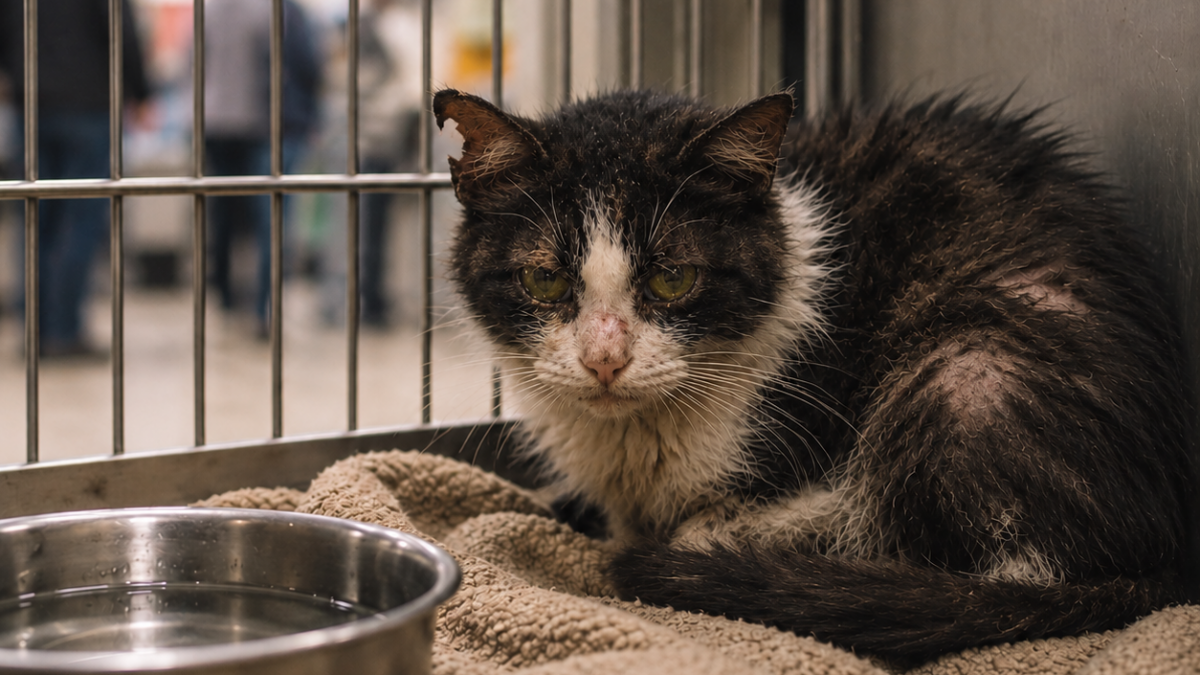
PART3:
Later, when Ruth fell in the hallway and could not get up, I sat beside her and howled until the neighbor came.
I remember the neighbor’s face at the window.
I remember the ambulance lights painting the walls red.
I remember Ruth’s hand reaching from the stretcher.
“August,” she said.
I tried to follow.
A boot blocked me.
Graham’s boot.
“Not now,” he snapped.
The door closed.
That was the first closing.
Not the last.
Ruth came back once after that.
Only once.
Smaller somehow.
Bent deeper into herself.
She smelled like hospital sheets and fear. A woman in blue scrubs helped her into the green chair, and Ruth looked around the living room like the room had moved while she was gone.
I jumped onto her lap.
She cried then.
Quietly.
Into my fur.
“Oh, August,” she whispered. “You’re still here.”
Of course I was.
Where else would I go?
But people kept coming. They touched Ruth’s papers. Opened cabinets. Spoke about care, facility, safety, assets, sale. Ruth sat in the green chair with both hands folded in her lap while the world became something other people discussed around her.
Graham came more than anyone.
He opened drawers.
Took photographs of rooms.
Measured windows.
Once, he lifted me by the scruff when I stepped onto a stack of papers.
I scratched him.
He shouted.
Ruth tried to stand from her chair.
“Don’t hurt him,” she said.
Graham looked at her with a face I had seen on people who wanted the old to feel sorry for needing things.
“Then keep him off the paperwork.”
“He’s not hurting anything.”
“He’s a cat, Aunt Ruth.”
The way he said cat made it sound like a stain.
The day Ruth left for good, it rained.
Not hard at first.
A cold, steady rain that made the windows blur.
Two women helped Ruth into a car. She wore her blue coat, the one with a missing button near the sleeve. Her eyes were wet, but I do not know if she understood why.
I pressed myself against the front window and cried.
She looked back.
For one second, I think she saw me.
Her mouth moved.
August.
Then the car drove away.
I waited at the window until dark.
Graham came the next morning with boxes.
He did not speak to me.
He moved through the house fast, throwing Ruth’s life into cardboard. Books. Dishes. Photographs. The blue blanket. Her knitting basket. The teacups she had never let anyone put in the dishwasher.
A woman came with him and said, “What about the cat?”
Graham said, “I’ll handle it.”
Those are dangerous words.
I hid under the sofa.
He dragged it away from the wall.
“There you are,” he said.
His hand came fast.
I ran.
For half a day, I hid behind the washing machine while furniture scraped and strangers walked through rooms that still smelled like Ruth. At some point, my food bowl disappeared. Then my water. Then the soft blue blanket.
By evening, the house echoed.
Empty houses are louder than full ones.
Graham found me in the laundry room.
He wore gloves this time.
Thick ones.
I fought.
Of course I fought.
A cat is not a package.
A cat is not a chair someone forgot to list.
He cursed when my claws caught his sleeve. He shoved me into a plastic carrier that smelled like dust and old fear, drove through rain, then stopped somewhere I did not know.
When the carrier door opened, there was no porch.
No Ruth.
No shelter worker.
Just an alley behind a closed building, wet pavement shining under a yellow light, garbage bins, and rain falling hard now.
I stayed inside the carrier.
Because even then, I thought maybe this was temporary.
Maybe he would come back.
Maybe Ruth had not allowed this.
Maybe humans did not do such things and drive away.
Graham tipped the carrier.
I slid out onto the pavement.
My bad leg twisted under me.
He tossed something after me.
A towel.
Not the blue blanket.
A towel.
Then he got back in the car.
The red lights disappeared into the rain.
I waited.
Cats are proud, but we are not stupid. We know abandonment long before we accept it.
The rain soaked through my fur.
My whiskers shook.
I pressed myself against the wall and stared at the empty street until the cold became bigger than hope.
That was the night I learned that some doors do not close because you did something wrong.
Some doors close because a human decided you were easier to discard than explain.
I survived for nine days outside.
Maybe ten.
Time becomes strange when every hour is about finding somewhere dry.
I drank from puddles. Ate something I should not have eaten behind a restaurant. Slept under a broken wooden pallet and woke to a raccoon staring at me like I was trespassing in my own misery.
My ear tore in a fight I did not start.
My back leg stiffened worse after a boy threw a stone that hit the pavement near me and made me bolt into the street.
A woman once placed a bowl of food by her back steps and called, “Kitty, kitty.”
Her voice was kind.
I did not go to her.
Kindness had become suspicious.
On the tenth morning, a delivery driver found me under a parked van, too tired to run.
He called someone.
A truck came.
A woman with a net approached slowly, speaking in a low voice.
“It’s okay, sweetheart. We’re gonna get you warm.”
I hissed until my throat hurt.
She did not get angry.
That confused me.
The shelter was louder than the street.
Warmer too.
They wrapped me in a towel, checked my wounds, cleaned my ear, gave me food in small careful amounts, and wrote things on a chart.
Male orange tabby.
Senior.
Underweight.
Torn left ear.
Stiffness in rear leg.
Fearful.
Fearful.
That word did not feel accurate.
I was not afraid of everything.
I was afraid of being right.
They called me Otis because I had no collar, no tag, no microchip anyone could find. If Ruth had ever had one placed, it was gone or failed or belonged to an old record nobody knew how to search.
August vanished from the world as easily as Ruth’s blanket.
Otis arrived in kennel 12.
Marcy was the one who gave me the name.
She worked the morning shift most days. Her sneakers squeaked on the floor, and she always smelled like coffee, laundry soap, and tired.
Not bad tired.
Kind tired.
The kind that keeps going anyway.
“Morning, old man,” she would say when she stopped by my kennel.
I never came forward for her at first.
That place was full of noise. Barking dogs. Metal doors. The sharp smell of disinfectant. Nervous people walking past, slowing down at the kittens, smiling at the young cats, then glancing at my card for half a second before moving on.
Senior cat.
Slow to trust.
Needs a quiet home.
That little card may as well have said: too much trouble.
The kittens always left first.
Then the pretty young tabbies.
Then the fluffy ones with bright eyes and no history.
I stayed.
Days turned into weeks.
Weeks into more weeks.
You stop counting after a while because counting begins to feel like touching bruises. Useless and depressing.
I watched families come in looking for easy love.
Something playful.
Something that would chase a string and look cute in holiday pictures.
Something that had not learned the sound of a car driving away.
Nobody came looking for a cat with a torn ear, a stiff back leg, and a face that looked like life had already had its say.
Children pointed at me sometimes.
“What happened to that one?”
Their parents pulled them gently away.
“Don’t stare.”
But they stared too.
I was not ugly.
Let us be clear.
I was orange, which is a noble color. My chest was broad. My eyes were green. My face had depth, by which I mean I looked like I had survived several disappointing governments.
But I was old enough that people could see the ending from the beginning.
Humans do not like that.
They want beginnings that promise not to hurt them soon.
Marcy still talked to me.
She never forced me out.
Never reached in too fast.
She would change my water, slide my food over, and sit on the floor beside my kennel like she had all the time in the world.
She did not.
I knew that because every day there were more cages than hands, more messes than minutes, more animals than homes waiting.
Still, she sat.
Sometimes she read paperwork out loud.
“Listen to this, Otis. Someone wrote that Mr. Pickles is ‘food motivated.’ That cat knocked over a trash can for half a muffin yesterday. Food motivated is generous.”
I did not respond.
She continued anyway.
“Fine. Strong silent type. I respect it.”
One afternoon, after a young couple picked the orange kitten from the cage across from mine, Marcy taped a new note to my door.
Worth the wait.
I stared at it for a long time.
It made me angry.
Not because it was cruel.
Because it was kind.
Kindness is hard when you have been let down enough.
It gets your hopes moving around inside you.
It makes old pain wake up and stretch.
So I stayed in the back corner and pretended I did not care.
That night, after the shelter lights dimmed, the kitten cage across from mine stood empty. There was no tiny body climbing the bars, no squeaky meow, no family pressing fingers through the door.
Just clean blankets waiting for the next animal young enough to be chosen quickly.
I looked at Marcy’s note.
Worth the wait.
I turned my back on it.
But I did not sleep.
Then Tuesday happened.
It was raining outside.
I could hear it tapping against the building, steady and cold. Rain had a way of finding the old rooms inside me. It pulled me back to the alley, the yellow light, Graham’s car, the towel hitting wet pavement behind me.
Marcy had just finished mopping when the front bell rang.
An older man walked in alone.
He was tall in the worn-down way people get when life has leaned on them for years. Gray jacket. Work boots. One hand pressed to his lower back as he moved. His face was clean-shaven, but not carefully. His hair was silver, combed with fingers more than intention. He did not look around at the kittens.
That was the first strange thing.
Everyone looked at the kittens.
He looked at the room like he had come to listen.
Marcy greeted him with her shelter voice.
Warm, hopeful, prepared for disappointment.
“Hi there. Looking to adopt?”
The man nodded once.
“Maybe.”
“Do you have anything specific in mind?”
“I’m not looking for a young one,” he said.
I listened from my corner.
“I need somebody who doesn’t expect me to be cheerful all day.”
Marcy was quiet for a second.
Then she looked over at me.
That annoyed me immediately.
A few minutes later, the man sat down on the floor outside my kennel.
Not too close.
Not with baby talk.
Not with that fake excited voice people use when they want you to perform for them.
He just sat.
“My name’s Leon,” he said.
I did not move.
He nodded like that was fair.
“My wife liked quiet,” he said after a minute. “House has been too quiet since she’s been gone.”
I lifted my head then.
He didn’t reach for me.
That was the first smart thing he did.
Leon looked at me the way Ruth used to look at her old books before deciding whether her eyes were strong enough to read another chapter.
Not with pity.
With recognition.
Marcy stood nearby holding a clipboard against her chest.
“Otis has had a rough time,” she said gently.
Leon did not take his eyes off me.
“Most of us do, if we live long enough.”
I studied him.
His boots were scuffed. One lace had been replaced with a different color. His left hand had a gold wedding ring worn thin at the edges. He smelled like cedar, winter coats, cough drops, sawdust, and a loneliness so old it had stopped asking for attention.
“His card says he needs patience,” Marcy said.
Leon gave a small laugh.
“Good. I’ve got more patience than excitement these days.”
Marcy opened the kennel door and stepped back.
I stayed where I was, deep in the shadows, ready to bolt even though there was nowhere worth bolting to.
Leon looked at me and said, “You don’t have to like me today.”
Nobody had said anything that sensible to me in years.
So I came forward one step.
Just one.
He noticed.
But he did not make a big deal out of it.
That was the second smart thing he did.
I stopped.
He stayed still.
Rain tapped the windows.
A dog barked somewhere far down the hall.
Leon spoke again, softer.
“My wife’s name was Eleanor. She died in March. Everybody keeps telling me to get out more. Join a group. Take a class. Learn pickleball.”
He shook his head.
“I don’t want pickleball. I want someone in the house who understands that silence doesn’t always mean something’s wrong.”
I took another step.
Marcy pressed her lips together like she was holding something in.
Leon pretended not to see that either.
Third smart thing.
“I had a cat when I was a boy,” he said. “Name was Barnaby. Meanest creature God ever made. Slept on my father’s newspaper every morning and bit my uncle twice at Thanksgiving.”
His mouth twitched.
“Best cat we ever had.”
I stopped near the front of the kennel.
Not close enough to touch.
Close enough to leave.
Leon looked at my torn ear, my stiff leg, my narrowed eyes.
Then he looked at Marcy.
“I think I’d like to sit with him a while.”
Marcy’s voice came out thick.
“You can take all the time you need.”
Take all the time you need.
Humans say things like that in shelters, in hospitals, in funeral homes, in all the places where time has already done something cruel.
Leon sat there for forty-seven minutes.
I know because Marcy checked the clock three times, and cats understand waiting better than numbers.
He did not ask me to come closer.
He did not try to touch me.
He did not fill the silence with nonsense.
Once, his back hurt and he shifted slowly, apologizing under his breath as if movement itself might offend me.
“I know,” he said when I flinched. “Bones complain.”
Eventually, I walked to the threshold of the kennel.
Leon lowered his eyes.
Most people stare when they want something from you.
Leon looked away.
That was the fourth smart thing.
I sniffed the air near his boot.
Old leather. Damp pavement. Sawdust. Cough drops. A house with no other animals.
He held his hand out, palm down, several inches away, not approaching.
I sniffed.
His skin smelled like soap, metal, and age.
No anger.
No hurry.
I touched my nose to one knuckle.
Marcy made a small sound and turned it into a cough.
Leon said nothing.
But his shoulders changed.
Sometimes happiness is loud.
Sometimes it is just a tired man letting out a breath he has been holding for months.
By evening, I was in his car, tucked inside a carrier with an old towel that smelled like cedar and winter coats.
I spent the whole ride waiting for the mistake to reveal itself.
Mistakes always reveal themselves.
A kind voice turns sharp.
A gentle hand grabs too tightly.
A door opens onto rain.
Leon drove carefully. The radio was off. The windshield wipers moved back and forth, back and forth, like a tired tail.
At one red light, he glanced at the carrier.
“I know,” he said. “This is sudden.”
I stared through the slats.
“Sudden for me too.”
His house was small, white, and set back from the road beneath two bare oak trees. A porch light glowed yellow in the rain. There was a wind chime near the door, moving gently though there was almost no wind.
Inside, the house smelled like dust, wood, old photographs, wool blankets, and something missing.
Not dirty.
Not neglected.
Just still.
A place where two people had lived long enough to leave their shape everywhere, and then one had vanished.
Leon carried the carrier into the living room and set it down near a worn armchair.
“All right,” he said. “Door’s open when you want it.”
He opened the carrier.
Then he stepped away.
I did not move.
For a long time, I watched.
Leon turned on a small lamp. Warm light filled the room. He removed his boots by the door with a quiet groan. He heated something plain for dinner in the kitchen. Soup, maybe. Toast. Nothing that smelled dangerous.
He brought his bowl to the living room and sat in the recliner.
The television came on low.
No guests.
No shouting.
No sudden footsteps.
Just one man in a quiet house trying not to look as lonely as he was.
After an hour, I stepped out of the carrier.
Leon did not look at me.
I appreciated that.
I moved low across the rug and hid under a side chair near the wall.
There was dust there.
A button.
A peppermint wrapper.
The smell of a woman’s slippers.
Eleanor.
She was everywhere.
In the folded quilt over the sofa.
In the framed photo on the mantel.
In the floral mug by the sink.
In the second chair angled slightly toward Leon’s recliner, as if someone had only stepped out of the room and might return to finish the conversation.
Leon finished his soup.
Washed the bowl.
Checked the lock on the back door.
Turned down the thermostat.
Then he stood in the middle of the living room for a long time, one hand on the back of Eleanor’s empty chair.
I watched from under mine.
He did not cry.
At least, not in the way humans usually cry.
But the air around him changed.
Grief has a scent too.
Not like fear.
Not sharp.
Heavy.
Like rain in old wood.
“I brought home a cat, Ellie,” he said quietly.
The house did not answer.
“He hates me so far.”
I narrowed my eyes.
Hate was too strong.
Mistrust was more precise.
Leon nodded toward the framed photograph on the mantel.
“You’d like him.”
Then he turned off the television and settled into the recliner with a blanket over his knees.
He did not go to the bedroom.
Later, I would learn he had not slept in the bedroom since Eleanor died.
Beds remember too much.
Sometime after midnight, Leon started coughing.
It began small.
One rough sound.
Then another.
Then a deep, rattling cough that bent him forward and made one hand grip the blanket.
I stayed under the chair.
I had heard humans cough before.
Ruth coughed sometimes near the end, small dry coughs she waved away. Graham coughed fake coughs when he wanted attention. Shelter workers coughed from disinfectant and winter air.
But Leon’s cough went on longer than it should have.
When it stopped, the silence after it felt wrong.
Too long.
Too thin.
I don’t know what made me do it.
Maybe the sound.
Maybe the silence.
Maybe I was tired of being the only creature in the room pretending I was fine.
I stepped out from under the chair.
Leon looked over, eyes red and surprised.
I jumped onto the couch.
Not next to him.
Just close enough to say I was considering it.
He gave me a small nod.
“That’s plenty,” he said softly.
Nobody grabbed me.
Nobody laughed.
Nobody asked me to be different than I was.
I sat there until dawn painted the curtains gray.
By morning, I had moved from the couch to his chest while he slept in the recliner, one hand resting near my back but not on it.
Not touching.
Waiting.
When Leon woke, his eyes opened slowly.
He looked down.
I froze.
His hand stayed still.
“Well,” he whispered. “Look at that.”
I considered leaving.
His chest rose and fell beneath me, a little uneven but warm.
I stayed.
A blurry picture reached Marcy before noon.
I know because Leon told me.
“She’s gonna cry when she sees this,” he said.
Maybe she did.
I did not.
But I will say this.
Something in me unclenched that morning.
Not all the way.
Never all at once.
Trust does not return like a door swinging open.
It comes back like a stray cat.
One step.
Then one more.
Ready to run.
Leon was good at one step.
The first week, he did not try to pick me up.
He spoke before entering rooms.
“Coming through, Otis.”
“Opening the pantry, old man.”
“Vacuum’s coming out. I apologize in advance.”
He placed my food in the same spot every time. Water on the left. Food on the right. Litter box in the laundry room with the door propped open by a brick. He learned quickly not to move chairs without warning.
On the fourth day, he bought a cat bed.
I ignored it.
On the fifth day, he placed one of his old flannel shirts inside.
I ignored it with less commitment.
On the sixth day, I slept in it while he pretended not to see.
Another smart thing.
Leon had a daughter named Diane.
She came that first Sunday carrying a casserole, a purse big enough to hide a small dog, and a face arranged for concern.
“Dad,” she said when she saw me on the windowsill. “You got a cat?”
“I did.”
“When?”
“Tuesday.”
“You didn’t tell me.”
“I’m telling you now.”
Diane looked at me.
I looked at Diane.
She smelled like perfume, car heat, worry, and resentment that had learned manners.
“He’s old,” she said.
“So am I.”
“That’s not funny.”
“It’s a little funny.”
She placed the casserole on the counter and lowered her voice, though I was right there and not deaf.
“Dad, I thought we talked about making decisions alone.”
Leon’s jaw tightened.
“We talked about me selling the house, moving into a retirement community, and letting you decide what furniture gets donated while I’m still using it.”
“That is not fair.”
“Neither was the brochure you left on my kitchen table two weeks after your mother’s funeral.”
Silence.
I flicked one ear.
Diane’s eyes filled quickly, which made me dislike her less and trust her no more.
“I’m trying to help,” she said.
“I know.”
“You don’t answer your phone half the time.”
“I’m usually in the garage.”
“You cough all night.”
“Not all night.”
“The neighbors hear you.”
“Mrs. Kaplan hears squirrels breathing.”
Diane pressed her fingers to her forehead.
“And now you have a senior cat?”
Leon looked toward me.
“His name is Otis.”
“He’ll need vet care.”
“So do I.”
“Dad.”
“Diane.”
They stood there in the kitchen, two people who loved each other and had forgotten how to prove it without trying to win.
I knew that shape.
Ruth and Graham had not been like that.
Graham had not loved Ruth. He had loved the house, the signature, the convenience of her silence.
Diane loved Leon.
That made her fear more dangerous.
Love mixed with fear can become control before anyone admits it.
Diane stayed for an hour.
She softened when Leon showed her my food bowls, my bed, the shelter papers.
She cried quietly when he said, “The house feels less like a waiting room now.”
But before she left, she turned at the door.
“I just don’t want you taking on something that breaks your heart again.”
Leon looked at me.
Then at Eleanor’s photo on the mantel.
“Sweetheart,” he said, “my heart’s already broken. That doesn’t mean I can’t use it.”
Diane left without answering.
That night, Leon coughed again.
Harder.
He waved it off when I lifted my head.
“Don’t start,” he said.
Humans only say that when there is something to start.
I started watching him.
Cats are often accused of indifference by people who mistake silence for not caring.
We notice everything.
Leon’s cough deepened.
He walked slower.
He pressed a hand to his chest when he thought no one saw.
His food became plainer. Toast. Soup. Crackers. Tea. Some nights he carried a plate to the recliner and forgot to eat more than half.
He talked to Eleanor more.
Not dramatically.
Just in passing.
“Diane’s mad again, Ellie.”
“The furnace is making that sound you hated.”
“Otis sat on your quilt today. I think that means he approves of you.”
I did approve of her quilt.
Not yet of being watched by her photograph.
A month after I arrived, snow came.
The first real snow of the season.
Leon opened the curtains in the morning and stood there with his coffee, looking out at the white street.
“Eleanor loved first snow,” he said.
I sat on the windowsill, tail tucked around my paws.
“She’d make cinnamon rolls. From a can, mind you. But she’d act like she invented baking.”
His smile faded.
The house was very quiet.
I bumped my head lightly against his arm.
It was not affection.
It was structural support.
He looked down.
Then, slowly, he placed his hand on my back.
This time, I allowed it.
His palm was heavy and warm.
A little uncertain.
I purred before deciding whether I meant to.
Leon went very still.
Then his eyes closed.
“Oh,” he whispered.
Humans forget that tenderness can be a shock.
After that, he touched me more often.
Always slow.
Always after speaking.
A hand resting near me.
Then on me.
Then scratching lightly behind my torn ear where I could no longer reach well.
I began sleeping on his lap during evening news.
He began buying better food than shelter kibble.
We both pretended these were practical decisions.
At Christmas, Diane came with her husband Mark and two children, Sophie and Luke.
Children are unpredictable weather.
I hid under the sofa immediately.
Luke, who was six, dropped to his knees and tried to look at me.
“He’s under there!”
Diane said, “Luke, leave him alone.”
“He’s orange!”
“I know.”
“Can I pet him?”
“No.”
“But Grandpa got him!”
“Otis gets to decide.”
That was Diane’s first smart thing.
I stayed under the sofa through dinner.
There were too many feet. Too many smells. Too many voices pretending joy was easy because the calendar demanded it.
At some point, Sophie, who was eleven and quieter than the others, sat on the floor near the tree. Not close to me. Just near. She read a book while everyone else talked.
After a long while, she said softly, without looking under the sofa, “Grandpa says you’re old. That’s okay. My hamster is old too.”
I listened.
“She bites people, though. You don’t have to.”
I considered biting her just to clarify my options.
Instead, I crawled halfway out.
Sophie did not move.
Second smart thing.
Later, Leon gave me a piece of turkey under the table and told me not to tell Diane.
I told no one.
The snow stayed.
January became hard.
Leon’s cough worsened.
He missed a doctor appointment because the driveway iced over and he said he would reschedule. He did not. He started sleeping more in the recliner, not because of grief now but because lying flat made his breathing worse.
I slept on his chest.
Not every night.
Enough.
His heartbeat changed beneath me sometimes.
Fast.
Then slow.
Then hard.
I did not understand illness the way humans name it.
But I understood wrongness.
One night near the end of January, Leon dropped a mug in the kitchen.
It shattered.
I ran toward the sound before remembering I was the kind of cat who ran away from sounds.
Leon stood at the sink, one hand gripping the counter, the other pressed against his chest. His face was pale, mouth open, breathing shallow.
“Otis,” he whispered.
Then he slid down the cabinet to the floor.
The house became too quiet.
I approached carefully.
His eyes were open but unfocused.
He tried to reach for the counter.
Failed.
The phone was on the kitchen table.
Too high.
The back door was locked.
The front door was closed.
I meowed.
Leon did not answer.
I meowed louder.
Nothing.
I climbed onto his chest, the way I did in the recliner. His breathing fluttered beneath my paws.
Wrong.
Wrong.
Wrong.
I jumped down and ran to the front window.
Mrs. Kaplan’s house across the street had lights on. Mrs. Kaplan heard squirrels breathing, Leon had said.
Good.
I leapt onto the windowsill and knocked over a clay pot.
It crashed to the floor.
No one came.
I knocked down the lamp.
The bulb burst.
Still no one.
I began screaming.
Not meowing.
Screaming.
The kind of sound cats make when the world has narrowed to one terrible instruction: notice.
Across the street, a curtain moved.
I screamed again.
Then I ran to the front door and threw my body against it.
Once.
Twice.
Again.
My stiff leg buckled, but I kept hitting the wood.
Leon made a small sound from the kitchen.
I screamed until my throat burned.
Mrs. Kaplan called Diane first.
Then 911.
Then she came across the street in snow boots and a nightgown under her coat, pounding on the door with both fists.
“Leon! Leon!”
I screamed back.
She had a key.
Neighbors like Mrs. Kaplan always have keys because old people understand practical trust better than young people do.
The door opened.
Cold air rushed in.
I bolted toward the kitchen.
She followed.
“Oh God,” she said.
Then everything became noise.
Sirens.
Boots.
Radios.
Diane’s voice breaking in the hallway.
Paramedics kneeling where I had been.
Someone tried to move me away.
I clawed him.
He said a word Ruth would not have approved.
Diane scooped me up with shaking hands.
I let her.
That surprised both of us.
Her coat smelled like snow and terror.
“They’ve got him,” she whispered into my fur. “They’ve got him, Otis.”
Leon lived.
Congestive heart failure, they said later.
Fluid in his lungs.
A cardiac episode.
Too much ignored for too long because grief had made him careless with his own body.
Diane cried in the hospital hallway and told the doctor she should have forced him sooner.
The doctor, who smelled like antiseptic and old coffee, said gently, “Adults are difficult to force.”
True.
Cats too.
Leon spent seven days in the hospital.
I spent those seven days at Diane’s house.
This was not ideal.
Diane’s house contained children, a dog named Pepper who believed enthusiasm was a personality, and a laundry room where she set up my food, bed, and litter box like a woman negotiating peace with a suspicious nation.
I hid behind the dryer for the first day.
Sophie sat outside the laundry room door and read to me.
Not because she thought I cared about stories.
Because she understood sitting.
Her book was about dragons.
It was poorly researched.
On the third day, I came out while she read.
On the fourth, I sat on the rug.
On the fifth, I allowed her to touch my head once.
On the sixth, Pepper stuck her nose through the cracked door, and I hit it.
Peace requires boundaries.
When Leon came home, Diane came with him.
Not to take over.
To stay for a few days.
Something had changed between them in the hospital.
Not fixed.
Changed.
Leon looked thinner, older, angry at his own weakness. Diane looked tired, guilty, determined not to let fear come out as orders.
She set up his medications in a plastic organizer.
“Morning, noon, night,” she said.
Leon opened his mouth.
She raised one hand.
“I’m not bossing. I’m labeling.”
He closed his mouth.
She pointed to a notebook.
“Your weight goes here every morning. Blood pressure here. Symptoms here.”
“I had a life before charts.”
“And you will have one after them.”
He looked at her.
She looked back.
For once, neither one turned love into a weapon.
I sat on the table beside the pill organizer.
Diane looked at me.
“You’re supervising?”
I blinked.
Obviously.
Leon smiled.
“Saved my life, you know.”
Diane’s eyes filled immediately.
“I know.”
She reached toward me, then stopped halfway.
Asking.
Finally.
I leaned forward and sniffed her fingers.
Perfume. Soap. Worry.
Less resentment now.
I let her scratch my chin.
Marcy came to visit two weeks later.
She stood on Leon’s porch holding a bag of cat treats and crying before he opened the door all the way.
“I’m sorry,” she said, wiping her face. “I told myself I wouldn’t do this.”
Leon laughed softly.
“You shelter people lie to yourselves a lot.”
She came inside, saw me sitting on the arm of the recliner, and pressed both hands over her heart.
“Otis,” she whispered.
I looked away.
Fame is uncomfortable.
Leon told her the whole story again, though Diane had already called the shelter and told everyone within an hour of the ambulance.
Marcy sat on the couch and listened, tears slipping down her cheeks.
“I knew he needed someone,” she said.
Leon rested one hand on my back.
“I think we both did.”
Marcy reached into her bag.
“I brought the note.”
She unfolded a small piece of laminated paper.
Worth the wait.
The note from my kennel.
I stared at it.
Something old shifted inside me.
Marcy smiled through tears.
“I thought maybe you should have it.”
Leon took it carefully.
“I’ll frame it.”
He did.
It hung in the hallway near Eleanor’s photograph.
For a while, life became good.
Not perfect.
Good.
There is a difference, and good is often better.
Perfect makes everyone nervous.
Leon took his medicine.
Mostly.
Diane came by twice a week, sometimes with groceries, sometimes with the children, sometimes alone. She learned to sit before reaching. She learned that I preferred chin scratches but not belly touches. She learned that fear does not always look like running away; sometimes it looks like anger, silence, or an old cat staring from a windowsill.
Sophie became my favorite child.
I never told Luke.
He had a loud soul.
Leon joined a cardiac rehab program at the community center. He complained about it constantly, which meant it helped. He started walking to the mailbox every morning, then to Mrs. Kaplan’s porch, then around the block when weather allowed.
He brought me a heated bed.
I slept beside it for three days to make a point.
Then inside it forever.
At night, he still spoke to Eleanor.
But not only with grief now.
“She’d laugh at you,” he told me once as I attempted to fit my whole body into a shoebox.
I looked at him.
“You’re too big.”
Incorrect.
The box was too small.
Spring came.
The oak trees grew green. Rain smelled less like abandonment and more like soil. Leon opened windows on mild days, and I sat in the screen watching birds behave foolishly.
One afternoon, a letter arrived.
Leon read it at the kitchen table.
His face changed.
Not fear.
Something harder.
Diane was there, washing dishes.
“What is it?”
He folded the paper.
“Nothing.”
That meant something.
Diane dried her hands and took the letter from him before he could object.
Her eyes moved over it.
“Who is Graham Whitaker?”
I froze.
Graham.
The name came into the room like rain through a broken roof.
Leon looked uncomfortable.
“He’s asking about the cat.”
Diane looked at me, then at the letter.
“What do you mean, asking about the cat?”
Leon rubbed his forehead.
“It says Otis may have belonged to his aunt. He saw the news story online.”
There had been a small local story after I saved Leon.
Senior shelter cat alerts neighbor, saves owner’s life.
They used a photo of me in Leon’s recliner looking irritated by journalism.
Apparently, Graham had seen it.
Apparently, Graham had recognized me.
Apparently, now that I was a hero instead of garbage in an alley, I interested him again.
Diane read the letter aloud.
He claimed I was his aunt’s lost cat.
He claimed he had searched for me.
He claimed he had been heartbroken.
He claimed he wanted to “discuss proper ownership.”
Humans have many words for stealing.
Proper ownership is one of them.
Leon’s hand rested on my back.
I did not realize I was trembling until he said, “Easy, old man.”
Diane’s face had gone cold.
“Dad.”
“I know.”
“This man cannot have him.”
“He won’t.”
“How do you know?”
Leon stood slowly, went to the hallway, and took down the framed shelter note.
Worth the wait.
He placed it on the table beside the letter.
“Because someone threw Otis away,” he said. “And someone else waited for him. That settles it for me.”
But humans enjoy paperwork.
Graham sent another letter.
Then he called the shelter.
Then he showed up at Leon’s house in a black car that smelled, even from the window, like money trying to cover rot.
I was on the sill when he stepped onto the porch.
My whole body went stiff.
Years collapsed.
Rain.
Carrier.
Gloves.
Alley.
Towel.
Red lights leaving.
Leon was slower than he used to be, but he moved to the door before Diane could stop him. She had come over for lunch and now stood in the hallway with her phone in hand.
Leon opened the door but kept the storm door locked.
Graham smiled.
Older now, but the same.
Shiny shoes.
Sharp coat.
A face that had practiced sincerity in mirrors.
“Mr. Mercer?” he said.
“Who’s asking?”
“Graham Whitaker. I believe you have my late aunt’s cat.”
Late.
Ruth was dead.
The room tilted inside me.
I had known, in the way animals know endings without being told. But the word still landed.
Late.
Ruth was gone.
For one moment, I was back on her lap, blue blanket under my paws, her hand moving slowly over my head.
August.
Leon said, “Otis is my cat.”
“His name is August.”
My ears flattened.
Leon glanced at me.
Not because he doubted.
Because he heard the truth in the way my body changed.
Graham noticed too.
“There,” he said, smiling wider. “He knows me.”
Diane stepped forward.
“He looks terrified.”
Graham’s smile tightened.
“He was always skittish.”
Diane opened her mouth, but Leon lifted one hand.
“You said you searched for him,” Leon said.
“I did.”
“When did he go missing?”
Graham paused.
“After my aunt transitioned into care. There was confusion. A door must have been left open.”
I hissed.
All three humans looked at me.
Leon’s voice lowered.
“Funny thing. He was found miles from your aunt’s house, half-starved, during a storm.”
“I can’t account for where an animal wanders.”
“No,” Leon said. “I suppose not.”
Graham sighed, performing patience badly.
“Look, Mr. Mercer, I appreciate what you’ve done. Truly. But this cat belonged to my aunt, and there are sentimental concerns.”
Sentimental.
That word made Diane laugh once.
It was not a kind laugh.
“You threw away her cat and now you want sentiment?”
Graham’s eyes sharpened.
“You don’t know anything about my family.”
“I know enough to smell garbage,” Diane said.
I liked Diane very much in that moment.
Graham looked at Leon again.
“I would prefer to handle this amicably.”
“You can leave amicably,” Leon said.
“Mr. Mercer—”
“No.”
“He is legally part of my aunt’s estate.”
Diane lifted her phone.
“Interesting. Because I’m recording this, and I’d love to hear you explain to animal control, the shelter, and maybe the local news why a senior cat from your aunt’s estate ended up abandoned in freezing rain without a microchip, collar, or medical records.”
Graham’s face changed.
There.
People always reveal themselves eventually.
Ruth had been right.
His politeness thinned into something ugly.
“You people have no idea what that house was like,” he snapped. “She had junk everywhere. Rotten food. Medical bills. That animal spraying and scratching and—”
Leon opened the storm door.
Only a few inches.
Enough for his voice to come through clean.
“You’re standing on my porch talking about a living creature like he’s trash. That tells me exactly what I need to know.”
Graham pointed toward me.
“That cat was a problem long before—”
I screamed.
Not a meow.
Not a hiss.
A sound from the alley.
From the rain.
From every door that had closed.
Leon stepped back instantly, not from fear of me, but to come closer.
I jumped down from the sill and ran behind the recliner, shaking so hard my bad leg gave out.
The porch went silent.
When Leon spoke again, his voice had changed.
It was soft.
That made it more dangerous.
“If you contact me, my daughter, the shelter, or anyone else about Otis again, I’ll make sure every person who admired that news story hears what he sounds like when he sees you.”
Graham left.
He did not come back.
But Diane, who had inherited her father’s patience and Eleanor’s ferocity, did not let it end there.
She called Marcy.
Marcy called the shelter director.
The shelter director called animal control.
Someone looked into Ruth’s address, the date I had been found, the weather reports, and records from the driver who first saw me.
Mrs. Kaplan found the news story and posted a comment asking why a man would abandon his aunt’s cat and then demand him back after he became locally famous.
Mrs. Kaplan had a gift for public clarity.
Graham’s name spread farther than he wanted.
Not far enough to ruin him.
Life rarely balances that neatly.
But far enough that people in his circles began asking questions.
Far enough that Ruth’s former neighbor, the one who had seen the ambulance take her away, called Diane and said, “I always wondered what happened to that orange cat.”
Far enough that another cousin came forward and told Diane that Graham had sold Ruth’s house quickly, donated almost nothing, and had not visited Ruth’s care facility more than twice before she died.
There was no grand courtroom.
No dramatic arrest.
Justice for animals and old women often arrives smaller than it should.
But Ruth’s blue blanket, which a neighbor had rescued from a donation pile, found its way to Leon’s house in a cardboard box one chilly April morning.
Diane brought it in.
Leon unfolded it at the kitchen table.
I was in the doorway when the smell reached me.
Lavender.
Tea.
Dust.
Ruth.
My legs moved before thought.
I climbed onto the blanket, pressed my face into it, and made a sound I did not know I still had inside me.
Leon sat beside me.
He did not touch me until I leaned into him.
Diane cried at the sink.
“It was yours,” Leon whispered.
No.
It had been Ruth’s.
Then mine.
Then lost.
Then found.
Like me.
That night, Leon placed the blue blanket on the end of his bed.
He had begun sleeping there again after the hospital, one night at a time, because Diane said the recliner was bad for his back and I had started walking into the bedroom at midnight and yelling until he followed.
I settled on the blanket.
Leon lay down slowly.
For a long time, we listened to the house breathe.
Then he said, “Good night, August.”
My eyes opened.
I turned my head.
Leon looked at me in the dim light.
“Otis too,” he said softly. “You can be both.”
I crossed the blanket and curled against his side.
Names matter.
But so does who says them.
Years passed.
Not many.
But enough to become a life.
Leon’s hair became whiter.
My orange became softer, faded at the edges.
My stiff leg grew stiffer. Leon built a small ramp to the windowsill, then pretended he had built it “for storage access” because both of us valued dignity.
Diane and I became allies.
Not affectionate in a sloppy way.
Respectful.
She brought my medication hidden in treats and apologized every time I caught her. She scratched the correct spot behind my torn ear. She stopped saying “Dad, you should” quite so often and started saying “What do you think about…”
Leon answered her more gently when she did.
Sophie grew tall and still read on the floor when she visited.
Luke grew less loud, though not silent. He learned to announce himself from the doorway.
“Otis, I’m entering.”
Good.
Training is possible.
Marcy visited every few months, always claiming she was “just in the neighborhood,” always bringing food or toys or paperwork from the shelter she wanted Leon to review because he had become a volunteer somehow.
Yes.
Leon, who had come looking for someone who did not expect him to be cheerful, began spending Thursday mornings at the shelter repairing shelves, fixing kennel latches, and sitting with scared animals.
He was very good at sitting.
One winter, a terrified black dog who had bitten three volunteers allowed Leon to sit outside his run for an hour. The dog stopped shaking after forty minutes.
Leon came home smelling like dog.
I disapproved.
Then he told me the dog had been adopted by a quiet woman with a farm.
I disapproved less.
On the wall near the hallway, four things hung together.
Eleanor’s photograph.
Marcy’s note.
Worth the wait.
The newspaper clipping about me saving Leon.
And a small framed square of Ruth’s blue blanket, cut from a frayed corner after Diane insisted the rest remain mine.
The house was not empty anymore.
It held the dead kindly.
That is different from being haunted.
Then came the spring when Leon got tired in a new way.
At first, he said it was weather.
Then age.
Then allergies.
Humans have many names for decline before they are ready to use the true one.
He went back to the doctor.
Then to more doctors.
Diane drove him.
He came home with folders, new pills, and fewer jokes.
Heart failure does not vanish because a cat once screamed through a window.
It waits.
It bargains.
It takes small things first.
The long walks.
Then the stairs.
Then breath.
Leon began using oxygen at night.
He hated it.
I hated the machine.
We reached an agreement: I would not chew the tube, and he would not pretend he did not need it.
Some nights, he woke coughing and reached for me before he reached for water.
I slept on Ruth’s blanket beside his hip.
My own body was failing too.
Kidneys, Dr. Patel said.
Arthritis.
Age.
Time.
The usual thieves.
Diane wanted to make a plan.
Leon wanted to avoid the word.
Marcy cried when she visited and saw how slowly I walked.
I head-butted her shoe.
Enough.
Pity is exhausting.
But I knew.
Animals usually do.
My life had become soft, warm, fed, named, and safe.
That is not a small thing.
One evening in late May, rain began.
Not violent.
Steady.
Cold for the season.
Leon sat in his recliner with the oxygen tube beneath his nose, one hand resting on Ruth’s blue blanket across his lap. I lay on the blanket, my body tucked against his stomach. Diane was in the kitchen making tea. Sophie, now almost grown, sat on the floor near us with a college textbook open but unread.
Leon looked toward the window.
“Rain night,” he said.
I opened one eye.
“Yes,” he whispered. “I remember.”
Maybe he did.
Maybe he remembered my story because Diane had told it enough times. Maybe he remembered his own rainy nights after Eleanor died. Maybe old grief speaks a language shared by everyone who has ever waited for a door to open.
His hand moved slowly over my back.
“You were worth the wait,” he said.
I purred.
Small.
Rough.
Still real.
Later that night, I could not climb onto the bed even with the ramp.
I tried once.
My back legs shook.
Leon reached down, but he could not lift me anymore.
His face crumpled with the humiliation of two old bodies failing each other at once.
Diane came in quietly.
“I’ve got him,” she said.
I would once have clawed her for that.
This time, I let her lift me.
She placed me on the blue blanket beside Leon.
He touched my head.
“I’m sorry,” he whispered.
Unnecessary.
Love does not prevent weakness.
It accompanies it.
By morning, I did not want food.
Not even the expensive kind.
Not even tuna.
Leon knew.
Diane knew.
Marcy came.
Mrs. Kaplan came.
Sophie came and sat on the floor by the bed, one hand near but not touching until I bumped it.
Dr. Patel came in the afternoon.
She had been kind since the beginning. Kindness matters most at the end, when there is nothing left to fix.
Leon insisted on sitting up.
Diane tried to argue.
He gave her a look.
She arranged the pillows and helped him.
I lay on Ruth’s blue blanket between his knees, the place where I had once slept on his chest in the recliner when we were both pretending not to need each other.
Marcy stood near the door, crying quietly.
“I’m sorry,” she whispered.
I looked at her.
She had given me Otis.
Leon had given me August back.
I had been both.
That was enough.
Dr. Patel explained what would happen, as humans do because they need words to walk toward pain.
Leon’s hand trembled on my back.
Not from fear.
From effort.
He leaned close.
His breath smelled like tea and medicine.
“You don’t have to stay for me,” he whispered.
Ah.
Humans.
Always thinking they are the only ones giving permission.
I pressed my head weakly into his palm.
You don’t either, I wanted to tell him.
But human language remained unavailable.
So I purred.
That was my answer.
The first injection made the room soften.
Pain loosened its teeth.
The rain tapped the window.
Sophie sniffled.
Marcy whispered, “Good boy.”
Leon said, “August.”
Then, after a breath, “Otis.”
Both names.
Both lives.
Both true.
Before the second injection, Diane stepped forward.
She touched my side lightly.
“Thank you for saving my dad,” she whispered.
I had saved him.
He had saved me.
Humans like to separate those things.
Cats know better.
The world became warm.
Blue blanket.
Rain.
Leon’s hand.
Ruth’s voice somewhere far away, saying my first name like it mattered.
Then stillness.
But that was not the end of the story.
Not really.
Stories like mine do not end where the body stops.
They end in what remains changed.
Leon lived seven more months.
Long enough to see summer.
Long enough to sit on the porch with Diane without arguing.
Long enough to help Sophie write a college essay about “unexpected teachers,” though he complained when she said I taught her more than high school did.
Long enough to go back to the shelter once more, in a wheelchair pushed by Diane, and sit outside a kennel where a terrified senior tortoiseshell hid in the back corner.
He did not adopt her.
He could not.
But he sat there for an hour.
“You don’t have to like anybody today,” he told her.
Marcy cried behind the desk.
The tortoiseshell came forward one step.
Just one.
Good.
One step is plenty.
After Leon died, Diane kept the house.
Not to live in.
Not at first.
She said she could not sell it quickly. Then she said the market was bad. Then she said Sophie might want it someday. Then one morning, she stood in the living room with Marcy and said, “What if we used it?”
Used it became Ruth and Eleanor House.
A temporary foster home for senior cats waiting for adoption.
The first resident was the tortoiseshell.
Her name became Winnie.
She slept on Ruth’s blue blanket, which Diane placed in the sunny room and refused to put away.
Then came a deaf white cat named Pearl.
A three-legged tabby named Samson.
A black cat with kidney disease named Mr. Finch.
Old cats.
Slow cats.
Cats who did not show well.
Cats with cards that might as well have said too much trouble.
Diane changed the wording.
Senior cat.
Slow to trust.
Needs a quiet home.
Worth the wait.
That note appeared on every door.
Marcy said Leon would have loved it.
Diane said, “He would have pretended not to.”
Sophie painted a small sign for the front porch.
RUTH AND ELEANOR HOUSE
Senior Cat Foster Home
Founded in honor of Otis, who was worth the wait.
August was not on the sign.
That was all right.
Some names belong to private rooms.
But inside, in the hallway, beneath Eleanor’s photograph and beside Ruth’s framed blue blanket, Diane hung my picture.
The one from the newspaper.
I looked irritated.
Appropriate.
Under it, a brass plate read:
OTIS / AUGUST
He taught us not to reach too fast.
People came.
Not as many as came for kittens.
Never as many.
But the right ones came.
An old woman who had lost her husband adopted Winnie.
A quiet veteran adopted Samson.
A librarian adopted Pearl because, she said, “I also ignore people when I’m tired.”
Mr. Finch stayed until the end and died in the sunny room with Marcy holding him.
Not every story became happy in the neat way people want.
But every story became held.
That matters.
Years later, people still told my story.
Some told it as the story of an old cat who saved a widower.
Some told it as the story of a lonely man who adopted the cat nobody wanted.
Some told it as the story of a cruel nephew who threw away what his aunt had loved and a family that later learned better.
All of those stories are true.
But I know the deepest version.
It is about doors.
The door Ruth opened when she first let me in from the porch, thin and hungry and young.
The door Graham closed in the rain.
The kennel door Marcy opened without forcing me through it.
The car door Leon opened when he decided old and frightened did not mean finished.
The front door I screamed beside until Mrs. Kaplan came running.
The bedroom door Diane opened, again and again, until love between her and her father had space to move differently.
The shelter doors that opened later for cats nobody expected to choose quickly.
A life is made of doors.
Some close too soon.
Some never open.
Some break your heart.
And sometimes, if you are lucky, love comes back wearing old boots, carrying house keys, and knowing better than to reach too fast.
I was not hard to love because I was broken.
I was hard to love because the world got there first.
Leon understood that.
Marcy did too.
Eventually, Diane learned.
And because they did, other old cats with torn ears, cloudy eyes, stiff legs, missing teeth, and tired hearts found soft places to land.
So if you ever walk into a shelter and see the one in the back corner, the one who does not come forward, the one whose card says senior, shy, slow to trust, needs patience, I ask only this:
Do not mistake fear for emptiness.
Do not mistake age for absence.
Do not mistake a wounded heart for a heart with nothing left to give.
Sit down.
Look away if you must.
Speak softly.
Wait.
Maybe nothing will happen.
Maybe one paw will move.
Maybe one old soul will come forward just one step.
And if that happens, understand what you have been given.
Not a performance.
Not gratitude.
A beginning.
One step is how trust returns.
One step is how a house stops being empty.
One step is how a cat named Otis became August again.
And somewhere, in the warmest patch of sun beyond all closed doors, an old orange cat with a torn ear, a stiff leg, and two true names is still listening for the kind of human hand that finally learned to wait.

