An Old Stray Cat Who Trusted No One Became the Eyes of a Blind Kitten—Then One Morning, the Kitten Suddenly Disappeared.
PART3:
If I lingered, he stared at me with deep offense until I apologized.
“I’m going,” I would say.
His expression always seemed to answer, “You should have gone sooner.”
That was our friendship.
No touching.
No trust.
No expectations.
To be honest, I understood him.
After my husband, Peter, died, I also became careful about closeness. People thought grief made you desperate for comfort, but sometimes it did the opposite. Sometimes it made every kindness feel dangerous because kindness could become love, and love could vanish from a hospital bed at 2:37 in the morning while a nurse turned off a monitor and whispered, “I’m so sorry.”
So Leone and I kept our distance from the world together.
I fed him.
He tolerated me.
That was enough.
Willow Creek Apartments sat in a working-class suburb outside Dayton, Ohio, though the leasing brochures described it as “a garden-style residential community with urban convenience.” That meant six brick apartment buildings from the 1970s, one laundry room where half the dryers ate quarters, a cracked basketball court, a pool that opened late every summer because something was always wrong with the pump, and our little park.
Calling it a park was generous.
It had one maple tree, two benches, three metal trash cans, a narrow path, a few flower beds, and a patch of grass worn thin by dogs, children, and people cutting across it because the sidewalk curved too politely.
But to us, it was a park.
Old men sat there in the evenings.
Teenagers gathered by the bench until security chased them off.
Children collected leaves there in October.
In spring, the maple tree turned the ground green with shade.
And Leone ruled it like a tired king.
People had opinions about him.
People always do.
Mrs. Alvarez saved chicken for him and left it under the bench when nobody was watching. Mr. Kim from Building A said Leone kept mice away from the dumpsters, which made him “essential staff.” A little boy named Jayden drew a picture of him in school and wrote “My friend Lion” beneath it, though Leone had once hissed at him for trying to offer a French fry.
Then there was Diane Mercer, the property manager.
Diane was not evil in the dramatic way people enjoy imagining. She did not laugh in shadows or kick puppies in parking lots. She was worse in the ordinary way. She cared about rules more than reasons. She cared about appearances more than people. She wore pencil skirts, carried a tablet, and spoke in the flat, patient voice of someone who believed compassion was a maintenance issue.
“Residents are not permitted to feed stray animals on the property,” she told me one morning in June.
I had just placed Leone’s food near the bench.
He was watching from beneath the hedge, tail flicking.
I straightened slowly. “Good morning to you too, Diane.”
She smiled without warmth. “Nora, this has been addressed in the community newsletter.”
“I don’t read the newsletter.”
“We email it every Friday.”
“That may be why.”
Her smile tightened. “Stray feeding attracts pests.”
“Leone has lived here longer than half the tenants.”
“That doesn’t make him a resident.”
“He minds his business better than most.”
“Nora.”
I looked at her then.
Diane was maybe forty, polished and tense, with blond hair cut in a sharp bob and a gold watch that flashed whenever she gestured. She was new to Willow Creek, brought in after the complex was purchased by a regional property company that immediately painted the office gray and raised rent by a hundred and seventy-five dollars.
She did not understand the place yet.
She understood policies.
She understood curb appeal.
She understood online reviews.
But she did not understand Mrs. Alvarez bringing soup to a sick neighbor, or Mr. Kim fixing children’s bikes near the laundry room, or Leone appearing beside the bench every morning like a grumpy old promise that something in the complex had survived every management change.
“He’s not hurting anyone,” I said.
“That isn’t the standard.”
“It should be.”
Her eyes cooled. “I’m going to have to ask you to stop.”
“And if I don’t?”
“Then I’ll have to issue a lease violation.”
There it was.
The threat, dressed as procedure.
I glanced toward Leone.
He was staring at Diane with open disgust.
For once, we agreed completely.
I picked up the empty container and smiled politely. “Then I suppose you’ll do what you think you need to do.”
Diane tilted her head. “And you’ll stop?”
“I didn’t say that.”
I walked away before she could answer.
That evening, a printed notice appeared on every building door.
DO NOT FEED STRAY OR FERAL ANIMALS.
Feeding stray animals may result in pests, property damage, health concerns, and lease action.
No exceptions.
By eight o’clock, someone had drawn whiskers on Diane’s printed signature.
By nine, maintenance took the notices down and replaced them.
By morning, the new notices had paw prints stamped across them in black ink.
I never learned who did it.
But I had my suspicions.
For a few weeks, feeding Leone became a quiet community conspiracy.
Mrs. Alvarez left food behind the planter.
Mr. Kim placed water near the utility shed.
I changed my morning routine and set the bowl down before sunrise.
Leone adjusted with the dignity of a creature accustomed to human foolishness.
Then, in early September, Mochi showed up.
I first heard him on a Tuesday evening, right after dinner.
I had made tomato soup from a can and grilled cheese the way Peter used to like it, browned almost too dark on one side because he always said that was “where the flavor lived.” I ate at the kitchen table with the news on low and the balcony door cracked open to let in the cooling air.
That was when I heard it.
A tiny cry.
Thin.
High.
Almost swallowed by the traffic on the road beyond the complex.
At first, I thought it was a bird.
Then it came again.
Not from the sky.
From below.
I stepped onto the balcony and looked toward the parking lot.
The evening light had turned everything gold. Cars lined the curb. A woman was carrying groceries toward Building D. Two kids were arguing near the basketball court. Leone was on the bench under the maple tree, curled like a gray question mark.
The sound came from the bushes near the parking lot.
I grabbed my keys and went downstairs.
By the time I reached the park, the cry had stopped.
“Hello?” I called softly, feeling ridiculous because I did not know whether I was speaking to an animal, a child, or my own imagination.
The bushes rustled.
Something white moved under the leaves.
Then a kitten stumbled out.
He was so small he looked unfinished.
That was the only word my mind could find.
Unfinished.
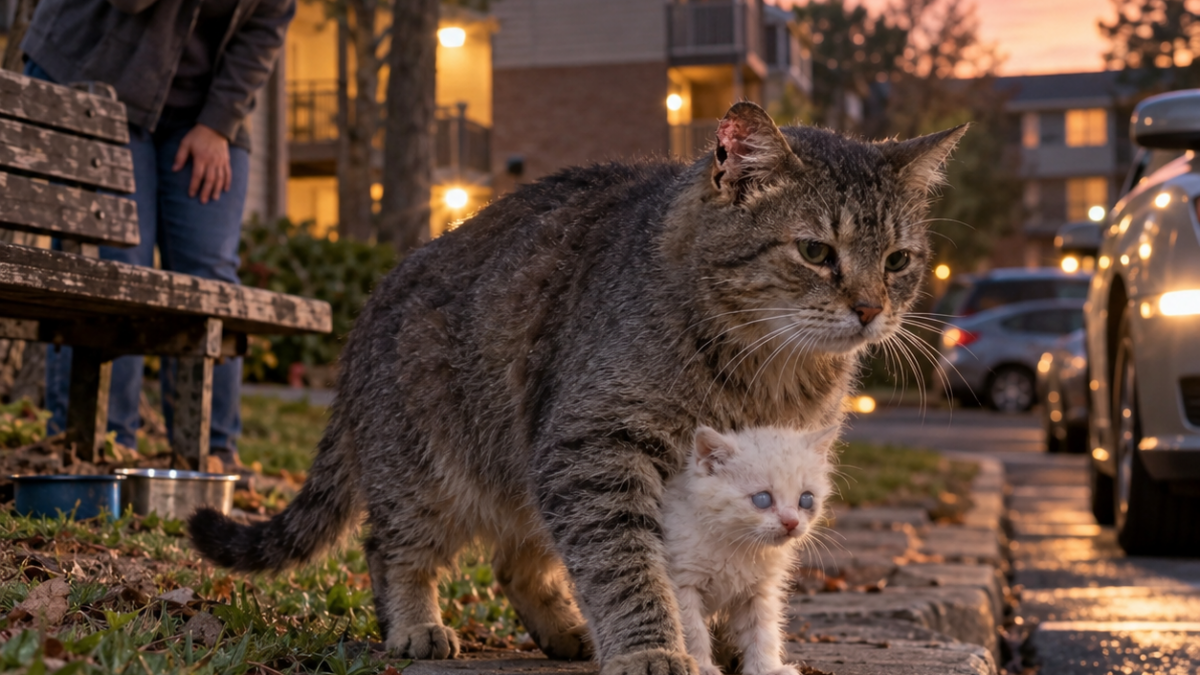
His fur was white, or would have been white if it had not been smeared with dirt and leaf dust. His ears were too large for his head. His legs shook under him. His belly looked round in that way kittens’ bellies do when hunger and worms fight for space. He lifted one paw too high and set it down badly, as if the ground kept surprising him.
My chest tightened.
“Oh, baby,” I whispered.
He turned toward my voice.
Not directly.
Almost.
His face tilted left, then right.
His eyes were cloudy.
A pale milky film covered both of them.
He could not see.
The realization moved through me cold and fast.
The kitten took three steps forward and bumped into a tree root.
He backed up, turned, and bumped into the metal leg of the bench.
He cried again.
Leone opened one eye.
“Leone,” I whispered. “Don’t you dare be mean.”
The old cat rose slowly.
At first I thought he was annoyed, which was fair. Leone considered most emergencies beneath him unless they involved food. He stretched one front leg, then the other. He jumped down from the bench with a heavy thud.
The kitten, startled by the sound, turned the wrong way.
Toward the parking lot.
A car door slammed nearby.
The kitten flinched and stumbled faster, his tiny body moving straight toward the curb.
I started forward.
“Wait—”
Before I could reach him, Leone moved.
I had never seen him move like that.
The old stiffness vanished. He crossed the grass in a low, quick rush and stepped directly in front of the kitten. He did not hiss. He did not swat. He did not bare his teeth.
He simply blocked him.
The kitten walked into Leone’s chest and stopped.
Leone leaned his big body against him, firm but gentle.
The kitten wobbled.
Leone nudged him again, turning him away from the pavement.
Then he lowered his head and made a sound I had never heard from him before.
Not a meow.
Not a growl.
A low, soft trill.
The kitten froze.
His tiny head turned toward the sound.
Leone trilled again.
The kitten took one uncertain step toward him.
I stood there with one hand over my mouth.
That was the first time I saw Leone become someone else.
Not softer exactly.
Leone was never soft.
But something old and hidden inside him opened.
He walked beside the blind kitten, shoulder to shoulder, steering him away from the curb and back toward the bench. When the kitten drifted left, Leone pressed him right. When he stopped, Leone stopped. When he cried, Leone answered.
By then, Mrs. Alvarez had come outside.
“What is it?” she called.
“A kitten,” I said. “He’s blind.”
She crossed herself. “Ay, pobrecito.”
The kitten bumped gently into Leone’s front leg, then tucked himself beneath the old cat’s chest as if he had found a wall that breathed.
Leone looked up at us.
His face said, “Do not make this complicated.”
Of course, we immediately made it complicated.
Within twenty minutes, four neighbors had gathered.
Mrs. Alvarez brought a towel.
Mr. Kim brought a shallow dish of water.
Jayden, the little boy from Building E, asked if the kitten was a ghost because he was white and “walked haunted.”
His mother told him that was rude.
He apologized to the kitten.
Someone suggested calling animal control.
Someone else said shelters were full.
Mrs. Alvarez said, “We cannot leave a blind baby outside.”
Leone responded by placing himself between the kitten and all of us.
He did not attack.
He did not run.
He simply made his answer clear.
The kitten was his.
At least for the night.
I crouched several feet away and placed soft food on a paper plate.
The kitten smelled it immediately but could not find it.
Leone watched.
Then, slowly, he stepped to the plate, sniffed it, and gave that low trill again.
The kitten turned toward him, bumped against the plate, and began eating with desperate little gulps.
Leone sat beside him.
He did not eat.
He waited.
Only after the kitten’s belly rounded and his frantic movements slowed did Leone lower his own head to the food.
That was the second time my eyes filled with tears.
The first had been when Peter died.
The second was because a scarred old cat with nothing in the world let a blind kitten eat first.
“His name should be Snowball,” Jayden said.
“No,” Mrs. Alvarez said. “Too common.”
“Cloud?”
“No.”
“Ghost?”
His mother gave him a look.
Mr. Kim said, “He looks like rice cake.”
I said, “Mochi.”
Everyone turned.
I shrugged. “He’s small and white and soft-looking.”
Leone looked at me as if the naming ceremony had been unnecessary.
But the kitten lifted his head, milk-white eyes unfocused, and licked food from his nose.
“Mochi,” Jayden whispered.
And that was that.
From that evening on, Leone never left Mochi alone.
I do not mean he watched him sometimes.
I mean he rearranged his whole life around that kitten.
Before Mochi, Leone spent his days according to a strict old-man schedule.
Morning food near the bench.
Sun on the sidewalk.
Nap under the hedge.
Afternoon patrol past the dumpsters.
Evening sleep in the flower bed.
Occasional judgment of passing dogs.
After Mochi, everything changed.
Leone became a guide.
He walked beside the kitten, shoulder to shoulder, using his body as a rail. He learned to move slowly so Mochi could keep up. When Mochi drifted toward the sidewalk, Leone nudged him back. When Mochi got stuck between the roots of the maple tree, Leone circled around and guided him out. When Mochi lost track of him, Leone made that low trilling sound, and the kitten followed the sound like it was a map.
If Mochi stopped, Leone stopped.
If Mochi cried, Leone answered.
If a dog barked from across the street, Leone placed himself between the sound and the kitten.
The whole complex started noticing.
People who barely spoke to one another began pausing near the park. A tired man in a construction vest, who came home every day with dust on his boots and never smiled at anyone, stopped one evening and stood there for five full minutes watching Leone guide Mochi around a puddle.
A mother carrying groceries whispered, “Look at them,” to her daughter.
A college student from Building F started leaving water in a clean bowl and washing it every morning.
Someone placed a small cardboard box under the bench with a towel inside.
Leone inspected it, found it insulting, and refused to use it.
Mochi walked into it face-first and fell asleep.
By the end of the week, there were two bowls by the bench instead of one.
Leone always waited.
He let Mochi eat first.
Only after the little blind kitten found the food and began to eat would Leone lower his own head.
At night, they slept pressed together under the bench or near the hedge, one small white shape tucked into one large gray one. When rain came, Leone led Mochi under a large concrete planter beside the walkway. He pushed the kitten in first, then sat at the opening like a guard.
I watched from my window more than I want to admit.
Something about them hurt me.
Maybe because everybody seemed so tired lately.
Tired from bills.
Tired from work.
Tired from pretending rent increases did not scare them.
Tired from being polite while carrying private pain.
We passed each other in hallways and parking lots and pretended not to need anything. We smiled with keys in our hands. We said “How are you?” without wanting the real answer. We carried groceries, laundry baskets, overdue bills, prescription bottles, grief, divorce, loneliness, and shame behind apartment doors that all looked the same from the outside.
Then there was Leone.
A street cat with nothing, giving everything.
It changed people.
Not all at once.
Not in a dramatic movie way.
But slowly.
Mrs. Alvarez began sitting on the bench in the mornings, speaking softly in Spanish while Leone pretended not to listen. Mr. Kim built a better shelter box from scrap plywood and lined it with straw after reading online that blankets held moisture in cold weather. Jayden drew a sign that said “PLEASE DRIVE SLOW BLIND KITTEN,” which his mother would not let him post near the road, so he taped it inside their apartment window facing the park.
Even the teenagers stopped throwing fast food wrappers near the bench.
One of them, a tall boy named Marcus, carried Mochi back from the sidewalk one afternoon with the careful terror of someone holding a bomb.
“He was going toward the street,” Marcus told me, arms stiff, kitten tucked against his hoodie. “I didn’t know what else to do.”
Leone followed close behind, tail puffed, glaring murder.
“Put him down near the bench,” I said.
Marcus lowered Mochi gently.
Leone rushed forward, sniffed the kitten all over, then smacked Marcus on the shoe.
“Fair,” Marcus said.
For three weeks, that was our strange little miracle.
Then Diane Mercer noticed.
She had noticed before, I’m sure.
Diane noticed everything eventually, especially if it threatened a leasing brochure.
But she had ignored Leone because he was old news, part of the background irritation of Willow Creek. Mochi made him visible. Mochi made people gather. Mochi made residents take pictures, place bowls, build shelters, leave notes, and talk to each other on the lawn.
Community is beautiful if you value people.
It is inconvenient if you manage property.
The first warning came in an email.
Residents are reminded that feeding, sheltering, or encouraging stray animals on community grounds is prohibited. Management is coordinating with appropriate services to address the matter humanely.
Appropriate services.
Matter.
Humanely.
I had lived long enough to distrust soft words from hard people.
That afternoon, I went to the leasing office.
Diane looked up from her desk as if she had been expecting me.
“Nora,” she said. “How can I help?”
“You can leave the cats alone.”
Her expression did not change. “If this is about the notice—”
“It is.”
“We have liability concerns.”
“The kitten is blind.”
“That’s exactly why professionals should handle it.”
“Which professionals?”
She folded her hands on the desk. “Animal control.”
“Have you called them?”
“Yes.”
“And what did they say?”
“That they would assess.”
“Assess means trap.”
“Possibly.”
“And then what?”
“That depends.”
“On whether the shelter has space? On whether anyone wants a blind kitten? On whether an old feral cat is considered adoptable?”
Her jaw tightened. “Nora, I appreciate your concern, but you are not qualified to determine what’s best for wildlife.”
“They are not wildlife. They are community cats.”
“They are stray animals living on private property.”
“Leone has lived here longer than you have worked here.”
“That does not grant him tenancy.”
“No,” I said. “But maybe it should grant him mercy.”
For a second, something flickered in her face.
Annoyance.
Not guilt.
Diane stood and walked around her desk.
“I understand you’ve been through loss,” she said.
The room went cold around me.
I stared at her. “Excuse me?”
Her voice softened in that awful way people use when they are about to weaponize sympathy.
“I know your husband passed. Sometimes people project emotional needs onto animals. It’s understandable, but it can cloud judgment.”
I felt my face burn.
“You do not get to use my husband to make your policy sound kind.”
“I’m not—”
“Yes,” I said. “You are.”
She inhaled sharply.
I leaned on my cane, though I had not meant to bring it down so hard. The sound cracked against the office floor.
“You think I am an old widow feeding cats because I cannot accept reality. Here is reality. That kitten cannot see. Leone is the only reason he has not wandered into the road, starved, or frozen in the rain. If you separate them without a plan, you are not solving a problem. You are breaking the only thing keeping him alive.”
Diane looked toward the glass door, where a young couple had paused outside.
Her face hardened.
“This conversation is over.”
“No,” I said. “It is documented.”
I lifted my phone.
I had not recorded her. I was bluffing.
Diane did not know that.
For the first time, she looked uncertain.
I turned and left before my hands could start shaking.
They shook in the hallway instead.
That evening, I told Mrs. Alvarez, Mr. Kim, and a few others what happened.
“We need a rescue,” Mrs. Alvarez said.
“I called three,” I told her. “All full.”
“Then we raise money,” Mr. Kim said.
“For what?”
“A vet. A real shelter. Something proper. Not management.”
He was right.
By midnight, Marcus had made a group chat called Leone’s Union.
Jayden’s mother joined.
Then the construction worker, whose name was Rob.
Then Mrs. Alvarez, who sent voice messages because texting “hurt her patience.”
Then me.
By morning, thirty-one residents were in it.
People offered money.
Transportation.
Blankets.
A woman in Building F knew a veterinary technician.
Someone else had a cousin who fostered special needs cats.
For the first time in years, my phone kept lighting up with messages that were not pharmacy reminders or scam calls.
At 7:10 the next morning, the veterinary technician’s cousin replied.
Her name was Bethany Rhodes. She ran a tiny nonprofit foster network for disabled cats called Second Sight Rescue out of her home two towns over. She had no open space but agreed to come evaluate Mochi.
She arrived that evening in a dented blue Subaru with cat carriers stacked in the back.
Bethany was maybe thirty-five, with short dark hair, tired eyes, and the calm efficiency of someone who had bottle-fed kittens at 3 a.m. and negotiated with angry raccoons before breakfast.
She knelt near the bench while Leone watched from six feet away.
Mochi, hearing her, turned toward the sound and promptly bumped into Leone’s side.
Bethany’s face softened.
“Oh, sweetheart,” she whispered.
She did not reach for him right away.
That made me like her.
Instead, she sat on the grass and waited.
Mochi found her shoe, sniffed it, then sneezed.
Leone glared.
Bethany smiled. “I know. I’m suspicious.”
She watched them for nearly half an hour.
She observed how Mochi followed Leone’s trills, how Leone guided him away from obstacles, how the old cat positioned himself between the kitten and people. She looked at Mochi’s eyes with a small penlight from a distance, then shook her head gently.
“He needs a vet,” she said. “Soon. Could be congenital blindness, infection damage, maybe something treatable, maybe not. Hard to say.”
“Can you take him?” I asked.
Bethany looked at Leone.
“I can take the kitten for medical care. But separating them permanently would be cruel unless there’s no other choice.”
Mrs. Alvarez whispered, “Thank you.”
Bethany continued, “The older cat is likely feral or semi-feral. Bringing him indoors suddenly could be dangerous for him. Stress can shut them down. But he is bonded to the kitten. Strongly.”
Leone licked Mochi’s head with quick, irritated strokes, as if confirming her diagnosis.
“What do we do?” I asked.
Bethany sighed. “Ideal? We trap both, vet both, and place them together in a protected outdoor enclosure or a very patient foster setup. Realistically? That requires money, space, and permission from property management.”
Permission.
The word sank.
From Diane.
Bethany looked at our faces and understood.
“Let me talk to her,” she said.
The meeting happened the next morning.
Bethany, me, Mrs. Alvarez, Mr. Kim, and Diane in the leasing office.
Diane listened with the expression of a woman being asked to approve a circus in the parking lot.
Bethany explained everything calmly.
The kitten’s blindness.
The bond.
The need for veterinary care.
The risk of separating them.
The possibility of installing a discreet, contained shelter station under the covered side of Building B while rescue volunteers arranged long-term placement.
Diane said no.
Not maybe.
Not let me check.
No.
“The owner group will not authorize animal housing on the property,” she said.
Bethany tried again. “This could be temporary.”
“No.”
“We have residents willing to cover costs.”
“No.”
“A blind kitten outdoors without support is at risk.”
“Which is why animal control should remove it.”
“And the bonded adult?”
Diane’s mouth tightened. “The adult is not adoptable.”
The room went silent.
I said, “What does that mean?”
She looked at me, then away. “It means outcomes vary.”
Outcomes.
Another soft word for hard things.
Mrs. Alvarez stood so quickly her chair scraped the floor.
“You should be ashamed.”
Diane’s cheeks reddened. “I’m trying to manage a property with rules.”
“No,” Mrs. Alvarez said. “You are trying to keep the grass pretty while an old cat does more for a blind baby than you are willing to do for anyone.”
Diane looked shaken, but only for a moment.
“Meeting over,” she said.
Two days later, Mochi disappeared.
I knew something was wrong before I opened my blinds.
It was 6:30 in the morning.
Leone was pacing.
Not walking.
Pacing.
He ran from the bench to the bushes, then back to the food bowls. His tail was low. His head swung side to side. He cried in a rough, broken voice I had never heard from him before.
Mochi’s bowl sat untouched.
My heart dropped.
I grabbed my coat and went downstairs.
“Leone?” I called.
He did not run from me.
That scared me more than anything.
He stared at me with wide, furious, desperate eyes and cried again.
A cracked sound.
A sound dragged out of a place too deep for pride.
I searched the bushes.
The flower beds.
Under cars.
Behind the dumpsters.
The maintenance shed.
Neighbors joined.
Marcus checked near the basketball court.
Rob looked along the road.
Mrs. Alvarez walked slowly around the building whispering prayers.
No Mochi.
At 8:15, Diane sent a message through the resident portal.
Animal control has removed the visually impaired kitten from the property for appropriate care. Residents are reminded not to interfere with management procedures.
Appropriate care.
My knees went weak.
I called animal control immediately.
They had no record of picking up a kitten at Willow Creek.
Bethany called every shelter within twenty miles.
No blind white kitten.
Then Marcus came running across the park with his phone in his hand.
“Mrs. Ellis,” he said, breathless. “You need to see this.”
The video was shaky, taken from his third-floor window at 5:42 a.m.
It showed Diane near the park with a carrier.
It showed a maintenance worker named Toby holding a towel.
It showed Mochi being lifted from under the bench.
And it showed Leone.
He came out of the shadows like a storm.
He did not attack anyone’s face. He did not leap dramatically. He threw himself at the carrier, clawing at the side, crying as Toby shoved it toward Diane.
Diane stepped back, startled.
Toby kicked out—not hard enough to send Leone flying, but enough to force him away.
I made a sound I did not recognize.
Marcus lowered the phone.
“I’m sorry,” he said.
My hands went cold.
“Send that to me.”
By noon, Leone had stopped pacing.
That was worse.
He curled under the bench where Mochi used to sleep and faced the bushes.
He did not eat.
He did not drink.
Rain started at three.
He did not move.
I went down after dark and sat on the wet grass a few feet away from him.
For once, he did not leave.
“I know,” I whispered.
My voice cracked before I could stop it.
“I know what it’s like when everyone says it’s for the best, but your heart still waits by the door.”
Leone looked at me.
His old eyes were tired.
But he did not look away.
And for the first time in seven years, I reached toward him.
Not to touch.
Just to offer my hand in the space between us.
He stared at it.
Then, slowly, he lowered his head onto his paws.
He did not come closer.
He did not forgive me.
But he stayed.
That night, the group chat became something else.
Not neighborly concern.
Action.
Marcus posted the video.
Rob said he had seen Toby loading a carrier into Diane’s car, not an animal control van.
Bethany called Diane and got no answer.
Mrs. Alvarez called Diane twenty-seven times.
Mr. Kim found the owner group’s corporate email.
Jayden’s mother posted in a local lost-pet group.
By 10 p.m., the video was online.
By midnight, it had been shared over two thousand times.
Old Stray Cat Fights To Keep Blind Kitten From Being Taken.
That was the caption someone added.
I did not write it.
But I did not correct it.
The next morning, reporters called the leasing office.
Diane refused to comment.
Corporate sent an email saying management had acted “in accordance with community safety guidelines.”
Then Bethany found Mochi.
Not through Diane.
Through Toby.
Toby was twenty-two, thin, nervous, and had been working maintenance for less than a month. He called Bethany from a blocked number and cried before he finished his first sentence.
“I didn’t know what she was going to do,” he said. “She told me animal control was coming. She told me the kitten was going to a rescue. Then she had me put him in her car.”
“Where is he?” Bethany demanded.
“At her sister’s place. I think. She said her sister wanted a kitten for her kids.”
I was sitting beside Bethany when she put the call on speaker.
The world narrowed to Toby’s voice.
“She took him to a house in Fairborn,” he said. “I heard her say the kitten was cute enough to rehome, but the old cat was a liability.”
“And Leone?” I asked.
Toby went quiet.
“What about Leone?” Bethany pressed.
“She called a pest removal company,” he whispered. “For tomorrow.”
I stood so fast the chair hit the wall.
Bethany’s face went white with fury.
“Address,” she said.
Toby gave it.
What happened next moved so quickly that later it felt like scenes from a movie I had watched through tears.
Bethany called animal control.
This time, Denise Rourke, the senior officer, came herself.
Marcus sent the video.
Toby agreed to provide a statement if his name was kept confidential until necessary.
Bethany, Denise, and I drove to the address in Fairborn, a tidy house with a basketball hoop and a wreath on the door.
Diane’s sister answered.
She looked overwhelmed before anyone spoke.
“I didn’t know,” she said immediately.
From somewhere inside, Mochi cried.
Leone’s call had been rough and broken.
Mochi’s was tiny.
But it cut me just as deeply.
Diane’s sister began crying.
“She said he was abandoned. She said the older cat was dangerous and nobody wanted him. My kids loved him, but he keeps crying. He won’t eat much. He just walks in circles.”
“May we see him?” Denise asked.
The woman nodded.
Mochi was in a laundry room with a soft blanket, a litter box, and a dish of kitten food he had barely touched. He was clean. Safe, technically. But he was shaking.
He turned his white face toward our footsteps.
“Mochi,” I whispered.
He froze.
Then he cried.
Bethany scooped him up with professional gentleness, but the moment he was in her arms, he twisted toward the door, searching for a sound that was not there.
“He needs the older cat,” Bethany said.
Diane’s sister covered her mouth. “I’m so sorry. I really didn’t know.”
I believed her.
Sometimes cruelty enters a room wearing someone else’s explanation.
By late afternoon, we had Mochi back at Willow Creek.
But we did not simply place him under the bench and hope.
Not this time.
Corporate had gone silent after Denise contacted them formally. Diane was “unavailable.” The pest removal company canceled after Bethany called and explained the situation. Rob and Mr. Kim spent the afternoon building a temporary shelter under the covered side of Building B, where rain could not reach and cars could not come close.
They used plywood, a low ramp, straw bedding, and a small entrance wide enough for Leone but protected from wind. Bethany brought heated pads designed for outdoor cats. Mrs. Alvarez brought bowls. Jayden made a new sign, this one smaller and laminated.
PLEASE GIVE THEM SPACE.
At 4:50 p.m., we placed Mochi inside the shelter.
He cried immediately.
Not loud.
Just lost.
Leone was under the bench.
He had not eaten in nearly two days.
His fur looked dull. His body seemed smaller.
When Mochi cried the second time, Leone lifted his head.
The entire courtyard went silent.
Mochi cried again.
Leone stood.
For a heartbeat, he did not move, as if he did not trust the world enough to believe what he heard.
Then he ran.
Not with the smooth speed of a young cat.
With the desperate, uneven rush of an old body forgetting pain.
He crossed the grass, up the walkway, past all of us, straight to the shelter.
Mochi stumbled out through the opening.
Leone reached him before anyone could breathe.
He pressed his head against Mochi’s neck so hard the kitten almost tipped over. Then he wrapped his body around him, circling once, twice, checking every inch of him, trilling, rumbling, making sounds I had never known a cat could make.
Mochi pushed his face into Leone’s chest.
Leone lowered his head over the kitten’s back.
And stayed there.
I cried right there in the park.
Not loud.
Not pretty.
Just the kind of crying that comes when something frozen inside you finally gives way.
Around me, other people cried too.
Mrs. Alvarez openly sobbed into a tissue.
Marcus wiped his face with his sleeve and pretended he had allergies.
Rob turned away.
Mr. Kim bowed his head.
For once, even the children were quiet.
Leone was still a stray.
Mochi was still blind.
But they had each other.
And somehow, because of them, the rest of us had become a little less alone too.
The consequences came slowly, then all at once.
Diane tried to defend herself.
She said she had acted out of concern for the kitten’s safety.
Then the video came out.
She said animal control had been notified.
Then animal control stated publicly that they had not removed Mochi and had not authorized private relocation.
She said Leone was aggressive.
Then residents posted dozens of videos of Leone guiding Mochi, blocking him from the curb, letting him eat first, and sleeping beside him in the rain.
She said she had arranged rehoming.
Then her sister, to her credit, admitted that Diane had not disclosed the kitten was bonded to an adult cat.
Corporate placed Diane on leave.
Then they fired her.
I wish I could say I felt triumphant.
I did not.
I felt tired.
Justice often arrives wearing work clothes, not fireworks.
It looks like emails, statements, meetings, and people finally admitting what they should have seen sooner.
But I did feel relief.
Willow Creek’s owner group approved a managed community cat plan after Bethany and Denise threatened to make the story even more public. Second Sight Rescue became the official contact. Leone was trapped—carefully, dramatically, with much insulting language from his side—and taken to the vet with Mochi.
I went with them.
Leone hated the carrier.
He hated the car.
He hated the vet.
He hated the scale.
He hated the thermometer most of all.
But when Mochi cried from the carrier beside him, Leone stopped growling and pressed himself against the mesh wall between them.
The vet, Dr. Patel, examined both.
Mochi’s blindness was likely permanent, caused by untreated infection very early in life. But he was otherwise stronger than we feared. Underweight, wormy, scared, but alive.
Leone was estimated to be eleven or twelve.
Maybe older.
He had arthritis in both hips, old dental disease, scars beneath his fur, one healed rib fracture, and a heart murmur that made Dr. Patel listen twice.
“He’s had a hard life,” she said.
I looked at Leone.
He glared at everyone while Mochi leaned against him.
“Yes,” I said. “But not a wasted one.”
They were vaccinated, treated, fed, and returned not to the bench but to their new shelter area under Building B, which had become the most protected spot at Willow Creek.
People donated enough to build a proper enclosure attached to the side garden: safe, shaded, with ramps, insulated shelters, and space for Leone to move without Mochi wandering into danger. It was not a cage in the cruel sense. It was a small kingdom designed around a blind kitten and an old cat who refused retirement.
Leone adjusted better than anyone expected.
He still would not let us touch him.
He still waited until I stepped back before eating.
But he allowed Mochi to climb over him, chew his ear, trip on his tail, and fall asleep with his face pressed into Leone’s belly.
Mochi grew.
Not graceful.
Never graceful.
He bumped into things daily.
He learned the enclosure by scent, sound, and memory. He followed the sound of Leone’s paws. He learned my voice, Mrs. Alvarez’s laugh, Mr. Kim’s cough, Jayden’s footsteps, the rattle of the food container.
When he heard Leone’s trill, his whole body changed.
He trusted that sound more than sight.
I understood that.
After Peter died, I had lost the map of my life. The person whose footsteps I knew in every room was gone. For months, I moved through my days like Mochi in the bushes, bumping into ordinary things that had become unfamiliar without him.
The left side of the bed.
The second coffee mug.
The empty passenger seat.
The silence after saying something funny and waiting for a laugh that would never come.
I thought grief meant learning to see alone.
But watching Mochi taught me something different.
Sometimes survival is not about seeing the whole path.
Sometimes it is about finding one faithful sound and following it one step at a time.
Leone became that sound for Mochi.
And somehow, the two of them became that sound for me.
Winter came early that year.
By December, snow lined the sidewalks and the maple tree stood bare over the park. The enclosure had clear wind panels, straw bedding, heated water, and more donated cat blankets than any two cats could reasonably use.
Leone’s arthritis worsened in the cold.
He moved slowly.
Some mornings, he struggled to stand.
Dr. Patel adjusted his medication. Bethany taught us how to hide pills in food. Leone learned how to eat around pills with insulting precision. Eventually, we found a method involving sardines that worked most of the time.
Mochi grew into a lanky young cat with white fur and cloudy eyes. He was still small compared with Leone, but no longer fragile. He played with soft toys that made noise. He chased bells. He pounced in the wrong direction and pretended he meant to.
But at night, he still slept pressed against Leone.
And Leone still positioned himself between Mochi and the door.
One January morning, I came down with food and found Leone lying near the entrance, breathing harder than usual.
Mochi was beside him, paw resting on his shoulder.
My heart knew before my mind did.
“Leone,” I whispered.
He lifted his head.
Not much.
Just enough.
I called Bethany.
Then Dr. Patel.
Then I sat outside the enclosure in the snow, my gloved hands wrapped around the fence, while Mochi cried softly and Leone watched me with old, tired eyes.
For once, he let me stay close.
Dr. Patel came to Willow Creek because moving him would have caused pain.
She examined him gently.
His heart was failing.
Maybe it had been for a while.
Maybe he had been hiding it, the way street cats hide everything weakness might cost them.
“We can make him comfortable,” she said quietly. “But I don’t think he has much time.”
The courtyard filled slowly.
Not crowded.
Respectful.
Mrs. Alvarez.
Mr. Kim.
Marcus.
Rob.
Jayden and his mother.
Bethany.
People who once barely nodded in hallways now stood together in the cold because an old cat had made the complex feel like a neighborhood.
Mochi stayed pressed against Leone.
Every time he shifted away, Leone made that low trill.
We all heard it.
We all understood.
He was still guiding him.
Even then.
I asked Dr. Patel, “Is he in pain?”
“Some,” she said. “We can help.”
There are decisions love does not want but must still make.
I had made one for Peter after the machines became a bridge to nowhere. I remembered signing the paper with a hand that did not feel like mine. I remembered thinking that mercy was the cruelest word because it asked you to break your own heart for someone else’s peace.
Now I looked at Leone.
The cat nobody could touch.
The old stray who had belonged to cracked sidewalks and flower beds.
The tired king of Willow Creek.
The guardian of a blind kitten who had given him a reason to become gentle.
“Can Mochi stay with him?” I asked.
Dr. Patel nodded. “Yes.”
I opened the enclosure door and stepped inside.
Leone watched me.
I stopped two feet away.
Then one.
Then, very slowly, I lowered my hand.
I did not place it on him.
I let it rest on the straw beside his paw.
For a long moment, nothing happened.
Then Leone shifted.
His paw touched the side of my hand.
Not by accident.
Not much.
Just enough.
After seven years, that was all he gave me.
And it was everything.
I cried silently.
“Thank you,” I whispered. “For him. For us. For staying as long as you did.”
Mochi pressed his face into Leone’s neck.
Leone gave one final low trill.
The sound was softer than breath.
Mochi stilled.
Dr. Patel helped Leone leave the world gently, with his body curled around the kitten he had saved.
No cars.
No curb.
No rain.
No fear.
Just straw, warm hands nearby, and the blind kitten who knew him not by sight but by love.
For a while afterward, nobody moved.
Snow fell lightly beyond the enclosure.
Mochi kept his face tucked against Leone.
Then, after several minutes, he lifted his head and cried.
The sound broke all of us.
Bethany took Mochi home that night, not to separate him from Willow Creek forever, but because grief can be dangerous for animals too. He needed warmth, monitoring, and a heart that knew disabled cats.
I thought he might never come back.
Part of me wanted him not to.
Maybe he deserved a quiet indoor life with soft beds and no memory of the bench.
But three weeks later, Bethany brought him to visit.
Mochi stepped out of his carrier into the enclosure and froze.
He listened.
No Leone.
No heavy paws.
No low trill.
He took one step.
Then another.
He bumped gently into the wooden shelter and corrected himself.
I stood outside the fence, holding my breath.
Mochi turned toward my voice when I said his name.
He walked to the fence.
Not perfectly.
Not without hesitation.
But he came.
I crouched.
“Hi, sweet boy.”
He sniffed.
Then he pressed his cheek against the wire near my fingers.
I cried again, because apparently old age had turned me into a leaking faucet.
Bethany smiled. “He’s doing well. He’s learning.”
“Will you keep him?”
“If you want him here, we can make Willow Creek his daytime place. But he sleeps indoors with me for now. He likes radiators.”
I laughed through tears. “Leone would disapprove of luxury.”
“Leone would pretend to disapprove.”
That was true.
The residents decided to place a small plaque beneath the maple tree.
Nothing dramatic.
No statue.
Leone would have hated a statue.
Just a flat stone near the bench that read:
LEONE
He belonged to no one, but he protected all he loved.
On the day we placed it, Mochi was there in a little harness Bethany had trained him to wear. He sniffed the stone, sneezed, and sat on my shoe.
Jayden, now slightly older and trying very hard not to cry in public, said, “Do you think he knows?”
I looked at Mochi.
His cloudy eyes faced the maple tree.
His ears twitched at the sound of wind moving through bare branches.
“I think he knows what matters,” I said.
Now, every morning, I still bring food to the bench.
Not because Leone is there.
Because habits made from love deserve gentle endings.
Sometimes Mochi visits with Bethany, and when he does, he follows the sound of my tapping fingers along the bench. He is not alone. He has Bethany, and me, and half the complex acting like ridiculous relatives. He has bells on his toys and ramps built by Mr. Kim and a heated bed Mrs. Alvarez insists is “medically necessary.”
But every so often, when the courtyard gets quiet, Mochi pauses.
He turns his little white face toward the maple tree.
And I wonder if somewhere in his memory, he still hears the heavy steps of the old gray cat who became his map.
I used to think kindness meant fixing someone’s whole life.
I thought it meant rescuing, solving, healing, making everything safe forever.
But Leone taught me better.
Sometimes kindness is simpler.
Sometimes it is standing between someone vulnerable and the road.
Sometimes it is letting the smaller one eat first.
Sometimes it is staying in the rain.
Sometimes it is refusing to separate someone from the one love that helps them survive.
And sometimes, if you are very lucky, it is an old stray cat touching your hand at the end of his life, forgiving the world just enough to leave it softly.

