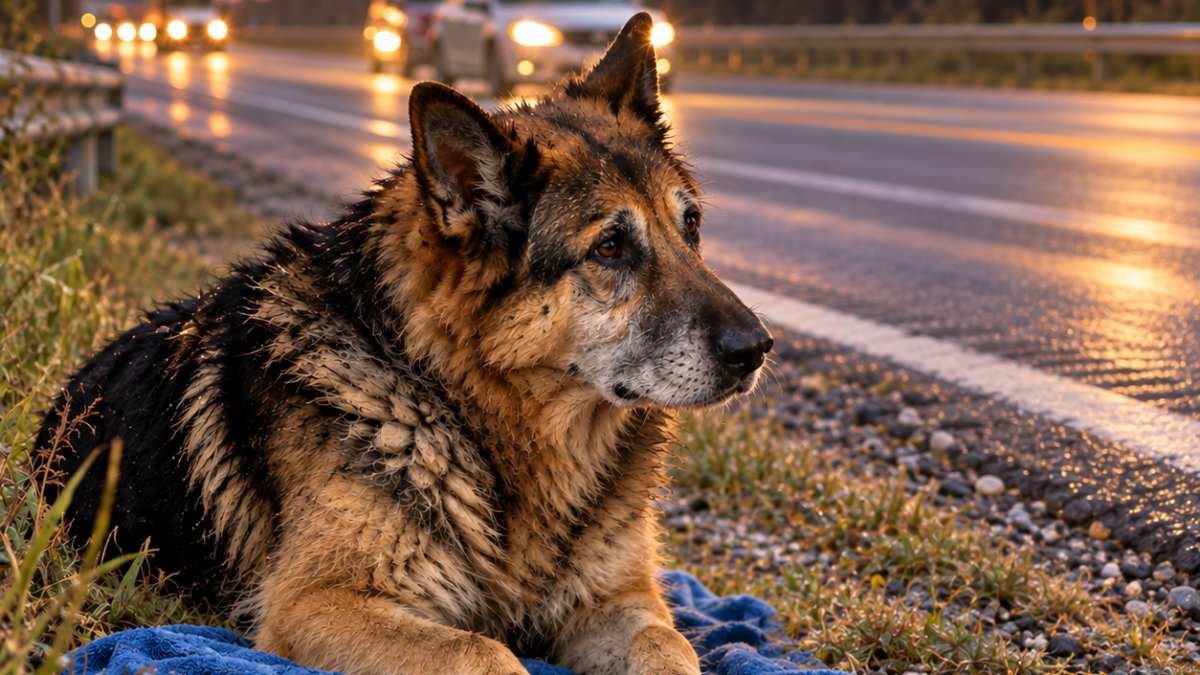
An Old German Shepherd Waited Beside the Highway for Two Days Because He Believed His Mom Was Coming Back—Then a Stranger Carried the Terrified K9 Home, and the Truth That Arrived at Her Door Broke Them Both.
PART3:
I did not know the word eviction.
I did not know unemployment.
I did not know overdue rent.
I did not know that the motel willing to let Mom stay for three nights did not accept dogs over forty pounds.
I did not know that the shelter she called was full.
I did not know that the rescue group never returned her second message.
I did not know that her sister had said she could sleep on the couch but “that huge dog” could not come.
Dogs do not understand systems.
We understand people.
And my person was breaking.
The afternoon she stopped beside County Road 18, she sat behind the wheel for a long time.
Cars rushed past us.
Each one rocked our little sedan.
I stood in the back seat, watching her.
“Pumpkin.”
Her voice sounded wrong.
My tail moved anyway.
She opened the rear door.
I jumped down.
That was normal.
She had taken me out beside roads before.
Rest stops.
Gas stations.
Long drives.
I sniffed dry grass.
Oil.
Dirt.
Old rain.
A rabbit somewhere beneath the weeds.
Mom removed my leash.
That was unusual.
I looked up.
She carried the blue towel from the car.
Spread it beside the ditch.
Then she sat down on it.
I immediately sat beside her.
She laughed.
One little broken sound.
“No.”
She moved me gently.
“You sit.”
I sat.
Because she asked.
That is the cruelty of dogs who trust you.
Sometimes obedience helps people hurt us.
She took my face in both hands.
Her forehead touched mine.
I smelled salt.
Tears.
Fear.
The stale coffee she had drunk that morning.
“Pumpkin.”
My tail tapped the towel.
Her breath broke.
“I’m sorry.”
Sorry.
Humans say that word after stepping on paws.
After forgetting dinner.
After leaving for work longer than they intended.
Sorry had never frightened me before.
She kissed the top of my head.
Then stood.
I stood too.
“No.”
She pointed.
“Stay.”
Stay.
That word I knew.
Stay meant temporary.
Stay meant she walks away.
Stay means I do not follow.
Stay means there will be another command.
Come.
Good boy.
That was how stay worked.
I sat again.
Mom backed away.
Her hands covered her mouth.
I tilted my head.
She walked toward the car.
Stay.
I stayed.
The door opened.
Closed.
The engine started.
I stood.
“Mom?”
Dogs do not say words like humans.
But we have sounds for questions.
She did not look at me.
The car moved.
I stepped from the towel.
Then remembered.
Stay.
I returned.
The car became smaller.
Smaller.
Smaller.
My ears stayed pointed toward it long after I could no longer hear the engine.
Gone.
I waited.
At first, there was no fear.
Only expectation.
Mom always came back.
She left me outside grocery stores once or twice while running inside for something.
She came back.
She went to work.
She came back.
She disappeared behind hospital doors when her mother got sick.
She came back.
Once, years earlier, she left me overnight at a veterinary hospital because I swallowed half a dish towel.
I thought the world had ended.
Then the next morning she appeared through the door crying harder than I was barking.
She always came back.
So I sat on the towel.
The sun moved.
Cars passed.
A truck roared close enough that the wind pushed my fur sideways.
I flinched.
Then watched its taillights disappear.
Not her.
Another car.
Not her.
Another.
Not her.
The first evening became cold.
My legs began to hurt.
They had been hurting for almost a year.
Mom called it arthritis.
I knew only that standing after lying down took longer now.
That stairs made my hips burn.
That sometimes Mom knelt and massaged the muscles beside my spine.
“You’re getting old on me.”
She always said it like an accusation.
Then kissed my nose.
The grass grew wet.
I curled onto the towel.
Every engine woke me.
Headlights appeared.
I stood.
Wrong car.
Lie down.
Headlights.
Stand.
Wrong car.
Lie down.
Around midnight, a raccoon moved near the ditch.
I growled.
It disappeared.
A plastic bottle rolled along the shoulder.
I barked at it once.
My voice sounded small against the highway.
The first time a car slowed, hope hit me so hard my legs almost folded.
Dark sedan.
Same shape.
I ran toward it.
My paws struck gravel.
The driver accelerated.
I chased three steps.
Four.
“Mom!”
The car disappeared.
A horn exploded behind me.
I jumped sideways.
A truck passed so close the air struck my chest.
I scrambled back toward the towel.
My heart hammered.
That was the first time the highway frightened me.
Before that it was simply where Mom had told me to stay.
Afterward, it became a thing with teeth.
I did not sleep much.
Morning arrived gray.
My stomach hurt.
There had been no dinner.
Mom sometimes forgot breakfast when she was upset, but never two meals.
I searched the towel.
Nothing.
I sniffed around the bushes.
An old hamburger wrapper.
Empty.
A crushed cup.
A dead insect.
Water collected in a shallow tire rut.
I drank from it.
It tasted like dirt and oil.
Then I returned to the towel.
Because what if Mom came while I was gone?
That question kept me alive beside the road.
It also kept me trapped.
Cars passed.
Some slowed.
People looked.
A pickup truck drove by twice.
A woman in the passenger seat pointed at me.
They did not stop.
A delivery van pulled onto the shoulder farther ahead.
I stood.
It drove away.
A motorcycle frightened me so badly I flattened against the ground.
Still I stayed.
Near noon, hunger became something different.
Not an empty feeling anymore.
Pain.
My body felt weak.
I was a German Shepherd.
Dogs like me are supposed to look powerful.
People cross streets when we bark.
Strangers call us intimidating.
Police departments use dogs that look like me because our bodies suggest certainty.
But there is nothing powerful about an old dog lying on a damp towel wondering why his person has not returned.
By the afternoon, the sun became hot.
There was no shade on the towel.
I moved beneath a bush for a while.
Not far.
Never far.
The towel remained visible.
Her scent was fading from it.
That frightened me more than hunger.
I pressed my nose deep into the fabric.
Laundry soap.
Apartment.
Mom.
Still there.
I slept with my face against it.
The second night was worse.
Clouds arrived.
Wind moved through the weeds.
My body shook.
Every sound became her car.
Every set of headlights became hope.
Hope is exhausting when it is wrong hundreds of times.
Sometime before dawn, I stopped standing for every vehicle.
My ears still moved.
My eyes opened.
But my body waited for proof.
Morning came.
Two days.
I did not know the number.
I knew only that I was thirsty.
That my legs were weak.
That the towel no longer smelled as much like home.
And that Mom had never taken this long before.
Near sunset, a dusty silver Subaru slowed.
I watched.
It passed.
I lowered my head.
Then brake lights appeared.
The car stopped.
Backed slowly along the shoulder.
My body tensed.
A woman stepped out.
She was perhaps sixty.
Brown hair with gray at the temples.
Jeans.
Green sweater.
Old sneakers.
Her face looked tired.
Not angry.
Not excited.
Tired in a way I recognized.
Mom had looked like that lately.
The woman stayed beside her car.
She did not approach.
“Hey.”
My ears moved.
“You’re still here.”
Still here.
The words meant nothing exactly.
But the tone told me she knew me.
Had seen me.
Maybe yesterday.
Maybe that morning.
She crouched.
“I saw you on my way to Ruth’s yesterday.”
I stared.
“I told myself you belonged to someone.”
She looked toward the empty road.
“Then I saw you again coming home.”
Her voice broke.
“And this morning.”
She wiped her face.
“I’m sorry.”
Another human saying sorry.
I moved backward.
She noticed.
“Okay.”
She sat in the gravel.
Not close.
She opened a can.
The smell reached me.
Meat.
Beef.
Gravy.
My entire body reacted.
My stomach cramped.
Saliva filled my mouth.
The woman placed the food several feet away.
“My name is Annie.”
I stared at the can.
“You don’t know me.”
Correct.
“You don’t have to.”
Also correct.
My front paw moved.
One step.
Then I stopped.
The towel remained behind me.
If I left it, Mom might come.
Annie looked at the towel.
Her eyes changed.
“Oh.”
She understood something.
“You’re waiting.”
My ears lowered.
She whispered, “Oh, sweetheart.”
I disliked that.
Sweetheart was Mom’s word.
I growled.
Annie immediately looked away.
“Okay.”
I wanted the food.
My body wanted it more than anything.
But leaving the towel felt like betrayal.
Annie stood.
Not toward me.
Away.
She walked back to the car.
I thought she was leaving.
Panic mixed with relief.
Instead she returned carrying a small plastic dish.
Water.
She placed it beside the food.
Then backed away.
I drank first.
I drank too quickly.
Water ran from both sides of my mouth.
I coughed.
Drank again.
Annie remained still.
“Easy.”
I ate.
The food disappeared so fast I barely tasted it.
Then I returned immediately to the towel.
Annie looked at me.
“You’re not leaving, are you?”
No.
“Because you think she’s coming back.”
I turned toward the road.
Annie sat there until the light began fading.
Then she approached.
Slowly.
One step.
Pause.
Another.
I growled.
She stopped.
“Okay.”
Another minute.
She moved again.
I showed my teeth.
German Shepherd teeth change human behavior quickly.
Annie stopped.
“I know.”
She reached one hand toward me.
Not over my head.
Low.
Sideways.
I smelled coffee.
Soap.
An old dog.
Very faint.
And grief.
Dogs know grief.
It changes sweat.
Breathing.
Movement.
Annie had lost something.
I almost let her touch me.
Then a car slammed over a pothole.
The sound became Mom’s car door.
My body reacted before thought.
I lunged.
Annie pulled back.
My teeth caught her sleeve.
Skin.
She cried out.
I released immediately.
Blood appeared on her wrist.
My ears flattened.
I expected shouting.
A kick.
A hand.
Punishment.
Annie looked at the blood.
Then at me.
“I know.”
Her eyes filled.
“I know you’re scared.”
She wrapped her wrist with a napkin from the car.
Then walked back.
I thought she would leave.
Instead she opened the rear hatch and took out a blanket.
She spread it beside herself.
Sat.
The sun disappeared.
Cars became streaks of light.
Annie remained.
Finally she said, “I can’t leave you here tonight.”
I backed away.
“I’m sorry.”
Her voice shook.
“But I can’t.”
She took off her jacket.
Approached.
I barked.
She kept moving.
I tried to run toward the bush.
My bad hip buckled.
That was how she caught me.
Not because she was stronger.
Because my body betrayed me.
Her arms wrapped around my chest.
I panicked.
I had spent two days making one decision.
Stay.
And suddenly a stranger was dragging me away from the place Mom had told me to remain.
I screamed.
There is no dignified word for it.
I screamed like a puppy.
Twisted.
Kicked.
Bit Annie’s sleeve again.
She nearly dropped me.
“No, no, no.”
I fought harder.
“Put me down!”
My nails scraped gravel.
The towel.
I could see it.
Getting farther away.
Mom would come.
I would be gone.
“She’s coming back!”
Annie could not understand the exact words.
But perhaps she understood everything else.
“I know.”
She cried openly now.
“I’m sorry.”
I bit her hand.
She gasped.
Still did not release me.
“You can hate me.”
She stumbled toward the car.
“You can bite me.”
She opened the rear door with one hand.
“But you are not dying on this road.”
She pushed me onto the back seat.
I immediately tried to get out.
The door shut.
I threw myself against it.
Barked.
Scratched.
Annie stood outside breathing hard.
Blood ran down her fingers.
Then she turned.
Walked back toward the shoulder.
My barking stopped.
She bent down.
Picked up the blue towel.
Carried it to me.
When the door opened, I tried to escape.
She blocked me with her body and threw the towel inside.
I smelled it.
Home.
Mom.
The old apartment.
Everything.
I stopped fighting.
Only for a second.
Long enough.
The door closed.
Annie climbed into the driver’s seat.
I paced across the back.
Whined.
Pressed my nose to the glass.
The highway moved backward.
The towel disappeared beneath my paws.
The place where Mom had left me became smaller.
Then gone.
I howled.
Annie cried the entire drive home.
Her house was small.
Quiet.
It smelled like coffee, lemon cleaner, dust, old blankets and a dog who had not been there for a long time.
She brought me inside through the side door.
I tried to pull back toward the car.
No leash was attached.
She had wrapped one around my chest to guide me.
I hated it.
Inside, she had prepared a laundry room.
Water.
Food.
Blankets.
A large dog bed.
The blue towel.
I ignored everything except the door.
For hours, I stood facing it.
Whined.
Scratched.
Barked whenever a vehicle passed outside.
Annie sat on the opposite side.
Not in the room.
Outside the baby gate she had placed in the doorway.
Her bitten hand was bandaged.
A second bandage wrapped her wrist.
She drank coffee.
“I know.”
I was beginning to hate those words.
“You think I stole you.”
Correct.
“You think somebody is coming.”
Correct.
“I hope I’m wrong.”
That surprised even me.
Annie’s voice broke.
“I really hope I’m wrong.”
She talked.
Humans do that when silence frightens them.
She told me her husband’s name had been Tom.
He died eighteen months earlier.
Heart attack.
Quick.
Unexpected.
I understood almost none of the words.
But when she said Tom, her breathing changed.
She pointed toward a photograph in the hallway.
A man smiling.
Beside him, an elderly golden retriever.
“Scout.”
Her eyes filled.
“Scout went six months after Tom.”
Now I understood.
The scent in the house.
The absence.
Dog.
Gone.
Annie had known an empty doorway before mine.
“The house got very quiet.”
I stopped scratching.
Only briefly.
Annie looked at me.
“I’m not asking you to fix that.”
Good.
“I just need you alive tonight.”
That first night I did not sleep.
Neither did she.
Every car became Mom.
I barked.
Annie woke.
“It’s okay.”
Every engine.
Every door.
Every headlight moving across the ceiling.
By dawn my voice was rough.
Annie opened the gate.
I growled.
She placed breakfast inside.
Left.
I ate only when she disappeared.
For three days I avoided her.
For four days I refused the dog bed.
I slept on the blue towel.
For six days, every time Annie opened the front door, I tried to get around her.
Not viciously.
Desperately.
She began attaching a second gate.
“Sorry.”
Always sorry.
On the seventh evening, I sat beside the living-room window.
Sunset.
That was when Mom had driven away.
I watched every car.
Annie placed food behind me.
I did not touch it.
She sat six feet away.
Did nothing.
That became our routine.
I waited.
She waited for me.
On the eighth night, thunder came.
I had not feared storms when Mom was there.
Not after puppyhood.
But thunder now sounded like trucks striking potholes.
Like slamming car doors.
Like metal and road.
I shoved myself beneath Annie’s kitchen table.
My body shook so violently the chair legs rattled.
Annie appeared.
Stopped.
“Can I sit?”
She did not expect an answer.
She lowered herself to the floor.
Far enough away.
The thunder hit again.
I flinched.
Annie began telling me about Scout.
Scout hated fireworks.
Scout once ate an entire birthday cake.
Scout slept with Tom’s slipper in his mouth.
Scout refused to swim despite being a Golden Retriever and therefore, according to Annie, “an embarrassment to the entire breed.”
Her voice moved around the room.
Soft.
Predictable.
It did not grab.
It did not leave.
Eventually my shaking slowed.
That was the first night I slept while Annie was awake.
The next morning, she disappeared.
The front door shut.
My body exploded.
I threw myself at the gate.
Barked.
Scratched.
The car started.
Gone.
I waited by the window.
No food.
No water.
Only waiting.
Two hours later, Annie returned.
I stared.
She opened the door.
“I came back.”
She carried something blue.
My towel?
No.
A second piece of fabric.
Then I smelled the road.
The same road.
Mud.
Dry weeds.
Exhaust.
Annie had returned to the place where she found me.
She sat on the floor.
“I looked.”
I remained beneath the table.
“I stayed almost an hour.”
Pause.
“No one came.”
I lowered my head.
“Maybe they came earlier.”
My ears moved.
“Maybe they’re looking.”
Another pause.
“But nobody came while I was there.”
She had brought back a small plastic bowl I had not noticed in the weeds.
Mom’s old collapsible travel bowl.
I recognized it instantly.
I walked toward Annie.
Slowly.
She stayed still.
I sniffed the bowl.
Mom.
Faint.
So faint.
I pressed my nose against it.
Then against Annie’s bandaged fingers.
She did not touch me.
I did it again.
Her eyes filled.
That evening, for the first time, I ate while she remained in the room.
Ten days after Annie found me, she took a photograph.
I did not look heroic.
German Shepherds are supposed to photograph well.
I looked terrible.
Ribs.
Dull coat.
One ear leaning slightly from exhaustion.
Eyes too large.
Blue towel beneath me.
Annie’s bandaged hand visible at the edge.
She posted:
“Found this older German Shepherd beside County Road 18 after seeing him there for two days. He was sitting on a blue towel and refused to leave the spot. No tags. No microchip information located yet. He is safe. If he belongs to you, contact me privately with proof.”
Then:
“Please do not turn this into a public hunt. Whatever happened, this dog is frightened enough.”
The internet ignored that last sentence completely.
People were furious.
Monster.
Trash owner.
Find out who did it.
Expose them.
They deserve the same treatment.
Someone wrote:
“No decent person leaves a German Shepherd beside a highway.”
Another:
“You don’t know what happened.”
Response:
“I know the dog waited two days.”
Someone said poverty was not an excuse.
Someone said desperation makes people do terrible things.
Someone said shelters exist.
Someone else posted screenshots showing every local shelter was full.
One woman wrote:
“Understanding why someone did something is not the same as saying it was okay.”
That comment stayed near the top.
Annie eventually turned her phone over.
“Humans.”
She looked at me.
“You’re better off not reading.”
I was licking peanut butter from a spoon.
Correct.
The veterinary visit happened the next morning.
The moment I saw the car, panic returned.
Annie had to coax me for almost forty minutes.
I would not climb inside.
She eventually sat in the back seat.
Did not pull.
Did not push.
Simply waited.
I put one paw on the floorboard.
Then another.
At the clinic, the veterinarian examined me.
Nine years old.
Maybe ten.
Severe dehydration improving.
Underweight.
Arthritis.
Old scar along one hind leg.
Worn teeth.
No heartworm.
No obvious major disease.
Then the scanner.
Nothing.
Again.
Nothing.
“No microchip.”
Annie exhaled.
Relief.
Sadness.
Responsibility.
The veterinarian studied the bandages on Annie’s hand.
“This him?”
Annie nodded.
The vet looked at me.
“You gave her some work.”
I stared back.
She smiled.
“Fair enough.”
Then she told Annie something I did not understand then.
“Trauma changes associations.”
Annie listened.
“Cars. Roads. Door closing. Being physically restrained. He may react to all of it now.”
“Will he get over it?”
The veterinarian looked at me.
“Maybe not completely.”
Annie went quiet.
“He can get better.”
That word became our goal.
Better.
Not fixed.
Two weeks after the highway, somebody knocked on Annie’s front door.
Three times.
Softly.
I was asleep beside the couch.
My head lifted.
Annie opened the door with the security chain still attached.
A woman stood outside.
My world stopped.
I knew her before I saw her face completely.
Smell.
Voice.
Breathing.
Mom.
“Pumpkin.”
My legs moved.
No command.
No thought.
I ran.
Annie stepped back in surprise.
The chain kept the door from opening more than a few inches.
Mom dropped to her knees.
“Pumpkin.”
I shoved my nose toward the crack.
Her fingers reached through.
I smelled her.
Car.
Old clothes.
Cheap soap.
Rain.
Fear.
And beneath it:
Home.
Old home.
My old person.
My tail moved so hard my hips hurt.
I whined.
Mom began sobbing.
“Oh, God.”
Annie stood behind me.
Silent.
“Oh, baby.”
Her fingers touched my muzzle.
I licked them.
For fourteen days, I had watched every car.
There she was.
My mother.
She came back.
I knew she would.
I knew.
Annie closed her eyes.
Then she gently shut the door.
My head snapped toward her.
For one horrible second I thought she was taking Mom away again.
Annie removed the chain.
Opened the door.
Mom remained kneeling.
She did not rush inside.
She did not grab my collar.
She held out her hand.
I walked to her.
Pressed my entire body into her.
She buried her face in my neck.
“I’m sorry.”
Her shoulders shook.
“I’m sorry.”
I leaned against her harder.
Love does not disappear because someone fails you.
Dogs know that better than people.
That does not mean failure does not hurt.
Both things can live in the same body.
Annie stood in the doorway.
Finally she asked:
“Why?”
One word.
Mom looked up.
Her name was Rachel.
I learned that from Annie later.
Rachel wiped her face.
“I lost my apartment.”
Annie waited.
“I lost my job in May.”
More silence.
“My car was where I was sleeping.”
Her hands buried themselves in my fur.
“My sister said I could stay with her, but her landlord doesn’t allow dogs.”
Annie’s expression tightened.
“There are shelters.”
“I called.”
“Rescues?”
“Two.”
“What did they say?”
“One had a waiting list. One never called back.”
“You could have called animal control.”
Rachel looked down.
“I was scared they’d euthanize him.”
“So you left him by a highway?”
The words struck.
Rachel physically folded.
“I know.”
“He waited two days.”
“I know.”
“He chased cars.”
Rachel covered her mouth.
“I know.”
“How?”
Rachel looked at me.
“I came back.”
Annie went completely still.
“When?”
“The next night.”
My ears moved.
Rachel continued.
“I was sleeping at a rest area. I couldn’t do it.”
Her voice broke.
“I drove back.”
Annie’s breathing changed.
“He was there?”
Rachel nodded.
“Under the bush.”
I stared at her.
“You saw me?”
“There was traffic. I pulled onto the other side.”
She cried harder.
“I called him. He stood up.”
Memory.
A dark car.
Across the road.
Maybe.
Was that her?
“I tried to cross, but a truck almost hit me. Pumpkin ran toward the road.”
Annie looked away.
“I got scared.”
Rachel wiped her nose with her sleeve.
“I thought if I kept calling him, he’d run into traffic.”
“What did you do?”
“I stayed.”
“How long?”
“Almost an hour.”
“And then?”
“A state truck stopped behind me. The driver told me I couldn’t park there.”
Her voice collapsed.
“I panicked.”
“You left again.”
“Yes.”
Annie’s face hardened.
Rachel nodded before she could be accused further.
“Yes.”
“What about the next morning?”
“I came back.”
I stood between them.
“He was gone.”
Rachel looked at me.
“I thought he was dead.”
My body trembled.
She pulled a folded photograph from her pocket.
Puppy me.
Huge paws.
Floppy ears not yet standing.
Sleeping across Rachel’s feet.
On the back:
PUMPKIN – OCTOBER 2014.
Then another.
Me at three years old.
Rachel sitting on an apartment floor.
My head in her lap.
Another.
Christmas.
Another.
A birthday hat I hated.
Another.
Rachel asleep on the couch.
My body pressed against hers.
Proof.
Years.
Annie looked through them.
Her anger did not disappear.
But something else entered beside it.
The woman on the porch was not a stranger dumping a disposable animal.
She loved me.
She had still abandoned me.
Both were true.
Humans dislike stories that require two truths.
They want villains and heroes.
Annie asked, “Why didn’t you leave him outside a shelter?”
Rachel whispered, “Shame.”
Annie stared.
“I know how stupid that sounds.”
“It sounds dangerous.”
“It was.”
Rachel nodded.
“I kept thinking if I explained myself to someone, they would look at me exactly the way you’re looking at me.”
Annie recoiled slightly.
Rachel continued.
“So I kept telling myself I could fix it tomorrow.”
Her hands shook.
“Then tomorrow came and I had nowhere.”
She touched my shoulder.
“I thought if I left him somewhere visible, someone with a house would take him.”
Annie’s voice sharpened.
“Someone with a car could have hit him.”
“I know.”
“Coyotes could have gotten him.”
“I know.”
“He could have died waiting for you.”
Rachel bent forward and sobbed into both hands.
“I know.”
No defense.
No excuse.
Just damage.
After a while, Rachel stood.
Then surprised all of us.
She backed away.
Sat on the porch step.
“I’m not going to grab him.”
Annie watched.
Rachel looked at me.
“If Pumpkin wants to come sit with me, he can.”
My old person.
Outside.
My rescuer.
Inside.
I stood in the doorway.
Rachel called softly.
“Pumpkin.”
Annie said nothing.
I walked outside.
Rachel held her breath.
I sniffed her shoes.
Same old scent beneath road dirt.
I leaned against her knee.
She started crying again.
Her hand hovered over my head.
Waited.
I pushed upward.
Then she touched me.
Slowly.
Like I might break.
For several minutes, there was no highway.
No Annie.
No apartment.
No internet.
Just Mom.
Her hand behind my ears.
My head against her.
Something inside me became eight weeks old again.
Then a pickup truck accelerated along Annie’s street.
Its exhaust cracked loudly.
My body exploded.
I ran.
Not toward Rachel.
Away.
Through the doorway.
Across the living room.
Behind Annie.
My nails slipped on the floor.
I crouched beside her legs shaking.
“Blue.”
That was what she had started calling me.
Not instead of Pumpkin.
At first because of the towel.
“Blue.”
Annie knelt.
“It’s okay.”
Rachel stood outside.
She saw me press into Annie.
Saw my entire body shake.
Saw my eyes fixed toward the street.
She did not come inside.
“Oh, God.”
Annie looked at her.
Rachel whispered:
“I did that.”
Annie said nothing.
“I made him afraid of cars.”
Nothing.
“He was never afraid.”
Rachel covered her mouth.
“He used to ride with his head out the window.”
The memory came.
Wind.
Rachel laughing.
My ears flying backward.
Good days.
Gone days.
Rachel sat again.
“I thought I was saving him from sleeping in my car.”
Annie finally spoke.
“You were trying to solve your crisis by handing him one.”
Rachel nodded.
“Yes.”
No argument.
Annie’s voice softened slightly.
“Desperation explains things.”
Pause.
“It does not erase what happened to him.”
“I know.”
Another long silence.
Rachel asked, “Can I tell you things about him?”
Annie looked at her.
“What?”
“Things you should know.”
She glanced toward me.
“He hates the vacuum.”
Annie almost laughed.
“I discovered that.”
“He likes ice cubes.”
“He does?”
“If you drop one, he’ll chase it.”
“His hips are bad.”
“I know.”
“So don’t let him jump down from the back of the car.”
Annie nodded.
“He hates peas.”
“That explains Tuesday.”
Rachel smiled.
For the first time, her face looked like the person in the photographs.
“He’ll eat around every single one.”
“He did.”
“He knows ‘place,’ ‘stay,’ ‘middle,’ and ‘find it.’”
Annie blinked.
“You trained him?”
“My ex was a deputy.”
That changed something.
Rachel touched the edge of her sleeve.
“He wanted Pumpkin to be a working dog.”
“What happened?”
“Pumpkin failed the department temperament screening.”
Annie looked at me.
“Why?”
Rachel laughed through tears.
“He was too friendly.”
I objected internally.
“He would track beautifully. Obedience was great. But the first decoy in a bite suit he met?”
Rachel looked directly at me.
“He wagged.”
Annie laughed.
I stared at both of them.
“Basically,” Rachel said, “the department said he was a German Shepherd who wanted to be customer service.”
“Pumpkin.”
“Yes.”
Annie covered her mouth.
Rachel smiled.
“My ex left two years later.”
Her smile disappeared.
“Pumpkin stayed.”
There it was again.
Stayed.
“He’s been mine ever since.”
Annie lowered her eyes.
Rachel took a blue collar from her pocket.
Old.
Scratched.
Metal tag.
PUMPKIN.
Her old phone number beneath it.
“I kept it.”
She handed it to Annie.
“I took it off before…”
She could not finish.
Before the highway.
Annie held the collar.
Her jaw tightened.
“What do you want?”
Rachel looked at me.
Then around Annie’s house.
The food bowl.
Large orthopedic bed.
Blue towel.
Water.
Toys.
A ramp Annie had bought for the porch after noticing my hips.
Her eyes filled.
“I want him safe.”
“He is.”
“I know.”
“What are you asking?”
Rachel swallowed.
“I’m asking you to keep him.”
Annie said nothing.
My head lifted.
Rachel cried silently.
“You came here to give him up?”
“I came because I had to know he was alive.”
She wiped her face.
“And because some ugly selfish part of me thought if I saw him, maybe I’d take him back.”
Annie’s face tightened.
Rachel continued before she could respond.
“But then the truck passed.”
She looked at me.
“And he ran to you.”
I stared at her.
“I still sleep in my car.”
That silenced everything.
“My sister lets me shower there.”
She looked down.
“I start a job Monday.”
Annie’s shoulders dropped.
“But I don’t have a place.”
Rachel touched the porch board.
“I don’t know when I will.”
She looked directly at Annie.
“Wanting him back isn’t the same as being able to take care of him.”
The words cost her something.
Annie knew it.
“So yes.”
Rachel’s voice broke.
“Please keep my dog.”
Annie sat down.
Not inside.
On the doorway threshold.
Two women.
One dog between them.
“What about when you get housing?”
Rachel looked at me for a long time.
Then shook her head.
“No.”
“Why?”
“Because he’ll spend every day wondering whether I’m going to leave him somewhere again.”
Annie did not answer.
Rachel whispered:
“I don’t get to make him prove he trusts me just because I miss him.”
Annie’s eyes filled.
For the first time, she reached toward Rachel.
Not to comfort.
Just one hand on her shoulder.
Rachel covered Annie’s fingers with hers.
Then she stood.
“Can I say goodbye?”
Annie looked at me.
“Yes.”
Rachel crouched.
I approached.
Not quickly.
But I went.
She wrapped both arms around my neck.
Her face pressed into my fur.
“Pumpkin.”
I leaned against her.
“I love you.”
Her words vibrated through my body.
“I loved you when I did the worst thing I’ve ever done.”
Annie looked away.
“I know that doesn’t make it okay.”
Rachel kissed my head.
“I hope someday you stop waiting.”
My tail moved once.
She released me before I released her.
That mattered.
She stood.
Walked down Annie’s steps.
Opened the car.
I followed to the edge of the porch.
My heart began racing.
Car.
Door.
Engine.
Gone.
No.
Rachel turned.
She saw me.
Came back three steps.
“No.”
Her voice was gentle.
“Stay.”
Stay.
The old command.
My body froze.
Rachel pointed toward Annie.
“Home.”
I knew that word.
Home.
She smiled while crying.
“Go home, Pumpkin.”
Annie stood behind me.
I looked back.
Then at Rachel.
Two worlds.
I walked toward Annie.
Rachel broke.
I heard it.
A sob so deep it seemed to tear through her body.
But she nodded.
“Good boy.”
Then she got into the car.
The engine started.
My legs trembled.
I watched.
The car moved.
Smaller.
Smaller.
Just like before.
This time Rachel lowered the window.
Her hand came out.
Waving.
She looked back.
She kept looking.
Until the corner.
Gone.
I stood.
My body waited for the panic.
It came.
But differently.
I turned.
Annie was there.
Door open.
Blue towel visible inside.
Water bowl.
Bed.
Her.
I went inside.
That night Annie wrote an update.
She did not name Rachel.
She did not post the photographs.
She did not tell strangers where she lived.
She wrote:
“Update on the German Shepherd found on County Road 18: His previous owner came forward privately and provided extensive proof of ownership. She has voluntarily surrendered him to me, and he will remain here permanently.”
Then:
“What happened to him was wrong. Leaving a frightened dog beside a highway is dangerous and could have killed him. Desperation can explain a terrible decision without turning that decision into a good one.”
She paused for almost ten minutes before finishing.
“If this story makes you angry, please do something more useful than hunting for a person to destroy. Foster a dog for one night. Keep a bag of food in your trunk. Share numbers for pet-friendly shelters. Offer transport. Build an option someone can find before they reach the side of a highway.”
One final line:
“He waited for the woman who left him. He is healing with the woman who stopped.”
The post exploded.
Some people accused Annie of protecting an abuser.
Some called Rachel heartless.
Others called Annie compassionate.
Some said poverty did not excuse abandonment.
Others said cruelty and desperation were not identical.
One comment became the center of an argument that lasted hundreds of replies.
“Both can be true.”
Rachel hurt him.
Rachel loved him.
Both can be true.
Annie rescued him.
Annie was furious with Rachel.
Both can be true.
Understanding is not approval.
Accountability is not hatred.
Both can be true.
The next morning, Annie turned off notifications.
“Come on, Blue.”
I looked at her.
“Walk.”
That word I loved.
At first, walking near roads was impossible.
The hiss of tires made me crouch.
Trucks made me pull backward.
If a car slowed, my body leaned toward it before my mind remembered.
Annie never yanked the leash.
Never told me I was being ridiculous.
She began taking me to a quiet trail.
Trees.
Dirt.
Birds.
No highway.
When a bicycle approached, she stepped aside.
“Safe.”
That became another word.
Safe.
At night I still watched the window.
At sunset especially.
Annie noticed.
She never closed the curtains.
Never forced me away.
“You can look.”
So I looked.
Weeks passed.
My ribs disappeared beneath fur.
My coat became glossy again.
Annie bought expensive joint medication and complained about the price every time she gave it to me.
“You better become twenty.”
I liked her more each time she complained.
People donated food.
A ramp.
A new bed.
Someone sent a black harness with reflective strips.
Annie did not use it for months.
The sight of harnesses made me nervous.
One day she placed it on the floor.
No touching.
No pressure.
A treat beside it.
Then another.
Eventually, I smelled it.
Then stepped over it.
Weeks later, I wore it.
Annie cried.
I ignored that.
Annie cried often.
Three months after the highway, I climbed onto her bed.
She was sleeping.
I stood beside her.
She opened one eye.
“Sir?”
I circled twice.
Lay against her legs.
Annie stopped breathing.
Then whispered:
“Oh.”
I slept.
The next morning she did not move for forty-five minutes because she did not want to wake me.
Humans are extremely easy to train.
Rachel sent a letter in December.
Annie read only part of it aloud.
“She has a room now.”
My ears moved.
“She’s working at a pharmacy warehouse.”
Annie looked at me.
“She says she hasn’t slept in the car in six weeks.”
I did not understand all of it.
But Annie smiled.
“She says she misses you.”
My head lowered.
“She also says missing you is not the same as having the right to undo your healing.”
Annie stopped reading.
Her eyes filled.
“She’s trying.”
I walked over.
Pressed my forehead against her knee.
Annie touched my neck.
“You can miss her.”
I closed my eyes.
“And stay here.”
That became one of Annie’s rules.
You can love someone and still need distance.
You can miss a life that hurt you.
You can remember without returning.
Humans needed that lesson more than dogs did.
The town changed around our story.
Not dramatically.
No movie ending.
No sudden transformation.
Small things.
The clinic created a list of volunteers who could temporarily house large dogs when owners entered shelters or hospitals.
Ruth organized a pet-food shelf.
Denise—the woman who had written the angriest comments—began fostering dogs for seventy-two hours at a time.
Carl, who argued that desperation mattered, volunteered transportation.
They disliked each other.
Constantly.
One Saturday, Annie returned from the clinic laughing.
“What?”
I stared.
“Denise and Carl almost killed each other over canned food.”
I tilted my head.
“Then they unloaded six cases together.”
Humans can disagree and carry the same box.
They should do that more.
My story stopped being only mine.
People called me Highway K9.
I disliked this because I had never been an actual police K9.
Annie occasionally called me Officer Pumpkin when I barked at squirrels.
I disliked that more.
“Perimeter secure?”
I stared.
“Excellent work.”
Humiliating.
But my German Shepherd appearance made strangers treat me like something heroic.
They did not see the dog who had screamed inside Annie’s car.
The dog who vomited from fear after his first veterinary visit.
The dog who slept against a towel because it still smelled faintly like someone who left.
Trauma does not always look dramatic.
Sometimes it is an eighty-pound Shepherd standing perfectly still because he heard a car door.
Sometimes it is refusing to eat while a suitcase sits in the hallway.
The first time Annie packed a suitcase, I stopped breathing.
She was going to Ruth’s for a weekend.
She placed clothes inside.
My body remembered boxes in Rachel’s car.
Blue towel.
Highway.
I blocked the front door.
Annie tried to move around me.
I moved too.
“Blue?”
She saw my face.
“Oh.”
Suitcase dropped.
She sat on the floor.
“No.”
I trembled.
“I’m not leaving you.”
Words.
Dogs trust patterns more.
So Annie unpacked.
Canceled.
Ruth came instead.
For the next month Annie practiced.
Suitcase out.
Treat.
Suitcase closed.
No leaving.
Suitcase in car.
Return five minutes later.
Ten minutes.
Thirty.
Every single time:
She came back.
That is how trust is rebuilt.
Not through one speech.
Through repetition.
Door closes.
Door opens.
Car leaves.
Car returns.
Again.
Again.
Again.
The opposite of abandonment is not rescue.
It is reliability.
A year after Annie stopped beside the highway, she cooked chicken.
Real chicken.
Not dog food.
She placed a little piece on the blue towel.
“You know what today is?”
I knew chicken.
She took a photograph.
I was heavier.
Healthy.
Gray beginning around my muzzle now.
German Shepherd dignity mostly restored.
The old towel beneath my front paws.
Annie posted:
“One year ago today, this old Shepherd was sitting beside County Road 18 waiting for a car that had already driven away. Tonight he stole half my chicken and barked at a cardboard box for ten minutes.”
Then:
“He is not ‘over it.’ Healing does not mean the past disappeared. It means the past stopped controlling every moment.”
People liked that.
Then she wrote:
“Please remember: the goal is not to prove you would never fail. The goal is to build enough help that fewer people and animals reach the point where failure becomes catastrophe.”
Arguments returned.
Of course.
Annie turned off her phone.
We ate chicken.
That winter, Ruth called at 8:14 p.m.
Annie listened.
Her expression changed.
“Where?”
Pause.
“I’ll go.”
She grabbed her coat.
I stood.
“No.”
I followed.
“You stay.”
She picked up a spare leash.
Blanket.
Food.
The old large crate from the garage.
My body tightened.
“What?”
Annie knelt.
“A Shepherd.”
My ears lifted.
“Somebody spotted a Shepherd near the overpass.”
The room disappeared.
Highway.
Headlights.
Wet grass.
Blue towel.
Annie touched my chest.
“You’re home.”
My breathing quickened.
“I’m coming back.”
She left.
I went to the window.
One hour.
Two.
Every set of headlights.
Old habit.
Stand.
Watch.
At 10:41, Annie’s Subaru appeared.
My tail moved.
She came inside soaked.
Mud on her pants.
Blood on one sleeve.
Behind her, Ruth carried the end of a blanket.
Inside it:
A German Shepherd.
Young.
Maybe two.
Thin.
One front paw injured.
Terrified.
The dog saw me.
Growled.
I growled back.
Annie laughed exhaustedly.
“Wonderful. Everybody’s friendly.”
They placed him in the laundry room.
The same room.
My room.
Years seemed to collapse.
He scratched the door.
Barked.
Threw himself against the gate.
Annie sat outside.
“I know.”
Those words.
My words.
The words I once hated.
Now I understood them.
Not as an answer.
As company.
The young Shepherd barked until after midnight.
I remained at the end of the hallway.
Annie looked at me.
“You okay?”
I walked closer.
The young dog froze.
We stared through the gate.
He was afraid.
Angry.
Lost.
I knew the smell.
I lay down.
Not touching.
Not close.
Just there.
He stopped barking.
Annie covered her mouth.
“Oh, Blue.”
I rested my head on my paws.
The dog remained awake.
So did I.
Maybe that was the first time I understood why Annie stopped.
Not because she believed she could repair the whole broken world.
Because one frightened animal was in front of her.
That is enough reason.
The Shepherd’s name turned out to be Duke.
He had escaped during a move.
His family had been searching for three days.
When they arrived, Duke nearly knocked his owner down.
No abandonment.
No complicated truth.
Just a lost dog.
Annie cried harder at that reunion than at almost anything.
“Go home, buddy.”
Duke went.
I watched the car leave.
No panic.
Only watching.
That was when Annie noticed.
She knelt beside me.
“You stayed.”
Yes.
The car became smaller.
Gone.
I did not chase.
Annie hugged me.
I allowed it for four seconds.
Then moved because dignity matters.
Years passed.
My face became gray.
My back legs worsened.
Annie installed rugs so I would not slip.
Then a ramp.
Then another ramp because I disliked the angle of the first one.
She accused me of manipulating her.
Correct.
Rachel continued sending one letter around my birthday.
Never asking for me back.
Sometimes photographs.
A room.
Later, a small apartment.
Then a plant.
Then a picture of a cheap couch.
One year she sent a photograph of a food bowl.
Empty.
No dog.
On the back:
“I’m waiting until I can promise the next one forever.”
Annie read that twice.
Then put it in the wooden box where she kept Scout’s collar.
Rachel eventually began volunteering at the same temporary-foster network our story helped create.
She did not use her real name publicly.
That was fine.
She transported dogs from shelters to foster homes.
Annie discovered it accidentally.
Ruth knew.
“Why didn’t you tell me?”
“Wasn’t my story.”
Annie asked Rachel about it in a letter.
Rachel replied:
“I can’t undo the highway. I can help someone else avoid one.”
That was enough.
I never saw Rachel again.
People sometimes think that makes the story sadder.
Maybe.
I do not know.
Dogs do not require every relationship to become what it was.
I remembered her.
Her smell faded from the towel.
Then disappeared.
But memory is not only scent.
Sometimes at sunset, I saw an old sedan and my ears lifted.
Sometimes a woman laughed in a parking lot and my head turned.
Sometimes Annie said Pumpkin while reading a letter.
My tail moved.
Then I returned to her.
Both can be true.
I loved Rachel.
I belonged with Annie.
Both can be true.
When I was twelve, Annie found a lump near my shoulder.
Cancer.
The word humans fear.
Surgery removed it.
For a while.
Then another appeared.
Treatment.
Medication.
Good months.
Bad weeks.
Annie began counting.
Meals.
Walks.
Pain.
Sleep.
Joy.
Humans think animals do not notice when they begin counting.
We do.
She watched me rise.
Watched stairs.
Watched how long I stood at my bowl.
Watched whether I barked at the mailman.
One evening, she sat beside my bed.
“I promised you no more highways.”
I opened my eyes.
“I promised I wouldn’t keep you somewhere just because I couldn’t stand letting you go.”
Her voice broke.
I placed my paw across her wrist.
The old bite scars were still faintly visible.
I had given her those.
She had carried me anyway.
When I stopped eating chicken, Annie knew.
Of course chicken.
It is always something ordinary.
A favorite food.
A walk.
A ball.
The body saying:
Enough.
Dr. Mercer came to Annie’s house on a cold afternoon.
No clinic.
No crate.
No highway.
I lay on the blue towel.
It was almost threadbare.
Annie had kept it all those years.
“You ready?”
Dr. Mercer asked.
“No.”
Annie answered.
Then looked at me.
“But he is.”
She lay beside me.
Her face in my neck.
“I’m sorry.”
Those words again.
But they meant something different now.
Not abandonment.
Love facing a limit.
My breathing slowed after the first medication.
Annie cried.
“I came back.”
She kept repeating it.
“I always came back.”
Yes.
She did.
Door.
Return.
Car.
Return.
Hospital.
Return.
Grocery store.
Return.
Every single time.
“I hope that was enough.”
It was.
She placed something beside my paw.
My old collar.
Pumpkin.
The blue one Rachel had returned years earlier.
“You were Pumpkin first.”
Then she touched the newer tag.
BLUE.
“And Blue after.”
Her tears wet my fur.
“You got two lives, old man.”
Maybe.
Or one life with two homes.
Two women.
One terrible road.
Many truths.
Dr. Mercer gave the final medication.
Annie held me.
No traffic.
No fear.
No waiting.
My last smell was her.
Coffee.
Lemon soap.
Old blankets.
Home.
After I died, Annie did something I think Rachel would have understood.
She cut the blue towel in half.
One half stayed with my ashes.
The other went into a small package.
No accusation.
No speech.
Only a note.
“He stopped waiting a long time ago. But he never stopped remembering you.”
Rachel wrote back.
Three words.
“Thank you, Annie.”
Then another line.
“I’m sorry, Pumpkin.”
Maybe humans need to say sorry even when no one is there to hear it.
Years later, Annie still kept a box in her Subaru.
Food.
Water.
Slip lead.
Blanket.
Flashlight.
Emergency numbers.
People in town called it Annie’s rescue kit.
She called it:
“The box I wish somebody else had carried that day.”
Sometimes she stopped.
Sometimes the dog had an owner nearby.
Sometimes the animal ran.
Sometimes there was nothing she could do.
Sometimes another person had already stopped.
That made her happiest.
Because the lesson was never supposed to be Annie is good.
Rachel is bad.
Dog is saved.
End.
The lesson was smaller.
Harder.
More useful.
Many people saw me beside the highway.
Most probably cared.
Some perhaps felt terrible.
Some thought someone else would stop.
Annie stopped.
That single difference divided my life into before and after.
Before:
Pumpkin.
Apartment.
Rachel.
Love.
Loss.
Blue towel.
Highway.
Stay.
After:
Annie.
Food.
Fear.
Healing.
Blue.
Home.
Come.
That is the command people forget matters most.
Stay kept me beside the road.
Come brought me home.
If I could tell humans anything about abandonment, I would not tell them to hate Rachel.
Hatred would be easy.
I would tell them to understand the cost of waiting.
An animal does not understand eviction.
Debt.
Shelter policies.
Poverty.
Shame.
We understand your hand on our head.
Your voice.
The car door.
Stay.
We interpret the world through promises you may not realize you made.
If you cannot keep us, ask.
Beg.
Call.
Knock.
Tell someone.
Be embarrassed.
Be judged.
Cry.
Try again.
Anything before the highway.
And if you are the person driving past—
you do not have to save every animal.
You cannot.
But perhaps once in your life, you will see one sitting somewhere it should not be.
A dog on a towel.
A cat beside a dumpster.
An old animal walking a parking lot.
You will think:
Someone should stop.
Remember that someone is made of individual people.
Sometimes it is you.
That is all Annie was.
Not a saint.
Not a rescuer with a building.
Not someone with unlimited money.
A tired widow with an empty house, a half tank of gas, and a hand I bit because I was terrified.
She stopped.
Then she stayed.
There is a difference between those two things too.
Stopping saved my body.
Staying saved the rest of me.
For months after the highway, every car meant goodbye.
Eventually cars became cars again.
Every closing door meant abandonment.
Eventually doors became doors.
Every absence meant forever.
Eventually Annie taught me that people can leave and return.
Over.
And over.
And over.
Trust is not a feeling.
Trust is accumulated evidence.
Annie gave me years of it.
So near the end, when she left the room to let Dr. Mercer inside, I did not panic.
I remained on the towel.
I knew.
She would come back.
And she did.
She always did.
That is the ending I would choose for my story.
Not the highway.
Not the woman driving away.
Not even Annie carrying me bloody and furious to her car.
This:
An old German Shepherd lying on a faded blue towel in a warm house.
A door closing.
No fear.
Footsteps returning.
The door opening.
And the absolute certainty that the person who loved him was coming back.
Because once, I waited two days beside a highway for someone who could not return for me.
Then a stranger stopped.
And for the rest of my life, she taught me that waiting did not always have to hurt.

