An HOA Called Me a Trespasser on an 18-Hole Golf Course Built Across 1,200 Acres I’d Just Inherited—Then I Opened the File My Uncle Told Me Never to Lose.
PART3:
Albert’s handwriting had become shakier with age, but I recognized it immediately.
They will tell you I agreed.
I never agreed.
Keep everything.
I read it once.
Then again.
Then a third time.
No explanation.
No names.
Nothing telling me what he supposedly had agreed to.
Albert had practiced real estate law for almost forty years.
He was not a dramatic man.
He did not write mysterious warnings for entertainment.
If he had left those words beside the deed, there was a reason.
I slept badly.
By six the next morning, I had made my decision.
I would drive to the property.
Denver to Austin was a long haul, but I needed the road.
Twelve hours alone gave me time to remember.
Albert bought the acreage when the outskirts of Austin looked nothing like they did now. Back then, developers considered the land too far from the city.
He disagreed.
“Cities move,” he once told me when I was a teenager. “Land doesn’t.”
He believed in holding property.
Not because he wanted to squeeze every dollar from it.
Because land gave you options.
“You sell too early,” he used to say, “and someone else decides what your patience was worth.”
For years I assumed he was talking about money.
Now I wondered whether he had meant something else.
The GPS brought me off the highway onto a smooth divided road.
Then I saw the stone entrance.
RIDGEREST ESTATES.
A PREMIER GOLF COMMUNITY.
Flowers surrounded the sign.
Beyond it were houses that easily crossed seven figures.
Stucco.
Stone.
Three-car garages.
Perfect roofs.
Perfect lawns.
Every visual detail communicated security.
Then the golf course appeared.
I slowed.
Pulled over.
Took Albert’s old survey from the envelope.
Red boundaries had been drawn across the map.
Dated 1985.
Surveyor seal.
Notarization.
Recorded references.
I compared it to my GPS.
Then to the development.
I checked again.
The golf course was inside the boundary.
So was the clubhouse.
So were sections of the trails.
I sat there with both hands on the steering wheel.
“No.”
I said it aloud.
Not because the map was unclear.
Because the alternative was difficult to accept.
Somehow, an entire luxury community had been using hundreds of acres of Albert’s property.
Maybe there was an easement I had not seen.
Maybe a lease.
Maybe some complicated ownership structure.
That would have explained it.
But then I remembered the note.
They will tell you I agreed.
I never agreed.
I drove closer.
Parked near the seventh fairway.
Then walked onto the grass.
It was almost painfully manicured.
Fairways that perfect do not happen naturally.
Someone had invested millions of dollars.
I unfolded the survey.
Followed the coordinates.
Near the edge of the seventh hole, I found an old metal boundary marker.
Or what should have been one.
The stake itself looked legitimate.
The soil around it did not.
Darker.
Looser.
Recently disturbed.
I knelt.
A survey monument is supposed to mark a fixed point.
You do not casually move one.
I photographed it.
Then found another.
Same thing.
And a third.
The locations did not correspond to the recorded boundary.
That was when I heard the golf cart.
Fast.
Aggressive.
It stopped several yards away.
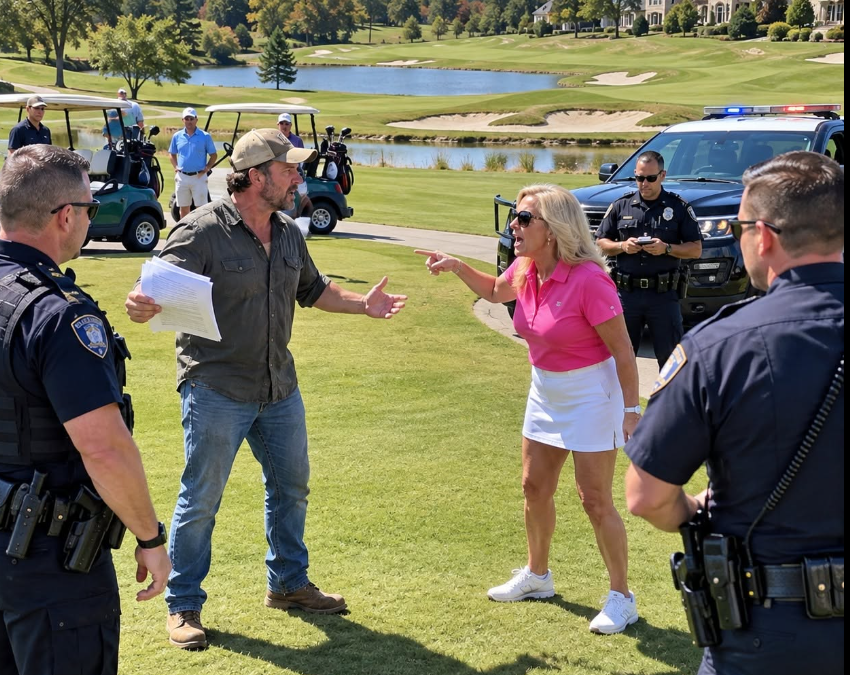
The woman driving stepped out.
Early sixties.
Platinum blonde hair.
White golf outfit.
White shoes.
Gold watch.
The kind of posture that tells you a person has spent years expecting people to listen when she speaks.
She did not ask whether I needed help.
She did not ask why I was examining the markers.
She opened with, “You are trespassing on private property.”
I stood.
“Am I?”
Her expression sharpened.
“This is a private course.”
She stepped closer.
“Residents and authorized guests only.”
I looked down at my map.
“Interesting.”
“There is nothing interesting about it.”
She pulled out her phone.
“If you refuse to leave, I will contact security and the police.”
“Before you do that, who are you?”
She almost looked offended.
“Victoria Harrington.”
Pause.
“President of the Ridgerest Estates Homeowners Association.”
Of course she was.
I nodded.
“Austin Harris.”
Recognition flickered through her eyes.
Small.
But there.
“Harris?”
“My uncle was Albert Harris.”
Now she knew exactly who I was.
Her posture did not change.
If anything, she became more confident.
“I knew Albert.”
“I’m sure.”
“I was sorry to hear about his passing.”
It was the first polite sentence she had spoken.
“He was a lovely man.”
I looked at her.
“According to this survey, this fairway is on his property.”
Her smile became careful.
“Formerly his property.”
“Now mine.”
Another tiny pause.
“Yes. Of course.”
“So if the survey is correct, I’m not trespassing.”
Victoria glanced at the document but did not take it.
“There has clearly been some confusion.”
“Then clear it up.”
She gave a short laugh.
“Mr. Harris, your uncle allowed Ridgerest to use this land for recreational purposes years ago.”
“What land?”
“The golf course acreage.”
“How much?”
“Around two hundred thirty acres.”
“Lease?”
“Permanent land use agreement.”
“When?”
“2005.”
The year hit me.
They will tell you I agreed.
I never agreed.
I kept my face neutral.
“I’d like a copy.”
“Certainly.”
“Recorded where?”
Her smile changed.
“Excuse me?”
“Which recording number?”
“I don’t carry county records in my golf cart.”
“Then your attorney can send it.”
“He will.”
“Good.”
Victoria looked toward the clubhouse.
People were watching now.
A foursome had stopped playing.
Two men stood near their carts.
Someone on the clubhouse patio had raised a phone.
She noticed too.
Her voice became louder.
“In the meantime, I’m asking you to leave our private amenities.”
“Our?”
“Yes.”
“If the land belongs to me?”
“This is exactly the kind of confrontation we do not need.”
“I’m asking about title.”
“You are creating a disturbance.”
I almost laughed.
The disturbance consisted of me holding a survey map.
Victoria reached for her phone again.
“I have called security.”
“Call whoever you like.”
Her eyes hardened.
“Mr. Harris, let me give you friendly advice.”
“I’m listening.”
“Your uncle was reasonable.”
I said nothing.
“He understood how things work here.”
That sentence felt rehearsed.
“I hope you will be reasonable too.”
I folded the survey.
Placed it inside my jacket.
“Send me the agreement.”
Then I walked back to my car.
I could feel every set of eyes following me.
Victoria had won the visual.
To every resident watching, she looked like the HOA president removing an intruder.
I looked like a stranger who had wandered onto their golf course carrying papers.
That mattered.
I understood perception.
Real estate conflicts rarely begin in court.
They begin with stories.
Who is the owner?
Who is the outsider?
Who is defending something?
Who is trying to take it?
Victoria already knew which story she wanted Ridgerest to believe.
I drove back to my hotel.
The next morning, her attorneys made sure I understood.
A courier arrived before I finished coffee.
Thick envelope.
MORRISON AND ASSOCIATES.
COUNSEL FOR RIDGEREST ESTATES HOA.
Three pages.
The letter accused me of trespassing, harassment, interference with community property, disruption of peaceful enjoyment, and behavior supposedly causing emotional distress to residents.
Emotional distress.
I had walked onto grass and examined a survey marker.
The final paragraph demanded that I stay away from the golf course, clubhouse, pool, trails, and all other community amenities.
Then I reached the attachment.
LAND USE AGREEMENT.
March 15, 2005.
Albert Harris and Ridgerest Estates HOA.
I read every line.
According to the document, Albert had granted the HOA permanent and irrevocable use of 230 acres.
Recreational use.
Golf.
Trails.
Community facilities.
No expiration.
No annual rent.
No meaningful compensation.
Effectively forever.
I read the compensation clause twice.
Nothing.
My uncle, a real estate attorney, had supposedly given an HOA permanent use of 230 acres of Texas land for free.
At the bottom:
Albert Harris.
Blue signature.
I stared at it.
I had seen Albert sign birthday cards.
Checks.
Contracts.
Letters.
Family documents.
The signature looked close.
Close enough to fool someone who did not know him.
But something bothered me.
The slant.
Albert’s capital H normally pulled farther right.
The pressure in the final strokes was wrong.
Maybe grief was making me see things.
I needed an original.
More importantly, I needed evidence.
That afternoon, Victoria escalated.
Every household in Ridgerest received an email.
I obtained a copy through an employee at the hotel whose parents lived in the community.
Subject:
URGENT COMMUNITY ALERT.
PROTECTING OUR AMENITIES.
It was excellent propaganda.
I say that professionally.
The writing was polished.
Controlled.
No direct threat.
No obvious hysteria.
It described me as “an outside individual” attempting to seize community property.
It described Albert as a beloved local figure who had generously partnered with Ridgerest for nearly twenty years.
Then it turned personal.
A distant relative exploiting the death of an elderly man.
A businessman from Denver attempting to profit from a technicality.
A threat to four hundred fifty homeowners.
The email warned that I wanted their golf course.
Their trails.
Their clubhouse.
Their lifestyle.
By evening, the community message board had turned me into a villain.
Land grabber.
Fraud.
Vulture.
Disgusting.
His uncle would be ashamed.
One resident wrote that people like me were exactly why HOAs existed.
I sat at the hotel desk reading comment after comment.
It would be easy to hate them.
But I did not.
These people had purchased homes based on certain assumptions.
They believed the golf course belonged to their community.
Their mortgages reflected the amenities.
Their property values reflected them.
Their retirement plans might depend on those values.
From their perspective, some man from Colorado had arrived after his uncle died and announced that he owned the thing anchoring their entire development.
Victoria knew that.
She turned their fear into loyalty.
Smart.
Then I saw one comment.
Raymond Torres.
I think we should hear Mr. Harris before deciding what happened.
That was it.
One sentence.
Immediately buried beneath angry replies.
Why?
We already have documentation.
Don’t fall for this.
Victoria knows the history.
But Raymond’s name stayed in my mind.
One person was not certain.
Sometimes one is enough.
That night, I returned to Albert’s files.
The obvious question was simple.
If Albert had granted 230 acres permanently in 2005, why had he left me the deed without mentioning the encumbrance?
I found a 2003 lease.
That document made sense.
Albert had leased approximately 200 acres to the developer for residential construction.
Specific parcel descriptions.
Specific rights.
Payment terms.
Recording information.
Lawyer signatures.
Notarization.
Everything you expect in a serious land transaction.
The 2003 lease covered the houses.
Not the golf course.
Not the clubhouse.
Not the trails.
I pulled another box from beneath the hotel desk.
Then another.
Hours passed.
Near midnight, I found a small envelope.
Inside:
A key.
Handwritten label.
SAFE DEPOSIT BOX.
FIRST NATIONAL BANK OF AUSTIN.
I stared at it.
Albert had not merely left records.
He had built a trail.
At nine the next morning, I was standing outside the bank.
The process took twenty minutes.
Death certificate.
Estate paperwork.
Identification.
Signature check.
Then the manager returned.
“Your uncle listed you as a co-holder years ago.”
“How many years?”
She checked.
“Almost nine.”
Albert had prepared for me long before he died.
A bank employee led me to a private room.
Placed the metal box on the table.
Then left.
I opened it.
The first document was the original 1985 survey.
Not a copy.
Seal intact.
The second was the 2003 development lease.
Original.
Two hundred acres.
Residential development only.
Then a thick folder.
CORRESPONDENCE.
RIDGEREST HOA.
I opened it.
Letters.
Twelve of them.
Every letter from Albert to Victoria Harrington or the HOA board.
Every letter said some version of the same thing.
You are using land without permission.
Your use extends beyond the 2003 lease.
You must cease construction or negotiate a legitimate agreement.
I read response letters.
Vague.
We are reviewing the matter.
We believe prior understandings control.
Our counsel will respond.
Please allow time.
Years of delay.
Albert never stopped objecting.
Then I found the photocopy.
The supposed 2005 agreement.
Same document Victoria’s attorney sent me.
Same typed language.
Same signature.
But Albert had written across the margin in red ink.
I NEVER SIGNED THIS.
I stared at those words.
The room felt suddenly very quiet.
My uncle knew.
He had seen the document.
He had identified it as false.
He had preserved it beside fifteen years of objections.
This was no longer a boundary disagreement.
Someone had created evidence claiming he gave away rights he repeatedly said he never gave.
I photographed everything.
Then called Grace Parker.
Grace’s name appeared on the 2003 lease.
She had worked with Albert for decades.
Her office was downtown.
She agreed to see me that afternoon.
Grace was in her early sixties.
Gray hair.
Minimal patience.
The kind of lawyer who did not waste words.
I placed the documents on her conference table.
She read the note.
Then the correspondence.
Then the alleged agreement.
Her expression changed.
“Where did you get this?”
“Victoria’s attorney.”
“No. This copy.”
“Albert’s safe deposit box.”
Grace looked at the red writing.
“I know his handwriting.”
“So do I.”
She sat back.
“If the signature is forged, this moves far beyond a civil title dispute.”
“I know.”
“You cannot prove forgery by looking at it.”
“I know.”
“We need a document examiner.”
“Yes.”
“The original if possible.”
“Victoria has not provided it.”
“Of course she hasn’t.”
Grace began making notes.
“First, we get certified copies of every recorded instrument related to Ridgerest.”
I nodded.
“Second, additional known signature samples.”
“Yes.”
“Third, forensic examination.”
“Yes.”
“Fourth.”
She looked at me.
“You say nothing publicly.”
“That’s harder.”
“It’s supposed to be.”
“She’s already accusing me of fraud.”
“Good.”
“Good?”
Grace nodded.
“Let her believe you have nothing.”
“She’s attacking my name.”
“And you want to win an argument or win the land case?”
I stared at her.
She continued.
“The moment Victoria knows you have Albert’s correspondence, she begins preparing explanations.”
“And if she knows we suspect forgery?”
“She starts looking for the people who know how the document was created.”
That landed.
“We move before she understands the evidence.”
I spent the rest of that day at the county recorder.
Deeds.
Plats.
Easements.
Development agreements.
HOA formation filings.
Amendments.
The 2003 lease was there.
The 1985 survey was there.
The 2005 land use agreement was not.
I checked twice.
Then a clerk checked.
Nothing.
That evening, Grace called.
“I ran it independently.”
“And?”
“Never recorded.”
“So either they forgot.”
“A developer forgot to record a permanent agreement involving 230 acres?”
Her tone answered the question.
“Possible?”
“Anything is possible.”
“Likely?”
“No.”
I stood at my hotel window looking over Austin.
Grace continued.
“A legitimate agreement this important should have left footprints.”
“Title records.”
“Yes.”
“Insurance.”
“Yes.”
“Development approvals.”
“Yes.”
“Tax treatment.”
“Yes.”
“But nothing.”
“Nothing yet.”
The next three days changed the fight.
Somehow, Victoria learned I was looking.
Her second community email was vicious.
This time my name was in the subject line.
AUSTIN HARRIS FRAUDULENT CLAIMS.
It accused me of fabricating documents.
Harassing residents.
Trying to steal community assets.
It said I barely knew my uncle.
That part hurt more than it should have.
Because buried underneath the lie was guilt.
I had not visited enough.
I had allowed years to pass.
Victoria did not know that.
But she knew exactly where to aim.
Then she used a photograph from my company website.
Underneath:
THIS MAN WANTS TO TAKE YOUR GOLF COURSE, CLUBHOUSE AND TRAILS.
DO NOT LET HIM.
Three hundred residents signed a petition demanding authorities investigate me.
Then the attack reached Denver.
Business partners received anonymous emails.
Fraud allegations.
Land scams.
Ethical concerns.
A client I had worked with for five years called.
“Austin, I need you to tell me what’s happening.”
“It’s a title dispute.”
“They’re saying you forged ownership documents.”
“They’re lying.”
“Can you prove that?”
“Yes.”
“When?”
That question hurt.
“Soon.”
He paused.
“Our legal team wants us to pause the project.”
I closed my eyes.
“For how long?”
“Until this gets clearer.”
After we hung up, my office manager called.
Her voice was careful.
“What is going on in Texas?”
“I’m handling it.”
“I know.”
She paused.
“But people are asking questions.”
“I know.”
“We trust you.”
The word we bothered me.
Not because I doubted her.
Because trust had entered the conversation.
Reputations take years to build.
Victoria understood how quickly uncertainty could damage one.
Then came the Texas Real Estate Commission complaint.
Anonymous.
Fraud.
False property representations.
Forged documents.
The irony was almost impressive.
The person I suspected of relying on a forged agreement was now accusing me of forgery.
Because the complaint concerned professional conduct, it had to be reviewed.
A letter arrived.
Retain counsel.
Respond.
Preserve records.
I called Grace.
For the first time, I was angry.
Not controlled irritation.
Angry.
“She’s going after my company.”
“I know.”
“My license.”
“I know.”
“She knows those allegations are false.”
“Probably.”
“I want to answer publicly.”
“No.”
“I want to post the deed.”
“No.”
“The correspondence.”
“No.”
“The note.”
“No.”
I stood from the hotel chair.
“So I’m supposed to sit here while she calls me a criminal?”
“Yes.”
“That’s insane.”
“No. It’s strategy.”
“It feels like surrender.”
Grace’s voice softened slightly.
“Austin, she wants you reacting.”
“I know.”
“She wants thirty versions of this conflict floating around so when the forensic evidence comes, she can call it another claim.”
I stared through the window.
“We give her one event.”
“What?”
“When everything is ready, we present everything together.”
I understood.
One story.
One evidence package.
No drip.
No premature warning.
“Stay quiet,” Grace said.
Then hung up.
Doing nothing publicly while your reputation is attacked is one of the most unpleasant forms of discipline.
You watch people decide who you are without answering.
You watch lies harden because silence looks like weakness.
For several days, I felt like I was underwater.
Then the hotel front desk called.
“Mr. Harris, someone left an envelope for you.”
I went downstairs.
Handwritten.
AUSTIN HARRIS.
Inside was a note.
I knew your uncle.
I know what happened in 2005.
Coffee shop on Fifth Street.
3:00.
Come alone.
R. Torres.
Raymond.
The only resident who had asked people to hear me.
I arrived early.
Raymond arrived exactly at three.
Late sixties.
Gray hair.
Weathered face.
He sat across from me.
For several seconds, he just looked.
“You resemble Albert.”
“So I’ve been told.”
“Same eyes.”
“Did you know him well?”
“Well enough to be ashamed.”
That was not the answer I expected.
Raymond wrapped both hands around his coffee.
“I served on the Ridgerest HOA board from 2003 until 2010.”
My attention sharpened.
“You were there during construction.”
“Yes.”
“The golf course?”
“Yes.”
“What happened?”
He looked toward the window.
“Victoria wanted it.”
“That simple?”
“At first.”
“Did Albert agree?”
“No.”
Immediate.
No hesitation.
“He never agreed.”
I leaned forward.
“Tell me everything.”
Raymond inhaled.
“In 2005, Victoria presented the board with a plan to expand the amenities. Golf course. Trails. Larger clubhouse footprint.”
“Whose land?”
“Albert’s.”
“What did the board ask?”
“Whether she had permission.”
“And?”
“She said she would get it.”
“Did she?”
Raymond shook his head.
“Albert came to a meeting.”
“When?”
“After construction had already started.”
“He knew?”
“He was furious.”
I could picture him.
Not loud.
Albert rarely shouted.
But furious in the way attorneys become furious when facts are being manipulated.
“He stood in the room,” Raymond said, “and asked who authorized construction on his property.”
“What did Victoria say?”
“That there was a misunderstanding.”
“Was there?”
“No.”
“What happened next?”
“She walked him outside.”
“For how long?”
“Twenty minutes.”
“And?”
“She came back smiling.”
“Said what?”
“Everything was handled.”
“Was it?”
Raymond’s face hardened.
“The construction continued.”
“And nobody asked Albert?”
“We trusted Victoria.”
“Did you?”
He looked down.
“At first.”
I waited.
Raymond reached into his jacket.
USB drive.
Placed it between us.
“I kept recordings.”
“Of what?”
“Board meetings.”
My pulse changed.
“Why?”
“I didn’t trust minutes.”
Fair.
“There is a recording from 2005.”
“What’s on it?”
He met my eyes.
“Victoria.”
I did not touch the drive yet.
“Victoria saying what?”
Raymond spoke slowly.
“Albert will never agree to this, but we are building anyway. He is old. He will not fight back.”
The noise of the coffee shop seemed to disappear.
“You’re sure?”
“I’ve listened to it enough times to hate myself.”
He pushed the drive closer.
“Take it.”
I finally picked it up.
“Why now?”
Raymond looked almost offended.
Then the emotion changed.
“I was a coward.”
He said it quietly.
“I watched her do it.”
“Why didn’t you stop her?”
“Because Victoria controlled the contracts.”
He counted.
“Landscaping. Security. Vendors. Board appointments. Social committees. Everything.”
“And?”
“And I had a wife who loved the house.”
He swallowed.
“I told myself someone else would fight.”
I said nothing.
“No one did.”
Raymond stood.
“Albert came to me years later.”
“What did he want?”
“My testimony.”
“And?”
“I refused.”
He looked at the floor.
“He said one thing before leaving.”
“What?”
“Someday someone will be brave enough.”
Raymond’s eyes were wet.
“Your uncle died waiting for me to grow a spine.”
Then he left.
I sat there alone with the drive.
That night, I listened to the recording.
Old audio.
Hiss.
Chairs moving.
Voices overlapping.
Then Victoria.
Younger.
Clear.
Confident.
“Albert will never agree to this, but we are building anyway.”
Another voice asked something indistinct.
Then Victoria again.
“He’s old. He will not fight back.”
I stopped the recording.
Played it again.
Then a third time.
That sentence eliminated the possibility of innocent misunderstanding.
The board knew there was no agreement.
Construction proceeded anyway.
I made three encrypted copies.
Sent one to Grace.
Stored another offsite.
Raymond contacted me two days later.
This time we met in a park.
He brought an envelope.
Minutes from closed board sessions.
Internal memoranda.
Financial documents.
Correspondence.
One record showed approximately $3.2 million spent developing the golf course.
On land the HOA did not own.
Another showed board discussions about Albert’s repeated letters.
Not confusion.
Not ignorance.
Instructions to ignore them.
“Why did you keep all this?”
Raymond looked tired.
“Because I always knew it was wrong.”
“That didn’t make you act.”
“No.”
His honesty disarmed me.
“I’m not asking you to forgive me.”
“I’m not the one you owed.”
“I know.”
He looked toward the trees.
“When Albert asked me to testify, I told him Victoria would destroy anyone who challenged her.”
“What did he say?”
“Nothing angry.”
Raymond smiled sadly.
“That made it worse.”
Grace reviewed the new material that night.
“Civil case is ready.”
“Now?”
“Yes.”
“Quiet title.”
“Yes.”
“Trespass.”
“Yes.”
“Unjust enrichment.”
“Yes.”
“Forgery?”
“Not until Ellen finishes.”
Dr. Ellen Marsh.
Former FBI document examiner.
Thirty years analyzing questioned documents.
Grace had sent her the alleged agreement, the 2003 lease, personal letters, legal filings, and additional known samples.
“What if she says the signature is genuine?”
“Then we adjust.”
I hated that answer.
“So everything depends on her.”
“No.”
Grace shook her head.
“We already have a strong land case.”
“But criminal exposure?”
“Forgery changes the scale.”
We waited.
Meanwhile, I opened another front.
Texas Real Estate Commission.
Complaint against Harrington Development Group.
Misrepresentation of boundaries.
Failure to verify ownership.
Then title insurance.
That was the pressure point I suspected Victoria had overlooked.
Four hundred fifty homes.
Each sold partly on the representation that Ridgerest controlled the golf amenities.
Title policies.
Insurance.
Mortgage underwriting.
If fraudulent documents had contaminated any of those assumptions, people with far more resources than Victoria would care.
The annual HOA meeting was twelve days away.
Usually fifty residents attended.
Victoria’s campaign against me guaranteed a much larger crowd.
Grace saw the opportunity.
“We present there.”
“To residents?”
“Yes.”
“She controls the meeting.”
“Not the evidence.”
“What if she refuses to let me speak?”
“Then the refusal becomes part of the story.”
We still needed Ellen.
Eight days before the meeting, Grace called.
Her tone told me before her words.
“Sit down.”
“Tell me.”
“The signature is forged.”
I stopped breathing for a second.
“How certain?”
“Her professional conclusion is extremely strong.”
“Method?”
“Digitally copied.”
“From where?”
“The 2003 lease.”
My skin went cold.
“She found matching characteristics inconsistent with natural repeated signatures.”
“And the document?”
Grace paused.
“The metadata shows creation in 2008.”
I stood.
“Not 2005.”
“Correct.”
Three years later.
Three years after the supposed date.
Three years after the original dispute began.
“There’s more.”
I waited.
“The computer metadata identifies Harrington Development Group.”
Victoria’s company.
I sat again.
Everything connected.
Albert complained.
Construction continued.
Then a document appeared claiming permission existed years earlier.
A document never recorded.
A signature copied from a legitimate lease.
Created on hardware associated with Victoria’s development company.
This was no longer an ambiguous story.
Grace said, “Now we move.”
Monday morning, she filed.
Civil quiet title action.
Trespass.
Unjust enrichment.
Criminal referral package to the Travis County District Attorney.
Notice to the title insurer.
Evidence attached.
1985 survey.
2003 lease.
Albert’s correspondence.
Raymond’s recording.
Forensic report.
Metadata analysis.
Victoria was served Thursday.
Two days before the annual meeting.
Within thirty minutes of service, according to Raymond, she called an emergency closed board session.
No residents.
Damage control.
That night, Raymond called.
“She’s panicking.”
“How?”
“She wants everyone aligned before Saturday.”
“Aligned around what?”
“Not sure.”
Then he lowered his voice.
“But Terry is scared.”
“Terry Simmons?”
“Vice president.”
I knew the name.
I had paid little attention to him.
Quiet board member.
Usually seated beside Victoria.
Raymond continued.
“He handled insurance.”
That got my attention.
“What insurance?”
“Most of it.”
I called Grace.
She had already been looking.
Terry Simmons owned a local insurance agency.
Brokered title-related products and HOA coverage.
Had signed certifications concerning community amenities.
If Terry had certified clean rights without adequate evidence, he had a problem.
A very large one.
Friday morning, my phone rang.
Unknown number.
“Mr. Harris?”
“Yes?”
“This is Terry Simmons.”
He sounded like he had been awake all night.
“We need to meet.”
“Why?”
“Victoria is blaming me.”
“For?”
“The title verification.”
I stayed silent.
“She told the board I assured her everything was clear.”
“Did you?”
Long pause.
“Not exactly.”
“Those two words are doing a lot of work, Terry.”
“I have records.”
“What records?”
“Emails.”
“From Victoria?”
“Yes.”
“What do they say?”
Another pause.
“That she told me to proceed.”
“Despite what?”
“Problems with the agreement.”
I closed my eyes.
“Did you know Albert disputed it?”
“Yes.”
“Did you know the land use document had not been recorded?”
“Yes.”
“Did you certify anyway?”
Silence.
“Terry?”
“Yes.”
“Why?”
“I thought Victoria would fix it.”
“For twenty years?”
His voice cracked.
“I’m not going to prison for her.”
There it was.
Not conscience.
Survival.
Still useful.
We met at Grace’s office.
Terry looked terrible.
Wrinkled suit.
Sweat around his collar.
Hands shaking.
He laid out emails.
Victoria instructing him to proceed.
Terry raising concerns.
Victoria dismissing them.
Internal memos.
Insurance certifications.
Then a recording from 2015.
Victoria laughing.
Albert complained again.
Her voice:
“What is he going to do? Sue us? He’ll be dead before it ever goes to trial.”
I felt something inside me harden.
That sentence was worse than the forgery.
Because it revealed the strategy.
Not legal right.
Delay.
Wait for an old man to die.
Then his objections die with him.
Except Albert had planned for that.
Grace looked at Terry.
“If you cooperate, that matters.”
“Can you guarantee I won’t go to prison?”
“No.”
He looked sick.
“But cooperation matters.”
“What do I have to do?”
“Tell the truth.”
It sounded almost too simple.
Saturday evening, the Ridgerest clubhouse was packed.
Three hundred eighty residents.
People stood against walls.
Filled aisles.
Crowded near exits.
Victoria stood at the podium.
Navy suit.
Perfect hair.
Controlled expression.
Twenty years of practice.
Terry’s chair was empty.
Raymond sat near the middle.
I stood at the back.
Victoria began.
“I know everyone has questions.”
The room quieted.
“We are facing an unprecedented attack on our community.”
Eyes turned toward me.
Victoria continued.
“An outside businessman is attempting to take control of amenities Ridgerest residents have enjoyed for almost twenty years.”
Outside businessman.
Not owner.
Not Albert’s nephew.
Not Austin.
She needed me abstract.
Enemy.
“The board has retained counsel.”
She paused.
“To defend our rights, we require a special assessment.”
People shifted.
“Two thousand dollars per household.”
The room erupted.
“What?”
“Two thousand?”
“For lawyers?”
“Why?”
Victoria raised both hands.
“This is necessary to protect property values.”
I almost admired the nerve.
She had built the problem.
Now she wanted four hundred fifty households to finance her defense.
Nine hundred thousand dollars.
Then someone near the front said, “Let Harris speak.”
Victoria froze.
Another voice followed.
“Yes.”
“If he’s lying, let us hear it.”
“Five minutes.”
“Give him the microphone.”
Victoria looked toward me.
Her eyes were cold.
“Mr. Harris.”
I walked forward.
“This is a homeowners meeting.”
“I understand.”
“You are not a homeowner.”
“I own the land under your golf course.”
People reacted.
Victoria stiffened.
“Five minutes.”
I stood beside the podium.
No microphone at first.
Then someone handed me one.
I held up the 1985 survey.
“This is the recorded survey for Albert Harris’s property.”
I held up the 2003 lease.
“This is the agreement my uncle actually signed when residential development began.”
Victoria immediately spoke.
“And we have another agreement.”
I nodded.
“Good.”
Her eyes narrowed.
“The 2003 lease covers two hundred acres.”
I pointed toward the houses.
“The residential parcels.”
Then toward the windows and fairway beyond.
“It does not include the golf course.”
Victoria said, “Because Albert later granted us the rights.”
“The 2005 agreement.”
“Yes.”
“The agreement never recorded with the county.”
Silence.
Victoria recovered.
“Recording is not always required for validity.”
“Fair point.”
That surprised her.
“So let’s talk about the document itself.”
Grace handed me Ellen’s report.
“Independent forensic document examiner Dr. Ellen Marsh compared the signature on your agreement with known examples of Albert Harris’s signature.”
Victoria’s lips tightened.
“Her conclusion?”
I held up the page.
“The signature was not written on that document.”
Murmurs.
“It was digitally copied from his signature on the 2003 lease.”
Victoria shook her head.
“That is absurd.”
“The file metadata was also examined.”
I paused.
“The document says 2005.”
“Yes.”
“The electronic file was created in 2008.”
The room changed.
People stopped whispering.
They were listening now.
“And the computer information traces the file to Harrington Development Group.”
I looked at Victoria.
“Your company.”
Her hand tightened on the podium.
“These allegations are fabricated.”
“Then we can let the court evaluate them.”
“You are twisting technical information.”
I nodded.
“Then perhaps we should discuss Albert’s letters.”
I held up the folder.
“From 2008 through 2023, my uncle repeatedly notified this HOA that the golf course and related facilities were using his land without permission.”
Victoria interrupted.
“He was confused.”
“Fifteen years?”
“He became increasingly difficult with age.”
I felt anger.
But I kept my voice calm.
“So difficult that he wrote legally specific objections for fifteen years?”
“Your uncle changed his mind constantly.”
Then Raymond stood.
Victoria saw him.
Her face altered immediately.
“Raymond.”
He ignored her.
“I was on the board in 2005.”
People turned.
“I was there.”
Victoria spoke faster.
“This is not appropriate.”
Raymond continued.
“Albert did not agree.”
The room erupted.
Victoria pounded the podium.
“Sit down.”
Raymond did not.
“You told us to build anyway.”
“Raymond.”
“You told us he was old and wouldn’t fight.”
Victoria’s face went white.
I took out my phone.
Connected it to the sound system.
“Maybe we don’t need to argue.”
Then I played the recording.
Static.
Room noise.
Then Victoria’s voice from almost twenty years earlier.
“Albert will never agree to this, but we are building anyway.”
A gasp somewhere behind me.
Then:
“He is old. He will not fight back.”
Silence.
Absolute.
I stopped playback.
Victoria gripped the podium.
Her knuckles had gone white.
“That is out of context.”
Raymond laughed.
It was not a happy sound.
“I was there.”
“You were removed from the board years ago.”
“I resigned.”
“Because you were incompetent.”
Raymond looked around at the residents.
“Everything Austin told you is true.”
Victoria shouted, “You have no idea what I built!”
The room fell silent again.
Her voice echoed.
“This community exists because of me.”
Nobody moved.
“Without that golf course, your homes would never have sold for what you paid.”
She pointed toward the windows.
“The pool. The clubhouse. The trails. All of it.”
Someone called, “On land you didn’t own.”
Victoria snapped toward him.
“You think development happens by asking permission every time someone changes their mind?”
That was the moment.
I watched her realize what she had just said.
Too late.
“You forged his signature?” a woman demanded.
“No.”
“You just said he didn’t agree.”
“I said development requires difficult decisions.”
People began shouting.
Victoria raised her voice.
“I did what was necessary.”
There it was.
Not denial.
Justification.
Raymond stared at her.
“You stole from Albert.”
“I created millions of dollars in value.”
“On his land.”
“He was sitting on empty acreage doing nothing.”
I almost could not believe she was saying it.
Her entire legal position depended on consent.
And under pressure, she abandoned consent entirely.
Because underneath all the documents, Victoria believed development itself had entitled her to the land.
A woman in the third row stood.
“I move for a vote of no confidence.”
“Second.”
“Second.”
“Call the vote.”
Victoria slammed her hand down.
“You cannot conduct an illegal vote because of a manipulated presentation.”
A board member beside her stood.
“Victoria.”
She turned.
He would not meet her eyes.
“We need to vote.”
For the first time, she looked afraid.
Hands rose.
Rows of them.
Again.
Again.
Again.
The opposition was overwhelming.
Victoria stared at the room that had obeyed her for twenty years.
The same residents who had signed petitions against me were now voting against her.
When the count was announced, she said nothing.
She picked up her purse.
Walked toward the side exit.
Raymond called her name.
She did not turn.
The door closed.
For several seconds, nobody spoke.
Then a man near the front raised his hand.
“Mr. Harris.”
I looked at him.
“What happens now?”
Another resident asked, “Are you closing the golf course?”
Then another.
“Do we lose the clubhouse?”
“Can you evict the HOA?”
“Are you selling the land?”
The fear returned.
Different now.
These people finally understood that Victoria had lied.
But truth created another problem.
The land really was mine.
They had spent twenty years building their lives around amenities that were not legally theirs.
I looked around the room.
Some of these people had called me a criminal.
Signed petitions.
Demanded investigations.
Contacted my business.
But Victoria had manipulated them too.
I said the only honest thing available.
“I don’t know yet.”
Nobody liked that answer.
Neither did I.
The legal consequences unfolded over the next three months.
Victoria’s position collapsed quickly once investigators received the complete evidence package.
Forensic report.
Metadata.
Correspondence.
Raymond’s recordings.
Terry’s emails.
Insurance certifications.
Internal board documents.
The criminal case never became the dramatic trial people expected.
Victoria entered a no-contest plea to forgery and fraud-related charges.
Two years probation.
Two-hundred-thousand-dollar fine.
Real estate license permanently revoked.
Restrictions on fiduciary roles during the probation period.
The woman who spent twenty years presenting herself as the guardian of property rights lost the professional license that allowed her to trade in property.
Terry Simmons cooperated.
His own consequences were serious.
Five-year suspension of his insurance license.
Fifty-thousand-dollar fine.
He avoided prison.
That made some residents angry.
I understood.
But without Terry’s records, parts of the scheme would have been harder to prove.
Cooperation has value precisely because people involved in wrongdoing often know where the evidence is.
Several former board members faced civil exposure.
The HOA itself eventually became responsible for $1.8 million in damages through available reserves, insurance, and assessment structures.
Grace told me we could continue.
“More damages.”
“How much?”
“Potentially substantial.”
“Force asset sales?”
“If necessary.”
“Golf course?”
“Potentially.”
“Clubhouse?”
“Potentially.”
She watched me.
“You own the land.”
“I know.”
“You could demand possession.”
“I know.”
“You could shut down access tomorrow once the orders are final.”
“I know.”
She closed the folder.
“You don’t sound happy.”
“I’m not.”
“Why?”
“Because four hundred fifty families didn’t forge Albert’s signature.”
“Some attacked you.”
“Because Victoria told them I was stealing their neighborhood.”
“They signed the petition.”
“Yes.”
“They contacted your business.”
“Some did.”
Grace waited.
I looked at Albert’s note on the table.
They will tell you I agreed.
I never agreed.
Keep everything.
He did not write:
Destroy them.
Take everything.
Make them pay.
Albert had spent fifteen years preserving the truth.
I wondered what he had wanted after the truth came out.
The answer came from something he used to tell me.
A lawyer’s job is not to create maximum damage.
It is to solve the actual problem.
The actual problem was not golf.
It was theft.
Not the houses.
Fraud.
Not residents playing golf on Saturday.
A system that converted stolen use into assumed ownership.
I told Grace, “I don’t want the course closed.”
She studied me.
“You’re sure?”
“Yes.”
“You could charge significantly more.”
“I know.”
“You could develop sections yourself.”
“I know.”
“Then what do you want?”
“A real agreement.”
One month after Victoria’s sentencing, another community meeting was held.
Same clubhouse.
Different atmosphere.
Raymond Torres had been elected interim HOA president.
When he introduced me, he did not give a speech.
“Austin Harris has a proposal.”
That was it.
I stood where I had confronted Victoria.
No evidence slides.
No recordings.
No accusation.
The residents looked nervous.
“I’m going to start with what I’m not doing.”
That got their attention.
“I am not closing the golf course.”
A wave moved through the room.
“I am not barricading the trails.”
More relief.
“I am not evicting residents.”
Someone actually laughed.
“I am not selling the disputed acreage to a developer.”
That mattered.
I continued.
“The 230 acres used for the golf course and community facilities will remain available to Ridgerest under a new lease.”
Raymond looked at me even though he already knew.
“Independent appraisers established a fair annual value.”
I paused.
“Forty-five thousand dollars per year.”
Someone whispered, “That’s it?”
Compared to the value at stake, yes.
It was manageable.
“The lease will be recorded.”
I looked around the room.
“Properly.”
A few people smiled.
“It will define every boundary.”
I continued.
“Every permitted use.”
“Every renewal.”
“Every payment.”
“No secret side agreements.”
“No permanent rights based on somebody’s word.”
Then the conditions.
Annual independent audits.
Open financial reporting.
Recorded board votes.
Conflict disclosures.
Document access.
No closed-door decisions affecting major property rights without appropriate process.
No president becoming the institution.
Then I explained the next part.
“Fifty acres of undeveloped land will become a public hiking area.”
People looked at each other.
“Open to Ridgerest residents and the surrounding community.”
A screen behind me displayed the trail plan.
ALBERT HARRIS MEMORIAL TRAIL.
I had not seen the final sign design until that morning.
For a second, I could not speak.
Then I continued.
“At the entrance will be a plaque.”
I read the proposed inscription.
In memory of Albert Harris, a man who believed the truth was worth protecting.
The room stayed quiet.
“And five hundred acres of the remaining property will be placed under a conservation easement.”
That got a bigger reaction.
“Five hundred?”
“Yes.”
“No development?”
“No major development.”
“Ever?”
“That’s the point.”
Albert had once told me he was preserving that land for something bigger than himself.
For years, I assumed he meant the family.
Maybe he did.
But family ownership only lasts until someone sells.
Conservation lasts longer.
When I finished, a woman in the first row stood.
I recognized her.
She had been one of the loudest voices online.
Her comment after Victoria’s first email had called me a fraud.
She signed the petition.
“Mr. Harris.”
“Yes?”
Her hands trembled.
“I owe you an apology.”
I waited.
“I believed Victoria.”
“I know.”
“I told people you were a con artist.”
“I know.”
She looked embarrassed.
“I thought you wanted to take something from us.”
“I know.”
Her voice cracked slightly.
“Why aren’t you?”
“What?”
“Taking it.”
I looked at her.
“It is yours,” she said, then corrected herself. “I understand that now.”
Then she looked around.
“After what people here said about you.”
I thought about my paused project in Denver.
The commission complaint.
The emails.
The comments about Albert.
For a moment, revenge felt very available.
Then it passed.
“You were lied to.”
She looked confused.
“That doesn’t excuse everything.”
“No,” I agreed. “But it explains a lot.”
I pointed toward the windows.
“You bought homes believing these amenities were legitimate.”
“Yes.”
“You paid premiums based on that belief.”
“Yes.”
“You were told I was trying to steal them.”
“Yes.”
“I’m not going to punish hundreds of families because one leadership group built your expectations on fraud.”
She stared at me.
“Why?”
I thought of Albert.
“Because my uncle taught me how to fix land problems.”
I paused.
“Not how to destroy people.”
Several weeks later, I prepared to return to Denver.
Before leaving, I drove to Ridgerest one last time.
Same entrance.
Different feeling.
The old promotional sign remained.
But another stood nearby.
ALBERT HARRIS MEMORIAL TRAIL.
I parked near the seventh fairway.
The exact place Victoria had first confronted me.
A licensed survey crew had restored the boundary monuments.
I walked to one.
Fresh notation.
Correct coordinates.
Properly documented.
No loose soil.
No moved markers.
The boundary was clear.
That mattered more than I expected.
Lines on land are abstract until somebody moves them.
Then they become something else.
A statement.
Someone had moved those markers because they wanted physical reality to match the lie.
Now the markers matched the record again.
I walked beyond the fairway toward the new trail.
A family passed me.
Father.
Mother.
Two children.
The younger child pointed at the memorial sign.
“Who’s Albert Harris?”
The father read the plaque.
“I don’t know.”
I smiled.
That was fine.
Albert never wanted fame.
He wanted the land protected.
The family kept walking.
I stood near the sign.
For twenty years, Victoria believed time would convert wrongdoing into ownership.
Build enough.
Spend enough.
Sell enough houses.
Maintain the grass.
Let children grow up using the trails.
Eventually, everyone would assume the land had always belonged to Ridgerest.
That was her real strategy.
Not law.
Normalization.
If you occupy something long enough, perhaps the original owner becomes inconvenient history.
If the owner is old enough, perhaps you can outlive the problem.
Victoria almost succeeded.
That was the frightening part.
Not because her forgery was brilliant.
It was not.
The metadata eventually exposed it.
Not because no records existed.
Albert kept them.
She nearly succeeded because everyone benefited from not asking.
The board wanted amenities.
Developers wanted home sales.
Brokers wanted commissions.
Residents wanted property values.
Vendors wanted contracts.
Insurance people wanted policies.
Every person could look at their small piece and tell themselves somebody else had verified the foundation.
Meanwhile, Albert wrote letters.
Year after year.
Stop using my land.
Nobody wanted to hear him.
Truth was inconvenient.
Golf was profitable.
Then he died.
I wondered what Victoria felt when she learned Albert was gone.
Relief?
Did she believe the problem had finally died with him?
Did she think I would sign whatever papers appeared?
Sell?
Take a settlement?
Walk away?
She miscalculated one thing.
Albert knew exactly what kind of adversary he was dealing with.
So he did what lawyers do when they suspect time may run out before justice arrives.
He preserved.
Original survey.
Original lease.
Every letter.
Copy of the false agreement.
Red ink.
I NEVER SIGNED THIS.
Safe deposit box.
My name added years before.
He did not need to know exactly how I would fight.
He only needed to ensure I had the facts.
Evidence survived him.
That was his victory.
Mine was smaller.
I listened.
As I stood beside the memorial trail, Raymond approached.
I had not heard him behind me.
“You leaving?”
“Tomorrow.”
He nodded.
For a while we looked at the trees.
Then he said, “I should have helped him sooner.”
“Yes.”
He flinched slightly.
Most people would have softened the answer.
I did not.
Raymond deserved truth too.
“I know.”
He stared at the sign.
“I thought you’d tell me it wasn’t my fault.”
“It was partly your fault.”
He nodded.
“I know.”
“But you eventually came forward.”
“Too late.”
“Late isn’t the same as never.”
He looked at me.
“That something Albert would say?”
“No.”
I smiled.
“He would probably have made it harsher.”
Raymond laughed.
Then his face turned serious.
“Do you forgive me?”
I considered it.
“That’s not really mine to give.”
He looked back toward the trail.
“But I think Albert would have appreciated what you finally did.”
Raymond nodded.
That seemed enough.
Before he left, he said, “Victoria used to say people respected her.”
“What do you think?”
“They feared consequences.”
“Different thing.”
“Very.”
The next morning, I checked out of the hotel.
My office manager called.
The Denver project that had been paused was restarting.
The professional complaint against me had collapsed once the underlying evidence became public.
Business partners who had sounded hesitant suddenly sounded apologetic.
Some overcompensated.
“Austin, we never doubted you.”
That was usually not true.
I let it go.
Trust shaken and restored does not need a ceremony.
I drove north.
Twelve hours back to Denver.
The same road.
Different man.
At some point outside Texas, I pulled into a rest stop.
Opened the glove compartment.
Albert’s original note was inside a protective sleeve.
They will tell you I agreed.
I never agreed.
Keep everything.
I read it one last time.
Then understood the last line differently.
Keep everything.
At first, I thought he meant documents.
Keep every record.
Every letter.
Every proof.
Maybe he did.
But Albert had also kept the land.
When development pressure increased, he kept it.
When Victoria wanted it, he kept it.
When millions of dollars appeared around it, he kept it.
And now part of that land would remain protected long after both of us were gone.
Five hundred acres.
Trees.
Fields.
Wildlife.
The memorial trail.
That felt closer to what he meant.
I returned to Denver and resumed my life.
But Ridgerest did not disappear from it entirely.
Quarterly lease payments arrived.
Annual reports.
Audit documents.
Boundary inspection records.
The new board became almost painfully transparent.
Raymond emailed too much.
Every few months:
Do you need to approve this?
Usually the answer was no.
He had gone from silence to overcorrection.
I preferred it.
A year after everything ended, I returned for the anniversary of Albert’s death.
Not because Ridgerest invited me.
Because I wanted to walk the property.
The golf course looked exactly the same.
That surprised me.
For all the legal chaos, grass had continued growing.
Golfers continued playing.
The clubhouse served lunch.
Kids swam.
Life rarely visually reflects the size of the conflict underneath it.
I walked the seventh fairway again.
A golfer waved.
I waved back.
No golf cart racing toward me.
No accusation.
No police threat.
At the trail entrance, the wooden sign had weathered slightly.
Albert’s name remained clear.
A small boy ran past me holding a water bottle.
His mother called after him.
Normal.
That was what restoration looked like.
Not dramatic.
Normal.
I thought about the alternative ending.
I could have closed everything.
Legally, I had leverage.
Imagine the headlines.
OWNER SHUTS DOWN GOLF COURSE AFTER HOA LAND FRAUD.
Four hundred fifty angry households.
Property values falling.
Litigation.
Bank disputes.
Resales collapsing.
A satisfying revenge story.
For maybe a week.
Then what?
I would still own land surrounded by people who hated me.
Albert’s name would become associated with destruction.
Trees might eventually be bulldozed for some new development because financial pressure made sale attractive.
Victoria would still be guilty.
But everyone else would pay too.
That never felt like justice.
Justice was making the record true again.
The land was mine.
Now the county record reflected it.
Ridgerest used 230 acres.
Now a legitimate lease reflected it.
Residents benefited.
Now compensation reflected it.
Albert objected for fifteen years.
Now the public history reflected it.
Victoria lied.
Now the court record reflected it.
The boundaries had been moved.
Now the monuments reflected the real line.
Truth returned to each place where convenience had replaced it.
That was enough.
I sat beneath an oak tree along the memorial trail.
One of the oldest on the property.
I remembered Albert sitting beneath similar trees when I was a kid.
He would bring legal pads everywhere.
Even fishing.
I once asked why.
“Because people remember badly,” he said.
I laughed.
“What?”
“Memory is arrogant.”
I was twelve.
I had no idea what that meant.
He explained.
“Everyone thinks they’ll remember exactly what happened.”
He tapped the legal pad.
“They won’t.”
“So you write it down?”
“Yes.”
“Everything?”
“Everything that matters.”
That became my career without me realizing where it started.
Contracts.
Site photos.
Title chains.
Surveys.
Emails.
Records.
Albert had taught me that documentation was memory you could cross-examine.
Victoria relied on the opposite.
She relied on time making everyone forget.
Who owned the ground before the clubhouse?
What exactly did the lease say?
When was permission supposedly granted?
Who challenged it?
When?
What did the board know?
Twenty years makes facts blurry.
Unless someone writes them down.
Albert wrote them down.
Raymond recorded them.
Terry saved emails.
The county preserved filings.
Metadata preserved the creation date.
Every layer of evidence defeated a different lie.
Victoria said Albert agreed.
His letters said no.
She produced an agreement.
The recorder had no copy.
She pointed to a signature.
Forensics showed it was copied.
She dated the document 2005.
Metadata said 2008.
She said the board believed ownership was clear.
Raymond had her voice saying Albert would never agree.
She blamed Terry.
Terry had her emails.
She called me a fraud.
The deed remained in Albert’s chain.
She told residents I wanted to destroy their community.
I offered a lease.
At the end, what defeated Victoria was not one dramatic piece of evidence.
It was consistency.
Truth connected.
Her story did not.
That is something I still think about professionally.
A lie can be polished.
Beautiful.
Persuasive.
Repeated by hundreds of people.
It can have lawyers.
Letterhead.
Petitions.
A golf course built on top of it.
But the more complicated the lie becomes, the more places reality can contradict it.
Victoria spent twenty years adding layers.
Construction.
Board minutes.
Insurance certifications.
Community mythology.
The supposed agreement.
Her own authority.
Each layer gave us another place to test the story.
Eventually, it broke everywhere.
The following year, Ridgerest commissioned a small permanent exhibit in the clubhouse about the property’s development.
I thought that was a terrible idea.
Raymond insisted.
“People should know.”
I reviewed the proposed language.
It was surprisingly direct.
Development began under a 2003 lease covering residential acreage. Additional recreational facilities were later built beyond the authorized area. A subsequent agreement used to justify those facilities was determined to be fraudulent. Ownership was resolved through court action and a new recorded lease. Albert Harris’s objections were acknowledged.
No euphemisms.
I approved it.
The exhibit included a copy of the legitimate survey.
Not Victoria’s agreement.
A photograph of Albert.
Trail information.
The point was not to shame Ridgerest forever.
It was to stop collective memory from becoming convenient again.
Communities are good at editing their own past.
Every institution is.
We didn’t know.
It was complicated.
Different time.
Everybody believed it.
Sometimes all true.
Sometimes excuses.
Records help tell the difference.
Years from now, a new resident might stand in that clubhouse and wonder why the HOA pays annual rent for its own golf course.
The answer will be visible.
Because it is not yours.
You use it lawfully.
There is nothing humiliating about that.
Permission is not weakness.
Rent is not defeat.
A contract is not oppression.
The humiliation came from pretending ownership where none existed.
Victoria could never accept that distinction.
For her, if Ridgerest needed something badly enough, that need became entitlement.
Albert’s land was unused.
Therefore develop it.
Residents benefited.
Therefore keep it.
Years passed.
Therefore ownership became irrelevant.
Money was invested.
Therefore correction became unfair.
She kept turning consequences of the original wrong into reasons the wrong could no longer be challenged.
That logic can justify almost anything.
Albert understood that.
So did I.
You cannot erase an owner because acknowledging him becomes inconvenient.
You cannot turn trespass into ownership simply by landscaping it.
You cannot convert a forged signature into consent because hundreds of innocent people relied on it.
What you can do is correct the wrong without maximizing collateral damage.
That distinction became the real inheritance Albert left me.
Not twelve hundred acres.
Judgment.
Patience.
The ability to separate what you can do from what you should do.
I could have crushed Ridgerest.
I chose not to.
Victoria could have negotiated with Albert.
She chose not to.
Those two choices tell the entire story.
When she first confronted me on the seventh fairway, she saw one man carrying an old survey.
She saw someone isolated.
No residents supporting me.
No local political network.
No visible legal team.
A nephew from Denver who had not visited in years.
She thought history was on her side because the golf course existed physically.
That was her biggest mistake.
Physical possession felt like proof.
Look around, her attitude said.
We built it.
We maintain it.
People use it.
Therefore it is ours.
But property law does not work by visual confidence.
Neither does truth.
The land did not become hers because she looked more comfortable standing on it.
The clubhouse did not become hers because residents believed the marketing brochure.
Albert’s silence was never consent.
His age was never surrender.
His death was never permission.
And my refusal to scream on the first day was never weakness.
I remember Victoria’s exact expression when she said:
“You are trespassing on private property.”
If I could return to that moment, knowing everything that came later, I still would not correct her aggressively.
I would still hold up the survey.
Still ask for the agreement.
Still walk away.
Because she needed to believe she had control.
That confidence made her repeat the lie.
Send the document.
Attack publicly.
Call me a fraud.
Demand assessments.
Blame Terry.
Speak too freely at the annual meeting.
People who believe consequences cannot reach them eventually stop protecting themselves from evidence.
Victoria did.
And Albert had been waiting for that arrogance longer than I knew.
The final time I visited his grave, I brought no flowers.
Albert hated cut flowers.
“Dead plants presented as affection,” he once called them.
Instead, I brought a photograph.
The memorial trail sign.
I placed it against the marker while I sat nearby.
“This took longer than it should have.”
Wind moved through the cemetery trees.
I felt ridiculous talking to a gravestone.
I did it anyway.
“You were right.”
Pause.
“They told me you agreed.”
I looked at the photograph.
“You didn’t.”
I thought about the safe deposit box.
The red ink.
Raymond.
The seventh fairway.
Then I smiled.
“And I kept everything.”
I stayed there for a while.
No great emotional revelation came.
No sense that Albert was somehow answering.
Just quiet.
But quiet felt appropriate.
The fight had been loud enough.
When I left, I took the photograph with me.
The land remains in the family trust.
The 230-acre lease remains recorded.
Ridgerest still plays golf.
Children still use the pool.
People hike the memorial trail.
Five hundred acres remain protected from development.
Annual rent funds land maintenance, taxes, and conservation work.
The HOA publishes audits.
Major decisions require documented votes.
Raymond eventually stepped down voluntarily.
Something Victoria never managed to do.
A younger board replaced him.
That was healthy.
Institutions should survive their leaders.
If a community only works because one person remains in control, it does not have leadership.
It has dependence.
Victoria Harrington spent twenty years making Ridgerest dependent on her version of reality.
Then one dead man’s records broke the spell.
People sometimes describe the ending as shocking.
I understand why.
They expect a story about inherited land to end with eviction.
Locked gates.
Bulldozers.
A giant lawsuit.
Maybe me turning the golf course into private farmland just to make a point.
That would have been dramatic.
It also would have been wasteful.
The real shock for Ridgerest was simpler.
I did not want what Victoria thought everyone wanted.
Control.
I wanted ownership acknowledged.
Consent respected.
The truth recorded.
Once those things happened, there was room for everyone else.
That is the difference between ownership and entitlement.
Ownership lets you choose.
Entitlement tells you other people’s choices do not matter.
Victoria never understood that.
Albert did.
And now I do too.
I inherited twelve hundred acres.
But the most valuable thing my uncle left behind fit on a folded piece of paper.
They will tell you I agreed.
I never agreed.
Keep everything.
So I did.
And in the end, the HOA kept its golf course.
The families kept their homes and amenities.
The land stayed protected.
Albert got his name and his truth back.

