An 84-Year-Old Stranger Walked Into a Desert Bar, Sat Across From a Feared Hells Angel, and Whispered One Sentence—Seconds Later, the Entire Table Went Silent.
PART3:
When Hells Angels claimed a corner, you gave them the room.
So she wiped the counter.
Kept her eyes down.
And prayed nothing interesting happened.
Then the front door groaned open.
A blade of white desert sunlight cut across the dim bar, slicing through smoke and dust.
Footsteps followed.
Not boots.
Not the heavy steel-toed stomp of a rival biker.
Not the sharp, official click of a lawman.
A slow shuffle.
Step.
Drag.
Thwack.
Step.
Drag.
Thwack.
Loretta looked up.
An old man stood in the doorway.
He was eighty at least.
Maybe older.
Thin enough to look breakable. His denim jacket hung from his shoulders like it belonged to a larger man who had died years before. Dust coated his sleeves, his boots, the brim of his battered Stetson. His face was leathered by sun, age, and whatever he had survived before arriving at that door. His hands curled around a carved wooden cane, the knuckles swollen with arthritis.
He carried no gun that Loretta could see.
No knife.
No attitude.
He looked like someone’s grandfather had wandered out of a hospice bus and taken a wrong turn into hell.
Loretta wanted to shout at him.
Turn around.
Leave.
Run if you can.
But fear stole the words from her throat.
The old man did not look at the bar.
Did not glance at the jukebox.
Did not ask for water.
He lifted his head beneath the Stetson and looked straight at the back corner booth.
Straight at Brick.
Loretta’s rag stopped moving.
The old man started walking.
Thwack.
Step.
Thwack.
Step.
The cane sounded too loud on the wooden floor.
At first, the bikers did not notice.
Then Wyatt stopped with a beer bottle halfway to his mouth.
He nudged Dane.
Dane nudged Cliff.
Travis turned.
Brick did not move at first.
He simply watched the old man approach with the bored curiosity of a predator watching something too small to eat.
The old man kept coming.
Thirty feet.
Twenty.
Ten.
Wyatt set his bottle down.
“Hey, Pops.”
His voice cracked across the room like a pistol shot.
“You lost? Retirement home’s about fifty miles back that way.”
The old man did not blink.
Did not turn.
Did not acknowledge Wyatt’s existence.
His pale blue eyes stayed on Brick.
Travis stood quickly, puffing himself up.
“Hey, deaf old fool. He told you to turn around. You don’t walk up on this table.”
He stepped forward, one hand already reaching to shove the old man backward.
“Hold on, Travis.”
Brick’s voice was low.
Dangerously calm.
The prospect froze instantly.
Brick leaned forward, resting both fists on the table. A slow smile cut across his scarred face.
It had been years since anyone had shown the complete lack of survival instinct required to approach him directly.
The old man stopped at the edge of the booth.
Close enough for Brick to smell peppermint, dust, tobacco, and old canvas.
For a long moment, the two men stared at each other.
The giant biker and the fragile old man.
Violence and age.
Present and past.
Then the old man inhaled with a wheeze that rattled in his chest.
He looked at the empty chair across from Brick.
“Mind if I join you?”
The silence that followed was not ordinary silence.
It was physical.
It pressed against the walls, the bottles, the jukebox, the ceiling fan, Loretta’s ribs.
Wyatt and Dane exchanged stunned looks. Cliff’s right hand dropped below the table. Travis looked toward Brick, eager for permission to become useful.
No one asked to join the president’s table.
You were summoned.
Or you stayed away.
Brick stared at the old man.
Then he chuckled.
Low.
Humorless.
Like gravel being crushed under a boot.
“Old-timer,” he said, “I don’t know what kind of medication you forgot to take this morning, but I highly recommend you turn around.”
The old man remained still.
“That chair ain’t for you,” Brick continued. “Matter of fact, there ain’t a chair in this whole damn state for you if you don’t walk away in the next three seconds.”
The old man’s hands tightened around the carved head of the cane.
Slowly, he lifted his chin.
The brim of the Stetson rose just enough for the dim bar light to catch his eyes.
Pale blue.
Clear.
Fearless.
“I’ve sat in chairs far worse than this one, Donovan.”
The air flash-froze.
Wyatt shot out of his seat, a Bowie knife suddenly in his hand.
Dane and Cliff stood too, chairs scraping violently against the floor.
Travis stepped backward, eyes wide, thrilled and terrified.
Nobody used Brick’s government name.
Nobody.
Not in public.
Not at the table.
Not unless they wanted their blood mopped off the floor before closing.
“I’ll gut this old bastard right here,” Wyatt hissed.
“Sit down.”
Brick’s voice exploded through the bar.
Wyatt froze.
The blade hovered uselessly in his hand.
Brick’s smile had vanished.
The amusement was gone.
In its place was something sharper.
Paranoia.
Calculation.
Maybe, though none of his crew could believe it yet, fear.
He studied the old man’s face, searching for a wire, a badge, a hidden camera, any sign of a federal setup.
“Who the hell are you?” Brick demanded. “And how do you know that name?”
The old man did not answer immediately.
Instead, he reached for the empty chair, pulled it out, and slowly lowered himself into it.
Wyatt looked as if his mind could not accept what his eyes were seeing.
The old man placed his cane against the table.
His breathing came in shallow, raspy pulls, but once seated, he seemed strangely rooted. Not strong in the way Brick was strong. Not broad, not fast, not built to break bones anymore.
But grounded.
Like an ancient tree burned by a hundred fires and somehow still standing.
He leaned forward.
Brick did not move away.
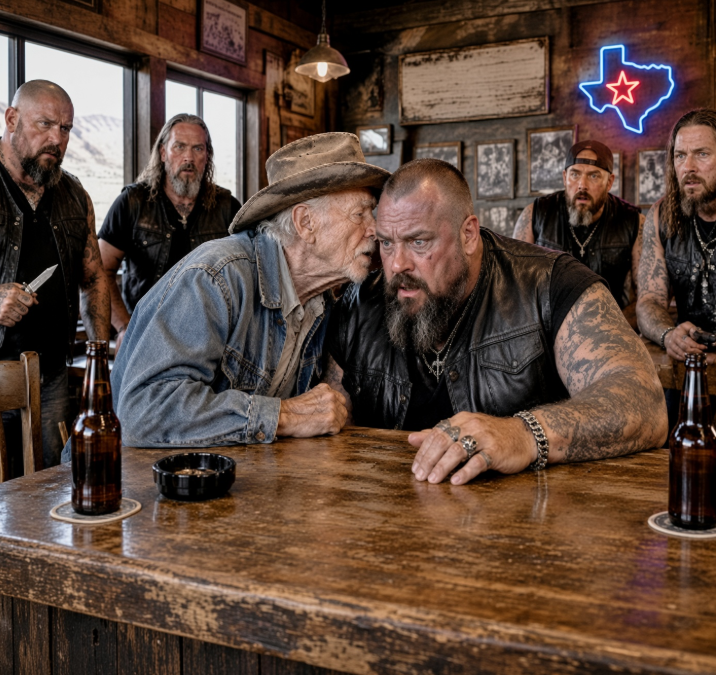
The old man brought his mouth close to Brick’s ear and whispered one sentence.
Loretta strained to hear.
She heard nothing.
Only the hum of the cooler.
The buzz of the neon.
The soft scrape of Wyatt’s knife handle against his palm.
The old man leaned back.
Seconds later, silence.
Not just the quiet of men waiting for violence.
A deeper silence.
A total stilling.
Donovan “Brick” Hayes, president, enforcer, killer, survivor of prison riots, cartel shootouts, and federal indictments, went pale.
All the color drained from his face.
The scars stood out white and sharp.
His shoulders lowered slightly, as if something invisible and enormous had been set across his back.
He stared at the old man with an expression none of his men had ever seen on him.
Recognition.
And something close to terror.
Wyatt gripped the knife harder.
“Boss,” he said, voice tight, “say the word. I’ll take him out back.”
Brick lifted one hand.
The gesture demanded stillness.
His hand was trembling.
That was when the room truly understood something had gone wrong.
Brick Hayes did not tremble.
“Put the knife away,” Brick said.
Wyatt blinked.
“But boss—”
“I said put the damn knife away.”
This time Brick’s voice cracked.
Not with weakness.
With panic barely chained.
Wyatt slowly lowered the knife.
Brick turned back to the old man.
“What did you say?” he whispered, though he had heard perfectly.
The old man’s expression did not change.
“I said I buried the iron box under the San Joaquin Bridge in ’73, right after your father bled out in my arms.”
No one else in the room understood.
But Brick did.
There were only three people alive—or so Brick had believed—who knew about the iron box.
One was his father, Ralph Hayes, a founding member of the original Oakland charter, murdered during a territorial war in 1973.
The second was the man who dragged Ralph’s body away from gunfire.
A man spoken of in half-whispered club legend.
The Ghost of Oakland.
The third was Brick, told the story decades later by a drunken uncle who cried into a bottle and said some debts never died.
The Ghost of Oakland was supposed to be dead.
He had vanished after the shootout, leaving behind a myth soaked in blood, loyalty, and fear.
Brick’s throat tightened.
“Arthur?”
The old man gave a slow nod.
“It’s been a long time, kid.”
Brick stared at him.
“You got big.”
The words were almost gentle.
That made them worse.
The Iron Horse Saloon changed in that instant.
It had been a powder keg.
Now it became a tomb.
Wyatt, Dane, Cliff, and Travis stood frozen, unable to process the sight of Brick looking at a frail old man not as prey, not as threat, but with something bordering on reverence.
Brick slowly lowered himself into the booth.
“Wyatt,” he said.
His voice sounded dry.
“Take the boys outside. Lock the front door. Flip the neon. Secure the perimeter. Nobody comes in.”
Wyatt’s mouth opened.
“Boss, you can’t be serious.”
Brick’s head snapped toward him.
The old fire returned to his eyes.
“I gave you an order.”
“This old man disrespected the table—”
Brick slammed his fist onto the table so hard the bottles jumped.
“You want to strip your patch right here? Walk out that door and stand guard, or I will bury you in the desert myself.”
Wyatt swallowed.
The room remembered who Brick was.
He nodded stiffly and signaled the others.
One by one, the bikers backed away.
Travis hesitated.
Brick looked at him.
“Outside.”
The young prospect moved quickly then.
The front door slammed behind them, leaving only Brick, Arthur, and Loretta.
Brick glanced toward the bar.
“Back room, Loretta.”
She did not argue.
She dropped the rag, backed through the swinging kitchen doors, and disappeared.
Now the main room was empty except for two men who belonged to different centuries of the same violent world.
Arthur reached into his denim jacket.
Brick’s muscles tightened instinctively.
But the old man only produced a battered silver Zippo and a crumpled pack of unfiltered Pall Malls.
He placed a cigarette between cracked lips.
The Zippo clicked.
Flame rose.
Arthur inhaled deeply, the ember glowing orange in the dimness.
The smoke left him in a slow blue stream.
“Your father smoked these,” Arthur said. “Ralph used to chain-smoke them in the garage while we rebuilt shovelheads in Oakland. Pall Malls, motor oil, and bad coffee. That’s what the golden years smelled like.”
Brick leaned forward.
“My uncle said the Ghost of Oakland died in ’78. Shootout with the Mongols. Said you took three rounds covering the retreat.”
Arthur laughed.
The laugh turned into a wet cough.
“Your uncle was a romantic. And a drunk.”
Brick watched him cough until it passed.
“I didn’t die in ’78,” Arthur said. “But Arthur Pendleton did. The Ghost ceased to exist. Took one round to the shoulder, dumped my cut in the river, and disappeared.”
“Why?”
“Federal RICO case was coming. I was the hinge. If they caught me, the original charter died. So I became a phantom.”
Brick looked at the fragile man across from him.
A legend reduced to bone, cough, and cigarette smoke.
Still dangerous.
Not in body.
In knowledge.
“And the iron box?”
Arthur’s expression hardened.
“The fourteenth of October, 1973. Warehouse exchange near the docks. Your father caught a bullet meant for the club president.”
Brick’s jaw tightened.
“I know.”
“No,” Arthur said softly. “You know the story they wanted you to know.”
Brick went still.
Arthur tapped ash into an empty beer cap.
“Ralph bled out in my arms in the back of a stolen panel van. Before he died, he gave me a key. Told me to find the iron box under the bridge abutment. Said if I loved the club, I’d make sure it didn’t fall into the wrong hands.”
“What was in it?”
“Not money.”
Arthur leaned closer.
“Insurance. Ledgers. Photographs. Names. Proof of which politicians, sheriffs, and judges were on the payroll.”
Brick waited.
“And proof of who set up the ambush.”
The ceiling fan chopped the smoky air above them.
Brick’s voice dropped.
“It was the rival crew.”
Arthur looked at him.
“No.”
The word landed like a hammer.
“It was an inside job.”
Brick’s eyes darkened.
Arthur continued.
“A faction inside our own patch wanted the president dead. Wanted the routes. Wanted control. Your father caught the bullet, but the betrayal came from brothers.”
Brick’s hands curled around the edge of the table.
Wood creaked beneath his grip.
For decades, his entire understanding of club history had rested on a lie. Wars had been fought over that lie. Men had died for it. Loyalties had been built on it.
“Why tell me now?” Brick asked. “Fifty years passed. The men who did it are dead.”
Arthur crushed the cigarette against the table.
“I didn’t come to talk about ghosts.”
His pale eyes sharpened.
“I came because history is repeating.”
The bar seemed to grow hotter.
Brick did not move.
Arthur reached into his jacket again and withdrew two items.
A yellowed folded paper.
And a modern burner phone.
He slid both across the table.
“The paper is a page from your father’s ledger. The name you need is Wallace ‘Rusty’ Vance.”
Brick knew the name instantly.
Rusty Vance.
Legendary sergeant-at-arms in the late seventies.
Dead in a motorcycle crash in the eighties.
A name spoken with respect by older members.
A bloodline still inside the club.
“Rusty’s dead.”
“His bloodline isn’t.”
Arthur tapped the phone.
“For six months, your gun routes through San Bernardino have been bleeding. Stashes seized. Mules arrested. Vehicles tagged before they move. You thought the leak was cartel-side.”
Brick stared at the phone.
“You’re saying it’s one of mine.”
“I’m saying the descendants of the men who sold out your father have been sitting close enough to pour your beer.”
Brick picked up the phone.
The screen glowed.
Message threads.
Dates.
Locations.
Vehicle plates.
Storage addresses.
Meet times.
Every secret that should have died inside closed rooms was there, delivered piece by piece to a federal task force contact.
Brick’s breathing slowed in a way that would have terrified his crew if they had been inside.
“Read the last one,” Arthur said.
Brick swiped down.
The last message had been sent less than an hour ago.
Target is at Iron Horse. President and enforcement crew present. Strike team green-lit. Confirm layout and bike count before breach.
The phone cracked in Brick’s fist.
“Who?”
Arthur looked toward the front door.
“The handler asked for confirmation from outside. Said the source would step out, count the bikes, and confirm you were in the back booth.”
Brick’s mind moved fast.
Wyatt.
Dane.
Cliff.
Travis.
The young prospect.
Always fetching drinks.
Always near the table.
Always listening.
Always too eager.
Travis Vance.
Rusty Vance’s grand-nephew.
Brick’s voice became hollow.
“The prospect.”
Arthur nodded.
“Travis has been texting a rogue agent named Hector Navarro. Navarro wants the glory of taking you down. Travis wants immunity and a throne made from whatever ashes are left.”
Brick rose.
The booth groaned as his weight left it.
His hand moved behind his back, closing around the grip of a customized pistol.
Arthur did not flinch.
“They’re minutes away.”
Brick’s eyes burned.
“Good.”
“You cannot shoot your way out of a federal raid.”
“I’m not shooting feds.”
“You shoot Travis, they will find a dead informant, lock this county down, and bury every loyal man you have under murder charges.”
Brick stood there, breathing through his nose, rage pounding under his skin like a second heart.
Every instinct screamed at him to walk outside and turn Travis into a warning.
Arthur’s voice cut through it.
“If you fire a shot, this club dies today.”
Brick looked down at him.
“Then what do I do?”
Arthur reached for his cane.
With visible effort, he stood.
The old man looked impossibly fragile.
And yet the room seemed to bend around him.
“We do what I did in Oakland,” Arthur said.
A thin smile touched his cracked lips.
“We become ghosts.”
Brick moved with cold precision after that.
The blind rage vanished behind calculation.
He tucked the pistol back into his waistband and pushed through the kitchen doors.
Loretta was near the deep fryer, pale and trembling.
“Loretta.”
She jumped.
“Grab your keys. Use the cellar exit. Take the old service tunnel out to the wash. Get in your truck and drive to your sister’s place in Reno.”
Her mouth opened.
“Do not stop. Do not answer unknown numbers. Do not come back tonight.”
She stared at him.
Then nodded.
Loretta had survived this bar because she knew when questions cost too much.
She vanished into the pantry.
Brick returned to the main room.
Arthur was already near the rear exit, cane tapping slowly.
“They’ll come from the highway.”
“How long?”
“Three minutes. Maybe less.”
Brick’s face emptied.
“Then let’s clean house.”
He kicked open the front door.
Heat slammed into him.
Wyatt, Dane, and Cliff stood near the bikes, smoking and irritated. Travis stood a few yards away, back turned, thumbs moving rapidly across his phone.
At the sound of the door crashing open, Travis jumped.
He shoved the phone into his vest too quickly.
Brick saw it.
“Mount up!” Brick barked. “We move now!”
Wyatt frowned.
“What about the old man?”
“The old man is a ghost,” Brick said. “And if we don’t vanish, we’re all going to become one.”
He walked straight toward Travis.
“Give me your phone.”
Travis swallowed.
“My phone?”
Brick kept coming.
“Now.”
“Boss, what’s going—”
Brick’s hand shot out and caught Travis by the throat, slamming him back against the hot brick wall of the saloon.
Wyatt and Dane reached for weapons, confused by violence turned inward.
Brick looked at them once.
They froze.
Holding Travis pinned with one hand, Brick reached into the prospect’s vest and pulled out the smartphone.
The lock screen glowed with incoming encrypted messages.
Agent Navarro:
Confirm count. Strike team ninety seconds out.
Wyatt’s face changed.
Dane stepped back.
Cliff drew his pistol and aimed it at Travis’s chest.
“Boss,” Cliff said, voice full of disgust, “say the word.”
Travis clawed at Brick’s wrist, eyes bulging.
Brick leaned close.
“Agent Navarro says hello.”
The words hit the parking lot like a grenade.
Travis began to shake.
“No, boss, listen—”
Brick ripped the prospect patch from Travis’s vest.
The heavy fabric tore loudly.
He threw the patch into the dirt.
“You wanted to hand this club to the feds?” Brick said. “You wanted the table?”
Travis sobbed.
Brick dropped him to his knees.
“Congratulations. The bar is yours.”
He looked at Wyatt.
“Secure him. Alive.”
Wyatt smiled without humor.
Travis was dragged behind the dumpster and tied to an iron pipe, screaming that he could explain.
No one wanted his explanation.
Brick turned to his men.
“No guns. No hero plays. We ride.”
Wyatt looked toward the saloon.
“What about you?”
Brick glanced across the lot.
Arthur was already behind the wheel of a faded 1990s Ford sedan hidden behind a rusted shipping container.
The old man rolled down the manual window.
The desert sun caught his pale blue eyes.
“Keep the rubber side down, Donovan.”
Brick walked closer.
“Where will you go?”
Arthur tapped the brim of his Stetson.
“I’m already gone, kid. Been gone fifty years.”
“Arthur.”
The old man looked at him.
Brick swallowed whatever he had almost said.
Thank you.
Forgive me.
Tell me more about my father.
Stay.
None of it fit the moment.
Arthur seemed to understand anyway.
“Keep your circle small,” he said. “Blood doesn’t mean loyalty.”
Then he put the Ford in reverse, spun it around with surprising speed, and disappeared down a hidden desert track in a cloud of pale alkali dust.
Less than a mile away, black tactical SUVs crested the highway.
Red and blue lights flashed in the heat haze.
Brick pulled a black bandana over the lower half of his face.
“Ride!”
Engines roared.
The Hells Angels tore out of the parking lot in tight formation, heading opposite the approaching convoy.
By the time federal agents breached the Iron Horse Saloon, they found no president, no enforcement crew, no weapons cache, and no old man.
Only Travis Vance tied behind the dumpster, crying into the dirt, with his phone buzzing beside him and a torn prospect patch lying in the dust.
The raid became a problem for Agent Hector Navarro very quickly.
A very public problem.
A source compromised.
An empty target site.
No weapons.
No arrests.
No glory.
And a prospect who began talking before the dust settled because men like Travis mistake betrayal for strategy until the consequences arrive.
Brick survived.
His loyal men survived.
The rotten bloodline inside his circle had been exposed before it could destroy him.
And the Ghost of Oakland vanished again.
For weeks afterward, Wyatt told the story in bars from Barstow to Bakersfield, though he never told all of it. He liked the part where Brick uncovered the rat. He liked the part where they vanished before the raid. He did not like the part where Brick trembled.
So that part stayed quieter.
But Brick remembered.
He remembered the old man stepping into the Iron Horse with nothing but a cane and a secret heavy enough to stop violence in its tracks.
He remembered the whisper.
The iron box.
His father’s blood.
The lie at the root of the legend.
He remembered Arthur’s warning.
Blood doesn’t mean loyalty.
Months later, a package arrived at the clubhouse.
No return address.
Inside was a tarnished silver Zippo, a yellowed photograph of Ralph Hayes standing beside a young Arthur Pendleton, and a key so old the teeth were nearly smooth.
Wrapped around them was a scrap of paper.
Only one sentence.
Some ghosts leave doors behind.
Brick kept the Zippo in his desk.
He never smoked Pall Malls.
He could not stand the smell.
But sometimes, late at night, when the garage was quiet and the desert wind rattled the metal doors, he opened the lighter and clicked it once.
Just to hear the sound.
Just to remember that legends were not born from patches, violence, or fear.
They were born from men who carried secrets too dangerous to die with them.
And from old ghosts who knew exactly when to step out of the shadows.
That day at the Iron Horse, a frail old man asked five words no one else would have survived saying.
Mind if I join you?
Everyone in the room thought he was asking for a chair.
He was not.
He was asking whether the past still had a seat at the table.
And seconds later, when silence swallowed the room, Donovan “Brick” Hayes learned the answer.
It did.
It always had.

