An 81-Year-Old Farmer Watched a Military K9 Shut Down During a Desperate Search—Then He Knelt in the Gravel and Whispered One Word No One Expected Him to Know.
PART3:
He watched the dog the way a man watches something he recognizes.
His name was Walter Bodin.
He was eighty-one years old.
He owned the farm that bordered the search grid, though owned was never a word he liked. The land had outlasted better men than him and would outlast him too. He worked it. He walked it. He fixed its fences. He moved sheep from one pasture to another. He listened to its low places fill with fog. He knew where water settled after rain, where coyotes crossed in winter, where the soil went soft near the drainage cut, and where sound carried strangely on October mornings.
He lived alone.
Mostly.
There were sheep.
There was an old farmhouse with a scanner on the kitchen shelf, set low enough not to bother sleep but high enough that emergency frequencies could cut through it.
There was a cedar post in the far corner of the pasture that served no farming purpose at all.
Every morning before dawn, Walter walked to that post.
He did not pray there.
He had decided that long ago.
Prayer involved words, even if they were only said inside the mind. Walter brought no words to that corner. He simply stood.
Four minutes.
Sometimes five.
Hands at his sides.
Fog moving through the low field.
Cedars along the ridge catching the first gray of morning.
Earth slightly sunken around the post, as if it had settled over something small.
Then he turned and went back to work.
He had done that most mornings since 1988.
That morning had started the same way.
Before the county vehicles.
Before the missing girl.
Before Jura.
Before someone said the dog was done.
Walter had stepped off his porch around 4:30, maybe quarter to five. October darkness covered the farm in a deep bruised blue, not black, but close enough. He did not carry a flashlight. He had not needed one in thirty years on that land.
His boots found the gravel by memory, then the wet grass.
Sheep shifted in the fog as he passed.
They did not startle.
They knew his rhythm.
Animals always learned the rhythm of what fed them.
The cedar post waited in the far corner, standing four feet south of the fence line. Old gray cedar. No cross timber. No wire attached to it. No purpose visible to a stranger.
Walter stopped in front of it.
The ground around the base dipped slightly lower than the surrounding earth.
He stood.
No words.
No prayer.
No performance.
Just standing.
The fog moved below him.
The first pale light touched the ridge.
Somewhere beyond the fence, a crow had not yet decided to call.
After several minutes, Walter turned and walked back.
He fed the sheep from the trailer bin by the barn.
Latch.
Scoop.
Walk the line.
Back again.
He moved around the animals without thinking, speaking to them in a low half-register that farmers use when they are not quite talking and not quite silent.
He had just hung the feed scoop on its nail when he heard the first vehicle on the gravel road.
Fast.
Too fast for a neighbor.
Walter straightened.
His eyes moved toward the tree line above the eastern fence.
Something in his posture shifted so slightly most people would have missed it.
The change of a man who had spent twenty-two years learning unexpected vehicles before dawn rarely carried good news.
He dried his hands on the front of his olive shirt and went to the gate.
Inside the farmhouse, the scanner crackled.
A dispatcher’s voice gave coordinates Walter already knew by heart.
His fence line.
Seven-year-old female last seen at Aldermont trailhead before first light. Search teams requested. K9 units requested. Landowner access needed for staging.
Walter turned off the burner under the coffee.
Pulled on his old work boots.
Stepped outside.
He opened the gate before the first truck reached his drive.
Then he walked the long way back along the fence that paralleled the forest boundary.
Not the shortest route.
The perimeter route.
The one that let him read the tree line.
Walter checked the gap between the second and third posts. Checked the dark between the oaks where the slope dropped toward the creek drainage. Checked the low bowl in the east field where fog stayed longer than anywhere else after rain.
Nothing moved.
But he kept watching.
By the time the kennel unit rolled into his yard, Walter was standing near the barn with the gate open, the barn light on behind him, and two cups of coffee resting on a fence post.
He did not know anyone would want coffee.
He had simply poured two.
The kennel master got out first.
Greer.
Big man.
Capable-looking.
Tired in the way men get tired when dawn has not yet come but the world has already asked too much.
The county truck followed.
White.
Official decal.
A woman with a clipboard stepped out and looked at Walter’s farm as if it were a problem already halfway written into a report.
Walter watched her without seeming to.
But his attention went to the crate in the back of the kennel vehicle.
He could hear the dog before she came out.
Not sound.
The absence of it.
The particular silence of an animal that has pulled itself inward.
Walter had heard that silence before.
Different continent.
Different decade.
Same silence.
Greer opened the crate.
Jura came out stiff-legged and wrong.
Not injured wrong.
Shut down wrong.
She took two steps into the gravel and stopped.
Her ears were low.
Her tail hung dead.
Her whole frame vibrated with that fine tremor.
The fog still sat heavy in the low field behind the fence.
She should have been looking at it.
She was not.
Stalard lifted her clipboard.
Greer folded his arms.
Breck stood with the lead.
Walter put down his coffee.
For several minutes, the conversation happened around the dog.
Observable distress.
Welfare assessment.
Working animal standards.
Operational need.
County protocol.
Transport requirement.
Search urgency.
Words.
Forms.
Authority.
All of them moving around the one thing that mattered.
The dog was still trying.
Walter saw it when no one else did.
A flicker in the left ear.
A slight shift in the nostrils.
A moment, just two seconds maybe, when Jura stopped trembling as he stepped nearer.
He did not rush.
He had learned long ago that moving quickly toward a tense conversation was how you got excluded from it.
He approached the edge of the circle like water finding low ground.
Greer glanced at him.
“Sir, I appreciate the access to your property, but I need you to step back.”
Stalard looked up.
“This is an active welfare assessment. Are you the property owner?”
“Yes, ma’am.”
“Then I need you to give us room to work.”
Walter did not move forward.
He did not move back.
He stood with both hands open and looked at Jura.
Her ear came up again.
Only a fraction.
Neither Greer nor Stalard saw it.
“Sir,” Greer said.
Polite.
Final.
Walter took one step back.
Not because they were right.
Because the dog needed calm, and confrontation would not be calm.
Everything else—the clipboard, the county seal, the regulation—mattered less than the next thirty seconds.
Walter breathed in.
Four counts.
Held.
Four counts out.
Stalard clicked her pen.
It was a small sound in the open yard.
Walter heard it.
He heard everything.
He always had.
“I want to be clear about the regulatory basis,” Stalard said.
She was speaking to Greer, not Walter.
“Tennessee code applies to working animals in county-contracted service. If I determine this dog is being held in ongoing distress without relief, I have the authority to mandate removal. And I’m determining that.”
Greer stared at Jura.
“She’s a military-trained asset.”
“The protocol for shutdown is the protocol,” Stalard said. “My clipboard is right now.”
She pulled a yellow citation form from the back of the binder.
Walter watched the pen touch paper.
The scanner on the nearest cruiser crackled.
No alert.
Dog nonresponsive. Requesting guidance.
No one answered.
Down the valley, three more vehicles were coming fast.
White pickup.
Two dark SUVs.
Dust trailing behind them.
Incident command, Walter guessed.
Maybe more K9 resources.
Maybe too late.
The fog was thinning now.
Morning light had gone gold and flat across the hills. Once the fog burned off fully, any scent laid before dawn would begin to break apart and scatter.
Twenty minutes.
Maybe thirty if God was kinder than usual.
Walter looked at Jura.
She was looking at him now.
Not at Greer.
Not at Breck.
Not at the tree line.
At Walter.
Her ears went flat, half up, flat again.
Not fear.
Something working.
Something still trying.
Stalard tore the first copy of the form free and held it toward Greer.
“This is formal notice. The dog needs transport to a county-approved veterinary facility for welfare assessment.”
“There’s a seven-year-old in that field,” Greer said.
“Quiet,” Stalard answered.
Not dismissive.
Just a fact.
“I understand that.”
Walter moved.
Not fast.
Not dramatic.
He stepped past Stalard the way a man steps around a fence post on land he knows better than anyone else. No apology. No announcement. No permission requested from people who had arrived on gravel he had worn down with thirty years of boots.
His steps were quiet.
He crossed the six feet between the clipboard and the dog.
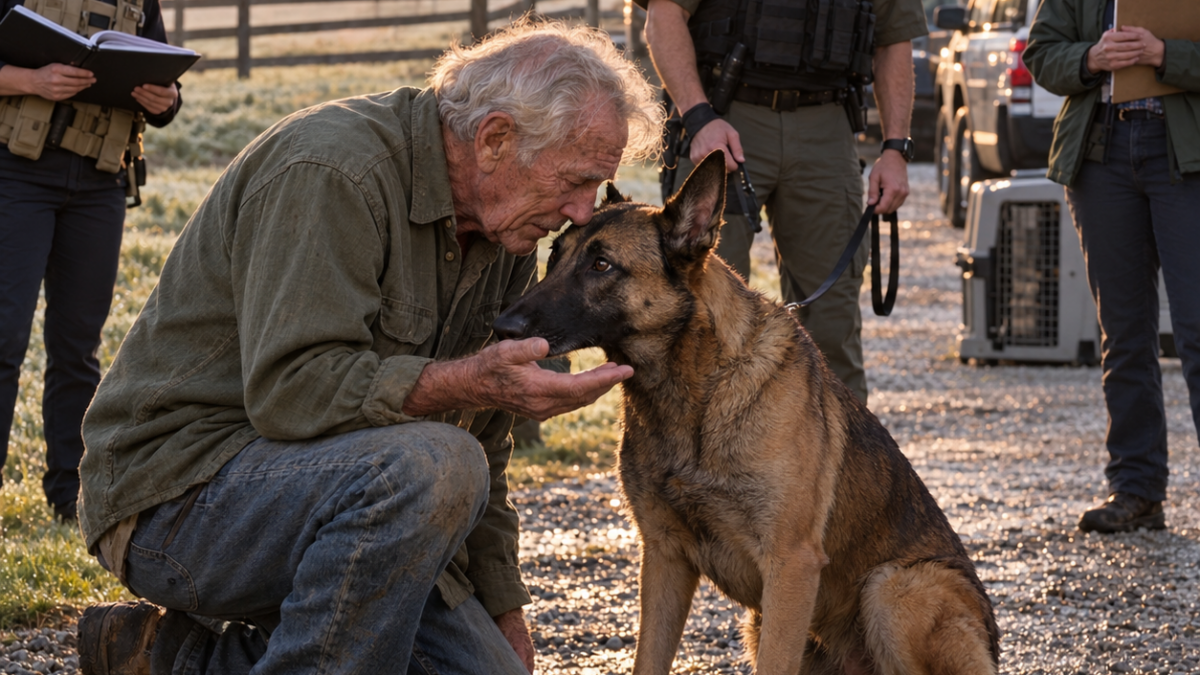
Then he knelt.
Eighty-one years old, and the kneel was controlled.
Both knees deliberate into the gravel.
Palms open on his thighs.
Not reaching.
Not yet.
He settled beside Jura and went still.
Stalard stopped mid-sentence.
Greer took half a step forward, then stopped too.
Something in the way the old man moved told him to wait.
Jura trembled.
Her head hung low, muzzle almost touching the ground. Her eyes remained unfocused.
Walter watched her for a long moment.
He studied her flanks, the micro-tremors in her hindquarters, the jaw tension, the spine, the ears.
Then he leaned close.
His mouth near her ear.
He whispered one word.
“Kestrel.”
Barely above the sound of fog settling in the field.
If you had stood three feet away, you might not have been sure you heard anything at all.
Jura’s head came up.
Not slowly.
Not gradually.
It lifted as if something had been released.
Her ears came forward.
The tremor dampened.
Stopped.
Her eyes found Walter’s face.
And something came back into them.
Not obedience.
Not exactly.
Presence.
She shifted her weight.
Then pressed her nose into his open hand.
Thirty-eight seconds.
Greer checked his watch later.
He would tell Incident Commander Nambiar during the debrief and still not fully account for what he had seen.
No one moved in the yard.
Stalard’s clipboard remained halfway raised.
Breck stood with his mouth slightly open.
Greer looked like a man watching a wall become a door.
Jura leaned into Walter’s knee with the full weight of her body.
Walter placed one hand lightly on the dog’s neck.
Not gripping.
Just resting.
The way you put your hand on something that belongs to you and always has.
A low sound came from Jura’s chest.
Not distress.
Something else.
Breck spoke first.
Quietly.
“How did you—”
Walter did not answer.
He looked toward the tree line above the low field where morning light had begun pulling the fog apart.
Somewhere in the three hundred acres beyond that fence, a seven-year-old girl had been missing for four hours and nineteen minutes.
Walter scratched Jura once behind the ear and began to stand.
That was when Incident Commander Nambiar’s vehicle rolled into the yard.
She was out before the door fully swung open.
Short woman.
Late thirties.
Utility vest.
Incident command patch on her shoulder.
Green three-ring binder open in her left hand.
She read the yard in two seconds.
Transport van.
Kennel master.
County official with clipboard.
Old farmer rising from the gravel.
Jura on her feet, still low in the hindquarters, still not fully steady, but head up, nose working, eyes focused.
Nambiar did not speak right away.
She watched the dog.
Then Walter.
He was standing one knee at a time, slow but unembarrassed, the way old men rise from gravel when they have no interest in proving anything.
“What did you just say to her?” Nambiar asked.
Her voice was not accusing.
It was quiet.
Precise.
The voice of someone hearing something that did not fit a category and needing to know where it belonged.
Walter looked at her.
“Just a word.”
Nambiar blinked once.
Then looked down at the binder.
She began moving through tabs.
Not frantically.
Purposefully.
The way someone searches for something she knows is there.
Greer stepped closer.
Stalard still had not moved.
Nambiar found a laminated cream-colored card slipped behind one of the tabs. The typeface was narrow, official, from another era.
She read it silently first.
Then her face changed by not changing much at all.
A small stillness.
The stillness of a word landing exactly where it belongs.
She read the author line aloud.
“C3 Walter D. Bodin, K9 Behavioral Standards, Stress Response Protocol, Amendment Seven, 1988.”
Greer leaned in.
Read it himself.
Went still.
Not confused.
Worse.
Awed.
The stillness of a man who has used something every day of his working life and just discovered where it came from.
Stalard slowly lowered the clipboard.
Walter stood with his hands open at his sides, looking at the tree line.
The wind shifted slightly.
Jura began pacing.
Three steps forward.
Tight turn.
Three steps back.
Nose down.
Nose up.
Sweeping the low air coming off the field.
The fog had thinned enough now to see the first line of trees, and the dog was reading something inside it.
Greer said quietly, “She’s on.”
Nobody argued.
Nobody filled out anything.
Walter was already walking toward the fence line.
His eyes were on the shallow depression in the east field, the place where the cold morning air sat longest, where the fog had been last to lift.
The ground out there would be saturated after last night’s rain.
The scent would be moving differently than most handlers expected.
Walter knew exactly how it moved.
Breck stood at the fence with Jura’s lead in his hand, wearing the expression of a young man who understood he was out of his depth but had not yet said it.
Walter stopped beside him.
“What’s her nose telling her?”
Breck glanced sideways.
The laminated card had changed the air around the old man. Authority was no longer coming from a badge, a binder, a uniform, or a county seal. It was coming from something older.
Experience.
“She’s hitting,” Breck said. “But not committing. Keeps pulling northeast, loses it, circles back.”
“She’s not wrong.”
Breck turned toward him.
“I don’t follow.”
Walter pointed.
Not at the northeast tree line where they had been working.
Down into the bowl of the east field.
A shallow depression maybe sixty yards out, no deeper than a bathtub, nearly invisible unless you had walked the land before daylight for thirty years.
“Ground’s waterlogged,” Walter said. “Saturated soil can’t absorb scent the way dry ground does. It bounces. Rides the cold air column. Drains downhill.”
Breck looked at the field.
Walter continued.
“That low spot held fog longest this morning. Cold air pooled there all night. Scent follows cold air. Whatever she’s searching for, the trail is sitting there now. Not where it was laid.”
Jura pulled toward the tree line again, then circled back, losing confidence at the same radius.
Breck watched.
“She keeps ending up on the same edge.”
“Because she’s orbiting the scent pool,” Walter said. “She can smell the edge, not the center.”
Nambiar had come up behind them without either man noticing.
She did not speak.
Just listened.
Walter pushed off the fence.
“Work her downwind of that depression. Come in from the south. Keep the wind at her left shoulder. Don’t let her get ahead of you or she’ll overrun it.”
He lifted one hand and showed the angle with two fingers.
No drama.
No performance.
A line drawn in air like he was reading a map that had been inside him for decades.
Breck looked at the depression.
Looked at Jura.
Made his decision.
He unclipped the short lead and gave her the working length.
Then he moved south along the fence, keeping his body between the dog and the wind exactly as Walter had shown him.
Jura’s head came down immediately.
Forty yards.
Thirty.
At twenty-five, her tail went rigid.
Then she pulled hard and low, fully committed now, driving toward the depression with a certainty that made everyone stop breathing.
Breck let her work.
No corrections.
No doubt.
Walter watched from the fence, hands open at his sides.
Stalard had followed them without realizing she had moved.
She stood eight feet from Walter.
Neither acknowledged it.
Jura entered the depression at a flat run.
Then locked up six feet from the far edge.
Sat alert.
Ears forward.
Unmoving.
The bark that followed was small and clear.
It carried across the wet field like a stone dropped into still water.
Breck was on the radio before the echo died.
Coordinates.
Culvert.
Alert.
Possible find.
Move medical.
Move parents.
Voices shifted on the other end from search cadence to something faster, harder, relieved.
Walter turned away before they started running.
The family came together fifty yards out.
He heard it without looking.
A sound that was not quite crying and not quite screaming.
The specific register of a parent whose worst fear has just been taken back.
He did not turn to watch.
That was not his moment.
He stood at the fence post nearest the east field with one hand resting on the wire and listened to it happen.
Jura came back to him before Breck did.
The dog had finished her work and returned to the last place she had been calm.
She pressed her flank against Walter’s left leg and stood there breathing steady now, the trembling completely gone.
Walter did not reach down right away.
He let her be there.
Nambiar walked over once the noise across the field softened into human voices.
She stopped a few feet back, read the moment, then came the rest of the way.
The protocol binder was under her arm.
She did not open it again.
For a while, she stood beside Walter and watched the field.
“Can I ask you something?” she said.
“Yes.”
“The word.”
She paused.
“Kestrel. You could have chosen anything for the de-escalation command. Any word with no operational overlap. Why that one?”
Walter did not answer immediately.
His left hand lowered to rest on Jura’s head.
The dog stayed still.
“That was her name,” he said.
Nambiar was quiet.
“The dog I worked. Belgian Malinois. She went with me to Lebanon in ’87.”
Walter’s voice was level.
Not flat.
Level in the way a man’s voice becomes when he has said a thing to himself ten thousand times and learned how to carry its weight.
“There was a hillside,” he said. “We took fire. I was down in a ditch forty meters from her position. Her handler was down.”
He stopped.
Jura leaned harder against his leg.
“She held the perimeter for six minutes by herself.”
Nambiar said nothing.
Walter looked toward the tree line.
“I couldn’t get to her.”
The fog was gone now. The east field sat in full morning light, the grass wet and flattened from night rain.
“They shipped her home in a crate,” Walter said. “I wasn’t allowed to open it. Regulations.”
He breathed once.
“I understood the regulations.”
Nambiar looked at the binder under her arm.
Walter’s hand moved slowly behind Jura’s ear.
“When I wrote the protocol, I needed a de-escalation word. Something clean. Something with no other association.”
He looked down at Jura.
“I put her name in it so every dog who came after her would hear it and come back.”
His thumb paused.
“I’ve been sending her name forward for thirty-seven years.”
Nambiar did not speak for a long time.
Then, quietly, she said, “That was the right call.”
Walter gave no sign that the words landed, but they did.
Stalard stood near the gravel edge with the clipboard at her side.
The citation form remained blank.
Her pen was clipped back in place.
She watched the dog lean into Walter’s leg, watched the search team carry the little girl from the wet field, watched the morning settle over a place where regulation had almost removed the one dog who could save a child.
Something moved across her face.
Not guilt exactly.
Not understanding exactly.
Somewhere between the two.
Working its way toward both.
She never filled out the citation.
The little girl’s name was Emma Reeves.
Seven years old.
Alive.
Cold.
Soaked.
Terrified.
Wedged inside a drainage culvert near the edge of the field where she had crawled after slipping down the wooded slope before dawn. She had been too frightened and too hoarse to answer searchers calling her name.
Jura had found the scent where the fog had carried it.
Not where humans expected the trail to be.
That distinction mattered.
It always mattered.
Parents cried.
Searchers laughed too loudly.
Radios chattered.
Someone called for blankets.
Someone else called the hospital.
Breck knelt in the wet grass with his arms around Jura’s neck after she returned to him, whispering praise in a voice he would later deny had broken.
Greer stood beside his vehicle for a long moment, staring at Walter across the yard.
Then he walked over.
The kennel master stopped two feet away.
He had the posture of a man who wanted to salute but did not know if he had the right.
“Sir,” he said.
Walter looked at him.
“I called her done.”
Walter glanced at Jura.
“You called what you saw.”
Greer swallowed.
“I didn’t see enough.”
Walter did not soften the truth.
“No.”
Greer nodded once.
Accepted it.
Then he looked at the dog.
“I won’t make that mistake twice.”
Walter’s face did not change.
“That’ll do.”
By nine o’clock, the vehicles began leaving.
The child had been transported.
The search grid had been cleared.
Reports would be written.
Debriefs scheduled.
Amendment Seven would be reread by people who had used it for years without knowing why one word sat quietly inside it like a buried name.
Stalard folded the blank citation form and placed it back in the binder.
Nambiar shook Walter’s hand before she left.
She did not thank him dramatically.
He appreciated that.
“Mr. Bodin,” she said, “we may need to speak with you again about training.”
Walter looked toward the sheep.
“I’ve got a gate latch that wants tightening.”
Nambiar almost smiled.
“I’ll take that as a maybe.”
Walter did not answer.
Jura stood by the open crate of the kennel vehicle, calm now. Alert. Back inside herself.
Before Breck loaded her, she looked once toward Walter.
He lifted two fingers from his side.
Not a wave.
Not quite.
Jura stepped into the crate.
Breck closed it gently.
The last vehicle cleared the gate just after nine.
Walter latched it behind them.
The chain clicked small against the returning quiet.
The fog had burned off completely.
The east field lay open and bright, ordinary again.
Nothing remained to show what had happened except bent grass where Jura had worked, already beginning to stand back up.
Walter crossed the pasture without hurrying.
The cedar post was warm on one side now.
The sun had found it.
The ground at its base remained slightly lower than the surrounding earth.
Still soft in the same place after thirty-seven years.
Walter stood there a while.
He did not speak.
He never did.
There was nothing to say that the standing did not already say.
Somewhere beyond the fence line, a crow called once, then went quiet.
Walter placed one hand on the cedar post.
Just briefly.
Flat palm against old gray wood.
In his mind, he did not see the county vehicles.
He did not see Stalard’s clipboard or Nambiar’s binder or Greer’s still face when he read the card.
He saw a hillside in 1987.
Smoke.
Wet dirt.
A handler down.
A Malinois holding the perimeter alone.
Six minutes.
A lifetime.
He remembered a crate he was not allowed to open.
Regulations.
He understood them.
He hated them.
Both things had always been true.
“Kestrel,” he whispered then.
Not to the post.
Not exactly.
To the morning.
To the name he had hidden inside a protocol so it could keep traveling farther than he had been allowed to carry her.
Thirty-seven years later, another Malinois had heard it.
Another dog had come back.
A child had gone home.
Walter took his hand from the post.
Turned toward the barn.
The sheep needed moving to the lower pasture.
The gate latch still wanted tightening.
The day was full.
Same as any other.
So Walter Bodin went back to work.

