An 8-Year-Old Girl Found a Bleeding Biker Beside His Crashed Motorcycle and Made Him Promise to Live—The Next Morning, Dozens of Riders Filled Her Street Asking for Her by Name.
PART2:
Sometimes they move toward the thing that feels most wrong.
He was a big man with gray in his beard and tattoos down both arms. The skin above his eyebrow was split open, and blood ran down the side of his face into his beard. His vest said Iron Road Riders.
I had seen men wearing those vests at the gas station.
Grown-ups lowered their voices when they walked in.
Nico once said people like that were trouble.
Mom told him not to judge people by clothes, then quietly pulled us toward another aisle.
So yes, I was scared.
Of the motorcycle.
Of the blood.
Of the skull on his vest.
Of the way his breathing sounded wet and uneven.
But he opened his eyes when I knelt beside him, and that changed everything.
Because people are harder to be afraid of when they are looking at you like they are trying very hard not to disappear.
“I’m Maya,” I said. “What’s your name?”
He blinked at me.
For a second, I thought he had not understood.
Then he said, “Gabe.”
His voice scraped out of him.
A little later, I learned everyone called him Ghost.
But that day, on the side of the road, he was just Gabe.
I took off my yellow sweatshirt and pressed it against the cut above his eyebrow. My hands shook so badly I could barely hold it still.
“You shouldn’t be here,” he whispered.
“I know. I’m supposed to go straight home.”
Something like a laugh moved through him, but it became a cough.
“Go, kid. Get somewhere safe.”
I looked down the empty road.
No cars.
No people close enough to hear me.
Just warehouses, chain-link fences, a repair shop near the corner, and my dead phone in my backpack.
A repair shop.
The garage door was half open.
PART3:
A man in blue coveralls moved inside.
“I’m getting help,” I said.
“Don’t come back.”
I shook my head.
“My mom says if somebody’s hurt, you help them. She also says to be careful. I can do both.”
His eyes closed.
For one terrible second, I thought he had stopped listening.
“Hey.”
I touched his hand.
“You have to stay awake.”
“I’ll try.”
“Promise?”
His little finger curled around mine.
It was weak.
Too weak.
“I promise to try,” he said.
That was enough.
I left my sweatshirt pressed near his head and ran harder than I had ever run at recess.
The repair shop smelled like oil, rubber, coffee, and metal dust. A radio played somewhere in the back. The man in coveralls turned when I burst through the open garage door.
“There’s a man,” I gasped. “He crashed. He’s bleeding. My phone died. Please call 911.”
The mechanic did not waste one second asking if I was sure.
He grabbed the shop phone, dialed, and kept his eyes on me while he spoke.
“Motorcycle accident. Service road behind Valencia Warehouse. Adult male. Child found him. Send ambulance.”
Child.
That was me.
Hearing him say it made my knees shake.
He grabbed a first-aid kit from the wall.
“Stay here,” he said.
“No.”
He looked at me.
“He told me not to come back,” I said. “But I promised.”
The mechanic stared at me for half a second.
Then he said, “Then stay behind me.”
We ran back together.
Gabe was still there.
Still breathing.
Still bleeding.
Still alive.
The mechanic knelt beside him and started talking in a calm voice. He told Gabe his name was Frank. He said help was coming. He checked things I did not understand and told me to keep back from the road.
I did not want to keep back.
I wanted to hold Gabe’s hand because he had promised.
But Frank looked serious, and Mom had always said serious adults were different from loud adults. Loud adults wanted attention. Serious adults knew what they were doing.
So I stood beside my backpack and watched.
The ambulance took what felt like forever.
It was probably less than ten minutes.
A police car arrived first. Then the ambulance. Then another police car.
The street filled with lights.
Red.
Blue.
White.
Everything flashed across the warehouse walls and the broken motorcycle.
The paramedics moved quickly. One spoke to Gabe while another cut part of his jeans around the injured leg. I looked away because I thought I might throw up, then looked back because I was afraid he would notice I had stopped watching and think I left.
His hand found mine as the paramedics worked.
“She came back,” he murmured.
“Of course I did,” I said.
One paramedic glanced at me.
I thought he might tell me to move away.
Instead, he said, “You did good, kid.”
I did not feel good.
I felt cold inside.
One paramedic asked me to step aside so they could lift Gabe.
I let go of his hand.
“Remember,” I said. “You promised.”
His eyes opened just enough to find me.
“I remember, Maya.”
Then they lifted him.
He made a sound I still heard years later when I woke from bad dreams.
The ambulance doors closed.
The siren started.
And Gabe was gone.
After the ambulance left, the police officer asked me questions.
What did I see?
Where was I walking?
Did I touch the motorcycle?
Was anyone else nearby?
I tried to answer everything, but my voice kept wobbling.
Then the officer asked for my mother’s phone number.
That was when I got scared in a different way.
Mom arrived at the station wearing her grocery-store name tag and the black shoes she hated because they made her ankles swell. Her hair had come loose from its clip, and her face looked like somebody had taken all the blood out of it.
When she saw the blood on my school pants, she stopped in the doorway.
“It isn’t mine,” I said quickly.
That did not help as much as I hoped.
She crossed the room and held me so tightly I could barely breathe.
I felt her shaking.
“Maya Isabel Torres,” she whispered into my hair.
Whenever Mom used my middle name, I was either in very big trouble or very deeply loved.
Sometimes both.
On the way home, she asked every question at once.
Had anyone else been there?
Had I touched the motorcycle?
Why had I gone back?
Why had I not stayed at the repair shop?
Did I understand how dangerous roads were?
Did I understand motorcycles could catch fire?
Did I understand strangers could be dangerous?
I looked at my hands folded in my lap.
There was dried blood under one fingernail.
“I was scared he’d be alone,” I said.
Mom went quiet.
The car seemed too small for the silence.
At a red light, she reached over and held my hand.
Her eyes filled.
“I’m proud of you,” she said. “And I need you to understand how scared I was.”
“I know.”
“No, baby. I don’t think you do.”
She was right.
I did not.
Not until years later.
That night, Mom threw away my sweatshirt because it would not come clean.
I stood by the trash can and cried.
“It was just a sweatshirt,” Nico said.
Then Mom looked at him, and he shut up.
It had not been just a sweatshirt.
It had been the thing I left with Gabe so he would know I was coming back.
I lay awake that night thinking about him on the road.
Every time I closed my eyes, I saw his hand trying to lift off the gravel.
I heard him say, I promise to try.
I wondered whether trying was enough.
The next morning, an engine woke me.
Then another.
Then another.
At first, I thought I was dreaming about the crash.
But the sound kept growing.
Low.
Heavy.
Rolling through our street like thunder had learned how to park.
Nico called from the living room.
“Maya, come look.”
I climbed out of bed and went to the window.
Motorcycles lined our block.
Not one.
Not two.
Dozens.
Men and women in leather vests stood beside them. Some had gray hair. Some had helmets tucked under their arms. Some wore sunglasses even though the morning was cloudy. Their bikes filled every open space along the curb.
Neighbors watched from porches and windows.
Mrs. Alvarez across the hall crossed herself.
The man downstairs opened his door, saw the motorcycles, and closed it again.
Mom came to the window and went still.
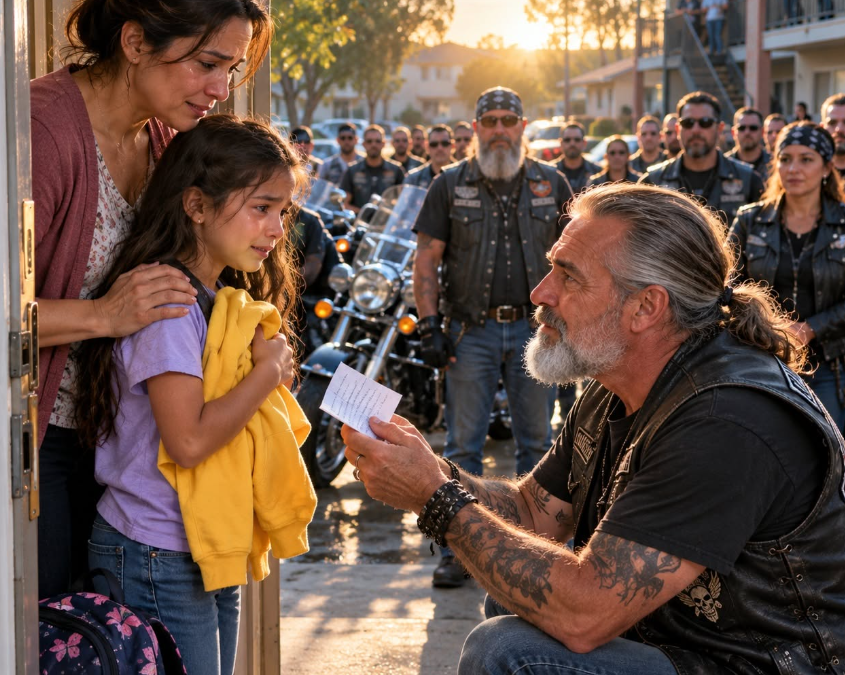
A knock sounded at our apartment door.
She turned so fast I stepped backward.
“Nico, Maya, stay behind me.”
Nico did not argue.
Neither did I.
Mom opened the door only partway, one hand still on the lock.
The man outside had a silver beard and the same patch Gabe wore. He removed his sunglasses and held them in both hands.
“I’m looking for Maya Torres,” he said.
Mom’s shoulders tightened.
“Why?”
“I’m Gabe’s friend. My name is Ray.”
“Is he all right?” I asked from behind her.
Ray looked past Mom at me.
“He made it through surgery.”
I felt my knees loosen.
Mom’s hand moved behind her until she found my shoulder.
Ray’s voice softened.
“When he woke up, he told us your name. He said he’d made you a promise.”
Then he reached into his vest.
Every rider on our street turned toward our door.
Mom stiffened.
Ray noticed.
He stopped moving immediately.
“I’m sorry,” he said. “I should have said what I was reaching for.”
Slowly, he brought out a folded piece of paper.
It was a page from my homework folder.
Dark with dried blood at one corner.
My spelling words were still visible on one side.
Across the blank side, someone had written in large, shaky letters:
I kept my promise. Thank you for coming back. —Gabe
I took it carefully.
The paper trembled in my hands.
Mom looked at the note.
Then at the riders.
“You all came to deliver this?”
“Yes, ma’am,” Ray said. “And to let her hear he’s going to be okay.”
“You could have called.”
“We should have,” Ray said.
He glanced back at the motorcycles.
“Gabe means a lot to us. When we heard what happened, everyone wanted to thank her. We didn’t think how this would look outside your home. I’m sorry.”
That surprised Mom.
It surprised me too.
Adults did not always apologize to children.
Or to mothers in apartment doorways.
Ray crouched so we were eye to eye.
It was strange seeing such a large man make himself smaller.
“When we heard what happened,” he said, “everyone wanted to thank you. You got help for our friend.”
“The mechanic helped,” I said. “And the ambulance people.”
“They did,” Ray said. “Gabe wanted to thank you for staying long enough to get them there.”
A woman standing behind Ray stepped forward.
She was tall, with black hair braided down her back and a kind face that looked like it knew how to become stern if necessary.
“I’m Lorna,” she said. “Gabe asked us to replace something.”
She held out a small paper bag.
Inside was a new sweatshirt.
Yellow.
The same shade as the one I had left on the road.
I pressed it against my chest.
“Is he still hurt?” I asked.
Ray nodded.
“Very. He’ll need time to heal.”
“Can I see him?”
Mom’s hand tightened on my shoulder.
Ray looked at her before answering me.
“When he’s feeling stronger, your mom can decide whether a visit is right for you.”
Mom nodded once.
That mattered to her.
For all those motorcycles outside, nobody tried to step around her or tell her what her daughter needed.
Then Ray stood.
The riders did not crowd the door.
They did not ask for pictures.
They did not call me a hero in front of everyone.
They simply started their engines one by one.
Before he left, Ray looked at Mom.
“You raised a good kid.”
Mom’s face changed.
Just a little.
The kind of change that happens when someone says the thing you needed to hear but did not know you needed.
After they left, the apartment seemed strangely quiet.
Too quiet.
Nico picked up the sweatshirt and inspected it.
“This is actually nice.”
I snatched it away.
“It’s mine.”
“I know. I was just saying.”
Mom put Gabe’s note on the kitchen table and stared at it for a long time.
Then she said, “We’re taping this somewhere safe.”
I taped it above my dresser.
For weeks, it was the first thing I saw in the morning and the last thing I looked at before bed.
I kept reading the same sentence.
I kept my promise.
At school, everyone had questions.
Someone’s older cousin had filmed the riders on our street, and a local news station ran a short story about the accident.
Eight-Year-Old Girl Helps Injured Motorcyclist.
That was what the headline said.
My classmates wanted to know whether I had been terrified of the biker.
I had been terrified.
But not the way they meant.
The motorcycle and vest were not what frightened me.
It was how weak his hand felt when it held mine.
It was the idea that someone so big could become that breakable.
It was learning adults were not made of stone.
Three weeks later, Ray called Mom.
Gabe wanted to see me before he went home from the hospital.
Mom said we could go together.
I made a card with markers.
On the front, I drew a motorcycle.
The wheels did not match.
Nico said it looked like a bicycle that had made poor life choices.
I told him art was subjective.
Inside the card, I wrote:
You did a good job keeping your promise.
The hospital smelled like disinfectant, warm blankets, and cafeteria food.
I held Mom’s hand all the way to Gabe’s room.
Before we went in, Mom crouched in front of me.
“Remember what we talked about.”
“I know.”
“What happened to him was scary. You helped. But you are not responsible for him now.”
“I know.”
She studied my face.
I thought she might repeat it.
Instead, she kissed my forehead.
Gabe was sitting up when we entered.
His leg was in a heavy brace.
A scar crossed his forehead where the cut had been.
Without the blood, he looked older than I remembered.
Tired.
Kind.
Still huge.
When he saw me, his face changed.
“There’s my boss,” he said.
I stopped in the doorway.
“Your what?”
“You told me what to do, and I listened.”
I walked closer and gave him the card.
He read it twice.
Then he pressed his mouth together like he was trying not to cry.
Big men crying had always made me uncomfortable.
Not because it was bad.
Because I did not know where to look.
He looked at Mom.
“I’m sorry she had to see me like that.”
Mom pulled a chair beside his bed.
“I’m sorry you were hurt,” she said. “I’m grateful she found you.”
Gabe rubbed the edge of my card with his thumb.
“I’ve spent a long time thinking people only see the vest,” he said. “She saw me lying there and stayed.”
I did not know what to say.
Mom did.
“She’s a child,” she said gently. “I want her to remember she helped you, but I don’t want her to feel responsible for what happens to you next.”
Gabe’s face changed.
He looked at me.
“Maya, your mom is right.”
I stared at the floor.
“The crash wasn’t your fault,” he said. “My recovery isn’t your job. You did enough that day.”
I had not known I needed to hear it.
Until then, I had imagined his promise meant I had to keep checking whether he was still alive.
Like if I stopped thinking about him, the promise might break.
“I’m glad you’re here,” I said.
“So am I.”
We visited for half an hour.
He asked about my teacher.
My brother.
Whether I had gotten in trouble for missing homework.
“The teacher said blood is a pretty good excuse,” I told him.
He laughed, then winced and told me not to be so funny until his ribs healed.
Before we left, he asked if I still had the note.
I nodded.
“Good,” he said. “I meant every word.”
After Gabe went home, life returned to its ordinary shape.
Mom still worked late.
Nico still left his shoes in the hallway.
I still forgot to feed the fish unless somebody reminded me.
But ordinary was different after that.
Sometimes I saw Gabe at the repair shop.
At first, he used a cane.
Then he walked without it, slowly.
Sometimes Mom had time to stop.
Sometimes she did not.
Gabe never made me feel that I owed him a visit.
He never asked me to retell the accident.
He never called me his angel.
I liked that.
Adults used that word too much after the news story.
Angel.
Hero.
Miracle kid.
They meant well.
But those words made the whole thing feel shiny, and nothing about that day had been shiny.
It had been blood.
Fear.
Gravel.
A dead phone.
A mechanic who knew what to do.
Paramedics with steady hands.
A promise.
Gabe mostly wanted to know whether I was doing all right.
One day, I asked about the patch on his vest.
We were outside the repair shop. He sat on a folding chair beside a motorcycle, his injured leg stretched out, a cup of coffee balanced on a toolbox.
“Some people think it means you’re dangerous,” I said.
Gabe looked down at the patch.
Iron Road Riders.
Skull.
Wings.
Old thread.
“Some people have reasons to think that,” he said.
I expected him to say people were wrong.
He did not.
“I’ve made choices I’m not proud of,” he said. “The patch doesn’t decide what I do next. I do.”
I thought about that for a long time.
When you are eight, you think people are one thing.
Good.
Bad.
Safe.
Dangerous.
Kind.
Scary.
Then life starts adding corners.
A scary-looking biker can be gentle.
A friendly-looking person can be cruel.
A child can be brave and still terrified.
A promise can help someone live and still not make you responsible for saving them forever.
That winter, Mom’s car broke down on her way home from work.
She called the repair shop because Gabe had given her its number.
Ray came with a tow truck.
He charged her the regular price, no discount, no charity performance, no big speech about helping the little girl who helped Gabe.
He stayed until he knew the car was running safely.
Mom told him she appreciated being treated like any other customer.
“Gabe told us that was important,” Ray said.
That was Gabe.
He noticed the shape of help.
Some help makes you feel small.
Some help gives you your height back.
The following spring, the Iron Road Riders organized a school supply collection at our community center.
Not because of me, they said.
Because kids needed supplies.
Still, Gabe asked the center’s staff what they actually needed before buying anything.
That impressed Mom.
“People donate what makes them feel generous,” she said. “Not always what helps.”
The riders listened.
Backpacks.
Pencils.
Notebooks.
Calculators.
Socks.
Hair ties.
Gift cards for shoes.
Nico helped unload boxes.
Mom checked the sign-in list.
I handed out pencils.
Nobody called me an angel that day.
I liked that.
At the end of the event, Gabe found me sitting on the curb, counting how many backpacks remained.
“Still making sure everybody gets help?” he asked.
“Some kids might come later.”
He sat beside me carefully, still protective of his leg.
“I’ve been thinking about what I said when we first met.”
“What did you say?”
“I told you to run because I assumed I knew what you’d see when you looked at me.”
I looked at him.
“You looked hurt.”
He nodded slowly.
“I did. You paid attention to what was right in front of you.”
I shrugged.
It felt strange to be thanked for that again.
Then he said, “I’m trying to do more of it myself.”
“Pay attention?”
“To what’s right in front of me.”
That sounded easy.
It was not.
Five years passed.
I grew into the yellow sweatshirt, then out of it.
The note from the hospital stayed above my dresser until the tape lost its grip. After that, I put it in a box with my school pictures, birthday cards, and the cheap plastic bracelet Nico won me at a carnival because he felt guilty for eating my churro.
Gabe’s limp got better, though it never disappeared completely.
Ray’s beard grew whiter.
Lorna started bringing tamales to community events and pretending she did not enjoy everyone praising them.
Mom eventually became assistant manager at the grocery store.
Nico made varsity soccer and still left his shoes in the hallway like a criminal.
And me?
I became thirteen.
Thirteen is a strange age to be known for something you did when you were eight.
Teachers remembered.
Neighbors remembered.
Sometimes people introduced me by the story.
“This is Maya, the girl who saved that biker.”
I hated that.
Not because I was ashamed.
Because it was never that simple.
I did not save him alone.
The mechanic called 911.
The paramedics saved him.
The surgeons saved him.
Gabe saved himself by trying to stay alive.
Mom saved me afterward by reminding me I was still a child.
But people like stories better when they have one hero.
At thirteen, I was asked to speak at an assembly about courage.
I almost said no.
I was tired of people telling the story as if I had never been afraid.
Mom said I could tell it my way.
So I did.
The gym was packed with students sitting cross-legged on the floor. Teachers stood along the walls. The microphone made a squeak when I adjusted it, and everyone laughed, which made me want to leave immediately.
Then I saw Gabe in the back.
He stood beside Ray, leaning slightly on his cane.
Mom stood near the side door with her arms crossed, smiling like she was trying not to look nervous for me.
I unfolded my paper.
“My name is Maya Torres,” I began. “When I was eight, I found a man hurt beside his motorcycle.”
The room got quiet.
“I ran for help because I was scared,” I said. “Then I went back because he was scared too.”
I looked at the students.
Some were listening.
Some were not.
That was okay.
At thirteen, I had learned you never know which sentence someone will carry home.
“I did not know what I was doing,” I continued. “I only knew he should not be alone. But I want to say something important. I did not save him by myself.”
I saw my principal look up.
“The mechanic helped. The paramedics helped. The doctors helped. My mom helped me understand that doing one brave thing did not make me responsible for fixing everything after.”
Mom’s eyes filled.
I kept going.
“People called me brave, but I was terrified. I think courage is not the opposite of fear. I think courage is when fear is there, and you still do the next right thing you can safely do.”
Then I looked toward the back of the gym.
Gabe stood very still.
“What I remember most,” I said, “is that he tried to keep his promise even when he was hurt.”
Afterward, students came up to me.
Some said I was amazing.
Some asked if I had touched the motorcycle.
One sixth-grade boy asked whether Gabe was in a gang.
I said, “He is in the back of the gym. You can ask him respectfully.”
The boy disappeared immediately.
Gabe waited until everyone else had spoken to me.
Then he walked over slowly.
“That was a better version than the one they put on the news,” he said.
“It’s the one I remember.”
Outside, his motorcycle stood in a parking space near Mom’s car.
I looked at it, then at him.
“Do you still ride?”
“On good days.”
“Does Mom still worry?”
“About both of us, probably.”
She was close enough to hear.
“You’re not wrong,” Mom said.
We laughed.
Then Gabe held out his hand.
I took it.
The same big, tattooed hand that had barely been able to hold mine on the road.
Now it was warm and steady.
For years, people had told me that day changed Gabe’s life.
Standing there between him and my mother in the school parking lot, I understood what had changed mine.
When someone is afraid, staying beside them can matter.
And when you need help, you can ask for it.
Those two lessons sound simple.
They are not.
They took blood, sirens, a dead phone, a yellow sweatshirt, and one promise to teach me.
Gabe let go of my hand.
Mom called me over.
I went to her.
Before we left, I looked once more at the motorcycle.
It did not look like a monster anymore.
It looked like a machine.
Powerful.
Dangerous if handled wrong.
Beautiful in a way I had not understood before.
A thing that could carry someone into trouble.
Or home.
That evening, I opened the box under my bed and took out Gabe’s note.
The paper had gone soft at the folds.
The blood at the corner had darkened to brown.
The words were still there.
I kept my promise. Thank you for coming back. —Gabe
I read them again.
Then I took out a piece of tape and put the note back above my dresser.
Not because I needed to check whether he had lived.
I knew he had.
Not because I thought I was responsible for him.
I knew I was not.
I put it there because sometimes we need proof that fear does not get the final word.
Sometimes proof looks like a scar.
Sometimes it looks like a yellow sweatshirt.
Sometimes it looks like a street full of motorcycles outside your apartment because a man people were afraid of wanted a little girl to know he had kept his promise.
Years later, when people ask me about that day, they still expect me to tell it like a rescue story.
I tell them it was.
But not in the way they think.
I helped Gabe.
Gabe helped me.
Ray helped Mom.
Frank the mechanic helped both of us.
The paramedics helped everyone.
And my mother helped me understand that compassion and safety have to walk together.
That last part matters.
Because I was eight.
I was brave.
I was also a child.
Both can be true.
The older I get, the more I understand what my mother felt when she walked into that police station and saw blood on my pants.
Pride and terror can live in the same body.
So can fear and courage.
So can danger and kindness.
The world is complicated that way.
But this part is simple.
A man beside a wrecked motorcycle once told me to run.
I stayed long enough to make sure he was not alone.
I made him promise to try.
He did.
And the next morning, when dozens of riders filled our street, I learned that sometimes the people everyone tells you to fear are the ones who know best what a promise is worth.
Not because a vest makes someone good.
Not because a motorcycle makes someone brave.
But because every person gets to decide what they do next.
Gabe did.
So did I.
And for the rest of my life, whenever I see someone afraid and alone, I remember his hand in mine, weak but trying.
I remember the gravel.
The sirens.
The note.
I remember the promise.
And I remember what I told him when I was too young to understand how true it was.
“You’ll die if I leave.”
Maybe that was not medically accurate.
Maybe he would have lived anyway.
But I know this.
Something in him held on when a child came back.
And something in me changed because he did.

