An 8-Year-Old Boy Walked Up to 16 Bikers, Slid $6.75 Across Their Table, and Asked, “Can You Help My Mom?”—Fifteen Years Later, Someone Walked Into the Same Diner Looking for Them.
PART2:
The waitress nearest the table froze with a coffee pot in her hand.
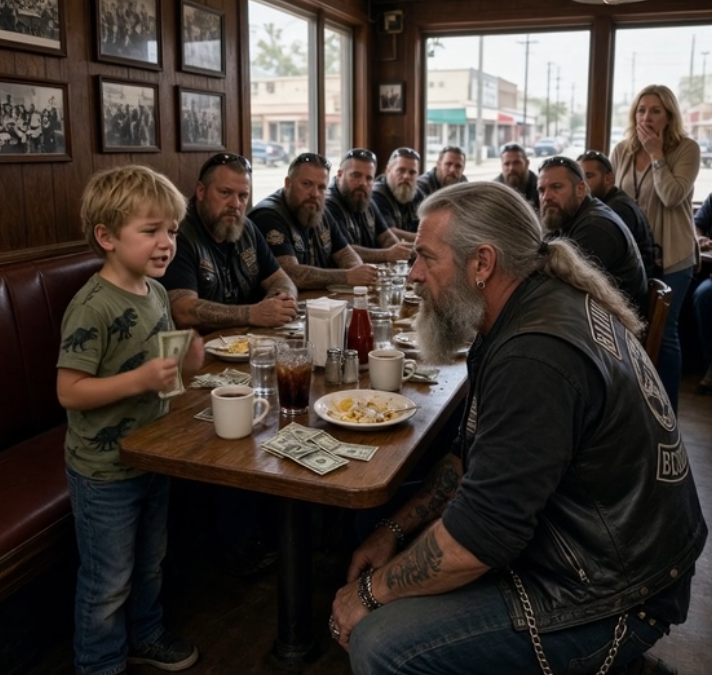
The boy stepped beside Everett Boone and placed the money on the table.
Six dollars and seventy-five cents.
Three wrinkled one-dollar bills.
A five that had been folded so many times it nearly stayed bent.
Three quarters.
Some dimes.
A nickel.
A few pennies.
Silence spread across the room.
The child took a deep breath.
Then he spoke.
“Can you help my mom?”
The words were simple.
But something in his voice made every man at the table pay attention.
Everett set down his coffee.
“What’s your name, son?”
“Mason.”
“Mason what?”
“Mason Keller.”
Everett glanced at the money on the table.
“You paying us?”
Mason nodded seriously.
“It’s all I have.”
Nobody at the table smiled.
Not because it was not sweet.
Because there was nothing funny about a child bringing every coin he owned to a table full of strangers because he had run out of safer places to go.
Everett leaned forward slowly, making sure his voice stayed gentle.
“What does your mama need help with?”
Mason swallowed.
His small shoulders lifted as he tried to be brave.
“She needs to leave,” he said. “But she says we can’t.”
The diner went even quieter.
Across the table, a biker named Harris lowered his fork.
Another, called Duke, turned his face toward the window.
Everett kept his eyes on the boy.
“Is somebody hurting her?”
Mason looked down at the table.
His fingers touched one of the pennies.
“He yells,” he whispered. “And breaks stuff. And sometimes she has marks she says are from cabinets.”
No one moved.
Everett’s jaw tightened once, then relaxed.
Years in the Army had taught him many things, but one of the hardest was this:
When a frightened child tells you the truth, you do not react so loudly that the child becomes afraid of the truth.
So Everett nodded.
“Where is your mama now?”
“In the car.”
“Outside?”
Mason nodded.
“She told me not to bother anybody.”
Everett looked toward the windows.
In the parking lot, beyond the line of motorcycles, an old gray sedan sat near the edge of the gravel. Its paint had faded. One headlight was fogged. A woman sat behind the wheel, both hands wrapped around the steering wheel though the car was not moving.
Her face was turned toward the diner.
Even from that distance, Everett could see fear.
Not ordinary worry.
The kind of fear that studies exits.
The kind that expects punishment for asking for help.
Everett looked back at Mason.
“Does your mom know you came in here?”
Mason shook his head.
“I told her I had to use the bathroom.”
One of the bikers closed his eyes.
Everett pushed the money gently back toward the boy.
“Mason, listen to me. You don’t have enough money to buy what you’re asking for.”
The boy’s face crumpled.
“I can get more.”
“No,” Everett said softly. “That’s not what I mean.”
He picked up the six dollars and seventy-five cents and folded Mason’s fingers around it.
“What you’re asking for isn’t something a child should ever have to buy.”
Mason stared at him.
Everett stood.
Every Steel Guardian at the table stood with him.
Sixteen chairs scraped the floor.
The whole diner held its breath.
Everett looked around the table.
Sixteen men looked back.
Men who had spent their lives protecting others.
Men who understood loyalty.
Responsibility.
And doing the right thing when someone needed help.
Everett nodded.
Then he looked at Mason.
“Yes, son,” he said. “We’re going to help.”
For the first time all day, the little boy smiled.
A tiny smile.
But a real one.
And that was enough.
Everett knew none of them were leaving until this family was safe.
The woman in the gray sedan was named Rachel Keller.
She was thirty-one years old, though fear and exhaustion had tried hard to make her look older. She worked part-time at a grocery store and cleaned offices three evenings a week. She had once wanted to become a nurse, but life had a way of taking women’s dreams and burying them under bills, bruises, apologies, and promises that this time would be different.
The man she needed to leave was not Mason’s father.
That mattered to Everett.
Not because a father could not become dangerous.
Because this meant Mason had already lost one man and was trying to survive another.
Rachel’s husband, Travis Cole, had moved into their lives two years earlier charming everyone who did not have to live with him. To neighbors, he was polite. To coworkers, he was unlucky. To people in town, he was the kind of man who could shake his head sadly and say Rachel was unstable, emotional, dramatic.
Inside the house, he was something else.
Rachel had tried to leave once.
Travis found out.
After that, her car keys disappeared at night. Her phone bill came under his name. He counted her tips. He told her no one would believe her.
And slowly, because fear is patient, Rachel began to believe him.
Until Mason walked into Maple Creek Grill with six dollars and seventy-five cents.
Everett approached the sedan alone at first.
Not because he was afraid.
Because sixteen bikers surrounding a terrified woman’s car might look too much like another kind of threat.
He stopped a few feet from her open window and removed his sunglasses.
“Ma’am,” he said gently, “my name is Everett Boone. Your boy came inside.”
Rachel went white.
“Oh God. I’m sorry. I’m so sorry. Mason—”
“He didn’t do anything wrong.”
“I told him not to bother people.”
“He didn’t bother us.”
Her eyes flicked past him to the diner windows, where the Steel Guardians stood watching without moving closer.
Everett lowered his voice.
“He said you need help leaving.”
Rachel closed her eyes.
For a moment, Everett thought she might deny it.
People did that sometimes.
Not because they were lying.
Because admitting danger out loud can feel like stepping off a cliff.
Then Rachel’s chin trembled.
“I don’t know how,” she whispered.
Everett nodded once.
“That’s all right. You don’t have to know how by yourself.”
Less than thirty minutes after lunch, the Steel Guardians were riding through the rolling hills outside Cookeville.
Sixteen motorcycles surrounded Rachel’s aging sedan like a moving shield.
Inside the car, Mason sat quietly in the passenger seat.
For the first time in months, he was not looking over his shoulder.
He was not afraid of what might happen when they got home.
Because for the first time, he was not going home alone.
Everett rode at the front of the formation.
Years in the military had taught him something important.
Fear grows in silence.
But courage grows when people stand together.
As they approached Rachel’s neighborhood, dark clouds gathered overhead.
The small rental house appeared exactly as Rachel had described.
Faded siding.
Uncut grass.
A front porch that looked one strong wind away from collapsing.
Rachel’s hands tightened around the steering wheel.
“Maybe this is a mistake,” she whispered.
Everett walked over to her window.
“No, ma’am.”
Her eyes lifted to his.
“The mistake would be leaving things the way they are.”
Tears immediately filled her eyes.
Nobody had spoken to her with that kind of kindness in years.
Within an hour, local deputies arrived after receiving reports and documentation Rachel had never felt safe enough to share before.
For the first time, she spoke openly.
For the first time, people listened.
And for the first time, she realized she was not fighting alone.
The Steel Guardians spent the rest of the evening helping Rachel gather what mattered most.
Family photographs.
Important papers.
Mason’s dinosaur books.
His baseball glove.
A worn backpack.
A faded blanket he had slept with since he was three.
A shoebox of birthday cards from his grandmother.
At one point, Mason walked into his bedroom and stopped.
Everett noticed.
“What’s wrong, buddy?”
The boy pointed toward a shelf.
“I don’t know if we have room for all my stuff.”
Everett looked at the little shelf.
Two toy trucks.
A stack of books.
A cracked plastic T-Rex.
A jar of bottle caps.
A photograph of Mason and Rachel at a county fair before fear had hollowed out her smile.
Everett nodded solemnly.
“Son, we’ll make room.”
That simple answer made Mason grin.
Years later, Rachel would say that was the exact moment her son started believing the future could be different.
The next few years were not easy.
Good people like to say leaving is the hard part.
Rachel learned leaving was only the first hard part.
After leaving came court dates.
Restraining orders.
Moving twice.
Mason waking from nightmares.
Rachel working double shifts and still counting pennies at the grocery store.
There were days when she sat in her car before work and cried because she was too tired to walk inside and too scared to stop trying.
But she was not alone.
The Steel Guardians made sure of that.
Everett called every Tuesday.
Harris fixed her car.
Duke helped move furniture into a small duplex the club found through a church contact.
A biker named Manny taught Mason how to change a tire before Mason was tall enough to lift one properly.
When Rachel started nursing school, the Steel Guardians took turns picking Mason up from baseball practice.
When Mason had a fever and Rachel had an exam, Everett sat beside the couch with soup and a thermometer, pretending he knew what he was doing.
“You were in the Army,” Mason said weakly.
“I was.”
“You don’t know fevers?”
“I know how to call your mother and follow orders.”
Mason smiled into his blanket.
Rachel passed her exam.
The Steel Guardians acted like she had won a war.
When Mason played Little League baseball, sixteen bikers appeared in the bleachers.
Other parents stared.
Then Mason hit a double and the Steel Guardians stood up cheering so loud the umpire flinched.
When Mason won a school award, they showed up again.
When Rachel graduated nursing school, the loudest cheers in the auditorium came from a group of men wearing leather vests.
People often stared.
Some judged.
Until they learned the story.
Then they understood.
The Steel Guardians were not just a motorcycle club.
They had become family.
On Mason’s tenth birthday, Everett handed him a small box.
Inside was a faded American flag pin.
The flag had traveled with Everett through deployments overseas decades earlier. The edges were worn. The metal had dulled slightly. But Everett held it like it still carried heat from every place it had been.
Mason looked up.
“Are you sure?”
Everett nodded.
“A flag doesn’t mean much if it stays in a drawer.”
Mason touched it carefully.
“It belongs with someone brave enough to carry it.”
Mason’s eyes widened.
“I’m not brave.”
Everett leaned back in his chair.
“You walked up to sixteen bikers with six dollars and seventy-five cents and asked for help for your mama.”
“I was scared.”
“That’s what made it brave.”
Mason looked down at the pin again.
From that day forward, he wore it everywhere.
School events.
Baseball games.
Graduations.
Family photographs.
The small pin became a reminder.
A reminder that courage is not the absence of fear.
It is asking for help when you are afraid.
Years passed.
Mason grew taller.
Stronger.
Quieter in the way boys sometimes become when childhood teaches them too early that loudness does not always mean safety.
But he did not become hard.
That impressed Everett more than any trophy ever could.
Mason excelled in school and athletics.
He volunteered at shelters.
Helped younger students.
Worked summer jobs.
Never forgot his mother’s shifts.
Never forgot who showed up.
Never forgot the sound of sixteen motorcycles around an old gray sedan.
One evening shortly before graduation, Mason sat beside Everett outside Maple Creek Grill.
The same diner where everything had begun.
The sunset painted the Tennessee sky orange and gold.
Motorcycles stood in the parking lot.
A new waitress carried pie to a booth.
The old sign flickered exactly the same way it had fifteen years earlier, though Everett claimed it had character and refused to let the owner replace it.
Mason had grown into a lean young man with Rachel’s eyes and a steadiness that made people listen when he spoke.
Everett was older now.
Seventy-one.
Still broad, but slower getting out of chairs. His hair had gone fully silver. His hands shook slightly some mornings, though he hid it from the club and fooled exactly no one.
Mason turned the flag pin between his fingers.
“I made a decision,” he said.
Everett glanced at him.
“That so?”
“I’m enlisting.”
Everett did not answer right away.
He watched a semi roll past on the highway.
“What branch?”
“Army.”
Everett’s jaw shifted.
“You sure?”
“Yes, sir.”
“You talk to your mama?”
“Not yet.”
Everett looked at him.
“Mason.”
“I know.”
“You tell Rachel before you tell me anything else.”
“I wanted to ask you first.”
“Ask what?”
Mason looked down at the pin.
“If I’m doing it for the right reasons.”
Everett leaned back against the bench.
“That depends. What are your reasons?”
Mason took a breath.
“I want to be useful.”
“That’s not enough.”
“I want to protect people.”
“Still not enough.”
Mason frowned.
“What would be enough?”
Everett looked at him for a long time.
“You need to know what you are not doing.”
“What does that mean?”
“It means you do not join the Army to prove you are not that scared boy anymore. That boy saved his mother. You do not owe anybody proof he was brave.”
Mason’s face tightened.
Everett continued.
“You do not join because you think pain has to be paid back. You do not join because you want to become harder. You do not join because you think a uniform will make you worth loving.”
Mason’s eyes shone.
“Then why?”
Everett’s voice softened.
“You join if you understand service is not about becoming bigger than other people. It is about becoming responsible enough to stand between harm and someone who needs time to get away.”
Mason stared at him.
The old diner sign buzzed.
Everett placed one hand on his shoulder.
“If that is why, then I’ll stand beside your mama while she cries and be proud of you both.”
Rachel cried.
Of course she did.
She cried at the kitchen table when Mason told her.
She cried in the laundry room later where she thought he could not hear.
She cried the day he left for basic training.
Then she wiped her face, hugged him so hard he could barely breathe, and said, “You come home as yourself. Do you hear me? Not someone colder. Not someone meaner. Yourself.”
Mason nodded.
“Yes, ma’am.”
Everett drove them to the station.
The Steel Guardians followed.
Not all sixteen from that first day were still riding.
Some had moved away.
Two had passed.
One was too sick to travel.
But the ones who could came.
They stood in a line while Mason hugged his mother.
Then he turned to Everett.
For a moment, neither spoke.
Everett held out his hand.
Mason ignored it and hugged him.
The old veteran stiffened, then held on.
“You keep that pin safe,” Everett said.
“I will.”
“No hero nonsense.”
Mason laughed once.
“You’re the one who taught me hero nonsense.”
“I taught you help. Different thing.”
“Yes, sir.”
The years that followed did what years do.
They carried everyone forward and took pieces with them.
Rachel became a respected nurse at the county hospital.
She worked emergency rooms with the calm of a woman who had once lived through emergencies no one saw.
Mason finished training.
Then Ranger School.
He wrote letters when he could.
Sometimes they were long.
Sometimes they were short.
Everett kept every one.
In a cigar box beside his bed, along with a photograph of Mason at ten wearing the flag pin crooked on his jacket.
The Steel Guardians aged.
Bikes were sold.
Knees failed.
Beards went white.
The diner changed owners twice but never changed the coffee, which everyone agreed was either loyalty or negligence.
Everett still sat in the corner booth every Saturday at lunch.
Same seat.
Same coffee.
Same quiet.
Fifteen years after Mason first walked into Maple Creek Grill, rain threatened again.
Dark clouds rolled over Cookeville.
Motorcycles lined the parking lot, fewer now than before but still enough to make strangers look twice.
Inside, the Steel Guardians sat at their old table.
Everett sat at the head.
He was seventy-eight now.
Thinner.
Slower.
Still upright.
Still watching the door.
Rachel sat beside him that day, which was unusual for a Saturday club lunch. She had gray at her temples now and strength in her face that had not been there when she first drove that old sedan home surrounded by motorcycles.
“You’re nervous,” Everett said.
Rachel smiled.
“You’re observant.”
“You’ve checked your phone twelve times.”
“You counted?”
“I’m old, not blind.”
She reached over and squeezed his hand.
Before he could ask another question, the diner door opened.
A young man in dress uniform stepped inside.
For a second, no one moved.
Then Everett Boone stood.
Not quickly.
Not easily.
But he stood.
Mason Keller had come home.
He was twenty-three now, lean and straight-backed, with a tan line at his wrist and the quiet eyes of someone who had seen more than he planned to say. His uniform fit sharply. On his chest were ribbons Everett understood at a glance. On his shoulder, the Ranger tab.
Pinned carefully inside his breast pocket, not visible until he reached for it, was the faded American flag pin Everett had given him at ten.
Mason stopped just inside the door.
His eyes found the corner table.
Fifteen years disappeared.
For Everett, he was still that little boy standing beside the table with six dollars and seventy-five cents in his palm.
For Mason, the men at that table were still giants.
Even the ones who now leaned on canes.
Even the ones whose hands trembled.
Even the ones whose bikes had been replaced by pickup trucks because time has no respect for legend.
Mason walked toward them.
Halfway there, his eyes filled.
He stopped beside Everett.
“Sir,” he said, voice rough.
Everett swallowed.
“You made it home.”
“Yes, sir.”
Rachel stood and reached for her son.
Mason hugged his mother first.
No hesitation.
No soldierly restraint.
He folded around her, and for a moment he was eight and she was the whole world.
Rachel cried into his uniform.
“You came back yourself,” she whispered.
Mason closed his eyes.
“I tried.”
Then he turned to Everett.
“I brought something.”
Everett glanced at his hands.
“You didn’t need to bring anything.”
“Yes, sir. I did.”
Mason set a wooden box on the table.
It was not large.
Maybe twelve inches wide.
Made of dark polished wood.
The diner went quiet the way it had fifteen years earlier.
Mason opened it.
Inside was a folded American flag.
Beside it lay a Ranger coin, the faded flag pin Everett had given him, and a small clear case holding six dollars and seventy-five cents.
Everett stared.
Mason spoke carefully, as if each word had weight.
“This flag flew over our outpost during my last deployment. I asked for it to be flown in honor of the Steel Guardians Riding Club of Cookeville, Tennessee.”
Nobody at the table spoke.
Mason touched the clear case.
“And this is six dollars and seventy-five cents.”
Everett’s mouth opened slightly.
Mason gave a small, tearful smile.
“Not the same money. I know you tried to give mine back that day. Mom told me later. But I wanted this amount here because it was everything I had when I asked for help.”
He looked around the table.
“It was not enough to buy help.”
His voice broke.
“But it was enough to find the men who would give it for free.”
Duke covered his face with one hand.
Harris turned toward the window.
Rachel pressed a fist against her mouth.
Mason lifted the flag pin.
“You gave me this when I was ten. You said it belonged with someone brave enough to carry it. I carried it through school. Through basic. Through Ranger School. Through every place I went.”
He looked at Everett.
“But it was never mine because I was brave.”
Everett’s eyes were wet now.
“It was mine because all of you taught me what brave looked like.”
Mason took a breath.
“There is one more thing.”
From inside the box, he removed an envelope.
He handed it to Everett.
Everett looked suspicious.
“What did you do?”
Mason laughed softly through tears.
“Open it.”
Everett unfolded the papers slowly.
His eyes moved across the first page.
Then stopped.
His hand began to shake.
Rachel reached over, but he lifted his other hand, asking for a moment.
“What is this?” Everett whispered.
Mason stood straighter.
“It is the filing paperwork for the Six Seventy-Five Fund.”
Everett looked up.
Mason continued.
“It is a nonprofit. Mom and I started it with help from the county hospital, the diner, and some local businesses. It will help families leaving dangerous homes with emergency gas cards, motel rooms, groceries, document replacement, and legal fees.”
The diner was silent.
Mason looked at the old bikers around the table.
“The first office is going into the empty building next door. Maple Creek donated the lease for the first year. The sign is already made.”
He swallowed hard.
“It says Steel Guardians House.”
Everett sat down slowly.
For once in his life, he seemed to have no words.
Mason looked at him, tears openly on his face now.
“You saved my mother because I walked in here with everything I had. I want other kids to know they do not have to find sixteen bikers in a diner by luck. I want there to be a door. I want there to be a number. I want there to be a place.”
Everett covered his eyes.
No one moved.
No one teased him.
No one cleared their throat.
Some moments deserve silence.
Finally, Everett lowered his hand.
“You did all this?”
Mason shook his head.
“No, sir.”
He looked at Rachel.
“We did.”
Rachel smiled through tears.
“Your stubborn boy came home with the idea. I helped make it legal.”
Marlene from the diner, now older and rounder, appeared near the table with a pie she had forgotten to serve.
“I donated the first pie sales,” she said, crying too. “Don’t make a fuss.”
Duke laughed wetly.
“You’re crying into the pie, Marlene.”
“Then it’ll taste better.”
That broke the room.
Soft laughter moved through the diner.
Then applause started.
Not loud at first.
One person.
Then another.
Then the whole diner stood.
Truck drivers.
Families.
Waitresses.
Old men at the counter.
Everyone.
Everett looked around as if embarrassed by the size of the love in the room.
Then Mason did something no one expected.
He took the six dollars and seventy-five cents from the wooden box and placed it in the center of the table.
Exactly where he had placed his money fifteen years earlier.
Then he looked at Everett.
“Can you help my mom?” he asked softly.
Everett’s face crumpled.
Mason continued.
“Can you help the next one?”
Everett stood again.
This time every Steel Guardian stood with him.
The old ones.
The limping ones.
The ones who could not ride anymore but still wore the vest.
Everett placed one weathered hand over the money.
Then he looked at Mason, at Rachel, at the flag, at the men who had become a family around one frightened boy’s question.
“Yes, son,” he said, voice breaking.
“We’re going to help.”
Fifteen years earlier, an eight-year-old boy walked up to the scariest table in Tennessee with six dollars and seventy-five cents and asked for help.
He did not know he was buying nothing.
He did not know help could not be purchased that way.
He did not know sixteen bikers would surround his mother’s old sedan like a shield.
He did not know they would show up at baseball games, graduations, court dates, sick days, and birthdays.
He did not know one of them would give him a flag pin and a definition of courage he would carry into adulthood.
He only knew his mother was afraid.
And he was afraid.
And someone had to ask.
Fifteen years later, that boy came home as a young Army Ranger with tears in his eyes, a folded flag in a wooden box, and a promise turned into a place.
The Steel Guardians thought they had saved one family.
Mason showed them they had started something much larger.
A fund.
A house.
A door.
A light in the window for the next mother sitting in a car with shaking hands.
For the next child counting coins.
For the next person who believes they have to be brave alone.
Everett Boone kept the wooden box in Steel Guardians House, mounted on the wall beside the front desk.
Inside it stayed the flag, the coin, the pin, and the six dollars and seventy-five cents.
Underneath, a brass plate read:
EVERYTHING HE HAD WAS ENOUGH TO ASK.
EVERYTHING WE HAD WAS ENOUGH TO ANSWER.
And years later, whenever someone walked through that door frightened, ashamed, or unsure whether they deserved help, Everett would point to that box and say the same thing every time.
“Courage does not always roar.”
Sometimes it sounds like a child in a diner.
Sometimes it looks like crumpled bills and loose change.
Sometimes it begins with six dollars and seventy-five cents sliding across a table.
And sometimes, if good people answer, it becomes a family strong enough to protect strangers for generations.


