An 11-Year-Old Cat Collapsed on the Morning of Her Granddaughter’s Wedding—Then One Sentence on the Phone Forced an Elderly Woman to Make an Impossible Choice.
PART3:
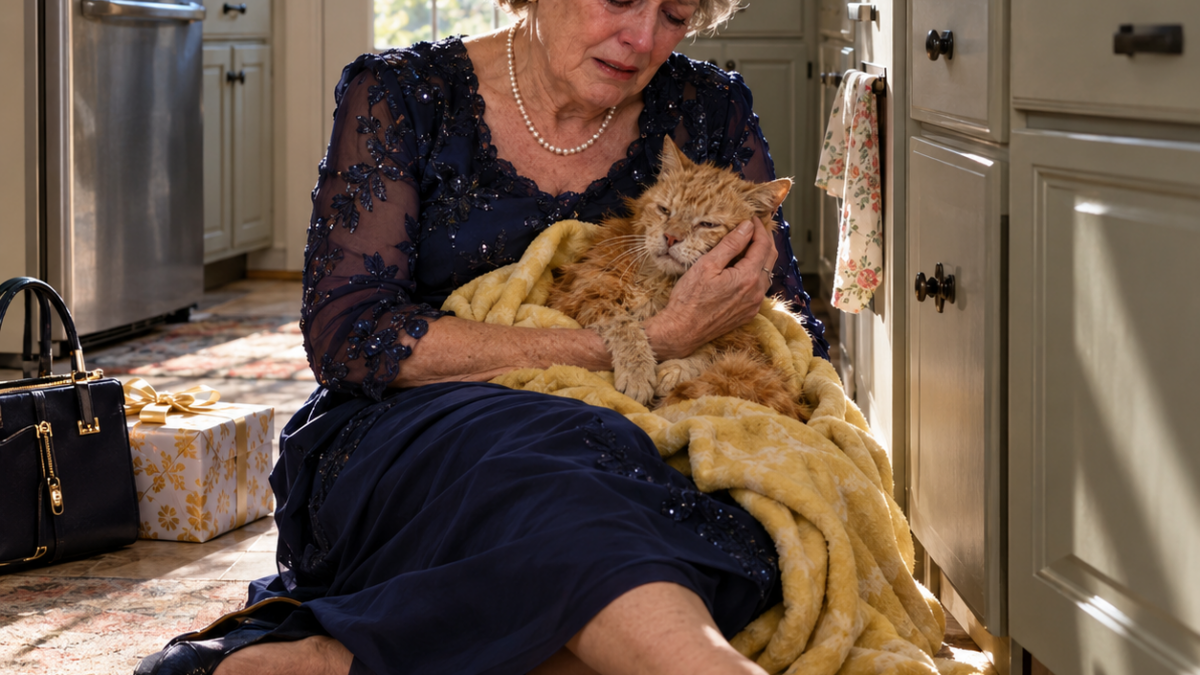
I dropped to my knees so fast my dress pulled tight across one hip and something in my left knee cracked. The pain meant nothing. I gathered him as gently as I could, sliding one hand beneath his ribs, one under his head. He was lighter than he had any right to be. In his younger years, Jasper had been a solid, swaggering creature with a face like a judgmental old man and paws large enough to make him look permanently offended by the floor. Now he felt like a bundle of warm laundry with bones inside.
His yellow eyes found mine.
That was the second I understood.
He was leaving.
And he knew I knew.
“No,” I whispered. “No, baby. Not today.”
The phone started buzzing.
I glanced up at the counter.
Lily.
Her name flashed over a photo of her at sixteen, laughing in my backyard with braces on her teeth and sunlight in her hair. I had never changed the picture. She hated that photo now, of course. Everyone hates the pictures where they look most like themselves before the world taught them posing.
The phone stopped.
Started again.
Lily.
I looked down at Jasper. His breathing was shallow. Fast, then slow, then fast again. A terrible rhythm. A rhythm that said his body was no longer taking orders from him.
I knew I should answer. I knew the wedding morning had a schedule. Hair, makeup, photographs, the ceremony at eleven, family portraits at ten-thirty sharp. Lily had planned that day for fourteen months. She had sent spreadsheets. Actual spreadsheets. My granddaughter had scheduled love in fifteen-minute increments because she thought if enough details were controlled, nothing could hurt her.
She had always been like that.
Even as a child, Lily arranged her crayons by shade and cried if anyone moved the blue one into the green row. When her parents fought during her middle school years, she made chore charts for the whole household. When her father lost his job, she organized coupons. When I was late picking her up from ballet once because Robert had fallen in the bathroom and I had to wait for the ambulance, she stood outside the studio with her little pink bag clutched to her chest, fighting tears, and said, “I thought you forgot me.”
I had taken her face in my hands and told her, “I will never forget you.”
And I hadn’t.
Not once.
But that morning, my cat was dying in my lap.
The phone stopped.
Started again.
I reached for it on the fourth call and nearly dropped it because my hand was shaking.
“Grandma?” Lily’s voice came through bright and strained. Music played behind her. Women talking. Someone laughing. The rustle of fabric. The kind of happy chaos that belongs to expensive hotel rooms and wedding mornings. “Where are you?”
I looked at Jasper.
“I’m still home, honey.”
A pause.
Not long.
Long enough.
“What do you mean you’re still home?”
“Jasper collapsed.”
Another pause.
I closed my eyes.
“He’s dying, Lily.”
In the background, somebody said, “We need the veil in five minutes.”
Lily covered the phone, but not enough. I heard muffled words. Then her voice came back sharper.
“Grandma, no. Not today. Please don’t do this today.”
The sentence landed awkwardly, like something thrown by a person already carrying too much.
I tried to breathe.
“I’m sorry. I’m so sorry. I don’t think he has much time.”
“Can you bring him to the emergency vet and come after?”
“He wouldn’t survive the drive.”
“You don’t know that.”
“I do.”
“You can’t miss my wedding.”
I opened my eyes.
Jasper shivered. His head turned just enough to press against my palm. For eleven years, that cat had been stubborn enough to headbutt me whenever he wanted something. Food. Attention. My chair. My dignity. Even now, weak as he was, he found my hand.
“Lily,” I whispered, “I made him a promise.”
“What promise?”
“That he wouldn’t die alone.”
She breathed out hard. Not quite a sigh. Not quite a sob. Something in between.
“Grandma…”
Then came the sentence.
The one neither of us would ever forget.
“It’s just a cat.”
Silence opened between us.
I could still hear the wedding room behind her. The laughter. The door closing. A bridesmaid asking where the gold earrings were. Life continuing loudly on the other end of the phone.
Just a cat.
I looked around my kitchen.
The chipped mug near the sink. The yellow dish towel with lemons on it. The pill organizer on the windowsill. The framed picture of Robert from before cancer hollowed out his cheeks. The empty chair across from mine where nobody had sat for breakfast in eight years.
Just a cat.
People use that word when they want to shrink something they have never needed.
Just.
Just a pet.
Just a house.
Just a memory.
Just loneliness.
Just grief.
Just the one living creature who knows the sound of your shoes and comes running anyway.
I did not yell. That surprises some people when I tell it now. They expect me to have become dramatic, to have defended myself, to have delivered the kind of speech that makes everyone watching online nod with satisfaction.
But real heartbreak is often quiet.
I simply said, “I love you, Lily. I am not choosing against you. But I cannot leave him.”
She did not answer right away.
When she did, her voice was small with anger and hurt.
“So you’re choosing him.”
“No.”
“That’s what this is.”
“No, sweetheart.”
“My chair will be empty.”
“I know.”
“My grandmother’s chair will be empty at my wedding.”
“I know.”
“Do you?”
That question hurt because she sounded seven years old again.
“I’m sorry,” I said.
She hung up.
I sat there listening to the dead line for several seconds before lowering the phone to the floor.
Then I texted her because sometimes typed words survive where spoken ones fail.
I love you. I am not choosing against you. I am keeping a promise. I am so sorry.
I set the phone facedown.
Then I wrapped Jasper in the old yellow blanket from the laundry basket, the one he had slept on every afternoon for years because it held heat from the dryer better than anything else. He made a faint sound when I moved him. Not pain, I don’t think. Protest, maybe. Jasper had always disapproved of being managed.
“I know,” I whispered. “Bossy old man.”
His tail flicked once.
That nearly destroyed me.
For the next hour, the world narrowed to the small rise and fall of his ribs.
I told him stories.
About the night I found him behind the trash cans in freezing rain, all bones and mud and suspicion. About how he bit the first vet who tried to examine him. About how Robert said we were absolutely not keeping that animal, then bought him salmon treats three days later. About how Jasper used to sleep on Robert’s chest during chemo, heavy and warm, refusing to move even when Robert joked that the cat was trying to finish what the cancer started.
“You remember him?” I whispered. “You’ll see him before I do, I suppose. Don’t let him feed you too many treats. He has no discipline.”
Jasper blinked slowly.
His breath hitched.
I bent close, pressing my cheek to his head. His fur smelled like old sunlight and dust and the tuna he never got to eat.
“You brought me back,” I said. “You know that, don’t you?”
His paw moved weakly against my wrist.
“I was supposed to save you, but you saved me first.”
That was the truth.
Eleven years earlier, I had found Jasper during the worst winter of my life.
Robert had been gone four months. The casseroles had stopped coming. The sympathy cards had been gathered into a box and placed in the closet because I could no longer bear to see my name written beside his in other people’s handwriting.
Ruth and Robert.
As if the two names still belonged together in the present tense.
My children called often at first. Karen from across town, always rushed but trying. Michael from Denver, guilty and kind and helpless from a thousand miles away. Lily sent drawings. Then school started. Work got busy. Life, as it always does, pulled people back into their own weather.
I told everyone I was fine because that is what widows are expected to say once the funeral flowers die.
Fine, thank you.
Managing.
Keeping busy.
Taking it one day at a time.
The truth was that I stopped opening the curtains.
I stopped cooking real meals. I ate toast over the sink. Sometimes cereal from a mug because bowls felt too formal. I let mail pile up on the table until bills hid under grocery flyers and sympathy cards. I went whole days without hearing my name spoken aloud.
That is a particular kind of loneliness.
Not the dramatic kind people write songs about.
A domestic loneliness.
A hallway too quiet.
One coffee cup in the sink.
No one asking if you remembered to lock the back door.
No one breathing beside you at night.
There were afternoons when I sat in Robert’s recliner and watched dust move through a sunbeam for so long the room darkened around me without my noticing. There were mornings when I woke and felt disappointment so heavy it seemed physical. Not because I wanted to die exactly. That sounds too simple. It was more that I had forgotten why getting up mattered.
Then one January evening, during a rain so cold it made the air look metallic, I heard a noise behind the trash cans.
A thin, furious, broken sound.
I found Jasper wedged between the bins and the fence, soaked to the skin, one eye swollen, ribs showing through filthy orange fur. He hissed at me with all the strength he did not have. I brought out a towel and a can of tuna. He bit me through the towel. I bled on the driveway and laughed for the first time in months because there was something so absurdly rude about this half-dead creature having the nerve to injure the person rescuing him.
“You ugly little thing,” I told him, crying and laughing at once. “You have terrible manners.”
He came inside that night.
He never left.
At first, I told myself I was caring for him temporarily. Just until he healed. Just until I found a rescue. Just until the weather warmed.
But Jasper had other plans.
He followed me from room to room like a small orange supervisor. He yelled for breakfast at dawn. He knocked pill bottles off the counter when I forgot to take them. He slept outside the bathroom door and complained if I took too long. He planted himself on my chest on nights when grief made breathing difficult and purred so hard it felt like a machine trying to restart me.
One winter morning, I woke from a dream of Robert and could not stop crying.
Jasper climbed onto my pillow, placed one paw against my mouth, and stared at me with such stern disapproval that I laughed through the tears.
That became our arrangement.
I kept him fed.
He kept me here.
So when his time came, on the morning my granddaughter became a wife, there was never truly a choice.
There was only a promise.
Jasper died at 9:23 a.m.
His breath left in two small shudders.
Then stillness.
I kept my hand on his ribs, waiting for one more movement. One more protest. One more impossible exception to the rule every living thing must obey.
Nothing came.
The kitchen did not change, and that felt offensive.
The refrigerator still hummed. The clock above the stove ticked. Outside, a lawn mower started somewhere down the block. A neighbor’s dog barked. A robin landed on the fence like the world had not just taken the last creature who slept against my knees.
I held Jasper for a long time.
Long enough that the phone buzzed nine more times.
Long enough that the light shifted across the floor.
Long enough that the navy dress wrinkled beneath me and one pearl earring slipped loose and landed beside my knee.
I don’t know when the crying stopped. Maybe it didn’t. Maybe it simply became quiet enough to be mistaken for breathing.
At some point, I wrapped Jasper more neatly in the yellow blanket and placed him in a cardboard box lined with the towel he used to knead when he was younger. My hands moved slowly, carefully, with the solemn foolishness we bring to bodies after the soul has gone. As if comfort can still be arranged.
I placed him on the kitchen table.
Then I sat across from him in my wedding clothes.
That was how Lily found me.
I heard tires in the driveway sometime after noon, then a car door, then hurried footsteps on the porch.
For one wild second, I thought Robert was coming in from the rain with groceries, calling out some ordinary complaint about traffic.
Then came a knock.
I opened the door.
Lily stood there in her wedding dress.
Her hair was half fallen loose from its pins. Her makeup had smudged beneath both eyes. One heel was in her hand. The skirt of her dress was gathered in her fist, a little dirty at the hem from the driveway.
For a second, neither of us spoke.
My granddaughter had never looked more beautiful.
Or more heartbroken.
“Oh, sweetheart,” I whispered.
Her eyes searched my face first, angry and afraid and still full of wedding-day urgency. Then she looked past me.
She saw the box.
Her whole expression changed.
Not dramatically. Not the way people change in movies.
It simply softened, then collapsed.
“He’s gone?” she asked.
I nodded.
She covered her mouth.
I stepped aside.
She came in slowly, as if entering a room after a storm. The house must have looked strange to her. The gift still by the door. My purse untouched. My shoes kicked off near the sink. The pearls beside the sugar bowl. The box on the table with the corner of yellow blanket visible.
Lily walked to the table and looked down.
For years, Jasper had tolerated her. That was the best way to put it. When she was a little girl, she adored him with the dangerous passion of children. She tried to put him in doll blankets and once attempted to include him in a tea party by offering him apple juice in a plastic cup. Jasper scratched nobody, which was generous, but he left the room whenever he heard her coming.
When she was older, he allowed her to touch his head on holidays. Once, during her senior year of high school, after a boy broke her heart, she came over and cried on my couch. Jasper jumped up beside her, sat just out of reach, and turned his back to her in the manner of a very elderly man offering emotional support under protest.
Lily had laughed then and said, “I think Jasper loves me but doesn’t respect me.”
“He doesn’t respect anyone,” I told her. “That’s why we trust him.”
Now she stood over him in her wedding dress and began to cry.
“I read your text again,” she said. “In the car. I read it maybe ten times.”
“I’m so sorry I missed it.”
She turned toward me, and I saw the sentence she had said on the phone sitting between us like something broken.
“No,” she whispered. “I’m sorry. I said a terrible thing.”
I opened my arms.
She came into them like she had when she was ten, careful and not careful at all. I held her in her white dress, feeling her shake against me, feeling my own grief fold around hers.
“I didn’t mean it,” she said into my shoulder.
“I know.”
“I was scared. Everyone kept asking where you were. Mom was upset. The photographer needed us. Daniel’s aunt was making comments, and I just—”
“I know.”
“I shouldn’t have said it.”
“No.”
She pulled back, wiping her face with the heel of her hand like a child. “I ruined my makeup.”
“You’re still beautiful.”
“I left my own wedding reception.”
“You came to me.”
“I didn’t know what else to do.”
“That’s often how love works.”
She laughed once, brokenly.
Then she walked to her bouquet, which she had dropped on the entry table without realizing it, and pulled one white rose from the arrangement. She brought it back to the kitchen and laid it gently inside the box beside Jasper’s head.
“I’m sorry,” she whispered to him.
That nearly undid me more than anything.
She stayed for forty minutes.
Not long enough, some people would later say.
Too long, others would argue.
People who were not there would become experts on exactly how grief and weddings should be measured against each other.
But those forty minutes mattered.
She helped me close the box. She sat at my kitchen table and held my hand. She called Daniel from the porch and told him she was safe. I heard her say, “No, I needed to come. I’ll explain later.”
When she returned, she looked exhausted in a way no bride should look before cutting cake.
“I have to go back,” she said.
“I know.”
“There’s an empty chair for you.”
“I know.”
Her eyes filled again. “There always will be.”
I did not understand then how true that sentence would become.
Before she left, she kissed my cheek.
Then she looked around my quiet kitchen, really looked, as if seeing not just the room but the life inside it.
“I love you, Grandma.”
“I love you too.”
She drove away with her dress gathered around her and one shoe still missing.
I thought the worst was over.
I had missed the wedding. Jasper was gone. Lily and I had cried and forgiven each other as much as people can forgive while still bleeding.
I thought grief would now become private.
I should have known better.
By late afternoon, my daughter Karen came through the front door without knocking.
She still wore her pale-pink mother-of-the-bride dress. Her hair was sprayed into a smooth shape that did not suit her, and her face was tight with the effort of holding too many things at once. My Karen had always been practical. Even as a child, she organized games rather than playing them. If someone fell down, she was the one who ran for Band-Aids, not because she lacked compassion, but because compassion, to her, required a plan.
She stopped when she saw the box on the table.
“Oh, Mom.”
Those two words held irritation, grief, pity, exhaustion, love.
The whole family mixture.
“I tried to call,” she said.
“I know.”
“You should have answered.”
“I know.”
“Lily was beside herself.”
“I know.”
Karen pressed two fingers to her temple. “People noticed.”
There it was.
Not Jasper.
Not my knees aching from the kitchen floor.
Not my empty house.
People.
People noticed.
I sat down because suddenly I felt older than I had that morning.
“Was the ceremony ruined?”
“No,” she said quickly.
Too quickly.
Then she sighed.
“No. Not ruined. But it was awkward. Lily disappeared in her dress. Daniel had to explain something to his parents. Guests started whispering. Someone thought you had fallen. Someone else thought Lily was having second thoughts.”
I closed my eyes.
“And then?”
“And then people found out.”
“That I missed it because Jasper was dying.”
Karen looked away.
I let out a small laugh without humor. “You can say it.”
“Mom…”
“That’s the sentence, isn’t it? That’s the headline.”
She sat across from me. “It does sound bad.”
“He died in my hand.”
“I know.”
“No,” I said quietly. “You know the fact. That isn’t the same thing.”
Her face changed.
I had not meant to say it sharply. But grief makes the skin thin. Every word reaches blood.
Karen folded her hands on the table. “I’m trying to understand.”
“I know.”
“But Lily is your granddaughter.”
“Yes.”
“This was her wedding day.”
“Yes.”
“She only gets one.”
“I hope so.”
Karen gave me a tired look, but I saw the corner of her mouth tremble because the joke had found her despite everything.
Then she said what I knew she had come to say.
“You could have said goodbye and come later.”
I looked at my daughter.
Really looked.
Her carefully done makeup was cracking near the corners of her eyes. A silver strand of hair had escaped near her temple. She looked fifty-two and twelve at the same time. My little girl, grown into a woman who still believed impossible situations could be solved if everyone would just behave reasonably.
“He was alive when I chose to stay,” I said. “That matters.”
She swallowed.
“I made him a promise.”
“Mom, I know you loved him.”
“No,” I said.
The word startled us both.
I placed my hands flat on the table so she could not see them shake.
“No, Karen. You know I fed him. You know I took him to the vet. You know he slept on my bed. You know the cute parts because those are easy to accept. You do not know what he was to me.”
She frowned. “Then tell me.”
There it was.
An opening.
After years of nobody quite asking the second question.
I looked at Jasper’s box. The white rose from Lily’s bouquet was already drooping slightly.
“You remember the year after your father died?”
Karen’s face softened. “Of course.”
“No,” I said again. “You remember visiting. You remember calling. You remember me saying I was fine.”
She grew still.
“I wasn’t fine.”
The refrigerator hummed.
Somewhere outside, a car passed slowly down the street.
“I stopped cooking,” I said. “I stopped opening curtains. There were days I did not get dressed until evening, and then only because the mailman might see me through the window. Sometimes I went three days without speaking to another person except the cashier at the grocery store.”
Karen’s eyes widened.
“Mom…”
“I’m not telling you this to hurt you.”
“It does hurt me.”
“I know.”
“Why didn’t you tell me?”
I almost smiled.
What a young question that is, even when asked by a woman old enough to have adult children of her own.
Why didn’t you tell me?
Because shame is quiet.
Because mothers are not supposed to become burdens.
Because older women are trained to make do with less and call it grace.
Because once everyone decides you are strong, your silence becomes convenient.
Because loneliness does not arrive waving a flag. It moves in slowly, fills the corners, sits beside you at dinner, and by the time you realize it has become dangerous, you are too embarrassed to call someone and say, I am disappearing in my own house.
“I didn’t want to become one more thing on your list,” I said.
Karen covered her mouth.
That was the moment she began to understand.
Not completely.
No one can fully enter another person’s loneliness.
But enough.
“When I found Jasper,” I continued, “he needed me. Every morning. Every night. He forced routine back into the house. He yelled until I got up. He sat on me when I cried. He made the rooms feel occupied. He made me laugh when nothing else could.”
My voice broke.
“He gave me somewhere to put love when I had too much of it and no husband left to receive it.”
Karen began crying silently.
“He was not a replacement for your father. Nothing could be. He was not a person. I know that. But he was a life beside mine. And sometimes, when a person is very alone, that is the difference between staying and not staying.”
Karen whispered, “How bad was it?”
I looked at her.
She looked like she already knew and was praying I would soften the answer.
“At the time?” I said. “Bad enough that Jasper may have saved your mother’s life.”
She stood so quickly the chair scraped against the floor.
Then she came around the table and knelt beside me, her dress pooling on the linoleum.
“I didn’t know.”
“I know.”
“I should have known.”
“Maybe.”
She flinched.
I touched her cheek.
“But I should have told you.”
She cried harder at that.
There are truths families avoid because they do not belong neatly to one guilty person. They spread. They reveal everybody’s part. The calls not made. The answers not honest. The visits postponed. The assumptions allowed to harden into fact.
Mom is fine.
Grandma is independent.
She likes being alone.
She would tell us if she needed anything.
Would she?
Would I?
Karen stayed until dark.
Still in her wedding clothes, she helped me carry Jasper to the backyard.
We chose the maple tree because he had loved lying in the patch of sunlight that fell beneath it every afternoon. Robert planted that tree the year Karen was born. Its roots were thick and stubborn, and the ground was harder than either of us expected. Grief should look more sacred than two women sweating through formal clothes and crying into the dirt while a neighbor’s sprinkler clicked on and off.
But maybe that is sacred.
Love doing the hard, ordinary thing all the way to the end.
We buried Jasper with his yellow blanket and Lily’s white rose.
Karen held the flashlight. I held the shovel. Then she took the shovel from me because my hands were trembling too badly.
When it was done, we stood under the maple tree in the damp spring air.
No speech.
No prayer.
Just the fresh mound of earth.
Just us.
At the door, Karen hugged me harder than usual.
“Lily wants to come tomorrow,” she said.
“Tell her she doesn’t have to.”
“She wants to.”
I nodded.
Then Karen hesitated.
“What?”
She looked down at her phone. “Mom, something happened online.”
I felt tired all at once.
“What happened?”
“Someone posted about it.”
“About what?”
Her mouth tightened.
“You missing the wedding.”
I stared at her.
“Who?”
“One of Daniel’s cousins, I think. Or maybe an aunt shared it from somebody else. It’s already gotten around.”
“What did it say?”
Karen closed her eyes for a second.
Then she read it.
“Sad when some people can’t tell the difference between a once-in-a-lifetime family milestone and a household pet.”
I felt the words enter me one at a time.
Not like bullets.
Like ice cubes dropped into warm water.
Slow shock.
“They used a picture of Lily and Daniel cutting the cake,” Karen said. “The caption doesn’t name you, but everyone knows.”
“Everyone?”
“It’s public.”
The backyard seemed suddenly too large.
Karen stepped closer. “Please don’t read the comments tonight.”
I almost laughed.
At seventy-three, being told not to do something has the same effect it did at seventeen.
“I won’t,” I lied.
She knew I was lying.
She left anyway because daughters can only protect mothers so far.
I waited until her car disappeared.
Then I sat at my kitchen table, in my wrinkled navy dress, with dirt still under one fingernail from burying the creature who had kept me alive, and I opened my phone.
The post had hundreds of comments.
By morning, it would have thousands.
Some called me selfish.
Some called me unstable.
Some said this was why people were too obsessed with pets nowadays.
Some said Lily should cut me off.
Some said old women use weakness to control their families.
Some said missing a wedding for an animal proved I had no respect for marriage, family, or God.
People who had never met me explained my heart to one another with astonishing confidence.
One woman wrote, My grandmother made everything about herself too. Classic narcissist behavior.
A man replied, Exactly. Pets are not people. If you can’t understand that, you’re broken.
Someone else wrote, Imagine being the bride and learning your grandmother cares more about a cat than you.
That one hurt most because I knew Lily might see it.
I scrolled for almost an hour, though every comment made me feel more foolish for looking. There is a terrible pull to public judgment. You want to stop reading, but you also want to know the full shape of what people are saying about you. As if gathering every knife will make you safer.
A few people defended me.
Maybe the cat was dying and she didn’t want him alone.
You don’t know the whole story.
Elderly people’s pets are sometimes their closest companions.
Those comments were mocked immediately.
Crazy cat lady energy.
Still not an excuse.
The bride should matter more.
One stranger wrote something that made me set the phone down.
Maybe the pet was the only one who showed up every day.
Nobody responded to that one.
Not at first.
Then someone replied with a laughing emoji.
That was when I turned off the screen.
I sat in the dark kitchen for a long time.
The house felt wrong without Jasper in it. Not empty exactly. Emptier than empty. As if every room still expected him and had not yet been told. The chair by the window waited. The food bowl sat clean in the corner. The little blue mouse he ignored for nine years lay beneath the radiator.
I got up and poured his water bowl into the sink.
Then I gripped the edge of the counter and cried so hard my ribs hurt.
Near midnight, my phone buzzed again.
Lily.
For a moment, fear stopped me from opening it.
Then I did.
Please don’t read the comments.
I’m handling it.
I love you.
I stared at those three lines until they blurred.
Then I wrote back:
I love you too.
Come tomorrow if you still want to.
There is soup in the freezer.
That is how women in my family say, I need you.
The next morning, I woke in my chair with my neck stiff and my makeup still half on. For a few seconds, I did not remember.
Then I heard nothing.
No paws in the hallway.
No gravelly meow demanding breakfast.
No thump of an old cat jumping down from the bed with more confidence than ability.
Fresh grief is cruelest in the ordinary moments.
I made coffee. Poured a second cup out of habit because Robert used to drink coffee black from the chipped blue mug. Then I remembered he had been gone eight years and poured it back.
Then I reached for Jasper’s bowl.
Stopped.
That was when the day truly began.
Lily arrived at ten wearing sweatpants and one of Daniel’s oversized shirts. No makeup. Hair in a knot. Face puffy from crying and too little sleep.
She looked less like a bride than a child who had wandered out of a storm.
“You looked, didn’t you?” she said as soon as she saw me.
I nodded.
Her shoulders fell. “Grandma.”
“I know.”
“I told you not to.”
“I have been doing things people told me not to since 1968.”
That startled a laugh from her.
A small one.
But real.
She came into the kitchen and looked toward the back window. “Mom said you buried him under the maple.”
“Yes.”
“Can I see?”
We went outside together.
The morning was bright in the rude way mornings are after terrible nights. The grass shone with dew. Birds sang like nothing had happened. Beneath the maple, the fresh earth was dark and uneven.
Lily knelt.
She touched the ground with two fingers.
“I’m sorry,” she whispered.
I stood behind her, giving her the privacy of grief she had not known she would have.
After a while she said, “Daniel is furious.”
“At me?”
She looked up. “No. At them.”
The relief that moved through me was embarrassing in its strength.
“He said nobody gets to use our wedding pictures to turn you into a villain,” she said. “He told his cousin to take it down.”
“Did she?”
“No.”
“Of course not.”
“She said she was allowed to have an opinion.”
“People confuse that with kindness often.”
Lily stood, brushing dirt from her hands. “I want to post something.”
My stomach tightened. “Lily…”
“Not to fight.”
“That is usually what people say before fighting.”
“I mean it.” She looked at me. “I want to tell the truth.”
“The internet does not always reward truth.”
“No. But lies get comfortable when nobody interrupts them.”
I studied her face.
She was twenty-eight years old. Married less than twenty-four hours. Already exhausted by the way people turn pain into entertainment. Already learning that adulthood is less about being certain and more about deciding which truth you can live with.
“Write it here first,” I said.
She took out her phone.
We sat at the kitchen table while she typed. Deleted. Typed again. Stared at the screen. Typed more slowly.
Finally, she handed it to me.
Yesterday I got married.
Yesterday, I also said something cruel to my grandmother while her beloved cat was dying. I told her it was “just a cat.” I regret those words more than I can explain.
What many of you do not know is that Jasper was not “just” anything to her. He was her companion through years of grief and loneliness after my grandfather died. He was the one waiting at her door every day. He was part of her home, her routine, her survival.
My grandmother made him a promise that he would not leave this world alone. On my wedding day, she kept that promise.
You are allowed to think weddings matter. Mine mattered to me deeply. But if defending my wedding requires mocking an elderly woman’s grief, insulting her love, or using my photos to shame her, please stop pretending you are protecting family. You are only defending cruelty.
Love is not always convenient.
Grief does not check the calendar.
And family should mean trying to understand the whole story before turning someone’s pain into a headline.
I read it once.
Then again.
Then a third time.
When I looked up, Lily was crying silently.
“You wrote this?”
She shrugged. “Mostly in the car.”
“It’s good.”
“Is it too much?”
“No,” I said. “It is exactly enough.”
She posted it.
Then we waited.
Modern punishment is watching strangers react in real time to a wound they have no intention of helping heal.
At first, the comments were what we expected.
Excuses.
Backtracking.
People claiming they had “only been concerned for the bride.”
People saying they were “entitled to ask questions.”
People insisting nobody could have known, which was true, and somehow did not stop them from having already judged.
Then something changed.
A woman wrote that her father’s old dog was the only reason he survived after her mother died.
A man wrote that he missed a promotion ceremony because his cat had a seizure and his coworkers mocked him for months.
A nurse wrote that she had seen elderly patients refuse hospital stays because they were afraid nobody would feed their animals.
A widow from Ohio wrote, The loneliest people in America are often the ones everyone assumes are fine.
That sentence traveled.
People shared it. Repeated it. Argued with it. Confessed beneath it.
Within hours, Lily’s post was no longer only about me.
It became a place where people brought their own hidden grief.
A woman admitted she had not visited her mother in three months because every visit made her feel guilty.
A grandson wrote that he had rolled his eyes at his grandfather’s attachment to an old beagle, then cried when he found the man’s calendar filled with notes like Buddy ate well today and Buddy slept beside me.
A teacher wrote that one of her students came to school devastated after his family gave away his cat during a move and told him he was too old to cry.
People were not really arguing about a wedding anymore.
They were arguing about what counts as love when no audience is clapping.
By evening, the original post disappeared.
No public apology came from Daniel’s cousin.
Of course not.
People who light matches rarely stay to admit they enjoyed the fire.
But the comments under Lily’s post kept coming.
Karen came over that night with leftovers from the reception. Cold chicken. Rolls wrapped in foil. Little white boxes of cake. She placed them on my kitchen table as if delivering evidence from another life.
“We saved you some of everything,” she said.
“Even though I disgraced the family?”
She gave me a look. “Mom.”
Lily, sitting beside me, said, “We were disgraced before. Grandma just gave us better material.”
Karen stared at her for half a second.
Then all three of us laughed.
Not because anything was funny.
Because sometimes laughter is the bridge your body builds over a hole it cannot fill.
We ate wedding food off mismatched plates.
The chicken was dry. The rolls were good. The cake was too sweet. Lily told us Daniel’s uncle had gotten drunk and made a speech about the importance of communication while mispronouncing Daniel’s middle name. Karen confessed she had stepped on the hem of her dress during family photos and nearly taken out a flower girl.
For an hour, we sounded like a family.
Then Karen looked toward the backyard.
“I keep thinking about what you said,” she told me.
“What did I say?”
“That there’s a difference between liking peace and being forgotten inside it.”
Lily went quiet.
I set down my fork.
Karen’s eyes filled, but she did not look away. “I think I told myself you liked being alone because it made me feel better about leaving you alone.”
That was honest enough to hurt.
“I helped you believe it,” I said.
“That doesn’t let me off.”
“No.”
She laughed through tears. “You’re supposed to say it does.”
“I am old, not dishonest.”
Lily reached across the table and took Karen’s hand.
For a moment, I saw them not as daughter and granddaughter, not as bride and mother-of-the-bride, not as the people who had misunderstood me, but as two women carrying their own private fears. Karen feared failing everyone. Lily feared being left. I feared becoming invisible. None of us had invented these fears, but we had handed them to one another in ways we were only beginning to see.
Families are not broken only by cruelty.
Sometimes they are worn thin by assumptions.
By everyone trying not to need too much.
By everyone mistaking silence for peace.
Three days later, Daniel came to my house carrying a small wooden marker.
He had made it himself. Sanded smooth. Simple. Jasper’s name burned into the surface in careful block letters.
Beneath it, he had written:
HE WAS LOVED.
I nearly lost my breath.
Daniel was a quiet man. Tall, gentle, with kind eyes and the nervous habit of checking if people needed more water. I had liked him from the first Christmas Lily brought him home because Jasper, who hated most men on principle, had sniffed his shoe and chosen not to leave the room.
“I thought he should have something,” Daniel said, suddenly shy. “If that’s okay.”
I touched the marker.
The wood was warm from his hands.
“It’s more than okay.”
He helped me press it into the ground beneath the maple tree. We stood side by side, looking down at it.
“I’m sorry about what happened,” he said.
“You don’t have anything to apologize for.”
“My family does.”
“You are not your entire family.”
“No,” he said. “But I brought them into Lily’s life. Into yours.”
I looked at him then.
That was not guilt speaking.
It was responsibility.
There is a difference.
“She chose well,” I said.
His ears turned red.
“I’m trying.”
“That matters more than people think.”
He nodded, hands in his pockets.
After a while, he said, “Lily told me Jasper helped after your husband died.”
“Yes.”
“She said she didn’t know.”
“Most people didn’t.”
“Do you wish they had?”
The question surprised me.
I looked at the marker.
“Yes,” I said after a moment. “And no. Knowing creates responsibility. People say they want to be known, but being known changes what others can ignore.”
Daniel thought about that.
Then he said, “Maybe that’s the point.”
I liked him very much for that.
In the weeks that followed, my life changed in small, suspicious ways.
Karen started calling every morning on her drive to work.
At first, the calls were awkward.
“Just checking in,” she would say too brightly.
“I am still alive,” I would answer.
“Great. Good. That’s good.”
Silence.
Then I would say, “I had toast.”
“With what?”
“Good Lord, Karen.”
“I’m asking.”
“Butter. Like an American.”
After a week, she stopped sounding like she was completing a duty and started telling me about ordinary things. A rude woman at the dry cleaner. A recipe she ruined. The way her boss said “circle back” fourteen times in one meeting. I told her about the neighbor’s roses, the squirrel stealing birdseed, the terrible new mystery show I was watching because the detective had good coats.
Love returned through nonsense first.
Then through honesty.
Lily and Daniel came for Sunday supper twice a month. Then almost every week. Not formal. Not planned months ahead. Just texts.
Can we come by tonight?
Do you need anything?
Daniel is craving your chicken soup.
One Sunday, Lily brought over a box of old photographs she had found in her mother’s attic. We sat at the table sorting through decades.
Robert holding Karen as a baby.
Me in a yellow dress in 1974, hair down my back, laughing at something outside the frame.
Michael missing two front teeth.
Lily asleep on my couch at age five, Jasper’s predecessor, a stern calico named Mabel, glaring from the armrest.
Then Lily found a photo of herself at six wearing a pillowcase veil, holding dandelions, with Jasper sitting in the hallway behind her like an unwilling witness.
She stared at it.
“I forgot this.”
“I didn’t.”
She traced Jasper’s tiny orange face with one finger. “I made him attend my first wedding.”
“Yes. He was very brave.”
She laughed softly, then her eyes filled. “He was there after all.”
“What do you mean?”
“At my wedding.” She turned the photo toward me. “Not the real one. But the first one.”
I took the picture and felt something ache open in my chest.
The world is cruel, but it is also strangely generous with circles.
We framed that photo too.
It went on the mantel beside Lily’s official wedding portrait and the picture of Jasper sleeping in sun.
Some people would find that odd.
A bride, a childhood pretend wedding, and an old cat on the same mantel.
Let them.
A life is not arranged according to public approval. It is made of attachments. Some loud, some quiet. Some official. Some invisible until the day they are threatened.
By summer, Lily was pregnant.
She told me before she told most people. She came over alone one afternoon, sat at my kitchen table, and pushed a small envelope toward me.
Inside was an ultrasound picture that looked, to me, like weather.
I stared at it.
“Is that…”
She nodded, crying and smiling at once.
“You’re going to be a great-grandmother.”
For a moment, the room tilted.
Then I laughed. Then I cried. Then I asked if she was feeling sick, if she was eating enough, if Daniel knew how to install a car seat, and whether she understood that babies did not care about spreadsheets.
She said, “I know, Grandma.”
“You do not. No one does.”
She smiled.
Then her expression shifted.
“If it’s a boy,” she said, “we’re thinking of naming him Robert.”
The sound that left me was not speech.
She came around the table and hugged me.
“If it’s a girl,” she whispered, “maybe Rose. For the flower I put with Jasper.”
I cried harder then.
Not because of names exactly.
Because healing had begun to move forward into people who had not even arrived yet.
The baby was a girl.
Rose Catherine.
She was born during the first snow of December, red-faced and furious, with Lily’s mouth and Daniel’s long fingers. I held her in the hospital room while machines beeped softly and Lily slept pale and exhausted in the bed.
Rose opened one dark eye and looked at me with the suspicion of a person who had just been introduced to air and found it overrated.
“Hello, sweetheart,” I whispered.
Her tiny hand closed around my finger.
And suddenly I understood something that frightened and comforted me at once.
Love does not replace love.
It expands the wound and the wonder both.
Holding Rose did not make me miss Jasper less. It did not make Robert less gone. It did not erase the wedding morning or the comments or the kitchen floor.
It simply added another reason to stay.
When Rose was two months old, Lily brought her to my house on a bitter February afternoon. Snow clung to the windowsills. The maple tree stood bare in the yard, Jasper’s marker half-covered in white.
Lily carried the baby inside, cheeks pink from cold, diaper bag sliding off one shoulder.
“Please tell me you have coffee,” she said.
“I have coffee and opinions.”
“I only need one.”
“You’ll receive both.”
She laughed and handed me Rose.
I settled into my chair with the baby against my chest. She smelled like milk and clean cotton and that indescribable new-baby scent that makes adults behave foolishly. Lily collapsed onto the couch.
“I’m so tired,” she said.
“Yes.”
“I didn’t know tired could be emotional.”
“Yes.”
“I cried yesterday because Daniel bought the wrong oatmeal.”
“Naturally.”
She covered her face. “I am becoming unstable.”
“No. You are becoming a mother.”
Rose slept against me.
After a while, Lily looked toward the mantel, where Jasper’s photo caught the winter light.
“I think I understand more now,” she said quietly.
“About oatmeal?”
“About promises.”
I looked at her.
She watched her daughter breathe in my arms.
“When she cries,” Lily said, “I feel it in my bones. Even if it’s something small. Even if someone else would say she’s fine. I can’t just ignore it because the timing is inconvenient.”
“No.”
“That morning…” She swallowed. “I kept thinking you chose wrong because I was thinking love had to follow importance. Wedding first. Cat second. But maybe love follows need.”
I held Rose a little closer.
“That is one of the wiser things anyone in this family has said.”
She smiled sadly. “Took me long enough.”
“Most wisdom arrives late and charges interest.”
Lily laughed softly.
Then she said, “I’m glad you stayed with him.”
I closed my eyes for a moment.
There are sentences you do not know you have been waiting to hear until they arrive.
“Thank you,” I whispered.
Spring came again.
One year after the wedding, Lily asked if we could gather under the maple tree.
Not a memorial, she said.
Not exactly.
Just family supper in the backyard.
Karen came with potato salad. Michael flew in from Denver with his wife and apologized three times for not having understood sooner. Daniel grilled chicken. Lily spread a quilt on the grass for Rose, who lay there kicking her legs at the sky as if personally improving it.
We placed flowers by Jasper’s marker.
Yellow ones.
Not roses.
He would have eaten roses out of spite.
After dinner, Lily stood with Rose in her arms and looked at all of us.
“I need to say something,” she said.
Everyone went quiet.
“One year ago, I thought my wedding day had been ruined because Grandma wasn’t there.” Her voice trembled. “But now I think something else happened. Something harder, but maybe more important. We found out where our family was weak.”
Karen wiped her eyes immediately.
Lily continued.
“I don’t mean that as blame. I mean we learned what we had stopped noticing. Grandma was lonely. Jasper mattered. We were busy. We assumed. And then strangers online did what strangers do and turned the smallest, ugliest version of the story into the loudest one.”
Daniel stood beside her, one hand at her back.
“But Grandma still came back to us. Even after we hurt her. And she let us come back too.”
I looked down at my hands.
Age spots. Thin skin. A small scar near my thumb from the night Jasper bit me eleven years earlier.
Lily shifted Rose in her arms.
“So today isn’t about sadness. It’s about promising we don’t go back to sleep. We call. We visit. We ask real questions. We don’t wait for emergencies to become honest.”
Nobody spoke for a moment.
Then Michael, my son, cleared his throat.
“I’d like to apologize,” he said.
I looked up sharply.
He was standing near the fence, gray at the temples now, older than Robert had been when we bought this house. My boy. My faraway child.
“I told myself distance made it hard,” he said. “And it did. But it also made excuses easier. Mom, I should have asked better questions after Dad died.”
My throat tightened.
“You had your own life.”
“I know. But you were part of it.” His voice broke. “I should have acted like that more.”
Karen reached for my hand.
I could have softened it. I almost did.
A mother’s instinct is to comfort children even when they confess hurting you.
But another instinct stopped me.
The one Jasper had taught me.
Stay.
Stay with the truth.
“Yes,” I said gently. “You should have.”
Michael nodded, tears in his eyes.
Then I added, “And I should have told you more.”
He came to me then, crossing the grass like a child, and bent to hug me.
Families do not heal in one speech.
That is a lie movies tell because two hours is not enough time for the real work.
Families heal in repeated choices.
In phone calls that keep happening after guilt fades.
In visits that are not only apologies.
In adult children learning their parents are not furniture in the rooms of their childhood.
In old mothers learning that needing people does not make them failures.
That year was not perfect.
No year is.
Karen still got busy. Michael still missed calls. Lily still sometimes overcontrolled everything because motherhood had given her new fears to organize. I still said I was fine when I wasn’t, though I caught myself more often.
But the pattern changed.
My house no longer went weeks without visitors.
My name was spoken often.
Rose learned to crawl on my living room rug. Her first word was “up,” which she used as a command, not a request. By ten months, she had discovered Jasper’s framed photo and would point at it from my arms.
“Cat,” Lily would say.
Rose would slap the frame with one damp little hand.
“Gigi,” she said once, for reasons none of us understood.
“No,” Lily laughed. “Jasper.”
But I smiled.
Maybe babies know more than we think.
On the second anniversary of the wedding, I began volunteering at the animal shelter.
Not adopting.
I told everyone that firmly.
“I am too old to take on another animal,” I said.
Jasmine, who had become a friend by then through Lily’s clinic visits, said, “That’s what every person says one week before getting a cat.”
“I am serious.”
“So are they.”
I started by folding towels.
Then washing bowls.
Then sitting with the frightened older cats because, as the shelter director put it, “You have the patience for the ones who don’t perform cute on demand.”
There was a tortoiseshell named Mabel who hated everyone except me and a senior black cat named Duke who drooled when petted. I told them both about Jasper. They listened better than most people.
One afternoon, a boy came into the shelter with his mother. He was maybe nine. He stood in front of Duke’s cage and frowned.
“He’s old,” the boy said.
His mother gave an apologetic smile. “We’re looking for a kitten.”
Duke blinked slowly from his bed.
I surprised myself by speaking.
“Old cats are wonderful,” I said.
The boy looked at me.
“They already know who they are,” I continued. “And if they choose you, it means something.”
He studied Duke.
“Does he play?”
“Sometimes. Mostly he supervises.”
The boy giggled.
Duke stood, stretched, and walked to the front of the cage. The boy placed one finger against the bars. Duke pressed his cheek to it.
The family adopted him two days later.
I drove home crying.
Not because Duke was Jasper.
Because Duke was Duke.
Because love had found another old creature before time ran out.
When I told Lily, she said, “Jasper would be proud.”
“No, he wouldn’t,” I said. “He would be jealous and rude.”
“Also true.”
My health began to change the winter Rose turned three.
Nothing dramatic at first.
Fatigue. A cough that lingered. Weight loss I pretended was due to sensible eating, though I had done nothing sensible. Karen insisted on appointments. Doctors ordered tests. Tests ordered more tests.
Cancer.
Pancreatic.
Such a heavy word for something that grows silently.
The doctor explained options with kind eyes and cautious language. Treatment might give time. Not a cure. Time.
People are always offering time as if it comes in clean boxes.
Six months. A year. Maybe more.
As if any of us has ever known what to do with time except spend it badly and beg for more.
I chose some treatment.
Not all.
Enough to try.
Not enough to turn my last months into a war my body could not win.
Telling my family was harder than hearing the diagnosis.
Karen cried angrily. Michael flew in. Lily sat very still with Rose in her lap, one hand pressed to her mouth. Daniel stood behind her, pale and silent.
“I don’t want everyone pretending,” I told them. “Do you hear me? No whispering in kitchens. No cheerful lying. No acting like I am made of glass unless I actually break something.”
Rose, who was too young to understand death but old enough to understand attention, announced, “Great-Grandma has a sick tummy.”
“Yes,” I said. “That’s right.”
“Need Band-Aid?”
I smiled. “A very big one.”
She ran to her bag and brought me a sticker with a cartoon frog on it.
I wore it on my sweater all day.
Cancer is not poetic.
People try to make it so because fear looks better dressed in meaning.
Mostly it is appointments. Nausea. Insurance calls. Pills lined up like tiny obligations. Good days that trick you. Bad days that expose the trick. People saying you look well when you know they mean not dead yet.
But there was love.
So much love that sometimes I found it harder to bear than the illness.
Karen came every Tuesday and cooked too much soup.
Michael called every night from Denver until he and his wife temporarily moved into my guest room for three weeks because he said he could work remotely and I said that sounded inconvenient and he said, “Good.”
Lily brought Rose after preschool. Rose climbed carefully onto my bed with picture books and explained each page incorrectly. Daniel fixed loose cabinet handles, changed light bulbs, cleaned gutters, and once spent two hours repairing the back gate even though I told him I would not be using it much.
People showed up.
Again and again.
Not perfectly.
Perfect love is another lie.
But consistently.
The house was not quiet anymore.
Sometimes, when everyone finally left and the rooms settled, I would look toward the place Jasper’s bed used to be and whisper, “You did this, old man.”
Because in a way, he had.
That cat’s death cracked open the story of my loneliness, and through that crack, my family found their way back inside.
My last Easter came warm and bright.
I knew it was my last.
No one said it out loud that morning, which annoyed me until I remembered I had forbidden cheerful lying, not gentle silence.
Lily arrived first with Rose, now four, wearing a yellow dress and carrying a basket of plastic eggs. Karen came with flowers. Michael made coffee badly. Daniel helped me onto the porch because the backyard felt too far, and everyone pretended not to watch how slowly I moved.
They had set a table under the maple tree.
Jasper’s marker had weathered silver at the edges, but the words remained.
HE WAS LOVED.
Beside it, Rose placed a stuffed orange cat.
“For Jasper,” she announced.
My heart folded in half.
We ate in the yard. Or rather, they ate. I moved food around my plate and accepted sips of lemonade because everyone seemed comforted when I consumed anything. The tree was full of new leaves. Sunlight moved over the grass. Rose hunted eggs with fierce concentration, finding the same obvious purple one three times and celebrating each discovery.
After lunch, Lily sat beside me.
She had grown into herself. Motherhood had softened some edges and sharpened others. Her face carried more lines now. More patience. More knowledge of inconvenient love.
“I’ve been thinking about the wedding,” she said.
“You and half the internet.”
She laughed softly. “Not like that.”
I waited.
“I used to wish I could redo it. Not the marriage. Just the day. I wanted you there in the chair. I wanted no ugly phone call. No posts. No crying in the car.”
“I wanted that too.”
“I know.” She looked toward Jasper’s marker. “But if it had gone perfectly, I don’t know if we would have learned what we learned.”
“That is a very expensive lesson.”
“Yeah.” She smiled through tears. “But maybe the kind families usually learn too late.”
I reached for her hand.
My fingers looked fragile against hers.
“I am sorry I missed your wedding,” I said.
She shook her head immediately. “Grandma—”
“No. Let me say it. I will always regret the empty chair.”
Her face crumpled.
“And,” I continued, “I will never regret staying with Jasper.”
She bowed her head over our joined hands.
“Both things can be true,” she whispered.
“Yes.”
That had been the lesson all along.
Not cat over granddaughter.
Not wedding over promise.
Not family over grief.
Both.
All.
The human heart is not a courtroom where love must be cross-examined until one attachment wins.
It is a house with many rooms.
Sometimes two rooms catch fire at once.
That evening, after everyone left, Lily stayed behind.
She helped me into my bedroom, brought water, adjusted the quilt, fussed with pillows until I told her she was becoming her mother.
She sat on the edge of the bed.
“I’m scared,” she said.
So simple.
So honest.
I touched her hair.
“So am I.”
“I don’t want you to be alone.”
“I’m not.”
“I mean at the end.”
I looked toward the window. The maple tree was visible from my bed if the curtain was open. Beyond it, the sunset had turned the yard gold.
“I made Jasper a promise,” I said. “And I think he made one for me without knowing it.”
Lily frowned.
“He made sure that when my time came, this house would not be empty.”
She began to cry.
I patted her hand.
“Don’t soak the quilt. It’s clean.”
She laughed through tears, just as I hoped she would.
Two weeks later, hospice brought a bed into the living room because I wanted to see the garden.
I declined quickly after that.
Not in a dramatic rush. More like a tide going out.
Food lost meaning. Time softened. I slept more. Woke to voices. Karen reading on the couch. Michael speaking quietly on the phone in the kitchen. Lily humming to Rose. Daniel moving around the house, fixing things that no longer needed fixing.
One night, I woke near midnight.
The room was dim. A lamp glowed in the corner. Rain tapped softly against the windows.
For a moment, I thought I felt weight at my feet.
A familiar, warm pressure.
I opened my eyes.
Nothing was there.
Or perhaps something was. At my age and in my condition, I was no longer arrogant enough to insist I knew the borders of the world.
Lily was asleep in the chair beside me, one hand resting near mine. Her hair had fallen across her face. She looked older than the bride who came to my door in tears and younger than the mother she had become. Both versions of her were there.
I whispered her name.
She woke immediately.
“I’m here.”
I smiled.
Those words.
How many times had I needed them?
How many times had Jasper said them without language?
How many times had my family learned, too late and then not too late, that presence is the first mercy?
“I know,” I whispered.
She leaned close.
“Do you need something?”
“Yes.”
“What?”
“Tell me about your wedding.”
Her face twisted. “Grandma…”
“The good parts.”
She wiped her eyes.
Then she told me.
She told me about Daniel crying before she even reached the aisle. About the flower girl dropping petals in one large pile instead of scattering them. About the officiant mispronouncing her middle name. About how, after she came back from my house, Daniel took her hands behind the reception hall and said, “We are not going to let anyone else decide what this day means.”
She told me about the first dance.
The cake.
The rain that started right after the last guest left.
She told me everything I had missed.
And because she told it without accusation, I received it without shame.
Near dawn, I asked her to open the curtain.
The maple tree stood dark against the pale sky.
Beneath it, Jasper slept in the earth.
Beside me, Lily held my hand.
In the kitchen, I could hear Karen making coffee too early. Michael’s low voice answered her. Daniel coughed softly. Rose murmured in sleep from the couch.
The house was full.
I thought, with sudden fierce gratitude, that Jasper had done his job to the end.
I died that morning just after sunrise.
At least, that is how Lily later wrote it.
She said my hand relaxed in hers. She said my face changed, became younger somehow, or maybe only free of pain. She said the room was quiet but not empty. She said rain stopped at the window right as the first light touched the maple leaves.
I do not know.
I can only tell this part the way I hope it was.
I hope I heard Jasper before I saw him.
That rough old meow, impatient as ever.
I hope he looked strong again. Thick-furred and orange, tail high, eyes full of judgment. I hope Robert stood behind him, smiling the way he smiled before sickness, hands in his pockets, saying, “Took your time, Ruth.”
I hope I laughed.
I hope I said, “You fed him too many treats, didn’t you?”
And I hope Jasper came to me, not as a cat who had needed saving, not as a dying body wrapped in yellow, but as the stubborn little soul who found me in my loneliest winter and refused to let me disappear.
Lily gave the eulogy.
She stood in the small church where Robert’s funeral had been held years before, holding a folded paper in both hands. Rose sat in the front row with Karen, clutching the stuffed orange cat she had once left by Jasper’s grave. Daniel sat beside them, crying openly because good men do not always hide what hurts.
Lily spoke about my chicken soup.
My stubbornness.
My terrible television mysteries.
The way I cheated at cards and denied it.
Then she paused.
“I need to tell you about my grandmother’s cat,” she said.
A soft ripple moved through the room. Most people knew by then. Family stories, once painful enough, become family scripture.
“Years ago,” Lily continued, “I thought Grandma missed my wedding because she chose a pet over me. I was wrong. She was keeping a promise to a creature who had helped her survive the loneliest years of her life.”
Her voice shook, but she kept going.
“That day taught our family something we should have known already. Love is not measured only by the events people attend. It is measured by the promises they keep when no one is applauding. It is measured by who sits on the kitchen floor. Who answers the second question. Who notices the silence in someone’s house. Who understands that being needed by even one small life can keep a person alive.”
Karen covered her face.
Michael bowed his head.
Lily looked down at Rose, then back at the room.
“My grandmother regretted missing my wedding. I know she did. But because of what happened, we stopped assuming she was fine. We came back to her. And when her own time came, she was not alone.”
She unfolded another piece of paper.
“This is something she wrote and asked me to read only if I was brave enough.”
That made people laugh softly through tears.
Then Lily read my final note.
My dear family,
Do not turn my life into a lesson so polished it stops being true.
I was lonely. Then I was loved better. Both things matter.
I failed to ask for help. You failed to notice. Then we all learned. That matters too.
Do not waste your years pretending love is simple. It is not. Love will ask you to miss things. It will ask you to stay when leaving would be easier to explain. It will ask you to forgive people who spoke too quickly and to apologize before pride builds a house around you.
Call the old people you love.
Visit before holidays require it.
Ask what they ate.
Ask who touched their shoulder this week.
Ask whether the house feels too quiet.
And when they tell you about the animal sleeping at their feet, listen carefully. Sometimes that animal is not a substitute for family. Sometimes that animal is the bridge that keeps someone alive long enough for family to find the way back.
Jasper mattered.
Lily mattered.
All of you mattered.
Love is not a scale.
It is a promise.
Keep yours.
When Lily finished, nobody moved.
Then Rose, too young to understand timing, slid off Karen’s lap and walked up the aisle toward her mother. She tugged at Lily’s black dress and whispered, loudly enough for the front rows to hear, “Great-Grandma is with the kitty now?”
Lily knelt and took her into her arms.
“Yes,” she said, crying and smiling at the same time. “I think she is.”
After the service, my family gathered beneath the maple tree.
They buried some of my ashes there, near Jasper.
Not all. Some went beside Robert. Families are complicated, even in death.
Lily placed a white rose on Jasper’s grave, just like she had on her wedding day. Rose placed the stuffed orange cat between the markers. Karen brought yellow flowers. Michael brought a small wind chime that now hangs from the lowest branch and sings whenever the weather changes.
The wooden marker Daniel made for Jasper still stands there.
Beside it, they placed a new stone.
RUTH ELLEN WHITAKER
SHE KEPT HER PROMISES.
SHE TAUGHT US TO COME BACK.
Years later, Rose would ask about the empty chair in her parents’ wedding album.
Children always notice what adults hope they won’t.
Lily would sit her down and tell the story.
Not the ugly version.
Not the internet version.
The true one.
She would tell her about a navy dress, a dying orange cat, a grandmother on a kitchen floor, a bride who said the wrong thing, a family that learned too late and then just in time.
She would tell Rose that love is not always neat enough for photographs.
That sometimes the most important person is missing from the picture because she is keeping a promise somewhere else.
That animals are not people, but they can carry people through darkness.
That old women are not always fine just because they say they are.
That public judgment is cheap, but private mercy is holy.
And every Easter, Lily would bring Rose to the maple tree.
They would leave yellow flowers for Jasper and white roses for me.
Rose would grow taller. Lily’s hair would silver at the temples. Daniel would still stand quietly behind them, hand at Lily’s back. Karen would come as long as she could. Michael would visit when distance allowed and call when it didn’t.
The wind chime would move above them.
The leaves would turn green, then gold, then fall, then return.
And the house, my once-quiet house, would never again be mistaken for empty.
Because that is the ending people never saw when they mocked me online.
They saw an old woman who missed a wedding for a cat.
They did not see the cat who kept the old woman alive.
They did not see the bride who left her own reception to kneel beside grief.
They did not see the daughter who learned her mother’s silence had not been peace.
They did not see the family that broke open, then chose to mend.
They did not see that an empty chair can become an invitation.
They did not see that a promise kept on a kitchen floor can echo through generations.
So yes.
I missed my granddaughter’s wedding because my cat was dying.
Some people will never forgive that sentence.
But my family did.
And in the end, that was the only audience love ever needed.

