A Woman Spent Two Years Chasing a New Life in California—Then She Stopped at a Lonely Arizona Cowboy’s Ranch and Told Him, “You Don’t Have to Save Me.” His Quiet Answer Changed What She Thought She Wanted.
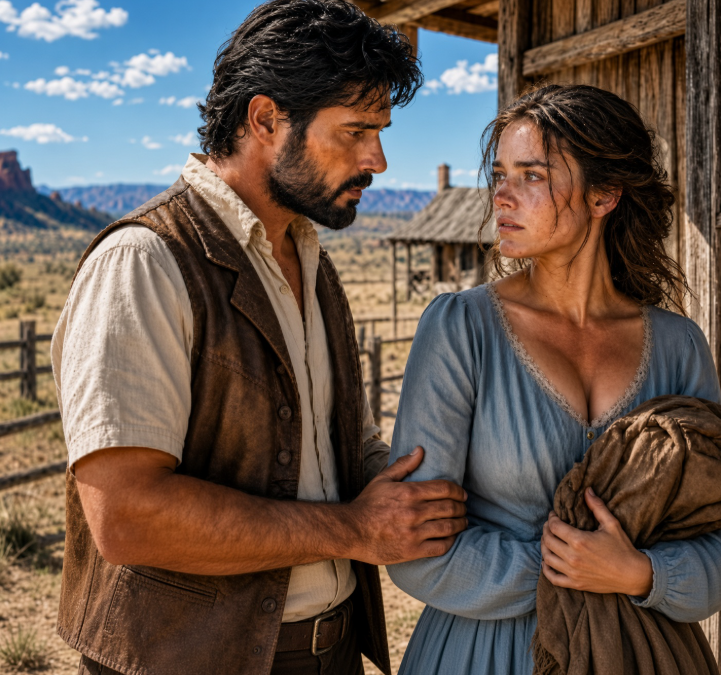
PART2:
He had never been much good at helping speech along. Silence came naturally to him, sometimes too naturally. He knew that about himself.
Eda took another small drink.
“I was running toward California. Sacramento, specifically. I have a cousin there. Catherine. She wrote saying there’s work at a boarding house. A room too. A room of my own.”
Something in her mouth changed around those last words.
A room of my own.
Not greedy.
Not dreamy.
Sacred.
“She still expecting you?” Emmett asked.
“I believe so.”
“You believe so?”
Eda looked down at the cup.
“I arranged letters through general delivery stops. Last one said the room would be held. But roads are longer than letters think they are.”
Emmett understood that more than he expected to.
Eda had come from Missouri originally, eldest daughter of a farming family that had slowly collapsed under debts, drought, and the kind of quiet despair that settled over people who had worked the same land for generations and watched it stop giving back.
Her father had died owing more than the farm was worth.
The debts surfaced one by one after the funeral, like stones turning up in a field everyone thought had already been cleared.
Her mother moved in with a sister in St. Louis.
PART3:
Eda spent the months after the farm sale watching a woman she had admired her whole life shrink into the spare room of someone else’s house, growing smaller by the week inside a life that no longer belonged to her.
So Eda left.
Not dramatically.
Not rebelliously.
She left because if the life behind her was gone entirely, she might as well build the next one as far from Missouri as the continent allowed.
She worked her way west in stages.
Six months cooking for a railroad crew in Kansas, where she learned to feed forty men three times a day on supplies that arrived late more often than they arrived on time.
Four months in a hotel kitchen in Albuquerque, where the head cook taught her to make green chile stew good enough that guests remembered it months later, and where she learned to navigate a kitchen in Spanish nearly as fluently as in English.
A three-month stretch at a cattle outfit near Tucson ended when the outfit folded and left her with final wages, a cousin’s letter, and a road west that had to pass through exactly the kind of desert sitting indifferent and enormous on the other side of Emmett Callaway’s fence.
“I was not planning to stop here,” she said.
“No?”
“I planned to make the next town by nightfall yesterday.”
Emmett looked out the window toward the empty horizon.
“You misjudged the distance.”
She gave him a tired look.
“Out here, everything looks closer than it actually is.”
“That’s the desert’s one real trick.”
Eda’s mouth almost smiled.
“It makes everything look possible from far enough away.”
“And up close?”
“That’s where the truth starts to show.”
Emmett said nothing.
He was thirty-two, had inherited the small ranch from an uncle he had barely known, and had spent the four years since discovering that inheriting a place and belonging to it were not remotely the same thing.
He had come west from Virginia after the war, or rather after the long, bitter aftermath of it.
He had been too young to fight by a handful of years, but old enough to watch what the war did to men who came back from it, including his father. The man returned with a silence inside him that never quite lifted, eventually settling over the whole household like weather nobody could change.
Emmett’s mother spent years trying to reach past that silence.
Cooking meals his father ate without comment.
Maintaining a house his father moved through without seeming to see.
Asking questions that received answers so short they barely qualified as language.
Emmett watched the effort slowly exhaust her in ways she never complained about.
He left at eighteen.
Not from anger.
From a quiet, persistent understanding that staying inside a house shaped by someone else’s grief was teaching him to mistake silence for peace. If he did not leave while he still knew the difference, he feared he might stop being able to tell them apart entirely.
His uncle’s ranch came by letter five years later.
A small operation on hard land nobody else in the family wanted.
The kind of place that required more stubbornness than skill to keep running and rewarded both in roughly equal measure.
Emmett accepted because he needed something under his hands that he could build and point to and say truthfully was his own.
The land was harsh.
Dust, creosote, cactus, and red rock in every direction, softened only by seasonal rains that turned dry washes into violent rivers and coaxed impossible wildflowers from ground that looked dead eleven months of the year.
The trouble was that four years of building alone in the desert had done something to him he had not fully noticed until Eda arrived at his fence.
The ranch functioned.
The cattle survived.
The fence held.
But the man inside the house had gradually become so accustomed to solitude that he had stopped noticing the weight of it.
The same way his father had stopped noticing the silence.
That parallel, once it occurred to him while watching Eda drink water at his kitchen table, frightened him in a way the desert never had.
He offered her the spare room for the night.
Then for a second night when the heat showed no sign of breaking.
Then, without either of them discussing it formally, for the rest of the week while she recovered the strength the desert crossing had cost her.
Eda had arrived in worse shape than she admitted at the fence.
The dehydration was serious enough that Emmett, who had seen men collapse from less in that country, kept a careful eye on how much water she drank for the first two days without mentioning he was doing it.
He refilled her cup before it emptied.
Not fussing.
Not hovering.
Just the way he would keep water in front of a horse ridden too hard and too far.
She slept fourteen hours the first night and ten the second, her body claiming rest with the desperate urgency of something that had been running empty considerably longer than a single desert crossing could explain.
Emmett noticed the details.
The sunburn across her nose and forehead.
The cracked skin at the corners of her mouth.
The way her hands shook slightly when she lifted the cup, not from fear but from the tremor of muscles that had been clenched too long and were only now remembering how to let go.
He said nothing about any of it.
A woman who had survived what the desert between Tucson and Red Bluff could do to a person in July did not need commentary on her own condition.
She needed water.
Shade.
And the dignity of not being stared at while she recovered.
By the third day, she was up and moving.
By the fourth, she had begun reorganizing his kitchen with the practiced efficiency of a woman who had spent two years making other people’s kitchens functional.
Emmett stood in the doorway, watching with mild bewilderment as she relocated his flour to a shelf it had never occurred to him to use.
“You don’t have to do that.”
“I know I don’t have to.”
She did not turn around.
“But if I sit still much longer, I’ll lose my mind, and your kitchen needs help more urgently than I do at this point.”
“That bad?”
Eda reached behind the stove and produced a can of beans so dust-covered it might have been excavated from a ruin.
“I found this back there.”
Emmett stared.
“I wondered where that went.”
“That is not the defense you think it is.”
“How old is it?”
“I believe it may predate the territory itself.”
He tried not to laugh.
Failed.
The sound surprised both of them.
It came out rough from disuse, as if his chest had forgotten the mechanics and needed a moment to recall them.
Eda looked at him over her shoulder.
“There,” she said.
“What?”
“You do know how.”
“How to what?”
“Make a noise that is not practical.”
Emmett shook his head and stepped back from the doorway.
He went outside under the excuse of checking the troughs.
But for the rest of that morning, he kept thinking about the laugh.
How strange it had felt.
How unfamiliar.
How much of himself he had allowed to go unused simply because there had been no one around to notice its absence.
The week stretched into two.
Then three.
The road to California sat between them like a question neither wanted to ask aloud.
Eda’s strength returned fully, and with it the restless competence Emmett began to recognize as her most fundamental characteristic. She could not sit still in a room without finding something to improve, fix, clean, sharpen, sort, or reorganize.
He found it equally admirable and slightly terrifying.
Most of what she improved had been in a state of comfortable neglect he had stopped noticing years ago.
She fixed the kitchen window first.
It was not broken, only so caked with dust that morning light barely penetrated. She scrubbed it clean on her third day with a determination that suggested she took the grime personally.
The difference was immediate.
Startling.
The kitchen, which Emmett had spent four years experiencing as a dim, functional room where he ate meals he did not taste, suddenly filled with a golden desert morning light he genuinely had not known was there.
He stood in the doorway that first clean-window morning, coffee in hand, staring at his own kitchen as if he had never seen it before.
Eda, watching from the stove, said nothing.
But something in her expression suggested she had been waiting for exactly that reaction.
“You’ve been alone too long,” she told him later that evening.
They were sitting on the porch, watching the mesas take their last colors before dark. The deep reds went purple. The purple went black. The desert settled into nighttime stillness in a way that never stopped feeling to Emmett like the land itself exhaling.
He looked at her.
“Is that a diagnosis?”
“An observation.”
“Those are often worse.”
She folded her hands in her lap.
“Not in a way that’s broken you. More like a fence post that still stands, but has gone soft inside without anyone noticing.”
He considered that.
“That is a hard thing to hear from a woman sitting on my porch.”
“I know.”
“You planning to soften it?”
“No.”
He almost laughed again.
Eda looked toward the darkening west.
“I would rather say it plainly than pretend I haven’t noticed. I have spent two years working in rooms I did not own, watching people who stopped seeing the rooms they lived in. You are not the first man I have met who built something solid and then forgot to look at it.”
He had no answer.
Because she was right.
The ranch was a mechanism Emmett kept running.
Not a life he was actively living.
He fed cattle.
Mended fence.
Cooked meals.
Ate alone without tasting.
Slept and rose and worked and slept again.
Somewhere in four years of that rhythm, the purpose underneath it had drained away quietly, leaving the motions intact but the meaning missing.
He looked toward the kitchen window, now clean enough to catch the last of the dying light.
“You always this direct?”
“No.”
“When are you indirect?”
“When there is no use being direct.”
“That sounds like something a direct person would say.”
She smiled faintly.
“You asked.”
He had.
That was becoming a habit around her.
The cousin’s letter arrived at the Red Bluff post office three weeks into Eda’s stay, forwarded through the chain of general delivery stops she had arranged before leaving Tucson.
She read it at Emmett’s kitchen table in the warm morning light.
He knew what it was before she said anything.
He saw it in the way her fingers stilled on the page.
The letter was the kind Eda had read and reread in her mind a hundred times across two years of walking west, proof that the future she was working toward was real, not imaginary.
Everything she had walked toward for two years sat in an envelope on a rancher’s kitchen table in Arizona, exactly as promised, waiting for her to simply keep walking.
“Good news?” Emmett asked.
His voice carried the careful neutrality she had learned to recognize as the register he used when bracing for something.
“The job is still there,” she said.
He nodded.
“The room too.”
Another nod.
“Everything I came west for.”
“Then that’s what you should do.”
He stood.
His chair scraped hard against the floor.
Then he walked out toward the corral without looking back.
The screen door closed behind him with a sound that seemed, in the quiet kitchen, considerably louder than a screen door had any right to be.
Eda sat with the letter a long time.
The desert light shifted from gold to orange through the window.
She held everything she had been working toward for two years in her hands and discovered that it no longer felt like enough.
Not because Sacramento had changed.
Because she had.
She found Emmett at the corral an hour later.
He leaned against the fence rail, watching the mesa as he did most evenings, though there was something different in the set of his shoulders. A tension she had not seen from him before, as though the careful, unhurried steadiness he had shown her for three weeks had reached the limit of what it could carry without cracking.
“You don’t have to save me,” she said.
He did not turn.
“I want that to be clear. I have a plan. I have a place to go. I am not stranded here, and I am not staying because I have no other choice.”
The evening wind moved dust through the corral.
“Whatever is happening between us—and something is, Emmett, whether either of us has been brave enough to call it by name—I need you to know it is not because I need rescuing.”
Emmett was quiet so long she thought perhaps she had asked too much of him.
Then he lowered his head.
“Maybe I need saving too.”
The words were so quiet they barely carried past the fence rail between them.
Eda did not move.
“That’s not something I would have said three weeks ago,” he continued. “Wasn’t something I knew three weeks ago. But I’ve spent four years running a ranch that works perfectly well and means nothing to me beyond the fact that it keeps my hands busy.”
He looked toward the house.
“And you have been here three weeks, and I have noticed more about this place than I noticed in four years alone. How the light comes through the kitchen window in the morning. How the mesas sound different at night when there is someone else in the house to hear the silence with.”
His mouth tightened.
“I don’t know what to do with that. I don’t know what it means exactly. But I know I noticed the difference the morning you cleaned that window, and I do not think I can go back to not noticing.”
Eda stepped closer to the fence.
“That is not rescue.”
“No?”
“No. That is someone finally pointing out you have been living in a house with the curtains closed.”
“Maybe.”
He turned then.
“But you are the one who opened them. And I am not sure I know how to close them again now that I have seen what the light looks like.”
They stood together at the fence a while longer.
The mesas had gone fully dark against a sky so thick with stars it looked to Eda as though someone had scattered a whole year’s worth of light across a single evening.
Neither said anything more.
Neither needed to.
She packed her bag that night.
The same bag she had carried from Missouri to Kansas to Albuquerque to Tucson to Emmett Callaway’s fence line. Worn soft at the handles from two years of being set down in rooms that never quite became hers, then picked up again each time the work ran out or the road called or the restless certainty that the next place might be better pulled her forward again.
She sat on the edge of the bed in the spare room with the packed bag beside her.
She thought about Sacramento.
A room of her own.
Steady work.
A cousin who had written with genuine warmth.
Everything she told herself she wanted for two years.
Everything she had survived the desert to reach.
Waiting for her to stand up and keep walking west.
She thought about Emmett too.
How he refilled her water cup those first days without being asked. The same quiet, unperformative attention he brought to watering a horse or checking a fence. Not because anyone watched, but because the need existed, and so did he.
She thought about the can of beans behind the stove and how hard he had tried not to laugh when she held it up like evidence in court.
She thought about how he watched the mesas every evening as though waiting for them to tell him something.
And how, in the past week, he had started watching her with some of that same patient attention, as if she might have an answer the mesas had not provided.
She thought about her mother, who had stayed on a failing farm for thirty years because leaving felt like admitting the work had been for nothing.
She thought about whether choosing to stay in a place because she loved what it was becoming was the same as choosing to stay because she was afraid of what she would lose by going.
The distinction mattered.
More than any other question she had faced since leaving Missouri.
She had watched what happened to a woman who stayed in a place for the wrong reasons.
She had no intention of discovering whether the same erosion waited for her at the other end of a different wrong decision.
She could not decide.
So she left the bag packed, but did not pick it up.
She went to sleep with the question sitting open beside her.
Unanswered.
She woke to the smell of coffee and eggs.
Emmett was in the kitchen cooking breakfast for two.
Something he had started doing in the second week without ever formally deciding to. One small adjustment at a time until the house felt different without either of them being able to point to the exact moment it changed.
The morning light caught steam rising from the pan and dust motes drifting slow and golden through the air.
Eda stood in the doorway longer than necessary, watching him work before he noticed her.
“You cooked,” she said.
“Seemed the thing to do.”
“Is that your full explanation?”
“Man doesn’t let a woman leave on an empty stomach, whatever else he can’t figure out how to say.”
Eda stepped into the kitchen.
“Is that what this is? A goodbye breakfast?”
Emmett set down the pan and looked at her directly.
The morning light caught the desert dust that never quite came off his skin, no matter how thoroughly he washed.
“No.”
He took a breath.
“I would like it to be a stay-for-breakfast breakfast.”
Eda did not speak.
“And a stay-for-lunch one. And a stay-for-supper one. And as many mornings after that as you are willing to give a man who only just figured out, three weeks too late, that his ranch was missing the one thing he could not build for himself no matter how many fences he mended.”
“What is that?”
She asked it softly, though she already knew.
Emmett looked around the kitchen.
The clean window.
The flour on the sensible shelf.
The table where she had first sat with shaking hands around a tin cup of water.
“Someone to eat with,” he said simply. “Someone who sees what the curtains were hiding and stays anyway. Someone who finds a can of beans behind my stove and holds it up like evidence of a crime, and somehow makes a kitchen I have eaten in for four years feel like a room I am seeing for the first time.”
Eda crossed the kitchen and took the coffee he poured for her.
The cup he had started setting out at her place each morning without comment.
The same quiet care he brought to everything.
She sat across from him.
“Then I’ll stay for breakfast,” she said. “And we’ll see about the rest.”
He nodded.
It was enough.
For now.
She wrote to her cousin that afternoon, sitting at the kitchen table with desert light pouring warm through the room.
Dear Catherine,
The room and the work you offered are the kindest things anyone has done for me in longer than I can properly express. I hope you will understand when I tell you I found a reason not to need them anymore.
Not because the need disappeared.
Because something I was not looking for turned out to be worth more than the thing I was.
She sealed the letter and walked it to the post office in Red Bluff that same afternoon.
Harlan Cook, the nearest neighbor, came out of the mercantile as she passed and tipped his hat with the easy curiosity of a man who had been watching the situation at the Callaway ranch develop from a neighborly distance.
“Still here, then?”
It was not quite a question.
“Still here,” Eda said.
“Emmett’s cooking has improved since you arrived.”
“Has it?”
“Man brought me a plate of something last week that was actually identifiable as food. Hadn’t managed that in four years.”
“I take no credit for his cooking,” Eda said. “Only for moving the flour to a shelf where a human being could reach it.”
Harlan considered this.
“That’d do it.”
He went on his way.
Eda mailed the letter and walked back toward the ranch in the late afternoon heat.
Dropping that envelope into the mail slot felt like setting down the last weight she had carried since Missouri.
Catherine wrote back within the month with the practical warmth of a woman who had taken in enough strays, human and otherwise, to know when one had found its own way home without needing hers.
The room will be here if you change your mind.
But something tells me you won’t.
The months settled into a rhythm neither Eda nor Emmett had known they were missing until it arrived.
Eda’s competence in the kitchen expanded gradually into competence across the whole operation. She learned cattle work through observation, stubbornness, and an absolute refusal to do anything badly once she decided to do it at all.
Emmett found himself more than once watching her manage a section of fence or handle a difficult heifer with the same quiet efficiency she once brought to reorganizing his flour shelf.
“You’re staring again,” Eda told him one afternoon, catching him watching from across the corral.
“Admiring,” Emmett corrected.
“There’s a difference?”
“Staring is what a man does when he cannot think of anything useful to do with his hands. Admiring is what he does when his hands already finished the work and his eyes haven’t caught up.”
“That is the worst compliment I have ever received.”
“You smiled.”
“I smiled at how bad it was.”
“Give me time. I have been alone four years. The compliments will improve after practice.”
They fell into a pattern of working side by side most mornings.
Splitting the fence line between them, each taking a section and meeting in the middle.
Eda discovered that the work itself was a kind of conversation, not in words but in the shared rhythm of labor. The quiet companionship of two people who had spent long enough working alone to appreciate what it meant to have someone else’s effort running parallel to their own.
Some mornings, they barely spoke at all.
The silence between them was nothing like the silence Emmett’s father had brought home from the war or the silence Eda had grown up inside on a failing farm.
This was the comfortable kind.
The kind that meant neither of them needed to perform anything for the other.
Both knew it.
Harlan Cook stopped by one afternoon to borrow a post-hole digger and found Eda mending a section of fence Emmett had been putting off for months, working with the focused efficiency of someone who took poor maintenance as a personal insult.
“I see you hired help,” Harlan said to Emmett, who stood nearby holding wire she had not asked him to hold but that he had picked up anyway.
“She’s not hired,” Emmett said.
“No,” Harlan agreed, watching them both with mild amusement. “I don’t imagine she is.”
The desert itself, Eda discovered across those months, was not the hostile emptiness she had assumed while crossing it.
It was alive in ways she had not expected.
Wildflowers appeared after rare rains, carpeting hard ground in impossible blues and yellows for a week before heat took them back.
Sunsets painted the mesas in colors she had never seen anywhere else.
The nighttime sky was so vast and unobstructed that stars looked closer than they had in Missouri, as though the desert’s flatness brought the whole universe nearer.
She stopped missing Missouri months before.
She stopped thinking about Sacramento weeks after the letter.
What she found herself thinking about instead, watching the mesas catch evening light with Emmett beside her, was how strange it was that the place she had been walking toward for two years turned out to be a place she had never planned to stop.
Emmett asked her to marry him on the first anniversary of her arrival.
He did it at the same fence line where she had first appeared, swaying in the heat with a bundle of clothes pressed against her chest and nothing in the world except a cousin’s letter and the stubborn refusal to stop walking.
He had clearly practiced.
That much was obvious by the way he stood too straight and kept removing his hat, then putting it back on, then removing it again.
Eda let him struggle for nearly a minute before taking pity.
“Emmett.”
“Yes?”
“Are you proposing or trying to decide whether your hat has offended you?”
He looked down at the hat in his hands.
“Possibly both.”
She laughed.
He smiled, then sobered.
“I figure a year is long enough to know whether a man is worth staying for, or whether the desert just made the options look limited.”
“The desert had nothing to do with it.”
“No?”
“I had a perfectly good room in Sacramento waiting for me. I chose this dusty, disorganized ranch and its deeply impractical owner entirely on purpose.”
“Deeply impractical?”
“You stored flour on the floor, Emmett. The floor. And I found a can of beans behind your stove that I am fairly certain was old enough to vote. These are not the habits of a man who should be left unsupervised.”
“You are never going to let that go.”
“Not in this lifetime.”
“Then I suppose I should ask whether you are willing to spend that lifetime reminding me.”
Eda looked at him.
The desert wind moved lightly through the fence wire.
The mesa stood red in the distance.
“Yes,” she said. “I am.”
They married that autumn in a small ceremony at the ranch with the mesa standing red and magnificent behind them.
The same desert that had nearly killed her on the way in served, in the warm golden light of an Arizona October, as the most beautiful backdrop she could have imagined for the beginning of something she had not known she was looking for until she had already found it.
Harlan Cook served as witness and declared afterward over a glass of whiskey that he had never attended a wedding where the bride looked more at home in the landscape than the groom did.
Emmett conceded that was probably fair, given that she had reorganized the whole ranch since arriving and he had mostly let her.
Catherine came from Sacramento for the wedding, declaring the heat unconscionable and the landscape aggressively beautiful. She spent the whole visit telling anyone who would listen that she had known from the first letter her cousin was not coming to California.
She brought as a wedding gift a set of kitchen canisters properly labeled in clear handwriting.
Eda placed them on the shelf above the stove with the satisfied precision of a woman who had been waiting for exactly that level of organizational support.
In a small frame on the kitchen wall beside the window she had cleaned her first week, Eda kept Catherine’s second letter.
Not the one offering the room and work.
The one that came after.
The one that said:
The room will be here if you change your mind.
But something tells me you won’t.
It hung beside the window Emmett had mentioned at the fence.
The one that let in morning light nobody had noticed for years because the glass had been too dusty to see through.
Eda told him once, passing it on her way to start the coffee, that the letter and the window meant the same thing to her.
Proof that sometimes the thing a person has been looking for is already there, just waiting for someone to clean the glass.
Two kinds of broken met in that story, though neither looked broken from the outside.
Eda was not lost.
She had a plan.
A destination.
A cousin waiting with a room.
Honest work ahead.
She was moving forward with purpose through the hardest stretch of country the continent had to offer. She would have made it to California if the desert had not placed a rancher’s chimney smoke on her horizon at exactly the right hour of exactly the right morning.
Emmett was not failing.
His ranch worked.
His cattle survived.
His fences held.
From outside, he looked like a man who had built something solid in difficult country and should have been proud of it.
But a ranch that works and a life that means something are not the same thing.
It took a woman with dust in her hair and a tin cup of water in both hands to show him the difference.
What saved them both in the end was not grand.
It was not rescue.
It was breakfast.
A window cleaned.
A can of beans found behind a stove and held up with genuine horror.
A cup of water refilled before it emptied.
Two people who had each proven they could survive alone discovering, one ordinary morning at a time, that surviving together was a different thing entirely.
And a better one.
Not because either of them needed the other in order to function.
They had both proven, thoroughly and at considerable personal cost, that they could function alone.
But functioning and living are not the same thing.
It took a stranger at a fence line, a desert morning, and a tin cup of water to remind them both of the difference.

