A Woman Doctor Offered to Marry a Cowboy She’d Known for Just Nine Days to Keep Him Alive—When She Said, “This Isn’t Love,” He Only Smiled.
PART3:
Some evenings, Adeline told herself the mountains at least never questioned her competence.
The peaks rose magnificent and indifferent every sunset, whether the town trusted her or not. In that indifference, she found a strange comfort during the loneliest stretches of her first months in the territory, sitting alone on the porch of her small office, watching light shift across ridgelines that asked nothing from her.
Cade Ferris was the first man in Whisper Creek to seek her out directly rather than as a last resort.
He arrived at her office nine days before the wedding with a gash along his ribs and a smile too relaxed to be honest.
“Fence caught me,” he said.
Adeline looked at him.
He stood in her doorway, thirty years old, tall and broad from ranch work, his hat in one hand and one side of his shirt dark with blood he had clearly tried to hide beneath his jacket.
“Fence wire?” she asked.
“That’s right.”
“You always lie this politely, Mr. Ferris?”
His smile faltered slightly.
“I beg your pardon?”
“Sit down.”
He obeyed, though not without a faint look of amusement.
Adeline washed her hands, set out her instruments, and cut away the damaged fabric around the wound.
Her father’s training had left her with a hard clarity about injuries. Bodies told the truth even when mouths did not. Fence wire tore. It dragged. It snagged and ripped unevenly.
The wound along Cade’s ribs was clean.
Deliberate.
A blade.
Not shallow either.
She cleaned it in silence.
Cade watched her hands for a while, then looked toward the window where the mountains stood dark against the evening sky.
“Bad?” he asked.
“Bad enough that lying about it was foolish.”
“That your medical opinion?”
“That is my human opinion. My medical opinion is that you are fortunate the blade did not go deeper.”
He said nothing.
She threaded the needle.
“You should have come sooner.”
“I was busy.”
“Bleeding?”
“Among other things.”
She tied the first stitch tighter than he expected.
His jaw flexed.
“Fence wire does not cut this clean,” she said. “This is a blade wound, Mr. Ferris, and I cannot treat a wound properly if I am working from a false account of how it was made.”
Cade was quiet for a long moment.
His eyes moved again toward the window.
“A man came at me in the dark three nights back near the north pasture.”
Adeline’s hands did not pause.
“Did you see his face?”
“No.”
“Did he speak?”
“No.”
“Did he try to rob you?”
“I told myself he did.”
“That is not what I asked.”
Cade looked at her then, and something guarded shifted behind his eyes.
“No. He did not ask for money. He came at me quiet and fast.”
“And you still told everyone it was a fence accident?”
“I did not much want the whole ranch worried over a stranger with a blade wandering the property.”
“You do not believe it was a stranger.”
It was not quite a question.
Cade looked down at the bandage she had just begun tying.
“No,” he admitted. “I don’t. But I do not have proof of anything else either. Accusing family of trying to kill a man is not the kind of thing you say out loud in a town this size without considerably more than a bad feeling to back it.”
That was the first time Adeline heard the name Roland Voss.
Cade Ferris had inherited the Ferris ranch three months earlier upon his father’s death from a fever that had taken hold fast and cruel.
Elias Ferris had built the ranch from nothing across thirty hard years in the Wind River Valley. He had watched his only son grow into a capable rancher but a reckless bachelor, prone to poor judgment where cards and women were concerned, prone to the restless dissatisfaction that worried a father who understood exactly how easily a ranch could be lost to a man without steady partnership to balance his instincts.
In the final year of his life, Elias had written a clause into his will requiring Cade to marry within six months of his father’s death in order to inherit the ranch outright.
To Elias, perhaps, it had seemed like old-fashioned wisdom.
A father’s final push toward stability.
A dead man’s insistence that his son build something lasting.
But Elias had never imagined the clause might paint a target on Cade’s back.
If Cade failed to marry within that window, the will specified the ranch would pass instead to Roland Voss, a cousin on Elias’s late wife’s side.
Cade described Roland as the kind of relative a family mentioned only when explaining why no one invited him to anything.
Roland had drifted between failed ventures across three territories, always neatly dressed, always short of money, always carrying some explanation for why fortune had failed him through no fault of his own.
He had arrived in Whisper Creek within a month of Elias’s funeral, ostensibly to pay respects.
Then he stayed.
He drank at the saloon, asked friendly questions of the ranch hands about how the operation had run under Elias, and made himself visible enough that no one could claim he was hiding anything, while remaining vague enough that no one knew exactly why he had lingered.
Cade had found the marriage clause absurd at first.
A dead man’s meddling hand reaching from beyond the grave.
He told himself he might simply let the six months lapse and accept whatever smaller inheritance the will provided for an unmarried son. He had never been in any particular hurry toward marriage, having watched enough hasty unions among friends curdle into resentment to feel entirely comfortable waiting for something he wanted rather than something a deadline demanded.
It had not occurred to him then that Roland Voss might prefer a faster solution.
That the six months Cade assumed he could let lapse peacefully might instead become a window Roland intended to make sure he never lived to see close.
Adeline finished tying the bandage.
“Then let us find proof.”
Cade looked at her.
“You say that as though proof grows wild along the creek.”
“No. But men who plan crimes often leave evidence because they believe nobody is looking for it.”
“And you intend to look?”
“I intend to ask questions.”
“Why?”
She packed away her instruments with brisk precision.
“Because a man who survives one attempt rarely gets warned before the second.”
Over the next few days, Adeline began asking careful questions around Whisper Creek.
The kind of questions a doctor could ask without raising much suspicion.
How quickly had Elias Ferris declined at the end?
Had anyone noticed strangers near the Ferris property?
Had Roland Voss’s business in town ever been explained to anyone’s satisfaction?
Piece by piece, a picture emerged considerably more troubling than Cade himself had assembled.
The mercantile owner mentioned, unprompted, that Roland had asked pointed questions about the exact wording of Elias’s will within a week of the funeral. Questions specific enough to suggest he had already seen a copy rather than simply inquiring out of family curiosity.
The county clerk, when Adeline visited under the pretense of an unrelated errand, confirmed Roland had requested and received a certified copy of the will’s full text, including the marriage stipulation, a full two weeks before Cade had gotten around to reading it properly.
Dr. Holbrook, when Adeline asked carefully about Elias’s final illness, admitted the fever had come on with unusual speed for a man of Elias’s otherwise sound constitution.
Fast enough that Holbrook had wondered privately whether something in Elias’s food or water might have accelerated an illness that should have progressed more slowly. He dismissed the suspicion at the time as an old man’s overcautious imagination, having no evidence and no wish to accuse a grieving family member without cause.
The saloon keeper offered the final thread almost as an afterthought.
Roland had been seen more than once with a rough-looking stranger nobody in town could place. The two men talked low over cards at a corner table some nights, always parting separately instead of leaving together.
Nobody had thought much of it.
Adeline did.
She sat with the accumulated weight of those conversations that evening, spreading careful notes across her office desk by lamplight. Outside, the mountains faded from gold to deep purple, and the room grew quiet except for the scratch of her pen.
What had begun as a suspicious wound had become something much larger.
Something deliberate.
She brought all of it to Cade three days later.
He sat on the ranch house porch, still healing, hat tipped back, watching the late light move over the Wind River Peaks.
Adeline stood near the porch rail with her notes in hand.
“I do not think your father died naturally,” she said.
Cade went still.
“And I do not think the man who cut you in the dark was a stranger. I think Roland Voss has been working toward this ranch for considerably longer than a few months. And I think he intends to have it whether your six months run out naturally or not.”
Cade absorbed that in silence.
The mountain wind moved through the pines behind the house.
When he finally spoke, his voice carried a weight she had not yet heard from him.
“Three months left on the will’s deadline.”
“Yes.”
“If I marry before then, the ranch is mine outright. No further contest possible under the terms my father wrote.”
“Yes.”
“If I don’t—whether by choice or because I am simply not alive to make the choice—everything passes to Roland automatically.”
Adeline folded her notes.
“Clean and legal. No court likely to look twice at the transfer given how plainly the will is written.”
Cade looked toward the pasture.
“I did not want to believe it. Man is my own blood, whatever distance sat between our fathers. But a blade in the dark is not the kind of thing a man argues himself out of taking seriously. Not twice.”
He looked at her directly.
“I don’t suppose your doctoring extends to advice on staying alive the next three months.”
Adeline was quiet.
She had been turning one possibility over since the county clerk’s office. It was so practical and so improper that she had nearly refused to let herself think it through fully.
But Adeline had learned from medicine that refusing to name an unpleasant treatment did not make the illness kinder.
“There is an obvious solution,” she said slowly. “Though I imagine it will strike you as considerably more forward than anything a proper courtship would allow.”
Cade’s eyes sharpened.
“I’m listening.”
“Marry before the deadline. Roland’s scheme collapses, regardless of what he attempts afterward. A completed marriage settles the inheritance immediately and irreversibly, does it not?”
“Yes.”
“Whatever happens to you after that point, the ranch is already legally secured. It removes his entire motive for wanting you gone before the six months lapse.”
Cade looked at her for a long moment.
“You are offering to marry a man you have known nine days purely to remove a murder motive.”
“I am offering to save your life using the only tool I actually have available to me.”
“That is one way to describe marriage.”
“I am a doctor, Cade Ferris, not a bodyguard. I cannot stand watch over you every night for three months. But I can sign a piece of paper that makes killing you considerably less useful to the man trying to do it.”
His expression shifted.
“And what does this arrangement give you, besides a husband you did not ask for?”
“I have spent four months in this town watching half the ranchers ride an extra day rather than trust a woman doctor with anything serious,” Adeline said. “A married woman established as the wife of a respected rancher might find considerably more of this town willing to let her practice the medicine she is capable of providing. I am not offering purely out of charity.”
Cade’s mouth moved almost into a smile.
“That is a generous way of describing marrying a man to keep him breathing.”
“I find generosity works better when mutual.”
He looked down at the porch boards.
“I won’t have you sacrifice your future for a problem that is mine to solve.”
“My future is already being limited by men who believe competence must wear trousers. If your name helps my practice, and my name on a marriage license helps keep you alive, then perhaps we can call it a fair trade instead of a sacrifice.”
Cade looked back at her.
The last of the daylight slid gold behind the mountains. The ranch house behind them glowed faintly where someone had lit a lamp inside.
“Three months of legal marriage to save my life,” he said slowly. “In exchange for whatever standing my name might lend your practice in this town. Nothing more expected of either of us beyond that.”
“Unless we find ourselves wanting more.”
The sentence came out before she could stop it.
Cade’s smile deepened.
“Unless we find ourselves wanting more.”
They married nine days after Adeline first examined Cade’s wound.
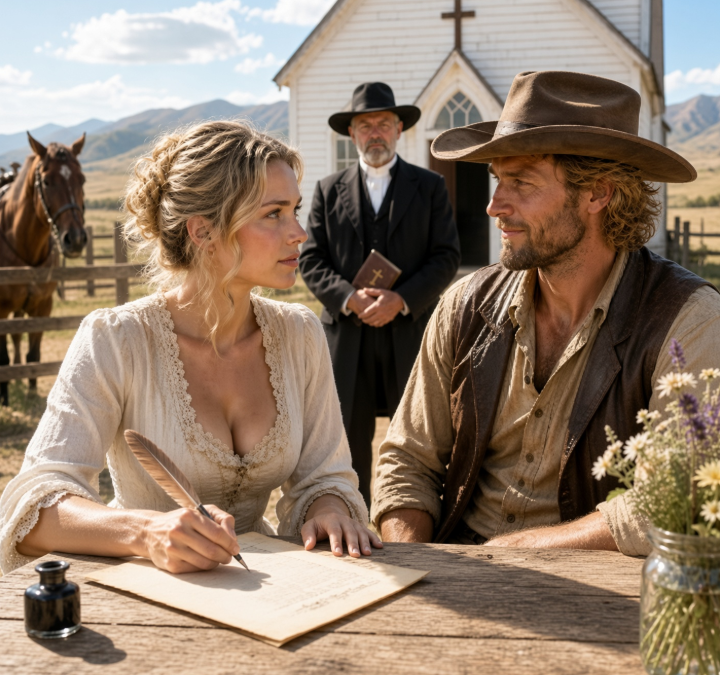
At the Little White Church.
Outside, because the morning was clear and the mountains looked too magnificent to shut behind walls.
Wildflowers Cade had picked himself sat in a jar on the small table where they signed the license. The mountain air carried sage and early summer grass. Reverend Cain asked, with the gentle delicacy of a man who had married enough couples to recognize when something unusual sat beneath a wedding surface, whether they were entirely certain of their decision, given how quickly it had all come together.
“Certain enough,” Cade said.
He held Adeline’s gaze as he said it.
Adeline nodded.
Neither explained the full shape of their certainty to a reverend who likely assumed, same as the rest of Whisper Creek would assume once word spread, that whirlwind romance rather than a murder plot had brought them to that table.
The ceremony itself was brief and plain.
No grand declarations beyond the vows territorial marriage law required.
Yet Adeline found herself repeating those ordinary words to a man she had known barely more than a week and feeling something far more complicated than the pure practicality she had insisted on at the outset.
She noticed how sunlight caught the gold in Cade’s beard.
The steady warmth in his eyes.
The fact he had not once made a jest of the arrangement or treated her proposal as foolish. He had let her frame it in practical terms because practical terms made the decision bearable.
Signing her name beside his, she knew plainly that saving his life was no longer the whole truth of what she felt.
Cade, for his part, said nothing of whatever he felt watching her sign.
He only offered that same warm, unhurried smile he had worn since she laid out her proposal.
A smile Adeline was beginning to suspect carried considerably more meaning than relief at having his life saved.
Word of the marriage reached Roland Voss within a day.
He arrived at the Ferris Ranch the following morning with the controlled fury of a man watching a carefully laid plan collapse in front of him. His horse was lathered from the hard ride out from town.
“That is a hasty arrangement,” Roland said, standing in the ranch yard, eyes moving between Cade and Adeline with barely concealed calculation. “Nine days’ acquaintance, by what I hear. Unusual decision for a man who spent thirty years avoiding exactly this kind of commitment.”
“Wasn’t your business how quickly I decided,” Cade said.
He stood his ground with an ease Adeline had not seen before. The wound along his ribs had healed enough that he carried himself without the careful guardedness of the past days.
Roland’s gaze flicked toward her.
“And you, Mrs. Ferris. I hope you understand the situation into which you have married.”
“I understand more than enough.”
“I doubt that.”
“I have often found men doubt women most when women understand them too clearly.”
Cade’s mouth twitched.
Roland’s did not.
Cade stepped forward.
“Marriage is legal and recorded at the county clerk’s office as of yesterday afternoon. The ranch is settled outright under my father’s own will. No further contest available to anyone.”
Roland’s jaw tightened.
A muscle worked near the corner of his mouth before he mastered it.
“I do not know what you are implying.”
“I wasn’t implying anything specific,” Cade said. “Simply informing you that the will’s condition is fully satisfied. There is nothing left for you to inherit here, regardless of what happens to me from this point forward. Whatever plans you made around my six-month deadline, consider them thoroughly settled.”
Roland’s composure held.
Barely.
He left without further pretense of cordiality, dust rising behind his horse and settling slowly in the yard.
Cade and Adeline stood watching him go, both understanding plainly that they had removed his motive without yet removing the anger left behind.
Sheriff Ambrose Cutter arrived three days later.
He came to the ranch kitchen with his hat in his hands and a look on his face that said the matter had turned from rumor to law.
“I received an anonymous tip,” he said. “Concerning a stranger seen leaving the Whisper Creek hardware store with a blade matching the description of your wound.”
Adeline’s notes lay spread across the table.
Dates.
Names.
Statements.
Elias’s illness.
Roland’s inquiries.
The stranger at the saloon.
The certified copy of the will.
Sheriff Cutter glanced at the stack, then at Adeline with the dry appreciation of a lawman rarely handed a case organized this thoroughly.
“Wish every witness in this county kept records half this useful, Mrs. Ferris. Might put me out of most of my work.”
“I would not want to deprive you of employment.”
“Kind of you.”
He looked to Cade.
“Description matches a man seen twice in Roland Voss’s company this past month. Combined with what your wife gathered regarding the will, and what Dr. Holbrook has now admitted about your father’s final illness, I have enough to bring Roland in for formal questioning if you are both willing to testify.”
“We are,” Cade said.
Adeline nodded.
No hesitation.
The investigation that followed confirmed considerably more than either had first suspected.
The hired man’s name was Purdy.
He had accepted payment from Roland for the attack near the north pasture. Once cornered by Sheriff Cutter and faced with the prospect of hanging alone for a scheme that had never been his own idea, Purdy became more willing to talk than Roland had anticipated.
Records surfaced of arsenic purchased under a false name.
Dr. Holbrook and a territorial physician reviewed the progression of Elias Ferris’s final illness and concluded poison had likely accelerated what had first appeared to be fever.
The saloon keeper identified Roland’s meetings with Purdy.
The county clerk confirmed Roland’s early interest in the will.
Piece by piece, the quiet plan Roland had expected to vanish into inheritance law became visible enough for a courtroom.
Cutter rode out to the Ferris Ranch himself once charges were filed.
“Man’s looking at serious time,” he said, turning his hat slowly in his hands. “Attempted murder, and murder outright if the arsenic evidence holds up the way the territorial physician thinks it will.”
Cade looked at Adeline.
Cutter followed his gaze.
“You two did the work that broke this case open,” the sheriff said. “Whatever credit the official report ends up giving a sheriff who mostly followed where Mrs. Ferris’s notes pointed.”
That evening, Cade and Adeline sat together on the porch as the day’s light faded behind the peaks.
For the first time in weeks, the air around them did not feel hunted.
“You saved my life twice over,” Cade said.
Adeline looked at him.
“Once with a marriage certificate,” he continued. “And once with a doctor’s careful eye for details a sheriff might never have thought to ask about.”
“I would say we saved it together. I only noticed the wound was not a fence accident. You trusted me enough to tell the truth instead of letting me stitch a lie closed and send you on your way.”
Cade smiled faintly.
“I had an excellent doctor.”
“That is true.”
“And a formidable wife.”
Adeline looked toward the mountains.
“That remains a legal description more than a personal one.”
“Does it?”
The question was soft.
Not pressing.
That was part of what unsettled her.
Cade never pushed their arrangement beyond the terms they had made. He gave her the best bedroom in the ranch house and took the room at the back. He introduced her as his wife with quiet respect and never with a wink or a claim. He walked beside her in town but did not take her arm unless she offered it. He treated the marriage neither as performance nor possession.
And somehow that restraint made the space between them more dangerous than boldness would have been.
The months that followed settled into a rhythm neither expected from an arrangement built on practical necessity.
Adeline’s medical practice grew steadily as Cade’s standing in Whisper Creek lent her exactly the credibility she had hoped it might. Ranchers who once rode an extra day now came to her with broken bones, infected cuts, dangerous fevers, and injuries they had first tried to ignore out of stubbornness.
Her waiting room grew busier.
Her father’s medical bag sat open more often than not.
She hired a young woman named Elsie from town to help with cleaning instruments and keeping patient notes. Elsie was sharp, curious, and entirely uninterested in being told women were not suited to medicine.
Adeline found herself watching Cade work the ranch some mornings through her office window, thinking less about the practical terms they had agreed to and more about how he brought her coffee before she finished dressing.
How he asked about difficult cases over supper with genuine interest rather than polite obligation.
How the warmth in his eyes had not wavered since the evening she proposed a marriage built entirely on saving his life.
She noticed, too, how he mended things around her small office without being asked.
A loose hinge.
A wobbling shelf.
A step that complained under patients’ boots.
One evening, she found him repairing a drawer that had stuck for weeks.
“You seem to have a genuine talent for fixing things nobody has complained about.”
Cade tightened a screw.
“Man gets in the habit of tending what is his to tend.”
She was quiet.
He looked up.
The meaning extended well past hinges and shelves.
“You have been quiet tonight,” Cade observed weeks later.
They sat on the porch where so much of their arrangement first took shape. The mountains caught the last gold light of a Wyoming sunset. Wildflowers along the fence line had grown taller than when they married.
Adeline folded her hands in her lap.
“I have been thinking.”
“That sounds serious.”
“It is.”
Cade gave her his full attention.
She looked toward the peaks.
“I proposed this marriage telling you plainly it was only to save your life. And I find myself four months later no longer entirely certain that is the whole truth of why I want to stay married to you.”
Cade did not speak immediately.
Something hopeful moved behind his careful expression.
“I have been waiting a while to hear you say something like that.”
Adeline looked at him sharply.
He smiled.
“Did not want to push you toward feeling something you had not arrived at honestly on your own. But I will tell you plainly now, since you have been brave enough to say it first. I stopped thinking of this as a practical arrangement considerably before you did.”
“When?”
“Somewhere around the third week.”
“That early?”
“I was watching you defend my life to Sheriff Cutter with the same fierce attention you bring to every patient who walks through your door. I remember thinking I had never seen anyone look at the truth as if it deserved protection.”
Adeline’s throat tightened.
“You said nothing.”
“You needed the marriage to be a fair trade, not a rescue. I could wait.”
“That seems unfair to you.”
“No. It seemed respectful of you.”
The honesty of that nearly undid her.
“Then perhaps,” Adeline said slowly, “we ought to consider staying married for an entirely different reason than the one I originally gave you.”
Cade’s smile returned.
Soft.
Warm.
Unhurried.
“Wouldn’t argue with that.”
This time, when he smiled at her, Adeline finally recognized everything that smile had carried unspoken since the morning she signed her name beside his outside the Little White Church.
Roland Voss was convicted the following spring.
Purdy testified against him in exchange for a reduced sentence. The arsenic evidence held. The hired attack was proven. The town that once whispered over Cade and Adeline’s hasty marriage now whispered over Roland’s trial with equal enthusiasm and considerably more satisfaction.
The affair settled eventually into the kind of story Whisper Creek told for years at gatherings and socials.
The marriage that began as a legal maneuver.
The woman doctor who saw what men had missed.
The cowboy who smiled when told he was being married only to stay alive.
And the practical arrangement that became, by all visible evidence, one of the happiest matches the town had witnessed in a generation.
Adeline’s practice became the finest in the county.
Eventually patients came from towns farther away than Whisper Creek itself. She trained two younger women as assistants, determined that no future doctor’s daughter would need to prove her competence quite so thoroughly as she had once proven her own.
She kept her father’s old medical bag on display in her office long after she replaced most of its contents with newer, better instruments.
When young women asked about it, she told them the bag itself mattered less than the stubbornness required to keep opening it morning after morning in a town slow to trust a woman’s hands with anything serious.
Cade rebuilt the north pasture fence line himself that first spring.
The same stretch of ground where he had nearly lost his life.
He worked the repair slowly and deliberately, as if the physical labor itself were a quiet reckoning with everything that patch of land had witnessed. He expanded the herd steadily over the years, weathering hard winters and dry summers with the patient competence his father had once worried he lacked.
More than once, he found himself grateful for a stipulation in a dead man’s will that he had once considered nothing more than old-fashioned meddling.
Some mornings, riding that same north pasture at dawn with the mountains catching first light and the whole valley quiet around him, Cade thought about how close he had come to never seeing any of it again.
He let the gratitude settle into him the same unhurried way most things did.
In his study, he kept framed the original marriage license Adeline had signed that first morning.
Not as a legal document anymore.
As a reminder, he told visitors who asked, of the exact moment a practical arrangement began quietly turning into something neither of them had planned for but both eventually chose freely and completely.
They renewed their vows on their fifth anniversary in the same Little White Church.
The Wind River Peaks still stood sharp and magnificent behind it. Wildflowers had grown thick along the same fence line where Cade once picked a modest jar’s worth for their first wedding.
This time, half the town attended openly and the other half pretended they had not arrived early to secure better seats.
Reverend Cain stood before them again, older by five years but with the same worn Bible in his hands.
When it came time for Adeline to speak, she looked at Cade and smiled.
“I told this man the first time I married him that I was only doing it to save his life.”
A soft ripple of laughter moved through the church.
Cade watched her as though no one else existed.
“I believed that when I said it. Or at least I believed it was enough of the truth to stand on. But I am not marrying Cade Ferris today to save his life.”
She paused.
“I am marrying him because somewhere in the process of saving it, I fell in love with the man wearing it.”
Cade looked down briefly, smiling in the way he did when feeling too much to trust his face with all of it.
There was something worth sitting with in the difference between the reason Adeline gave for the first marriage and the reason she gave for the second one five years later in that same church.
The first reason was true.
Entirely true.
And entirely insufficient to explain everything that happened between two people forced together by urgency and danger.
She really was only marrying him to save his life that first morning.
Love, as it turns out, does not care much whether the door it walks through was opened for practical reasons or romantic ones.
It simply finds its way in, given enough patient, ordinary mornings to work with.
Coffee brought unasked.
A shelf mended that nobody had complained about.
A woman’s fierce testimony to a sheriff standing in for words neither of them had yet found courage to speak plainly.
Cade never rushed her past practicality into feeling.
He let his affection grow quietly in the background while she needed certainty that their marriage was a fair trade rather than a rescue.
That patience made room for real love to arrive honestly, not as pressure born from danger, not as gratitude mistaken for affection, but as something chosen after the crisis had passed.
A lesser man might have mistaken her willingness to save him for devotion and pressed his advantage before she had room to discover her own heart.
Cade simply waited.
Mended what needed mending.
Brought coffee.
Smiled when she said the first marriage was only to save his life.
And let the truth arrive in its own time.
Some of the truest marriages begin with the most practical sentence one person can say to another.
Then, given enough mornings, enough work shared side by side, enough quiet respect, and enough courage to admit when the reason has changed, they become something neither person could have predicted when they first sat down to sign their names beneath a small church with mountains rising behind it.

