A Widowed Wyoming Rancher Bought the Same Slice of Apple Pie for 50 Saturdays—Then the Baker Finally Asked Him to Stay, and He Smiled…
PART2:
Her mother wiped her cheek with the back of one wrist and smiled too quickly.
“Nothing, Addie. Dough’s being stubborn.”
Even then, Adeline knew dough had not done it.
Years later, after Ruth was gone and Adeline lived alone above the small room she rented behind Mrs. Larkin’s boardinghouse, she would think about that tear often. It visited her whenever someone praised her pies as if the flavor had arrived by magic rather than labor. Whenever a man at market said, “You’ll make some lucky fellow a fine wife,” while paying three cents less than her bread was worth. Whenever a woman sighed over her preserves and said, “I don’t know how you find the time,” as if time were a meadow Adeline wandered through picking hours like flowers.
Adeline found the time by not sleeping enough.
By starting before sunrise.
By hauling her own table.
By burning her fingers.
By patching her own apron.
By smiling when people haggled over jam but never haggled with the men who sold tools, nails, or harness leather.
Every Saturday, without fail, she set her table at the edge of the market square in Benton Ridge.
Bread stacked in neat rows.
Biscuits wrapped in cloth.
Apple pies, peach pies when she could get fruit, berry pies in season, molasses cakes, cinnamon rolls, and, when butter prices allowed it, little hand pies that children stood around staring at until their mothers either bought one or dragged them away.
She baked before dawn in the rented oven behind the boardinghouse.
Then she loaded the wagon.
Then she hauled everything to the square.
Then she set the table with the same care some women set Sunday china.
Because if a woman’s work was going to be dismissed as ordinary, Adeline intended at least to make ordinary beautiful.
Most customers came and went.
Farm wives buying bread because their own ovens had failed.
Cowhands buying rolls because they missed their mothers and would never admit it.
Children with pennies.
Travelers passing through.
Widowers.
There were more widowers than anyone liked to name on the frontier.
Death had a wide road out there.
Fever, childbirth, falls, storms, infections, horses, rifles, winters, loneliness. Every church pew held absences. Every market square had men who bought food in quantities that gave them away: one loaf, one jar, one slice, no conversation beyond necessary politeness.
Graham Ellsworth had been one of those men.
The first Saturday he came to her table, Adeline noticed him because he removed his hat before speaking.
That should not have been remarkable.
It was.
Men often tipped hats to ladies they wished to impress and forgot courtesy for women selling things. Graham did not. He dismounted at the rail, tied his horse, crossed the square in long, unhurried strides, and stopped before her table with his hat in one hand.
He was perhaps forty, maybe a little younger, weathered in the way ranchers became weathered: sun at the eyes, wind in the skin, strength in the shoulders, old tiredness held quietly around the mouth. He wore a dark coat patched neatly at one cuff, boots worn but cared for, and a wedding ring.
Adeline saw the ring before she saw his eyes.
Not because she was looking for it.
Because widowers often kept their rings, and she had learned to notice the men who looked both married and alone.
“Morning, ma’am,” he said.
“Morning.”
He looked over the table with solemn consideration, as if buying pie required moral seriousness.
“What do you recommend?”
“That depends.”
“On?”
“Whether you want the answer I give everyone or the truth.”
The corner of his mouth moved.
“The truth, then.”
“The apple is best today. Peach looks prettier, but apple has better sense.”
That earned a real smile, small but unmistakable.
“I’ll take apple.”
“One slice?”
He hesitated just long enough.
“Yes, ma’am.”
She wrapped it in paper and handed it over.
He paid without haggling.
That, too, was noticeable.
The next Saturday, he returned.
“Apple again?” she asked.
“If it has kept its sense.”
“It has.”
The third Saturday, he bought apple again.
The fourth, she had a slice ready before he asked.
By the tenth, she knew he rode from six miles west, ran a modest cattle operation near the low ridge, and lived alone except for a horse named Amos who, according to Graham, was “judgmental but useful.”
By the twentieth Saturday, Adeline began cutting his slice slightly larger.
By the thirtieth, she realized pie was no longer the main reason he came.
By the fortieth, Mrs. Odell at the next stall had realized it too, along with half the market square.
Mrs. Odell sold eggs, butter, and opinions with equal commitment. She was a widow with sharp eyes, a sharper tongue, and the rare ability to make meddling feel like community service.
“That man has bought enough apple pie from you to roof a barn,” she said one Saturday after Graham rode away.
“It is good pie.”
“Pie is not that good.”
“You sell eggs. Don’t insult my profession.”
Mrs. Odell snorted.
“Profession? Child, what is happening at your table is closer to courtship by crust.”
Adeline rearranged jars of plum preserves.
“It is breakfast.”
“Then I am the territorial governor.”
“You might do a better job.”
“I certainly would. First law, widowed ranchers must say what they mean before the baker wears herself out pretending not to know.”
Adeline refused to blush.
She did anyway.
On the Saturday that changed everything, the air was warm enough to make the market slower than usual. Dust lifted beneath wagon wheels. Dogs slept in the shade. Mrs. Odell had removed her gloves before nine and complained twice that spring had “turned showy.”
Graham rode in at his usual hour.
Adeline knew his shape from a distance now.
The easy seat in the saddle.
The slight lean to the left when he dismounted.
The way he always touched his horse’s neck before stepping away.
He approached her table and tipped his hat.
“Miss Crowther.”
“Mr. Ellsworth.”
“Apple again.”
“Wouldn’t dream of changing your order this late in our acquaintance?”
His eyes warmed.
“I was about to say much the same.”
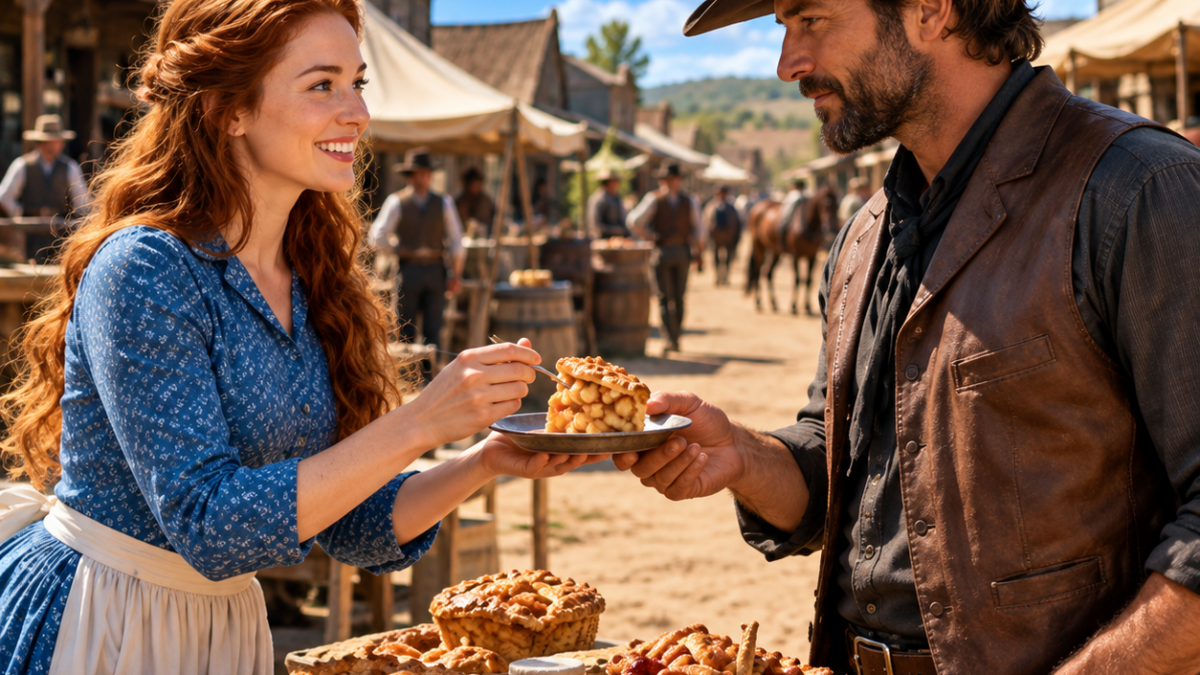
Adeline cut a fresh piece and set it on a plate instead of wrapping it in paper.
Graham looked at it.
Then at her.
“Fifty Saturdays running,” she said. “Seems only fair you eat it here for once instead of carrying it all the way home alone.”
He took his time answering.
Graham Ellsworth took his time with most things.
He looked at the plate, the bench beside the table, the market square, then back at her with an expression that settled slowly into a smile.
“Only if the baker comes with it.”
Adeline laughed.
A real laugh.
Not polite.
Not guarded.
Surprised out of her.
Mrs. Odell turned so fast she nearly spilled coffee down her dress.
Adeline set down her apron, came around the table, and sat beside Graham on the bench.
The pie rested between them on the plate.
Neither reached for it at first.
For a moment, they sat shoulder to shoulder in the slow Saturday sun, two grown people suddenly shy because a joke had carried something honest farther than either expected.
Finally, Graham picked up the fork.
“One fork?” he asked.
“I assumed you were eating alone.”
“So did I.”
Adeline should have said something clever.
Instead, she looked at his hand.
At the wedding ring.
Graham noticed.
His smile faded slightly, not with offense, but with recognition.
There it is, his face seemed to say.
The history between the words.
He offered her the first bite.
She took it.
Mrs. Odell made a sound from the egg stall that was either approval or indigestion.
Adeline ignored her.
From that day on, the visits stopped pretending to be only about pie.
Not all at once.
People think important things happen in clean turns, but most lives change by degrees. A plate instead of paper. A bench instead of a hurried farewell. A shared fork. A question held back one week and asked the next. A man lingering three minutes longer than usual. A woman setting aside the best slice before she admitted, even to herself, who it was for.
Graham still bought apple.
He still paid.
He still rode six miles.
But now he stayed.
At first, only long enough to eat.
Then long enough to ask how early she had started baking.
Then long enough to carry her flour sack from the wagon.
Then long enough to fix the market awning when a gust pulled one rope loose.
He never took over.
That mattered.
Adeline noticed.
Some men saw a woman struggling with a task and treated her competence as temporary until male hands arrived. Graham was different. If her table leg wobbled, he held the corner steady while she tightened the bolt herself. If she lifted something heavy, he asked, “Want the other end?” rather than “Let me.” If she said no, he accepted no without making her pay for it with wounded pride.
One Saturday, the leg of her table gave way under the weight of a full pie tin. Three loaves rolled into the dust. A jar of peach preserves nearly followed before Graham’s hand shot out and caught the table edge.
“I’ve got tools,” Adeline said, already pulling the small kit she kept beneath the cloth.
“I can see that.”
She knelt, tightened the joint, and felt him watching.
Not with surprise.
With approval.
“Your father teach you?” he asked.
“My father taught me which end of a hammer to hold. The rest I worked out on my own, same as most things.”
“Seems you worked it out well enough.”
He did not offer to finish.
He held the wood steady until she was satisfied.
She appreciated that more than she said.
Another Saturday, she made him an apple pie with half the usual sugar.
She told him it was for a customer who preferred things less sweet.
He ate the entire slice.
Near the end, he said mildly, “Mercantile raise sugar prices again?”
“Something like that.”
She did not tell him for weeks that she had noticed the particular face he made at anything too sweet. It was barely a face at all, just the faintest crease between his brows, gone almost before it appeared. But Adeline had always been good at noticing small things. Small things were where people hid.
Over the next weeks, it became a private game.
She changed the crust.
He noticed.
She added nutmeg.
He raised one eyebrow.
She used sharper apples.
He said nothing but finished faster.
Mrs. Odell called it “courting by crust” so often that Adeline threatened to put cayenne in her breakfast roll.
“You wouldn’t,” Mrs. Odell said.
“I know where you buy butter.”
“That sounds like a confession of intent.”
“It is a warning.”
Mrs. Odell grinned.
For a while, it was gentle.
That was the only word Adeline had for it.
Graham’s presence did not rush her.
He did not demand to know why she lived alone, why she worked so hard, why she never spoke of family beyond the mother buried three towns east and the father gone so long his absence felt more historical than personal.
She did not ask about his wife at first.
Josephine.
She learned the name from Mrs. Odell before Graham told her.
The old widow had delivered the information with unusual care.
“His wife was Josephine Ellsworth. Good woman, by all accounts. Died of fever four years back.”
Adeline had looked across the square at Graham, who stood near the livery talking to a man about fence wire.
“He still wears the ring.”
“Yes.”
“Do people expect him not to?”
Mrs. Odell’s mouth softened.
“People expect grief to do what comforts them. Wear the ring if they wish proof of devotion. Remove it if they wish proof of recovery. Either way, they want a sign they can read without asking a difficult question.”
Adeline looked at her.
“That may be the wisest thing you’ve ever said.”
“I am wise constantly. You notice only in emergencies.”
Graham told her about Josephine himself weeks later.
It came out in pieces, the way honest things do when neither person is trying to force a door open.
A late spring Saturday.
Market almost closed.
Wind pushing dust low across the square.
Adeline was wrapping unsold cinnamon rolls. Graham was tying paper around the last piece of pie he claimed was for later, though she suspected it would not survive the ride home.
“My mother was useful to everyone she knew,” Adeline said, apropos of very little.
Graham looked up.
“Useful?”
“She fed people. Mended for them. Sat with them when they were sick. Baked for church suppers. Helped with births. Watched children. Took in laundry when money got thin. Everyone praised her for it.”
“That sounds like a generous life.”
“It was.”
“But?”
Adeline tied the string too tightly around the parcel.
“I’m not sure anyone ever asked what she wanted.”
Graham said nothing.
That was one of the things she liked about him.
He could let silence remain unfinished.
Finally, he asked, “Did she know?”
“What?”
“What she wanted.”
Adeline’s hands stilled.
“I don’t know.”
That answer hurt more than she expected.
Graham looked toward the road west.
“Josephine knew.”
The name entered the space between them without ceremony.
Adeline stayed still.
He turned his hat in his hands.
“She wanted horses, music, two children, lilacs by the porch, and one day without wind ruining her hair.”
Adeline smiled softly.
“Wyoming was cruel to her, then.”
“She said so often.”
His thumb moved along the hat brim.
“Fever took her quick. Quicker than seemed fair, given how much of her there was to lose.”
Adeline did not offer easy comfort.
She knew better.
Instead, she said, “I’m sorry.”
“So am I.”
He looked down at his ring.
“Sometimes wanting another life feels like saying the first one wasn’t enough. I know that isn’t true. Knowing hasn’t made it easier.”
Adeline felt something in her chest ache.
“Grief makes rules no one agreed to, Graham.”
He looked at her.
She used his given name for the first time without thinking.
“You’re allowed to stop obeying them whenever you’re ready,” she said.
His face changed.
Not dramatically.
But enough.
As if some locked room inside him had heard a hand on the knob.
He did not answer.
He only nodded once, took the wrapped pie, and rode home more slowly than usual.
After that, something tender and dangerous settled between them.
Graham nearly invited her to the ranch in July.
He got as far as, “You might like to see the—”
Then courage failed him.
“The new foal,” he finished.
Adeline let him have the retreat.
“I’d like to see a foal sometime.”
Both of them understood perfectly well that was not what he had almost asked.
He rode away that day with regret sitting visibly in his shoulders.
The following Saturday, Adeline set aside the best slice before sunrise.
By noon, it sat untouched.
She told herself it meant nothing.
A rancher could be delayed by anything.
A loose fence.
A sick cow.
A difficult calving.
A lame horse.
Weather.
Work.
Life.
By closing, she sold the slice to a freckled boy with two pennies and the ability to look tragically hungry.
The second Saturday Graham did not come, Adeline’s hands began betraying her.
She dropped a loaf.
Miscounted change.
Tied string badly.
Mrs. Odell watched her from behind a basket of eggs.
“Go,” the widow said.
Adeline looked up.
“What?”
“You know the road?”
“Yes.”
“Then go.”
“I have a table.”
“I have eyes and two hands.”
“You have your own stall.”
“I also have a soul, though I try not to advertise it.”
Adeline stared west.
“He may simply be busy.”
“He may be. Then you’ll ride home irritated and alive. Better than sitting here imagining him dead.”
Adeline closed her table early.
She left unsold bread with Mrs. Odell and rode west before she fully admitted that was what she meant to do.
The ride felt longer than six miles.
Past the dry creek bed.
North at the split cottonwood.
Three miles toward the low ridge.
Every landmark Graham had mentioned in casual conversation returned to her with frightening clarity. How many times had he described this road? How carefully had she listened while pretending not to collect pieces of his life?
When the Ellsworth fence line came into view, she almost turned back.
Then she saw the horse.
Unsaddled near the yard, grazing with complete indifference.
A horse loose near a silent house was not nothing.
Adeline urged her mare forward.
“Graham?”
No answer.
She dismounted near the porch.
The yard looked neglected, but not abandoned. A bucket overturned near the trough. A length of rope tangled by the fence. A hat lying in the dust near the rail.
Then she saw him.
Half collapsed against the fence, one hand gripping the lower rail, face flushed with fever, trousers dark near one leg where a bandage had stiffened around an infected cut.
For one second, fear emptied her.
Then she moved.
“Graham!”
His eyes opened halfway.
“Adeline?”
The relief in his voice frightened her almost as much as the wound.
She knelt beside him.
“What happened?”
“Fell.”
His voice was rough.
“Horse spooked. North pasture.”
“How long ago?”
He closed his eyes.
“Few days.”
“Few days?”
“Been meaning to get into town.”
“You have been meaning to for two Saturdays,” she snapped, already working at the stiff bandage with shaking hands. “That is considerably longer than meaning to generally allows a man.”
His mouth twitched weakly.
“Missed pie.”
“You are not charming enough to die.”
That made him give a breath that almost became a laugh, then turned into pain.
The wound was bad.
Too bad.
The skin around it was angry, swollen, hot beneath her fingers. The bandage smelled wrong. The fever in his face told her what the wound already had.
Infection.
Adeline knew cuts, burns, kitchen injuries, fever care, poultices, cleaning, watching. She did not know enough to manage this alone, and unlike some proud men she had known, she did not mistake courage for pretending otherwise.
First, she had to get him inside.
Graham was heavy.
Not just tall-heavy.
Rancher-heavy.
All bone, muscle, stubbornness, and poor decision-making.
She got her shoulder under his good arm and half walked, half dragged him toward the house, cursing under her breath the entire way.
“You cursing me?” he muttered.
“Yes.”
“Fair.”
“You live six miles from town and decide bleeding alone is a management strategy?”
“Didn’t decide.”
“No, thinking appears to have left early in the process.”
Inside, she got him onto the bed.
The house struck her even in urgency.
It was too quiet.
Not simply bachelor-untidy. Graham was not careless. The place was ordered, but joylessly. Flour, coffee, salt, and little else in the pantry. One plate set near the basin. One chair used at the kitchen table, the other pushed against the wall. A woman’s shawl hanging by the door, faded not from wear but from waiting.
Josephine.
Adeline saw it, understood it, and did not touch it.
She heated water.
Cleaned what she could.
Changed what she could.
Then stepped outside and shouted across the near pasture until a boy from the Ferris place, twelve and alarmed, came running.
“Ride for the doctor,” she ordered. “Tell him Graham Ellsworth has an infected leg wound and fever. Tell him to bring proper dressings. Say Adeline Crowther sent you and that if he dawdles, I’ll tell every woman in Benton Ridge exactly how slowly he answers calls.”
The boy stared.
“Go!”
He went.
The doctor arrived within the hour, breathless and irritated until he saw the wound.
Then he became entirely serious.
Dr. Hale was a compact man with quick hands and a better manner than many physicians Adeline had endured. He spoke to her directly, not around her.
“How long?”
“Several days.”
“Cleaned with what?”
“Hot water. I didn’t have carbolic.”
“Good enough until I got here.”
She stepped back while he worked.
Graham woke twice, muttered once about fence line, and once said Josephine’s name.
Adeline held herself steady.
She had known the name might come.
Still, knowing did not make it painless.
Dr. Hale cleaned the wound properly, packed it, bound it, then washed his hands.
“Infection has taken hold,” he said. “Not past managing, if fever breaks. Dressing changed twice daily. Watch for spreading redness. He needs fluids. Food if he can take it. Laudanum only for worst pain. I can’t stay. Mrs. Kettering is due any hour, and I’ve been expecting that baby for two days.”
“I can manage.”
The answer came before she examined why.
Dr. Hale looked at her.
“You understand? Two nights at least. He shouldn’t be alone.”
“I understand.”
He wrote instructions, left supplies, and paused at the door.
“You’re not kin?”
Adeline looked toward the bed.
“No.”
“Hm.”
She turned.
“Hm?”
“Nothing.”
“Doctor.”
He adjusted his hat.
“Only thinking Mr. Ellsworth is luckier than his sense deserves.”
“That is already clear.”
After Dr. Hale left, Adeline stayed.
She made broth from what little the kitchen held.
Changed dressings.
Coaxed water between Graham’s cracked lips.
Sat beside him through the fever.
The first night, he drifted in and out, sometimes aware, sometimes speaking to people not in the room.
He asked once whether the north fence was holding.
“It will keep until morning,” Adeline said, pressing a cool cloth to his forehead.
He seemed to accept that.
He asked for Josephine near midnight.
Adeline closed her eyes.
Then answered gently, “Rest, Graham.”
He turned his head toward her voice.
“Adeline?”
“Yes.”
His brow eased.
That almost undid her.
The second night was worse.
Fever rose hard after sundown. His skin burned. His hands moved restlessly over the blanket as if searching for reins. He muttered about horses dead years before, fence posts, rain barrels, Josephine, and once, startlingly, apple pie.
“You are not allowed to haunt me over pastry,” Adeline whispered.
He did not hear.
Near dawn, the fever broke.
Not in a dramatic moment.
No sudden speech.
No clear-eyed miracle.
Only sweat.
Then cooler skin.
Then deeper sleep.
Adeline sat in the chair beside the bed, eyes burning from two nights without proper rest, and listened to him breathe.
When he woke properly, the first word he spoke was her name.
“Adeline.”
She looked at him.
He seemed confused, then relieved.
“You’re here.”
“I am.”
“How long?”
“Long enough to know you own two spoons, one clean shirt, and no earthly sense.”
His eyes moved over her face.
“I missed two Saturdays.”
“Yes.”
“I’m sorry.”
She almost laughed.
“You almost lost a leg and possibly your life, and that is what you’re apologizing for?”
“I knew you’d save a slice.”
That made her look away.
Because she had.
By the third evening, Graham could sit up.
By the fourth, he could argue weakly.
By the fifth, Dr. Hale declared the wound improving and told Adeline she had done good work.
“She has,” Graham said from the bed.
Adeline tied the fresh bandage more firmly than necessary.
“Ow.”
“Hold still.”
Dr. Hale hid a smile.
The doctor’s instructions required care for several more days.
Adeline stayed beyond that.
At first, because the wound needed tending.
Then because Graham was unsteady.
Then because she found she was in no hurry to stop.
The house changed while she was there.
Not because she rearranged it. She was careful. She did not move Josephine’s shawl. She did not pull the second chair out without reason. She did not treat the dead woman’s traces as clutter.
She cooked what the pantry allowed.
Then, after riding into town, she brought proper supplies and cooked better.
She aired bedding.
Scrubbed the basin.
Mended one shirt because the tear offended her.
Graham noticed everything and said little.
One evening, once he was well enough to sit at the kitchen table, he reached without ceremony for the unused chair pushed against the wall and drew it across from his own.
“You’ve stood through enough suppers,” he said. “Sit.”
Adeline sat.
Neither mentioned whose chair it had likely been.
Both knew.
They ate stew in quiet.
Then Graham said, “I haven’t let anyone close since Josephine.”
Adeline did not look up immediately.
“No?”
“Not because I didn’t notice you.”
Her hand stilled over the spoon.
“I noticed you the first Saturday you sold me that pie,” he said. “Told myself noticing wasn’t the same as allowing anything to come of it.”
“That’s grief,” Adeline said softly. “Not cowardice.”
“It feels like cowardice from inside.”
“Most grief does.”
He looked at her.
“Adeline.”
He said her name differently that time.
Not fevered.
Not confused.
Chosen.
“Graham,” she answered.
Something unofficial between them became something else.
Nothing was said beyond that.
Nothing needed to be.
The trouble began after he got better.
Trouble often does.
During crisis, love can disguise itself as necessity. A wound needs dressing. A fever needs watching. A pot needs stirring. A man needs help standing. A woman needs to stay because leaving would be cruel.
Then recovery comes, and necessity steps aside, leaving want exposed.
Adeline packed her few things on a Thursday morning.
Graham stood near the door, weight still favoring his injured leg.
“You’re leaving?”
“The doctor says you can manage dressing changes yourself now.”
“I can.”
“Then I should get back to town. Mrs. Odell has been minding my table, which means she has also been minding everybody’s business within reach.”
“She likes doing that.”
“She does. That does not make it safe.”
He tried to smile.
It failed.
She tied her bag.
The house seemed to hold its breath.
She wanted him to ask.
Not because he needed help.
Not because the pantry would be thin without her.
Not because his wound might ache.
Because he wanted her.
Graham walked her out to the horse.
The sky was wide and pale. Wind moved through the grass. His hand rested on the porch rail, knuckles tight.
He knew what he wanted to say.
She could see him failing to say it.
Finally, he spoke.
“The house needs you.”
Adeline went very still.
There are sentences that strike old bruises.
That one struck all of them.
Her mother kneading dough with tears in the flour.
Customers praising usefulness.
Men saying she would make a fine wife because they admired what she could do for someone else.
A lifetime of being valued by the work her hands produced before anyone wondered what her heart wanted.
“A house,” she said, quiet and level, “may need curtains, Graham. A man ought to know the difference between a house needing someone and a man wanting her.”
His face changed.
He heard it too late.
“Adeline—”
She swung into the saddle before he could finish.
“I’ve spent my whole life being needed. I came out here because I wanted to, not because your kitchen was short a pair of hands.”
“That isn’t what I meant.”
“It is what you said.”
He stepped forward.
She pulled the reins.
“Do not ask me to become furniture in a lonely room and call it love.”
She rode back to town without looking over her shoulder.
That was the hardest ride of Adeline Crowther’s life.
Harder than the ride out fearing him dead.
Because anger kept her upright, but grief rode behind it.
By the time she reached Benton Ridge, Mrs. Odell took one look at her face and said, “I’ll put coffee on.”
“I don’t need coffee.”
“Then I will drink it while you tell lies.”
Adeline sat in the back room of Mrs. Odell’s small house and told her everything.
Almost everything.
She did not admit how badly she wanted to turn around.
Mrs. Odell knew anyway.
“Fool man,” the widow said.
“Yes.”
“Grieving fool man.”
“Yes.”
“Those are the most dangerous. They mean well just late enough to wound.”
Adeline wrapped both hands around the coffee cup.
“He asked for the house.”
“Sounds to me he asked badly for you.”
“That difference matters.”
“It does.”
“I won’t live my mother’s life.”
“No.”
“I won’t be swallowed by a man’s need and praised for disappearing.”
Mrs. Odell leaned back.
“Good.”
Adeline looked at her.
“That’s all?”
“What did you want? A sermon?”
“I expected more.”
“Child, you already know the truth. Women don’t need advice half as often as they need a witness.”
Adeline blinked hard.
Mrs. Odell added, “That said, if he does not come apologize properly, I will sell him rotten butter at a spiritual discount.”
Adeline laughed despite herself.
For two Saturdays, Graham did not come to her table.
Adeline told herself she was glad.
Her hands worked with mechanical precision.
Bread.
Preserves.
Apple pie.
Always apple pie.
Always the best slice kept too long before she scolded herself and sold it.
Customers asked careful questions.
Mrs. Odell answered them in ways that discouraged follow-up.
“Healing,” she told one woman.
“From what?” the woman asked.
“From being a man.”
That ended that.
Graham spent those two weeks at the ranch turning Adeline’s words over until they lost their sting and revealed their truth.
The house needs you.
He had meant, I do.
He had meant, This place is unbearable now that I know what it feels like with you in it.
He had meant, The second chair looks empty again.
He had meant, I am frightened that if I ask as a man, not as a patient, you will say no.
But fear had reached for safer language.
Need.
House.
Kitchen.
Care.
He had offered her exactly the cage she had spent her life refusing to enter.
On the third Saturday, Graham rode into town.
Not to her table.
Adeline noticed because she noticed everything about him against her will.
He tied Amos near the empty building past the mercantile.
The old harness maker’s place.
She had priced it in her head a dozen times and talked herself out of it just as often. Four walls. Front windows. Space for ovens along the back. A proper counter. Shelves. A room where bread could be sold six days a week instead of only Saturdays under weather and canvas.
A dream too large to hold long in public.
She watched Graham stand in front of it holding a length of twine.
At first, anger rose.
If he thought buying a building would repair a sentence, she would—
Then he measured the doorway.
Not like a man claiming property.
Like a man trying to understand someone else’s dream accurately.
Adeline left Mrs. Odell at the table and crossed the square.
“What are you doing?”
Graham turned.
He looked tired.
Good, she thought, then immediately felt unkind.
“Getting measurements you’ll need if you decide the ovens go along the back wall.”
She stared at him.
“I asked Mrs. Holloway what she’d take for the building,” he said. “It’s less than you feared. More than you hoped.”
“I never told you what I hoped.”
“You told me enough.”
Her arms folded.
“You are not buying me a shop.”
“No.”
“You are not putting your name on it.”
“No.”
“You are not making me indebted to you so I feel obliged to forgive you.”
“No.”
“What, then?”
He held out the twine.
“I am holding this while you decide whether you want it enough to ask the bank yourself.”
She looked at the twine.
Then at him.
“That is all?”
“That is all of my part unless you ask more.”
Her throat tightened.
He continued, voice rough.
“I did not come to ask you back to my kitchen. I came because I want to see you have the one you have been talking yourself out of for a year.”
Adeline said nothing.
“I said the house needed you,” he said. “That was wrong. Cowardly too, though you may prefer foolish.”
“I prefer accurate.”
“Then cowardly and foolish.”
She almost smiled.
He took a breath.
“I don’t want you because the house is quieter without you. I want you because every place is.”
The market square continued around them.
Wagon wheels.
Voices.
Mrs. Odell pretending not to watch with the intensity of a hawk.
Adeline looked through the dusty front window of the old harness shop.
She could see it.
The counter.
The shelves.
The oven heat.
Her name painted above the door.
Not Mrs. Somebody.
Not a man’s bakery.
Crowther’s.
Hers.
“I’m afraid,” she said.
“I know.”
“Wanting something this large feels like tempting fate.”
“I know that too.”
“No, you don’t.”
He nodded slowly.
“Maybe not the same way.”
She looked at him.
“But I know what it is to leave a room empty because filling it feels like asking the world to take it back.”
That reached her.
He did not touch her.
He was learning.
“Will you hold the twine straight?” she asked.
His face changed.
“Yes.”
“Then hold it straight.”
The next week, Adeline went to the bank.
She carried records wrapped in oilcloth: market earnings, supply costs, customer lists, notes on weekly sales, estimates for ovens, flour, rent, repairs, and projected bread orders. She also carried cinnamon rolls, because she had no intention of entering a negotiation with only paper.
The bank clerk, Mr. Pritchard, was a narrow man with narrow spectacles and a heart rumored to exist in theory.
He looked over her papers.
“A bakery is a significant undertaking for an unmarried woman.”
Adeline smiled.
“A bakery is a significant undertaking for anyone.”
“Yes, but—”
“I have sold out most Saturdays before noon for three years. I have standing orders from four ranch households, two boardinghouses, and Mrs. Keene at the school. My preserves keep through winter. My bread costs less than freighted loaves and tastes better than anything your wife has bought from the mercantile since Christmas.”
His spectacles lowered.
“You are quite direct.”
“I find ovens punish hesitation.”
He looked at the cinnamon rolls.
She waited.
He ate one.
Then another half under the pretense of examining texture.
The loan was smaller than she feared.
The terms fairer than she expected.
Graham signed as guarantor, not owner.
Adeline made him read the paper twice.
“My name is nowhere on the deed,” he said.
“Correct.”
“My name is nowhere on the storefront.”
“Correct.”
“My pride will survive.”
“That remains to be seen.”
He laughed.
For the next month, Graham rode into town almost every day to help with the building.
He tore out old harness racks.
Repaired the back wall where the timber had softened.
Hauled lumber from his land.
Built the front counter by hand.
Adeline worked beside him, sleeves rolled, hair pinned badly, hands dusted with flour one day and sawdust the next.
People watched.
People talked.
People made assumptions.
Adeline corrected only the ones that mattered.
When Mrs. Bell said, “How sweet of Mr. Ellsworth to build you a bakery,” Adeline looked up from sanding a shelf and said, “He is building a counter. I am building a bakery.”
Mrs. Bell flushed.
Graham, behind her, bent over his work to hide a smile.
One afternoon, as he planed a board smooth, Adeline leaned against the unfinished counter.
“You don’t need to do all this.”
“I know.”
He did not look up.
“I would like to anyway.”
She folded her arms.
“There is a difference, I’m told, between what a person needs and what someone wants to give freely.”
He glanced up.
“I am trying to get some practice at the second kind.”
She let him continue.
Watching a man build something with his own hands for a business that would carry only her name above the door turned out to be a kind of romance she had never expected to want.
More lasting than flowers.
More intimate than flattery.
He was not making her smaller.
He was making room for her to become more fully herself.
That was when she knew she loved him.
Not at the bench with pie.
Not during fever.
Not when he said every place was quieter without her.
Those mattered.
But love settled deepest while he sanded the counter of a bakery that did not belong to him and looked proud that it did not.
He asked her to marry him some weeks later on the porch of the ranch.
The same porch where he had taken his first unsteady steps after the fever broke, leaning on her arm.
By then, his leg had healed, though a scar remained and a slight stiffness came in damp weather. The house had changed too. Not because Adeline had moved in. She had not. But Graham had begun living in it differently.
Josephine’s shawl still hung by the door for a while.
Then one evening, before he asked Adeline anything, he took it down carefully, folded it, and placed it in a small cedar trunk.
Adeline watched from the threshold.
“You needn’t hide every sign that she lived here.”
“No,” he said. “I know.”
He rested his hand on the closed trunk.
“But I think it’s time the door held something belonging to the life I’m living now.”
That was the first proposal, though neither named it.
The spoken one came later, under a pink evening sky.
Graham held her hand like something precious but not fragile.
“I spent four years telling myself I’d already had my share of luck,” he said. “That wanting more would be greed. Or betrayal. Or proof that I had not loved Josephine rightly.”
Adeline squeezed his hand.
“I do not believe that anymore.”
“No?”
“No.”
He looked toward the yard, then back at her.
“Marry me, Adeline. Not because I need tending. Not because the house is empty. Not because your hands know how to make it warmer. Marry me because I want the years ahead better with you in them. Because I love you. Because I mean to spend the rest of mine making sure you never once have to choose between being wanted and being your own woman.”
Adeline’s eyes filled.
“That,” she said, “is the correct way to ask.”
His breath caught.
“Yes?”
“Yes, Graham.”
He laughed with such visible relief that she laughed too.
Then he kissed her, and somewhere from the yard Amos snorted as if unimpressed by all human developments.
They married that autumn in the small church at the edge of town.
Half the congregation had spent the better part of a year watching Graham buy the same slice of pie every Saturday and took no small satisfaction in finally seeing the matter resolved.
Mrs. Odell sat in the second row and cried more openly than anyone expected.
When asked later, she claimed dust had gotten in her eyes, which fooled no one because she had never once been defeated by dust.
The ceremony was plain and short.
Graham’s hands were steady.
His voice was not.
Adeline’s voice was clear when her vows came due.
Afterward, there was no elaborate wedding breakfast, only cake she had baked herself two days earlier and set out on the same long table she had once used at market. People gathered around it exchanging the same knowing looks they had been exchanging all year.
Crowther’s Bakery opened one month later.
The sign above the door read:
CROWTHER’S BAKERY
BREAD, PIES, PRESERVES
No Ellsworth.
No husband’s name.
No apology.
Graham stood across the street the morning the sign went up, hands in his pockets, looking as proud as if his own name were painted there.
The first winter was hard.
Harder than either admitted at first.
A Saturday market table had low overhead. A proper shop had rent, fuel costs, repairs, flour accounts, slow Tuesdays, storm days, and the cruel arithmetic of unsold bread.
There were nights in January when Adeline sat behind the counter after closing, adding figures that refused to improve no matter how often she recalculated.
Graham rode in from the ranch whenever weather allowed, helped sweep, banked the stove, carried flour, and never once said she could close the shop and return to the market.
Not once.
That mattered.
One evening, after a week of brutal cold and poor sales, Adeline shut the ledger harder than necessary.
“Say it.”
Graham looked up from stacking wood near the back stove.
“Say what?”
“That this is too much. That the table was safer. That I should have waited. That perhaps a woman running a shop alone was too grand an idea.”
He stood.
“Do you want me to say those things?”
“No.”
“Good. I don’t believe them.”
She looked away.
“I am frightened.”
“I know.”
“If it fails—”
“If it fails, we learn what can be changed.”
“And if it cannot?”
“Then we grieve something you were brave enough to build. That is not the same as being foolish.”
Her eyes burned.
“You are inconveniently good at answering correctly now.”
“I had a harsh teacher.”
“She sounds wise.”
“She also threatened me with emotional exile over one bad sentence.”
“As she should have.”
He came around the counter and took her hand.
“We will manage,” he said.
“We will,” she replied, voice steadier. “Provided the town develops a considerably stronger appetite for bread before spring.”
Mrs. Odell helped with that.
She had retired from her egg stall, though retirement for Mrs. Odell meant moving her operations indoors where chairs existed. She took up a standing appointment at the corner table each morning, coffee in hand, and informed every person who entered exactly which bread they ought to buy, which pie had the best crust, and why a household serving mercantile biscuits deserved pity.
“Do you work here now?” one man asked.
Mrs. Odell looked offended.
“Certainly not. I am the atmosphere.”
By March, orders increased.
By April, ranch wives began coming in on Fridays for weekend loaves.
By May, children pressed noses to the window for cinnamon rolls.
By summer, Crowther’s Bakery smelled of butter, sugar, yeast, apples, coffee, and success hard-earned enough to taste like relief.
Adeline kept the first profitable ledger page folded in her Bible.
Not because she was sentimental.
Because she had learned that proof matters.
Four years passed.
The market square changed.
Benton Ridge grew.
A new livery opened.
Mrs. Bell finally stopped calling the bakery “that sweet little venture” after Adeline asked whether Bell’s husband’s law office was also a sweet little venture or whether poor bookkeeping was required first.
Graham still ran the ranch six miles west, though now he hired help during busy seasons and admitted when injuries required rest before infection took over. Adeline continued running the bakery with an efficiency that frightened suppliers and inspired young women.
She hired two girls.
Paid them fairly.
Taught them to price their work properly.
When one customer said a loaf cost too much, Adeline handed it back and said, “Then it is fortunate you are not required to buy it.”
The customer bought it.
Graham still came every Saturday.
Rain or shine.
At first alone.
Then sometimes with Adeline, if they had spent Friday night at the ranch.
Then, eventually, with a small girl on his hip.
Their daughter was named Ruth Josephine Ellsworth.
Ruth for Adeline’s mother.
Josephine because love, when healthy, did not require erasing what came before.
She had red hair like Adeline, Graham’s patient stubbornness, and Mrs. Odell’s capacity for commentary, which everyone agreed was unfortunate but entertaining.
At not yet three, Ruth reached for pie plates with the confidence of a banker collecting debt.
One bright Saturday morning, Graham entered the bakery with Ruth balanced on one arm.
The line was already out the door.
Shelves of bread stood half empty.
Cinnamon scent filled the room.
Mrs. Odell sat in her corner holding court over coffee and a roll she claimed was misshapen enough to require personal disposal.
Adeline came from the back wiping flour from her hands.
“Same order?” she asked.
Graham smiled.
“Wouldn’t dream of changing it this late in our acquaintance.”
Adeline laughed.
The same real laugh she had laughed that first morning on the bench, when a joke had carried an unspoken hope between them.
She cut two slices.
One for Graham.
One for Ruth.
Then, after considering, a third for herself.
Ruth grabbed at hers with both hands.
“Patience,” Graham said.
Ruth frowned at him.
Adeline leaned closer.
“She gets that from you.”
“I was about to accuse you.”
“You would be wrong.”
Mrs. Odell called from the corner, “The child comes by stubbornness honestly on both sides and from unrelated community influence.”
Adeline pointed the pie knife at her.
“You are the unrelated community influence.”
“Proudly.”
Graham set Ruth on the counter stool and looked around the bakery.
Adeline followed his gaze.
The front windows bright with morning.
The counter he had built.
The ovens along the back wall.
The sign above the door.
Her name.
Their life.
Not the one either had first imagined.
Not replacing what was lost.
Not erasing Josephine.
Not repeating Ruth Crowther’s quiet disappearance into usefulness.
Something different.
Something chosen.
Outside, Amos’s successor, a patient bay mare named Nell, waited at the rail, unbothered as any horse by human sentiment.
Adeline took the last bite of pie from Graham’s plate.
He raised an eyebrow.
“Thief.”
“Baker’s tax.”
Ruth echoed, “Tax.”
Mrs. Odell nearly choked laughing.
Graham looked at his daughter, then at his wife.
“You know,” he said, “I came for pie once.”
“No,” Adeline said.
He smiled.
“No?”
“You came because you were lonely and had excellent taste.”
“That too.”
She leaned her hip against the counter.
“And I offered you a slice.”
“You did.”
“And you said the baker had to come with it.”
His expression softened.
“I was braver in jokes then.”
“You were.”
“You still came.”
She looked around her bakery.
Then back at him.
“Yes,” she said. “But not because you needed me.”
“No.”
He reached across the counter and touched her flour-dusted hand.
“Because I wanted you.”
Adeline turned her hand beneath his and held on.
That was the difference.
That had always been the difference.
A woman can spend her whole life being useful and still starve for the dignity of being desired beyond what she gives.
A widower can love the dead faithfully and still make room for the living without betrayal.
A house can hold memory without becoming a tomb.
A shop can carry a woman’s name even when a man helped build the counter.
A slice of pie can be breakfast for fifty Saturdays, then become a promise.
And sometimes love does not arrive as thunder.
Sometimes it rides in every Saturday, removes its hat, orders apple pie, and waits until the baker is ready to sit beside it.
Adeline Crowther did not become Graham Ellsworth’s second chance because his house needed her.
She became his second chance because he learned to want her fully, freely, and in daylight.
Graham did not become Adeline’s future because he saved her from work.
He became her future because he stood beside her dream, held the twine straight, and knew when to step back.
And every Saturday after, when he came through the bakery door with dust on his boots and love in his eyes, Adeline cut the apple pie warm.
One slice for the widowed rancher who had learned to live again.
One for the baker who had learned she could be wanted without being swallowed.
And, more often than not, one extra for the little girl who reached for sweetness with both hands, born into a life her parents had chosen instead of merely survived.


