A Wheelchair Boy Asked 14 Bikers for $20 at a Gas Station—Then He Touched One Man’s Motorcycle and Said, “That Was My Daddy’s Bike.”
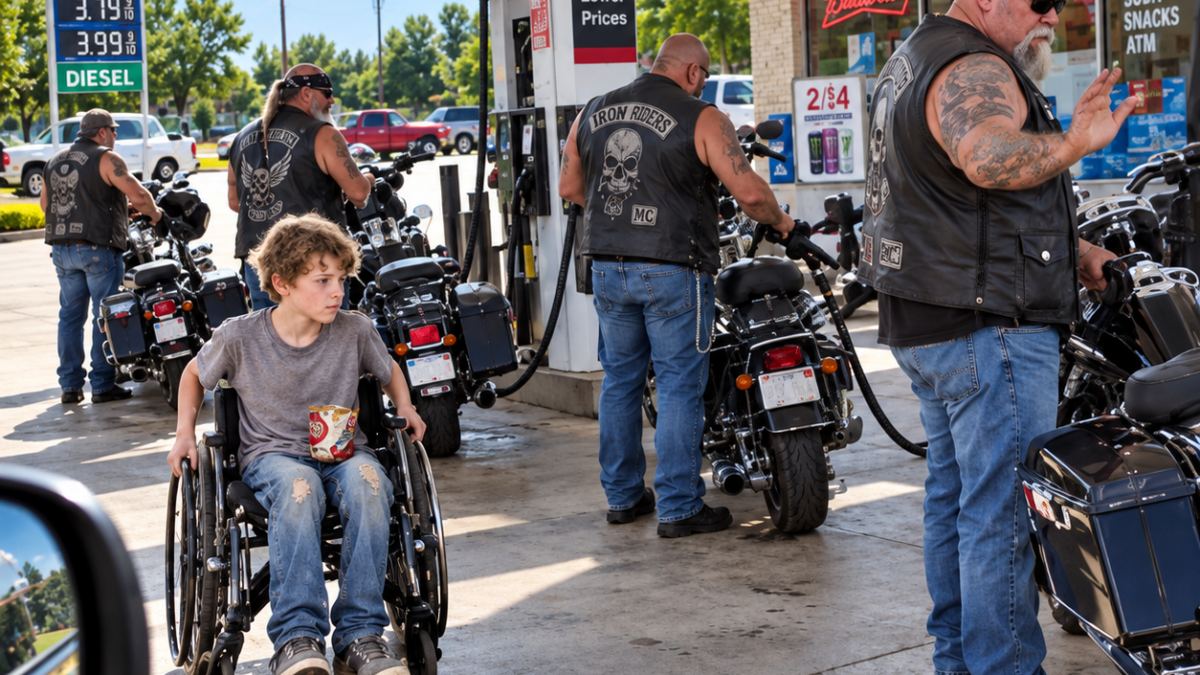
A Wheelchair Boy Asked 14 Bikers for $20 at a Gas Station—Then He Touched One Man’s Motorcycle and Said, “That Was My Daddy’s Bike.”
Fourteen bikers looked an eleven-year-old boy in a battered wheelchair straight in the face and told him no when he asked each of us for exactly twenty dollars.
I was the last one he asked—and I watched his shoulders sink after thirteen rejections before I looked away and told him, “Not today, pal.”
Ten seconds later, that boy touched a long scratch across my Road King’s gas tank and whispered six words that made every man around us stop moving: “That was my daddy’s bike.”
My name is Walt Baker.
I was sixty-seven that August afternoon, forty-eight years on motorcycles, a bad left knee, a worse right shoulder, and more road miles behind me than I cared to count.
There were fourteen of us riding west on U.S. 412 outside Tulsa, Oklahoma, after a memorial run for one of our oldest brothers.
We were hot.
Tired.
Emotionally drained.
All I wanted was air conditioning, a cold drink, and eventually my wife Joan and my recliner back home.
Then Caleb rolled toward us.
His wheelchair clicked every time the front caster turned.
Click.
Click.
Click.
One armrest was wrapped in electrical tape. The blue vinyl seat was torn. Metal braces disappeared beneath his jeans, and on his lap sat an old red coffee can with a strip of masking tape across it.
In black marker, someone had written:
BIKE FUND.
He stopped at Rooster first.
“Sir, could you spare twenty dollars?”
Rooster shook his head.
“Sorry, kid.”
Caleb nodded politely and rolled to the next man.
Same question.
Same answer.
Twenty dollars was an odd amount.
Not spare change.
Not a dollar for a soda.
Exactly twenty.
By the time he reached Dale, some of us had already started assuming the worst.
Dale looked at the wheelchair, then the coffee can.
“Parents ought to be ashamed,” he muttered, “sending a crippled kid around begging.”
Caleb heard him.
I know he did because his face changed.
But he didn’t argue.
He simply moved on.
One biker after another.
No.
Sorry.
Not today.
Can’t help you.
Thirteen men.
Then me.
I was standing beside my dark blue 2008 Road King, putting my gloves away when Caleb stopped near my saddlebag.
“Sir?”
I didn’t look at him.
“Could you spare twenty dollars?”
“Not today, pal.”
I expected to hear that wheelchair click away.
It didn’t.
When I finally turned, Caleb wasn’t looking at me anymore.
He was staring at my motorcycle.
Not at the chrome.
Not at the pipes.
Not at the size of it.
His eyes were locked on one ugly scratch running almost fourteen inches down the left side of the fuel tank.
I’d owned that bike for two years.
Bought it cheap from an estate sale outside Tulsa.
Twice, I had bought the paint to repair that scratch.
Twice, for reasons I couldn’t explain, I left it alone.
Caleb rolled closer.
“Can I touch it?”
Something in his voice made me say yes.
He reached out with two fingers and slowly traced the damaged paint.
His lower lip began to tremble.
“I’ve been saving since summer,” he whispered.
“For what?”
“The bike.”
I frowned.
“What bike?”
He looked up at me.
“This one.”
Every sound at that Oklahoma gas station seemed to disappear.
Then he told me the scratch had happened years earlier when one of the steel braces on his legs scraped the tank during a secret ride with his father.
His dad had laughed instead of getting angry.
He’d refused to repair it.
“That one’s yours now,” his father had told him.
I looked at the mark beneath Caleb’s fingers.
Then at the boy.
PART2:
“Where’s your dad now?”
His eyes dropped.
“Dead.”
Christmas Eve.
An ice storm.
His father had been a power lineman called out to restore electricity while thousands of Oklahoma families sat without heat.
He never came home.
After the funeral, Caleb’s mother eventually sold the Road King because medical equipment, a wheelchair-accessible van, and life without her husband had become too expensive.
That was the motorcycle I had bought.
The motorcycle I had thought was simply a bargain.
Then I finally asked Caleb the question all fourteen of us should have asked before judging him.
“Why exactly twenty dollars?”
Caleb looked around at every leather vest surrounding him.
“Because Daddy said real bikers always keep twenty dollars folded behind their license.”
Nobody spoke.
“For gas,” he continued. “Or for somebody who needs it worse.”
My chest tightened.
Because behind my own driver’s license was a twenty-dollar bill.
Folded twice.
Exactly where his father had said it would be.
And when I looked at the other thirteen men, I already knew what we were about to find in their wallets too.
But before any of us could process what we had just done to that boy, a woman in a diner apron came sprinting across the parking lot screaming his name.
She stopped the instant she saw my Road King.
Then her eyes found the scratch on the tank.
And the expression on her face told me the motorcycle was only the beginning of what Caleb had been trying to get back…

