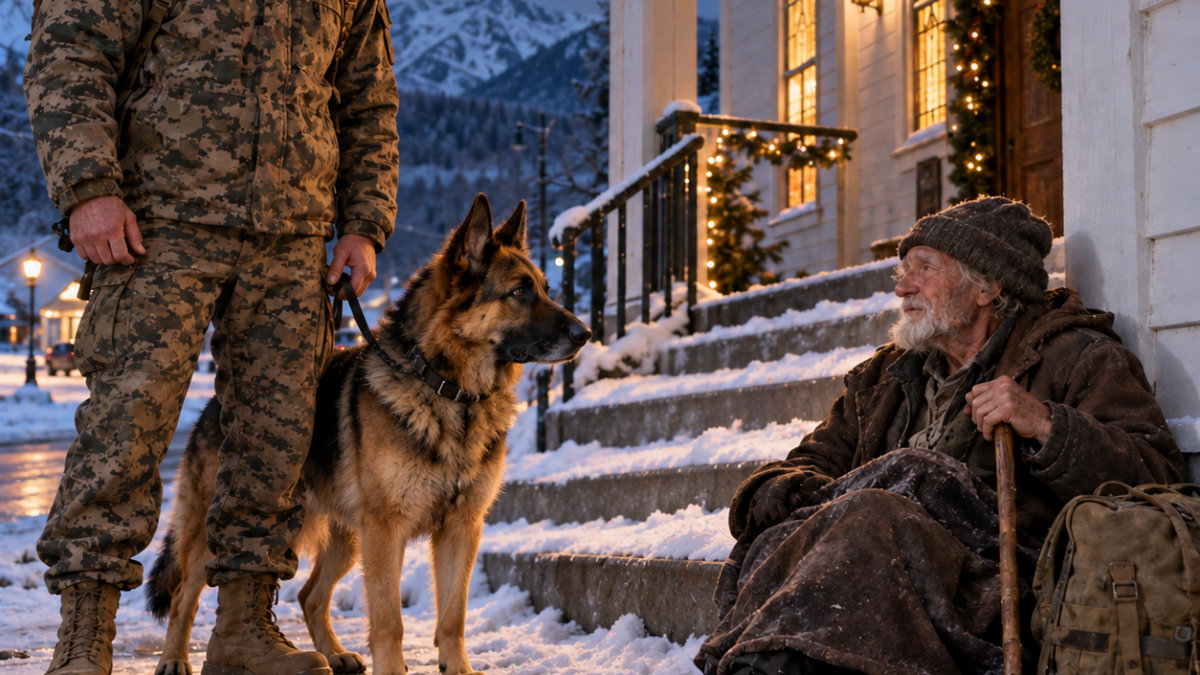
A U.S. Marine’s K9 Refused to Leave an Old Man Sleeping Outside a Church—Then a Doctor Examined Him and Realized the Entire Town Had Believed the Wrong Story.
PART3:
He nodded.
“To her.”
I did not ask who.
Not yet.
People carrying deep wounds rarely respond well to questions asked too quickly.
Instead, I reached into the paper bag I had picked up from the diner earlier and pulled out a warm container of beef stew and a piece of bread wrapped in foil.
“Eat,” I said.
Harold looked at the food.
Then at me.
“I’ll pay you back someday.”
“You already have.”
His brow furrowed.
“How?”
“You reminded my partner to smile.”
For the first time that night, Kodiak’s tail tapped gently against the wooden floor.
Harold accepted the stew with both hands.
Not like a beggar receiving charity.
Like a man determined to protect the last piece of his dignity.
He ate slowly. Carefully. As if his body needed the food more desperately than his pride wanted anyone to know.
While he ate, a woman carrying grocery bags stopped across the street.
She was in her seventies, sturdy, silver-haired, and wrapped in a long wool coat. She stared toward the porch for a moment, then crossed through the snow with visible concern.
“Oh, Harold,” she said softly. “You’re back here again.”
I stood.
“You know him?”
The woman looked at me, then at Kodiak, then back at Harold.
“Everybody knows Harold.”
That sentence sounded simple.
But something in her voice told me it was not.
“My name is Clara Whitfield,” she said. “I run the boarding house on Maple Street. You must be Sergeant Carter.”
“Mason is fine.”
She nodded politely, then looked back at Harold.
“You shouldn’t be out here in this weather.”
Harold lowered his spoon.
“I’ve slept in worse.”
“That doesn’t mean you should.”
He did not answer.
Clara’s eyes softened with a sorrow that seemed old and familiar.
“He used to own the Bennett farm,” she told me quietly. “Outside town. One of the finest cattle ranches in the county.”
“Used to?”
Harold’s hand tightened around the walking stick.
Clara glanced at him before continuing.
“His wife, Eleanor, passed three years ago. After that, people said Harold started forgetting things. His son had him placed in a nursing facility. Harold left months ago.”
“I didn’t wander,” Harold said.
His voice was quiet.
But it cut through the cold.
“I left.”
Clara closed her eyes for a moment.
I looked at Harold more carefully.
His coat was torn. His backpack was worn nearly through at the seams. His boots had cracks near the soles. But the walking stick never left his hand. Even while eating, his fingers remained wrapped around it like losing that old stick would mean losing the last piece of himself.
Beside him, Kodiak lifted his head.
The dog’s nose moved toward the walking stick.
Then he scratched the weathered wood once with his paw.
A faint sound came from inside the handle.
Not wood.
Metal.
Harold froze.
Kodiak scratched again.
This time, the sound was clearer.
A tiny rattle.
I looked at the stick.
Harold stared at it as if it had spoken.
“I’ve carried this since before my wife died,” he whispered. “I never knew there was anything inside.”
Clara’s grocery bags sagged in her hands.
I reached toward the stick.
Then stopped.
Whatever that old wood concealed had waited years to be found.
It could wait one more night.
“Harold,” I said, “you need to come inside.”
He looked toward the church doors.
“I promised Eleanor.”
“Then bring the promise with you.”
His eyes lifted to mine.
I nodded toward Kodiak.
“He won’t leave you here. And I learned a long time ago not to argue with him when he’s sure.”
Harold looked down at the dog.
Kodiak remained pressed against his leg, still as a stone wall.
Finally, the old man sighed.
“Stubborn animal.”
“Yes, sir.”
Harold’s mouth twitched.
“So was Eleanor.”
That was how Harold Bennett came back indoors.
Not because I convinced him.
Not because Clara pleaded.
Because Kodiak refused to leave.
Clara brought us to her boarding house, fussing the entire way without ever sounding unkind. She put Harold in the downstairs guest room near the kitchen, brought him dry socks, set his coat near the stove, and made more stew even though he insisted he had already eaten.
Harold kept thanking her.
She kept pretending not to hear.
I sat at the kitchen table with Kodiak resting beneath my chair, watching Harold through the doorway.
The old man did not behave like a guest.
He behaved like someone trying very hard not to become a burden.
When Clara stepped outside to bring in firewood, Harold stood too quickly and reached for the stack.
His knees nearly gave.
I caught him by the arm.
“I’ve got it.”
“I can carry wood.”
“I’m sure you can.”
“Then let me.”
“No.”
His eyes flashed.
For a second, I saw the rancher people remembered.
Not the cold old man beneath the church porch.
A man used to long days, hard weather, and animals that weighed more than trucks.
“I’m not useless,” he said.
“I didn’t say you were.”
“People hear old and decide it means finished.”
“I know.”
He studied me.
“You sound like a man who’s been called finished before.”
I looked down at Kodiak.
“Something like that.”
That night, I did not sleep much.
I rarely did.
Military life had carved an invisible clock into my body, and grief had made sure it kept terrible time.
Before dawn, I was outside clearing snow from Clara’s front steps. Then I carried firewood onto the porch. Then I repaired the loose garden latch that had rattled through the night.
I never planned those tasks.
My hands simply looked for something useful to do whenever my mind became too crowded.
When Clara came into the kitchen, she found Harold wiping the dining table.
She stopped in the doorway.
“Harold Bennett.”
He looked almost embarrassed.
“I thought I’d make myself useful.”
“You already are.”
He smiled politely.
But his eyes said he did not believe her.
I understood that look.
Some wounds make kindness uncomfortable.
Breakfast was slow and quiet.
Clara spoke about the winter festival. Harold looked out the window toward the distant white hills. Kodiak rested beside his chair as if assigned there by command.
An hour later, we took Harold to Pine Hollow Medical Clinic.
Deputy Sarah Whitmore met us near the entrance.
Sarah was thirty-six, composed, sharp-eyed, and carried herself like a woman who had made hard decisions in bad weather more than once. A pale scar crossed the back of her right hand. I later learned she got it breaking through river ice to rescue two children trapped inside a sinking pickup truck.
She trusted evidence more than rumors.
But that morning, I could tell she had arrived with the same story everyone else in town had accepted.
Harold Bennett was confused.
Difficult.
Safer under care.
The clinic doctor, Nathan Collins, had served Pine Hollow for more than thirty years. He did not rush Harold. He did not begin with memory tests or pitying questions. Instead, he talked to him about cattle prices, irrigation lines, snowfall, fence rot, hay yields, and the history of Bennett farm.
Harold answered everything.
Not perfectly.
Not quickly every time.
But clearly.
He remembered the slope of the north pasture.
The year the creek flooded.
The name of the bull that broke Daniel’s wrist when Daniel was fourteen.
The cost of feed in a drought year.
The way Eleanor had planted lilacs along the western fence because she said every working place deserved something soft at the edge of it.
Only after nearly an hour did Dr. Collins close the file on his desk.
Then he looked at Deputy Whitmore.
“I’m afraid this town may have stopped believing Mr. Bennett long before it had reason to.”
No one spoke.
Harold lowered his eyes to the handle of his walking stick, as if the years of being dismissed had taught him not to trust relief too quickly.
Dr. Collins explained that Harold was undernourished, dehydrated, and suffering from untreated high blood pressure.
But his memory, judgment, and ability to understand consequences were intact.
He had misplaced a cap.
He needed time to recall the name of one medication.
He forgot one date by a month.
Those things, the doctor said, were ordinary aging.
Not proof that a man had lost the right to his own life.
Sarah listened without interrupting.
I watched her face change.
Not dramatically.
But enough.
Certainty became discomfort.
Discomfort became shame.
“I want to review the original guardianship file,” she said at last. “Not because I’ve decided anyone is guilty. Because this evaluation does not match the story we were given.”
Harold looked at her carefully.
He had heard promises from officials before.
Hope, I could tell, was something he held lightly now.
Outside, Kodiak waited beside the clinic steps.
The moment Harold appeared, the dog rose and pressed close to his side.
Harold rested one hand on Kodiak’s neck.
Something in his face softened.
“My wife raised working dogs,” he said as we crossed the parking lot. “She used to say the best ones never guarded property first.”
“What did they guard?”
“The people who made a place worth protecting.”
On the drive back, Harold asked me to stop at a turnout overlooking the frozen valley.
Far below, rows of cottonwoods marked the edge of Bennett farm. Snow had covered the pastures, but Harold could still trace every fence line from memory.
“There,” he said, pointing with the walking stick. “That’s where my father built the horse barn. Daniel broke his arm near that lower corral. Eleanor planted lilacs near the western fence.”
His voice thinned.
“That farm knew us before we knew ourselves.”
“What happened?” I asked.
Harold did not answer right away.
When he did, his voice carried more sadness than anger.
“Grief happened. Then debt. Then fear. Then people with papers.”
He told me Daniel had once been a loyal son.
A good son.
After Eleanor died, Daniel began handling more of the ranch. He said Harold needed rest. He said the ranch finances were too much. He said temporary guardianship would protect both Harold and the land until things settled.
“I signed because I trusted him,” Harold said.
Then he looked over the valley.
“That’s the part people never understand. Betrayal only works when love opens the door first.”
Back at Clara’s boarding house, Harold noticed the front gate dragging against the snow.
He refused to rest until I brought out the toolbox.
Working side by side, he showed me how to shave the swollen edge instead of forcing the hinge.
“Wood moves,” he said. “You don’t fix it by pretending it doesn’t.”
His hands moved with old certainty.
For several minutes, he was not a man the town had forgotten.
He was a rancher teaching someone younger how to care for what had been neglected.
When the gate finally swung freely, Kodiak walked to Harold’s walking stick and scratched the polished wood again.
That same faint rattle sounded from inside the handle.
This time, Harold did not look away.
“Maybe,” he whispered, “it’s time.”
We carried the stick to Clara’s kitchen table.
The handle had a brass cap worn smooth by decades of use. I examined it carefully and found a seam so fine I almost missed it. With Clara’s sewing scissors and a patience I did not feel, I loosened the cap.
Something slid out onto the table.
A small brass key.
And a rolled piece of paper tied with faded blue thread.
Harold did not touch either one.
Clara covered her mouth.
I untied the thread and opened the paper.
The handwriting was delicate.
Eleanor’s.
Harold,
If you are reading this, then either I waited too long to tell you, or you were too stubborn to notice what Kodiak found. I kept the safe deposit key in your walking stick because you never go anywhere without it. The original deeds, my journals, and the north pasture records are in Box 17. If anyone ever tells you that you are too old to know your own land, take those papers to Evelyn Brooks. She will know what to do.
Do not let grief make you smaller.
You are still Harold Bennett.
And I still know you.
—Eleanor
Harold stared at the letter.
For a long moment, he did not breathe.
Then he sat down slowly.
Clara began to cry.
I looked away because some moments belong only to the living and the dead.
Kodiak rested his head on Harold’s knee.
Harold placed one trembling hand on the dog’s head.
“She knew,” he whispered.
His voice broke.
“She knew I would get lost without her.”
“No,” I said quietly.
Harold looked at me.
“She knew you might need a map back.”
Three days later, the rhythm of life in Pine Hollow began to shift.
Every morning before canine training, I found Harold outside walking slowly across Clara’s frost-covered yard with Kodiak at his side. He rarely spoke during those walks. Instead, he pointed toward clouds, birds, wind over the fields, and taught me how weather could be read long before it appeared on a forecast.
I listened more than I talked.
Somewhere between those slow conversations, I realized I had spent most of my adult life learning how to survive, but very little time learning how to live.
Sarah moved fast.
She contacted Evelyn Brooks, the attorney Eleanor had named in the hidden letter.
Evelyn was fifty-four, silver-blonde, calm-eyed, and known in Pine Hollow for patience rather than courtroom theatrics. Her husband had died of cancer years earlier, and since then she had quietly taken on cases involving elderly residents who had been ignored, pressured, or financially trapped by people they once trusted.
She met us in a courthouse conference room two days after we found the key.
“I spent forty-eight hours reading everything connected to Bennett Farm,” she said, spreading documents across the table. “The paperwork tells a very different story than the rumors.”
She organized the records by date.
Loan agreements.
Tax statements.
Equipment sales.
Veterinary bills.
Drought assistance applications.
Mortgage records.
Property transfer forms.
Guardianship filings.
At first, I expected a simple story.
A greedy son.
A helpless father.
A stolen ranch.
But the documents refused to give us something that easy.
Very little money had vanished into luxury.
Most of it had gone directly toward keeping the ranch alive.
Cattle prices had collapsed.
Drought had lasted almost three seasons.
Feed costs nearly doubled.
A broken irrigation pump had taken money they did not have.
Veterinary bills stacked up.
The ranch had been bleeding long before Harold was placed in the facility.
Sarah frowned as she followed the numbers.
“So Daniel wasn’t draining accounts for himself?”
Evelyn shook her head.
“If he wanted an expensive life, he chose a very poor way to get one.”
I studied the documents.
The situation no longer looked like simple greed.
It looked like years of desperation buried beneath one terrible decision after another.
That afternoon, I returned to Clara’s boarding house expecting a quiet evening.
Instead, a dark pickup sat near the front gate.
A man stood alone beside the porch with both hands buried in the pockets of his heavy jacket.
Clara met me near the kitchen.
“He’s been here twenty minutes,” she said quietly. “Won’t come inside. Said he would wait.”
I stepped onto the porch.
The man lifted his eyes.
He was in his late thirties or early forties, tired in a way that had little to do with the cold. There were dark circles beneath his eyes. His clothes were clean but worn at the cuffs. His shoulders sagged like he had spent years sleeping under unfinished thoughts.
“This was my father’s favorite place to watch sunsets,” he said softly.
I did not answer.
He looked toward the upstairs window where a light glowed inside Harold’s room.
“I’m Daniel Bennett.”
I stayed on the porch.
He gave a bitter half-smile.
“I didn’t come here to argue. If that’s what you’re expecting, I’ll leave.”
“Then why did you come?”
His eyes moved again to the upstairs window.
“I wanted to know whether he was warm.”
The answer caught me off guard.
“You could have knocked.”
“I’ve stood outside three times this week,” Daniel said. “I just couldn’t make myself walk through that door.”
Snow drifted between us.
Kodiak stepped onto the porch behind me, watching Daniel without growling.
Daniel noticed him.
“That the dog that found him?”
“He found what everyone else walked past.”
Daniel flinched.
Good.
Some truths should hurt.
He took a slow breath.
“When Mom died, everything changed faster than either of us admitted. The ranch had already been struggling for years, but she was the one holding our family together. After the funeral, Dad buried himself in work. He refused to sell cattle when the market collapsed. Refused to lease part of the pasture. Refused every suggestion that meant changing the way Granddad had run the place.”
He looked down.
“I believed one good season would fix everything too.”
“And when it didn’t?”
“The first loan was legal. The second was larger. Then came another drought. Interest. Equipment repairs. Vet bills. Every decision was made with the hope that next year would be different.”
His voice cracked.
“It never was.”
I waited.
“When Dad started forgetting small things, I convinced myself guardianship would protect him. Give me enough authority to save the ranch.”
He looked toward the dark outline of the hills beyond town.
“The worst lies aren’t the ones we tell other people. They’re the ones we tell ourselves. I kept saying I’d put everything back once we recovered. But every month there was another payment, another signature, another excuse.”
His face twisted.
“One day I realized I wasn’t protecting my father anymore. I was protecting the lie.”
Before I could answer, the front door opened behind me.
Harold stepped onto the porch.
No one had heard him approach.
Father and son looked at one another across the snow-covered yard.
Neither moved.
Neither spoke.
Years of disappointment, regret, pride, grief, and love stood between them like a frozen river.
Kodiak walked down the steps.
He stopped halfway between them.
Then he sat calmly in the snow, looking first at Harold, then at Daniel.
The gesture was so simple neither man could ignore it.
Daniel’s eyes filled.
“I’m sorry,” he whispered.
Harold closed his eyes for a long moment.
“I know you are.”
It was not forgiveness.
Not yet.
It was not reconciliation.
Not yet.
It was only the first honest sentence they had shared in years.
Then my phone vibrated.
A message from Evelyn appeared on the screen.
The handwriting analysis is finished. We need to meet first thing tomorrow.
The next morning dawned clear and sharp.
For the first time since I arrived in Pine Hollow, Harold did not stop at the edge of Bennett Farm.
He unlatched the old gate himself.
Snow covered the pastures. Several barns had collapsed under years of neglected repairs. Rusted equipment sat half-buried near a fence line. Empty corrals stood where hundreds of cattle had once gathered at sunrise.
Harold did not complain.
He walked through the property with the slow familiarity of a man greeting old friends who had grown older in his absence.
I stayed beside him without asking questions.
Some places deserve silence more than conversation.
We eventually reached a weathered horse barn leaning beneath the weight of winter. Half the roof had sagged. One wall had begun separating from its frame. Broken boards let the wind whistle through.
Harold placed one hand on the faded timber.
“My father built this barn,” he said. “I was twelve when he finally trusted me to hold a hammer instead of sweeping the floor.”
I walked back to my truck and returned with a toolbox.
We did not try to rebuild the entire barn.
We began with one loose board.
Then another.
Hour after hour, we worked side by side without urgency.
Harold explained how old pine expanded during wet winters, why warped boards should be trimmed instead of forced into place, and how every fence post leaned slightly against the prevailing wind because his grandfather believed nature was easier to understand than to fight.
I listened carefully.
Repairing a building, I realized, demanded the same patience as rebuilding trust.
Neither could be hurried.
Around midday, Sarah arrived carrying folders.
Evelyn followed in a second vehicle.
Daniel came last.
This time, he carried a worn cardboard box.
No one moved as he crossed the frozen yard.
The box looked heavier than its size suggested.
Not because of its weight.
Because of what it represented.
He placed it on the old workbench.
“I found these while cleaning my apartment,” he said quietly. “I should have brought them back a long time ago.”
Inside were notebooks, faded envelopes tied with blue ribbon, tax ledgers, livestock records, photographs, and a leather-bound journal softened by years of use.
Harold stared at the journal.
“Your mother wrote in that almost every evening.”
Daniel nodded.
“I couldn’t throw it away.”
Evelyn spread the records beside the new handwriting report.
One page explained very little.
A second raised questions.
A third revealed inconsistencies.
By the time every document had been arranged in order, the pattern could not be ignored.
The questioned signatures appeared only after the guardianship order took effect.
Harold’s own handwritten journals continued to record weather conditions, feed expenses, equipment repairs, and daily ranch operations with remarkable consistency.
He had never stopped thinking clearly.
“He was still managing the ranch in his own way,” Evelyn said. “These records show planning, reasoning, and consistent judgment over a long period.”
Daniel lowered his head.
“I kept telling myself Dad wouldn’t understand the financial decisions anymore.”
His voice trembled.
“But deep down, I knew that wasn’t true.”
Nobody answered.
Some confessions require silence before they deserve words.
That afternoon, Harold and I finished replacing the final damaged board inside the horse barn.
When the last nail was driven into place, Harold rested both hands against the repaired wall.
It still carried scars.
It still leaned.
It still needed months of work.
But it stood straighter than it had the day before.
“It isn’t perfect,” I said.
Harold smiled gently.
“It doesn’t need to be.”
Kodiak raced across the snow after a drifting pine cone.
Harold watched him.
“Most things worth saving never are.”
The hearing took place the following morning.
The courthouse stood only a few blocks from Trinity Church, but the distance between those two buildings felt larger than the town itself.
One building had witnessed the moment a forgotten old man was found beneath its roof.
The other would decide how his story would finally be remembered.
There was no spectacle.
No shouting.
No dramatic accusations.
Just paper turning, quiet footsteps, and the respectful greetings of people who had known one another for years and now had to admit they might not have known enough.
I sat near the back beside Sarah.
Kodiak lay at my feet, calm but alert.
Harold sat at the front with Evelyn.
His hands rested peacefully on the same walking stick that had accompanied him through every difficult season of his life.
He no longer held it because he feared falling.
He held it because endurance, I had learned, was sometimes stronger than strength.
Evelyn rose first.
She did not begin with betrayal.
She began with facts.
Patiently, she reconstructed the story one document at a time.
Original land deeds recovered from the safe deposit box Eleanor had protected.
Decades of handwritten journals showing daily records of livestock, weather, expenses, repairs, and harvest plans.
Medical evaluations confirming Harold possessed clear judgment and understood the consequences of important decisions.
Handwriting analysis demonstrating that multiple signatures on later property transfers had not been written by Harold.
No single document transformed the case.
Together, they formed a truth no one could ignore.
When the judge invited Daniel to respond, he stood slowly.
For several moments, he said nothing.
His eyes remained fixed on the table before him, as though searching for words that had arrived years too late.
“I never wanted to steal my father’s life,” he began quietly. “I wanted to save the only home our family had ever known.”
He explained the drought.
The debts.
The failed seasons.
The fear of losing generations of family history.
Every temporary solution demanded another signature.
Another hidden debt.
Another promise that everything would be repaired before anyone discovered what had happened.
“I kept believing the next season would save us,” he said.
His voice broke.
“Then I started believing one more lie would.”
Across the room, Harold did not interrupt.
He simply listened.
For the first time in years, father and son were no longer arguing about what had happened.
They were finally speaking about why.
When Daniel finished, the courtroom remained silent.
The judge reviewed the evidence carefully.
Then he delivered a decision measured by law rather than emotion.
The guardianship order was revoked.
The disputed property transfers would be reviewed through the proper legal process.
Daniel would remain responsible for the documents he had signed and the consequences that followed.
The ruling did not erase the years Harold lost.
It did not erase Daniel’s choices.
It did not restore trust in a single morning.
It simply returned the truth to its rightful place.
Then Harold was given the chance to speak.
Everyone expected anger.
Instead, they heard something harder.
Gratitude.
He rose slowly.
“I have already lost enough years,” he said. “I don’t want my son to lose the rest of his if he is willing to carry the weight of what he has done.”
Daniel began to cry.
Harold looked at him.
“Responsibility is not the same as hopelessness. I want him to face the law honestly. And then, if he can, I want him to become an honest man again.”
No one spoke after that.
Some lessons reach deeper than punishment ever could.
Spring came slowly to Pine Hollow.
Snow melted from the fence lines.
The creek began to move again.
The lilacs Eleanor had planted along the western fence sent up green shoots.
What remained of Bennett Farm was reorganized into something Harold had not planned and Daniel could never have imagined.
Bennett Community Farm and Skills Center.
A place where veterans, young adults, widows, retired ranchers, and people trying to find their way back from hard seasons could learn practical skills without paying with pride.
Equipment repair.
Fencing.
Livestock care.
Gardening.
Welding.
Search-and-rescue support.
Therapy dog handling.
What had once been a symbol of loss became a place where people learned how to become useful again.
When my six-week assignment ended, the sheriff asked if I would consider staying.
I thought about leaving.
I knew how to leave.
Leaving had been my specialty for most of my life.
But that afternoon, I watched Kodiak walk slowly beside Harold through the eastern pasture. The old man rested one hand on the dog’s back. The wind moved across the grass. Daniel worked near the fence line, driving nails into a repaired post, not speaking, not asking for forgiveness, only doing the next right thing.
Peace did not feel familiar.
But for the first time, it did not feel like a threat.
“I’ll stay,” I told the sheriff.
Kodiak approved of the decision before anyone else did.
Every afternoon after that, he could be found somewhere on the property.
Walking with veterans who had forgotten how to talk about war.
Lying beside widows who needed silent company more than advice.
Letting children read aloud to him in the old barn.
Following Harold as he inspected fences, gates, tools, and young people who thought they already knew how to swing a hammer.
One mild afternoon near the beginning of spring, I drove past the eastern pasture and saw Harold standing beside a damaged stretch of fence with a hammer resting against his shoulder.
I pulled over.
Before I reached him, another truck stopped nearby.
Daniel climbed out carrying a bucket of new fence nails.
Neither father nor son apologized.
Neither tried to explain the past again.
Harold simply held out the hammer.
Daniel accepted it.
For several hours, they replaced broken posts, straightened wire, and drove fresh nails into weathered boards one careful strike at a time.
Conversation remained scarce.
But the silence no longer felt empty.
It carried effort.
Humility.
And the quiet determination to rebuild what words alone never could.
Kodiak ran through the fresh grass, circled back, and sat in the middle of the fence line, looking from Harold to Daniel the same way he had looked from one man to the other that night in the snow.
Only then did I understand why my dog had refused to leave an old stranger beneath the church roof.
He had not only been leading me toward a man in danger.
He had been leading me toward a family that still deserved one more chance to become whole.
Sometimes miracles do not arrive with thunder.
Sometimes they begin with a dog who refuses to obey because obedience would mean walking away from someone who still matters.
I thought I was helping Harold reclaim his dignity.
But along the way, he helped me reclaim something too.
Purpose.
Stillness.
The courage to remain.
For years, I believed service meant running toward danger.
That was true.
But in Pine Hollow, I learned another kind of service.
Staying after the danger passed.
Listening after the story became complicated.
Choosing not to abandon people just because the truth made everyone uncomfortable.
Harold Bennett had not been a confused old man outside a church.
He had been a rancher.
A husband.
A father.
A man betrayed by love, buried under rumors, and almost erased by a town that mistook paperwork for truth.
Daniel had not been a simple villain.
He had been a frightened son who told one lie to save a home, then another to protect the first, until the lies became bigger than the house he wanted to preserve.
And Kodiak?
Kodiak had known what the rest of us were too distracted to see.
The old man beneath that church porch was still worth guarding.
Not because he was innocent of pain.
Not because his family was easy to repair.
But because life does not stop mattering when people stop asking questions.
Months later, I returned to Trinity Church with Harold and Kodiak.
The snow was gone.
The porch had been repaired.
The steps were swept clean.
Harold stood where I had first found him and looked toward the street.
“I thought that night was the end of everything,” he said.
I stood beside him.
“It wasn’t.”
“No.”
Kodiak lay down between us.
Harold smiled.
“It was the beginning of being found.”
The church bell rang once above us.
A slow, deep sound rolling across Pine Hollow.
Harold rested both hands on the walking stick Eleanor had turned into a map back to himself.
Then he looked down at Kodiak.
“Good dog,” he whispered.
Kodiak’s tail tapped once against the porch.
I looked at the old man.
At the dog.
At the town that had nearly forgotten him and was now learning how to remember better.
And for the first time in years, I did not feel like I was standing between missions.
I felt like I had arrived.
Because sometimes the life that saves you is not the one you planned.
Sometimes it is the one you follow into the snow after your dog refuses to leave.
And sometimes, the truth that shocks everyone is not that a man was betrayed.
It is that he was still worth believing.
Even after years of silence.
Even after the papers said otherwise.
Even after everyone else walked by.
Kodiak did not.
And because he stopped, so did I.

