A Tortoiseshell Cat Refused to Leave Her Owner Alone After Surgery—Then She Started Bringing Strange Little “Gifts” to the Bed.
PART2:
A little white Cape Cod with blue shutters, a deep front porch, and a maple tree that turned bright orange every October like it was trying to set the sky on fire. My mother left it to me when she died three years earlier. Her will had been simple. The house was mine. The savings account was mine. Her old jewelry box, full of costume pearls and grocery receipts she never threw away, was mine.
Michael moved in six months after the funeral.
Back then, I told myself I was lucky.
I had been thirty-four, grieving, lonely, and terrified of all the silence my mother had left behind. Michael brought noise back into the house. He brought dinners out, weekend drives, flowers he bought from the grocery store but presented like they came from Paris. He knew how to fill a room. He knew how to make people laugh. He knew how to take over without making it look like taking.
By the time I noticed that fewer and fewer things in the house felt like mine, we were already married.
Rosie was the one thing Michael never fully claimed.
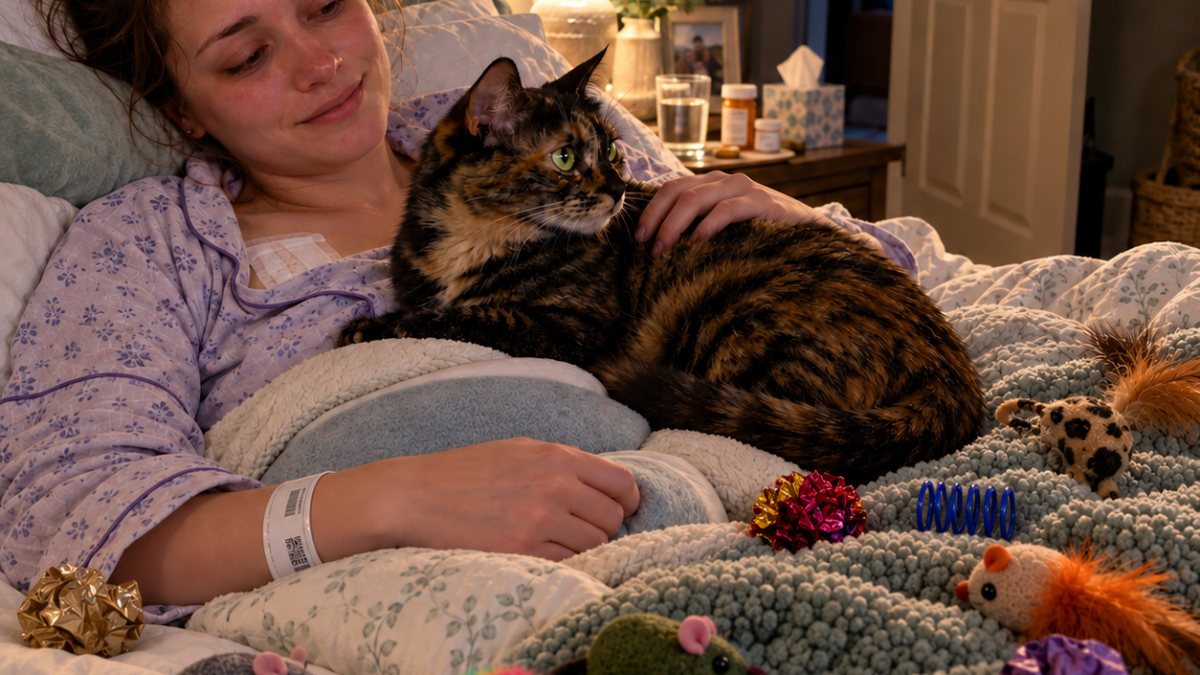
She had been my mother’s cat first, although Rosie would have objected to the word owned. She was a small tortoiseshell with a split-colored face, one side honey orange, the other smoky black, with green eyes that always looked like she had just overheard something disappointing.
My mother found her under the porch during a thunderstorm, wet, furious, and screaming at the world like it had personally offended her.
“She’s not sweet,” my mother told me the first time Rosie bit the sleeve of her cardigan and refused to let go. “But she’s honest.”
That was Rosie.
Independent. Dramatic. Selective with affection. She could spend six hours in another room ignoring me completely, then appear in the kitchen the instant she heard the lid come off a can of tuna. She hated being picked up. She loved cardboard boxes more than the expensive cat tower I bought her. She slept wherever she pleased: the back of the couch, the linen closet, the sunny square under the dining room window, occasionally my clean laundry if she felt it needed fur.
PART3:
Michael tolerated her the way he tolerated anything that did not flatter him.
“She looks at me like she’s judging my credit score,” he used to say.
“She probably is,” I’d answer.
He would laugh, but never for long.
On the drive home from the hospital, Michael kept both hands on the steering wheel and the radio turned low. I stared out the window at the gray afternoon, at bare trees and wet streets and kids walking home from school with backpacks bouncing against their shoulders.
“How do you feel?” he asked.
“Sore.”
“That’s normal.”
“I know.”
“You scared me this morning.”
I turned my head toward him. “I scared you?”
“When they took you back.” He glanced at me, then back at the road. “It hit me, you know? How fragile everything is.”
For a second, I believed him.
That was the worst part about Michael. He could put warmth into his voice like a blanket. He could say the right thing in the exact right tone, and some tired, hopeful part of me would reach for it before my wiser self could stop her.
“I’m okay,” I said.
He reached over and rested his hand on my knee. “You’re going to be.”
The procedure had been scheduled after months of pain I could no longer explain away.
At first, I blamed stress. Then bad sleep. Then hormones. Then age, as if thirty-seven were old enough for a body to start punishing a woman for existing. But the cramps got sharper. The exhaustion got heavier. Then came the bleeding that made me sit on the bathroom floor one Tuesday morning with my phone in my shaking hand, wondering whether I should call an ambulance or my husband.
My doctor ordered tests. Then imaging. Then a biopsy.
“Most likely benign,” she told me, and I held onto the word likely like a rope over deep water.
The procedure that morning had been minor compared to the terrifying things my imagination had built around it. They removed a suspicious growth. They sent tissue to pathology. They told me results would come in several days.
Several days.
Long enough for fear to become a second pulse.
When Michael pulled into our driveway, the porch light was already on even though it was only four in the afternoon. I remember the windshield wipers dragging across the glass. I remember the wet leaves plastered to the walkway. I remember Michael opening my door and saying, “Careful,” like he was speaking to a stranger carrying crystal.
Inside, the house smelled like lemon cleaner and something else.
Something sharp.
Chemical.
Not bad exactly, just unfamiliar.
I paused in the entryway, one hand braced against the wall.
“What’s that smell?” I asked.
Michael was behind me with my hospital bag. “What smell?”
“Like bleach.”
“I cleaned the bathroom.”
“You cleaned?”
He smiled. “Don’t sound so shocked.”
I wanted to smile back, but something about the house felt too neat. The mail basket by the door was empty. The throw blankets were folded into perfect squares. The dining table, usually cluttered with my work laptop, a half-dead plant, and Rosie’s unauthorized collection of stolen pens, had been cleared completely.
Even Rosie was absent.
Normally, she arrived at the sound of the front door with offended little chirps, not because she missed me, but because she believed all entrances and exits required her supervision.
“Rosie?” I called.
Nothing.
Michael shut the door. “She’s probably hiding. You know how she is.”
But I did know how she was.
And that was not how she was.
I took two slow steps toward the hallway.
A flash of orange and black appeared near the bedroom door.
Rosie stood frozen at the end of the hall, low to the ground, tail puffed slightly, green eyes fixed on me.
“Hi, baby,” I whispered.
She did not come running.
She stared.
Then she looked at Michael.
Her ears flattened.
“See?” he said lightly. “Drama queen.”
Rosie ignored him. She crept toward me, not with her usual casual arrogance, but with careful, cautious steps. When she reached my shoes, she sniffed them. Then my pajama pants. Then the hem of my oversized sweatshirt. She moved around my ankles in a slow circle, nose twitching, whiskers forward, every inch of her suddenly alert.
“I know,” I murmured. “I smell weird.”
She made a sound I had never heard from her before.
Not a meow.
Not a hiss.
A low, broken little trill.
Michael laughed from behind me. “She thinks you brought another cat home.”
Rosie’s head snapped toward him.
The sound stopped.
I should have noticed that.
I should have noticed many things sooner.
Michael helped me down the hallway to the bedroom. Rosie followed so closely that her shoulder brushed my heel. When I sat on the edge of the bed, pain flared across my lower abdomen and I sucked in a breath.
Michael set the pill bottle on the nightstand. “You need one?”
“In a minute.”
“You should stay ahead of the pain.”
“I just want to lie down first.”
He pulled the blankets back, too quickly, like he was performing care rather than offering it. I lowered myself onto the mattress inch by inch, jaw clenched, one hand pressed gently over the bandage beneath my loose shirt.
Rosie jumped onto the bed.
“Not now,” Michael said, reaching for her.
She dodged his hand so fast he caught only air.
“Rosie,” he snapped.
I opened my eyes. “Leave her.”
“She can’t be crawling all over your incision.”
“She won’t.”
That was optimism, not evidence.
Rosie had no respect for human medical boundaries.
She walked across the bed toward my side, slow and serious, and sniffed the blanket near my stomach. Her nose moved closer. Her body stiffened. She looked at me, then down at the place beneath my shirt, then back at me.
I could almost hear her thinking.
Something happened to my human.
Her paw lifted, hovered, then lowered gently onto the blanket beside me, not on me. Her claws did not come out. She leaned forward and sniffed again, then sat down with her tail wrapped tightly around her paws.
Michael stood at the foot of the bed, watching.
There was something in his face I was too drugged and sore to understand.
I thought it was irritation.
Later, I would realize it was fear.
“She needs rest,” he said.
“I know.”
“Cats carry germs.”
“She sleeps on this bed every night.”
“That was before you had stitches.”
“Michael.”
He raised both hands. “Fine. Your call.”
He said it the way he always said your call when he wanted me to remember that any bad result would be my fault.
I closed my eyes.
Rosie remained beside me.
Michael moved around the room, opening and closing drawers. I heard the rustle of paper. The soft zip of a bag. The click of his phone camera.
My eyes opened.
“What are you doing?”
He turned with the hospital folder in his hand. “Just taking pictures of the discharge instructions in case we misplace them.”
“They’re right there.”
“Claire, relax.” His smile was patient. “You’re still foggy.”
There it was.
The first time.
Foggy.
A word that would become a cage.
I let it pass because I was tired.
That evening blurred into fragments.
Michael brought soup I barely touched.
He handed me pills with water.
He dimmed the lights.
He answered a call in the hallway, speaking too low for me to hear.
Rosie never left the bed.
If I shifted, she lifted her head. If Michael entered, her ears tilted back. If he moved too close to my side of the bed, she inserted herself between his hand and my body with such silent determination that even he noticed.
“Your cat is being ridiculous,” he said around eight.
“She’s worried.”
“She’s a cat.”
“Exactly.”
He stared at me for a second, then laughed without humor. “Whatever that means.”
At ten, he said he needed to sleep in the guest room so he would not accidentally bump me during the night.
It sounded thoughtful.
It also sounded convenient.
“Okay,” I said.
He kissed my forehead again.
Rosie watched him with unblinking eyes.
When he turned off the lamp and left, she did not curl beside my feet like usual. She walked to the edge of the bed, jumped down, and positioned herself on the rug between me and the bedroom door.
At first, I thought she was just choosing a new spot.
Then the house settled.
A pipe clicked.
The refrigerator hummed.
Rain tapped the window.
Every time there was a sound in the hallway, Rosie lifted her head.
“Rosie,” I whispered into the dark. “Nobody is coming to get me.”
She did not look back.
She stared at the door.
Apparently, she was not willing to take that risk.
I fell asleep to the sight of her small silhouette guarding the threshold.
Sometime after midnight, I woke with my mouth dry and my heart racing.
At first, I did not know why.
The room was dark except for the thin stripe of light under the door. My body ached. My head floated in that heavy, unreal place between pain medication and dreams.
Then I heard it.
A floorboard.
Not the old house settling.
A slow creak in the hallway outside my bedroom.
Rosie was standing.
Her back was arched, tail low, ears flat.
“Michael?” I called.
No answer.
The door handle moved.
Just a little.
Not opening.
Testing.
Rosie let out a growl so deep and violent I barely recognized it as hers.
The handle stopped.
For three seconds, nothing happened.
Then footsteps retreated down the hall.
My hand fumbled for the lamp. Pain ripped across my abdomen as I twisted too quickly, and I cried out before I could stop myself. The lamp clicked on.
The door was closed.
Rosie stood in front of it, trembling with rage.
“Michael?” I called again, louder.
A few seconds later, his voice came from the far end of the hallway. “What?”
The guest room door opened. He appeared in sweatpants and a T-shirt, hair messy, eyes narrowed against the light.
“What happened?”
“Were you just at my door?”
He blinked. “No.”
“I heard someone.”
He rubbed his face. “Claire, I was asleep.”
“The handle moved.”
“The handle moved?”
“Yes.”
He looked at Rosie, still growling, then back at me. “You’re on painkillers.”
The words landed hard.
Not angry.
Not dismissive.
Worse.
Concerned.
Like I was a problem he had expected.
“I know what I heard,” I said.
He walked to the door and opened it wider, making Rosie jump back with a hiss. He looked up and down the empty hallway.
“See?” he said. “No one.”
“You could have gone back.”
His expression changed.
Just slightly.
“Are you accusing me of sneaking around?”
“No. I’m saying I heard—”
“You just came home from anesthesia. You took hydrocodone two hours ago. You’re exhausted.” He softened his face again. “Honey, this is exactly why they said you shouldn’t be alone.”
I stared at him.
He came toward the bed.
Rosie moved faster.
She leapt onto the mattress and planted herself against my side, facing him.
Michael stopped.
For the first time that day, the mask slipped enough that I saw something ugly beneath it.
“Get that cat off the bed,” he said quietly.
“No.”
“Claire.”
“No.”
A silence stretched between us.
Then he smiled.
Small.
Controlled.
“All right,” he said. “Try to sleep.”
He closed the door.
This time, Rosie stayed on the bed, pressed against my hip, her body tense and hot.
I did not sleep much after that.
The next morning, sunlight came through the blinds in pale stripes.
For a few seconds, I woke into ordinary pain and ordinary confusion. Then I saw Rosie sitting on the nightstand beside my pill bottle.
One paw rested on top of it.
Like evidence.
“Good morning to you too,” I whispered.
She blinked slowly, but did not move.
When Michael came in carrying coffee, her paw stayed exactly where it was.
“That’s unsanitary,” he said.
“She’s making sure I don’t overdose.”
He did not laugh.
I reached for the bottle. Rosie allowed me to take it. There were three pills missing, which was right. One at the hospital, one last evening, one before bed.
I thought it was right.
At the time, numbers were still slippery in my head.
Michael set coffee on the nightstand and opened the curtains.
“How’s the pain?”
“Bad, but manageable.”
“Any more ghosts at the door?”
I looked at him.
He gave me a teasing smile.
It was a small thing. A joke. The kind of sentence other people would tell me not to overreact to.
But it marked the beginning of the public version of my recovery.
The one where Claire was confused.
Claire was emotional.
Claire was on medication.
Claire was imagining things.
By noon, my sister Emily called from Colorado.
“Michael texted me,” she said.
I frowned at the ceiling. “He did?”
“He said you had a rough night.”
My stomach tightened under the bandage. “Did he.”
“He said you got scared and thought someone was trying to come into your room.”
“He told you that?”
“He was worried.”
I stared at Rosie, who sat on the dresser licking one paw with offended dignity.
“What exactly did he say?”
Emily paused. “Claire.”
“What?”
“He said not to upset you.”
My throat went cold.
My sister and I had never been close the way sisters in movies are close. She was five years older, practical, busy, mother of three, living two states away. She loved me, I knew that. But after Mom died, she let me be the daughter who stayed, the daughter who handled the house, the bills, the funeral flowers, the casserole dishes nobody wanted back.
She liked Michael because he made difficult things look easy.
“Emily,” I said carefully, “I heard the doorknob move.”
“I believe that you think you did.”
Those words hurt more than I expected.
I believe that you think you did.
I turned my face away from the sunlight.
“Never mind.”
“Don’t do that.”
“I’m tired.”
“Michael said the doctor warned hallucinations can happen with pain meds.”
“No, she didn’t.”
“She didn’t?”
“No.”
“Well… maybe he meant confusion.”
“Emily, I’m not confused.”
Rosie jumped down from the dresser and climbed onto the bed. She stepped carefully around my legs and placed something near my hand.
Her fabric mouse.
Small. Gray. Chewed at one ear.
A gift from her royal collection.
I touched it with two fingers and nearly cried.
“I have to go,” I said.
“Claire—”
“I’ll call you later.”
I ended the call.
Rosie looked at me.
“Thank you,” I whispered. “I’m sure the mouse will help.”
She purred.
That was when the bringing began.
The mouse first.
Then a crumpled paper ball.
Then one of her plastic springs, bright green, slightly dusty from wherever she had hidden it under the stove.
Each offering appeared beside my pillow like a tiny medical supply delivery from a creature who had no understanding of medicine but every understanding of love.
Michael found the spring that afternoon.
“What is this?” he asked, holding it between two fingers.
“Rosie brought it.”
He looked at the cat, then at me. “Great. The cat’s practicing nursing now.”
“She’s better at it than some people.”
The sentence slipped out before I could soften it.
His face went still.
“What does that mean?”
“Nothing.”
“No, say it.”
“I’m sore, Michael. I don’t want to fight.”
“Then don’t make comments.”
Rosie, who had been sitting on the window ledge, rose slowly.
Michael saw her move and laughed under his breath. “Unbelievable.”
“What?”
“Nothing. It’s just funny.”
“What’s funny?”
He tossed the spring onto the dresser. “You and that cat. You act like she’s the only one taking care of you.”
I looked at the soup bowl on the tray, untouched because he had made it with cream even though dairy made me nauseated. I looked at the water glass he had not refilled since morning. I looked at my phone, which he kept moving out of reach because he said I needed rest.
“I didn’t say that,” I whispered.
“You didn’t have to.”
He left the room.
Rosie watched the door long after he was gone.
That second night, she guarded again.
This time, I placed a pillow across my stomach because she kept trying to climb onto the exact place I needed protected. The first attempt was gentle. She put one paw on my blanket, then another, testing whether I would allow it.
“No, ma’am,” I murmured, moving her aside.
Five minutes later, she tried again.
I moved her.
She returned.
Eventually, I laid a thick pillow across my abdomen. Rosie examined this new arrangement, considered the legal implications, stepped onto the pillow, turned three times, and curled into a compact tortoiseshell ball.
“Compromise?” I whispered.
She closed her eyes.
At 1:13 in the morning, she woke me with another growl.
This time, I did not call out.
I held my breath.
The hallway was dark.
The line under the door showed no light, but I heard something soft.
A shuffle.
A whisper.
Then the faintest click.
Not the handle.
Something lower.
The old brass keyhole.
I had never locked the bedroom door because the lock barely worked. My mother had meant to replace it years ago and never did. It was one of those household problems we all learned to live around.
Now I watched the knob.
It did not move.
Rosie stood on the pillow above my stomach, all four paws planted, body rigid.
A shadow broke the line beneath the door.
Someone was standing there.
I reached slowly for my phone.
It was not on the nightstand.
My hand touched empty wood.
I turned my head.
The nightstand held water, tissues, the lamp, the pill bottle.
No phone.
I knew I had left it there.
My heartbeat became louder than the rain.
“Michael?” I said.
The shadow vanished.
Footsteps.
Fast this time.
Retreating.
I struggled upright too quickly and gasped as pain tore through me. Rosie jumped down and ran to the door, hissing so hard her whole body shook.
The hallway light switched on.
Michael opened the door from the outside without knocking.
“What now?”
My breath came in short bursts. “My phone is gone.”
He frowned. “What?”
“My phone was right there.”
He walked to the nightstand. “Maybe it fell.”
“It didn’t.”
He looked under the bed, then lifted the blanket near my hip as if it might have teleported beneath me. Rosie struck his hand.
Not a playful swat.
A warning.
“Damn it!” He jerked back, three red lines rising on his wrist.
“Don’t reach over me,” I snapped.
His eyes flashed. “I was trying to help.”
“My phone is gone.”
“You probably left it in the living room.”
“I didn’t go to the living room.”
He exhaled slowly. “Okay. Let’s not spiral.”
“I’m not spiraling.”
“Claire.”
“Stop saying my name like that.”
He looked toward the hallway. “I’ll check.”
He came back two minutes later with my phone in his hand.
“Couch cushion,” he said.
“I wasn’t on the couch.”
“You don’t remember.”
“Yes, I do.”
He placed the phone on the nightstand with exaggerated patience. “You got up around ten. You went to the bathroom. You said you wanted to sit in the living room. I helped you. You must’ve forgotten.”
“I never went to the living room.”
“Okay.”
“I didn’t.”
“Okay.”
The second okay was worse than yelling.
It meant he had already decided what reality would be.
The next morning, he told my sister I was having memory gaps.
By afternoon, my neighbor Mrs. Harlow called.
Mrs. Harlow lived across the street in a yellow house with hydrangeas in the front yard and a collection of cardigans for every possible temperature. She had been my mother’s closest friend. She had watched me grow up, which meant she could still look at me and see scraped knees, braces, prom night, and funeral tears all at once.
“Sweetheart,” she said, “how are you feeling?”
“I’m okay.”
“That’s not what I asked.”
I closed my eyes. “I’m tired.”
“Michael came over to borrow my step ladder.”
I opened my eyes.
“When?”
“Yesterday afternoon. Said he was changing a smoke detector battery.”
I looked at the ceiling.
The smoke detector above my bedroom door had been missing since I came home.
A small round shadow marked where it used to be.
“He borrowed your ladder for that?”
“He returned it after about twenty minutes.”
My mouth went dry. “Did he say anything else?”
Mrs. Harlow hesitated.
“Tell me.”
“He said you were having a rough recovery. Said the anesthesia was making you… anxious.”
I wanted to scream.
Instead, I watched Rosie bat a plastic spring under the dresser, then crouch flat and fish for it with one paw.
“Did he say I imagined someone at my door?”
A longer pause.
“Oh, honey.”
The pity in her voice nearly broke me.
“He told you too.”
“He said he was worried about you.”
“Mrs. Harlow, do you believe him?”
She did not answer immediately.
That was the first mercy anyone gave me.
“I believe,” she said slowly, “that after your mother died, you started apologizing for things that were not your fault.”
A sob rose so suddenly I pressed my fist against my mouth.
“Claire?”
“I’m here.”
“I also believe that cat of yours has better judgment than most people on this street.”
A wet laugh escaped me.
Rosie, hearing her name or sensing praise from miles away, jumped onto the bed.
“Listen to me,” Mrs. Harlow said. “Keep your phone with you. And if you need me, you call. Day or night.”
“I will.”
“I mean it.”
“I know.”
After we hung up, I stared at the missing smoke detector mark until my eyes burned.
Then I did something small.
So small it felt ridiculous.
I turned on the voice recorder on my phone and placed it under my pillow.
That night, Rosie did not sleep on the pillow over my stomach.
She returned to the door.
At 12:46, Michael whispered outside my room.
I could not make out the words.
Not then.
Not until later, when I would play the recording for Detective Alvarez in a small room that smelled like coffee and printer toner.
But in the moment, all I heard was a low male voice, then the soft beep of a phone keypad, then silence.
Rosie heard enough.
She threw herself at the door.
Her body hit it with a thud so loud I screamed.
Michael cursed from the hallway.
The door opened.
He stood there in the dark with his phone in one hand and a small metal screwdriver in the other.
For one frozen second, neither of us spoke.
Rosie stood between us, back arched, teeth bared.
“What are you doing?” I asked.
He looked down at the screwdriver as if surprised to find it there.
“The smoke detector,” he said.
“In the hallway?”
“I forgot a screw.”
“At almost one in the morning?”
His face tightened. “I couldn’t sleep.”
“You were outside my door.”
“This is getting exhausting, Claire.”
“What were you doing with a screwdriver?”
“I just told you.”
“You took down the smoke detector yesterday.”
“I was putting it back.”
“Then where is it?”
He stared at me.
I stared back.
And for the first time in our marriage, he looked uncertain.
Not guilty.
Not ashamed.
Just annoyed that I had become difficult.
Then he stepped into the room.
Rosie lunged.
He kicked at her.
Not hard enough to injure.
Hard enough to tell the truth.
I screamed, “Don’t you touch her!”
Rosie darted under the bed, but she did not run from the room. I could hear her growling from the shadows.
Michael pointed at me with the screwdriver still in his hand.
“You need to stop this,” he said.
My whole body shook. “Get out.”
“This paranoia? This little victim performance? It needs to stop.”
“Get out of my room.”
“Your room?” He laughed once. “That’s interesting.”
The air changed.
Cold.
I had never heard him say it that way before.
Your room.
Your house.
Your inheritance.
All the things he never said out loud suddenly stood between us.
“What does that mean?” I whispered.
“It means you don’t get to treat me like an intruder in my own home.”
“This is my mother’s house.”
His jaw shifted.
I saw it then.
The resentment.
Years of it.
Polished smooth under charm, hidden behind anniversary dinners and porch repairs and photographs where his hand rested on the small of my back like ownership.
“This again,” he said softly.
“Yes,” I said. “This again.”
His eyes moved to the nightstand.
To the pill bottle.
Then to my phone.
Too quickly.
I reached for it.
He reached first.
Rosie shot from under the bed like a thrown knife.
She landed on his forearm, claws deep.
Michael shouted and dropped both the screwdriver and my phone. The phone bounced against the rug near the bed. I grabbed it, pain exploding through me as I moved.
I did not think.
I pressed call.
Mrs. Harlow answered on the second ring.
“Claire?”
“Come over,” I gasped. “Please.”
Michael froze.
The performance returned so fast it was almost beautiful.
“Claire,” he said, voice suddenly gentle, “hang up. You’re upset.”
“Mrs. Harlow,” I said louder, “he’s in my room and I’m scared.”
“I’m coming,” she said.
The line went dead.
Michael stared at me.
There are moments in a life when a person you know becomes a person you never knew.
That was one of mine.
He looked at me with hatred so clean and direct that I wondered how I had ever mistaken its polished edges for love.
“You have no idea what you just did,” he said.
Rosie stood on the bed now, between us again, one paw lifted slightly because she had landed wrong when she jumped.
My voice shook, but it came.
“I think I do.”
Mrs. Harlow arrived wearing a raincoat over her nightgown and rubber boots with sunflowers on them. She did not knock. She used the spare key my mother had given her twenty years earlier and called from the entryway in a voice that could have stopped traffic.
“Michael, you step where I can see you.”
He turned toward the hallway, face shifting into disbelief.
“This is insane,” he said.
Mrs. Harlow came into the bedroom holding her phone in one hand.
Behind her stood Mr. Harlow, seventy-eight years old, retired electrician, kind as bread and built like someone who had once moved refrigerators for fun. He held a flashlight like a weapon.
“Claire?” Mrs. Harlow said.
“I’m okay.”
“She’s not okay,” Michael said. “She’s drugged and confused and now she’s calling neighbors like I’m attacking her.”
Mrs. Harlow looked at the screwdriver on the floor.
Then at the missing smoke detector.
Then at Rosie, still growling.
Then at Michael’s scratched arm.
“Seems like the cat has an opinion,” she said.
Michael laughed. “Are we taking testimony from pets now?”
“No,” Mrs. Harlow said. “We’re taking testimony from women you thought nobody would believe.”
The room went silent.
I had never loved her more.
Michael slept somewhere else that night.
Not because he wanted to, but because Mrs. Harlow stood in my hallway and said, “You can either leave voluntarily, or I can call the police and explain why a recovering woman had to ask her elderly neighbors to protect her from her own husband.”
He left.
But not before turning to me at the front door.
“You’re making a mistake,” he said.
I sat on the edge of the bed, wrapped in a blanket, Rosie pressed against my leg.
“No,” I whispered. “I think I made one years ago.”
He smiled.
That smile followed me into sleep.
The next morning, my sister flew in.
Emily arrived with a suitcase, a navy coat, and the expression of a woman trying to decide whether she had come for a medical emergency, a marital crisis, or both. She hugged me carefully, then looked around the bedroom like it might provide evidence.
Rosie sat on the dresser watching her.
“She looks smaller than I remember,” Emily said.
“She’s powerful.”
“I can see that.”
For the first hour, Emily was kind. She made tea. She checked my incision. She refilled my water and found crackers I could keep down. She listened as I told her what had happened.
But listening is not the same as believing.
“Claire,” she said eventually, sitting in the chair near the bed, “I’m not saying Michael handled it well.”
I closed my eyes.
There it was.
The opening statement of every betrayal disguised as fairness.
“But?”
“But you just had anesthesia. You’re on medication. You were scared.”
“Emily.”
“I’m trying to be objective.”
“No, you’re trying to make this easier.”
Her face stiffened. “That’s not fair.”
“Neither is having my own sister repeat my husband’s version of events while I’m sitting here with stitches.”
She looked wounded.
I almost apologized.
Old habit.
Rosie jumped from the dresser to the bed and placed a crumpled paper ball on my blanket.
Emily looked down.
“What is that?”
“Her latest medical contribution.”
I picked it up, expecting junk mail or one of the grocery receipts Rosie loved stealing from the trash.
It was not a receipt.
It was a torn corner of paper.
Heavy white paper.
A notary stamp embossed into the edge.
I unfolded what little there was.
Only a few partial words remained.
…Durable Power of Attorney…
…mental incapacity…
…authorized representative…
My hand went cold.
Emily leaned forward. “What is it?”
I could not speak.
She took it gently from my fingers and read.
Her face changed.
“What is this?” she whispered.
“I don’t know.”
But I did know.
Some part of me knew before the rest caught up.
“Where did she get it?” Emily asked.
Rosie sat proudly beside my knee.
I looked at the trash can near the desk.
Empty.
Michael had emptied every trash can before I came home.
Rosie walked to the closet.
She looked back at us.
Then she meowed.
Not her normal impatient chirp.
A sharp command.
Emily and I stared at each other.
“No,” I said weakly. “That’s ridiculous.”
Rosie meowed again.
Emily stood.
“Where does that closet lead?”
“It’s just clothes.”
She opened the door.
Rosie slipped inside and vanished behind the hanging winter coats.
A second later, we heard scratching.
Emily pulled the coats aside.
At the back of the closet sat a cardboard file box I had not seen in months.
My mother’s file box.
The one with tax returns, insurance papers, old warranties, and the original deed to the house.
It was open.
Files were scattered inside like someone had searched quickly and shoved them back wrong.
Emily pulled the box out.
She looked at me.
My throat tightened.
“That was in the attic,” I whispered.
The next hour changed everything.
We found copies of my mother’s will.
Bank statements.
A packet from an attorney’s office I did not recognize.
A life insurance policy I had taken out through work years earlier, with Michael as beneficiary because at the time that was what married people did.
And beneath those, a folder labeled in Michael’s handwriting:
C.W. Medical / Competency.
Inside were printed articles about post-anesthesia confusion, opioid side effects, cognitive impairment after surgery, and spousal medical decision-making.
There were blank forms.
Durable Power of Attorney.
Healthcare Proxy.
Petition for Emergency Guardianship.
My name appeared typed into some of them.
Not signed.
Not yet.
But ready.
Emily sat on the floor with one hand over her mouth.
The color had drained from her face.
“I’m going to be sick,” she whispered.
I reached for the torn paper Rosie had brought me.
The corner matched one of the draft forms.
Michael had torn it up.
Maybe because there was a mistake.
Maybe because he printed too many copies.
Maybe because he believed trash disappeared when he wanted it to.
But Rosie had found it.
Tiny detective.
Tiny witness.
Tiny furious guardian of a truth he thought he had buried.
Emily looked at me, tears filling her eyes.
“Claire,” she said. “I am so sorry.”
I nodded, but my chest hurt too much to answer.
She crawled toward the bed and gripped my hand.
“I should have believed you.”
“Yes,” I whispered.
She flinched, but she did not let go.
That was the first time I let someone sit with the full weight of what they had done instead of making it lighter for them.
Mrs. Harlow came over again that afternoon.
Then Detective Alvarez.
Mrs. Harlow had a nephew who worked dispatch. She called him, he told her how to make the report properly, and by three o’clock a detective stood in my bedroom doorway with kind eyes, a gray mustache, and a notebook he did not close once.
I told him everything.
The doorknob.
The missing phone.
The screwdriver.
The smoke detector.
The papers.
The way Michael had started telling people I was confused before I even had a chance to understand what was happening.
Detective Alvarez asked questions without making me feel foolish.
“Did he ever ask you to sign anything after the procedure?”
“No.”
“Before?”
I thought back.
A week earlier, Michael had set papers beside my coffee while I was answering work emails.
“Just some insurance stuff,” he had said. “Hospital billing. I’ll handle most of it.”
I signed one form.
Or thought I did.
My stomach twisted.
“I need to check something,” I said.
Emily found my laptop.
It took me three tries to type my password because my hands shook so badly.
In my email trash folder, we found messages I did not delete.
A request to St. Catherine’s Medical Records.
A scanned authorization form.
A message to an attorney named Graham Whitlock.
A message subject line that read:
Re: Spousal Authority / Incapacity Window.
I read that phrase six times.
Incapacity window.
Like my body’s pain had created an opportunity.
Like my recovery was not a vulnerable human state but a gap in a fence.
Detective Alvarez asked permission to photograph everything.
I gave it.
Rosie sat at the edge of the bed and watched him move through the room. When he stepped too close to me, she gave one warning chirp.
He stopped, looked at her, and said, “Understood, ma’am.”
For the first time in days, I smiled.
The investigation did not explode the way stories make investigations explode.
There was no dramatic arrest that afternoon.
No flashing lights.
No slammed doors.
Real justice, I learned, often begins in quiet rooms with photographed papers, recorded audio, hesitant witnesses, and women trying not to cry while explaining why they are afraid inside their own homes.
Michael did not come home that night.
He texted.
You’re unstable right now. I’m giving you space.
Then:
Emily shouldn’t be enabling this.
Then:
You are destroying our marriage over pain meds and a cat.
Then:
When you calm down, we’ll talk.
I did not answer.
Detective Alvarez told me not to.
My doctor called after Emily contacted her office.
“Claire,” Dr. Benton said, her voice tight with concern, “I want you to stop taking the pain medication from the bottle you have.”
My hand tightened around the phone. “Why?”
“Just to be safe.”
“Why?” I repeated.
A pause.
“I checked what was prescribed. There may be a discrepancy in the pill count and dosage information based on what your sister read to my nurse.”
The room tilted.
“What does that mean?”
“It means I want your sister to bring the bottle to the pharmacy and have it verified. Tonight.”
Emily drove it there.
Mrs. Harlow stayed with me.
Rosie slept on the pillow across my stomach, one paw resting lightly on the blanket.
When Emily came back, she was crying.
Not loud crying.
Silent crying.
The kind that changes a person’s face.
“The pharmacist said some of them aren’t yours,” she said.
I stared at her.
“What?”
“There were your prescribed pills in the bottle, but there were also stronger sedatives mixed in. Similar size. Different imprint.”
Mrs. Harlow said something I did not hear.
The room became very quiet.
I looked at Rosie.
At my little cat who had sat with one paw on that bottle.
At my little cat who knocked pills from Michael’s hand the third morning when I thought she was just being difficult.
At my little cat who seemed to know the medicine was not just medicine.
My body started shaking so violently Mrs. Harlow climbed onto the bed and held me like I was still the girl who had scraped her knees on the sidewalk.
“He was trying to make me confused,” I whispered.
Nobody contradicted me.
The pathology results came in two days later.
Benign.
That was the word every doctor had told me to hope for.
Benign.
No cancer.
No spreading shadow.
No battle I could not see.
I sat in bed with the phone pressed to my ear and cried so hard Dr. Benton waited silently until I could breathe.
“You’re going to be okay,” she said.
I looked at the investigation folder on my nightstand, the police card, the photocopies, the pill report from the pharmacy.
Was I?
Medically, maybe.
But there are wounds no surgeon makes and no bandage covers.
Michael returned on the fifth day.
Not alone.
He came at ten in the morning with his mother, his brother, and a woman named Rebecca Lane.
Rebecca was a nurse at St. Catherine’s.
She had been friendly to me once in the pre-op area. Blonde, polished, blue eyes that moved over people like scanners. She had told me not to worry, that Michael had asked all the right questions, that I was lucky to have such an attentive husband.
I remembered her perfume.
Sweet.
Sharp.
The same unfamiliar scent I had smelled in my house when I came home.
Mrs. Harlow saw them from across the street and called before they reached the porch.
“They’re coming,” she said.
Emily looked out the bedroom window. “Oh my God.”
“Don’t open the door,” I said.
But Michael still had a key.
Or thought he did.
Mr. Harlow had changed the locks the day before, muttering under his breath about men who confused marriage with ownership.
So Michael stood on the porch and knocked.
Then knocked harder.
“Claire!” he called. “Open the door.”
Emily went downstairs while I listened from the bedroom, phone recording under my blanket.
Rosie sat at the top of the stairs.
“Michael, you need to leave,” Emily said through the door.
“I live here.”
“Not right now.”
“My wife is being manipulated.”
“Your wife asked you to leave.”
Rebecca’s voice came next. “Emily, right? I’m Rebecca. I’m a registered nurse. We’re concerned about Claire’s mental state.”
The arrogance in her tone made me sit up despite the pain.
Emily laughed once.
It was not a kind laugh.
“Oh, I bet you are.”
Michael’s mother, Patricia, spoke sharply. “This family has been through enough embarrassment.”
Embarrassment.
Not fear.
Not betrayal.
Not crime.
Embarrassment.
That was Patricia’s religion.
Public image.
Good manners.
Clean windows.
A son who could do no wrong as long as no one important saw him do it.
“Mrs. Turner,” Emily said, “your son is under investigation.”
“For what? Caring for his wife?”
“For tampering with her medication.”
A silence.
Then Michael said, “That is disgusting.”
Rebecca added, “Medication confusion is common after procedures. Patients mix things up all the time.”
Emily opened the door then, but left the chain attached.
I wished I could see her face.
“Funny,” my sister said. “The pharmacy didn’t sound confused.”
Michael lowered his voice. “Emily, you are making this worse.”
“No. You did that.”
Rebecca tried again. “We should assess Claire.”
Rosie began growling from the top of the stairs.
Everyone heard it.
Michael looked up through the gap in the door.
“You need to get rid of that cat,” he said.
The words were so cold, so full of old hatred, that I felt them from upstairs.
Emily said, “Leave.”
“This is my house.”
“No,” I called from the bedroom, my voice weak but clear. “It isn’t.”
No one moved.
I heard Michael inhale.
“Claire,” he called, “come downstairs.”
“No.”
“Don’t hide behind your sister.”
“I’m not hiding,” I said. “I’m healing.”
Rebecca laughed softly.
That sound did something to me.
It burned through the fear.
I pushed the blanket back.
Emily shouted up, “Claire, stay there.”
But I was already standing.
Pain flashed white at the edges of my vision. I gripped the wall. Rosie rushed to my side, weaving between my feet like a tiny panicked nurse. Step by step, I made it to the top of the stairs.
Michael saw me.
So did Rebecca.
So did Patricia.
I stood there in loose pajama pants, an oversized sweatshirt, unwashed hair, pale face, one hand pressed protectively over my abdomen.
Not dignified in the polished way Michael loved.
Not presentable.
Not easy to use.
But standing.
“Get off my porch,” I said.
Patricia’s mouth opened.
I raised one hand.
“No. I am done listening to people explain my own life to me.”
Rebecca’s eyes narrowed. “Claire, you’re clearly distressed.”
“Yes,” I said. “Betrayal does that.”
Michael stepped closer to the door. “You don’t know what you’re saying.”
“I know exactly what I’m saying.”
“You’re making accusations that could ruin lives.”
“Then you should have lived differently.”
His face flushed.
For one second, I saw panic break through the anger.
Then Rosie hissed.
Not at Michael.
At Rebecca.
Rebecca took half a step back before catching herself.
And I knew.
Not suspected.
Knew.
“You were in my house,” I said.
Rebecca blinked.
Michael said, “What?”
“You were here while I was at the hospital.”
Rebecca recovered quickly. “I’ve never been inside your home.”
I looked down at Rosie. “She smelled you.”
A laugh broke out of Michael, loud and cruel. “Listen to yourself. Do you hear how insane that sounds?”
I looked at him through the narrow opening of the chained door.
“You taught everyone to doubt me,” I said. “But you forgot one thing.”
“What’s that?”
“I started recording.”
The porch went silent.
Michael’s eyes changed.
Rebecca’s hand tightened around her purse strap.
Emily slowly turned and looked up at me.
I had not planned to say it then.
But once the words left my mouth, I was glad.
“I recorded you outside my door,” I said. “I recorded you coming in with a screwdriver. I recorded you telling me I was paranoid. I recorded this conversation too.”
Michael stepped back.
Patricia looked at him.
For the first time, doubt crossed her face.
Rebecca spoke quietly. “Michael.”
That one word told the truth better than any confession.
Detective Alvarez arrived eleven minutes later.
Michael tried to leave before he got there.
Mr. Harlow blocked the driveway with his truck.
That became neighborhood legend.
The retired electrician in rubber boots, parked sideways across my driveway, sipping gas station coffee while Michael Turner shouted about false imprisonment and half the street pretended not to watch from behind curtains.
By noon, the story was everywhere.
By evening, Michael’s version was too.
He posted on Facebook.
Not directly, of course.
Men like Michael rarely begin with the wound. They begin with the performance.
Please pray for my wife. She is struggling after a medical procedure and has been manipulated by people who don’t understand the situation. Mental health and medication reactions are serious. I love her and only want her safe.
The comments came fast.
Oh Michael, you’re such a good husband.
Praying for Claire.
Medication can really change people.
Stay strong.
Then someone wrote:
Didn’t the police come to your house today?
The post disappeared ten minutes later.
But screenshots, unlike charm, survive.
The public humiliation he had tried to build for me became the first crack in his own image.
Over the next week, the investigation widened.
Not explosively.
Methodically.
Detective Alvarez found that Michael had contacted an attorney about emergency guardianship three days before my procedure.
He had claimed I showed signs of “declining judgment” and “medication misuse,” though no doctor had documented either.
He had requested copies of my medical records using a form with my electronic signature.
I had not signed it.
The IP address traced back to our home.
The authorization had been submitted at 11:42 p.m. while I was asleep beside Rosie two nights before the procedure.
The notary whose stamp appeared on the torn paper corner told investigators she had never notarized anything for me.
Her stamp had been copied from an old document Michael had access to through his insurance office.
Rebecca Lane, the nurse, had accessed my hospital chart without being assigned to my care after I left recovery.
She had also pulled medication information she had no reason to view.
The hospital placed her on administrative leave.
Then came the security footage.
My house had no indoor cameras because Michael always said they were paranoid.
But Mrs. Harlow had a porch camera angled wide enough to catch our driveway.
The afternoon of my procedure, at 1:18 p.m., Michael’s car pulled into the driveway.
At 1:21, Rebecca’s silver SUV parked behind it.
At 2:03, Rebecca left carrying a small white pharmacy bag.
At 2:10, Michael walked onto the porch holding the smoke detector.
At 2:12, he looked directly at Mrs. Harlow’s house.
Then he stepped back inside.
When Detective Alvarez showed me the still images, I did not cry.
I stared at Rebecca’s SUV.
At the timestamp.
At proof.
Proof is a strange kind of mercy.
It does not undo what happened.
It does not give back the nights you spent wondering whether your mind had betrayed you.
But it places the weight where it belongs.
Not on your memory.
Not on your fear.
On the person who told you that you were crazy while moving pieces in the dark.
Michael was arrested eighteen days after my procedure.
Forgery.
Medication tampering.
Attempted unlawful restraint.
Financial exploitation of a vulnerable adult.
Conspiracy charges came later.
Rebecca was arrested too.
The local news picked it up because nothing travels faster in a small city than a respectable man in handcuffs.
Former insurance advisor accused of attempting to gain control over wife’s estate after surgery.
They used our wedding photo.
Of course they did.
Me in ivory lace.
Michael smiling like a promise.
I sat on the couch beneath my mother’s quilt and watched the segment with no sound.
Rosie sat beside me, one paw touching my thigh.
Emily muted the television anyway.
“I’m sorry,” she said.
She said that often now.
Not in a way that asked me to forgive her quickly.
Just placing the words in the room whenever the room needed them.
“I know,” I said.
“Mom would have hated him.”
That made me laugh unexpectedly.
“Oh, she did.”
Emily looked at me. “She did?”
“She never said it directly. But once she told me Michael had salesman eyes.”
Emily smiled through tears. “That sounds like Mom.”
Rosie kneaded the quilt.
My mother’s quilt.
My mother’s cat.
My mother’s house.
All the things that stayed when everything else turned false.
The court process took months.
By then, winter had buried Maple Falls under dirty snow and gray skies. My incision healed into a thin pink line. My strength returned slowly. My appetite came back. I went to therapy because Detective Alvarez gently suggested that almost dying is not the only reason a person deserves help.
“You were violated,” my therapist said during our second session.
I looked at the tissue box on the table between us.
“That word feels dramatic.”
“Does it feel inaccurate?”
I stared at the floor.
“No.”
She waited.
I learned that healing often means letting accurate words hurt.
Abuse.
Coercion.
Gaslighting.
Financial exploitation.
Medical vulnerability.
Attempted control.
Marriage had made those words feel too large, too legal, too ugly for the small private humiliations I had accepted one at a time. But they were not too large. They were exactly the size of what happened.
Michael took a plea deal the following spring.
He stood in court in a navy suit, thinner than before, his hair shorter, his charm dimmed but not gone. Men like Michael do not lose charm all at once. They keep trying keys in locked doors.
His attorney spoke of stress.
Of marital strain.
Of concern taken too far.
The judge listened without expression.
Then the prosecutor played part of my recording.
Michael’s voice filled the courtroom.
This paranoia? This little victim performance? It needs to stop.
Then my voice, weak and shaking.
Get out of my room.
Then his.
Your room? That’s interesting.
I did not look at him while it played.
I looked at the back of Detective Alvarez’s head.
At Emily’s hand gripping mine.
At Mrs. Harlow sitting in the row behind me wearing a lavender cardigan like armor.
At the empty space near my feet where Rosie would have been if cats were allowed to attend hearings and judge everyone properly.
When it was my turn to speak, I stood slowly.
My voice trembled at first, but it did not break.
“I used to think betrayal was one terrible moment,” I said. “A door slamming. A lie discovered. A signature forged. But betrayal is often quieter than that. It is the person closest to you learning exactly when you are weakest, then calling that weakness an opportunity.”
Michael stared straight ahead.
I continued.
“I was recovering from surgery. I was scared about my health. I was in pain. And my husband used those things to make other people doubt me before I could defend myself. He tried to turn my body into evidence against my mind. He told my family, my neighbors, and eventually the internet that I was confused, unstable, and dangerous to myself.”
I looked at him then.
“He almost succeeded.”
His jaw tightened.
“But he underestimated the people who loved me. He underestimated my sister. He underestimated my neighbors. He underestimated a detective who listened carefully. And most of all, he underestimated how loudly the truth can speak through even the smallest witness.”
A few people in the courtroom shifted.
The judge leaned slightly forward.
“My cat Rosie could not explain what she saw. She could not call the police. She could not tell me the pills were wrong or the papers were hidden. But she knew danger when she smelled it. She guarded my door when I was too weak to stand. She brought me the piece of paper he thought he had thrown away. She protected me with everything she had.”
My throat closed.
I took a breath.
“I am alive, free, and standing in this courtroom because a seven-pound cat believed me before anyone else did.”
Mrs. Harlow cried openly.
Emily did too.
Even Detective Alvarez removed his glasses and rubbed his eyes.
Michael received prison time.
Not enough, some people said.
More than expected, others said.
Rebecca lost her nursing license before her own sentencing. Her plea came later. She admitted she had helped Michael access my chart and had switched pills from leftover medication she obtained through a patient disposal bin. She claimed she believed Michael when he told her I was unstable, abusive, and trying to ruin him financially.
I did not know whether that was true.
Maybe he lied to her.
Maybe she lied to herself.
Maybe cruelty is easier when it comes dressed as rescue.
In the end, it did not matter as much as I thought it would.
Justice was not the same as satisfaction.
It did not make me sleep through the night.
It did not erase the sound of my doorknob moving in the dark.
It did not give back the years I spent shrinking inside my own house.
But it did something important.
It drew a line.
It said what happened was real.
It said I was not crazy.
It said Michael did not get to write the ending.
For a while, Rosie became famous.
Not nationally famous, though Mrs. Harlow insisted Ellen would have called if the show were still on. But locally, she was a legend.
The newspaper ran a small human-interest piece after the sentencing.
Cat helps uncover alleged abuse scheme, protects recovering owner.
The photo they used showed Rosie sitting on my porch in a patch of sun, looking deeply unimpressed by journalism.
People sent toys.
So many toys.
Fabric mice.
Crinkle balls.
Plastic springs in every color.
Someone mailed a tiny pink nurse hat, which Rosie attacked with such violence that Emily said it was a fair review of the American healthcare system.
For months, every time I opened a package, Rosie inspected it as if approving evidence.
But fame did not soften her.
She still ignored me when she felt like it.
She still knocked pens off the desk.
She still screamed at 5:40 every morning because breakfast, in her legal opinion, began at dawn.
She still refused every expensive bed and slept in shoeboxes.
And slowly, almost without my permission, life became life again.
Not the old life.
A quieter one.
A truer one.
I returned to work part-time, then full-time. I painted the bedroom a soft green because Michael had always preferred gray. I replaced the missing smoke detector. I changed every lock, every password, every beneficiary form. I took down the wedding photos and found, behind one of them, a nail hole shaped like a tiny dark eye.
I filled it.
Emily stayed for three weeks, then came back once a month. Our relationship did not magically become perfect, but it became honest. Sometimes honest was awkward. Sometimes it was sharp. Sometimes it made us both cry in restaurants.
But it was real.
One evening in June, she stood in my kitchen drying dishes while I washed.
“I keep thinking about that phone call,” she said.
“Which one?”
“When you told me you heard someone at your door, and I said I believed that you thought you did.”
Water ran over my hands.
“I know.”
“I hate myself for that sentence.”
I turned off the faucet.
“You should hate the sentence,” I said. “Not yourself forever.”
She nodded, crying quietly.
Rosie jumped onto the counter, where she was not allowed.
Emily pointed at her. “You see? She forgives me.”
Rosie knocked a spoon into the sink and left.
“She does not,” I said.
Emily laughed through tears.
That summer, Mrs. Harlow helped me plant lavender along the front walk. She said the house needed something gentle by the door after everything that had crossed that threshold.
I agreed.
Mr. Harlow fixed the porch railing. He refused money, so I baked him banana bread, which he accepted with great ceremony while pretending not to notice Rosie sniffing the foil.
Detective Alvarez stopped by once after the case fully closed. He brought copies of the final report and, for Rosie, a toy badge meant for police dogs.
She ignored it.
He nodded respectfully. “Professionals are picky.”
I framed the newspaper article and hung it not in the living room, where guests would see it, but in the hallway outside my bedroom.
Not because I wanted to remember the fear.
Because I wanted to remember the truth.
The hallway was not haunted anymore.
It was witnessed.
A year passed.
Then two.
Healing did not announce itself dramatically. It came in ordinary moments.
The first night I slept through rain without checking the door.
The first time I laughed when someone knocked unexpectedly.
The first time I went away for a weekend and did not feel guilty leaving the house in someone else’s care.
The first time I caught myself singing in the kitchen while Rosie sat by her bowl pretending she had not been fed.
I dated once.
A kind man named Daniel from the bookstore.
He had warm eyes, a daughter in college, and the good sense to let Rosie approach him first. On our third date, he came over with Thai food and sat on the floor for twenty minutes while Rosie sniffed his shoes.
“She’s thorough,” he said.
“She has standards.”
“I respect that.”
Rosie eventually placed one paw on his knee.
He looked at me like he had received a blessing from a difficult queen.
But I was not ready.
Not because Daniel did anything wrong.
Because safety, once broken, returns in layers. I had only found the first ones.
He understood.
That was how I knew he was kind.
Years later, we would become friends. Nothing more. Sometimes that is its own kind of happy ending.
Rosie grew older.
At first, it was subtle.
She jumped onto the bed in two stages instead of one.
She slept more in the sun.
Her black-and-orange face grew dusted with gray around the mouth, giving her the expression of a tiny retired judge.
The vet said her kidneys were starting to fail.
“Early stage,” Dr. Patel said gently. “Manageable for now.”
For now.
Two words that sound harmless until you love something mortal.
I changed her food. Learned to give fluids under her skin with hands that shook less each time. Counted pills. Monitored water. Became, finally, the nurse she had once tried to be for me.
Rosie hated all of it.
She expressed this through biting, betrayal stares, and once, memorably, peeing directly beside the new expensive fountain I bought because the internet said cats preferred moving water.
“Fair,” I told her, cleaning the floor. “You’re entitled to your opinion.”
She continued living with fierce inconvenience.
Another year passed.
Then one October evening, I came home from work and found her sitting outside my bedroom door.
At first, I smiled.
“Old post?”
She looked at me.
Something in her eyes made the smile fade.
I crouched slowly.
“Rosie?”
She stood, took two steps toward me, then sat again as if the effort had cost more than she expected.
I carried her to the bed.
She did not protest.
That scared me more than anything.
At the emergency vet, they ran bloodwork under fluorescent lights while I sat in a plastic chair gripping my own hands. A young couple across from me cried over a golden retriever. A little boy in pajamas slept against his father’s shoulder. Somewhere behind a door, a dog barked once and stopped.
Dr. Patel came out after midnight.
Her face told me before her mouth did.
Kidney failure.
Advanced now.
Complications.
Options that were not really options.
Time measured in days, maybe weeks, but not good days if we pushed too hard.
I listened.
I nodded.
I asked questions because asking questions gave me something to do besides break.
When I brought Rosie home, she sat quietly in the carrier.
The house felt enormous around us.
I placed her on my bed, and she immediately began sniffing the blanket near my abdomen.
The place where my bandage had once been.
The place she had guarded years before.
Then she looked at me.
Not with alarm this time.
With recognition.
As if checking one final time that her patient had healed.
“Oh, Rosie,” I whispered.
She walked, slowly and stiffly, to the foot of the bed.
For years, that had been her official declaration that I had been discharged from her medical care. No pillow. No guarding the door. No emergency toy mouse.
Just the foot of the bed.
The normal place.
The safe place.
But that night, after a few minutes, she stood again.
She jumped down carefully, landed awkwardly, and disappeared into the hallway.
“Rosie?”
I followed, heart pounding.
She moved like an old soldier through the house.
Past the bedroom door.
Past the hallway where she had once thrown her tiny body against the threat.
Into the living room.
Under the couch.
I heard rustling.
Then she emerged dragging something in her mouth.
Her gray fabric mouse.
The old one.
The first thing she had brought me after surgery.
Its ear was still chewed. Its body was faded. I had not seen it in months and assumed it had vanished into whatever secret country swallowed cat toys.
She carried it down the hallway and jumped, with great effort, back onto the bed.
Then she dropped it beside my pillow.
A gift.
A memory.
A final medical contribution.
I pressed both hands over my mouth.
“No,” I whispered, because sometimes the heart says no to things the world has already decided.
Rosie nudged the mouse toward me.
Then she lay down.
Not at the foot of the bed.
Not by the door.
Beside my chest.
I did not sleep.
I lay there with one hand resting gently near her back, feeling the shallow rise and fall of her breathing. Rain started around three in the morning, soft against the windows. The house smelled like lavender from the dried bundle Mrs. Harlow had given me, and faintly of Rosie’s fur, warm and dusty and familiar.
At dawn, Emily arrived.
She did not knock.
Some things had changed forever after that first night.
She came into the bedroom, saw my face, and understood.
Mrs. Harlow came too, carrying a blanket my mother had knitted before her hands got too stiff.
Mr. Harlow waited on the porch because he said he did not want to crowd Rosie, but I saw him wipe his eyes twice through the window.
Dr. Patel came to the house at noon.
That was her kindness.
Rosie hated the vet office. I would not let fluorescent lights be the last ceiling she saw.
Before Dr. Patel arrived, I carried Rosie to every place she had loved.
The kitchen, where she had screamed for breakfast like a tiny landlord.
The sunny dining room square.
The linen closet shelf where she had shed on towels for years.
The porch, where she sniffed the October air with her eyes half closed.
Then the hallway.
I sat down on the floor outside my bedroom door with Rosie in my lap.
The door she guarded.
The door she defended.
The door where fear had once stood on the other side and found her waiting.
“I need to tell you something,” I whispered.
Emily stood behind me, crying silently.
Mrs. Harlow held the knitted blanket to her chest.
I stroked Rosie’s little gray muzzle.
“You saved me,” I said. “Not just from him. From believing him. From losing myself. You stayed when I was scared. You knew when I wasn’t safe. You made noise when I couldn’t. You brought me proof when everyone wanted an explanation that made less trouble.”
Rosie blinked slowly.
Her purr started, faint but real.
I laughed and cried at the same time.
“You were such a bossy little thing,” I said. “Such a rude, dramatic, judgmental, perfect girl.”
Emily made a broken sound behind me.
I kissed the top of Rosie’s head.
“When Mom left, you stayed. When Michael lied, you knew. When I healed, you let me go back to myself. And now I need you to know I’m okay.”
The purr continued.
“I’m okay,” I said again, because maybe she needed to hear it twice.
Or maybe I did.
Dr. Patel arrived with soft steps and kind eyes.
We gathered on my bed because that was where Rosie had done her best work. I placed the old fabric mouse beside her paws. Emily sat on one side of me. Mrs. Harlow on the other. The room was quiet except for rain, breathing, and the low murmur of Dr. Patel explaining what would happen in a voice gentle enough not to frighten the living.
Rosie’s head rested on my hand.
Her eyes were half-open, green and tired.
I leaned close.
“You can sleep now,” I whispered. “I’ll guard the door.”
The first injection made her relax.
The second carried her away.
There was no dramatic movement.
No final cry.
Just one small breath.
Then stillness.
The silence after was enormous.
I had survived betrayal, surgery, courtrooms, rumors, fear, and nights when every floorboard sounded like danger.
But nothing prepared me for the weight of seven pounds becoming memory.
I held her for a long time.
No one rushed me.
Outside, the rain stopped.
A thin line of sunlight appeared through the clouds and moved slowly across the green bedroom wall, touching the bed, the quilt, the little gray mouse.
For days afterward, the house felt wrong.
Too quiet at dawn.
Too still in the kitchen.
Food cans remained unopened in the pantry. A plastic spring appeared under the stove when I swept, and I sat on the floor holding it until my knees hurt. Her fur clung to blankets, sweaters, corners of furniture. I could not bring myself to wash certain things.
Grief made everything sacred and unbearable.
A week after Rosie died, a letter arrived from the county court.
Michael had petitioned for early release consideration.
My hands went numb when I opened it.
For one terrible second, I was back in that bed, hearing the handle move.
Then I looked down.
On the hallway wall, beneath the framed newspaper article, Emily had hung a small shadow box while I was too numb to notice.
Inside were Rosie’s old fabric mouse, the toy police badge Detective Alvarez had given her, and a brass nameplate.
ROSIE WHITMAN
SHE GUARDED THE DOOR.
I stood there looking at it until my breathing steadied.
Then I called the prosecutor.
This time, my voice did not shake.
I submitted a statement opposing release. So did Emily. So did Mrs. Harlow. So did Detective Alvarez, who wrote in careful official language that Michael’s pattern of manipulation had relied on access, privacy, and the victim’s medical vulnerability.
The petition was denied.
When the notice came, I placed it beneath Rosie’s shadow box.
“Still winning,” I whispered.
The following spring, I planted a small garden beside the porch.
Lavender.
Catmint.
Marigolds orange as the bright side of Rosie’s face.
Mrs. Harlow helped me kneel because my back hurt now when I gardened too long, which made both of us laugh because apparently healing did not make anyone younger.
Emily brought a little stone marker she had ordered without telling me.
At first, I thought it would say Rosie’s name.
It did.
But beneath it, in smaller letters, were the words:
She believed me first.
I cried so hard Emily had to sit in the dirt with me.
Neighbors still walked past sometimes and slowed down, remembering the police cars, the news vans, the scandal. For a long time, that used to bother me. I felt like my house had become a story people told at dinner.
But eventually, I understood something.
It was a story.
Mine.
Not Michael’s.
Not the polished lie he tried to build.
Mine.
And Rosie’s.
A woman came to my porch one afternoon nearly six months after Rosie died. She was young, maybe twenty-five, with a toddler on her hip and a bruise fading yellow near her jawline. I recognized her from three streets over, though I did not know her name.
She looked embarrassed to be there.
“I’m sorry,” she said. “This is weird.”
“It’s okay.”
She glanced toward the hallway behind me, where Rosie’s article hung.
“I read what happened to you,” she said. “Back when it was in the paper.”
I waited.
Her toddler played with the zipper on her jacket.
“My boyfriend says I’m crazy,” she whispered. “He says nobody will believe me because I get anxious. But I started recording. Because of your story.”
My throat tightened.
“Do you need help?”
Her eyes filled.
“Yes.”
I let her in.
That was how Rosie’s story kept saving people after she was gone.
Not in a loud way.
Not with headlines.
In whispers at doorways.
In women keeping copies of papers.
In neighbors watching closer.
In sisters believing sooner.
In a detective’s careful report.
In a little stone marker under marigolds.
In the knowledge that sometimes the truth does not arrive with a badge or a witness who can raise a right hand and swear an oath.
Sometimes it arrives with fur on its paws and a stolen scrap of paper in its mouth.
Years have passed now.
The house is still mine.
The bedroom is still green.
The hallway no longer scares me, though I still wake sometimes when old wood shifts in the cold. On those nights, I lie still and listen. Then I remember there is no small growl at the door, no shadow of pointed ears against the moonlight, no tortoiseshell body ready to throw itself between me and danger.
The ache of that never fully leaves.
But neither does the love.
On quiet mornings, when sunlight falls across the foot of the bed, I sometimes imagine I feel the mattress dip.
Just slightly.
The way it used to when Rosie jumped up and walked toward me with great purpose, sniffing whatever part of my life required inspection.
I imagine her looking at me.
Then at the door.
Then back at me.
And I tell her the same thing every time.
“I’m safe.”
I say it out loud because I believe somewhere, in whatever place fierce little souls go when their work here is done, Rosie still wants confirmation.
“I’m safe, baby.”
The house settles.
The lavender moves in the wind.
The old fabric mouse rests behind glass in the hallway, faded and worn and more precious than anything Michael ever tried to steal.
People think animals do not understand what is wrong with us.
Maybe they do not understand surgery.
Or paperwork.
Or betrayal.
Or courtrooms.
Maybe Rosie never knew the words for forgery, medication tampering, guardianship, or justice.
But she knew my footsteps were slower.
She knew my scent had changed.
She knew the wrong person stood outside my door.
She knew love was not a speech or a wedding photo or a public prayer posted online for sympathy.
Love was staying awake.
Love was guarding the weak place.
Love was bringing everything valuable you had, even if all you had was a chewed-up mouse and a plastic spring.
And in the darkest season of my life, when almost everyone else needed proof before they could believe me, Rosie gave me something better first.
She gave me protection.
She gave me courage.
She gave me back my own reality.
That is why, every spring, when the marigolds bloom beside the porch and the catmint leans wild in the sun, I sit by her little stone and tell her about the life she saved.
I tell her Emily is coming next weekend.
I tell her Mrs. Harlow still calls everyone sweetheart and still terrifies dishonest men.
I tell her Michael is still far away from this house.
I tell her the young woman from three streets over has her own apartment now, with yellow curtains and a little boy who laughs loudly.
I tell her I painted the front door blue.
I tell her I am learning to trust quiet again.
Then I touch the words on the stone.
She believed me first.
And I always end the same way.
“Patient discharged, Nurse Rosie,” I whisper.
The wind moves softly through the lavender.
And for one impossible second, I swear I hear a purr.

