A Tortie Cat Walked Nearly 11 Miles Through Winter With Both Front Legs Broken—Then an X-Ray Revealed Why She Refused to Stop.
PART2:
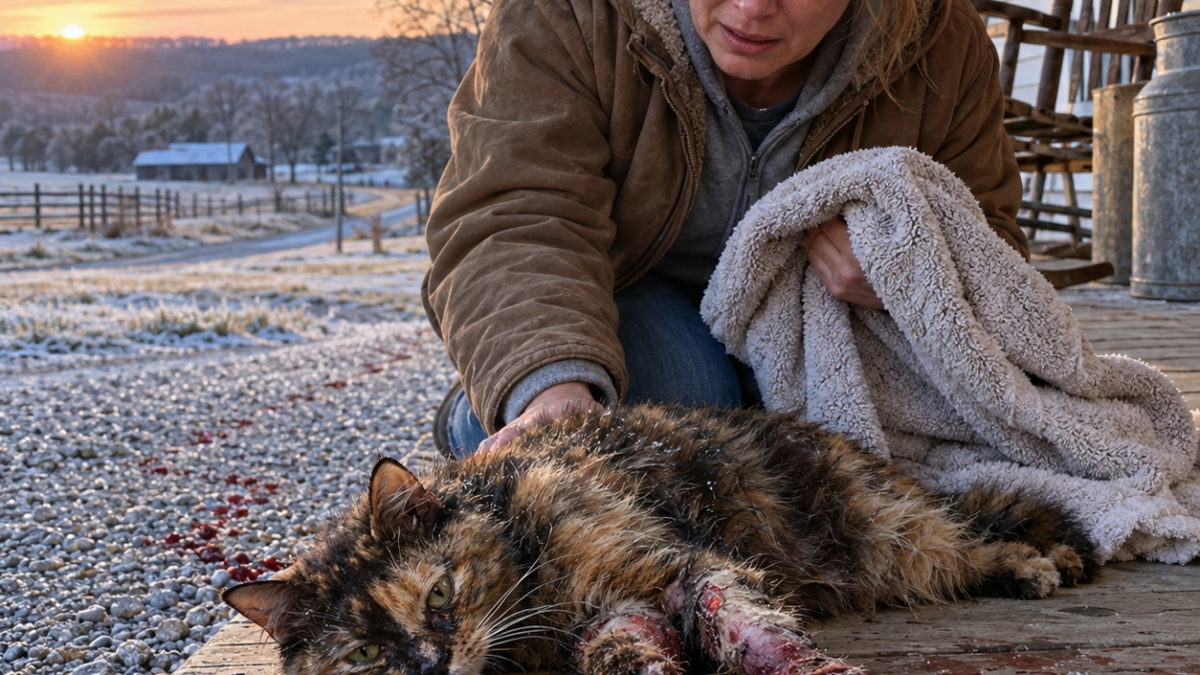
Her two front legs were twisted beneath her at angles that made Margaret’s stomach turn. The left front leg was swollen nearly twice its normal size, bent just above the wrist. The right was worse. The fur was dark with blood and dirt, and something pale showed near the break in the skin.
Margaret knew enough not to touch it.
The cat’s paw pads were shredded.
Not scratched.
Not sore.
Shredded.
The pads on all four feet were torn open, raw, some worn away so badly the pink tissue underneath showed. Small pieces of gravel clung to the blood. One pad looked almost gone.
Margaret ran inside, grabbed the cleanest towel from the laundry basket, and came back barefoot in the cold because she had forgotten shoes.
The cat did not fight when Margaret wrapped her.
That frightened her more than resistance would have.
A frightened cat will claw.
A dying one saves its strength.
Margaret lifted her carefully, supporting the broken front legs as best she could without knowing how. The cat made one sound then.
Not a meow.
Not a hiss.
A thin, breathy cry that barely escaped her throat.
“I know,” Margaret said, though she did not know anything yet. “I know. I’m sorry. I’m so sorry.”
PART3:
She placed the cat in a cardboard produce box lined with towels, set the box on the passenger seat of her old Subaru, and drove twenty-one minutes to the nearest veterinary clinic.
She did not remember putting the car in reverse.
She did not remember closing the front door.
She did not remember whether she turned off the stove under the kettle.
She remembered only the box beside her, the cat’s breath rattling faintly under the towel, and the red dots the animal left on the fabric every time the car hit a bump.
The clinic was called North Valley Animal Hospital, though the building was too small for the word hospital to feel quite honest. It sat between a closed feed store and a laundromat, with a faded sign, a plowed parking lot, and a bell on the front door that jingled too cheerfully when Margaret pushed inside.
The receptionist looked up.
Then stood so quickly her chair rolled backward.
“Emergency?”
Margaret did not trust herself to speak.
She set the box on the counter.
The towel shifted.
The receptionist’s face changed.
“Dr. Bell!”
A man in blue scrubs came through the back hall wiping his hands on a paper towel. Dr. Aaron Bell was forty-six, kind-eyed, balding, and not easily startled. He had treated farm dogs kicked by horses, calves with difficult births, cats from hoarding houses, hunting dogs with infected wounds, and old pets whose owners cried before he even entered the exam room.
He took one look into the box and stopped wiping his hands.
“Treatment room two,” he said.
Margaret followed them because no one told her not to.
The cat was lifted onto the exam table. Under the brighter light, she looked worse. Her tortoiseshell coat—black, orange, brown, and cream all broken together like autumn leaves soaked in rain—was matted with dirt and ice crystals. Her whiskers were crusted. Her ears were torn at the edges. Her body was thin beneath the roundness of her belly.
That was when Margaret noticed it.
The belly.
Not bloated.
Not swollen from injury.
Round.
Low.
Heavy.
She looked at Dr. Bell.
He had noticed too.
He did not say anything yet.
He began the exam with the practiced calm of a veterinarian who knew panic was contagious. Temperature. Gums. Heart. Lungs. Hydration. Pupils. Pulse. Pain response.
He made it less than a minute before his face changed.
“Lena,” he called through the open door, “get Dr. Moreno.”
A young technician appeared.
“Now?”
“Now.”
Then Dr. Bell closed the exam room door.
Margaret stood against the wall, hands clasped so tightly her fingers hurt.
“How bad?” she asked.
Dr. Bell did not answer right away.
That was the first answer.
He reached for scissors and carefully cut away some of the fur around the right front leg. The cat’s breathing quickened, but she did not move.
“Both front legs are fractured,” he said quietly. “The left looks like a clean fracture above the carpus. The right is open.”
Margaret swallowed.
“Open?”
“The bone has broken through the skin.”
The room tilted slightly.
Margaret gripped the edge of the counter.
“And she walked like this?”
Dr. Bell looked down at the torn paw pads.
“Yes.”
The second veterinarian entered before Margaret could ask anything else.
Dr. Elena Moreno was the clinic’s orthopedic surgeon, though in a rural clinic that meant she was also a dentist, emergency surgeon, fracture repair specialist, wound manager, grief counselor, and occasional goat-wrestler. She was in her early fifties, silver threaded through dark hair, with the steady hands of someone who had learned long ago that animals did not care how frightened you were if your fingers stayed useful.
She examined the cat’s legs.
Then the paw pads.
Then the belly.
Her expression tightened.
“Radiographs,” she said.
Dr. Bell nodded.
“Chest, abdomen, both forelimbs.”
“And fluids.”
“Already starting.”
“And pain control.”
“Yes.”
Margaret stepped forward.
“Can she survive?”
Dr. Moreno looked at her.
Veterinarians learn to answer hope carefully.
“We’re going to try.”
That was all.
It took three people to position the cat for X-rays without causing more damage. Even sedated, even exhausted, even with pain medication beginning to move through her system, the cat reacted when they touched the broken right leg. Her body flinched once, hard. Then she settled again, as if apologizing for using energy.
Margaret stood behind the protective screen, arms wrapped around herself.
The first images confirmed what Dr. Bell had said.
Left front leg: fractured above the wrist, displaced but repairable.
Right front leg: open fracture, ugly and contaminated, bone alignment poor, soft tissue trauma severe.
Paw pads: too damaged for X-ray to fully capture, but clinically devastating.
Then Dr. Moreno took the abdominal radiograph.
The machine clicked.
The image loaded.
The room became completely silent.
One by one, the shapes appeared.
Tiny spines.
Tiny skulls.
Tiny curled bodies.
Five kittens.
Full term.
Dr. Bell took one step closer to the screen.
Dr. Moreno did not speak.
Lena, the technician, covered her mouth.
Margaret looked from one face to another.
“What?”
Dr. Bell turned slowly.
“She’s pregnant.”
Margaret let out a breath.
“No.”
“She is.”
Dr. Moreno moved the image, checked the positioning, measured what she could.
“Five kittens,” she said.
Margaret whispered, “Are they alive?”
“We need ultrasound to confirm,” Dr. Bell said. “But based on positioning, development, and her body condition…”
He stopped.
Dr. Moreno finished for him.
“She’s at term.”
Margaret did not understand.
“At term?”
“She’s due now,” Dr. Moreno said. “She may already be in early labor.”
The words entered the room and changed everything.
Not just injured.
Not just starving.
Not just frozen.
Not just a cat who had walked with two broken legs.
A mother.
A mother in labor.
Margaret looked at the cat on the table through the small window in the X-ray room door.
The animal lay wrapped in warmed towels, eyes half open, body too exhausted even to lift her head.
And inside her, five lives waited.
That was when Margaret began to cry.
Quietly at first.
Then with a hand over her mouth because she did not want to make noise near the cat.
Dr. Moreno stared at the X-ray as if she were looking at a medical impossibility and an accusation at the same time.
“How far did you say the blood trail went?” she asked.
“I don’t know,” Margaret said. “Down my drive. To the road. I couldn’t see past the bend.”
Dr. Bell examined the paw pads again.
“Injury age?”
Dr. Moreno exhaled slowly.
“Based on swelling, infection beginning in the open fracture, pad degradation, tissue dryness…” She looked at him. “At least forty-eight hours.”
Lena whispered, “She’s been walking for two days?”
“At least.”
Margaret stared at them.
“With two broken front legs?”
Dr. Moreno did not soften the truth.
“With one open fracture.”
No one spoke.
Outside the treatment room, the clinic continued around them. A phone rang. A dog barked once. Someone laughed in the lobby, unaware of what had just been discovered behind the closed door.
Inside, the cat’s breathing continued fast and shallow.
Five kittens shifted inside her.
Dr. Bell said, “We need to stabilize her first.”
Dr. Moreno nodded.
“Temporary splints. IV fluids. Broad-spectrum antibiotics. Pain management safe for pregnancy. Warmth. Monitor labor.”
“Surgery?” Lena asked.
“Not now,” Dr. Moreno said. “Not unless we have no choice.”
Margaret wiped her face.
“What happens if she gives birth like this?”
Dr. Moreno looked at the cat.
“We help her if she needs help.”
“And if she can’t?”
“Then we act.”
“She walked all the way here,” Margaret said.
It came out as a statement, but everyone heard the question inside it.
Why?
Dr. Bell looked at the X-ray.
Then at the porch cat.
“Maybe because she had to.”
They stabilized her.
The clinic staff moved quickly now, each person doing the practiced work that becomes almost sacred when time is thin. Warm IV fluids. Pain medication. Antibiotics. Soft padding beneath the belly. Wounds cleaned as much as the cat could tolerate. Temporary immobilization for both front legs. A heated recovery kennel prepared in the quietest room.
The cat did not have a name.
That bothered Margaret.
Animals in crisis should have names, she thought. Not because names save them, but because a name tells everyone in the room this is not a case. This is someone.
“What should we call her?” Lena asked, as if reading her mind.
Margaret looked at the cat’s tortoiseshell face, the orange blaze near one eye, the black patch over the other, the small white hairs at her chin.
“I don’t know.”
Dr. Bell said, “We can wait.”
But Margaret felt suddenly that waiting was wrong.
The cat had not waited.
She had crossed miles of winter without waiting for rescue that did not come.
“Eleven,” Margaret said.
Everyone looked at her.
“I don’t know why. It just…” She shook her head. “Eleven.”
Dr. Moreno nodded once.
“Eleven it is.”
They wrote it on the chart.
ELEVEN
TORTOISESHELL FEMALE
EMERGENCY
PREGNANT
BILATERAL FORELIMB FRACTURES
A name in black ink.
A beginning.
Four hours later, Eleven went into active labor.
No one expected her to have strength for it.
Dr. Moreno had prepared for surgical intervention. Dr. Bell stood nearby with sterile supplies. Lena had warmed towels stacked in a neat pile. Margaret sat in the corner wearing a borrowed clinic sweatshirt because her own had blood on the sleeves.
The first kitten came at 2:41 p.m.
Eleven barely lifted her head.
Dr. Bell moved forward, ready to help.
Then the cat did something that made him stop.
With both front legs splinted, exhausted beyond anything that should have allowed instinct to work, she twisted her body just enough to reach the newborn kitten. Her tongue moved slowly at first. Then faster. She cleaned the kitten’s face. Broke the membrane. Stimulated breath.
A tiny cry filled the room.
Lena made a sound halfway between a laugh and a sob.
“Alive,” she whispered.
The kitten was black with a small orange streak on its forehead.
Ninety-seven grams.
Normal.
The second kitten arrived twenty-six minutes later.
Tortoiseshell.
Ninety-four grams.
Alive.
The third came after a long pause that frightened everyone.
Gray tabby.
Ninety-eight grams.
Alive.
The fourth was smaller.
Ninety-one grams.
Dr. Bell rubbed him gently with a warm towel until he squeaked in protest.
Alive.
The fifth arrived near dusk.
Orange and white.
One hundred grams exactly.
Alive.
Five kittens.
Five living, breathing, squirming kittens.
All normal weights.
All nursing within an hour.
Eleven lay on her side beneath warmed blankets, both broken front legs secured, eyes half closed, while the five tiny bodies pushed against her belly with the blind determination of newborns who had no idea how close they had come to never reaching the world at all.
Margaret sat beside the kennel and cried openly now.
No one told her to stop.
Dr. Moreno stood at the counter with both hands braced against it.
Dr. Bell looked at her.
In eighteen years, he had seen many things.
Animals abandoned in boxes.
Dogs protecting children.
Cats surviving falls that should have killed them.
Old horses waiting until owners arrived to die.
But this was different.
A mother cat had walked through winter with both front legs broken, one bone exposed, paw pads destroyed, body starved, infection beginning, labor approaching.
She had kept moving until she found a porch.
Then, and only then, she stopped.
Dr. Moreno whispered, “I have never seen anything like this.”
No one doubted her.
The next morning, Dr. Bell began making calls.
He wanted to know where Eleven had come from.
Not out of curiosity alone. The fractures mattered. The distance mattered. The state of her pads mattered. If there were other animals left behind somewhere, they had to know.
He called nearby farms.
A trailer park.
Two properties with barns.
A county animal officer.
A church on the rural road.
A woman who fed feral cats behind the feed store.
By the fourth call, he found the first possible lead.
By the seventh, he found the truth.
Nearly eleven miles from Margaret’s property, along a back road that froze hard at night and turned to mud by noon, there was an abandoned farmhouse that had recently been seized by the county. The property had sat empty for months. A neighbor named Clyde Henson confirmed that a tortoiseshell cat had been living under the porch since late summer.
“She was wild,” Clyde said over the phone. “Wouldn’t let anybody near her. I left scraps sometimes. Saw her belly getting bigger. Figured she’d have them under that porch.”
“What happened?” Dr. Bell asked.
“Cleanup crew came last week. Bank sent them, I think. Hauled junk out. Boarded windows. Tore some porch skirting off.”
“Did they find animals?”
“They said no.”
Clyde paused.
“But after they left, I didn’t see her anymore.”
Dr. Bell closed his eyes.
The picture formed too clearly.
A pregnant feral cat living under an abandoned porch.
Her only shelter disturbed.
Maybe chased out by noise.
Maybe trapped briefly.
Maybe struck by equipment.
Maybe hit by a vehicle while fleeing.
Both front legs broken.
No safe nest.
No food.
No shelter.
Labor approaching.
So she moved.
Across frozen fields.
Down rural roads.
Through ditches.
Past empty barns.
Over gravel that tore her pads apart.
Through nights cold enough to drop to nineteen degrees Fahrenheit.
Eleven miles.
Two broken front legs.
Five kittens inside her.
Dr. Bell thanked Clyde and hung up.
For a long time, he did not leave his office.
When he returned to the treatment room, Margaret was sitting beside Eleven’s kennel, watching the kittens nurse.
Dr. Bell pulled up a chair.
“We think we found where she came from.”
Margaret listened without interrupting.
When he finished, she looked at Eleven.
The cat slept with her head turned toward her kittens, body curved as much as the splints allowed.
“She was looking for another porch,” Margaret said.
Dr. Bell nodded.
“I think so.”
Margaret reached through the kennel bars and rested two fingers lightly near Eleven’s shoulder. She did not touch the broken leg.
“You found one,” she whispered. “You found the right one.”
Eleven’s recovery was not simple.
Viral stories like endings that arrive quickly.
Real healing does not care what makes a good ending.
Her right front leg became infected twice. The open fracture required surgery after the kittens were stable enough to supplement feed for a few hours. Dr. Moreno placed hardware as carefully as she could, cleaned damaged tissue, and warned Margaret that the leg might never be straight.
The left leg healed cleaner.
The right did not.
Eleven’s paw pads had to be cleaned, bandaged, rechecked, rebandaged, and watched obsessively for infection. She hated bandage changes. Not dramatically. She simply turned her head away as if she had no interest in helping humans do things she had already survived without them.
The kittens thrived.
That was the miracle inside the struggle.
They grew round.
Loud.
Demanding.
The black one, whom Margaret named Ash, learned to climb the side of the kitten pen before his eyes fully focused.
The tortoiseshell female became Penny because she had one copper-colored patch shaped like a coin over her nose.
The gray tabby, Moses, shouted constantly for no reason anyone could identify.
The small one, Bean, remained small but fierce, always first to nurse and last to sleep.
The orange-and-white kitten, March, opened his eyes earliest and stared at Margaret with the grave suspicion of an old judge.
Eleven watched them all.
She did not play.
She did not purr much in those first weeks.
Pain kept her quiet.
Exhaustion kept her still.
But her eyes followed every kitten.
If one rolled too far from the warmed bedding, she lifted her head.
If one squeaked, her ears moved.
If a technician reached in too quickly, Eleven’s body stiffened despite the splints.
Even broken, she mothered like a creature who had crossed winter and would not allow carelessness to finish what the cold had failed to do.
Three weeks after the birth, Margaret brought Eleven and the kittens home.
Dr. Bell helped carry the crate.
Dr. Moreno came too, though she pretended she was only there to check the bandages.
It was a clear afternoon, the kind February sometimes offers not as mercy but as reminder. The porch boards were dry. The sun touched the place where Margaret had found Eleven collapsed.
Margaret set the crate down near that spot.
For a moment, no one opened it.
The kittens shifted inside, making tiny impatient sounds.
Eleven lay at the front, eyes open, nose twitching.
Margaret crouched.
“This is home,” she said.
Then she opened the crate.
Eleven did not come out immediately.
She sniffed the porch.
The boards.
The air.
The threshold.
The place where she had stopped.
Then, awkwardly, painfully, with both front legs still splinted and wrapped, she pulled herself forward.
Not far.
Only enough to place her body fully on the porch.
Then she lay down.
Exactly where Margaret had found her.
Dr. Moreno turned away.
Dr. Bell looked at the sky.
Margaret sat beside Eleven and placed one hand flat on the porch boards.
“You don’t have to go anywhere else,” she said.
Eleven blinked slowly.
The kittens were raised on that porch and in the warm mudroom just inside the door.
Margaret told herself at first that she would find homes for them.
Five kittens were too many.
She was nearly sixty.
Money was not abundant.
Vet bills had already become a stack she tried not to look at too closely.
Five kittens would become five cats.
Food.
Litter.
Vaccines.
Spay and neuter appointments.
Winter bedding.
Flea prevention.
Scratching posts.
Broken things.
Hair everywhere.
She told Dr. Bell she would keep them until they were old enough.
Then she would decide.
At eight weeks, Ash fell asleep inside one of Margaret’s slippers.
At nine weeks, Penny learned to ride on Margaret’s shoulder while she washed dishes.
At ten weeks, Moses began waiting by the door every morning to yell at the sunrise.
At eleven weeks, Bean chased a moth across the kitchen, collided with a cabinet, and stood up offended but victorious.
At twelve weeks, March curled beside Eleven on the porch and placed his tiny paw over his mother’s crooked right leg.
Margaret called Dr. Bell that afternoon.
“I’m keeping them.”
He did not pretend surprise.
“All five?”
“All five.”
“And Eleven?”
Margaret looked through the window at the mother cat lying on the porch, watching her kittens tumble in a patch of weak spring sun.
“She chose this place,” Margaret said. “I think that means something.”
Dr. Bell was quiet for a moment.
“Yes,” he said. “I think it does.”
Eleven’s legs healed.
But not perfectly.
The left one returned almost straight, though it remained thick at the fracture site. The right leg stayed slightly twisted where the open fracture had damaged too much tissue and bone to restore completely. Her paw pads scarred over in thick, rough patches that looked more like old leather than skin.
She could walk.
But every step carried the story.
Her shoulders shifted unevenly.
Her body rocked slightly from side to side.
Her right paw placed differently from the left.
In the beginning, Margaret cried whenever she watched her cross the kitchen.
Then one day Eleven limped past her carrying a toy mouse in her mouth, placed it in front of five sleeping kittens, and looked at Margaret as if to say, Why are you making that face?
After that, Margaret tried to stop crying about the limp.
Eleven did not run again.
Not truly.
She could hurry in short bursts if a kitten cried or a strange dog barked near the fence, but the smooth flying motion of a healthy cat was gone from her body forever.
She did not seem to mourn it.
That was another lesson Margaret had not expected.
Humans count what is lost.
Animals count what remains.
Eleven had the porch.
Food.
Warmth.
Five kittens.
A woman who spoke softly.
Sun in the afternoon.
A safe place to sleep.
Perhaps, to her, that was not a small life.
Perhaps it was the exact life she had walked eleven miles to find.
The story spread slowly at first.
A technician told her sister.
Her sister told someone at church.
The local paper heard about the cat who walked eleven miles with broken legs to give birth on a stranger’s porch.
A reporter called Margaret.
She almost said no.
Then she looked at the vet bill folder.
The reporter came on a Thursday.
Margaret allowed photographs but no flash. Eleven sat on the porch with her front legs tucked carefully beneath her chest, five kittens climbing over and around her like she was part of the furniture of the world.
The headline ran that Sunday:
PREGNANT CAT WALKS 11 MILES WITH TWO BROKEN LEGS TO SAVE HER KITTENS
The story did what stories do.
It became larger as it traveled.
Some people called it a miracle.
Some called it instinct.
Some argued online about whether cats could love their unborn kittens.
Some said Margaret should have taken the cat to a shelter.
Some said the cleanup crew should be charged.
Some said the vet was exaggerating.
Some said animals do not feel purpose.
Dr. Moreno saw that last comment and closed her laptop before she threw it.
In the clinic break room, Lena printed a photograph of Eleven curled around her kittens and taped it to the cabinet above the coffee maker.
Below it, on a scrap of paper, she wrote something Dr. Bell had said during a late-night bandage change when someone asked why Eleven had not simply lain down and died like most animals with injuries that severe.
He had been quiet for several seconds.
Then he said:
“She stopped only once. When she found a porch. When she decided her kittens would be born somewhere safe. That’s where she stopped. Not one second before.”
The note stayed on the wall for years.
When new staff complained during hard shifts, someone would point at it.
When an owner cried in exam room three because they could not afford everything at once, Dr. Bell would sometimes glance toward that note before walking in, reminding himself that survival often came one step at a time, even when every step hurt.
When Dr. Moreno doubted whether a complicated repair would give an animal enough quality of life, she thought of Eleven watching her kittens from the porch, crooked leg tucked under her, alive enough for the life she had chosen.
Margaret became known in town as “the cat lady with Eleven.”
She objected at first, then accepted it as harmless because people brought food donations when they said it.
The porch changed.
A heated shelter appeared in one corner.
Then a second.
Then a row of low shelves so the cats could sit at different heights and supervise the property.
Windbreak panels went up before the next winter.
A neighbor built a ramp because Eleven struggled with steps on damp days.
Margaret painted the ramp blue.
Eleven ignored it for a week out of principle, then used it every day afterward as if she had invented it.
The five kittens grew.
Ash became enormous, black and sleek, with a white whisker that made him look permanently skeptical.
Penny grew into a perfect echo of her mother’s tortoiseshell coloring, except she moved like a spark and feared nothing, including lawn equipment.
Moses remained talkative and developed a habit of standing on the fence post yelling into fields.
Bean stayed small, fierce, and convinced she was in charge of every living thing.
March became orange, round, affectionate, and shameless. He followed Margaret into the garden, flopped on seedlings, and once stole an entire biscuit from her plate while maintaining eye contact.
They ran in the pasture.
They climbed fence rails.
They chased grasshoppers.
They slept in impossible piles.
Eleven watched.
Always.
From the porch.
From the ramp.
From the top step.
From the sunny board near the door.
She rarely joined their games, but she never looked away from them for long.
Margaret sometimes stood in the kitchen and watched Eleven watching them.
The mother cat’s body remained damaged.
Her walk remained uneven.
Her front paws were rough and thick from the scars.
But her eyes, once distant and empty on that first morning, had become clear.
Not soft exactly.
Eleven was never a soft cat.
She accepted affection on specific terms and with the expression of a queen granting political access. She tolerated being kissed on the head only when sleepy. She disapproved of loud appliances. She once slapped a visiting pastor’s hand because he touched her tail without a proper introduction.
But she loved Margaret.
Not in a dramatic way.
In practical ways.
She came inside before storms because Margaret worried.
She allowed bandage checks long after bandages were no longer needed because Margaret still needed to feel useful.
She slept beside Margaret’s boots when the woman was sick with flu.
She brought dead mice to the porch and placed them by the door with the solemn pride of someone contributing to household expenses.
And every year, on the anniversary of the morning she arrived, Margaret made chicken.
Not a party.
Not exactly.
She would boil chicken plain, shred it, and divide it into six small bowls on the porch. Eleven always received hers first. The five grown kittens would wait, though not patiently, while their mother ate.
Margaret would sit in her chair with coffee and say, “Happy porch day.”
No one else was invited.
Some sacred days are small.
Years passed.
Not many.
Enough.
Eleven’s limp worsened with age. Cold weather made the old fractures stiff. Dr. Moreno prescribed pain management when needed. Margaret added more rugs inside so Eleven would not slip on the floor. The ramp was widened. The heated bed became softer.
The kittens, no longer kittens, remained close.
They left the porch for fields and barns and tree lines, but they always came home.
At dusk, they gathered around Eleven.
Even when they were full grown, even when they towered over her, even when Ash weighed almost twice what she did, they returned to the porch as if some part of them understood that every life they had began with her refusal to stop.
Eleven lived six more years.
Six years on the porch she chose.
Six springs watching grass return.
Six summers blinking in heat while cicadas screamed in the trees.
Six autumns with leaves skittering across the boards.
Six winters tucked in heated bedding while snow built along the rail.
Margaret grew older too.
Her hair went from brown-gray to mostly gray.
Her knees began complaining on stairs.
The garden got smaller.
The porch got more important.
On the last morning, Margaret found Eleven lying on her side.
For one terrible second, time folded.
The frost.
The porch.
The body on its side.
The open eyes.
But this time, Eleven’s eyes were closed.
Her breathing had stopped.
She lay in the same place where she had collapsed six years earlier, just beside the door, where the morning sun touched first when the clouds allowed it.
Margaret knew before she knelt.
The five grown kittens were there.
Ash on the top step.
Penny by the railing.
Moses silent for once near the ramp.
Bean pressed against Margaret’s boot.
March lying closest to Eleven, one orange paw resting near his mother’s crooked right leg.
Margaret sat down slowly.
The porch boards were warm from early sun.
Not hot.
Warm.
Eleven’s body was still soft.
Peaceful.
No struggle.
No fear.
No long road.
No blood trail.
No winter night.
Just sleep.
Margaret reached out and touched the rough scarred pads of one front paw.
The same paws that had crossed eleven miles of frozen ground.
The same paws that had torn open on gravel.
The same paws that had carried five unborn kittens toward safety when every sensible part of the world said stop.
“You made it,” Margaret whispered.
Then she began to cry.
She did not move Eleven until sunset.
When Dr. Bell called after Margaret left a message, he offered to come.
So did Dr. Moreno.
Margaret thanked them but said no.
“Not yet,” she said. “She chose this place. I want to give her one last day in it.”
So Eleven stayed on the porch through the morning.
The sun moved across the boards.
Birds came and went.
The five cats remained nearby.
Margaret sat with her for hours, telling her things she had said before and things she had not.
She told her she was brave.
She told her she was stubborn.
She told her the porch was hers.
She told her the kittens were safe.
She told her she had done enough.
In the afternoon, Margaret brought out the folded scrap of paper Lena had copied years earlier from the clinic break room. The words had faded slightly.
She stopped only once. When she found a porch. When she decided her kittens would be born somewhere safe. That’s where she stopped. Not one second before.
Margaret read it aloud.
Her voice shook, but she finished.
At sunset, Dr. Bell came after all.
Not because Margaret asked.
Because some patients remain yours long after treatment ends.
Dr. Moreno came too.
They helped Margaret wrap Eleven in a soft blanket. Not the towel from that first morning. That towel had been washed and folded and kept in Margaret’s closet for six years, but she could not use it now. That towel belonged to the beginning.
For the ending, she chose a quilt.
They buried Eleven beneath the maple near the porch, where she could see the steps if seeing were still something she needed.
The five cats watched from the rail.
Moses made one small sound.
No one spoke for a while.
Finally Dr. Moreno said, “I’ve done thousands of surgeries.”
Margaret looked at her.
“I still think about hers.”
“She was special,” Margaret said.
Dr. Moreno shook her head gently.
“She was determined. People call that special when they see it from far away.”
Dr. Bell placed a small stone at the grave.
No marker yet.
That came later.
A simple flat stone with Eleven’s name carved by a local man who refused payment after hearing the story from his wife for the hundredth time.
ELEVEN
SHE FOUND THE PORCH
Below that, Margaret added:
NOT ONE SECOND BEFORE
People still ask about her sometimes.
They ask if the story is true.
If the cat really walked eleven miles.
If both legs were truly broken.
If one fracture was really open.
If the kittens all survived.
If Eleven really lived six more years on the same porch.
Margaret answers patiently when she has the strength.
Yes.
Yes.
Yes.
Yes.
Yes.
And then, if they are quiet enough to deserve the rest, she tells them what the story was never really about.
It was not about pain, though there was pain beyond imagining.
It was not about distance, though eleven miles can become eternity when each step tears you open.
It was not about miracle, not exactly.
Miracles sound too easy when told afterward.
This was not easy.
This was frost and blood and gravel.
This was a mother’s body failing while her will kept moving.
This was an animal with no language humans could understand making one decision over and over again.
Not here.
Not yet.
Keep going.
There.
A porch.
A door.
A chance.
Only then did she stop.
Years after Eleven died, Margaret kept the porch the same.
The ramp stayed blue.
The heated shelters remained, though the cats used them less often as they grew older and preferred the house.
Every February, Margaret still made chicken.
Six bowls at first.
Then five, after Eleven was gone.
But she always placed a small extra portion on a saucer near the door, where the sun touched first.
People told her she did not need to do that.
Margaret knew.
Need had very little to do with love.
One winter morning, long after Eleven’s passing, a young woman pulled into Margaret’s drive with a carrier in her back seat and tears in her eyes. She had found a stray cat injured near the highway and did not know what to do. Someone in town had told her, “Go to Margaret’s porch. She’ll know.”
Margaret came out in slippers and a sweater, gray hair loose around her face.
The cat in the carrier was frightened, bleeding from one paw, not nearly as badly hurt as Eleven had been, but hurt enough.
Margaret wrapped the carrier in a blanket, loaded the young woman back into the car, and rode with her to North Valley Animal Hospital.
On the way, the young woman kept saying, “I’m sorry. I didn’t know where else to go.”
Margaret looked out at the winter fields.
Then at the frightened cat.
Then down at her own hands, older now, but still useful.
“You came to a porch,” she said.
The young woman did not understand.
Not yet.
But Margaret did.
Some places become safe because someone once suffered their way to them.
Some doors become answers because something desperate decided to stop there.
And sometimes a small porch at the end of a gravel drive becomes more than wood and nails.
It becomes proof.
That a creature can arrive broken and still bring life with her.
That a body can fail and still protect what it loves.
That survival is not always graceful, not always clean, not always understandable to anyone watching from a distance.
Sometimes survival is ugly.
Bloody.
Crooked.
Limping.
Sometimes it leaves a permanent mark.
Sometimes it cannot run again.
But it reaches the porch.
It gives birth.
It watches the ones it saved run farther than it ever will.
And in the end, maybe that is enough.
The surgeon had said he had never seen anything like Eleven.
He never did again.
Not in eighteen years of practice.
Not afterward.
He saw brave animals.
Stubborn animals.
Mothers who fought for their young.
Old dogs who waited for owners.
Cats who survived impossible injuries.
But never another Eleven.
Never another mother who crossed winter on broken legs and shredded paws with five lives inside her, stopping only when she found a place safe enough for them to begin.
And perhaps that is why her story stayed.
Not because it was sad.
Not because it was shocking.
But because somewhere inside it, people recognized a truth they could not easily say aloud.
Love does not always look soft.
Sometimes love drags itself across eleven miles of frozen road.
Sometimes love bleeds on gravel.
Sometimes love refuses to die because someone small and unseen still needs a chance.
And sometimes, when love finally reaches a porch, it lies down at the door and waits for someone kind enough to open it.

