A Tiny Orange Kitten Was Barely Alive When His Owner Rushed Him Into a Vet Clinic—Then the Scarred Cat Waiting Inside Walked Over and Did Something No One Expected.
PART3:
Quiet woman who says hi in the mailroom but never stays long enough to turn it into conversation.
There are worse things to be called than quiet.
But people use that word when they do not know what else to call distance.
The truth was, I had become very good at needing almost nothing.
I lived alone in a one-bedroom apartment with beige walls, a too-loud refrigerator, and a view of the parking lot behind the building. I worked customer support for a medical software company, which meant I spent all day helping strangers solve problems through a headset while my own life sat behind me like a room I did not know how to enter.
After work, I heated up leftovers or cereal.
I watched old crime shows with the volume too high.
I slept with the TV on because silence made the apartment feel less like a home and more like a place someone had forgotten to finish.
I had friends once.
Not lost in a dramatic way.
No huge fight.
No betrayal scene in the rain.
Just adulthood doing what it does when nobody is paying attention. People moved. Married. Had babies. Got promotions. Bought houses forty minutes away. Started group chats I forgot to answer until answering felt too late. I became the person who always said, “I’m fine, just busy,” until eventually nobody asked much more.
Then one night in August, Sunny screamed at me from behind the dumpster.
Not meowed.
Screamed.
Like the world had wronged him personally and I, standing there with a trash bag in one hand and wet hair from the shower, had been appointed to fix it.
He was orange, filthy, and furious.
His eyes were too big for his head. His ribs showed. One ear had a tiny nick in it. He stood beside an old pizza box with his back arched and his whole body trembling, but he did not run when I crouched.
“Hi,” I said.
He screamed louder.
I brought him upstairs in a laundry basket because I did not own a carrier. I wrapped him in a towel, called three shelters, cried once in my bathroom, and fed him warm kitten formula from a syringe after watching a video online five times.
I thought I was helping him.
The truth was, he was helping me.
Sunny changed the air in my apartment.
He followed me from room to room like I was the only thing in the world worth trusting. He slept under my chin at night, not beside me, not near me—under my chin, as if his entire plan for survival depended on hearing my breath. He attacked my shoelaces. He climbed into the dishwasher. He knocked pens off my desk during calls and once sent a half-written email to my supervisor that said, “Thank you for your paaaaaaaaaaaaa.”
My supervisor replied, “Cat?”
I replied, “Cat.”
Sunny filled the rooms with need.
I had been avoiding need for years.
His was impossible to ignore.
He needed food every few hours at first. Then vaccines. Then deworming. Then toys. Then someone to rescue him from the laundry hamper he had climbed into and immediately regretted. He needed warmth. He needed attention. He needed patience when he bit too hard because nobody had taught him how to play gently.
And I needed something that wanted me alive and home.
That is not a pretty sentence.
But it is true.
So when he stopped eating the night before, I noticed.
When he refused even the soft food he usually attacked like a tiny criminal, I felt the first cold line of fear move through me.
When he crawled under the couch instead of climbing into bed, I barely slept.
And when I found him limp the next morning, his little body curled against the baseboard, eyes half-open but not really seeing me, panic hit so hard I could barely get my keys in the ignition.
Now the tech was carrying him away.
“Wait,” I said.
She paused.
I hated myself for asking, but the words came anyway.
“Is he going to die?”
Her face softened.
“We’re going to do everything we can.”
There it was.
The truth in clinic language.
Not yes.
Not no.
Everything we can.
The swinging door closed behind her.
I stood there with my hoodie still bunched open at my chest, empty now, and I suddenly did not know what to do with my hands.
The woman at the desk slid a clipboard toward me.
“I know this is hard,” she said. “But we need some information.”
Information.
Name.
Address.
Phone number.
Sunny’s age.
Sunny’s diet.
Possible toxin exposure.
Vaccination status.
Payment method.
I wrote everything down with a hand that did not look like mine.
When I got to the payment section, my stomach twisted.
I was not poor enough for people to understand panic and not comfortable enough to avoid it. I was one of those Americans whose life looked stable from far away but had no real room for disaster. I paid rent. I paid utilities. I had a little savings, but not the kind that smiled calmly at emergency medicine.
“How much…” I began.
The woman at the desk looked at me with a tired kindness that told me she had seen that exact fear many times.
“The doctor will talk with you after the exam. We’ll give you an estimate before treatment beyond stabilization.”
Stabilization.
I hated every word that morning.
I sat in a plastic chair beneath the bulletin board and tried not to cry loudly.
That was when I saw the big cat.
He came around the corner slow, like he had nowhere else to be.
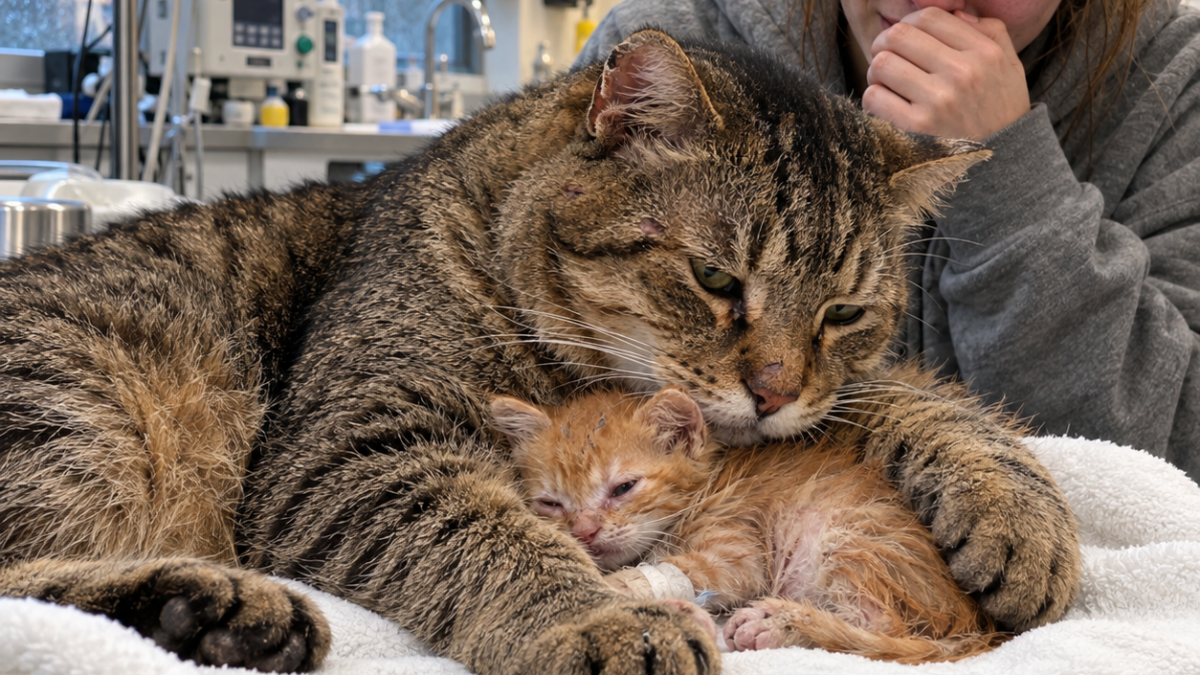
A broad-headed tabby with worn ears, thick paws, and a body built like an old couch cushion. His stripes were dark and uneven. One ear bent slightly at the tip. His face was scarred across the bridge of the nose, not dramatically, just enough to make him look like he had survived weather.
He wasn’t curious the way most cats are.
He didn’t sniff around or hang back.
He looked straight toward the exam area.
Then he walked to the towel where Sunny had been set down for triage, just as the tech brought him back out for a moment while the doctor prepared something behind the door.
Sunny looked impossibly small on that towel.
The big cat went to him.
No hesitation.
No fear.
He lowered himself carefully beside Sunny and pressed his whole body against my kitten’s tiny side. Then he wrapped one front leg over him like he was holding him in place.
I just stood there staring.
It was so human it hurt.
Sunny gave the faintest little movement.
Not much.
Just enough to make my breath catch.
The big cat stayed where he was.
Still.
Steady.
Like he knew stillness was what mattered.
I sat down right there on the floor.
I didn’t even care.
A woman in a business coat glanced over from the chairs.
A man with a dachshund in a sweater looked away politely.
The tech watched me for a second, then knelt beside the cats.
“That’s Moose,” she said softly.
“Moose?”
“Our clinic cat.”
Moose never took his eyes off Sunny.
“He does this sometimes,” she said.
“What?”
“Sits with them.”
“With sick animals?”
She nodded.
“Especially the ones that are shutting down.”
I looked at her.
“What does that mean?”
Her face changed slightly, like she regretted saying too much and also knew there was no way to make the sentence softer.
“The ones that stop fighting because they think they’re alone.”
Something inside me cracked.
Not open.
Just cracked enough for air to get in.
The doctor called Sunny back then, and Moose let the tech lift him away. But before Sunny disappeared behind the swinging door, Moose stood and touched his nose gently to the top of Sunny’s head.
A benediction.
That is the only word I have for it.
A little while later, while Sunny was being checked, I noticed a framed photo on a shelf near the wall.
It was Moose.
Only smaller.
So much smaller.
He was a kitten in that picture, and he looked awful. All bones and huge eyes, fur patchy, one paw wrapped in gauze. The kind of tiny, sick animal you see and assume will not make it.
There was a handwritten note under the frame.
I leaned closer and read it.
Moose came to us during a January freeze, barely alive, half the weight he should have been, full of infection and too weak to stand. He fought for weeks. We saved him. Then he decided this clinic was home. Fifteen years later, he still helps us save others.
I read it three times.
Then I looked back at him.
He had settled near the exam room door, tail tucked around his paws, as if waiting for updates.
And all at once, it made sense.
The way he walked right to Sunny.
The way he pressed himself against him.
The way he stayed so calm.
Moose knew.
He had been the one fighting to stay once.
He had been the one too weak to lift his head.
Maybe that was why he didn’t flinch from fear.
Maybe that was why sick animals trusted him.
He knew what that lonely edge felt like.
And now he sat beside others so they wouldn’t have to feel it alone.
That thought broke something open in me.
I started crying quietly, right there in that bright room, with my hands in my lap.
Not because I thought everything would be okay.
But because I realized how long it had been since I had seen that kind of gentleness up close.
No speech.
No grand moment.
No promise that pain would end.
Just one scarred old cat laying his body next to something smaller and weaker, as if to say, I remember. I’m here.
The doctor came out twenty minutes later.
Her name was Dr. Ruiz. She was small, direct, and kind in a way that did not waste time pretending things were better than they were.
“He’s very dehydrated,” she said. “His temperature is low. Blood sugar is low too. We’re running tests now. Did he get into anything? Medication? Plants? Cleaning supplies?”
“I don’t think so.”
“Any vomiting?”
“No.”
“Diarrhea?”
“A little yesterday.”
She nodded. “There may be an infection. He could have a parasite load we missed initially. Kittens can crash fast.”
Crash.
My knees weakened.
“What do we do?”
“Warmth, fluids, glucose support, anti-nausea medication, and we’ll treat based on what the labs show. I want to keep him for observation today.”
“How much will it cost?”
I hated asking.
Dr. Ruiz did not make me feel ashamed.
The estimate made my stomach drop anyway.
I said yes.
There are moments where financial fear and emotional terror collide so violently that you become almost calm. I handed over my credit card with fingers that shook but did not hesitate.
Sunny had been found behind a dumpster.
Moose had been found in a freeze.
Maybe survival was always expensive in ways someone eventually had to decide were worth paying.
I stayed at the clinic for hours.
I called out of work from the parking lot, telling my manager I had an emergency. She asked no questions, just said, “Take care of what you need to take care of.” I almost cried from that too.
When I came back inside, Moose was sitting near the front window, one eye half-closed.
I sat two chairs away.
“Does he do that for people too?” I asked the desk woman.
She looked from me to Moose.
“He chooses who he chooses.”
“That’s not an answer.”
She smiled.
“No, but it’s the only one we’ve got.”
Her name was Paula. I learned that from the little name tag clipped to her cardigan. Over the next few hours, Paula answered phones, checked in patients, printed invoices, soothed a man furious about wait times, and never once acted like my fear was an inconvenience.
At noon, Dr. Ruiz came back out.
“He’s responding.”
I stared at her.
“What does that mean?”
“It means his temperature is improving. He lifted his head for us. We’re not out of the woods, but he’s fighting.”
I covered my mouth.
Moose opened both eyes, as if he had been waiting for that sentence.
Sunny made it through.
He wasn’t okay right away.
He was still weak when I carried him back out that evening in a cardboard carrier lined with warm towels. He had medications, feeding instructions, warning signs, and a follow-up appointment scheduled for three days later.
But he was alive.
That was enough to make the whole world look different than it had that morning.
Before I left, Moose came over one last time.
He touched his nose to Sunny’s head.
Sunny barely moved, but he leaned into it.
Just a little.
On the drive home, I kept one hand on the box beside me the whole time.
Traffic was slow.
Rain tapped against the windshield.
But for once, I didn’t mind the long way home.
That morning, I brought a dying kitten into a clinic.
But the life that came back out with me wasn’t just Sunny’s.
It was the part of me that had almost forgotten what comfort feels like.
A week after Moose laid his body over Sunny on that clinic floor, I learned something nobody tells you about almost losing something you love.
The fear does not leave when you get the good news.
It follows you home.
It sits on the counter while you measure medicine into a dropper.
It stands in the doorway while you stare at a sleeping kitten and try to decide whether his breathing looks normal or too slow or different somehow from ten minutes ago.
Sunny was alive.
But he was still so weak that every small thing felt enormous.
If he turned his head away from food, my stomach dropped.
If he slept too hard, I touched his side just to make sure I felt him rise.
If he made one small sound in the night, I was out of bed before I was fully awake.
My apartment changed that week.
Not in some beautiful movie way.
Not all at once.
It smelled like canned food, warm towels, and the sharp clean scent of the disinfectant the clinic sent home with me. There were pill bottles by the sink. A blanket folded on the couch. A little notebook where I wrote down what time he ate, what time he used the litter box, what time he lifted his head on his own, like I was trying to hold his life together with a pen.
I barely slept.
I dozed sitting up with the lamp on.
More than once, I woke with my chin on my chest and Sunny curled into the hollow of my stomach, his tiny body pressed there like he was borrowing my heat.
And every time I woke like that, I thought of Moose.
That scarred old tabby.
That steady weight laid against something weaker.
That strange, holy kind of calm.
I thought about him more than I expected to.
More, maybe, than made sense.
It was not just that he helped Sunny.
It was that in one quiet moment, without a word, he had shown me the kind of comfort I had been starving for without even knowing I was hungry.
Three days after the clinic, Sunny ate on his own.
Not much.
Just a few bites.
But I sat on the kitchen floor and cried over a shallow dish like I had witnessed a miracle.
Maybe I had.
He looked up at me afterward with food on his nose and a tired little expression like eating had been harder than he wanted to admit.
I laughed through tears and wiped his face with my thumb.
“Good job,” I whispered. “Good job, buddy.”
There was nobody there to hear me.
No one to tell.
No one I could text who would understand why three bites of soft food felt bigger than most of the things people call important.
And that should have felt lonely.
But somehow it did not.
Not the way it used to.
Because now the quiet in my apartment had changed shape.
It was no longer empty.
It was waiting.
It was watching.
It was one little orange body sleeping in a laundry basket near the couch while I folded my whole heart around the next hour and the next and the next.
At the follow-up appointment, I was more nervous than I had been the first day.
The first day had been panic.
This was different.
This was the fear of hope.
The fear that once you finally let yourself believe something might be okay, the world will punish you for it.
I carried Sunny inside against my chest. He was still light. Still smaller than he should have been. But he lifted his head this time. He looked around.
And before Paula at the desk even finished greeting me, I saw Moose.
He came out from the back room at the same slow, unbothered pace.
Same worn ears.
Same thick paws.
Same face that looked like it had survived weather.
My whole body softened the second I saw him.
Which felt ridiculous.
And true.
Sunny noticed him too.
That was what got me.
He made a small sound from inside the carrier.
Not scared.
Not strained.
Just a soft little chirp.
Moose walked right over.
He sat down beside the carrier and looked in.
Sunny pushed his nose toward the grate.
Moose blinked once.
Then he leaned forward and touched noses with him through the opening.
It lasted maybe two seconds.
But I felt it in my chest.
Like watching someone return to the person who had pulled them back from the edge.
A tech passing by smiled.
“He remembers him,” she said.
I looked up.
“Do animals really do that?”
She shrugged.
“I’ve worked here long enough not to say they don’t.”
Her name was Kayla. She was the tired-eyed tech with the long braid. She glanced at Moose with the kind of affection people reserve for old family stories.
“He has a way with the scared ones.”
I wanted to ask a thousand questions.
I only asked one.
“Was he really that sick when he came in?”
Kayla nodded.
“Barely hanging on.”
She said it gently, like she knew the note in the frame had already done its job.
“He was feral at first. Half frozen. Full of infection. Thought he’d die on us more than once.”
She looked down at him.
“But he stayed. Never wanted to be anybody’s house cat. Just sort of decided this was his place.”
Moose, who at that moment was washing one thick paw as if the conversation had nothing to do with him, did not disagree.
Sunny’s exam went well.
Still underweight.
Still needed monitoring.
Still not entirely out of the woods.
But better.
Dr. Ruiz said the word better, and I carried it home like it was breakable.
That afternoon, for the first time in weeks, maybe months, I turned the television off.
I sat on the couch in actual silence.
Sunny slept beside my hip under a blanket.
Rain moved softly against the window.
And I realized I did not need noise just to keep myself company.
I had gotten so used to filling every room with sound because I could not stand hearing my own life echo back at me.
Now there was this other thing in the room.
Not noise.
Not distraction.
Presence.
Something alive enough to make the space feel chosen instead of endured.
A few days later, Sunny found one of my socks under the bed and dragged it halfway into the hallway like he had hunted something enormous.
I laughed so hard I had to sit down.
He looked proud.
Small.
A little unsteady.
But proud.
That was the first time I saw his old self flicker back.
The loud one.
The stubborn one.
The creature who had screamed behind a dumpster like the whole world owed him an explanation.
I had never been so happy to hear anything in my life.
I started taking pictures of him the way people do when they know they are trying to hold onto something that is changing fast.
Sunny half asleep in a sun patch.
Sunny with one paw in the water dish.
Sunny glaring at a stuffed mouse like it had insulted his family.
Sunny curled in my hoodie sleeve.
Sunny standing on all fours with his back arched, thin but determined, as if he had decided survival was one thing and attitude was another.
But the photo I kept coming back to was not of Sunny.
It was of Moose.
I had snapped it on the second follow-up visit without really thinking.
Moose by the window.
One eye half-closed.
Light across his striped face.
Looking older than ever and stronger than anything.
There was a look in him I could not get over.
Not softness exactly.
Not even kindness in the usual way people mean it.
Something steadier.
Like he had already accepted how hard life could be and made up his mind to stay gentle anyway.
That, I think, is rarer than people admit.
On the third follow-up, I brought a bag of old towels to the clinic.
Nothing fancy.
Just some clean ones from the hall closet and two fleece blankets I never used.
Paula thanked me like I had brought something bigger.
Which embarrassed me.
I almost said, “It’s not much.”
But then I saw the stack of laundry bins behind the door.
The cardboard box of donated food near the wall.
The handwritten sign asking for newspapers, litter, unopened cans, washable bedding.
And I realized maybe I had been wrong about what counts as much.
Maybe most help arrives looking ordinary.
Kayla came out to carry the bag to the back.
She glanced inside and smiled.
“These are gold around here.”
I laughed a little.
“It’s just towels.”
She shifted the bag against her hip.
“No,” she said. “It’s one less thing we have to worry about replacing.”
That stayed with me.
One less thing we have to worry about replacing.
There are whole kinds of care nobody notices because they happen quietly and are made of things too plain to be praised.
Someone washing bowls.
Someone folding blankets.
Someone staying ten minutes late.
Someone remembering which cat will only eat if the room is still.
Someone choosing gentleness when nobody is watching.
The world likes dramatic goodness.
Big checks.
Public speeches.
Grand rescue moments.
But the truth is most lives are held together by small, repetitive acts that nobody claps for.
The clinic felt full of those.
I started noticing things.
Paula remembering every pet’s name even when the owners looked half asleep.
Dr. Ruiz crouching instead of standing over nervous animals.
Kayla tucking a towel around a trembling carrier as if privacy itself could be medicine.
And Moose.
Always Moose.
Sometimes in the waiting room.
Sometimes near recovery.
Sometimes stretched in a warm patch of light like he was resting, but with one eye open, tracking every new arrival.
He had favorites, apparently.
Not favorite people.
Favorite kinds of fear.
That is how Kayla explained it one Saturday when I came in for Sunny’s weight check and ended up talking longer than I meant to.
“He goes to the ones who are shutting down,” she said.
I looked at her.
“What do you mean?”
She lowered her voice.
“The ones that stop fighting because they think they’re alone.”
I glanced over at Moose.
He was by a carrier near the wall, sitting very still beside a small gray cat that had not made a sound since I came in.
“He can tell?”
Kayla gave me that same shrug.
“I don’t know what he can tell. I just know he’s usually right.”
Then she smiled a little.
“He doesn’t waste his energy on the dramatic ones.”
That made me laugh.
But it also did something else.
It made me think about how many people I knew—how many I had been—who learned to hide pain so well that they disappeared in plain sight.
The loud suffering gets attention.
The quiet kind often gets mistaken for coping.
That afternoon, I stayed longer than I needed to.
Sunny had done well.
His exam was good.
Dr. Ruiz even smiled when she weighed him.
But I lingered in the lobby, pretending I was rearranging things in my bag, just so I could sit in the same room as Moose a little longer.
A woman came in carrying an old plastic carrier duct-taped at one corner.
Inside was a big black cat with cloudy eyes and a coat gone rough in patches.
He did not cry.
He did not paw at the door.
He just sat there with the defeated stillness of something that had already decided not to expect much.
Paula spoke softly to the owner.
I did not mean to overhear.
But waiting rooms are built for overhearing.
“He belonged to my dad,” the woman said.
Her voice was flat from tiredness, not cruelty.
“Dad moved into assisted living last month. They don’t allow pets. I tried for a while, but he pees outside the box now, and my husband’s done with it.”
She looked exhausted.
Ashamed too, maybe.
But the part that lodged in me was what came next.
“I know nobody really wants old cats,” she said. “I just didn’t know where else to bring him.”
Nobody really wants old cats.
There are sentences that sound small when they are spoken.
Then they keep expanding after.
I looked at the carrier.
At the old black cat sitting there like he had heard every word.
And before I could stop myself, I looked at Moose.
He had already crossed the room.
He sat beside that carrier like he had been summoned.
The woman noticed him then.
“Oh,” she said, startled.
Paula smiled.
“That’s Moose.”
The owner stared for a second.
Then something in her face changed.
Not enough to undo what had brought her there.
But enough to crack it open.
“He’s staying with him,” she whispered.
Paula nodded.
“He does that.”
I went home angry in a quiet way.
Not at that woman, exactly.
Life is messy.
People get overwhelmed.
Housing rules are real.
Money is real.
Exhaustion is real.
But I could not stop thinking about how quickly the world teaches us to sort living things by convenience.
Young is easier.
Healthy is easier.
Quiet is easier.
Cute is easier.
Anything that needs too much, takes too long, costs too much, sheds too much, cries too much, slows down too much—well.
Suddenly people start talking about practicality.
And once practicality takes over, tenderness goes first.
I sat on the edge of my bed that night with Sunny asleep against my thigh and thought something that made me uncomfortable because it felt too true.
A lot of people do not know how to love once love stops being easy.
They know how to enjoy.
They know how to choose.
They know how to claim.
But staying—really staying—once something becomes inconvenient or expensive or old or hard?
That is where the numbers get small.
The next morning, I went back to the clinic with coffee and a bag of paper towels.
No reason.
No appointment.
Just an awkward feeling that I should do something with the ache that had been sitting in me since I heard that woman say nobody really wants old cats.
Kayla laughed when she saw me.
“Back again?”
I held up the bag.
“I promise I’m not trying to move in.”
She smiled.
“We’ve had worse ideas.”
That was how it started.
Not with a grand decision.
Not with some dramatic vow to change my life.
Just with me coming by once in a while.
Dropping off supplies.
Holding a carrier while someone filled out paperwork.
Folding donated blankets in the back when they were short-staffed.
Refilling water bowls.
Sweeping fur from corners.
I did not become some kind of hero.
I became useful.
And useful, I learned, can heal a person in ways attention never does.
Sunny kept getting stronger.
By the end of the month, he was climbing onto the windowsill again. He was eating like he had a personal grudge against the food bowl. He pounced on my shoelaces, attacked dust motes, and ran sideways down the hall at midnight for reasons known only to cats and whatever strange weather lives in their brains.
Sometimes I woke up in the dark to the sound of him batting at a crumpled receipt like it had insulted him personally.
And I would lie there smiling.
Not because my life had become perfect.
It had not.
The bills were still there.
The job was still the job.
The apartment was still too quiet in certain corners.
I was still me.
But I was no longer just moving through my days waiting to get through them.
That is not a small difference.
It is the difference between surviving a life and belonging to it.
I started bringing Sunny with me sometimes when the clinic was calm and the staff said it was okay. He was due for checkups anyway, and by then everyone knew him.
“He’s the orange baby Moose adopted,” Paula joked once.
Sunny, who had grown exactly enough confidence to become a menace, acted like he was famous.
He would come in puffed up with importance, then melt into complete devotion the second Moose appeared.
It happened every time.
Moose would round the corner.
Sunny would go still.
Then he would make that same tiny chirp and lean forward in the carrier.
And Moose—old, unhurried, dignified Moose—would come over and greet him like no time had passed.
I started watching for it.
Needing it, maybe.
The weird thing was, Sunny was different after those visits.
Calmer.
Not sleepy.
Settled.
As if something in him got reset by being near the cat who remembered the worst version of him and met the better one without surprise.
I understood that too.
Some people know the polished version of you.
Very few know the version of you that almost disappeared and do not look away from the version that came back.
About six weeks after Sunny got sick, I took a picture that changed more than I expected.
It was a simple one.
Moose curled on a folded blanket near the recovery room door.
Sunny sitting beside him, upright and alert now, his orange coat finally starting to look full again.
Moose looked like weathered wood and old patience.
Sunny looked like sunlight learning how to take shape.
Their bodies were not touching.
But they were close.
Close in the deliberate way that says connection without needing to prove it.
I posted it late that night because I could not sleep.
No plan.
No strategy.
Just the picture and the truth.
I wrote about the morning I thought Sunny would die.
I wrote about the clinic floor.
I wrote about Moose laying down beside him like he remembered what it was to be too weak to lift your head.
I wrote about the note in the frame.
About how Moose had once been the sick one.
About how he stayed.
About how I had been lonelier than I admitted, and how one orange kitten and one scarred old tabby had dragged me back toward life without either of them knowing it.
I expected maybe a few friends from work to click the heart button.
Maybe one comment from my supervisor saying, “Glad Sunny’s better.”
That was it.
By the next afternoon, thousands of people had shared it.
I wish I could tell you that was purely beautiful.
It was not.
Some of it was.
A lot of it was.
People wrote about dogs who stayed by hospital beds.
Cats who waited in windows.
Old pets who held them together through divorces, layoffs, funerals, empty houses, panic attacks, grief so heavy it made the dishes in the sink feel impossible.
People wrote, “I needed this today.”
People wrote, “I haven’t stopped crying.”
People wrote, “This old cat understands more than most people I know.”
But the internet is still the internet.
And the bigger the story got, the uglier some of the responses became.
People said I was making too much of an animal.
People said folks in this country would spend money on cats while ignoring human beings.
People said pets had become emotional replacements because adults no longer knew how to build real lives.
People said old animals were a financial black hole and clinics should focus on “cases with actual long-term value.”
That one sat with me.
Actual long-term value.
As if worth could be measured like a return on investment.
As if being old automatically makes a life less deserving of care.
As if comfort only matters when it comes from something still young enough to be considered promising.
I kept reading even when I knew I should stop.
Sunny was asleep on the couch with all four paws in the air.
The room was dim.
My phone kept lighting up against the armrest.
And there I was, letting strangers tell me what counted as meaningful love.
One comment said, “People call this heartwarming, but this is why everyone’s so soft now. Not every weak thing needs saving.”
I stared at that one for a long time.
Not every weak thing needs saving.
It was such a brutal sentence.
And not because it was loud.
Because it was efficient.
It took the whole messy, sacred, exhausting business of caring for something vulnerable and flattened it into logic.
There are ideas like that everywhere now.
Not just about animals.
About people too.
If you are too slow, too old, too sick, too needy, too expensive, too inconvenient, too complicated to fit neatly into somebody else’s schedule or worldview, a certain kind of mind starts calculating your worth right in front of you.
They call it realism.
They call it discipline.
They call it common sense.
What it often is, is fear dressed up as wisdom.
Fear of burden.
Fear of dependence.
Fear of being asked for more than comfort.
Fear of having to admit that love costs.
The post kept spreading.
The clinic’s phone started ringing more than usual.
People wanted to donate.
People wanted to send blankets, food, toys, heating pads.
People wanted to know if Moose was adoptable.
That part made Paula laugh darkly.
“Moose would never forgive us.”
People also wanted pictures.
Meet-and-greets.
Updates.
Daily content.
A woman drove forty minutes because her teenage daughter had seen the post and wanted to “hug the miracle cat.”
The clinic had to put up a small sign asking visitors not to crowd the lobby or photograph animals receiving treatment.
That was when I learned another hard thing.
The internet loves tenderness in theory.
But once it decides something is beautiful, it can consume it.
It does not always know how to protect the very thing it claims to love.
Moose handled the attention exactly the way you would expect Moose to handle anything.
He ignored most of it.
He moved when he wanted.
Slept when he wanted.
Chose who got his attention and who did not.
Children adored him.
He tolerated them if they were gentle.
Adults bent themselves into emotional shapes around him.
He acted as if human projections were weather.
But he was getting older.
That part was easy to see once I had begun really looking.
He slept harder.
Moved slower.
His hips seemed stiff some mornings.
There were days he did not come out to the front at all.
When I finally asked about it, Kayla looked away before answering.
“He’s fine,” she said first.
Then, because she was honest, she added, “He’s old.”
There it was again.
Old.
Such a neutral word.
Such a frightening one when it touches something you love.
I think people imagine that fear of loss arrives in one big dramatic wave.
Sometimes it does.
But often it comes in smaller moments.
A pause before a jump.
A slower walk.
A body that once moved through the world like certainty beginning, very gently, to negotiate.
I started coming by more.
Not because anyone asked me to.
Because I had begun to understand that time with something precious does not become more valuable after it is gone.
It is valuable while you still have it.
That should be obvious.
It is not.
One Thursday afternoon, I was helping sort donated food in the back when I heard voices at the front desk sharpen.
Not shouting.
That was almost worse.
A man in a clean jacket was standing at the counter with a carrier at his feet.
Inside was a thin brown tabby missing part of one ear. The cat’s face was swollen on one side. He looked feral.
Or close to it.
The man’s mouth was set the way people set it when they want to seem reasonable while saying something cruel.
“I’m not paying that much for a stray,” he said.
Paula kept her voice calm.
“He has an abscess and likely an infection. If you want him treated, that’s the estimate.”
The man let out a hard breath.
“For a cat that’s just going to go back outside?”
He tapped the counter with two fingers.
“There has to be a point where this stops being ridiculous.”
Paula did not react.
Maybe because she had heard versions of that sentence a thousand times.
I had not.
Or maybe I had, just in different forms.
About animals.
About people.
About the elderly.
About the disabled.
About anyone whose care could not be justified by productivity.
There has to be a point where this stops being ridiculous.
Kayla stepped beside me in the hallway.
Quietly, she said, “This is the part nobody shares.”
I looked at her.
She nodded toward the front.
“Everybody likes the miracle story. Nobody likes the invoice.”
That line hit me harder than almost anything else had.
Everybody likes the miracle story.
Nobody likes the invoice.
That was it.
That was the whole ugly truth packed into one sentence.
People love survival after it is complete.
Love the happy ending.
Love the recovery photo.
Love the glowing post that lets them cry into their coffee and feel something warm.
But the middle?
The middle is expensive.
Messy.
Repetitive.
Uncertain.
It asks for time.
It asks for money.
It asks for patience when there is no guarantee.
That is where sentiment ends for a lot of people.
That is where character starts.
The man eventually paid part of the cost.
A rescue contact covered the rest.
The brown tabby stayed.
Moose appeared from somewhere in the back, limped once, then settled beside the carrier.
Of course he did.
Of course.
It was like watching the same truth show up in different bodies over and over again.
Stay beside what the world is already backing away from.
That night, I could not stop thinking.
About the comments.
About the man.
About the woman with her father’s old cat.
About how fast people start making worth-based arguments the moment care becomes inconvenient.
Sunny curled against my ribs in bed.
The room was dark.
And I found myself saying something out loud that I had not admitted even to myself.
“I think I’m scared of becoming the kind of thing people don’t want.”
Sunny opened one eye.
Then closed it again.
But the sentence stayed.
Because if I was honest, that fear had been shaping my life for years.
I kept to myself.
Asked little.
Needed little.
Made myself easy.
Not because independence felt strong.
Because dependency felt dangerous.
I knew what it was to be quietly terrified of becoming inconvenient.
And suddenly the whole story of Moose felt bigger than an old clinic cat being sweet to sick animals.
It felt like a direct answer to a culture that keeps telling everything vulnerable to justify its existence.
Moose never justified anything.
He just showed up.
There was power in that.
A power stronger than charisma.
Stronger than performance.
Stronger than being impressive.
He did not argue for the worth of frightened things.
He behaved as if their worth were settled.
Maybe that was why the story struck people so hard.
Maybe that was why it made others angry.
Because when you treat the weak as worthy without asking what they offer in return, it exposes something in everybody watching.
The people who are relieved by it.
And the people who resent it.
A week after the post went viral, Sunny had his final recheck.
He was no longer the fragile little spark I had carried in with both hands.
He was still small.
Still lean.
But alive in all the obvious ways now.
Eyes bright.
Feet restless.
Tail up.
Dr. Ruiz listened to his chest, looked him over, smiled, and said the sentence I had barely let myself hope for.
“I think he’s going to be just fine.”
I laughed and cried at the same time, which by then had become normal enough that nobody in the room seemed alarmed.
When I took him back out to the lobby, Moose was there.
Only this time, instead of Sunny pressing forward first, Moose hesitated.
Just a second.
A small one.
But I saw it.
He sat more carefully.
Lower.
Like his joints had to think about it.
Sunny made his chirp and reached toward him anyway.
Moose touched noses with him.
Then, very slowly, he lay down.
I knelt on the floor.
“Are you okay, old man?” I whispered.
Paula answered from behind me.
“He had a long morning.”
I looked back at her.
She gave me a little smile that did not quite hide the sadness behind it.
“He’s still doing his rounds. Just… shorter rounds.”
There are few things more tender than watching age meet usefulness and refuse to turn bitter.
There are few things sadder than realizing usefulness has limits and dignity is learning to accept them.
I sat with Moose that day while Sunny explored the inside of the carrier like he owned it.
People came and went.
Phones rang.
Papers shuffled.
A dog barked once from the back.
And Moose slept with his head on my shoe.
Not because I was special.
I do not think that is how he worked.
Maybe because I was still.
Maybe because he knew I needed it too.
The first really cold rain of the season came two weeks later.
The kind that makes the whole city look tired. The kind that turns parking lots into mirrors and sidewalks into gray ribbons.
I had finished work late.
Sunny was at home.
I was halfway through microwaving leftovers when the clinic called.
Not an emergency exactly.
Just a question.
They had taken in several donated carriers and needed help sorting and cleaning before the next day.
Could I come for an hour?
I did.
Of course I did.
The place looked different after dark.
Softer.
More exposed somehow.
The front lights were lower.
The waiting room emptier.
The noise reduced to the hum of air, the occasional clink of metal bowls, the muted sounds of treatment happening behind closed doors.
I spent the first half hour wiping down carriers in the back sink.
Kayla was checking charts nearby.
Paula had gone home.
Dr. Ruiz was still in one exam room.
Moose was not around.
I asked where he was.
Kayla pointed toward the recovery room.
“Taking it easy.”
Something in her voice made me dry my hands.
“Is he okay?”
She hesitated.
Then she nodded once toward the doorway.
“He’s in there.”
Moose was on a thick folded blanket under a heat lamp.
He lifted his head when I stepped in.
Still Moose.
Always Moose.
But older all at once.
The kind of older that takes your breath a little because you realize time has been moving even while you were busy being grateful.
I sat down on the floor beside him.
He leaned into my hand.
Not dramatically.
Not like a pet begging for affection.
More like he was allowing it.
His fur felt warm.
Too warm maybe.
Or maybe that was my imagination.
I was still sitting there when the bell over the front door rang.
Then voices.
Then the particular rush of footsteps that means something alive has arrived in bad shape.
Kayla turned before I did.
By the time I reached the doorway, she was already at the front desk.
A teenage boy stood there soaked through, holding a towel bundle against his chest.
He looked scared enough to shake.
“I found her under the steps,” he said. “I think she’s old. I think she’s freezing. She won’t move.”
When he peeled back the towel, I saw a small tortoiseshell cat.
Or maybe not small.
Maybe just shrunken by age.
Her face was narrow.
Her whiskers white.
Her coat thin over the spine.
Her eyes barely open.
Not kitten-young.
Not shiny.
Not the kind of animal people line up to save because the pictures will be cute.
An old girl.
Cold.
Tired.
Still alive.
Kayla took her gently.
Dr. Ruiz came fast from the exam room.
Everything shifted into that quick quiet competence people build only through repetition.
Towels.
Warmth.
Stethoscope.
Low voices.
The boy stood there dripping on the floor, hands empty now, looking wrecked.
“I can pay a little,” he said quickly. “Not a lot. But some.”
Dr. Ruiz did not even look up.
“We’ll talk in a minute.”
Then she carried the cat to the back.
I turned automatically toward recovery.
Toward Moose.
Because in my mind, that is what happened next.
Moose got up.
Moose went to the frightened one.
Moose did what Moose did.
But he did not.
He watched from the blanket.
He tried, I think.
His front legs shifted.
His body leaned.
Then stopped.
He settled back down.
Something in me broke a little at the sight of it.
Not because he had failed.
Because he was allowed to be tired.
Because even the ones who spend their lives holding everyone else do not get spared from the body’s limits.
Kayla must have seen my face.
She said quietly, “He can’t be everybody’s brave thing forever.”
I nodded.
Then the strangest thing happened.
I had brought Sunny with me that night because I had planned to swing by my sister’s place afterward and did not want to leave him longer than usual. His carrier sat near the wall of the back office, mostly covered.
He had been asleep.
I know he had.
I heard him before I saw him.
That tiny chirp.
The one he always made for Moose.
I turned.
Sunny had pressed himself against the carrier door, eyes locked on the treatment table where the old tortoiseshell lay bundled in warm towels.
He made the sound again.
Kayla looked over.
Then at me.
“Do you want me to move him?”
I should have said yes.
That would have been the responsible answer.
Too much stimulation.
Too many smells.
Too much chaos.
But something in Sunny’s face stopped me.
Not excitement.
Not fear.
Recognition.
I opened the carrier.
He stepped out.
Not rushed.
Not wild.
He was bigger now than he had been when Moose first laid beside him, but still young, still bright, still a little crooked in his confidence.
He moved across the room with a careful seriousness I had never seen in him at home.
Dr. Ruiz glanced up once, saw where he was going, and did not stop him.
Sunny jumped onto the lower shelf beside the treatment table.
He looked at the old tortoiseshell.
She did not move.
Then slowly, he climbed up onto the towel near her hind legs.
Curled his body against her side.
And lay down.
The whole room went still.
I mean truly still.
Not just quiet.
Stopped.
Sunny tucked himself close.
Pressed his warmth along her.
Then rested one front paw over the edge of the blanket as if this, somehow, was exactly what came next.
Kayla put one hand over her mouth.
Dr. Ruiz did not speak for several seconds.
Then she exhaled and shook her head a little like she had run out of language.
Moose, from his blanket across the room, was watching.
Not alarmed.
Not jealous.
Just watching.
And in that moment, I felt the story turn.
Not end.
Turn.
Because there it was.
The thing I had been trying to explain to strangers and maybe to myself ever since that first morning in the clinic.
Mercy taught mercy.
Comfort passed on.
A life once held against the dark learning, in time, to become shelter for another life.
The old tortoiseshell shivered once.
Then again.
The second time was stronger.
Her head moved the smallest amount toward Sunny’s warmth.
Dr. Ruiz looked at the monitor.
Then at the cat.
Then at Sunny.
“Well,” she said softly. “There you go, ma’am.”
Nobody made a big deal of it in the moment.
There was too much to do.
The cat needed fluids.
Heat.
Lab work.
Time.
But Sunny stayed where he was until they needed the space.
And even then, when I lifted him away, he kept looking back over my shoulder with this strange solemn concern that made him seem older than he was.
The boy who had brought the tortoiseshell stood by the doorway watching all of it.
He looked from Sunny to Moose to the treatment table and back again.
Then he said, almost to himself, “I didn’t think animals did stuff like that.”
Kayla laughed softly.
“A lot of people don’t.”
The old tortoiseshell made it through the night.
Not because of one young orange cat.
Not because life is that simple.
Because of heat and medicine and skilled hands and hours of care and a body that, despite age and cold and neglect, still had one more fight in it.
But when I came back the next morning, she was in a padded kennel with food at the front.
And Sunny’s blanket—one of the small fleece ones I kept in his carrier—had been folded beneath her.
Her name, it turned out, was Maybell.
The boy had named her after his grandmother, who apparently used to call every stubborn old woman “Miss Maybell” whether that was their name or not.
It fit.
Maybell had a weak kidney, bad teeth, arthritis, and the sort of expression that suggested she had opinions about everyone in the room.
She also had no chip.
No owner came forward.
And when the clinic posted that she had been found and was stable, the same internet that had turned Moose into a symbol did what it always does.
Some people asked how to help.
Some people asked if she was adoptable.
And some people said exactly what people always say when a life is no longer glossy enough to flatter their idea of rescue.
Too old.
Too expensive.
Too much trouble.
Someone actually wrote, “Why save a cat at the end of her life when there are healthy kittens that could use those resources?”
I saw that one while standing beside Maybell’s kennel.
She was eating three careful bites of wet food between long naps.
Her whiskers were crooked.
Her coat was ragged.
She had one little white paw dipped like it had stepped in paint years ago.
She looked up at me as if she had no intention of defending her right to be here.
And maybe that was the moment the message of the whole thing landed in me for good.
The question was never really about cats.
Not fully.
It was about whether worth belongs only to the easy.
Whether value belongs only to the new.
Whether care should be reserved for what still promises a long enough future to make the math feel satisfying.
I looked at Maybell.
At Moose sleeping under his heat lamp.
At Sunny sitting outside her kennel now, tail wrapped over his paws in a clumsy imitation of old-cat gravity.
And I thought: this is the sickness underneath so much of the rest of it.
The obsession with usefulness.
The worship of efficiency.
The belief that love must justify itself through outcome.
But some beings are worth loving simply because they are here.
Some days are worth saving even if they do not add up to years.
Some frightened things deserve warmth not because they can repay it, but because they are frightened.
I posted again that night.
Not for virality this time.
Not for attention.
For clarity.
I posted the picture of Sunny curled beside Maybell.
Not a polished picture.
Just a phone photo in clinic light.
Young orange fur against faded tortoiseshell.
And I wrote this:
That old cat in the photo is not young.
She is not easy.
She may not have years.
She may not even have months.
But if your idea of worth depends on age, convenience, or return on investment, then you do not have a compassion problem.
You have a value problem.
And sooner or later, every one of us becomes inconvenient to somebody.
I stared at the screen before posting it.
Then I hit send.
I knew what I was doing.
I knew it would divide people.
It did.
The comments filled fast.
People argued.
About money.
About rescue.
About aging.
About whether animals should ever matter this much.
About whether lonely adults were projecting too much onto pets.
About whether society had become more tender or just more emotionally confused.
Some comments were thoughtful.
Some were cruel.
Some were clearly written by people who were not really talking about cats at all.
They were talking about parents getting old.
About disabled relatives.
About sick spouses.
About burnout.
About being asked to care when they were already emptied out.
That is the thing about a story like this.
It becomes a mirror.
People do not just react to the cat.
They react to the part of themselves the cat touches.
The post spread too.
Not as wildly as the first one.
But far enough.
And this time, the kind of people it found were different.
Quieter.
Older.
People who knew something about being dismissed.
People who had become caretakers for parents.
People who had been left themselves.
People who had outlived usefulness in somebody else’s eyes and still wanted someone to tell them that did not erase their worth.
The clinic got offers.
Not flashy ones.
Real ones.
A retired woman offered to cover Maybell’s medication for six months if needed.
A high school kid dropped off blankets he said his mom would not miss.
A man mailed a handwritten note with twenty dollars and one sentence:
For the old ones nobody fights over.
I cried over that note at the desk while Paula pretended not to notice.
Maybell stayed.
She improved slowly.
She ate more.
She hissed at two technicians and one mop.
She tolerated exactly one chin scratch per day and acted offended by gratitude.
Sunny visited when he could.
He did not lie beside her every time.
That had not been the point.
The point was not that he became Moose.
Nobody becomes Moose.
The point was that he had learned something from being held.
And once learned, it had nowhere to go but outward.
Moose began spending most of his time in recovery after that.
Semi-retired, Kayla joked.
He still made his rounds sometimes.
Still sat by certain kennels.
Still knew.
But he no longer carried himself like the building was his to patrol.
More like he had passed some invisible baton and was not afraid to rest.
One afternoon, I sat beside him and told him all of this as if he were a person who needed the summary.
About Maybell eating.
About Sunny acting impossible at home.
About how much money the clinic had raised for the hard cases, not just the pretty ones.
About teenagers leaving notes in the donation jar.
About the comments that still made me angry and the ones that made me feel less alone.
Moose listened with his eyes half closed.
At the end I said, “I think you started something.”
He opened one eye.
Then closed it again.
Which I took as agreement.
Or indifference.
With Moose, the two often looked the same.
Winter came in for real after that.
My apartment stayed warmer because I finally fixed the drafty window in the bedroom.
Sunny filled out into a lean teenage cat with oversized confidence and selective hearing.
Maybell remained at the clinic because no one wanted to force a fragile old cat through more change unless the right home appeared.
I visited three times a week.
Sometimes more.
Not because I was still broken in the same way.
Because I had built a life that included staying.
And staying, once practiced, gets easier.
I think about that a lot.
How people talk about love as if it is a feeling first.
Sometimes it is.
Sometimes it is a decision repeated so often it becomes your character.
Feed the animal.
Wash the bowl.
Show up.
Pay the bill.
Sit in the room.
Answer the call.
Refuse to sort living things into worthy and unworthy based on ease.
That is love too.
Maybe the truest kind.
One Sunday close to Christmas, the clinic held a small open house for donors.
Nothing fancy.
Coffee.
Cookies.
A table of wish-list items.
A board with pictures of recovered animals and handwritten updates.
There were lights around the front window and paper snowflakes taped badly to the glass.
Sunny came in a sweater he hated.
Maybell looked furious about the entire holiday concept.
Moose slept through most of it.
A little girl stood in front of his blanket for a full minute just watching him.
Then she asked her father, in the clear voice only children have, “Is he the cat who stays with the sick ones?”
Her father nodded.
She thought about that.
Then she said, “That’s the best job.”
I felt tears sting right away.
Not because it was cute.
Because it was correct.
What if that really is the best job?
Not best in status.
Not best in money.
Not best in attention.
Best in meaning.
To stay with the sick ones.
The scared ones.
The old ones.
The ones the world has already started treating like a problem.
What if that is the holiest thing a creature can do?
A little later, while people were milling around the donation table, I overheard two women by the coffee urn.
One of them had clearly read the viral posts.
“I get it,” she said. “It’s sweet. But sometimes I think people pour all this emotion into animals because animals don’t argue back.”
The other woman was quiet for a second.
Then she said, “Or maybe people feel safe loving something that won’t ask them to perform.”
I turned that over in my mind for days.
Maybe both things are true sometimes.
Maybe some people do choose animals because animals are easier than people.
But maybe that is not the whole story.
Maybe sometimes an animal teaches a person how to stay soft enough to try again with the rest of the world.
Maybe sometimes the creature curled against your ribs at night is the only reason you did not fully disappear into yourself.
Maybe learning to care well in one place makes you braver in others.
It did for me.
I called my sister for the first time in months.
Nothing dramatic had happened between us.
That was the problem.
Too many years of assuming silence meant peace.
It does not.
Sometimes it just means distance got lazy and nobody challenged it.
We talked for an hour.
About work.
About our mother’s old recipes.
About how tired everybody seems lately.
About Sunny.
About the clinic.
About Moose.
She cried when I told her about Maybell and then laughed at herself for crying over a cat she had never met.
I laughed too.
Then we made plans to meet for dinner the next week.
It felt small.
It was not.
This is the part I think people miss when they roll their eyes at stories like mine.
They think the point is that animals are magical.
That a cat did something human-like and everybody online got emotional for a weekend.
But that is not the point.
The point is that tenderness is contagious.
The point is that being cared for can make you less afraid to care.
The point is that one small act of presence—one body laid beside another body in fear—can interrupt the whole cold logic that says only the strong deserve comfort.
That logic is everywhere right now.
You can hear it in how people talk about aging.
About illness.
About poverty.
About burnout.
About motherhood.
About disability.
About anyone not producing fast enough to be admired.
Underneath so much of public life now is this ugly pressure to earn your place every day through performance.
Be efficient.
Be desirable.
Be useful.
Be low maintenance.
Be resilient in a way that does not inconvenience anyone else.
And if you cannot manage that, then at least fail quietly.
But Moose never asked that of anybody.
Neither did Sunny.
Neither did Maybell.
They were not inspirational because they overcame some obstacle and then became impressive.
They were powerful because they made no argument at all.
They were simply alive.
Scared.
Old.
Weak.
Recovering.
Present.
And worthy.
That is what some people cannot stand.
Not sentiment.
Not softness.
Worth without performance.
I know this now because the angriest comments were never really about money.
They were about permission.
If old cats deserve care, then maybe your aging father does too even when he is difficult.
If frightened strays deserve warmth, maybe the neighbor you avoid because she is lonely deserves five extra minutes of your time.
If a weak little kitten deserves saving even when the outcome is uncertain, maybe you do not get to treat every vulnerable life like a failed investment.
That is the real argument.
Not cat versus human.
Not emotion versus logic.
It is whether compassion has to be earned.
I do not think it does.
And neither, I suspect, did Moose.
Spring started to show up at the edges of winter before I was ready for it.
Longer light.
Less bite in the wind.
Sunny stretched out in sun patches like they belonged to him.
Maybell gained enough strength to boss the clinic staff with real consistency.
And one afternoon, something happened that felt so quiet and complete I almost missed how much it meant.
A new intake came in.
Young orange-and-white kitten.
Respiratory infection.
Scared out of her mind.
Too weak to make much noise.
They set her in a warm kennel in recovery.
I looked automatically for Moose.
He was asleep.
Old bones deep in the blanket.
Still here.
Still ours.
But sleeping.
Then I looked for Sunny.
He was by the kennel.
Just sitting there.
Not touching this time.
Not climbing in.
Not trying to make a dramatic scene.
Just staying.
Watchful.
Steady.
Near enough that the kitten could smell another living thing.
Near enough that if she lifted her head, someone would be there.
And I smiled because that was it.
That was the legacy.
Not a statue.
Not a plaque.
Not a viral post.
A pattern repeated.
A kindness learned by being given.
Some lives are not important because they change the whole world.
Some lives are important because they change the temperature of one room.
Then another.
Then another.
Until warmth starts traveling farther than anybody planned.
But Moose was not finished teaching us.
The last lesson came in May.
I knew before anyone said it.
Maybe everyone did.
Moose stopped eating first.
Not completely.
Just enough.
A few bites left behind.
A treat sniffed and ignored.
A bowl nudged with his nose, then abandoned.
Paula tried to joke at first.
“He’s holding out for better service.”
Kayla did not laugh.
Dr. Ruiz ran bloodwork.
Kidneys.
Age.
Time.
The usual thieves.
They made him comfortable. Adjusted his food. Gave fluids. Added blankets. Moved his bed to the recovery room window where afternoon light came in warm and gold.
People came quietly.
Not crowds.
The staff protected him from that.
But those who truly knew him came.
A woman whose old black cat Moose had sat beside during his surrender came by with flowers. The teenage boy who found Maybell brought a card drawn in pencil. The retired woman who covered Maybell’s medication brought a quilt her mother had made. She cried while folding it.
I came with Sunny.
By then, Sunny was almost full-grown, still lean but strong, his orange coat bright enough to look lit from inside.
The first time he saw Moose in the blanket by the window, he made that chirp.
The old chirp.
The baby chirp.
Moose lifted his head.
Not much.
Enough.
Sunny walked to him and pressed his face against Moose’s forehead.
Moose closed his eyes.
I sat on the floor and broke in silence.
That evening, Dr. Ruiz stayed after closing.
Paula stayed too.
Kayla sat by Moose’s blanket with one hand on his back.
No one said the word yet.
Nobody wanted to be the first to put shape to the pain.
Finally, Dr. Ruiz looked at Moose, then at all of us.
“He’s tired.”
Those two words carried fifteen years.
Fifteen years of recovery rooms.
Of frightened animals.
Of weak kittens.
Of old strays.
Of bodies laid beside bodies.
Of heat shared without condition.
“He’s still comfortable?” I asked.
“For now,” Dr. Ruiz said.
For now.
The cruelest mercy phrase in medicine.
The next morning, Maybell refused breakfast until Moose was carried to her kennel.
I need you to understand what that looked like.
Maybell, ancient and stubborn and ragged in all the ways old survivor cats are ragged, stood on her thin legs as Kayla opened the kennel. Moose lay in her arms, wrapped in the retired woman’s quilt.
Maybell sniffed him.
One breath.
Then another.
Moose opened his eyes.
Maybell touched her nose to his.
The clinic went silent.
Then Maybell began eating.
Three bites.
Four.
As if Moose had reminded her of her duties.
As if staying, even at the edge of leaving, still mattered.
That afternoon, I took Sunny home and tried to work.
I could not.
Every email looked absurd.
Every customer complaint sounded like a message from another planet.
At three o’clock, Paula called.
“Erin,” she said.
I was already standing before she finished the sentence.
Dr. Ruiz had decided it was time.
Not because Moose was a burden.
Not because he was inconvenient.
Because the body that had given warmth to so many others had begun to ask for release.
They waited for me.
They did not have to.
But they did.
When I arrived, the clinic was closed to regular appointments for an hour. A handwritten sign on the door said:
Brief emergency closure. Thank you for understanding.
Inside, the lights were low.
Moose lay on the blanket by the recovery room window.
Sunny walked beside me without his carrier for once, because the building knew him and because some rules bend for grief.
Maybell was in her kennel, watching through half-closed eyes.
Paula stood near the counter, crying openly.
Kayla sat cross-legged beside Moose.
Dr. Ruiz knelt on the other side.
I sat at his head.
Sunny approached slowly.
Not playful.
Not uncertain.
He curled beside Moose just the way Moose had once curled beside him.
Young orange body against old striped body.
No hesitation.
No fear.
He rested one paw across Moose’s blanket.
The circle closed so gently it hurt more than drama ever could.
Dr. Ruiz wiped her eyes with the back of her wrist.
“I’ve done this for twenty-two years,” she whispered. “They still surprise me.”
Moose’s breathing was shallow.
His eyes were half-open.
I leaned close.
“You saved him,” I whispered, though I knew that was too small. “You saved so many.”
Moose blinked.
Once.
Slowly.
Maybe at me.
Maybe at Sunny.
Maybe at the light.
Dr. Ruiz explained what would happen.
Her voice was steady because it had to be.
The first injection would make him sleepy.
The second would let him go.
Let him go.
As if any of us were letting anything.
As if love is not sometimes dragged by mercy to the edge of what it cannot bear and asked to open its hands anyway.
Kayla pressed her forehead to Moose’s side.
“Good boy,” she whispered. “Best boy.”
Paula said, “You did your job, Moose.”
Dr. Ruiz gave the first injection.
Moose relaxed.
Sunny did not move.
He stayed pressed against him, still and steady, as if stillness was what mattered.
Just like Moose had known.
Just like Moose had taught him.
I thought about the framed note near the wall.
He fought for weeks.
They saved him.
He never left.
His life had not been long enough for me.
No life you love ever is.
But it had been long enough to become shelter.
That was not nothing.
That was everything.
Before the second injection, I whispered, “You can rest now. Sunny knows.”
Dr. Ruiz’s hand trembled.
Just barely.
Then she helped him go.
Moose died in a room full of the kind of quiet he had given others.
No fear.
No rush.
No loneliness.
Sunny stayed against him until Dr. Ruiz gently touched his back.
Even then, he did not leave right away.
He leaned forward and touched his nose to Moose’s forehead.
The way Moose had touched his.
Then he stepped back.
Outside, it had started raining.
Of course it had.
Some stories know how to echo.
The clinic did not feel the same after Moose died.
How could it?
The recovery room window looked too bright.
The folded blanket looked too empty.
The hallway seemed to wait for heavy paws that did not come.
For days, staff members moved around the absence carefully, the way people move around a piece of furniture after someone dies, afraid to touch the place where they used to sit.
Paula made a small memorial table near the front desk.
Moose’s framed kitten photo.
His old collar.
A clay paw print.
The note from the wall.
A bowl of smooth stones where people could write the names of animals Moose had helped.
The bowl filled in two days.
Sunny.
Milo.
Queen Bean.
Mr. Pickles.
Old Man River.
Scout.
Unknown gray kitten.
Black cat from carrier.
Maybell.
Someone wrote, simply:
Me.
Paula cried when she found that one.
So did I.
The internet found out.
Of course it did.
The clinic posted a simple message.
Today we said goodbye to Moose, our clinic cat, our comforter, our old man, our teacher. Fifteen years ago he came to us barely alive. He spent the life he was given helping others stay. We will miss him beyond words.
The post spread faster than any of us were ready for.
This time, the cruelty was quieter.
Maybe because death makes even careless people hesitate.
Maybe because Moose had become too beloved to mock without looking small.
People donated.
Not huge amounts, mostly.
Five dollars.
Ten.
Twenty.
Notes attached.
For the ones Moose would have sat with.
For the hard cases.
For the old ones.
For my dog who died scared before I knew better.
For my mom, who loved cats.
For Moose.
Within a week, the clinic had enough to create a small emergency fund for animals whose care fell into that awful gap between possible and unaffordable.
They named it The Moose Fund.
Dr. Ruiz resisted at first.
“He would hate this,” she said, staring at the printed sign.
Paula looked at the empty window bed.
“He hated most things loudly and loved quietly. That’s exactly why it fits.”
The Moose Fund saved its first animal three days later.
A young dog hit by a car.
Then a senior cat with infected teeth.
Then a rabbit with a broken leg.
Then Maybell.
Because Maybell, against all odds and medical expectations, kept living.
She stayed at the clinic for another month after Moose died.
Not because no one wanted her.
People asked.
But Dr. Ruiz was careful.
Maybell needed the right place.
Quiet.
Patient.
Someone who understood that caring for an old animal is not adopting a future, exactly.
It is honoring a present.
Then a woman named Nora came in.
She was seventy-three, recently widowed, with silver hair cut blunt at her chin and hands that trembled slightly when she filled out paperwork. She had seen Maybell’s picture online, but she did not say she wanted to rescue her.
That mattered.
People who want to rescue too loudly sometimes want gratitude more than companionship.
Nora sat beside Maybell’s kennel and said, “I’m old too.”
Maybell stared at her.
Nora nodded.
“Yes, exactly.”
Maybell hissed.
Nora smiled.
“Fair.”
She came back three times.
On the third visit, Maybell allowed exactly one chin scratch.
Nora cried.
Maybell looked offended.
It was perfect.
When Maybell left the clinic, Sunny was there.
He sat beside her carrier and gave one small chirp.
Maybell did not answer.
But she leaned toward the sound.
Just slightly.
After Nora carried her out, I stood in the lobby with Sunny in my arms and felt grief and joy mix until I could not tell which was heavier.
Kayla put one hand on my shoulder.
“She gets a home,” she said.
“Yes.”
“She deserved one.”
“Yes.”
“So did he.”
I looked at Moose’s photo.
“Yes,” I whispered. “He did.”
Life did not become magical after that.
That would be dishonest.
My apartment still had beige walls.
My refrigerator still made a strange rattling sound at midnight.
My job still tired me out.
I still had days where I felt myself drifting toward old isolation, toward the version of me who needed little because needing felt dangerous.
But now there were interruptions.
Sunny, screaming from the bathroom because he had knocked the door shut and trapped himself.
My sister texting, Dinner Thursday?
Kayla sending a picture of a recovered kitten.
Paula asking if I could help sort blankets.
Nora emailing an update about Maybell sleeping in her late husband’s recliner as if she had inherited it legally.
The world had not become less painful.
But it had become less empty.
That is no small thing.
Sunny became a clinic visitor once a week.
Not officially.
No badge.
No title.
No expectation that he become Moose.
But sometimes, if the lobby was quiet and the animal was calm enough, he would sit near a carrier. Sometimes he did nothing. Sometimes that was the point.
He did not choose the dramatic ones.
Moose would have approved.
One morning in late summer, a little girl came in with a shoebox.
Inside was a kitten she had found behind a grocery store.
Too small.
Too cold.
Too weak to make much sound.
I was there dropping off donated towels when she arrived.
For one awful second, I was back in August.
Back at the dumpster.
Back at the morning I carried Sunny through the rain.
Back in every place where a living thing became a question.
The girl was crying.
Her mother looked overwhelmed.
Dr. Ruiz moved fast.
Kayla wrapped the kitten.
Paula took down information.
Sunny, who had been lying under the reception chair pretending not to be supervised, stood.
He watched.
Then he walked to the treatment table, jumped onto the lower shelf, and sat there.
Near.
Not in the way.
Not performing.
Just present.
The little girl wiped her face.
“Is that cat helping?”
Paula looked down at Sunny.
Then at Moose’s photo on the wall.
“Yes,” she said softly. “He learned from the best.”
The kitten lived.
Not because of Sunny.
Because of medicine and heat and luck and the girl who refused to leave a shoebox behind the store.
But Sunny stayed.
And sometimes staying changes the temperature of a room enough for hope to breathe.
Years from now, I know people will tell Moose’s story differently.
Some will say he was a miracle cat.
Some will say he comforted sick animals because he remembered being sick.
Some will say an orange kitten named Sunny inherited his work.
Some will say the whole thing is proof that animals understand more than we give them credit for.
All of that may be true.
But the version I carry is quieter.
It is the story of a dying kitten in my hoodie and an old tabby who did not ask whether he was worth the effort.
It is the story of a clinic full of ordinary people doing repetitive, exhausting, unglamorous acts of mercy.
It is the story of invoices and blankets, medicine and criticism, viral posts and private tears.
It is the story of Maybell, old and inconvenient and still worthy of warmth.
It is the story of Sunny, once held against the dark, learning to hold someone else.
And yes, it is my story too.
A woman who thought she was saving a kitten and discovered she had been slowly disappearing from her own life.
A woman who learned that loneliness can become normal if no one interrupts it.
A woman who found out that tenderness is not soft in the way people think.
Tenderness is work.
Tenderness is money you are afraid to spend.
Tenderness is staying past closing.
Tenderness is letting yourself care when caring may hurt.
Tenderness is refusing the lie that only the easy deserve your best.
The world does not get colder all at once.
It gets colder every time we decide something vulnerable has to prove it deserves warmth.
And it gets better the same way.
One life at a time.
One room at a time.
One creature staying beside another creature long enough for the fear to loosen.
Some lives are saved for a reason.
I still believe that.
But now I think the reason is even simpler than I did before.
Sometimes a life is saved so it can become proof.
Proof that gentleness is not the same as weakness.
Proof that care does not need permission from convenience.
Proof that what was once held can learn to hold.
And proof that in a world obsessed with usefulness, there is still something radical about staying beside the ones who cannot offer you anything back except the chance to remain human.
On the wall inside the clinic, Moose’s photo still hangs near the recovery room door.
In it, he is younger than I knew him but already scarred, already solemn, already looking like he has no interest in nonsense.
Beneath the picture, Paula placed a small brass plaque.
MOOSE
He stayed.
That is all.
No long quote.
No dramatic explanation.
Just the truth.
He stayed.
Some days, when Sunny is sitting beside a frightened carrier and I see that same stillness move through him, I think about the morning I carried him in almost weightless against my chest.
I think about Moose pressing his body against that tiny orange side.
I think about how close I came to losing the only living thing that had made my apartment feel like home.
Then I think about everything that came after.
The towels.
The donations.
The arguments.
The fund.
Maybell’s adoption.
The little girl with the shoebox.
The clinic room changing temperature, one frightened animal at a time.
Sunny will never be Moose.
He is too orange for that, too ridiculous, too likely to knock a pen off the counter during a serious moment.
But sometimes, when the clinic gets quiet and an animal in recovery stops fighting because fear has made the world too heavy, Sunny goes still.
He walks over.
He lies down close.
And if I listen carefully, I can hear the lesson Moose left inside him.
No speech.
No grand moment.
Just one body beside another, saying the only thing that has ever truly mattered at the edge of fear.
I remember.
I’m here.
Stay.

