A Tiny Cat Was Found Trembling Under a Dumpster With Metal Darts Buried Deep in Her Body—Then Rescuers Noticed a Security Camera Pointing Straight at the Alley.
PART3:
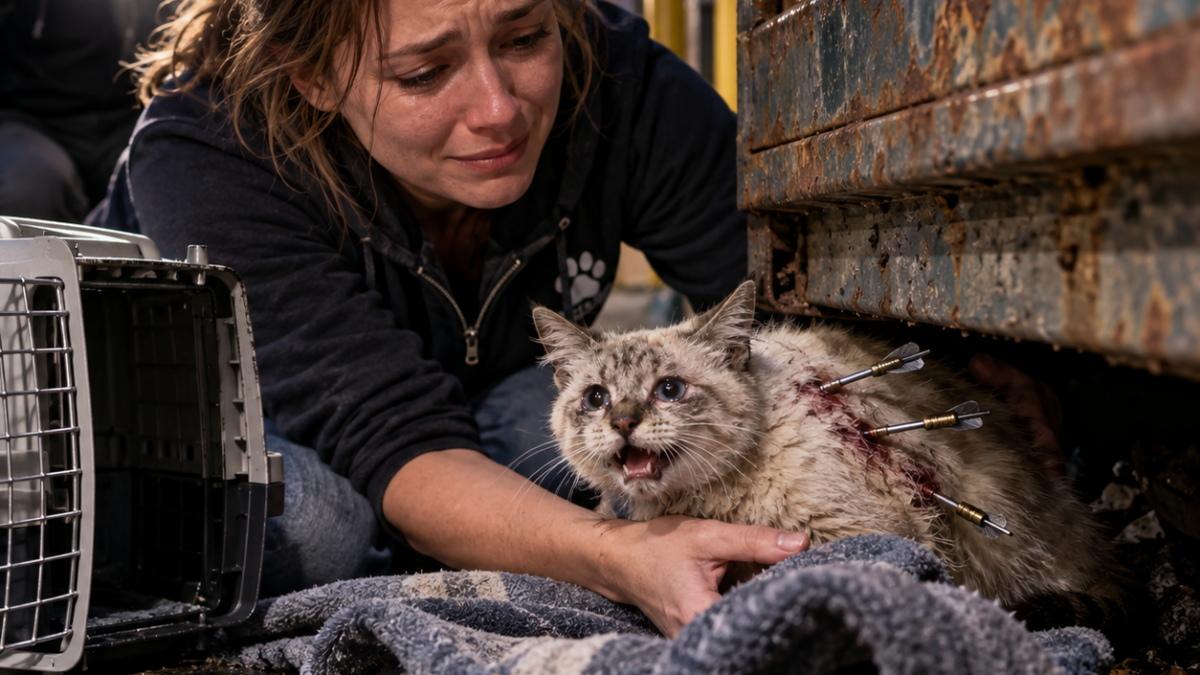
Her breathing was fast.
Too fast.
Shallow.
Pain breathing.
“Hey, sweetheart,” I whispered. “We’re not going to hurt you.”
She did not run.
She did not strike.
She did not even shift deeper into the shadows.
She simply cried.
One thin sound.
Then another.
Miguel crouched beside me with the flashlight angled away from her face.
“Can you reach her?”
“I don’t know.”
“Trap?”
“Not fast enough.”
I could see enough blood on her fur to know we did not have hours to negotiate.
We slid a blanket slowly toward her.
She watched it.
Her ears did not flatten.
That almost made it worse.
A terrified feral cat would have fought us.
Luna just trembled.
When my hand finally reached under the dumpster, she flinched hard enough that one of the darts brushed the concrete.
She cried out.
I froze.
“I know,” I whispered. “I’m sorry. I’m so sorry.”
There is a specific kind of helplessness that comes from touching an injured animal and knowing your help is causing pain before it can stop pain.
I had no idea how deep the darts had gone.
No idea what organs they might be near.
No idea whether lifting her wrong could turn a survivable wound into a fatal one.
So I moved like she was made of glass.
The moment I got both hands around her, Luna went rigid.
Then her body softened.
Not with trust exactly.
Exhaustion.
She trembled against my palms but never scratched me.
When I lifted her, she cried louder.
Miguel’s face twisted.
“God.”
“Open the carrier.”
We placed her inside a padded carrier lined with towels and drove straight to the emergency hospital.
Every bump in the road made her whimper.
I sat beside the carrier with one hand pressed against the outside, talking because there was nothing else I could safely do.
“Stay with me. Just stay with me. We’ve got you. You’re not alone now.”
Luna looked at me through the carrier door.
Her amber eyes were wide.
I kept thinking, Who did this to you?
Then, almost immediately, another thought followed.
Don’t make this about them yet.
She needs you here.
So I stayed with her.
In the present.
In the car.
In the rain.
With a tiny cat who had every reason to hate human hands and somehow had not decided to.
The veterinary team was waiting when we arrived.
Dr. Harris met us at the door in blue scrubs, his expression shifting the moment he looked into the carrier.
“How many?”
“At least four visible.”
“Any broken off?”
“I don’t know.”
“Breathing?”
“Fast. Shallow.”
He nodded to the techs.
“Treatment room now.”
They took Luna back immediately.
Miguel and I stood in the lobby with rain dripping from our jackets onto the floor.
I looked down and realized there was blood on my sleeve.
Her blood.
My hands began shaking then.
Not in the alley.
Not in the car.
Only when she was no longer in my hands.
Miguel noticed.
“Sit down.”
“I’m fine.”
“Rebecca.”
“I’m fine.”
“You’re dripping blood on your shoe.”
I sat.
The waiting room smelled like disinfectant, wet dog, and coffee burned onto the bottom of a pot. A golden retriever with a bandaged paw leaned against his owner near the wall. A woman in pajamas cried quietly beside a cat carrier covered with a towel. The television above the corner played a home renovation show no one watched.
Every few minutes, I stared at the doors.
Every time they opened, my stomach clenched.
Finally, Dr. Harris came out.
“She’s alive,” he said first.
Because good emergency veterinarians learn which sentence matters most.
I stood.
“She’s sedated enough for exam and imaging. We shaved around the entry points.”
“How bad?”
His face gave me the answer before his words did.
“Worse than it looked from outside.”
He led us into a consultation room and pulled up the X-rays.
I have seen a lot of ugly things in rescue.
Still, the image made my hand go to my mouth.
The darts looked too large inside her small body.
Too deliberate.
Too wrong.
One sat dangerously close to the chest cavity.
Another was near abdominal structures.
Others were embedded deep in muscle, where removal still carried risk of bleeding, tearing, or pushing damage farther inward.
Dr. Harris studied the image again even though he clearly already had.
“We have to operate.”
“Can you get them all?”
“I think so.”
“Without hitting anything vital?”
His eyes met mine.
“That’s what we’re going to try to do.”
I hated the word try.
Not because he was wrong to use it.
Because he was honest.
The surgery began just before midnight.
Miguel and I refused to leave.
We sat beneath fluorescent lights with coffee neither of us drank. Sharon arrived with extra phone chargers and granola bars. None of us touched the granola bars either.
Time changed shape after midnight.
Ten minutes felt like forty.
An hour vanished.
Every time the surgical doors opened, we looked up.
Every time it was not Dr. Harris, we pretended to breathe normally.
At 3:47 a.m., he finally came out.
His surgical cap was still on.
“She made it.”
I covered my face with both hands.
Miguel whispered something in Spanish under his breath and leaned forward with his elbows on his knees.
Dr. Harris continued.
“We removed every dart. No major organ was punctured.”
I looked up.
“But?”
“But she has significant soft-tissue trauma. Infection is still a serious concern. The next forty-eight hours matter.”
“Can I see her?”
“Not yet. She’s still waking up.”
I nodded.
I should have felt only relief.
Instead, my mind went back to the alley.
To the angle of the dumpster.
The cracked pavement.
The loading dock across the lane.
And the small security camera mounted above it, pointed almost directly at where Luna had been found.
Miguel looked at me.
“You saw the camera too?”
“Yes.”
“It might not work.”
“I know.”
“Might point the wrong way.”
“I know.”
“Could be overwritten.”
“I know.”
He stared at me.
“You’re going there as soon as the sun comes up, aren’t you?”
“Yes.”
“So am I.”
“You have a job.”
“So do you.”
“My boss likes cats.”
“My boss likes not firing me.”
I almost smiled.
Almost.
At 4:10 in the morning, Luna was unconscious.
The darts were gone.
That was the sentence I kept repeating to myself.
The darts were gone.
Four small pieces of metal sat inside an evidence container on the counter because Dr. Harris had insisted we preserve them rather than discard them. He photographed each wound before surgery, photographed the X-rays, documented the location and depth of every injury, and wrote detailed notes about what he found after opening the damaged tissue.
At the time, I was grateful because I thought of those records as Luna’s medical history.
I did not yet understand how important they would become for another reason.
We waited until the overnight veterinarian finally told us Luna was stable enough for us to go home.
I did not go home.
Neither did Miguel.
At 6:22 a.m., we were back in the alley.
Daylight made everything look smaller.
The dumpster.
The cracked pavement.
The brick wall where Luna had hidden.
During the night, the place had felt almost unreal, like a dark stage built around one injured animal.
In daylight, it was just an alley behind businesses.
That made me angrier.
Someone had hurt Luna in an ordinary place.
People had driven past.
Employees had taken smoke breaks twenty yards away.
Deliveries had arrived.
Life had continued around her pain.
The camera was mounted above the rear door of a commercial refrigeration company. A faded sign on the building read:
PARKER COLD SYSTEMS
The office opened at seven.
We waited in my car.
At 6:56, a pickup truck pulled into the lot.
A man in his sixties got out, wearing jeans, a quilted jacket, and the tired expression of someone who had been waking up before sunrise for decades. He unlocked the rear door.
I was out of the car before he fully stepped inside.
“Sir?”
He turned.
“Yes?”
“My name is Rebecca Cole. I’m with North County Animal Rescue. We found an injured cat behind your building last night.”
His face changed immediately.
“The dart cat?”
“You heard?”
“One of my guys showed me the neighborhood post.”
I pointed toward the camera.
“Does that work?”
He looked up.
“Yes.”
“Does it record the alley?”
“Most of it.”
My heart started pounding.
“How long do you keep footage?”
“Thirty days.”
Miguel and I looked at each other.
The owner’s name was Frank Parker.
When we explained what had happened, he let us into his office without hesitation. It was a small, cluttered room with invoices pinned to a corkboard, a space heater under the desk, and a framed photograph of a golden retriever wearing a Christmas bow.
Frank sat down at the computer and pulled up the camera system.
Four feeds appeared.
Front entrance.
Shop floor.
Parking lot.
Loading dock.
Camera four showed the alley.
The dumpster was visible.
So was the area where Luna had been found.
Frank rubbed one hand over his chin.
“When did this happen?”
“We don’t know exactly.”
I gave him the approximate period residents had reported seeing her.
He scrubbed backward.
Hours of empty pavement.
Employees carrying boxes.
Delivery vans.
A raccoon.
Two stray cats passing at night.
Nothing.
Then, at 3:18 p.m. the previous day, Luna appeared.
She was already injured.
I knew immediately.
Her body was low.
Her movement wrong.
One dart was clearly visible along her side.
She moved slowly from right to left, stopped beneath a parked trailer, then disappeared out of frame.
My stomach sank.
“The shooting happened somewhere else.”
Miguel swore quietly.
Frank kept watching.
At 5:04 p.m., Luna returned.
This time, she went under the dumpster.
That was where we found her hours later.
No attacker.
No person.
No event.
Only the aftermath.
For several seconds, nobody spoke.
Then Frank said, “Wait.”
He rewound.
“What?” I asked.
“Look where she came from.”
He pointed toward the far end of the alley, where a service road connected behind three other businesses.
“She enters from that direction both times.”
“What’s back there?”
“Machine shop. Storage company. Vacant warehouse.”
“Cameras?”
“Probably.”
That was how the investigation began.
Not with a heroic detective kicking down a door.
With three exhausted people carrying a flash drive from one business to another asking, “Do you have a camera?”
Some owners helped immediately.
Some said they were too busy.
One refused until animal control contacted him.
By noon, Officer Elena Ruiz from county animal welfare had joined us.
She listened to the entire story, watched Frank’s footage, and then made one thing very clear.
“You two stop collecting footage yourselves.”
I folded my arms.
“Why?”
“Because if this becomes a criminal case, I want original files with a documented chain of custody.”
“We already copied Frank’s.”
“That’s fine. I’ll collect the original export from him.”
Miguel asked, “You think there’s enough for charges?”
Elena looked toward the alley.
“I think deliberately shooting metal darts into a cat is worth investigating.”
“That wasn’t my question.”
“It’s the only answer I can give you yet.”
She went business to business.
By evening, she had footage from five cameras.
Most showed nothing useful.
One changed everything.
A storage facility two blocks away had a camera facing a narrow gravel cut-through between buildings.
At 1:42 p.m. the day before Luna was found, a pale cat walked into frame.
Healthy gait.
No visible darts.
Luna.
She sniffed along a fence.
Disappeared behind a stack of pallets.
At 1:47, two men appeared at the far edge of the frame.
Both wore work clothes.
One carried something long and narrow.
The image was too distant to identify exactly what.
They moved toward the area where Luna had disappeared.
Three minutes later, Luna shot back into view.
Running.
At least two metal shafts were clearly protruding from her body.
One man followed several steps behind her.
He appeared to be laughing.
I stopped breathing.
“Go back.”
Elena did.
Again.
Luna ran.
The man followed.
Laughing.
A third figure appeared near a loading door, looked toward the men, then went inside.
“Who owns that building?” I asked.
Elena did not answer.
She was already writing down the timestamp.
“Rebecca.”
“What?”
“You are not going there.”
“I didn’t say I was.”
“You were thinking loudly.”
Miguel almost laughed.
I didn’t.
I wanted to walk into that building.
I wanted to hold up Luna’s X-rays.
I wanted whoever had done it to look at the metal removed from her body and explain what kind of person turns pain into entertainment.
Elena paused the video.
“Do not contact anyone.”
“Fine.”
“Do not post this footage.”
“I said fine.”
“You’re angry.”
“Of course I’m angry.”
“Good. Be angry at home.”
I stared at her.
“If we identify someone,” she continued, “the fastest way to make this harder is letting them know exactly what evidence we have before investigators speak to them.”
I hated how right she was.
So I went back to the hospital.
Luna was awake.
Barely.
Her pupils were wide from medication. A soft cone surrounded her neck to keep her from reaching the surgical areas. Several small incisions ran along her side and shoulder, the shaved patches making her look even smaller.
She looked at me.
Then cried.
One weak sound.
I sat down immediately.
“Hey.”
Her eyes stayed on me.
“I know.”
I put my fingers through the kennel bars.
Luna moved her nose toward them.
Stopped half an inch away.
Then rested her head again.
Dr. Harris came in.
“She’s stable.”
“Eating?”
“Not yet.”
“Infection?”
“Too early to know.”
“Pain?”
“Controlled.”
I looked at the incisions.
“Did you see the footage?”
“Elena called.”
“What kind of person does that?”
He pulled a chair beside me.
“The kind we don’t need Luna spending energy thinking about.”
I turned toward him.
“She doesn’t know what happened?”
“She knows she was hurt.”
“That’s what I mean.”
“No,” he said gently. “She doesn’t need a human explanation. She needs her body to learn that the hurting has stopped.”
That sentence stayed with me.
Because I realized how much of my anger was about my need for a story.
Who.
Why.
What punishment.
Luna’s needs were simpler.
Pain control.
Antibiotics.
Food.
Sleep.
Predictable hands.
No more darts.
For the next forty-eight hours, we had no legal update.
That was probably good.
I needed something else to focus on.
Luna refused food the first day.
We tried warmed wet food.
Chicken.
Tuna water.
Recovery diet.
Nothing.
On the second morning, one of the veterinary technicians, Maya, sat beside Luna’s kennel for nearly forty minutes without touching her.
Maya had a strange gift with frightened cats.
She could become almost invisible.
No eye contact.
No reaching.
No excited baby voice.
She simply existed nearby.
Eventually, Luna stood.
Her movements were stiff.
She took one step.
Then another.
Maya placed a plate near the kennel door.
Luna sniffed it.
Ate one bite.
Maya did not react.
Another bite.
Then three.
When Maya texted me the photo, I cried at my desk.
Luna eating looked more important than the surveillance footage.
I did not expect that.
By day three, the swelling around her wounds had begun to decrease.
No fever.
No signs of internal bleeding.
She tolerated medication.
She ate half a meal.
Then most of one.
The medical staff started calling her Luna because we needed a name for records and no owner had come forward.
Miguel suggested it.
“Why Luna?” I asked.
“She came out after dark.”
“That’s your reasoning?”
“I’m exhausted.”
The name stayed.
Luna.
Soft.
Simple.
By the fourth day, she responded when we said it.
Probably because it usually predicted food.
I was fine with that.
On day five, Officer Elena called.
“We identified the building.”
I stepped outside the clinic.
“And?”
“It belongs to a commercial supply company.”
“The men?”
“Both employees.”
My grip tightened around the phone.
“Names?”
“No.”
“Elena.”
“No.”
“Why?”
“Because one has been interviewed and one has not.”
“What did the first say?”
“Rebecca.”
“I’m not going anywhere.”
“That is exactly what someone who is going somewhere says.”
I paced the sidewalk.
“Did he admit it?”
“He says he witnessed the other man using a dart launcher at stray animals behind the building.”
My entire body went cold.
“Animals?”
“Yes.”
“Plural?”
“Yes.”
“What animals?”
“He claims he saw him shoot at cats more than once.”
I stopped walking.
“More than once?”
“That is what he told investigators.”
“Did he stop him?”
“No.”
“Did he report him?”
“No.”
“What did he do?”
There was a pause.
“Elena.”
“He laughed in one of the videos.”
I closed my eyes.
I had already seen that.
Hearing it confirmed made it worse.
“What happens now?”
“A search warrant request is being prepared based on the footage, witness statement, and veterinary evidence.”
“So they haven’t arrested him.”
“Not yet.”
“What if he destroys everything?”
“That’s why you are not calling him.”
“I’m not.”
“Or posting his workplace.”
“I’m not.”
“Or messaging people from the company.”
“I’m not.”
Elena sighed.
“Good.”
I went back inside.
Luna was asleep.
I looked at the tiny rise and fall of her side.
Someone had treated her pain like entertainment.
Now twelve people were organizing shifts around making sure she was never alone too long.
That contrast did something to me.
It did not erase the anger.
It changed its direction.
Instead of asking, How do we make him suffer?
I started asking, How do we make sure Luna gets a life so full that what he did becomes the smallest part of it?
That was the beginning of my own recovery.
Luna’s came in inches.
On day six, she accepted a treat from Maya’s fingers.
On day seven, she stepped toward me instead of away.
I froze.
She sniffed my hand.
Then backed up.
“Okay,” I whispered.
I stayed still.
She approached again.
This time her cheek touched one finger.
Barely.
A brush.
Then she withdrew.
My throat tightened.
“Was that an accident?”
Luna blinked.
I offered the same hand.
She rubbed against it again.
Maya watched from the doorway.
“Congratulations.”
I looked at her.
“For what?”
“You’ve been promoted from threat to furniture.”
I laughed.
Luna startled.
I immediately lowered my voice.
“Sorry.”
Maya smiled.
“Furniture shouldn’t laugh.”
On day eight, Luna purred.
I almost missed it.
I was changing the blanket in her kennel while Maya held her loosely inside a towel. Luna’s eyes were half closed. Maya scratched gently beneath her chin.
A faint vibration started.
I stopped moving.
“Do you hear that?”
Maya smiled.
“Yeah.”
“Is she—”
“Yes.”
Luna purred.
Quietly.
Unevenly.
But unmistakably.
I turned away because I was crying.
Miguel walked in ten minutes later.
“What happened?”
“She purred.”
He stared.
“That’s why you look like someone died?”
“Shut up.”
He crouched beside Luna.
“Good girl.”
Luna stopped purring.
Miguel looked offended.
“She likes me.”
“Evidence suggests otherwise.”
He left to get coffee.
The following morning, police executed the search warrant.
Elena called that afternoon.
“They recovered a dart-launching device and additional metal darts consistent in size and construction with the ones removed from Luna.”
“Consistent?”
“Forensics still has to do its job.”
“Did they arrest him?”
“Yes.”
I sat down.
“What’s his name?”
This time she told me.
Derek Mullen.
Thirty-one years old.
Warehouse technician.
No prior animal-cruelty conviction.
The witness, another employee named Jason, told investigators Derek had talked for weeks about “clearing out” stray cats because they got into trash near the loading area.
He allegedly began shooting at them during breaks.
Jason admitted he had watched at least twice.
Once, he filmed it on his phone.
My stomach turned.
“Why would he film it?”
“You’re asking me to explain cruelty,” Elena said.
“Yes.”
“I can’t.”
“Was Luna in the video?”
“Not the one I was told about.”
“Other cats?”
“Yes.”
“Alive?”
She paused.
“One animal was injured and escaped.”
“Can we find it?”
“We’re trying.”
The investigation expanded.
Rescue volunteers searched the area again.
This time, not for Luna.
For any other cat who might have been hurt.
We trapped four strays over the next week.
Three were healthy aside from ordinary street-cat problems.
The fourth had an old puncture wound near the shoulder.
No dart.
No major infection.
We named him Jasper.
He recovered quickly.
I wanted to believe that meant there were no others.
I could not know.
That uncertainty stayed with me longer than I wanted.
Derek was charged under state animal-cruelty laws.
The exact charges changed after prosecutors reviewed the evidence.
There were counts related to intentionally injuring Luna and allegations involving another cat.
Jason was not charged with the same conduct, but investigators made clear that witnessing cruelty and treating it like entertainment had helped it continue.
His employer fired both men.
The company installed new cameras.
The owner donated to Luna’s care.
None of that brought me the satisfaction I expected.
I thought an arrest would feel like a door slamming shut.
Instead, I mostly felt tired.
Luna did not care.
On the day Derek was arrested, she ate almost two full cans of food.
That mattered more.
By day ten, she had begun sitting near the front of her kennel when familiar staff entered.
Not strangers.
Not yet.
If someone new walked in too quickly, Luna retreated to the back.
We respected that.
No forcing.
No pulling her out so people could prove they were nice.
Kindness is not kindness if the frightened animal has no choice.
By day eleven, she played.
It happened at 6:14 p.m.
Maya dragged a feather wand slowly across the floor outside the kennel.
Luna watched.
Her pupils widened.
The feather moved again.
One paw lifted.
Then stopped.
Maya moved it once more.
Luna slapped through the bars.
We all went silent.
She slapped again.
Maya let the feather jump.
Luna pounced.
Not a full-body kitten pounce.
Her incisions were still healing.
It was more of an enthusiastic lean.
But the instinct was there.
Predator.
Play.
Life.
The cat who had been curled under a dumpster too exhausted to flee was annoyed because a fake bird would not cooperate.
Perfect.
By day thirteen, Dr. Harris removed several sutures.
Healing beautifully.
No infection.
No organ damage discovered later.
The most dangerous dart had missed the chest cavity by less than an inch.
He started to show me the image again.
I stopped him.
“I don’t want to see it.”
He lowered the tablet.
“Fair.”
“I’ve looked at those X-rays enough.”
“You’ll have to eventually for the case.”
“I know.”
“But not today.”
That mattered.
At first, I thought loving Luna meant keeping my attention fixed on what happened.
I learned that sometimes love means letting the horror become background.
The prosecution could look backward.
Luna needed us looking forward.
On day fifteen, a woman named Sarah Reed visited the clinic.
She had been following Luna’s case through the rescue updates.
Sarah was forty-three, worked from home as a medical transcriptionist, lived with her husband Daniel and their eleven-year-old daughter Emma, and had lost a fifteen-year-old tabby named Winston the previous year.
I had rejected three early adoption inquiries because they came with sentences like:
We want the famous dart cat.
No.
Luna was not a trophy.
Not a symbol.
Not a dramatic story someone could tell guests.
Sarah’s email was different.
She wrote:
We don’t need to meet her until you believe meeting people is useful to her. If that takes weeks, that’s fine. If she needs to stay with a medical foster first, that’s fine too. We are interested in the cat, not the story.
I called her.
“What if Luna never becomes a lap cat?”
“Then she won’t be a lap cat.”
“What if strangers scare her forever?”
“We don’t have many strangers.”
“What if she hides for the first month?”
“We have a spare bedroom.”
“What if she bites when frightened?”
“We’ll follow the behavior plan.”
“Do you have children besides Emma?”
“No.”
“Does Emma understand she may not be allowed to touch Luna for a while?”
Sarah handed her the phone.
A young voice said, “Hi.”
“Hi, Emma.”
“Mom said Luna might be scared of hands.”
“Maybe.”
“So I won’t use mine until she asks.”
I stopped writing.
“What does that mean?”
“I can sit and read.”
“You’re eleven?”
“Yes.”
“Are you sure?”
She laughed.
That was their first point in favor.
The second was that when they came to meet Luna on day seventeen, none of them walked directly to the kennel.
Sarah sat sideways.
Daniel stayed by the wall.
Emma opened a book.
Not a cat book.
A fantasy novel.
She read silently.
Luna watched them from the back of the kennel.
Five minutes.
Ten.
Then fifteen.
Sarah did nothing.
Daniel did nothing.
Emma turned pages.
At eighteen minutes, Luna moved forward.
One step.
Then another.
She sat halfway between the back wall and the kennel door.
Emma kept reading.
At twenty-five minutes, Luna lay down.
That was all.
Sarah looked at me.
“Was that okay?”
“That was excellent.”
“We didn’t do anything.”
“Exactly.”
On the second visit, Luna sniffed Sarah’s fingers.
On the third, she sat near Emma.
On the fourth, she rubbed once against Daniel’s shoe.
Daniel looked terrified to move.
I whispered, “Don’t ruin it.”
He mouthed, “I’m trying.”
Luna rubbed again.
By day twenty, Dr. Harris cleared her medically.
One more day of observation.
Then discharge.
Twenty-one days after she arrived at the hospital, Luna left.
I cried before she did.
She hated the carrier less than I expected.
We placed her blanket inside.
Maya put one of her favorite toys beside her.
Sarah’s family met us at their house.
No adoption ceremony.
No balloons.
No crowd.
No social-media sign.
Luna had survived enough spectacle.
The spare room contained a low bed, covered hiding boxes, food, water, litter, scratching surfaces, and a wide window overlooking the backyard.
Emma had taped a handwritten note to the outside of the door.
LUNA’S ROOM — KNOCK QUIETLY
I laughed.
“She can’t read.”
Emma shrugged.
“Dad can.”
Daniel nodded solemnly.
Luna stayed inside the carrier for forty-three minutes.
Nobody reached in.
We sat on the floor.
Talked quietly.
Eventually, she stepped out.
Her body stayed low.
She sniffed.
One corner.
Another.
The bed.
The box.
Then the window.
She jumped onto the low sill.
We all froze.
Outside, birds moved through a feeder.
Luna watched.
For nearly ten minutes, she forgot we existed.
That was when I knew the room might become hers.
Not because she loved the family yet.
Because she felt safe enough to be curious.
Before I left, I knelt near the doorway.
“Bye, Luna.”
She looked at me.
I expected nothing.
Then she walked closer.
Stopped.
Touched her forehead to my fingers.
Once.
I cried all the way home.
The trial adoption period lasted three weeks.
Sarah sent daily updates at first.
Day 1: Ate overnight. Used litter box. Hiding when we enter.
Day 3: Watched Emma read for twenty minutes.
Day 5: Came out while Daniel was in the room.
Day 7: Played with wand toy.
Day 9: Slept on bed instead of under it.
Day 12: Followed Sarah into hallway.
Day 14: Purred during cheek rub.
Day 18: Stole chicken. Apparently healing is complete.
I laughed.
Then day nineteen arrived with no message.
I panicked.
Called Sarah.
She answered whispering.
“Everything’s fine.”
“Why are you whispering?”
“She’s asleep on my lap.”
I stopped.
“On your lap?”
“Yes.”
“You said she might never be a lap cat.”
“I know.”
“Can I see?”
Sarah sent a picture.
Luna curled across her legs.
Eyes closed.
One paw stretched over Sarah’s wrist.
The scars on her side were still visible beneath thin regrowing fur.
But they no longer commanded the picture.
The dominant thing was trust.
The adoption became permanent two days later.
Luna Reed.
Not famous.
Not a symbol.
A family cat.
The legal case took longer.
Months.
That frustrated me.
Every update about Luna moved quickly.
Every legal update seemed trapped beneath paperwork.
Derek’s attorney challenged parts of the evidence.
Questioned whether the darts recovered from his workplace could be definitively matched to Luna’s.
Questioned the exact time of injury.
Questioned whether Derek had been the person visible in every piece of footage.
That was his attorney’s job.
I understood.
I hated it.
The prosecutor relied on the combination of evidence rather than one magical proof.
Video showing Derek and Jason entering the area where Luna disappeared.
Luna emerging injured minutes later.
Jason’s statement.
His phone video from another incident.
The launcher recovered during the search.
Matching types of darts.
Veterinary documentation showing deliberate projectile wounds.
Witness statements that Derek had complained about stray cats.
Digital messages recovered from a work group chat in which he joked about “target practice.”
That last evidence made me physically sick.
Luna had become entertainment.
A living target.
The prosecutor asked if I would testify.
“Yes.”
“Are you sure?”
“Yes.”
I wanted the court to hear the sound she made under the dumpster.
Not as drama.
As fact.
The hearing room was smaller than I imagined.
Derek sat beside his attorney.
He looked younger than I expected.
That bothered me.
I wanted cruelty to look monstrous.
Instead, it looked ordinary.
Short hair.
Work shirt.
Hands folded.
The prosecutor asked me to describe Luna when we found her.
I did.
Her position.
Her breathing.
The metal darts.
The lack of aggression.
Her crying.
The transport.
I did not add anything I could not prove.
Then the attorney asked:
“Ms. Cole, you cannot say who actually shot Luna, correct?”
“I did not witness the shooting.”
“So you cannot identify my client as the person who injured the cat.”
“I can identify what I saw when we found her.”
“Yes or no?”
“No. I did not witness the shooting.”
It felt like losing.
Elena had warned me.
“Truth doesn’t weaken the case,” she had said. “Pretending certainty does.”
So I answered exactly what I knew.
Dr. Harris testified after me.
Clinical language became devastating in a way my emotion never could.
Penetrating projectile trauma.
Depth.
Risk to thoracic structures.
Surgical extraction.
Pain.
Infection risk.
He explained that Luna’s wounds could not reasonably have occurred through ordinary contact with debris.
Then Jason testified.
I almost felt more anger toward him than Derek.
Because he had watched.
Laughed.
Done nothing.
Jason looked at the floor most of the time.
The prosecutor asked, “Did you see Mr. Mullen fire darts at stray cats?”
“Yes.”
“How many times?”
“More than once.”
“Did you see him fire at Luna?”
Jason swallowed.
“I saw him aim at that cat.”
“Did you see a projectile strike her?”
“Yes.”
My chest tightened.
There it was.
The thing no camera angle could give us.
The defense attorney asked, “Why should anyone believe you now when you failed to report these incidents?”
Jason’s face reddened.
“They shouldn’t believe me because I’m good.”
The courtroom went very quiet.
He continued.
“They should believe me because I was there.”
He admitted laughing.
Admitted filming once.
Admitted doing nothing.
“I thought it was stupid,” he said. “I didn’t think about what it was doing to the animal.”
The prosecutor asked, “When did you start thinking about it differently?”
Jason looked toward me.
Then away.
“When I saw the rescue picture.”
Luna beneath the dumpster.
Darts visible.
Eyes exhausted.
That photograph had made him understand the joke had a body.
Pain.
Consequences.
I did not forgive him.
But I believed his shame.
Derek eventually changed his plea.
Not because he suddenly became remorseful.
Because the evidence had become difficult to contest.
He pleaded guilty to multiple animal-cruelty offenses.
The sentencing happened weeks later.
Sarah asked if she should bring Luna.
“No.”
“Are you sure?”
“Yes.”
Luna did not need to enter a courthouse because someone wanted a powerful visual.
She stayed home with Emma.
The judge reviewed the evidence.
Derek spoke briefly.
He said he had been frustrated by feral cats around the workplace.
He said he never intended to kill one.
That sentence made my hands close into fists.
The judge noticed.
The prosecutor asked permission to respond.
The judge spoke before she could.
“An intent to frighten or injure an animal is not made harmless merely because death was not the intended result.”
Exactly.
Derek received jail time, probation after release, restitution for Luna’s medical care and expenses related to the other injured cat, mandatory psychological and animal-cruelty intervention programming, and a long-term prohibition on possessing or having unsupervised control over animals.
The judge also ordered the weapon destroyed after the appeals period and evidence requirements ended.
Was it enough?
I did not know.
Some people online wanted years more.
Others said jail was excessive for “a cat.”
That phrase made me understand why the case mattered.
A cat.
As though species reduced pain.
As though a small body somehow made deliberate suffering smaller.
I stopped reading comments.
Sarah sent me a video instead.
Luna was chasing a crinkle ball down the hallway.
She slammed into a cardboard box.
Jumped out.
Ran again.
I watched it six times.
That was enough.
The day after sentencing, Miguel asked me, “Feel better?”
We were sitting in the rescue office.
“No.”
“Me neither.”
“I thought I would.”
“So did I.”
“What was I expecting?”
He shrugged.
“For something to balance.”
That was it.
Balance.
I had imagined punishment as a scale.
Luna’s pain on one side.
Consequences on the other.
But there was no sentence that could reproduce what she endured without creating more suffering.
And creating suffering was the very thing we had been fighting.
“So what does justice feel like?” I asked.
Miguel thought for a moment.
“Maybe it doesn’t feel good.”
That was the most honest answer.
Justice made a record.
It named the act.
Stopped the person.
Protected other animals.
Required restitution.
Changed the workplace.
Brought attention to the other injured cats.
Those things mattered.
But satisfaction came from somewhere else.
It came four months later, when I visited Luna.
Sarah opened the door.
“Brace yourself.”
“For what?”
“She has become unbearable.”
Luna appeared around the corner.
Healthy.
Fur completely regrown except for two barely visible scar lines.
Tail high.
She looked at me.
Stopped.
Then ran.
Not cautiously.
Not one step at a time.
Ran.
She hit my legs.
Rubbed against both ankles.
Then flopped dramatically onto her side.
I knelt.
“Who are you?”
Luna purred.
Sarah folded her arms.
“She wakes Emma at five.”
“Excellent.”
“She steals toast.”
“Better.”
“She screams outside the bathroom door.”
“Perfect.”
“She knocked a plant down yesterday.”
I looked at Luna.
“Acquitted.”
Sarah laughed.
Emma came downstairs.
Luna immediately ran to her.
The relationship between them had become exactly what I hoped.
Not forced.
Not sentimental.
Ordinary.
Emma did homework with Luna sitting on the textbook.
Luna slept at the foot of her bed.
Sometimes under the blanket.
Sometimes on Sarah.
She preferred Daniel during football games because his lap remained still longer.
She sat in the sunny window every afternoon.
Bird-watched.
Chattered.
Napped.
Normal cat crimes.
It was beautiful.
Emma showed me Luna’s toy basket.
There were at least twenty toys.
“Does she need all of these?” I asked.
“No.”
“Then why?”
Emma looked at me as if the answer were obvious.
“She almost died.”
Apparently, that justified consumer excess.
I approved.
A year after Luna’s rescue, Sarah’s family invited our rescue team over for dinner.
No media.
No fundraiser.
Just dinner.
Miguel came.
Maya came.
Dr. Harris arrived late from work.
Officer Elena came carrying wine.
Luna spent the first twenty minutes upstairs because six extra adults violated her preferred population density.
Then she appeared.
Slowly.
She sat on the staircase.
Watched.
Nobody called her.
Nobody reached.
Eventually, she came down.
She went directly to Dr. Harris.
He laughed.
“Oh, now you like me?”
Luna sniffed his shoe.
Then rubbed against his leg.
He froze.
“I spent three hours removing metal from you, and this is my thank-you?”
Purr.
Maya took a picture.
Dr. Harris scratched Luna’s cheek.
“You look good, kid.”
That was when I cried.
Not dramatically.
Just tears.
Elena saw.
“You okay?”
“Yes.”
“No revenge fantasies?”
I laughed.
“Less often.”
“Growth.”
I looked at Luna.
“Turns out she’s better revenge than anything I imagined.”
Elena raised an eyebrow.
“How?”
Luna abandoned Dr. Harris and attempted to steal chicken from Miguel’s plate.
“Because whoever hurt her wanted her pain to be the whole event,” I said. “It wasn’t.”
Two years passed.
Luna became less fearful of visitors, though she still preferred people who waited for her.
The family respected that.
No picking her up when she did not ask.
No passing her around.
No forcing introductions.
She had choices.
That seemed to matter more than any amount of affection.
One afternoon, Sarah called me.
“Do you remember Jasper?”
The other stray with the old puncture wound.
“Of course.”
“He’s still at the sanctuary?”
“Yes.”
“We’ve been talking.”
I knew immediately.
“No.”
Sarah laughed.
“You don’t know what I’m asking.”
“Yes, I do.”
Emma had been volunteering at the rescue.
She had become attached to Jasper.
Older male.
Shy.
Not as photogenic as Luna.
No viral story.
Just a quiet cat with an old injury and no permanent home.
“Luna likes other cats,” Sarah said.
“Sometimes.”
“We want to foster him.”
“Foster.”
“Yes.”
I did not believe them.
Neither did Miguel.
Jasper moved in a week later.
The introduction took time.
Separate rooms.
Scent swapping.
Barrier feeding.
Short supervised meetings.
Luna hissed at him.
Sarah looked horrified.
“She hissed.”
“She’s a cat.”
“She didn’t even hiss when she was injured.”
“Exactly.”
Sarah blinked.
“She feels safe enough to have opinions now.”
That changed how we saw it.
A hiss was not regression.
It was communication.
Luna had spent her worst night too depleted to defend herself.
Now she could tell another cat:
Too close.
Back off.
My space.
Good.
Jasper listened.
Eventually.
Within six weeks, they were sharing the windowsill.
Within three months, Jasper’s foster status became fiction.
He stayed.
Their bond was imperfect.
Real.
Luna groomed his head.
Jasper stole her bed.
She slapped him.
He returned ten minutes later.
Family.
Years moved.
The case became old news.
Derek served his sentence.
Completed probation.
I heard once that he moved out of the county.
I did not search for him.
That surprised me.
There had been a time when I knew every available public detail.
Court dates.
Filings.
Conditions.
Then one day I realized I had not thought about him for months.
Luna had made him irrelevant.
That was the final form of revenge.
Not ruining his life.
Not imagining suffering returned.
Irrelevance.
The person who caused the worst night of Luna’s life did not get to remain the central character in all the years that followed.
Luna did.
At five years after rescue, she developed a habit of sleeping inside laundry baskets.
At six, she became obsessed with a heated mat.
At seven, she gained weight and Dr. Harris called her “pleasantly round.”
Sarah argued with him.
He changed it to “medically not ideal.”
Luna remained unmoved.
At eight, Emma left for college.
That was Luna’s next great emotional challenge.
She searched Emma’s room.
Sat on the bed.
Waited near the front door the first few evenings.
Sarah worried.
“She thinks Emma left her.”
“Maybe.”
“What do I do?”
“Keep routine.”
Emma video-called.
Luna ignored the screen.
Of course.
Then Emma returned home for the first weekend.
Luna heard the door.
Ran.
Stopped halfway.
Then ran again.
Emma dropped her bag.
Luna jumped onto the couch beside her.
Rubbed her face all over Emma’s arms.
No dramatic fear.
No permanent mistrust.
Because this time, leaving had a history of return.
That mattered.
Luna had learned something she did not know beneath the dumpster.
People could go away without abandoning her.
At ten, Luna’s muzzle lightened.
Not much.
Cats age quietly.
She slept more.
Played in shorter bursts.
Jasper died that year from kidney disease.
Luna looked for him.
For several days, she checked his bed.
The hallway.
The window.
Then stopped.
She became more attached to Sarah afterward.
Not desperate.
Closer.
At night, she slept against Sarah’s hip.
I visited a week later.
“She misses him,” Sarah said.
“I think so.”
“Will she be okay?”
I watched Luna wash one paw.
“Yes.”
“How do you know?”
“I don’t.”
Sarah smiled.
“Useful.”
“But grief didn’t destroy her before.”
That was true.
Luna had survived worse.
Not because pain made her stronger.
I hate that phrase.
Pain is not a gift.
It does not need to be thanked for building resilience.
Luna survived because when pain happened, other things happened afterward.
Care.
Safety.
Time.
Food.
Predictability.
Choice.
Connection.
Those were the things that built her.
At twelve, Luna developed arthritis.
We added low steps to the furniture.
A warmer bed.
Joint medication.
The scars from the darts were invisible beneath her fur.
Dr. Harris could still feel slight changes in the tissue if he searched carefully.
Nobody else knew.
That was how I wanted it.
Her body remembered medically.
Her life did not revolve around remembering.
At thirteen, Sarah called me from the vet.
“Kidney values.”
My stomach tightened.
“How bad?”
“Early.”
“Okay.”
“You say that too calmly.”
“I’ve learned.”
They changed food.
Increased monitoring.
Luna adapted.
She rejected the renal diet at first.
Naturally.
Sarah tried three brands.
Luna accepted the most expensive.
Naturally.
At fourteen, she still sat in the same sunny window.
Emma had moved back to town by then.
She visited every Sunday.
Luna knew the pattern.
Around noon, she began waiting near the door.
Not anxiously.
Expectantly.
The difference was visible.
Waiting can come from trust or fear.
You can tell by the body.
Luna’s body stayed loose.
Tail relaxed.
Sometimes she fell asleep before Emma arrived.
She knew.
That was trust.
At fifteen, Luna stopped jumping onto the windowsill.
Daniel built a small ramp.
Luna used it immediately.
Unlike most cats, she did not take six months to punish him for trying to help.
Age had improved her diplomacy.
Slightly.
At sixteen, her kidneys worsened.
Appetite became unpredictable.
Good morning.
Bad evening.
Medication.
Fluids under the skin.
Sarah learned how to do it at home.
The first time, Luna protested.
A healthy hiss.
We laughed.
“Still has opinions,” Sarah said.
“Good.”
The story was approaching its final chapter.
We all knew.
No one said it too early.
Luna had already spent enough of her life treated as though death was the main thing people saw when they looked at her.
We let her be alive.
Until the balance changed.
One February morning, Sarah called.
“Rebecca.”
Her voice told me before the words did.
“Is it time?”
“I think so.”
I closed my eyes.
“I’m coming.”
Luna was on the heated mat when I arrived.
Thin now.
Still beautiful.
Amber eyes slower.
Emma sat on the floor beside her.
Daniel stood in the kitchen pretending to make coffee.
Sarah had already called the mobile veterinarian.
Luna lifted her head when I entered.
I sat several feet away.
No dramatic greeting.
No running.
She looked.
Blink.
I blinked back.
Then moved closer.
“Hi, kid.”
Luna purred.
Faintly.
I put one hand near her cheek.
She rubbed against one finger.
Exactly like she had in the hospital all those years ago.
The memory hit me so hard I had to look away.
Sarah whispered, “You okay?”
“No.”
Luna closed her eyes.
“I remember the first time she did that.”
Sarah smiled through tears.
“She still likes you.”
“Furniture,” I whispered.
“What?”
“Maya said I’d been promoted from threat to furniture.”
Sarah laughed.
Luna’s tail moved once.
The veterinarian arrived at noon.
She examined Luna gently.
Kidney failure advanced.
Weight loss.
Weakness.
Nausea despite medication.
Pain controlled, but quality of life narrowing.
There were possible ways to extend time.
Hospitalization.
More aggressive fluid support.
Feeding interventions.
Sarah asked every question.
Then one.
“Would any of that give her back good days, or mostly more days?”
The veterinarian paused.
“Mostly more days.”
Sarah cried.
“Then no.”
That was love.
Hard.
Clear.
Not surrender.
Protection.
We gathered in the living room.
No clinic.
No stainless steel.
No frightened carrier.
Sun came through the window.
Luna lay on her heated mat.
Emma brought the old feather toy.
Luna ignored it.
Appropriate.
Daniel brought tuna.
Luna licked it once.
Then stopped.
Sarah lay beside her.
“You’re allowed,” she whispered.
Her voice broke.
“You hear me? You don’t have to stay because we’re not ready.”
Luna purred faintly.
The first medication made her sleepy.
Her body softened.
No fear.
No trembling.
No cries.
I remembered the alley.
The metal darts.
The carrier.
Every bump making her cry.
That cat felt both close and impossibly far away.
Sarah stroked Luna’s forehead.
Emma held one paw.
Daniel put his hand against Luna’s back.
I sat nearby.
The veterinarian waited.
When Sarah nodded, the final medication went in.
Luna’s breathing slowed.
One breath.
Another.
A pause.
Then stillness.
The veterinarian listened.
“She’s gone.”
Sarah pressed her face into Luna’s fur.
Emma sobbed.
Daniel turned away.
I looked toward the sunny window.
For a strange second, I expected to see Luna there.
Then I looked back at her body.
No darts.
No wounds.
No fear.
Old.
Loved.
Home.
That was everything.
Later, people asked whether Luna’s story had a happy ending.
I never liked the question.
Happy endings are usually described as though nothing painful happens after happiness begins.
That is not life.
Luna’s ending included kidney disease.
Age.
Loss.
Grief.
Death.
And yes, it was still happy.
Because the ending was not the moment her heart stopped.
The ending was the entire distance between a dumpster and that living-room floor.
Sixteen years of distance.
That is an enormous thing.
The person who shot her had controlled a few terrible hours.
He did not control the rest.
He did not get the sunny windows.
Emma’s bed.
Sarah’s lap.
Jasper.
The stolen chicken.
The heated mat.
The Sunday waiting.
The hisses.
The purrs.
The old age.
He got none of it.
Luna did.
After the cremation, the family asked if I wanted one of Luna’s toys.
I said no.
Then Emma brought me a small feather wand.
“The first kind she played with at the clinic.”
I took it.
Not as a relic of suffering.
As proof that play came back.
At the rescue, we placed a photograph of Luna on the wall.
Not the alley photograph.
Not the X-ray.
Not the picture with the darts.
A photo taken when she was maybe six.
Luna stretched across a sunny windowsill.
Eyes closed.
One paw dangling.
Below it, a small plaque:
LUNA
HER PAIN WAS A CHAPTER. HER LIFE WAS THE STORY.
That was enough.
Years after her case, younger volunteers still heard about it.
Some knew the famous part.
The darts.
The surgery.
The court case.
I always corrected them.
“You’re skipping the good part.”
“What good part?”
“The fifteen years after.”
They wanted drama.
I gave them routine.
She hated cheap cat food.
She loved heat.
She preferred Emma when Emma was reading.
She stole Daniel’s chair.
She hissed at Jasper for six weeks.
She hated the vacuum.
She loved tuna until kidney disease made her picky.
She slept against Sarah’s left hip, never the right.
She chirped at cardinals.
She developed one white whisker before all the others.
Those details mattered.
They rescued her from becoming only a victim.
That became one of the lessons Luna changed in our rescue.
We became more careful about the images we shared.
Yes, evidence photographs mattered.
Medical photographs mattered.
Fundraising sometimes required showing urgency.
But pain should not become an animal’s permanent public identity.
We started showing recovery more intentionally.
Playing.
Sleeping.
Misbehaving.
Being ordinary.
Because ordinary was the goal.
A rescued animal does not owe the world lifelong inspiration.
Luna got to stop being inspirational.
She got to be annoying.
That was success.
Sometimes people asked whether I forgave Derek.
No.
Not in the way they meant.
Forgiveness was never required for my life to continue.
I stopped thinking about him because Luna became more interesting.
That is different.
I did not need to hate him every morning for justice to remain true.
The court record existed.
The sentence happened.
Restrictions happened.
Animals were safer.
My anger had done its job.
Then it could retire.
Luna never needed to know his name.
I was glad.
Her vocabulary was better.
Dinner.
Window.
Emma.
Sarah.
Treat.
Bed.
Home.
Those words built a life.
If I could go back to that first night beneath the dumpster, I would still kneel exactly where I did.
I would still slide the blanket slowly.
I would still say:
“We’re not going to hurt you.”
But I would know something I did not know then.
I would know the cat looking at me with those exhausted amber eyes would one day become elderly enough to need a ramp.
I would know she would hiss.
Good, healthy hisses.
I would know she would steal food.
I would know she would sleep through visitors.
I would know one little girl would grow into a woman with Luna beside her through most of childhood.
I would know a shy male cat named Jasper would sleep against her back.
I would know a veterinarian would one day call her “pleasantly round.”
I would know she would reach sixteen.
Sixteen.
The animal I was afraid might die before sunrise.
That fact still feels impossible.
The last time I visited Sarah after Luna died, we sat near the window.
The heated mat was gone.
The ramp remained.
Sarah had not moved it yet.
“You want me to take that down?” Daniel asked.
Sarah shook her head.
“Not yet.”
I understood.
There is no correct timetable for removing evidence of love.
Emma came in carrying an old photo album.
She opened it.
Luna at three months after adoption.
Luna at one.
Luna with Jasper.
Luna wearing a ridiculous holiday bow she clearly hated.
Luna on Emma’s homework.
Luna in the laundry basket.
Luna gray-faced in the window.
Page after page.
At the end, Emma had placed one copy of the original rescue photograph.
Luna beneath the dumpster.
Tiny.
Injured.
Amber eyes.
I stared.
Emma touched the edge.
“I used to hate this picture.”
“Me too.”
“Now I don’t.”
“Why?”
She turned back through the album.
“Because I know what came after.”
That was the answer.
Pain is different when it is not the last page.
Not less painful.
But no longer total.
Luna’s worst photograph had once looked like her entire future.
Now it was one page in an album thick with years.
Emma closed it.
Sarah asked, “Do you think she knew?”
“Knew what?”
“That she was safe.”
I almost laughed.
“Eventually?”
“Yes.”
I thought about the lap.
The window.
The way Luna slept with her back completely exposed.
The way she hissed when annoyed.
The way she ignored the front door because she trusted people to return.
“Yes,” I said. “She knew.”
That is the ending I carry.
Not the sentencing.
Not the surgery.
Not even the first purr.
Luna knew.
She knew the world was no longer the alley.
She knew hands could reach without causing pain.
She knew footsteps could mean food.
She knew doors could open because someone was coming home.
She knew being seen did not always lead to cruelty.
She knew she could sleep.
Deeply.
Carelessly.
In sunlight.
If there is revenge in that, it is the only kind I care about now.
Someone tried to teach Luna that people were dangerous.
Sixteen years of gentleness contradicted him.
Someone treated her body like a target.
Her family treated it like something precious.
Someone left metal inside her.
Veterinarians removed every piece.
Someone made her cry beneath a dumpster.
Years later, the same cat learned to scream outside the bathroom because Sarah had dared close the door.
Someone reduced her world to pain.
Luna made it enormous again.
Room by room.
Person by person.
Year by year.
That was the answer.
Not pain returned.
Life restored.
And in the end, Luna did not leave this world beneath rusted metal in an empty alley.
She left from a warm room.
With sunlight nearby.
With the people she had chosen around her.
After enough years that her scars had become difficult to find beneath the fur.
After enough love that cruelty no longer knew how to define her.
The darts were removed in one night.
What replaced them took a lifetime.
Trust.
Safety.
Family.
Home.



