A Tiny Calico Risked Her Life to Keep a Blind 15-Year-Old Cat Alive in -14°F Cold—And When Rescuers Tried to Separate Them, She Refused to Let Him Go.
PART3:
Mara felt the first unease move through her.
“She’s not just hiding,” she said.
They reached the trailer.
There was a gap where the skirting had torn away near the back corner. Beneath it, the ground was frozen dirt, protected from the worst of the snow but not from the cold. Mara got down on one knee and shined the flashlight underneath.
At first, she saw only shadows.
Then two eyes reflected back.
Low.
Wide.
Watching.
“There she is,” Owen whispered.
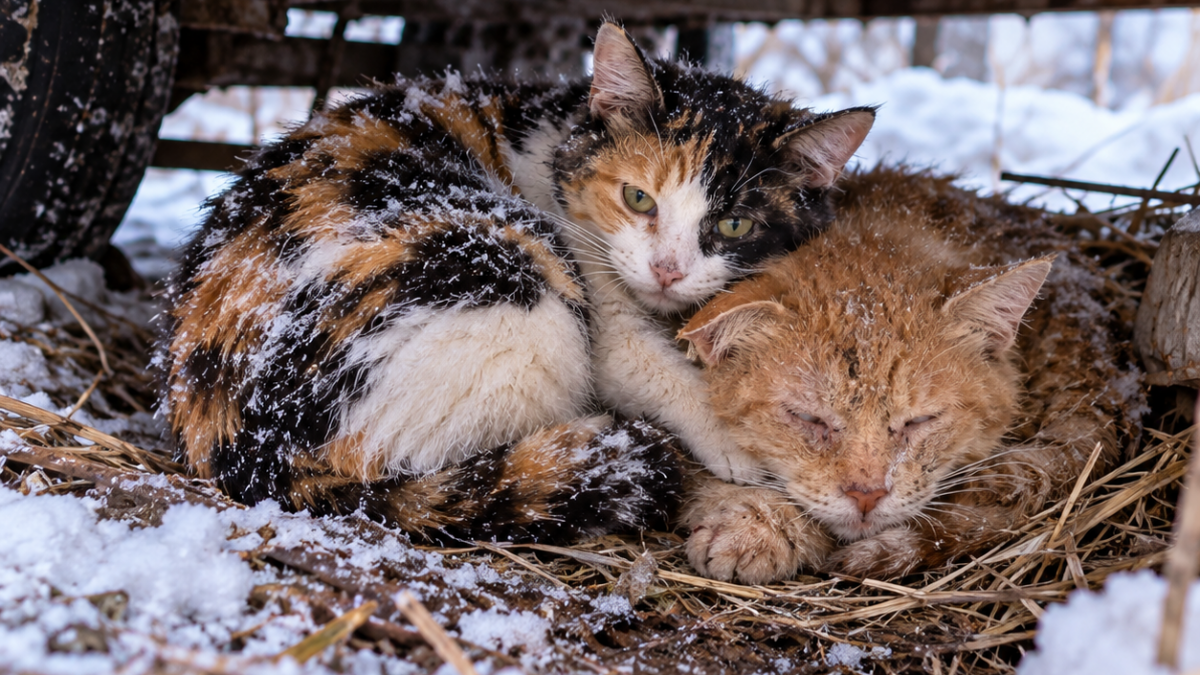
The calico crouched under the trailer, tucked near one of the support blocks. She was even smaller than June had described. Barely four pounds, Mara guessed, maybe less. Her fur was puffed out against the cold, but it did not hide how thin she was. One ear had a tear near the tip. Her front paws looked swollen.
Mara softened her voice.
“Hey, sweetheart.”
The calico did not move.
Mara reached for the food pouch.
Then the flashlight beam shifted.
And she saw the ginger cat.
He was behind the calico, pressed against the concrete block and half-covered by old insulation the calico had apparently dragged into a nest. At first, he looked like a pile of orange cloth. Then his head lifted.
Slowly.
Too slowly.
He was large-framed but wasted down to almost nothing, an elderly ginger tom with matted fur, cloudy eyes, and a face so sunken with age and dehydration that he looked more like a memory of a cat than a living one.
His eyes did not focus.
He turned his head toward Mara’s voice but looked past her.
Blind.
Mara’s throat tightened.
“Owen,” she said quietly, “there are two.”
Owen leaned closer.
“Oh God.”
The calico shifted immediately, placing herself between the rescuers and the ginger cat.
She did not hiss.
She was too weak for drama.
But she lowered her body and opened her mouth in a silent warning.
Not him.
Mara understood.
“She’s protecting him.”
Owen stared at the old cat.
“Is he alive?”
“Yes.”
“Barely.”
Mara had the same thought.
The ginger cat’s breath came shallow and slow. His body trembled, but not enough. A healthy animal shivers hard in cold. A dying one sometimes stops trying.
Mara opened the food pouch and placed a small amount on a paper tray just inside the gap.
The calico looked at it.
Her nose twitched.
Every line of her body screamed hunger.
But she did not eat.
Instead, she turned, nudged the tray backward with her nose, and pushed it toward the ginger cat.
Owen went completely still.
The old ginger lowered his head.
He sniffed.
Missed the food.
The calico nudged it closer.
He found it then.
His tongue moved weakly.
He ate two bites.
Three.
The calico watched.
Only after he stopped did she take one quick bite for herself.
Mara felt heat behind her eyes despite the cold.
“Well,” she whispered, “that answers one question.”
“What question?”
“How he’s still alive.”
The next twenty minutes were delicate.
The trailer’s underside was too low for easy access. The cats were too weak to chase, but the calico would not leave the ginger. Every time Mara tried to reach her, she pressed herself against him. Every time Owen tried to slide a towel behind them, she braced her tiny paws in the frozen dirt.
The ginger cat barely moved.
The calico fought for both of them.
Mara had seen mothers protect kittens.
She had seen bonded dogs refuse to separate.
She had seen old animals cling to the familiar.
But this was different.
The calico was not guarding a baby.
She was guarding an old blind cat who could not hunt, could not see, could barely stand, and almost certainly would have died days earlier if she had chosen herself.
Mara spoke softly the whole time.
“I know. I know. We’re taking him too. I promise. We’re taking him too.”
The calico did not understand the words.
But maybe she understood tone.
Or maybe her body simply ran out.
Mara finally wrapped the ginger first.
The old cat was so cold through the towel that Mara felt fear tighten in her chest. He made no protest when she lifted him. His head lolled once against her arm.
The calico lunged.
Not away.
Toward him.
She bit Mara’s glove and clung to it with the last of her strength.
Owen reached for her.
“She’s going to hurt herself.”
“She thinks we’re taking him.”
The calico growled then, a low broken sound.
Mara held the ginger close and lowered him toward the carrier so the calico could see.
“We’re not leaving him.”
Owen placed the second carrier beside the first.
But the calico panicked when the ginger disappeared into his carrier. She clawed at the frozen ground, tried to follow, and nearly collapsed.
Mara made the decision.
“Same carrier.”
“Is that safe?” Owen asked.
“Safer than separating them.”
They lined the largest carrier with blankets and a thermal pad, then placed the ginger inside first. The calico stumbled after him before they could even lift her. She crawled into the carrier, pressed herself against his side, and immediately tucked her body along his chest, exactly as they had found her beneath the trailer.
Only then did she stop fighting.
The door closed.
The calico did not look at Mara.
She looked at the ginger cat.
All the way back to the van, she stayed curled against him.
At the shelter, the staff was waiting.
The call had gone ahead: two critical cats, one geriatric, one severely underweight, possible hypothermia and frostbite.
Dr. Helen Ward met them at the treatment room door.
She was in her sixties, with silver hair pulled into a knot and the calm hands of someone who had spent a lifetime making decisions while animals breathed badly under fluorescent lights.
“Start with the ginger,” Mara said. “He’s worse.”
The calico heard none of the words as meaning, but the moment the carrier door opened and hands reached for the old cat, she struck.
Fast.
Weak, but determined.
Her teeth sank into Owen’s glove again. Her claws hooked the towel. Her whole body said no.
Mara put her hand gently over the calico’s shoulders.
“We’re not taking him away.”
Dr. Ward paused.
“How bonded?”
Mara looked at her.
“Deep.”
“Then keep them visual.”
They set the ginger cat on a warmed exam table and placed the calico’s carrier directly beside it, door open, so she could see him.
Still, she dragged herself out and tried to climb onto the table.
She failed.
Her legs shook.
Mara lifted her and set her beside him.
The calico immediately pressed against his flank.
Dr. Ward worked around her.
Temperature dangerously low.
Severe dehydration.
Kidney values likely poor.
Advanced age.
Blindness.
Muscle wasting.
Possible dental disease.
Possible chronic illness.
The ginger cat lay still, breathing shallowly, head turned toward the warmth of the smaller body pressed against him.
“What’s his chance?” Owen asked.
Dr. Ward did not answer quickly.
That was never good.
“If he were alone,” she said finally, “I would say he might not make the night.”
Mara looked at the calico.
“And with her?”
Dr. Ward watched the tiny cat tuck her chin over his shoulder.
“With her,” she said, “we fight for him.”
They treated both cats together.
Warmed fluids.
Heated blankets.
Careful nutrition.
Bloodwork.
Pain control.
Paw checks.
The calico’s front paws were damaged. The pads showed early frostbite injury, raw places, and tiny cuts. Her claws were badly worn, some cracked, likely from digging through frozen ground, scraping at barn debris, or pulling apart whatever she could find to reach mice or nesting material.
She weighed just under four pounds.
Barely more than a kitten.
Yet she had been moving between the trailer and barn in lethal cold, hunting for two.
The evidence came from the field and from the cats themselves.
Bits of prey had been found under the trailer, placed near the ginger cat’s resting area. Not scattered randomly. Close enough for a blind animal to locate by smell. Melted snow had been collected in a broken plastic lid near the nest. The calico’s tracks ran repeatedly between that lid, the barn, and the trailer.
“She was bringing him water,” Owen said when Mara told Dr. Ward.
Dr. Ward did not look surprised.
Some people think veterinarians stop believing in miracles because they see too much biology.
The opposite is often true.
They see biology survive by methods no textbook would dare promise.
“She was keeping him alive,” Dr. Ward said.
“For how long?”
“Long enough.”
The shelter gave the ginger cat twenty-four hours.
Not as a limit on care.
As an honest window.
If he survived the first night, if his body responded to warmth and fluids, if his kidneys stabilized enough, then he might have a chance at comfort. Not youth. Not a full recovery. Not years, probably.
But time.
Warm time.
Fed time.
Time without freezing dirt beneath him.
Time with the calico still pressed to his side.
The shelter named him Holden before midnight.
Mara suggested it because he was holding on.
Owen named the calico Parish after the old parish road near the farm where they were found.
“Parish,” Mara said, testing the name.
The calico lifted her head.
Not because she knew it.
Because Holden shifted slightly.
She immediately looked down at him.
“Parish it is,” Owen said.
That first night, the staff took turns checking them.
Every hour.
Sometimes every thirty minutes.
Holden lay under warming blankets, blind eyes half open, breath shallow but steady. Parish refused to sleep unless she was touching him. If someone moved her even a few inches to check her paws, she dragged herself back.
At 2:10 a.m., Holden’s temperature rose by one degree.
At 3:40, he drank a little from a syringe.
At 5:15, he lifted his head.
At 6:30, Parish finally ate a full spoonful of food.
Not before him.
After him.
Always after him.
By morning, Dr. Ward looked at the numbers and allowed herself one small nod.
“He wants to stay,” she said.
Owen, who had not gone home, asked, “And her?”
Dr. Ward looked at Parish.
The calico was curled against Holden’s chest, eyes closing for the first time since rescue.
“She never left.”
The shelter posted their story that afternoon.
They did not make it dramatic.
They did not need to.
Two cats found beneath abandoned trailer in subzero temperatures.
Elderly blind ginger male in critical condition.
Tiny calico female believed to have been bringing food and water to him.
Both receiving emergency care.
Bonded pair must remain together.
Donations welcome.
By evening, the post had been shared thousands of times.
By morning, it had reached a woman named Evelyn Porter.
Evelyn lived ninety minutes away, in a small house outside Burlington with a wide front window, old wooden floors, and three heated cat beds even though she currently had no cats.
She was sixty-two, widowed, retired from teaching, and the kind of woman who believed grief should make a person gentler, not smaller.
Her last cat had died six months earlier at nineteen.
She had told herself she was not ready.
Then she saw the photo.
Holden lay wrapped in a blanket, eyes cloudy and unfocused. Parish was curled tight against him, her calico body so small beside his that she looked like a patchwork mitten someone had placed there to keep him warm.
Evelyn read the story once.
Then again.
Then she looked out the window at snow blowing sideways past her porch light.
She imagined forty yards through that cold.
Forty yards to the barn.
Forty yards back.
Carrying prey.
Finding water.
Returning to an old blind cat who could not follow.
Not once.
Again and again.
She put on boots.
Her sister called while she was pulling on her coat.
“Where are you going in this weather?”
“To the shelter.”
“Why?”
“There are two cats.”
“Evelyn.”
“I know.”
“You said you weren’t ready.”
Evelyn looked at the empty heated bed near the window.
“I wasn’t. They are.”
The drive took almost two hours because of the snow.
By the time Evelyn reached Green Valley Animal Rescue, her hands hurt from gripping the steering wheel.
Mara met her in the lobby.
“You called about Holden and Parish?”
“Yes.”
“They are not easy cases.”
“I know.”
“The ginger is old. Blind. Medically fragile. He may have months. He may have less.”
“I know.”
“The calico is traumatized and extremely attached to him.”
“That is why I’m here.”
Mara studied her.
Some adopters came wanting the story.
Some came wanting to be praised.
Some came because the internet had made them emotional and they would change their minds when reality smelled like medication, kidney diets, and 3 a.m. worry.
Evelyn did not look excited.
She looked ready.
Mara brought her to the medical room.
Holden was awake, lying on a soft heated bed. Parish was beside him, front paws tucked under her chest, eyes alert. She watched Evelyn enter with immediate suspicion.
Evelyn stopped several feet away.
She did not reach.
She did not speak loudly.
She simply sat on the floor.
“Hello,” she said softly.
Parish stared.
Holden turned his blind face toward the voice.
Evelyn’s eyes filled.
She had taught kindergarten for thirty-four years. She had seen children arrive hungry, frightened, silent, angry, brave beyond their years. She knew what it looked like when someone small had been forced to carry too much.
Parish looked like that.
Mara explained the care plan.
Medication.
Warmth.
Small meals.
Hydration.
Kidney monitoring.
Possible hospice care.
They could not be separated.
Evelyn listened.
At the end, Mara said, “Most people would take the calico and leave the old man.”
Evelyn looked at her then.
“I am not most people.”
Parish lowered her head and rested it lightly against Holden’s shoulder.
Evelyn said, “And she is not leaving him.”
That was the moment Mara knew.
The adoption was not immediate. There were forms, checks, medical discussions, and practical planning. But by the next afternoon, Evelyn had brought two carriers, both lined with blankets. She placed them side by side and insisted they travel close enough to see and smell each other.
Parish fought the carrier until Holden was inside the one beside hers.
Then she quieted.
At Evelyn’s house, the front room had been prepared like a recovery suite.
Low beds.
Heating pads.
Water dishes.
Soft rugs for Holden’s uncertain steps.
A litter box with a low entrance.
Food stations.
A wide window facing the snowy yard.
Parish came out first and searched the room.
Not casually.
Professionally.
Door.
Window.
Food.
Water.
Bed.
Holden’s carrier.
She went to him before anything else.
When Evelyn opened his carrier, Holden took one shaky step forward, then stopped, lost in darkness.
Parish pressed her side against his.
He leaned into her.
Together, they reached the heated bed by the window.
Evelyn stood in the doorway and cried quietly.
The first weeks were hard.
Holden needed medication twice daily. He needed fluids under the skin, which Evelyn learned to give with steady hands even when her stomach twisted. He needed help finding food until he memorized the room. He bumped into furniture if anything moved.
So nothing moved.
Evelyn arranged the house around his blindness and Parish’s vigilance.
Parish patrolled.
That was the only word for it.
She checked Holden before she ate.
She checked the windows before she slept.
If Holden shifted, she woke.
If he meowed, she came running.
If Evelyn picked him up, Parish followed, eyes fixed, ready to object.
At first, Parish did not trust the food bowls.
She ate quickly, then looked for Holden’s bowl.
If his was empty, she seemed satisfied.
If he had not eaten, she nudged him toward it.
One evening, Evelyn watched Parish pick up a piece of softened food that had fallen near Holden’s dish and drop it closer to his nose.
Evelyn sat down hard.
“Oh, little girl,” she whispered.
Parish looked at her, then back at Holden, as if humans were very slow students.
Holden improved.
Not dramatically.
He did not become young.
He did not regain sight.
His kidneys did not magically heal.
But warmth and food gave him back a little dignity.
His fur grew softer.
His body filled out slightly.
He learned the path from the bed to the water dish.
He learned Evelyn’s voice.
He learned the sunny patch that appeared on the rug at noon.
Most of all, he learned that when he reached out in darkness, Parish was still there.
Every night, she curled against him in the same position she had taken beneath the trailer.
Her body along his side.
Her head near his shoulder.
Her tail wrapped around his back legs.
As if the cold still waited outside the circle of her warmth.
Evelyn took a photo of them that first month and sent it to Mara.
The message read:
Still together.
Mara cried in the shelter office.
Owen saw and pretended not to.
Spring came slowly to Vermont.
Snow softened.
Icicles thinned.
Mud replaced ice along the road.
Holden began sitting by the window for hours, blind face turned toward warmth he could feel but not see. Parish sat beside him, watching the yard for both of them.
Birds came to the feeder.
Holden could hear them.
His ears twitched.
Parish’s eyes tracked every movement.
Evelyn started calling her “his eyes.”
Not because Holden needed eyes to be loved.
But because Parish never stopped looking for him.
When summer came, Holden gained nearly a pound.
Dr. Ward called it remarkable.
Evelyn called it Parish’s work.
On good days, Holden walked slowly through the house, mapping it with memory and whiskers. Parish followed half a step behind. If he angled toward a chair leg, she stepped between him and the obstacle. If he wandered too close to the basement door, she blocked him.
A cat barely four pounds had appointed herself guardian of an elderly blind tom twice her size.
And nobody in that house questioned her authority.
The story online faded, as stories do.
But the people who loved them did not.
Evelyn sent monthly updates to the shelter.
Holden sleeping in a sunbeam.
Parish stealing his blanket, then returning it by lying on top of him.
Holden with food on his nose.
Parish glaring at the camera.
Holden’s first summer afternoon on the screened porch.
Parish beside him, body pressed close, eyes narrowed in suspicion at a butterfly.
People followed quietly.
Not in a loud internet way anymore.
In the way you remember a candle in a window during a storm.
Every update mattered because it meant the old ginger was still here.
August.
September.
October.
Then winter again.
Evelyn feared that winter.
So did Mara.
So did Dr. Ward.
Cold had nearly taken him once.
But this time, winter found Holden indoors.
The house was warm.
The beds were heated.
The bowls were full.
The window was frosted, but only on the outside.
On the first night the temperature dropped below zero, Evelyn woke at 2:00 a.m. and went downstairs.
She found Parish awake.
Sitting upright beside Holden.
Not sleeping.
Guarding.
Holden slept deeply, one paw resting against her front leg.
Evelyn stood in the doorway.
“Not this time,” she whispered.
Parish looked at her.
Evelyn said it again.
“Not this time. He’s warm.”
Parish did not relax immediately.
Some memories live in the body long after danger leaves.
But eventually she lowered herself beside him and tucked her head against his neck.
That winter, Holden did not decline.
He held.
That became the word everyone used.
How is Holden?
Holding.
He held through January.
Through February.
Through March.
He reached the anniversary of his rescue.
Evelyn made him a tiny plate of soft chicken and sang “Happy rescue day” in a voice so bad Parish left the room.
Holden ate half the chicken.
Parish ate the rest after he finished.
Of course she did.
In May of the following year, Holden began to fail.
Not suddenly.
Gently.
His appetite faded.
His steps shortened.
He slept more.
The kidney numbers worsened.
Evelyn saw it before the bloodwork confirmed it.
Parish saw it before everyone.
She stopped leaving his side.
Not for birds.
Not for meals.
Not for Evelyn calling her.
She ate only when the bowl was placed beside Holden’s bed. She drank quickly and returned. She groomed his face when he forgot to clean himself. She tucked her body against him even on warm days when he did not need heat.
Dr. Ward came to the house on a soft May afternoon.
The windows were open.
The air smelled like thawed earth and lilacs.
Holden lay on his warm bed by the window.
Parish was wrapped around him.
Evelyn sat on the floor beside them, one hand resting near Holden’s paw.
Dr. Ward examined him quietly.
Then she looked at Evelyn.
They both knew.
The gift now would not be more time.
It would be a peaceful ending.
Evelyn sobbed once, hard, then covered her mouth.
Parish lifted her head and stared at Dr. Ward.
Mara came too.
So did Owen.
They had promised they would if the day came, and they kept that promise.
Holden passed with warmth under him, sunlight on his fur, Evelyn’s hand touching his paw, and Parish pressed against his side.
No frozen dirt.
No hunger.
No darkness.
No fear.
Only the body that had kept him alive beneath the trailer still beside him at the end.
When he was gone, Parish did not understand at first.
She waited.
She nudged his shoulder.
She licked his ear.
She curled tighter.
No one pulled her away.
Evelyn let her stay beside him until Dr. Ward gently asked for more time.
Parish followed the blanket when they carried Holden out.
At the door, she stopped.
For the first time since Evelyn had known her, Parish made a sound that did not belong to an ordinary cat.
A low, broken cry.
Evelyn bent down and gathered her carefully.
Parish did not fight.
That frightened Evelyn more than anything.
For two days, Parish stayed beside Holden’s empty bed.
She did not eat.
She drank only a little.
Evelyn placed food near her.
Parish looked at it and turned away.
Mara came the second day and sat on the floor without speaking.
Evelyn said, “What if she doesn’t come back from this?”
Mara watched Parish lying on the bed, nose tucked into the blanket that still smelled like Holden.
“She came back from fourteen below,” Mara said softly. “Give her time.”
On the third morning, Parish ate.
Only a few bites.
But she ate.
Evelyn cried so hard she had to sit down.
Parish did not become cheerful.
That is not how grief works.
Not for people.
Not for animals.
She searched the house for Holden for weeks. She paused at corners where he used to bump his whiskers. She sat by the water dish and waited. She slept on his bed, always in the same position, curled around an absence.
But slowly, life adjusted around the missing shape.
Parish began sitting beside Evelyn.
Not on her lap at first.
Beside her.
Then closer.
Then one evening, during a rainstorm, she climbed onto Evelyn’s chest, tucked her head under the woman’s chin, and slept there for an hour.
Evelyn did not move.
Not even when her leg cramped.
Parish had spent so long being warmth for someone else.
Now, perhaps, she was learning to receive it.
Years passed.
Parish remained small.
Healthy now, though her paws always stayed a little sensitive in cold weather. The frostbite had healed, but winter remembered her.
Evelyn kept the heated beds plugged in every year before the first hard freeze.
Parish still sat in the front window.
Always the same window.
The one Holden had loved.
Sometimes she watched birds.
Sometimes snow.
Sometimes nothing anyone else could see.
Beside the window sat a framed photo: Holden and Parish on their first spring day in Evelyn’s house. He was blind, orange, fragile, face turned toward warmth. She was pressed against him, calico body curved around his side, eyes open and watchful.
Under the photo, Evelyn placed a small brass plate.
SHE WOULD NOT LEAVE HIM.
When visitors asked about it, Evelyn told the story.
Not quickly.
Not as a cute anecdote.
As something sacred.
A tiny calico under an abandoned trailer.
A blind old ginger who could not survive alone.
Forty yards to the barn.
Forty yards back.
Frozen ground.
Worn claws.
Frostbitten paws.
Prey left close enough for him to find by smell.
Water brought in whatever way she could manage.
A bite on a rescuer’s glove because she thought they were taking him away.
Fourteen months of warmth by a window.
Two days beside his empty bed.
A love that had not asked whether they were related, whether survival was practical, whether she had enough strength left to share.
One winter evening, long after Holden was gone, Mara visited Evelyn.
Snow fell outside, soft and steady.
Parish sat in the window, tail tucked around her paws.
“She looks good,” Mara said.
“She is.”
“Does she still sleep on his bed?”
“Every night.”
Mara nodded.
Evelyn looked at the calico.
“I used to think I rescued them.”
Mara smiled gently.
“You did.”
“No,” Evelyn said. “I brought them inside. That’s different. She had already rescued him.”
Mara did not argue.
Because it was true.
The rescue had not begun when the van arrived.
It had begun in the dark beneath that trailer, when a starving four-pound calico decided that one life was not enough to save if the old blind cat beside her was left behind.
It had begun with a tiny animal moving through snow that could have killed her.
It had begun with prey placed near his nose.
With water found.
With warmth shared.
With refusal.
That was the word Mara always came back to.
Refusal.
Parish refused the simplest law of survival: save yourself first.
She refused to abandon weakness.
She refused to let blindness become a death sentence.
She refused to leave when rescuers came.
She refused to stop loving when Holden grew warm, then old, then gone.
People like to say animals act only on instinct because it makes love feel easier to explain.
But what instinct sends a starving cat back through deadly cold for another animal who cannot follow?
What instinct tells her to place food where blind hunger can find it?
What instinct makes her bite a glove not to escape, but to stay with the one being she has already chosen?
Maybe instinct is larger than people admit.
Maybe love is not separate from it.
Maybe love is instinct deepened by choice.
Parish did not have words.
She did not need them.
Her language was distance crossed.
Food shared.
Warmth given.
A body placed beside another body in the cold.
A refusal to leave.
By the time Parish was old herself, her face had softened and her calico patches had faded slightly. She slept more. She no longer leapt to the window, so Evelyn placed a little ramp beside it.
Parish used it with dignity, as if ramps had been invented for queens.
She still sat beside Holden’s photo.
Some days, Evelyn found her touching the frame with one paw.
Probably coincidence.
Maybe not.
At eighty, Evelyn stopped pretending she knew where the line was between animal memory and human meaning.
Love had crossed stranger distances than that.
On Parish’s last winter, Vermont was cruel again.
Snow came early.
Wind shoved against the windows.
The thermometer dropped below zero for three nights in a row.
Evelyn kept the house warm.
Extra warm.
She put two heated beds near the window, though only one cat slept there now.
Parish chose the bed closest to Holden’s photo.
On the coldest night, Evelyn woke at 3:00 a.m. and went downstairs.
Old habit.
Old worry.
She found Parish awake, looking out at the snow.
Evelyn sat beside her.
“You saved him from that,” she whispered.
Parish blinked slowly.
Outside, the world was white and merciless.
Inside, the room glowed with lamplight.
Evelyn reached out.
Parish leaned into her hand.
For years, people had thanked Evelyn for saving Parish.
But sitting there in the warm room, listening to wind move around the house, Evelyn thought of all the times she had nearly let grief make her life smaller. All the evenings after her husband died when she had sat alone in that same room, convinced that love was something behind her.
Then two cats arrived.
One old and blind.
One small and fierce.
One needing care.
One teaching devotion.
They had filled the house again.
Not loudly.
Not easily.
But completely.
Parish had saved more than Holden.
She had saved the part of Evelyn that still wanted to be needed.
That spring, when Parish passed, she did so in the window bed.
Not in snow.
Not under a trailer.
Not hungry.
Not afraid.
Evelyn sat beside her.
Mara came.
Owen came too, no longer a rookie, now a senior field officer himself.
Dr. Ward, retired but still answering the calls that mattered, came with her old medical bag.
Parish was very tired.
Her breathing was shallow.
Her eyes, still bright beneath age, rested on the framed photo of Holden.
Evelyn placed one hand on the calico’s side.
“You can go find him,” she whispered.
Mara began to cry silently.
Owen looked away.
Parish’s paw moved once, touching the edge of the blanket.
Then she was still.
They buried her ashes beside Holden’s beneath a maple tree in Evelyn’s yard.
In summer, the tree threw shade over the place where they rested.
In winter, snow covered them both.
Evelyn placed a single stone there.
HOLDEN AND PARISH
FOUND IN THE COLD
KEPT WARM BY LOVE
Years later, people still shared the photo from the rescue.
Sometimes the details got shortened.
Sometimes exaggerated.
Sometimes turned into a caption with too many emojis and not enough reverence.
But the truth remained strong enough to survive retelling.
A blind old ginger cat lived fourteen more months because a tiny calico would not let him die alone beneath an abandoned trailer.
She could not give him sight.
She could not make him young.
She could not heal his kidneys or erase whatever life had done to bring them both to that frozen place.
But she could bring him food.
She could bring him water.
She could curl around him when the temperature fell.
She could fight the glove that tried to separate them.
She could ride beside him to warmth.
She could spend every night of his last good months exactly where she had been when rescuers first found her.
Beside him.
Always beside him.
That is what love looked like when no one was watching.
Not a grand speech.
Not a promise.
Not a word.
Forty yards through snow.
Forty yards back.
Again.
Again.
Again.
A tiny body making itself into shelter.
A hungry mouth sharing food.
A frightened heart refusing the easiest kind of survival.
The shelter thought Holden had twenty-four hours.
Maybe he did.
But Parish gave him more than that.
She gave him her warmth.
Her strength.
Her prey.
Her vigilance.
Her body against the cold.
Then Evelyn gave them a window, a heated bed, and fourteen months of peace.
And in the end, perhaps that is the most any of us can do for the ones we love.
We cannot always save them from age.
Or blindness.
Or illness.
Or the winter that found them before we did.
But we can stay.
We can bring what food we have.
We can share warmth.
We can make sure they are not alone in the dark.
Some people say animals only act on instinct.
Maybe they do.
Maybe love is the oldest instinct of all.
And maybe, on a frozen Vermont morning beneath an abandoned trailer, a four-pound calico named Parish proved that the smallest heart can carry another life through the cold when everyone else has already given up.

