A Terrified Shepherd Puppy Hid Under a Bridge for Three Days and Wouldn’t Let Anyone Near—Then an Old Farmer Walked Into the Mud and Spoke in a Voice the Dog Somehow Understood.
PART3:
He had cut that notch eleven years ago with his folding knife while sitting at the field corner, with the ground still turned over and soft, and he had not been sure then that he would ever get up from that particular patch of earth.
He did get up.
Eventually.
He kept walking the fence line.
He kept touching the notch.
Mornings when he turned at that corner because the walk was a promise he had made to something bigger than grief.
Promises did not stop keeping themselves just because the one you made them with was gone.
The walking stick held that in a way Wilbur had never tried to put into words.
None of that was visible to the people on the bridge.
What they saw was an old man in a dirty coat crouching in creek mud for no apparent reason.
“Hey,” one of the neighbors called down. “Sir, what are you doing?”
Wilbur did not answer.
Not rude.
Just unavailable.
He let his gaze settle on the gravel six inches in front of his boots.
Not on the puppy.
Anywhere but the puppy.
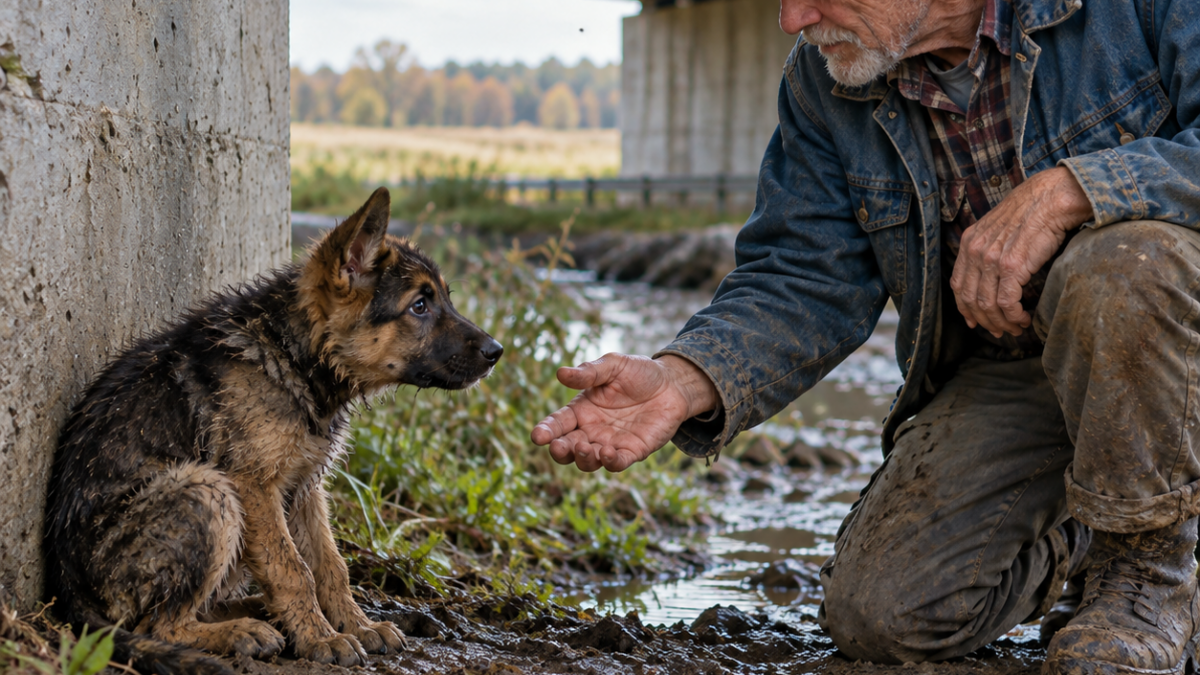
The young shepherd was tucked beneath the bridge’s shadow, maybe eight feet in, pressed near the place where concrete met mud and dead grass. Wilbur could see him clearly enough in peripheral vision.
A young animal.
Five or six months.
Hollow in the middle.
Skin too tight over ribs.
Not mange.
Neglect.
Dehydration.
Stress.
His ears told Wilbur things.
His front-leg weight told him more.
But the way the puppy had gone still when Wilbur lowered his gaze told him the most important thing.
The dog was watching him.
Not with threat.
With suspended attention.
The kind of attention an animal has when it has learned not to trust anyone and cannot quite stop wanting to.
Wilbur breathed out slowly through his nose.
He let his shoulders drop another inch.
Made himself smaller.
Rounder.
Less like a decision and more like a feature of the landscape.
Above him, Winslow was explaining dart-gun calibration to Mara with the satisfaction of a man who knew the correct method and intended to use it.
“Standard procedure is a fifteen-minute sedation window,” he said. “We go in, we bag it, we’re done before afternoon.”
The puppy had not moved.
But its weight shifted barely forward.
Wilbur saw it.
He let it mean nothing on his face.
He lowered his chin another fraction and waited.
Still.
Deliberate.
Unhurried.
The way a man waits when he has spent most of his life learning that patience is not passive.
Patience is a language.
It has grammar.
Syntax.
A quiet vocabulary most people never learn because they cannot stop filling silence with their own noise.
Wilbur did not know what this dog had lost.
He knew what it felt like to lose it.
The puppy remained under the bridge, crouched in the narrow triangle of mud and shadow.
Three days had given it ownership of that space.
It knew every sound the water made.
Every vibration from the road above.
Every boot on gravel.
Every change in air pressure when a human came too close.
Wilbur could see that in the way its ears moved.
Not frantic.
Cataloging.
The left ear dropped slightly when a car passed overhead.
The right stayed half lifted toward him.
Fear in the left channel.
Interest in the right.
The dog was running two separate calculations at once.
Which meant it was not purely reactive.
It was thinking.
Wilbur timed his next exhale to the puppy’s rib cage.
Nobody watching from the road would have seen that.
To them, it looked like an old man crouching in the mud doing nothing.
That was fine.
Wilbur had spent most of his adult life doing things that looked like nothing.
He had walked fence lines that looked straight to anyone driving past but told him, by a half-inch lean in a cedar post, where the ground had softened after rain.
He had stood in barns at midnight with a hand on a mare’s neck, doing nothing but matching her breathing until panic left her body.
He had sat in field hospitals long ago with dogs that had carried messages, found mines, tracked wounded men, and then shook uncontrollably at the smell of antiseptic, and he had done nothing in exactly the right way until their eyes came back from wherever fear had taken them.
Doing nothing was one of the hardest things people ever asked of themselves.
Most failed.
Wilbur had learned because failure had once cost too much.
He thought of the fence line at home.
He thought of it the way a man thinks of a place walked so many times it lives in his legs instead of his memory.
Eleven years of the same quarter mile.
East gate first.
Then the low corner where the ground went soft after rain.
Then the long stretch of cedar posts to the flat stone at the field’s edge.
The stone was not marked.
It did not need to be.
Wilbur knew where it was.
That was enough.
The walking stick had one notch near the grip.
He had cut it the morning after, sitting in the dirt with a folding knife he still carried.
Not to remember.
He was never going to forget.
He had cut it because he needed to do something with his hands that day, and the alternative was worse.
Cord had worked eleven years beside him.
Through two deployments and a third stretch nobody officially called a deployment.
Through field dressing stations in the dark, where the ground was cold and the work was fast and you learned to keep your hands moving because stopping meant thinking, and thinking could wait.
Cord had been the last dog Wilbur trained from a pup.
The last one he cleared for duty.
The last one he patched up in the field and brought home.
The only one he was with at the end.
The flat stone sat forty yards from where Wilbur was crouching now, give or take, past the fence and low ground.
He touched the notch every morning at that corner.
Not because he decided to.
Because his hand did it before his mind arrived.
Under the bridge, the puppy’s tail shifted.
Barely.
Low.
Slow.
Not wagging.
Nothing that optimistic.
But the tucked curl softened by a degree.
The right ear lifted a little more.
Wilbur let his weight settle.
He breathed out long and even, letting his shoulders drop with it.
He kept his eyes at the puppy’s chest, not its face.
Direct eye contact was pressure.
He was not here to apply pressure.
The tail shifted again.
Up on the road, Winslow’s voice cut through someone else’s.
“Liability matters. If this animal bolts into traffic, everybody here will ask why we didn’t follow procedure.”
The words bounced off the bridge concrete and fell into the creek without touching Wilbur at all.
He was watching the ear.
Watching the breathing.
Watching the way the puppy’s body had begun, almost without the dog knowing it, to match his rhythm.
Three days alone under a bridge.
Three days of strangers’ voices.
Boots on gravel.
Hands reaching.
Food tossed too close.
Nets shown too early.
Good intentions piled up until they became another kind of threat.
Something had happened before any of that.
Something that had made trust into a thing that had to be rebuilt from nothing.
One quiet breath at a time.
Wilbur understood that completely.
He had been rebuilding things from nothing for eleven years.
The county truck’s amber light kept turning slowly.
No siren.
Just the official pulse of a situation the county believed it had already decided.
Winslow stepped down the bank before the engine fully cooled.
His orange-trimmed gloves snapped at the cuffs as he walked.
He saw the neighbors at the rail first.
Then Mara.
Then Wilbur.
The old man crouched in the mud below the bridge lip, coat hanging open, stick pressed into the bank beside him.
Winslow stopped at the top of the slope.
He looked at Wilbur the way a man sizes up something that does not belong in the scene he arranged in his head.
Then he came down.
“Sir,” Winslow called, voice trained for outdoor use. “Standard procedure is not for civilians to be inside the capture zone. I’m going to need you back up on the road.”
He carried the dart kit in one hand.
Set it on a flat rock behind him.
Already cataloging distance, angle, opening width, wind, weight estimate.
Wilbur looked up.
Not quickly.
Not sharply.
He turned his gaze from the dog to Winslow and held it one beat longer than the exchange required.
Not hostile.
Not wounded.
Level.
The kind of eye contact that has no need for the next word.
Winslow blinked first.
He covered it by looking down at his kit.
Wilbur rose from his crouch without hurry.
The fingers of his left hand found the notch on the stick as he came upright.
A brief press.
The way a man fingers a rosary bead in a coat pocket.
Then he stepped back from the bank, moved ten feet up the slope, and stopped on the gravel at the edge of everything.
He said nothing.
Winslow watched him another second, uncertain in a way he could not name.
Then he turned to Mara.
“Right. Chemical capture when a subject has refused contact over forty-eight hours. What’s our sight line?”
Mara pointed toward the bridge opening.
The neighbors leaned in to listen because an official plan gave them something to do besides stand there feeling useless.
One young man stayed apart from them.
His name was Elias Horowitz.
He was twenty-six, a mechanic at his uncle’s shop, and had been one of the neighbors who first noticed the puppy under the bridge three mornings earlier.
Elias had tried bringing food.
He had tried a blanket.
He had tried sitting near the rail and reading aloud because his mother said animals liked voices.
The puppy had stayed in the shadows.
Now Elias watched Wilbur.
Wilbur was no longer watching Winslow.
He was watching the bridge.
Or rather, the shadow below it.
The small dark shape that had not moved while everyone discussed equipment.
The puppy was listening.
Every voice another variable.
Every footstep above another piece of data filed into whatever remained of trust.
Winslow popped the dart kit’s latch.
Soft snap.
The sound crossed the water clean as a stone dropped into a still place.
Under the bridge, the puppy pressed farther back against concrete.
Wilbur breathed out slowly through his nose.
Elias saw no anger on the old man’s face.
No resignation.
Only attention.
The particular kind of attention that belonged to someone still counting options everyone else had stopped looking for.
Winslow moved down the creek bank with confidence.
Mara followed with the case.
For a moment, they were almost choreographed.
Careful lateral approach.
Low crouch.
Empty hand extended.
Textbook.
Practiced.
The puppy went flat against the far concrete wall.
Not a slow retreat.
Instant.
Weight dropped.
Hindquarters tucked.
Whole body pressing into shadow like it wanted to become part of the stone.
A sound came from it.
Barely audible from the road.
Not a growl.
Something older than a growl.
Winslow held position.
Gave it thirty seconds.
Tried one more step.
The puppy wedged itself deeper into the angle where the bridge footing met creek bed.
Trembling became visible from the road.
Elias watched Winslow because Winslow was the one making things happen.
But somewhere in those two minutes, his eyes drifted back to Wilbur.
The old man stood where Winslow had left him.
He had not crossed his arms.
Had not checked his phone.
Had not muttered.
Had not done any of the things a man does after being dismissed and deciding whether to be annoyed.
He was watching the dog.
Not the procedure.
The dog.
His head tilted maybe five degrees.
His hands hung loose at his sides, but not resting.
Waiting.
As if his body understood instructions no one had spoken yet.
Elias had seen something like that once.
Not in person.
In photographs his uncle kept in a shoebox.
His uncle had spent two years working supply with military dog teams and talked about handlers the way some men talked about surgeons.
That quality of attention.
Not alertness exactly.
Something quieter.
Something that moved at the same speed as the thing being watched.
Elias took out his phone.
Not to call.
Not yet.
He opened the veterans association page his uncle had once sent him during a conversation about county history and old military families.
He did not know exactly what he was looking for.
He typed the county name.
Then agricultural.
Then canine.
Then Army Veterinary Corps.
The search results loaded slowly.
Below the bridge, Winslow retreated two steps and spoke to Mara in a low, flat voice.
The cadence of a man rebuilding the case for what he already wanted to do.
Chemical capture.
Standard procedure.
Sedation window.
Retrieval plan.
The puppy had not moved from the far wall.
Three days it had refused every approach.
Fire department.
Animal rescue volunteer.
Neighbors.
Soft voices.
Food.
Ropes.
Hands.
Three days of good intentions and extended arms.
And each time, the puppy had moved exactly as far back as it needed.
No more.
No less.
With a patience that felt less like fear and more like grief.
Elias scrolled.
Rosters.
Unit histories.
Old photographs.
Then he found one.
He did not speak immediately.
He studied the scanned image on his phone.
A younger Wilbur Arseno stood at the left edge of a group in faded desert camouflage. Twenty or thirty pounds heavier. Shoulders squared. Face harder, but unmistakable.
At his left knee sat a German Shepherd in full working kit.
Harness.
Lead.
Head angled up toward the man with an attention that looked, even across thirty years and a low-resolution scan, like faith.
Elias looked from the screen to Wilbur.
Then back again.
The posture was unmistakable.
Winslow was still talking.
“Standard procedure is two-person retrieval once sedation takes effect,” he said, turning the dart injector over in his hands with practiced ease. “One secures the hindquarters, one takes the head. You don’t want an unsecured animal coming out of sedation during transport. Had an officer lose two fingers that way, county over. Standard procedure exists for a reason.”
Wilbur had already moved.
No one saw him decide.
That was the thing about it.
Later, when people tried to describe what happened, there was no moment when he stood and walked forward.
He was simply somewhere else.
Then he was at the creek bank.
Then he was lowering himself into the mud on one knee.
The whole sequence was so unhurried that it took the watching neighbors a full three seconds to understand he had ignored everything Winslow had just said.
The walking stick went into the mud beside him.
His hand found the notch.
Held there one breath.
Released.
Then he started talking.
Not loud.
Not soft.
Exactly.
Something between speech and hum.
A low rhythmic cadence with no clear words at first, just sound and shape. The same phrase length repeated with the same rise and fall, like humming something you cannot quite remember the words to.
It came from somewhere behind his sternum.
It was not for the people on the bridge.
Under the bridge, the puppy stopped moving.
One of the neighbors touched another’s arm without looking.
Winslow’s explanation died mid-clause.
Mara stopped nodding.
The puppy had been pressed against the far abutment, a gray-tan smear of fear in the shadow.
Its ears had been flat since Winslow’s approach.
Now one lifted.
Just one.
Rotating forward on its own.
Independent of the other.
The way a dog’s ear moves when something has reached it below the level of threat.
Wilbur kept talking.
Same cadence.
Same rise.
Same fall.
He had not looked at the puppy.
His gaze was down and left, aimed at the mud, taking the animal out of his direct visual field the way you take a gun off someone to let them breathe.
His body remained angled.
Open.
Unthreatening.
Smaller than a man his size should look.
He had made himself into something the puppy could approach if it wanted to.
The second ear came up.
“What is he—” one neighbor began.
Winslow raised one hand for quiet.
It was the most self-aware thing he had done since arriving.
The puppy took one step forward.
Stopped.
Then two more.
It was trembling.
Everyone could see it now.
The fine all-over shiver of an animal alone and afraid too long. An animal approached wrong too many times. An animal spending every bit of nerve it had on three steps toward an old man kneeling in mud.
Wilbur breathed out slowly.
The cadence continued, unbroken.
His hands rested open on his knees.
Not reaching.
Not inviting.
Just present.
Elias moved quietly toward Winslow and turned the phone screen toward him.
“He trained military working dogs for the Army,” Elias whispered. “Twenty-two years.”
Winslow looked at the screen.
At the younger man in uniform.
At the German Shepherd at his knee.
At the posture between them.
Something more than handler and animal.
Two living beings that had learned to read the same world.
Winslow’s mouth remained open from the sentence the photograph had interrupted.
Then it closed.
He looked from the phone to Wilbur.
The dart kit sat at his feet.
Standard procedure had no slot for old farmers who showed up uninvited.
No checkbox for a man who had once trained dogs to walk through danger before humans did.
No form for grief, patience, or the precise way an animal’s ear moves when it hears safety for the first time in days.
Winslow set the dart gun against the tire of his truck.
He did not announce the decision.
He just put it down.
Elias said nothing else.
The photograph did the rest.
Below them, Wilbur’s cadence continued.
Not words exactly.
Or words arranged so the meaning did not matter, only rhythm.
The way a heartbeat is steady information, not instruction.
His hands rested open.
His coat hung loose.
He had not offered food.
Had not thrown a blanket.
Had not said, “Come here, boy.”
He was just present in the mud, breathing at the speed of something that had nowhere else to be.
The puppy took one step.
Then stopped.
Its ears shifted.
Near one forward.
Far one sideways.
Nose working the air between them.
Three days under a bridge.
Three days of people trying to solve the problem from above.
Winslow watched with his hands at his sides.
The dart kit remained at his feet.
The weight of what he had almost done settled into him slowly.
Not because chemical capture was always wrong.
Sometimes it was necessary.
Sometimes it saved animals from highways, ice, traps, starvation, worse.
But this time, watching the old man in the mud, Winslow understood something uncomfortable.
Procedure could be correct and still not be the first language a frightened animal needed.
The puppy’s muzzle dipped.
The trembling changed.
Less sharp now.
Deeper.
The shaking that comes from somewhere below muscle.
Wilbur read all of it.
He lowered himself further into the mud, left knee taking more weight, right boot finding solid ground beneath the silt.
The walking stick lay beside him.
He did not need it now.
He needed both hands free and both hands quiet.
The cadence never stopped.
Twelve years of doing it in the dark.
In working kennels.
In field triage.
In places where sirens, rotors, shouting, and gunfire filled the air, and a terrified animal needed one steady thing to follow.
It had become something below conscious thought.
A rhythm with soft consonants at the edges.
A sound that bypassed fear-bonded decision-making and landed somewhere older.
Somewhere before the fear.
Wilbur let his right hand settle into the mud.
Palm up.
Not extended.
Not offered exactly.
Just present at ground level.
Below the line of his body.
Below the line of the puppy’s gaze.
The trick, the one no manual ever explained correctly, was making the hand into something that required nothing in return.
Not patience.
Patience was still waiting with an agenda.
This was different.
This was the hand of a man who had already accepted the outcome did not belong to him.
The puppy’s nose lifted.
One short pull of air.
Two.
Nobody on the road moved.
Elias had gone completely quiet.
Mara held her breath.
Winslow’s breathing was audible from several feet away.
Wilbur dropped his gaze another degree.
Gave the dog the side of his face instead of the front.
An old protocol, older than any formal program that later gave it names.
Frontal eye contact is challenge.
Peripheral vision is safety.
He had learned that first from a shepherd named Kira, long before Cord, before deployments, before he had enough scars to understand that animals were often more honest about fear than people.
The puppy took another step.
Small.
Maybe eight inches.
But its weight shifted forward, and that meant the decision had already been made somewhere the step had not caught up to yet.
Wilbur kept breathing.
Slow out.
Longer than the inhale.
The exhale was the part that mattered.
It carried something animals measured without knowing they measured it.
He had tried explaining that once to a young handler in the third year of his last posting. The kid had nodded without truly hearing.
The dog had taught him the rest later.
Three more steps.
The puppy’s nose reached the edge of his hand.
It did not sniff at first.
It pressed the soft bridge of its muzzle into his upturned palm hard enough that Wilbur felt the tremble travel up his wrist.
He held his hand exactly where it was.
No response.
No reward.
No sudden relief.
Just the hand still there, the same as it had been before the dog chose it.
Then the puppy folded.
Not collapsed.
Folded.
The way an exhausted animal finally trusts the surface enough to let it hold weight.
Its legs went beneath it in a slow, deliberate descent, and its face found Wilbur’s chest.
The trembling ran through it once more, hard and total, the way a fever breaks.
Then it stopped.
The puppy’s breathing evened.
Its ears lifted slightly.
The low, drawn-down weight of three days alone under concrete released from its body like something held underwater finally let go.
Wilbur put his left arm around it slowly.
One degree at a time.
Nobody said anything.
The puppy breathed against him.
Small, ragged breaths.
Then slower.
Wilbur let it breathe.
He did not move.
Did not speak.
Did not do anything but hold the weight of it and let his heartbeat do the work his voice had already finished.
After a while, he reached with his free hand and found the walking stick in the mud.
Getting up took longer than it used to.
One knee.
Then the other.
The creek bank did not cooperate.
Mara stepped forward instinctively, but stopped when she saw he had it.
Wilbur came to his feet, the puppy held against his chest.
The dog made a low sound somewhere between a whimper and a sigh.
Then pressed its face harder into his coat and went quiet.
Winslow stood at the bank’s edge.
The two neighbors watched from the gravel shoulder with hands in pockets and nothing useful to say, which was the first sensible thing either of them had done all afternoon.
Elias met Wilbur near the top of the bank with one hand extended in case the footing gave way.
Wilbur did not need it.
He came up steady, stick taking his weight, mud to both knees, puppy against his chest in the low afternoon sun.
“How did you know what to do?” Elias asked.
He said it quietly, the way a person asks a question when they already understand most of the answer but need to hear the rest.
Wilbur looked down at the puppy.
One ear twitched toward his voice.
His left hand found the notch on the stick.
He did not look at his hand.
He never did.
“I know, son,” Wilbur said.
Not loud.
Not for the crowd.
“I know what it’s like to lose the one thing you trusted.”
Elias did not ask him to say more.
He had found the photograph.
He had seen enough.
He understood that the notch was old.
That somewhere at the edge of Wilbur’s field sat a flat stone with a name no one needed carved into it because Wilbur knew where it was.
He understood the man carrying this puppy had spent years reaching animals broken by noise, loss, fear, and the kind of violence that does not forgive mistakes.
He understood, too, that none of it had ever fully left.
Some things you learn in the company of a partner.
And when the partner is gone, the learning stays, but the weight of it has nowhere to go.
Winslow came around the front of the truck.
He was not carrying the dart kit anymore.
He stopped a few feet away and turned his hat in his hands once.
Then he looked at Wilbur.
“What should I have done differently?”
The bluster was gone.
The procedural narration was gone.
He sounded like a man who had just watched something he did not have a category for and was honest enough to say so.
Wilbur considered him.
No hurry in it.
“Less talking,” he said. “More listening to the dog first. Then to the people who’ve been where the dog’s been.”
Winslow nodded once.
He did not try to answer.
The puppy shifted in Wilbur’s arms and turned its head toward the light.
Its ears came up slightly.
Not fear.
Not threat assessment.
Something closer to curiosity.
The first curiosity it had shown in three days.
Wilbur felt the change in its body.
The small unclenching.
He recognized it the way a person recognizes something felt long ago in his own chest.
The first moment after a loss so deep you stop believing anything can reach you.
Then something does.
“What happens now?” Mara asked.
Wilbur adjusted his grip on the puppy.
“Now he gets water.”
“Then?”
“Then food.”
Winslow looked at the dog.
“He needs evaluation.”
“He’ll get it.”
“He may belong to someone.”
Wilbur’s jaw tightened slightly.
“Then they had better have a good reason he was under a bridge for three days.”
No one argued.
The shelter protocol still existed.
Forms still had to be filled.
A found animal still had to be logged.
A hold period still had to run.
But by the end of that hour, Winslow had made a decision that would later require three explanations, two signatures, and one uncomfortable phone call to the county office.
The puppy would not be chemically captured.
It would not be transported in a crate while sedated.
It would not be taken to the loud county kennel that afternoon.
It would be placed under emergency foster observation with Wilbur Arseno, pending veterinary clearance, found-dog reports, and ownership review.
Winslow phrased it carefully in the report.
Subject stabilized through voluntary contact with experienced handler.
Experienced handler.
That was one way to say it.
Elias helped carry a folded blanket from the truck, though the puppy refused to leave Wilbur’s arms long enough to be wrapped properly.
Mara scanned him for obvious wounds.
Thin.
Dehydrated.
Tick under left ear.
Raw place on rear paw.
No broken bones she could see.
No collar.
No chip they could scan roadside.
No identification.
The puppy tolerated all of it only because Wilbur kept the cadence low in his chest.
When the old farm truck door opened, the puppy stiffened.
Wilbur waited.
No pressure.
No lifting too fast.
No pushing.
The dog looked at the seat.
Then the floorboard.
Then Wilbur.
Wilbur placed one hand on the bench seat, palm down.
The puppy sniffed.
Then, with the exhausted dignity of a creature who had already spent every ounce of bravery it owned, climbed into the passenger side and curled against the cracked vinyl.
Wilbur shut the door gently.
Elias stood beside the truck.
“What will you call him?”
Wilbur looked through the glass at the puppy.
The dog’s eyes were half closed, but one ear stayed up.
“Not mine to name yet.”
“But if he becomes yours?”
Wilbur put one hand on the truck door.
“Then he’ll tell me.”
The drive to Wilbur’s farm took fourteen minutes.
The puppy slept for eight of them, then startled awake when the truck crossed the cattle guard.
Wilbur did not reach for him.
He let him look.
Fence lines.
Winter grass.
Bare hardwoods.
A red barn weathered at the doors.
Two old horses in the east pasture lifting their heads.
A farmhouse with a tin roof and smoke beginning from the chimney because Wilbur had banked the stove before leaving.
Home, though the dog did not know the word yet.
Wilbur parked by the barn.
He did not take the puppy into the house.
Too many smells.
Too many rooms.
Too much expectation.
He carried him into the corner stall where the barn stayed warmest and made a nest from clean straw and two old horse blankets from the loft.
The puppy watched every movement.
Eyes heavy.
Still calculating.
Wilbur placed a shallow dish of water near the stall entrance, then sat ten feet away on an overturned bucket and waited.
The puppy looked at the water.
Then at Wilbur.
Then at the water again.
Wilbur turned his face toward the barn wall and rested both hands open on his knees.
The puppy crawled forward and drank.
Not much.
Enough.
Then lay down immediately, as if the effort of trusting the water had taken everything left.
Later, Wilbur warmed a little broth and softened bits of plain chicken in it.
The puppy ate three mouthfuls.
Stopped.
Watched.
Ate two more.
Then circled three slow times in the straw and collapsed with one ear folded under and the other still upright.
Wilbur stood in the stall doorway while the last light went out of the sky in layers, orange fading to a gray so soft it was almost kind.
He did not go inside.
Did not return to the house.
He simply stood with the walking stick leaned against the frame beside him, hands loose at his sides, watching the small chest rise and fall.
The puppy’s paws moved once in some private dream of running.
Eleven years was a long time to walk a fence line alone.
Wilbur had not planned on stopping.
He was not sure he could explain what had changed, or if he would try.
He reached out without looking and touched the notch on the stick.
Once.
The way a person confirms something is still there.
The way a person keeps a promise.
The puppy’s ear stayed up all night.
The next morning, Elias came with a bag of puppy food, three cans of wet food, and a collar too large for the dog’s neck.
Wilbur found him standing awkwardly by the barn, unsure whether to knock on a barn door.
“You lost?” Wilbur asked.
Elias held up the bag.
“My mother said I should bring something.”
“Your mother is sensible.”
“She also said not to bother you.”
“Then you’re half obedient.”
Elias smiled nervously.
The puppy lifted his head from the straw.
He did not hide.
That was new.
Wilbur noticed but did not celebrate. Celebrations were pressure too, sometimes.
“This is Elias,” he told the puppy, voice low. “He’s noisy but harmless.”
“I am not noisy.”
Wilbur looked at him.
Elias lowered his voice.
“Sorry.”
The puppy’s nose worked.
Elias crouched too fast.
The puppy shrank.
Wilbur did not speak sharply.
He only said, “Sideways.”
Elias froze.
“What?”
“Turn your shoulder. Don’t face him head-on.”
Elias shifted awkwardly until his body angled.
“Eyes down.”
Elias lowered his gaze.
“Hands quiet.”
Elias put the food bag down and rested his hands on his knees.
The puppy watched.
His ears made their two-channel calculation again.
Fear in one.
Interest in the other.
“He was under there a long time,” Elias said.
“Three days.”
“No, I mean before the bridge.”
Wilbur’s eyes moved to the raw place on the puppy’s paw.
“Yes.”
“You think somebody dumped him?”
“I think somebody taught him people come too fast.”
Elias swallowed.
“What do we do?”
Wilbur looked at him.
“We don’t come too fast.”
That became the rule.
For the puppy.
For the farm.
For everyone who visited.
Do not come too fast.
Mara came that afternoon with a scanner, paperwork, and official caution she tried to hide under kindness.
No microchip.
No collar mark.
No lost-dog report matching him.
No calls from anyone looking for a shepherd puppy.
Winslow came the next day.
He parked by the barn but did not get out immediately.
Wilbur watched through the stall doorway.
The puppy watched Wilbur.
Finally, Winslow stepped from the truck carrying his hat in one hand and a folder in the other.
He looked different without the procedure in his voice.
Less certain.
More useful.
“Morning,” he said.
“Morning.”
“I brought the foster forms.”
Wilbur took them.
“And the vet appointment. Dr. Harlan can see him tomorrow morning before clinic opens. Less noise.”
“Good.”
Winslow shifted his weight.
“How is he?”
Wilbur looked at the puppy.
The dog lay with his chin on his paws, eyes open, ears tracking.
“Still here.”
Winslow nodded.
After a moment, he said, “I keep thinking about what you said.”
“Don’t recall saying much.”
“Less talking.”
Wilbur almost smiled.
“That one?”
“I deserved it.”
“You asked.”
“Still.”
Winslow looked toward the stall.
“May I?”
Wilbur glanced at the puppy.
The dog had gone still but not flat.
“Stand there.”
Winslow stood in the barn aisle.
“Turn sideways.”
He did.
“Breathe slower.”
Winslow tried.
Wilbur watched him fail.
“Slower than that.”
Winslow breathed again.
The puppy’s ears shifted.
Not forward.
But not back.
“That’s enough,” Wilbur said.
Winslow nodded.
“Thank you.”
He left the folder on a barrel and drove away without making the truck tires spit gravel.
That counted for something.
The vet confirmed what Wilbur already knew.
Malnourished.
Dehydrated.
Flea-bitten.
Two healed scars along one flank.
Raw pads.
No fracture.
No disease that would stop recovery.
“German Shepherd mix,” Dr. Harlan said, scratching notes onto the chart. “Maybe some Malinois in there. Maybe cattle dog. Hard to say at this age.”
The puppy stood pressed lightly against Wilbur’s boot.
Not hiding.
Anchoring.
Dr. Harlan noticed.
Smart woman.
She examined him from the side, slowly, narrating less than most people did.
“He got lucky,” she said.
Wilbur looked down at the dog.
“No.”
Dr. Harlan paused.
Then nodded.
“Right. He got found.”
On the seventh day, the puppy wagged his tail.
Only once.
Elias saw it and nearly shouted.
Wilbur lifted one finger.
Elias clamped his mouth shut so hard his teeth clicked.
The puppy looked at him.
Then, apparently deciding Elias was ridiculous but not dangerous, wagged again.
Twice.
Elias whispered, “Did you see?”
“No,” Wilbur said.
Elias stared at him.
Wilbur’s mouth twitched.
“Maybe.”
By the tenth day, the puppy walked to the barn door when Wilbur entered.
By the twelfth, he followed him to the water trough and back.
By the fifteenth, he barked once at a crow landing on the fence post, then startled at his own voice and ran behind Wilbur’s legs.
Wilbur stood still until the dog came out.
“Good,” he said.
The puppy sneezed.
That was not agreement, exactly, but Wilbur accepted it.
Naming took longer.
Elias suggested Scout.
Mara suggested Creek.
Winslow, trying too hard, suggested Lucky.
Wilbur rejected none of them aloud.
He simply did not use them.
The puppy answered to no name anyway.
He answered to cadence.
To breath.
To the slow shape of Wilbur’s body moving through chores.
He learned the farm first.
Kitchen porch.
Barn aisle.
Water trough.
East gate.
Low corner.
Long stretch of cedar posts.
Flat stone at the field’s edge.
The first time Wilbur walked that route with the puppy following behind him, he almost turned back.
Not because the dog could not manage.
Because the field corner was Cord’s place.
The flat stone had sat there eleven years.
Unmarked.
Known.
Enough.
Wilbur stopped ten feet short.
The puppy stopped too.
The morning was cold.
Frost silvered the grass.
His hand found the notch on the walking stick.
The puppy watched him.
Wilbur had never brought another dog here.
Not because he had refused.
Because none had come.
He took one step.
Then another.
At the stone, he stood still.
The puppy sniffed the grass.
Then the stone.
Then looked up at Wilbur.
His ears lifted.
Not question.
Recognition, maybe.
Or simply attention.
Wilbur’s throat tightened.
“This was Cord,” he said.
The puppy sat.
No command.
Just sat beside the flat stone with his thin body straight and ears high.
Wilbur looked down at him.
“Well,” he said quietly. “That’s respectful.”
The puppy leaned against his boot.
That was the day Wilbur named him.
“Bridge,” he said.
The puppy looked up.
“Not because I found you under one,” Wilbur said. “Because you crossed one.”
Bridge blinked.
Wilbur touched the notch on the stick.
“Good enough.”
Bridge learned slowly.
Not tricks.
Trust.
There is a difference.
He learned that the broom falling in the tack room did not mean punishment.
He learned that men could sneeze without swinging.
He learned that trucks leaving did not always mean abandonment.
He learned that rain on the tin roof was not danger.
Thunder took longer.
Hands took longer.
Children took longest.
The first child who came too fast sent him under the workbench for an hour.
Wilbur sat on the barn floor ten feet away and read the seed catalog aloud until Bridge crawled out and slept beside his boot.
After that, the farm rule became known by everyone.
Do not come too fast.
Children from neighboring farms learned it.
So did adults.
Some adults learned slower than children.
One Saturday, Mrs. Parker from the next road over arrived with her grandson, a boy of seven who had lost his mother the year before and had not spoken much since.
His name was Jonah.
He stood beside the truck with both hands buried in his coat pockets and a face so carefully blank Wilbur recognized it immediately.
Blankness in children is never empty.
It is full of things they do not have words for.
Mrs. Parker said, “He wanted to see the dog.”
Jonah looked at the ground.
Bridge stood in the barn doorway, ears forward.
Wilbur leaned on his stick.
“Dog’s not much for visitors.”
Jonah’s face did not change.
“Neither am I,” the boy whispered.
Wilbur looked at him.
Then at Bridge.
“Fair.”
He set a bucket upside down near the barn wall.
“Sit there if you want. Don’t look at him too much.”
Jonah sat.
Bridge watched.
Jonah watched the dirt.
Ten minutes passed.
Then twenty.
Mrs. Parker shifted.
Wilbur shook his head once.
She stilled.
After half an hour, Bridge walked over and sat three feet from Jonah.
The boy did not reach.
Good boy, Wilbur thought, though he was not sure whether he meant the dog or the child.
Bridge lowered himself onto the straw.
Jonah’s hand moved from his pocket and rested palm-up on his knee.
Not reaching.
Just available.
Wilbur’s chest went tight.
The boy had understood without being told.
Bridge sniffed the air.
Then pressed his muzzle into the child’s palm.
Jonah’s eyes filled, but he did not cry.
Not yet.
Bridge rested his head against the boy’s boot.
Mrs. Parker turned away and covered her mouth.
Wilbur looked toward the field corner.
Cord would have liked this one, he thought.
By spring, people in Harrow Creek stopped referring to Bridge as “that puppy from under the bridge.”
He became Wilbur’s dog.
Or maybe Wilbur became Bridge’s man.
It depended who was telling it.
Elias came every Thursday after work and learned how to move slower than his age wanted him to. Mara came once a month to check paperwork and always brought biscuits she claimed were for Wilbur but gave mostly to Bridge. Winslow stopped by twice, then three times, then finally admitted he wanted to learn.
Wilbur did not teach in any formal way.
He had never cared for lectures.
He made Winslow carry feed buckets, walk fence lines, sit in the barn, and shut up longer than was comfortable.
“The silence is the lesson,” Wilbur said one evening when Winslow got impatient.
Winslow sighed.
“I hate that.”
“Most people do.”
Bridge, lying nearby, opened one eye as if agreeing.
The county changed too, though not loudly.
Winslow still used chemical capture when needed.
But not as first language.
Not always.
He trained Mara and the younger officers to pause longer, talk less, watch ears, weight, breath, eye line, and the difference between refusal and terror.
He added a line to internal reports.
Low-pressure contact attempted when safe.
Not fancy.
Not revolutionary.
But enough to give some animals one more chance before procedure took over.
One year after the bridge, Winslow called Wilbur about a hound trapped in a drainage culvert.
Two years after, Mara called about a barn cat with kittens inside a burned shed.
Three years after, Elias called about himself.
He showed up at dusk, truck idling too long in the driveway before he shut it off.
Wilbur was on the porch.
Bridge lay beside him, full grown now, lean and strong, one ear still slightly more expressive than the other.
Elias got out and stood by the truck.
“My uncle died,” he said.
Wilbur said nothing.
“He was the one with the military dog photos.”
Bridge lifted his head.
Elias wiped at his face angrily.
“I don’t know why I came here.”
Wilbur looked at the empty chair beside him.
“Yes, you do.”
Elias sat.
Bridge rose, crossed the porch, and pressed his muzzle into Elias’s hand.
The young man broke then.
Not loudly.
Not dramatically.
He bent forward with one hand buried in Bridge’s coat and cried like a person who had been holding a bridge up alone and had finally found somewhere to set it down.
Wilbur watched the fields darken.
He did not offer advice.
Some grief does not need advice.
It needs weight beside it.
A warm animal.
A quiet porch.
A man old enough to know that nothing useful begins with “at least.”
Years folded into seasons.
Bridge’s muzzle darkened into its adult mask, then slowly softened with gray.
Wilbur’s walk shortened.
The fence line took longer.
The east gate sagged and was fixed.
The barn roof lost shingles and gained new tin.
The flat stone at the field’s edge stayed where it had always been.
Bridge learned the route until it lived in his legs too.
East gate.
Low corner.
Long stretch.
Flat stone.
At the stone, he sat.
Every time.
Wilbur never taught him that.
Or perhaps he did, without meaning to.
One winter morning, five years after the rescue, snow fell thin and silent over the farm.
Wilbur moved slower than usual.
His hip hurt.
His hands ached.
The cold found old injuries with the loyalty of a debt collector.
Bridge walked at his side, matching pace.
At the field corner, Wilbur stopped and touched the notch.
The wood had darkened where his thumb rested.
Eleven years had become sixteen.
Cord felt both farther away and nearer than ever.
Bridge sat by the stone.
Wilbur looked down.
“You know,” he said, voice rough, “I thought bringing you here would feel like replacing him.”
Bridge’s ears moved.
“It didn’t.”
Snow touched the dog’s back and melted.
“It felt like telling him I was still listening.”
Bridge leaned against his leg.
Wilbur closed his eyes.
For a moment, the field held all of them.
The old man.
The dog beside him.
The dog beneath the stone.
The years between.
The promise still keeping itself.
People later told the bridge story as if it had been one magical moment.
The old farmer came.
The puppy listened.
The dog walked out.
It made a fine story that way.
Simple.
Clean.
Short enough to fit in the telling.
But the truth was longer.
The truth was three days under a bridge and eleven years along a fence line.
It was a walking stick with one notch worn smooth by a thumb.
It was a man who had learned from dogs that fear is not disobedience.
It was a county officer brave enough to set down the dart gun.
It was a young neighbor who looked past a dirty coat and found a soldier in an old photograph.
It was a puppy who still wanted to trust after every reason not to.
And it was the quiet knowledge that rescue is not always reaching.
Sometimes rescue is waiting correctly.
Sometimes it is lowering your eyes.
Turning your shoulder.
Breathing slower than fear.
Making your hand into a place that asks for nothing.
Sometimes it is understanding that a frightened animal under a bridge does not need to be conquered, captured, or convinced.
Sometimes he needs someone who has known loss deeply enough to speak its language.
Wilbur Arseno did not save Bridge by being louder.
He saved him by becoming the first quiet thing the puppy could believe in.
And long after the county truck drove away, after the neighbors stopped telling the story, after the bridge returned to being just a bridge on a rural road, the old farmer and the shepherd walked the fence line every morning.
East gate.
Low corner.
Long stretch.
Flat stone.
Light and shadow across the fields.
One man.
One dog.
One promise carried forward by four paws, a wooden stick, and a notch worn smooth from all the times grief had been touched and answered with another step.


