A Soldier Had 72 Hours Before Deployment and No One Would Take His Cat—So He Left His Dog Tags Around Her Neck and Whispered, “So She Knows Someone Claimed Her.”
PART3:
Ten animals on a normal day.
Fifteen on a bad one.
Twenty when animal control brings in a seizure case or some idiot decides to dump an accidental litter on our front step overnight.
You become efficient.
“Name?”
“Age?”
“Spayed?”
“Vaccinated?”
“Medical conditions?”
“Bite history?”
“Behavior around children?”
“Behavior around other animals?”
“Reason for surrender?”
You ask.
You type.
You scan paperwork.
You print a kennel card.
You take the leash or carrier.
You say something humane.
Then you walk the animal to the back.
If you absorb every goodbye, you will not last.
I thought I had become pretty good at not absorbing them.
Then Staff Sergeant Daniel Mercer walked through my door on a Tuesday afternoon in October.
It was 2:17.
I know because I wrote it down later.
Not in the official file.
In my own notebook.
The shelter lobby was almost empty.
A woman had just left after adopting a hound mix named Tucker, and one of our volunteers was mopping muddy paw prints near the entrance.
Outside, rain tapped lightly against the windows.
I was drinking coffee that had been hot sometime around eleven.
The front door opened.
A man stepped inside carrying a gray plastic cat carrier.
Early thirties.
Close military haircut.
Clean-shaven.
Tan jacket.
Jeans.
Boots polished enough that I noticed.
He looked like someone who normally entered rooms knowing exactly where he was going.
That afternoon, he looked lost.
I smiled automatically.
“Hi. Can I help you?”
He set the carrier on the counter.
Opened his mouth.
Nothing came out.
Then he looked down.
That was when I saw he was crying.
Not watery eyes.
Not a man trying to blink away a difficult moment.
Crying.
His face was red.
His jaw was clenched.
His shoulders shook once before he got control of them.
I stopped touching the keyboard.
“Take your time.”
He nodded.
Tried again.
“I need to—”
His voice broke.
He turned away.
I had handled grieving families at the shelter before.
I knew better than to rush him.
So I waited.
After maybe thirty seconds, he wiped his face with the heel of his hand.
“I need to surrender my cat.”
“All right.”
Another nod.
“I deploy Thursday.”
I looked at the calendar taped beside my computer.
Tuesday.
“You leave in two days?”
“Seventy-two hours.”
His answer came like a fact he had repeated too many times.
I looked at the carrier.
A small brown tabby sat inside.
Green eyes.
White patch beneath her chin.
She looked perfectly calm.
“What’s her name?”
The man swallowed.
“Sergeant.”
I thought I had misheard.
“Sergeant?”
He gave the smallest smile.
“Yeah.”
The cat blinked.
I smiled back.
“That’s a strong name.”
“It started as a joke.”
“What happened to the joke?”
“She started acting like she outranked me.”
That got an actual laugh out of me.
Barely.
But it helped him too.
He rested one hand on top of the carrier.
“I got her the week I finished basic.”
“How old?”
“Six.”
I pulled up the surrender form.
“Okay, Daniel.”
I had seen his name on his ID.
“Tell me what happened.”
He stared at Sergeant for a long moment.
Then he did.
His deployment orders had changed with almost no warning.
Originally he believed he had another month.
Then seventy-two hours.
He rented a small apartment outside the base.
The lease was ending the same week.
Management would not hold the unit for an eight-month deployment.
He had tried to negotiate.
Tried offering partial rent.
Tried paying three months in advance.
No.
He contacted his parents first.
They lived in Alabama.
Two large hunting dogs.
One of them aggressive toward cats.
His father said no.
His sister lived in Texas.
Severe allergies.
No.
Four friends.
One already had three cats.
One’s landlord prohibited animals.
One was deploying with Daniel.
One had a newborn and a spouse who refused.
A coworker offered for two weeks.
Not eight months.
He called boarding facilities.
The cheapest estimate for an extended stay was more money than he could afford on top of storing his furniture, breaking the lease, insurance, and everything else.
He contacted military pet foster organizations.
Wait lists.
No available placement near enough to complete transfer before departure.
That part hurt me because I knew those organizations existed specifically for situations like his.
Sometimes capacity simply loses the race against time.
“I’ve been calling people for three weeks,” Daniel said.
“You knew three weeks ago?”
“I knew deployment was possible.”
He rubbed his face.
“I just didn’t know the date.”
Sergeant shifted inside the carrier.
Daniel immediately put his fingers through the door.
She rubbed against them.
He stopped talking.
I waited.
Eventually he said, “I thought somebody would say yes.”
There was something about that sentence.
Not accusation.
Just disbelief.
He had probably spent six years believing that if the worst happened, somebody would help.
Then the worst happened.
And every door stayed closed.
“Do you have her veterinary records?”
He placed a thick folder on the counter.
Of course he did.
Organized chronologically.
Vaccinations.
Dental records.
Microchip registration.
Lab work.
Medication history.
Emergency contact.
He had written feeding instructions on the front.
Half a can in the morning.
Half at night.
Dry food available during the day.
No tuna because it upset her stomach.
He had even listed the brand of litter she preferred.
I looked at him.
“You came prepared.”
“I’ve had three weeks to prepare to lose her.”
That one got me.
I looked down before he saw.
Professional.
That word again.
I typed.
“Any medical issues?”
“No.”
“Behavior problems?”
“No.”
“Litter box?”
“Perfect.”
“Scratching furniture?”
“She has a post.”
“Children?”
“She likes them if they’re quiet.”
“Dogs?”
“She tolerates calm ones.”
“Other cats?”
“I don’t know.”
“Bite history?”
“Never.”
I paused.
“Reason for surrender.”
He stared at me.
I hated that field suddenly.
Usually it was just another box.
Moving.
Landlord.
Financial.
Behavior.
Owner health.
This time none of them seemed large enough.
I typed:
Military deployment / no temporary caregiver available.
Daniel watched me.
Then asked the question I dreaded.
“Can you promise she’ll get adopted?”
I could have lied.
People think kindness and reassurance are the same thing.
They aren’t.
Sometimes kindness is telling somebody the truth when a lie would make both of you feel better for five minutes.
“No.”
His eyes closed.
I continued quickly.
“She’s six, healthy, social, and attractive. Those are all in her favor.”
He nodded.
“But I can’t guarantee it.”
“How long do cats usually stay?”
“Depends.”
“What’s the longest?”
I hesitated.
He opened his eyes.
“I already looked at your statistics.”
That told me everything.
He knew our adoption rate.
Knew our intake rate.
Probably knew our capacity.
He had likely read the reports at two in the morning while Sergeant slept beside him.
“We will do everything we can,” I said.
He nodded again.
“I know.”
Then he put both hands flat on the counter.
“Can I hold her?”
“Of course.”
“One more time.”
My throat tightened.
“Take all the time you need.”
He carried the carrier to a bench beneath the front window.
I returned to my computer because I understood he did not need an audience.
He opened the door.
Sergeant came out immediately.
No hesitation.
She stepped onto his thigh and climbed up his chest.
He wrapped both arms around her.
The cat tucked her face beneath his chin.
And Daniel broke.
No sound at first.
That somehow made it worse.
His eyes closed.
His mouth tightened.
His shoulders began shaking.
Sergeant purred.
I could hear it from behind the desk.
A small, steady motor in the shelter lobby.
Daniel pressed his face into her fur.
I looked away.
Twenty minutes.
I know because three phone calls came in.
A volunteer asked me twice whether she should interrupt him.
I said no.
A delivery driver arrived with dog food.
I signed for it.
Two people entered looking for a lost beagle.
I took their description.
Through all of it, Daniel stayed on the bench holding Sergeant.
Occasionally he whispered something.
I could not hear most of it.
Once I heard:
“I’m sorry.”
Then:
“You be good.”
Then:
“I know.”
The cat had no idea she was being surrendered.
That’s what people always say.
I am not sure that’s true.
Animals may not understand our paperwork.
They understand patterns.
Boxes.
Carriers.
Suitcases.
Changes in voice.
Changes in smell.
Humans crying.
Something was different.
Sergeant knew that much.
Eventually Daniel stood.
He carried her back to the counter.
“Okay.”
He didn’t mean okay.
He meant there was no more time.
He set her down.
Then reached underneath his shirt.
I thought he was adjusting something.
Instead he pulled a chain over his head.
Military dog tags.
Two dull metal rectangles.
They clicked softly together.
Daniel placed them on the counter.
Then reached into his jacket pocket.
He took out a piece of olive-green cord.
He had brought it specifically.
He had planned this.
I watched as he threaded the cord through the holes in the tags.
Then he turned toward Sergeant.
“Can I?”
I didn’t know what he was asking.
Then I understood.
“Are they going around her neck?”
He nodded.
“Only if it’s safe.”
I looked at the metal tags.
“They’re heavier than a normal ID tag.”
“I know.”
“We can’t leave them on unattended if there’s a snag risk.”
His expression fell.
I hated disappointing him.
“But we can attach them to her kennel.”
He looked at Sergeant.
Then at me.
“Could she wear them just while I’m here?”
“Yes.”
“Please.”
He tied the green cord carefully.
Loose enough that I could slide two fingers beneath it.
He positioned the tags against Sergeant’s chest.
Two pieces of metal that had belonged around his neck now rested against brown tabby fur.
I asked:
“Why?”
Daniel kept his eyes on her.
“So she knows somebody claimed her.”
I didn’t say anything.
He continued.
“So whoever adopts her knows too.”
His voice broke again.
“She isn’t some cat nobody wanted.”
He swallowed.
“She was mine.”
The lobby seemed suddenly very quiet.
Daniel touched one tag.
“Still is, I guess.”
I had no professional response.
None.
So I just said:
“I’ll make sure they know.”
He looked at me.
“Promise?”
“Yes.”
That was the first promise I made.
The surrender documents were waiting.
I turned the clipboard toward him.
“You need to sign here.”
His hand shook so badly his signature barely resembled a name.
Second page.
Initial.
Third page.
Signature.
He never read them.
I knew he already had.
Probably online.
Probably more than once.
When it was finished, Daniel knelt.
Sergeant jumped from the counter into his arms.
He held her one final time.
“Be good, Sarge.”
She head-butted his chin.
He laughed.
One tiny broken laugh.
“You were never good.”
He kissed the top of her head.
Then placed her back into my arms.
She immediately twisted toward him.
One paw reached over my elbow.
Daniel saw it.
His face changed.
I tightened my hold gently.
He turned away.
Walked to the door.
He did not look back.
I thought that was cruel for about half a second.
Then I understood.
He couldn’t.
The front door closed.
Daniel crossed the parking lot.
Got into a dark blue pickup.
He did not start it.
I stood inside holding Sergeant.
The dog tags clicked softly against her chest.
Through the window I could see Daniel bent over the steering wheel.
He stayed like that for six minutes.
Then he drove away.
I carried Sergeant into intake.
I removed the green cord because of safety policy.
But I did not put the tags into a property bag.
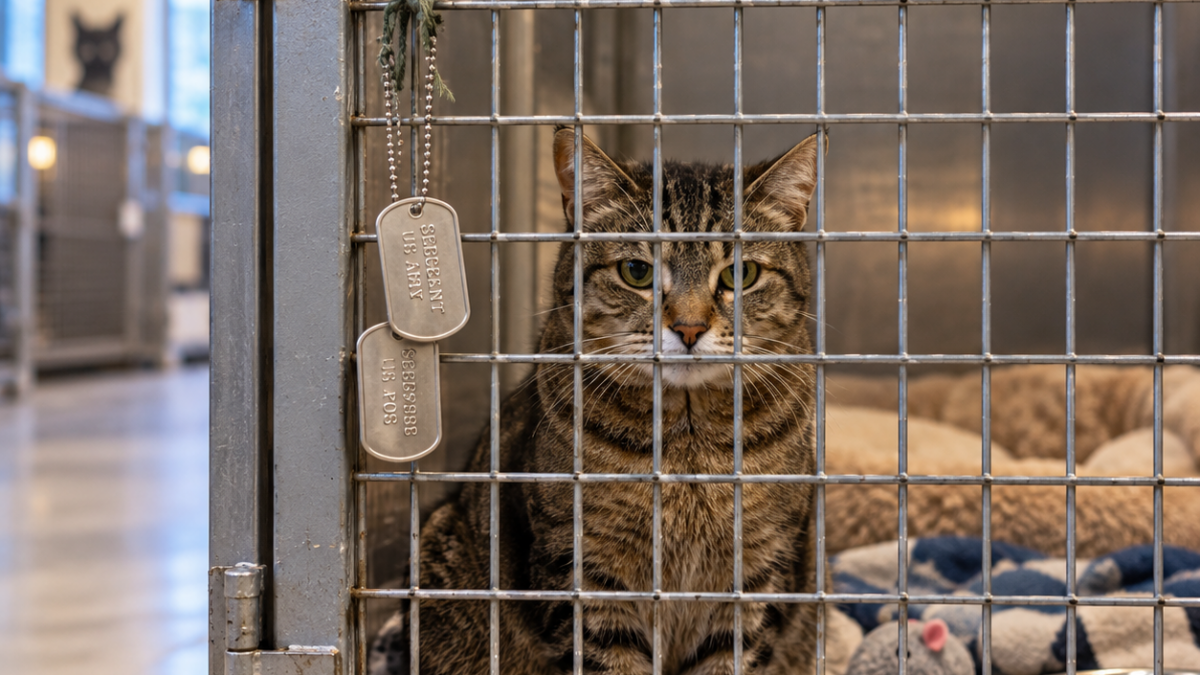
Instead I attached them to the outside of kennel 14 with a zip tie.
Right beside her information card.
SERGEANT
6 YEARS
FEMALE / SPAYED
BROWN TABBY
OWNER SURRENDER — MILITARY DEPLOYMENT
The tags hung beneath it.
Everybody who walked past asked.
“What are those?”
I told them.
By the fifth telling, my voice started shaking.
I went into the staff bathroom.
Locked myself in a stall.
Sat on the closed toilet lid.
And cried for five minutes.
That was all I gave myself.
Five minutes.
Then I washed my face.
Returned to the desk.
At 3:18, a woman surrendered a rabbit because her son had gone to college.
At 3:44, animal control brought in a terrier found tied to a fence.
At 4:02, somebody called asking whether we took parrots.
The work continued.
It always does.
But Daniel stayed with me.
So did Sergeant.
The first night, she barely ate.
That was not unusual.
She sat toward the front of kennel 14.
Not hiding.
Watching.
Whenever the back door opened, her head lifted.
Whenever boots crossed the concrete hallway, she stood.
Our cat technician, Melissa, came to the desk the next morning.
“She keeps waiting.”
“For what?”
Melissa gave me a look.
I knew.
Daniel.
I checked the time.
He had less than forty-eight hours before deployment.
“Has she eaten?”
“A little.”
“Used the litter box?”
“Yes.”
“Good.”
Melissa looked toward the hallway.
“What happens to the tags if she’s adopted?”
“They go with her.”
“Was that his request?”
“It was mine.”
Melissa smiled.
“Good.”
The next problem was something I had not anticipated.
Sergeant was adoptable.
Very adoptable.
Pretty.
Friendly.
Healthy.
But she was grieving.
People would enter her meeting room.
She tolerated petting.
Sometimes even climbed into a lap.
But every sound from outside made her turn toward the door.
She seemed to be waiting for somebody to return.
On Thursday morning, I checked Daniel’s surrender form.
Deployment day.
I did not know the exact time.
I imagined him at an airport.
Or a military terminal.
Duffel bag.
Uniform.
A hundred other people leaving.
I wondered whether he was thinking about Sergeant.
Of course he was.
At 11:23, a shelter volunteer named Judy came to my desk.
“Did you post her?”
“Not yet.”
“Why?”
“Photography is this afternoon.”
Judy looked at the tags.
“We should post the story.”
I immediately shook my head.
“No.”
“Why?”
“He didn’t consent.”
“We don’t have to name him.”
“No.”
Judy nodded.
She respected that.
I thought that was the end of it.
Then at 2:40, the shelter director, Karen, approached.
“He emailed.”
“Who?”
“The soldier.”
My chair rolled backward.
“What?”
She handed me her phone.
The email was short.
I won’t include the exact address or military details.
But the message said:
Thank you for taking Sergeant.
I’m sorry I wasn’t in a better state yesterday.
If possible, could someone tell me when she is adopted?
You can use my surrender story if it helps her find a home.
Please don’t include my full name, unit, or location.
The dog tags should go with her.
They belong to her now.
At the bottom:
Tell whoever takes her that she sleeps at the foot of the bed for about twenty minutes and then slowly moves onto your pillow while you’re sleeping. You cannot stop this. I tried for six years.
P.S. She hates bananas. I don’t know why.
I laughed.
Then cried again.
Professionalism was having a difficult week.
We posted Sergeant on Friday morning.
Not Daniel’s photograph.
We didn’t have one.
Just Sergeant sitting inside kennel 14 with his tags hanging on the door.
The caption was restrained.
Six-year-old Sergeant came to us this week because her person received deployment orders and exhausted every available option for temporary care.
Before leaving, he gave Sergeant his dog tags.
His reason:
“So whoever adopts her knows she was never unwanted.”
Sergeant is available for adoption.
Her tags go with her.
By noon, the post had been shared eight hundred times.
By evening, more than seven thousand.
By Saturday morning, our voicemail was full.
People offered to foster her.
People offered to pay boarding.
People offered to send money.
Military families contacted us.
Veterans.
Organizations.
A woman in Ohio offered to drive twelve hours.
One man wrote:
Don’t adopt her. I’ll pay every boarding expense until her soldier comes home.
That comment bothered me.
Not because it wasn’t generous.
Because it assumed we could simply reverse a legal surrender indefinitely.
We couldn’t.
Daniel had surrendered ownership.
The shelter now had legal responsibility.
We could potentially arrange foster care.
But we needed certainty.
Eight months was long.
Deployments changed.
People were injured.
Orders extended.
Housing situations shifted.
Promises made emotionally on social media were not always the same as stable placements.
Karen called Daniel.
No answer.
Of course.
He was leaving the country.
She emailed.
We waited.
Meanwhile more than two hundred adoption applications arrived for Sergeant.
Two hundred.
For a cat who had entered the shelter because one man believed he had nobody.
That was the first lesson those tags taught us.
Sometimes “nobody” means nobody you know yet.
We began sorting applications.
Most were good.
Some were ridiculous.
One person lived across the country and seemed more interested in social media than Sergeant.
Rejected.
One applicant wanted to change her name immediately and discard the tags because “she needs a fresh start.”
Rejected before Melissa finished reading the sentence.
Then there was Evelyn Brooks.
Sixty-two.
Widowed.
Retired high-school librarian.
Owned her home.
One cat previously, deceased at nineteen.
No current pets.
Veterinary references excellent.
Her husband had served twenty-four years in the Marine Corps.
He had died of cancer four years earlier.
In the application box asking WHY DO YOU WANT THIS ANIMAL?, Evelyn wrote:
Because I know what it means to wait for someone who is overseas.
And because if her soldier cannot come home to her right now, I can make sure she has a home to wait in.
I read it three times.
Karen called her.
Evelyn came the next morning.
She did not bring a camera.
Did not ask whether the media would be there.
Did not cry dramatically over the tags.
She simply entered the meeting room.
Sergeant sat beneath a chair.
Evelyn sat on the floor.
“Hello, Sergeant.”
Nothing.
“I married a sergeant once.”
One green eye appeared from beneath the chair.
“He was also bossy.”
Sergeant came out.
Evelyn smiled.
“And hairy.”
Sergeant sniffed her knee.
“He’d be furious I said that.”
Five minutes later Sergeant climbed into her lap.
Evelyn looked at me.
“Is her person definitely surrendering permanently?”
That was the right question.
“We’re trying to verify what he wants now that people have offered help.”
Evelyn nodded.
“If he wants her back after deployment?”
I studied her.
“That would complicate a normal adoption.”
“Then don’t make it a normal adoption.”
I frowned.
“What are you suggesting?”
“Foster her.”
“For eight months?”
“I’m retired.”
“Deployment could extend.”
“I know.”
“You could get attached.”
She looked down at Sergeant.
“Already happening.”
She stroked the cat’s back.
“But that isn’t Sergeant’s problem.”
I liked Evelyn immediately.
Karen did too.
But shelters run on rules.
Rules exist because good intentions can become disasters.
So we waited for Daniel.
His reply arrived two days later.
I read it at the front desk.
I wish I could take back the surrender now that people are offering help, but I don’t know where I’ll live when I return, and I may be reassigned.
I don’t want Sergeant moved again because of me.
If you find a permanent home for her, please let her go.
Please don’t ask someone to put their life on hold for eight months.
If the adopter is willing, maybe they could send a photo once in a while.
That’s enough.
Then:
I knew giving her up meant giving her up.
I just couldn’t leave the country knowing she might have nobody.
Thank you for proving me wrong.
I printed the email.
Karen read it.
Evelyn read the relevant portion with Daniel’s permission.
She sat quietly.
“So he wants her adopted.”
“Yes.”
Evelyn looked at Sergeant.
“Then I’ll adopt her.”
I should have felt relieved.
Instead I felt strangely sad.
Because this made Daniel’s loss permanent.
The adoption became official that afternoon.
Evelyn paid the normal fee even though donors had offered.
Then she wrote another check to cover the next ten senior-cat adoptions.
“For the ones without soldiers making the internet cry.”
I laughed.
Before leaving, I cut the zip tie holding Daniel’s tags to kennel 14.
I placed them in Evelyn’s palm.
She closed her fingers around them.
“I won’t put these on her unsupervised.”
“Thank you.”
“But they stay with her.”
“Yes.”
“Always.”
“Yes.”
Evelyn bent down.
Sergeant sat inside her carrier.
The woman tied the green cord loosely around the carrier handle.
The tags hung outside.
Visible.
Exactly as Daniel had wanted.
When the front doors opened, Sergeant left our shelter.
Four days after her soldier did.
Evelyn began sending photographs almost immediately.
The first showed Sergeant beneath a dining-room table.
Caption:
Day one. She has chosen strategic cover.
The second:
Sergeant has located the bedroom. I have been demoted.
The third arrived at 4:07 a.m.
A photograph of Sergeant sleeping on Evelyn’s pillow.
Caption:
Her father was correct. This is not preventable.
We forwarded every picture to Daniel through the approved address.
Sometimes weeks passed before he replied.
Sometimes only days.
His messages were brief.
She looks good.
Thank you.
That blanket used to be mine too.
Watch your coffee. She knocks mugs over when offended.
Then, in December:
That Christmas sweater should be considered a war crime.
Evelyn had dressed Sergeant in a tiny red sweater for exactly thirty seconds.
The cat looked furious.
I printed Daniel’s comment and taped it beside the staff computer.
Sergeant’s story faded from the internet.
That is what internet stories do.
For forty-eight hours, everybody cares.
Then another story appears.
Another rescue.
Another outrage.
Another tragedy.
Life moves.
But inside our little circle, something continued.
Evelyn sent photos.
Daniel answered when he could.
We forwarded messages because direct contact between surrendering owners and adopters was not normally something our shelter arranged.
But nothing about this felt normal.
Then January came.
And Daniel stopped responding.
At first nobody worried.
Deployment.
Operational security.
Limited internet.
Normal.
Two weeks.
Three.
A month.
Evelyn still sent photographs.
Sergeant sleeping beside the fireplace.
Sergeant sitting inside an empty laundry basket.
Sergeant watching snow.
Sergeant sitting on top of Evelyn’s late husband’s Marine Corps footlocker.
Caption:
Apparently military equipment is familiar territory.
No response.
Six weeks.
I finally asked Karen.
“Have you heard anything?”
“No.”
“Can we check?”
“Not really.”
“Emergency contact?”
“The shelter isn’t family.”
I knew.
Still.
Something felt wrong.
Evelyn never asked for details.
She simply kept sending pictures.
Then one morning in February, a letter arrived.
Physical mail.
Military postal markings.
Addressed to Cedar Ridge Animal Shelter.
Inside was a single sheet of paper.
Handwritten.
Not by Daniel.
The writer identified himself as Sergeant First Class Marcus Webb.
A friend in Daniel’s unit.
I sat before reading.
I don’t know why.
Some part of me knew.
Daniel had been injured.
Not killed.
I read that line twice.
An attack on their convoy.
He had survived.
Multiple fractures.
Shrapnel injuries.
Surgery.
Transferred first to a military hospital in Europe, then stateside.
Recovery would be long.
Marcus wrote that Daniel had been unable to use email for several weeks.
Then he added:
One of the first things he asked after he was fully awake was whether anyone had sent a picture of Sergeant.
I cried right there at the desk.
No bathroom.
No five-minute rule.
Melissa came around the corner.
“What happened?”
I handed her the letter.
She cried too.
Karen emailed the contact provided.
Two days later, Daniel responded.
Typing with one hand, apparently.
Message:
Still ugly. Still alive.
Can I see Sarge?
We contacted Evelyn.
She did not hesitate.
“Video?”
“If he’s able.”
“Tonight.”
That evening I stayed late.
Karen stayed.
Melissa.
Judy.
None of us admitted we were there because of the call.
Evelyn joined from her living room.
Daniel appeared on screen from a hospital bed.
He looked completely different.
Thinner.
Bruises fading.
One arm immobilized.
Bandage along his temple.
He smiled anyway.
“Hi.”
Evelyn smiled.
“Hello, Sergeant.”
Daniel laughed softly.
“That’s confusing.”
“Sorry. Old Marine-wife habit.”
Then Sergeant walked into frame.
Everything changed.
Daniel stopped smiling.
The cat heard his voice from the laptop speaker.
Her head snapped toward it.
Daniel whispered:
“Sarge.”
She moved closer.
Sniffed the screen.
Then meowed.
A strange low sound.
Daniel covered his face with his good hand.
Nobody said anything.
“Hey, girl.”
Sergeant pawed the screen.
Evelyn lifted her gently.
The tags hung from a shadow box on the wall behind them.
Daniel saw.
“You kept them.”
Evelyn looked almost offended.
“Of course.”
He nodded.
“I didn’t know if—”
She interrupted.
“Those are hers.”
Daniel swallowed.
“Thank you.”
Sergeant meowed again.
Daniel laughed while crying.
“You still bossing everybody around?”
Evelyn answered.
“Yes.”
“Good.”
He looked at the cat for almost a minute.
Then said something that made every person in our shelter room look away.
“I’m sorry I didn’t come back for you.”
Sergeant began purring.
Evelyn moved her near the speaker.
The microphone caught the sound.
Daniel closed his eyes.
The call lasted twelve minutes.
Afterward, Evelyn emailed me.
He thinks he abandoned her.
I wrote back:
He saved her.
Evelyn answered:
Make sure he eventually believes that.
Recovery took months.
Daniel returned to the United States permanently.
His injuries ended that deployment early.
They also threatened his career.
One leg required multiple surgeries.
Nerve damage in his left hand.
Months of physical therapy.
He moved into temporary military housing.
No pets permitted.
That detail felt obscenely unfair.
He had surrendered Sergeant because he had nowhere to keep her.
Then he came home wounded to another place where she still could not live.
He never asked Evelyn to return her.
Not once.
Instead he asked for more photos.
Evelyn sent them.
Then one day she asked me a question.
“Can he visit?”
I hesitated.
“That’s between you and him now.”
“Would it hurt Sergeant?”
I thought about it.
“I honestly don’t know.”
“What do you think?”
“I think she remembers him.”
“So do I.”
“He might leave again.”
“People leave houses every day.”
“That isn’t what I mean.”
“I know.”
Evelyn became quiet.
Then:
“He deserves to know she doesn’t think he threw her away.”
I had no answer to that.
They arranged a meeting.
Not at Evelyn’s house.
Neutral location.
Our shelter.
Eight months after Daniel had first walked through our doors.
He arrived using a cane.
I almost didn’t recognize him.
He had gained some weight back but remained leaner.
Civilian clothes.
Longer hair.
Scar along the left side of his forehead.
He paused outside the shelter entrance.
I saw him through the window.
Same place where his truck had been eight months earlier.
I went outside.
“Daniel?”
He smiled.
“Hey.”
“You look better.”
“You’re a bad liar.”
“Occupational hazard.”
He looked toward the building.
“Is she here?”
“Yes.”
His grip tightened on the cane.
“I almost didn’t come.”
“Why?”
“What if she doesn’t remember me?”
I looked at him.
“What if she does?”
He laughed nervously.
“That’s worse.”
“Why?”
“Because I left.”
I shook my head.
“You deployed.”
“She doesn’t know the difference.”
“You don’t know what she knows.”
He stared at the doors.
“I signed her away.”
I stepped closer.
“Because the alternative was what?”
Silence.
“Daniel.”
“I know.”
“No.”
I pointed toward the building.
“You need to stop calling the worst day of your life abandonment.”
His eyes filled.
“That isn’t what happened.”
He looked at me.
“You don’t get to decide that.”
“You’re right.”
I softened.
“Sergeant does.”
We went inside.
The lobby had not changed much.
Different adoption posters.
New chairs.
Same counter.
Same bench beneath the window.
Daniel saw it.
Stopped.
“That’s where—”
“I know.”
Evelyn was waiting in a private meeting room.
Sergeant was inside a carrier.
Daniel stood outside the door.
I could see his chest moving.
Fast.
“You want me there?”
He shook his head.
Then changed his mind.
“Actually, yes.”
We entered.
Evelyn stood.
Daniel had never met her in person.
He tried to straighten despite the cane.
“Ma’am.”
She rolled her eyes.
“If you call me ma’am, I’m leaving.”
Daniel smiled.
“Evelyn.”
“Better.”
Then he saw the carrier.
His face collapsed.
Evelyn opened it.
Sergeant didn’t emerge.
Daniel’s smile disappeared.
He crouched slowly.
Pain crossed his face as he bent his injured leg.
“Sarge?”
The carrier moved.
One paw appeared.
Then Sergeant’s head.
She looked around.
Saw Evelyn.
Saw me.
Then saw him.
She froze.
Daniel stopped breathing.
Sergeant stepped out.
One step.
Two.
Then she ran.
Not walked.
Ran.
Straight into his chest.
Daniel fell backward onto the floor.
His cane hit the wall.
Sergeant climbed him exactly the way she had the day he surrendered her.
Paws on his chest.
Face beneath his chin.
Daniel made a sound I cannot describe.
Half laugh.
Half sob.
He wrapped both arms around her.
And eight months disappeared.
No shelter.
No deployment.
No explosion.
No hospital.
No paperwork.
Just a man holding his cat.
“Hey.”
He buried his face in her fur.
“Hey, girl.”
Sergeant purred so loudly I could hear it across the room.
Daniel shook.
“I’m sorry.”
Evelyn knelt beside him.
“Don’t.”
He looked at her.
“She waited for me.”
“Yes.”
“I left her.”
Evelyn’s voice sharpened.
“You gave her to people who could keep her safe when you couldn’t.”
He stared.
“That’s not abandonment.”
He looked down.
Evelyn continued.
“My husband deployed nine times.”
Daniel glanced at her.
“Nine?”
“Nine.”
She sat on the floor.
“Every time he left, my children cried.”
She touched Sergeant.
“Did he abandon them?”
“No.”
“Did he abandon me?”
“No.”
“Then stop giving yourself a harsher definition.”
Daniel looked away.
His jaw trembled.
Evelyn said softly:
“She was loved every day.”
“I know.”
“She had a home.”
“I know.”
“She still does.”
That sentence changed the room.
Daniel looked at her.
Evelyn took a breath.
“I need you to understand something.”
He waited.
“I adopted her.”
“I know.”
“I love her.”
Daniel nodded.
“I know.”
“And if you asked me for her back today, I would probably say no.”
I held my breath.
Daniel looked down at Sergeant.
“I wouldn’t ask.”
“I know.”
Evelyn smiled.
“That’s why I trust you.”
He looked confused.
She continued.
“But I also don’t believe love has to become ownership to be real.”
Daniel’s eyes filled again.
“What are you saying?”
“I’m saying you’re her person too.”
Silence.
“You can visit.”
Daniel stared.
“As much as is healthy for her.”
Evelyn smiled.
“And for me. I’m old. I have boundaries.”
He laughed.
“I’m serious.”
“I know.”
“Video calls.”
“Okay.”
“Visits when you’re nearby.”
“Okay.”
“If she needs something and you’re able to help, I’ll call.”
Daniel swallowed.
“Okay.”
“But she’s sleeping on my pillow now.”
“That is unfortunately irreversible.”
“I’ve noticed.”
Sergeant rubbed her face against Daniel’s chin.
Evelyn looked at me.
“The tags.”
I had forgotten.
She opened her handbag.
Inside was the original olive-green cord.
And Daniel’s dog tags.
She handed them to him.
Daniel stared.
His thumb moved across the stamped metal.
“I thought these were hers.”
“They are.”
“Then why—”
Evelyn nodded toward Sergeant.
“Put them on her.”
He looked at her.
“You sure?”
“Yes.”
Daniel tied the cord carefully.
Exactly as he had eight months earlier.
Loose.
Checked twice.
The metal rested against Sergeant’s chest.
Daniel whispered:
“There.”
Sergeant purred.
He touched the tags.
“So you know somebody claimed you.”
Evelyn corrected him.
“Two somebodies.”
Daniel laughed.
For the first time, I watched him cry without looking away.
The story could have ended there.
Most internet stories would.
Soldier returns.
Cat remembers.
Everybody cries.
Perfect ending.
Life kept going.
That is where stories become real.
Daniel’s injuries changed him.
He did not return to his old unit.
He spent almost another year navigating rehabilitation and a medical evaluation.
Some days were good.
Some weren’t.
His hand never fully recovered.
His left leg hurt in cold weather.
He hated crowded parking lots.
He slept badly.
Once, during a visit at Evelyn’s house, a car backfired outside.
Daniel was on the floor before he understood what had happened.
Sergeant ran.
Not away.
To him.
Evelyn found Daniel sitting against the kitchen cabinet with Sergeant pressed against his chest.
He was embarrassed.
She wasn’t.
She made coffee.
Said nothing.
That became their rhythm.
Daniel visited every few weeks.
Sometimes less.
Eventually he moved into a small rental that allowed pets.
Everyone assumed the next step.
He would ask for Sergeant back.
He didn’t.
I asked him once.
Not because it was my business.
Because by then we had become friends.
“Why not?”
We were standing outside the shelter during our annual adoption event.
He looked at me.
“She has a home.”
“She’d probably go with you.”
“I know.”
“Evelyn would understand.”
“I know.”
“So?”
He looked toward the parking lot.
“I spent months thinking loving her meant getting her back.”
He rubbed the scar near his temple.
“Then I realized that’s the same mistake I made before deployment.”
“What mistake?”
“Thinking ownership was the proof.”
I waited.
“She knows I love her.”
“Yes.”
“I know she’s safe.”
“Yes.”
“Evelyn needs her too.”
That last part surprised me.
Daniel smiled.
“Her husband died. House was empty.”
He shrugged.
“Sarge runs it now.”
I laughed.
“True.”
“I don’t need to win.”
“Win?”
“Who gets the cat.”
He looked at me.
“Sometimes loving somebody means being grateful they’re okay, even if okay doesn’t look the way you pictured.”
I wrote that sentence down later.
Daniel eventually adopted another cat from us.
Not immediately.
Two years after Sergeant’s surrender.
He came in on a Saturday.
Walked past the kittens.
Past the beautiful young cats.
Stopped at kennel 27.
A huge black male named Tank.
Ten years old.
Diabetic.
Missing half his tail.
Had been at the shelter six months.
I looked at Daniel.
“You have a type.”
He smiled.
“I learned from Sergeant.”
Tank hissed.
Daniel crouched.
“Hey.”
Tank hissed again.
“Strong opening.”
I laughed.
Daniel adopted him that afternoon.
Before leaving, I asked:
“Want a military tag for his collar?”
Daniel looked horrified.
“No chance.”
“Why?”
“Those are Sergeant’s.”
Fair.
Evelyn and Daniel stayed connected.
Christmas dinners.
Not every year.
Most.
Sergeant became a shared piece of family history.
Sometimes she spent a weekend with Daniel when Evelyn traveled.
The first time, Evelyn wrote three pages of instructions.
Daniel stared at them.
“I raised her.”
“She has changed.”
“She still eats food.”
“At seven a.m. precisely.”
“She used to eat at six.”
“See?”
Daniel rolled his eyes.
Sergeant slept on his pillow that weekend.
Of course.
Years passed.
Her muzzle lightened.
She slowed.
Kidney numbers began creeping up.
Then arthritis.
Evelyn called Daniel before she called me.
“She’s getting old.”
He laughed sadly.
“She was six yesterday.”
“No.”
“I know.”
“She is eleven.”
“I know.”
“That’s not old-old.”
“I’m sixty-seven. Don’t push it.”
He visited more often.
When Sergeant turned twelve, Daniel bought her a heated bed.
She refused it for three months.
Then refused to sleep anywhere else.
When she turned thirteen, Evelyn joked that the dog tags were aging better than all of them.
By fourteen, Sergeant’s kidneys needed medication.
Daniel paid the veterinary bill without asking.
Evelyn tried to reimburse him.
He sent the check back.
She mailed it again.
He shredded it and mailed the pieces.
She called him an idiot.
He called her ma’am.
She hung up.
Their relationship was perfect.
Then Sergeant stopped eating.
Fifteen years old.
I wasn’t there when Evelyn called Daniel.
I heard about it afterward.
He drove four hours overnight.
By morning, he was at the veterinary clinic.
Evelyn sat in the waiting room holding Sergeant.
The tags were not around the cat’s neck anymore.
Too heavy for an old body.
They were in Evelyn’s pocket.
The veterinarian explained kidney failure.
Advanced.
Treatment could buy time.
Maybe days.
Maybe a few weeks.
Hospitalization.
IV fluids.
Repeated blood draws.
Stress.
Evelyn looked at Daniel.
Daniel looked at Sergeant.
Then asked:
“Is she hurting?”
“She’s nauseated. Weak.”
“Can we fix it?”
“No.”
That was all.
No miracle.
No heroic surgery.
No final cure.
They brought Sergeant to Evelyn’s house.
A veterinarian agreed to come later that afternoon.
Daniel sat on the floor with Sergeant.
Same position as the shelter lobby fifteen years of her life earlier.
Her body was lighter.
Bones beneath fur.
He held her against his chest.
Evelyn sat nearby.
At some point she placed the dog tags in his hand.
Daniel stared at them.
“You should keep these.”
“No.”
“They were yours.”
“They were hers.”
“Daniel.”
He looked at Evelyn.
“I gave them to her because I needed the next person to know she belonged to somebody.”
Evelyn smiled through tears.
“I knew.”
“She doesn’t need them anymore.”
“Why?”
Daniel looked down.
“Everybody knows.”
That broke Evelyn.
She cried.
So did he.
When the veterinarian arrived, Daniel asked for one minute.
He tied the green cord around Sergeant one final time.
The tags rested against her chest.
She was too weak to care.
Daniel held her face.
“Hey, Sarge.”
One green eye opened.
He smiled.
“You remember that shelter?”
Evelyn whispered, “Don’t.”
Daniel laughed through tears.
“Worst day of my life.”
Sergeant purred.
Very softly.
Evelyn moved closer.
Daniel said:
“I told you to be good.”
The purr continued.
“You didn’t listen.”
He kissed her head.
“Thank you.”
The veterinarian gave the sedative.
Sergeant relaxed in Daniel’s arms.
Evelyn stroked her back.
Daniel whispered:
“You were never abandoned.”
His voice broke.
“You hear me?”
Another breath.
“Never.”
The second injection went in.
Sergeant’s heart stopped between the two people who had each believed, at different moments, that she was theirs.
Maybe she was.
Daniel removed the tags.
Held them for a while.
Then handed one to Evelyn.
There were two.
Of course.
One for each of them.
Evelyn laughed when she realized what he meant.
“That is incredibly sentimental.”
Daniel wiped his face.
“I’m injured. I’m allowed.”
“You’ve been using that excuse for nine years.”
“Works every time.”
He kept one tag.
She kept the other.
The olive cord came back to Cedar Ridge Animal Shelter.
Daniel brought it himself.
I was still working intake.
Eight years after the Tuesday he first walked through our doors.
I had gray in my hair now.
Melissa was shelter director.
Karen had retired.
The front desk had been replaced.
The bench beneath the window was still there.
Daniel placed the cord on my counter.
I looked at it.
“No.”
He nodded.
I knew before he said anything.
“She died?”
“Yesterday.”
I stood.
Walked around the desk.
Hugged him.
I usually do not hug surrender clients.
Daniel was no longer a surrender client.
He was family.
Afterward he sat on the same bench.
Neither of us said much.
Finally I asked:
“Do you regret it?”
He looked at me.
“The surrender?”
“Yes.”
He thought for a long time.
“I regret that it happened.”
I nodded.
“But do I regret bringing her here?”
He looked around the shelter.
“No.”
That surprised me.
“Really?”
“I hated myself for years.”
“I know.”
“I thought the moment I handed her to you was the moment I failed her.”
He rubbed the metal tag hanging now from his key chain.
“But if I had kept her without a plan?”
He shook his head.
“If I’d abandoned her outside? Left her with somebody unsafe? Smuggled her somewhere I couldn’t care for her?”
He looked at me.
“That would have been about making myself feel better.”
“And bringing her here?”
“That was about her.”
I swallowed.
He continued.
“I thought love meant never letting go.”
His voice softened.
“Sometimes it means making sure somebody is held after you have to.”
That sentence stayed with me.
We mounted the green cord in a small frame near intake.
Daniel objected at first.
I told him he no longer had authority.
Under it, we placed a photograph.
Not the shelter photo.
Not the viral picture.
One Evelyn had taken years later.
Daniel sitting on her couch.
Sergeant across his lap.
Evelyn beside him.
All three looking completely ordinary.
The plaque underneath read:
SERGEANT
LOVED BEFORE SHE ARRIVED.
LOVED WHILE SHE WAS HERE.
LOVED AFTER SHE LEFT.
The display changed the way people behaved in our lobby.
Not dramatically.
But enough.
A young woman surrendering her mother’s cat after the mother died stood in front of it and cried.
She told me, “I feel like everyone thinks I’m getting rid of him.”
I pointed at Sergeant’s picture.
“Sometimes surrender is a failure.”
She looked at me.
“Sometimes it isn’t.”
Another man arrived after losing housing.
He kept apologizing.
I told him:
“Don’t apologize to me. Tell me everything your dog needs.”
He did.
We found the dog a foster placement.
An Army reservist came in two years later after receiving deployment orders.
The moment I heard the word deployment, I stopped.
“How long?”
“Nine months.”
“When do you leave?”
“Two weeks.”
We had changed by then.
Sergeant changed us.
After her story, donations funded a temporary military foster program.
Nothing enormous.
A network of volunteer homes.
Contracts.
Veterinary support.
Emergency plans.
We had partnerships with organizations that did this professionally.
That reservist did not surrender his dog.
A retired couple fostered him.
Nine months later, the reservist came home.
I watched the reunion through photographs.
The dog knocked him over.
I thought of Daniel.
Everything connected.
That is what people misunderstand about rescue stories.
They think saving one animal is only about one animal.
Sometimes it is.
Sometimes it isn’t.
One surrendered cat can expose a hole in a system.
One man crying in a lobby can make a shelter ask why military families have so few emergency options.
One pair of dog tags can raise enough money to create a fund.
One adoption can connect two people who would never otherwise meet.
One cat can belong to a soldier and a widow and still not be divided between them.
Years after Sergeant died, Evelyn passed away.
Peacefully.
Daniel called me.
By then I had finally left full-time shelter work.
My knees hurt.
My back hated concrete floors.
But I still volunteered.
“She left you something,” he said.
“Me?”
“Sort of.”
Evelyn’s will included a donation to our military foster program.
Enough money to keep it operating for years.
The memo line on the estate paperwork said:
FOR THE ANIMALS WHOSE PEOPLE HAVE TO GO BUT STILL PLAN TO COME BACK.
I sat at my kitchen table and cried.
Again.
Apparently professionalism expires with retirement.
Daniel kept adopting old cats.
Tank lived to seventeen.
After him came Lucy, twelve, hyperthyroid.
Then Major, a one-eyed orange cat nobody could explain the name of.
Then a sixteen-year-old tortoiseshell named Gloria who hated Daniel for four months before deciding he was acceptable.
I teased him once.
“You realize normal people adopt kittens.”
He shook his head.
“Kittens have options.”
That sounded like Evelyn.
I told him.
He smiled.
“She ruined me.”
Sergeant had ruined all of us.
In the best possible way.
I still think about that Tuesday.
2:17 p.m.
Rain against the front windows.
A thirty-something soldier trying to speak.
A small tabby inside a carrier.
If you had walked into the lobby at that moment, you might have seen what surrender looks like from the outside.
A man giving up his cat.
Paperwork.
Signature.
Carrier.
Door.
Done.
You might even have judged him.
People do.
Online comments always have easy answers.
“I would live in my car before giving up my pet.”
“I’d never leave mine.”
“He should have planned better.”
“Family should’ve taken her.”
“Someone always finds a way.”
Maybe.
Sometimes.
But I sat three feet from him.
I watched a man exhaust every way he knew.
I watched him hold a six-year-old cat for twenty minutes because he knew it might be the last time.
I watched him remove the tags that identified him as a soldier and tie them around an animal who could not understand deployment orders, leases, military bureaucracy, or why the person she trusted was crying.
And I watched him leave without turning around.
Not because he didn’t love her enough to look.
Because he loved her too much to survive one more look.
For years, I believed the most important sentence Daniel said that day was:
“So she knows somebody claimed her.”
It wasn’t.
The important part came afterward.
The part none of us understood yet.
Daniel thought the tags proved Sergeant belonged to him.
Later Evelyn thought they proved Sergeant had belonged to someone before her.
Eventually we understood something else.
The tags did not mean possession.
They meant history.
They meant:
Someone knows this animal.
Someone remembers her favorite food.
Someone knows she sleeps on pillows.
Someone knows she hates bananas.
Someone once woke up beside her.
Someone once carried her through moves.
Someone once put her into a shelter because he could not take her where he was going.
Someone cried afterward.
Someone still thought of her from the other side of the world.
She did not arrive from nowhere.
She was not disposable.
She was not unwanted.
She had a story before the shelter door opened.
That lesson changed how I handled every surrender after Daniel.
I started asking one more question.
Not on the official form.
“What should the next person know?”
People answered differently.
“She loves ice cubes.”
“He’s afraid of men wearing hats.”
“She sleeps under blankets.”
“Please don’t let anyone yell at her.”
“He loves children.”
“She hates vacuum cleaners.”
“His favorite toy is the green dinosaur.”
“He waits by the bathroom door because my husband used to let him.”
“My mother used to sing to her.”
“She has never slept outside.”
“Please tell them he is a good boy.”
Those details mattered.
They turned a surrendered animal from a kennel number into somebody who had existed before us.
That became Sergeant’s quiet legacy.
Not viral shares.
Not dog tags.
Not even the military foster fund.
Memory.
We began keeping short “Before You Met Me” cards on kennels when owners surrendered animals with enough history.
Visitors loved them.
A cat wasn’t simply:
MILO, 8 YEARS.
He became:
Milo has slept beside the same blue pillow for eight years and will yell if breakfast is late.
A dog wasn’t:
SADIE, 11.
She became:
Sadie belonged to an elderly man who died. He called her “Kiddo.” She still turns her head when she hears it.
People connected differently.
Adoptions increased for older owner-surrendered animals.
Not because we manipulated anyone.
Because we stopped presenting surrender as if the animal began existing the moment it entered our database.
Sergeant taught us that.
Daniel occasionally visited the shelter display.
Not often.
Maybe once a year.
One Christmas Eve, I happened to be volunteering when he came in.
He had more gray hair.
Walked with the same slight limp.
He stood in front of Sergeant’s photograph.
A little boy nearby was looking at cats with his mother.
The boy pointed at the display.
“Is that your cat?”
Daniel glanced at him.
“Used to be.”
“Why are those necklaces?”
“Dog tags.”
“Why did the cat have dog tags?”
Daniel smiled.
“Because I was scared she’d forget me.”
The boy considered.
“Did she?”
“No.”
“How do you know?”
Daniel looked at Sergeant’s photograph.
“She knocked me over when I came back.”
The child laughed.
His mother apologized for interrupting.
Daniel shook his head.
“No problem.”
The boy asked:
“Why didn’t you take her back?”
His mother looked horrified.
“Ethan.”
“No.”
Daniel crouched as much as his leg allowed.
“That’s a fair question.”
The boy waited.
“She had another home.”
“But she was yours.”
Daniel smiled.
“And then she was Evelyn’s.”
“Both?”
“Yeah.”
The boy frowned.
“Can a cat have two people?”
Daniel looked at me.
I smiled.
He answered:
“Apparently cats can have as many people as they want.”
The boy accepted that instantly.
Children are sometimes better at emotional complexity than adults.
A few minutes later he chose a seven-year-old gray cat.
Not because of Sergeant.
Probably.
But I like to believe she helped.
The night before I retired from Cedar Ridge, I stayed after everyone left.
I walked through the cat room.
Twenty-three cats.
Some asleep.
Some staring.
One yelling because dinner had apparently been inadequate.
I walked to kennel 14.
Not Sergeant’s exact kennel.
The shelter had been renovated.
Numbers shifted.
But I still thought of that spot as hers.
A black-and-white cat named Pepper sat inside.
Owner hospitalized permanently.
Ten years old.
Pepper walked to the bars.
I put one finger through.
He rubbed against it.
“What should the next person know?”
I asked him.
Pepper purred.
His surrender card said:
Sleeps on feet.
Loves rotisserie chicken.
Afraid of thunderstorms.
Owner says: “Please tell him I didn’t leave because I wanted to.”
I closed my eyes.
There it was.
Same story.
Different life.
I opened Pepper’s cage and sat with him for ten minutes.
Then I walked to the lobby.
Sergeant’s photograph remained near intake.
The green cord beneath it.
I touched the frame.
Four years of intake had become seventeen by then.
Thousands of animals.
Thousands of humans.
I had forgotten most.
Not intentionally.
The mind cannot carry all of them.
But there are some moments memory refuses to file away.
Daniel’s shaking signature.
Sergeant reaching toward him from my arms.
The metal click of two dog tags.
A blue pickup sitting motionless in the parking lot.
Evelyn saying:
“Don’t make it a normal adoption.”
Sergeant running across the meeting-room floor eight months later.
Daniel whispering:
“You were never abandoned.”
Those stayed.
They still do.
People sometimes ask whether shelter work made me lose faith in humans.
The answer is complicated.
I saw cruelty.
Real cruelty.
Animals starved.
Beaten.
Thrown from cars.
Tied to fences.
Litters abandoned in boxes.
People lying because honesty would have required responsibility.
Yes.
There were days I hated humans.
Then Daniel walked in.
Then Evelyn.
Then donors who paid for strangers’ animals.
Retired couples who fostered deployment pets.
Children donating birthday money.
Veterans volunteering to transport cats across three states.
People who could not adopt but paid insulin bills.
People who adopted fifteen-year-old dogs knowing they might get one year.
Sometimes three months.
Sometimes two weeks.
And I realized the shelter was not only a building where people abandoned animals.
It was also a building where strangers inherited responsibility from strangers.
One person reached the limit of what they could do.
Another picked up from there.
Sometimes badly.
Sometimes beautifully.
Sergeant lived because both happened.
Daniel had to let go.
Evelyn chose to hold on.
Neither erased the other.
If you visit Cedar Ridge today, Sergeant’s picture is still there.
The shelter is bigger now.
Military foster network.
New surgical suite.
Better cat rooms.
Different staff.
Most employees never met Sergeant.
They know the story.
New intake workers hear it during training.
Not as a sentimental legend.
As a rule.
Never assume surrender means unloved.
Ask questions.
Preserve history.
Look for options.
Tell the next person what mattered to the last one.
And if an animal arrives carrying something that proves somebody loved them before you—
do not throw it away.
The original tags are gone.
One is with Daniel.
The other was buried with Evelyn.
I think that is exactly where they belong.
But the green cord remains.
Frayed now.
Faded.
Worthless if you measure it as an object.
Priceless if you know why a soldier carried it into a shelter.
He had planned that moment before arriving.
That fact still hurts me.
Somewhere during those frantic final days—packing furniture, canceling utilities, military processing, phone calls, trying to find a home for his cat—Daniel had stopped long enough to find a piece of cord.
He knew he was going to remove his dog tags.
He knew he would tie them around Sergeant.
He knew what he wanted the next person to understand.
She belonged to somebody.
Not belonged as property.
Belonged as history.
As memory.
As love.
Years later, when I asked Daniel what he remembered most about that day, I expected him to say the tags.
He didn’t.
“The sound of the door.”
“What door?”
“The shelter door when I left.”
He stared at his coffee.
“I heard it close behind me.”
He swallowed.
“I thought that was the sound of losing her.”
I waited.
“What was it?”
He smiled.
“Turned out it was the sound of somebody else getting a chance to love her.”
That is the line I remember now.
More than anything.
Because rescue does not always look like keeping.
Sometimes rescue looks like staying.
Sometimes it looks like leaving.
Sometimes it looks like signing a paper while your hand shakes.
Sometimes it looks like adopting an animal whose heart still belongs partly to someone else.
Sometimes it looks like sending photographs to a wounded soldier in a hospital bed.
Sometimes it looks like not asking for the cat back when you finally can.
Sometimes it looks like opening your house to another old, difficult animal because losing the first one taught you that grief is not a reason to stop choosing.
Sergeant lived nine more years after Daniel walked into our shelter.
Nine.
She had fireplaces.
Window seats.
Two humans who argued over her veterinary bills.
Christmas sweaters she hated.
A heated bed.
A late-life kidney diet she hated even more.
A dead Marine’s footlocker she claimed as furniture.
A soldier who visited.
A widow who called herself Sergeant’s staff.
And two small pieces of metal that traveled from one chest to another because one terrified man needed the world to know something simple.
This cat has been loved before.
Maybe every surrendered animal deserves some version of that tag.
Not metal.
Just acknowledgment.
Someone knew me.
Someone held me.
Someone tried.
Someone failed.
Someone had no choice.
Someone made a terrible choice.
Someone loved me badly.
Someone loved me well.
I existed before this cage.
My story did not begin here.
And it does not have to end here either.
On my last official day working intake, a young Air Force lieutenant came through our doors.
She was deploying in three weeks.
She had a nine-year-old cat named Pancake.
She was terrified.
“My mother backed out.”
I smiled.
“Okay.”
She looked surprised.
“Okay?”
“Yeah.”
I turned the monitor toward me.
“We have a military foster program.”
Her eyes widened.
“You do?”
“We do.”
“Temporary?”
“Yes.”
“For the whole deployment?”
“If we have a match.”
She began crying.
Not like Daniel.
Not yet.
“I’m sorry.”
“Don’t apologize.”
I pulled up the form.
“Tell me about Pancake.”
She laughed through tears.
“He bites feet.”
“Excellent.”
“He screams in the car.”
“Even better.”
“He has asthma.”
“We can work with asthma.”
She stared at me.
“You’re serious.”
I looked at Sergeant’s photograph on the wall.
“Very.”
Twenty minutes later, we had begun the foster process.
The lieutenant stood beneath Sergeant’s picture while I printed paperwork.
She read the plaque.
Then asked:
“Was she yours?”
I smiled.
“No.”
“Whose?”
I looked at the photograph.
At Daniel.
At Evelyn.
At the green cord.
At seventeen years of people learning that ownership and love were never exactly the same thing.
“A lot of people’s.”
The lieutenant nodded as if that made sense.
Maybe it did.
She left with Pancake still in her carrier.
Not surrendered.
Still hers.
A foster home took him two weeks later.
When she returned from deployment, Pancake went home.
I received the photograph after retirement.
The cat had climbed onto her duffel bag before she could unpack.
Caption:
He remembered.
I printed it.
Placed it beside Sergeant’s photograph in my home office.
Sometimes I look at the two pictures together.
One soldier who had to surrender.
One who didn’t.
A gap of years between them.
One small brown tabby connecting both stories without ever knowing it.
And when people ask me for the saddest surrender I ever handled, I no longer call Daniel’s the saddest.
It felt like it at the time.
Now I call it the one that taught me the most.
Because I watched a man walk into a shelter believing he had failed the animal he loved more than almost anything in his life.
I watched a stranger prove that letting go did not erase the love that came before.
I watched a cat recognize him eight months later.
I watched him understand that being remembered mattered more than being owned.
And I watched one terrible goodbye become the reason other soldiers would not have to make the same one.
Daniel tied his dog tags around Sergeant’s neck so she would know somebody had claimed her.
He was wrong about one thing.
She never needed metal tags to know.
She knew his voice.
She knew his hands.
She knew the way he held her.
She knew enough to run to him after eight months apart.
The tags were never for Sergeant.
They were for us.
For the shelter worker filling out the form.
For the woman who eventually adopted her.
For every stranger who saw her kennel card.
For every person tempted to look at an owner-surrendered animal and assume nobody had cared enough.
Those tags said:
Look again.
Somebody loved this one.
Somebody still does.
And years later, whenever I think about Daniel walking out through that shelter door without turning around, I don’t picture the man who left his cat behind anymore.
I picture the soldier who used the last thing around his own neck to make sure the world understood she had never been left emotionally, even when circumstance forced him to leave physically.
He could not give her his apartment.
He could not give her a seat on the aircraft.
He could not give her certainty that he would come home.
So he gave her his name.
His identity.
His proof that he existed.
And then he trusted strangers to carry the rest.
We did.
Evelyn did.
Sergeant did.
For nine more years.
And when that old brown tabby finally closed her eyes for the last time, she did not die wearing the story of an animal abandoned at a shelter.
She died with one soldier holding her, one military widow beside her, and two worn dog tags resting against her chest.
Exactly where he’d placed them years before.
Not because she belonged to him.
Because, in every way that mattered, she had never stopped belonging somewhere.

