A Soldier Came Home After Eight Months Away—Then His 14-Year-Old Arthritic Cat Did Something the Entire Family Couldn’t Stop Rewatching.
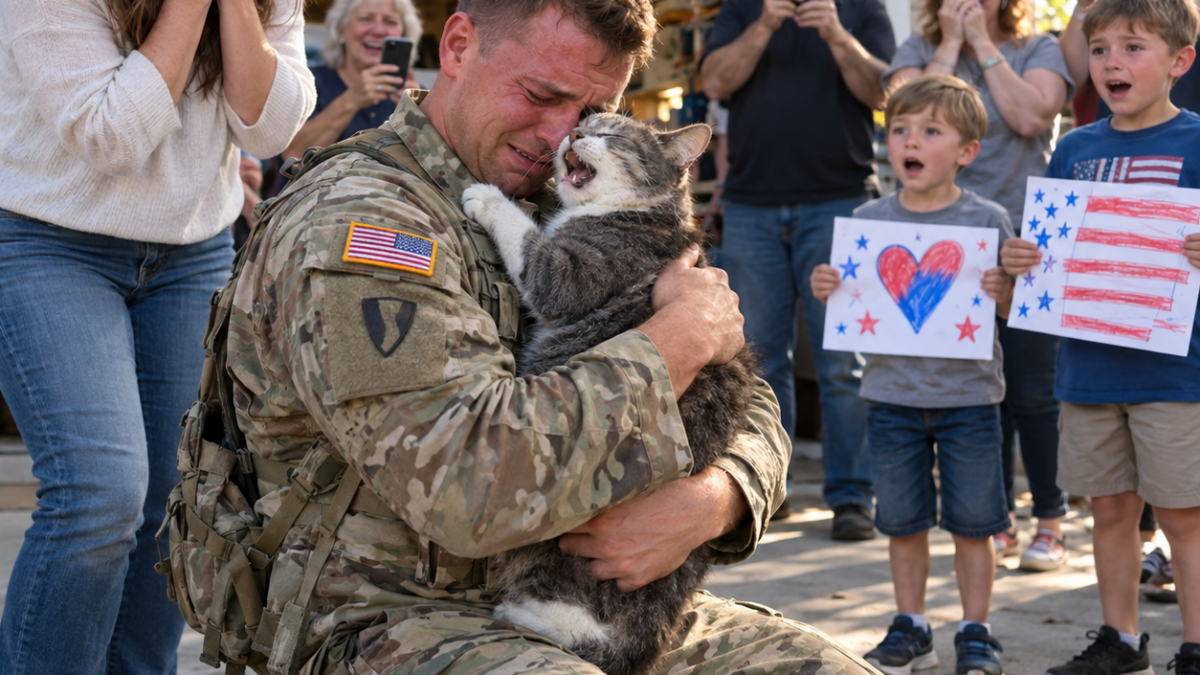
A Soldier Came Home After Eight Months Away—Then His 14-Year-Old Arthritic Cat Did Something the Entire Family Couldn’t Stop Rewatching.
A soldier came home after eight months overseas, and his family filmed the reunion they had been waiting for since winter.
But when he stepped out of the car, nobody kept watching the soldier, his wife, or even the two little boys running toward him with handmade signs.
Everyone turned toward the front door, because a fourteen-year-old cat named Ghost was about to do something no one in that driveway would ever forget.
The banner in the garage said WELCOME HOME, DADDY in red, blue, and silver letters, but half the tape had already started peeling away from the wall.
Sarah Whitaker had fixed it three times that morning.
First at 7:10, while the coffee was still dripping and both boys were too excited to eat their cereal.
Again at 9:35, after her mother-in-law arrived carrying a tray of deviled eggs and immediately started crying before anyone had even mentioned Daniel’s name.
Then again at noon, when the left side sagged low enough that six-year-old Mason pointed up and said, “Mom, the E is giving up.”
Sarah had laughed because laughing was safer than crying.
“Then we’ll make the E stand at attention,” she said, climbing onto a folding chair with a roll of painter’s tape between her teeth.
Mason saluted the letter.
His older brother, Noah, who was nine and trying very hard to be mature about the whole thing, rolled his eyes but held the bottom of the chair anyway.
“Don’t fall before Dad gets here,” Noah said. “That would ruin the video.”
Sarah looked down at him.
“You’re worried about the video?”
“No,” he said too quickly. “I’m worried about you. And the video.”
That was how the entire day had felt.
Like joy standing too close to panic.
Like every ordinary thing had become too bright, too sharp, too fragile to touch.
A soldier was coming home.
Not a news story soldier.
Not a stranger in uniform on a screen.
Their soldier.
Daniel Whitaker.
Thirty-eight years old.
Eight months deployed overseas.
Husband.
Father.
Son.
The man who always burned pancakes on the first side and claimed it was intentional because “smoke adds character.”
The man who taught both boys to tie fishing knots before they could tie their shoes.
The man whose old gray T-shirts still sat folded in the second drawer of Sarah’s dresser because she had never been able to move them back to his side of the closet.
PART2:
The man Ghost had been waiting for.
Nobody understood that part fully yet.
Not even Sarah.
She thought she did.
She knew Ghost missed Daniel. Everyone did. Ghost had slept on Daniel’s side of the bed every night after he left, curled in the hollow that remained on the mattress as if the man had only gotten up to brush his teeth and would be back in a minute.
She knew the cat had stopped eating for nine days.
She knew she had sat on the kitchen floor with a syringe full of water, whispering, “Please, buddy, please,” while Ghost turned his head away from food, treats, tuna, chicken broth, wet food warmed in the microwave, dry food soaked soft, and every desperate combination she could invent.
She knew the veterinarian had found nothing physically wrong.
No obstruction.
No infection.
No organ failure.
No dental injury.
No hidden pain.
“Sometimes,” Dr. Lewis had told her gently, “animals don’t understand absence the way we do.”
Sarah remembered how cold the exam room table had felt beneath her palms.
“What does that mean?”
Dr. Lewis had looked at Ghost, who lay with his head turned toward the door, not even angry, simply gone somewhere inside himself.
“It means he may not know Daniel is away,” the vet said. “He may think Daniel is dead. Some animals grieve like that.”
Sarah had managed not to cry until she reached the parking lot.
Then she sat behind the wheel with Ghost in his carrier on the passenger seat and sobbed so hard she could not start the car.
Because Daniel was not dead.
PART3:
She knew that.
She had emails.
Delayed phone calls.
Short video messages with poor signal, his face grainy and tired but smiling anyway.
But Ghost did not have emails.
Ghost had scent.
Routine.
Footsteps.
A hand under his chin at 5:30 in the morning.
A warm chest he slept against.
A voice that said, “You’re not as mysterious as you think, old man.”
And then one day, all of that had vanished.
To a cat, maybe absence did not come with explanations.
Maybe it only came with silence.
That night, after the vet visit, Sarah did something that felt foolish until it worked.
She opened Daniel’s dresser drawer and pulled out one of his old T-shirts.
Dark blue.
Soft from years of washing.
Worn thin at the collar.
She had almost washed it after he left but stopped herself because it still smelled faintly like him. Laundry soap. Cedar deodorant. Coffee. The cold metal smell that clung to his uniforms no matter how often they were cleaned. Daniel.
Sarah placed the shirt on his side of the bed.
She did not make a speech to Ghost.
She did not coax him.
She did not pretend to understand the rules of grief in a fourteen-year-old cat.
She simply put the shirt there and turned off the light.
At 2:14 in the morning, she woke to the sound of movement beside her.
Ghost had climbed onto the bed.
Slowly, because arthritis had made every jump into negotiation.
He stood over the shirt for almost a full minute, nose lowered, breathing in tiny sharp pulls. Then he turned once, twice, settled down on top of it, tucked his paws beneath his chest, and placed his chin near the collar.
The next morning, he ate.
Only three bites.
But he ate.
Sarah leaned against the kitchen counter and cried into a dish towel so the boys would not hear.
After that, the shirts became a ritual.
Daniel never knew.
Not then.
Every few nights, Sarah took another worn shirt from the drawer and placed it on the bed. She did not wash them. She did not let anyone wash them. She protected them with a seriousness that would have embarrassed her if anyone had asked.
When Mason spilled orange juice near the laundry basket, Sarah snapped at him so sharply that he burst into tears.
She apologized for twenty minutes.
She still moved the shirts to the top shelf of the closet.
During those eight months, Ghost aged faster than any of them wanted to admit.
He had been fourteen when Daniel left, but still sturdy in that old-cat way that made him seem permanent. Gray and white tabby. Broad face. White chest. One torn ear from a fight he had clearly won before Daniel ever found him. Green eyes that judged every new person who entered the house.
Daniel had found Ghost behind a barracks during his first year in service.
A six-week-old kitten, filthy and furious, wedged behind a stack of pallets near a maintenance shed. The other soldiers told Daniel not to touch him because the kitten was spitting like a demon and had claws like fishhooks.
Daniel, who had been twenty-four then and too young to know that love often arrives badly behaved, took off his jacket, wrapped the kitten in it, and said, “Well, he’s got spirit.”
The kitten bit him hard enough to draw blood.
Daniel named him Ghost because the little gray thing kept disappearing into impossible corners of the barracks room and reappearing silently on Daniel’s pillow like a haunting.
For fourteen years, Ghost followed Daniel through life.
Four duty stations.
Two countries.
A first marriage that ended badly.
A tiny apartment near base housing where the heat went out for three days and Ghost slept inside Daniel’s hoodie.
A move across the country in a pickup truck, where Ghost refused the carrier and spent seven hundred miles glaring from the passenger seat like a retired judge.
When Daniel met Sarah, Ghost did not approve.
Sarah still remembered the first night she came to Daniel’s apartment for dinner. Daniel made pasta. Overcooked it. Called it “field-grade Italian.” Sarah laughed harder than the joke deserved because she already liked him too much.
Ghost sat on the arm of the couch and stared at her for two hours.
Not blinking.
Not moving.
Just watching.
“He hates me,” Sarah whispered.
Daniel glanced at the cat.
“No. That’s his interview face.”
“Interview for what?”
“Whether you’re allowed to stay.”
Ghost did not allow her to stay easily.
When Sarah and Daniel got married two years later, Ghost tolerated the wedding guests from under the bed and emerged only after everyone left, walking straight past Sarah to jump onto Daniel’s lap with the air of someone reclaiming property.
For the first year of their marriage, Ghost sat between them on the couch every night.
Always between.
Never beside.
If Sarah leaned against Daniel, Ghost shifted his body so one paw touched Daniel’s leg and his back faced Sarah like a small furry wall.
“I think he’s conducting a moral background check,” Sarah told Daniel.
“He’s thorough.”
“He’s rude.”
“He’s government-adjacent.”
It took thirteen months before Ghost climbed onto Sarah’s lap.
She had been watching television alone, Daniel working late, rain tapping against the windows. Ghost approached from the hallway, looked at her for a long time, then jumped carefully onto her knees, turned in a circle, and lay down.
Sarah froze.
Afraid to breathe wrong.
When Daniel came home and saw them, he stopped in the doorway.
“Well,” he said softly. “You passed.”
Sarah cried.
She had not expected to.
But she understood what it meant.
Ghost did not offer trust casually.
When he gave it, he meant it.
That was why his grief during Daniel’s deployment became part of the household.
Not a dramatic detail.
A weather system.
On bad nights, Ghost walked the hallway crying. Not loudly. He had never been a noisy cat. Just small, broken calls that began near Daniel’s side of the bed and ended by the front door.
The boys heard him.
Mason would climb into Sarah’s bed and ask, “Does Ghost miss Dad too?”
“Yes,” Sarah would whisper.
“Does Dad miss Ghost?”
“Very much.”
“Does Ghost know Dad loves him?”
Sarah would look toward the doorway, where the cat sat staring into the dark.
“I hope so.”
Noah did not ask those kinds of questions as often.
He was nine.
Old enough to understand deployment in the uneven way children understand adult danger. He knew his father was alive. He knew his father was somewhere far away. He knew they could not always talk. He knew Sarah checked her phone too much. He knew Grandma lowered her voice whenever the news mentioned regions he had learned not to name.
He did not know what to do with his fear, so he became helpful.
He carried laundry.
Packed Mason’s lunches.
Fed Ghost when Sarah forgot.
Made signs for the homecoming before anyone knew the date, then hid them under his bed because he said they were “practice versions.”
Every few nights, Sarah found him asleep with one of Daniel’s old hoodies bunched under his chin.
She pretended not to notice.
The homecoming date came in pieces.
Not certain at first.
Then likely.
Then confirmed.
Then changed.
Then confirmed again.
That final week stretched longer than the eight months before it.
Sarah cleaned the house twice.
Then gave up because two boys lived there.
Daniel’s mother, Linda, called every day asking what she should bring.
Daniel’s sister volunteered to film.
Sarah’s brother said he could set up the garage so everyone would have a good view.
The boys made new signs.
Noah’s read WELCOME HOME, DAD in block letters with small drawings of tanks, stars, and one suspiciously dragon-like airplane.
Mason’s read I SAVED YOU A COOKIE, though he had not saved any cookies and Sarah had to bake more the night before.
Ghost watched all of this from the window.
In the last month before Daniel returned, he had begun spending most afternoons on the back of the couch beneath the front window, the one facing the driveway. Arthritis had made jumping difficult, so Sarah placed a footstool beside the couch, then a low storage cube beside that, creating a little staircase.
Ghost used it with visible offense.
He sat in the window and looked out.
Hours at a time.
Sometimes Sarah wondered whether he knew.
Not the date.
Not the schedule.
But something.
The way the house changed when hope moved back in.
The boys’ voices grew brighter.
Sarah played music while cleaning.
Relatives called.
Suitcases of emotion began stacking everywhere.
Maybe Ghost smelled it.
Maybe he felt the tension shift.
Maybe he had been waiting for eight months and did not need anyone to tell him waiting was almost over.
On the morning Daniel came home, Ghost refused breakfast.
Sarah’s heart lurched.
“No,” she said, kneeling by the bowl. “Not today, buddy. Please, not today.”
Ghost stood beside the bowl without looking at it.
Then he turned and walked—slowly, stiffly—to the front window.
He climbed his little staircase.
Storage cube.
Footstool.
Couch.
Back cushion.
Window ledge.
Each movement deliberate.
He settled there with his front paws tucked beneath him and stared down the driveway.
“Do you know?” Sarah whispered.
Ghost did not look at her.
By noon, fifteen family members had arrived.
Too many people for the house.
Too much noise.
Everyone trying to help.
No one helping.
Linda arranged food nobody would eat until later.
Daniel’s sister, Kate, checked her phone storage for video space.
Sarah’s brother, Mark, adjusted the banner and declared himself “logistics command,” which made Noah tell him logistics command was blocking the lemonade.
Grandparents cried in shifts.
Neighbors wandered near the edge of the driveway pretending to check mail.
The boys changed shirts three times.
Sarah changed once, then changed back into the first shirt because Daniel had always said she looked pretty in blue.
At 2:43 p.m., her phone buzzed.
A message from Daniel.
Ten minutes.
She stared at the screen.
Then shouted, “Ten minutes!”
The house detonated.
People rushed into position as if the reunion were a military exercise and everyone had been poorly trained.
The boys grabbed their signs and ran outside.
Sarah followed them, then ran back in because she had forgotten the small flag Mason wanted to wave, then ran out again.
Someone opened the front door and left it open.
Nobody noticed.
Ghost did.
He remained at the window.
The driveway curved slightly through two maple trees before reaching the house. For years, Sarah had loved that curve because cars appeared gradually, giving her a few seconds of recognition before arrival.
That day, it nearly killed her.
First the sound.
Tires on gravel.
Then the dark hood of a car.
Then the windshield.
Then the driver she did not care about.
Then the passenger door.
Daniel.
The car stopped.
For one suspended second, nobody moved.
Daniel stepped out.
He was thinner than when he left.
Or maybe the uniform made him look that way.
His hair was shorter.
His face was darker from sun, sharper at the jaw, tired around the eyes.
He had a duffel over one shoulder and the uncertain half-smile of a man arriving at the life he had dreamed about for months and suddenly not knowing where to put his hands.
Mason broke first.
“Daddy!”
Noah dropped his sign and ran too.
Daniel’s duffel hit the gravel.
He went to his knees just in time for both boys to crash into him.
Mason climbed him like a tree.
Noah wrapped both arms around his neck and buried his face in Daniel’s shoulder with the force of a child trying not to cry and failing completely.
Sarah stopped ten feet away.
She had imagined running into his arms.
She had imagined kissing him first.
She had imagined a thousand versions.
Instead she stood there watching him hold their sons and felt something in her chest unclench so violently it hurt.
Daniel looked up at her over Noah’s head.
His eyes filled.
“Hey,” he said.
It was absurd.
Eight months.
Thousands of miles.
Fear.
Loneliness.
Two boys growing inches.
A cat grieving like a widow.
And he said hey.
Sarah laughed through tears.
“Hey.”
The family applauded.
Phones recorded.
Linda sobbed openly.
Mark said, “I’m not crying, this is dust,” though there was no dust.
It was exactly what a homecoming was supposed to look like.
Then the front door moved.
A shadow appeared on the threshold.
Kate, who was filming from the side of the driveway, gasped.
“Oh my God.”
At first, Daniel did not hear.
He was still on his knees, one arm around each boy, eyes locked on Sarah.
Then Mason turned toward the house.
“Ghost!”
Every phone shifted.
Every head turned.
Ghost stood in the open doorway.
Fourteen years old.
Arthritic.
Slow.
A cat who had not voluntarily run in more than two years.
A cat who climbed stairs one at a time.
A cat who needed three attempts to jump onto the couch unless the footstool was placed exactly right.
He stood there with sunlight behind him, gray and white fur lifted by the afternoon breeze.
For one second, he stared.
Daniel saw him.
His face changed.
“Ghost?”
The cat moved.
Not walked.
Moved.
Down the threshold step.
Across the porch.
Onto the walkway.
Fast.
Too fast for the body everyone knew he had.
His back legs gathered under him. His front paws struck concrete. His old body stretched into a run that looked impossible, uneven, wild, desperate.
Sarah made a sound.
Linda covered her mouth.
Mason shouted, “He’s running!”
Ghost crossed the yard.
Past the flower bed.
Past the welcome sign Mason had dropped.
Past fifteen relatives who had suddenly forgotten the soldier, the wife, the children, the banner, the camera angles, everything.
Everyone watched the cat.
Daniel shifted just in time.
Ghost hit his chest so hard Daniel nearly fell backward onto the gravel.
The boys scrambled aside, startled.
Daniel caught the cat automatically, both hands closing around a body that had once been strong and was now mostly bone, fur, and will.
“Ghost,” he whispered.
The cat climbed him.
Not gracefully.
There was nothing graceful about it.
He dug claws into Daniel’s uniform, pulled himself higher, planted both front paws against Daniel’s chest, and shoved the top of his head under Daniel’s chin.
Then he screamed.
Not meowed.
Not cried.
Screamed.
A long, guttural, trembling sound tore out of him and held for nearly ten seconds.
It sounded too large for his body.
Too human for an animal.
Too broken for joy and too joyful for grief.
The driveway went silent.
No one breathed.
Daniel closed both arms around him.
Ghost screamed again.
And again.
And again.
Eleven times.
Later, the family would count by watching the videos from different angles. Eleven full cries. Each one starting deep in his chest and shaking through his old body. Each one muffled slightly by Daniel’s uniform because Ghost had buried himself under his chin as if trying to crawl into the place where the missing heartbeat had finally returned.
Daniel did not speak.
For nearly four minutes, he said nothing.
He knelt in the driveway, holding his old gray cat against his chest, tears running silently down his face. His sons stood beside him, confused and crying because everyone else was crying. Sarah stood with both hands over her mouth, watching eight months of grief pour out of a fourteen-year-old animal in sounds none of them would ever forget.
Mason still held half of his sign.
The other half had torn when he dropped it.
He looked up at Sarah.
“Why is Ghost crying like that?”
Sarah tried to answer.
Could not.
She wiped her face and knelt beside Daniel.
“Because,” she whispered, voice breaking, “he thought Daddy was never coming back.”
Daniel’s eyes closed.
Ghost pressed harder against him.
As if the words had been true.
As if for eight months he had lived in a house where everyone promised Daniel would return, but only scent could prove it, and scent fades.
After a while, Daniel shifted one arm enough to reach for Sarah.
She went to him.
Carefully, because Ghost would not move.
Daniel held his wife with one arm, his cat with the other, and his boys pressed against his shoulders.
That became the real reunion.
Not the first embrace.
Not the banner.
Not the handmade signs.
The moment a grieving cat finally believed absence had ended.
The videos spread through the family first.
Not online.
Not at first.
They watched them that night after everyone left, sitting in the living room with plates of untouched food on the coffee table and Ghost asleep across Daniel’s chest.
Daniel had tried to put him down once.
Ghost responded by gripping his uniform sleeve with claws and making a low sound that ended the discussion.
So Daniel stayed on the couch.
Sarah sat beside him.
Noah on the floor.
Mason tucked against Daniel’s leg.
Kate played the video from her phone.
Then Linda played hers.
Then Mark’s.
Then one from Sarah’s cousin near the garage.
Each showed a different angle of the same impossible thing.
Ghost at the doorway.
Ghost running.
Ghost hitting Daniel’s chest.
The scream.
Again.
Again.
Again.
Daniel watched in silence.
On the third replay, he touched Ghost’s back.
“He stopped eating?” he asked.
Sarah looked down.
She had not planned to tell him that night.
But secrets of that kind become too heavy once their purpose is gone.
“For nine days.”
Daniel turned his head slowly.
“What?”
“I tried everything. Tuna. Chicken. Broth. The vet. He wasn’t sick.”
Daniel stared at her.
“What did the vet say?”
Sarah hesitated.
“That he might be grieving.”
Daniel looked at Ghost.
The cat slept deeply now, face tucked beneath Daniel’s chin, one paw hooked into the fabric as if guarding against disappearance.
“He thought I died?”
“I think he didn’t know the difference.”
Daniel’s face changed again.
That was the moment deployment reached him from the other direction.
Not the danger he had lived through.
The absence he had caused.
He had thought of Sarah.
The boys.
His mother.
He had worried about birthdays missed, school events missed, bedtime calls cut short, the weight Sarah carried alone.
He had imagined Ghost sleeping on his side of the bed.
He had not imagined the cat starving himself because the world had failed to explain why Daniel’s smell was leaving the house one molecule at a time.
Sarah told him about the shirts.
How she slept with his old T-shirts.
How she laid them on the bed.
How Ghost ate the next morning.
How she rotated them carefully for eight months, never washing them, never telling anyone because it felt too strange and too sacred and too sad.
Daniel listened without interrupting.
Then he lowered his face into Ghost’s fur and cried harder than he had in the driveway.
The boys watched.
Not scared this time.
Quiet.
Noah moved closer and placed one hand on Ghost’s back.
Mason whispered, “Did Ghost think the shirts were you?”
Sarah said, “Maybe they helped him remember Daddy was real.”
Mason considered this.
Then climbed off the couch, ran to his room, and returned with a small dinosaur blanket.
He placed it beside Daniel.
“For next time,” he said.
Nobody said anything for a long moment.
Then Daniel pulled both boys into him, Ghost trapped between all three, and said, “I’m here now.”
Ghost opened one eye.
As if to confirm.
The first night back, Daniel slept badly.
So did Ghost.
Not because either was unhappy.
Because neither trusted sleep yet.
Daniel woke four times.
Each time, Ghost was there.
On his chest.
On his shoulder.
Pressed against his side.
Once, Daniel woke to Ghost standing over him in the dark, staring into his face from two inches away.
“Buddy,” Daniel whispered. “That’s creepy.”
Ghost touched his nose to Daniel’s chin and lay down again.
At 5:12, Daniel gave up and went to the kitchen.
Ghost followed.
Slowly now.
The run from the driveway had cost him. His back legs were stiff, and he paused at the hallway rug before continuing. Daniel noticed every step.
In the kitchen, he found Sarah already awake, wrapped in a robe, watching them from the doorway.
“You okay?” she asked.
Daniel poured coffee.
“No.”
She nodded.
“Me neither.”
Ghost sat between them.
The old cat looked from one to the other, as if dissatisfied by the emotional management of the household.
Daniel crouched.
His knees cracked.
Ghost stepped into the space between his boots.
“I’m sorry,” Daniel whispered.
Sarah leaned against the counter, eyes filling again.
Daniel kept his hand on Ghost’s head.
“I know you don’t understand any of it. I know I left and you thought I wasn’t coming back. I’m sorry.”
Ghost pushed his head into Daniel’s palm.
“I came back,” Daniel said. “I came back.”
For the first two weeks, Ghost refused to let Daniel out of sight.
Bathroom doors were an insult.
Garage trips were unacceptable.
Taking trash to the curb caused a crisis.
When Daniel walked outside to get the mail, Ghost stationed himself at the front window and cried until he returned, even if it took ninety seconds.
The first time Daniel left for a medical appointment, Ghost hid under the bed for six hours after he came home.
“He thinks you’re going again,” Sarah said.
Daniel sat on the floor beside the bed, one hand extended into the darkness.
“I know.”
Ghost did not come out.
Daniel stayed there anyway.
Twenty minutes.
Forty.
An hour.
Finally, the cat crept forward and placed one paw on Daniel’s fingertips.
That became their new training.
Not military training.
Trust training.
Daniel left for five minutes and came back.
Then ten.
Then twenty.
Each time he returned, he found Ghost waiting.
At the window.
On the couch.
By the door.
Always pretending he had not been afraid.
Always failing.
Daniel began leaving worn shirts intentionally now.
Not because he was gone for long.
Because he understood the language.
Scent meant promise.
Scent meant I was here.
Scent meant I am coming back.
He put one of his shirts on the couch before driving Noah to school.
Another on the bed before taking Mason to the dentist.
One folded beside Ghost’s favorite window when he went to the grocery store with Sarah.
Ghost slept on them all.
The family changed around the cat.
Not dramatically.
In small ways.
The boys stopped racing past him in the hallway.
Noah built a lower ramp to the couch out of scrap wood and carpet pieces. It looked terrible. Ghost used it immediately, which Noah considered the greatest compliment of his life.
Mason began saying goodbye to Ghost before school every morning.
Not just “Bye, Ghost.”
Full briefings.
“Dad is staying home today. Mom is going to work at ten. Noah has soccer. I have library. We come back after snack. Don’t worry.”
Ghost tolerated the briefings with closed eyes.
Sarah began taking more videos, but quieter ones.
Ghost asleep with his paw on Daniel’s wrist.
Ghost sitting between Daniel and the boys during a board game.
Ghost glaring at Daniel’s duffel bag whenever it came out of the closet.
Ghost refusing to let Daniel pack laundry into it.
One afternoon, Daniel found the cat sleeping inside the empty duffel.
He stood over him for a long time.
Then he carried the duffel, cat and all, into the living room and placed it beside his chair.
“Fair,” Daniel said.
Ghost opened one eye.
The wider family watched the driveway video more than two hundred times.
Linda said she watched it because it proved her son had come home.
Kate said she watched it because she had never heard love sound like that.
Mark admitted after Thanksgiving that he watched it whenever he needed to cry but could not get started.
They did not post it publicly.
Daniel refused.
Not because he was embarrassed.
Because the sound Ghost made did not feel like something strangers should scroll past between recipes and arguments.
“That was his,” Daniel said. “Not everyone gets to have it.”
Sarah agreed.
The video stayed in the family group chat, where people sometimes sent only a heart emoji after watching it again.
But stories leak even when videos do not.
A neighbor told another neighbor.
Someone at church heard.
Daniel’s mother mentioned it to her hairdresser.
The vet heard from Sarah during Ghost’s checkup and had to leave the room for a minute.
Dr. Lewis examined Ghost carefully.
“Heart sounds decent for his age,” he said. “Kidneys stable. Arthritis worse, but not surprising.”
Daniel nodded.
Ghost sat on the exam table pressed against his arm.
Dr. Lewis smiled sadly.
“He waited for you.”
Daniel swallowed.
“Yeah.”
“I don’t mean that poetically.”
Daniel looked up.
The vet removed his stethoscope.
“I’ve seen animals decline when their person is gone. I’ve seen them rebound when reunited. But what Sarah described… the not eating, the fixation on scent, that reaction when you returned…”
He looked at Ghost.
“He held on.”
Daniel touched the cat’s head.
Ghost leaned into him.
“How much time?” Daniel asked.
Dr. Lewis hesitated.
“With a fourteen-year-old cat? We don’t know. Could be months. Could be longer. He’s old. His body has been old for a while.”
Daniel nodded.
He had asked the question expecting a medical answer.
What he heard instead was permission to notice every day.
Ghost made it four more months.
September softened into October.
Then November.
Then December.
He watched the boys carve pumpkins from Daniel’s lap. He sat in the kitchen during Thanksgiving and judged every person who tried to feed him turkey until Daniel did, at which point he accepted it as lawfully prepared.
He slept under the Christmas tree before gifts were placed there, curling on the tree skirt as if it had been laid down for him personally.
He knocked one ornament off the lower branch every morning for six straight days.
Mason blamed “Christmas gravity.”
On Christmas Eve, Daniel fell asleep in the recliner with Ghost on his chest and both boys on the floor building a Lego set too complicated for the hour. Sarah stood in the doorway watching them and thought, with sudden terror, Remember this.
Not because she knew.
Because happiness sometimes warns you by becoming too clear.
January came hard.
Cold rain.
Gray skies.
School delays.
Ghost slowed.
More than before.
He still climbed the couch ramp but paused halfway.
He still followed Daniel but sometimes changed his mind and lay down in the hallway instead.
He ate less.
Slept more.
His fur lost some shine.
His eyes remained sharp, but his body had begun that quiet withdrawal old animals make when the world they guarded is almost ready to continue without them.
Daniel noticed.
Sarah noticed Daniel noticing.
Neither said much in front of the boys.
One night, Noah found Ghost lying beside Daniel’s boots near the front door.
“Is he sick?” Noah asked.
Daniel sat beside him.
“He’s old.”
“That’s not what I asked.”
Daniel looked at his son.
Noah’s eyes were too serious for nine.
“He might be getting tired,” Daniel said.
Noah touched Ghost’s back.
“Like Grandpa’s dog?”
“Yes.”
“Will he die?”
Sarah, listening from the kitchen, closed her eyes.
Daniel answered because children deserve the truth when they are brave enough to ask for it.
“Yes,” he said softly. “Someday.”
Noah’s mouth trembled.
“But not tonight?”
Daniel looked at Ghost.
The cat opened one eye, offended by the discussion.
“Not tonight,” Daniel said.
Not that night.
But soon.
On a Thursday in January 2024, snow fell lightly all afternoon.
The boys came home early.
Sarah made soup.
Daniel watched television after dinner, though later he could not remember what had been on. Some documentary. Maybe weather. Maybe nothing. He sat in the recliner, the same brown chair he had owned since before Sarah, before the boys, before the second marriage that had saved more of him than he admitted.
Ghost stood at the foot of the chair looking up.
Daniel patted his lap.
“Come on, old man.”
Ghost gathered himself.
His first attempt failed.
His front paws caught the edge of Daniel’s pants, but his back legs did not follow. Daniel reached down immediately.
“No, no, I’ve got you.”
He lifted Ghost gently.
The cat made a small irritated sound, as if assistance was unnecessary and legally questionable.
Daniel settled him on his lap.
Ghost turned in a slow circle.
One turn.
Then another.
Then he tucked himself into the position he had slept in for fourteen years.
Chest against Daniel.
Head beneath his chin.
One paw hooked lightly into the fabric of Daniel’s shirt.
Daniel lowered the recliner slightly and rested one hand across Ghost’s back.
Sarah passed through the living room with a basket of folded laundry.
She saw them and smiled.
“You two okay?”
Daniel’s eyes were already half closed.
“We’re good.”
Ghost’s tail moved once.
Sarah turned off the kitchen light.
The boys went to bed.
Snow tapped softly against the windows.
The house quieted.
Daniel fell asleep with one hand on the cat who had waited eight months for him to return.
Ghost died there.
Not dramatically.
Not with a cry.
Not with fear.
He simply let go while pressed against the heartbeat he had searched for in shirts, pillows, doorways, and dreams.
When Daniel woke, he knew before he moved.
There was a stillness to Ghost that sleep had never held.
A weight.
A softness without breath.
Daniel opened his eyes and stared at the wall.
His hand remained on Ghost’s back.
He did not call Sarah.
He did not sit up.
He did not speak.
For two hours, he stayed exactly where he was.
The house woke slowly around him.
Sarah came downstairs first.
She saw the recliner.
Daniel awake.
Ghost still in his lap.
At first, she smiled.
Then she saw Daniel’s face.
She stopped.
“Oh,” she whispered.
Daniel looked at her.
His lips moved, but nothing came out.
Sarah crossed the room slowly and knelt beside the chair.
She touched Ghost’s head.
Still warm, but fading.
Her breath caught.
Daniel finally spoke.
“He made it back.”
Sarah nodded through tears.
“Yes.”
“He waited.”
“I know.”
Daniel looked down at the cat.
“I fell asleep.”
“That’s what he wanted.”
His face broke.
Sarah placed her hand over his on Ghost’s back.
“He didn’t go alone,” she said. “He went exactly where he wanted to be.”
The boys cried differently.
Mason cried loudly and immediately, the way six-year-olds do when grief is still honest enough to use the whole body.
Noah stood silent for almost a minute, then asked if he could touch Ghost.
Daniel said yes.
Noah placed two fingers on Ghost’s paw.
“He’s not hurting?”
“No,” Daniel said.
“He knows Dad stayed?”
Daniel closed his eyes.
“Yes.”
Mason asked whether Ghost would be buried in Daniel’s T-shirt.
Sarah looked at Daniel.
Daniel nodded.
They chose the dark blue one.
The first shirt Ghost had slept on after he stopped eating.
Sarah had kept it folded in the closet even after Daniel came home. She had never known why.
Now she did.
They wrapped Ghost in it that afternoon.
Daniel dug the grave beneath the maple tree near the front window, the one Ghost had watched from for eight months. The ground was hard, and Mark came over to help, but Daniel did most of it himself.
Not because he had to.
Because some final acts belong to the person most broken by them.
They buried Ghost with the shirt, one of Mason’s tiny toy dinosaurs, and the torn paper corner of Noah’s welcome-home sign.
The boys chose that.
Sarah placed a smooth gray stone on top.
No words.
Not yet.
Words came later.
That evening, after family left and the boys finally slept, Sarah found Daniel sitting in the recliner.
Empty lap.
Television off.
One hand resting on the left armrest.
She sat on the couch.
Neither spoke for a while.
Then Sarah said what she would later tell the neighbor because the sentence arrived whole and true and would not leave her.
“He waited eight months to make sure you came home,” she whispered. “Then he waited four more to make sure you stayed. When he knew, he could go.”
Daniel bowed his head.
Sarah moved to him, and he cried into her shoulder with the same silence he had carried in the driveway.
The chair stayed.
Daniel refused to move it.
He did not say refuse.
Nobody asked after the first time.
The recliner remained angled toward the television, left armrest worn, fabric slightly scratched where Ghost had climbed over the years. Sarah vacuumed around it but not deeply. She cleaned the cushion but gently. She did not touch the small strip of upholstery where a few gray-and-white hairs remained caught in the weave.
One hair in particular stayed lodged in the fabric of the left armrest.
Thin.
Gray at one end.
White at the other.
Daniel found it three days after Ghost died.
He touched it carefully with the tip of his finger but did not pull it free.
That night, before going upstairs, he checked whether it was still there.
It was.
The next night, he checked again.
Still there.
It became a ritual.
Not one he explained.
After dinner.
After the boys went to bed.
After Sarah locked the back door.
Daniel would pause beside the recliner, lean down, and check the left armrest.
The hair remained.
Weeks passed.
Then months.
Dust came and went.
Seasons shifted.
Noah turned ten.
Mason lost another tooth.
Daniel returned to work stateside.
Life, indifferent and merciful, continued.
But every evening, Daniel checked.
Sometimes Sarah watched from the doorway.
Sometimes Mason asked, “Still there?”
Daniel would nod.
“Still there.”
One day, Noah stood beside him and looked at the armrest for a long time.
“It’s just one hair,” he said.
Daniel did not answer right away.
Then he said, “No.”
Noah looked up.
“It’s proof.”
“Proof of what?”
Daniel touched the fabric beside the hair.
“That he was here.”
Noah thought about that.
Then nodded.
Years later, the boys would remember many things about their father’s homecoming.
The signs.
The driveway.
The way Daniel dropped his duffel.
The smell of his uniform when they hugged him.
Their mother crying.
Their grandmother making too much food.
But most of all, they would remember Ghost.
The old cat at the doorway.
The impossible run.
The sound.
Eleven cries from a body everyone thought had no strength left to give.
They would remember learning that love can wait in ways people cannot see.
That grief is not limited to humans.
That a cat can mistake deployment for death and survive eight months on nothing but scent, routine, and stubborn hope.
They would remember the way Daniel held him.
Like a soldier coming home.
Like a boy getting back the first creature that had ever chosen him.
Like a man realizing the cost of absence had been paid by everyone in the house, even the one who could not understand where he had gone.
And Daniel would remember something else.
On the hardest days after Ghost died, when grief felt too small to explain and too large to ignore, he remembered the driveway.
Not the tears.
Not the cameras.
The moment before Ghost ran.
That one second when the old cat stood in the doorway and saw him.
Daniel liked to believe that in that second, the world corrected itself for Ghost.
The missing scent returned.
The absent heartbeat came back.
The dead became living.
The waiting ended.
Maybe that was why Ghost ran.
Not because his body was healed.
Not because pain vanished.
Because recognition is sometimes stronger than pain.
Because love, when it has been holding its breath for eight months, does not walk calmly across the yard.
It runs.
Ghost’s stone beneath the maple eventually received words.
Sarah ordered it quietly.
Daniel did not know until it arrived.
A simple gray marker, small enough to fit under the tree but heavy enough to last.
GHOST
2009–2024
HE WAITED
Daniel stood over it for a long time.
Then he nodded.
Nothing more needed saying.
But every evening, he still sits in that recliner.
He has never moved it.
He has never replaced it.
He has never cleaned the left armrest too carefully.
And before he turns off the light, he checks the fabric with one finger, gentle as a prayer.
The single gray-and-white hair is still there.
Still caught in the weave.
Still refusing to leave.
Just like Ghost did.

