A Shelter Sold a “Useless” Police K9 for $15 and Scheduled Her to Die Days Later—Then a Silent Old Farmer Stepped Into the Yard, Knelt Down, and She Finally Came to Him. Văn bản đã dán (1)
PART3:
Did not read the kennel card aloud.
Did not say, “Hey, girl,” in that falsely bright tone people used when they wanted an animal to make them feel kinder than they were.
He was just there.
Weight settled.
Back straight without being stiff.
Head angled so he could see both the yard and the parking lot in his peripheral vision.
His jacket was the color of dry wheat, collar up, elbows worn pale, a working jacket that had seen real seasons, not decorative ones. His boots were mud-dark around the seams. His hair was gray and cut short without style. His face held the weathered flatness of someone who had learned long ago that expression could cost energy better spent elsewhere.
Maya watched him through the break room window while coffee dripped into the pot.
Cora, the younger intake worker, came in behind her, tying her hair up with one hand and balancing a stack of vaccine logs with the other.
“He’s back,” Cora said.
Maya did not turn.
“I know.”
“Do we need to tell Dawson?”
Maya watched the dog.
The Malinois had not looked away from the old man.
“Not yet.”
Cora leaned past her to see.
“Is that the guy from yesterday?”
“And the day before.”
“What’s he doing?”
“Standing.”
Cora frowned.
“That’s creepy.”
Maya looked at the dog’s ears.
“No,” she said slowly. “It’s not.”
Cora gave her a skeptical look.
Maya could not explain it.
Not yet.
All she knew was that the dog was quiet.
And the old man was not making himself important.
In a shelter, that was rare enough to pay attention to.
Inside the kennel corridor, two workers were talking near the intake desk.
“She bit Martinez clean through the glove last Tuesday,” one of them said. “Whole hand. He’s still on light duty.”
The second worker did not look up from his sheet.
“Doesn’t matter. Dawson already flagged her. She’s got maybe three days.”
Neither was talking to Roland.
He was only a shape beyond the chain link to them.
Just there.
Like a gate post.
The Malinois heard their voices.
Her ears flicked once.
Roland’s hand tightened around the lure.
Then went still again.
At 7:32, the shelter unlocked.
Roland entered without hurry.
His boots were quiet on the concrete floor.
Maya looked up from the desk before he spoke.
Up close, he seemed both older and harder to place. Seventy? Maybe more. His face had the deep-lined stillness of men who spent more time in weather than in conversation. His hands were old, rope-scarred across the knuckles, one finger crooked at the second joint where it had healed wrong and stayed that way.
But there was nothing frail in the way he stood.
“I’d like the intake paperwork on the Belgian Malinois in Isolation Yard C,” he said.
His voice was low.
Even.
Not a request from someone hoping to be humored.
Maya reached beneath the counter and pulled the folder.
She set it down and watched his hands when he opened it.
That was the first moment she felt certain the man was not merely curious.
He turned the pages carefully.
Not the way people handle unfamiliar paperwork, trying to find the parts they understand.
He handled them the way her grandfather had handled the inner mechanism of his pocket watch: with an economy of motion that meant he understood exactly what he was touching and exactly what could be damaged by haste.
Page one.
Intake summary.
Female Belgian Malinois.
Estimated age: nine.
Transferred from regional holding facility.
Bite incident pending review.
No confirmed owner.
Behavioral assessment failed.
Adoption restriction pending director review.
Page two.
Incident report.
Handler contact.
Unprovoked aggression.
Level three bite.
Broken skin.
Protective equipment compromised.
County liability.
Recommended outcome pending.
His right hand drifted to his jacket pocket and returned with the keychain.
His thumb found the salt-bleached lure without looking.
Turned it once.
Twice.
Then the hand stopped.
The lure rested in his palm.
“Who made the euthanasia determination?” he asked.
Maya glanced toward the back office.
“Director Dawson.”
“He here?”
“He comes in at nine.”
Roland nodded once.
No frustration.
No surprise.
No performance.
He closed the folder and slid it back with two fingers, a small precise movement that reminded Maya of someone returning a map already memorized.
“I’ll wait,” he said.
Then he walked to the single plastic chair near the wall and sat down.
The keychain began moving again.
Lure turning over slow and quiet.
Once.
Twice.
Pause.
Maya watched him for a moment, then looked toward the back corridor.
The Malinois could not see him from inside the lobby.
But somehow, through three doors and forty feet of concrete hallway, the shelter felt quieter.
At 8:04, Cora came out with another form.
“He paid the adoption fee,” she whispered.
Maya looked up sharply.
“What?”
“The standard domestic transfer template popped up when I searched the intake code. Fifteen-dollar senior special. He paid cash.”
Maya stared.
“For the Malinois?”
Cora looked defensive.
“He asked if she was available for adoption under the number on the intake board. The system let me process it.”
“That dog is under hold.”
“I know that now.”
“You didn’t know it before taking the money?”
“I saw the fee field,” Cora said. “He had exact change.”
Maya closed her eyes.
Director Dawson was going to make this a problem.
“Did you print a receipt?”
Cora winced.
“Yes.”
Maya looked at Roland.
He sat quietly in the plastic chair with the receipt folded once in his jacket pocket, turning the old fishing lure in his fingers like a man waiting on weather.
At 8:17, Cora returned to the lobby.
“Mr. Ludwig?”
The old man looked up.
“Hal can take you back.”
Hal Roth stood by the corridor door.
Hal was maybe sixty, with the build of a man who had done physical work long enough for his body to remember it after the job changed. He wore a volunteer vest over a faded flannel shirt and carried a ring of keys so large it looked like something from a jailer’s belt.
Hal had worked at the shelter six years.
Before that, he had been a maintenance supervisor for the county, and before that, depending who told the story, a mechanic, a ranch hand, or someone who once drove trucks through weather most people pulled off the road to avoid.
He moved through the kennel corridor the way people move through places they have memorized.
Not looking where his feet landed.
Hands loose.
Shoulders neither hunched nor proud.
He glanced once at Roland as they walked.
Measured something privately.
Said nothing.
At the end of the corridor, Hal unlocked the inner door.
He did not explain what was behind it.
Roland already knew.
Isolation Yard C was a concrete rectangle, forty feet by twenty, chain link on three sides and the back wall of the shelter on the fourth. There was no shade. A water bowl sat in the corner with half an inch of water and a dead leaf floating on the surface.
The Malinois stood at the far end.
When the gate opened, she hit the opposite fence in a single movement.
Not toward them.
Away.
She flattened her body against the wire and tracked Roland with her eyes without making a sound.
That was worse than barking.
Hal noticed Roland notice it.
He also noticed the old man did not react the way others had reacted.
Most people flinched.
Some froze.
Some immediately spoke in soothing tones, which usually made the dog worse.
Roland only stood inside the gate until Hal closed it behind him.
Then he crouched.
All the way down.
Weight on his heels.
Back straight.
Both hands resting open on his knees.
He did not look at the dog.
He looked at the ground six feet in front of him.
Hal watched from the corridor window and did not understand what he was seeing.
The Malinois paced the far end once.
Then twice.
She stopped.
Her head turned.
She looked at the man crouching in the yard, eyes on the dirt, body quiet.
Something shifted.
Small.
A reduction in the shoulders.
A fraction of weight moving off the back haunches.
One minute passed.
Then another.
Roland raised his right hand.
Palm open.
He made a single slow gesture.
Not pointing.
Not beckoning.
Something between.
A flat lateral movement starting at his chest, sweeping outward, stopping.
It meant nothing to Hal.
He frowned and tried to place it.
He had seen hand signals before.
Sit.
Stay.
Down.
Come.
Heel.
This was not one of those.
This was more precise.
More economical.
Like the difference between someone who had read about a thing and someone who had done it in the dark while breath mattered and noise could kill.
The dog took four steps toward Roland.
Stopped.
Her nose dropped twice, reading the air near the ground.
Then she crossed the rest of the distance.
She pushed her muzzle against Roland’s open palm.
Roland let her smell the back of his hand first.
Then the palm.
His other hand came up from below, slow, and rested flat against the side of her neck.
He held it there while she breathed.
Three minutes.
Maybe three and a half.
Hal had watched professional trainers, experienced volunteers, a vet tech who competed in protection sports, and Martinez, the handler she had bitten through the glove, all fail to get within ten feet of that dog in eleven days.
Now an old man in a wheat-colored jacket sat in the dirt with one hand on her neck and the Malinois breathing against his palm like she had reached the only calm place in the yard.
Hal felt a small cold shift in the back of his mind.
The sensation of a question forming before language arrived.
He turned from the window and walked back up the corridor.
Cora was updating intake records.
“Pull the original paperwork on that Malinois,” Hal said.
Cora looked up.
“You mean the county assessment?”
“No. The whole file. Whatever came in with her transfer.”
“It’s in the system.”
“Paper,” Hal said. “The box file.”
Cora hesitated.
“Why?”
Hal looked back down the corridor.
“Because that old man didn’t learn that in a YouTube video.”
At 8:56, Phil Dawson’s voice arrived before he did.
“Who authorized a civilian inside the isolation enclosure?”
The shelter director came through the corridor door with the particular walk of a man who had never had to hurry because rooms rearranged themselves around him.
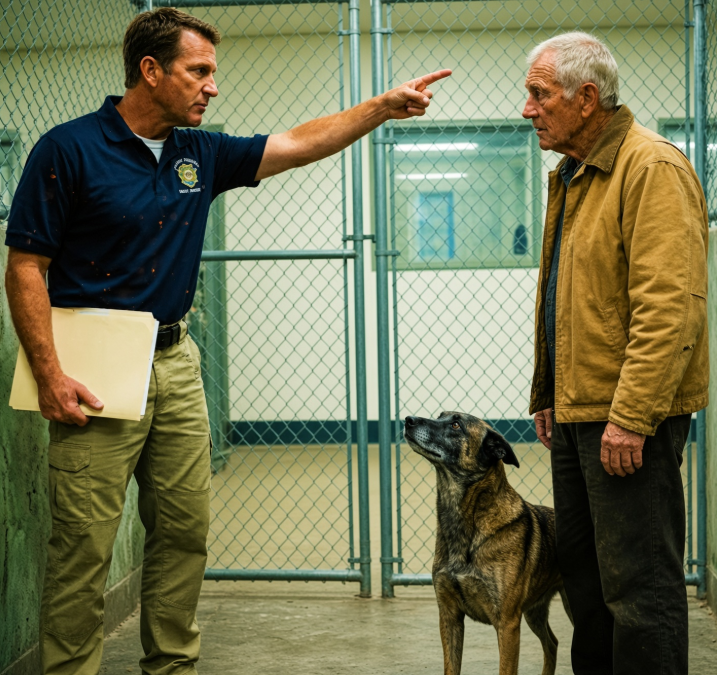
Phil Dawson was mid-forties, tan in the way men get tan from standing near job sites without doing the work. He wore a county polo under a dark jacket, clean boots, and a laminated badge clipped where everyone could see it.
He carried a manila folder under one arm.
His face was not angry yet.
That was important.
Anger would have meant surprise.
Phil looked offended, which meant he believed the day had failed to follow his structure.
He stopped at the gate to Isolation Yard C.
Roland was crouched beside the dog.
One hand rested on her flank.
Flat.
Easy.
He did not look up immediately.
He finished what he was doing, which appeared to be nothing more than allowing the dog to breathe against his palm.
Then he rose, unhurried, and turned toward the gate.
“He asked to see her,” Hal said from the corridor entrance.
Hal had a folder in both hands now, and he kept glancing between Roland and the papers as if checking a sum that refused to come out right.
Phil pushed the gate open and stepped into the yard.
He did not look at the dog first.
He looked at Roland.
“Sir, this animal is under a liability hold. Active assessment. You should not be in this enclosure, and whoever let you in here has created significant exposure for the county.”
Roland said nothing.
Phil smoothed the front of his jacket.
“I also need to address the transaction from this morning. The fifteen-dollar figure on the adoption form was a data-entry error on a standard template. It does not constitute a binding agreement under county procurement guidelines.”
Roland looked at him.
Just looked.
His hands came together in front of him, keychain between his fingers.
The bleached lure turned once.
Twice.
Then stilled.
“I paid the fee,” Roland said. “Woman at the desk took it.”
“Cora is an intake coordinator. She does not have authority to finalize transactions on animals under active hold.”
Phil’s voice had the texture of a policy manual read aloud by the person who wrote it.
“This dog bit a trained handler. She failed behavioral assessment twice. Whatever you believe you observed in here, certified evaluators have reached a determination.”
Roland looked at the dog.
She was sitting now.
Balanced.
Ears forward.
Watching Phil with the focused patience of an animal trained to wait.
“What determination?” Roland asked.
“Euthanasia,” Phil said. “Scheduled for Friday.”
The word entered the yard and stayed there.
The Malinois’s ears flicked once.
Roland did not argue.
Did not raise his voice.
Did not step forward.
He turned the lure over once more and put the keychain in his pocket.
“I’d like to see the file,” he said.
Phil blinked.
“You’ve seen the intake summary.”
“The original intake file. Not the county assessment. Whatever transferred with her.”
Phil’s mouth opened.
Roland turned slightly.
“Hal.”
He did not raise his voice.
He did not need to.
Hal looked down at the folder in his hands.
Then he opened it.
That was when his face changed.
Not dramatically.
A small shift around the eyes.
The expression of a man who has turned over a rock and found something alive beneath it.
He turned one page.
Then another.
His thumb stopped near the back.
He looked up at Roland.
“There’s…”
He stopped.
Looked at the dog.
Looked back at Roland.
“There’s a service record in here.”
Phil turned sharply.
“What does it say?”
Hal did not answer right away.
He was still reading.
Phil pulled his own incident report from the folder under his arm. County letterhead. Three paragraphs. Clean formatting. The kind of document that made a decision look inevitable.
“Handler contact,” Phil read. “Unprovoked aggression. Bite severity rated level three.”
He looked up at Roland.
“That is not a nervous dog. That is a dangerous one.”
Roland stood exactly where he was.
Weight settled back.
Arms loose.
The keychain lure turned once between thumb and forefinger before his hand dropped.
“Who assessed her?”
“Our staff veterinarian and intake coordinator.”
“Were either trained in working dog behavior?”
Phil’s mouth tightened.
“They’re certified animal welfare professionals.”
Roland did not answer.
He looked at the report in Phil’s hand with the patience of a man who had read a great many documents written by people who were not there.
“Level three,” Phil continued, finding his footing again, “means broken skin. It means liability exposure if the county transfers an animal with documented aggression history. The fifteen-dollar fee was processed under a domestic intake schedule. This animal does not qualify.”
He folded the incident report with a clean bureaucratic crease.
“I’m not unsympathetic, but I cannot allow sentiment to override a public safety determination.”
In the back office, Hal had already stopped hearing Phil.
The manila folder was thicker than it should have been. It had come in with the dog on day one, rubber-banded to vaccination records, then filed under the wrong intake number by a temp worker.
A KC number instead of the civilian sequence.
That was why nobody had looked at it.
The cover sheet was printed on heavier cream-colored stock, federal agency letterhead Hal did not immediately recognize.
Below it was a transfer document.
Below that, a service record.
The dog’s name.
Her designation.
Deployments rendered in clinical shorthand.
Hal had to read the lines twice before understanding what he held.
Belgian Malinois.
Female.
Designated Coda.
Patrol and detection.
Classified unit attachment.
Six deployments.
Four overseas rotations listed in redacted theater language.
Forty-one operational taskings.
Two confirmed find-and-alert events.
Credited with preventing mass casualty.
Hal turned the page.
A commendation was attached.
Not a certificate.
A real military commendation.
Original.
Folded once along a horizontal crease and clipped inside the back cover. The crease had worn so thin the paper nearly separated there. Hal unfolded it carefully.
He read the language at the top.
Then the handler’s name at the bottom.
Read it twice.
His thumb moved across the name the way a person touches something they are not sure is real.
Chief Warrant Officer Roland A. Ludwig.
Through the office window, Hal looked out at the man in the concrete yard.
The old farmer in the wheat-colored jacket.
Hands loose.
Dog at his side.
Listening to Phil Dawson speak about county liability and automatic review as if the world had not just shifted beneath the floor.
Hal picked up the folder and walked out.
Phil was explaining insurance exposure when Hal entered the yard.
“The county’s position is that once the carrier has been notified of an incident classification, section fourteen of the liability framework triggers automatic review, which means—”
He stopped.
Hal had crossed into the center of the concrete yard holding the folder in both hands.
Not waving it.
Not dramatizing.
Carrying it the way you carry something that has changed what you know.
“I need everybody to stop talking for a minute,” Hal said.
Phil turned.
“Hal, we’re in the middle of—”
“I know what we’re in the middle of.”
Hal’s voice was quiet.
Final.
“I need a minute.”
Roland had not moved.
He stood beside the dog with one hand resting along her shoulder.
Not gripping.
Not pressing.
Just contact.
The Malinois’s head was up now.
Her ears were forward in a way they had not been in eleven days.
Aware.
Assessing.
Not afraid.
Hal looked at Roland.
Then down at the folder.
Then back at Roland.
“This dog came in with a military intake file,” he said. “Transfer documentation from a receiving facility. It got misfiled when she came in eleven days ago.”
Phil stared.
Hal turned a page.
“Her name is Coda. Belgian Malinois. Nine years old. Patrol and detection. Classified unit attachment. Six deployments.”
His voice stopped on the next line.
He read ahead silently.
“Commendation for service. The language is redacted in places, but what’s there…”
He paused again.
Phil made a sound of impatience.
“Hal, this does not change the liability profile.”
“She recovered two soldiers from a collapsed structure after an IED strike,” Hal said.
Not loudly.
Clearly.
“The report says she was the only asset able to get through the debris field. She worked for four hours straight.”
The yard quieted completely.
The dog breathed.
Wind moved thinly beyond the fence line.
Hal turned another page.
“She was awarded a service commendation. Her handler was awarded one too.”
He looked up.
“The handler’s name is listed as primary contact for post-service placement.”
Roland’s hand remained flat on Coda’s shoulder.
Hal turned the page outward, though he was the only one close enough to read it clearly.
“Roland Ludwig. Chief Warrant Officer. Retired.”
Phil said nothing.
Maya, standing just inside the corridor door, said nothing.
Cora, behind her, covered her mouth.
The only sound was Coda shifting her weight and leaning a fraction of an inch into Roland’s hand.
Roland did not straighten.
Did not look up at Hal.
Did not make anything of the moment.
He put one hand flat over the ridge of the dog’s ribs.
When he spoke, his voice was low and even.
Aimed at no one in particular.
“She waited longer than she should have had to.”
Hal closed the folder.
Phil opened his mouth.
Closed it.
He was still holding the incident report with its bite classification and liability language.
He looked at it the way a man looks at something he built carefully and correctly only to discover it had been built for the wrong purpose entirely.
Roland’s thumb moved once across the dog’s back.
Nothing wasted.
Nothing performed.
Coda exhaled, low and long.
The tension that had lived in her shoulders for eleven days went somewhere else.
Hal set the military file on top of Phil’s incident report.
“I think we need to talk about the paperwork,” he said.
Phil said, “That does not erase the bite.”
“No,” Roland said.
Everyone looked at him.
He had not spoken loudly.
He did not need to.
“No, it doesn’t.”
For the first time, his eyes moved fully to Phil.
“She bit Martinez because he crowded her left blind angle with a bite glove and a catch pole while two people yelled behind her.”
Phil stiffened.
“You weren’t present.”
Roland looked at the dog.
“No.”
“Then you don’t know that.”
Roland’s expression did not change.
“Maya?”
Maya startled.
She had not expected him to know her name.
He must have read it off her badge earlier. Or heard someone say it. Or simply collected it the way he collected everything in a room.
“Yes?”
“You were there?”
Maya hesitated.
“Yes.”
Roland kept his hand on Coda.
“Tell him.”
Phil looked annoyed.
“Maya, this isn’t—”
“Actually,” Hal said, “I’d like to hear it too.”
Maya swallowed.
She looked at Coda, who was watching her now.
Not lunging.
Not shaking.
Just watching.
“Martinez had the bite glove,” she said slowly. “He thought he could redirect her. Cora was at the corridor gate. Dr. Vale had the catch pole in case she came forward.”
Roland said nothing.
Maya continued.
“Coda was in the back corner.”
Coda.
It was the first time Maya had said the name aloud.
It felt different from saying the Malinois.
“She was rigid,” Maya said. “Not barking. Just… locked. Martinez moved in from her left, but she didn’t turn toward him until he was already close. Dr. Vale told him to stop. He didn’t. The pole hit the fence. Cora dropped the clipboard. Coda spun and bit the glove.”
“Unprovoked aggression,” Phil said.
Maya looked at him.
Her voice became softer, but steadier.
“No. She was cornered.”
Phil’s jaw tightened.
“Are you revising an official incident statement now?”
Maya’s face flushed.
Before she could answer, Roland spoke.
“You wrote what you were asked to write.”
Maya looked at him.
There was no accusation in his voice.
That made it worse.
Phil said, “This is becoming emotional.”
Hal glanced at him.
“Phil, an hour ago you almost voided the adoption of a decorated military working dog because the shelter misfiled her records under the wrong intake number and assessed her like a stray shepherd mix with bite history.”
Phil’s face hardened.
“She is still a bite-risk animal.”
Roland nodded.
“Yes.”
That surprised everyone more than denial would have.
He continued.
“She is also a working dog under extreme kennel stress, separated from handler context, placed in isolation for eleven days, approached incorrectly, and evaluated by people who did not know her name.”
Coda leaned into his leg.
Roland looked down at her.
“She is not useless.”
The word hung in the yard.
Maya felt herself flinch.
She had not heard anyone say useless out loud, but the word had lived in the building since the second assessment failed. It lived in the way staff lowered their voices near Yard C. It lived in the way Dawson talked about resources. It lived in the euthanasia schedule already penciled into Friday’s whiteboard slot.
Roland bent and rested his hand at the base of Coda’s neck.
“She never was.”
For a moment, no one spoke.
Then Phil said, “If this animal is going to leave this facility under county authorization, I need documentation of behavioral soundness.”
Hal looked at him.
“You’re asking for a demonstration?”
Phil crossed his arms.
“I’m asking for evidence.”
Roland repeated the word as if confirming a radio transmission.
“Evidence.”
His voice was flat.
No inflection.
Phil lifted his chin.
“That is procedure.”
Roland looked at Coda the way a man reads a map he helped draw.
Her breathing had slowed. Her ears tracked Phil’s voice without urgency. Her body remained aware but not locked. Eleven days of kennel stress, and she had come back to him in four minutes.
The shelf life of training did not expire.
Roland had always known it would not.
He stood, unhurried.
“Give us the yard,” he said.
Hal stepped aside immediately.
Maya moved back.
Cora retreated behind the corridor threshold.
Phil did not move at first.
Then he did, with the stiffness of a man who realizes he has already lost the argument and is only now catching up.
Roland unclipped the leash and let it hang from his left hand.
He did not look at Coda.
He exhaled once.
Slow.
Even.
His right hand dropped at his side with two fingers extended.
Coda sat.
Not fast.
Not theatrical.
She simply organized herself into the correct position as if the command had always been in the air and she had only been waiting for it to arrive.
Roland spoke.
Not English.
Not the casual shorthand civilian trainers used in weekend classes.
Dutch.
Operational language.
The language her nervous system had been wired to from twelve weeks old, before transfers, kennels, county intake forms, isolation yards, bite reports, and eleven days of being called dangerous by people who did not know what she had survived.
He gave the heel command.
Coda moved with him.
Tight on his left side.
Not pressed against him.
Not forging ahead.
Not hanging back.
Aligned.
He stopped.
She stopped.
He changed direction without verbal cue, and she adjusted with the economy of a partner reading a partner.
Hal watched from the doorway with the file open in his hands.
Phil watched from six feet away, arms crossed, face carefully neutral.
Roland took Coda through obedience first.
Sit.
Down.
Stay.
Recall.
Each transition clean.
Immediate.
No panic.
No frantic eagerness.
No suppressed stress disguised as compliance.
Only work.
Then Roland moved to detection.
He had no training objects in the yard.
So he used what he had.
The fishing lure.
He unclipped it from his keychain and held it in his palm.
For the first time, Maya saw it clearly.
Salt-bleached.
Metal dulled.
One hook bent flat.
A thing that had traveled years in a pocket, turned between fingers until it became less object than memory.
Roland let Coda scent it.
One second.
No more.
Then he moved along the yard wall to three positions. On the third pass, he crouched and placed the lure low behind a drainage post.
He returned to center.
Gave the search command.
One word.
Two syllables.
The same word, Hal would later learn, Roland had used on the first day he ever put Coda in harness.
Coda worked the yard in a systematic grid.
No wasted motion.
No anxiety.
Nose down.
Sweep.
Check.
Lift.
Correct.
She passed the drainage post once, overshot by two feet, turned back into the scent cone, and dropped clean beside it.
Sat.
Looked at Roland.
Not at the lure.
At Roland.
That was the part nobody else in the yard understood at first.
That final look.
Not instinct.
Not stimulus response.
A report.
A dog telling her handler the job was done.
The way a soldier checks in after a clearance.
The way it had always been between them.
Roland walked over.
Picked up the lure.
Held it a moment.
Clipped it back to the keychain.
He did not look at Phil.
Did not speak to Phil.
He reattached the leash with one practiced motion and walked toward the building.
Coda moved with him like she had never stopped.
Behind him, Phil said, “Given the animal’s apparent operational status, we may need to reconsider the valuation on the paperwork.”
Roland kept walking.
Hal looked at Phil then.
Really looked.
“Valuation?”
Phil’s face colored slightly.
“That is not what I meant.”
“It is what you said.”
Phil closed his mouth.
Maya thought about the fifteen-dollar fee.
A data-entry error.
A standard template.
A senior special.
Useless dog.
Dangerous dog.
Wrong dog.
Wrong file.
Wrong everything.
Roland stopped at the corridor door and turned back.
Not to Phil.
To Maya.
“She needs water.”
Maya moved immediately.
“I’ll get fresh.”
“And a blanket for transport.”
“Yes.”
“Not a crate with a wire floor.”
“No. Of course.”
He nodded once.
Maya almost apologized then.
For the water bowl.
For the misfiled record.
For eleven days.
For every time she had walked past that yard and thought there was nothing she could do because the system had already decided.
But Roland’s face told her he was not interested in being apologized to.
Not because it did not matter.
Because apologies were not care.
Water was care.
A blanket was care.
Correct paperwork was care.
Getting the dog out of that yard was care.
So Maya went.
In the office, Phil countersigned the adoption form in silence.
His pen moved across the paper with the particular quiet of a man who had run out of useful language.
Hal did not sit.
He stood at the corridor window, watching Roland and Coda through the glass.
The old man had returned to the center of the concrete yard.
He crouched once.
Coda came to him without command.
She crossed the distance and pressed her muzzle against the side of his knee.
Roland let her.
He did not reach for her immediately.
He allowed her to make the contact she had waited eleven days to make with something that felt like belonging.
Then he sat down.
Not crouched.
Not knelt.
Sat right there on the cold concrete, one leg out, one knee up, the way a man sits when he is not performing anything for anyone.
Coda circled once and settled beside him.
Her flank against his thigh.
Her graying muzzle tilted up toward his face.
Roland put one hand flat on her side.
The other hand went to his jacket pocket.
Found the keychain.
Went still.
He said something.
Hal could not hear it through the glass.
Just a few words.
Quiet enough that even Coda leaned in to catch them.
And Hal, who had been trying all morning to understand why the old man felt like something he should have recognized, finally had the answer.
It was not in the file.
It was in the weight of the hand on the dog’s flank.
It was in the fact that Roland did not look relieved.
Did not look victorious.
Did not look like a man who had won an argument.
He looked like a man who had come a long distance to keep a promise that should have been kept years ago.
And the distance was not geographical.
Hal looked down at the file again.
Eleven years of service.
Deployments to places hidden behind black bars of redaction.
Commendation for actions the public would never read about.
Primary handler: Roland Ludwig, CW3.
Handler separated due to medical retirement.
And at the bottom of the transfer form, in the field marked recommended disposition, someone had written in blue pen:
Long before this shelter ever saw her.
Reunify if possible.
Someone had written that years ago.
Someone had known what should happen.
Then paperwork had moved.
Systems had shifted.
People had changed jobs.
Files had been scanned badly, labeled incorrectly, transferred through facilities, printed, rubber-banded, misplaced, and forgotten.
And Coda had ended up in an isolation kennel on the edge of a county that did not know what she was.
Eleven days in the yard.
Roland said something else.
His hand moved once along Coda’s spine.
The same flat-palm economy he had used at the fence every morning.
The same motion that had brought her across the yard when nothing else could.
Coda exhaled.
Her whole body shifted lower, closer.
The way an animal settles when it has finally decided it is done running from something.
Hal set the folder on the window sill.
Whatever Roland had said, whatever it cost him, was not for the building to keep.
It belonged between handler and dog.
It had been waiting inside the specific silence of unfinished things for a long time.
Maya returned with water in a clean bowl and a folded blanket from the laundry room.
She stopped when she saw them sitting together.
Roland looked up.
“Set it there.”
She placed the bowl three feet away.
Coda lifted her head but did not move until Roland’s fingers left her side.
Then she drank.
Slowly at first.
Then deeper.
When she finished, Maya set the blanket near the gate.
Roland stood.
Coda stood with him.
Maya said, “Mr. Ludwig?”
He looked at her.
“I’m sorry.”
He did not answer immediately.
Maya kept going before she lost nerve.
“I saw you out there three mornings. I saw she was different with you. I should have said something.”
Roland looked toward the yard fence.
“You saw.”
“Yes.”
“That’s more than most people did.”
It was not forgiveness.
Not exactly.
But it was something she could carry.
Cora came down the corridor holding the adoption receipt, her eyes red.
“I fixed the intake code,” she said. “The system still shows the fifteen-dollar transaction, but Hal said—”
“I paid what was asked,” Roland said.
Cora nodded quickly.
“Yes, sir. I know.”
She held out the receipt.
Roland took it.
Folded it once.
Put it back in his jacket pocket.
Phil appeared behind her, holding the final paperwork.
He looked smaller than he had in the yard.
Not physically.
But the air around him had less furniture in it.
He had arrived with authority arranged around him.
Now he was just a man in a county polo holding a form that could have become a death warrant if a misfiled folder had stayed buried one more day.
He handed the papers to Roland.
“Mr. Ludwig.”
Roland took them.
Phil hesitated.
His mouth moved once.
No words came.
He did not apologize.
Maybe he did not have the vocabulary for it.
Not in front of staff.
Not in front of that folder.
Not in front of a dog who made his certainty look thin.
Roland looked at him once.
Not long.
A look that took inventory and found the total unremarkable.
Then he looked back at Coda.
“Come.”
He did not raise his voice.
Coda walked with him through the shelter corridor.
Past the kennels.
Past the barking dogs.
Past the intake desk.
Past the bulletin board where her red euthanasia tag had already been removed by someone whose hands had shaken while doing it.
Maya held the front door open.
Coda paused at the threshold.
Not because she feared outside.
Because working dogs read transitions.
Roland stepped through first.
Then Coda followed.
In the parking lot, Roland’s truck sat near the fence where he had stood since before dawn. It was an older pickup, white once but now mostly dust, with a metal toolbox in the bed and a folded tarp tied behind the cab.
He opened the passenger door.
Coda looked inside.
Blanket on the seat.
No crate.
No wire floor.
No transport van smell.
Roland placed one hand on the door frame.
She jumped in without command.
He closed the door gently.
For a moment, he stood outside the truck with one hand flat on the closed door.
Through the window, Coda sat upright, ears forward, watching him.
Not panicked.
Not pacing.
Just watching.
The way she had been trained to watch.
Reading movement.
Reading distance.
Reading him.
Maya stood by the shelter entrance.
Hal beside her.
Cora behind them.
Even Phil had come as far as the doorway.
Roland walked around the hood, got in, and started the engine.
The truck idled rough for two seconds, then settled.
Coda looked through the windshield.
Roland looked too.
Neither looked back at the shelter.
Then he drove away.
For the rest of that day, Isolation Yard C stayed empty.
Maya cleaned it herself.
She dumped the water bowl, scrubbed it, rinsed it twice, and set it upside down to dry. She swept the concrete track where Coda had paced for eleven days. Dust lifted in pale lines. She thought of paws walking the same route again and again because movement was the only way to keep the mind from closing.
Near the far fence, she found a small dark mark on the concrete.
Not blood.
Not dirt.
Just a worn place.
Where Coda had stood facing the old man.
Maya left it alone.
In the office, Hal made three copies of the military file.
One went into the correct intake record.
One went to the county archive with a note written in handwriting so forceful it looked carved.
One he kept on his desk.
Not because he had the right.
Because he never wanted to forget how close they had come.
Phil spent the afternoon rewriting the assessment protocol for former working dogs.
He did not announce it.
Did not make a speech.
Did not call it reform.
But by closing time, there was a new checklist taped beside the intake computer:
CHECK FOR SERVICE RECORDS.
VERIFY TRANSFER DOCUMENTS.
CONTACT PRIMARY HANDLER IF LISTED.
WORKING DOGS REQUIRE WORKING DOG ASSESSMENT.
DO NOT RELY ON CIVILIAN BITE TEMPLATE ALONE.
Maya read it after everyone left.
At the bottom, Hal had added one line in pen.
Know the name before you judge the dog.
Three days later, Roland’s truck came up a gravel drive just before dusk.
The farm sat thirty miles outside town, past two cattle gates, a church with peeling white paint, and a line of cottonwoods along a creek that ran shallow most of the year. The house was old but kept. White siding. Green trim. Porch wide enough for two chairs and a sleeping dog. Barn to the left. Hay stacked beneath tin. Pastures rolling out behind it in brown and gold.
Coda was already at the top of the porch steps when Roland cut the engine.
Not pacing.
Not whining.
Sitting.
Weight settled.
Ears forward.
She watched the long drive the way she had been trained to watch.
Reading distance.
Reading movement.
Reading threat.
Reading him.
Roland sat in the cab for a moment before getting out.
He wanted to look at her.
Up there in the yellow porch light, graying muzzle, squared shoulders, old service record no longer hidden in a folder, body quiet in the specific dignity of a working dog who had been given back more than safety.
Purpose.
He got out.
Closed the truck door.
Walked to the steps.
Coda did not move down to meet him.
She held position.
Because he had not released her.
Roland almost smiled.
Almost.
He climbed the first step, then the second, then crouched in front of her the way he always had.
Flat palm.
No wasted motion.
Weight low and easy.
She pressed her head into his hand.
That was all.
No dramatic reunion.
No barking.
No leaping.
No music.
No audience.
Just an old handler and the dog who had never stopped waiting.
The porch light held them in its small yellow circle.
Behind Roland, the gravel drive stretched into the dark.
Nothing left out there that either of them needed to watch for anymore.
“She had eleven days in that yard,” Roland said quietly.
Coda’s ears moved at his voice.
“I know.”
He rested his hand against the side of her neck.
“Should’ve been there sooner.”
Coda breathed out.
Roland closed his eyes.
That was the thing about dogs.
They did not forgive with speeches.
They did not list the evidence.
They did not make humans earn absolution in language.
They leaned their weight into the hand that had come back.
Sometimes that was worse.
Sometimes it was mercy.
He opened the door.
Coda entered the house first, paused inside the threshold, scanned the room, and moved to the old braided rug near the stove as if she had left only yesterday.
But it had not been yesterday.
It had been years.
Years since Roland’s medical retirement.
Years since the blast that had taken most of the hearing in his left ear and left nerve damage down one side.
Years since the doctors told him he could no longer deploy.
Years since Coda had been transferred to another handler because working dogs were assets and assets could not be retired every time a man’s body broke.
Years since he had signed the separation forms with his right hand steady and his chest hollow.
He had told himself it was regulation.
He understood regulation.
He had lived by it.
He had enforced it.
He had written parts of it.
But understanding a thing did not mean it cost less.
Coda had watched him leave then, head high, ears forward, waiting for the command that would explain the world.
No command came.
He had not been allowed to give one.
The official line was clean.
Handler medically retired.
Dog reassigned.
Operational continuity maintained.
But there are things official lines cannot hold.
The way a dog’s eyes follow a door.
The way an old handler stops sleeping through dawn.
The way a fishing lure becomes something for the hand to do when memory has no place else to go.
The lure had belonged to Roland’s brother.
Or that was how the story started.
Later, after enough years of carrying it, it belonged to all the things he had not known where to put.
He hung his jacket by the door.
Coda watched.
The house smelled of wood smoke, coffee, leather, and old floorboards. A bowl waited in the kitchen. Fresh water. Food measured exactly, though Roland knew she might not eat much the first night. Dogs returning from stress sometimes needed silence more than food.
Coda sniffed the bowl.
Then looked back at him.
Roland said one Dutch word.
Soft.
She ate.
Not desperately.
Not like a shelter dog afraid food would vanish.
Steady.
Trusting that more would come when needed.
Roland stood at the counter and watched her.
When she finished, she walked to the rug by the stove, circled twice, and lay down with her head on her paws.
Her eyes stayed on him.
Roland sat in the wooden chair near the table.
The house settled around them.
Outside, wind moved along the pasture fence.
Somewhere in the barn, an old hinge knocked once.
Coda’s ears flicked.
Roland’s did too.
Then both went still.
For the first time in years, the silence in the house had another breathing thing inside it.
That night, Roland did not put Coda in a crate.
He left the bedroom door open.
He expected her to choose the stove rug or the hallway, both good tactical positions in a house with two entrances and three windows facing the drive.
Instead, sometime after midnight, he woke to the soft sound of nails on floorboards.
Coda entered the room.
Paused.
Waited.
Roland did not move.
The room was dark except for moonlight along the dresser.
Coda came to the left side of the bed.
The side nearest the door.
Her old side.
She lowered herself to the floor with a quiet sigh and rested her head against the bed frame.
Roland stared at the ceiling.
His hand moved down slowly until his fingers touched the top of her head.
Coda did not lift her head.
Only leaned into the contact.
Roland closed his eyes.
“She waited longer than she should have had to,” he had said at the shelter.
Now, in the dark, with no one to hear, he said the rest.
“So did I.”
Morning came cold and pale.
Roland woke before dawn, as he always did.
For years, he had woken with the old absence beside him, that instinctive moment when the body expected a dog’s breathing and found only the empty floor.
This time, Coda was there.
Already awake.
Watching the bedroom door.
He sat up.
Her ears turned back to him.
“Work?” he asked.
Her tail moved once.
Small.
Controlled.
But real.
They walked the fence line at first light.
Not because anything needed checking urgently.
Because purpose should be given back carefully.
Roland did not throw her immediately into old routines. He did not ask too much. He did not test her the way Phil had wanted evidence. He simply brought her into the morning and let the farm explain itself.
Gate.
Fence.
Water trough.
Barn.
Pasture.
Wind from the west.
Cows two properties over.
Coyotes sometimes from the ridge.
Mail truck at ten if it was running early.
No threats in the immediate field.
No pressure.
No kennel.
No chain link.
Coda walked at his left side.
Not in a formal heel.
Not loose either.
Somewhere between working and home.
At the far fence, she stopped.
Roland stopped with her.
She lifted her nose.
Scented.
Roland waited.
A rabbit broke from the brush ten yards ahead and vanished under the lower wire.
Coda did not chase.
She looked at Roland.
He nodded once.
“Good.”
Her mouth opened slightly.
Not quite a smile.
Dogs do not smile the way people pretend they do.
But something loosened around her face.
They continued.
Back at the house, Roland made coffee and sat on the porch.
Coda settled at the top of the steps, exactly where she had waited the evening before, watching the driveway.
The world opened slowly.
Birds in the hedge.
A truck far off on the county road.
Wind shifting through dry grass.
Roland turned the fishing lure in his fingers.
Once.
Twice.
Then stopped.
Coda looked back at the stillness of his hand.
He unclipped the lure from the keychain and held it up.
“You found this three times yesterday,” he said.
Coda’s ears lifted.
“You want it?”
She watched him.
He leaned forward and set it gently on the porch rail.
For a long time, neither moved.
Then Coda stood, stepped to the rail, sniffed the lure once, and sat beside it.
Not alerting.
Not searching.
Guarding.
Roland nodded.
“All right.”
That afternoon, Maya drove out to the farm.
She had not planned to.
She told herself she needed a follow-up signature.
That was partly true.
She also needed to see.
Roland came onto the porch when her car pulled in, Coda beside him. The dog watched the vehicle, then Maya, then Roland’s hand, and found no cause for alarm.
Maya stepped out slowly.
“I brought the amended paperwork.”
Roland nodded.
She held up a folder.
“And the microchip transfer confirmation.”
Another nod.
“And her vaccination records.”
He opened the screen door.
“Coffee?”
Maya blinked.
“I don’t want to impose.”
“You drove thirty miles.”
That seemed to settle the matter.
She sat at his kitchen table while Coda lay near Roland’s chair. Not under it. Not hiding. Positioned where she could see the door, the hallway, and Maya’s hands.
Maya noticed.
Roland noticed her noticing.
“She’s always preferred corners with options,” he said.
Maya smiled faintly.
“Don’t we all?”
Roland looked at her then, as if deciding something.
“Some people never learn to choose them.”
Maya accepted the coffee with both hands.
For a while, they discussed paperwork. Microchip. License. Follow-up exam. Transfer confirmation. County records corrected. Maya explained that Hal had pushed for a new intake protocol for working dogs.
Roland listened without visible reaction.
When she finished, he said, “Good.”
Maya looked at Coda.
“She looks different.”
“She is different here.”
“Because of you?”
Roland shook his head.
“Because here, the room tells the truth.”
Maya did not understand immediately.
Roland’s hand rested on Coda’s side.
“In that shelter, everything told her the wrong thing. Chain link. Footsteps. Unknown hands. Noise behind her. People approaching from bad angles. Commands that did not belong to her. No clear work. No handler. No end point.”
Coda’s eyes half closed under his hand.
“She wasn’t useless,” Roland said. “She was reading a room that didn’t know how to read her back.”
Maya sat with that.
It felt larger than dogs.
Before leaving, she asked the question she had carried from the shelter to the farm.
“Did you know she was there before we did?”
Roland looked toward the porch window.
“No.”
“But you came four mornings.”
“I saw the intake listing after they posted the euthanasia schedule.”
Maya swallowed.
“They posted it publicly by mistake.”
“Yes.”
“And you knew it was her?”
“Not from the listing.”
“How, then?”
Roland reached into his pocket and took out the keychain.
The fishing lure caught the kitchen light.
“They included a photo,” he said. “Bad one. Blurry. But her left ear has a split near the tip.”
He looked down at Coda.
“She got that in training at sixteen months. Hit a fence gate too fast because I sent her too hard.”
His thumb moved over the lure.
“She forgave me before I forgave myself.”
Maya looked at the dog.
“Why didn’t you tell Dawson who you were right away?”
Roland put the keychain away.
“People who don’t see the dog won’t see the file either.”
Maya thought about that all the way back to the shelter.
Three weeks later, Cora taped a photograph to the staff bulletin board.
Roland had not sent it.
Maya had taken it during her follow-up visit and asked permission to share it.
In the photo, Coda sat on the porch steps in yellow evening light, graying muzzle lifted, ears forward, Roland crouched in front of her with one hand open beneath her chin.
No drama.
No performance.
Just a dog and the handler she had waited too long to find.
Under the photo, Hal wrote:
CODA — REUNIFIED
NOT USELESS. MISREAD.
No one took it down.
Not even Phil.
In fact, Phil stood in front of it one evening after closing, arms crossed, looking at the picture longer than he meant to. Maya saw him from the hallway but did not interrupt.
The next week, a shepherd mix came in from a sheriff’s department two counties over. Failed kennel transition. Bite history. No attached service record. New protocol required review before classification.
Phil was the one who said, “Check for prior handler contact before assessment.”
Maya looked at him.
He did not look back.
But he said it.
Sometimes change did not arrive as apology.
Sometimes it arrived as a revised form, an extra phone call, a life not ended by a template.
At the farm, Coda settled into Roland’s days the way water returns to a ditch it once knew.
Morning fence line.
Breakfast.
Porch watch.
Barn check.
Nap near the stove.
Evening patrol to the far gate.
No one called it training.
Roland did not call it therapy.
He disliked that word when applied too quickly to animals who had already worked harder than most people ever would.
It was work.
It was rhythm.
It was belonging.
Some days were not easy.
On the ninth day, thunder rolled hard before dawn, and Coda woke standing, body rigid, head low. Roland found her in the hallway facing the back door. He did not command her down. Did not soothe her falsely. Did not turn on all the lights.
He stood beside her until the thunder moved farther east.
Then he said one Dutch word.
Not sharp.
Not soft.
Known.
Coda exhaled and leaned against his leg.
On the fifteenth day, a county truck backfired on the road, and she took cover behind the porch rail before Roland’s hand found the air. He waited until her eyes returned to him. Then they walked the fence line twice.
On the twenty-second day, she brought him the fishing lure.
He had left it on the porch rail by mistake.
She carried it carefully in her mouth and set it beside his boot.
Then sat.
Report complete.
Roland looked down at it.
Then at her.
“Well,” he said. “Good find.”
Her tail moved once.
By winter, Coda had learned the farm’s full map.
The places deer crossed.
The loose board in the barn.
The corner where wind made the gate rattle.
The spot on the porch where sun landed first.
She never became young again.
That was not how time worked.
Her muzzle remained gray.
Her hips stiffened in cold weather.
Some mornings she stood slowly, testing each leg before trusting it.
Roland understood.
He had his own inventory of pain.
They did not pity each other.
They adjusted.
On the first snow, Roland opened the front door and Coda stepped onto the porch, looked at the white field, and gave him a long sideways glance as if he had personally arranged an inconvenience.
Roland said, “Not my doing.”
She did not seem convinced.
They walked anyway.
Snow softened the fence line, covered old tracks, made the world briefly new. Coda’s nose worked the air. Roland watched her read the morning.
Halfway to the barn, she stopped.
Roland stopped.
She turned her head toward the far tree line.
A deer stood there, barely visible between trunks.
Coda held.
No chase.
No command.
After a moment, the deer bounded away.
Coda looked at Roland.
He nodded.
“Good.”
That was most of their conversation now.
Not because there was nothing else to say.
Because enough things had finally been said correctly.
In March, Hal came to visit.
He brought a bag of dog treats and a file folder he did not need but had invented as an excuse.
Roland met him at the porch.
Coda stood beside him.
Hal smiled carefully.
“Hey, girl.”
Coda regarded him.
Not warmly.
Not poorly.
Just accurately.
Hal held up the treats.
Roland said, “She doesn’t take food from hands she hasn’t cleared.”
Hal lowered the bag.
“Right.”
Roland took the bag, opened it, offered one treat to Coda, and set the rest on the porch table.
Coda accepted.
Hal looked at her for a long time.
“She looks good.”
“She is.”
“I wanted to tell you something.”
Roland waited.
Hal shifted the folder under one arm.
“We had another transfer last month. Retired detection dog from a transit unit. Nervous in kennel. Snapped at intake.”
Roland’s face did not change.
“We found the handler contact. Called him before classification. Turns out the dog responds to Spanish commands, not English.”
Hal smiled a little.
“He went home in two days.”
Roland looked toward the pasture.
“Good.”
“That happened because of Coda.”
Roland’s hand rested on her head.
“No,” he said. “It happened because someone read the file.”
Hal accepted the correction.
After he left, Roland stood on the porch until the truck disappeared down the drive.
Coda sat beside him.
The sun was low.
The pasture gold.
The world quiet in the way it gets when evening asks old things to settle.
Roland took the fishing lure from his pocket.
Turned it once.
Twice.
Coda watched.
Then he clipped it to her collar.
Just for a moment.
It hung there, absurd and salt-bleached, against the dark fur at her chest.
Coda looked down at it.
Then back at him.
Roland almost smiled.
“Doesn’t suit you.”
He unclipped it and put it back on the keychain.
She huffed softly.
That was new.
A sound close to complaint.
He took it as progress.
Years earlier, before the medical retirement, before separation forms, before county shelters and wrong intake numbers, Roland and Coda had slept in places that had no names in public records.
She had found explosives under floorboards.
Bodies under concrete.
A living man beneath collapsed stone.
She had alerted on wires no human eye caught.
She had cleared rooms ahead of men who trusted her nose more than their own fear.
She had worked until her paws bled and then worked again after they wrapped them.
Roland had once believed the partnership belonged to service.
To mission.
To necessity.
Later, after losing her, he understood it had also belonged to something simpler.
Presence.
The fact of another living thing moving with you through danger without asking for explanation.
The fact of being known by someone who did not require speech.
That was what the shelter had failed to see.
Coda had not been waiting for adoption.
Not exactly.
She had been waiting for the world to make sense again.
So had Roland.
That spring, the shelter held a volunteer training session.
Maya asked Roland to come speak.
He said no.
Hal asked.
He said no.
Cora mailed a handwritten invitation with a photo of Coda copied on the bottom.
Roland still said no.
But on the morning of the training, an envelope arrived at the shelter desk.
No return address.
Inside was a single page.
Typed.
Short.
Maya read it aloud to the staff.
Working dogs are not failed pets.
They are not household strays with better obedience.
They are animals built through pattern, language, work, trust, and consequence. When one shuts down, do not ask first what is wrong with the dog. Ask what room, person, sound, command, or absence the dog is reading that you are not.
Find the name.
Find the language.
Find the handler if living.
Find the work if safe.
Do not crowd the blind side.
Do not mistake stillness for consent.
Do not mistake a bite for the whole story.
Do not write useless because you do not know how to read purpose.
— R.L.
No one spoke for a moment after Maya finished.
Then Hal said, “Make copies.”
They did.
One went into the training binder.
One went beside the intake computer.
One went on the wall beneath Coda’s photograph.
Phil read it later and stood there a long time.
He did not say anything.
But the next time a dog came in with a vest, he asked for the full transfer file before the intake form was even printed.
On a warm evening six months after Coda came home, Roland sat on the porch while she slept at his feet.
The fishing lure rested on the table beside his coffee.
The pasture was quiet.
The sky was turning the soft purple-blue that comes just before full dark.
Coda dreamed.
Her paws moved once.
A small movement.
Not running.
Working, maybe.
Roland watched her.
Then, for the first time in years, he spoke aloud to the empty air without needing the dog to hear.
“They called you useless.”
Coda slept.
Roland’s hand rested on her side.
“They didn’t know.”
The last light touched her graying muzzle.
He thought of the concrete yard.
The water bowl.
The misfiled folder.
The yellow euthanasia tag.
The fifteen-dollar receipt folded in his jacket pocket.
He had kept that receipt.
Not because money mattered.
Because the system had accidentally told the truth for once.
Fifteen dollars.
That was what they thought she was worth when they did not know her name.
Roland knew better.
Coda shifted in sleep, pressing closer to his boot.
The porch light clicked on automatically, wrapping them both in its small yellow circle.
The gravel drive stretched into the dark behind him.
The house stood quiet.
No wire floor.
No chain link.
No corridor footsteps.
No one coming to assess what could not be measured on the form.
Coda had her handler.
Roland had his dog.
And the rest of it—the paperwork, the concrete yard, the years between, the silence of unfinished things—settled quietly into the ground the way old things do when they are finally finished.

