A Shelter Gave a Stray Cat Just 72 Hours Before Euthanasia—On Her Final Morning, Staff Found Her Lying Against Five Orphaned Kittens and Realized What She’d Been Doing Through the Cage Bars All Week.
PART3:
“Scared. Not mean.”
“That is not the same thing.”
“Never is.”
He opened the carrier carefully.
The cat did not bolt.
She crouched low, legs tucked under her, body tense and small. She was white with gray patches over her ears, along her spine, and around one eye, giving her face the uneven softness of an old watercolor painting. Her fur was dirty but not matted. Her ribs were not sharp, but she was thin enough that I could feel the hard line of her spine when I touched her gently.
She smelled like rain, dust, and car oil.
A stray smell.
Not feral exactly.
Not owned exactly.
That middle place where so many animals live before somebody admits they need help.
“Any collar?” I asked.
Wade shook his head.
“Microchip?”
“Scanner didn’t pick one up in the field. Try again.”
I passed the scanner over her shoulders, down her sides, across her neck.
Nothing.
No beep.
No history.
No one to call.
She allowed the exam without fighting. That almost made it worse. Angry animals spend their fear loudly. Quiet animals hold it inside until you want to apologize for every human they have met.
Her temperature was normal. Eyes clear. Teeth worn enough to suggest she was not young, but not old. Maybe four, maybe six. Hard to tell. Her paws were rough. One ear had a tiny notch from an old healed tear. She had recently had kittens at some point in her life. Not that week, maybe not that month, but her body carried the signs.
I wrote the notes.
Adult female. White/gray. No chip. Mild dehydration. Fearful but handleable.
Then I looked at the cage chart.
There was only one open space.
Bottom row.
Third from the left.
I placed a folded towel inside, a small litter box, a dish of food, a water bowl, and a cardboard hide box with a half-moon entrance cut into it. When I slid her into the cage, she went straight into the box and turned around so only her eyes showed.
I clipped the card to the door.
Female cat. White/gray. Adult. Intake: October 17, 2022.
Hold expires: 72 hours.
I hated writing that line.
I wrote it anyway.
Above her, in the cage directly over the left corner of her enclosure, were five kittens.
They were not hers.
They had come in two days earlier in a laundry basket lined with a bath towel. Someone had found them behind a closed grocery store after hearing them cry near the dumpster. Their mother was nowhere around. We searched the area, set a humane trap, asked nearby businesses, checked cameras.
Nothing.
No mother.
Just five kittens too young to be alone and too old to stop screaming about it.
They were around three weeks old, maybe a little more. Eyes open. Ears lifting. Wobbly legs. Tiny needle claws. One black, two orange tabbies, one gray tabby, and one white kitten with a little smudge on its nose like it had been kissed by ash.
We bottle-fed them every few hours, but bottle-feeding in an overcrowded shelter is an act of desperation disguised as care. They needed warmth, routine, patience, and someone who could answer them every time they cried.
We had alarms on our phones.
We had feeding charts.
We had formula.
We had hands that were always needed somewhere else.
The kittens cried constantly.
Not because we ignored them.
Because we could not become what they were missing.
A mother cat does not only feed kittens.
She cleans them.
Warms them.
Repositions them.
Answers every tiny panic before it becomes a scream.
A shelter worker can feed formula from a syringe and wipe bellies with warm cotton, but she cannot lie around them all day with a heartbeat they can sleep against.
So they cried.
High, thin, piercing cries that rose through the metal cage fronts and seemed to find every soft place in the room.
The white and gray cat heard them within minutes of being placed below them.
I noticed because her eyes changed.
She had been crouched in the hide box, staring out with the flat fear of an animal waiting for the next bad thing. Then one of the orange kittens cried overhead, and her ears moved.
Not back.
Not down.
Forward.
She lifted her head.
Another kitten cried.
She stepped out of the hide box.
Slowly.
Carefully.
As if her body had received instructions from somewhere deeper than thought.
She looked up.
The kittens cried again.
She answered.
It was not loud.
A small sound.
Almost a chirp.
I stopped writing on the clipboard.
“Did you hear that?” I asked Julia, the other tech in the room.
Julia turned from the sink, bottle nipple in one hand.
“Hear what?”
“She answered them.”
The cat did it again.
A low, broken trill.
The kittens cried louder.
The white and gray cat moved to the front corner of her cage nearest their cage above. She pressed her nose through the narrow gap where the metal side panel met the door frame. She could not see them clearly from below, only hear them.
But she knew.
Something in her knew.
“Poor girl,” Julia said softly. “She must have had babies before.”
“Maybe recently.”
“Maybe.”
We both stood there longer than we had time to stand.
Then the phone rang.
A dog started barking.
Someone at the front desk called for help.
The shelter swallowed the moment, the way shelters swallow everything.
By evening, the cat had no name, but everyone knew which one she was.
“The gray-white girl keeps talking to the kittens,” Julia said during closing chores.
“She ate?”
“Half.”
“Used the box?”
“Yes.”
“Any aggression?”
“No. Just… worried.”
Worried.
That was the right word.
Animals can look worried. Anyone who says otherwise has not spent enough time cleaning cages under fluorescent lights. Fear and worry are not the same. Fear looks inward. Worry reaches outward. That cat was not only afraid of what would happen to her.
She was listening for what was happening above her.
The next morning, I came in before sunrise.
The shelter was always different in the early morning. Quieter, but not peaceful. Night settled into the kennels and left a residue. Animals who barked all day whimpered in dreams. Cats watched from dark corners. The air felt heavy with waiting.
I unlocked the cat room and heard the kittens crying before I turned on the light.
“Good morning, babies,” I whispered.
Then I stopped.
The white and gray cat was lying against the upper side of her cage, body pressed as close as possible to the metal divider. One front paw reached up toward the seam between cages. Her face was tilted toward the kittens.
Her eyes were open.
She had not been sleeping.
“She’s still listening,” I said to nobody.
I warmed formula.
Fed the kittens one by one.
The black kitten fought the nipple, then latched. The little smudged white one drank too fast and had to be slowed. One of the orange kittens cried even while swallowing, offended by the entire arrangement.
Below them, the white and gray cat stood on her hind legs with her front paws against the cage wall.
She watched my hands.
When the kittens cried, she chirped.
When I put them back into their blanket pile, she paced.
“Hey,” I said gently. “They’re okay.”
She looked at me.
I do not know how to explain that look without sounding foolish.
It was not human.
It was not magical.
It was a cat’s face behind a cage door.
But there was a question in it.
Or maybe I placed the question there because I already felt guilty.
Why are they still crying?
By the second day, something strange began.
The kittens’ cage sat above and slightly to the left of hers, separated by metal, brackets, and a small gap in the framing. It was not designed for contact. Nothing in that shelter was designed for miracles. The vertical bars on the cage doors were close together, but near the side seam, there was a narrow angle where a tiny paw could reach down and a cat below could reach up.
I saw the gray tabby kitten find it first.
He had crawled away from the blanket pile, drawn by the sound below. He pushed his face toward the lower edge of the cage door and cried downward.
The white and gray cat stood beneath him.
She made that soft trilling sound again.
The kitten pushed harder.
His little paw slipped through the narrow space.
The cat below lifted her nose and touched it.
I set down the laundry basket in my hands.
“No way,” I whispered.
The kitten cried.
The cat rubbed her face against the tiny paw.
Then she lowered herself, turned her body awkwardly, and pressed her side along the inside wall of her cage.
At first, I thought she was just trying to comfort him.
Then I saw the kitten pushing his face downward through the gap.
Searching.
Rooting.
The way hungry kittens search.
I opened the kitten cage quickly and pulled him back before he could get stuck.
His belly was not full, but he was warm.
I checked the cat below.
Her nipples looked slightly swollen.
Not enough to mean anything yet.
But enough to make me think.
“Julia,” I called.
She came in with a mop.
“What?”
“I think she might be producing milk.”
Julia looked at the cat.
Then the kittens.
Then me.
“That fast?”
“I don’t know.”
“Maybe she had kittens recently.”
“Maybe.”
We noted it on her chart.
Possible lactation. Monitor.
Monitor.
That word shelters use when nobody has enough answers.
By the afternoon, two kittens had found the lower gap.
We moved their bedding away from it twice.
They crawled back.
The white and gray cat stayed against the metal for hours.
We should have moved them.
That is the part I still think about.
We should have moved the kittens to another room. We should have moved her cage. We should have found some better arrangement immediately.
But shelters run on what should happen and what there are hands to do.
That day, three dogs came in from an eviction. A senior cat needed fluids. A volunteer fainted in the laundry room. A family surrendered two rabbits in a cardboard beer box. The front desk printer broke. A man yelled at our manager because we would not take his aggressive dog and guarantee adoption by Monday.
The kittens were fed.
The white and gray cat had food, water, litter.
Nobody was actively dying.
In an overcrowded shelter, that can become the standard of success if you are not careful.
By the third morning, everything changed.
I arrived at 6:18 a.m.
I remember because my coffee had spilled in the car, and I was angry about starting the day smelling like burnt espresso. I unlocked the side door, turned off the alarm, and stepped into the hallway.
The cat room was too quiet.
That was my first warning.
Kittens that age do not give silence as a gift unless something has changed.
I opened the door.
The five kittens were not in their blanket pile.
For one second, my brain refused the image in front of me.
Then it understood.
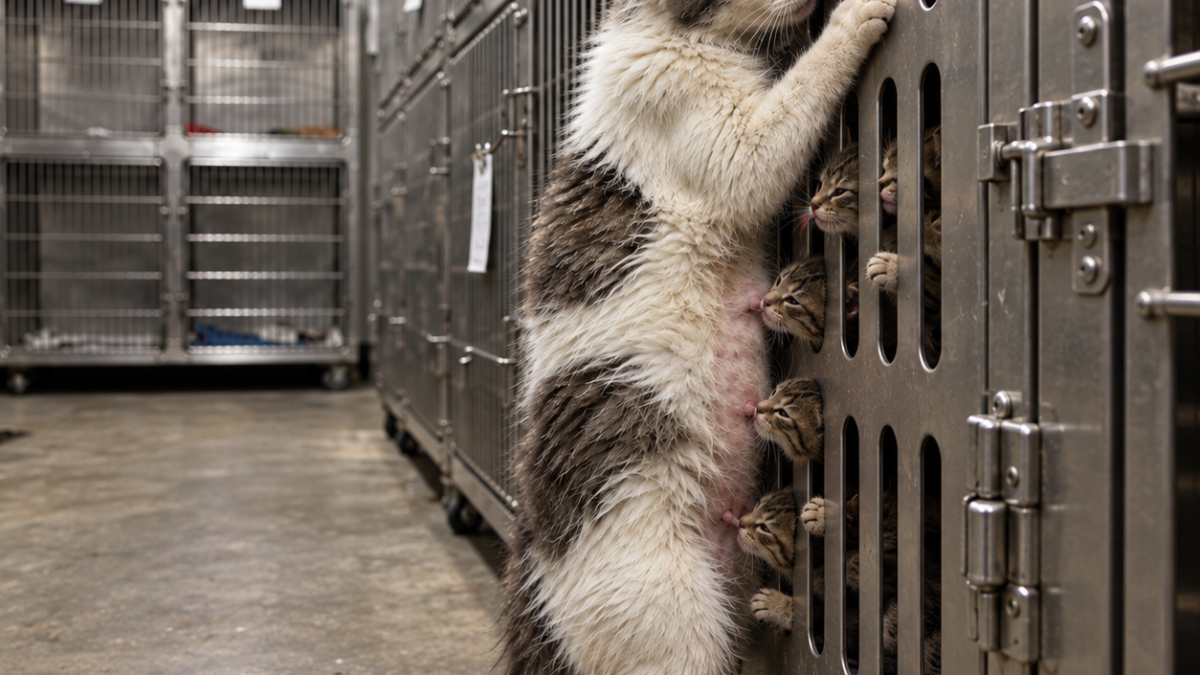
The white and gray cat was lying on her side in the bottom cage, pressed hard against the metal partition and front bars. Her body was twisted in a position that could not have been comfortable. Her belly was against the narrow opening where the upper cage edge created a small space. The kittens had squeezed down, one by one, through the only access they could reach. Not fully into her cage—not safely, not normally—but close enough.
Close enough to nurse.
Five tiny bodies were pressed along the metal barrier, mouths latched wherever they could reach. Their paws kneaded against bars, against towel, against air. One orange kitten had his face pushed through the narrow gap so tightly I panicked and rushed forward.
The white and gray cat lifted her head.
She looked exhausted.
Utterly exhausted.
But she did not move away.
She saw my hands coming and gave one low warning sound.
Not a threat.
A plea.
Do not take them.
“Julia!” I shouted. “Julia, come here now!”
I opened the upper cage carefully.
The kittens protested when I lifted them away, tiny mouths opening, milk on their lips.
Milk.
Actual milk.
The gray tabby’s belly was rounded.
The black kitten, who had fought bottle feedings since arrival, was quiet for the first time in two days.
Julia ran in behind me.
“Oh my God,” she said.
The white and gray cat tried to sit up, but her legs trembled. Her fur along her side was damp. The skin near her belly had red marks where the cage edge had pressed into her for too long. One front paw was scraped. She had wedged herself into that position for hours, maybe most of the night, letting kittens who were not hers feed through metal.
Julia covered her mouth.
“She’s nursing them.”
“I know.”
“They’re not hers.”
“I know.”
The cat blinked slowly.
Then lowered her head.
Not because she was relaxed.
Because she had nothing left.
That was when I stopped thinking of her as the white and gray cat.
I still did not have a name for her.
But she was no longer an intake number.
She was someone.
The shelter manager, Denise, arrived twenty minutes later and stood in the doorway staring at the scene. Denise had been in animal welfare for seventeen years. She had seen cruelty cases, hoarding houses, parvo outbreaks, failed adoptions, abandoned litters, impossible choices. She was not easy to shock.
That morning, she cried without making a sound.
“Move them together,” she said.
“We don’t have a foster.”
“Move them together here. Bigger kennel. Dog isolation if we have to.”
“We have a coughing dog in isolation.”
“Then clear the storage crate. I don’t care. They stay together.”
Policy bent that morning.
Not enough policies bend when they should.
But that one did.
We cleared an oversized recovery crate used for small dogs after surgery. We disinfected it, lined it with blankets, added a low litter tray, food, water, and a heating pad under half the bedding. Then we moved the kittens in first.
They cried.
The white and gray cat heard them from her cage and tried to stand before I even reached for her.
“Easy,” I whispered.
When I lifted her, she weighed almost nothing.
That is what I remember next.
How light she was.
She had given away what little she had.
Her body was warm but weak. The skin along her belly had thin red lines from the metal. Her paws curled inward when I carried her, but she did not fight. She only turned her head toward the sound of the kittens.
I placed her in the recovery crate.
The kittens found her immediately.
Not through bars now.
Not through metal.
Properly.
Fully.
They crawled against her belly, bumping into each other, crying, rooting.
She let out one long breath.
Then she stretched her neck around them and began grooming the nearest orange kitten with slow, exhausted licks.
Julia started crying.
Denise looked at the chart clipped to the old cage.
Hold expires: 72 hours.
The red letters looked obscene now.
“She’s on the list?” Julia asked.
Denise did not answer immediately.
In our shelter, nobody said euthanasia list loudly unless they had to. It was not superstition. It was respect, or maybe shame.
“She was unclaimed,” Denise said. “Adult stray. No space. No rescue hold.”
“She saved them.”
“I know.”
“She can’t be—”
“I know.”
Denise took the card off the cage.
She folded it once.
Then again.
“I’ll make calls.”
Calls.
That was how lives moved in our world.
A call to a rescue.
A call to a foster.
A call to a vet.
A call to someone who knew someone who maybe had space in a laundry room, a spare bathroom, a heated garage, a corner of a clinic, one empty crate, one more chance.
Denise called seven rescues before noon.
Everyone was full.
Everyone was sorry.
Sorry is the most common word in animal rescue.
Sorry, we are full.
Sorry, we have no fosters.
Sorry, we can take kittens but not the adult.
Sorry, we can take the adult but not bottle babies.
Sorry, our quarantine room has ringworm.
Sorry, transport is down.
Sorry, call back next week.
Next week did not exist for her.
By lunchtime, we named her Grace.
Not officially.
Official names require paperwork.
This was the kind of name staff give when they need to stop saying “the white and gray female” because the animal has become too real for that.
Grace.
It fit her in a way that made me angry.
Not soft grace.
Not pretty grace.
The hard kind.
The kind that shows up hungry, frightened, trapped behind bars, and still answers someone smaller crying above her.
The kittens became the choir, because Julia said they sounded like five terrible singers warming up at different speeds.
The black one was Alto.
The gray tabby was Tempo.
The two orange kittens became Biscuit and Rusty.
The white one with the smudge became Dot.
Names help.
Names hurt.
A named animal is harder to lose.
By that afternoon, the story had spread through the shelter. Volunteers came quietly to peek through the cat room window. Wade, the animal control officer who had brought Grace in, stood outside the recovery crate with his hat in both hands.
“She did that?” he asked.
“All night,” I said.
“She didn’t even know them.”
“No.”
He crouched.
Grace watched him carefully.
One kitten slept across her front leg.
“I picked her up near Old Mill,” he said. “She was under a porch. Lady said she’d been hanging around for days.”
“Any kittens nearby?”
“I looked. Didn’t find any.”
He swallowed.
“Maybe she lost hers.”
Maybe.
That thought stayed with us.
Maybe Grace had once had kittens and lost them.
Maybe her body remembered before her mind trusted us.
Maybe the cries from above had opened some door in her that grief had not closed.
Or maybe animals do not need stories as much as humans do.
Maybe hungry babies cried.
Maybe she had milk.
Maybe that was enough.
By evening, Grace was weaker.
The vet examined her and confirmed what we already feared: she was dehydrated, undernourished, and giving too much. Lactation takes from the body, and Grace did not have much body to spare. She needed fluids, high-calorie food, rest, and controlled nursing so the kittens did not drain her completely.
Try explaining controlled nursing to five hungry kittens and a cat who has decided she belongs to them.
We supplemented with bottles.
Grace objected.
Every time we lifted a kitten, she watched.
Every time one cried in our hands, she tried to sit up.
“Girl,” Julia whispered, “you do not have to do all of it.”
Grace disagreed.
The clock kept moving.
That is the thing about shelter stories people hear later as miracles. They forget the clock. The miracle does not stop time. It only makes time feel crueler.
Grace’s original hold was nearly over.
The kittens were fragile.
The shelter was full.
A recovery crate in a back room was not a long-term plan.
Denise kept calling.
I posted in private rescue networks with permission:
Urgent foster/rescue needed. Adult female stray, induced lactation/possible recent mother, now nursing five orphan kittens not her own. Shelter full. Needs immediate placement. Friendly but exhausted. Kittens approx. 3 weeks. Must stay together.
I included one photo.
Grace lying on her side, eyes half closed, five kittens tucked against her belly.
I did not add emojis.
I did not add dramatic language.
The photo was enough.
By midnight, the post had been shared dozens of times.
By 6 a.m., still nothing solid.
A woman in Ohio asked if transport was possible.
A rescue two counties away said they could take the kittens if we separated them from Grace.
Denise said no.
A foster offered a bathroom, then realized her resident cat was not vaccinated.
A rescue coordinator wrote, I’m trying.
That message broke me more than no would have.
Trying is hope with no guarantee.
The next morning was the final morning.
If the old card had stayed on Grace’s cage, that would have been the day.
Hold expired.
Decision due.
I came in early again.
Grace was awake.
The kittens were asleep.
All five of them.
Full.
Warm.
Silent.
Grace lay around them like a tired crescent moon. Her white fur looked cleaner now because she had groomed herself between grooming them. Her gray patch over one eye made her expression seem permanently serious. The red marks on her belly were visible when she shifted.
I sat on the floor outside the crate.
“Hey, Mama,” I said.
She looked at me.
Then blinked.
Slowly.
Trust from a shelter cat rarely arrives like a door opening. It comes like a match struck in wind. Brief. Precious. Easy to lose.
I blinked back.
My phone rang at 7:42.
It was Denise.
“Claire,” she said, and her voice sounded different.
“What?”
“Do not let anyone move them.”
My heart began to pound.
“What happened?”
“I got a rescue.”
“Who?”
“Lena Ortiz. Safe Harbor Feline Rescue.”
I closed my eyes.
Safe Harbor was small but good. Really good. They took hard cases when they could. Moms with litters. Medical kittens. Senior cats. The ones that needed more than a cage and luck.
“She can take all six?” I asked.
“All six.”
“When?”
“She’s already driving.”
I looked at Grace.
Grace looked back at me, one paw curved around Dot’s tiny body.
“Okay,” I whispered.
Denise paused.
“Claire?”
“Yeah?”
“We got her.”
We got her.
Not saved.
Not yet.
Rescue is not a finish line.
But it was the first gate opening.
Lena arrived at 10:13 in a blue minivan with a cracked windshield, three carriers, a heating disc bag, a medical kit, and the exhausted expression of a woman who had not said no enough times to protect her own sleep.
She was in her early forties, hair pulled into a messy knot, sweatshirt covered in cat hair, phone clipped to her pocket, keys on a carabiner, eyes already wet before she reached the crate.
“Oh, sweetheart,” she said when she saw Grace.
Grace lifted her head.
The kittens woke and began their chaotic little search for milk.
Lena crouched.
“She did all this through bars?”
“Yes.”
“How long?”
“At least one night. Probably longer trying.”
Lena pressed her hand against her mouth.
“I’ve seen mothers reject their own babies under stress,” she whispered. “And she took strangers.”
“She heard them.”
Lena nodded.
Sometimes that is all anyone can say.
She signed the transfer papers.
Adult female cat. White/gray. Now named Grace.
Five juvenile kittens. Orphaned. Transferred with nursing surrogate.
Reason for transfer: rescue placement.
I watched Denise cross out the old red hold note in the system.
Not delete it.
Nothing disappears from shelter software.
But the active status changed.
Released to rescue.
Those three words can feel like sunlight.
We prepared Grace for transport carefully. Lena set up a large carrier with soft blankets and a heating disc under one side. We moved the kittens first. They squeaked in protest.
Grace rose immediately.
Still weak.
Still determined.
When I lifted her, she did not resist. She only looked toward the carrier until I placed her inside with them.
The kittens found her again.
Normal this time.
No bars.
No metal.
No desperate angle.
They pressed against her belly in a pile of tiny bodies.
Grace lowered herself slowly, painfully, then rested her chin on the blanket.
Lena looked at me.
“She’s done,” she said softly. “She knows she can stop fighting now.”
In the parking lot, the autumn air smelled like damp leaves and diesel from the county truck. The shelter door buzzed behind us. A dog barked inside. Someone at the front desk answered the phone.
Life did not pause for the miracle leaving in a minivan.
Lena opened the sliding door and secured the carrier.
I leaned in one last time.
Grace’s eyes were half closed.
The kittens were nursing.
“You did good,” I whispered.
I wanted to say more.
I wanted to apologize.
I wanted to promise nothing bad would ever happen to her again, but shelter work teaches you not to make promises the world might break.
So I said the only true thing I had.
“You did good.”
Lena drove away.
The minivan turned out of the lot, past the recycling center, past the ditch, past the half-dead pine trees.
I stood there until it disappeared.
Then I went back inside and cleaned the empty recovery crate.
That is the part nobody puts in the stories.
After the rescue leaves, someone still washes the blankets.
Someone still scrubs the floor.
Someone still answers the next phone call.
Someone still walks past the cage where a miracle happened and sees another animal waiting.
But that day, every person in the building moved a little differently.
Not happier exactly.
Hopeful, maybe.
Hope in a shelter is dangerous if you let it become expectation.
But in small doses, it keeps you human.
Lena sent the first update that evening.
A photo.
Grace in a quiet foster room, lying in a clean nesting box lined with fleece. The kittens were tucked against her. A bowl of wet food sat nearby. Grace’s eyes were open, but softer.
Text below:
She ate half a can. Let me clean her belly. Kittens nursing well. She is exhausted but settled.
I sat on my couch and cried harder than I had cried at work.
At work, you hold it together because animals need steady hands.
At home, steady hands become shaking ones.
Over the next week, updates came daily.
Grace received fluids.
Grace gained four ounces.
Grace allowed Lena to supplement the kittens without panicking.
Grace purred for the first time.
That update came on a Thursday.
Grace purred today. Very quiet. Only when Dot fell asleep under her chin.
I read it three times.
Then sent it to Julia.
She replied with eight crying emojis and one sentence:
I knew she had a purr in there.
The kittens grew.
Alto became bossy.
Tempo learned to climb out of the nesting box too early and then complained because the floor existed.
Biscuit fell asleep in the food dish twice.
Rusty tried to nurse from Grace’s elbow.
Dot remained the smallest but loudest, which felt appropriate.
Grace learned rest.
That took longer.
For the first several days, Lena wrote that Grace would wake whenever one kitten moved. She would count them in her way, nose touching each small body. If Lena lifted one for a bottle, Grace watched until the kitten returned. Her body did not understand yet that the crisis had ended.
Animals who survive by vigilance do not stop being vigilant because a room becomes safe.
Safety has to repeat itself.
Meal after meal.
Night after night.
No shouting.
No metal bars.
No crying unanswered.
Gradually, Grace slept deeper.
At two weeks, Lena sent a video.
Grace lay on her side in a patch of sunlight while five kittens climbed over her like she was furniture. Biscuit bit her ear. Alto smacked Tempo. Dot tried to pounce and fell sideways. Rusty climbed onto Grace’s ribs, looked confused by height, then slid down.
Grace did not move.
She only opened one eye with the weary expression of every mother in every species.
Then she began to purr.
Not loud.
But there.
A small engine under white and gray fur.
I watched the video in the shelter break room with Julia and Denise.
Nobody spoke until it ended.
Then Denise said, “She was supposed to be gone.”
No one answered.
Because there are some sentences you do not answer.
By week four, the kittens no longer needed Grace’s milk to survive, but they still needed her. She taught them things we could not. How to clean paws. How hard to bite before a lesson came back. How to read another body. How to sleep in a pile. How to be cats.
By week six, Grace’s milk dried up.
Her job, biologically, was over.
Emotionally, she disagreed.
She continued grooming them. Continued letting them sleep against her. Continued chirping when one wandered too far. Lena said Grace had the patience of a saint and the appetite of a farmhand.
“She eats like she’s making up for every meal she missed,” Lena said.
“Good,” I replied.
“Her belly marks are healing.”
“Scars?”
“Probably fine ones. Thin.”
I thought about the metal bars.
About her body pressed against them all night.
About the way the kittens found the only access possible.
About hunger answered through a cage.
Some scars should be allowed to accuse the world.
The kittens were adopted first.
That is usually how it goes.
Kittens are easy to love publicly. They are tiny, funny, photogenic, uncomplicated in the way baby animals seem uncomplicated until they chew phone chargers and climb curtains.
Safe Harbor posted their photos when they were old enough.
Applications came in quickly.
Alto and Tempo went together to a family with two gentle teenagers.
Biscuit was adopted by a retired couple who had recently lost an orange cat and swore they were “just looking,” which everyone in rescue knows means they are one kitten away from surrendering.
Rusty went to a young teacher.
Dot stayed with Lena an extra two weeks because she was still small and had the dramatic confidence of a kitten who believes size is a rumor.
Grace watched them leave.
That was the part I worried about.
Had she already lost kittens once?
Would losing these break something open again?
Lena handled it slowly. Not all at once. One adoption at a time. Grace got extra attention, extra meals, warm beds, quiet reassurance. She searched after the first pair left, walking the foster room, sniffing blankets, chirping.
Then she returned to the window and sat in the sun.
When Dot finally left for her adoptive home, Lena sent me a message:
Grace looked for her for about an hour. Now she is sleeping on my laundry. I think she is okay.
I wanted Grace to be adopted immediately.
I also feared it.
Adult cats who have given everything are sometimes admired more than chosen. People share their stories, cry over them, call them angels, then adopt a kitten.
Grace’s adoption post went up in December.
Her photo showed her sitting on a blue blanket, front paws tucked neatly, green eyes calm but serious. Her gray patches looked cleaner now. Her body had filled out. She looked like a cat who had survived something and was not interested in being decorative about it.
The caption told a careful version of her story.
Not too dramatic.
Not exploitative.
Just true.
Grace came to us after saving five orphaned kittens in an overcrowded shelter. She is gentle, quiet, affectionate once she trusts, and ready for a home where she can finally be the one cared for.
People commented.
Beautiful girl.
Hero mama.
I’m crying.
Someone adopt this angel.
For two weeks, nobody applied.
Then a woman named Marian contacted Safe Harbor.
She was sixty-three, widowed, lived alone in a small house with a sunroom, and had recently lost a senior cat named Juniper. She wrote a long email. Not emotional in a performative way. Honest.
I am not looking for a kitten.
I am looking for a quiet adult cat who needs quiet back.
That sentence got her approved faster than any “hero mama” comment ever could.
Lena called me after the meet-and-greet.
“She chose Marian.”
“How do you know?”
“Grace climbed into her coat.”
“She what?”
“Marian sat on the floor. Grace sniffed her sleeve, stepped into her lap, then tucked herself halfway into the open coat like she had found a cave.”
“That sounds like a yes.”
“It was a yes.”
Grace went home three days before Christmas.
Marian sent a photo the first night.
Grace under a side table, watching.
Second night.
Grace on a rug near the heater.
Third night.
Grace on the couch, not touching Marian, but close.
One week later.
Grace asleep on her side in the sunroom.
Belly visible.
Thin scars faint against pale skin.
I stared at that photo for a long time.
A cat showing her belly is not always an invitation to touch. People get that wrong. But it is often a sign of safety. Vulnerability offered to a room that has earned it.
Grace slept on her side because she no longer had to curl around anyone to keep them alive.
She slept because the house was warm.
Because no kittens cried above her.
Because no clock counted down on a cage card.
Because somebody had finally made space for her.
I visited her in the spring.
I told myself I was dropping off old medical records, but that was not the real reason. I needed to see her with my own eyes. Needed to close the loop in the part of me that still saw her pressed against metal.
Marian’s house was small and yellow with white trim and wind chimes on the porch. The sunroom faced a garden full of bird feeders, which Grace apparently considered premium television.
Marian opened the door smiling.
“She may hide,” she warned. “She likes people, but she likes deciding first.”
“That is fair.”
Grace did not hide.
She sat in the sunroom on a quilted chair, watching me.
For a second, I was back in the shelter.
Bottom row.
Third cage.
Green eyes behind metal.
Then she blinked.
Slowly.
I sat on the floor.
“Hi, Grace,” I said.
She stood, stretched, stepped down from the chair, and crossed the room with the unhurried dignity of a cat who knows no one can make her hurry anymore.
She sniffed my hand.
Then rubbed her cheek against my knuckles.
I cried.
Of course I did.
Marian pretended not to notice.
“She does that to delivery boxes too,” she said kindly.
“Do not ruin this for me.”
Grace walked around my knee once, then returned to her chair.
That was enough.
More than enough.
Marian made tea. We sat in the sunroom while Grace watched birds and occasionally looked back as if making sure the humans remained where she had left them.
“Does she ever cry?” I asked.
“Sometimes in her sleep.”
My chest tightened.
“Not often,” Marian added quickly. “Just little sounds. I talk to her, and she settles.”
“Does she like being held?”
“No. But she likes being near.”
That made sense.
Some animals love by pressing close.
Some love by staying in the same room.
Some love by trusting you not to grab.
Marian told me Grace slept beside her bed every night, never on the bed, always on the rug. In the morning, she followed Marian to the kitchen and sat politely while breakfast was prepared. She liked chicken, sunbeams, the blue chair, and one particular knitted blanket. She disliked the vacuum, closed doors, and a ceramic owl in the hallway.
“She knocked it down three times,” Marian said.
“Maybe it deserved it.”
“I moved it.”
“Wise.”
Before I left, Marian asked, “Do you think she remembers?”
I looked at Grace.
She was washing one paw slowly, sunlight turning her whiskers silver.
“I don’t know,” I said.
That was the honest answer.
Animals remember differently than we do. Not in dates. Not in stories told from beginning to end. They remember smells, sounds, body feelings, danger patterns, safe routines. Maybe Grace did not remember the shelter as a narrative. Maybe she did not think: I was in a bottom cage under five kittens, and I fed them through metal until someone came.
Maybe she only remembered that crying needed answering.
Maybe she remembered enough to sleep lightly sometimes.
Maybe she remembered nothing and her body carried the rest.
Marian looked at the faint scars on Grace’s belly.
“I remember for her,” she said.
That felt right.
Today, Grace is still with Marian.
She is older now. Softer around the middle. More demanding about breakfast. She has a heated bed she uses only when Marian pretends not to care whether she uses it. She has a window shelf overlooking the bird feeders. She has a veterinarian who writes “sweet, shy, stable” in her chart. She has no official relationship with the kittens she saved, though Lena still gets updates on all five.
Alto and Tempo grew into enormous cats who sleep tangled together.
Biscuit steals socks.
Rusty lives with the teacher and appears in the background of online lesson plans more often than anyone expected.
Dot, smallest and loudest, became queen of a house with two patient dogs.
None of them know Grace saved them.
Not in the way humans mean know.
They do not gather once a year and honor her.
They do not understand what seventy-two hours meant.
They do not remember the metal bars, the hunger, the cries, the body below them answering.
They simply live.
That is enough.
Survival is not less meaningful because the saved do not understand the cost.
I still work with shelters, though not full time anymore. I tell new volunteers about Grace when they ask how I keep going. I do not tell it as a cute story. It is not cute.
It is beautiful.
It is painful.
It is an accusation.
It is a reminder that animals are not numbers on cage cards, even when systems reduce them to numbers because systems are overwhelmed and humans are tired.
Grace was almost lost because there was no space.
Not because she was unworthy.
Not because she was unwanted by the world forever.
Because on one October week, in one crowded shelter, math became more powerful than mercy.
Then she heard five kittens cry.
And something in her answered.
That answer bought time.
Time bought a call.
A call brought Lena.
Lena brought a carrier.
A carrier became a foster room.
A foster room became adoption.
Adoption became a sunroom.
A sunroom became a life.
People want rescue stories to be simple.
Before and after.
Sad and happy.
Dying and saved.
But Grace taught me that rescue is often a chain of very small links.
A cat pressing herself against metal.
A worker noticing milk.
A manager making one more call.
A rescuer driving even though she is tired.
A foster staying up through the night.
A stranger choosing the adult cat instead of the kitten.
Miss one link, and the story breaks.
Catch one link, and life continues.
I still remember that bottom cage.
Third from the left.
I remember the card.
Hold expires: 72 hours.
I remember the sound of the kittens crying.
I remember Grace looking up.
I remember thinking she was worried.
Now I think she was deciding.
Not in words.
Not the way humans decide.
But somewhere deeper.
A cry came.
She answered.
Her body gave what it was not supposed to have left to give.
Her skin pressed against metal.
Her strength drained.
Her time ran down.
And still she stayed.
Not for her own kittens.
Not for babies that smelled like her.
Not for any reason a policy could measure.
She stayed because they were hungry.
Because they were crying.
Because she could hear them.
That is the part I cannot forget.
She could hear them.
In a building full of noise, fear, barking, bleach, ringing phones, footsteps, cage doors, and human exhaustion, she heard five tiny voices above her.
And she answered.
The world had treated her like a stray with no name and a countdown.
She answered like a mother.
The shelter gave her seventy-two hours.
She used them to save five lives.
And in doing so, she saved her own.

