A Shelter Couldn’t Explain Why a Scarred 7-Year-Old Cat and a Tiny Kitten Had the Exact Same Shaved Patch on Their Necks—Then Someone Asked the One Question That Changed Everything.
PART3:
And Moss tried too, in the reluctant way old survivors try when they do not want to be caught hoping.
He was moved into a larger enclosure in the adult cat room, one with a perch, a hiding box, and a window view of a brick wall where pigeons sometimes landed. The younger cats around him rolled, chirped, stretched paws through cage bars, and performed for adopters.
Moss did not perform.
Moss sat.
Moss watched.
Moss blinked slowly.
Moss accepted treats from people who had earned the privilege.
Most visitors did not understand him.
Families came in looking for kittens. Couples came in looking for soft cats who would climb into their laps immediately. Children pointed at orange tabbies, fluffy calicos, tiny tuxedo kittens, anything small and bright and easy to imagine in a home.
They passed Moss without slowing.
Sometimes they glanced at his card.
Moss. Adult male. Approx. 7 years. Best for patient home.
Patient home.
Those two words can make a cat invisible.
Everybody admires patience as a virtue.
Few people want to adopt something that requires it.
So Moss waited.
Thirty days.
Sixty.
Ninety.
His intake photo moved lower on the website as newer cats arrived. His adoption profile was rewritten three times. Mara took better pictures. Moss sitting near the window. Moss looking dignified. Moss with one paw tucked under his chest. Moss accepting a chin scratch from a volunteer.
Still, people passed.
At 120 days, Evelyn moved him into the front cat room for more visibility.
He hated it.
Too many voices.
Too many children tapping glass.
Too many people saying, “Oh, that one looks rough.”
After three days, Moss stopped eating breakfast.
Evelyn moved him back.
“Fine,” she said, clipping his card to the quieter enclosure again. “You win.”
Moss ate dinner that night.
At 150 days, a retired man considered him. He stood in front of Moss for almost ten minutes and said he liked older cats. Moss even came forward and sniffed his fingers.
The man adopted a six-month-old black kitten instead.
At 181 days, someone asked if Moss was “discounted because of the ear.”
Mara went into the laundry room and folded towels very aggressively for half an hour.
At 200 days, the staff started talking about him in softer voices.
Long-stay cats change the atmosphere around them. Nobody wants to say what everyone is thinking. Nobody wants to admit that the longer an animal stays, the harder adoption can become. Not because the animal is less worthy, but because waiting becomes part of the story in a way adopters can feel.
Why has he been here so long?
There must be a reason.
There was a reason.
The reason was people.
People did not stop long enough.
People did not ask the right questions.
People saw scars and age and caution, and they missed the extraordinary thing living quietly inside him.
The first clue had come during his intake exam.
Every shelter cat received basic medical screening. Weight. Temperature. Teeth. Ears. Skin. Parasite check. Vaccines if healthy. Bloodwork when needed. Testing. Notes. The ordinary paperwork of trying to turn unknown lives into knowable records.
Moss had fought the thermometer with dignity.
He had submitted to the ear exam with offense.
He had allowed blood to be drawn only after Mara wrapped him in a towel and whispered nonsense into his good ear.
“You are a gentleman. A suspicious gentleman. A deeply misunderstood gentleman.”
The blood test came back normal.
Then the clinic ran his blood type.
Not every shelter routinely typed every cat, but this shelter did when it could, especially for adult cats who might become emergency donors. Feline blood transfusions are not as simple as many people imagine. Cats have blood types, and compatibility matters. A mismatched transfusion can be dangerous or fatal. Type A is common in many cat populations. Type B is much less common, depending on breed and region. Type AB is rare.
Moss was type B.
The veterinarian, Dr. Helen Carver, looked at the result and lifted her eyebrows.
“Well,” she said. “That may matter someday.”
Evelyn looked at the paper.
“Is that unusual?”
“Uncommon enough that I’m writing it clearly.”
Moss sat on the exam table, wrapped in a towel, glaring at everyone.
Mara scratched his cheek.
“You hear that? You’re rare.”
Moss did not appear impressed.
His name was placed on the shelter’s emergency donor list.
Moss. Adult male. Approx. 7 years. Type B. Healthy. Weight adequate. Temperament manageable with quiet handling.
Nobody expected the note to matter.
Most notes do not.
Shelters are full of details that feel important when written and then disappear under new emergencies. Food sensitivities. Favorite toys. Fear of mops. Prefers covered beds. Loves tuna. Hates blue carriers. Needs slow introductions. Type B.
The world moved on.
Moss waited.
Then, one spring evening, a kitten was hit by a car.
The woman who found her was named Elise Warren. She was a middle school art teacher driving home late after preparing student projects for an end-of-year show. It had rained earlier, and the roads still reflected the last orange light of sunset. She was half a mile from the school when she saw something tiny move near the curb.
At first, she thought it was a leaf.
Then the leaf lifted its head.
Elise pulled over so quickly the car behind her honked.
The kitten lay near the edge of the road, soaked, trembling, too small to understand why the world had suddenly become pain. She was gray-brown with white paws and a little pale chin. Her body fit inside Elise’s two hands. One back leg dragged. There was blood near her mouth. Her breathing was shallow and fast.
“Oh no,” Elise whispered.
She took off her cardigan, wrapped the kitten carefully, and drove straight to Briar Hill Veterinary Emergency Clinic.
She called ahead from the car, voice shaking.
“I found a kitten. She’s been hit. She’s alive. I’m coming. Please be ready.”
The clinic was ready.
Emergency clinics live in a different rhythm from regular life. Doors open. Hands reach. Questions come quickly. Weight. Breathing. Heart rate. Gum color. Trauma. Pain response. Fluids. Oxygen. X-rays. Ultrasound. Blood pressure.
The kitten weighed barely 900 grams.
Less than two pounds.
She was around eight weeks old, though malnutrition made her look younger. She had bruising along her abdomen, a fractured pelvis that might heal with strict care if she survived, and signs of internal bleeding.
Her blood pressure dropped.
Her gums paled.
The emergency veterinarian, Dr. Singh, looked at the ultrasound and felt the room tighten around the same conclusion.
She needed blood.
Fast.
The clinic had donor cats available for common matches.
But then the blood type came back.
Type B.
Dr. Singh stared at the result.
“Type her again.”
They did.
Type B.
The room changed.
A tiny type B kitten with internal hemorrhage did not have time for a long search.
The clinic called the shelter first because the shelter and emergency clinic shared emergency donor records.
Evelyn answered from home. She had been eating reheated soup at her kitchen counter while reviewing adoption applications on her laptop, because shelter managers pretend to have evenings off the way cats pretend not to want treats.
“Evelyn,” Dr. Singh said, “do you still have the gray adult male? Moss?”
Evelyn stood before she knew she was standing.
“Yes.”
“Is he still healthy?”
“Yes.”
“Still type B?”
“Yes.”
“We need him.”
“When?”
“Now.”
Evelyn called Mara.
Mara arrived at the shelter in twelve minutes wearing sweatpants, a raincoat, and shoes that did not match.
“I look insane,” she said, unlocking the side door.
Evelyn was already inside.
“Moss doesn’t care.”
Moss did care.
Moss cared very much about being woken after dinner, placed in a carrier, and carried through the shelter hallway toward the parking lot. He did not scream. He did not thrash. He simply compressed himself into a gray block of disapproval.
It was the first time he had been in a car since arriving at the shelter.
Maybe the first time ever.
Mara sat in the back seat beside his carrier while Evelyn drove.
Rain tapped the windshield.
Streetlights slid over Moss’s face through the carrier door.
He was perfectly silent.
Not relaxed.
Not calm exactly.
Silent in the way outdoor cats become silent when the world is unpredictable and noise might invite danger.
Mara placed two fingers against the carrier bars.
“You’re okay,” she whispered. “You’re helping somebody.”
Moss blinked.
At the clinic, everything moved quickly.
Donor intake.
Weight check.
Brief exam.
Consent forms signed by the shelter.
Sedation plan minimal.
Blood draw volume calculated carefully. Enough to help the kitten. Not enough to endanger Moss.
They shaved a small rectangle on the side of his neck.
Moss tolerated this with the expression of a cat personally betrayed by modern medicine.
Dr. Carver had come in after Evelyn called her, even though it was not her shift. She held Moss’s head gently while the emergency tech prepared the site.
“He’s doing beautifully,” the tech said.
Moss looked as if he disagreed with the entire concept of beautifully.
Blood flowed into the collection bag.
Dark red.
Warm.
Precious.
The kind of thing every living body carries without thinking until another body needs it to stay.
Moss gave enough.
Not too much.
Just enough.
Then he was wrapped in a warm towel and monitored in a quiet room. Mara sat beside him while the transfusion began down the hall.
The kitten lay on a heated pad, tiny body connected to lines and monitors. Elise Warren sat in the waiting area with dried rain on her sleeves and both hands clasped so tightly her knuckles had gone pale.
She had no idea who Moss was.
She only knew someone had said they had found a compatible donor.
A shelter cat.
An older gray one.
A cat no one had adopted.
She asked if she could thank him.
Not then, they told her gently.
He needed quiet.
So she thanked him through a wall.
The transfusion ran slowly.
Carefully.
Every few minutes, staff checked temperature, heart rate, breathing, signs of reaction. The kitten’s little body accepted the blood.
Her heart rate steadied.
Her gums began to pink.
Her breathing softened.
Dr. Singh let out a breath he had been holding for nearly an hour.
“She’s responding.”
Elise covered her face.
Down the hall, Moss rested with his shaved patch showing on the side of his neck.
He did not know he had changed anything.
He did not know a tiny heart had stabilized because of him.
He did not know that in another room, a woman who had never met him was crying into her hands.
He only knew he was tired, warm, and being offered a small dish of recovery food that smelled excellent.
He ate all of it.
By midnight, Moss was back at the shelter.
Evelyn placed him in his enclosure, expecting him to hide.
Instead, he stepped out of the carrier, walked to his water bowl, drank, then climbed onto his blanket and turned his back to everyone.
“That went better than expected,” Mara whispered.
Moss flicked his damaged ear.
“Thank you,” she said.
He did not turn around.
But the next morning, when she opened his enclosure, he allowed her to stroke his head for five full seconds.
A record.
The kitten survived the night.
That did not mean she was safe.
Trauma recovery is not one miracle. It is a chain of fragile improvements, any one of which can break. Her internal bleeding slowed. Her blood pressure improved. Pain medication helped. The fractured pelvis was stable enough for strict rest. She ate a little from a syringe. She slept.
Elise visited her every day.
The clinic staff began calling the kitten Juniper because one technician said she was “small, stubborn, and impossible to kill,” which apparently reminded her of a juniper bush growing through rock near her grandmother’s house.
Juniper.
The name fit.
Eleven days passed.
Moss returned to waiting.
The shaved patch on his neck became a small pale rectangle in his thick gray fur. Visitors noticed it sometimes.
“What happened there?” a child asked.
“He helped the vet,” Mara said.
That was easier than explaining blood transfusions between shelter cats and dying kittens to a six-year-old wearing dinosaur shoes.
The child looked at Moss.
Moss looked back.
“He looks grumpy,” the child said.
“He is allowed.”
The child nodded solemnly.
Moss was not adopted.
Juniper improved slowly.
Then, on the eleventh day, she crashed.
It happened in the early morning. A technician noticed she was quieter than usual. Her gums looked pale again. Her heart rate climbed. Repeat imaging suggested ongoing bleeding or delayed complications. Her tiny body had used everything the first transfusion gave her, and now she needed more.
Dr. Singh stood over the chart.
Type B.
Again.
The clinic called Evelyn.
This time, nobody spoke for a second after Dr. Singh explained.
A second donation in such a short time was not something anyone wanted to ask from Moss. Cats are not machines. Donor safety matters. There are limits. There are guidelines. There is the hard ethical balance between saving one animal and protecting another.
Evelyn called Dr. Carver.
Dr. Carver reviewed Moss’s weight, first donation volume, recovery, bloodwork, appetite, hydration, and timeline.
“It is the edge,” she said.
“Can he do it?”
“That is not the only question.”
“I know.”
“He must be examined first. If anything is off, no.”
“And if he’s okay?”
Dr. Carver was quiet.
Then she said, “If he’s okay, and if the volume is conservative, and if this is truly the only compatible option, then yes. But this is the limit. No more.”
Evelyn closed her eyes.
“I’ll bring him.”
Mara found Moss asleep on his blanket, one paw over his nose.
When she opened the enclosure, he lifted his head and gave her a look that said whatever this is, absolutely not.
“I know,” she whispered.
She sat beside him for a minute before touching him.
“I’m sorry.”
Moss blinked slowly.
“You saved her once.”
He looked away.
“She needs you again.”
He could not understand the words.
But maybe he understood the tone.
Or maybe he simply trusted Mara more than he used to.
When she placed the carrier in front of him, he resisted for exactly four seconds, then walked inside.
Mara cried in the car.
Quietly.
Not dramatic sobbing.
Just tears slipping down while Moss rode silently in the carrier beside her.
“It’s not fair,” she said.
Evelyn kept both hands on the wheel.
“No.”
“He waited 214 days and now we’re asking him for this.”
“I know.”
“He should be in someone’s living room. Not doing emergency blood donation.”
“I know.”
Rain was not falling that day. The spring sky was bright and blue, which felt rude.
At the clinic, Moss passed his exam.
Good heart.
Stable weight.
Hydrated.
Strong enough.
Dr. Carver looked at him for a long time before approving the second draw.
Moss sat on the exam table, towel wrapped around his body, shaved patch still visible from the first donation. The new shave widened it slightly, making the small rectangle on his neck more obvious.
Mara stayed near his face.
“You don’t have to be nice,” she whispered. “Just be Moss.”
Moss was Moss.
He was still.
He was offended.
He was brave in a way that did not look like bravery because cats do not perform heroism for human comfort.
They drew the blood.
Less this time.
Carefully.
Enough to help.
Not enough to harm.
Juniper received it within minutes.
Again, staff watched for reaction.
Again, the room moved around her with quiet urgency.
Again, her tiny body accepted what Moss had given.
Hours later, her numbers improved.
By evening, she lifted her head and complained.
It was a small sound.
Thin.
Scratchy.
Furious.
The whole clinic celebrated like she had sung an opera.
“She yelled at me,” a technician announced.
“Good,” Dr. Singh said. “I like yelling.”
Moss recovered in a warmed kennel with fluids, food, and strict monitoring. He ate slowly this time. He was more tired after the second donation. Mara sat with him for hours, reading emails aloud because she did not know what else to do.
At one point, Moss turned his head and rested his chin against the edge of her sleeve.
Mara stopped reading.
She did not move.
For ten minutes, neither of them did.
Later, she told Evelyn, “He forgave me.”
Evelyn said, “He may have just been tired.”
“I’m choosing forgiven.”
“That’s allowed.”
After that second transfusion, Juniper truly began to recover.
Not quickly.
Not magically.
But steadily.
Her appetite returned. Her blood values stabilized. Her fractured pelvis began healing. She learned to stand again, wobbly at first, then with offended determination. Her fur grew back where IV tape had been placed. The shaved patch on her neck, where the transfusion catheter had been secured and monitored, remained visible as a small matching rectangle.
The clinic staff loved her.
Everyone loves the tiny survivors.
That is not criticism.
It is biology.
Small animals who almost die and then demand food with their whole bodies activate something ancient in people. Juniper became the clinic’s little storm cloud. She hissed at thermometers, attacked a blanket corner, and tried to bite Dr. Singh’s shoelace during an exam.
“She has no gratitude,” he said.
“She has life,” the technician replied.
“Same thing, apparently.”
Elise wanted to adopt her.
Of course she did.
She had been there from the road. She had wrapped the tiny body in her cardigan. She had sat through the first transfusion. She had visited every day. But Juniper needed continued medical monitoring before adoption. The clinic transferred her to the shelter’s foster program once stable, and Elise became her foster-to-adopt home.
The first night in Elise’s apartment, Juniper slept in a soft crate beside the bed and woke every two hours to yell.
Elise sent a message at 3:12 a.m.
She is tiny and furious and perfect.
Mara replied:
That means she’s healing.
Moss returned to his shelter enclosure.
He had saved Juniper twice.
He still had no adopter.
That is the part that hurts people when they hear it.
They expect the world to reward goodness immediately. They expect the hero to be recognized as soon as the heroic act occurs. They expect the overlooked cat to save the kitten and then be adopted the next day by someone with a sunny window and excellent taste.
But the world is rarely that tidy.
For a while, nothing changed.
Moss’s shaved patch grew in slowly.
Visitors still passed.
His card was updated.
Moss is a gentle, cautious long-stay cat who recently served as an emergency blood donor for a kitten in critical care. He would thrive in a quiet, patient home.
People said, “Aww.”
Then adopted kittens.
Mara tried not to resent them.
She failed sometimes.
At night, after closing, she sat in Moss’s enclosure. This was not technically encouraged, but Moss’s enclosure was large enough and Mara was trusted enough and Evelyn pretended not to notice.
Moss would sit on his blanket while Mara sat on the floor.
Sometimes he came close.
Sometimes he did not.
One night, she said, “You know, if people knew what you did, they would love you.”
Moss looked toward the brick wall window.
“That’s not fair, though,” she continued. “You shouldn’t have to do something extraordinary to be loved.”
Moss blinked.
“You were enough before.”
He yawned.
“That was heartfelt.”
He began washing one paw.
“Rude.”
Two weeks after Juniper’s second transfusion, the shelter decided to try something simple.
Juniper had a recheck appointment at the shelter clinic before going back to Elise’s foster home. Moss was due for bloodwork after his donations. Both appointments were scheduled the same morning.
Mara said it first.
“Could they meet?”
Evelyn hesitated.
“They’re both stable.”
“Supervised. Short. Just… I don’t know. It feels wrong that he saved her and never even knows.”
“He’s a cat, Mara.”
“I know.”
“Cats don’t need narrative closure.”
“I know.”
Evelyn sighed.
“But humans do.”
“Yes.”
Dr. Carver approved a careful introduction.
Neutral enclosure.
Clean bedding.
Two staff present.
No pressure.
Juniper arrived first, tiny and bright-eyed, moving with the determined wobble of a kitten whose body had been broken and was now renegotiating gravity. The shaved patch on her neck was still visible. A small pale square in baby fur.
Moss arrived in his carrier.
He did not like the clinic room.
He did not like the smell.
He did not like the memory of medical things.
But he trusted Mara enough to step out when she opened the door.
At first, he ignored Juniper.
That was very Moss.
Juniper did not ignore him.
She stared at the large gray cat with the intensity of a creature seeing a mountain for the first time.
Moss sniffed the blanket.
Juniper took one step toward him.
Moss looked at her.
She froze.
He blinked.
She squeaked.
Not a meow.
A squeak.
Moss’s ears shifted.
Or rather, one ear shifted fully and the damaged one tried.
Juniper took another step.
Then another.
Moss lowered his head and sniffed her.
Everyone held their breath.
Juniper pushed her tiny face under his chin.
Moss went completely still.
Then, slowly, he began to groom the top of her head.
Mara covered her mouth.
Evelyn whispered, “Oh.”
Dr. Carver looked suspiciously hard at the chart.
Juniper leaned into him like she had known him always.
Maybe she smelled the clinic.
Maybe she smelled something familiar in his body.
Maybe kittens simply understand warmth.
Moss groomed her for thirty seconds.
Then he lay down.
Juniper climbed against him, turned in a circle too small to matter, and fell asleep pressed into his chest.
Moss looked at the humans.
His expression said: This appears to be happening.
Nobody moved them.
The planned short introduction lasted forty minutes.
Juniper slept the entire time.
Moss dozed.
The photographer volunteer, Theo, happened to be in the building taking adoption photos. Evelyn waved him over silently.
He lifted the camera.
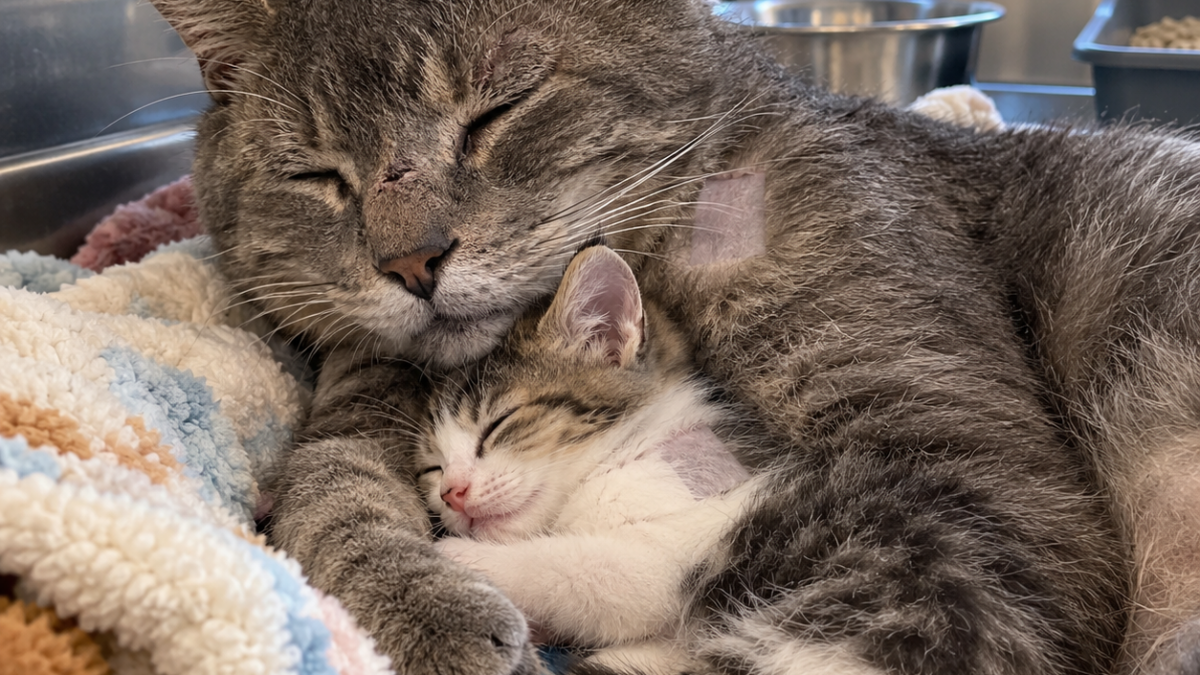
Click.
That was the photo.
A big gray cat, scarred and solid, sleeping in an enclosure.
A tiny kitten tucked against him, small enough to fit in the curve of his body.
Both with the same little shaved patch on the side of the neck.
Same size.
Same place.
One patch from giving blood.
One patch from receiving it.
The photo went on the shelter’s social media that evening with a careful caption:
Moss and Juniper finally met today. Moss, our long-stay type B donor cat, gave blood twice to help Juniper survive after emergency trauma. Today, she curled up beside him like she knew.
The post did not go viral instantly.
Most things do not.
First came the regular shelter supporters.
I’m crying.
Moss deserves the world.
Look at her with him.
Then local shares.
Then a regional rescue page.
Then a veterinary group.
Then strangers.
Within two days, the shelter phone would not stop ringing.
But before that happened, before the world arrived to celebrate Moss, something quieter occurred.
Elise came back to finalize Juniper’s adoption.
She brought the carrier, the adoption fee, a folder of medical papers, and the cardigan she had wrapped Juniper in on the night of the accident. She said she was keeping it forever, even though one sleeve still had a blood stain that would not fully wash out.
Juniper was in the front office with Mara, chewing on the corner of a clipboard.
Elise signed the adoption paperwork with tears in her eyes.
“She’s really mine?”
“She’s really yours,” Evelyn said.
Juniper attacked the pen.
“She seems emotional,” Elise said.
“She expresses it through violence,” Mara replied.
After the papers were signed, Elise noticed the photo taped to the front of the cat room door.
Moss and Juniper sleeping together.
Two shaved patches visible.
Elise stepped closer.
She knew the story, of course. She knew a donor cat had saved Juniper. She knew his name was Moss. She knew he lived at the shelter.
But knowing and seeing are different.
In the photo, Moss did not look like a medical note.
He looked like a guardian.
A tired, scarred, overlooked guardian who had given part of himself to keep a kitten alive.
Elise touched the edge of the paper.
“Is the big gray cat still here?”
Mara, who had been smiling at Juniper, went quiet.
“No,” she said softly.
Elise turned.
Mara smiled through sudden tears.
“Not anymore.”
Because that morning, after 214 days, Moss had gone home.
His adopter’s name was Thomas Reed.
He was a widower in his late sixties who had come to the shelter two days after seeing the photo. He did not come with children. He did not ask for kittens. He did not ask which cats were playful or pretty or young.
He walked in holding a printed copy of Moss’s photo.
“I want to meet this one,” he said.
The front desk volunteer asked, “Moss?”
Thomas looked down at the picture.
“Yes. The donor.”
Mara happened to be passing the lobby at that moment.
She stopped so abruptly she nearly dropped the laundry basket.
Thomas was taken to Moss’s enclosure.
Moss sat on his perch, unimpressed by destiny.
Thomas did not reach into the cage. He did not make kissy sounds. He did not tap the bars. He did not say, “Come here, buddy,” as if Moss owed him friendliness on demand.
He simply pulled up a chair and sat.
For ten minutes.
Then twenty.
Mara watched from the doorway.
Finally, Thomas said, “My wife used to say the old ones are where the best souls hide.”
Moss looked at him.
Thomas continued, “She brought home every senior cat in the county, I think. I used to complain. Then after she died, the house was too clean.”
Moss jumped down from the perch.
Mara stopped breathing.
He walked to the front of the enclosure.
Thomas held out one hand, low and still.
Moss sniffed his fingers.
Then, after a long pause, rubbed the side of his face against them.
Not much.
Not dramatically.
Just once.
Thomas closed his eyes.
“That’s enough for me,” he said.
The adoption counselor went over Moss’s needs.
Quiet home.
Patience.
No small children.
Slow adjustment.
Possible hiding.
Time.
Thomas nodded at every word.
“I have time,” he said.
Those were the magic words.
Not I have experience.
Not I love cats.
Not He’ll warm up quickly, right?
I have time.
Moss went home that afternoon in a carrier lined with a blanket Thomas had brought from home. The blanket smelled like clean laundry, old wood, and a house waiting for a cat.
Before leaving, Mara crouched beside the carrier.
Moss sat inside, shaved patch still faint on his neck.
“You were enough before,” she whispered. “But I’m glad they finally saw you.”
Moss blinked slowly.
The shelter staff watched him leave.
Some cried openly.
Evelyn pretended not to and failed.
The cat room felt strange afterward.
His enclosure was empty.
For 214 days, Moss had been part of the room’s weather. Quiet gray presence. Watchful eyes. The cat people walked past until the world finally learned what it had missed.
Now the blanket was gone.
The perch was empty.
The brick wall window had no gray cat in it.
Mara placed a card on the enclosure door.
Adopted.
Then she stood there for a long time.
When Elise asked if Moss was still there and Mara said no, she expected disappointment.
Instead, Elise smiled.
“Oh,” she said, pressing one hand to her chest. “Good.”
Juniper, still trying to murder the clipboard, sneezed.
Elise laughed and wiped her eyes.
“Good,” she said again.
Moss’s first week in Thomas’s house was quiet.
Thomas had prepared a spare bedroom with everything the adoption counselor recommended. Litter box. Food. Water. Bed. Hiding places. Scratching post. Nightlight. No pressure.
When Moss came out of the carrier, he walked straight under the bed.
Thomas did not reach for him.
He sat in the armchair by the window and read a book aloud.
Not a cat book.
A history of railroads.
Moss remained under the bed.
The next day, Thomas read more about railroads.
Moss ate overnight.
The third day, Thomas read the newspaper aloud.
Moss watched from under the bed skirt.
The fourth day, Thomas fell asleep in the chair.
Moss came out, sniffed his shoe, then retreated.
The fifth day, Thomas woke from a nap to find Moss sitting in the middle of the room, staring at him.
“Hello,” Thomas said.
Moss blinked.
The sixth day, Moss accepted a treat from Thomas’s fingers.
The seventh day, he allowed one chin scratch.
Thomas wrote an email to the shelter.
Subject: Moss progress.
He wrote:
He is not hiding all the time now. He prefers the blue rug and dislikes the grandfather clock. I have stopped winding it. He eats well. He accepted one chin scratch today. I cried a little. Please do not tell him.
Mara printed the email.
Into Moss’s file it went.
Not because it was required.
Because some records deserve keeping.
Juniper, meanwhile, became exactly the kind of cat everyone suspected she would become.
Tiny.
Fearless.
Loud.
Elise adopted her officially but continued sending updates to the shelter.
Juniper learned to climb the sofa before her pelvis had fully convinced anyone that climbing was wise. She attacked shoelaces. She slept under Elise’s chin. She had physical therapy exercises she treated as personal insults. Her shaved patch grew back slowly, a small shadow disappearing under kitten fur.
One month after adoption, Elise sent a photo of Juniper sitting beside the framed picture of her and Moss.
Caption:
She bit the frame after this.
Mara replied:
That sounds like gratitude.
The shelter used Moss’s story carefully after that.
They did not turn him into a mascot.
They did not reduce him to a marketing tool.
But they did create a small board in the lobby:
LONG-STAY DOES NOT MEAN LESS LOVABLE.
Under it were photos of adult cats who had been waiting.
Not kittens.
Not easy adoptions.
The quiet ones.
The shy ones.
The scarred ones.
The ones with medical notes.
The ones who needed patience.
Moss’s photo sat at the top.
Not because he was better than the others.
Because he had finally made people understand.
Beside the photo, Evelyn wrote:
Moss waited 214 days. During that time, many visitors saw only an older gray cat with scars. What they did not see was that Moss carried something rare and life-saving. He donated blood twice to save Juniper, a critically injured kitten with the same uncommon blood type. Sometimes the animals people overlook are the ones with the most to give.
Adoptions of adult cats increased for three months after that.
Not forever.
Stories change hearts, but systems need constant reminding.
Still, three long-stay cats went home that summer because people came in asking, “Who has been here the longest?”
Mara loved that question.
It became her favorite question.
Better than “Do you have kittens?”
Better than “Which one is the prettiest?”
Better than “Which one is free?”
Who has been here the longest?
That question opened doors.
A black cat named Pepper went home after 188 days.
A senior tabby named Louise went home after 241.
A shy white cat named Satellite, who hid whenever children entered, was adopted by a night-shift nurse who said, “I also prefer quiet.”
Every time one left, Mara thought of Moss.
Moss, who had waited.
Moss, who had given blood.
Moss, who had not become valuable because he saved Juniper, but whose value had finally become visible because of it.
That distinction mattered.
Thomas understood it too.
He brought Moss back to the shelter once, months later, for a scheduled wellness visit with Dr. Carver. Moss arrived in a carrier lined with the same blanket from adoption day. He looked healthier. Heavier. His coat had softened. His scarred ear remained scarred, of course, and his face still had the weathered dignity of a retired street king, but his eyes were different.
Less watchful.
Still Moss.
But less braced for disappointment.
When Mara saw him, she crouched near the carrier.
“Moss?”
He looked at her.
For a moment, she thought he might not remember.
Then he pressed his face against the carrier door.
Mara cried immediately.
Thomas laughed.
“He does that to the refrigerator too.”
“Do not ruin this for me,” Mara said.
During the exam, Dr. Carver checked his donor records and smiled.
“No more donations for you, sir. You are retired.”
Moss flicked his damaged ear.
Thomas looked at him proudly.
“He spends most afternoons in the window,” he said. “There’s a maple tree outside. He watches squirrels like they owe him money.”
“Does he sit with you?”
“Sometimes.”
That sometimes meant everything.
Thomas hesitated.
“Can I ask something?”
“Of course,” Dr. Carver said.
“Do cats know when they save another animal?”
Dr. Carver thought about that.
“I don’t know if they understand it the way we do.”
Thomas nodded.
“But I think they know when they are handled gently. I think they know when someone they trust is asking something. I think they know when they are safe afterward.”
Thomas looked at Moss.
“That’s enough, maybe.”
“Yes,” she said. “Maybe it is.”
Before leaving, Thomas asked if Juniper had survived long-term.
Mara pulled out her phone.
She had photos.
Many photos.
Juniper on a windowsill.
Juniper inside a grocery bag.
Juniper asleep with her healed leg stretched behind her.
Juniper biting the corner of a book.
Thomas studied them.
“She’s a little menace.”
“She is.”
“Good.”
That one word carried more emotion than a speech.
Good.
The kitten lived.
The blood mattered.
The waiting cat had not waited for nothing.
A year later, the shelter held a small donor awareness event with the emergency clinic. Nothing fancy. Folding chairs. Coffee. Posters about feline blood types and emergency care. Information about how healthy cats can sometimes become screened donors through veterinary programs. A table with adoption profiles for long-stay cats.
Moss did not attend.
Thomas said Moss had retired from public life and would not be accepting speaking engagements.
But he sent a photo.
Moss asleep in a sunbeam on a blue rug.
Fully relaxed.
Belly partly exposed.
Scarred ear flat against the floor.
The little shaved patch on his neck completely grown back.
Juniper’s family sent a photo too.
Juniper, now sleek and healthy, sat in a cardboard box far too small for her body, eyes bright with nonsense.
The shelter placed the two photos side by side.
People who came to the event stood in front of them for a long time.
Some cried.
Some asked questions about blood donation.
Some asked to meet adult cats.
One woman stared at Moss’s photo and said, “I would have walked past him.”
Mara, standing nearby, answered honestly.
“Most people did.”
The woman wiped her eyes.
“I don’t want to do that anymore.”
That afternoon, she adopted Louise, the senior tabby.
Stories do not fix everything.
But sometimes they interrupt a habit.
The habit of overlooking.
The habit of choosing only the easy face.
The habit of assuming older means less.
The habit of thinking scars are warnings instead of history.
Moss interrupted that.
He never meant to.
He never posed for heroism.
He never stood in front of a crowd.
He never knew why people suddenly said his name softly.
He simply existed.
He waited.
He gave what only he could give.
Twice.
And then he went home.
Juniper grew up.
That may be the most beautiful sentence in the story.
She grew up.
The kitten who had arrived at the emergency clinic weighing barely 900 grams, bleeding inside, with almost no chance without transfusion, became a cat who knocked cups off counters and yelled at closed doors.
She grew into her ears.
She grew into her paws.
She grew into the kind of confidence only rescued kittens seem to have, as if surviving early danger convinces them the rest of life should be negotiated loudly.
Elise sometimes told guests the story when they noticed the framed shelter photo.
“This is Juniper when she was tiny,” she would say.
“And that big gray cat saved her life.”
People would lean closer.
“What happened to him?”
“He was adopted.”
“By you?”
“No.”
“Do you ever see him?”
“No. But I get updates sometimes.”
“Does Juniper know?”
Elise always smiled at that.
“I don’t know. But I do.”
That matters too.
Knowing on someone else’s behalf.
Remembering what the saved cannot remember.
Honoring the donor who cannot understand honor.
One winter evening, Thomas sent the shelter a video.
Moss sat beside him on the couch.
Not on his lap.
Moss was not a lap cat.
At least not then.
But he sat close enough that his side touched Thomas’s leg. Thomas’s hand rested on the cushion near him. Moss leaned slowly, almost accidentally, until his head rested against the back of Thomas’s hand.
The video lasted twelve seconds.
No music.
No caption.
Just a scarred gray cat choosing contact.
Mara watched it six times.
Then she forwarded it to Evelyn.
Evelyn replied:
214 days.
Mara wrote back:
Worth every one.
But that was not quite true.
Moss should not have had to wait 214 days.
No animal should have to become a miracle for someone to see them.
And yet, because Moss waited, he was there when Juniper needed him.
That is the strange ache at the center of the story.
If Moss had been adopted earlier, would Juniper have survived?
Maybe another donor would have been found.
Maybe not.
No one can know.
Life often turns on details no one understands while they are happening.
A blood type recorded months earlier.
A long-stay cat still in the building.
A volunteer answering her phone.
A driver stopping on the road.
A clinic calling the right number.
A donor tolerating one more car ride.
A kitten holding on long enough.
A photo capturing two shaved patches before the fur grew back.
A family asking, “Is the big gray cat still here?”
A man saying, “I have time.”
None of those links looked enormous alone.
Together, they became a life.
Two lives, really.
Juniper’s, because she survived.
Moss’s, because the world finally looked closely enough to see him.
Years later, people still ask about the photo.
It remains one of the shelter’s most shared images.
Not because it is dramatic.
Not because it shows blood or injury or rescue vehicles.
It shows sleep.
That is all.
A big scarred gray cat asleep beside a tiny kitten.
Two small shaved rectangles on two small necks.
If you do not know the story, the photo is sweet.
If you do know, it becomes something else.
A record of an invisible gift.
A before-and-after contained in one frame.
The donor and the survivor.
The overlooked and the saved.
The one who gave and the one who lived.
Moss’s patch meant sacrifice.
Juniper’s patch meant receiving.
Both meant somebody had cared enough to try.
That is why the photo mattered.
It made hidden kindness visible.
Most heroism is not visible.
Most of it happens in quiet rooms.
A nurse checking gums.
A volunteer driving in the rain.
A veterinarian calculating safe blood volume.
A shelter manager answering a phone after dinner.
A cat sitting still because someone he trusts asks him to.
A frightened kitten accepting blood from a cat she has never met.
The world often celebrates noise.
Moss was not noise.
Moss was quiet.
He had lived quietly.
Waited quietly.
Given quietly.
Gone home quietly.
But quiet does not mean small.
Sometimes quiet is where the largest things happen.
Moss spent the rest of his life in Thomas Reed’s house.
Not as a symbol.
Not as a shelter celebrity.
As a cat.
That is important.
He slept in the window.
He disliked the grandfather clock until Thomas stopped winding it forever.
He learned the sound of the treat bag.
He accepted chin scratches from Thomas and eventually, on winter mornings, climbed halfway onto his lap. Not fully. Moss had boundaries. But two front paws counted. Thomas considered it an honor.
He chased one toy mouse exactly twice, then decided play was undignified unless no one was watching.
He watched squirrels.
He snored.
He shed gray fur on dark pants.
He became ordinary.
That is the ending every shelter worker wants for the extraordinary ones.
Not fame.
Not endless sharing.
A home where the miracle gets to become routine.
Juniper, meanwhile, lived with Elise and became the kind of cat who made guests protect their drinking glasses. Her pelvis healed well. She ran with a slight hitch when tired, but she ran. She climbed. She yelled. She once stole an entire piece of toast and dragged it under the couch like prey.
Every year, on the anniversary of her rescue, Elise donated to the shelter’s emergency medical fund in Moss’s name.
Not Juniper’s.
Moss’s.
The note always said:
For the ones people walk past.
The first time Mara saw that note, she cried in the supply closet.
She was not embarrassed.
By then, everyone cried in the supply closet sometimes.
It was practically an employee benefit.
The fund helped other animals later.
A senior cat needing dental surgery.
A kitten with pneumonia.
A stray with a broken leg.
A diabetic cat whose owner had died.
Moss’s gift kept echoing.
That is another thing about kindness.
The first act is never the last effect.
Blood became life.
Life became a photo.
The photo became attention.
Attention became adoption.
Adoption became donations.
Donations became treatment.
Treatment became more lives.
All from a cat people had once passed without slowing.
Sometimes I think about the visitors who walked past Moss before the photo.
The ones who glanced and moved on.
They were not monsters.
They were ordinary people doing what ordinary people do. Looking for what they thought they wanted. Something young. Something easy. Something pretty in an obvious way. Something that did not ask them to slow down and wonder.
Most overlooking is not cruelty.
It is speed.
Moss needed someone slow.
Thomas was slow.
Mara was slow.
Evelyn was slow.
Juniper, by necessity, made the whole world slow down around Moss for a moment.
Long enough to ask:
Who is he?
Why does he have that shaved patch?
What did he give?
Why has he waited so long?
And finally:
Is he still here?
By the time people asked, the answer was no.
That was the best possible answer.
No.
He is not still waiting.
No.
He is not still being passed by.
No.
He is not still only a scarred gray cat in a shelter enclosure.
He is home.
There is a photograph on Thomas’s mantel now.
Not the viral one.
A different one.
Moss sitting in the window, head turned slightly, sunlight along his whiskers. He looks serious, as he always did. His damaged ear is visible. His eyes are half closed, not in fear, but in peace.
Beside it is a smaller printed copy of the shelter photo with Juniper.
Thomas keeps it there because, as he once told Mara, “A man ought to know the history of whoever shares his house.”
Moss never cared about the photo.
He cared about breakfast.
He cared about the window.
He cared about Thomas’s hand resting near him but not grabbing.
He cared about routine.
That is another mercy.
Animals do not need to understand our stories about them to benefit from the love those stories create.
Moss did not know he was rare.
He did not know he was type B.
He did not know Juniper’s heart stabilized because of him.
He did not know strangers cried over his picture.
He did not know his adoption changed how people looked at long-stay cats.
He knew the shelter.
Then the clinic.
Then Thomas.
He knew fear.
Then patience.
Then home.
Maybe that was enough.
No.
Not maybe.
It was enough.
When people ask what makes an animal extraordinary, they often look for something dramatic. A dog pulling someone from water. A cat alerting a family to fire. A horse surviving against odds. A rescue filmed at the perfect moment.
But sometimes extraordinary lives quietly inside an animal for months while nobody notices.
It sits in a gray cat with a damaged ear.
It waits behind cautious eyes.
It survives 214 days of being overlooked.
It is written in a blood type on a medical form no visitor reads.
Then one night, when a kitten is dying, that hidden extraordinary thing becomes the only thing that matters.
Moss did not have to be young.
He did not have to be beautiful in the easy way.
He did not have to perform affection for strangers.
He did not have to be anyone’s first choice.
He only had to be exactly who he was.
And who he was saved Juniper.
Twice.
That is the part worth remembering.
Not because saving her made him worthy.
He was worthy before.
But because saving her made people finally see the worth that had been there all along.
The shelter did not understand why the two cats in the photo had the same shaved patch on their necks.
Then someone asked the right question.
Who gave blood?
The answer was Moss.
The cat nobody noticed.
The cat who waited 214 days.
The cat with scars, a damaged ear, and a rare blood type.
The cat who gave part of himself to a kitten who could not survive without him.
The cat who gave again when once was not enough.
The cat who finally went home because one photograph showed the world what the shelter staff had been trying to say all along.
Look closer.
The ones you pass by may be carrying exactly what someone else needs to live.
And sometimes, the quietest heroes leave the deepest mark.
Not with a roar.
Not with a speech.
Not with anything dramatic at all.
Only with a small shaved patch on the neck.
A sleeping kitten tucked against their side.
And the gift of life given twice.




