A Retired K9 Had Less Than an Hour Before Euthanasia—Then an Old Farmer Who’d Been Sitting Outside His Kennel for Two Months Stepped Forward and Said One Word Nobody Expected Him to Know.
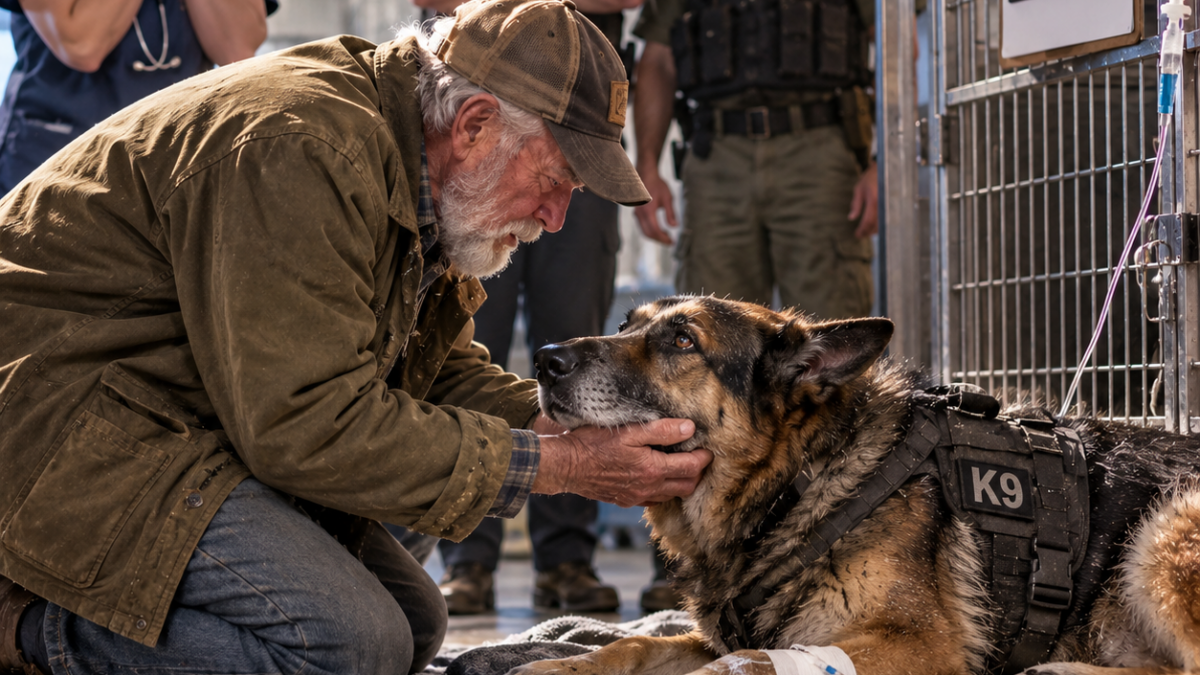
PART3:
They said things like poor thing from a safe distance, then hurried back to the lobby where the adoptable dogs were smaller, softer, and easier to imagine in Christmas photos.
Lorenzo sat like he had all the time in the world.
The problem was, according to the clock above the intake desk, Ranger did not.
Perry set his pen down.
The cap was still off.
“Sir, I need you to step back from the kennel. This dog is flagged aggressive. We have two bite incidents on file since intake.”
“He’s not aggressive,” Lorenzo said.
His voice was low, dry, and even.
The kind of voice built for calling a dog off a slope without spooking sheep.
“He’s guarding a hurt.”
Perry blinked.
“Excuse me?”
“Watch his weight.”
Lorenzo did not point.
He never pointed at this dog.
“He’s got it all on the back legs. Fronts barely touching.”
Bernie looked up from the folder.
Ranger’s growl rolled again, and then, half a second after Lorenzo said it, the dog shifted exactly that way.
Back legs loaded.
Front paws light.
Right shoulder held high and rolled inward, as if setting it flat cost him something he did not want anyone to know he was paying.
Lorenzo continued.
“His head’s not down because he’s scared of you. It’s down because lifting it pulls something across his shoulders he doesn’t want pulled.”
Perry’s mouth opened.
Closed.
“That’s not—”
He stopped because Ranger did it again.
A tiny adjustment.
Barely visible.
But it matched Lorenzo’s words so closely that even Casey lowered the pole syringe an inch without realizing she had moved.
Perry cleared his throat and picked up the pen again like it might rescue him.
“Regardless, the behavioral hold protocol runs on a schedule. This animal’s window closed at close of business yesterday.”
“I know what day it is.”
Lorenzo did not raise his voice to meet the tension in the room.
“I’ve known what day it is for two months.”
That stopped Perry mid-motion.
The form remained half turned toward Bernie for her signature.
“You’ve been here before?”
“Every Tuesday.”
Lorenzo kept his eyes on the dog.
“I sit here for a while.”
Perry frowned.
“You sit here?”
“I don’t feed him through the wire. I don’t put my hand near the gate. I don’t talk much.”
“Why?”
Lorenzo did not answer directly.
Ranger’s ears had come up half an inch.
Not much.
Enough.
“I sit,” Lorenzo said.
Bernie closed the folder slowly.
She knew he had been coming.
Of course she knew.
Bernie noticed more than people gave her credit for. Eleven years running intake had trained her to see patterns other people missed: the way a surrendered dog looked back at the door after the owner left; the way men surrendering “family pets” often refused to touch the leash one last time; the way people lied differently when guilt sat on them versus inconvenience.
She had noticed Lorenzo in the third week.
At first, she thought he was lonely.
Old men came into shelters sometimes because kennels were easier than empty houses. They wandered the rows, reading cards, asking names, touching fingers to mesh, then leaving without applications because wanting a dog and surviving the thought of another goodbye were not always the same thing.
Then she thought he might be looking to adopt.
But he never asked about fees.
Never asked about age.
Never asked whether Ranger was housebroken, leash-trained, cat-safe, child-safe, crate-trained, or any of the other phrases visitors used to imagine a dog fitting neatly into a life already arranged for comfort.
He came every Tuesday.
Sometimes Wednesday, if his truck was acting up.
He signed in.
Walked to Kennel C-7.
Unfolded the same camp chair.
Sat for forty minutes.
Then left.
He never took treats from the jar.
Never sweet-talked through the wire.
Never tried to lure Ranger forward.
Never asked to touch him.
That was what had made Bernie start watching.
Most people could not resist trying to matter to a dog.
Lorenzo seemed content to matter only if Ranger decided he did.
Perry tapped the folder against his palm.
A small, nervous rhythm.
“Mister Hogan.”
He said the name carefully, like he had asked Bernie for it earlier and did not want to get it wrong twice.
“The procedure is scheduled for eleven. That’s forty minutes from now. County protocol requires the intake room cleared of civilian visitors thirty minutes prior. I need you to gather your things.”
“I’m not in anybody’s way over here.”
“It’s not about being in the way, sir. It’s about protocol.”
Lorenzo’s breathing did not change.
In.
Out.
Low through the diaphragm.
The same rhythm he had held since he sat down.
Like there was not a clock on the wall at all.
Like the room ran on some older measurement Perry could not see.
“You said thirty minutes,” Lorenzo said. “That gives us time to talk.”
“There’s nothing to talk about. The window closed.”
“You told me a date. I’m asking you to look at the dog.”
“I’ve looked at the dog every day for two weeks,” Perry said. “That’s my job. Bite history. Unpredictable aggression. Nonresponsive to standard handling. Bernie’s notes are thorough.”
“Her notes are thorough,” Lorenzo agreed. “They’re also wrong about what they’re describing.”
Bernie froze.
Not offended.
Caught.
Because some part of her, the part she had kept quiet under procedure and shelter reality and too many hard decisions, had wondered the same thing.
Ranger had come in two months earlier through county transfer.
No known owner.
No active adoption claim.
No next of kin contact.
Military-style microchip, unreadable at intake due to database access errors.
Old scars.
Right shoulder stiffness.
Left ear notch.
Strong guarding behaviors.
Two bite incidents.
One with a kennel tech who tried to slip a lead over his head while he was lying down.
One with a volunteer who reached through the mesh toward his collar because she said he “looked sad.”
Neither bite had been catastrophic.
Both had been enough.
Enough to mark the file.
Enough to move him from adoptable review to behavioral hold.
Enough to make staff approach with tools, catchpoles, gloves, and warnings.
Enough to convince Ranger that every human hand came carrying force.
Perry’s voice climbed half a register.
“With respect, I don’t have time this morning for a debate about temperament theory.”
There it was.
With respect.
The phrase people used when respect had already left the room.
“I have a dog scheduled. I have a tech ready. I have paperwork requiring three signatures before noon. And I have a visitor who needs to clear the room in—”
He checked the clock.
“Twenty-eight minutes.”
“Twenty-eight minutes is enough.”
“Enough for what?”
Lorenzo did not answer.
He kept watching Ranger.
The dog had gone quiet again, that low simmering hush that was not calm so much as coiled restraint. His weight sat back over the hindquarters. His head dropped just enough to track Perry’s hands without seeming to. The left ear stayed half pinned. The right angled toward Lorenzo’s chair.
Something in Lorenzo’s face went past patience.
It settled into a deeper place.
“He hasn’t used up anything,” Lorenzo said.
Perry looked down at the file.
“Excuse me?”
“You said he used up his chances. That’s not true. Nobody gave him a chance. You used up your patience.”
The room changed.
Not loudly.
Not dramatically.
But everyone felt it.
“That,” Lorenzo said, “is a different animal entirely.”
Perry’s pen stopped moving.
Bernie looked at Ranger’s left ear.
For two months, she had logged the notch as laceration scarring.
Unremarkable.
Consistent with prior injury.
But now, with Ranger’s ear angled toward Lorenzo, she saw something she had not seen before.
A shape inside the scar.
Not random.
Not torn.
Placed.
Old.
Almost grown over.
She pulled the folder closer and tilted it toward the fluorescent light.
“This ear notch,” she said.
Perry exhaled sharply.
“Bernie.”
“I logged it as laceration scarring when he came in. I never had it looked at close.”
“Dogs tear ears in kennels constantly.”
“That’s not a tear pattern.”
She flipped to the back pocket of the folder.
The one no one ever opened because no one needed extended chip history for a stray with no active claim and a euthanasia hold already scheduled.
“Bernie, we do not have time for—”
She pulled out the scanner wand.
Ranger’s ears flattened the second she stepped toward the kennel.
His weight shifted backward.
Lorenzo clocked it before she did.
He said nothing.
Just breathed.
Four counts in.
Four counts out.
The same count he had used on mountainsides when dogs were injured, handlers were bleeding, and panic wanted into the work.
Bernie slowed.
To her credit, she noticed him noticing.
She lowered her shoulders.
Turned slightly sideways.
Did not reach toward Ranger’s head.
The wand passed near the back of his neck.
It chirped once.
Small.
Thin.
Almost apologetic.
“Got it,” Bernie said.
She squinted at the little screen.
“Okay. Registered handler tag. Military intake. This is old.”
Perry’s jaw tightened.
“Miss Vogel, I need that form back in the folder in the next five minutes or I have to call this in as a scheduling failure. That goes on both our names.”
Bernie did not look up.
“Deployment codes are faded, but I can read the unit line. Hang on.”
“You don’t need to hang on.”
“His call sign’s on here.”
Perry stopped.
Bernie’s voice changed.
Not louder.
Stronger.
“Deployment tag reads Kilo-Seven, K9 designation. Unit attached to mountain recon element. And there’s a call sign field. It’s worn, but I can make out…”
“Ranger,” Lorenzo said.
He said it low.
Before Bernie finished.
Before the final letters appeared fully on the cracked little screen.
The room went silent.
Not quiet like before.
Not procedure quiet.
Not held-breath quiet.
This was the silence of people realizing they had been standing beside something they did not have eyes to see.
Perry’s pen hovered an inch above the paper.
Bernie looked down.
Then up.
Then down again.
“That’s exactly what it says.”
“I know.”
Perry stared at Lorenzo.
“How?”
His voice had lost procedure.
Lost schedule.
Lost authority.
It was just a man in a room with an uncapped pen, suddenly aware the paper in front of him might be the least informed thing there.
“How do you know that? Nobody knows that. That chip record is sealed to civilian access.”
Lorenzo kept his eyes on Ranger.
The dog had gone still too.
Different than before.
Not coiled.
Listening.
Head coming up an inch.
Nose working the air like it had caught something it had not smelled in a long time and did not yet dare believe.
“I trained the man who trained him,” Lorenzo said.
Casey lowered the pole syringe.
Nobody told her to.
She simply did.
Lorenzo leaned forward slightly in the chair.
“Two months I’ve been sitting outside that kennel. Every week I told myself I’d say something. Every week I didn’t.”
Bernie’s hand tightened around the scanner.
“Why?”
Lorenzo ran his thumb along the patched seam of the camp chair.
The uneven black stitching.
Old repair.
Old habit.
Old grief.
“Because saying it made it real.”
No one spoke.
“And I’ve had enough real for one lifetime already.”
Ranger’s ears came forward another fraction.
Lorenzo said the name again.
Not as a command.
Not loud.
Not sharp.
Just offered into the space between chair and kennel.
“Ranger.”
The dog’s eyes moved fully from Perry to Lorenzo.
The growl disappeared.
Not faded.
Gone.
Bernie looked at the scanner again, then at the old man in the frayed coat.
“Mr. Hogan,” she said, and the name carried different weight now. “How do you know his call sign?”
The question had been sitting under the room since Lorenzo unfolded the chair.
Now it had a shape.
Perry’s pen still had not touched the paper.
Lorenzo took one breath.
Deep.
Even.
Then another.
His left hand rested on the camp chair, thumb tracing the worn stitching.
Behind him, Casey shifted.
The pole syringe clicked faintly against her belt.
Ranger’s eyes flicked to the sound.
The right shoulder rolled inward.
“There,” Lorenzo said.
Perry blinked.
“What?”
“Don’t open that gate.”
Casey’s hand stopped near the latch.
“I wasn’t—”
“You were about to prep him.”
She looked to Perry.
Perry looked at Lorenzo.
“He’s cleared for handling under restraint,” Casey said carefully. “I can get him sedated before the vet arrives. It may be easier on him.”
“It won’t.”
Lorenzo rose from the chair.
Slowly.
Old joints announced themselves in small ways.
One knee.
Then the other.
His body straightened, but not fully. He kept his shoulders rounded. Hands open and low.
“He’s guarding his right shoulder,” Lorenzo said. “Look at the weight. He’s not loading that leg. He’s carrying it high and rolled in because every time he sets it down, something pulls across scar tissue or a joint that never healed right.”
“That’s not in the intake notes,” Perry said.
“Notes say aggressive on approach, unhandleable, high bite risk.”
“Yes.”
“Notes are describing what happens when somebody grabs him wrong.”
Perry did not answer.
Lorenzo stepped toward the kennel.
“Sir, I can’t let you—”
“Watch.”
He did not say it unkindly.
It was not a challenge.
It was instruction.
He crouched beside the gate, slow enough that Ranger watched every inch and did not retreat.
Lorenzo let him see both hands.
No reaching high.
No fingers through the mesh toward the face.
No leash clip.
No collar grab.
He slid two fingers through the bars, flat, low, finding the space just behind Ranger’s shoulder blade where the muscle had knotted hard as a fist.
He did not press.
He cupped beneath.
Lifted slightly.
Not the leg.
The weight above it.
The way a man takes pressure off rigging before loosening a strap.
Ranger’s growl caught in his throat and never finished.
The dog’s whole body dropped an inch.
Ears forward.
Protective stance easing.
The front paw came down flat.
Even.
For the first time since Lorenzo had walked into the room, Ranger leaned into a human hand instead of away from it.
“There,” Lorenzo said.
Quiet.
Mostly to the dog.
“There it is.”
Nobody moved.
The fluorescent light hummed overhead.
Rain tapped the awning.
Somewhere down the hall, a dog barked once and stopped.
Casey stared at the syringe in her hand like she had forgotten why she was holding it.
“That’s a pressure relief hold,” Lorenzo said. “Handlers use it when dogs work off pack straps on grades too steep for a vehicle. You don’t fight the joint. You take the load off it.”
Ranger exhaled through his nose.
Long.
Shuddering.
The kind of breath that leaves after being held too long.
“Any tech in this county could learn that hold in an afternoon,” Lorenzo said, still supporting the shoulder. “And you’d never need a sedation order on this dog again.”
Perry looked down at the euthanasia form.
Then at Ranger.
Then at the clock.
The scheduled time had become less powerful.
Not gone.
But smaller.
He looked back at Lorenzo.
“You said you taught handlers. Which handlers?”
Lorenzo lowered slowly to one knee.
His other hand came to rest against the side of Ranger’s neck, thumb finding the place behind the left ear where the old service mark had faded beneath fur and scar tissue.
Ranger leaned into it.
Not much.
Enough.
“Sergeant First Class Wayne Prader,” Lorenzo said.
Bernie’s face changed.
She knew that name.
Not personally.
From the sealed record now glowing in her hand.
“Prader is listed as registered handler.”
“I ran the handler course. Wayne came through third rotation. Good hands. Better instincts than most.”
Lorenzo’s voice stayed steady.
“I taught him how this dog reads terrain before he reads a compass. Taught him how to let Ranger choose a line across shale instead of dragging him across bad footing. Taught him the pressure hold. Taught him how to get a dog with injured shoulders off a grade when no vehicle can climb within six hours.”
He paused.
His hand remained steady on Ranger’s neck.
“I didn’t teach him what to do if he didn’t come back down himself.”
No one spoke.
The sentence held its place in the room.
Bernie read the file in silence now.
Ranger’s transfer history.
Military retirement designation.
Temporary hold.
Behavioral flag.
County transfer.
Second transfer.
Third.
No registered next of kin.
No active handler claim.
No adoption applicant approved due to behavioral risk.
Two years moving between systems that recorded symptoms but not story.
Lorenzo looked at the dog.
“He’s not in this file, is he?”
“Who?” Perry asked, though he already knew.
“Wayne.”
Bernie shook her head slowly.
“No next of kin attached.”
“That’s why nobody claimed him when the unit rotated him stateside,” Lorenzo said. “That’s why he’s been sitting in intake for two years getting passed between counties. Nobody wanted a dog with a bad file, a bad shoulder, and no name attached to sign for him.”
Perry’s voice came quieter.
“You knew where he was?”
“For two months.”
“Then why didn’t you apply?”
Lorenzo did not flinch.
“I asked twice.”
Bernie looked up.
“Asked who?”
“County desk first. Then intake. Both times I was told the adoption window on a flagged animal had closed. That he was red-tagged before I got out here. That only rescue transfer with special clearance could take him.”
Perry looked uncomfortable now.
He should have.
“Paperwork does what paperwork does,” Lorenzo said.
No bitterness.
Like weather.
“So I came back anyway. Brought a chair. Sat outside his kennel every week. Didn’t sign anything because I didn’t know how to walk in here and tell you what he was without telling you what happened to the man who trained him.”
His voice dropped.
“And how I’m the one who taught that man to bring dogs like this one home alive off ground that wanted to kill both of them.”
The room became so quiet the fluorescent hum sounded loud.
Ranger’s head was up now.
Not high.
Not proud exactly.
But no longer folded inward.
His eyes stayed on Lorenzo.
“I taught your handler how to bring you home,” Lorenzo said to the dog.
His voice almost broke then.
Almost.
“Nobody taught me how to bring mine.”
Bernie’s eyes filled.
She turned away before anyone could see.
Perry looked down at the sedation authorization.
The pen remained in his hand.
The clock on the wall passed eleven.
The hour that had been scheduled to matter moved on without permission.
Perry set the pen down.
Not capped.
Just down.
“Give me the adoption file,” he said.
Bernie looked at him.
“Perry.”
“Give me the adoption file.”
His voice was quiet now.
None of the clipped procedure left in it.
“Whatever window we said was closed, I’m reopening it.”
Casey let out a breath she must have been holding.
The volunteer near the wall wiped her face with her sleeve.
Lorenzo did not move for a moment.
Then he removed his hand from Ranger’s shoulder slowly.
The dog leaned after it.
A small movement.
But everyone saw.
Bernie brought the adoption packet from the desk.
“Mr. Hogan,” Perry said, and this time the name came out like respect. “There will be conditions.”
“Should be.”
“Medical evaluation.”
“Yes.”
“Shoulder imaging.”
“Yes.”
“Behavioral waiver.”
“I know.”
“Home inspection.”
“Come today.”
“Fencing?”
“Forty acres. Inner yard fenced. Barn stall converted already.”
Bernie looked up sharply.
“You converted a stall?”
Lorenzo’s eyes stayed on Ranger.
“Two weeks ago.”
Perry stared at him.
“You thought we’d say yes?”
“No.”
“Then why?”
Lorenzo reached into his coat.
Not for a wallet at first.
For a pencil.
A stub worn nearly to nothing.
“The stall needed fixing either way.”
Bernie almost smiled.
Almost.
He signed where she indicated.
His hand was steady.
Lorenzo Hogan.
The letters moved across the page slowly but without hesitation.
Perry signed next.
Bernie witnessed.
Casey uncapped nothing.
The pole syringe went back on the rack.
When Bernie reached for the kennel latch, Lorenzo lifted one hand.
“Let me.”
Perry nodded.
Lorenzo clipped the lead through the bars first.
Not to pull.
Just to connect.
Ranger watched his hands.
The lead was old rope, soft from use, one end repaired with a small knot Bernie recognized.
The same knot Lorenzo had tied weeks earlier on a frayed shelter lead.
“Where’d you learn that?” she had asked him then.
“Somewhere it mattered,” he had said.
Now she understood that he had not been avoiding the question.
He had been surviving it.
Lorenzo opened the kennel.
Ranger did not bolt.
Did not lunge.
Did not look at Perry.
He stepped out slowly, favoring the shoulder, body low, eyes flicking once to the room, then back to Lorenzo.
Lorenzo did not crowd him.
He turned sideways.
Gave space.
One step.
Pause.
Another.
The dog came to his left side as if some old pattern still lived in his body beneath two years of being mishandled.
Heel position.
Loose.
Imperfect.
Enough to make Bernie cover her mouth.
“Look at that,” Casey whispered.
Lorenzo looked down.
“Ranger.”
The dog lifted his head.
The left ear, scarred and stiff, moved barely at all.
The right came fully forward.
“Yes,” Lorenzo said softly. “I know.”
Outside, the rain had lightened to mist.
The sky hung low and pale over the shelter parking lot.
Lorenzo folded the camp chair one joint at a time and carried it under one arm. Ranger walked beside him on the repaired lead, stiff at first, then easier with each step as if his body was remembering what it meant to move beside someone who understood where pain lived.
Perry followed them to the door.
He did not have to.
He did.
At the threshold, he cleared his throat.
“Mr. Hogan.”
Lorenzo stopped.
Ranger stopped with him.
Perry turned his hat in his hands.
He looked younger without procedure holding him up.
“What should I have done differently?”
Lorenzo considered him.
No hurry.
“Less clock,” he said. “More dog.”
Perry nodded once.
Did not defend himself.
That mattered.
“Anything else?”
“Read behavior like weather. Not like a verdict.”
Bernie stood behind Perry, arms crossed tight, the scanner still in one hand.
“And when you don’t know,” Lorenzo added, “ask somebody who’s been where the dog’s been.”
Perry nodded again.
Ranger leaned lightly into Lorenzo’s leg.
Not much.
Enough.
Lorenzo walked him to the old blue pickup parked near the far side of the lot.
The truck looked like it had outlived three better-looking vehicles through spite and maintenance. Its tailgate had a dent shaped like a stubborn cow. The passenger seat held a folded wool blanket, a canvas water bowl, and a bag of joint-support food already opened.
Bernie noticed.
“You really did get ready.”
Lorenzo lowered the tailgate.
“No point inviting a dog home if the house isn’t ready to answer.”
Ranger sniffed the truck bed.
The folded camp chair lay flat against one side.
He stepped up carefully, one front paw, then the other.
Lorenzo shifted the lead but did not lift him.
Ranger needed to know his own body could still choose.
The dog climbed in and lay down with his head against the worn canvas seat of the chair like he had done it a hundred times before in some other truck for some other man.
Lorenzo stood at the tailgate, one hand resting on Ranger’s flank.
Behind them, the shelter porch light clicked on early against the gray morning.
Nobody mentioned that it was only eleven-ten.
Nobody mentioned the form still unsigned on the counter.
Nobody mentioned how close they had come.
Ranger closed his eyes.
Lorenzo stayed there until the dog’s breathing settled.
Only then did he close the tailgate.
The farm sat twelve miles north of town, where county road turned to gravel and gravel narrowed into two ruts between winter fields.
Hogan land had been in Lorenzo’s family for three generations, though most people in town still called it “the old sheep place” even after the sheep had been gone for fifteen years. The barn leaned slightly east. The windmill no longer pumped but remained standing because Lorenzo liked things that kept their shape after their purpose changed. The farmhouse was small, white once, now weathered into a color between bone and smoke.
Ranger did not lift his head when the truck turned down the long drive.
He did open one eye.
Lorenzo saw it in the rearview mirror.
“Home,” he said.
Not command.
Information.
Ranger’s ear twitched.
The yard had been prepared.
Not prettied.
Prepared.
Lorenzo did not believe in making a wounded animal perform gratitude over decorations.
The inner yard fence had been repaired, low gaps filled, old wire replaced where rust had chewed it weak. The barn stall nearest the door had fresh straw, a rubber mat over the boards, a low bed made from a folded army blanket and two feed sacks stuffed with cedar shavings. Water waited in a wide metal bowl. Food sat measured but untouched.
The stall door had been removed entirely.
No gate.
No latch.
No threshold that looked like another kennel.
Just an open corner with a roof, straw, and a place to step out.
Ranger stood in the truck bed and scanned the yard.
He did not jump down.
Lorenzo did not ask him to.
He lowered the old ramp he used for feed sacks and injured calves. Ranger watched every movement. Lorenzo stepped back and let the dog decide.
It took three minutes.
Three minutes can feel long to people who do not understand fear.
To Lorenzo, it was nothing.
The dog placed one paw on the ramp.
Tested.
Shifted weight.
Paused when the shoulder pulled.
Lorenzo breathed low.
Ranger glanced at him.
Then came down.
At the bottom, he stood in the yard stiff-legged, nose moving through new air.
Mud.
Old hay.
Diesel.
Rain.
Mice under the corn bin.
Barn cats watching from the loft.
Lorenzo.
The dog’s body remained guarded, but his eyes changed.
Not safe.
Not yet.
Curious.
That was enough for the first day.
Lorenzo walked to the porch and sat on the bottom step, leaving the lead loose in his hand.
Ranger stood where he was.
Five feet away.
Ten minutes passed.
Then fifteen.
Finally, Ranger lowered himself carefully onto the wet grass with a soft grunt.
His shoulder was hurting.
Lorenzo looked toward the barn.
“Stall’s there when you want it.”
Ranger stared at him.
Lorenzo did not repeat himself.
By dusk, Ranger had eaten four bites.
Drunk half a bowl of water.
Sniffed the stall.
Refused to enter the house.
Snapped once at a barn cat who got too bold.
Lorenzo told the cat, “You earned that.”
At midnight, Ranger began pacing.
Lorenzo heard it from the kitchen table.
Three steps.
Pause.
Turn.
Three steps.
Pause.
Turn.
Not outside.
Inside the barn.
The old man sat in the dark with one lamp lit, his hands wrapped around a mug of coffee he did not want.
He knew that pacing.
He had heard it in kennels after firefights.
He had heard it in dogs pulled from handlers who did not come back.
Movement as argument.
Movement as refusal.
Movement as a body trying to escape a room built inside its own ribs.
He put on his coat and boots and walked to the barn.
Ranger stopped the second he entered.
The dog stood in the stall corner, head low, eyes shining in the dark.
Lorenzo did not go in.
He sat outside the stall opening on an overturned bucket.
The same distance he had held at the shelter.
No reaching.
No coaxing.
No good boy.
Just presence.
Ranger’s breathing came fast.
Lorenzo matched it for three breaths.
Then slowed his own.
Little by little.
Not dragging the dog with him.
Offering a road.
After twenty minutes, Ranger’s breathing followed.
After forty, the dog lay down.
Lorenzo stayed until dawn.
The second day, the veterinarian came.
Dr. Amelia Kent had known Lorenzo for twenty years and trusted him only because he never asked her to trust nonsense.
She arrived in a green truck, boots muddy before she reached the barn, hair tucked under a wool cap, X-ray unit in the back, and a face already set for argument.
“Tell me why the county released a red-flagged dog to a seventy-one-year-old man with one good knee.”
“Because Perry’s learning.”
“That is not an answer.”
“It’s the only one I’ve got.”
She examined Ranger carefully.
Lorenzo handled the shoulder.
Not restrained.
Supported.
Dr. Kent saw it immediately.
“Well,” she said after the first palpation, “this file is a mess.”
Lorenzo sat on a hay bale.
“Shoulder?”
“Old injury. Chronic soft tissue damage. Possible partial dislocation history. Arthritic changes. Compensatory strain through the neck. Whoever called this aggression because he objected to being grabbed here should not touch dogs for money.”
“Can he be helped?”
“Yes.”
Ranger watched her.
Dr. Kent looked back.
“But not fixed like new.”
“Nothing old gets fixed like new.”
She glanced at him.
“You talking about the dog?”
“Yes.”
“Liar.”
He almost smiled.
Treatment began with anti-inflammatory medication, joint support, controlled exercise, no collar pressure, harness only, massage if tolerated, heat packs if accepted, and rest whether Ranger believed in it or not.
Ranger did not believe in rest.
He believed in doors.
Corners.
Perimeters.
Approach angles.
Fence lines.
The first week, he checked the yard every hour.
The second week, every two.
By the third, he allowed himself to sleep in the open stall during daylight.
The first time he slept deeply enough to dream, Lorenzo was mending a gate hinge nearby. Ranger’s paws twitched. His lips moved over silent barks. His breath caught, and a whine slipped out sharp enough to make Lorenzo set down the wrench.
“Ranger.”
The dog jerked awake.
For half a second, he was not in the barn.
His eyes were elsewhere.
Mountains.
Snow.
Rock.
A slope too steep for vehicles.
A handler who did not return.
Lorenzo stayed still.
“Here,” he said.
Not heel.
Not come.
Here.
The smallest truth.
Ranger’s eyes found him.
His breathing slowed.
“Here,” Lorenzo said again.
The dog lowered his head.
From then on, Lorenzo used the word when the past took the dog away.
Here.
Some commands tell a dog what to do.
Some tell him where he is.
The farm learned Ranger the way Ranger learned the farm.
The barn cats learned he would not chase if they did not run.
The old tractor learned a dog could lie in its shade.
The mail carrier learned to stay in the truck until Lorenzo gave a nod.
The neighbor’s grandson learned not to sprint toward the fence yelling “doggy” after Ranger’s bark sent him backward into a puddle.
Lorenzo learned that Ranger liked lying where he could see three doors at once.
Learned he hated the clink of metal buckets dropped suddenly.
Learned he loved eggs cooked soft.
Learned he would take pills hidden in cheese but spit out pills hidden in sausage, which Lorenzo considered proof of refined suspicion.
Learned he would not step into the farmhouse until the fourth week.
It happened during rain.
Hard rain.
The kind that turned the yard silver and made the barn roof speak in a thousand little impacts.
Lorenzo left the farmhouse door open while he brought in firewood.
Not for Ranger.
At least that was what he told himself.
He set the wood down beside the stove and turned.
Ranger stood on the porch.
Wet along the back.
Harness dark with rain.
One paw over the threshold.
Lorenzo did not look at him too long.
“Floor’s dry,” he said.
Ranger stood there another minute.
Then stepped in.
Only one step.
Then another.
The farmhouse held its breath.
It had been a long time since a dog that size stood in Lorenzo’s kitchen.
Cord had been smaller.
Darker.
More patient with stupid young handlers.
More forgiving of Lorenzo’s grief than Lorenzo deserved.
Ranger sniffed the table leg.
The stove.
The rug.
The boot tray.
The closed door to the spare room.
Then he went to the hearth, turned once with effort, and lay down facing the door.
Lorenzo stood at the counter, one hand on the edge.
For eleven years, the house had been quiet in a way that looked peaceful to people who did not live inside it.
Now a dog exhaled by the fire.
A big, scarred, red-filed, almost-dead retired K9.
Lorenzo touched the repaired seam of the camp chair where it leaned folded near the wall.
Then he did something he had not done in years.
He spoke into the house as if someone else occupied it.
“Guess you’re staying.”
Ranger’s right ear twitched.
The fourth Tuesday after adoption, Lorenzo drove back to the shelter.
Not with Ranger.
Alone.
Perry saw him from the intake desk and stood too fast, bumping his knee against a drawer.
“Mr. Hogan.”
“Morning.”
Bernie came from the back room holding a stack of towels.
“How is he?”
“Mean to pills. Polite to cats. Suspicious of rain gutters.”
Bernie smiled.
“That sounds like progress.”
Lorenzo reached into his coat and placed a folded paper on the counter.
Dr. Kent’s report.
Shoulder diagnosis.
Handling recommendations.
Pressure relief hold instructions.
Harness requirements.
Notes on pain response mistaken as aggression.
Perry unfolded it slowly.
“I thought you might use it,” Lorenzo said.
Perry read the first page.
Then the second.
“You didn’t have to bring this.”
“Yes, I did.”
Perry looked up.
Lorenzo’s face was not accusing.
That somehow made it harder.
“I almost signed it,” Perry said.
“I know.”
“I keep thinking about that.”
“You should.”
Perry flinched slightly.
Lorenzo let that sit.
Then said, “Thinking isn’t punishment. It’s how a man stops doing the same wrong thing twice.”
Bernie placed the towels down.
“Would you teach us?”
Lorenzo looked at her.
“The hold?”
“The hold. The watching. All of it. Whatever you’re willing to teach.”
Perry did not object.
That mattered too.
So every other Thursday, Lorenzo came to the shelter.
At first, staff were nervous.
Not because of dogs.
Because of him.
Old men with quiet voices and histories no one fully knows make people careful.
He taught them to approach sideways.
To notice weight distribution.
To stop calling every growl aggression.
To distinguish pain guarding from threat display.
To lower hands.
To stop reaching for collars.
To read ears separately.
To let silence work.
To understand that a file recorded incidents, not always causes.
He taught Casey the pressure relief hold.
The first time she used it successfully on a terrified mastiff mix with a neck injury, she cried in the laundry room afterward and pretended she had bleach in her eye.
Perry changed the red-flag review policy.
Not alone.
Not dramatically.
But he changed it.
No euthanasia order for behavioral aggression could proceed without medical pain screening, extended observation, and at least one outside handler consult when the animal’s history suggested working-dog or service-dog background.
County complained.
Perry handled it.
Bernie updated intake forms.
Casey started writing better notes.
The shelter did not become perfect.
Nothing real does.
But fewer dogs were judged only by the worst four minutes of their lives.
At the farm, Ranger improved slowly.
Slow enough that impatient people would have missed it.
But Lorenzo was not impatient.
A dog that slept twenty minutes without waking at every truck became a dog that slept forty.
A dog that guarded the barn door became a dog that let the wind move it.
A dog that flinched at hands near his shoulder became a dog who leaned into massage after dinner.
Winter came.
Then spring.
Ranger’s coat filled out.
His eyes cleared.
His limp remained, but softened.
Lorenzo’s knee worsened.
That was not in any file.
But Ranger noticed.
The dog began adjusting his pace when they walked fence.
At first, Lorenzo thought it was the shoulder.
Then he realized Ranger slowed on the hill before Lorenzo did.
Waited near the gate when Lorenzo’s breath shortened.
Blocked the barn cat from weaving between his boots on icy mornings.
Once, when Lorenzo slipped near the water trough, Ranger pressed his body against Lorenzo’s thigh and held until the old man found his balance.
“You’re supposed to be retired,” Lorenzo muttered.
Ranger looked at him.
“So am I,” Lorenzo said.
Neither believed it.
The call about Wayne Prader came in late May.
Bernie found the obituary first.
She called Lorenzo at 7:15 in the evening.
He was washing dishes.
Ranger lay by the stove.
“Mr. Hogan,” Bernie said, voice careful. “I found something.”
Lorenzo closed the tap.
“About Wayne.”
Ranger lifted his head at the shift in Lorenzo’s breathing.
Bernie continued.
“Sergeant First Class Wayne Prader died three years ago. Training accident overseas. There’s a sister listed. Claire Prader. Lives in Montana.”
Lorenzo sat at the kitchen table.
For a moment, the room tilted.
He had known Wayne was gone.
In the way a man knows what a file refuses to say.
But knowing from silence and hearing the date are not the same.
“Does she know about Ranger?” he asked.
“I don’t think so.”
Lorenzo looked at the dog.
Ranger stared back.
He had loved another man first.
That truth did not threaten Lorenzo.
It made the dog whole.
“Send me the number.”
He called the next morning.
Claire Prader answered on the fourth ring.
“This is Claire.”
Lorenzo held the phone in one hand and Ranger’s old lead in the other.
“Miss Prader, my name is Lorenzo Hogan. I trained military working dog handlers years back. Your brother Wayne came through my course.”
Silence.
Then, softer: “Wayne talked about you.”
Lorenzo closed his eyes.
“He did?”
“He said you taught him dogs read lies faster than men do.”
Lorenzo almost laughed.
“That sounds like him.”
“Is something wrong?”
“No. But there’s something you should know.”
He told her.
Not all at once.
Enough.
Ranger.
The shelter.
The chip.
The near euthanasia.
The adoption.
The shoulder.
The farm.
Claire did not speak for a long time.
When she did, her voice had broken.
“I thought Ranger died before Wayne.”
“So did everybody.”
“Wayne wrote about him. In letters. He said Ranger was the only creature alive who could make him feel stupid and safe at the same time.”
“That sounds like a good dog.”
“He was Wayne’s family.”
Lorenzo looked at Ranger.
“He still is.”
Claire came two weeks later.
She drove fourteen hours in a dusty Subaru with Montana plates and arrived at the farm just before noon. She was in her forties, with Wayne’s eyes and the exhausted politeness of someone who had learned grief is easier when folded neatly in public.
Ranger was in the yard when she stepped out.
He froze.
Claire froze too.
She had brought a photo.
Wayne in uniform.
Ranger beside him.
Snow in the background.
Both looking younger than they had any right to.
Claire whispered, “Ranger?”
The dog’s right ear came forward.
His body went still in that old working-dog way.
Lorenzo stood by the porch and said nothing.
Claire sank slowly to her knees in the gravel.
“I’m Wayne’s sister,” she said, crying already. “I’m Claire.”
Ranger approached in three slow steps.
Stopped.
Sniffed.
Then pressed his scarred head into her chest.
Claire folded around him and sobbed.
Not pretty crying.
Not quiet.
The kind that had waited three years for a body to hold.
Ranger stood there and let her.
Afterward, they sat on the porch for hours.
Claire told stories of Wayne as a boy who brought home injured birds and once tried to train a goat to fetch.
Lorenzo told stories of Wayne as a handler who pretended not to be nervous on day one and then asked better questions than anyone else in the class.
They did not tell every story.
Some belonged to the dead.
Some belonged to dogs.
Before she left, Claire knelt beside Ranger and touched his harness.
“Thank you for coming home,” she whispered.
Ranger leaned into her.
Claire looked at Lorenzo.
“Wayne would want him with you.”
Lorenzo nodded once.
His throat had closed.
“He is.”
She handed him a folded letter.
“Wayne wrote this before his last deployment. It was with his things. I don’t know why I brought it, except I think maybe I was supposed to.”
Lorenzo did not open it until after she drove away.
He sat at the kitchen table.
Ranger lay at his feet.
The letter was short.
Chief Hogan,
If anything ever happens to me and Ranger gets out, find him if you can. I know that’s not fair to ask. You already gave enough to all of us. But you always said a handler’s last job is to make sure the dog doesn’t pay for the handler’s bad luck.
He trusts slow voices. Hates being pulled by the collar. Shoulder gets stiff in cold. Likes eggs. Acts tough when he’s hurting. You’ll know.
Wayne
Lorenzo read it once.
Then again.
On the third time, the words blurred.
You’ll know.
Ranger rested his chin on Lorenzo’s boot.
“I’m sorry I was late,” Lorenzo said.
The dog closed his eyes.
Summer came warm and green.
Ranger learned the fence line.
Not all at once.
First the inner yard.
Then the barn perimeter.
Then the east pasture.
By August, he walked the full quarter mile with Lorenzo every morning, slow but steady.
East gate first.
Low corner where the ground softened after rain.
Long stretch of cedar posts.
Flat stone at the field’s edge.
Cord’s stone.
Lorenzo had not taken Ranger there at first.
He had not known how.
Grief can be territorial.
Even when you think you have made peace with it, a new presence near an old loss can feel like betrayal if you walk too fast into it.
But Ranger found the place himself.
One morning, he stopped at the flat stone and lowered his head.
Sniffed.
Not like a dog finding a scent.
Like a soldier reading a name.
There was no name on the stone.
Lorenzo had never carved one.
He had not needed to.
He knew who lay there.
That had been enough for eleven years.
Ranger stood beside the stone, then looked at Lorenzo.
The old man’s hand went to the camp chair repair seam in memory, though the chair was back at the house. His thumb found nothing but denim.
“His name was Cord,” Lorenzo said.
Ranger listened.
“I trained him from a pup. Last one I cleared for duty. Last one I brought home. Only one I was with at the end.”
The morning wind moved across the field.
“He hated thunder. Pretended he didn’t. Bad liar.”
Ranger’s ears shifted.
“I walked this line with him every morning. After he was gone, I kept walking because stopping felt like leaving him twice.”
Lorenzo looked down at the stone.
“I don’t know what it means that you’re here now.”
Ranger stepped forward and leaned his shoulder—not the bad one, the other—against Lorenzo’s leg.
The old man placed one hand on his back.
Maybe it did not have to mean anything more than that.
A living dog beside an old grief.
A new weight against a man who had walked too long alone.
In September, the shelter held its first working-dog handling workshop.
Lorenzo refused to call it that.
“Too fancy,” he said.
Bernie printed flyers anyway.
PAIN, FEAR, AND BEHAVIOR: READING THE DOG BEFORE WRITING THE FILE
Led by Lorenzo Hogan
He scowled at the flyer.
“I’m not leading anything.”
“You’re teaching.”
“That’s different.”
“Then teach from the front.”
He did.
Twenty-three people attended.
Shelter staff from three counties.
Two rescue volunteers.
A sheriff’s deputy.
A retired K9 officer.
Perry sat in the front row with a notebook.
Casey demonstrated the pressure hold.
Bernie took pictures.
Ranger lay on a mat near Lorenzo’s chair, harness on, eyes half closed, listening to the room like a veteran listening to young soldiers learn not to get themselves killed.
At the end, a woman raised her hand.
“What do you do when the dog truly is dangerous?”
Lorenzo nodded.
Good question.
“You respect that dangerous may be true.”
He looked down at Ranger.
“Then you ask dangerous why. Pain dangerous. Fear dangerous. Trained dangerous. Cornered dangerous. Predatory dangerous. Those aren’t the same dog. Treat them the same, you’ll make more danger than you found.”
The woman wrote that down.
Perry did too.
That night, Lorenzo found Ranger asleep beside the camp chair in the farmhouse.
Not on the bed.
Not by the stove.
Beside the chair.
The same chair from the shelter.
The one Ranger had heard before he trusted a hand.
Lorenzo lowered himself into it.
The chair creaked.
Ranger opened one eye.
“Yeah,” Lorenzo said. “Still here.”
The dog sighed and slept again.
Winter returned.
Ranger slowed in the cold, but he did not retreat into himself.
Dr. Kent adjusted medication.
Lorenzo added a heated mat to the barn stall.
Bernie sent a ridiculous sweater she insisted was therapeutic.
Ranger refused to move while wearing it.
Lorenzo took a picture and mailed it to Claire.
Claire sent back a note:
Wayne would have laughed until he cried.
On the anniversary of the day Ranger came home, Lorenzo drove to the shelter.
This time, Ranger came with him.
He stepped from the truck slowly, wearing his harness and the new leather patch Claire had made.
KILO-7
RANGER
Under it, smaller:
HOME
Staff gathered near the entrance.
Perry came out last.
He had changed in a year.
Not dramatically.
Enough.
More gray at the temples.
Less certainty in the shoulders.
More listening.
He crouched when Ranger approached, but did not reach.
Ranger sniffed him.
Perry stayed still.
After a moment, Ranger turned away.
Perry looked up at Lorenzo.
“I’ll take that as forgiveness.”
Lorenzo snorted.
“Don’t get greedy.”
Bernie laughed.
Inside, Kennel C-7 was empty.
Clean.
Open.
No red sign.
No form clipped to the door.
Ranger walked past it once.
Paused.
Looked in.
Then continued down the hall.
The staff watched him go.
No one said what everyone thought.
How close that kennel had come to becoming the last place he ever saw.
At the intake desk, Bernie had framed something.
Not the adoption photo.
Not the newspaper article about the workshop.
The old euthanasia form.
Unsigned.
Across it, Perry had written in black marker:
READ THE DOG FIRST.
Lorenzo looked at it for a long time.
Then nodded.
Years later, people in the county still told the story.
They told it as if it happened in a single dramatic moment.
One hour left.
Old farmer steps forward.
Says the secret name.
Dog saved.
That version was not wrong.
It just missed the important parts.
It missed two months of Tuesdays.
A sun-bleached camp chair.
A dog learning the sound of one old man’s breathing before trusting his hands.
A shelter worker willing to look again at an ear notch she had already filed away.
A supervisor who finally set down the pen.
A pressure hold that turned aggression back into pain.
A dead handler’s letter.
A sister kneeling in gravel.
A farm stall with no door.
A dog learning that not every approach ends in force.
A man learning that bringing one dog home late is still bringing him home.
The miracle was not that Lorenzo knew the name Ranger.
The miracle was that he waited long enough for the dog to hear it without fear.
Because names are powerful things.
But they are not magic by themselves.
A name spoken by the wrong mouth can be a leash.
A name spoken too soon can be pressure.
A name spoken by someone who has listened first can become a door.
Ranger lived four more years on Hogan land.
Good years.
Not easy ones.
Pain came and went.
Storms bothered him.
Some nights, the past still pulled him from sleep.
But he had Lorenzo’s voice.
He had the barn, the stove, the fence line, the flat stone, the camp chair, Claire’s visits, Bernie’s treats, Dr. Kent’s careful hands, and Perry’s awkward apologies disguised as administrative updates.
He had eggs on Sundays.
He had a job when he wanted one.
He had rest when he could accept it.
On his last morning, Ranger walked the full fence line.
Slowly.
Stubbornly.
Lorenzo knew.
Dogs often give notice when they can.
They stopped at Cord’s stone.
Ranger lowered himself beside it with a long breath.
Lorenzo sat next to him in the grass.
His hand rested on the dog’s shoulder, not gripping, just taking a little weight.
The same way he had done through the kennel bars years before.
“You did good,” Lorenzo said.
Ranger’s eyes stayed on the field.
The wind moved through the grass.
His right ear came forward.
The left, stiff with old scar tissue, tried.
Lorenzo smiled through tears.
“Yeah,” he whispered. “I know.”
When Ranger was gone, Lorenzo marked the flat stone at last.
Not just for Cord.
For both.
CORD
RANGER
GOOD DOGS KNOW THE WAY HOME
The next Tuesday, Lorenzo drove to the shelter.
He brought the camp chair.
Bernie saw it under his arm and understood before he spoke.
Her face crumpled.
Perry came from the back office.
No one asked if he was all right.
He was not.
Lorenzo walked to Kennel Block C and unfolded the chair beside C-7.
Empty now.
Clean.
Waiting.
He sat.
Forearms on knees.
Hands loose.
Breathing low and even.
After a while, Bernie sat on the floor beside the desk.
Perry leaned against the wall.
Casey stood in the doorway.
No one filled the silence.
They had learned better.
Finally, from the far end of the row, a young dog began to bark.
Sharp.
Fearful.
Angry.
Lorenzo turned his head slightly.
Not direct.
Never direct.
He listened.
The barking broke, caught, started again.
The old man breathed out.
Then he stood.
The camp chair creaked behind him.
“Which one?” Bernie asked softly.
Lorenzo looked down the row.
“Third kennel.”
“That one bites.”
“Most scared things do.”
He walked slowly toward the sound.
Hands low.
Shoulders rounded.
No hurry in him.
Outside, rain began tapping the metal awning again.
Inside, Perry picked up a blank observation sheet instead of a red form.
Bernie reached for the scanner.
Casey set the catchpole down.
And Lorenzo Hogan, who had once arrived with one hour left to save a retired K9 no one understood, crouched beside another kennel and began the old work again.
Not rescue as drama.
Not rescue as force.
Rescue as listening.
Rescue as patience.
Rescue as one living creature telling another, without hurry and without lies:
I see where it hurts.
I am not reaching for the wrong place.
I know your name may not be the one they wrote down.
And I will wait until you are ready to hear it.


