A Pregnant Stray Cat Appeared at My Door and Refused to Leave—Days Later, I Realized She Had Chosen My Home as the Safe Place to Have Her Babies.
PART3:
She rubbed against my shin.
Then the other.
Circled.
Came back.
I looked around the yard.
No one.
“Where’d you come from?”
She answered with a short chirping sound.
I stood.
She followed.
I walked to the steps.
She followed.
I picked up the package.
She sat beside the door.
When I opened it, she leaned forward.
I blocked the entrance with my leg.
“Absolutely not.”
She looked up.
My house was not prepared for a cat.
I had no litter box.
No cat food.
No carrier.
No plan.
Also, I told myself, she clearly belonged to somebody.
Cats do not walk up to strangers like that unless they have lived around humans.
Someone was probably frantic.
Maybe she slipped through a door.
Maybe a visitor left a gate open.
Maybe she had been missing for only a few hours.
I went inside.
Closed the door.
Looked through the glass.
She was still there.
Sitting.
Waiting.
I put the package on the kitchen counter.
Then stood there feeling ridiculous.
Outside, she remained perfectly still.
I opened the refrigerator.
Chicken.
Leftovers from the night before.
I pulled off a few small pieces.
Filled a bowl with water.
Returned outside.
She stood immediately.
I set everything down.
She ate like she had not seen food recently.
Not violently.
But fast.
Too fast.
She took a piece.
Swallowed.
Another.
Another.
Paused for water.
Then back to food.
I sat on the top step.
She kept glancing at me.
Every few bites.
As if checking whether I was still there.
When the chicken was gone, she licked the plate.
Then came back to me.
Rubbed my knee.
Curled up beside the door.
I checked my phone.
Weather forecast.
Forty-one degrees overnight.
Cold, but not dangerous for a healthy outdoor cat.
Still.
Something bothered me.
I took a photo.
Posted it in the neighborhood group.
FOUND CAT — GRAY/WHITE FEMALE? VERY FRIENDLY. APPEARED NEAR HAWTHORNE AND 7TH. NO COLLAR. PLEASE MESSAGE IF SHE’S YOURS.
Within minutes:
Cute!
Not mine.
Check for chip!
Looks like one I saw by the park.
Try Lost Pets group.
I posted there too.
No immediate match.
At ten, I checked the porch.
She was asleep against the door.
Curled into a ball so tightly her nose disappeared beneath her tail.
I opened it.
She woke instantly.
Purred.
I sighed.
“I cannot believe I’m doing this.”
I found an old plastic storage bin.
Filled it with shredded newspaper.
Terrible litter box.
Better than nothing.
Put towels in the laundry room.
Moved chemicals to a cabinet.
Opened the door.
The cat walked in as if she had been invited weeks earlier.
No fear.
No exploration at first.
She went straight to the towel.
Turned twice.
Collapsed.
That was the word.
Collapsed.
Within thirty seconds, she was asleep.
Not light sleep.
Deep.
Her body loosened.
Paws stretched.
Head sideways.
For the first time, the tension left her face.
I stood in the doorway watching.
And something about that disturbed me more than if she had cried.
A truly feral animal does not usually walk into an unfamiliar house and surrender consciousness immediately.
This cat had been holding herself together outside.
Whatever she had been searching for, she believed she had found enough of it to stop.
At least for one night.
I texted my sister.
Found a cat.
She replied:
Of course you did.
I sent photo.
Her next message:
That cat is pregnant.
I laughed.
No chance.
Then I zoomed in.
Round abdomen.
Prominent nipples.
I had noticed neither.
I typed:
Or fat.
My sister replied:
That is not a fat cat.
The next morning, I woke at six.
Before I reached the laundry room, I heard purring.
I opened the door.
She was sitting beside it.
Waiting.
The second she saw me, she walked between my legs.
I nearly fell.
“Good morning to you too.”
She followed me into the kitchen.
Then bathroom.
Then bedroom.
Then back into kitchen.
Everywhere.
If I stopped moving, she rubbed against me.
If I sat, she jumped beside me.
If I stopped petting, she placed one paw on my arm.
Tap.
I pet.
Stopped.
Tap.
“Seriously?”
Tap.
I laughed.
“You’re very demanding for someone who broke into my life twelve hours ago.”
No collar.
No obvious injuries.
She used the makeshift litter box perfectly.
Another sign she had lived indoors.
I called a nearby veterinary clinic.
Explained found cat.
They could scan for a microchip at ten-thirty.
I put her into a borrowed dog crate from my neighbor because it was the only thing available.
She objected.
Loudly.
The friendly, calm cat vanished.
She cried the entire ten-minute drive.
At the clinic, the receptionist opened the crate.
The cat immediately climbed into my arms.
I did not know we had reached that stage of the relationship.
Apparently she did.
The technician scanned.
Neck.
Shoulders.
Back.
Nothing.
No chip.
No collar.
No tattoo.
The veterinarian, Dr. Lena Patel, came in.
She examined her.
Teeth suggested maybe two years old.
Maybe three.
Underweight.
Mild dehydration.
Flea dirt.
No fever.
No obvious disease.
Then Lena placed both hands gently along the abdomen.
Paused.
Looked at me.
“You were right.”
“I was hoping I wasn’t.”
“She’s pregnant.”
“How pregnant?”
Lena palpated carefully.
“Far enough along that I’d want an ultrasound if she were mine.”
That phrase caught me.
“If she were mine.”
“She isn’t.”
Lena smiled.
“Not yet.”
“Definitely not.”
She laughed.
“We’ll see.”
The ultrasound showed at least four fetuses.
Possibly five.
Heartbeats.
Movement.
Likely within two to three weeks of delivery.
I stared at the monitor.
Tiny shapes.
Spines.
Heads.
Little flickers.
“That’s insane.”
Lena nodded.
“Pretty amazing.”
“She just showed up.”
“She may have been looking for a nesting site.”
“Do cats do that?”
“Absolutely.”
“Friendly pregnant cats sometimes seek human shelter if they’ve had positive experiences with people.”
“Or if they’re desperate enough.”
I looked at the cat.
She was kneading the blanket.
Purring.
“What should I do?”
Lena gave practical answers.
Keep her indoors if possible.
Separate quiet room.
High-calorie kitten food.
Fresh water.
Litter.
Parasite treatment safe for pregnancy.
Watch appetite.
Watch breathing.
Prepare nesting choices.
Emergency signs.
Discharge.
Prolonged straining without kitten.
Bleeding.
Extreme lethargy.
Fever.
She handed me printed instructions.
I said:
“I’m still trying to find her owner.”
“Good.”
“But until then?”
“You’re her foster.”
The cat looked at me.
I sighed.
“Apparently.”
I expanded the search.
Neighborhood apps.
Local shelters.
Veterinary clinics.
Printed FOUND CAT posters.
Facebook groups.
Pet-loss websites.
I walked three blocks in every direction asking people.
Nobody recognized her.
Mr. Collins, who lived near the corner, said:
“I saw that cat near the bus stop about a week ago.”
“Was she with anyone?”
“No.”
“She came when I called.”
“Then left.”
A woman two streets over thought she had seen her near dumpsters behind a restaurant.
Someone else remembered a similar cat crossing the grocery parking lot.
No one knew from where.
That was the beginning of the mystery.
And also the beginning of my mistake.
I kept thinking if I searched hard enough, the story before my porch would reveal itself.
It never really did.
People want clean origins.
Lost.
Abandoned.
Escaped.
Dumped.
Neglected.
We want one explanation.
Preferably one with a villain.
The truth is that sometimes an animal arrives carrying a history no one can recover.
I had to learn to stop demanding one.
The cat needed a name.
Calling her “the cat” became ridiculous by day two.
My sister suggested Grace.
My neighbor wanted Smokey.
The vet paperwork listed FOUND FELINE 1127.
I hated all of them.
That evening, she climbed onto the couch beside me.
I was eating soup.
She placed one paw on my thigh.
“You can’t have this.”
Tap.
“No.”
Tap.
“You are manipulative.”
She purred.
I said:
“Fine, Mara.”
I don’t know where the name came from.
Maybe a character in a book.
Maybe nowhere.
She looked at me when I said it.
That was enough.
Mara.
The next two weeks rearranged my house.
I bought everything.
Litter boxes.
Real ones.
Food.
Bowls.
Scratchers.
Flea comb.
Cat bed.
Carrier.
Toys.
Then nesting supplies.
I prepared a box in the laundry room.
Blankets.
Low entry.
Covered corner.
Mara inspected it.
Rejected.
I prepared one in the guest-room closet.
Rejected.
A soft bed in the bathroom.
Rejected.
A large cardboard box beneath my desk.
She liked that one for twenty minutes.
Then abandoned it.
Instead, she wanted my bedroom.
Specifically, the space between the bed and wall.
“Absolutely not.”
I blocked it.
She looked offended.
Every evening, Mara slept beside me.
Not on top of me.
Beside.
Curled into a tight ball near my hip.
The first night, she had slept like someone escaping exhaustion.
After that, she slept like someone certain morning would come.
There is a difference.
She stopped checking doors.
Stopped startling at every outside sound.
Her appetite became enormous.
She ate four small meals a day.
Sometimes five.
Her belly grew.
The kittens moved visibly beneath her skin.
The first time I saw it, I called my sister.
“It moved.”
“What?”
“Her stomach.”
“She’s pregnant.”
“I know.”
“That’s what babies do.”
“It is deeply weird.”
“You’re emotionally unprepared for childbirth.”
“Correct.”
Mara began following me everywhere.
Bathroom.
Kitchen.
Office.
If I closed a door, she waited outside.
Once I took a shower and came out to find her sitting inches from the bathroom threshold.
“You thought I escaped through plumbing?”
She chirped.
The paw-tapping increased.
Pet.
Stop.
Tap.
Pet.
Stop.
Tap.
I started working from home more than I had before.
Not because Mara needed supervision every second.
Because I wanted to be there.
That surprised me.
My house had been quiet before her.
I had told myself I liked it.
After my mother died three years earlier, quiet had seemed preferable to conversation.
Then after my relationship ended eighteen months later, quiet became routine.
I was thirty-nine.
Single.
No children.
I worked as a copy editor for a regional magazine.
Most days I spoke more through email than aloud.
I was not unhappy.
That was what I told everyone.
And mostly it was true.
But there is a form of loneliness that hides successfully inside competence.
Bills paid.
House maintained.
Job done.
Meals cooked.
No crisis.
Nothing visibly wrong.
Then a cat arrives and waits outside the bathroom and suddenly you realize how rarely anything in your life had recently noticed which room you entered.
Mara noticed.
Constantly.
It was intrusive.
And wonderful.
Day twelve after arrival, I woke at 3:10 A.M.
Mara was not beside me.
I sat up.
“Mara?”
No answer.
I checked laundry room.
Kitchen.
Bathroom.
Guest room.
Then heard scratching.
Closet.
She had crawled into the nesting box I had placed there and then ignored for a week.
She looked at me.
Eyes wide.
Panting.
My heart exploded.
“Oh no.”
She stood.
Turned.
Lay down.
Stood again.
Licked herself.
Then stared at me.
I grabbed the instruction sheet.
Labor signs.
Restlessness.
Nesting.
Panting.
Vocalization.
Grooming.
“I am not qualified.”
Mara meowed.
“I know.”
I called the emergency veterinary line.
A calm technician named Beth answered.
“Any active contractions?”
“I don’t know what a cat contraction looks like.”
“Abdominal tightening.”
I watched.
“Yes.”
“How long?”
“Maybe just started.”
“Any discharge?”
“Some.”
“Green before first kitten?”
“No.”
“Significant blood?”
“No.”
“Is she distressed?”
“She’s glaring at me.”
Beth laughed softly.
“That can be normal.”
“She chose the nesting box?”
“Yes.”
“That’s good.”
“Stay nearby but don’t crowd.”
“Call if active pushing lasts twenty to thirty minutes without a kitten.”
I sat on the floor outside closet.
Mara panted.
I whispered nonsense.
“You’re fine.”
“I’m here.”
“I have no idea what I’m doing.”
“Neither of us discussed this.”
At 3:48, the first kitten arrived.
I cried.
Immediately.
No dignity.
Tiny dark kitten.
Wet.
Motionless for half a second that felt like an hour.
Then Mara turned.
Opened the sac.
Licked.
The kitten moved.
Made a sound.
I covered my mouth.
Mara ate the placenta.
That was less magical.
I texted my sister:
ONE.
She replied instantly despite it being almost four.
Photo???
I wrote:
No flash. Leave us alone.
Second kitten came at 4:16.
Orange-and-white.
Louder.
Third at 4:52.
Gray.
Fourth at 5:31.
Mostly black.
Then nothing.
I waited.
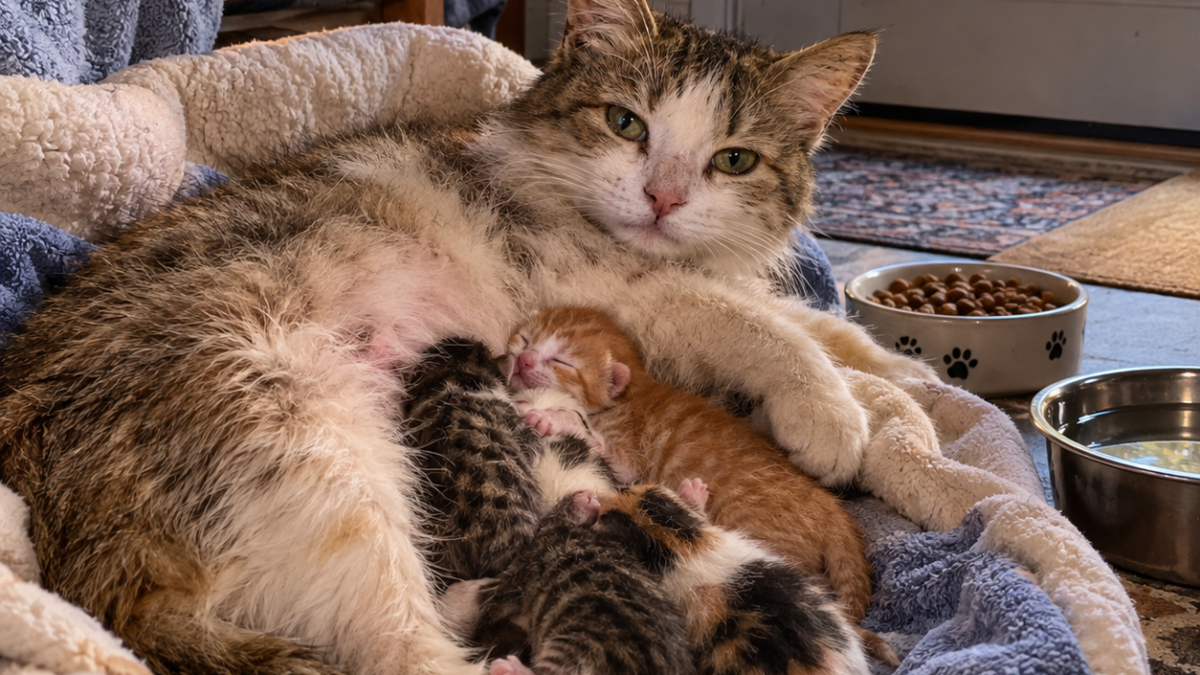
Mara nursed four.
She looked exhausted.
I called Beth again.
“Ultrasound said four or five.”
“Is she still contracting?”
“Not that I can see.”
“Relaxed?”
“Yes.”
“Eating?”
“Not yet.”
“If she appears comfortable, sometimes that’s all.”
“Any straining?”
“No.”
“We can recheck in morning.”
At 6:20, Mara stood.
I panicked.
She stepped out of box.
Walked to water.
Drank.
Ate half a bowl.
Then returned.
Four kittens.
That was the family.
I named none of them for three days because I was afraid.
That sounds irrational.
They were healthy.
Mara was healthy.
The vet checked all five that afternoon.
No retained fetus.
No fever.
Four good kittens.
Still, I knew neonatal kittens were fragile.
I had spent enough time reading rescue websites at three in the morning to understand how quickly things could change.
So they were:
Black one.
Orange one.
Gray one.
Stripey one.
My sister hated that.
At day four, names happened anyway.
Black male: Bean.
Orange-and-white female: Penny.
Gray female: June.
Tabby male: Scout.
Mara was extraordinary.
Not perfect.
Extraordinary.
She nursed constantly.
Cleaned them.
Moved them if I repositioned bedding wrong.
If one squeaked from more than twelve inches away, her head snapped up.
She trusted me near them.
Mostly.
The first time I picked up Bean to weigh him, Mara stood.
Watched.
I showed him.
“I’m not stealing your child.”
She followed my hand.
I put him back.
She sniffed him.
Then me.
Approved.
By the end of week one, weighing became routine.
Mara sat beside the scale.
Each kitten up.
Numbers written.
Back.
If I took too long, she tapped my arm.
Of course.
The first real scare came with Scout.
Day nine.
He gained less overnight.
Only three grams.
Maybe nothing.
I weighed again.
Same.
Mara had been nursing.
Scout seemed warm.
Active.
But smaller.
I called Dr. Patel.
“Monitor.”
“Make sure he gets access.”
“Weigh twice daily.”
I became obsessed.
I rotated stronger kittens briefly so Scout could nurse alone.
Mara tolerated this because everyone remained visible.
That night I slept beside the nesting box.
At 2:00 A.M., Scout was nursing.
At 5:00.
Again.
Morning weight:
plus eight grams.
I cried over a kitchen scale.
Mara ate breakfast while I told her:
“He’s fine.”
She looked uninterested.
Motherhood made my definition of success microscopic.
A gram.
A latch.
Warm paws.
A full belly.
Weeks passed.
Eyes opened.
Bean first.
Penny second.
June.
Scout last.
Their eyes were blue.
All kittens’ eyes begin that way.
I knew that intellectually.
Still felt like revelation.
At three weeks, they began walking.
Badly.
They looked like drunk potatoes.
Mara became more relaxed.
She left the box for longer stretches.
Sat at the window.
Slept beside me again for portions of the night.
The first time she climbed into bed and left all four kittens asleep in the other room, I understood something.
She trusted the house.
Before, she had needed to stay physically near them every moment.
Now she believed they would still be there when she returned.
That felt like the first real proof that she knew this place was safe.
My search for an owner continued.
Less urgently.
Not because I wanted to steal her.
Because every week made the absence harder to explain.
No microchip.
No missing-pet report.
No poster.
No call.
I drove through surrounding neighborhoods looking for LOST CAT flyers.
Nothing.
Then on day twenty-six, I got a message.
I think that’s my cat.
My heart stopped.
The sender’s name was Kyle Mercer.
He lived fourteen miles away.
He sent a photograph.
Gray-and-white female.
Similar.
Very.
I stared.
The markings around eyes looked close.
Maybe exact.
He called.
“She disappeared six weeks ago.”
“What’s her name?”
“Luna.”
I looked toward Mara nursing kittens.
“What happened?”
“Door got left open.”
“Is she spayed?”
Pause.
“No.”
“Any chip?”
“No.”
“How old?”
“Two.”
“Distinct markings?”
Kyle described a white patch under chin.
Mara had it.
A dark spot on one rear leg.
Mara had something similar.
My stomach tightened.
Maybe the story was over.
Someone had been looking.
Maybe not effectively.
But looking.
I asked:
“Can you send more photos?”
He did.
Ten.
Some blurry.
Some old.
The cat looked close enough to hurt.
I contacted Dr. Patel.
She recommended an in-person identification but cautioned that many cats resemble each other.
Kyle came that evening.
I put Mara in bedroom.
Kittens remained.
Kyle walked in.
He looked nervous.
“I really think it’s her.”
I opened door.
Mara saw him.
No reaction.
Kyle crouched.
“Luna.”
Mara stopped.
Looked.
Then walked past him directly to me.
That proved nothing.
Cats can react unpredictably.
Kyle reached.
Mara moved away.
He looked crushed.
“She used to do that sometimes.”
I asked:
“Any scars?”
“She had a little nick in left ear.”
Mara’s ears intact.
“White paws?”
“Back feet, yes.”
Mara had only one partial white back foot.
Kyle showed clearer photo.
His cat had a white line across nose.
Mara’s stopped beneath eye.
Not same.
Close.
Not same.
Kyle sat on couch.
“Oh.”
“I’m sorry.”
He nodded.
“Me too.”
He looked at kittens.
“She had babies?”
“Yes.”
He smiled sadly.
“They’re cute.”
Before leaving, he asked if he could pet Mara once.
I said:
“If she lets you.”
He held hand out.
Mara sniffed.
Accepted one cheek scratch.
Kyle laughed.
“Not Luna.”
“No?”
“Luna bit strangers.”
He left.
I posted his missing cat information in every group I had used.
Three weeks later, someone found Luna two towns away.
Kyle sent me a photo.
I was relieved.
And ashamed at how relieved I was that Mara was not his.
That was the moment I stopped pretending she was temporary in my heart.
Legally, practically, responsibly, I still followed found-animal procedures.
But emotionally?
She was already home.
The kittens grew.
At five weeks, my house became impossible.
They climbed everything.
Penny discovered curtains.
Bean attacked shoelaces.
June sat inside food bowls.
Scout became fearless after starting as the smallest.
Mara looked exhausted in an entirely different way.
Less endangered.
More annoyed.
She would lie in the center of living room while four kittens assaulted her tail.
Sometimes she walked onto couch and stared at me.
“This was your choice.”
I told her.
Tap.
“Don’t blame me.”
Tap.
“Fine.”
By six weeks, adoption discussions began.
That part felt wrong.
Not because kittens should stay forever.
Because the house had become full of them.
Noise.
Movement.
Little bodies.
Mara calling.
Kittens answering.
Suddenly I was expected to break it apart.
Dr. Patel reminded me gently:
“Kittens can begin going to homes around eight to ten weeks depending on health, vaccines, social development, and your rescue’s protocol.”
I had partnered with a local rescue to manage adoptions properly.
They screened applications.
Home requirements.
Veterinary references.
No impulse parking-lot handoffs.
I insisted Bean and Scout go together.
They wrestled constantly and slept touching.
The rescue agreed they seemed bonded.
Penny and June could go separately or together.
One couple applied for both.
Perfect.
So it happened in pairs.
Penny and June left first.
I cried after the door closed.
Mara searched for maybe twenty minutes.
Then returned to Bean and Scout.
Three days later, Bean and Scout left.
Mara watched carriers go.
That night, the house was quiet.
Too quiet.
I had wanted quiet once.
Now I hated it.
Mara walked room to room.
Closet.
Laundry.
Under couch.
Nesting box.
She called.
Once.
Then again.
I sat on floor.
“I know.”
She came to me.
Climbed into my lap.
First time she had done that since giving birth.
She stayed an hour.
The next morning she ate normally.
By day three, she stopped searching.
By week two, she seemed relieved.
She played.
Really played.
Not kitten supervision.
Not defensive monitoring.
A toy mouse flew across kitchen at midnight because Mara discovered she could entertain herself.
She gained weight.
Her coat changed.
That amazed me.
The dullness disappeared.
Soft gray.
Bright white.
Tail fuller.
Eyes clearer.
Her entire body became evidence of what regular food and safety could do.
She was spayed after her milk dried up.
The rescue paid.
I officially adopted her the same day.
The paperwork asked:
NAME:
Mara Bennett.
I smiled.
“Bennett?”
The rescue coordinator asked.
“My last name.”
“Making it official?”
“She’s been paying no rent for three months.”
Mara sat in carrier glaring.
The coordinator laughed.
“Congratulations.”
On the ride home, Mara screamed as if being kidnapped.
I told her:
“You’re going home.”
She screamed louder.
Some things did not improve with trust.
Her four kittens thrived.
Penny and June went to a young couple, Naomi and Claire.
Bean and Scout to a family with a twelve-year-old boy.
Photos came constantly at first.
Then monthly.
Then birthdays.
Penny grew long-haired.
June became tiny and bossy.
Bean became enormous.
Scout remained mischievous.
Mara did not seem interested in phone photos.
Good.
Humans need narrative closure more than cats do.
A year passed.
Then two.
Mara became the center of my routines without asking permission.
Morning:
She sat beside coffee machine.
Work:
She occupied the chair behind me.
Bathroom:
Guard duty.
Dinner:
She supervised.
Bed:
Always the same.
Curled beside my hip.
Sometimes, before falling asleep, I remembered that first night.
Outside.
Cold.
Dirty fur.
Round belly.
Eyes still scanning.
The way she collapsed into sleep inside the laundry room.
That was the image that stayed.
Not birth.
Not kittens.
Not adoption.
Sleep.
Because sleep is trust made physical.
You cannot remain fully vigilant and deeply asleep at the same time.
Something had to be surrendered.
For Mara, that surrender happened almost immediately.
Why me?
I still do not know.
Maybe my porch was closest.
Maybe she smelled food.
Maybe she had approached three houses before mine.
Maybe some stranger had once been kind and taught her humans could be useful.
Maybe she was simply exhausted.
We love assigning destiny after the fact.
She chose you.
She knew.
She found her person.
Maybe.
Or maybe a tired pregnant cat needed a door, and mine opened.
That is enough.
Three years after Mara arrived, my life changed too.
Not because of magic.
No dramatic transformation.
I still had the same job.
Same house.
Same grief.
But I volunteered one Saturday a month with the rescue that had helped place the kittens.
Mostly paperwork.
Transport.
Cleaning.
I learned how many animals arrive without stories anyone can confirm.
Friendly cats found near apartment complexes.
Dogs tied outside closed stores.
Senior pets surrendered after owners enter hospitals.
Kittens in sheds.
Cats whose humans die.
Animals who simply appear.
At first, I wanted explanations for all of them.
What happened?
Who failed them?
Was someone cruel?
Did someone dump them?
The rescue director, Helen, corrected me repeatedly.
“We know what we know.”
“That’s all.”
“But how can a friendly cat just be outside?”
“Lots of ways.”
“Some bad.”
“Some tragic.”
“Some accidental.”
“Don’t invent an enemy because it makes the story cleaner.”
I remembered Mara.
No owner.
No chip.
Pregnant.
Affectionate.
Could have been abandoned.
Could have wandered.
Could have escaped during a move.
Could have belonged to an elderly person taken to hospital.
Could have been fed by someone who never considered her theirs.
I never learned.
At some point, uncertainty stopped feeling unfinished.
Mara was safe.
That was the answer that mattered.
My mother would have loved her.
That thought came often.
My mother had adored cats.
When I was ten, she rescued a kitten from beneath a grocery cart return.
She named him Chester.
He lived eighteen years.
After she died, I had convinced myself I did not want an animal.
Too much responsibility.
Travel complications.
Vet bills.
Heartbreak.
All true.
Then Mara sat on my back step and apparently ignored the committee decision.
One evening, I found an old voicemail from my mother.
Accidental preservation.
Her voice:
“Call me when you get this.”
Nothing profound.
I listened twice.
Then cried.
Mara came from bedroom.
Jumped onto couch.
Sat beside me.
Did not climb onto lap.
Did not perform comfort.
She simply stayed.
I scratched behind her ears.
That was enough.
Four years after adoption, Bean developed a urinary obstruction.
His family messaged me from emergency clinic.
I drove there.
Why?
I don’t know.
He was not my cat.
But he had been born in my closet.
That creates a strange category.
Former responsibility.
Permanent concern.
Bean recovered.
His family cried.
I cried.
We sent Mara a photo.
She licked her paw.
Unmoved.
I told her:
“Your son is dramatic.”
Mara yawned.
At five, she developed a habit of sitting by the back door around sunset.
Not asking to go out.
Just sitting.
Watching through glass.
That unsettled me initially.
Was she remembering?
Wanting outside?
I opened door once while holding her securely.
Cold air.
Leaves.
Mara leaned backward.
Climbed up my chest.
No interest.
I closed it.
She returned to floor.
Sat.
Watched.
Maybe the door had meaning.
Maybe not.
I stopped interpreting everything.
Cats deserve mystery.
At six, she started sleeping on my pillow.
At seven, she developed mild dental disease.
At eight, arthritis began.
Nothing unusual.
Life.
I installed pet steps beside bed.
She ignored them.
Jumped anyway.
Then one evening missed.
Pretended she hadn’t.
I moved steps directly in her route.
She used them only when I looked away.
Pride.
At nine, Scout died unexpectedly.
Heart condition nobody knew existed.
His family called me.
I sat in kitchen afterward.
Mara was eating.
I watched her.
One of her kittens was gone.
Did she know?
No.
Would knowing matter?
Impossible question.
I grieved for both of us.
Maybe unfairly.
Maybe only for myself.
I pulled out newborn photos.
Scout at ninety grams.
Tiny striped body.
Mara’s paw around him.
Nine years.
Not enough.
Also nine years he would not have had if Mara had never found a door.
That thought helped.
Bean, Penny, and June grew older.
Bean developed diabetes at eleven.
Managed.
Penny became deaf.
June remained bossy.
Their families sent updates.
Mara entered senior years.
At twelve, kidney values began drifting.
At thirteen, she needed medication.
At fourteen, more sleep.
I learned subcutaneous fluids.
She hated the setup.
Needle.
Bag.
Line.
Every other day.
She tolerated because treats followed.
Sometimes she tapped my arm afterward.
Same old gesture.
Pet me.
I did.
Tap.
“Still demanding.”
Purr.
By then, I had told her story hundreds of times.
Friends.
Neighbors.
Volunteers.
People always loved the same detail.
“She came to your door pregnant?”
“Yes.”
“She chose you.”
Maybe.
“You saved her.”
That part always made me uncomfortable.
Because Mara had done most of the difficult work before I knew her.
She had carried kittens.
Found food.
Stayed alive.
Walked through whatever distance separated her previous life from my yard.
Approached a stranger.
Trust was her gamble.
I just happened not to punish it.
That is not nothing.
But it is different from heroism.
The more accurate version is:
She asked.
I answered.
Years later, Helen called me about another cat.
Very friendly pregnant female.
Found behind grocery store.
“Absolutely not.”
I said.
Helen laughed.
“I didn’t ask you to foster.”
“Good.”
“I need transport.”
“Oh.”
I drove.
The cat sat in carrier.
Cried.
At clinic, she rubbed my fingers through door.
For one second, the past overlapped.
Mara.
Porch.
Cold.
Then I remembered every animal gets its own story.
I delivered her.
Went home.
Mara was asleep.
I sat beside her.
“You started something.”
She opened one eye.
Closed it.
At fifteen, her kidneys worsened significantly.
Weight fell.
Appetite fluctuated.
Dr. Patel still practiced, though now silver threaded her hair.
She examined Mara.
Looked at labs.
Then at me.
“We can support.”
“How long?”
“No honest way to know.”
“Weeks?”
“Maybe.”
“Months?”
“Possible.”
“A year?”
“Less likely.”
I nodded.
“What does support look like?”
Fluids.
Anti-nausea medication.
Appetite stimulant.
Renal diet if she would eat it.
Comfort.
Monitoring.
Mara responded well for four months.
Good months.
She sat in sun.
Ate.
Slept beside me.
Still waited outside bathroom.
Then one week she changed.
No dramatic collapse.
She simply stopped being interested in food.
Even tuna.
That frightened me.
Mara loved tuna enough to commit crimes.
I opened a can.
Nothing.
She sniffed.
Turned away.
I called Dr. Patel.
Appointment next morning.
The labs were worse.
Much worse.
I knew before Lena spoke.
“What would you do?”
I asked.
Veterinarians hate that question.
She answered carefully.
“If she were mine, I would be thinking about whether we can still create more good days than difficult ones.”
Mara sat on towel.
Thin.
Old.
Still purring because I was touching her.
I asked:
“Is she suffering?”
“She’s nauseated.”
“Weak.”
“Probably uncomfortable.”
“Can we fix it?”
“Temporarily, maybe.”
I understood.
“Can we go home?”
“Yes.”
I took her home.
One last night.
Not because I wanted her to endure.
Because she was stable enough and I wanted goodbye to happen there.
I placed blankets on bed.
Opened window slightly.
Cool evening air.
Mara climbed onto her spot beside my hip.
Slowly.
Using steps.
She curled.
Exactly like first night.
Smaller now.
Older.
But the same shape.
I stayed awake.
Around midnight, I whispered:
“You know, this was supposed to be one night.”
Mara purred faintly.
“You were supposed to eat chicken and leave.”
Her eyes remained closed.
“You were very bad at that.”
Purr.
“You brought four babies.”
Purr.
“You destroyed my curtains.”
Nothing.
“That was Penny, technically.”
I smiled through tears.
At three, I remembered the laundry room.
The first night.
The way she slept.
Deep.
Safe.
I realized what I wanted for her now was the same thing.
No searching.
No vigilance.
No fear.
Rest.
Dr. Patel came at ten the next morning.
Home visit.
Mara lay on my bed.
Sun came through curtains.
I sat beside her.
Lena examined.
“Ready?”
No.
“Yes.”
Sedation first.
Mara relaxed gradually.
Her head sank into my palm.
Purring stopped.
Not from pain.
Sleep.
I stroked her.
“I’ve got you.”
Lena waited.
I whispered:
“You don’t have to keep looking anymore.”
That was the sentence.
Not planned.
It came from the porch fifteen years earlier.
A tired cat wandering without an owner anyone could find.
Searching for something.
I wanted her final moment to know the search was over.
Medication.
One breath.
Another.
Then stillness.
I cried harder than I had after some people died.
Grief does not respect categories.
Lena let me sit.
Eventually she asked:
“What do you want to do with her ashes?”
I had thought.
“Bring them back.”
Weeks later, the urn arrived.
Small.
Too small.
I placed it near the back door.
Not permanently.
Just initially.
Then one evening I sat on steps.
Same porch light.
Same wet-leaf smell.
Different year.
I thought about where Mara came from.
Still no answer.
Fifteen years and no answer.
I had once believed that mattered.
Now I knew better.
A life does not require a complete prologue to become meaningful.
We met in the middle.
That was enough.
The three surviving kittens outlived her briefly.
Penny died at sixteen.
Bean at sixteen and a half.
June made seventeen.
Their families kept in touch.
The four kittens born in my closet collectively lived more than sixty years.
That number stunned me.
Sixty years of windows.
Food bowls.
Vet visits.
Beds.
Sunbeams.
People.
All beginning with one tired animal sitting outside one door.
I started volunteering more after Mara died.
Not immediately.
For months, I couldn’t look at gray-and-white cats without my chest tightening.
Then one Saturday I returned.
Laundry.
Always laundry.
A young volunteer handed me a towel.
“You’re Mara’s person, right?”
I smiled.
“Was.”
“She’s famous here.”
“She would hate that.”
The rescue had used her story in orientation.
Not for sentimentality.
For something Helen called the Found Animal Rule.
Do not assume.
Friendly does not guarantee owned.
Dirty does not guarantee abandoned.
Pregnant does not prove neglect.
Fear does not prove abuse.
Affection does not prove history.
Search properly.
Check microchip.
Report found animal.
Document.
Provide safety.
Let facts remain facts.
Mara had taught them through uncertainty.
A volunteer once asked me:
“But don’t you think someone dumped her?”
I answered:
“Maybe.”
“Doesn’t that make you angry?”
“I don’t know whether it happened.”
“What if it did?”
“Then I’m angry at something I know.”
“And if it didn’t?”
He thought.
I continued:
“Compassion doesn’t need a villain.”
That line came from Helen.
I stole it.
She approved.
Years later, I moved from the house.
That was harder than expected.
The back steps.
Closet where kittens were born.
Window Mara used.
Bathroom door she guarded.
All just architecture.
Also not.
Before leaving, I sat on the porch one final evening.
New owners were a young couple with a toddler.
They had a dog.
I told them nothing dramatic.
Only:
“A cat once showed up here and stayed fifteen years.”
The woman smiled.
“That’s sweet.”
“Yes.”
I did not need them to understand more.
I moved Mara’s urn with me.
New apartment.
Different city.
Smaller.
No back steps.
I placed her photograph near a window.
The photo I chose was not from the night she arrived.
Not pregnant.
Not exhausted.
Not mothering kittens.
Mara at age seven.
Fat.
Healthy.
Asleep on her back.
Feet in air.
Completely undignified.
That was the life I wanted remembered.
Not the crisis that brought her to me.
The safety that came afterward.
That distinction became important in rescue work.
People love before-and-after pictures.
Starving then healthy.
Dirty then clean.
Scared then cuddling.
They are powerful.
But sometimes we accidentally trap animals forever inside their worst day because that is the day humans found emotionally useful.
Mara had been more than a pregnant stray.
She was impatient.
Affectionate.
Possessive about pillows.
Terrified of carriers.
Obsessed with tuna.
Suspicious of men wearing hats.
Loved paper bags.
Hated closed bathroom doors.
Learned to open one cabinet and ignored every attempt to childproof it.
She spent fifteen years being ordinary.
That was the triumph.
Not surviving long enough to give birth.
Not finding my porch.
Becoming ordinary.
Safety is ordinary.
That is why people who have always had it can underestimate its value.
A full bowl every morning.
Door that stays closed against weather.
A veterinarian when sick.
A person who notices appetite changes.
A blanket.
A name.
Someone expecting you home.
None of it looks cinematic.
It is everything.
One winter, years after moving, I fostered a cat again.
My first.
Helen called.
“You sure?”
“No.”
“Good answer.”
The foster was a five-year-old black cat named Theo.
Owner had died.
He hid under bed for eleven days.
Would not let me touch him.
Nothing like Mara.
On day twelve, he ate while I sat in room.
Day seventeen, he came out.
Day twenty-three, he sniffed my hand.
Day thirty-one, he rubbed against chair.
Someone asked:
“Does he cuddle?”
“No.”
“Then how do you know he likes you?”
I looked at Theo sleeping six feet away with his back toward me.
“Because he sleeps.”
There it was again.
Sleep.
Trust does not always look like affection.
Sometimes it looks like turning your back.
Closing eyes.
Not checking door.
Theo was adopted by an older man.
Perfect match.
I cried.
Of course.
Then fostered again.
Not constantly.
Enough.
Every animal different.
None Mara.
Good.
I did not need another Mara.
She had completed her part.
What she changed stayed.
I became the person who checked porch twice.
Who carried spare cat food in car.
Who knew rescue phone numbers.
Who scanned community posts for lost pets.
Who understood how quickly an ordinary evening can become responsibility.
People sometimes call that being chosen.
Maybe.
I think it is noticing.
Mara noticed me too.
That part is easy to forget.
She took risk.
Walked toward a human.
Rubbed my leg.
Sat at door.
Waited.
She could have chosen another porch.
Maybe she had.
Maybe nobody opened.
I will never know.
What I do know is that she asked clearly in the only ways available.
Food.
Touch.
Door.
Stay.
I answered.
Chicken.
Water.
Laundry room.
Then vet.
Then nest.
Then years.
That is how permanent things sometimes begin.
Without ceremony.
No plan.
No permission.
Just:
Can I stay tonight?
And then one night becomes fifteen years.
On the anniversary of Mara’s death, I still make tuna.
Not for ritual exactly.
Usually I eat some.
The smell makes me think of her.
Once my niece visited and asked why there was a framed picture of a cat beside my mother’s picture.
“Family.”
I said.
She accepted immediately.
Children often understand categories better when adults stop overexplaining.
Mara had arrived carrying four lives.
She left having changed more than four.
Mine.
The adoptive families.
Rescue volunteers.
People who read her story.
Not because she was extraordinary in some mythical way.
Because she was an animal who needed something and trusted someone enough to ask.
That is vulnerable.
It deserves respect.
The version people prefer is:
Pregnant stray chooses kind stranger.
Finds perfect home.
Happy ending.
Reality contained more uncertainty.
I was not always kind.
I got frustrated when kittens destroyed things.
I complained about vet bills.
I resented interrupted sleep.
Mara scratched a couch I loved.
I yelled once.
She hid.
I felt terrible.
We repaired it.
I traveled and worried.
She got sick.
I made mistakes.
There was no perfect rescue.
Only commitment.
That is what “forever home” actually means.
Not endless happiness.
Staying through the inconvenient parts.
The expensive parts.
The aging parts.
The parts where the animal no longer resembles the cute photo that made you say yes.
Mara arrived young.
Pregnant.
Beautiful despite dirt.
She ended old.
Thin.
Kidney failure.
Still mine.
Especially then.
I think about that whenever people say:
“You gave her a home.”
True.
But she also gave my house a reason to feel occupied.
Before Mara, it had been shelter.
Address.
Mortgage.
Furniture.
After Mara, there was a living thing waiting.
That changed the emotional geometry.
Coming home became arriving somewhere someone noticed.
That is not small.
Maybe that is why I understand her first night differently now.
I had assumed she was searching for a safe place to have kittens.
She probably was.
But maybe safety works both directions.
She found a room where she could sleep.
I found a reason to wake up and check another heartbeat.
Neither of us announced the arrangement.
It simply grew.
Years after everything, one of Mara’s kittens—June—sent me a final gift without knowing it.
Her family mailed a small envelope after she died.
Inside was a photograph.
June asleep beside a window.
On the back:
She always slept curled exactly like her mother.
I stared at it.
Same tight ball.
Tail over nose.
For one second, I saw Mara on my laundry-room towel.
First night.
Exhausted.
Pregnant.
Finally asleep.
I turned the photo over again.
June had lived seventeen years.
Safe enough to sleep like that thousands of nights.
Mara had given her that chance before finding me.
Then together, somehow, we kept it going.
That is the part I carry.
Not mystery.
Not abandonment.
Not whether someone failed before.
The chain afterward.
One door opened.
Four kittens born.
Four homes.
Decades.
Everything that followed.
There is a temptation to believe rescue begins when a human intervenes.
Sometimes it begins earlier.
With an animal surviving one more block.
Trying one more yard.
Approaching one more person.
Sitting beside one more door.
Mara had already done the first half.
She found me.
All I had to do was notice she was asking.
The first evening, I thought:
Someone must be looking for you.
Maybe no one was.
Maybe someone had been.
Maybe somewhere, years later, someone saw a picture and wondered.
I hope not.
Not because I wanted to erase a previous person.
Because I hope nobody carried unresolved grief while Mara was safe with me.
But if someone had loved her before, I would tell them this:
She was warm.
She ate well.
She raised four kittens.
She hated carriers.
She slept beside me.
She got old.
She was loved all the way through.
She did not spend the rest of her life searching.
And if no one had loved her before, then at least someone did afterward.
That is the only certainty I can offer.
On that first night, Mara finished the food I gave her and curled beside my door.
She could have left.
I could have closed the curtain.
Instead, I opened the door one more time.
She walked inside.
No hesitation.
As if we had already agreed.
Years later, when I replay the moment, I no longer think she came looking only for somewhere to give birth.
I think she came looking for permission to stop moving.
For one place where food would still exist tomorrow.
Where footsteps did not automatically mean danger.
Where a closed door could keep danger out instead of keeping her away.
Where her babies could arrive without her needing to hide them beneath a shed or inside a drainage pipe.
Where she could finally sleep so deeply that she stopped listening for whatever had followed her before.
And somehow, without intending to, she found it.
Then stayed long after the babies were gone.
Long enough to become gray around the face.
Long enough to know every room.
Long enough to make the house hers.
Long enough that after she died, I still occasionally expected to hear one paw tapping my arm when I stopped petting too soon.
That is how I know where she belonged.
Not because she appeared pregnant.
Not because nobody claimed her.
Not because the paperwork eventually had my name.
Because for fifteen years, she never again sat outside my door waiting to be let in.
She was already home.



