A Police K9 Refused to Leave a Little Boy’s Hospital Bed—Then the Surgeon Found Something No Scan Had Shown
PART3:
Not for himself.
For the boy.
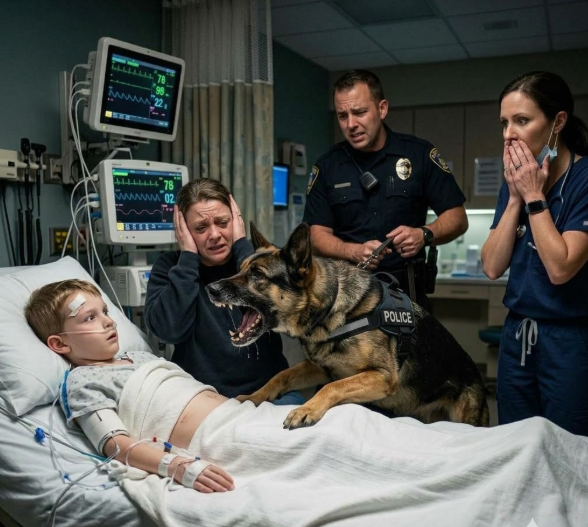
The dog’s ears flattened for half a second, as if apologizing, then he turned back to Noah and pressed his nose gently against the blanket beneath the boy’s left ribs.
He sniffed.
Paused.
Sniffed again.
Then he whined.
It was small.
Almost swallowed.
The sound of an animal trying to tell humans something in a language none of them deserved to understand.
Angela lowered her chart.
“He keeps doing that.”
Emily looked up.
“What?”
“That spot.” Angela pointed carefully. “Every time I come near him, Ranger goes to that same spot.”
Caleb felt a cold line move through his chest.
On the bed, Noah’s eyes fluttered.
His lips moved under the oxygen tube.
Emily leaned closer instantly.
“Baby? Noah? Mommy’s here.”
Noah’s eyelids opened halfway. His pupils wandered, unfocused and glassy from pain medication and exhaustion. He looked past his mother, toward the dog.
“Ranger,” he whispered.
The dog’s tail moved once.
Caleb tried to guide Ranger back.
The dog resisted, paws braced against the floor.
Angela looked toward the hallway.
“I need Dr. Cole.”
At the sound of the doctor’s name, Caleb turned.
Dr. Hannah Cole appeared in the doorway thirty seconds later, tying her hair back with one hand and holding a tablet in the other. She was thirty-eight, pediatric trauma surgeon, sharp-eyed, sleep-deprived, and built from the kind of quiet discipline that made interns stand straighter when she entered a room.
She had been awake for twenty-one hours.
It did not show except around her eyes.
“What happened?”
Angela answered before Caleb could.
“The dog blocked me when I tried to turn him.”
Hannah looked at Ranger.
Then at Caleb.
“Officer, the dog cannot interfere with care.”
“I know.”
“Then remove him.”
Caleb’s jaw tightened.
“I tried.”
Hannah’s expression changed slightly.
The words did not make sense to her.
She looked down at Ranger.
“Is he trained?”
“Yes, ma’am. Highly.”
“And he won’t obey?”
“No, ma’am.”
Ranger pressed his nose again to the same spot below Noah’s left rib cage, then lifted his head and stared at Hannah.
Not at Caleb.
At the surgeon.
Hannah folded her arms.
“Why does he keep doing that?”
No one answered.
Because no one knew.
Outside the room, hospital administrator Mark Feldman arrived in a dark coat over wrinkled dress pants, his tie pulled loose, his face carrying the annoyed exhaustion of a man dragged from sleep into liability.
“What is a police dog doing in my ICU?”
Emily stood so fast the chair nearly tipped.
“He found my son.”
Feldman held up both hands in a calming gesture that calmed no one.
“Mrs. Bennett, I understand emotions are high.”
“No, you don’t.”
He ignored that.
“But this is a pediatric intensive care unit. We have infection control concerns, staff safety concerns, legal concerns—”
Ranger growled again.
Feldman stopped mid-sentence.
His eyes widened.
Caleb stepped in front of Ranger.
“He’s not going to attack.”
“He just threatened hospital staff.”
“He warned her not to touch him.”
“That is not better.”
Dr. Hannah Cole looked at Noah’s monitor.
Heart rate slightly elevated.
Oxygen acceptable.
Blood pressure low-normal, but he had been through a traumatic crash. Everything in his chart looked bruised, battered, painful, frightening—but not surgical. Not yet.
She had reviewed the scans herself.
Head CT: concussion, no bleed.
Chest film: bruising, one hairline rib fracture, no collapsed lung.
Abdominal CT: no clear active bleeding, no obvious organ rupture.
FAST ultrasound: negative.
Labs: acceptable.
Noah Bennett was injured, but stable.
That was what the machines said.
Ranger’s body said everyone in that room was wrong.
Feldman pointed toward the door.
“Officer, remove the dog.”
Emily stepped toward him.
“Please don’t. Noah wakes up when he hears him breathe.”
“Mrs. Bennett—”
“He was in the woods alone. In the rain. That dog found him before anyone else did.”
Her voice cracked.
“If Ranger wants to stay by his bed, then maybe we should ask why.”
Feldman sighed.
“With respect, ma’am, dogs do not make clinical decisions.”
Ranger placed one paw on the bed frame and whined again.
Noah’s fingers twitched.
His lips moved.
Emily bent down.
“What, baby?”
Noah’s voice was barely air.
“Hurts.”
Hannah stepped closer.
“Where, Noah?”
His eyes rolled weakly toward Ranger.
“The dog knows.”
Then he slipped back under.
The room went silent.
Two hours earlier, Noah Bennett had been lying in a ditch eighty yards from the twisted wreckage of his mother’s car, half-buried in mud and leaves while cold rain fell through the trees.
That night had started with cupcakes.
Emily had taken him to his grandmother’s birthday dinner outside Ashton Creek, a small town tucked against forested hills in northern Oregon. Noah had worn his dinosaur sweatshirt because he wore it whenever laundry and weather allowed. He had eaten two cupcakes, given his grandmother a drawing of a dragon wearing reading glasses, and fallen asleep in the back seat before Emily turned onto County Road 12.
The rain began lightly.
Then harder.
By 8:40, the windshield wipers were losing the argument.
Emily drove slowly, both hands on the wheel, headlights cutting tunnels through fog and rain. Noah slept behind her, his stuffed blue dinosaur tucked under his chin.
She remembered the song on the radio.
She remembered thinking she needed gas in the morning.
She remembered seeing headlights crest the hill ahead too fast.
A pickup truck, drifting over the center line.
Emily hit the horn and swerved right.
The pickup corrected too late.
Her tires left the pavement.
The car dropped into gravel, bounced hard, and slid sideways down the embankment. Emily screamed Noah’s name as the world turned metal, glass, trees, and mud. The car rolled once, maybe twice. Something slammed into her shoulder. The windshield shattered. The roof crushed down with a sound like the sky breaking.
Then there was silence.
Not real silence.
Rain hit metal.
Steam hissed.
Somewhere, a wheel spun uselessly.
Emily’s ears rang so hard she thought she was underwater.
She woke with her face against the steering wheel and blood in her mouth.
Her first thought was not pain.
It was Noah.
She twisted, screamed at the pull in her ribs, and looked into the back seat.
The booster seat was empty.
“Noah?”
Her voice sounded wrong.
Small.
“Noah!”
The rear passenger door hung open.
The seat belt strap had torn loose where the crash had wrenched the booster sideways. His stuffed dinosaur lay on the floor mat, soaked with rain blowing through broken glass.
Emily clawed at her seat belt.
It jammed.
She screamed until her throat burned.
Cars passed above on the road without seeing the wreck in the dark below.
She found her phone beneath the pedals and called 911 with fingers slick with blood.
“My son,” she kept saying. “My son is gone. He was in the back. He’s gone.”
By the time the first cruiser arrived, Emily had nearly torn skin from her wrist trying to pull herself free.
Firefighters cut her out.
Paramedics tried to put her on a stretcher.
She fought them.
“My son is out there!”
Deputies swept flashlights through the trees.
The rain destroyed everything.
No footprints.
No clear trail.
Only mud, leaves, broken branches, and darkness.
That was when Officer Caleb Mercer arrived with Ranger.
Caleb had been eight miles away finishing a call about a break-in at a feed store when dispatch reported a child missing from a crash scene. He knew the road. Knew the ravine. Knew how cold the water ran at the bottom after rain.
He did not waste words when he arrived.
“Article?”
A firefighter handed him the stuffed dinosaur.
“Found in the back.”
Ranger sniffed it once.
Then again.
His whole body changed.
To most people, it looked like excitement.
To Caleb, it looked like focus so complete the rest of the world disappeared.
“Find him,” Caleb said.
Ranger lunged into the trees.
Caleb ran behind him, slipping down mud, branches whipping his face. Flashlights bobbed behind them. Rain flattened sound, then threw it back strangely. Men shouted Noah’s name. Emily screamed from near the ambulance until someone closed the doors to keep her warm, but they could still hear her through the metal.
Ranger pulled hard left away from the obvious slope.
One deputy shouted, “The creek’s that way!”
Caleb did not answer.
Ranger knew.
The dog crossed through brush so thick Caleb’s jacket tore. He scrambled over a fallen log, slid down a muddy bank, then stopped so abruptly Caleb nearly fell over him.
Ranger lowered himself to the ground beside a tangle of blackberry vines and whined.
At first, Caleb saw only mud.
Then a small shoe.
“Noah!”
The boy lay half on his side, half in a shallow run of water, caught against roots and brush. His face was gray. Rain plastered hair to his forehead. One arm was twisted beneath him. His lips had gone blue.
Caleb dropped to his knees.
“Found him!” he shouted. “I’ve got the boy!”
Ranger lay down beside Noah, pressing his body against the child’s back as if shielding him from the rain.
Noah did not wake.
Caleb checked his pulse.
There.
Weak.
But there.
“Hang on, little man,” Caleb said, his voice shaking once before he forced it steady. “We’ve got you.”
Ranger licked mud from Noah’s cheek.
The boy made a tiny sound.
Not a word.
Barely a breath.
But Ranger’s ears came up.
He had found Noah alive.
By the time they carried the child up the ravine, Ranger was soaked, scratched, and trembling with adrenaline. He refused to leave the ambulance until Caleb climbed in too. When they drove toward Children’s Regional Hospital, Ranger sat on the floor beside the stretcher, eyes fixed on Noah’s chest.
Every time Noah’s breathing changed, Ranger lifted his head before the monitor did.
At the hospital, they tried to separate them.
Ranger refused.
Caleb should have taken him outside.
He knew policy.
He knew the rules.
But Emily Bennett, strapped to her own gurney, saw the dog hesitate at the trauma bay doors and reached for Caleb with her uninjured hand.
“Please,” she said. “He found him.”
Caleb looked at Ranger.
Ranger stared at the doors Noah had disappeared through.
For reasons Caleb would later struggle to explain in any report, he said, “Five minutes.”
Five minutes became fifteen.
Fifteen became an hour.
By midnight, Ranger had been allowed into the pediatric ICU under “exceptional circumstances,” a phrase Feldman hated even when he invented it.
Now those circumstances stood in room 417 with teeth.
Dr. Hannah Cole believed in evidence.
She believed in labs, scans, pressure readings, anatomy, controlled decisions, and the terrible humility of knowing the body could betray both doctor and patient without warning.
She did not believe in miracles.
She had seen too many parents beg for them and leave without one.
She did not believe dogs diagnosed abdominal injuries.
But she believed in observation.
And Ranger was giving them something to observe.
“Show me what he does,” she said.
Feldman turned.
“Dr. Cole—”
She raised one hand without looking at him.
“Angela, step toward the left side of the bed again. Slowly.”
Angela looked at the dog.
Then at Caleb.
“Are we sure about this?”
“No,” Caleb said.
Angela gave him a look.
“Appreciate the honesty.”
She moved one step toward Noah.
Ranger stood.
No growl yet.
Angela took another step.
Ranger’s ears went forward.
Angela reached toward the blanket near Noah’s shoulder.
Nothing.
She moved her hand lower, toward the left ribs.
Ranger growled.
Hannah’s eyes narrowed.
“Again. From the other side.”
Angela circled carefully to Noah’s right.
She touched the boy’s right shoulder.
No reaction.
Right hip.
No reaction.
Right ribs.
Ranger watched.
Angela reached across toward the left upper abdomen.
Ranger barked once, sharp enough to make Feldman jump backward into the IV pole.
Noah flinched in his sleep.
The monitor chirped faster.
Emily covered her mouth.
Hannah stepped to the bed herself.
“Ranger,” Caleb said softly. “Easy.”
The dog trembled.
Hannah slowly pulled the blanket down enough to expose Noah’s bruised torso.
There were marks everywhere.
Seat belt bruising across the lower abdomen. A purple bruise near his left side. Scrapes. Tenderness. Nothing unusual for a child thrown from a crash.
At least, nothing obvious.
She pressed gently along the right side.
Noah shifted but did not wake.
She pressed near the left.
Ranger whined.
Noah gasped.
His eyes opened wide for one terrifying second.
“Hurts!”
Emily stood.
“That’s where he keeps smelling.”
Hannah removed her hand.
Noah’s breathing eased, but not enough.
She looked at Angela.
“Get me his last CBC.”
Angela handed over the chart.
“Hemoglobin was fine.”
“When?”
“Eighty minutes ago.”
“Draw another.”
Feldman frowned.
“Doctor, the child has already been evaluated.”
Hannah did not look at him.
“Draw another.”
Angela moved immediately.
Feldman lowered his voice.
“Dr. Cole, we cannot allow a police animal to direct treatment.”
Hannah finally faced him.
“He isn’t directing treatment. He is reacting consistently to one anatomical location in a trauma patient who now has reproducible tenderness.”
“That sounds like you are dressing up a dog’s behavior in medical language.”
“That sounds like you should leave the room.”
Feldman’s mouth shut.
Caleb almost smiled.
Almost.
Ranger lowered his head again and sniffed Noah’s left side.
Then he looked at Hannah.
She hated that look.
Not because it was threatening.
Because it was too steady.
A memory rose before she could stop it.
Her first year as an attending, a father had kept telling them his daughter was “not acting right” after a fall. The scan looked acceptable. The numbers looked acceptable. The child looked sleepy, but children were often sleepy after trauma and medication. Hannah had been busy, overworked, overly confident.
Two hours later, the girl seized.
She survived.
Barely.
Hannah had never forgotten the father’s words.
She’s not acting right.
Doctors are trained to filter panic.
They have to.
If they chase every fear, every hunch, every whispered certainty, they hurt people. But sometimes, buried inside panic, there is data. Human data. A mother’s data. A father’s data. A dog’s data, apparently, though she could almost hear her old professors groaning.
She looked at Caleb.
“Has he ever done this before?”
“Not like this.”
“What does that mean?”
“It means he has alerted to blood. Fear. Human scent trails. Bodies. Evidence. But he doesn’t guard for no reason.”
“Could he be bonded to the boy because of the rescue?”
“Yes.”
“Could that make him overprotective?”
“Yes.”
“Could that explain why he reacts only when we touch one spot?”
Caleb held her gaze.
“No.”
The answer was too quick.
Too certain.
Hannah wanted to dismiss it.
She could not.
Angela returned after sending the bloodwork.
“Lab says twenty minutes.”
Hannah looked at Noah.
“We don’t wait twenty minutes if he changes. Repeat vitals every five.”
Feldman exhaled sharply.
“And the dog?”
Hannah looked at Ranger.
“He stays.”
For now.
The phrase hung unsaid.
Caleb heard it anyway.
For the next forty minutes, nothing dramatic happened.
That was the most dangerous part.
Noah slept.
His numbers stayed imperfect but explainable.
Emily sat beside him and stroked his foot through the blanket. Ranger lay beneath the bed rail with his head up, never relaxing, never taking his eyes off the boy’s side. Caleb stood against the wall, one hand on the leash, feeling the old, familiar helplessness coil through him.
Hospitals did that to him.
Always had.
Police work was movement.
Command.
Decision.
Risk.
Hospitals were waiting rooms where fear wore clean shoes.
When Caleb was twenty-seven, his younger brother Eli died in a hospital after a motorcycle crash.
Eli had been twenty-two.
Laughing one day, gone the next.
He had been conscious in the emergency department. Joking, even. Complaining about his ruined boots. Their mother had cried with relief because the scan showed nothing immediately catastrophic. Bruises. Broken wrist. Observation.
Caleb remembered Eli telling him, “Don’t look like that, man. You look like Dad at a tax hearing.”
Three hours later, Eli turned gray.
Internal bleeding.
A small vascular injury hidden deep, slow at first, then sudden.
Caleb remembered the surgeon’s face afterward.
Not cold.
Worse.
Sad.
“We didn’t see it in time.”
That sentence had lived inside Caleb for fifteen years.
We didn’t see it.
As if seeing were luck.
As if the body had hidden the truth and nobody could be blamed for failing to find it.
Maybe that was fair.
Maybe it was not.
Caleb had never decided.
What he knew was this: Ranger saw things people missed.
Not with magic.
With attention.
With nose, ears, instinct, training, and the absence of pride.
Ranger did not care what the first scan said.
Ranger did not care about hospital policy.
Ranger did not care whether a doctor felt challenged by a dog.
Something was wrong with Noah Bennett’s left side.
And Ranger knew.
At 3:06, Angela returned with the bloodwork.
Her face was too controlled.
Hannah saw it immediately.
“How much?”
“Down almost two points from arrival.”
Hannah took the paper.
Her eyes moved quickly.
Then again, slower.
“That could be dilution from fluids,” Angela said.
“It could.”
“But?”
Hannah looked at Noah’s abdomen.
“But I don’t like it.”
Feldman, who had not left because administrators have a gift for remaining where least wanted, stepped forward.
“Is this an emergency?”
“Not yet.”
“Then we proceed according to standard—”
Noah moaned.
Everyone turned.
His small body curled slightly toward the left.
Ranger stood so fast his claws scraped the floor.
Noah’s heart rate climbed.
The monitor chirped louder.
Emily leaned over him.
“Noah? Baby?”
His eyes opened halfway.
“Mommy.”
“I’m here.”
“Cold.”
Hannah touched his foot.
Cooler than before.
She looked at the monitor.
Blood pressure down.
Not crashing.
Not yet.
But down.
“Angela, call ultrasound. Bedside now. Also page radiology for review of the abdominal CT.”
Angela moved.
Hannah stepped closer to Noah.
“Sweetheart, can you tell me where it hurts?”
Noah’s lips trembled.
He looked toward Ranger.
The dog whined.
“There,” Noah whispered.
His small fingers twitched toward the same spot beneath his left ribs.
Then his eyes drifted shut.
Emily looked at Hannah.
“You believe him now?”
Hannah’s face softened for half a second.
“I believed he was in pain. Now I need to find out why.”
The bedside ultrasound showed fluid.
Maybe.
Not enough to satisfy everyone.
Enough to worry Hannah.
The radiologist on call reviewed the CT again and called back with the tone of a man who did not want to be dragged into a decision.
“There’s some artifact from motion. A lot of bruising. I don’t see active extravasation.”
“Look at the left upper quadrant again,” Hannah said.
“I did.”
“Look again.”
A pause.
“Dr. Cole, I can’t create a bleed because you want one.”
Her jaw tightened.
“I don’t want one.”
“You know what I mean.”
“I have a child with dropping hemoglobin, increasing localized tenderness, borderline pressure, and fluid that may be evolving.”
“You also have an initial scan that does not show a surgical abdomen.”
“Initial scans are not holy scripture.”
Another pause.
“I’ll review it again.”
“Thank you.”
She hung up.
Feldman spoke quietly.
“Dr. Cole, exploratory surgery on a child with equivocal imaging exposes this hospital to enormous risk.”
Hannah turned slowly.
“Do you think I don’t know that?”
“I think you are under emotional pressure.”
“I am always under emotional pressure. It’s pediatric trauma.”
“You are letting the mother and this officer influence you.”
“I am letting the patient influence me.”
“And the dog.”
Hannah looked at Ranger.
The dog stood beside Noah’s bed, nose hovering over the left side, shaking faintly.
“Yes,” she said. “And the dog.”
Feldman’s eyes widened as if she had confessed to witchcraft.
“This is reckless.”
“No. Reckless is ignoring a changing child because the first image made us comfortable.”
Caleb watched her then with something like gratitude.
Not relief.
Not yet.
But gratitude.
At 3:28, Feldman made the decision to remove Ranger.
He did it in the hall.
Not in front of Emily.
That was cowardly, Caleb thought, but not surprising.
“Officer Mercer, I’m giving you a direct administrative order. Remove the dog from the ICU. If you refuse, hospital security will contact your department.”
Caleb stared at him.
“My department already knows he’s here.”
“Then I’ll call your captain.”
“Do that.”
Feldman’s nostrils flared.
“You are not helping this child by creating chaos.”
Caleb looked through the glass at Noah.
Ranger stood motionless.
Emily sat pale beside the bed.
Hannah spoke with Angela near the monitor.
“I am not the one creating chaos,” Caleb said.
Feldman stepped closer.
“I understand you care about your animal.”
Caleb’s voice went cold.
“He’s not my animal.”
“No?”
“He’s my partner.”
“That may be meaningful to you. It is not a hospital category.”
Caleb almost said something that would have ended badly.
Instead, he opened the ICU door and stepped inside.
“Ranger,” he said.
The dog turned.
Caleb hated what he was about to do.
“Come.”
Ranger did not move.
“Ranger, come.”
The dog’s ears flattened.
Caleb approached slowly.
“Buddy.”
He clipped the shorter lead to Ranger’s harness.
The dog began to tremble.
Not with resistance at first.
With disbelief.
As if the one human he trusted most had failed to understand the only message that mattered.
Caleb swallowed.
“I’m sorry.”
He pulled gently.
Ranger resisted.
Not violently.
Just refused.
Caleb crouched.
“Ranger, I know.”
The dog stared at him.
“I know.”
Emily stood.
“No. Please.”
Caleb could not look at her.
“If he bites someone, they’ll force him out permanently.”
“He won’t bite.”
“You don’t know that.”
“He saved my son.”
“I know.”
“Then listen to him.”
The words hit Caleb harder than she intended.
He looked at Ranger.
The dog whined once.
Caleb pulled.
Ranger dug in.
A security guard appeared at the door, uncertain and unhappy.
Hannah looked over.
“What’s going on?”
“Administration wants him out,” Angela said.
Hannah’s eyes flashed.
“We are in the middle of reassessing—”
Feldman entered.
“The dog is leaving now.”
Ranger suddenly barked.
Not at Feldman.
At Noah.
The monitor alarmed.
Noah’s oxygen saturation dipped.
Heart rate spiked.
His body arched slightly, then folded.
Emily screamed.
“Noah!”
Ranger lunged toward the bed so hard Caleb lost grip of the short lead. The dog reached the side rail, put both front paws up, and pressed his nose hard against Noah’s left ribs.
Hannah was already moving.
“Angela, pressure?”
“Dropping.”
“Get the crash cart outside. Call the OR. Tell them possible internal bleed. Move now.”
Feldman stepped backward.
The security guard disappeared.
Noah’s lips had gone pale.
Emily sobbed, one hand on his hair.
“What’s happening?”
Hannah pulled the blanket back.
The bruise on Noah’s left side looked darker now.
Or maybe she simply understood it differently.
“We’re taking him to surgery.”
Feldman’s voice shook.
“Based on what?”
Hannah did not even look at him.
“Based on the fact that he is no longer stable.”
The room erupted into motion.
Nurses entered.
Lines checked.
Orders called.
Consent forms brought.
Emily’s hands shook so hard she could not hold the pen.
Hannah crouched in front of her.
“Mrs. Bennett. Listen to me. Noah may be bleeding internally. We didn’t see enough on the first scan, but he’s changing. I think if we wait, we may lose time we don’t have.”
Emily stared at her.
“Will he die?”
Hannah did not lie.
“He could.”
Emily made a sound that seemed to come from somewhere deeper than lungs.
Caleb stood beside Ranger, who had dropped back to the floor but refused to leave the bed.
Emily looked at the dog.
Then at Caleb.
“Ranger found him in the woods.”
“Yes.”
“Is he finding him again?”
Caleb’s eyes burned.
“I think so.”
Emily signed.
When they rolled Noah out, Ranger blocked the bed one final time.
Not growling now.
He stood in front of it, trembling, head low.
Caleb touched his harness.
“Let them help him.”
Ranger looked up.
The dog’s eyes were wet, though Caleb knew that was probably irritation from hospital air and not tears. Probably.
Noah’s eyelids fluttered.
His small hand moved, searching weakly.
Ranger stepped close enough for Noah’s fingers to brush his ear.
“Stay,” Noah whispered.
Caleb bent down.
“He’ll be right here when you wake up.”
Ranger pressed his head once against Noah’s hand.
Then he stepped aside.
The bed rolled through the doors.
Ranger tried to follow.
Caleb held him back.
For the first time since the accident, Ranger barked like something was being taken from him.
In operating room three, Dr. Hannah Cole opened Noah Bennett’s abdomen under bright white lights while rain streaked the windows of the surgical wing.
The first look did not satisfy her.
No massive pool of blood.
No obvious ruptured organ.
No dramatic confirmation that made the decision easy.
Exploratory surgery is a terrible place to be almost right.
The assisting surgeon, Dr. Patel, stood across from her.
“Not seeing much.”
“Pack and suction,” Hannah said.
They worked carefully.
A small amount of blood.
More than she wanted.
Less than would impress anyone afterward.
“Could be from the incision,” Patel said.
“It isn’t.”
“You sure?”
“No.”
He looked at her over his mask.
She ignored him.
They examined the liver.
No.
Bowel.
No.
Stomach.
No.
Spleen.
At first glance, bruised but intact.
Hannah felt the old fear whisper.
What if Feldman was right?
What if she had let a dog, a mother, a memory, and her own guilt push her into unnecessary surgery on a six-year-old boy?
Then she remembered Ranger’s nose.
Not generally left.
Not vaguely abdomen.
One place.
Again and again.
Beneath the left ribs.
“Lift here,” she said.
Patel adjusted.
Hannah leaned closer.
There.
Not obvious.
Not dramatic.
A small tear near the posterior aspect of the spleen, tucked where swelling and positioning could obscure it. A slow bleed. Worse, a tiny sharp fragment from the fractured rib had nicked tissue nearby. Each movement, each turn, each shift in pressure had worsened it. It had not been pouring blood when the first scan was done.
It had been waiting.
Hannah’s voice changed.
“There it is.”
The OR quieted.
Patel leaned in.
“I’ll be damned.”
“Not tonight. Clamp.”
Now the room became what Hannah understood.
Action.
Precise.
Fast.
Blood controlled.
Repair.
Assess.
Confirm.
The danger hiding beneath a child’s ribs finally visible because one dog had refused to let humans remain comfortable.
Patel shook his head once as they worked.
“How did the dog know?”
Hannah kept her eyes on the field.
“He smelled blood, stress chemistry, inflammation. Maybe he felt the boy react. Maybe all of it.”
“That’s not the same as knowing.”
“No,” she said. “But it was close enough.”
Hours later, she would phrase it better.
Ranger did not practice medicine.
He noticed what mattered.
And medicine, at its best, is noticing what matters before it becomes too late.
Outside the OR, Emily Bennett sat folded into a chair with both hands around a paper cup of water she had not drunk.
Caleb sat across from her on the floor because Ranger would not settle anywhere else.
The dog lay facing the operating room doors, chin on his paws, body tense as a drawn wire. Nurses stepped around him. No one asked him to move. Even Feldman did not return.
Angela came by once and placed a bowl of water near Ranger.
He ignored it.
Caleb touched his head.
“Drink.”
Ranger’s eyes did not leave the doors.
“He won’t?” Emily asked.
“No.”
“Is that normal?”
“No.”
She nodded, as if normal had become irrelevant.
For a long time, neither spoke.
Then Emily said, “My husband used to hate dogs.”
Caleb looked up.
“Used to?”
“He left when Noah was two.”
“I’m sorry.”
She shrugged, but the movement broke halfway.
“Noah asked for a dog every birthday. I always said no. Too expensive. Too much work. Too hard with my shifts.”
Her mouth trembled.
“I kept saying maybe next year.”
Caleb said nothing.
Ranger watched the doors.
“I almost didn’t go tonight,” Emily whispered. “To my mother’s birthday. I was tired. Noah wanted to wear that stupid dinosaur sweatshirt, and I told him it was dirty. He cried, so I washed it quick in the sink and dried it with a hair dryer because he said Grandma needed to see the dragon again.”
She laughed once, broken and sharp.
“A dragon. It’s not even a dinosaur to him. It’s a dragon.”
Caleb remembered the mud-soaked stuffed animal.
“He had a blue toy?”
She nodded.
“Blueberry. That’s his dragon.”
“Ranger used it to find him.”
Emily closed her eyes.
“My God.”
The OR doors remained closed.
Caleb looked at Ranger.
The dog’s ears twitched at sounds no human could separate.
“You trust him,” Emily said.
“With my life.”
“Before tonight?”
“Before tonight.”
“Has he ever been wrong?”
Caleb thought about it.
Ranger had followed weak trails. Lost scent in rain. Stopped when conditions changed. He had failed, as every living creature fails.
But wrong like this?
Alerting with certainty when nothing was there?
“No,” Caleb said.
Emily nodded.
“I should have trusted him sooner.”
“So should I.”
She looked at him.
“You did.”
“Not enough.”
At 5:12 in the morning, Dr. Hannah Cole stepped through the doors in a surgical cap and blood-stained shoe covers.
Emily stood.
Caleb stood.
Ranger stood before either of them.
Hannah pulled down her mask.
Her face was exhausted.
But her eyes were clear.
“He’s alive.”
Emily made a sound and collapsed into Caleb before either of them realized she had moved.
Hannah continued quickly.
“We found a small hidden tear near his spleen, with slow internal bleeding. It was not obvious on the first scan. It likely worsened over time. We repaired it. He needed blood, but he is stable now.”
Emily sobbed into her hands.
Caleb looked down at Ranger.
The dog stared at Hannah.
Hannah stared back.
Emily lifted her head.
“Was Ranger right?”
The question entered the hallway and seemed to stop there.
Nurses nearby pretended not to listen.
Angela, who had appeared behind Hannah, did not bother pretending.
Hannah looked at the German Shepherd whose refusal had nearly started a hospital incident and absolutely saved a child’s life.
“Yes,” she said.
Her voice caught slightly.
“Ranger was right.”
The dog’s tail moved once.
Just once.
Then he lowered himself to the floor as if someone had finally given him permission to be tired.
Noah woke eighteen hours later.
Not fully.
Not easily.
But enough.
His eyes opened under the soft lights of recovery, and for a moment he looked lost inside the fog of pain medicine and memory. Emily was there immediately, leaning over him, hair unwashed, face swollen from crying, voice breaking on every word.
“Hi, baby. Hi. Mommy’s here.”
Noah blinked.
His lips were dry.
“Ranger?”
Emily laughed and cried at the same time.
“Of course.”
There had been arguments about that.
Feldman had resurfaced after surgery with softened edges and revised phrasing. He spoke of protocols, exceptions, controlled visits, infection precautions, and public relations opportunities until Angela told him, in a tone so calm it was lethal, that if the dog was not allowed to see the child, half the nursing staff would revolt before breakfast.
Ranger was bathed.
Brushed.
Wiped.
Fitted with a clean therapy-style cover over his K9 harness, which he clearly found insulting.
Then Caleb brought him in.
The dog entered Noah’s recovery room differently than he had entered the ICU.
No pulling.
No frantic scanning.
No growling.
He walked slowly, nails clicking softly on the floor, head low, eyes fixed on the boy.
When he reached the bed, he sat.
Noah turned his hand palm-up.
It took visible effort.
Ranger placed his nose into it with impossible gentleness.
Noah’s fingers curled over his muzzle.
“You told them,” the boy whispered.
Emily covered her mouth.
Caleb turned toward the window.
Hannah, standing near the door, looked down at her shoes.
Ranger exhaled, long and deep, then lay beside the bed.
For the first time since the crash, he closed his eyes.
The story might have ended there if hospitals, police departments, and mothers with smartphones were better at keeping miracles quiet.
They were not.
Three days after surgery, with Emily’s permission, Angela filmed a short video.
Noah sat propped in bed with pillows around him, pale but awake, a small stuffed dragon tucked under one arm. Ranger lay beside the bed with his head resting on the mattress. Caleb stood in the background, arms crossed, trying to appear official and failing because his eyes were red.
Angela asked from behind the phone, “Noah, who’s that?”
Noah stroked Ranger’s ear.
“My police dog.”
Caleb said, “Technically he belongs to the department.”
Noah did not look away from Ranger.
“No. He belongs where he’s needed.”
Angela stopped recording for a second because her hands started shaking.
The police department posted the video the next morning.
The caption read:
K9 Ranger found six-year-old Noah Bennett after a crash in the rain. Later, at Children’s Regional, Ranger refused to leave Noah’s bedside and repeatedly alerted to the same spot. Doctors found a hidden internal injury and saved Noah’s life. Sometimes heroes have four legs.
By noon, it had been shared seventy thousand times.
By evening, national news had called.
By the next morning, people across the country were arguing, crying, tagging friends, telling stories of dogs who sensed seizures, cats who detected illness, horses who would not leave grieving owners, and family pets who had woken sleeping parents before fires.
Some comments were angry.
Hospitals don’t listen.
Doctors think they know everything.
That dog should get a medal.
Some defended the doctors.
Scans miss things.
The surgeon listened.
Medicine and instinct worked together.
Hannah avoided all of it until Angela shoved a phone at her and said, “You need to see this one.”
The comment had been written by Emily.
My son is alive because a police dog found him in the rain, because a nurse noticed he kept pointing to the same place, because an officer trusted his partner, and because a surgeon was humble enough to look twice. Please don’t turn this into humans versus medicine. It took all of them to save Noah.
Hannah read it three times.
Then she sat in the staff room and cried for the first time in years.
Caleb found her there five minutes later and immediately looked like he regretted entering.
“Sorry.”
She wiped her face.
“Do not make that face.”
“What face?”
“The man-who-has-discovered-a-woman-crying-and-would-rather-face-gunfire face.”
“I have no idea what you mean.”
“You absolutely do.”
He stood awkwardly in the doorway.
“Ranger’s with Noah?”
“Yes. Angela’s spoiling him.”
“That’s against policy.”
“Everything about this week is against policy.”
He smiled faintly and stepped inside.
For a while, neither spoke.
Then Hannah said, “You were right.”
Caleb leaned against the counter.
“I enjoy hearing that, but about what?”
“He wasn’t guarding Noah from us. He was showing us where to look.”
Caleb’s smile faded.
“Yeah.”
Hannah looked at him.
“You’ve seen something like that before.”
It was not a question.
Caleb looked down at his hands.
“My brother died after a crash. Years ago. Internal bleed. They didn’t catch it in time.”
Hannah’s expression softened.
“I’m sorry.”
“He was twenty-two.” Caleb swallowed. “He was talking. Joking. Scan looked okay. Then it didn’t.”
Hannah said nothing.
“There’s a sentence I’ve hated for fifteen years,” Caleb said. “‘We didn’t see it in time.’”
Hannah looked at the table between them.
“Doctors hate that sentence too.”
“I know.”
“No,” she said quietly. “I mean it. We hate it. It follows us home. The things we miss. The calls we almost made. The ones we made too late. People think arrogance protects doctors. It doesn’t. Sometimes arrogance is just fear wearing a white coat.”
Caleb studied her.
“You weren’t arrogant.”
“I almost was.”
“But you weren’t.”
Hannah breathed out.
“No. Ranger made it difficult.”
“He’s good at that.”
“He doesn’t know pride,” she said. “That may be his advantage.”
Caleb nodded.
“Dogs don’t care about being right. Just about the work.”
“And he decided Noah was the work.”
“He decided Noah was his.”
That became undeniable over the next two weeks.
Noah recovered slowly.
Painfully.
He hated coughing because coughing hurt.
He hated getting out of bed because standing made him dizzy.
He hated the breathing exercises most of all and accused the plastic incentive spirometer of being “a tiny evil trumpet.”
Ranger changed that.
When Ranger visited, Noah sat up straighter.
When Ranger placed his head on the bed, Noah used his good hand to pet him and forgot to complain for nearly thirty seconds at a time.
When the physical therapist asked Noah to take five steps, he refused.
When Caleb said Ranger needed someone to walk beside him, Noah took seven.
The staff began calling Ranger “Dr. Shepherd.”
Caleb objected.
No one cared.
Hannah objected less than she should have.
Feldman arranged an official photo with Noah, Ranger, Caleb, Hannah, Angela, and several hospital representatives standing beneath a banner that said COMMUNITY HEROES.
Ranger sneezed during the first photo.
Noah laughed so hard he had to hold his side.
The second photo went viral too.
In it, Noah was smiling, Emily was crying, Caleb looked uncomfortable, Hannah looked like she would rather be in surgery, Angela looked triumphant, Feldman looked proud of a situation he had opposed, and Ranger looked directly into the camera with the mild irritation of a professional whose work had been interrupted by publicity.
At discharge, the hospital staff lined the hallway.
Noah left in a wheelchair, wearing his dinosaur sweatshirt because Emily had washed it at home and brought it in. Across the front, a nurse had pinned a paper sign that said:
RANGER FOUND ME
Ranger walked beside the wheelchair.
Not pulling.
Not working a search.
Just walking.
Every few feet, Noah reached down to touch his head.
Outside, officers from Caleb’s department stood near their cruisers. Firefighters from the crash response team came too. The deputy who had handed Caleb the stuffed dragon at the scene gave Noah a new one, bigger and brighter blue.
Noah accepted it solemnly.
“This one is Blueberry’s cousin,” he said.
The deputy nodded as if this were official.
“Good to know.”
Emily hugged every person within reach.
When she reached Caleb, she hesitated.
Then hugged him too.
He froze, then hugged her back carefully.
“Thank you,” she whispered.
He shook his head.
“Ranger found him.”
“You both did.”
Noah rolled forward.
“Officer Caleb?”
“Yeah, buddy?”
“When Ranger retires, can he visit me?”
Caleb looked down at the dog.
Ranger was watching Noah.
Of course.
“We’ll see.”
Noah narrowed his eyes.
“That means yes but grown-ups are scared.”
Emily laughed for the first time in weeks.
Caleb raised both hands.
“Caught me.”
No one knew then how soon the question would matter.
Three months later, Ranger slipped during a search in a ravine and injured his hip.
Not badly enough to destroy him.
Badly enough to end the work.
Police dogs are strong until they are not. Like officers. Like surgeons. Like mothers. Like children. One day the body sends a bill for every brave thing it has done.
The department veterinarian recommended retirement.
Caleb knew it was coming.
That did not make it easier.
Ranger had been his partner for six years. He had ridden in the back of Caleb’s unit through snowstorms, summer nights, search calls, traffic stops, school demonstrations, funeral escorts, and lonely patrol shifts when the radio stayed quiet and the world felt too large. Ranger had slept beside his desk, stolen half a sandwich from his hand once and denied it with crumbs on his nose, and stood between Caleb and danger more times than any report fully captured.
A K9 retirement ceremony was scheduled.
There would be speeches.
Photos.
A plaque.
A shadow box.
Caleb hated all of it.
“What happens after?” Emily asked him one afternoon.
They were at the park near her apartment. Noah sat on a bench with Ranger’s head in his lap, reading aloud from a book about dragons while Ranger pretended interest.
Caleb kept his eyes on them.
“Usually the handler adopts the dog.”
“Usually?”
“I work long hours.”
“You already did with him.”
“That was different. He came with me.”
Emily nodded.
Ranger shifted, pressing closer to Noah.
Noah stopped reading and scratched his ear.
“He likes the scary part,” Noah announced.
“What scary part?” Caleb asked.
“The dragon is guarding the cave.”
“Sounds familiar.”
Emily looked at Caleb.
“He could come home with us.”
Caleb turned.
“What?”
“Ranger. After retirement.”
The words hit harder than he expected.
Emily spoke quickly.
“I know he’s your partner. I know I have no right to ask. But Noah sleeps better when Ranger visits. He eats better. He does his exercises. And Ranger—”
She looked at the dog.
Ranger lay with his head across Noah’s knees, eyes half-closed in the afternoon sun.
“He looks peaceful with him.”
Caleb looked away.
“He’s a working dog.”
“He was.”
“He’s stubborn.”
“So is Noah.”
“He sheds.”
“So does Noah, somehow. There are crumbs everywhere.”
“He barks at suspicious noises.”
“I’m a single mother. I welcome that.”
“He is terrible at sharing blankets.”
Noah looked up.
“Me too.”
Caleb laughed despite himself.
Then his throat tightened.
Noah watched him carefully.
The boy was still thin from recovery, but color had returned to his face. A scar curved near his temple. Another, hidden beneath his shirt, marked where Hannah had opened him and found what Ranger had known.
“Officer Caleb,” Noah said.
“Yeah?”
“You can still be his person.”
Caleb blinked.
Noah continued.
“I can be his boy. Mom can be his mom. You can be his police person.”
Emily pressed a hand over her mouth.
Caleb stared at Ranger.
The dog opened one eye.
As if waiting for Caleb to catch up.
“You’d let me visit?” Caleb asked.
Noah looked offended.
“You have to. Ranger would miss you.”
Caleb crouched in front of the dog.
Ranger lifted his head.
For six years, Caleb had trusted that face in darkness, smoke, rain, fear, and violence. He had followed that dog into places no sane person went willingly. He had believed him when belief mattered.
Now Ranger was telling him something else.
Not with a bark.
Not with a search alert.
With the quiet weight of his head on a little boy’s lap.
He had found his final assignment.
Caleb put one hand on Ranger’s neck.
“You sure, buddy?”
Ranger sighed and closed his eyes again.
That was answer enough.
The retirement ceremony took place two weeks later.
Half the town came.
The department lot was decorated with flags. Officers lined up in dress uniforms. Kids from Noah’s school made cards. Someone baked a cake shaped like a badge, which Ranger was not allowed to eat and considered a personal betrayal.
Chief Morales gave a speech about service, bravery, and loyalty.
Caleb heard almost none of it.
He stood with Ranger beside him, one hand resting on the dog’s harness, feeling the end of one life and the beginning of another press against him.
Noah sat in the front row wearing a blue shirt that said:
RANGER’S BOY
At the end, Chief Morales removed Ranger’s working badge from his harness.
Caleb’s jaw clenched.
Then Noah rolled forward with Emily beside him and clipped on a new patch.
K9 RANGER
TWICE A HERO
RETIRED
Ranger sniffed it.
Approved, apparently.
Then he walked directly to Noah and sat beside him.
The crowd laughed.
Caleb did not.
Not because it was not funny.
Because if he laughed, he might break.
That night, Ranger went home with the Bennetts.
He inspected the apartment like a building official.
Living room.
Kitchen.
Bathroom.
Noah’s bedroom.
He sniffed the bed, the dragon blanket, the basket of stuffed animals, the night-light shaped like a moon, and the corner where Noah had placed a new dog bed.
Ranger ignored the dog bed.
He climbed onto Noah’s rug and lay facing the door.
Emily looked at Caleb.
“Is that okay?”
Caleb smiled.
“That’s where he wants to be.”
Noah got under his blanket.
“Ranger?”
The dog lifted his head.
“You can sleep.”
Ranger stared at the door.
Noah yawned.
“I’m safe now.”
For a moment, Ranger did not move.
Then he lowered his head onto his paws.
Caleb stood in the doorway until Emily touched his arm.
“He’s not gone,” she said.
“I know.”
“You can come Tuesday.”
“Tuesday?”
“Noah says retired heroes need routine.”
Caleb looked at the boy, already half asleep.
“He said that?”
“He said Ranger needs routine. I added the hero part.”
Caleb nodded.
“Tuesday, then.”
He knelt beside Ranger.
The dog opened his eyes.
“You be good.”
Ranger blinked.
“Listen to Emily.”
Another blink.
“Don’t steal food.”
Ranger looked away.
“Yeah. That’s what I thought.”
Noah laughed sleepily.
Caleb stood.
Leaving that apartment without Ranger was one of the hardest things he had ever done.
But when he reached his truck, he looked back through the lit window.
Ranger lay in Noah’s doorway.
Emily moved through the kitchen.
Noah slept.
Caleb realized he was not leaving his partner behind.
He was leaving him where he was needed.
One year after the crash, Children’s Regional held a ceremony in the main lobby.
Not a fundraiser.
Not exactly.
A recognition event, Feldman called it, because administrators prefer phrases that sound laminated.
The lobby was full of hospital staff, police officers, reporters, families, and children who wanted to meet the famous dog. Ranger arrived wearing his retired K9 patch and a blue bandana Noah had insisted on tying himself. It was crooked.
Noah, now seven, walked beside him.
Walked.
Not far.
Not without a limp when tired.
But walked.
Emily cried before anyone spoke.
Hannah Cole stood at the podium and looked at the crowd.
She hated public speaking almost as much as Feldman loved it.
That seemed fair.
She cleared her throat.
“One year ago, Noah Bennett came to us after a traumatic crash. He had injuries we could see, and one we could not. We had scans. We had labs. We had training. But that night reminded us that medicine begins with listening.”
Her eyes moved to Emily.
“Sometimes to a mother.”
To Noah.
“Sometimes to a child.”
To Caleb.
“Sometimes to an officer who knows his partner.”
Then Ranger.
“And sometimes to a dog who refuses to move.”
The lobby went quiet.
Hannah’s voice softened.
“Ranger did not replace medicine. He reminded us to practice it with humility.”
Applause filled the lobby.
Ranger yawned.
Noah giggled.
Then Feldman, to his credit, stepped up and publicly apologized to Emily.
“I thought I was protecting the hospital,” he said. “I did not understand that Ranger was protecting your son.”
Emily looked at him for a long moment.
Then said, “Thank you for saying that.”
It was more generous than many people would have been.
Finally, Noah took the microphone.
He was not supposed to speak.
At least not then.
But Noah had become very good at ignoring adult schedules when something important needed saying.
The microphone squealed.
Everyone winced.
Noah looked at Ranger.
Then at the crowd.
“Everybody thought Ranger was being bad,” he said. “But he was the only one who knew where I hurt.”
Caleb looked down.
Hannah pressed her lips together.
Angela openly cried.
Noah continued.
“He found me in the rain. Then he found the hurt place. So he saved me twice.”
He looked at Ranger.
“Now he sleeps in my room and snores.”
The crowd laughed through tears.
Ranger looked deeply unashamed.
That evening, after the ceremony, Emily drove home with Noah in the back seat and Ranger stretched across the floorboards in a way that violated several laws of space.
Rain tapped lightly on the windshield.
Noah watched it.
For a long time, he said nothing.
Then he asked, “Mom?”
“Yes, baby?”
“Do heroes know they’re heroes?”
Emily looked at Ranger in the rearview mirror.
The dog was asleep, muzzle gray, paws twitching slightly as if chasing something in a dream.
“No,” she said. “I don’t think real heroes think about that.”
“What do they think about?”
Emily turned onto their street.
“Staying.”
Noah leaned back.
“Ranger stayed.”
“Yes.”
“So did Officer Caleb.”
“Yes.”
“And Dr. Hannah.”
“Yes.”
“And you.”
Emily’s hands tightened on the wheel.
The rain blurred the road for a second.
“Yes,” she whispered. “I stayed too.”
At home, Noah put on his pajamas and climbed into bed beneath his dragon blanket. Ranger settled across the doorway, as always, facing out.
Noah reached one hand toward him.
Ranger lifted his head and moved closer, just enough for the boy’s fingers to touch his ear.
“Good night, Ranger.”
The dog sighed.
Emily stood in the doorway watching them.
The little boy who had vanished from the back seat of her wrecked car.
The dog who had found him in the rain.
The same dog who had refused to leave a hospital bed until the humans learned how to listen.
Ranger had found Noah once in the mud, half-hidden beneath brush beside a broken road.
But the second time, he found him somewhere no flashlight, no search team, and no scan had reached.
He found the danger hiding beneath a little boy’s ribs.
He found the truth before pride, policy, or machines could name it.
And because one police K9 refused to move, a mother brought her child home.
Years later, when people asked Noah about the scar on his side, he would lift his shirt just enough to show the thin pale line and say, with absolute certainty:
“That’s where Ranger told them to look.”
And every time he said it, Ranger, older and grayer but still watching from nearby, would lift his head as if to confirm the story.
Because some heroes do not need medals.
Some do not need speeches.
Some do not even need people to understand them right away.
They only need to stay beside the bed.
Keep their nose on the truth.
And refuse to leave until someone finally listens.

