A One-Eyed Orange Cat Spent Three Years Watching Hundreds of Families Walk Past His Cage—Then a 70-Year-Old Man Stopped, Put His Hand Through the Bars, and Began to Cry.
PART3:
That was when their faces changed.
A little recoil.
A quick softening of the mouth.
Eyes sliding away.
Then the step sideways.
Toward the kittens.
Toward anything easier.
I used to get angry at them.
Not openly. Volunteers are supposed to be welcoming, patient, educational. We are supposed to smile when someone says they want to rescue but only if the animal is under two, litter trained, playful but calm, independent but cuddly, healthy but “special,” and preferably photogenic.
So I smiled.
But inside, every person who passed Rusty felt like another hand closing a door.
I stayed with him after closing sometimes. The shelter became different at night. Without visitors, without barking families, without children squealing over puppies, the place seemed to exhale. The fluorescent lights hummed. The dryers thumped in the laundry room. The cats settled into their blankets.
Rusty always knew when I came for him.
I would open his box, sit cross-legged on the rubber mat, and he would climb into my lap with the slow dignity of an old man lowering himself into a favorite chair.
I would scratch under his chin.
He would close his one eye.
“It’s not your fault,” I told him.
I said it so often that eventually I started wondering which of us I was trying to convince.
The staff loved Rusty, but love from staff is not the same as a home.
That is one of the hardest truths in rescue.
A shelter can keep an animal alive. It can keep him fed, vaccinated, warm, and safe. It can give him toys, blankets, medicine, and names. It can post his picture, lower his fee, write glowing descriptions, and ask strangers to please consider him.
But a shelter cannot be a person.
A shelter cannot be the same lap every evening.
It cannot be one voice saying, “Come here, buddy,” from the same worn recliner.
It cannot be the smell of coffee in one kitchen, the sunlight in one window, the sound of one set of footsteps coming home.
Rusty had care.
He did not have belonging.
By his third year, he was officially the longest resident at Willow Creek.
That became a problem.
Not for us, at first.
For the board.
Willow Creek was small, underfunded, and constantly one broken air conditioner away from disaster. The rescue had started twenty years earlier in an old feed store on the edge of town. We had twelve dog kennels, two cat rooms, one isolation room, an office with a printer that jammed if you looked at it wrong, and a storage closet that smelled permanently of bleach and peanut butter.
Every dollar mattered.
Every enclosure mattered.
And eventually, someone always looked at the animal who had waited longest and began doing math.
His name was Leonard Price.
He was new to the board, a retired insurance executive with polished shoes and a way of speaking that made compassion sound financially irresponsible. He wore expensive glasses and called animals “placement units” in emails, which should have been reason enough to keep him out of a shelter forever.
At the March board meeting, he projected a spreadsheet onto the wall.
I was there because our volunteer coordinator, Marcy, had asked me to give a report on weekend adoption events. I was sitting in the back with a notebook on my lap, trying not to fall asleep, when Rusty’s name appeared in red.
Leonard tapped the screen with a laser pointer.
“This is exactly what I’m talking about,” he said. “Three years in care. Food, litter, veterinary maintenance, staff time, enclosure space. We need to have a serious conversation about quality of life and resource allocation.”
Marcy’s jaw tightened.
Our director, Dana Mitchell, folded her hands on the table.
“Rusty’s quality of life is good.”
Leonard looked at her the way men like him often look at women who disagree calmly, as if patience is something he is generously lending.
“I’m sure everyone here is attached to him.”
“That’s not the point.”
“It is part of the point. Attachment clouds judgment.”
Dr. Patel, our shelter veterinarian, leaned forward.
“He is not suffering.”
“He is unadoptable.”
“No,” I said before I could stop myself.
Every head turned.
Volunteers were not usually supposed to interrupt board members.
Leonard raised an eyebrow.
I felt my face go hot, but I kept going.
“He is not unadoptable. He just hasn’t been adopted yet.”
“That is a sentimental distinction.”
“It’s an accurate one.”
Dana gave me a look that said she appreciated the spirit but wanted me to stop before I got us both killed.
Leonard clicked to the next slide.
“We are not a sanctuary. Every long-term resident limits our ability to help new animals. At some point, we must ask whether keeping one difficult animal indefinitely is fair to the others.”
Difficult.
Rusty, who had never bitten a soul.
Rusty, who purred when children tapped on his glass.
Rusty, who let us clean his ears, trim his nails, check his mouth, and carry him like a sack of flour.
Difficult.
“What are you suggesting?” Dana asked.
Leonard’s voice softened in that dangerous way people use when they know they are about to say something cruel.
“I’m suggesting a humane evaluation.”
The room went silent.
I felt those two words land in my stomach.
Humane evaluation.
People invent gentle phrases when they do not want to say what they mean.
Marcy’s eyes filled with anger.
Dr. Patel said, “I will not euthanize a healthy cat because he is old and scarred.”
“Nobody is asking you to do anything today,” Leonard said smoothly. “But we must be practical.”
Practical.
There it was.
The word people use when they are tired of feeling guilty.
Dana ended the discussion by saying Rusty would remain available for adoption and that we would increase promotion for senior animals. Leonard did not argue further, but when he closed his laptop, he looked at Rusty’s name on the printed sheet in front of him as if he had not finished with it.
That night, I sat with Rusty after closing longer than usual.
He climbed into my lap, kneaded my sweatshirt, and pressed his damaged face against my hand.
“You have no idea,” I whispered.
He purred.
Maybe that was mercy.
Animals do not understand spreadsheets.
The following weeks became a quiet campaign.
We took new photos of Rusty. Good ones. Not hiding his missing eye, not angling him so people could pretend he was younger or smoother or less himself. We photographed him in sunlight, in laps, with his chin lifted, with his crooked ear visible and his orange fur glowing like autumn.
We wrote a new bio.
Rusty is a senior gentleman with a big heart, a loud purr, and a face that tells you he has survived things he never should have had to. He loves warm laps, quiet afternoons, soft blankets, and people who understand that beauty is not the same as perfection. He has waited a long time for someone to see him. Maybe that person is you.
People liked the post.
They shared it.
They commented crying emojis and orange hearts.
Poor baby.
Someone adopt him.
If I didn’t already have four cats.
Wish I lived closer.
But no one came.
Online love is easy.
A carrier in the car is harder.
Then came the spring adoption fair.
Leonard insisted on calling it a “high-traffic placement initiative,” but everyone else called it Saturday. We decorated the lobby with balloons, set up a bake sale, invited a local radio station, and put every adoptable animal’s picture on the wall.
I made Rusty a sign myself.
RUSTY
Waiting three years.
Still hopeful.
Still gentle.
Still ready.
Marcy saw it and hugged me without asking.
“That’s going to make me cry all day,” she said.
“Good. Cry near donors.”
“You’re learning.”
The shelter filled by noon. Families crowded around the puppy pens. Children squealed over kittens. A young couple adopted two bonded tabbies. An older woman fell in love with a blind poodle named Miss Daisy. Even Rocket, a nervous black cat who hated men in hats, let a college student pet him and went home an hour later.
Rusty stood at the front of his enclosure the entire time.
Every time someone entered the senior cat room, he rose.
Every time, he hoped.
Every time, they moved on.
Around two o’clock, a little girl in a yellow dress stopped in front of him. She looked at his missing eye, tilted her head, and said, “He looks like a pirate.”
Her father laughed.
“He kind of does.”
Rusty pressed his head against the glass.
“Can we see him?” the girl asked.
My heart jumped.
“Of course,” I said.
I opened Rusty’s enclosure and carried him to the meeting room. He settled into the girl’s lap immediately, purring so loudly she giggled.
“He’s vibrating.”
“That means he likes you.”
The father smiled. The mother smiled. The little girl looked enchanted.
For fifteen minutes, I let myself hope.
Then the mother asked how old he was.
“Twelve or thirteen, probably,” I said.
Her expression shifted.
“Oh.”
Just that.
Oh.
The father asked about medical issues. I explained he needed routine senior checkups, that he had some dental work in the past, that he ate well, used his litter box, loved attention.
The mother looked at her daughter.
“Honey, maybe we should look at the kittens again.”
The girl protested.
“But I like him.”
“I know, sweetheart.”
The father helped lift Rusty from her lap.
Rusty looked confused.
That was the only word for it.
Confused.
He had done everything right.
He had been gentle. Sweet. Still. Loving. He had purred. He had not scratched. He had not hidden.
And still, he went back to his box.
The family adopted a kitten an hour later.
I carried Rusty back and shut the enclosure door. He turned around once, then pressed his head against the bars.
“It’s not your fault,” I whispered.
For the first time, I was not sure I believed it.
Not because it was his fault.
Because maybe fault did not matter.
Maybe some animals, like some people, simply arrived in the world carrying stories others did not want to read.
By late afternoon, the crowd thinned.
The bake sale table was almost empty. The balloons had started sagging. A toddler had cried because he was not allowed to take home a guinea pig. The lobby smelled like coffee, dog treats, and wet coats.
That was when the old man came in.
I noticed him because he did not move like the others.
Most visitors entered shelters with a certain energy, either excited or overwhelmed. They turned their heads quickly, scanning, comparing, deciding. This man stepped inside and paused as if he needed a moment to gather himself.
He was maybe in his early seventies, tall but slightly bent, with a cane in one hand and a dark wool coat that looked too formal for an adoption fair. His shoes were polished. His silver hair was combed neatly back. He wore dark sunglasses even though the sky outside was cloudy.
There was something careful about him.
Not weak.
Careful.
As if every movement had been negotiated with pain.
Dana greeted him at the front desk.
“Welcome to Willow Creek. Are you looking for anyone in particular?”
“A cat,” he said.
His voice was low and rough, with the faintest Southern edge. “Older, if you have one.”
Dana’s expression softened.
“We have several seniors.”
“I’d like to see them.”
“Of course.”
I was wiping paw prints from the meeting room table when Dana nodded for me to help him.
“This is Emily,” she said. “She knows our cats better than anyone.”
That was not true, but I accepted the compliment because volunteers live on praise and stale cookies.
The man turned toward me.
“I’m Thomas,” he said. “Thomas Whitaker.”
I shook his hand.
His grip was warm but weak in the fingers, like arthritis had taken some of the strength and left the intention behind.
“We have a senior room this way,” I said.
He nodded.
As we walked, I noticed how slowly he moved. Not because he was lost. Because he was looking. Really looking. He stopped at every enclosure. Read every card. Asked each cat’s name out loud.
“Mabel,” he said to a round gray cat. “A fine name.”
Mabel ignored him.
He smiled.
“Honest woman.”
He paused at Rocket’s empty enclosure and read the adoption card still taped there.
“Went home today?”
“Yes.”
“That’s good.”
At the door to the senior room, he removed his sunglasses.
That was when I saw it.
He had one eye.
The left was gone, the socket covered by a smooth patch of healed skin pulled tight beneath a deep scar that ran from his brow down toward his cheekbone. It was old, long healed, but impossible not to notice. The rest of his face was handsome in the worn, weathered way of men who have spent decades not asking for sympathy.
I tried not to react.
I must have failed, because he gave a small smile.
“It’s all right,” he said. “People look. It’s what they do.”
I felt ashamed.
“I’m sorry.”
“No need.”
He put the sunglasses in his coat pocket.
“I’d rather know when someone’s looking than feel them pretending they’re not.”
I did not know what to say to that.
So I opened the senior room door.
Rusty stood up.
Of course he did.
Thomas walked down the row slowly. He greeted Mabel. He spoke softly to a white cat named Sugar who had kidney disease. He let a black-and-white senior sniff his knuckles through the bars.
Then he reached the last enclosure.
Rusty pressed his big orange head against the front.
Thomas stopped.
Everything in him went still.
Not frozen.
Still.
There is a difference.
Frozen is fear.
Still is recognition.
For a long time, he did not speak. He only looked at Rusty. At the missing eye. The torn ear. The scar across the muzzle. The broad old face that had sent hundreds of people moving gently, politely, painfully away.
Rusty looked back with his one good eye.
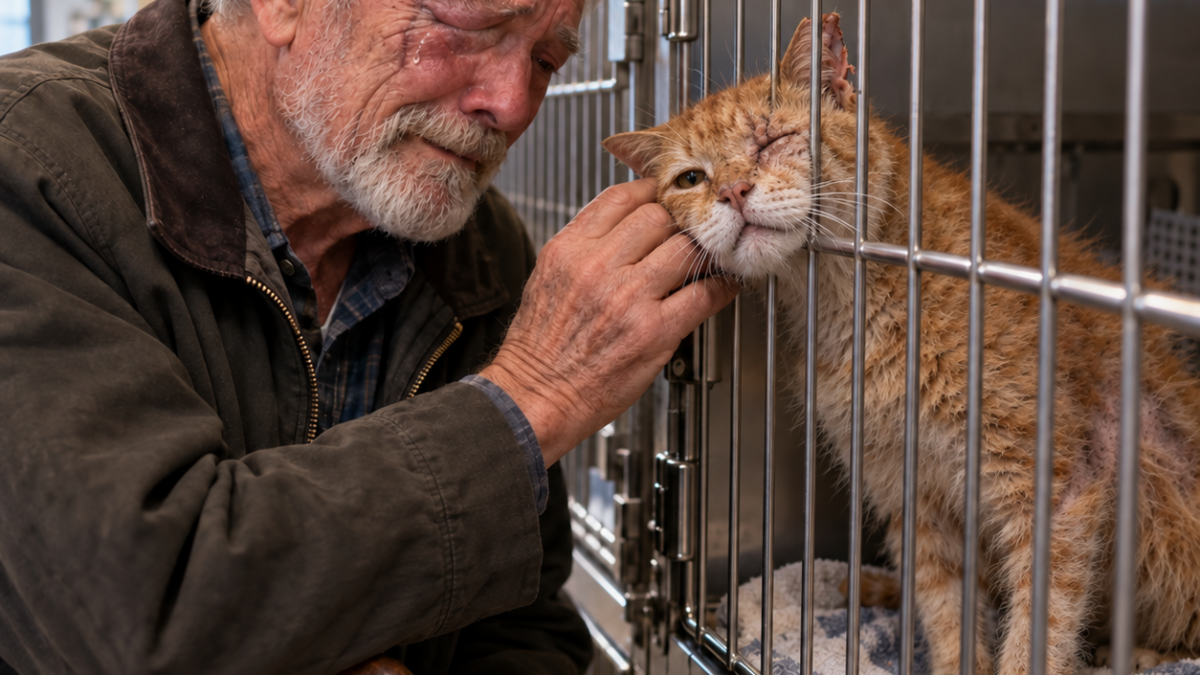
Then Thomas lifted one hand and placed it against the bars.
Rusty immediately pressed his head into it.
The old man’s mouth trembled.
I looked away because the intimacy of that moment felt like something I had not been invited to witness.
But then I heard him take a broken breath.
When I looked back, he was crying.
Not loud crying.
Not dramatic.
Just tears slipping down the lined side of his face while his hand stayed against Rusty’s box.
“Sir?” I asked softly. “Are you all right?”
He did not take his eye off the cat.
“How long has he been here?”
I swallowed.
“Three years.”
Thomas nodded slowly, as if the answer confirmed something painful.
“That doesn’t surprise me.”
My throat tightened.
“Why?”
He gave a small, humorless smile.
“People don’t like looking at what’s been damaged. Most don’t mean to be cruel. They just… look for somewhere easier to put their eyes.”
Rusty pushed harder against his hand.
Thomas slid two fingers through the bars and scratched the scarred side of Rusty’s face.
“When I came home from the Army in 1971,” he said, “I looked a lot like him.”
I stayed silent.
“The left side of my face was bandaged for a long time. After that, it was scars. Missing eye. Nerve damage. Jaw wired twice. People tried to be kind. But I saw it anyway.”
He paused.
“That little flinch. That quick search for something else to look at.”
He looked at me then.
“Fifty years, and I still know the movement.”
I felt my chest ache.
Thomas turned back to Rusty.
“He’s not ugly,” he said. “He’s just been through something.”
Rusty purred through the bars.
“Like me.”
I opened my mouth, but no words came.
Thomas wiped his cheek with the back of his hand, almost impatiently, as if tears were an inconvenience.
“May I meet him?”
“Yes,” I said quickly. “Of course.”
I unlocked Rusty’s enclosure.
Usually, when meeting visitors, Rusty stepped out eagerly but politely. That day, he moved as if something had pulled him forward. He walked straight to Thomas, who lowered himself carefully onto the bench with a small sound of pain.
“Easy,” I said. “Take your time.”
“I’ve had worse than a bench,” he said.
Rusty climbed into his lap.
No hesitation.
No circling.
No uncertainty.
He simply climbed into that old man’s lap, pressed his scarred face against Thomas’s coat, and began to purr so loudly the room seemed to vibrate.
Thomas closed his eye.
For a moment, neither of them moved.
I had seen many adoptions. Excited ones. Tearful ones. Impulsive ones. Long-awaited ones. I had seen people fall in love with animals in a heartbeat and animals choose people before the people had caught up.
But I had never seen two living beings recognize each other so quietly.
It did not feel like selection.
It felt like reunion.
Thomas rested one trembling hand on Rusty’s back.
“My wife would have loved you,” he whispered.
Rusty kneaded his coat.
Thomas laughed once through tears.
“Margaret always did have a soft spot for orange fools.”
I sat across from him.
“Did you lose her recently?”
“Eighteen months ago.”
“I’m sorry.”
“So am I.”
He said it without bitterness, which somehow made it sadder.
“We were married forty-six years. She used to say the house was too quiet if there wasn’t something shedding on the furniture. We always had cats. Usually the ones nobody else wanted.”
He stroked Rusty’s crooked ear.
“After she died, I told myself I was too old to start over with another animal.”
Rusty pushed his head under Thomas’s hand.
Thomas looked down at him.
“Seems I may have been wrong.”
The adoption paperwork was brought out twenty minutes later.
Thomas filled it in slowly, his handwriting careful but uneven. Rusty stayed in his lap the entire time, one paw hooked into the fold of his coat as if to make sure no one changed their mind.
On the line asking why he wanted to adopt this cat, Thomas stopped.
The pen hovered.
Then he wrote:
Because we recognized each other.
While he filled out the rest, he asked me only one question.
“Does he like company?”
I smiled, but my eyes burned.
“He has spent three years wanting nothing else.”
Thomas put the pen down.
For a few seconds, he did not move.
Then he breathed in slowly.
“Well,” he said. “That makes two of us.”
The room went blurry.
I excused myself to get Rusty’s medical file, though the file was already on the desk. In the hallway, Marcy saw my face and rushed toward me.
“What happened?”
I tried to answer.
Couldn’t.
Then I pointed toward the meeting room.
“Rusty?”
I nodded.
Marcy covered her mouth.
“No.”
“Yes.”
She started crying immediately.
By the time I returned with the file, half the staff knew. Dana came in pretending she needed to check paperwork. Dr. Patel suddenly appeared to review senior cat care instructions. Even Leonard Price, who had come to observe the event with his polished shoes and practical spreadsheets, stood in the doorway with an unreadable expression.
Thomas listened carefully as Dr. Patel explained Rusty’s needs.
Senior bloodwork once a year, maybe twice if anything changed. Dental checks. Joint supplements if stiffness worsened. No special diet yet, though he should not gain too much weight. Watch for changes in drinking, appetite, litter box habits.
Thomas nodded like every instruction mattered.
“I have a quiet home,” he said. “No other pets now. No stairs he’d need to climb except to the bedroom, and I can carry him if he lets me.”
“He’ll let you,” I said.
Rusty, still in his lap, purred as if confirming.
Leonard stepped farther into the room.
“Mr. Whitaker,” he said. “It’s very generous of you to consider a cat like Rusty.”
The room changed.
I felt it.
Dana looked sharply at him.
Thomas lifted his head.
“A cat like Rusty?”
Leonard smiled, but there was strain around it.
“I only mean a senior animal with visible challenges. Many adopters would find that difficult.”
Thomas studied him.
“Would they?”
Leonard cleared his throat.
“Well, statistically speaking, animals with age and disfigurement face placement barriers.”
Thomas kept one hand on Rusty’s back.
“Is that what you call it?”
Leonard blinked.
“I’m sorry?”
“When people look away.”
The silence was immediate.
Leonard’s face flushed.
“I didn’t mean any offense.”
“No,” Thomas said quietly. “People usually don’t.”
That was all.
No shouting.
No accusation.
But Leonard looked as if he had been stripped bare in front of us.
Because sometimes dignity humiliates cruelty more thoroughly than anger ever could.
I walked Thomas to his car with Rusty in a carrier.
A folded blanket was already waiting on the passenger seat.
“You came prepared,” I said.
Thomas looked slightly embarrassed.
“I suppose I hoped.”
That nearly undid me.
He had hoped.
Before entering the shelter, before seeing Rusty, before knowing whether the right cat existed, he had folded a blanket onto the passenger seat because some part of him had wanted to believe he would not drive home alone.
I buckled the carrier in.
Rusty complained once, a deep offended sound.
Thomas leaned in.
“I know,” he said. “Undignified. We’ll discuss it at home.”
Rusty blinked.
Before leaving, Thomas rolled down the window.
“You know what I think?” he said.
“What?”
“I don’t believe I adopted him.”
He looked at Rusty through the carrier door.
“I think we just recognized each other.”
Then he drove away, one old man and one old one-eyed cat, both finally heading home.
After the car disappeared, I went back inside and stood in front of Rusty’s empty enclosure.
His blanket was still there.
So was the little stuffed mouse he had never played with but always slept beside.
For three years, I had imagined that empty box. I thought it would feel like victory.
It did.
But it also felt like grief.
Not because Rusty was gone.
Because he had waited so long.
Marcy stood beside me.
“You okay?”
“No.”
“Good no or bad no?”
“Both.”
She leaned her head on my shoulder.
The card still hung on the front.
RUSTY
Waiting three years.
Still hopeful.
Still gentle.
Still ready.
I took it down and held it against my chest.
For the first time, those words no longer felt like a plea.
They felt like proof.
The next morning, Thomas called the shelter at exactly 8:14.
I answered with my heart in my throat.
“Willow Creek Animal Rescue, this is Emily.”
“It’s Thomas Whitaker.”
“Is Rusty okay?”
“He is currently sitting in my sink.”
I gripped the counter.
“What?”
“My bathroom sink. I turned on the light, and there he was. Like he owns it.”
I laughed so hard Marcy looked over from the food prep station.
“That sounds about right.”
“He slept on my chest.”
The laughter caught in my throat.
“All night?”
“Most of it. He started at my feet. Then my knees. Then somewhere around midnight, he apparently decided we knew each other well enough for my lungs to become public property.”
I smiled.
“He does love closeness.”
Thomas was quiet for a moment.
“So do I, I suppose. I had forgotten.”
He cleared his throat.
“I just wanted you to know he ate breakfast, used the litter box, inspected every room, and has rejected the expensive cat bed in favor of a folded towel.”
“Typical.”
“I also wanted to thank you.”
“You already did.”
“Not properly.”
His voice softened.
“I slept better last night than I have in months.”
I leaned against the counter.
“That was Rusty.”
“Yes,” Thomas said. “I believe it was.”
The calls became a routine.
At first, Thomas called every few days with updates.
Rusty had discovered the recliner.
Rusty had decided the recliner belonged to him.
Rusty had knocked Thomas’s crossword puzzle onto the floor.
Rusty had growled at a squirrel through the window despite having no intention of fighting anything ever again.
Rusty had sneezed in Thomas’s coffee.
Rusty had learned that if he sat on Thomas’s medication organizer, breakfast happened faster.
Each update came with a quiet change in Thomas’s voice.
The first day, he sounded grateful.
By the second week, amused.
By the first month, alive.
He began emailing pictures. Rusty in a patch of sunlight. Rusty on the arm of Thomas’s chair. Rusty lying on a folded army blanket at the foot of the bed. Rusty asleep with his scarred face pressed against Thomas’s scarred cheek.
That photograph made the entire shelter cry.
Even Leonard saw it.
Dana had printed it and placed it on the bulletin board in the break room with Thomas’s permission. Under it, she wrote:
Not hard to love. Just waiting for the right person.
Leonard stood in front of it one afternoon longer than necessary.
I was refilling treat jars nearby.
“He looks comfortable,” Leonard said.
“He is.”
“I suppose Mr. Whitaker is happy with the adoption.”
“Yes.”
Leonard adjusted his glasses.
“I’m glad.”
I did not answer.
He knew I remembered the meeting.
So did he.
To his credit, he did not defend himself.
He only looked at the photograph and said, “I may have been wrong about that cat.”
I turned.
“You were.”
He nodded once.
The apology was not dramatic.
But it was something.
And in shelter work, you learn to accept small improvements in creatures who move slowly.
Human or otherwise.
Three months after Rusty’s adoption, Thomas invited me and Marcy to visit.
“I’d like you to see him at home,” he said. “And I suspect he would like to show off.”
“He’s become arrogant?”
“He was arrogant when I got him. Now he has real estate.”
So on a warm Saturday afternoon, Marcy and I drove out to Thomas’s house on the west side of town.
It was a small brick ranch with white shutters, a neat lawn, and rosebushes along the porch. Wind chimes hung near the door. A folded American flag sat in a triangular case visible through the front window, and beside it was a framed photo of a woman with silver hair and kind eyes.
Margaret.
Thomas opened the door before we knocked.
Rusty stood behind him in the hallway.
Not hiding.
Not nervous.
Standing there like a host.
His orange fur looked brighter. He had gained a little weight, not too much, but enough that his hips no longer seemed sharp. His one eye was clear. His crooked ear tilted forward.
“Rusty,” I said.
He looked at me.
For one terrible second, I wondered if he remembered.
Then he walked forward, pressed his big head against my shin, and purred.
I cried immediately.
Marcy laughed at me while crying too.
Thomas handed us tissues as if he had expected this.
“He remembers,” he said.
We sat in the living room while Rusty moved from person to person, collecting admiration as if owed. The house smelled like coffee, lemon polish, and old books. A crocheted blanket lay over the back of the couch. On the side table sat two coffee mugs, one used and one clean.
I noticed Thomas still kept the second mug out.
Grief has its own furniture.
Rusty jumped into Thomas’s lap with the ease of habit. Thomas’s hand settled over him automatically.
“How has it been?” Marcy asked.
Thomas looked down at the cat.
“Quiet,” he said. “But not empty.”
That answer stayed with me.
He told us more that afternoon.
He had served in Vietnam as an Army mechanic attached to a transport unit. In 1971, near the end of his deployment, a roadside explosion tore through the convoy he was riding in. He lost his left eye, part of his hearing, and two friends whose names he still spoke carefully, as if setting down something fragile.
When he came home, he expected pain.
He expected nightmares.
He expected people to ask questions.
He did not expect invisibility.
“I thought folks would stare,” he said. “Some did. But mostly they looked away. That was worse.”
Rusty slept in his lap, purring.
“My mother cried the first time she saw me. My father shook my hand like I was a guest. Children stared in grocery stores. Women looked at the floor. Men talked too loud and clapped me on the shoulder because they didn’t know what else to do.”
He paused.
“Margaret didn’t.”
I looked at the photo by the window.
“She knew you before?”
“No. Met me after.”
His expression softened.
“She was a nurse at the VA hospital. First time she changed the dressing near my eye, I told her she didn’t have to look so directly.”
“What did she say?”
“She said, ‘Mr. Whitaker, if you wanted someone squeamish, you came to the wrong nurse.’”
Marcy laughed.
“I like her.”
“You would have.”
Thomas stroked Rusty’s head.
“She looked at me like I was still in there. Not under the scars. Not despite them. Just me.”
Rusty opened his one eye and looked up at him.
Thomas smiled.
“This old boy does the same.”
On our way out, I stopped near Margaret’s photograph.
“She would have loved Rusty,” I said.
Thomas nodded.
“I think she sent me.”
I did not argue.
Some beliefs are too beautiful to correct.
The story of Rusty and Thomas spread through Willow Creek, but we were careful with it. Thomas gave us permission to share a version without making his pain into entertainment. No close-up photos of his scar without consent. No dramatic captions. No begging language.
Just a photo of Rusty asleep in his lap and the words:
Rusty waited three years. Thomas waited eighteen months after losing his wife. They found each other on a Saturday afternoon. Senior animals are not last choices. Sometimes they are exactly who someone needs.
The post changed things.
Not all at once.
Not magically.
But noticeably.
People began asking about older cats. Not many. But some.
A woman adopted Sugar, the white kidney cat, after saying she had cared for her mother through illness and was not afraid of medication schedules. A retired teacher adopted Mabel because she “liked a cat with boundaries.” A widower came in looking for “a Rusty kind of cat,” which made Marcy cry so hard she had to pretend to look for printer paper.
And when visitors hesitated in front of scarred animals, I stopped rushing to reassure them.
I stopped saying, “He’s sweet though.”
Though.
As if sweetness had to compensate for appearance.
Instead, I said, “Take your time. Sometimes the ones who have been through the most are worth looking at a little longer.”
Some people still moved on.
That was all right.
Not everyone is meant for every animal.
But some stayed.
They looked longer.
That was enough to change a life.
One rainy afternoon in November, almost eight months after Rusty went home, Thomas came back to the shelter without him.
I was sorting laundry when he arrived.
His face looked different.
Paler.
Tired.
He leaned more heavily on his cane.
My first thought was Rusty.
“Is he okay?”
Thomas smiled quickly.
“Yes. Spoiled, dramatic, healthy as Dr. Patel says a cat his age can be. He’s at home sitting on a heating pad I bought for my back.”
I exhaled.
“What brings you in?”
Thomas removed an envelope from his coat.
“I need to talk to Dana. And perhaps you.”
We sat in the office, the three of us, while rain streaked the window.
Thomas placed the envelope on the desk.
“I’ve been thinking about Rusty’s three years here.”
Dana nodded.
“So have we.”
“I don’t want another animal like him waiting that long because people don’t know how to see him.”
He pushed the envelope forward.
Inside was a check.
Dana looked at it.
Then looked again.
Her mouth opened.
“Mr. Whitaker—”
“Thomas.”
“Thomas, this is… this is too much.”
“It’s Margaret’s life insurance.”
The room went silent.
He lifted one hand before we could object.
“Not all of it. Don’t look so alarmed. Enough to make me feel useful and not foolish.”
I glanced at the amount and had to sit back.
It was enough to fund senior and special-needs adoption care for years.
Thomas looked out the window.
“Margaret and I never had children. We had cats. Dogs too, sometimes. Mostly the ones other people missed. When she died, I thought the caring part of my life had ended.”
His voice grew rough.
“Rusty proved otherwise.”
Dana’s eyes filled.
“What would you like us to do with it?”
“Create a fund. For animals like him. Medical care. Sponsored adoption fees. Better photographs. Whatever helps people stop long enough to meet them.”
He smiled slightly.
“And perhaps a comfortable chair in the senior room. These old knees object to your benches.”
Dana laughed through tears.
“We can do that.”
“Call it Margaret’s Fund,” he said. “Not mine.”
“Of course.”
I wiped my eyes.
Thomas looked at me.
“And I’d like you to help decide which animals need it most.”
“Me?”
“You saw Rusty when others didn’t.”
I thought about all the times I had sat with Rusty after closing, telling him it wasn’t his fault.
Maybe some part of me had needed someone to see that too.
“I’d be honored,” I said.
Margaret’s Fund changed Willow Creek more than any social media post ever could.
We bought soft bedding for seniors. Paid for dental work adopters might have feared. Sponsored blood panels. Created honest, beautiful profiles for animals who had been overlooked. We added a small sitting area to the senior cat room with a green armchair, a lamp, and a sign that read:
Sit awhile. Some hearts take longer to introduce themselves.
Thomas hated the sign at first.
“Too sentimental,” he said.
Rusty loved the chair.
That settled the matter.
Once a month, Thomas brought Rusty to visit the shelter—not to return him, never that, but as an ambassador. Rusty would sit in the green chair on a blanket, accept admiration, and demonstrate the art of being old, scarred, one-eyed, and completely adored.
Visitors loved him now.
That was complicated.
Part of me was happy. Part of me wanted to shout, Where were you before?
But Rusty did not hold grudges.
He leaned into every hand.
He purred for every child.
He accepted treats from people who might once have passed him by.
Animals can be more generous than justice.
One day, Leonard came in during one of Rusty’s visits.
He stood near the chair awkwardly.
Thomas looked up.
“Mr. Price.”
“Mr. Whitaker.”
Rusty was asleep with his head on Thomas’s knee.
Leonard cleared his throat.
“I wanted to apologize.”
Thomas waited.
“To you. And to Rusty, I suppose, though that sounds ridiculous.”
“Not to me,” Thomas said.
Leonard looked at the cat.
“I thought in terms of numbers. Too much, perhaps. I forgot what the numbers were counting.”
Thomas studied him for a long moment.
Then he said, “That’s a dangerous thing to forget.”
“Yes,” Leonard said. “It is.”
Rusty woke, stretched, and reached one paw toward Leonard’s sleeve.
Leonard froze.
“He wants you to scratch his chin,” I said.
Leonard looked terrified, which I enjoyed more than I should have.
He bent and scratched gently under Rusty’s chin.
Rusty purred.
Leonard’s face changed.
It was not redemption.
Life is rarely that tidy.
But it was a crack in something hard.
And sometimes cracks let light in.
Thomas’s health declined the following winter.
He did not say so at first, but I noticed. He moved more slowly. His hands trembled more. His calls became shorter. When he brought Rusty for checkups, he sometimes sat down before removing his coat.
One afternoon, he called me directly.
“I need to ask something difficult.”
My stomach tightened.
“What?”
“If something happens to me, Rusty needs a plan.”
I closed my eyes.
We had this conversation often with older adopters. Responsible people asked it. Loving people dreaded it.
“Okay,” I said gently. “We can make one.”
“I won’t have him returned to a cage.”
“He won’t be.”
“My niece in Nashville has agreed to take him if necessary. She loves cats. I trust her. But if he’s too old to adjust, or if she can’t…”
His voice broke.
“If she can’t, I need to know he won’t end up waiting again.”
I gripped the phone.
“Thomas, listen to me. Rusty will always have us. But he will not be abandoned. I promise.”
He was silent for a long time.
Then he said, “I believe you.”
That promise became paperwork.
Dana helped arrange it formally. Rusty would go to Thomas’s niece if Thomas passed or became unable to care for him. If that failed, I would foster him. If I could not, Marcy would. If Marcy could not, Dana would take him herself.
Thomas reviewed the document with the seriousness of a man signing peace treaties.
Rusty sat on it twice.
“He approves,” I said.
“He can’t read.”
“He knows love in other ways.”
Thomas looked at me then.
“Yes,” he said. “He does.”
But Thomas did not leave us that winter.
He rallied in spring.
By May, he was back at the shelter with Rusty, sitting in the green chair, telling a little boy that Rusty was not a pirate because pirates had worse manners. The boy asked what happened to Thomas’s eye.
His mother gasped.
“Eli!”
Thomas lifted a hand.
“It’s all right.”
The boy looked mortified.
Thomas leaned on his cane.
“I was hurt a long time ago.”
“Did it hurt?”
“Yes.”
“Were you scared?”
“Yes.”
The boy looked at Rusty.
“Was he scared too?”
“I imagine so.”
The boy thought about that.
Then he stepped closer and gently petted Rusty’s head.
“My grandma has scars,” he said. “From surgery.”
Thomas nodded.
“Then your grandma has been through something too.”
The boy looked back at his mother.
“Can we look at the old cats?”
The mother’s eyes filled.
“Yes,” she said. “We can.”
They adopted Mabel that day.
Mabel, who ignored everyone.
Mabel, who had been waiting fourteen months.
Mabel, who climbed into the boy’s lap only after he sat still for twenty minutes and told her about dinosaurs.
Thomas watched the adoption from the green chair.
Rusty slept through it.
“See?” I said. “Ambassador.”
Thomas smiled.
“More like retired general.”
“Fair.”
The last time I saw Thomas alive, it was late autumn.
The leaves outside Willow Creek had turned gold and copper, and the air smelled like woodsmoke. He came in without Rusty, which worried me until he explained Rusty had refused to leave the heating pad.
“Smart cat,” Marcy said.
Thomas handed Dana another envelope for Margaret’s Fund. Smaller this time, but still generous.
Then he asked to sit in the senior room.
I walked with him.
He lowered himself into the green chair with a sigh. For a while, we sat in comfortable silence. The cats moved around us. One batted at a toy. Another snored. Rain began tapping softly on the roof.
“Do you ever wonder why some of us have to wait so long?” he asked.
I looked at him.
“Animals?”
“Animals. People.”
I thought about Rusty’s three years. Thomas’s eighteen months alone after Margaret. The fifty years he had spent recognizing that tiny flinch in strangers’ faces.
“Yes,” I said. “I do.”
“Have you found an answer?”
“No.”
He smiled faintly.
“Good. I’d distrust you if you had.”
We sat quietly.
Then he said, “I used to hate the way people looked away. After a while, I started helping them do it. Turned my bad side from them. Wore glasses. Kept conversations short. Made it easier for everyone.”
His hand rested on the cane.
“Margaret hated that. She used to say, ‘Thomas, you are not responsible for making your pain convenient.’”
I wrote that down later.
You are not responsible for making your pain convenient.
He looked toward Rusty’s old enclosure.
“I wish I had known that sooner.”
“Me too,” I said.
Thomas turned to me.
“You know it now, though.”
I did not understand until later that he was not talking about himself.
Two weeks after Thanksgiving, Thomas died in his sleep.
His niece called us.
Rusty was found curled against his side.
The old cat did not want to leave the bed.
That detail undid me.
I had imagined many possible endings for Thomas and Rusty. I had feared hospitalizations, emergency calls, frantic rehoming, confusion. Instead, Thomas left the world in his own bed with the cat who had made his house feel alive again sleeping beside him.
Gentle.
Unfair.
Merciful.
All at once.
His niece, Caroline, drove in from Nashville the next morning. She was kind, tired, and grieving. Rusty knew her from visits and allowed her to carry him, though he grumbled the entire time.
She kept her promise.
Rusty went home with her.
Not to a cage.
Not to a shelter.
To a sunny guest room already prepared with Thomas’s blanket, Rusty’s heating pad, and the green toy mouse he still did not play with but apparently required for emotional reasons.
Caroline sent updates every week.
Rusty hid for two days.
Then ate.
Then slept on Thomas’s old army blanket.
Then climbed onto Caroline’s lap during a thunderstorm.
Then began sleeping on her chest.
“He is bossy,” she wrote.
I replied, “He has earned that.”
At Thomas’s memorial service, Dana, Marcy, Dr. Patel, and I sat near the back of the church.
There were photographs near the altar.
Thomas young in uniform.
Thomas and Margaret on their wedding day.
Thomas in a fishing hat.
Thomas holding Rusty.
That last photo drew people in.
I watched them stop.
I watched them look.
Not away.
At.
At Thomas’s scarred face.
At Rusty’s one-eyed face.
At the way they leaned into each other like two old survivors who had finally stopped apologizing for being seen.
Caroline spoke during the service.
“My uncle lived with visible wounds for most of his life,” she said. “He did not talk about them often. But after he adopted Rusty, he told me something I will never forget. He said, ‘For the first time in years, I don’t feel like the most damaged thing in the room. I feel like one of two old souls who made it home.’”
People cried.
I did too.
After the service, Caroline handed me a folded paper.
“Uncle Thomas wanted you to have this.”
I opened it in the car because I knew better than to try inside the church.
It was a letter.
Emily,
If you are reading this, I suppose I have gone on ahead, as Margaret used to say.
Please do not be sad for Rusty. Or for me. We had less time than I wanted and more than I expected. That is true of most good things.
I want you to know what you did.
You did not simply introduce me to a cat. You stood beside him long enough for me to find him. That matters.
The world is full of people and creatures waiting beside closed doors, hoping someone will stay patient. Most will be passed by for reasons that sound practical. Too old. Too scarred. Too difficult. Too late.
You stayed patient.
Because you did, Rusty did not spend his last years in a box, and I did not spend mine alone.
That is no small thing.
Keep telling people to look longer.
Some will not.
Some will.
And sometimes, one person looking longer is enough to change the ending.
Thomas
By the time I finished reading, the church parking lot had blurred into colors.
Marcy, sitting beside me, handed me tissues without asking.
“What does it say?” she whispered.
I gave her the letter.
She read it.
Then she cried too.
Rusty lived another year and a half with Caroline.
He grew slower. Slept more. Demanded warmth like royalty. Caroline sent photos of him in sunny windows, on folded quilts, beside her laptop, on top of clean laundry with no remorse whatsoever.
In his final months, he became thin but remained stubborn. Dr. Patel consulted with Caroline’s vet in Nashville. Pain was managed. Food was adjusted. The heating pad remained nonnegotiable.
When Rusty died, he was asleep in Caroline’s lap.
She called us herself.
“He wasn’t alone,” she said through tears.
I closed my eyes.
“Thank you.”
“No,” she said. “Thank you for letting Uncle Thomas find him first.”
After we hung up, I went into the senior cat room.
Rusty’s old enclosure had housed many cats since he left. At that moment, it held a fifteen-year-old tabby named June Bug who hated everyone except Marcy and a rubber banana toy.
I sat in the green chair.
June Bug stared at me suspiciously.
“You’re not Rusty,” I told her.
She blinked with contempt.
“No,” I said. “You’re yourself.”
That was the lesson Rusty left me.
Not that scars are beautiful because they inspire people.
Not that age is adorable if you market it correctly.
Not that every wound has a purpose.
Some wounds are just wounds.
Some things should not have happened.
Rusty should not have been left by a road. Thomas should not have come home to strangers looking away. Margaret should not have died before seeing the cat who would have made her laugh.
But love does not require a wound to become meaningful before it shows up.
Love only requires someone to stop.
To stay.
To look at what others avoid and say, There you are.
Now, when I give tours at Willow Creek, I do it differently.
When people enter and hesitate in front of the older ones, the scarred ones, the one-eyed ones, the ones missing tails or teeth or pieces of their past, I do not shame them. Shame rarely opens hearts.
I tell them about Rusty.
I tell them about the old orange cat who waited three years in the same box while hundreds of people walked past him. I tell them he never stopped standing up when the door opened. I tell them about the one-eyed veteran who came in with a cane, stopped in front of his enclosure, and cried because he recognized the way the world had been looking away.
I tell them Rusty did not need everyone.
He needed one person.
Some visitors still move on.
That is okay.
But some stop.
They look a little longer.
They ask the animal’s name.
They read the whole card.
They sit in the green chair.
And every now and then, someone sees beyond the missing eye, the torn ear, the gray muzzle, the limp, the scar, the age, the thing that made everyone else keep walking.
They see what was there all along.
A heart waiting.
Not for pity.
Not for rescue as performance.
Not for someone who wants to feel noble.
Just for one person willing to recognize it.
That is what Thomas and Rusty taught me.
They did not save each other by pretending the damage wasn’t real.
They saved each other by refusing to let the damage be the only thing that was real.
Rusty had been passed by for three years because people were looking for something intact.
Thomas had been passed by in quieter ways for fifty years because people did not know how to look at what war had changed.
Then they met in a small shelter room at the end of a long row of cages.
A scarred old man placed his hand against the bars.
A scarred old cat pressed his face into it.
And in that moment, neither one was too broken, too old, too difficult, or too late.
They were simply seen.
They were not adopted.
They recognized each other.



