A Nurse Found a Retired Military K9 Hiding in the Same Corner for 3 Weeks—Then She Discovered Why He Panicked Whenever Anyone Reached for His Collar.
PART3:
“Marissa made it sound like I’m doing you a favor.”
“You are.”
“She owes me coffee.”
“She owes everybody coffee.”
He gave her a visitor badge.
Then hesitated.
“There’s one dog I want you to see before anything else.”
Leah noticed his tone.
“Which one?”
“Atlas.”
“What’s wrong with him?”
Caleb looked down the hallway.
“That’s the problem.”
He paused.
“We don’t know.”
They walked toward the rehabilitation wing.
Photographs lined the wall.
German Shepherds.
Belgian Malinois.
Labradors.
Handlers kneeling beside them.
Dogs wearing protective goggles in desert environments.
Dogs sitting beneath military transport aircraft.
Retirement photographs too.
Gray muzzles.
Birthday hats.
Children hugging animals who had once searched buildings for explosives.
One frame showed an elderly Shepherd sleeping beside a wheelchair.
Another showed a Malinois lying under a hospice bed.
Leah slowed slightly.
Caleb noticed.
“Some stay here permanently.”
“Others?”
“Adopted by former handlers when possible.”
“Families.”
“Law enforcement retirees.”
“Veterans.”
“Depends on the dog.”
“And Atlas?”
Caleb did not answer immediately.
They stopped outside a quiet room at the far end of the hall.
The door stood open.
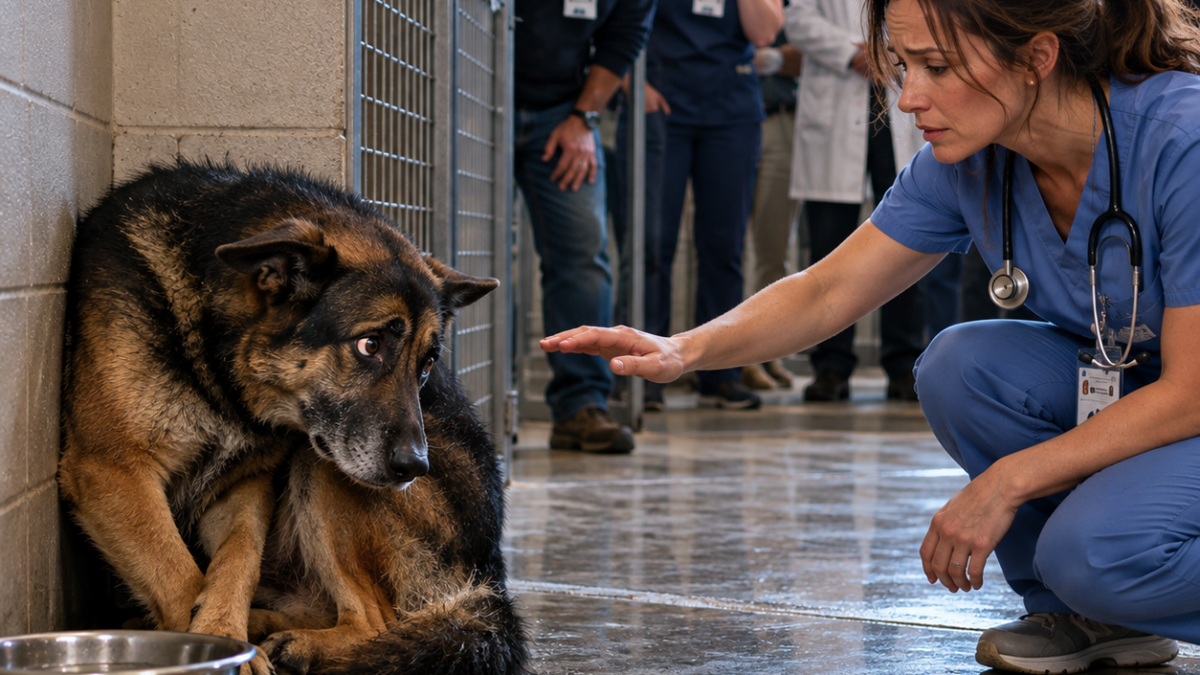
Leah saw him.
Large black-and-tan German Shepherd.
Gray around muzzle.
One ear bent slightly near the tip.
Powerful body that age had softened but not diminished.
Faded olive-drab K9 harness hanging from a hook beside his bed.
Atlas sat in the farthest corner of the room.
Back nearly touching two walls.
Head lowered.
Front paws placed carefully beneath him.
He was not shaking.
Not panting.
Not barking.
Not growling.
He simply looked as though he wanted to occupy less space than his body required.
Leah stopped before crossing the threshold.
Caleb lowered his voice.
“He’s been there almost three weeks.”
“Constantly?”
“Mostly.”
“Eating?”
“Yes.”
“Drinking?”
“Yes.”
“Bathroom?”
“He goes outside if the room is empty.”
“Pain?”
“Nothing obvious.”
“Blood work?”
“Normal for his age.”
“Imaging?”
“Some arthritis.”
“No acute injury.”
“Neurologic?”
“Nothing significant.”
Leah watched Atlas.
His eyes had shifted toward them.
Not wide.
Not glassy.
Focused.
Assessing.
“What happens when someone approaches?”
“He backs farther in.”
“He can’t go farther.”
“I know.”
“Does he snap?”
“Rarely.”
“Bite?”
“Never.”
“Growl?”
“Sometimes if someone reaches too quickly.”
“Does anyone force him out?”
Caleb looked uncomfortable.
“We have.”
Leah turned.
“Why?”
“We thought he needed socialization.”
“How?”
“Handlers.”
“Volunteers.”
“Treats.”
“Leashes.”
“Group walks.”
“When that didn’t work?”
Caleb exhaled.
“We tried more structured interaction.”
“What does that mean?”
“Somebody enters.”
“Leashes him.”
“Brings him out.”
“Walks him.”
“Returns him.”
Leah looked back toward Atlas.
His chin had lowered another inch.
“How many people are interacting with him every day?”
“Eight, sometimes ten.”
Her expression changed.
Caleb saw it.
“That’s too many?”
“For a dog who spends all day trying to get away from people?”
“Yes.”
“We thought isolation would make it worse.”
“Maybe.”
“But this isn’t isolation.”
“What is it?”
“Flooding.”
Caleb frowned.
Leah continued watching Atlas.
“Every person who comes through this door predicts something for him.”
“Food?”
“Maybe.”
“Command.”
“Touch.”
“Movement.”
“Leash.”
“Collar.”
“Expectation.”
“He has no way to make the interaction stop except retreating.”
Caleb folded his arms.
“So what does he need?”
Leah looked at Atlas.
“Space.”
“That’s it?”
“For now.”
“You don’t want to examine him?”
“Not yet.”
“We asked you here to assess him.”
“I am.”
“You’re standing in the hallway.”
“Yes.”
Caleb stared.
Leah put down her medical bag.
Then sat against the opposite wall outside the doorway.
Caleb looked even more confused.
“What are you doing?”
“Nothing.”
“That’s the plan?”
“For the next few minutes.”
“You came two hours to sit on the floor?”
“I’ve driven farther for less.”
He almost smiled.
Atlas watched.
Leah did not stare back.
Did not call his name.
Did not pat her leg.
Did not hold out a treat.
She rested her hands loosely in her lap.
Five minutes passed.
Caleb shifted his weight.
Leah glanced up.
“You’re making me nervous.”
“I’m standing.”
“You’re standing loudly.”
He moved back.
Another five minutes.
Atlas remained in the corner.
But his ears changed.
One angled toward the hallway.
The other stayed relaxed.
Then his nose lifted.
He sampled the air.
Caleb whispered:
“He’s looking at you.”
“I know.”
“What do I do?”
“Nothing.”
“Should I leave?”
“Not yet.”
Atlas shifted one front paw.
Then another.
He rose.
Caleb inhaled.
Atlas took one step away from the corner.
Stopped.
Leah remained still.
Another step.
The dog looked directly at her.
She looked toward the floor.
A third step.
Then Atlas stopped maybe twelve feet from the doorway.
Caleb’s mouth opened.
“He hasn’t done that voluntarily in days.”
Leah smiled slightly.
“Then let’s not ruin it.”
Atlas sniffed.
Looked at hallway.
Then back toward corner.
Leah spoke softly.
“That’s enough.”
Atlas froze.
Caleb glanced at her.
“Why’d you say that?”
“Because he gave us something.”
“What?”
“Choice.”
Atlas remained standing several seconds.
Then turned.
Walked back to the corner.
Not scrambling.
Not trying to flatten himself.
Just walking.
He lay down.
Caleb frowned.
“He went back.”
“Yes.”
“So we’re calling that progress?”
“Yes.”
“Explain.”
“He left because he chose to.”
“He returned because he chose to.”
“Nobody chased him.”
“Nobody stopped him.”
“The corner was a place he selected.”
“Not where we forced him to stay.”
Caleb looked toward Atlas.
Leah continued:
“If that corner is where he feels safe, taking it away doesn’t teach him the room is safe.”
“It teaches him we can invade the last place where he has control.”
Caleb slowly nodded.
“You think this is about control.”
“I think it might be.”
“That’s different.”
“From anxiety?”
“Not necessarily.”
“Fear and control overlap.”
“But I’m not diagnosing him from a hallway.”
“Good.”
Leah stood.
“What now?”
“Nothing else today.”
Caleb blinked.
“That’s it?”
“For Atlas.”
“Yes.”
“We can review the other dogs.”
“You’re really leaving him alone?”
Leah picked up bag.
“I’m leaving him successful.”
That afternoon, she reviewed Atlas’s file.
Military service:
Seven years, nine months.
Primary specialty:
Explosive detection.
Secondary work:
Building search.
Route clearance.
Recovery support.
Multiple deployments.
No bite history outside operational command.
No major disciplinary issues.
Strong attachment to primary handler.
Excellent working drive.
High reliability.
Retirement transition rated initially good.
Then behavioral notes changed.
Avoids unfamiliar handlers.
Increasing vigilance.
Retreats under social pressure.
Refuses group walking.
Reduced play behavior.
Normal appetite when alone.
Marked improvement in empty room.
Leah stopped.
Read that last line again.
Dog becomes noticeably calmer when room is empty.
She tapped the paper.
“Caleb.”
He looked up from his desk.
“What?”
“Why does a dog calmer in an empty room get eight to ten visitors every day?”
His expression fell.
“When you say it like that…”
“How else should I say it?”
“We thought withdrawal meant he needed interaction.”
“Maybe he will.”
“Eventually.”
“But there’s a difference between offering connection and requiring performance.”
Caleb leaned back.
“We’re a retirement shelter.”
“Our volunteers come because they care.”
“I believe that.”
“They sit with dogs.”
“Walk them.”
“Brush them.”
“Play.”
“All great.”
“Unless the dog is communicating no.”
Caleb rubbed his face.
“So we stop volunteers?”
“For Atlas.”
“Yes.”
“For how long?”
“We’ll see.”
“What’s the treatment plan?”
Leah smiled.
“You really like plans.”
“I ran logistics.”
“I can tell.”
Then she wrote one.
One primary caregiver.
Predictable feeding schedule.
Predictable cleaning.
No group visits.
No reaching over head.
No direct collar handling unless medically necessary.
No forced walks.
No dragging from resting space.
Doorway remains available when safe.
Quiet approach.
Sideways posture.
Let Atlas control distance.
“No treats?”
Caleb asked.
“Food is fine.”
“But not as bait.”
“What’s the difference?”
“If he has to approach farther than he wants because we’re bribing him, then gets touched or leashed, food becomes part of the trap.”
Caleb looked at her.
“You’ve done this before.”
“With humans.”
“That’s not the same.”
“No.”
“But I’ve seen people stop trusting hospital staff because every person entering the room causes pain.”
“Blood pressure.”
“Needles.”
“Dressing changes.”
“Physical therapy.”
“Eventually they stop seeing us as help.”
“They see us as the next thing happening to them.”
Caleb looked toward Atlas’s wing.
“And the answer?”
“Sometimes you enter and nothing bad happens.”
“Sometimes you ask permission.”
“Sometimes you explain.”
“Sometimes you leave.”
“Humans understand language.”
“Dogs understand patterns.”
Next morning, Leah returned at seven.
Atlas was already watching the doorway.
She placed her bag in the same spot.
Sat in the same place.
No direct eye contact.
Ten minutes.
Nothing.
Twenty.
Atlas stood.
Walked halfway across the room.
Stopped.
Leah remained still.
Then:
“Good morning.”
Atlas tilted his head.
Leah looked away again.
Another step.
Then another.
Six feet away.
He sat.
Caleb was watching from down hallway.
“You’ve barely spoken.”
“He doesn’t need a conversation.”
“What does he need?”
Leah kept her gaze soft.
“Someone who doesn’t make him regret coming closer.”
Atlas remained for almost three minutes.
Then returned to his bed.
Not corner.
Bed.
Small difference.
Leah noticed.
Caleb did too.
“Was that progress?”
“Yes.”
“You’re going to make me hate that word.”
“Good.”
Third day, Atlas approached doorway.
Did not cross.
Fourth, he sat beside Leah.
Not touching.
His shoulder maybe eight inches from her knee.
Leah did not reach.
Caleb whispered:
“You aren’t going to pet him?”
“No.”
“He’s right there.”
“I know.”
“He came to you.”
“Yes.”
“Isn’t that permission?”
“No.”
“It’s permission to be near me.”
“Not automatically permission to touch.”
Caleb looked embarrassed.
“We’ve probably been assuming a lot.”
“Most people do.”
Atlas eventually lay down.
Facing hallway.
Not corner.
Leah stayed twenty minutes.
Then stood slowly.
Atlas watched.
She left.
No touch.
No treat.
Nothing taken.
That evening, a volunteer entered without seeing Atlas near the doorway.
Young woman named Tessa.
Good intentions.
Fast feet.
“Hey, buddy—”
She stepped forward.
Atlas rose instantly.
Body rigid.
Head low.
Pupils larger.
Weight shifted backward.
Leah was there.
“Stop.”
Tessa froze.
Atlas backed up.
Leah did not move toward him.
“Give him space.”
Tessa stepped backward.
Atlas’s breathing stayed fast.
Leah turned sideways.
Lowered her gaze.
No command.
No reaching.
After twenty seconds, Atlas looked at her.
Then another twenty.
His chest slowed.
Leah sat on floor.
Atlas remained standing.
Then walked forward.
Slow.
Past where Tessa had been.
Toward Leah.
He stopped beside her shoulder.
Leah did nothing.
Atlas touched his nose to sleeve.
Caleb, watching from doorway, whispered:
“He’s never done that.”
Atlas moved closer.
Lowered his head against Leah’s knee.
Her hand lifted halfway.
Stopped.
Waited.
Atlas stayed.
She rested palm lightly against shoulder.
Not neck.
Not collar.
Atlas exhaled.
Long.
Leah felt something beneath fur.
Scar tissue.
Small ridge under collar line.
She withdrew hand.
Later, she asked:
“Has anybody documented a neck injury?”
Caleb searched memory.
“No.”
“Military records?”
“Nothing major.”
“Transport?”
He hesitated.
“What?”
“His arrival here wasn’t smooth.”
“How not smooth?”
“He refused crate.”
“Who transported?”
“Contract service.”
“Not handler?”
“No.”
“What happened?”
“They had trouble loading.”
“How many people?”
“I don’t know.”
“Guess.”
“Three?”
“Four?”
“Did they use collar?”
Caleb looked uncomfortable.
“Yes.”
“How?”
“Pulled.”
Leah’s face changed.
“You saw?”
“I was here when he arrived.”
“He wouldn’t move.”
“They thought if they got him inside quickly, he’d settle.”
“So they dragged him?”
“Not across floor.”
Caleb defended automatically.
Then stopped.
“They pulled him forward by collar.”
“How hard?”
“Enough.”
“Did he vocalize?”
“Yes.”
“Did he resist?”
“Yes.”
“How?”
“Backed away.”
“Braced.”
“Twisted.”
Leah closed notebook.
“Show me the transport report.”
It was six lines.
Atlas displayed resistance during loading.
Increased vocalization.
Additional personnel required.
Transport completed without injury.
Leah read it twice.
“This isn’t enough.”
“What are you looking for?”
“Whether his behavior started before transport or after.”
Caleb pulled records.
Atlas had been subdued after handler separation but still social.
Accepted touch.
Walked with staff.
Allowed harnessing.
Within forty-eight hours after transport:
avoiding collar handling.
refusing group interaction.
retreating.
“That’s not proof.”
Caleb said.
“No.”
“It’s timing.”
“What does scar mean?”
“Maybe nothing.”
“Could be old.”
“Could be pressure injury.”
“Could be unrelated.”
“We need Marissa.”
Dr. Marissa Keane examined Atlas that afternoon.
Leah sat nearby.
Caleb remained outside.
Atlas allowed shoulder palpation.
Chest.
Limbs.
Marissa worked slowly toward neck.
When fingers moved near collar, Atlas stiffened.
Marissa stopped.
Waited.
Changed angle.
Moved fur.
There was healed scar tissue under the left side.
Small thickened band.
“Old.”
she said.
“Could be pressure injury.”
“From collar?”
“Possibly.”
“Could be deployment.”
“Could be transport.”
“Could be years ago.”
Atlas moved away when Caleb entered.
Leah watched.
“Look.”
Marissa followed her gaze.
Caleb had instinctively lifted his hand toward collar.
Atlas retreated.
Leah said:
“He’s not generally afraid of touch.”
“He’s afraid of what happens when somebody reaches around his neck.”
Marissa nodded.
“That fits.”
Caleb dropped his hand.
His face changed.
“So every time we pulled him out…”
Leah answered gently.
“You may have been repeating the exact sensation his body was trying to avoid.”
Caleb looked sick.
“We were trying to help.”
“I know.”
“That doesn’t mean it felt like help.”
He walked out.
Leah found him later near kennels.
“I hurt him.”
“You made a mistake.”
“That sounds nicer.”
“It’s accurate.”
“I kept doing it.”
“Because you misunderstood what you were seeing.”
“He was hiding.”
“So we pulled him out.”
“Yes.”
“That made sense to you at time.”
“Yes.”
“Now you know more.”
Caleb looked at her.
“You’re letting me off easy.”
“No.”
“I’m telling you guilt is only useful if it changes behavior.”
“What do we do?”
“We change behavior.”
Atlas’s handling plan was rewritten.
No collar pressure.
No reaching from above.
Harness introduced only after voluntary approach.
One caregiver at first.
Then slowly more.
Volunteers excluded temporarily.
Predictable routines.
Same feeding person.
Same walking door.
Same cleaning window.
No forced socialization.
Leah kept coming.
Nothing dramatic.
That was point.
Day one:
Atlas stopped staying in corner constantly.
Day two:
He ate while Leah remained in room.
Day three:
He slept with his back to her.
Caleb understood why that mattered.
“Vulnerability.”
Leah nodded.
“He believes he doesn’t have to watch you.”
Day four:
Atlas rested beside her chair.
Day five:
He stood when she arrived.
Day six:
He approached before she sat.
Caleb began learning.
He entered sideways.
Stopped several feet away.
Did not look directly.
Did not reach.
Atlas stayed.
Caleb sat.
Nothing happened.
Five minutes.
Atlas lowered his head.
Caleb’s eyes filled unexpectedly.
“He stayed.”
“Yes.”
“I didn’t do anything.”
“That’s why.”
Caleb laughed softly.
“This whole month is destroying everything I thought helping looked like.”
“Good.”
“You enjoy that word.”
“A little.”
Then came metal bowl.
Volunteer dropped it outside room.
Crash echoed.
Atlas jumped up.
Rigid.
Started toward corner.
Leah stayed seated.
“Okay.”
Soft.
No chase.
No command.
Atlas looked.
Leah turned sideways.
He stopped halfway.
Breathing.
Then instead of retreating fully, he returned.
Sat several feet from Leah.
Caleb whispered:
“That was fast.”
“He recovered faster.”
“Because you’re here.”
“Because environment stayed predictable.”
Atlas looked around.
No one rushed.
No hands.
No collar.
No punishment.
Nothing happened.
His nervous system learned something new.
A week after Leah’s first visit, Atlas walked into rehabilitation yard.
Voluntarily.
Open door.
Grass.
Three retired dogs in distance.
Staff spread out.
No one called him.
Atlas stood at threshold.
Looked at yard.
Then Leah.
She did not encourage.
He stepped.
Stopped.
Another step.
Then another.
Grass.
Sunlight.
He sniffed.
Raised head.
Wind moved gray fur around muzzle.
For maybe thirty seconds, Leah saw photograph version of him.
Alert.
Curious.
Present.
Then Atlas turned and walked inside.
Caleb smiled.
“He came back.”
“Yes.”
“He chose both.”
“Yes.”
“That’s progress.”
Leah looked at him.
“Careful.”
He laughed.
That afternoon they reviewed service records again.
One line:
HANDLER DEPENDENT DURING HIGH-STRESS RECOVERY.
Another:
STRONG PRIMARY-HANDLER ATTACHMENT.
Leah pointed.
“Who?”
Caleb searched.
Sergeant Elias Grant.
Army.
Explosive ordnance support unit.
Primary handler five years.
Retired overseas? No, source says retired, lives states away, unable to travel easily initially. Caleb found contact through veterans’ network.
He called.
“This is Elias.”
Voice older.
Careful.
Caleb explained Harbor Pines.
Silence.
Then:
“Atlas?”
“Yes.”
Another pause.
“How is he?”
Caleb looked through office glass.
Atlas resting on mat.
“He’s safe.”
Elias exhaled.
That sound carried years.
Leah leaned closer.
“Sergeant Grant?”
“Yes?”
“My name is Leah Mercer.”
“I’m a nurse helping with Atlas’s rehabilitation.”
“Okay.”
“Can I ask you about his neck?”
Silence.
“What about it?”
“Did he ever have an injury involving his collar?”
Longer silence.
Then Elias’s voice lowered.
“Yes.”
Leah looked at Caleb.
“When?”
“Afghanistan.”
“Last deployment together.”
“What happened?”
“Building search.”
“Secondary collapse.”
“Atlas went through opening ahead of me.”
“Debris came down.”
“His lead snagged.”
“I got trapped on other side.”
Elias stopped.
Leah waited.
“I could hear him.”
“What was he doing?”
“Trying to pull free.”
“I couldn’t reach harness.”
“Only collar.”
“So I grabbed it.”
“Pulled.”
“How hard?”
“As hard as I could.”
“Why?”
“Because wall was moving.”
His voice broke slightly.
“If I didn’t, he died.”
Leah closed eyes.
“Did he get injured?”
“Neck abrasion.”
“Some swelling.”
“Vet cleared him.”
“He worked again.”
“Any behavior changes?”
“Wouldn’t let anybody handle collar for weeks except me.”
“There it is.”
Caleb whispered.
Leah held up finger.
Elias heard maybe.
“What?”
“Nothing.”
Leah continued.
“What happened after you retired?”
“I was medically retired first.”
“Back injury.”
“Atlas stayed working.”
“Different handler?”
“Yes.”
“Did you see him again?”
“Once.”
“Then retirement transfer happened before I could get there.”
Elias’s voice became smaller.
“I should’ve gone.”
Leah looked at Atlas through glass.
“You were injured.”
“I should’ve gone.”
“You didn’t cause what happened during transport.”
“I left him.”
“No.”
“I retired.”
“He kept working.”
“That is not the same as abandoning him.”
“Tell him.”
Silence.
Then Elias said:
“I thought he understood I was helping that day.”
“When you pulled him out?”
“Yes.”
Leah chose words carefully.
“He probably did.”
“Then why would he still be afraid?”
“Because memory isn’t always logical.”
“Our bodies can learn fear faster than our thinking minds can explain it.”
“Pressure around neck.”
“Crowding.”
“No escape.”
“His nervous system may react before he has time to decide whether this person is safe.”
Elias breathed.
“So what do we do?”
“We stop repeating it.”
Another pause.
“Can I talk to him?”
Leah smiled.
“Yes.”
They placed phone near doorway.
Speaker on low.
Elias:
“Hey, buddy.”
Atlas lifted head.
Ears shifted.
Leah watched.
“It’s me.”
Atlas stood.
Walked toward phone.
Slow.
Sniffed.
Sat.
Elias laughed quietly.
“Yeah.”
“That’s you.”
Atlas made sound.
Soft whine.
First vocalization Caleb had heard that wasn’t stress.
Elias’s voice cracked.
“I missed you.”
Atlas lowered his head beside phone.
Leah looked away.
Not because she was crying.
Though she was.
Because privacy matters even when one participant is a dog.
After call, Caleb stood beside her.
“He remembered.”
“Yes.”
“What now?”
Leah looked at Atlas.
“Now we stop trying to erase what happened.”
“And?”
“We make present safe enough that the past doesn’t have to control every decision.”
Atlas walked toward her.
No hesitation.
Rested head against shoulder.
Leah placed hand lightly on side of neck.
No pressure.
No grip.
Atlas closed eyes.
Caleb whispered:
“He trusts you.”
Leah shook head.
“He trusts what we’ve taught him to expect.”
“That’s not same?”
“No.”
“I don’t want him dependent on me.”
“Then what?”
“I want him safe when I’m gone.”
That became next phase.
Leah reduced her presence.
One hour.
Forty minutes.
Twenty.
Other staff copied routine.
Same pace.
Same tone.
No collar reach.
No forced interaction.
Atlas hesitated.
Stayed.
Caleb entered alone one afternoon.
Sat across room.
Atlas remained on mat.
Caleb smiled.
“You were right.”
Leah stood in doorway.
“About?”
“He didn’t need me to make him brave.”
“He needed me to stop making him scared.”
Leah nodded.
“That’s closer.”
The shelter changed language too.
That mattered more than Caleb expected.
Old notes:
Withdrawn.
Difficult.
Resistant.
Poor socialization.
Noncompliant.
New notes:
Fear response associated with restraint and loss of control.
Improves with predictable routines.
Requires voluntary approach.
Sensitive to neck handling.
Recovers well when given distance.
Marissa told staff:
“Labels become instructions.”
“If we call a dog aggressive, you enter prepared for aggression.”
“If we call him stubborn, you push harder.”
“If we call him frightened, you become careful.”
“What we name changes what we do.”
Caleb removed Atlas from general volunteer schedule permanently.
Not isolation.
Choice.
A quiet room with window.
Natural light.
Soft bedding.
Private yard access.
Open doorway when safe.
Atlas could join.
Leave.
Approach.
Retreat.
Nobody applauded when he walked out.
That was deliberate.
Praise can also become pressure.
Three days after Elias call, Leah arrived and found Atlas lying outside room.
Hallway.
No hiding.
He stood when she entered.
Walked toward her.
Stopped.
She crouched.
“Morning.”
Atlas pressed nose into her palm.
Caleb smiled.
“He does that every morning now.”
“How long?”
“Since hearing Elias.”
Leah touched shoulder.
“He has more context.”
“You think dogs understand reunion?”
“Not as story.”
“Smell.”
“Voice.”
“Familiarity.”
“Safety.”
“Enough.”
Elias called again a month later.
“I heard he’s walking outside.”
“Yes.”
“Still hates collar?”
“He doesn’t hate collar.”
“He hates pressure and hands coming around his neck.”
“That sounds like Atlas.”
Then Elias became quiet.
“Can I see him?”
“Yes.”
“I’m scared.”
“Of what?”
“He won’t want me.”
Leah sat.
“Why would he not?”
“Because I left.”
“We covered this.”
“I know.”
“Knowing and feeling are different.”
“Yes.”
Leah smiled.
“Now you sound like a nurse.”
“I’ve been listening.”
Two weeks later, Elias Grant arrived.
He was sixty-one.
Older than service photographs.
Gray beard.
Slight limp.
Back injury still visible in way he moved.
He stopped at edge of rehabilitation yard.
Atlas lay in grass.
Leah stood several yards away.
Caleb stayed near building.
No crowd.
No cameras.
No volunteers.
Elias looked at Leah.
“What do I do?”
“Nothing.”
He laughed nervously.
“You really like that.”
“Yes.”
Atlas lifted head.
Saw him.
Everything stopped.
Elias did not call.
Atlas stood.
One step.
Then another.
Slow.
No sprint.
No dramatic bark.
No cinematic leap.
Recognition does not always need spectacle.
Atlas crossed grass.
Stopped four feet away.
Sniffed.
Elias lowered himself carefully.
Pain showed.
He did not reach.
Atlas moved closer.
Sniffed his hand.
Then pressed entire shoulder into Elias’s chest.
Elias folded.
Arms around dog, but loose.
No collar.
No restraint.
His face broke.
“I thought you forgot me.”
Atlas leaned harder.
“I missed you too.”
Leah turned away.
Some reunions do not improve by having witnesses.
Later, Elias sat beside her.
Atlas asleep nearby.
“He’s different.”
“Yes.”
“You changed him.”
“No.”
“Come on.”
“I didn’t.”
“Then who?”
“All of you.”
“What does that mean?”
“You stopped asking him to behave like the dog you remembered.”
Elias looked toward Atlas.
Leah continued:
“He’s retired.”
“He doesn’t need to be operationally convenient.”
“He doesn’t need to tolerate every hand.”
“He doesn’t need to walk because somebody scheduled a walk.”
“He doesn’t need to prove he’s still good.”
Elias stared.
“A working dog spends his whole life obeying.”
“Yes.”
He smiled sadly.
“Maybe retirement means he gets to choose.”
“That’s exactly what it means.”
Elias visited for three days.
Never took Atlas home.
His own health made full-time care difficult.
He hated that.
Leah helped him understand love was not ownership.
He could remain part of Atlas’s life without pretending his body could provide what it once had.
Before leaving, he stood beside Leah.
“Thank you.”
“For what?”
“Sitting there.”
“That was easy.”
“No.”
Elias looked at Atlas.
“Most of us want helping to look like action.”
“Pull.”
“Move.”
“Fix.”
“Train.”
“Command.”
“You helped him because you were willing to do less.”
Leah smiled.
“Doing less can require more patience.”
After Elias left, Atlas did not regress.
That was the test Leah cared about.
He searched gate for several minutes.
Then returned inside.
Ate dinner.
Slept.
Next morning, came out.
Not because he forgot Elias.
Because attachment no longer meant catastrophe every time someone left.
Weeks became months.
Atlas joined morning yard selectively.
Never group chaos.
He liked one retired Labrador named Boone.
Ignored most others.
He allowed Marissa to examine neck with warning.
No surprise.
Harness rather than collar for routine movement.
A light flat collar remained for identification, never used as control point.
He began approaching new volunteers.
Not all.
That was acceptable.
One volunteer, Nina, asked:
“Should I stay back?”
Leah smiled.
“Yes.”
“Talk to him?”
“Only if he seems interested.”
“How do I know?”
“You wait.”
Nina sat.
Five minutes.
Atlas slept.
Ten.
He lifted head.
Nina looked at Leah.
Leah nodded.
“Hi.”
That was all.
Atlas stood.
Walked halfway.
Stopped.
Nina did not move.
Atlas continued.
Sniffed hand.
Stayed.
She smiled.
“He’s gentle.”
“He always was.”
Months earlier, nobody would have believed that sentence.
Because behavior viewed without context becomes character judgment.
Atlas had never been bad.
Never broken.
Never stubborn.
He was a retired working dog whose body had learned that losing control around his neck could mean panic.
Then well-meaning people repeatedly recreated pressure.
When he fled, they called it withdrawal.
When he resisted, they called it difficult.
When he hid, they increased socialization.
Every solution became another version of problem.
Leah did not cure memory.
That would have been dishonest.
Atlas still startled when people approached from behind.
Still disliked hands over head.
Still stiffened around collar pressure.
Healing did not mean forgetting.
It meant recovery becoming faster.
Choice becoming available.
Safety becoming believable.
One afternoon, a transport crate arrived for another dog.
Metal latch slammed.
Atlas startled hard.
Ran three steps toward corner.
Stopped.
Looked at Leah.
She sat across room.
No words.
Atlas breathed.
Turned.
Walked to his bed.
Lay down.
Caleb smiled from hall.
“He chose a different safe place.”
“Yes.”
“Corner didn’t win.”
Leah shook head.
“There is no winning against corner.”
“What do you mean?”
“The corner kept him safe when nothing else did.”
“We shouldn’t hate it.”
“We should make it unnecessary.”
That sentence changed how Harbor Pines designed rooms.
Caleb replaced several kennel-style spaces with retreat zones.
Visual barriers.
Quiet dens.
Open resting areas.
Choice.
Volunteers received training.
Never corner a dog.
Never reach for collar automatically.
Never assume stillness means consent.
Watch distance.
Watch breathing.
Watch weight shift.
Reward recovery, not performance.
Marissa added trauma-informed handling protocol.
A phrase some staff initially mocked.
Then results appeared.
Another retired Malinois stopped spinning at doors.
An elderly Labrador began accepting grooming after staff changed positioning.
A Shepherd named Duke, previously labeled “standoffish,” became affectionate when allowed to initiate contact.
Caleb called Leah one evening.
“You broke my shelter.”
“That sounds bad.”
“I mean I see everything differently.”
“That sounds exhausting.”
“It is.”
“Good.”
“You really do like that word.”
Harbor Pines became known regionally for retired working-dog adjustment care.
Leah resisted publicity.
Caleb did too, eventually.
They did not want Atlas turned into mascot.
No viral videos.
No dramatic transformation reels.
No before-and-after montage with sad piano.
His progress belonged to him.
A military-veteran organization asked to feature him.
Caleb declined.
Then called Elias.
“What do you think?”
Elias said:
“He spent enough of his life working for people.”
“Let him retire.”
That settled it.
Leah continued visiting once a week.
Not because Atlas required her.
Because she enjoyed him.
That distinction pleased her.
Some mornings he greeted her.
Some mornings barely lifted head.
She preferred latter sometimes.
Trust means knowing relationship survives disinterest.
One winter afternoon, Leah sat near window while Atlas slept beside chair.
Snow began outside.
Caleb entered.
“Can I ask something personal?”
“You just did.”
He smiled.
“Why are you so good at this?”
“I’m not.”
“That’s annoying.”
“Why?”
“You knew to wait.”
“You noticed control issue.”
“You understood body memory.”
“You changed everything.”
Leah looked at Atlas.
Then outside.
“My younger brother had a spinal injury.”
Caleb waited.
“Car wreck.”
“I was nineteen.”
“He was seventeen.”
“Spent months in rehab.”
“People touched him constantly.”
“Rolled him.”
“Lifted him.”
“Catheter.”
“Therapy.”
“Transfers.”
“Everyone helping.”
“All necessary.”
She paused.
“One day he yelled at physical therapist because she moved his leg without warning.”
“My mother apologized for him.”
“I’ll never forget his face.”
“He said, ‘Everybody owns my body now.’”
Caleb became still.
Leah continued.
“He wasn’t refusing treatment.”
“He was asking to remain a person inside treatment.”
“What happened?”
“Good therapist heard him.”
“Started asking before every touch.”
“Even when answer had to be, ‘I need to do this.’”
“She explained.”
“Waited.”
“Let him choose timing where possible.”
“My brother changed.”
“Same therapy.”
“Different experience.”
“Did he recover?”
“Mostly.”
“Walks with brace.”
“Has two kids.”
“Hates hospitals.”
Caleb smiled.
“So Atlas reminded you of him?”
“Not exactly.”
“But I recognize what happens when care removes control.”
Atlas lifted head briefly.
Leah looked down.
“Everybody needs somewhere inside themselves that still belongs to them.”
Atlas’s second winter at Harbor Pines was quiet.
His muzzle whiter.
Arthritis worse.
Marissa started joint medications.
Leah worried about pain.
Atlas accepted injections when given on floor, not exam table.
Choice again.
He began spending afternoons in private yard.
Often sat beneath cedar tree near fence.
Elias visited every few months.
Each reunion became less dramatic.
That was healthy.
First:
tears.
Later:
Elias arriving with coffee while Atlas sniffed his boots and walked away.
“Nice to see you too.”
he would say.
That normalcy meant relationship had moved from fear of loss into life.
One spring, Elias asked whether Atlas could spend weekend with him at nearby accessible cabin.
Harbor Pines evaluated.
Safe.
No long travel.
Leah agreed with plan.
Caleb transported.
Atlas walked into cabin.
Sniffed.
Found rug.
Slept.
Elias called Leah that night.
“He’s snoring.”
“So?”
“He never snored when working.”
“He’s old.”
“No respect.”
“Go to sleep.”
The weekend succeeded.
Then another.
Eventually Atlas spent one weekend each month with Elias.
Not permanent relocation.
A bridge.
The shelter learned another lesson.
Care does not have to choose between institution and family when both can cooperate.
When Atlas turned fourteen, Harbor Pines held no birthday party.
Leah refused hats.
Caleb respected that.
Elias brought steak.
Marissa vetoed quantity.
Compromise:
small cooked pieces.
Atlas ate them with dignity.
Leah said:
“He has no idea it’s his birthday.”
Elias said:
“Neither do I most years.”
At fifteen, Atlas slowed substantially.
No crisis.
Aging.
His world became smaller.
Room.
Private yard.
Leah.
Caleb.
Marissa.
Elias.
Boone had died the year before.
Atlas searched Boone’s bed for two days.
Then stopped.
Loss changes animals too.
Again, no need to romanticize.
Atlas did not write grief narrative.
He simply noticed absence.
One October morning, Leah arrived and Atlas did not stand.
He lifted head.
Tail moved once.
She sat beside him.
Marissa had already examined.
Cancer.
Splenic mass.
Advanced.
Surgery technically possible.
Age.
Risks.
Prognosis poor.
Caleb asked:
“What do we do?”
Leah did not answer.
Elias drove in.
They sat together.
Marissa explained.
Could attempt surgery.
Could buy time.
Could also create painful ending.
Could provide comfort.
Elias looked at Atlas.
“For eight years, everybody decided for him.”
He swallowed.
“How do I let him choose this?”
Leah’s eyes filled.
“We can’t.”
“Some choices belong to us because they have to.”
“That feels unfair.”
“It is.”
Elias put hand against Atlas’s shoulder.
“No collar.”
he whispered.
“No.”
Leah answered.
“No collar.”
They chose comfort.
Weeks, maybe.
Atlas had nine days.
Good days.
Ate.
Walked yard.
Sat in corner once.
Caleb saw.
Started crying.
Leah said:
“Let him.”
Atlas slept there afternoon.
Because shade was cool.
Not fear.
That difference mattered enormously.
On final morning, Atlas refused breakfast.
Could not stand without effort.
Breathing changed.
Marissa came.
Elias sat on floor.
Leah on other side.
Caleb near door.
Atlas’s room.
Not clinic.
No table.
No restraints.
No collar pressure.
Marissa explained every step even though Atlas could not understand words.
Because humans needed ritual too.
Elias whispered:
“You’re done working.”
Atlas rested head against his chest.
“You don’t have to do anything.”
Leah stroked shoulder.
Not neck.
Never neck unless Atlas offered.
He exhaled.
And did not inhale again.
Silence.
Real silence.
The kind Harbor Pines rarely had.
Elias cried openly.
Caleb too.
Leah stayed.
That was all.
Stayed.
They buried Atlas on shelter property beneath cedar where he liked sitting.
Elias asked for no military ceremony.
“No folded flag?”
Caleb asked.
“No.”
“He served.”
“I know.”
“What do you want?”
Elias thought.
“A bench.”
So they installed simple wooden bench.
Plaque:
ATLAS
HE SERVED LONG ENOUGH.
HERE, HE GOT TO CHOOSE.
Leah cried when she read it.
Then complained it was too sentimental.
Elias ignored her.
Months later, Harbor Pines received new dog.
Retired Malinois.
Nervous.
Staff member began walking toward kennel quickly.
Stopped himself.
Turned sideways.
Waited.
Leah saw from hallway.
Smiled.
Atlas was gone.
Lesson remained.
That is how care should work.
Not turning one animal into legend.
Changing what people do after.
Harbor Pines created formal decompression protocol for all incoming retired working dogs.
Seventy-two hours minimum low-demand transition unless medical emergency.
One primary caregiver initially.
No volunteer rotation until baseline established.
No collar pulling.
No forced group exposure.
Behavior interpreted in context.
History reviewed before labels applied.
Former handlers contacted when possible.
Choice built into housing.
Caleb presented protocol at working-dog conference.
He began with photograph of an empty corner.
Not Atlas.
Just corner.
Then said:
“We thought problem was dog wouldn’t leave.”
“We eventually learned problem was that every person entering the room gave him another reason to stay.”
That line traveled.
Shelters adopted pieces.
Veterinary teams requested training.
Leah resisted being named as creator.
“Atlas created it.”
Caleb corrected:
“Atlas communicated it.”
“We finally listened.”
Years later, Leah’s nursing colleagues asked why she continued volunteering at dog retirement center.
She answered:
“Because dogs make people honest about control.”
“What does that mean?”
“You cannot explain good intentions to frightened nervous system.”
“You have to behave safely enough that the body believes you.”
That applied to humans too.
Leah carried it back to hospital.
She started asking before touch more often.
Even routine things.
“Can I move your arm?”
“I need to check incision—is that okay?”
“I’m going to lift blanket.”
Patients noticed.
One elderly veteran said:
“You’re the first person today who asked.”
Leah thought of Atlas.
Another patient refused physical therapy.
Staff called him difficult.
Leah sat.
Asked why.
He said every therapist grabbed gait belt before telling him.
He felt like furniture.
They changed approach.
He participated.
Not because Atlas magically solved human medicine.
Because lesson was transferable.
Respect control where possible.
Explain when not possible.
Never confuse compliance with trust.
Caleb and Leah remained friends.
Not romantic.
People always wanted stories to pair everyone off.
Life does not owe narrative symmetry.
Caleb eventually married Marissa.
Leah gave speech.
She said:
“Caleb once believed eight strangers per day was appropriate socialization for a terrified dog.”
Everyone laughed.
“He has improved.”
Marissa said:
“Marginally.”
Leah’s brother attended wedding.
Walked with brace.
Two children.
When Caleb learned story, he understood more.
“You never told me.”
“You never asked.”
“I asked why you were good at it.”
“I answered.”
“Partially.”
“That’s my specialty.”
Harbor Pines grew.
Added sensory-friendly wing.
Private yards.
Better flooring.
Rehabilitation pool.
But kept Atlas’s old room.
Not shrine.
Used.
New dogs stayed there.
Corner remained.
Sunlight fell same.
One new volunteer asked why there was no bed in far corner.
Caleb said:
“Because some dogs prefer floor.”
“Shouldn’t we make it cozier?”
“Maybe.”
“Or maybe we let them tell us.”
Volunteer nodded.
Good answer.
Elias continued visiting annually even after Atlas died.
Sat on bench.
Sometimes stayed ten minutes.
Sometimes hour.
One afternoon he found Leah there.
“You miss him?”
“Yes.”
“Me too.”
They sat.
Then Elias said:
“You know what bothers me?”
“What?”
“I saved him that day.”
“Debris.”
“Collar.”
“If I hadn’t pulled, he died.”
“I know.”
“And still that saving hurt him.”
“Yes.”
“How do you live with that?”
Leah looked toward cedar.
“By refusing simple stories.”
“What does that mean?”
“You saved him.”
“You also hurt him.”
“Both true.”
“You didn’t intend injury.”
“Body remembered anyway.”
“Good people can cause fear while doing necessary things.”
“Then what?”
“We notice.”
“Repair what we can.”
“Stop demanding gratitude for intention.”
Elias sat with that.
“Wish somebody told me years ago.”
“We usually learn useful things late.”
Atlas’s story eventually became case example in veterinary behavior training.
Not miracle.
Not “nurse healed traumatized dog with love.”
Leah would have hated that.
Actual lesson:
History.
Environment.
Control.
Predictability.
Body memory.
Voluntary interaction.
Behavior as communication.
A graduate student interviewed Leah.
“What was breakthrough moment?”
“There wasn’t one.”
“But surely when he touched your sleeve?”
“No.”
“When he reunited with Elias?”
“Important.”
“But not breakthrough.”
“When he walked outside?”
“Important.”
“So what changed him?”
Leah smiled.
“Nothing changed him.”
Student frowned.
“He changed.”
“Yes.”
“Because environment changed.”
“That’s different.”
Student wrote.
Leah continued:
“People love transformation stories because they make helper look powerful.”
“But Atlas wasn’t clay.”
“I didn’t reshape him.”
“We stopped doing things that kept him afraid.”
“That gave him room to show what was already there.”
“That’s much less glamorous.”
“It’s also true.”
The student asked:
“Did he forgive people?”
Leah shook head.
“That’s a human word.”
“What did he do?”
“He learned new predictions.”
“Hands didn’t always grab.”
“Doors didn’t always mean restraint.”
“People could enter without demanding.”
“Collar didn’t have to tighten.”
“Leaving corner didn’t cost safety.”
“That was enough.”
Leah turned fifty.
Still nursing.
Less trauma floor.
More rehabilitation leadership.
She taught young nurses same lesson.
One orientation class included phrase:
Don’t make patients earn dignity by cooperating.
A student asked where that came from.
Leah almost said brother.
Then Atlas.
Instead:
“Experience.”
Because lesson belonged to many lives by then.
On a rainy November morning, years after Atlas died, Leah returned to Harbor Pines.
A new German Shepherd had arrived.
Retired from federal service.
Name:
Mercury.
He sat near back wall.
Not corner.
But withdrawn.
Volunteer whispered:
“Should we get him moving?”
Leah looked at Caleb.
Older now.
More gray.
He smiled.
“No.”
Volunteer looked confused.
“What should we do?”
Caleb sat down outside doorway.
“Nothing.”
Leah laughed.
“You finally learned.”
“Took long enough.”
They sat.
Mercury watched.
Five minutes.
Ten.
Nothing.
Nobody forced.
Nothing needed proving.
Outside, rain tapped roof.
Inside, dog remained still.
Leah felt no urgency.
Healing did not operate on audience time.
Eventually Mercury shifted one paw.
Caleb whispered:
“He moved.”
Leah gave him look.
He smiled.
“Sorry.”
They waited.
That was Atlas’s legacy.
Not plaque.
Not protocol binder.
Not conference presentation.
Waiting without turning waiting into failure.
One evening years later, Leah found an old note she had written in Atlas’s file.
Atlas no longer requires isolation-based management.
Responds positively to predictable routines, voluntary interaction, patient handling.
Progress improves when given control over distance and contact.
Then final line:
He did not need to be fixed.
He needed to feel safe enough to be himself.
Leah stared.
Almost crossed out “himself.”
Too sentimental.
She left it.
Because true.
Harbor Pines eventually digitized files.
Caleb wanted to preserve original handwritten note.
Framed it in staff training room.
Leah objected.
Again.
Nobody listened.
Underneath, someone added another line later.
HELP IS NOT ALWAYS SOMETHING YOU DO TO SOMEONE.
SOMETIMES IT IS WHAT YOU STOP DOING.
Leah liked that better.
If people asked about terrified K9 hiding in corner, staff told story carefully.
Atlas served almost eight years.
Loved handler.
Survived dangerous extraction.
Learned pressure around neck could mean panic.
Later transport recreated sensation.
Shelter misread fear.
Increased exposure.
Dog retreated.
Nurse noticed pattern.
Environment changed.
Trust returned.
Handler reunited.
Dog lived remainder of retirement with more choice.
No magic.
No villain.
That was important too.
Transport workers were not monsters.
They were trying to move dog safely.
Caleb was not cruel.
He misunderstood.
Volunteers cared.
They simply assumed more contact was better.
Elias had not traumatized Atlas intentionally.
He had saved life.
This complexity mattered because if story required bad people, good people would learn nothing.
Most harm in care settings comes from ordinary people using wrong solution with confidence.
That is why listening matters.
The corner became symbol.
At first staff saw it as enemy.
Place Atlas hid.
Leah saw differently.
Corner was only place Atlas could guarantee nobody got behind him.
Two walls.
One direction to watch.
Maximum predictability.
It made perfect sense.
Once room became safe, corner lost function.
Atlas still used it sometimes.
Because cool.
Quiet.
Comfortable.
Same location.
Different meaning.
That may be one of clearest ways to understand recovery.
Healing does not always remove place, sound, touch, memory.
It changes what they predict.
A hand near neck once predicted panic.
Later, Leah’s hand predicted nothing bad.
Open doorway once predicted somebody entering.
Later, it predicted option to leave.
Corner once meant survival.
Later, shade.
That was recovery.
Not forgetting.
Not becoming old Atlas again.
Becoming dog who could remember and still choose differently.
Leah thought about Elias’s sentence often:
A working dog spends his whole life obeying.
Maybe retirement should mean he gets to choose sometimes.
Humans too.
Soldiers.
Nurses.
Patients.
Caregivers.
Parents.
People who spent whole lives useful can become frightened when usefulness is removed.
Atlas’s retirement was not only loss of handler.
It was loss of command structure.
Purpose.
Predictability.
Routine.
Then shelter tried to fill emptiness with interaction.
But what Atlas needed first was control.
Not purpose assigned by someone else.
Eventually he found new routines.
Not work.
Life.
Sunlight.
Grass.
Elias’s visits.
Leah’s chair.
Boone.
Private yard.
Steak on birthday.
Enough.
That mattered.
Near end of career, Leah gave keynote at rehabilitation conference.
Topic was not dogs.
Autonomy after trauma.
She told one anonymous story.
Retired working animal hides in corner.
Every caregiver tries to bring him out.
Behavior worsens.
One person sits nearby.
No demand.
Animal begins approaching.
Then she asked audience:
“How often do we make recovery look like compliance with our plan?”
Silence.
“How often do we call a patient difficult when what we mean is that they are not moving at the speed that makes us comfortable?”
People took notes.
Leah continued:
“Sometimes the person in the corner is not refusing the world.”
“They’re protecting the last piece of control they still possess.”
“Our job may not be to pull them out.”
“Our job may be to make outside safe enough that they choose it.”
Afterward, physical therapist approached.
“My father refused rehab after stroke.”
Leah listened.
“We fought him every day.”
“I wish I had heard this then.”
Leah said:
“You did what you knew.”
“That doesn’t make regret disappear.”
“No.”
“But regret can improve what you do next.”
Same thing she told Caleb.
Same thing Atlas taught all of them.
Years later, Harbor Pines built new outdoor trail.
They named nothing after Atlas.
Elias requested that.
“No monuments everywhere.”
“He was a dog.”
“Let him be a dog.”
So bench remained only marker.
Eventually plaque weathered.
Letters faded.
Caleb replaced it.
Same words.
HE SERVED LONG ENOUGH.
HERE, HE GOT TO CHOOSE.
Leah visited bench at sunset.
Not often.
Enough.
One afternoon a young volunteer sat beside her.
Did not know who Leah was.
Asked:
“Was Atlas your dog?”
“No.”
“Handler?”
“No.”
“Then why are you here?”
Leah smiled.
“He taught me something.”
“What?”
She looked across yard where Mercury, now gray himself, chose whether to join group.
“That you can’t force someone to feel safe.”
Volunteer nodded as though obvious.
Good.
Lessons should eventually become obvious.
That means culture changed.
When Leah first entered Harbor Pines, everyone asked:
How do we get Atlas out of corner?
Years later, new staff asked:
What is Atlas trying to tell us by staying there?
That single change in question transformed more dogs than any special technique.
Because one question centers human goal.
The other centers animal experience.
“How do we make him do this?”
Versus:
“What makes this hard for him?”
There is compassion in second.
Also better problem-solving.
Leah never called herself dog behaviorist.
She corrected people every time.
“I’m a nurse.”
Then someone would say:
“But you saved Atlas.”
And she would answer:
“No.”
“Atlas saved Atlas.”
“We finally stopped getting in his way.”
That answer frustrated journalists.
Good.
She preferred frustration to mythology.
The last photograph anyone took of Atlas showed him standing beside Elias in open yard.
No harness.
No collar visible.
Leah several feet away.
Gate open.
Atlas looking toward fields.
Elias’s hand near shoulder but not holding.
No corner behind him.
Caleb loved photograph.
Leah did too.
Not because it represented cure.
Because choice was visible.
Atlas could walk away.
He stayed.
That is different from being restrained.
That difference was entire story.
The frightened retired military K9 had spent nearly three weeks pressed into a corner because it was the only place where nobody could get behind him, pull him forward, reach around his neck, or decide where his body went next.
Everyone saw hiding and thought he needed to be brought out.
Leah saw hiding and wondered what made staying there feel safer than everything else.
That question changed Harbor Pines.
It changed Caleb.
It changed Elias’s relationship with guilt.
It changed volunteers.
It changed handling protocols.
It changed the way Leah approached human patients.
Atlas never knew any of that.
He did not need to.
He simply learned that footsteps in hallway did not always mean hands.
That hands did not always mean restraint.
That doors could stay open.
That people could sit near him without asking anything.
That his old handler could return and leave again without disappearing forever inside panic.
That the corner belonged to him, but so did the rest of room.
That grass outside was available.
That he could approach.
Retreat.
Rest.
Choose.
On Atlas’s last evening before cancer took him, Leah sat on floor beside him.
Elias had already fallen asleep in chair.
Caleb stood quietly at door.
Atlas’s head rested against Leah’s leg.
She stroked one ear.
“You know what?”
Atlas opened one eye.
“You never had to hide from us.”
Then Leah stopped herself.
That was not true.
At first, he had.
So she corrected it.
“You don’t have to hide anymore.”
His eye closed.
She smiled.
Then added:
“But you can if you want.”
Atlas’s tail moved once.
He shifted closer.
Leah laughed softly.
“You choose.”
And Atlas did.
That was the lesson everybody else had taken far too long to learn.

