A Navy SEAL’s K9 Refused to Let Anyone Near Him for 6 Months After His Handler Died—Then an Old Montana Farmer Stepped Inside the Kennel and Spoke One Word.
PART3:
His gaze never left Phalanx.
“Liam was my grandson.”
The professional mask on Elena’s face softened for one brief second.
Then she remembered where she was.
“Mr. Brandt,” she said carefully. “Jacob Brandt. We spoke on the phone. I’m Dr. Reed.”
“I know who you are.”
He said it without hostility.
That somehow made it sting more.
“You’re the one trying to fix him with charts and pills.”
Beside Elena, Petty Officer Marcus Davis shifted his weight.
Davis was young, maybe twenty-eight, a canine handler with the quiet alertness of someone who had learned not to waste movement. He was the only person who fed Phalanx, though “feeding” meant sliding a bowl into place with a long pole and retreating before the dog struck the gate.
Davis respected Dr. Reed.
She was brilliant.
Patient.
Better than most officers at admitting when a dog was not a machine.
But he had also seen what existed between a handler and a military working dog. He had seen dogs refuse food when their handlers deployed without them. He had seen dogs sleep with their noses pressed into abandoned boots. He had seen grief in animals that looked nothing like the grief in textbooks.
And he was watching the old man now with growing unease.
Not because Jacob Brandt looked dangerous.
Because he did not look surprised.
Elena drew herself straighter.
“Mr. Brandt, Phalanx is suffering from severe combat trauma. A prolonged grief-aggression loop combined with hyperarousal and territorial guarding. We’ve attempted desensitization, counter-conditioning, controlled scent exposure, handler substitution, environmental modification, and pharmacological intervention.”
Jacob nodded once.
The nod did not say, I understand.
It said, I heard your list.
“Nothing has broken through,” Elena finished.
“No,” Jacob said. “Because you’re telling him the wrong thing.”
Elena’s jaw tightened.
“Excuse me?”
“He’s not protecting that kennel.”
Jacob lifted one hand slightly, not pointing, just indicating.
“He’s guarding a position.”
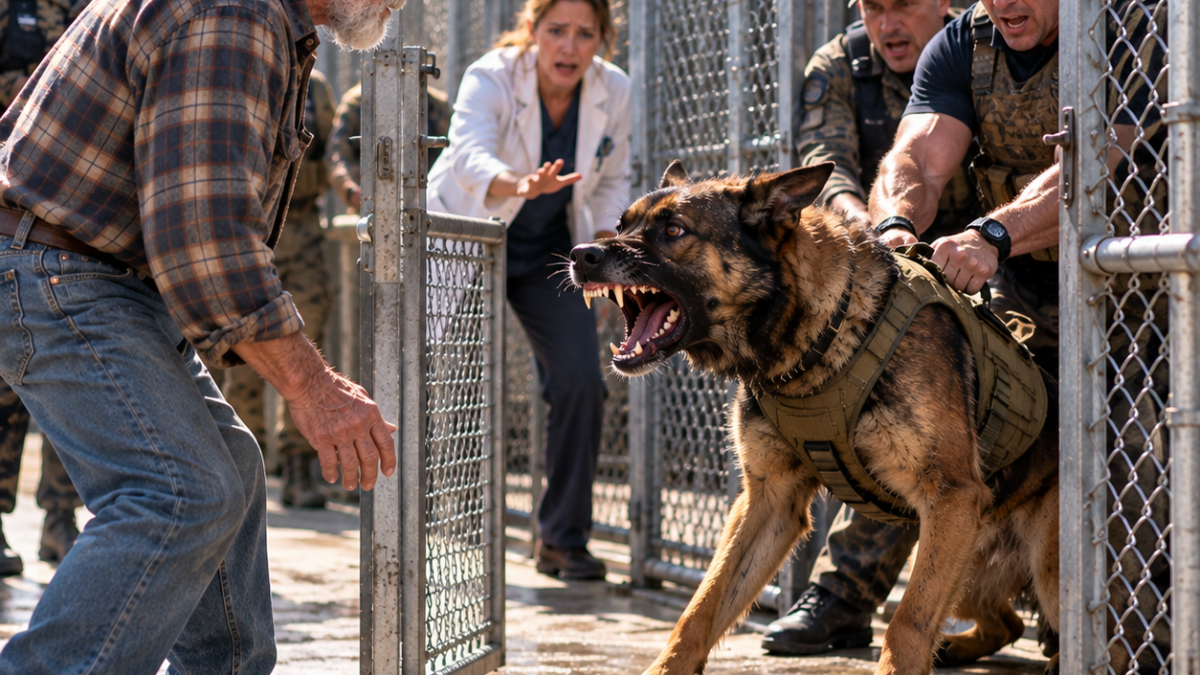
Phalanx hit the fence suddenly.
The chain-link exploded outward under his weight, snapping tight against steel posts with a metallic crack. Elena flinched despite herself. Davis did not, but his hand moved closer to the tranquilizer pistol on his belt.
Jacob did not move.
The dog’s teeth flashed through the mesh.
Saliva sprayed.
The growl became a bark that ricocheted off concrete and steel.
Jacob watched his eyes.
Not his mouth.
Not his teeth.
His eyes.
“He thinks his boy is still in the fight,” Jacob said. “He’s holding the line until Liam comes back.”
Elena inhaled sharply.
“With respect, Mr. Brandt, anthropomorphizing his behavior is not helpful.”
“With respect, Doctor, pretending he’s only a behavior problem is why he’s still dying in front of you.”
Davis looked at Jacob then.
Really looked.
The old man’s posture had changed, though only slightly.
Feet shoulder-width apart.
Weight balanced.
Hands loose.
Chin down.
Eyes scanning without seeming to scan—the gate latch, the corner blind spot, the fence height, the distance between Davis’s hand and the tranquilizer pistol, the direction of the sun, the pattern of Phalanx’s pacing.
Davis had seen that kind of assessment before.
Not on farms.
Not in therapy rooms.
On ranges.
In kill houses.
In men who had been through doors first.
Elena pinched the bridge of her nose.
“Mr. Brandt, I understand this is emotional for you.”
“No,” Jacob said.
That single word stopped her.
He turned those pale eyes toward her for the first time.
“I drove one thousand two hundred miles from Montana to stand in front of the last living piece of my grandson’s war. I am well past emotional.”
Elena said nothing.
Jacob looked back at Phalanx.
“You called me because you’re out of options.”
The words landed like something dropped in an empty room.
Elena’s eyes flicked toward the clipboard in her hand.
The final report was already drafted.
Not submitted.
Not signed.
But drafted.
The Navy did not have infinite space for permanently unstable assets, no matter how decorated their past. Phalanx could not be reassigned. Could not be handled. Could not be adopted. Could not remain locked in a concrete run for the rest of his life, suffering and dangerous and unreachable.
The recommendation was written in clinical language.
Humane euthanasia.
The words hung over the compound like heat.
Jacob seemed to see them without being told.
“He has a week,” he said.
Elena’s face changed.
“How did you—”
“He has about a week before some captain in an office signs a piece of paper and everyone here gets to tell themselves they did all they could.”
Phalanx paced.
Click.
Click.
Click.
Jacob’s voice remained quiet.
“You’ll put down a hero because you were scared of him. And the worst part is you won’t be wrong to be scared.”
Elena looked at him for a long moment.
Anger rose first.
Then defense.
Then shame.
Because beneath the bluntness, he had found the thing she had been avoiding: her protocols had failed, but her fear had survived.
“He is highly dangerous,” she said.
“Yes.”
“You have no idea what he’s capable of.”
Jacob’s mouth tightened at one corner.
“Doctor, if that dog wanted someone dead, your fence wouldn’t be the thing stopping him.”
Davis’s eyes sharpened.
That was not a farmer’s assessment.
Jacob stepped toward the gate.
“I didn’t come to talk through wire.”
Elena’s voice snapped.
“No.”
He stopped.
“Open the gate.”
“Absolutely not.”
Davis looked from Elena to Jacob.
Phalanx stopped pacing.
The dog sensed the shift before any person acknowledged it.
His head lowered.
The growl deepened.
Elena stepped between Jacob and the gate.
“Mr. Brandt, I will allow you to see him and speak to him from a safe distance. That is all.”
Jacob’s eyes stayed on Phalanx.
“Your safe distance is killing him.”
“My primary responsibility is personnel safety.”
“And mine is family.”
For the first time, emotion entered his voice.
Not loud.
Not pleading.
Something older.
A grief packed so tightly it had become command.
“Liam’s mother died when he was nine,” Jacob said. “His father drank himself out of usefulness before the boy turned twelve. I raised him on a ranch outside Lewistown, taught him to drive fence posts, mend wire, shoot straight, tell the truth, and come home when he said he would.”
His eyes did not leave the dog.
“He wrote me about Phalanx. Every letter. Every call. Said he was the best partner he ever had. Said the dog could smell a wire under dust, hear fear through a wall, and read Liam’s breathing better than any doctor alive.”
Phalanx’s ears shifted at the sound of Liam’s name.
Jacob noticed.
So did Davis.
“He called him family,” Jacob said.
Elena’s face softened despite herself.
Jacob turned to her.
“You’ve had him six months. Your way isn’t working. Let me try mine.”
“It violates every protocol.”
“Then write that down after.”
The wind moved across the compound, carrying the dry smell of concrete, metal, ocean salt, and kennel disinfectant.
Elena looked at the dog.
At the old man.
At Davis.
Davis said nothing.
But his eyes said what his rank would not permit.
Let him try.
Elena exhaled.
“Davis.”
“Ma’am?”
“Open the gate.”
His hand tightened on the tranquilizer pistol.
“Yes, ma’am.”
“If Phalanx makes one committed charge—”
“I know.”
“No, Petty Officer. I need you to understand me. If he makes one committed charge, you drop him.”
Davis looked pained.
Jacob gave him the slightest nod.
Not gratitude.
Acknowledgment.
I have this.
Davis unlocked the heavy padlock.
The gate groaned inward.
Phalanx stopped moving.
For one breath, there was perfect silence.
Then the growl intensified until it seemed to vibrate through bone.
His lips peeled back from white teeth.
His shoulders bunched.
He was no longer only a grieving dog.
He was a weapon acquiring a target.
Jacob Brandt stepped into the enclosure.
He did not extend a hand.
He did not crouch.
He did not make soft noises.
He did not say, “Good boy,” in that nervous singsong voice people used when they wanted to convince themselves animals could not smell fear.
He simply walked in.
One step.
Then another.
His movements were slow, economical, and strangely smooth for a man his age. The stiffness of arthritis, if he had any, disappeared. He stopped fifteen feet from Phalanx, just outside the invisible line every handler had learned to respect.
Phalanx’s bark tore through the kennel.
Elena’s hand flew to her mouth.
Davis’s fingers tightened around the tranquilizer grip.
Jacob did not flinch.
He did not even appear to breathe.
He watched the dog’s eyes.
That was where the truth lived.
Rage, yes.
Threat, yes.
But beneath it, Jacob saw something Elena’s reports had named without truly recognizing.
Confusion.
Pain.
A soldier left behind in the last place his world still made sense.
Phalanx lunged.
Not a full attack.
A blast.
A warning detonation.
He covered half the distance in a single explosive movement, stopping five feet from Jacob with a bark so forceful it struck the old man’s pant leg with warm air and spit.
Elena whispered, “Oh my God.”
Jacob remained still.
His body was angled now, barely. Weight centered on the balls of his feet. Knees soft. Hands relaxed but ready. Not defensive exactly. Not aggressive.
Prepared.
Davis saw it clearly.
He was not watching a reckless old farmer.
He was watching a professional allow a hostile dog to spend the first wave of violence against an immovable object.
Phalanx barked again.
And again.
Each sound cracked off the kennel walls.
Jacob endured it.
One minute passed.
Then two.
The barking changed first.
Not stopped.
Changed.
Less certain.
The note beneath the fury shifted from threat to frustration, from frustration to confusion.
This man was not prey.
He was not an intruder.
He was not a handler with a pole.
He was not a veterinarian with fear leaking from his skin.
He was something Phalanx had not encountered since Liam died.
Calm authority.
Jacob took one slow step forward.
Phalanx barked, but the sound had a fracture in it now.
“That’s enough of that,” Jacob said.
His voice was low.
Not soothing.
Ordering.
“You’re done scaring the people in white coats. I’m not them.”
Another step.
Phalanx’s head jerked.
The dog’s entire body trembled with the effort of holding two conflicting realities: attack and listen.
Jacob stopped.
“I know you’re waiting for him.”
At Liam’s absence, Phalanx snarled again.
But weaker.
“I know you miss him.”
Jacob’s voice roughened.
“I miss him too.”
Elena saw it then.
The old man had not come only for the dog.
He had come to stand in the same room as the grief he had been outrunning since the folded flag came to Montana.
“He was my boy long before he was yours,” Jacob said.
The growling faltered.
Jacob lowered himself to one knee.
Elena almost shouted for him not to.
Davis raised one hand slightly, stopping her without thinking.
The movement was smooth.
Controlled.
Jacob settled onto the concrete below the dog’s eye level, placing himself in a position that should have made him vulnerable.
But somehow it did not.
It looked less like surrender than trust sharpened into discipline.
“He’s not coming back, Phalanx.”
The dog froze.
Jacob swallowed.
The words scraped his throat raw.
“He’s gone home. And he’s waiting on us now.”
Phalanx whined once.
Small.
Broken.
Then swallowed it into a growl.
Jacob looked toward the fence without taking his eyes off the dog.
“Dr. Reed.”
Elena barely found her voice.
“Yes?”
“I need something of Liam’s. Something he wore. Vest if you have it.”
For a second, no one moved.
Then Davis snapped, “Ma’am. The vest.”
Elena turned and ran to the evidence locker.
Liam Olsen’s final kit had been cleaned as much as policy required, cataloged, stored, and avoided by everyone who could not bear to touch it. The plate carrier still held desert dust in the seams. It smelled faintly of sweat, cordite, canvas, sun-baked stone, and something human enough to make Elena pause in the doorway before carrying it back.
She handed it to Davis.
Davis approached the gate carefully and placed the carrier inside before retreating.
Jacob did not look away from Phalanx.
He reached slowly to the side, hooked two fingers into the MOLLE webbing, and dragged the vest across the concrete.
The scent hit Phalanx like a physical blow.
The dog reeled back.
A high, piercing whine tore from him.
It was the first sound in six months that was neither bark nor growl.
Elena’s eyes filled instantly.
She had documented Phalanx’s vocalizations.
Frequency.
Duration.
Context.
She had never heard grief come from him in its naked form.
Jacob placed one hand flat on the dusty armor.
“He told me about you,” he said.
Phalanx stared at the vest.
His whole body shook.
“Said you were the best he’d ever seen. Said you could find a needle in a sandstorm. Said you had the heart of a lion and the patience of a saint, though I told him no dog living with an Olsen had that much patience.”
Davis let out a breath that was almost a laugh and almost a sob.
Jacob’s fingers stroked the fabric once.
“He said you were family.”
Phalanx stopped growling.
The silence startled everyone more than the barking had.
The dog’s ears moved forward.
Jacob’s face changed.
Barely.
A decision.
Then he spoke a single word.
“Stashy.”
The reaction was immediate.
Phalanx flinched as if struck.
His entire body went slack.
The tension that had held him rigid for six months vanished so completely Elena thought his legs might give out. His head cocked. His ears came up. His eyes locked onto Jacob’s face, no longer furious, but bewildered.
Deeply.
Completely.
A word from another world had entered the concrete box.
Davis felt the hair rise along the back of his neck.
That was not a pet command.
That was not something a handler’s grieving grandfather picked up from a letter.
Jacob said it again.
Softer.
“Stashy.”
Phalanx whimpered.
Long.
Shuddering.
A sound of collapse.
A dam breaking.
He took one step forward.
Then another.
Slowly now.
Cautiously.
As if approaching a ghost.
He stopped in front of Jacob’s knee and stretched his neck.
His wet nose twitched.
Old cotton.
Hay.
Machine oil.
Dust.
And beneath it, faint but unmistakable.
Gunpowder.
Phalanx nudged Jacob’s hand.
Jacob did not move.
The dog nudged him again.
Harder.
A question becoming a plea.
Jacob lifted his hand from Liam’s vest and placed it on the dog’s head.
Not petting.
Not comforting in the civilian way.
His fingers moved with practiced precision over ears, jaw, neck, shoulders, ribs. Checking. Assessing. Feeling glands. Searching for injury, heat, swelling, hidden pain.
The diagnostic touch of a master handler evaluating a partner after contact.
Phalanx leaned into him.
All at once, the dog’s massive body folded.
He sank to the concrete and laid his head on Jacob’s knee.
His eyes closed.
The compound went still.
Elena pressed both hands to her mouth.
Davis looked away because he did not want anyone to see what the moment had done to him.
For the first time in one hundred eighty-two days, Phalanx rested.
Jacob’s hand continued moving.
Slow.
Methodical.
On the dog’s flank, beneath a thick fold of sable fur, his fingers found a small hardened mat. He worked it gently apart with blunt fingernails until something tiny came free.
A dried burr.
Brown.
Brittle.
Sharp.
The kind that grew wild in the high desert regions of Afghanistan.
It had been there for six months, buried in the coat, too small for scans and too deep for quick exams on an unapproachable dog. A tiny piece of the battlefield Phalanx had carried home in his skin.
Jacob flicked it away.
“You didn’t need that anymore either,” he murmured.
Phalanx sighed.
A real sigh.
Deep and exhausted.
Jacob lowered his head for a moment, his hand resting on the dog’s neck.
Elena had built her career on measured observation.
Data.
Protocol.
Treatment plans.
But standing outside that fence, she understood that her charts had missed something essential.
She had seen symptoms.
Jacob had seen a soldier.
“How?” she whispered.
Jacob looked up.
His pale eyes were tired.
“How did you do that?”
He stroked the dog’s head.
“Listened.”
“That word,” Davis said quietly. “What was it?”
Jacob’s face closed a little.
“Something Liam mentioned in a letter. A field word. Calming cue.”
Davis did not move.
“With respect, sir, that was not a cue you picked up from a letter.”
Jacob met his eyes.
Davis continued, careful but firm.
“The stance. Your breathing. The way you took the lunge. The way you checked him over. Sir, where did you serve?”
The air shifted.
For the first time, Jacob looked old.
Not weak.
Old.
As if the years had returned all at once and settled on his shoulders.
“A long time ago,” he said.
That was all.
He rose slowly.
Phalanx rose with him, pressing against his leg as if magnetized.
Jacob turned toward the gate.
“He’ll be all right now.”
Elena blinked.
“You can’t just—”
But she stopped.
Because Phalanx was walking calmly at Jacob’s heel.
Not dragging.
Not lunging.
Not scanning for targets.
Walking.
Focused.
Silent.
Whole enough to follow.
Jacob reached the gate, paused, and looked back at Davis.
“Your fence is good,” he said. “But it was the wrong kind.”
Then he stepped through, and Phalanx followed him into the sunlight.
That afternoon, Petty Officer Davis stood at parade rest in Captain Wallace’s office.
He had requested the meeting because something about what he had witnessed refused to settle into ordinary explanation.
Captain Wallace, base commander, read Dr. Reed’s preliminary memo with a frown.
“This is vague,” Wallace said. “It says the Olsen K9 is no longer an immediate threat and that the handler’s grandfather was instrumental. It recommends transfer of the dog into Mr. Brandt’s custody pending command approval.”
He looked up.
“Fill in the blanks, Davis.”
Davis did.
Precisely.
He described the kennel.
The dog’s state.
Jacob’s entrance.
The lunge.
The stillness.
The word.
The way Phalanx broke.
The field check.
The burr.
The dog walking out at heel.
Wallace did not interrupt until Davis said the word again.
“Stashy, sir.”
Wallace’s pen stopped moving.
Davis noticed.
“I looked it up,” he said. “Pashto, maybe regional. Could mean ‘be at ease’ or ‘rest,’ depending on dialect. But it’s not common. Not something you learn from a phrasebook.”
Wallace leaned back in his chair.
“Brandt,” he said slowly. “Jacob Brandt. Montana?”
“Yes, sir.”
For a long moment, Wallace said nothing.
Then he turned to his computer.
“What do you know about the early history of Naval Special Warfare canine integration?”
Davis frowned.
“Formal programs expanded heavily post-9/11. Before that, there were scout and sentry dogs going back—”
“Before the official programs,” Wallace interrupted.
His voice had lowered.
“Before budgets, doctrine, kennels, PowerPoints, and procurement pipelines. Before anyone admitted how much of the work was being invented in the mud by men who weren’t supposed to be where they were.”
He typed.
Davis waited.
A restricted file opened on the screen.
Most of it was blacked out.
Wallace turned the monitor.
The name at the top read:
BRANDT, JACOB T.
CPO, USN, RETIRED
Davis stared.
Beneath the name were dates stretching from the late 1960s into the early 1980s. Unit designations redacted. Operations redacted. Locations redacted. Commendations partially redacted.
One citation remained readable.
Navy Cross.
Awarded in secret.
For extraordinary heroism while serving as lead scout and K9 handler during a clandestine cross-border operation. CPO Brandt and his K9, Major, held a numerically superior enemy force long enough to permit the extraction of his reconnaissance element.
Davis read it twice.
His throat went dry.
Wallace watched him.
“Jacob Brandt is not a farmer who happens to be a SEAL’s grandfather,” the captain said. “He is one of the originals.”
Davis looked up.
“One of what, sir?”
“One of the men who wrote the first chapter of this work before anyone had a manual. MACV-SOG era. Scouts. Trackers. Dogs used as living early-warning systems in places the government still pretends we weren’t. Most records buried. Some destroyed. A few sealed so deeply you need stars on your shoulder or ghosts in your family to find them.”
Davis looked back at the citation.
“Why didn’t anyone know?”
“Because Brandt wanted it that way.”
Wallace leaned back.
“When he retired, he requested his file be sealed. Bought land in Montana. Became a farmer. Refused speaking invitations. Refused consulting. Refused honors. As far as the modern Navy was concerned, Chief Petty Officer Jacob Brandt disappeared.”
“But Liam knew?”
“Liam was his grandson,” Wallace said. “And if I had to guess, Liam learned more from that old man before age eighteen than most handlers learn in a career.”
Davis thought of Jacob’s stance.
The breathing.
The hand on Phalanx’s head.
The word that opened the cage inside the dog.
“He wasn’t calming him,” Davis said quietly.
“No.”
“He was giving him an order.”
Wallace nodded.
“A lawful one, if you ask me.”
Davis looked up.
“Sir?”
Wallace closed the file.
“He told a soldier the battle was over.”
The next morning, Dr. Elena Reed found Jacob Brandt on the far training field just after sunrise.
The grass was still damp.
The Pacific lay beyond the base in a flat blue-gray line. Gulls circled overhead. Somewhere in the distance, a cadence call drifted from a formation run.
Jacob wore the same boots, the same jeans, the same flannel under a worn canvas jacket. He stood in the center of the field holding a rope toy.
Phalanx was with him.
The change was staggering.
Not cured.
Elena knew better than to use that word lightly.
But present.
The dog’s body was relaxed, his mouth slightly open, his ears attentive. His eyes still carried shadows. So did Jacob’s. But Phalanx was no longer pacing inside an invisible war. He watched Jacob with focused trust, waiting not in panic but in readiness.
Jacob tossed the rope.
Phalanx bounded after it.
Not perfectly.
A little stiff.
A little uncertain.
But when he returned and dropped it at Jacob’s boots, Elena felt her chest tighten.
It was play.
Simple.
Ordinary.
Miraculous.
“Mr. Brandt,” she called.
Jacob turned.
“Doctor.”
She stopped several feet away.
This time she did not approach like an expert entering a case.
She approached like a student.
“I owe you an apology.”
Jacob said nothing.
“I was arrogant,” she said. “I looked at Phalanx and saw a clinical problem. A risk profile. A case study.” She swallowed. “You saw him.”
Jacob bent and picked up the rope.
“You weren’t wrong to use science.”
Elena blinked.
“I wasn’t?”
“No. Medicine matters. Data matters. Protocol matters. But they’re tools, not eyes.”
Phalanx leaned against his leg.
Jacob rested a hand on the dog’s neck.
“You can measure stress response. You can chart aggression. You can medicate hyperarousal. But if you forget what loyalty looks like when it’s wounded, you’ll misread the whole animal.”
Elena looked at Phalanx.
“What was happening to him?”
Jacob’s fingers moved lightly through the dog’s fur.
“Liam was his alpha, his partner, his language, his purpose. When Liam died, Phalanx didn’t understand death the way you and I do. He understood absence. Broken routine. No return scent. No release. No final command he could trust.”
“So he guarded.”
“He guarded the last position his world gave him.”
Elena looked toward the kennels.
“We thought he was refusing reintegration.”
“He was refusing surrender.”
The words struck her hard.
Jacob continued.
“There’s a difference.”
“And the word?”
His eyes flicked toward her.
“Stashy.”
“It wasn’t just a calming cue.”
“No.”
“What was it?”
“A key.”
Elena waited.
Jacob sighed.
“Field command. Not official anymore. Maybe never was. Liam must have used it with him under certain conditions. It meant stand down without going soft. Be at ease, but stay ready. It told Phalanx the fight had an ending.”
Elena’s voice softened.
“It gave him permission to grieve.”
Jacob looked at her then, something like approval in his eyes.
“Yes.”
Phalanx picked up the rope and pressed it against Jacob’s hand.
Jacob took it.
The dog’s tail moved once.
Elena smiled despite herself.
“The Navy approved transfer to your custody,” she said.
“I know.”
“You already knew?”
“I know how officers think when they realize they almost killed something valuable.”
She looked down.
The words hurt because they were true.
“I signed the report,” she said. “I hadn’t submitted it yet, but I signed it.”
Jacob did not answer.
Elena forced herself to continue.
“I told myself it was humane. I told myself suffering with no path forward was cruelty. And maybe in some cases that’s true. But with Phalanx…” Her voice caught. “I didn’t understand the path.”
Jacob’s face softened slightly.
“Now you do.”
“I understand that I don’t understand enough.”
“That’s a better start.”
She nodded.
“I want to build something better.”
He watched her carefully.
“A program for dogs like him,” Elena said. “For working dogs who lose handlers. Not just behavioral containment. Not just medication and risk management. Something that treats the bond as part of the injury.”
Jacob’s gaze sharpened.
This was not casual interest now.
This was command attention.
“Say that again.”
Elena straightened.
“The bond is part of the injury.”
Jacob studied her for a long time.
Phalanx leaned quietly against his leg.
Finally, Jacob said, “Good.”
Elena exhaled.
“I need help.”
“Yes.”
“I need someone who understands what I missed.”
“Yes.”
“I need you.”
Jacob looked toward the ocean.
For a moment, Elena thought he would refuse.
Men like him disappeared for reasons.
Pain.
Exhaustion.
Secrets.
A lifetime of being used by institutions that later praised themselves for surviving the consequences.
Then Phalanx nudged his hand.
Jacob looked down.
The dog’s eyes were clear.
Waiting.
Jacob scratched behind one ear.
“I came here to bring Liam’s dog home,” he said.
Elena nodded, disappointment already settling.
“But Liam would tell me I’m being stubborn if I stopped there.”
Her head lifted.
Jacob looked back at her.
“Get a notebook, Doctor.”
She blinked.
“What?”
“Class starts now.”
Elena almost laughed from sheer relief.
Jacob pointed toward Phalanx.
“First lesson. It’s not about control.”
He began walking across the grass.
Phalanx followed at heel.
Elena fell into step, pulling a pen from her coat pocket and opening the small notebook she always carried.
Jacob spoke without looking at her.
“It’s about trust. Everything—training, correction, recovery, deployment, retirement, grief—everything starts there. You break trust, you can still get obedience, but you won’t get partnership.”
Elena wrote quickly.
“Second lesson,” Jacob continued. “A working dog does not retire from loyalty just because paperwork says the mission is over.”
Phalanx glanced up at him.
Jacob’s face tightened with memory.
“You have to give him a new mission he can understand.”
“What is Phalanx’s new mission?” Elena asked.
Jacob looked down at the dog.
Then toward the base.
Then beyond it, somewhere farther than the ocean, toward a ranch in Montana and a grave with Liam Olsen’s name on it.
“Living,” he said.
The first week after transfer, Phalanx slept on Jacob’s motel room floor with Liam’s plate carrier folded beside him.
He woke four times the first night, growling at sounds in the hallway.
Each time, Jacob spoke one word.
“Stashy.”
Each time, Phalanx settled faster.
By the fourth night, he slept for six straight hours.
Davis visited daily.
At first, he came under the excuse of paperwork.
Then equipment.
Then checking diet transition.
Finally, Jacob opened the motel door and said, “You can just admit you miss him.”
Davis looked past him at Phalanx.
The dog stood alert but calm.
“Yes, sir.”
Jacob stepped aside.
“Then come in right.”
Davis stopped.
“Right?”
“Don’t square up. Don’t reach. Don’t lean over him. Give him your side, your scent, and your patience.”
Davis obeyed.
Phalanx sniffed him for a long time.
Then turned away and lay back down.
Davis looked devastated and honored at once.
“He didn’t growl.”
“No.”
“That’s good?”
“That’s very good.”
Davis sat in the chair by the door.
For thirty minutes, he said nothing.
Phalanx slept.
Jacob nodded once.
“Better than most lieutenants,” he said.
Davis smiled.
Over the next month, Dr. Reed’s new pilot program began unofficially because official things moved slowly and wounded creatures did not.
She called it the Handler Legacy Transition Protocol.
Jacob hated the name.
“Sounds like a printer setting,” he said.
Elena crossed it out.
Together, they built the bones of something better.
Scent continuity before separation.
Structured mourning rituals after handler death.
Controlled exposure to handler gear.
Replacement hierarchy introduced through known commands.
Peer handler support.
Medical checks only after trust bridging.
Recognition that what looked like aggression might be duty without release.
Jacob taught handlers to stop asking, “How do we make the dog safe?”
And start asking, “What does the dog think his mission is?”
Davis became the first official student.
Then three more.
Then seven.
Captain Wallace approved facility time after watching Phalanx walk calmly through a training yard full of personnel who had once avoided his kennel entirely.
The first time Phalanx entered the old kennel area again, Elena held her breath.
He stopped outside the enclosure where he had spent six months.
His ears shifted.
His body tightened.
Jacob stood beside him.
Not gripping.
Not restraining.
Present.
Phalanx looked at the gate.
Then at Jacob.
The old man said softly, “That post is covered.”
Phalanx exhaled.
Then walked on.
Elena turned away before anyone saw her cry.
Three months later, Jacob finally took Phalanx home to Montana.
The ranch lay outside Lewistown, under a sky so wide it seemed impossible to defend and impossible not to love. Fences ran toward low hills. Cattle moved like dark punctuation across winter grass. The barn leaned slightly but stood stubborn. A line of cottonwoods marked the creek.
Phalanx stepped out of the truck and froze.
Wind moved over him.
Not sea wind.
Not desert wind.
Cold, dry Montana air filled with hay, soil, cattle, rust, pine, distant snow, and old machinery.
His nose worked.
Jacob stood beside him.
“This is home now.”
Phalanx looked up.
Jacob pointed toward the porch.
“Your boy grew up there.”
The dog stared at the house.
A memory he had never lived seemed to move through him because Liam’s scent, old and faint but real, still lived in the place. In the porch rail his hands had sanded. In the barn jacket hanging by the mudroom. In the bedroom Jacob had not changed since Liam left for the Navy.
Phalanx walked to the porch steps.
He sniffed the wood.
Then lay down.
Jacob stood behind him for a long time.
That evening, he opened Liam’s room.
He had not entered it properly since the funeral.
The bed was made. The bookshelf still held paperbacks, wrestling trophies, a cracked baseball glove, and a photograph of Liam at twelve holding a ranch dog named Major’s grandson—because Jacob, sentimental despite all evidence, had named too many dogs after the one he lost in war.
Phalanx entered slowly.
He moved around the room, nose low.
At the closet, he stopped.
Jacob opened it.
Liam’s old denim jacket hung inside.
The one he had worn before uniforms replaced everything.
Phalanx pressed his nose into the fabric and whined.
Jacob sat on the bed.
For a long time, neither old man nor warrior dog moved.
Then Phalanx climbed halfway onto the bed, too disciplined to fully take it without permission, too broken not to ask.
Jacob looked at him.
“Go on.”
The dog climbed up, turned once, and lay with his head on Liam’s pillow.
Jacob placed a hand on his side.
And finally, in the room where he had once taught a boy to lace boots, tie knots, and tell the truth, Jacob Brandt wept.
Not loudly.
Not dramatically.
Just an old man with one hand on the last living partner his grandson had trusted, letting grief come because the dog had shown him how.
Spring came slowly to Montana.
Snow melted from fence lines.
Mud swallowed boots.
Calves arrived in the cold hours before dawn, and Phalanx learned ranch work with the seriousness of a soldier accepting new orders.
He did not herd naturally at first.
He tried to clear barns like compounds.
He treated coyotes as enemy combatants and nearly gave Jacob a heart attack the first time he vaulted a low fence after one.
He learned which cows kicked.
He learned the sound of Jacob’s truck.
He learned that mail carriers were not insurgents.
Mostly.
He learned to sleep.
That was the miracle no citation captured.
He slept on the porch in afternoon sun.
In the barn during rain.
Beside Jacob’s chair at night.
Sometimes he dreamed, paws twitching, throat rumbling. Jacob would lower one hand and say, “Stashy,” and the dog would settle without fully waking.
Dr. Reed visited in June.
She arrived with Davis and two other handlers from Coronado, carrying notebooks, recorders, and far less certainty than she had once worn.
Jacob met them at the gate.
Phalanx stood at his side.
Healthy.
Scarred.
Alert.
Alive.
Davis smiled when he saw him.
“Hey, buddy.”
Phalanx looked at Jacob.
Jacob nodded.
The dog walked to Davis and pressed his head briefly against the young handler’s thigh.
Davis froze.
Then placed one hand on Phalanx’s neck.
“Good to see you too.”
Elena watched the exchange and understood something else.
Healing did not erase loyalty to the dead.
It made room for loyalty to continue without becoming a cage.
That afternoon, under the shade of the barn, Jacob taught them with coffee in tin mugs and Phalanx asleep at his boots.
He told them stories without giving away classified details.
About dogs who smelled tripwires before men saw them.
About handlers who trusted a shift in an ear more than a map.
About the difference between obedience and partnership.
About Major, the dog who had saved his life in a jungle no report described accurately.
About losing that dog and being told by a commanding officer to “requisition another asset.”
His voice hardened there.
Elena wrote nothing for a while.
Some lessons were not notes.
“Never call them assets in front of me,” Jacob said.
No one did.
By the end of summer, the program had a real name.
The Warrior Bond Initiative.
Jacob still said it sounded like something painted on a government banner, but he stopped objecting after Elena showed him the first case file.
Another dog.
A Dutch Shepherd whose handler had died in training.
Not violent yet.
Just shutting down.
Refusing food.
Sleeping beside a gear locker.
Elena asked, “Will you consult?”
Jacob looked at Phalanx.
The dog lifted his head.
As if waiting.
Jacob sighed.
“Send me the file.”
The work continued.
Not fast.
Not perfect.
Some dogs recovered enough for adoption.
Some returned to limited work.
Some only learned to rest safely.
Some cases still ended in heartbreak.
Jacob never pretended every story could be saved by a word, a vest, or an old man walking through a gate. He hated sentimental lies almost as much as bureaucratic ones.
But the question changed.
Before Phalanx, the Navy had asked, “Is the dog too dangerous to keep?”
After Phalanx, someone in the room would ask, “Has anyone told him the mission is over in a language he understands?”
That question saved lives.
Canine and human.
A year after Liam’s death, Jacob drove to Coronado with Phalanx for a memorial ceremony he had not planned to attend.
Captain Wallace insisted.
Elena asked.
Davis drove all the way to Montana and stood on Jacob’s porch until the old man agreed, mostly to make him leave.
The ceremony was held near the canine compound.
Not in the kennel.
Never there.
On a grass field by the flagpole.
Handlers stood in formation. Command staff in dress uniforms. Dr. Reed in a dark suit. Davis beside the front row. Phalanx sat at Jacob’s left, wearing a plain black collar with a small tag engraved:
PHALANX
MWD
SEAL TEAM 3
LIAM’S PARTNER
Liam’s name was read aloud.
Petty Officer First Class Liam Olsen.
Silver Star.
Purple Heart.
Killed in action.
Beloved son. Grandson. Teammate. Handler.
Jacob stared straight ahead.
His face did not move.
Phalanx leaned against his leg.
Then Captain Wallace did something not on the printed program.
He called Jacob forward.
Jacob’s eyes narrowed.
Wallace looked entirely too pleased with himself.
“Chief Petty Officer Jacob Brandt, United States Navy, retired.”
A murmur moved through the crowd.
Jacob did not move.
Phalanx looked up at him.
Davis whispered from the front row, “Go on, Chief.”
Jacob shot him a look that promised future suffering.
Then he walked forward with Phalanx at heel.
Wallace spoke into the microphone.
“Some men serve in ways history records. Others serve in ways history buries, even when entire generations build upon what they created. Today, we recognize not only the sacrifice of Petty Officer Liam Olsen, but the legacy of service that shaped him.”
Jacob’s jaw tightened.
“Elena Reed and Petty Officer Davis have built, under Chief Brandt’s reluctant guidance, a program that will change how this command cares for military working dogs who lose handlers. That program exists because one man refused to let a warrior be mistaken for a problem.”
Elena’s eyes shone.
Davis stood very straight.
Wallace turned to Jacob.
“Chief, would you care to say a few words?”
Jacob leaned toward the microphone.
“No.”
A ripple of laughter broke the tension.
Wallace smiled.
Jacob looked out at the handlers.
Young faces.
Old eyes.
Men and women who would someday learn that love for a dog in war was both strength and wound.
He sighed.
Then he spoke.
“Your dog is not your equipment.”
Silence fell.
“He is not your pet either. Not out there. He is your partner. He reads you when you don’t know you’re speaking. He trusts your breath, your hands, your pace, your fear, your courage, your lies.”
Phalanx sat still beside him.
“If you fall, he may not understand why the world kept moving without you. So build trust strong enough that someone else can carry your last order home.”
Jacob looked down at Phalanx.
“And if only the dog comes back, don’t ask what’s wrong with him first. Ask what he’s still trying to do right.”
No one breathed.
Jacob stepped away from the microphone.
That was all.
But it was enough.
After the ceremony, Elena found him near the old enclosure.
The gate was open now.
Empty.
Clean.
Unused.
Phalanx stood beside it without tension.
Jacob looked through the chain-link.
“I hate this place,” he said.
“I know.”
“You should keep it.”
Elena looked surprised.
“As a reminder?”
“As a warning.”
She nodded.
Then she said, “We had another success last week.”
“The Dutch Shepherd?”
“Yes. He’s eating again. Sleeping in four-hour blocks. Accepted a new handler for walks.”
Jacob grunted.
That was his version of celebration.
Elena smiled.
“He responded to scent work. You were right. He didn’t need comfort first. He needed a job.”
“Most of us do.”
They stood together in silence.
Then Elena asked the question she had carried for months.
“Did Liam know who you were?”
Jacob’s face remained unreadable.
“He knew enough.”
“Did he know about the Navy Cross?”
“No.”
“Why not?”
Jacob looked toward the flag.
“Because medals tell young men the wrong part of the story.”
“What part is that?”
“That surviving makes you a hero.”
Elena waited.
Jacob’s hand settled on Phalanx’s head.
“Sometimes surviving just means you’re the one left to feed the dog.”
The answer stayed with her longer than any lecture.
That evening, Jacob and Phalanx returned to the motel near the beach.
The old man sat outside the room in a plastic chair, watching the Pacific darken. Phalanx lay at his feet, head on paws.
Jacob held Liam’s old plate carrier across his lap.
He had brought it for the ceremony.
He had not decided what to do with it.
The dog lifted his head.
Jacob looked down.
“You think he’d want us to keep carrying this?”
Phalanx blinked.
Jacob nodded as if receiving advice.
“Yeah. Me neither.”
The next morning, before sunrise, Jacob drove north to a quiet stretch of beach where service members sometimes scattered ashes, said goodbyes, or stood alone long enough for the ocean to take what words could not.
He laid the plate carrier on the sand.
Phalanx sniffed it.
Then sat.
Jacob removed the name tape.
OLSEN.
He folded it and placed it in his shirt pocket.
The rest he held for a while.
Then he whispered, “Last watch is over, boy.”
For Liam.
For Phalanx.
For himself.
He did not throw the carrier into the ocean. Jacob Brandt was sentimental, not stupid, and littering still annoyed him. He packed it away to be preserved properly at the command memorial.
But he left something there.
A weight.
A post no living soul was required to guard anymore.
Phalanx stood.
He shook sand from his coat.
Then he picked up a piece of driftwood and dropped it at Jacob’s feet.
Jacob stared at it.
“You want to play now?”
Phalanx’s tail moved.
Jacob laughed.
It startled a gull into flight.
The sound was rusty.
Rare.
Alive.
He picked up the driftwood and threw it.
Phalanx ran.
Not from memory.
Not from ghosts.
Toward morning.
Years later, handlers at Coronado would tell new recruits the story.
Some versions made Jacob taller, meaner, more mysterious.
Some said Phalanx broke through two fences before the old man arrived, which was false.
Some said Jacob whispered a magic word, which was not true either.
There was no magic.
There was knowledge.
Trust.
Grief.
Timing.
And one old warrior recognizing another.
The official reports were more careful.
Military Working Dog Phalanx successfully transferred to private rehabilitative custody under Jacob T. Brandt, CPO, USN Ret. Subject demonstrated rapid reduction in aggression following handler-scent exposure and legacy command response. Case informed creation of Warrior Bond Initiative.
Clinical language.
Useful language.
Incomplete language.
Because no report could capture the moment a dog who had been called dangerous laid his head on an old man’s knee and finally slept.
No report could capture how Elena Reed changed from expert to student.
How Davis became a better handler because he learned to see beyond behavior.
How Captain Wallace quietly reopened sealed histories so the living could learn from ghosts.
How a grandfather who had disappeared into Montana came back because grief called him by name.
And how Phalanx, once written off as broken, spent the rest of his life on a ranch under a wide sky, guarding cattle, sleeping in sun, chasing rope toys, and walking beside Jacob Brandt like a shadow that had chosen peace.
On certain evenings, when the wind moved through the cottonwoods and the western light turned the barn gold, Jacob would sit on the porch with one hand resting on Phalanx’s head.
He would not speak much.
Phalanx did not require it.
They both understood the language beneath words.
Duty.
Loss.
Trust.
Release.
Sometimes Jacob would look toward the hills and think of Liam as a boy running through the pasture with scraped knees and impossible dreams.
Sometimes Phalanx would lift his head at a sound no human heard, ears forward, body ready.
And Jacob would say softly, “Stashy.”
At ease.
Rest.
The battle is over.
The dog would exhale and settle again.
And together, the old ghost and the warrior dog would sit beneath the Montana sky, keeping watch over a quieter world neither of them had believed they would live long enough to find.

