A Navy SEAL Spent Seven Years Searching for the Nurse Who Saved Him—Then His K9 Sat Down at Her Feet
PART3:
I tried to sit.
Pain slammed me flat.
“Where?”
“Veterinary surgical unit.”
“Alive?”
“Yes.”
That was enough.
Second question:
“The nurse.”
“What nurse?”
“The woman.”
He looked at chart.
“Which woman?”
“The one from the extraction.”
“Sir, your field evac team was mixed personnel.”
“She saved me.”
“I’m sure several people—”
“No.”
I remember gripping his wrist.
“The nurse.”
He got uncomfortable.
“I’ll ask.”
Nobody gave me a name.
The official report later described her as:
UNKNOWN ALLIED MEDICAL PERSONNEL.
That phrase made me furious.
Unknown.
Nobody who went back into a burning field station to pull out a SEAL officer and a military dog was unknown.
Somebody knew her.
I just didn’t.
Rook recovered faster than I did.
Belgian Malinois.
Seventy pounds of attitude.
Lean.
Dark mask.
One torn ear.
He had served with me four years by then.
In the field, his call sign was Shadow.
Very few people outside the team knew it.
His actual military records used a different identifier.
Shadow was ours.
Short.
Easy over radio.
He earned it because he moved so quietly that men occasionally realized he was beside them only when his nose hit their hand.
At Glass Harbor, Rook was injured badly enough that the veterinarians initially recommended retirement.
Two broken ribs.
Deep laceration through the shoulder.
Smoke inhalation.
He had bitten through a restraint trying to get back into the collapsed triage structure.
That detail was in his veterinary report.
The report didn’t say why.
I knew.
He had been trying to reach me.
It took six months before I could walk without looking like every step required negotiation.
Nine months before I could run.
A year before I admitted I wasn’t going back to the Teams.
That part nearly destroyed me.
Men like me are trained to imagine death.
Nobody trains you to imagine irrelevance.
The Navy offered staff assignments.
Instruction.
Planning.
I tried.
Every office felt too quiet.
Every meeting felt like somebody discussing weather from inside a bunker while the storm happened somewhere else.
I started having episodes.
Smoke from a barbecue could put me back under that collapsed frame.
A metal tray hitting tile sounded like incoming fire.
I’d wake at 2:00 a.m. convinced somebody was screaming.
Rook always knew before I did.
He’d climb onto the bed.
Press his body against my legs.
Sometimes put his muzzle against my chest.
My therapist called it grounding behavior.
I called it Rook being Rook.
Eventually, I medically retired.
Rook came with me.
Getting him released was easier than I expected.
His injuries and age helped.
The Navy had no interest in forcing an aging working dog with a reconstructed shoulder into another handler partnership.
For once, bureaucracy showed mercy.
Rook became mine.
Officially.
I thought retirement would close Glass Harbor.
It didn’t.
The woman remained.
I had one photograph.
A helmet-camera still pulled from corrupted footage.
Barely usable.
Me on a stretcher.
Chest wrapped.
Face black with soot.
Rook beside the stretcher with one paw on the metal frame.
Behind us, half turned away, a woman in medical gear.
One cheek.
One eye.
Dark hair.
Patch on her sleeve partially obscured.
No visible name.
The edge of the image was burned from damaged storage media.
I printed it.
Folded it.
Put it in my wallet.
Then my jacket.
Then every jacket after that.
At first I searched casually.
Asked former teammates.
Asked medics.
Nobody knew.
One guy remembered a female trauma nurse attached temporarily to a forward support team.
Another thought she was Navy.
Someone else said Air Force.
One man remembered hearing the surname Sloan.
Another swore it was Stone.
I chased both.
Nothing.
Then I filed records requests.
Denied.
Operational security.
Protective classification.
Medical personnel identities restricted.
Glass Harbor had involved intelligence assets, multinational personnel, and people whose names were buried deeper than mine.
I knew how that world worked.
I’d helped create files like that.
Suddenly I hated every black rectangle.
The first year, I sent six letters.
Portsmouth.
Bethesda.
Walter Reed.
A Naval medical command.
Two returned.
Three unanswered.
One acknowledged and said:
No matching personnel record located.
Second year, I went through veterans’ organizations.
Former medical corps.
Retired nurses.
Special operations support groups.
A woman in Norfolk claimed she knew exactly who I meant.
Wrong person.
A man in Tampa told me the nurse had died.
Wrong nurse.
Someone sent me a photograph of a woman who looked similar.
She had never been overseas.
By year three, friends started saying:
“Cole.”
I knew what came next.
“You need to let this go.”
I hated that phrase.
Let go.
As though gratitude could become obsession simply because the person receiving it was difficult to locate.
I wasn’t looking for romance.
I wasn’t imagining some reunion where music swelled and everything broken became whole.
I wanted one thing.
To tell her:
You saved my life.
I remember.
Thank you.
That was all.
At least that’s what I told myself.
The truth was more complicated.
Every time I woke from Glass Harbor, she was there.
Voice.
Hands.
Smoke.
Rook.
I needed proof that my memory hadn’t invented the person who held me together.
There were periods when I doubted the whole thing.
Traumatic memory is unreliable.
Maybe several nurses had become one face.
Maybe I’d combined a medic’s voice with somebody else’s hands.
Maybe the photograph had nothing to do with the woman I remembered.
Rook was the only other living witness I trusted.
And dogs don’t answer questions.
Seven years passed.
The photograph softened at the folds.
My scars faded.
Rook’s muzzle turned gray.
My left shoulder became unreliable in cold weather.
I learned how to sleep four hours without waking.
Progress.
Not recovery.
I stopped actively searching every week.
Then every month.
But I never stopped completely.
West Haven Veterans Hospital entered my life because of headaches.
Neurological symptoms.
Old blast injury.
Nothing dramatic.
A specialist wanted updated imaging.
Monday evening.
Storm outside.
6:23.
I remember the exact time because that’s what the clock above reception said when Rook and I walked into the emergency wing.
West Haven was one of those hospitals where every hallway felt full of different wars.
Vietnam veterans with walkers.
Younger Marines with prosthetics.
Women who looked completely healthy until a sudden sound made them freeze.
Service dogs.
Oxygen tanks.
Spouses holding folders thick with paperwork.
Men laughing too loudly.
Men saying nothing.
I noticed exits.
Always.
Front doors.
East stairwell.
Hall junction.
Reflective glass in the nurses’ station.
Hands.
My therapist once told me:
“This is not paranoia.”
“What is it?”
“Survival that forgot the war ended.”
Rook walked tight against my left leg.
He wore a black harness.
No aggressive-looking tactical patches.
Just:
RETIRED MWD
DO NOT DISTRACT.
People tried anyway.
Receptionist checked my appointment.
“You’re early.”
“I know.”
“Dr. Harlan is running behind.”
“Okay.”
“You can sit.”
“I’ll stand.”
She glanced toward the waiting room.
“There are empty chairs.”
“I know.”
I wasn’t trying to be rude.
Waiting rooms made my chest tighten.
Too many people behind me.
Too many unpredictable sounds.
Standing made movement possible.
That mattered.
Before she could answer, a doctor approached.
Mid-fifties.
White coat over a tailored suit.
Expensive watch.
Precise hair.
Badge:
DR. PRESTON VALE
DIRECTOR, VETERAN TRAUMA SERVICES.
“Mr. Maddox?”
“Yes.”
He extended hand.
I shook.
“I reviewed your referral.”
“Good.”
“Neurological follow-up and service animal behavioral review.”
I stared.
“Behavioral what?”
“Your referral notes mention episodes of command refusal.”
“Rook isn’t being evaluated.”
Vale gave me the smile professionals use when they want disagreement to sound childish.
“Mr. Maddox, a service animal can sometimes reinforce avoidance behaviors.”
My hand moved to Rook’s harness.
“He does his job.”
“No one said he doesn’t.”
“You just suggested he’s part of a pathology.”
“That’s not what I said.”
“It’s what you meant.”
Vale’s eyes tightened.
“I’ve worked with combat trauma for sixteen years.”
“You ever been shot at?”
Receptionist stopped typing.
Vale smiled without humor.
“My personal service is not relevant.”
“Then don’t talk about mine like it’s a textbook diagram.”
A couple veterans looked over.
Vale lowered his voice.
“Hostility won’t improve your treatment.”
I almost snapped.
Instead I said:
“I’m not hostile.”
“No?”
“No.”
Then, because I was tired:
“I’m exhausted.”
That surprised him.
For half a second, his face softened.
Then professionalism returned.
“Wait near east corridor.”
I did.
Rook stood beside me.
There was a donor wall.
Framed photographs.
Names.
People who had given money large enough to have lighting under their plaques.
I reached into my jacket.
Touched the old photograph.
Habit.
Then Rook changed.
I felt it through the leash.
Head up.
Body still.
Ears forward.
I looked down.
“What?”
He stared along hallway.
A nurse was pushing a medication cart.
Pale-blue scrubs.
Dark hair tied in a loose knot.
Clipboard.
Tired.
Maybe early forties.
Nothing remarkable unless you believe ordinary people cannot contain extraordinary histories.
She stopped near Room 14.
Looked at chart.
Rook leaned forward.
“Leave it.”
No response.
“Rook.”
The nurse turned.
Her eyes landed on him.
She froze.
Not subtle.
The clipboard trembled.
Rook stepped.
I tightened leash.
“Heel.”
He didn’t.
I stared.
Rook had ignored a direct command only three times after retirement.
Once before a mortar demonstration at a veterans’ event unexpectedly detonated early.
Once when I walked toward traffic during a dissociative episode.
Once when a man outside a gas station reached into his jacket for what turned out to be a knife.
Rook didn’t refuse casually.
“Rook.”
The nurse whispered something.
I couldn’t hear.
He pulled harder.
“Do you know him?”
She said nothing.
I followed her eyes.
She wasn’t looking at me.
Only Rook.
I loosened the leash.
“Go.”
He crossed the hallway.
Slow.
Controlled.
People noticed.
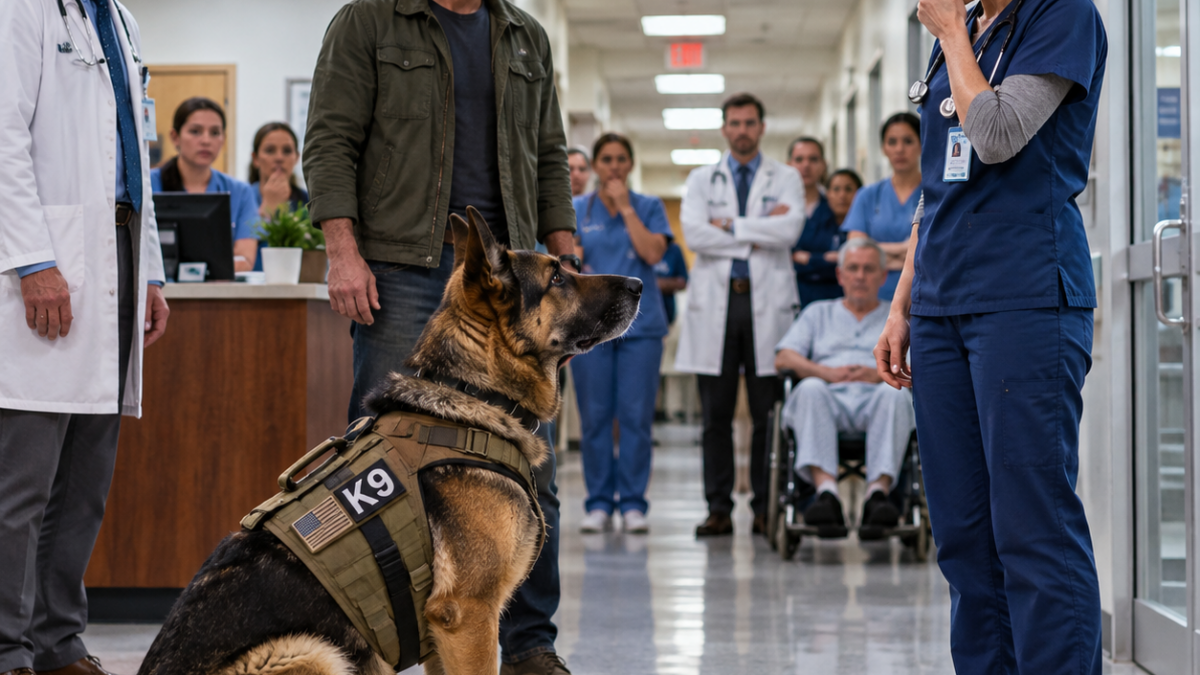
Rook stopped directly in front of the nurse.
Sat.
Perfect posture.
Chest high.
Head slightly lowered.
The position he’d used in the field when reporting to a handler.
The nurse’s clipboard fell.
Slap against tile.
The entire hallway turned.
Rook looked up.
Then made a sound.
Not bark.
A small broken whine I had never heard before.
The nurse’s face collapsed.
One second.
Then control returned.
She whispered:
“Shadow.”
My heart stopped.
“What?”
Her eyes snapped toward mine.
“What did you say?”
“Nothing.”
“You said Shadow.”
“No.”
I moved closer.
Rook pressed against her leg.
“Who are you?”
Her badge read:
ANNA MERCER, RN.
“My name is Anna Mercer.”
“Who were you before that?”
Color left her face.
Behind me I heard Dr. Vale.
“Mr. Maddox?”
I ignored him.
“How do you know Shadow?”
“I don’t.”
“That name was classified.”
“I made a mistake.”
“People don’t accidentally guess classified K9 call signs.”
“Cole.”
Vale now.
I turned.
He had used first name like we were allies.
“Your dog needs to be recalled.”
“He found something.”
“This is not an operational environment.”
“No.”
I looked at Anna.
“Apparently it is.”
Vale sighed.
“Nurse Mercer, step away from the animal.”
Anna didn’t move.
His tone sharpened.
“Nurse Mercer.”
Her jaw tightened.
“I heard you.”
That was the first time I noticed her left hand.
It held the edge of the cart strangely.
Two fingers curved more than they should.
Rook leaned against that side.
Anna’s eyes filled.
She whispered:
“Please.”
I thought she meant me.
Then:
“Not here.”
My pulse hammered.
“Then where?”
Vale snapped toward security.
“Clear the hallway.”
A guard approached.
Rook stood.
Not aggressive.
Simply placed himself between Anna, me, and the guard.
Vale said:
“Get animal control if necessary.”
I turned slowly.
“You want animal control called on a retired military working dog inside a veterans hospital?”
“I want control.”
Anna put one hand on Rook’s head.
“Easy.”
Rook settled immediately.
Not after my command.
Hers.
I couldn’t breathe.
“You were there.”
Anna closed her eyes.
Vale said:
“Enough.”
She opened them.
Gray.
Same eye as photograph.
Older.
Tired.
But same.
Vale pointed toward his office.
“Nurse Mercer.”
“For what?”
“We’ll discuss this privately.”
“She didn’t do anything.”
He looked at me.
“You are a patient.”
“No.”
He frowned.
“I mean, yes.”
I stepped closer.
“But being a patient doesn’t make me blind.”
He flushed.
Anna tried to move.
Rook shifted gently.
Blocked her.
She looked down.
“Shadow.”
There it was again.
Then softer:
“Rook.”
This time I felt something even colder.
“How do you know his current name?”
Anna’s face changed.
“I followed his recovery.”
“What?”
“For two years.”
“Why?”
She looked away.
Vale interrupted immediately.
“Nurse Mercer has a documented history of inappropriate emotional involvement in veteran cases.”
The words landed like a slap.
Anna went still.
Not surprised.
Familiar wound.
Vale continued.
“She was hired under special consideration after a complicated medical separation.”
I looked at him.
“What special consideration?”
“That is personnel information.”
Anna laughed once.
No humor.
“If you’re going to humiliate me publicly, Preston, don’t hide behind privacy after.”
Every head turned.
Vale’s jaw clenched.
“Anna.”
“No.”
She looked around hallway.
“I had a breakdown after deployment.”
Silence.
“Burn injuries.”
“Nerve damage.”
“Nightmares.”
“Panic episodes.”
She lifted left hand.
“This doesn’t fully work.”
Her fingers shook.
“I spent nine months in military rehabilitation.”
She pointed toward Vale.
“Colonel Reeves used a veteran placement agreement to get me hired here.”
Vale said:
“That is an oversimplification.”
Anna looked directly at me.
“I was a combat trauma nurse.”
My ears rang.
“And yes.”
Her voice dropped.
“I was there.”
Everything disappeared.
Hospital lights became fire.
A metal cart squeaked.
In my head it became twisted frame.
My vision narrowed.
I grabbed wall.
Glass Harbor.
Smoke.
Rook barking.
Can’t breathe.
Then her voice.
“Cole.”
I looked.
Anna.
“Look at me.”
Her tone changed.
Not louder.
Not softer.
Exact cadence.
“Breathe in for four.”
I did.
“Hold two.”
Smoke vanished slightly.
“Out for six.”
My knees weakened.
“You’re at West Haven.”
Her voice.
“You’re safe.”
“Rook is with you.”
I stared.
Seven years collapsed.
“It was you.”
Anna’s eyes shone.
“Yes.”
I pulled photograph from my pocket.
Hands shaking.
Unfolded it.
“I’ve been looking for you.”
Her hand flew to her mouth.
She stared.
“Where did you get that?”
“Helmet footage.”
“I thought those were destroyed.”
“Somebody tried.”
She reached.
Stopped.
“May I?”
I handed it to her.
Her damaged fingers traced the burned edge.
Behind us Vale said:
“This is classified material.”
I turned.
“No.”
“What?”
“This is memory.”
Then a new voice came from far end.
“Doctor.”
Everyone turned.
Rear Admiral Thomas Keen walked down the corridor.
Dark Navy uniform.
White at temples.
Two officers behind him.
I knew him.
He had signed my medical retirement.
He had also spent three years pretending not to care when I sent him increasingly irritated emails asking about Glass Harbor personnel.
Vale went pale.
“Admiral Keen.”
Keen ignored him.
Looked at Anna.
Something changed in his face.
“Lieutenant Mercer.”
Anna straightened automatically.
“Sir.”
Lieutenant.
I stared.
Keen looked at me.
“Formerly Lieutenant Anna Sloan.”
The name hit somewhere buried.
Sloan.
One of my failed leads.
One blacked-out name.
A line in a redacted after-action summary.
“Anna Sloan.”
She nodded.
Keen continued.
“Senior trauma nurse attached to forward special operations medical support.”
Vale interrupted:
“Admiral, perhaps this should be—”
Keen looked at him.
Doctor shut up.
Not literally.
Expression did it.
Keen faced me again.
“She pulled you, Rook, and two other operators from Glass Harbor.”
“I know she treated me.”
“No.”
Keen’s voice softened.
“You don’t.”
Anna said:
“Sir.”
“You kept it classified long enough.”
Her eyes closed.
Keen continued.
“The first evacuation team withdrew when the fire reached the triage structure.”
I remembered shouting.
“The report said everyone medical cleared.”
“The report was edited.”
My body went cold.
“Why?”
“Operational liability.”
Anna stared at floor.
Keen said:
“Rook was still inside.”
I looked at her.
“He bit through his restraint.”
“Yes.”
“Trying to get to me.”
“Yes.”
“Anna heard him.”
Keen glanced toward her.
“She went back.”
My mouth went dry.
“Without authorization.”
Anna whispered:
“The roof was coming down.”
Keen nodded.
“She followed his barking through smoke.”
I looked at Rook.
He sat beside Anna.
Gray muzzle now.
Old.
But watching.
Keen continued.
“She sedated him enough to move him outside.”
“Then returned for you.”
I couldn’t speak.
“Second blast hit while she was shielding your chest.”
My eyes went to her left hand.
Keen’s voice:
“She lost partial nerve function.”
“Burns along shoulder and arm.”
“Spent nine months in rehabilitation.”
“And the official report?”
“Rewritten.”
Anna looked angry now.
Not at Keen.
At history.
“Medical command didn’t want another unauthorized reentry becoming the story.”
I whispered:
“You saved me twice.”
Anna finally met my eyes.
“I did my job.”
“No.”
“You did more.”
She shook her head.
“Cole.”
“Why didn’t you answer?”
“What?”
“My letters.”
Confusion.
“What letters?”
“Portsmouth.”
“Bethesda.”
“Naval commands.”
“I wrote for years.”
Anna looked at Keen.
The admiral’s face hardened.
“She was moved under protective medical relocation.”
“Why?”
“Threats connected to Glass Harbor personnel.”
Anna said:
“My name was sealed.”
“My address changed.”
“I became Mercer.”
“My mother’s surname.”
I stared.
“I thought you died.”
Her expression broke.
“I thought you forgot.”
That hurt worse than the shrapnel memory.
“How could I forget you?”
Anna looked down.
“People forget nurses.”
No bitterness.
Just fact.
That made it unbearable.
“Not this one.”
Rook stood.
Pressed his head into her thigh.
Anna put her left hand on him.
“He didn’t forget.”
“No.”
My voice broke.
“No, he didn’t.”
Vale cleared his throat.
Of all possible things, he said:
“We do still have a hospital to run.”
Keen turned slowly.
“Indeed.”
Vale looked relieved.
Wrongly.
Keen continued.
“And apparently we have concerns about how it has been run.”
Vale’s face tightened.
“I don’t follow.”
Keen pulled a folder from the officer beside him.
“I have three staff complaints.”
Vale froze.
“Two blocked promotion requests involving Lieutenant Mercer.”
Anna looked up.
“And an internal memorandum from your office describing her as emotionally unstable around special operations patients.”
Vale said quickly:
“Those were clinical observations.”
“You are not her treating physician.”
Silence.
“You used her trauma history to limit her authority while relying on her combat expertise whenever the hospital needed it.”
“That is not accurate.”
Keen opened folder.
“It is documented.”
An old Vietnam veteran in wheelchair said from behind us:
“That’s worse.”
Somebody coughed to hide a laugh.
Vale looked furious.
Anna said:
“Sir, please.”
Keen stopped.
She handed photograph back to me.
“I need to work.”
“Anna.”
“If I stop now…”
She inhaled.
“…I may not start again.”
I understood.
Work is armor.
Duty gives grief something to stand behind.
Before I could answer, an alarm sounded near ambulance bay.
A nurse shouted:
“Incoming trauma!”
Hospital transformed.
Conversation disappeared.
Staff moved.
Anna changed immediately.
No longer hidden woman.
No longer the person in photograph.
Nurse.
“Clear Trauma Two.”
“Get blood ready.”
“Call imaging.”
Vale straightened.
Authority returned to his posture.
Ambulance doors opened.
Older man.
Late sixties.
Marine Corps jacket cut open.
Blood on chest.
Wife behind gurney.
Crying.
Paramedic called:
“Blunt thoracic trauma.”
“Hypotensive.”
“Possible internal bleed.”
“Cardiac history.”
Vale took head position.
Anna moved beside him.
She looked once.
Breathing.
Chest rise.
Neck.
Color.
Her face changed.
“Right chest isn’t moving.”
Vale ignored.
“Fluids.”
“Portable imaging.”
“Doctor.”
He looked irritated.
“Possible tension pneumothorax.”
“We’ll confirm.”
“He may arrest before confirmation.”
“Nurse Mercer.”
Her voice stayed calm.
“Breath sounds absent right.”
“Trachea shifting.”
“Pressure dropping.”
Monitor alarm.
Patient gasped.
His wife cried:
“Please!”
Vale said:
“We need imaging.”
Anna looked at monitor.
Then at him.
“Not enough time.”
“Step back.”
Blood pressure dropped again.
A younger nurse whispered:
“Doctor…”
Vale hesitated.
One second.
Combat medicine teaches you how long a second can be.
Anna moved.
Grabbed decompression kit.
Vale snapped:
“What are you doing?”
“Preventing an arrest.”
She positioned.
Needle.
Decompression.
Air escaped.
Immediate.
The patient’s breathing changed.
Monitor improved.
Pressure began rising.
The room froze.
Anna said:
“He needs definitive chest tube and imaging when stable.”
Vale stared.
Not because she’d failed.
Because she hadn’t.
She removed gloves.
“I’ll document the intervention.”
Keen stepped into trauma doorway.
“Doctor Vale.”
Vale turned.
“You were about to let pride delay treatment on a Marine.”
“Admiral, I made a clinical judgment.”
Anna said quietly:
“It was the wrong one.”
No satisfaction.
No humiliation.
Truth.
Vale looked at patient.
Then staff.
He had no answer.
By midnight, he was under administrative review.
Not fired.
Institutions move slower than emergencies.
His committee roles were suspended.
Case review ordered.
Staff complaints reopened.
Anna’s promotion history examined.
For the first time since she joined West Haven, people stopped calling her a special placement.
They started calling her Lieutenant.
That embarrassed her almost as much.
I found her after shift in the courtyard.
Rain tapping glass ceiling.
She sat on a bench.
Hands folded.
Left over right.
Rook reached her first.
I didn’t command him.
He sat at her feet.
Again.
Anna smiled.
“He always was disobedient.”
“He is not.”
“He ignored you twice today.”
“He had intelligence I didn’t.”
“Still.”
I sat.
For a while neither of us spoke.
Then:
“I had a speech.”
She glanced over.
“Seven years?”
“Long speech.”
“What was in it?”
“Mostly thank you.”
“And the rest?”
“I’m sorry.”
“For what?”
“Not finding you.”
“You weren’t supposed to.”
“For living when you got hurt saving me.”
Anna looked at me.
“That is not a crime.”
“Felt like one sometimes.”
“I know.”
Those two words.
I believed them because she did know.
I took photograph out.
Again.
“I looked at this every night for almost a year.”
Anna touched edge.
“I used to read your recovery reports.”
“What?”
“Protected access.”
“You had that?”
“For a while.”
“Why?”
Her smile turned sad.
“Because I wanted to know whether going back mattered.”
I couldn’t answer.
She continued.
“You hated rehabilitation.”
“How do you know?”
“Your notes were colorful.”
“That’s classified.”
“You threw a walker at someone.”
“Near someone.”
“Fine.”
“Did you think I’d survive?”
Anna looked down at Rook.
“I didn’t know.”
“And him?”
“Worse.”
She rubbed old shoulder scar beneath his fur.
“He kept trying to get back to you.”
“Even after sedation.”
“I had to sit on the floor beside him.”
“Tell him you were alive.”
“You did?”
“Yes.”
“What did you call him?”
“Shadow.”
Rook’s ears moved.
Anna smiled.
“He wouldn’t respond to anything else.”
I looked at her.
“That’s why he remembers.”
“Maybe.”
“I spent seven years searching.”
She looked at dog.
“He took seven seconds.”
“Show-off.”
Rook sighed.
We laughed.
Small.
Rusty.
Real.
Then I said:
“I don’t want to lose you again.”
Anna became careful.
“Cole.”
“I don’t mean—”
She stopped me.
“You found me.”
“Yes.”
“That doesn’t make me another mission.”
The sentence hit cleanly.
She wasn’t a missing person to recover.
Wasn’t a debt to repay.
Wasn’t a symbol from my trauma.
She was a woman.
A nurse.
A veteran.
Someone who had survived Glass Harbor too.
“I know.”
“Do you?”
“I can learn.”
Anna studied me.
Then:
“Coffee.”
“What?”
“We start with coffee.”
“That simple?”
“Normal people do that.”
“We are not normal.”
“Hospital coffee then.”
“That’s punishment.”
“You survived BUD/S.”
“Not sure I can survive hospital coffee.”
She smiled.
Rook’s tail tapped floor.
That was our beginning.
Not romance immediately.
Coffee.
Then another coffee.
Lunch.
Walking Rook.
Talking.
Silence.
Anna told me about rehabilitation.
How burns made shower water unbearable at first.
How left hand refused commands.
How she dropped cups.
Couldn’t button shirts.
How surgeons told her function might return.
Some did.
Not all.
She told me she changed her name because Anna Sloan felt like somebody trapped in a report.
Mercer was her mother’s name.
A woman who had died before Glass Harbor.
“It gave me somewhere else to stand,” Anna said.
She returned to civilian nursing because leaving medicine felt like letting the blast take everything.
Then West Haven hired her.
Dr. Vale initially praised her experience.
Later, when she challenged decisions, he began referencing her “emotional history.”
Promotion denied.
Committee position denied.
High-acuity veterans redirected away from her when administrators thought she might “over-identify.”
Yet when a difficult trauma came in, people called Anna.
Useful.
But not promotable.
Experienced.
But unstable.
That contradiction had become her life.
Keen changed some of that.
Not alone.
The investigation did.
Staff complaints.
Records.
Clinical review.
Vale resigned before final board findings.
His email called it:
A divergence in treatment philosophy.
Elena Ruiz, the older veteran who had muttered “that’s even better” in hallway, printed the phrase and taped it to a coffee machine.
Anna laughed for ten minutes.
Two months later, West Haven launched a pilot program.
Integrated Combat Recovery Initiative.
Trauma medicine.
Peer support.
Service and military working dogs.
Handlers.
Veterans whose recovery didn’t fit neatly into one department.
Anna led clinical side.
I helped peer support.
Rear Admiral Keen insisted he had nothing to do with approval.
Nobody believed him.
Rook attended everything.
Veterans started calling the room:
Shadow’s Room.
There was no sign.
No official designation.
The nickname simply spread.
Anna pretended to dislike it.
She didn’t.
The first time a young Marine with panic disorder sat on floor because he couldn’t tolerate chairs facing hallway, Rook walked over and lay beside him.
Anna whispered:
“He still knows.”
I said:
“He always knows.”
Rook grew older.
Gray spread.
Shoulder stiffened.
The Glass Harbor injury never fully disappeared.
Neither did ours.
But healing changed.
That word used to irritate me.
Healing sounded like ending.
As if wounds became nothing.
They don’t.
They become integrated.
A scar is not uninjured skin.
It’s tissue that closed the wound.
Different.
Still functional.
Sometimes painful.
Anna taught me that without trying.
I taught her something too.
At least she says I did.
One evening after program session, she sat staring at her left hand.
“Bad day?”
“Dropped a medication vial.”
“Anyone hurt?”
“No.”
“Then vial lost.”
“I hate this hand.”
I understood.
“Want to know something?”
“No.”
“Too bad.”
She glared.
I held up my left shoulder.
“This arm can’t clear overhead the way it used to.”
“You’ve mentioned.”
“My right knee predicts rain.”
“You’re seventy emotionally.”
“Rook snores.”
“That isn’t relevant.”
“The point is none of us came home factory original.”
Anna looked at me.
I continued.
“You saved that Marine with the hand you hate.”
Silence.
“That hand worked.”
“Not perfectly.”
“Neither did Vale’s perfect hands.”
She laughed despite herself.
Later she told me that sentence stayed.
Not factory original.
Good enough.
One year after we found each other, West Haven held a small anniversary event for Shadow’s Room.
Anna hated speeches.
Keen made her.
She stood in front of veterans, nurses, handlers.
Rook at her feet.
“I used to think being remembered would hurt.”
Room quiet.
“I thought if people knew what happened at Glass Harbor, they would look at me and only see damage.”
She looked at her hand.
“Or sacrifice.”
“Sometimes that isn’t much better.”
Then at room.
“But being remembered by the right people doesn’t trap you in the past.”
She looked toward me.
“Sometimes it gives you permission to stop hiding from it.”
My eyes burned.
Anna looked at Rook.
“And sometimes a dog remembers before either human is brave enough to.”
People laughed softly.
She bent.
“Good boy, Shadow.”
I said from back:
“His name is Rook.”
Anna didn’t miss beat.
“Not to me.”
Rook wagged his tail.
Traitor.
I stopped carrying photograph every day after that.
At first I didn’t notice.
One morning I reached into jacket.
Empty.
Panic.
Then remembered it was framed at home.
I no longer needed proof she existed.
That realization hit harder than expected.
For seven years the photograph had been evidence.
Now Anna was a person who texted me reminders to buy milk.
A person who complained I loaded dishwasher incorrectly.
A person who could fall asleep halfway through documentaries and still insist she was watching.
Normal.
That was what I had actually wanted without knowing.
Not closure.
Normalcy.
Rook adored her.
Maybe remembered her from Glass Harbor.
Maybe simply adopted her again.
Doesn’t matter.
When Anna entered room, his ears changed.
Every time.
Two years after our reunion, Rook developed degenerative neurological disease.
Slow at first.
Back paw dragging.
Then weakness.
We adapted.
Harness.
Ramps.
Medication.
Anna handled it professionally until one night she didn’t.
Rook tried to stand.
Couldn’t.
She sat beside him and cried.
“I saved him once.”
I sat down.
“Yes.”
“I should be able to—”
“No.”
She looked at me.
“Don’t.”
“You can’t turn every ending into a failed rescue.”
She covered face.
I repeated:
“You can’t.”
That was a lesson both of us needed.
Rook lived another eight months.
Good months.
Slow walks.
Shadow’s Room.
Too many treats from veterans.
Keen smuggled bacon.
Denied it.
Rook gained six pounds.
Anna blamed admiral.
Correctly.
His final day was quiet.
Home.
Rain.
Funny how much rain appears in important memories.
Maybe I just notice it.
Rook lay between us.
Anna’s left hand on his head.
My hand over his chest.
Breathing slowing.
I whispered:
“You brought me home.”
Anna added:
“Twice.”
Then:
“Good boy, Shadow.”
I said:
“Good boy, Rook.”
His tail moved once.
He died with both names.
Afterward, Shadow’s Room felt impossible.
I avoided it for two weeks.
Anna went back after three days.
Of course.
Work.
Armor.
Routine.
Then she came home one night and said:
“A veteran asked where Rook was.”
I couldn’t answer.
“He brought his dog.”
“So?”
“A retired Malinois.”
I looked up.
“You should come tomorrow.”
“I can’t.”
“Yes, you can.”
She was right.
I went.
The new dog wasn’t Rook.
Thank God.
Different face.
Different movement.
He lay beside his handler.
I sat.
Listened.
Eventually, room became room again.
We put Rook’s harness in a glass case.
I hated that idea until Anna added the burned photograph beside it.
Underneath:
ROOK — “SHADOW”
MWD
HE REMEMBERED THE WAY HOME.
No rank.
No mission details.
Enough.
Keen retired fully a year later.
Meaning he appeared twice as often.
Anna eventually became Director of the Integrated Combat Recovery Initiative.
When announcement came, she stared at email.
“Director.”
“Yes.”
“I hate titles.”
“You deserve it.”
“That’s exactly the kind of thing titles make people say.”
I smiled.
“Dr. Vale had a title.”
She looked at me.
“Point taken.”
She accepted.
Not because she wanted authority.
Because she had learned authority could be used differently.
Her first policy change:
No veteran’s trauma history could be used as informal justification for limiting professional advancement without documented occupational criteria and independent review.
Boring sentence.
Important result.
A nurse came to her six months later.
Former Army medic.
PTSD diagnosis.
Promotion delayed repeatedly.
Anna helped.
When the nurse got new role, she hugged Anna.
Anna came home quiet.
“You okay?”
“Yes.”
Then:
“I think that’s why I stayed.”
“What?”
“West Haven.”
“All those years.”
“Maybe I was waiting to become the person I needed when I first arrived.”
I knew that feeling.
Peer support became my job too.
Not official at first.
Then official.
I worked with operators transitioning out.
Men who believed civilian life was a demotion.
Women who felt guilty because they missed deployment.
Handlers grieving dogs.
Dogs adjusting to quiet.
I told them:
“Don’t confuse being needed in one way with being worthless in another.”
I wish someone had told me that twenty years earlier.
Anna and I did eventually become more than coffee.
Slow.
Deliberate.
No mission.
No debt.
We moved in together after three years.
Marriage came later.
Small.
Keen attended.
Of course.
He brought a framed copy of the original Glass Harbor commendation recommendation for Anna.
Unredacted.
She read it after ceremony.
Then yelled at him.
“Sir, I told you I didn’t want this.”
Keen smiled.
“You are no longer under my command.”
“That does not make you less annoying.”
He looked at me.
“She always talked like this?”
“I met her while bleeding out.”
“Good point.”
The commendation described what she had done.
Went back through active fire.
Recovered wounded military working dog.
Returned to collapsed treatment shelter.
Protected patient during secondary blast.
Continued treatment despite injury.
She had never received the full recognition because sections remained classified and command feared exposing operational details.
Years later, after review, a corrected award was approved.
Anna almost refused.
I asked:
“Why?”
“I don’t want Glass Harbor becoming my whole life.”
“It isn’t.”
“How do you know?”
“Because you yell at me about recycling.”
She stared.
“That’s your argument?”
“Yes.”
I touched the medal case.
“This doesn’t define you.”
“It records something you did.”
“Different.”
She accepted.
At the ceremony, I stood in back.
Rook wasn’t there.
That hurt.
But I imagined him sitting at her feet.
Perfect posture.
Reporting.
Years later, people still ask about how we found each other.
The version they like best is simple.
Navy SEAL searches seven years.
Dog recognizes nurse.
Truth revealed.
Bad doctor exposed.
Heroic nurse honored.
Happy ending.
Reality has more texture.
Finding Anna didn’t cure my nightmares.
Recognition didn’t restore her hand.
Vale resigning didn’t erase the years she spent doubting herself.
Rook died.
Keen got older.
I still count exits sometimes.
Anna still flinches when metal collapses loudly.
Healing isn’t deletion.
What changed was that neither of us carried the night alone anymore.
That’s bigger.
One night, long after we married, I woke from Glass Harbor.
Couldn’t breathe.
Bedroom dark.
For years Rook would have climbed onto bed.
No Rook.
My hands shook.
Then Anna’s voice.
“Cole.”
I looked.
“Four.”
I breathed in.
“Two.”
Held.
“Six.”
Out.
Same cadence.
Same voice.
Older.
Mine now in a way it wasn’t then—not ownership, but shared life.
When I settled, I said:
“You know what’s annoying?”
“What?”
“You’ve been giving me same breathing instructions for twenty years.”
“Still can’t do them without supervision.”
“Apparently.”
She put her damaged left hand against my chest.
“Go back to sleep.”
I did.
There is one thing I never told Anna until recently.
On Glass Harbor, before I lost consciousness, I remember reaching for her wrist.
Very briefly.
I remember saying something.
For years I thought I had said:
“Don’t leave.”
After we found each other, memory sharpened.
I think I said:
“Rook first.”
That sounds like me.
Of course.
Anna laughed when I finally told her.
“You did.”
“What?”
“You said, ‘Dog first.’”
“I knew it.”
“I told you to shut up.”
“Also sounds like you.”
“I moved Shadow first.”
“Rook.”
“Shadow.”
“Then came back.”
I looked at her.
“Why?”
She became serious.
“Because you were alive.”
“People were evacuating.”
“Yes.”
“You were injured.”
“Yes.”
“You got hurt because of it.”
“Yes.”
“Why come back?”
Anna thought.
Then:
“You think there was a reason?”
“There had to be.”
“No.”
She shook her head.
“You needed help.”
“That was enough.”
That answer changed the way I remembered Glass Harbor.
For years I turned Anna into a mystery.
Then a mission.
Then a hero.
She had always been a nurse seeing a wounded man who needed help.
Sometimes courage is grand.
Sometimes it is simply refusing to walk away because another human being is still breathing.
Rook understood that instinctively.
Maybe that’s why he found her.
The day at West Haven, I saw pale-blue scrubs.
Rook saw the woman who had once crawled into smoke when he barked.
He didn’t care that her last name changed.
Didn’t care about classified records.
Didn’t care about awards.
Didn’t care that seven years had passed.
He knew.
Scent.
Voice.
Movement.
Memory.
Whatever dogs use to hold the people who matter.
He crossed twenty feet.
Sat.
Waited.
And gave both of us our missing history back.
I spent seven years looking through databases.
Hospitals.
Military archives.
Old units.
Emails.
Letters.
Contacts.
Rook searched once.
Found her.
Anna still brings that up.
Any time I claim superior situational awareness.
She says:
“Seven years.”
I say:
“Operational security.”
She points toward the framed photograph.
“Seven seconds.”
I have no defense.
On the fifth anniversary of Shadow’s Room, West Haven put up a small plaque.
Anna resisted.
Lost.
It reads:
IN HONOR OF THOSE WHO FIND THEIR WAY BACK TO ONE ANOTHER.
No names.
We chose that.
Because the room was never supposed to be about us.
Veterans come through every month.
Some with visible injuries.
Some without.
Service dogs.
Retired working dogs.
Handlers who feel guilty.
Medics who remember too much.
People who spent years believing survival itself was evidence they had taken somebody else’s place.
We don’t cure them.
We don’t promise closure.
We give them somewhere to sit while they figure out what comes next.
Sometimes that’s enough.
A young SEAL came in last year.
Medical retirement pending.
Twenty-nine.
Furious.
Dog beside him.
He looked at me.
“They say I’m done.”
I nodded.
“So?”
“So my life is over.”
“No.”
“You don’t understand.”
Anna, across room, looked at me.
I smiled.
“Oh, I understand.”
He said:
“What am I supposed to do now?”
I looked at his dog.
The dog was staring at him.
“Start by listening to the animal.”
He frowned.
“What?”
“He doesn’t think you’re finished.”
The young man looked down.
Dog leaned against his leg.
I continued.
“Your team role can end.”
“Your usefulness doesn’t.”
“Your identity can change.”
“That isn’t death.”
He started crying.
Quietly.
His dog climbed partly into his lap.
I looked away.
Privacy.
Anna later said:
“You sounded wise.”
“I’m old.”
“Same thing eventually.”
Fair.
Sometimes I think about the original photograph.
Burned edge.
Blurry.
Seven years in my pocket.
It used to feel like proof of absence.
Now it feels like the first page of a story I hadn’t finished reading.
Anna framed it beside another photograph.
Taken at West Haven years later.
Her in pale-blue scrubs.
Me beside her.
Rook sitting at her feet.
Gray muzzle.
Head high.
In the second picture, all three of us are looking in different directions.
Anna says that’s appropriate.
“No one in this family follows instructions.”
Also true.
On the back she wrote:
FOUND.
I added beneath it:
BY ROOK.
Then she crossed Rook out.
SHADOW.
I crossed Shadow out.
We have been doing this for years.
The truth is both names fit.
Rook was the dog who brought me home.
Shadow was the dog who remembered who brought us out.
Anna was Lieutenant Sloan.
Anna is Nurse Mercer.
I was Lieutenant Maddox.
Then patient.
Then retiree.
Then husband.
Then peer counselor.
None of those identities erased the others.
Maybe that’s the lesson I had been missing.
We spend too much time trying to decide which version of ourselves is real.
The operator.
The wounded man.
The nurse.
The traumatized veteran.
The dog in war.
The old dog sleeping beneath a table.
All real.
Survival doesn’t require becoming the person you were before.
Sometimes survival means becoming someone who can carry all the versions without letting any one of them take over.
Rook did that better than we did.
He could answer to Rook.
He could answer to Shadow.
He didn’t seem confused.
He only cared who needed him.
On the night of the first anniversary ceremony, after everyone left, Anna and I walked through the hospital courtyard.
Rain had stopped.
Parking-lot lights reflected on wet pavement.
Veterans came and went through automatic doors.
One man with a cane.
A woman carrying a thick folder.
Another veteran beside a service dog.
I stopped near entrance.
Seven years earlier, hospitals made me want to run.
That night, I didn’t count exits.
Didn’t check reflections.
Didn’t touch photograph.
Anna stood beside me.
Rook sat at her feet.
I said:
“I spent seven years looking for you.”
She looked over.
“And?”
I looked down.
“He found you in seven seconds.”
Anna smiled.
“Dogs are better at important things.”
I couldn’t argue.
I still can’t.
Because after all the classified files, missing signatures, sealed records, failed searches, false names, and years of wondering whether the woman in the smoke had been real, the answer didn’t come from a database.
It came from an old military dog who stopped in the middle of a hospital hallway, ignored the man he had obeyed for years, walked straight toward a tired nurse everyone else overlooked, and sat at her feet like a soldier reporting to the one person he had never forgotten.
Then she whispered:
“Shadow.”
And seven years of searching were over.

