A Navy SEAL Smirked, “Don’t Touch Him”—Then His K9 Ran Straight to the Quiet Nurse, Locked Onto Her Bag, and Exposed the Danger Hidden Inside
PART3:
“Electronic chart has none.”
I scanned the bracelet.
The electronic profile loaded.
Something felt wrong.
Not dramatic.
Just wrong.
The middle initial did not match the bracelet.
I checked again.
The resident beside me, Dr. Fallon, had already pulled an antibiotic.
“Hold.”
He looked at me.
“What?”
“Stop.”
“Nell, we need—”
“That isn’t his chart.”
Fallon glanced at the screen.
“Name matches.”
“Middle initial doesn’t. Birth month doesn’t either.”
He looked closer.
The computer had pulled a sailor with the same first and last name.
Different man.
I grabbed the paper transfer sheet clipped behind the stretcher.
Allergy field:
CEPHALOSPORINS — SEVERE ANAPHYLAXIS.
Fallon froze with the syringe inches from the IV port.
“Jesus.”
“Switch profile.”
Kelly corrected the chart.
Fallon disposed of the medication.
The entire incident lasted maybe fifteen seconds.
Then we moved on.
That was trauma nursing.
A disaster almost happens.
You prevent it.
Then someone else needs you before your hands stop shaking.
I did not know Soren Howitt saw the final seconds from the corridor.
I would learn later that his first impression of me was simply competent nurse catches chart error.
Nothing more.
That was fitting.
My first impression of him was less generous.
He stood outside the restricted trauma area in dark tactical clothing beneath a Navy jacket, broad-shouldered and completely still while everyone else moved around him.
Early forties.
Close-cropped brown hair beginning to gray at the temples.
Controlled expression.
The kind of posture that announced military training even before you saw the insignia.
Beside him sat Talon.
Belgian Malinois.
Lean.
Dark mask.
Alert amber eyes.
Every muscle contained.
Not tense.
Prepared.
There is a difference.
I knew immediately he was not a therapy dog.
Nobody needed to tell me.
Talon watched the hallway the way experienced nurses watch a crashing patient.
Nothing casual.
Every movement registered.
Soren watched almost the same way.
Later, I discovered he had spent most of his adult life in Naval Special Warfare, including maritime interdiction and explosive-threat operations.
At the time, all I knew was that he looked at our hospital as though he expected it to disappoint him.
He was not entirely wrong.
Hospitals are built to save people.
That makes us surprisingly vulnerable to anyone willing to exploit compassion.
Doors need to open fast.
Staff move constantly.
Contractors appear at all hours.
Delivery workers enter with boxes nobody wants to inspect too carefully because somewhere upstairs a patient is waiting for medication, oxygen equipment, food, linen, blood products, replacement monitors, sterile instruments.
Our instinct is access.
Security requires hesitation.
The two can fight each other.
Soren knew that better than I did.
I also learned later that the harbor collision itself had not felt accidental to him.
The Navy patrol vessel had struck an unmanned maintenance craft positioned where it should not have been.
The damage was limited.
But equipment recovered near the collision showed signs that somebody may have deliberately interfered with navigation and harbor operations.
Soren had insisted Talon accompany him to the hospital because the investigation was not over.
He trusted Talon absolutely.
People, less so.
Especially civilians.
Especially civilian systems.
That became clear the first time we actually spoke.
Nearly two hours after the first ambulance arrived, the department stabilized.
One sailor went to surgery.
Two transferred to the burn unit.
The young operator whose antibiotic allergy I had caught was awake and complaining about the oxygen cannula, which I considered a good sign.
I carried fresh bandages down the restricted trauma corridor.
Talon sat beside Soren.
As I passed, I noticed the dog’s front paw.
Raw abrasion along one pad.
Not deep.
But irritated.
Probably from working on rough deck surface.
I slowed.
Soren noticed immediately.
His mouth tilted into the faintest smirk.
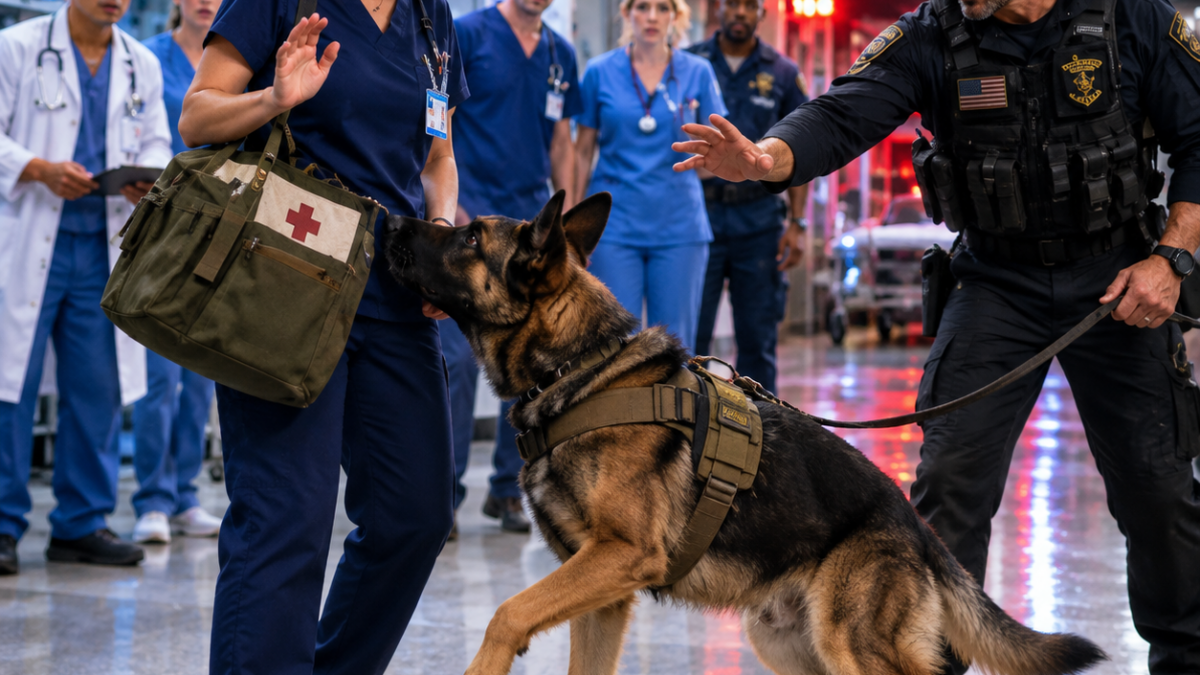
“Don’t touch him.”
I looked up.
There was enough amusement in his voice to irritate me.
“I wasn’t planning to.”
“He doesn’t like strangers.”
I nodded toward the paw.
“I was checking the abrasion.”
Soren glanced down.
“He’s fine.”
Maybe he was.
But “fine” is the favorite word of military personnel and nurses who are absolutely not fine.
Still, Talon was his dog.
His working partner.
His decision.
“All right.”
I started walking.
Behind me, claws clicked against tile.
Soren said, “Talon.”
The clicking continued.
I turned.
The dog was coming toward me.
Not running wildly.
Direct.
Purposeful.
Head raised.
Nose working.
“Talon.”
Soren’s voice sharpened.
The dog ignored him.
That got everyone’s attention.
A receptionist glanced up.
Kelly stopped near the medication room.
Two orderlies stepped aside.
Talon reached me.
For one strange second, he pressed against my leg.
Someone behind the desk laughed.
“Guess he likes strangers after all.”
I almost smiled.
Then Talon circled me once.
Sat.
Hard.
Close against my left side.
His eyes fixed downward.
Not at me.
At my canvas nursing bag.
Soren’s face changed.
The smirk vanished so completely it felt like watching a door slam shut.
I looked at him.
“What?”
He did not answer me.
“Talon.”
The dog remained seated.
Rigid tail.
Controlled breathing.
Focused.
Soren stepped closer.
“Nurse.”
“Nell.”
“Nell. Put the bag down.”
Every conversation in the hallway seemed to stop.
I looked at my bag.
It had been with me for years.
Canvas.
Gray.
One torn strap I had repaired twice.
Inside:
Gloves.
Trauma shears.
Granola bars.
Notebook.
Spare pens.
Hand lotion.
A tiny packet of tissues.
Patient thank-you cards I never had the heart to throw away.
Nothing dangerous.
“Soren—”
“Put it down.”
His tone left no room for debate.
I slowly lowered the bag to the floor.
Talon stayed locked on it.
My pulse accelerated.
“What is happening?”
Soren raised one hand toward security.
“Clear the corridor.”
Kelly stared.
“Why?”
“Now.”
Something in his voice moved people faster than explanation would have.
Patients were redirected.
Doors closed.
Security officers blocked the hall.
I stood beside the wall feeling absurd.
Then terrified.
Talon remained between me and the bag.
Soren looked at me.
“Did anyone else handle it?”
“Not that I know of.”
“Where was it?”
“Under the nurse’s station.”
“For how long?”
“Most of the shift.”
“Unattended?”
My defensiveness surfaced.
“We were receiving six trauma patients.”
“That’s not criticism.”
It sounded like criticism.
“I’m asking because Talon is alerting.”
“To what?”
Soren’s eyes stayed on the bag.
“He’s trained for explosive compounds.”
The room seemed to tilt.
“No.”
“Nell.”
“There’s nothing in there.”
“I believe you.”
“You just met me.”
“I believe the dog.”
That should have offended me.
Instead, it frightened me more.
A military explosive technician arrived with equipment I had only ever seen in training videos.
My bag went into a portable containment chamber.
I stood behind reinforced doors beside Soren.
Talon stayed near me.
Not touching now.
Watching.
The technician called out each item.
“Gloves.”
Mine.
“Scissors.”
Mine.
“Notebook.”
Mine.
“Food.”
Embarrassingly mine.
“Cards.”
Mine.
Then silence.
The technician leaned closer.
“Sealed envelope.”
My stomach dropped.
“What envelope?”
Soren looked at me.
I shook my head.
“There’s no envelope.”
The technician removed it using tools.
Plain white.
No name.
No hospital markings.
Inside were four items.
A temporary hospital access badge.
A parking pass.
A thin electronic relay no larger than a pack of gum.
And a photograph.
Soren entering our emergency department earlier that evening.
Across the bottom someone had written:
Nine-forty p.m.
The technician looked at Soren.
“This isn’t the main device.”
“What is it?”
“Proximity relay.”
He tested residue.
His expression hardened.
“Trace explosive compound. Maritime type.”
Soren’s whole body went still.
I looked between them.
“What does that mean?”
The technician answered.
“This relay was intended to communicate with something else.”
“Like what?”
“A receiver.”
“Where?”
“We don’t know.”
My mouth went dry.
Soren looked at my hospital badge.
Then at the bag.
Then at me.
And I watched the answer form in his face before he spoke.
“They wanted you to carry it.”
I stared.
“Why me?”
Nobody answered immediately.
Then Soren said:
“Because you move everywhere.”
I shook my head.
“So do dozens of nurses.”
“Yes.”
“But you carry the same bag.”
My skin went cold.
“You access restricted clinical areas.”
I looked toward the corridor.
“And people recognize you.”
“Exactly.”
“I still don’t understand.”
His voice lowered.
“People see you and stop seeing you.”
That sentence hit harder than it should have.
Maybe because it was true.
A nurse carrying supplies through a staff door did not look suspicious.
A nurse entering the burn unit.
Medication rooms.
Surgical corridors.
Staff elevators.
Nobody questioned us.
We belonged.
Our belonging was the weapon.
The technician added, “Whoever planted this didn’t need her cooperation. They needed her routine.”
My routine.
Suddenly, every ordinary thing became sinister.
Where I left my bag.
Where I ate.
Which elevator I preferred.
Which unit I visited before shift change.
I folded my arms around myself.
Soren said, “When did you last inspect the bag?”
“This morning.”
“Anything unusual?”
“No.”
“Anybody near it?”
“I don’t know.”
“Think.”
I closed my eyes.
Faces.
Paramedics.
Residents.
Housekeeping.
Delivery workers.
Lab techs.
Pharmacy.
Food service.
Contractors.
Then a memory.
Not strong enough to be useful.
A man in a courier uniform near the nurse’s station.
Maybe.
Or maybe I was building memories after the fact.
“I saw a courier.”
“When?”
“Earlier.”
“Describe him.”
“Blue hospital logistics jacket. Dark hair. Maybe thirty-five.”
“Did you speak?”
“No.”
“Did he belong there?”
“I assumed he did.”
Soren said nothing.
The silence answered for him.
Security pulled camera footage.
There he was.
Partial angle.
A man approaching the nurse’s station.
Looking once down the crowded hallway.
Then dropping something into my bag.
Three seconds.
That was all.
Three seconds to turn me into part of an attack.
I watched the footage twice.
On the third time, I had to look away.
“He touched my bag.”
Soren stood beside me.
“Yes.”
“And I never knew.”
“No.”
I hated the answer.
I hated that it was true.
Hospital administration wanted to move me somewhere secure and continue operations quietly.
Soren wanted lockdown.
Not the dramatic kind.
No alarms.
No announcement that would send families running into hallways.
Department supervisors received a coded message.
Level Indigo.
Secure clinical access.
Restricted movement.
Verification on maintenance and delivery staff.
Military explosive specialists entered through the service loading dock.
Patients continued receiving care.
That was the strangest part.
Somebody may have been preparing to attack my hospital, and in room 418 an old man was still arguing about his low-sodium diet.
A baby was being born upstairs.
A woman in oncology was FaceTiming her daughter.
Life did not stop because danger arrived.
Soren stood over a floor map.
“We need the intended route.”
I looked at him.
“What?”
“If the relay activates by proximity, they expected your bag to pass somewhere specific.”
My stomach tightened.
He pointed at the map.
“Where would you normally go between now and twenty-one-forty?”
I closed my eyes.
My shift routine.
Emergency department.
Medication storage.
Burn unit follow-up.
Surgical supply corridor.
Staff elevator.
I spoke each one.
Soren marked them.
Then I remembered one more.
“Oxygen systems.”
Everyone stopped.
A facilities engineer looked up.
“What?”
“I have paperwork for respiratory systems review. It was supposed to go to the oxygen systems office before ten.”
Soren stared at the map.
“Where?”
The engineer pointed.
Sublevel corridor C.
Near central oxygen distribution.
A bomb technician cursed quietly.
I felt sick.
Hospital oxygen systems are essential.
They are also dangerous around ignition sources.
If someone placed a device near critical infrastructure—
“How many patients depend on that network?”
I asked.
Nobody answered.
They did not need to.
Hundreds.
Soren reached for Talon’s harness.
“Talon.”
The dog stood instantly.
“Search.”
They started moving.
I followed.
Soren turned.
“No.”
“I know the corridors.”
“Security can guide us.”
“They don’t know which doors stick, which service hall is closed for plumbing, or which elevator is out tonight.”
“Nell.”
“If this was built around my route, you need me.”
He looked at me.
For the first time, there was no condescension.
No amusement.
Only calculation.
Then a nod.
“Stay beside me.”
We moved.
Talon worked ahead.
Nose low.
Then high.
Ignoring nurses.
Ignoring visitors.
Ignoring carts.
The hospital suddenly looked different through his eyes.
Every abandoned box.
Every utility closet.
Every maintenance panel.
Potential.
We reached sublevel C.
Industrial lighting.
Concrete walls.
Fewer people.
Louder ventilation.
My heartbeat sounded enormous.
Talon stopped at an intersection.
Turned.
Moved toward the oxygen distribution corridor.
Then stopped beside a laundry cart.
White linens stacked nearly to the top.
Nothing unusual.
Laundry carts lived everywhere in hospitals.
Talon sat.
Alert.
Soren stopped immediately.
“Back.”
We retreated.
Explosive technicians approached.
The cart was cleared.
Under folded sheets, inside a false-bottom compartment, they found the device.
Compact.
Wired into a maintenance access panel near the oxygen infrastructure.
Digital timer.
Seventeen minutes.
I stared at the screen from down the corridor.
17:03.
17:02.
17:01.
Soren moved me backward.
“Go.”
I could not stop staring.
A technician ordered evacuation of the immediate service zone.
Respiratory engineering rerouted parts of the system.
Hospital leadership quietly prepared contingency oxygen support.
The device was disabled with less than nine minutes remaining.
No explosion.
No panic.
No patients even knew.
I should have felt relief.
Instead, I started shaking.
Delayed reaction.
Nurses know it well.
Your body waits until the emergency ends before informing you that you were terrified.
Soren found me sitting on a storage crate in an empty equipment room.
Talon lay beside my chair.
“You okay?”
I laughed once.
“You really ask people that after bomb threats?”
“It’s a habit.”
“I’m fine.”
“Military answer.”
“Nursing answer too.”
He almost smiled.
Then his face became serious.
“You prevented one sailor from receiving a drug he was allergic to.”
“That was my job.”
“You identified the oxygen office.”
“My job.”
“You knew the route.”
“My job.”
He nodded.
“You say that a lot.”
“Because it’s true.”
“Does it make the things less important?”
I looked at him.
That question irritated me because I did not have an immediate answer.
Investigators worked through the night.
The courier’s name came back as Parker Dane.
Temporary logistics supervisor.
Employed six weeks.
Background heavily falsified.
No stable address.
No legitimate medical logistics history before the previous year.
Military investigators connected him to a smuggling network dismantled after one of Soren’s maritime operations.
Weapons components.
Illegal explosives.
Contraband moving through commercial ports under falsified maintenance manifests.
Soren had helped lead the operation that broke the network.
Several members went to federal prison.
Others disappeared.
Parker apparently had not.
At first, investigators assumed the hospital plot was revenge against Soren.
Then they found more video.
Days of it.
Weeks.
Parker near our loading dock.
Parker outside the staff entrance.
Parker pretending to inspect supply labels.
Parker watching the emergency department.
Watching me.
Not Soren.
Me.
One recording showed me leaving for lunch.
Another showed me carrying my canvas bag toward the burn unit.
Another showed me using the staff elevator.
Another showed me stopping to help an elderly visitor find radiology.
I stared at the screens.
“He wasn’t watching Soren.”
Captain Elise Morgan, the federal investigator leading the hospital portion of the case, shook her head.
“He was studying access.”
“My access.”
“Yes.”
My skin crawled.
“How long?”
“At least nineteen days based on current footage.”
Nineteen days.
Nineteen mornings walking into work.
Nineteen evenings going home.
Nineteen days somebody had been turning my ordinary habits into a map.
Soren stood across the command room.
His expression had gone unreadable.
I said, “Why me?”
Morgan answered.
“Predictable movement. Broad clinical clearance. Same bag every day.”
Soren added quietly, “And almost nobody stops you.”
I looked at him.
He looked ashamed when he said the next words.
“Including me.”
I said nothing.
“I saw you earlier and thought ‘civilian nurse.’”
“You weren’t exactly subtle.”
“I was wrong.”
“About what?”
“About where experience lives.”
He looked toward Talon.
“I assumed uniforms told me who had been tested.”
I folded my arms.
“And your dog corrected you?”
A faint smile.
“Talon does that.”
Long after investigators left, I went into an empty treatment room.
My hands smelled like smoke and disinfectant.
There was black residue along one wrist from helping move equipment during the search.
I turned on the sink.
Washed.
The water ran gray.
Then clear.
I washed again.
I kept thinking about Parker touching my bag.
My personal things.
The cards patients had written.
A note from a little boy whose mother survived a car crash.
A folded drawing from a woman’s granddaughter.
My granola bars.
Pens.
Small ordinary pieces of a life.
Somebody had placed a trigger among them.
It felt violating in a way I had not expected.
The door opened.
Soren entered.
Talon came with him.
“No reporters,” I said.
“No reporters.”
“Administration?”
“No.”
“Good.”
He leaned against the counter.
“I owe you an apology.”
“For ordering me away from your dog?”
“That too.”
I dried my hands.
“For judging you.”
“You knew me for about six minutes.”
“Apparently enough for me to make several assumptions.”
“That efficient?”
“I’m military.”
I smiled despite myself.
Then he said, “I thought experience belonged to certain environments.”
“War zones.”
“Operations.”
“Uniforms.”
“Yes.”
I looked at him.
“Patients can be terrifying too.”
“I believe you.”
“I once had a ninety-pound grandmother threaten me with a bedpan.”
He almost laughed.
“She win?”
“Absolutely.”
Talon walked toward me.
This time, slowly.
No working posture.
No rigid tail.
He sat beside my chair.
Then rested his head against my knee.
I froze.
Soren watched.
“He’s off task.”
“So I can touch him now?”
“Apparently I’ve lost authority.”
I lowered my hand.
Let Talon smell it.
Then scratched gently beneath his jaw.
He leaned closer.
“He trusted me,” I said.
Soren shook his head.
“Earlier?”
“Yes.”
“No.”
I looked up.
“He protected you.”
There was something in his voice.
“Difference?”
“Trust comes after.”
I thought about that.
Then said, “You trust Talon because you learned to read him.”
“Yes.”
“You know the difference between alert and fear. Between distraction and intent.”
“Yes.”
“People deserve that much effort too.”
Soren’s expression changed.
Not defensive.
Hit.
After a long moment, he nodded.
“I’ll remember.”
For the first time all night, silence between us felt easy.
The hospital tried to turn the incident into a press conference.
I refused.
They offered me an award.
I refused that too.
Then Kelly cornered me in the locker room.
“You’re being ridiculous.”
“I don’t want a plaque.”
“It’s not about a plaque.”
“They ignored me for eight years and now they want a photograph because I almost carried a trigger into the oxygen corridor.”
“Nell.”
“No.”
She crossed her arms.
“You always say being useful matters more than being noticed.”
“Yes.”
“Maybe being noticed is useful sometimes.”
I stared.
I hated when other people used my own philosophy against me.
Kelly continued.
“You know who security meetings usually include?”
“People who enjoy security meetings?”
“Executives. Doctors. Administrators.”
“Probably.”
“You know who knows which delivery workers enter every floor?”
I stopped.
“Environmental services.”
“Who knows which doors never latch right?”
“Nurses.”
“Who knows contractors by face?”
“Maintenance.”
“Exactly.”
She tossed me my jacket.
“Maybe stand in front of a room once.”
That was how I ended up on the hospital security redesign committee.
I expected two meetings.
It became eight months.
Soren represented the military security side.
Captain Morgan joined early sessions.
Facilities.
Nursing.
Maintenance.
Environmental services.
Food service.
Volunteers.
Respiratory therapy.
Transport.
Pharmacy.
For once, not just department directors.
I insisted on that.
“If the system depends on people nobody notices,” I said during the first meeting, “then those people belong in the room.”
One administrator asked, “Can you clarify?”
I pointed toward Jamal, an environmental-services supervisor.
“How many restricted doors do your staff enter overnight?”
He answered immediately.
“Most of them.”
I pointed toward Linda from food services.
“How many temporary vendors deliver each week?”
“Depends, but sometimes thirty.”
Maintenance tech Luis knew exactly which contractors reused badges.
Respiratory knew which utility corridors were regularly propped during equipment transfers.
Volunteers knew confused visitors followed anyone in scrubs through secure doors.
Nobody had ever gathered those observations in one room.
We created what became known as the Silent Route Protocol.
I hated the name.
Marketing chose it.
But the system worked.
Courier identities verified digitally.
Temporary badges changed appearance daily.
Unattended personal bags near secure zones moved to monitored storage.
Random access checks.
Not punishment.
Protection.
If someone questioned a nurse, janitor, volunteer, technician, or physician entering a restricted area, the person was expected to cooperate without insult.
“No role should be considered too ordinary to verify,” I said.
Then I added something that became the program’s guiding sentence.
“The people least noticed are often the easiest to exploit.”
That line spread farther than I expected.
Other hospitals requested our procedures.
A coastal trauma network adopted portions.
Then two naval hospitals.
Then regional medical centers.
I started being invited to speak.
I still hated it.
Soren found that hilarious.
“You stopped a sophisticated attack and public speaking scares you?”
“I understand trauma patients.”
“Crowds are just multiple patients.”
“That is not how crowds work.”
Talon sometimes came with him.
Over the next year, I learned the dog in ways Soren once assumed only he could.
How Talon’s ears shifted when he heard children.
How he disliked rolling floor buffers.
How he could sleep through helicopters but woke if someone opened a granola wrapper.
How his entire expression softened when he was no longer working.
His paw healed.
I checked it every time I saw him.
Soren pretended this was unnecessary.
“It healed months ago.”
“I’m a nurse.”
“He’s a dog.”
“You say that like dogs don’t have feet.”
“I regret starting this conversation.”
Our friendship grew quietly.
No dramatic romance.
No instant attraction that transformed either of us.
We were both too stubborn for that.
We argued about security policy.
We drank bad hospital coffee.
He started asking nurses questions instead of assuming.
I started admitting that sometimes military caution was not paranoia.
Once, during a training day, I watched him stop a briefing because a young janitor raised his hand.
The old Soren might have kept talking.
This Soren said, “Go ahead.”
The janitor pointed out that emergency evacuation carts blocked a service exit when stored incorrectly.
Nobody had considered it.
The problem was fixed that afternoon.
Soren found me later.
“You were right.”
I looked around theatrically.
“Could you repeat that?”
“Never.”
“One more time.”
“I’m leaving.”
Talon stayed beside me.
I smiled.
“Your dog likes me more.”
“That betrayal remains under investigation.”
A year after the incident, Blackwater Coast hosted a joint emergency-preparedness demonstration.
Hospital staff.
Military teams.
Fire department.
EMS.
Families.
Students.
Children lined up to meet working dogs.
Talon was nearing retirement.
Not because he had lost ability.
Age.
Years of work.
That day, he completed a final public detection demonstration flawlessly.
Hidden training material.
Four decoys.
Crowd.
Noise.
Nothing fooled him.
When the exercise ended, applause filled the courtyard.
Soren unclipped the leash.
Talon looked toward the military formation.
Then toward the hospital staff.
Then walked away from everyone.
Straight to me.
I was standing beside six nursing students explaining triage tags.
They stopped speaking.
Talon sat against my leg.
Exactly where he had the first night.
A little girl nearby pointed.
“Is he protecting her again?”
Soren approached.
He looked at Talon.
Then me.
His expression softened.
“No.”
The little girl frowned.
“Then why is he there?”
Soren smiled.
“This time he just wants to stand beside someone he trusts.”
My throat tightened.
I crouched beside Talon.
Touched the old front paw.
“Still looks good.”
Soren groaned.
“It healed a year ago.”
“Excellent nursing.”
Talon leaned into my shoulder.
The children laughed.
For a moment, I remembered everything at once.
The corridor.
The warning.
The bag on the floor.
The photograph of Soren.
Seventeen minutes.
The laundry cart.
The realization that somebody had watched me for weeks because I had become skilled at moving through the world without being noticed.
I used to consider invisibility a kind of freedom.
No politics.
No attention.
No expectations beyond the work.
After Parker Dane, I understood the other side.
Being unseen can protect you.
It can also make you vulnerable.
More importantly, it can make you believe your contribution does not need defending.
That was the lesson Talon forced me to learn.
Not that I was extraordinary.
I dislike that word.
Extraordinary makes competence sound magical.
I was trained.
Experienced.
Observant.
I worked hard.
So did thousands of nurses, technicians, cleaners, orderlies, respiratory therapists, cooks, security officers, volunteers, and maintenance staff whose names never appear on hospital banners.
The danger was not that nobody understood I was special.
The danger was that too many systems assumed ordinary people were interchangeable.
Parker understood our blind spot before we did.
He saw a quiet nurse.
Same bag.
Same route.
Same badge.
Predictable.
Invisible.
Useful.
He thought that made me the perfect tool.
What he did not understand was that quiet people notice things too.
Sometimes more.
He also did not understand Talon.
Neither did I at first.
Everyone who saw him cross that hallway thought the same thing.
The dangerous military dog liked the quiet nurse.
Cute.
Unexpected.
A story people could smile about.
Soren knew better.
Talon had not chosen me because he wanted affection.
He smelled the danger someone had hidden beside my notebook and patient cards.
He came to me because the threat came with me.
Then, after the danger was gone, he chose to stay.
That difference matters.
Protection is not trust.
Trust comes later.
Through repetition.
Patience.
Learning the language of someone who cannot always explain what they feel.
My father taught me that decades earlier.
Talon reminded me.
And Soren, to his credit, learned it too.
Two years after the attack, Talon retired officially.
Soren called me before anyone else.
“He’s done.”
The words hit me harder than expected.
“Done?”
“Last evaluation today.”
“How is he?”
“Offended.”
I laughed.
“Of course.”
“What now?”
Soren paused.
“Home.”
Talon went home with him.
No question.
A working dog does not become equipment when retirement paperwork is signed.
He remained family.
His days changed.
Morning walks instead of searches.
Sleeping in sunlight.
Stealing socks.
Pretending not to hear Soren when called.
And coming to Blackwater Coast sometimes because our staff had become part of his world too.
I kept a bag of dog treats in my desk.
Soren accused me of corruption.
I pleaded guilty.
One afternoon, months after retirement, Talon and Soren visited while I was training new emergency nurses.
I told the class the story.
Not the dramatic version.
The useful version.
I showed them the kind of access badge Parker had used.
Talked about bag security.
Routine awareness.
The danger of assuming a familiar uniform equals verified identity.
At the end, one student asked:
“Were you scared?”
“Yes.”
“During the bomb search?”
“Yes.”
“Did you think you were going to die?”
I considered lying.
Nurses are good at practical answers.
Instead, I said:
“For about ten seconds, yes.”
The room became quiet.
“What did you do?”
“My job.”
The student smiled slightly.
I shook my head.
“That isn’t bravery.”
“What is?”
“Bravery is doing what matters while knowing you’re afraid.”
I looked toward Soren.
He stood near the door with Talon.
“I had training. The bomb technicians had training. Security had training. Talon had training. Nobody saved the hospital alone.”
That mattered to me.
Stories like to create one hero.
Real emergencies rarely work that way.
The resident listened when I stopped the medication.
Kelly trusted my memory about the route.
Soren trusted Talon.
The technicians disarmed the device.
Facilities rerouted oxygen.
Security found the footage.
Investigators followed evidence.
Environmental services helped redesign procedures.
Every piece mattered.
The student asked, “Then what did Talon change?”
I looked at him.
The old Belgian Malinois was lying near Soren’s boots.
Gray around the muzzle.
Eyes still sharp.
“He made us look where we weren’t looking.”
That was the answer.
Not just inside my bag.
At people.
At routines.
At assumptions.
At me.
After class, Soren waited until everyone left.
“You finally admit the dog was smarter than you.”
“I admitted he was smarter than both of us.”
“Speak for yourself.”
Talon got up.
Walked to me.
Sat.
Soren stared.
I raised an eyebrow.
“Case closed.”
Years have passed since that night now.
The canvas bag is gone.
Hospital security asked me to retire it because it had technically become evidence during the investigation.
They eventually returned it.
I keep it at home.
Clean.
Empty.
Except for the thank-you cards.
I could not throw those away.
My new work bag locks.
My badge access is logged.
Couriers wear rotating credentials.
Restricted doors no longer stay propped because “everybody knows everybody.”
We ask.
We verify.
We pay attention.
Not because hospitals should become fortresses.
Because care deserves protection too.
I still work trauma.
Still prefer nights.
Still speak quietly.
Leadership has changed.
I have changed.
My name occasionally appears on things now.
Committees.
Research papers on hospital vulnerability.
Training materials.
I still dislike award ceremonies.
Kelly still forces me to attend.
But I no longer confuse disappearing with humility.
That is probably the largest change.
Being useful and being noticed are not the same thing.
I was right about that.
What I failed to understand was that sometimes useful people must allow themselves to be seen so their knowledge can protect someone else.
Talon taught me that.
A dog who had been trained to locate what humans miss looked at a hallway full of doctors, nurses, soldiers, security officers, patients, and equipment—
and found danger hidden in the most ordinary place imaginable.
My bag.
The bag of the quiet nurse everyone trusted enough to ignore.
That night, I thought Talon had run to me because something was wrong with him.
Then I thought something was wrong with me.
The truth was simpler.
Something dangerous had been placed beside me, and Talon refused to let anyone overlook it.
He did not make me extraordinary.
He did not give me courage.
He did not transform an invisible woman into someone valuable.
I had value before he crossed that hallway.
So did every quiet worker Parker had studied and dismissed as predictable.
Talon simply forced everyone—including me—to pay attention.
And sometimes that is what changes everything.
Not becoming someone new.
Finally seeing what was there all along.

