A Navy Lieutenant Called My Mother a Liar for Serving With SEAL Team Six—Then 50 Retired War Dogs Followed Her Into His Office
PART3:
One sealed envelope she told me not to open.
She had said:
“Take this to Room 412.”
“If they have questions, give them the folder.”
“And if anybody gives you trouble, call me.”
At the time, I almost laughed.
Trouble to my mother meant a flat tire.
Or flooding.
Or a dog biting through a transport kennel.
She had no normal definition.
I said:
“My mother told me the sponsor records sometimes don’t match the public personnel file.”
Griggs smiled.
“Public personnel file.”
“Yes, sir.”
“Interesting phrase for a seventeen-year-old.”
“She used it.”
“I’m sure she did.”
He lifted the form.
“Sarah Jenkins.”
I nodded.
“Chief Petty Officer.”
“Yes.”
“Naval Special Warfare.”
“Yes.”
He tapped another line.
“Attached to SEAL Team Six.”
I said:
“She said she worked with them.”
Griggs stared.
Then he laughed.
Short.
Wet.
Cruel.
Not because something was funny.
Because he wanted me to feel stupid.
“There are no female SEALs.”
“I didn’t say she was a SEAL.”
“You wrote SEAL Team Six.”
“That was what she told me to put.”
He adjusted his glasses.
“Kid, DEVGRU is not something you write on a dependent form because your mother told you bedtime stories.”
My face got hot.
“She didn’t tell me bedtime stories.”
“No?”
“No.”
“What did she tell you?”
“Almost nothing.”
“Convenient.”
I looked down.
That made him smile wider.
“Look at me.”
I did.
He said slowly:
“Women have served in Naval Special Warfare support roles. Women have served with special operations organizations. That does not make your mother a SEAL.”
“I know.”
“Do you?”
“Yes.”
“Then why does this form imply otherwise?”
“It doesn’t.”
He leaned forward.
“Don’t get smart.”
I shut my mouth.
My lungs tightened another fraction.
Griggs looked at his computer.
“Your mother’s visible service history lists logistics support.”
“I know.”
“Warehouse operations.”
“I know.”
“Inventory control.”
“I know.”
“Naval supply.”
I nodded.
He turned the monitor slightly.
“Nothing here says tactical operations.”
I said nothing.
“Nothing says DEVGRU.”
Nothing.
“Nothing says SEAL Team Six.”
I whispered:
“She said it wouldn’t.”
He laughed again.
“Of course she did.”
My fingernails dug into my palms.
The worst part was not that he insulted her.
The worst part was the doubt.
For one second, he made me wonder.
My mother looked like somebody’s exhausted suburban mom.
She was forty-four.
Five-foot-seven.
Brown hair usually tied back.
No makeup most days.
Drove a fifteen-year-old Chevy Silverado with a cracked taillight.
Bought generic cereal.
Burned toast.
Forgot laundry inside the washer.
Lost her reading glasses while they were on her head.
Her official job after leaving active service was listed as logistics contractor and warehouse manager.
She spent half her time around dogs.
The other half around shipping manifests.
If you searched Sarah Jenkins online, you found almost nothing.
Maybe a race result from 2011.
A donation to an animal shelter.
A logistics conference registration.
That was it.
But living with her was different.
There were things.
Scars.
A jagged white line along her left ribs that she claimed came from a vehicle accident.
A round scar beneath her collarbone.
Two small scars on the back of her thigh.
She never explained them.
The locked Pelican cases in our garage.
The way she always sat facing doors.
The way she could fall asleep anywhere but woke instantly if a floorboard creaked wrong.
The nightmares.
Some nights I would hear the bedframe hit the wall at three in the morning.
Then silence.
Then the back door.
She would sit outside until sunrise with one of the dogs.
There were visitors too.
Men mostly.
Sometimes women.
They never rang the bell.
They stood on the porch until Mom opened.
They rarely introduced themselves.
Some had prosthetic legs.
Some had scars.
Some looked completely ordinary.
But every one of them looked at my mother the same way.
Not like a warehouse clerk.
Not even like an old friend.
Like they knew exactly what she could do when things went bad.
One man with a gray beard once hugged her in our kitchen and whispered:
“You brought three of us home.”
Mom answered:
“Four.”
He started crying.
I was thirteen.
When I asked later, she said:
“Old work friend.”
That was Sarah Jenkins.
The less she wanted you to know, the shorter the sentence became.
And there were the dogs.
Always dogs.
Retired military working dogs.
Failed police dogs.
Contract dogs nobody wanted because they were too old, too scarred, too reactive, too expensive.
Mom could walk into a kennel with a hundred-pound German Shepherd trying to climb the walls, sit on the concrete floor, and somehow ten minutes later the animal would be lying beside her.
Not every time.
She hated when people called it magic.
“It’s not magic.”
“What is it?”
“Reading.”
“Dogs can’t read.”
“They read you.”
Griggs’s voice pulled me back.
“So what exactly are you asking for?”
I looked at him.
“My dependent coverage needs to be reactivated.”
“Why?”
“Medication.”
“What medication?”
I hated answering.
“Asthma.”
“What kind?”
“My controller inhaler.”
He sighed.
“And you ran out?”
“Two days ago.”
“Whose fault is that?”
That surprised me.
“What?”
“Medication management is your family’s responsibility.”
“I know.”
“Then why is this suddenly my emergency?”
I felt the wheeze.
Small.
Audible.
Griggs noticed.
His face did not change.
“My mom’s sponsor record got flagged after her status changed.”
“Status changed how?”
“I don’t know.”
“You don’t know what your own mother does?”
“No.”
He laughed.
That one hurt worse.
He opened another window.
“I can submit this for fraud review.”
My stomach dropped.
“What?”
“If sponsor information appears intentionally false, the file gets flagged.”
“I’m not lying.”
“Then your mother can explain why her son is claiming she served with an organization that isn’t in her record.”
“She told me to write it.”
“You keep saying that.”
“Because she did.”
Griggs clicked.
I stood.
“Please don’t flag it.”
“Sit down.”
“I need the medication.”
“And I need accurate documents.”
I reached into my pocket.
Rescue inhaler.
Shook it.
Griggs watched.
“How many doses?”
I hated him for asking like that.
“Fourteen.”
“You’ll survive the afternoon.”
There are sentences you remember because they were important.
Others because they reveal someone.
You’ll survive the afternoon.
He said it casually.
I sat.
My hands started trembling.
Griggs picked up the sealed envelope from Mom’s folder.
“What is this?”
“She said only give it if the record doesn’t verify.”
He turned it over.
No normal address.
Embossed seal.
Phone number.
A reference code.
He frowned.
“Who is Admiral Jonathan Reeves?”
My heart jumped.
I had heard that name.
Once.
Maybe twice.
Mom never explained.
“Friend of hers.”
Griggs laughed.
“Of course.”
He reached for a letter opener.
I said:
“She said you’re supposed to call the number.”
“I’m sure she did.”
He opened the envelope.
Read.
His expression changed slightly.
Then flattened.
“What?”
I asked.
He placed the paper down.
“It’s unverifiable.”
“What does it say?”
“Not your concern.”
“It’s my file.”
He looked at me.
“It says sponsor records require compartmented verification through a command liaison.”
“So call.”
Griggs smiled.
“No.”
My chest tightened.
“Why?”
“Because anyone with a printer can produce a letter.”
“There is a number.”
“I’m not calling random numbers supplied by applicants.”
“I’m not an applicant.”
“Dependent.”
“Whatever.”
He pushed the folder aside.
“I am suspending processing pending sponsor verification.”
My heart started pounding.
“How long?”
“Could be a week.”
“I don’t have a week.”
“Then buy the prescription.”
“It costs hundreds.”
“That isn’t the Navy’s problem until eligibility is verified.”
I reached for my phone.
Griggs said:
“Who are you calling?”
“My mom.”
“Fine.”
I called.
No answer.
Again.
Nothing.
Griggs watched.
“Maybe she’s busy saving the country.”
I wanted to hit him.
I’m not proud of that.
I imagined it.
Standing.
Leaning across the desk.
One punch.
My mother would have killed me herself.
Not literally.
Probably.
The phone went to voicemail.
I texted:
ROOM 412. PROBLEM.
Then:
HE’S FLAGGING THE FILE.
Three dots did not appear.
Griggs said:
“Anything else?”
I sat there.
“Can I wait?”
“For what?”
“For her.”
“This isn’t a waiting room.”
My lungs whistled.
He looked irritated.
“Use your inhaler.”
“I don’t want to waste it.”
“Medication isn’t wasted when you need it.”
That was the first sensible thing he said all day.
I took one dose.
Waited.
Breathing eased slightly.
Griggs returned to typing.
I stared at the moth.
Beat.
Beat.
Beat.
Then my phone buzzed.
MOM.
I answered instantly.
“Mom.”
Her voice changed the moment she heard mine.
“What happened?”
“He won’t verify it.”
“Who?”
“Lieutenant Griggs.”
Pause.
Long enough that something inside me relaxed.
My mother did not get louder when angry.
She got slower.
“Put me on speaker.”
I did.
“Lieutenant Griggs?”
He looked over.
“Yes?”
“This is Chief Sarah Jenkins.”
“Ma’am, your dependent file contains unverifiable service claims.”
“What claim?”
“Assignment to SEAL Team Six.”
“I was never a SEAL.”
Griggs smiled at me.
See?
My stomach fell.
Then Mom continued.
“I was Naval Special Warfare support personnel attached under compartmented tasking to a Joint Special Mission Unit whose administrative verification is handled through the liaison number in the sealed letter.”
Griggs stopped smiling.
Mom said:
“You opened the letter?”
“Yes.”
“Did you call?”
“No.”
“Why?”
“I have no way to know the number is legitimate.”
“You verify it through your command directory.”
Griggs’s jaw tightened.
“The visible database lists logistics.”
“Correct.”
“Warehouse operations.”
“Correct.”
“So your son’s form is inaccurate.”
“No.”
“He wrote SEAL Team Six.”
“He wrote the common-language unit designation associated with the sponsor verification code.”
Griggs said:
“There are no female SEALs.”
My mother’s voice went flat.
“I am aware.”
“Then—”
“I never claimed to be one.”
Silence.
Mom continued:
“Lieutenant, are you delaying a minor dependent’s medical-benefit revalidation because you personally disagree with classified record-handling procedures?”
Griggs reddened.
“I am protecting the integrity of military benefits.”
“Good.”
“Then verify the sponsor.”
“I will not authenticate classified claims based on a telephone conversation.”
“Neither would I.”
Griggs looked briefly confused.
Mom said:
“Call the liaison.”
Then:
“And Toby?”
“Yeah?”
“Breathe slowly.”
I closed my eyes.
She heard it.
Even over the phone.
“Four in.”
I breathed.
“Six out.”
Did it.
Again.
Griggs watched.
Mom said:
“Do you have your rescue inhaler?”
“Yes.”
“Use it if you need it.”
“I did one.”
“Good.”
Then to Griggs:
“I am fifteen minutes away.”
He looked toward the clock.
“Ma’am, bringing yourself here will not alter the documentation requirement.”
“I know.”
Click.
She hung up.
Griggs looked at me.
“So.”
I said nothing.
“She admitted she’s not a SEAL.”
“I never said she was.”
“You wrote the unit.”
“She served with them.”
“Support staff serve near many units.”
“Okay.”
He smiled.
“Kid, let me give you advice.”
I didn’t want it.
“When parents tell stories, especially military parents, sometimes the stories grow.”
My hands tightened.
“Maybe she did important things.”
“Maybe she supported important people.”
“That doesn’t mean she was what you think.”
I stared at him.
“You don’t know what I think.”
He paused.
Good.
I continued.
“I think she’s my mom.”
Nothing clever after that.
He looked away first.
Ten minutes passed.
Then something strange happened.
A dog barked somewhere in the hallway.
Not unusual near a military facility.
Then another.
Then another.
Griggs looked at the door.
I did too.
A deep thump.
Metal tag.
Nails on tile.
Then many nails.
Clicking.
Scratching.
Moving together.
People started talking outside.
A receptionist said:
“Ma’am, you cannot bring—”
Another voice:
“They’re cleared.”
Then paws.
Dozens.
The sound grew.
Two hundred feet against institutional tile.
Griggs stood.
“What the hell?”
The hallway filled.
German Shepherds.
Belgian Malinois.
Labradors.
A Dutch Shepherd.
Two big black dogs I couldn’t identify.
Gray muzzles.
Scars.
Old harnesses.
Retirement vests.
Some limping.
One missing an eye.
One moving on a brace.
Handlers walked beside them.
Men.
Women.
Veterans.
Volunteers.
The first ten passed Room 412.
Then ten more.
Then more.
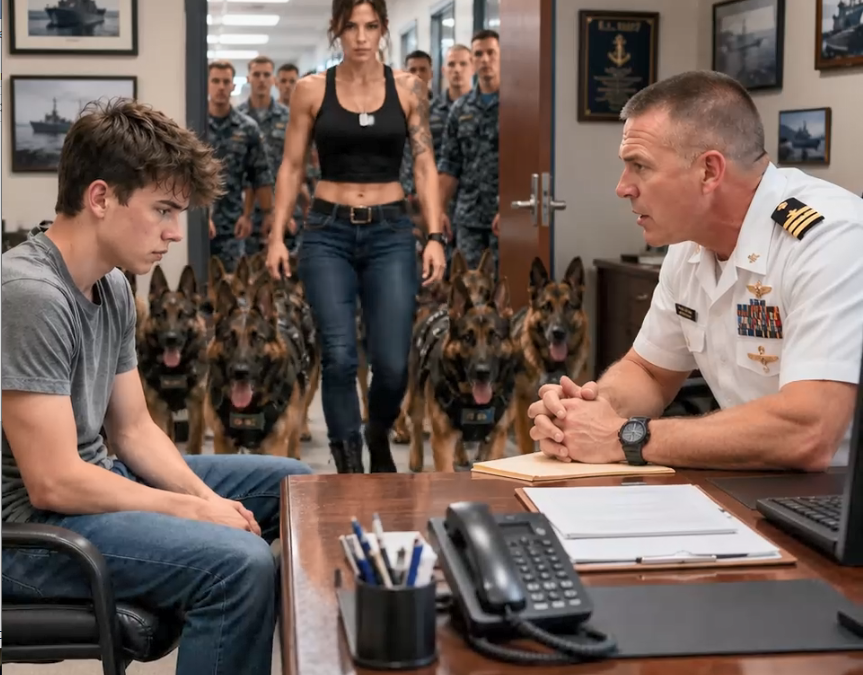
Fifty retired military working dogs had come into the annex.
Not loose.
Not charging.
Orderly.
Silent except for nails and breathing.
Griggs walked to the door.
“Who authorized this?”
Then my mother appeared.
Sarah Jenkins.
Jeans.
Brown work boots.
Dark green jacket.
Hair pulled back.
No makeup.
No dramatic uniform.
No medals.
A clipboard under one arm.
Dog leash in the other.
Beside her walked a giant retired Malinois named Ghost.
I knew Ghost.
He lived at our rehabilitation center.
Thirteen years old.
Scar across his muzzle.
Left ear missing a piece.
Arthritis.
Terrible gas.
He loved cheese.
He had also, according to Mom, “worked overseas.”
That was all she’d ever say.
Behind her came fifty dogs and their handlers.
Griggs stared.
My mother looked at me first.
Always me first.
She saw my face.
My breathing.
Came over.
Knelt.
“Chest?”
“Tight.”
“Dizzy?”
“No.”
“Can you talk full sentences?”
“Yes.”
“Good.”
She touched my shoulder.
Then looked at Griggs.
“Lieutenant.”
He pointed toward the hallway.
“What is this?”
Mom looked back.
“Oh.”
Like she’d forgotten fifty dogs were there.
“We were transferring retired working dogs from the regional rehabilitation facility to a veterans’ placement program today.”
“All of them?”
“Fifty-two total.”
She looked behind her.
“Two stayed on the transport.”
Griggs stared.
“You brought fifty military dogs into an administrative building?”
“No.”
“They were already scheduled through this annex for transfer verification.”
That was true.
I learned later.
My mother had not summoned fifty war dogs as intimidation.
Reality was better.
Once every few months, the regional Military Working Dog Transition Network processed group retirement and placement documentation at the annex because multiple branches needed records updated.
Mom coordinated the program.
Today happened to be transfer day.
She had been in the parking lot with them when I called.
Griggs said:
“You coordinate this?”
“Yes.”
“Your file says warehouse manager.”
“I manage logistics for the network.”
Something clicked in his face.
Mom asked:
“Did you call the liaison?”
“No.”
“Let’s do that.”
Griggs crossed his arms.
“I don’t take administrative orders from civilians.”
Mom smiled.
Not warmly.
“Good thing I’m not giving you one.”
Ghost entered the office.
He walked past me.
Past Griggs.
Sat beside Mom.
Then another dog appeared.
A German Shepherd named Odin.
He saw Mom.
Pulled his handler gently.
Came inside.
Sat.
Then another.
And another.
The office was not physically large enough for fifty dogs.
But within two minutes the doorway, hall, and adjoining waiting area were packed with them.
Most settled.
Heads down.
Eyes on Mom.
Griggs noticed.
Everybody noticed.
A young petty officer whispered:
“Why are they all looking at her?”
One handler answered quietly:
“Because they know her.”
Mom heard.
“Don’t start.”
The man smiled.
“Yes, Chief.”
Griggs looked at him.
“You know her?”
The handler was probably sixty.
Retired.
Gray beard.
Prosthetic below one knee.
He looked at Mom.
Then Griggs.
“Longer than I’d like.”
Mom said:
“Frank.”
“What?”
“Don’t.”
“I didn’t say anything.”
“You were about to.”
He grinned.
Griggs stepped back behind the desk.
“This has become completely inappropriate.”
Mom nodded.
“I agree.”
That surprised him.
She pointed at my folder.
“A seventeen-year-old dependent with an expiring controller medication should not be sitting here while an officer debates whether his sponsor’s classified administrative record is personally believable.”
Griggs’s face hardened.
“I did not deny medical care.”
“You suspended verification.”
“Pending fraud review.”
My mother went still.
“You opened a fraud review?”
He hesitated.
“Preliminary flag.”
“Because?”
“The sponsor information didn’t match visible personnel data.”
“And you did not call the authorized verifier.”
“I explained why.”
Mom pulled out her phone.
“Let’s remove the uncertainty.”
She dialed.
Put it on speaker.
Griggs said:
“Who are you calling?”
“The person listed in your envelope.”
Ring.
Once.
Twice.
A man’s voice answered.
“Reeves.”
Mom said:
“Sir, Sarah Jenkins.”
Pause.
Then:
“Jesus, Sarah. Who died?”
Half the hallway went silent.
Mom glanced at me.
“No one.”
“Good. What do you need?”
“Administrative sponsor verification.”
Long pause.
“You called me for paperwork?”
“Technically my son called me.”
The voice changed.
“Is Toby okay?”
I stared.
The admiral knew my name.
Mom said:
“His dependent file is being delayed.”
“Why?”
Lieutenant Griggs stepped forward.
“Sir, Lieutenant Robert Griggs, Naval Administrative Annex.”
The man on the phone said:
“Lieutenant.”
Griggs straightened reflexively.
“Yes, sir.”
“Who am I speaking as?”
Griggs looked confused.
“Sir?”
Mom sighed.
The voice said:
“Rear Admiral Jonathan Reeves. Naval Special Warfare Command.”
Griggs’s face emptied.
Not white.
Empty.
Like his brain needed to reboot.
“Yes, sir.”
Reeves continued:
“What exactly is the problem?”
Griggs swallowed.
“Chief Jenkins’s public service file shows logistics and supply assignments inconsistent with a dependent form referencing SEAL Team Six.”
The admiral paused.
Then:
“That’s because the public file is supposed to show logistics and supply.”
Nobody moved.
Griggs said:
“Sir?”
“The sponsor history you are attempting to reconcile includes assignments that were administratively sanitized under compartmented personnel-security procedures.”
Sanitized.
There was the word.
Not erased.
Not deleted.
Sanitized.
Mom had explained it correctly.
Certain assignments, locations, and operational taskings did not appear in ordinary systems because they were handled through restricted channels.
Reeves said:
“Chief Jenkins was not a SEAL.”
Griggs looked at me again.
But the admiral continued.
“She was a Naval Special Warfare combat-support specialist with advanced K9, recovery, medical-support, and logistics qualifications who spent multiple rotations attached to elements supporting DEVGRU missions.”
The hallway became so quiet I could hear Ghost breathing.
Griggs said nothing.
Reeves continued:
“Her administrative cover specialty was logistics.”
Mom closed her eyes slightly.
Like she hated this.
“Some assignments remain classified.”
“Some have been declassified in part.”
“Her dependent eligibility is valid.”
“The sponsor authentication code in the sealed letter exists specifically so personnel like you do not attempt to reconstruct compartmented histories from ordinary databases.”
Every sentence was calm.
That made them worse.
Griggs whispered:
“Yes, sir.”
Reeves asked:
“Did you call the verification number?”
“No, sir.”
“Why not?”
“I believed the claim may have been fraudulent.”
“Based on what?”
“The visible record.”
The admiral’s voice hardened.
“Then what exactly did you think the verification procedure was for?”
Nothing.
Mom looked at the floor.
She wasn’t smiling.
I was beginning to understand the difference between revenge fantasies and adults who had seen actual consequences.
Nobody enjoyed this.
Except maybe Frank.
He looked delighted.
Reeves said:
“Chief Jenkins’s service record is not a story for you to adjudicate.”
“Verify sponsor eligibility.”
“Process the dependent.”
“And ensure the medical coverage interruption is corrected.”
“Yes, sir.”
Then the admiral paused.
“Sarah.”
“Yes, sir?”
“Fifty?”
Mom looked around.
“Fifty downstairs.”
“Why?”
“Transition day.”
Reeves laughed.
“I thought you’d finally lost your mind.”
“Still possible.”
He said:
“Put Toby on.”
My mother handed me the phone.
My throat closed.
“Hello?”
“Toby.”
“Sir.”
“Your mother tells me you’re seventeen now.”
“Yes, sir.”
“Last time I saw you, you threw macaroni at my uniform.”
My mouth dropped open.
Mom covered her face.
Frank started laughing.
“I was little.”
“You were four.”
“Sorry.”
“I survived.”
Then his voice softened.
“You doing okay?”
I looked at Griggs.
Then my mother.
“Yeah.”
My breathing wasn’t great.
But I was okay.
“Your mom ever tell you what she did?”
“No.”
“Good.”
That surprised me.
He continued.
“She shouldn’t tell you most of it.”
Mom looked relieved.
“But understand this.”
I waited.
“Your mother spent a long time supporting people who received more public credit than she ever would.”
“She knew that going in.”
“She chose it.”
“That doesn’t make her a secret superhero.”
My mother nodded hard at that.
“It makes her someone who did difficult work without needing strangers to know.”
I swallowed.
“Yes, sir.”
“And Toby?”
“Yes?”
“Do not put classified unit names on forms unless your mother tells you exactly what to write.”
Frank laughed louder.
Mom said:
“I did.”
Reeves replied:
“Then this one’s on Sarah.”
For the first time all afternoon, I laughed.
Actually laughed.
It turned into a cough.
Mom immediately looked at me.
“Easy.”
Reeves said:
“Get your medication.”
“Yes, sir.”
Call ended.
The office stayed silent.
Then Griggs moved.
Fast.
He pulled my record back onto the screen.
Removed the preliminary fraud flag.
Entered verification code.
Called another office.
Spoke differently now.
Not scared exactly.
Professional.
“Dependent sponsor verified through command liaison.”
“Eligibility effective without lapse.”
“Yes.”
“Urgent pharmacy access.”
He looked at me.
“Controller medication.”
Ten minutes earlier, I had been a liar’s kid.
Now every word mattered.
That change made me angrier than the insults.
My mother noticed.
She always noticed.
Griggs printed a temporary eligibility confirmation.
Handed it to me.
“Take this to the pharmacy desk.”
I didn’t reach for it immediately.
He looked at my mother.
Then me.
“Mr. Jenkins.”
“Toby.”
He swallowed.
“Toby.”
Pause.
“I was wrong about your mother’s service status.”
My mother said nothing.
Neither did I.
Griggs continued.
“I should have used the verification procedure before making assumptions.”
Still nothing.
“And I should not have made comments about your family.”
That was closer.
He looked uncomfortable.
Good.
“I apologize.”
I took the paper.
“Okay.”
He looked like he expected more.
I didn’t give it.
Forgiveness is not something people get because they completed the apology form.
Mom touched my shoulder.
“Pharmacy.”
“I know.”
She turned to Frank.
“Can you keep the dogs staged?”
He saluted dramatically.
“Chief.”
“You retired twenty years ago.”
“Still scared of you.”
“Healthy instinct.”
The hallway started moving again.
Handlers rose.
Dogs stood.
One by one.
I walked with Mom toward the pharmacy.
Ghost beside us.
My chest still tight.
Mom said:
“How many rescue doses left?”
“Thirteen.”
“You said fourteen this morning.”
“I used one.”
“Okay.”
“No lecture?”
“Later.”
“Great.”
We reached the elevator.
I stared at her.
“What?”
She knew.
“Nothing.”
“Toby.”
“Were you really with SEAL Team Six?”
She sighed.
“We just did this.”
“Admiral Reeves said—”
“I was attached to missions supporting a unit whose public nickname is SEAL Team Six.”
“So yes.”
“No.”
“You were there.”
“Sometimes.”
“You went on missions?”
She looked at the elevator numbers.
“Sometimes.”
“Armed?”
“Toby.”
“That’s a yes.”
“No, that’s me refusing to discuss it in an elevator.”
I looked at the scar near her collar.
“The car accident?”
She glanced down.
“What car accident?”
“The ribs.”
She sighed.
“Oh.”
“That wasn’t a car accident.”
“Technically there was a vehicle involved.”
“Mom.”
She smiled faintly.
“Some things stay mine.”
That stopped me.
I nodded.
“Okay.”
Elevator opened.
We went to pharmacy.
The temporary authorization worked.
My controller inhaler was dispensed that afternoon.
Not free.
Not magically simple.
But covered.
The pharmacist made me use my rescue inhaler again because my peak flow was lower than normal.
Mom sat beside me.
No speeches.
No dogs.
No admirals.
Just my mother holding a paper cup of water while I waited for my breathing to settle.
That was the part I remember most clearly.
Not the hallway full of war dogs.
Not Griggs’s face.
Mom.
Plastic chair.
One hand against my back.
“Slow.”
In.
Out.
Again.
Once I could breathe properly, the anger arrived.
I said:
“Why didn’t you tell me?”
She knew exactly what I meant.
We sat inside her truck.
Rain starting against the windshield.
Fifty dogs had been processed and moved to the rehabilitation center.
Ghost was in the back seat, asleep.
Mom looked tired.
“Tell you what?”
“Anything.”
“I tell you things.”
“You tell me to empty the dishwasher.”
“Frequently ignored intelligence.”
“Mom.”
She looked forward.
I said:
“People know you.”
“Yes.”
“An admiral knows me.”
“You threw macaroni at him.”
“I was four.”
“He was emotionally scarred.”
I wasn’t laughing.
Neither was she now.
“Why did I have to find out from some asshole lieutenant?”
Mom looked at me.
“Because none of it changes what you need to know about me.”
“It changes a lot.”
“Does it?”
“Yes.”
“How?”
I couldn’t answer immediately.
She waited.
I said:
“You’re not a warehouse manager.”
“I am literally a warehouse manager.”
“You know what I mean.”
She smiled slightly.
Then serious again.
“Toby, the most dangerous thing about classified work isn’t the secrets.”
“What is?”
“What people build around them.”
I frowned.
“Stories.”
She continued.
“Heroes.”
“Legends.”
“People start turning complicated human beings into mythology.”
“They decide scars mean something dramatic.”
“Silence means something noble.”
“Dogs mean loyalty.”
“Bad nights mean sacrifice.”
“Sometimes a scar is just a scar.”
“Sometimes somebody is quiet because they don’t want to talk.”
I looked at her.
“You did combat missions.”
“Yes.”
First straight answer.
My heart jumped.
She said:
“Support missions.”
“Recovery.”
“K9 work.”
“Logistics.”
“Medical support.”
“Some other things.”
“I was attached to teams whose names people recognize now.”
“At the time, my job wasn’t to become a story.”
“It was to help the team come home.”
I stared at my hands.
“Were you good?”
Mom laughed once.
“What kind of question is that?”
“Admiral Reeves—”
“Jonathan remembers the good days.”
“What about the bad ones?”
She looked out the windshield.
“I do.”
Enough.
I changed direction.
“Why dogs?”
That softened her.
“Because they don’t care about medals.”
“That’s your answer?”
“Pretty much.”
Ghost snored behind us.
Mom looked back.
“When handlers leave service, dogs can become complicated.”
“Some retire smoothly.”
“Some don’t.”
“Some have medical issues.”
“Some have behavior nobody wants to manage.”
“Some are owned by contractors and fall into gaps.”
“So I started helping.”
“Fifty?”
“Today.”
“How many total?”
She hesitated.
“Through the network?”
“Yeah.”
“Three hundred eighty-seven.”
I turned.
“What?”
“Over twelve years.”
“Mom.”
“What?”
“You rescued almost four hundred military dogs?”
“The network did.”
“You started it.”
“With other people.”
“You always do that.”
“Do what?”
“Make yourself smaller.”
Her face changed.
Not angry.
Thoughtful.
I continued.
“When Admiral Reeves talked about you, you looked like you wanted to crawl under the desk.”
“I did.”
“Why?”
“Because people confuse recognition with worth.”
That sentence stayed.
She said:
“I was the same person at 9:00 this morning before Griggs knew anything.”
“Yes.”
“If the admiral hadn’t called, would I be less worthy of basic respect?”
“No.”
“Would you?”
“No.”
“That’s the part I want you to remember.”
I thought about Griggs.
How his voice changed.
Before verification.
After admiral.
Same me.
Same asthma.
Same paperwork.
Only status changed.
Mom said:
“That is why I don’t lead with the résumé.”
I nodded.
Then:
“He called you a liar.”
“I heard.”
“You aren’t mad?”
“Oh, I’m mad.”
She looked at me.
“I just don’t confuse anger with instruction.”
That sounded like something she’d paid therapy money to learn.
“What happens to him?”
“I don’t know.”
“Aren’t you going to call Reeves?”
“No.”
“He nearly delayed my medicine.”
“I will file a factual complaint.”
“That’s it?”
“What do you want?”
I pictured Griggs humiliated.
Stripped rank.
Escorted out.
The fantasy felt good for three seconds.
Then cheap.
“I don’t know.”
Mom said:
“He used authority badly.”
“That should be reviewed.”
“Not avenged.”
I hated how reasonable she was.
The complaint did go forward.
Not because she had secret pull.
Because the interaction was documented.
The sealed verification letter.
The skipped procedure.
The preliminary fraud flag.
My medical urgency.
Witnesses.
Griggs’s comments.
The office had cameras in public areas.
A civilian employee had heard part of it.
His command conducted an administrative review.
They found Griggs had violated verification procedure and behaved unprofessionally.
He was removed from dependent-benefits processing temporarily.
Formally counseled.
Required retraining.
His record received an adverse administrative entry.
No court-martial.
No handcuffs.
No admiral personally destroying his career.
At seventeen, that disappointed me.
At twenty-seven, I understand.
Consequences are supposed to fit conduct.
Mom taught me that too.
Two weeks after the incident, Griggs sent a written apology.
Not to Mom.
To me.
That mattered.
He wrote:
Toby,
I treated uncertainty in your paperwork as evidence that you were dishonest.
That was wrong.
I also allowed my skepticism about your mother’s stated service association to become ridicule.
It was unprofessional and unfair.
Most importantly, I failed to follow an established verification procedure before delaying your sponsor review.
You were seventeen and seeking access to medical coverage.
You should not have had to defend your mother’s credibility to receive competent administrative service.
I am sorry.
I read it three times.
Mom asked:
“What do you think?”
“I hate that it’s good.”
She laughed.
“That’s inconvenient.”
“Am I supposed to forgive him?”
“No.”
“What am I supposed to do?”
“Whatever is honest.”
So I wrote back:
Thank you for apologizing.
I hope the next kid doesn’t have to prove his parent is important before you treat him like he’s telling the truth.
Toby.
Mom read it.
Nodded.
“Good.”
Griggs never replied.
Didn’t need to.
The dog story became a bigger problem.
Because fifty retired military working dogs entering an administrative annex is not subtle.
Somebody took video.
Not inside Room 412.
Hallway.
Dogs.
Handlers.
My mother walking.
The clip spread among military social media.
Caption:
WHEN YOU QUESTION CHIEF JENKINS’S PAPERWORK ON TRANSITION DAY.
Then another:
200 PAWS OF ADMINISTRATIVE CORRECTION.
Mom hated both.
Frank loved them.
One evening he came to our house with barbecue and showed us memes.
Mom threatened to remove his Wi-Fi access.
“You can’t.”
“I know people.”
“You retired.”
“Still scared.”
I learned more about Frank.
Senior Chief Frank Delaney.
Former Naval Special Warfare operator.
Lost part of his leg years after his first deployment, during a training accident.
He had worked with Mom on and off.
I asked:
“Was she scary?”
He looked at her.
Mom was washing dishes.
He whispered:
“Yes.”
She threw a sponge without turning.
It hit him in the chest.
He said:
“See?”
Then he became serious.
“Your mom was never a SEAL.”
“I know.”
“But there were years when support people went places they never got credit for.”
“What did she do?”
He shook his head.
“Ask her.”
“She won’t tell me.”
“Smart.”
“Why does everyone say that?”
Frank leaned back.
“Because operational stories belong to more than one person.”
I frowned.
“If I tell you something your mom did, I’m also telling you something about men who may not want it told.”
That made sense.
He continued.
“But I’ll tell you one thing.”
I waited.
“Dogs trusted her.”
“That I know.”
“No.”
He looked toward the kitchen.
“You don’t.”
His voice softened.
“There was a dog named Harlan.”
Mom stopped washing.
She turned.
“Frank.”
He raised both hands.
“Nothing classified.”
She stared.
Then went back to the sink.
Frank continued carefully.
“Harlan lost his handler.”
“Bad day.”
“Afterward he wouldn’t let anyone near him.”
“People said euthanasia.”
“Your mom sat twenty feet away for six hours.”
“Didn’t touch him.”
“Didn’t feed him.”
“Didn’t speak.”
I looked at her.
She kept washing the same plate.
Frank said:
“Seventh hour, Harlan walked over and put his head on her boot.”
“What happened?”
“Went home with the handler’s brother eventually.”
Mom said:
“That story gets longer every time you tell it.”
Frank shrugged.
“Six hours?”
“Five and a half.”
I smiled.
There she was.
The woman Griggs’s database called logistics.
Maybe it was technically true.
She moved things.
Equipment.
Dogs.
People.
Fear.
Sometimes survivors.
She spent her entire life getting something from where it was to where it needed to be.
Logistics.
The word stopped sounding small.
My asthma coverage stabilized.
The sponsor record was corrected with a special administrative marker that told clerks to use command verification instead of trying to interpret the sanitized file.
Mom made me keep copies.
Three.
One in my backpack.
One at home.
One scanned.
“Why three?”
“Because government.”
Fair.
I finished high school.
Applied to college.
Not the Naval Academy.
Everyone assumed I might.
No.
I had enough uniforms around me.
I studied veterinary medicine.
That surprised Mom.
Not me.
Dogs had always made more sense than people.
My application essay was about Ghost.
Not my mother’s career.
Not Room 412.
Ghost.
He had arrived at our center at age eleven with arthritis, cracked teeth, and an aversion to men wearing baseball caps.
I spent six months earning the privilege of touching his ears.
That felt more meaningful than any admiral.
Mom cried when I got accepted.
Denied crying immediately afterward.
“I had something in my eye.”
“Both?”
“Dust.”
“Indoors?”
“Very dusty house.”
Ghost lived until I was twenty.
We buried him behind the rehabilitation property.
Mom did not speak during the little ceremony.
Frank did.
Too much.
As usual.
Afterward, I found Mom sitting beside the grave.
I sat too.
She said:
“He was on my last deployment.”
That was new.
I waited.
She continued.
“Not assigned to me.”
“Worked near us.”
“Lost his handler later.”
I looked at the grave.
“So he knew you?”
“Yes.”
“That day in Griggs’s office—”
“Yes.”
“He wasn’t just following you because you fed him cheese.”
Mom almost smiled.
“Cheese helped.”
She put one hand on the dirt.
“That was the strange thing about retired working dogs.”
“What?”
“They remember versions of you that no longer exist.”
I understood more years later.
People do too.
Admiral Reeves retired eventually.
There was a ceremony.
Mom tried not to attend.
He personally called me.
“Get your mother here.”
“I don’t control her.”
“None of us did.”
I convinced her by saying there would be food.
She wore a navy dress.
No uniform.
No medals.
Reeves saw her from across the room.
Walked over.
“Warehouse manager.”
Mom smiled.
“Desk admiral.”
They hugged.
I had never seen her hug him.
Then Reeves looked at me.
“No macaroni?”
“I’ve matured.”
“Debatable.”
During his speech, he thanked hundreds of people.
Public names.
Private names.
Then he said:
“There are also men and women who served near the sharp end without ever receiving the mythology attached to the units they supported.”
Mom looked down.
Reeves continued.
“Intelligence.”
“Logistics.”
“Aviation.”
“Medical.”
“Communications.”
“K9.”
“Analysts.”
“Technicians.”
“People whose names you’ll never know.”
“Some had records that looked ordinary by design.”
“They were not ordinary.”
He did not say Mom’s name.
That was the greatest gift he could give her.
Afterward, I told him:
“You were talking about her.”
He smiled.
“I was talking about thousands of people.”
Better answer.
By then I understood.
The mythology around special operations can swallow everybody standing nearby.
People hear SEAL Team Six and imagine one type of person.
Operator.
Weapon.
Night raid.
They forget the machine behind every mission.
Pilots.
Mechanics.
Intelligence officers.
Dog handlers.
Medical personnel.
Cryptologists.
Logistics specialists.
People who move equipment.
People who arrange extraction.
People who make sure a dog gets home.
My mother had spent years inside that shadow.
Not as a secret female SEAL.
The truth was more interesting.
She had been Sarah Jenkins.
Chief Petty Officer.
Naval Special Warfare support specialist.
K9-qualified.
Recovery trained.
Logistics by rating and cover assignment.
Attached when needed.
Forgotten on purpose in ordinary databases.
Remembered very clearly by the people who had depended on her.
That was enough.
Years after Room 412, I saw Lieutenant Griggs again.
I was twenty-four.
Veterinary student.
Mom’s network had partnered with a military family event.
I was examining an old Malinois’s hip.
Someone said:
“Dr. Jenkins?”
Not doctor yet.
I turned.
Griggs.
Older.
More gray.
Same neck.
Different expression.
He recognized me.
“Toby?”
“Yeah.”
He looked embarrassed.
“How are you?”
“Breathing.”
That slipped out.
He winced.
I immediately regretted it.
Then didn’t.
“Fair.”
He looked at the dog.
“You work with them now?”
“Trying to.”
He nodded.
“Your mother?”
“Still impossible.”
He smiled.
Then:
“I think about that day.”
“So do I.”
“I was an ass.”
“Yes.”
That surprised him.
Then he laughed.
“I deserved that.”
We stood there.
No dramatic hostility.
He said:
“I’d been dealing with benefits fraud cases for months.”
“Okay.”
“I started treating every inconsistency like fraud.”
“That’s not an excuse.”
“No.”
He nodded.
“It’s an explanation.”
That I accepted.
He continued.
“The worst part wasn’t being corrected by the admiral.”
“What was?”
“My daughter was sixteen.”
I waited.
“I went home and imagined a lieutenant talking to her the way I talked to you.”
His face changed.
“That did more damage than the reprimand.”
I believed him.
He asked:
“Did you ever find out what your mother really did?”
I smiled.
“Some.”
“And?”
I looked across the field.
Mom was forty yards away.
Kneeling beside a retired German Shepherd.
One hand under its chin.
Talking to a veteran.
Nothing dramatic.
Same woman.
I said:
“She did her job.”
Griggs nodded.
“Probably the best answer.”
It was.
Mom retired from the logistics contract at fifty-two.
Not from dogs.
Never from dogs.
The rehabilitation network expanded to three states.
More than a thousand former military, police, and contract working dogs moved through partner programs over the years.
Not all were adopted.
Some had medical needs too complex.
Some stayed in sanctuary care.
Some died before placement.
Mom refused happy-ending mythology there too.
“Helping doesn’t mean everything works.”
She taught staff that constantly.
“Sometimes helping means making the last month safe.”
She got arthritis.
Old shoulder injury worsened.
Stopped kneeling as easily.
Still tried.
I became the one saying:
“Let me.”
She hated that.
One afternoon, when she was fifty-eight, I found her sitting inside a kennel with a twelve-year-old shepherd named Bishop.
New intake.
Handler dead.
Dog withdrawn.
Wouldn’t eat.
Mom sat against the wall.
Didn’t touch him.
I stood outside.
“How long?”
“Two hours.”
“You’re too old for concrete floors.”
“So are you.”
“I’m thirty-one.”
“Tragic.”
Bishop eventually moved.
One step.
Then another.
Head against her boot.
I thought about Harlan.
Frank’s story.
Five and a half hours.
This one took two.
Maybe she was improving.
I said:
“Magic?”
She glared.
“Reading.”
Right.
When Mom finally told me the most she would ever tell me about her service, we were sitting on the back porch.
No dramatic deathbed.
She was fine.
Seventy-one.
I asked:
“Were you afraid?”
She thought a long time.
“Yes.”
That answer mattered.
“You always looked like nothing scared you.”
“That means I was doing my job.”
“How often?”
“Often enough.”
“Did you ever kill anyone?”
She looked at me.
I immediately wished I hadn’t asked.
Then she said:
“I carried a weapon in places where weapons were necessary.”
“That isn’t an answer.”
“It’s the answer you’re getting.”
Fair.
“Did you save people?”
She frowned.
“People saved each other.”
“Mom.”
“What?”
“Admiral Reeves said—”
“Jonathan talked too much.”
“He said people depended on you.”
“I depended on them.”
Again.
Always reducing herself.
Or maybe correcting the story.
I asked:
“What are you proudest of?”
She looked toward the kennels.
I assumed dogs.
Instead she said:
“You.”
I laughed.
“No.”
“Yes.”
“That is such a mom answer.”
“You asked.”
“Military.”
She considered.
Then:
“There were some nights when everybody we left with came back.”
That’s all.
I never asked again.
After she died, at seventy-six, the funeral became a problem.
Mom had written instructions.
SMALL.
NO UNIFORM CEREMONY UNLESS REQUIRED.
NO SPEECHES LONGER THAN THREE MINUTES.
NO DOG PARADE.
Frank was already dead by then.
Probably the only reason she thought she could enforce the third rule.
She was wrong.
We held the service at the rehabilitation property.
Family.
Friends.
Veterans.
Handlers.
Employees.
Admiral Reeves came in a wheelchair.
Ninety-something.
Still sharp.
He squeezed my hand.
“She’d be furious.”
“Yes.”
“Good.”
Then the dogs came.
Not fifty.
Not planned.
Families brought retired dogs Mom had helped place.
Old dogs.
Young dogs descended from working lines.
Service dogs.
One-eyed shepherds.
Malinois with gray faces.
Labs.
Dozens.
Nobody organized them into formation.
Thank God.
They just existed around the property.
Lying beneath chairs.
Beside veterans.
Under tables.
Mom would’ve approved eventually.
Maybe.
Reeves gave the only military speech.
Two minutes.
Forty-three seconds.
I timed him because Mom would have.
He said:
“Sarah Jenkins spent much of her career in records that were incomplete by design.”
“She did not need them corrected.”
“She did not need strangers to know.”
“The people who needed to know, knew.”
Then he looked at me.
“And the dogs knew.”
That got me.
After everyone left, I walked into Mom’s old office.
There was one framed photograph on the wall.
Not a team.
Not a medal.
Room 412.
Someone had taken it from the hallway.
Seventeen-year-old me standing beside her.
Ghost sitting between us.
Rows of retired dogs behind.
I had never noticed she kept it.
On the back, in Mom’s handwriting:
THE DAY TOBY LEARNED THAT DATABASES ARE NOT PEOPLE.
Below that:
AND I LEARNED HE WOULD DEFEND ME EVEN WHEN HE WAS SCARED.
I sat down.
Cried harder than I had at the funeral.
Because that was the piece I’d never understood.
I had spent years thinking Room 412 was the day my mother’s secret identity was revealed.
It wasn’t.
Nothing important about Sarah Jenkins changed when the admiral spoke.
She had already been the woman who burned toast.
The woman who forgot conferences.
The woman who sat beside broken dogs.
The woman who held an inhaler spacer against my face when I was six and couldn’t breathe.
The woman who worked classified missions.
The woman who stocked cereal.
Same woman.
The admiral did not make her important.
Fifty retired war dogs did not make her important.
A sanitized record did not make her mysterious enough to deserve respect.
What changed that day was me.
For seventeen years, I thought my mother was hiding a grand story.
After Room 412, I understood she was protecting something simpler.
The right to be ordinary after doing extraordinary work.
Lieutenant Griggs made the opposite mistake.
He looked at an ordinary record and decided an ordinary-looking woman could not possibly have an extraordinary past.
Then, when an admiral verified it, he suddenly treated us differently.
My mother hated that part.
She told me once:
“If somebody only respects you after they learn your résumé, they don’t respect you. They respect the résumé.”
I use that sentence now.
With young handlers.
Students.
Veterans.
Anybody.
Because databases are useful.
Rank matters in the right context.
Records matter.
Verification matters.
But none of them tell you the full value of the person sitting across the desk.
Sometimes the warehouse clerk really is a warehouse clerk.
Treat her with dignity.
Sometimes the exhausted mother in work boots once supported missions nobody can discuss.
Treat her with dignity.
Sometimes the scared seventeen-year-old is confused.
Treat him with dignity.
Sometimes he’s right.
Treat him with dignity anyway.
That is what Room 412 should have taught all of us before the dogs arrived.
The fifty retired war dogs just made it impossible to ignore.
And all these years later, when people ask whether my mother really served with SEAL Team Six, I give them the answer she would have wanted.
“No.”
Then I let them look confused.
“She served as Sarah Jenkins.”
And to the people who came home because she did her job, that name was always enough.

