A Man Hit My Cat With His Truck—Then He Wrapped Her in His Jacket, Rushed Her to the Vet, and Waited So I’d Have Time to Say Goodbye.
PART3:
Then I saw the man.
Early fifties.
Blue work shirt.
Jeans.
Work boots.
He stood beside the entrance holding a brown jacket in both hands.
There was blood on one sleeve.
I knew.
He stepped toward me.
I raised my hand.
“Please don’t.”
He stopped immediately.
His face was gray.
“My name is John.”
I could hear my heartbeat.
“I’m the one who hit her.”
For one terrible second, I hated him more purely than I had ever hated anyone.
Not disliked.
Not resented.
Hated.
The feeling was clean because I did not yet know anything else about him.
He had hit Belle.
That was enough.
“How fast were you going?”
“Twenty-five.”
“Were you looking at your phone?”
“No.”
“Were you drinking coffee?”
“No.”
“Did you even see her?”
His mouth tightened.
“She came between two parked cars.”
“That’s what everyone says.”
“I know.”
“Did you stop?”
The question came out cruelly because the blood on his jacket already answered it.
John looked down at the stain.
“Yes.”
He swallowed.
“I hit the brakes.”
“She was still breathing.”
“I got out.”
“I wrapped her in this.”
He lifted the jacket slightly.
“And I brought her here.”
I walked past him.
If I had stayed another ten seconds, I might have said something I would have remembered forever.
Inside, a technician met me.
“Margaret?”
“Yes.”
“This way.”
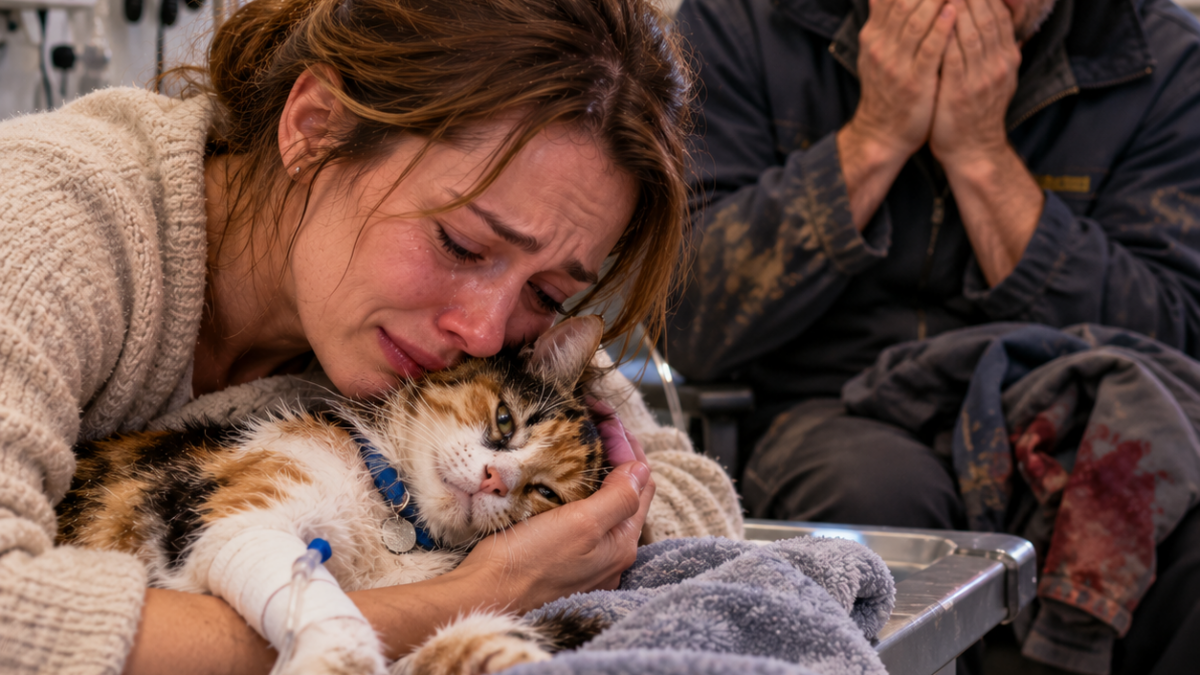
Belle was lying on a fleece blanket in an examination room.
I had owned her for eleven years.
I had seen her asleep.
Angry.
Sick.
Drowsy after dental work.
Wet after escaping from the bathtub.
I had never seen her look small.
Belle had always taken up more space than her body required.
That morning she looked tiny.
One front leg rested wrong.
Her breathing came in shallow pulls.
There was blood near her mouth.
Her green eyes were closed.
“Belle.”
One eye opened.
Then the other.
Her tail moved once.
The veterinarian stood beside me.
Dr. Priya Shah.
I had met her years earlier for an emergency urinary infection.
She remembered Belle.
Or maybe veterinarians are simply good at making people feel remembered when they need it.
“She came in conscious.”
I nodded.
“Is she going to live?”
Dr. Shah did not lie.
That was a gift even though I hated it.
“She has severe internal trauma.”
“Her pelvis is fractured.”
“There are injuries to the chest.”
“We could attempt surgical stabilization, but based on what we’re seeing, I don’t believe we could give her a comfortable recovery.”
“What does that mean?”
“It means we may be able to prolong her life.”
She paused.
“I do not believe we can restore a life she would recognize as comfortable.”
The room became very still.
I had imagined if this day ever came, I would ask every question.
Second opinions.
Odds.
Percentages.
Possible treatments.
Instead, I looked at Belle.
She had hated the veterinary clinic all her life.
She once climbed onto my head during an examination.
Another time she bit through a towel and then refused to look at me for two days.
Now she did not even resist the IV catheter.
That told me more than any percentage.
I sat.
Placed my hand beneath her chin.
Belle shifted toward my palm.
Exactly as she had every night for eleven years.
That movement broke me.
“Oh, baby.”
Her eyes stayed open.
“I’m here.”
I had found Belle beneath a shopping cart in a grocery-store parking lot when she was maybe six months old.
My marriage had ended five months earlier.
My daughter Claire had left for college three states away.
The house had become so quiet that sometimes I left the television on in rooms I was not using.
I was forty-three and deeply embarrassed by how lonely I had become.
Loneliness felt like failure then.
As though adulthood should have produced enough people by that age that silence became impossible.
One rainy afternoon I came out of the grocery store and heard crying.
Not human.
Sharp, furious little cat screams.
A calico kitten was crouched beneath a shopping-cart corral.
Wet.
Thin.
Hissing at everyone.
A teenager from the store had tried to catch her.
She scratched him.
I knelt ten feet away.
“You seem reasonable.”
The kitten hissed.
“I’m going through a divorce.”
Another hiss.
“So your judgment is probably better than mine.”
For reasons nobody understood, she crawled toward me.
I took her home “for one night.”
Eleven years later, her food was still automatically included in every grocery list.
Belle slept on my sweaters.
She sat beside the bathtub while I soaked.
She waited behind the door when I came home from work.
She screamed every morning at seven like starvation was seconds away, even when food remained in her bowl.
When Claire called every Sunday, one of her first questions was always:
“How’s Belle?”
During the worst months after the divorce, Belle slept pressed against my ribs.
I used to tell people I saved her from a parking lot.
That was flattering to me.
The truth was more balanced.
We found each other when neither of us had much else.
Dr. Shah asked if I wanted time.
“Yes.”
She left.
I touched Belle’s head.
“I’m sorry.”
Her ear twitched.
“I left the door open.”
That sentence would become a weapon I used against myself for months.
That morning it was simply true.
“I should’ve checked.”
I kissed her forehead.
“You were a good girl.”
Belle breathed.
“You drove me completely insane.”
Her tail moved.
I laughed while crying.
“You ruined two couches.”
“You threw up inside my good shoes.”
“You once brought a mouse into bed.”
Her eyes stayed on me.
“Claire still asks about you every Sunday.”
My voice broke.
“She’s going to be so mad at me.”
Then something began under my fingers.
A purr.
Faint.
Almost nothing.
But there.
I put my face against her head.
Dr. Shah returned several minutes later.
I signed the form.
My signature barely resembled my name.
When I stepped into the hallway to let them prepare medication, John was still there.
He sat alone on a vinyl chair.
His bloody jacket was folded beside him.
I stopped.
“You’re still here?”
He stood immediately.
“I didn’t know if I should leave.”
He looked toward the exam-room door.
“I didn’t want you to come out and think I had just disappeared.”
I was too exhausted to be angry properly.
“Why?”
He stared at the floor.
“When my daughter was nine, we had a dog.”
I said nothing.
“Rusty.”
“Brown mutt.”
“One white paw.”
“He got out one afternoon.”
John swallowed.
“A driver hit him and left.”
His fingers twisted together.
“We found him later.”
“Beside the road.”
“My daughter kept asking whether he had been alone.”
“Whether he was scared.”
“I never knew what to tell her.”
For the first time, I saw John.
Not the truck.
Not the bumper.
Not Belle’s blood.
A man whose hands were trembling.
“I couldn’t leave your cat there.”
His eyes filled.
“I know I can’t fix what happened.”
“I know stopping doesn’t make it okay.”
“I just couldn’t let her be alone.”
I did not forgive him.
People sometimes tell this story later as though grief transformed instantly into grace.
It did not.
Part of me still wanted to scream at him.
Part of me wanted him to hurt.
But another part understood something.
If John had driven away, Belle might have died before anyone found her.
Instead, a microchip scan gave the clinic my phone number.
I had reached her.
I had spoken to her.
My hand was beneath her chin.
That mattered.
“I don’t know what I feel about you.”
“That’s fair.”
“But thank you for stopping.”
John covered his face.
He cried.
Not performatively.
Not loudly.
Just one exhausted man in a hallway beside the woman whose cat he had accidentally killed.
Belle died fifteen minutes later.
Her head rested against my arm.
I felt the final breath.
I felt the absence after it.
The clinic gave me her blue collar.
John was still waiting when I came out.
The staff had sealed his jacket in a clear plastic bag.
Blood darkened one sleeve.
“I’m sorry.”
“I know.”
“I understand if you hate me.”
“I don’t know yet.”
He nodded.
Then I said:
“Thank you for bringing her here.”
His face folded again.
I drove home alone.
At seven that evening, I put Belle’s food bowl on the floor.
Habit.
I had already opened the can before remembering.
I sat on the kitchen floor and cried beside a bowl no one was coming to eat.
Later, because grief makes people do strange things, I opened our neighborhood Facebook group.
I wrote about Belle.
I did not identify John.
I had no desire to unleash strangers on a man who had already told me the truth.
I wrote:
This morning, someone accidentally hit my cat.
Then I told them what happened next.
He stopped.
He picked her up.
He carried her into his truck.
He found an emergency clinic.
He stayed.
Because he stopped, I got to say goodbye.
I ended with:
If you ever hit an animal, please stop if it is safe to do so.
The post spread farther than I expected.
Hundreds of shares.
Then thousands.
People wrote about dogs they had lost.
Cats.
Deer.
A fox one woman had sat beside while waiting for animal control.
Some people admitted they had once hit an animal and panicked.
A man wrote:
I kept driving when I was seventeen and I have regretted it for thirty years.
Another wrote:
My dog died alone because nobody stopped.
Thank you to whoever carried Belle.
For two days, the comments made me cry in a way that felt almost healing.
Then three days after Belle died, I found a plant on my front porch.
Small green pothos.
Beside it:
A card.
Thank you for letting me remember Belle for what I did after my worst mistake, not only for the mistake itself.
No signature.
I placed the plant on Belle’s windowsill.
Her blue collar beneath it.
For the first time since Tuesday, I slept more than four hours.
Then the internet did what the internet often does.
It got bored with compassion.
Someone commented:
Why are you protecting the driver?
Another:
People deserve to know who killed animals in our neighborhood.
Another:
If he was really such a good guy, why hide his name?
I replied once:
Because I chose not to identify him.
That should have ended it.
Instead, my silence became mystery.
Someone said they had seen a silver pickup outside Greenfield Veterinary that morning.
Someone else remembered that Marcus Reed, who lived four blocks from me, owned a silver pickup.
His bumper had a dent.
A photograph appeared.
THIS IS THE TRUCK.
It was not.
Then a photo of Marcus.
Forty-two.
Glasses.
Thin face.
Carrying grocery bags.
Then his address.
Then his workplace.
Marcus worked as custodian at a private elementary school.
Someone called the school.
Then another.
A commenter wrote:
Anyone who leaves an animal dying in a road should not work around children.
Except Marcus had left no animal.
Marcus had hit no animal.
Marcus had done nothing.
I did not know most of this immediately.
I had stopped reading.
The comments had become unbearable.
Three weeks after Belle died, John appeared at my front door.
Claire was visiting.
She opened it first.
When she saw him, her entire body changed.
“Who are you?”
“My name is John Mercer.”
I stood behind her.
John looked at me.
“Margaret.”
Claire turned.
“You know him?”
“He’s the driver.”
She stepped between us.
“No.”
“Claire.”
“No.”
She looked at John.
“You need to leave.”
John nodded.
“I understand.”
He reached for the porch rail.
Then stopped.
“Someone else is being blamed.”
Claire’s face changed.
“What?”
John took out his phone.
Marcus’s photograph.
His truck.
His house.
Comments about his job.
His fifteen-year-old son had been shown the posts at school.
The boy went home sick.
John said:
“I contacted the group administrators.”
“One post disappeared.”
“Three more showed up.”
“I went to Marcus’s house.”
“He wouldn’t open the door.”
Claire folded her arms.
“What do you want from my mother?”
John looked at me.
“Permission to tell people who I am.”
“Absolutely not,” Claire said.
He looked at her.
“I wasn’t asking you.”
“You came into my mother’s house.”
“Claire.”
“No, Mom.”
She turned back to John.
“You think giving these people a new person to destroy fixes what happened to Marcus?”
“No.”
“Then what does it do?”
“It makes the truth available.”
“And your employer?”
“My family?”
“Your address?”
“Your daughter?”
John looked at the floor.
“I know.”
“Do you?”
“Yes.”
He did not say it dramatically.
That scared Claire more.
“You are volunteering to be publicly attacked.”
“There’s an innocent man being attacked now.”
“You can privately clear him.”
“I tried.”
“Then try harder.”
“I stayed quiet three weeks.”
“To respect my mother.”
John looked at me.
Then said:
“That’s what I told myself.”
Claire frowned.
He continued.
“I said I was protecting Margaret’s privacy.”
“I said if people knew my name, they would turn Belle into a spectacle.”
“They did that anyway.”
“Yes.”
He rubbed his palms against his jeans.
“The truth is I was also relieved.”
The room quieted.
“I went to work.”
“Bought groceries.”
“Drove past the road.”
“People called me compassionate without knowing who I was.”
“I did not have to stand in front of anyone as the man who caused the pain.”
I said:
“You made an accident.”
His eyes met mine.
“I killed someone you loved.”
Claire flinched.
So did I.
But the sentence deserved to exist.
John said:
“I don’t think responsibility means choosing only the consequences that feel comfortable.”
Claire stepped closer.
“And I don’t think responsibility means handing yourself to a crowd that enjoys punishment.”
He nodded.
“Maybe you’re right.”
That disarmed her slightly.
I took his phone.
Read the comments.
A stranger had written Marcus’s employer should fire him.
Another had implied he abused his mother’s elderly beagle because they had seen him at the vet once.
These people had never met him.
“Does Marcus know you’re here?”
“No.”
“What does he want?”
“I don’t know.”
“Then why should this be about what you want?”
John absorbed that.
“You’re right.”
Claire said:
“Good.”
“Leave.”
He turned.
I said:
“Wait.”
Claire stared at me.
“Mom.”
“We need to correct Marcus’s name.”
“Yes.”
“Without giving them John’s.”
“How?”
I looked at him.
“Can the group admin verify privately?”
“Tried.”
“Police report?”
“No police report.”
“Clinic?”
“They won’t release information.”
“Then I’ll post.”
Claire shook her head immediately.
“You shouldn’t.”
“People believed the first story because it came from me.”
“Maybe they’ll believe the correction.”
“And when they ask who did it?”
I looked at John.
He said:
“I’ll answer.”
Claire threw up her hands.
“You always do this.”
I turned.
“Do what?”
“You find the part of the person who hurt you that deserves sympathy.”
Her voice sharpened.
“Dad left us.”
“You spent years explaining him.”
“He was depressed.”
“He was confused.”
“His childhood was difficult.”
“He loved us even when he forgot to call.”
“Claire.”
“You forgave him before I was ready.”
“That has nothing to do with Belle.”
“It has everything to do with Belle.”
John shifted.
“I should go.”
Claire said:
“No.”
“You came here.”
“You should hear it.”
Then she looked at me.
“You act like understanding somebody makes the damage less real.”
“I never said that.”
“You didn’t have to.”
Her eyes filled.
“When Dad left, I needed you to say he hurt me.”
“I did.”
“No.”
“You explained why he hurt me.”
“That is not the same.”
The room became smaller.
John looked like he wanted to disappear.
Claire continued:
“You thanked the man who killed Belle.”
“Because he stopped.”
“He killed her.”
“And he stopped.”
Both truths came out together.
Claire froze.
I did too.
John had hit Belle.
John had also made sure she did not die alone.
Gratitude did not cancel responsibility.
Responsibility did not cancel gratitude.
Claire sat down.
“I loved her too.”
“I know.”
“No.”
Her voice softened.
“You always said Belle saved you when I left for college.”
“I used to hear that and think leaving broke you.”
“Oh, honey.”
“I called every Sunday partly because I wanted to hear about Belle.”
“I wanted to know you weren’t alone.”
“She never replaced you.”
“I know.”
Claire wiped her face.
“But I hadn’t seen her in four months.”
“I thought I had time.”
“So did I.”
John moved toward the door.
This time I let him.
“I’ll call you this afternoon.”
He nodded.
“Whatever you decide.”
After he left, Claire and I sat at my kitchen table.
Neither touched coffee.
“I don’t want strangers destroying him.”
“Neither do I.”
“Then don’t help him identify himself.”
“Marcus is already being destroyed.”
She closed her eyes.
“I know.”
By afternoon, John returned.
Claire stayed.
We wrote a statement.
John’s draft was four pages.
He included his age.
Employer.
Street.
Every detail of the accident.
Claire crossed out most of it.
“You can accept responsibility without publishing directions to your front door.”
John did not argue.
His opening sentence remained.
My name is John Mercer, and I was the driver who struck Belle.
He had written:
I was traveling under the speed limit.
I removed it.
“That sounds defensive.”
“It is true.”
“I know.”
“But the truth can still sound like an excuse when you put it in the wrong place.”
He nodded.
Claire deleted graphic details about Belle.
“Nobody needs those.”
Finally we had this:
My name is John Mercer.
I was driving the truck that struck Belle three weeks ago.
Belle ran into the road between two parked vehicles, and I could not stop in time.
I carried her to my truck and took her to the veterinary clinic, where her owner was able to be with her before she died.
Marcus Reed had no connection to the accident.
The photographs and accusations being shared about him are false.
Please remove them and stop contacting him, his family, and his workplace.
I remained anonymous because Belle’s owner chose not to identify me.
I also remained anonymous because I was afraid.
That silence allowed suspicion to fall on an innocent person.
I am sorry to Belle’s family.
I am sorry to Marcus Reed and his family.
Whatever you believe about me, please leave them alone.
John read it.
Signed his name.
Posted.
For five minutes, nothing happened.
Then:
Thank you for telling the truth.
Then:
You’re brave.
Then:
Brave would have been not killing the cat.
Within an hour, hundreds of comments.
Some apologized to Marcus.
Some deleted posts.
Some attacked John.
Some attacked me.
One person wrote:
This is really the owner’s fault for letting the cat outside.
Claire took my phone.
“That’s enough.”
John’s screen kept lighting.
He turned it face down.
“Do you regret it?” I asked.
He thought.
“I’m afraid of it.”
“That’s not the question,” Claire said.
“No.”
He breathed.
“I don’t regret it.”
That evening Marcus responded.
Eleven words.
My family was innocent yesterday, before John decided to be honest.
John read it three times.
Claire sat beside him.
“That doesn’t mean speaking was wrong.”
“No.”
He put down the phone.
“It means speaking does not repair everything.”
The next morning, John’s employer placed him on temporary leave.
Two clients complained.
One said they did not want “a reckless driver” at their property.
Another accused the company of protecting an animal killer.
John’s supervisor told him it wasn’t punishment.
They needed time.
Online, people celebrated.
Other people called the company to demand he be reinstated.
Nobody asked John what he wanted.
Belle’s death barely belonged to Belle anymore.
She had become a symbol.
John became accountability to some people.
Cruelty to others.
Marcus became proof of online vigilantism.
I became either merciful or irresponsible depending on who was commenting.
Claire became the daughter who “saw through everyone.”
None of us felt like symbols.
We felt exhausted.
Two days later, Marcus knocked on my door.
No dog.
Dark jacket.
Hands in pockets.
“I’m sorry,” I said before he spoke.
“I’m not here for your apology.”
That worried me more than anger.
He came inside.
Saw Belle’s collar beneath the plant.
“My mother has a beagle.”
“Daisy.”
I had seen them walking.
“She’s twelve.”
“My mother can’t walk far anymore.”
“So I take Daisy every night.”
He sat.
“People found a photograph of me taking her to the vet.”
“They said maybe I hurt my own dog too.”
I closed my eyes.
“My son saw it.”
“He asked if I was going to lose my job.”
“If we would have to move.”
“They had no right.”
Marcus’s jaw tightened.
“They believed they did.”
“My post never named you.”
“No.”
“It gave people a mystery.”
That hurt because it was true.
“I wanted people to understand what John did after the accident.”
“And they wanted to identify what happened before it.”
“I should have deleted the post.”
“Maybe.”
“I can delete it now.”
“It’s too late.”
He did not say it cruelly.
I almost wished he had.
“Do you hate John?”
Marcus looked surprised.
“No.”
“Are you angry?”
“Yes.”
“For Belle?”
“For waiting.”
“He didn’t know they’d accuse you.”
“He knew someone caused the accident.”
“He knew people were guessing.”
“He was respecting my choice.”
“And protecting himself.”
“Yes.”
Marcus nodded.
“At least he admitted that.”
I asked:
“Would you meet him?”
“What would that do?”
“I don’t know.”
Marcus almost smiled.
“That is the first sensible answer I’ve heard all week.”
He stood.
At the door:
“My mother thinks I should forgive him.”
“You don’t have to.”
“She says he told the truth when he could’ve stayed hidden.”
“She’s right.”
“She also says people make mistakes.”
“They do.”
Marcus looked straight at me.
“People say that most often when the mistake belongs to somebody else.”
He left.
That sentence stayed.
People make mistakes.
It can sound compassionate.
It can also sound like an order to the injured person.
Move on.
Understand.
Do not make the person who harmed you uncomfortable.
Claire’s accusation returned.
You always find the part of the person who hurt you that deserves sympathy.
She wasn’t wrong.
Anger scared me.
My mother had been angry.
Cabinets.
Silence.
Small mistakes transformed into punishments that lasted days.
I grew up deciding I would never be like that.
So I became an explainer.
My former husband forgot our anniversary because work was hard.
He missed Claire’s school performance because he was exhausted.
He moved out because he felt lost.
Every explanation contained truth.
None made Claire less abandoned.
Maybe compassion could become a hiding place too.
Maybe understanding someone was sometimes easier than admitting I had been treated unfairly.
Belle never demanded explanations.
She stayed.
A week later, the neighborhood association announced a public meeting.
Responsibility, Privacy and Compassion After Neighborhood Accidents.
The title made me laugh bitterly.
As though grief could be handled by agenda.
I was invited.
So was John.
So was Marcus.
That evening, John’s daughter Leah called.
We had never spoken.
“I’m asking you not to attend with my dad.”
“Why?”
“Because people will think you support everything he says.”
“What is he planning to say?”
“I don’t know.”
Her voice tightened.
“He barely talks to me.”
“Is he okay?”
“He says he is.”
“But he has not driven since work placed him on leave.”
“He goes outside every morning.”
“Sits in his truck.”
“Holds the keys.”
“Then comes back inside.”
I looked at Belle’s collar.
Leah said:
“I was nine when Rusty died.”
“The dog?”
“Yes.”
“Dad told you?”
“Yes.”
“For years I asked whether Rusty had been scared.”
“Whether he waited for us.”
“Dad told me he probably died quickly.”
“But he didn’t know.”
Her voice cracked.
“The morning he hit Belle, he called me from the clinic parking lot.”
“He was crying so hard I could barely understand him.”
“He kept saying, ‘I stopped. I stopped.’”
“As if stopping could save him from becoming the person he had hated for twenty years.”
I covered my mouth.
Leah said:
“I want you to tell him he’s done enough.”
“I can’t.”
“Why?”
“I don’t know what enough means.”
“You can tell him you forgive him.”
“I don’t know if I do.”
Leah became quiet.
“I’m sorry.”
“No.”
“You’re allowed.”
“I’m grateful to him.”
“That’s different.”
“Yes.”
“Do you think he’s bad?”
“No.”
“Should he lose his job?”
“No.”
“Does he deserve people threatening him?”
“No.”
“Then what’s left?”
I looked at the empty space where Belle’s bed had been.
“Belle is still dead.”
Leah cried.
“I know.”
Finally she said:
“There’s something Dad hasn’t told you.”
Cold moved through me.
“What?”
“You should ask him.”
The next morning, I drove to John’s house.
His silver pickup sat in the driveway.
Dent unrepaired.
He opened the door.
“Margaret?”
“I spoke to Leah.”
His face changed.
Inside, his house was painfully tidy.
A photograph of Leah as a child.
Another of Rusty.
Brown dog.
White paw.
We sat.
“Leah said you left something out.”
John stared into his coffee.
“I told you what happened.”
“She said compassion wasn’t your first reaction.”
His fingers tightened.
“No.”
“What was?”
Silence.
“John.”
He looked up.
“For one second, I wanted to keep driving.”
The sentence hit physically.
I pushed my chair backward.
He noticed.
“I didn’t.”
“I know.”
“But I wanted to.”
“How long?”
“I don’t know.”
“A second.”
“Maybe less.”
“What were you thinking?”
“That I was late.”
His voice shook.
“That if I stopped, I would get blamed.”
“That she might already be dead.”
“That I couldn’t stand seeing what I had done.”
I went to the window.
His truck sat outside.
Bright morning.
The day Belle died had been gray.
“Why did you stop?”
“Rusty.”
I turned.
“I saw him beside the road again.”
“I heard Leah asking if he had been alone.”
“So I stopped.”
I was angry.
Not because he left.
He hadn’t.
Because my grief took that one second and expanded it.
Belle in the road.
John’s foot hovering.
Truck moving.
His life continuing.
Her alone.
“You should have told me.”
“When?”
“At the clinic.”
“You were saying goodbye.”
“Later.”
“What would it have changed?”
“I would have known.”
“I was ashamed.”
“So you gave me the version that made you look better.”
John flinched.
“Yes.”
I expected a defense.
He offered none.
“I’m going to tell them at the meeting.”
“No.”
He looked up.
“People will destroy you with it.”
“They should know.”
“Why?”
“Because it’s true.”
“It is not all the truth.”
“It is part.”
“The whole truth is that you stopped.”
“After wanting to leave.”
“But you stopped.”
He looked toward Rusty’s photo.
“If I tell only the clean version, I make compassion sound easy.”
I said nothing.
“It wasn’t easy.”
“I was afraid.”
“I wanted to protect myself.”
“Then I made a different choice.”
“You think saying that helps anyone?”
“Maybe.”
“How?”
“Maybe someone hits an animal next year.”
My stomach tightened.
“And their first instinct is to run.”
“If they think good people stop immediately and bad people leave, they may decide they’ve already become the bad person.”
John leaned forward.
“But maybe if they know fear can happen first and they can still choose differently, they stop.”
I hated that he was right enough to complicate my anger.
“Leah wants me to release you.”
His face twisted.
“I don’t want that.”
“What do you want?”
“I keep thinking there must be a point where I’ve paid enough.”
“There isn’t.”
He looked at me.
“That’s not how grief works.”
“You cannot lose enough to bring Belle back.”
“You cannot apologize enough.”
“You cannot suffer enough.”
“Then what do I do?”
“Live with it.”
“That sounds like punishment.”
“Sometimes it is.”
I sat.
“But living with something is not the same as letting it destroy you.”
“How do you know?”
“Because I left the door open.”
John shook his head.
“No.”
“Yes.”
“That was an accident.”
“So was yours.”
“You took out trash.”
“You drove to work.”
“You didn’t choose Belle to run outside.”
“You didn’t choose her to run between cars.”
“I hit her.”
“And you stopped.”
He stared.
“We are not equally responsible.”
“Maybe not.”
“But grief doesn’t require equal responsibility to belong to more than one person.”
That Thursday, eighty chairs filled the neighborhood center.
People stood along the walls.
Claire drove in.
She told me:
“I don’t trust strangers to remember Belle was yours.”
Marcus sat front row beside his mother.
Daisy lay beneath her chair wearing a purple sweater and looking personally offended by fashion.
John stood near a side wall.
Leah beside him.
The association president began:
“We are not here to determine who is good or bad.”
A man in the back said:
“Then what are we here for?”
Nervous laughter.
I was asked to speak first.
I had written three pages.
At the front, I folded them.
“My cat’s name was Belle.”
The room quieted.
“She was eleven.”
I told them about the shopping cart.
The divorce.
Claire leaving for college.
Belle sleeping on sweaters.
Screaming for breakfast while breakfast remained in the bowl.
People smiled.
Then:
“The morning Belle died, I left my back door open.”
A murmur.
“I did not mean to.”
“I did not want her outside.”
“But she went outside.”
I looked at John.
“John did not mean to hit her.”
Then Marcus.
“Marcus had nothing to do with any of it.”
I tightened my grip on the table.
“I wrote about John because what he did after the accident mattered.”
“It still matters.”
“He gave me enough time to say goodbye.”
Someone interrupted:
“That doesn’t make killing her okay.”
“No.”
I looked directly toward the voice.
“It doesn’t.”
“My gratitude does not mean Belle’s death was acceptable.”
“It does not mean John should be celebrated for hitting her.”
“It does not mean I am no longer angry.”
I touched Belle’s blue collar, wrapped around my wrist.
“It means a human being can be responsible for pain and capable of compassion in the same morning.”
“That sounds like an excuse,” someone said.
“No.”
My voice steadied.
“An excuse says the harm should not count.”
“Belle counts.”
“So does the fact that she was not abandoned.”
No one interrupted after that.
Claire took my hand when I sat.
“You didn’t blame yourself.”
“I told the truth.”
“For you, those have not always been different.”
Then Marcus stood.
No notes.
“My name is Marcus Reed.”
“Some of you decided I killed Belle because I owned a silver pickup with a damaged bumper.”
“You found my house.”
“My job.”
“Photographs of my family.”
Several people looked down.
“You told yourselves you were protecting animals.”
“My fifteen-year-old son asked if the neighborhood hated us.”
Someone whispered:
“We’re sorry.”
Marcus nodded.
“I believe some of you are.”
“But hear me.”
“An apology after the truth is known is not the same thing as restraint before the truth is known.”
Stillness.
“You had a photograph.”
“A dent.”
“And a desire to be certain.”
He turned toward John.
“I’m angry with you.”
John lowered his head.
“I’m angry that your fear became my family’s problem.”
“I’m sorry.”
“I know.”
Marcus faced the room.
“I do not know if I forgive him.”
His mother touched Daisy.
“But my anger does not give anyone permission to destroy another person.”
John looked stunned.
Then he walked forward.
Leah grabbed his sleeve.
Whispered something.
John closed his eyes.
Continued.
“My name is John Mercer.”
“I hit Belle.”
He told them about the road.
Parked cars.
A flash of white, black, and orange.
Brake pedal.
Then:
“I got out.”
He stopped.
Looked at me.
“That isn’t completely true.”
People shifted.
“I did get out.”
“But first, for one second, I thought about driving away.”
The room changed.
Someone said:
“Wow.”
John kept going.
“I was late.”
“I was scared.”
“I thought people would blame me.”
“I thought she might already be dead.”
A man muttered:
“Unbelievable.”
John’s face flushed.
“I am not telling you because I’m proud.”
Silence.
“I’m telling you because stopping was a choice.”
“I wish compassion had been my first thought.”
“It wasn’t.”
The man near the door said:
“Then you’re no better than someone who leaves.”
Several voices erupted.
“He didn’t leave.”
“He wanted to.”
“Thoughts aren’t actions.”
“Intentions matter.”
“Results matter.”
The organizer raised both hands.
John waited.
Then:
“My daughter’s dog Rusty was hit when she was nine.”
Leah cried.
“The driver left him.”
“We found him beside the road.”
“For years my daughter asked if he had been scared and alone.”
John looked at her.
“When I hit Belle, I remembered Rusty.”
“I remembered that question.”
“I couldn’t do that to another family.”
He looked at me.
“I cannot change hitting Belle.”
“I cannot change that first second.”
“But I changed what I did next.”
A woman in the front row raised her hand.
“My dog was hit twelve years ago.”
Her voice trembled.
“The driver left.”
She looked at John.
“For years I hoped whoever did it suffered.”
“I thought if they felt guilty enough, somehow it would make things fair.”
She wiped her eyes.
“It didn’t.”
“My dog was still dead.”
John nodded.
“I’m sorry.”
“I am not telling you that to make you feel better.”
“I understand.”
Then she looked at me.
“I would have given anything to hold my dog before he died.”
Her eyes returned to John.
“What you did matters.”
A man behind her scoffed.
“So we congratulate somebody for the minimum?”
She turned.
“No.”
“We recognize that there is a difference between doing the minimum and doing nothing.”
That sentence began an hour of argument.
Public identification.
Privacy.
Consequences.
Animal safety.
Driving.
Pet ownership.
Responsibility.
Revenge.
A nurse explained how to move an injured animal safely.
A retired dispatcher gave people emergency clinic numbers.
Someone proposed a pet-identification event.
The elementary school where Marcus worked offered its parking lot.
By the end, our neighborhood association wrote down three simple instructions:
Stop if it is safe.
Call for help.
Stay long enough to tell the truth.
Nobody named it after Belle.
I was grateful.
Belle had not volunteered to become a lesson.
Afterward people apologized to Marcus.
He listened.
Did not automatically forgive.
John stood alone.
A few people shook his hand.
The woman whose dog had died hugged him.
Then Leah approached me.
“You knew what he would say.”
“Yes.”
“You could have stopped him.”
“No.”
“You let everyone judge him.”
“He chose to speak.”
“He thinks you’re the only person who can forgive him.”
“I never told him that.”
“You don’t have to.”
Claire stepped beside me.
“She doesn’t owe him absolution.”
Leah’s cheeks reddened.
“My father is losing his life over an accident.”
“My mother lost Belle.”
“I know.”
“Then stop asking her to fix him.”
Leah’s face crumpled.
“I don’t know how.”
Claire softened.
“I don’t know how to fix my mother either.”
Two daughters.
Trying to repair pain they had not caused.
I said:
“You are not responsible for fixing us.”
Both looked at me.
“Either of you.”
A few minutes later, John asked Leah to drive him home.
He had brought his truck.
She asked:
“What about it?”
“Tomorrow.”
She took his keys.
At the exit, Marcus called:
“John.”
John stopped.
Marcus held out a hand.
“This does not mean I forgive everything.”
“I know.”
“It means I heard you.”
John shook his hand.
“That’s more than I expected.”
Six weeks later, Daisy got hit by a car.
It was raining hard.
My phone rang at 11:43 at night.
For one insane second, I thought Greenfield Veterinary was calling about Belle again.
It was Marcus.
“It’s Daisy.”
I sat up.
“What happened?”
“She got out.”
“Where are you?”
“The clinic.”
“Is she alive?”
“Yes.”
His voice broke.
“But she needs surgery.”
“I’m coming.”
Claire was staying with me that weekend.
She heard me dressing.
“What happened?”
“Daisy.”
Her face went pale.
We drove through rain.
Same clinic.
Same lights reflecting across wet pavement.
A dark sedan stood near the curb.
One headlight cracked.
A teenage boy stood beside it.
Soaked.
His mother held him.
John stood nearby holding a wet jacket.
For one horrible moment, time folded.
Blood.
Bumper.
Belle.
My knees weakened.
Claire caught me.
“Mom.”
“I’m okay.”
John saw us.
“Daisy is stable.”
“What happened?”
“The boy hit her.”
He nodded toward the teenager.
“Noah.”
“Coming home from work.”
“Did he stop?”
John looked at me.
“Yes.”
“He stopped.”
Marcus came from the treatment area.
His shirt was buttoned wrong.
Hair wet.
“Her hip is broken.”
“Internal bruising.”
“They think she can recover.”
I hugged him.
His body shook.
“My mother left the gate open.”
He whispered it against my shoulder.
“She brought in a package.”
“She thought Daisy was asleep.”
“She thinks it’s her fault.”
“It was an accident.”
“I told her that.”
“Do you believe it?”
Marcus looked at me.
“I’m trying.”
Noah’s mother said:
“We should go.”
Noah stepped away from her.
“I’m not leaving.”
“You gave them your information.”
“I’m staying.”
“You can’t do anything here.”
“I can stay.”
His mother looked exhausted.
“He is sixteen.”
“He is terrified.”
Marcus said:
“So am I.”
She flinched.
Noah approached.
“I’m sorry.”
“I know.”
“I wasn’t speeding.”
Marcus’s face hardened.
Noah stopped.
“I’m sorry.”
His mother said:
“We’ll pay everything.”
“We should handle this privately.”
John asked quietly:
“What does privately mean?”
She looked at him.
“I know who you are.”
John said nothing.
“I read the story about Belle.”
She looked at me.
“And what happened to you.”
Then Marcus.
“My son is a minor.”
“I do not want his name online.”
“No photographs.”
“No neighborhood lesson.”
Marcus’s jaw tightened.
“You want privacy.”
“I want to protect my child.”
“My child wasn’t protected when strangers accused me.”
“That had nothing to do with Noah.”
“No.”
Marcus became quiet.
“Neither did I.”
Noah said:
“Mom, stop.”
“I’m helping.”
“You’re trying to take me home.”
“Yes.”
“I hit their dog.”
“It was an accident.”
“I know.”
“But I hit her.”
Noah looked at Marcus.
“I want to stay until you know she’s okay.”
His mother closed her eyes.
John set his wet jacket on a chair.
“Let him stay.”
“With respect,” she snapped, “you are the last person I want advising my son.”
John absorbed it.
“You may be right.”
She looked surprised.
“But I know what it feels like to want to leave.”
Noah stared at him.
John continued:
“Staying won’t undo this.”
“But leaving may become the part you remember most.”
Noah’s mother said:
“Public confession helped you?”
“No.”
“It hurt my daughter.”
“Cost me work.”
“Let strangers decide who I was.”
“Then why encourage my son?”
“I’m not telling him to become public.”
John looked at Marcus.
“I’m telling him to stay present.”
That distinction was everything.
Noah’s mother sat.
“All right.”
“We stay.”
Noah cried.
An hour later, the veterinarian came out.
Daisy had survived surgery.
Weeks of recovery.
Possible permanent limp.
Expected to live.
Marcus covered his face.
Noah’s mother cried.
Noah slid into a chair.
John closed his eyes.
Leah had driven him.
She rested her head on his shoulder.
The veterinarian said one person could see Daisy.
Marcus stood.
Then looked at Noah.
“Come.”
The boy stared.
“Me?”
“Yes.”
His mother started to object.
Marcus lifted a hand.
“He stayed.”
When they returned, Noah looked older.
“She licked me.”
Marcus nodded.
“She does that.”
“I’m sorry.”
“I know.”
Noah turned to John.
“I thought about leaving.”
John did not look shocked.
“What made you stay?”
Noah wiped his eyes.
“We had an assembly at school.”
Marcus frowned.
“What assembly?”
“After the neighborhood meeting.”
“They taught us what to do if we hit an animal.”
He looked at me.
“They talked about Belle.”
“No names.”
“But I knew.”
Noah looked at John.
“They said stopping doesn’t undo the accident.”
“It keeps a bad moment from becoming worse.”
John’s face changed.
Noah said:
“So I called the clinic.”
Belle was still gone.
Nothing about Daisy living corrected that.
But somewhere between Belle’s death and that rainy night, her story had reached a frightened sixteen-year-old.
He had experienced the same ugly impulse.
Leave.
Protect yourself.
Make it somebody else’s problem.
Then chose otherwise.
John’s worst moment had helped another person make a better decision inside his own.
Not heroism.
Not sainthood.
Human behavior.
Before we left, Noah’s mother approached me.
“Please don’t write about him.”
“I won’t use his name.”
“I mean don’t write it.”
Marcus heard.
He stepped closer.
“Stopping mattered.”
“My son should not become a symbol.”
“No.”
Marcus looked at her.
“He shouldn’t.”
“Then keep it private.”
Marcus looked toward Daisy’s room.
“Privacy came too late for my family.”
“That was not Noah’s fault.”
“No.”
“And public shame would not repair tonight.”
She stared.
“What are you saying?”
“We can tell people that someone stopped.”
“We don’t have to hand them a teenager to punish.”
Relief moved across her face.
Marcus said:
“I wish somebody had understood that distinction sooner.”
The next morning he posted:
Daisy escaped through an open gate last night and was struck by a young driver.
The driver stopped.
He called for help.
He stayed at the clinic.
Daisy survived surgery and is expected to recover.
Then:
Accountability does not require an audience, but it always requires the truth.
People argued anyway.
Someone accused Marcus of hypocrisy.
He replied once:
John revealed his identity because an innocent man had been falsely accused.
No innocent person is being blamed now.
Then he stopped replying.
That was growth too.
Not every stranger deserved an argument.
Daisy came home five days later.
She walked with a sling at first.
Then slowly.
Her back leg developed a slight permanent hitch.
She also discovered that limping near people holding food earned sympathy.
Within two months her limp became mysteriously worse whenever Marcus’s mother cooked chicken.
Claire said:
“Belle would respect that scam.”
I laughed.
Then stopped because I had laughed about Belle.
Guilt rose.
Then faded.
That was new.
John returned to work.
Three days a week first.
Some clients refused him.
Others requested him specifically.
He accepted both.
Leah rode beside him the first time he drove after the accident.
One lap around the neighborhood.
He returned home and cried in the driveway.
Next day:
Two laps.
A week later:
Work.
Marcus’s mother began inviting John to Sunday dinner.
Marcus claimed he had no control over this.
“I am forty-two.”
“She is seventy-eight.”
“That gives her no authority.”
I stared.
“You said that while going to her house for dinner.”
“Different issue.”
Daisy went too.
Over time, John and Marcus became something not quite friendship.
Not at first.
They helped each other.
John fixed a loose battery cable on Marcus’s truck.
Marcus helped John’s daughter move furniture.
There were silences.
Tension.
Then ordinary conversations.
Sports.
Taxes.
Bad coffee.
Sometimes healing begins when the story stops being the only subject.
Months passed.
Belle’s plant grew.
Her collar remained on the windowsill.
I still heard phantom sounds.
Claws on hallway carpet.
A jump onto the couch.
An irritated meow behind me.
I still woke reaching toward the place where she had slept.
Loss did not get smaller.
My life slowly grew around it.
Then the veterinary clinic called.
My hands shook before I answered.
Teresa said immediately:
“Nothing bad happened.”
I sat.
“Thank you for leading with that.”
She laughed softly.
“We have an older cat.”
“No.”
“I haven’t asked yet.”
“I know where this is going.”
“She’s thirteen.”
“Owner moved into assisted living.”
“She has stopped eating normally.”
“I’m sorry.”
“She responds when people sit with her.”
I closed my eyes.
“I’m not ready.”
“I understand.”
“You cannot replace Belle.”
“No one is asking you to.”
“Then why me?”
Teresa paused.
“Because you know what a quiet house can feel like.”
That was unfair.
“What’s her name?”
“June.”
“What color?”
“Gray.”
I laughed.
Belle had been a violent patchwork of orange, black, and white.
Nothing about her had been gray.
“Can I meet her?”
Claire came.
June sat in the corner with her face toward the wall.
Thin fur around back legs.
One ear bent forward.
Yellow eyes.
I sat on the floor.
Claire beside me.
For twenty minutes, nothing.
Then June turned.
Watched.
I put my hand flat on the floor.
She did not move.
Claire whispered:
“Belle would already be yelling at you.”
“She had poor boundaries.”
“She had confidence.”
“She had poor boundaries.”
After ten more minutes, June crossed the room.
She did not touch me.
Sat one foot away.
Teresa whispered from the door:
“That’s progress.”
We returned the next day.
And the next.
Fourth day:
Paw on my shoe.
Sixth:
Claire touched her head.
Seventh:
June climbed into my lap.
Curled.
Slept.
I cried into gray fur.
Not because she was Belle.
Because she wasn’t.
June had another history.
Another loss.
Her person had moved somewhere they could no longer care for her.
She had spent weeks waiting for a life that had ended without death.
I understood that kind of confusion.
I took her home.
John built a secure screen system for my back door.
He asked first.
Claire inspected every screw.
Marcus tested the latch three times.
Leah brought a gray blanket.
Daisy tried to follow June down the hall and received such a violent hiss that she retreated behind Marcus.
June chose Belle’s windowsill that first afternoon.
She sniffed the plant.
Then Belle’s blue collar.
Lay down in sunlight.
For a moment, guilt whispered:
You are replacing her.
Then June stretched one paw.
Touched the collar.
The tag clicked against wood.
Belle did not disappear.
Love does not work by vacancy.
A new presence does not erase the old one.
One evening months later, John and I sat on my porch.
June watched through the window.
Marcus and Daisy were walking toward us.
John asked:
“Do you forgive me?”
I thought.
“I don’t know.”
He smiled faintly.
“You love that answer.”
“It has become useful.”
He nodded.
“Do you need me to?”
“I used to.”
“And now?”
He looked toward the road.
“I thought forgiveness meant Belle’s death would stop defining me.”
“Does it define you?”
“Partly.”
He rubbed his hands.
“But it isn’t all of me.”
“No.”
He was quiet.
“I still think about that second.”
“So do I.”
“I’m sorry.”
“I know.”
“I wish I had stopped without hesitation.”
“I know.”
Marcus reached us.
Daisy sat.
Then lifted one paw dramatically.
“She has been limping three blocks,” Marcus said.
John leaned forward.
“Was she limping when she chased the rabbit?”
“No.”
Daisy stared.
I said:
“Remarkable medical recovery.”
Marcus handed me an envelope.
Inside was a photograph.
Daisy at the clinic.
Noah beside her.
His face not visible.
His hand resting on her head.
On the back Marcus had written:
HE STAYED.
I put the photograph beside Belle’s collar.
Not because stories replace each other.
Because sometimes they continue.
The man who killed my cat was not transformed into a good man by carrying her from the road.
He was not transformed into a bad man because fear entered his mind first.
John became responsible for the next choice.
So did I.
So did Marcus.
So did Noah.
So did Claire.
So did Leah.
Every one of us had moments when protecting ourselves would have been easier.
John could have kept driving.
I could have hidden the open door from my story.
Marcus could have used public anger to destroy John.
Noah’s mother could have taken him from the clinic.
Claire could have turned grief into permanent hatred.
Leah could have made me responsible for saving her father from his guilt.
Instead, imperfectly, we stayed.
We told truths that were not flattering.
We allowed anger without turning it into cruelty.
We allowed compassion without pretending it erased responsibility.
That became the lesson I had never intended Belle to teach anyone.
The world likes clean categories.
Victim.
Offender.
Good person.
Bad person.
Forgiven.
Condemned.
But Belle’s final morning did not fit them.
There was an open door.
That was mine.
A frightened cat.
A road.
A driver who could not stop in time.
One second of fear.
A memory of a dog named Rusty.
A decision.
A bloodstained jacket.
A veterinarian.
My hand beneath Belle’s chin.
A goodbye.
All of it happened.
All of it mattered.
I still miss Belle.
I miss the sound of her paws.
The weight of her body beside mine.
The way she complained whenever I moved while she slept.
June sleeps in that place now.
Not the same way.
She kicks.
She snores.
She occasionally bites my sleeve when I stop petting her.
Some nights she wakes and stares toward the doorway as though she hears something I cannot.
Then she settles against me.
Belle’s collar remains beneath the plant.
John’s pothos is enormous now.
It has vines long enough that I had to hang a hook beside the window.
There are mornings when I look at it and remember the card.
Thank you for letting me remember Belle for what I did after my worst mistake, not only for the mistake itself.
At first, I thought those words were about forgiveness.
They weren’t.
Not exactly.
They were about responsibility without erasure.
John could not undo what happened.
Neither could I.
Marcus could not erase what strangers posted about him.
Noah could not unbreak Daisy’s hip.
Claire could not recover the months she wished she had spent visiting Belle.
None of us received the luxury of revision.
Only the next decision.
That may be the hardest form of hope.
Not believing everything will become okay.
Believing the next choice still matters even when the last one cannot be changed.
John stopped.
Belle reached me alive.
I held her.
She purred.
She died hearing my voice.
Nothing makes her death good.
Nothing makes the accident fair.
Nothing gives me back the eleven years I thought I would somehow have forever.
But she was not alone on cold pavement.
She was not a mystery beside the road.
She did not disappear while I stood in my kitchen wondering where she had gone.
A frightened man made one terrible mistake.
Then, while the moment was still unfolding, he made a compassionate choice.
That choice did not erase the pain.
It changed what the pain became.
And after everything that followed—the false accusation, the public anger, John’s confession, Marcus’s grief, Daisy’s accident, Noah’s decision to stay, and June finding a place beneath my window—I finally understood something I wish I had known before Belle ever walked into the road.
We cannot always repair what we break.
We cannot force another person to forgive us.
We cannot control whether strangers reduce us to our worst moment.
But when fear tells us to disappear, we can stop.
When shame tells us to hide, we can tell the truth.
When anger tells us another person must be destroyed before we can heal, we can refuse.
And when something living is frightened, hurt, and alone beside the road, we can choose not to leave.
John could not save Belle.
But he stayed long enough for me to say goodbye.
Noah could not prevent hitting Daisy.
But he stayed long enough for her to be saved.
Marcus could not stop strangers from hurting his family.
But he refused to use that hurt as permission to hurt someone else.
And I could not change the open door.
But I finally stopped believing that one careless moment erased eleven years of love.
Belle’s story did not teach me that mistakes do not matter.
It taught me the opposite.
They matter so much that what we choose immediately afterward matters too.
Because sometimes the worst moment of your life is already behind you before you understand what happened.
And the only thing still in your hands—
is what you do next.

